
Skip to article sections
Purpose

Formal female networks (FFNs) counteract exclusion in male-dominated professional networks. Evaluating their effectiveness requires an understanding of their social capital and network structures. This study therefore explores the role of social capital in FFNs and its impact on their members’ career success.

Design/methodology/approach

Ego-centred network maps (n = 50) and quantitative questionnaires (n = 140) were triangulated to explore FFNs in the culture sector, examining how women’s networking behaviour and FFN membership impact network structures, social support and subjective career success.

Findings

The findings suggest that women’s networking behaviour predicts their subjective career success. Women with higher extraversion and agreeableness engage in more networking. Social network analysis revealed that women accumulate social capital through network degree and density and that networking behaviour correlates with strong ties in qualitative network maps and increases social support from FFNs. However, while strong ties in FFNs are linked to greater social support, they do not directly explain the variance in subjective career success. This highlights the challenges women face in mobilising their accumulated social capital.

Research limitations/implications

This study’s approach offers valuable insights, encouraging future research to explore its findings using a longitudinal design for stronger causal inferences.

Practical implications

The findings underscore the importance of FFNs in providing social support for women in male-dominated professions while highlighting the need to engage in strategic networking.

Originality/value

Previous research has largely overlooked how social capital is accumulated and mobilised within FFNs and how it affects career success. By using triangulated data, this study offers deeper insights into the structures and outcomes of FFNs.

Despite progress over the past 50 years, workplace gender inequality persists across various sectors. Globally, women hold only 33.4% of mid-level management roles, remain concentrated in low-status, low-paid jobs, and, in Germany, face a 16% gender pay gap (German Federal Statistical Office, 2025; World Economic Forum, 2025).

There is growing interest in the underrepresentation of women in the cultural and arts workforce (Vilarroya and Barrios, 2022). Consistently underrepresented in leading creative positions, executive roles, and decision-making bodies, women's career advancement continues to lag behind that of their male counterparts (Loist and Prommer, 2019; Vecco et al., 2022; Vilarroya and Barrios, 2022). Creative work produced by women also receives less recognition and value than that produced by men across various sub-sectors (Clark et al., 2018; Loist and Prommer, 2019; Vecco et al., 2022). With respect to literature, male authors are reviewed more frequently and in greater detail in the German media, with two-thirds of all reviewed books written by men (Clark et al., 2018). The gender imbalance is equally stark in the music sector: at major German music festivals, women account for less than 10% of performing artists (MaLisa Foundation, 2022). An average gender pay gap of 25% also persists across all branches of the cultural and arts sector in Germany, with women consistently earning less than men (Ver.di, 2025).

Workplace inequalities are reinforced by male-centric values that place women at a structural disadvantage (Villarroya and Barrios, 2022). Consider a female project coordinator involved in theatre production. Like many in the cultural sector, she works under precarious conditions, including short-term contracts, irregular hours, and high-pressure deadlines (Vecco et al., 2022). After taking an extended career break for caregiving (World Economic Forum, 2025), she is less likely to be considered for sudden leadership opportunities. Part-time employment, often necessitated by ongoing care responsibilities, conflicts with the sector's norm of constant availability (Holst and Marquardt, 2018). Additionally, creativity itself remains culturally coded as masculine (Miller, 2016; Scharff, 2017), positioning maleness as a form of “masculine capital” that affords men an advantage irrespective of their competence (Wulff et al., 2022). Consequently, a female project coordinator may not be included in important informal gatherings, such as social events after production, and is thereby excluded from informal networks that are instrumental to career progression (Kaeppel et al., 2020; MaLisa Foundation, 2022; Villarroya and Barrios, 2022; Wulff et al., 2022).

Exclusion from informal networks deprives women of access to influential individuals and valuable information, which hinders their career development and reduces their individual social capital (Burt, 1998; Vecco et al., 2022). Social capital refers to the social and relational resources that individuals can collectively leverage to achieve otherwise unattainable goals (Coleman, 1958; Putnam, 2001). These resources can be “accessed and/or mobilised” within social networks, through purposive actions such as networking (Lin et al., 2001). Social capital, alongside human capital (individual competencies and experiences), is crucial for career advancement (Sauer et al., 2014). Human and social capital are interconnected—social capital involves building up and employing individual competencies within established social networks (Monserrat and Simmers, 2020).

Leveraging human capital to build social capital is often challenging for women. This is because, over recent decades, men have consciously or unconsciously excluded them from informal yet influential male-dominated career-related networks (Cullen and Perez-Truglia, 2023; Lalanne and Seabright, 2022; Mooney and Ryan, 2009; Papafilippou et al., 2022; Topic et al., 2021). These networks—typically comprising men with similar social and educational backgrounds—reinforce male dominance in the cultural and arts workforce by limiting women's access to informal yet crucial interactions (Brass, 1985; Vecco et al., 2022). Consequently, Burt's (1998) strategy of borrowing social capital from powerful male contacts proves insufficient for women's career advancement (Acker, 2009; Calinaud et al., 2021). This is especially problematic in the creative and cultural sectors, which are characterised by an informal working culture, high competition, and the importance of networking and self-promotion (Vecco et al., 2022; Villarroya and Barrios, 2022), making social capital crucial (Martin et al., 2023).

Formal female networks (FFNs) were established as a countermeasure to the exclusion women face in male-dominated professions and to provide much-needed support for their female members (Bierema, 2005). These networks have been initiated across various sectors such as engineering (Papafilippou et al., 2022), entrepreneurship and business (Harrison et al., 2024; Villèseche, 2022), trade (Wulff et al., 2022), technology (Petrucci, 2020), and academia (Casad et al., 2021), with a particularly significant increase in the masculine-coded culture industry (O'Neil et al., 2011; Zimmermann and Geißler, 2023). FFNs are typically branch-specific networks characterised by regular meetings and formalised structures that are open to everyone except men, and often operate without external funding (Grimme and Kauffeld, 2025). FFNs serve not only as a source of instrumental support for women's career progression (Durbin, 2011; Singh et al., 2006) but also offer them the chance to come together with other individuals facing similar barriers to form gender equality strategies in their professional contexts (Bleijenbergh et al., 2020). An FFN, as a counterspace, has a dual effect: initially, it enables individuals to manage and mitigate the stress of working in an unsupportive social environment (Martinez et al., 2015; Villesèche and Josserand, 2017). Once individuals no longer feel threatened, FFNs provide a relational space that facilitates career exploration and development (La Guardia and Patrick, 2008). Moreover, they increase the visibility of their members (Davis et al., 2020). Nonetheless, the male norm persists—social networks predominantly composed of women are often assessed negatively as being associated with femininity (Brands et al., 2022), are considered less valuable and credible (Sagebiel, 2019).

Most existing research on gender differences in networking for career advancement frames women's behaviour as deficient compared to the “male norm” (Benschop, 2009; Mengel, 2020; Papafilippou et al., 2022). Findings suggest that women tend to form smaller, tighter networks, while men develop larger, looser ones (De Klerk and Verreynne, 2017; Forret and Dougherty, 2004; Lalanne and Seabright, 2022; Woehler et al., 2021). These structural differences can influence the accumulation and mobilisation of social capital (Lin, 2001), ultimately impacting instrumental outcomes such as career success (Seibert et al., 2024). Studies frequently report that women benefit less from social capital than men (Duberley and Cohen, 2010), with men more readily gaining it within informal yet influential homogeneous networks (Lalanne and Seabright, 2022). While the literature acknowledges this disparity, it remains unclear whether women's lower returns are due to their relative lack of social capital or to mobilising it differently.

FFNs have emerged as a strategy to counteract the exclusion women experience in male-dominated networks, offering them opportunities to build relationships in environments with less restrictive gendered norms (Grimme and Kauffeld, 2025). Existing studies suggest that FFNs provide more socio-emotional than instrumental support (Durbin, 2011; Singh et al., 2006); however, social support encompasses four distinct dimensions—emotional, appraisal, informational, and instrumental (House, 1981)—each of which can influence career advancement (Greer and Kirk, 2022). The extent to which FFNs provide these forms of support, and how their members mobilise them, remains underexplored. This gap is particularly pronounced in the cultural and arts sector.

Despite the cultural and arts sector's pronounced gendered structures and reliance on social capital for career progression, research on FFNs in this field is particularly scarce (Martin et al., 2023). While initial qualitative work has explored women's motivations to join FFNs in STEM (e.g. Papafilippou et al., 2022), to our knowledge, there are no extended quantitative investigations of FFN structures, the composition of their members' networks, or their effects on members' social capital and career success.

This study addresses these gaps by adopting a non-deficit, asset-based perspective to examine FFNs in the German cultural and arts workforce. Specifically, we ask.

  1. How do the socially gendered traits of extraversion and agreeableness influence the networking behaviour of FFN members? (2) What is the composition of FFNs?

  2. To what extent can individual members build social capital within FFNs? (4) Do FFNs provide the career support needed to counteract the exclusion from male-dominated networks in the cultural and arts sector in Germany?

To answer these questions, drawing upon social capital theory as our framework (Lin, 2001), we triangulated qualitative ego-centred network maps with complementary quantitative data to explore how women accumulate and mobilise their social capital for career advancement.

According to Lin's social capital theory, an individual's network is a source of embedded resources that can be mobilised to achieve goals (Lin, 2001; Son and Lin, 2012; Van Der Gaag, 2005). This theory comprises three main components: Inequality (women navigating male-dominated fields), Capitalisation (accessing and mobilising resources within FFNs), and Effects (the career success of FFN members).

While individuals can pursue goals independently, the resources available through their social ties (ties) and contacts (alters) constitute valuable assets that can be strategically leveraged (Van Der Gaag, 2005). In this study, we used an ego-centred social network approach in which the network actors include a focal person (“ego”), an FFN Member, and that member's direct contacts (“alters”) within their FFN (Crossley et al., 2015; Marsden, 1990; Perry et al., 2018; Vacca, 2020; Wellman, 2007).

Women face structural and positional inequality that hinders their ability to build and maintain social capital (Lin, 2001), as they are excluded from male-dominated social networks (Lalanne and Seabright, 2022; Papafilippou et al., 2022). To access social capital, it is essential to employ networking behaviours to build, maintain, and use relationships within social networks (Wolff and Moser, 2006; Wolff and Spurk, 2020). These behaviours are goal-oriented and foster connections to career-related resources, including increasing visibility, professional engagement, socialising, contact maintenance, and community participation (Wolff and Moser, 2006; Wolff and Spurk, 2020).

Research has identified antecedents of networking behaviour, with personality emerging as a particularly well-researched and relevant factor, especially the traits of extraversion and agreeableness from the Big Five model (Bendella and Wolff, 2020; Gibson et al., 2014; Thiele et al., 2018; Wingender and Wolff, 2023). Nonetheless, societal beliefs about gender result in different social desirability for men and women (Braddy et al., 2020; Eagly and Karau, 2002; Heilman, 2012).

Social norms mean that women often feel uncomfortable networking for career advancement (Kumra and Vinnicombe, 2008; Lindner et al., 2022) and experience backlash when not conforming to the social expectation to be agreeable (Braddy et al., 2020). Extraversion, seen as socially desirable for men, predicts networking behaviour more strongly than agreeableness (Bendella and Wolff, 2020), while agreeableness aligns with the social expectations placed on women (Eagly et al., 2020; Eagly and Chaiken, 1975; Eagly and Karau, 2002; Heilman et al., 2024; Vianello et al., 2013). Building on the work of Wulff et al. (2022), these traits can also be understood through the lens of gender capital, which frames certain personality characteristics as socially valued resources, the advantage of which depends on their alignment with prevailing gender norms. Women may benefit from higher extraversion in gender-homogeneous settings where social norms are less activated, such as FFNs (Casciaro et al., 2014; Porter et al., 2016), as the risk of being judged as “too assertive” diminishes. Agreeableness, however, appears to influence the quality of social interactions rather than the quantity (Casciaro et al., 2014; Porter et al., 2016; Wolf and Moser, 2006). Its emphasis on trust is particularly important for fostering supportive ties in FFNs, where mutual encouragement and resource sharing help women counter exclusion the face in male-dominated networks.

H1a.

Extraversion has a positive effect on the networking behaviour of FFN members.

H1b.

Agreeableness has a positive effect on the networking behaviour of FFN members.

Accessible social resources, which enable individuals to reinvest and build on their social capital (Lin et al., 2001; Rungo et al., 2024; Turetsky et al., 2022), can be measured by degree, density, and ties (Burt, 2004). Degree refers to the number of alters in a network (Wasserman and Faust, 1994); density quantifies the proportion of actual relations among alters relative to the number of possible relations (Borgatti and Everett, 1997); and ties, the relationships between individuals in a network, vary in strength based on time invested, emotional closeness, mutual trust, and reciprocity (Crowell, 2004; Granovetter, 1973).

Networking behaviour enables individuals to shape key parameters of social capital (De Weerdt et al., 2024; Forret and Dougherty, 2004). Individuals join FFNs to access and mobilise resources for their own professional goals and are therefore likely to engage in behaviours aimed at acquiring and utilising contacts within the FFN. Such behaviour has been shown to increase an individual's number of contacts (De Weerdt et al., 2024) and may, in turn, enhance connectedness among members. A network exhibits high density when all alters are interconnected, facilitating the rapid and effective exchange of information (Barthauer and Kauffeld, 2018; Brass, 2012; Coleman, 1990; Luwei and Huimin, 2024). Dense networks also foster environments in which members can collectively address shared challenges (Jungbauer-Gans and Gross, 2013). Women who face comparable career barriers may respond by forming denser networks and actively connecting with one another.

Networking behaviour enables individuals to build interpersonal relationships with different levels of trust and connectedness, leading to both strong and weak ties within social networks (Wolff and Spurk, 2020). Strong ties are close relationships such as friendships and family relationships, which provide emotional support (Marsden and Campbell, 2012; Granovetter, 1973; Small et al., 2024). Networking behaviour in FFNs includes discussions on intimate topics such as facing career barriers due to gender inequality (Grimme and Kauffeld, 2025; Papafilippou et al., 2022; Radmacher and Azmitia, 2006). Research has shown that deeper conversations create stronger connections between individuals (Atir et al., 2022). We therefore expect women to form strong ties within their FFNs.

Forming weak ties through networking behaviour is just as important as creating strong ones. Weak ties, such as distant or casual relationships or acquaintances, offer greater access to information and opportunities (Atir et al., 2022; Barthauer et al., 2016; Granovetter, 1973) and increase an individual's sense of belongingness and emotional well-being (Sandstrom and Dunn, 2014). Engaging in networking behaviour within FFNs can result in the formation of weak ties since members share a common cause and attend regular casual meetings.

H2.

The network behaviour of FFN members positively influences the (a) degree, (b) density, (c) strong ties, and (d) weak ties in their ego-centred FFN networks.

In exclusionary environments, such as a gendered workforce, the resources individuals seek include mutual support, shared experiences, and ways to challenge negative perceptions (Ong et al., 2018), which they cannot access within male-dominated networks (Kaeppel et al., 2020). Social support plays a key role in mitigating stress and promoting psychological health (Schmiedl and Kauffeld, 2023; Szkody et al., 2021). The present study centres on two key indicators of career-related support: emotional and instrumental (Kundi et al., 2022; Mathieu et al., 2019). Successfully capitalising on the social resources accessible in social networks necessitates mobilising them through relationships (Lin et al., 2001). We assume that women engage in networking behaviour to leverage social support from their networks.

H3.

The stronger the network behaviour exhibited by FFN members, the more social support they receive from other members of the network.

Examining women's social capital through a network lens reveals that social support is embedded in network structures (Lee et al., 2018; Wittner and Kauffeld, 2023; Zhu et al., 2014). A higher number of relationships (degree) within a social network is likely associated with a greater amount of social support (Zhu et al., 2014). Previous research has found that alters in social networks who are more connected with other alters are more likely to provide support for the ego-the focal individual at the centre of the network- (Lee et al., 2018; Wyngaerden et al., 2022), a pattern that may hold for FFN members. Both weak and strong ties are vital for social support in networks. Strong ties offer emotional and comprehensive informational support (Wittner and Kauffeld, 2023). In FFNs, these close relationships are crucial for both career-related and emotional support, which female-dominated networks excel at providing (Brands et al., 2022; Putnam, 2001). Simultaneously, weak ties offer FFN members access to informational support (Granovetter, 1973) and facilitate the rapid exchange of new information (Barthauer et al., 2018; Barthauer and Kauffeld, 2018), supporting FFN members in accessing opportunities such as tenders, job openings, and project collaborations.

H4.

Network metrics such as (a) network degree, (b) network density, (c) strong ties, and (d) weak ties positively influence the support received within an FFN.

The accumulation and mobilisation of social capital through social connections can lead to instrumental outcomes, such as career success (Seibert et al., 2024).

Career success refers to objective measures such as pay and promotion, as well as subjective measures like job satisfaction (Seibert et al., 2001). Subjective career measures involve social comparisons of one's own career with the careers of others, individual assessments of career success, and situational conditions for further career steps (Seibert et al., 2001). Subjective measures are more suitable for freelancers (Lo Presti et al., 2018; Ngo and Hui, 2018), who are common in the culture sector.

Networking behaviour is positively correlated with career outcomes, including wage growth, salary, promotions, and career satisfaction (Forret and Dougherty, 2001, 2004; Wolff and Moser, 2009, 2010). Building connections and being aware of opportunities enhances individuals' perceptions of career success (Forret and Dougherty, 2004; Spurk et al., 2015). This is crucial for women, who often undervalue their competencies and tend to network more with peers than with higher-ranking individuals (Barthauer et al., 2016; Woehler et al., 2021). To examine the role of networking in Lin's (2001) capitalisation process, we propose the following hypothesis.

H5.

FFN members' networking behaviour positively influences their subjective career success (SCS).

Social support fosters individuals' courage to take career risks, meet their needs, build self-confidence, define their goals, and enhance their performance (Jolly et al., 2021; Molloy, 2005; Seibert et al., 2001). Many women join FFNs to access career-related support that is unavailable in male-dominated networks (Martinez et al., 2015; Seefeld, 2022). FFN members gain greater access to connections, increasing support availability, leading to the following hypothesis.

H6.

Social support from an FFN leads to the higher SCS of its members.

This cross-sectional study recruited participants from FFNs in the culture sector in Germany. Our study examined FFNs that include women and gender non-conforming individuals, which meet regularly and allow any female working in their career field to join.

A total of 277 participants began the survey, and 51 completed an ego-centred social network map. This study required complete data on SCS, personality traits, and social support. We therefore excluded 137 participants who had missing responses for one or more of these variables, as their data could not be included in the planned analyses. The analysis was therefore conducted using an adjusted sample with 140 (Mage = 49.37, SDage = 10.6) participants and 50 social network maps. Forty-six social network maps could be matched to the quantitative data. Of the participants, 133 identified as women and seven used gender non-conforming self-descriptions. The final sample included 103 participants who worked as freelancers (nine missing cases). All participants worked in the culture sector in Germany, in areas such as fine culture, film and media, literature, architecture and heritage culture.

Ethical approval for this study was obtained from the institute affiliated with the first author (approval ID: D_2022-08). Participants initially completed an online questionnaire via LimeSurvey (LimeSurvey GmbH, n.d.) before receiving a virtual template to assess their ego-centred social network maps. Data were collected between June and December 2022. The online survey could be completed independently of the network map.

Ego-centred social network analysis

Ego-centred social network analysis examines how social ties are distributed among an individual's (ego) personal contacts (alters) and considers this network's structural characteristics, such as density, as well as measures of centralisation (Vacca, 2020).

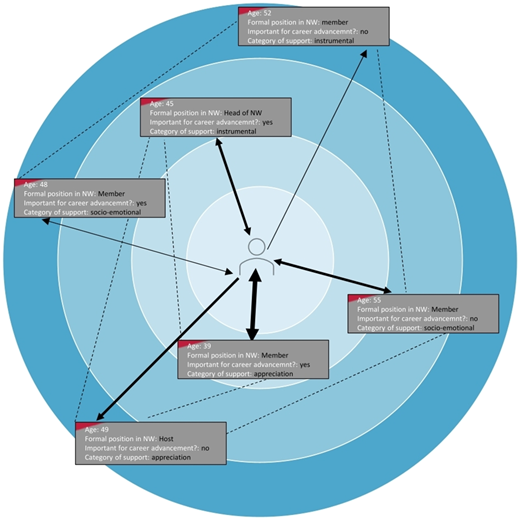
We collected ego network data in three stages, following the procedure outlined by Perry et al. (2018). To gain deeper insights into participants' networks, we employed a visual approach. First, based on Burt's (1984) name generator, participants (egos) were asked to identify fellow FFN members (alters) who provide them with emotional and/or professional support. Second, a name interpreter was used to collect further information on each alter, including their age, formal role within the FFN, perceived importance for the ego's career, and the type of support provided. We then categorised this information according to the four forms of social support identified by House (1981): emotional (belonging, security, self-esteem), informational (advice, experiences), instrumental (practical help, networking), and appraisal (feedback). Participants then visualised their networks using an online mapping tool (see Figure 1), placing alters in concentric circles according to interaction frequency, with the innermost circle indicating frequent contact and the outermost infrequent exchanges. Emotional closeness was represented by lines of varying thickness between the ego and alters. Third, to assess the interconnectedness of the network, participants indicated relationships between alters by drawing dotted lines, regardless of the emotional closeness of those ties.

Social capital

Burt's (1992) concept and Lin's (2001) model were used to measure social capital within the ego-centred networks. Measures of women's access to social capital were ego network structural shape parameters, including (1) network size (degree), which refers to the total number of individuals named by ego, across all types of ties (Perry et al., 2018) (2) ego network density, which refers to the proportion of existing ties between alters relative to the maximum number of possible ties. In our case of undirected ties, the maximum was calculated as the number of all possible pairs of alters. Egos and ties with egos were excluded (Perry et al., 2018).

Note. N represents the total number of alters;

And (3) tie strength between ego and alters, including social support and compositional quality (Burt, 1992).

Social support

To gain a better understanding of the ties, participants were asked to report the type of social support they received from each alter, referring to House's (1981) categories: emotional (This person offers me a sense of belonging and secureness), instrumental (This person gives me practical support in my daily challenges), appraisal (This person feedbacks me on my work”), informational (“This person has information that is relevant for me and hands them on to me.”).

Compositional quality was assessed by asking participants whether each alter supported their career advancement (Wittner and Kauffeld, 2023).

Social network analysis was used to examine the qualitative ego-centred social network maps, assessing both ego–alter relationships and the ties between alters, as described by Herz et al. (2014). We investigated structural aspects, including degree, density, tie strength, and compositional quality. Social support was also assessed to provide a detailed view of ego–alter ties.

Gender identity

To measure gender identity, we employed a self-description scale with ten answer options, including female, male, and non-binary gender identities, as well as a free field (Wittner et al., 2020).

Social support in FFNs

We applied the widely established German language version of the Berlin Social Support Scale (Schulz and Schwarzer, 2003). The scale comprises four statements on emotional support (e.g. “There is always someone there for me when I need comforting”) and instrumental support (e.g. “I know some people upon whom I can always rely”). which are rated on a six-point Likert-type scale ranging from 1 (not at all true) to 6 (exactly true). The internal consistency of the questionnaire is excellent, with Cronbach's alpha = 0.95.

Personality traits

We used a short version of the Big Five Inventory (BI-K) (Rammstedt and John, 2005) to assess personality traits. The scale comprises 21 items rated on a six-point Likert-type scale ranging from 1 (not at all true) to 6 (exactly true). The subscales used for our quantitative data analysis were Extraversion (Cronbach's α = 0.85) and Agreeableness (Cronbach's α = 0.70), which demonstrated acceptable to excellent internal consistency.

Subjective career success

To assess SCS, we used the four-item scale developed by Turban and Dougherty (1994), which measures an individual's perception of their own career success (Spurk et al., 2018). Several studies have employed the scale in German-speaking contexts (e.g. Spurk et al., 2015). Following the multistep iterative process proposed by Brislin (1970), the items were translated and independently back-translated. All three versions were subsequently examined by bilingual researchers to ensure an error-free translation. An expert on gender issues in the creative workforce confirmed the clarity and appropriateness of the items for the target population. The items cover other-referent success evaluation (e.g. my career is on schedule considering my age), self-referent success evaluation (e.g. my career to date has been successful) and comparison judgement, in which participants compared their own career success with a reference group (their network members) (Heslin, 2005). The internal consistency of the questionnaire is good, with Cronbach's alpha = 0.83.

Networking behaviour

We measured participants' general networking behaviour using the 18-item Short Networking Behaviour Scale (Wolff and Spurk, 2020). This instrument provides statements on networking behaviour (e.g. I build up informal contacts with people from other professional environments in order to have personal contacts there), which participants rate on a six-point Likert-type scale ranging from 1 (not at all true) to 6 (exactly true). The scale has good internal consistency and reliability, with Cronbach's alpha = 0.88.

Network goals

Participants selected their goals from a list of 16 relevant topics, choosing multiple if desired.

Prior to statistical analysis, the dataset was checked for missing values and outliers, especially those suggesting extreme value tendencies. Assumptions of linearity, homoscedasticity, and normality of residuals were assessed and confirmed using scatterplots and Q–Q plots. The data were analysed using IBM SPSS Statistics (Version 27) (IBM Corp, 2020). All results with p < 0.05 were deemed statistically significant. Given our small sample size, we did not apply an alpha adjustment for multiple comparisons. While such corrections reduce the risk of Type I errors, they also substantially increase the likelihood of Type II errors, particularly in small samples with limited statistical power (Feise, 2002; Perneger, 1998).

Descriptive results

The average age of the egos was 49.07 years (SD = 10.9), ranging from 31 to 79 years; between them, they were members of 11 different FFNs. The alters had an average age of 49.3 years (SD = 10.33), ranging from 29 to 82 years.

Social network analysis results

On average, participants' ego-centred networks consisted of seven alters. Table 1 presents the detailed descriptive results of the social network analysis. The mean density was 0.28, indicating that 28% of possible connections were actual relationships. Members had an average of 2.42 weak ties and 1.76 strong ties in their networks. The compositional quality of ego-centred networks revealed that each ego reported an average of three members (SD = 3.28) of their FFN as being helpful for their own careers.

On average, FFN members received emotional support from 3.74 alters (SD = 3.03), instrumental support from 3.04 alters (SD = 3.34), appraisal from 4.02 alters (SD = 3.34), and informational support from 4.64 alters (SD = 3.63).

Descriptive results

Participants rated the following topics as those most pursued by their FFN: exchange with colleagues (n = 131), networking (n = 131), rising visibility (n = 129), and mutual encouragement (n = 124).

An intercorrelation matrix for all study variables was calculated to provide an overview of the quantitative data (Table 2).

We conducted two linear regressions to evaluate whether extraversion (H1a). and agreeableness (H1b) predict networking behaviour in females. The analysis for extraversion was statistically significant (F(1,136) = 17.84, p < 0.001, R2 = 0.116), indicating that extraversion explained 11.6% of the variance in networking behaviour. The analysis for agreeableness was also statistically significant (F(1,136) = 9.33, p = 0.003, R2 = 0.064), explaining 6.4% of the variance. These results support H1.

No significant correlations were found between networking behaviour and social network parameters within FFNs, including degree (H2a), density (H2b), and weak ties (H2d) (see Table 3). A positive moderate correlation was observed for strong ties (H2c) (r = 0.331, p = 0.025). A linear regression revealed that networking behaviour significantly predicted strong ties (F(1,44) = 5.41, p = 0.025, with R2 = 0.11), explaining 11% of the variance. Thus, H2 received partial support.

A linear regression analysis assessing the relationship between networking behaviour and social support received within FFNs (H3) was significant (F(1,132) = 8.736, p = 0.004, R2 = 0.06), explaining 6% of the variance, which supports H3.

One-tailed Pearson correlations were conducted to examine whether network characteristics are associated with received support (Table 3). No significant correlations were observed for degree (H4a), density (H4b), or weak ties (H4d). However, strong ties (H4c) were positively and significantly correlated with received support (r = 0.27, p = 0.038). Thus, H4 was not supported. An exploratory repeated measures ANOVA with a Greenhouse–Geisser correction revealed statistically significant differences in support within ego networks across the four different support types (F(2.54,1.24) = 5.5, p = 0.003, partial η2 = 0.101). Bonferroni-adjusted post-hoc analysis revealed significantly higher informational support than instrumental support (MDiff = 1.6, 95%-CI[0.36, 2.8], p = 0.004).

A linear regression analysis tested whether networking behaviour in FFNs predicts.

SCS (H5). The regression was significant (F (1,136) = 8.14, p = 0.005, R2 = 0.06), indicating that networking behaviour explained 6% of the variance, which supports H5.

The social support received from FFNs did not predict SCS (H6) (F (1,130) = 0.241, p = 0.624). Thus, H6 is rejected.

In the gendered cultural and arts sector, where career success heavily depends on social capital (Martin et al., 2023), women often join FFNs to counter exclusion from influential, male-dominated networks. Applying Lin's (2001) individual social capital framework and employing social network analysis with extensive quantitative data, we show that FFN members successfully accumulate social capital but often struggle to mobilise it for their own career advancement. This highlights the critical role of networking behaviour in women's careers within the creative workforce. Our findings extend prior research on FFNs (e.g. Lalanne and Seabright, 2022; Sagebiel, 2019) by demonstrating that while FFN members receive support from their FFNs and build networks high in social capital, these resources do not translate into career success.

Our social network analysis showed that FFN members identified an average of seven generally supportive fellow members. When compared to the findings of prior studies on unbounded support networks, this suggests a relatively high level of access to social resources (Kempnich et al., 2024; Pollet et al., 2011; Wittner and Kauffeld, 2023). Our examination of the different forms of general support revealed that women in these networks mostly receive informational support (House, 1981), aligning with the results of previous research finding that women do not necessarily receive instrumental support (Durbin, 2011; Singh et al., 2006) and contradicting the assumption that FFNs primarily provide emotional support (Brands et al., 2022). Building on previous research on closed networks (Woehler et al., 2021), the compositional quality suggests that while women can access general or emotional support from many fellow network members, they can only access career-related support from slightly less than half of their nominated supporters. Nonetheless, FFN members' ego-centred networks are low-density (Wyngaerden et al., 2022), with only 28% of possible connections established. This low density slows information flow (Barthauer and Kauffeld, 2018), limiting resource dissemination and potentially hindering members' effective use of network resources for individual purposes.

Our findings also demonstrate that the personality traits of agreeableness and extraversion influence women's networking behaviour (H1). These results align with prior research showing that extraversion is a significant predictor of networking behaviour in gender-mixed networking contexts (Ashton et al., 2002; Bendella and Wolff, 2020; Costa and McCrae, 1995; Judge et al., 2002; Wanberg et al., 2000). FFN members' networking behaviour was linked to the number of strong ties. This is likely because women often feel uncomfortable forming connections solely for career purposes (Cullen and Perez-Truglia, 2023; Kumra and Vinnicombe, 2008) and instead focus on deepening existing relationships. Contrary to our expectation, no relationship emerged between networking behaviour and degree, density, or weak ties. This contrasts with prior research on gender-mixed networking contexts, which has shown that networking behaviour expands network size and weak ties (De Weerdt et al., 2024; Wolff and Spurk, 2020b), suggesting that FFNs' formalised settings may reduce the impact of individual networking behaviour compared to less formal networks. Building on prior studies investigating support within female career networks (e.g. Lalanne and Seabright, 2022; Papafilippou et al., 2022; Sagebiel, 2019; Wulff et al., 2022; Villesèche, 2022), our findings show that networking behaviour predicts the support members receive within FFNs (H3). This provides empirical evidence of women's active engagement with others to access social support (Ong et al., 2018; Sagebiel, 2019; Woehler et al., 2021), underscoring the effectiveness of FFNs in fostering mutual support within male-dominated sectors. Networking behaviour was also found to contribute to women's SCS (H5), providing new evidence for its positive effects on this career outcome (Forret and Dougherty, 2004; Wolff and Moser, 2010). In contrast, ego-centred network parameters did not predict social support (H4), despite prior evidence (Lee et al., 2018; Wittner and Kauffeld, 2023; Wyngaerden et al., 2022; Zhu et al., 2014). Furthermore, social support within FFNs did not predict members' SCS (H6), contradicting earlier studies linking social support to improved career outcomes (Jolly et al., 2021; Kundi et al., 2022).

Unlike previous research on gendered networking behaviour (Benschop, 2009; Mengel, 2020; Papafilippou et al., 2022), we investigated how women in male-dominated workforces build, structure, and benefit from their networks, expanding Lin's (2001) model of individual social capital.

Our findings confirm that extraversion is a key predictor of networking behaviour (Bendella and Wolff, 2020). However, the effect was modest and should be interpreted with caution, as it appeared to be weaker in women-only contexts than in previously examined mixed-gender samples, where women risk backlash for being assertive. More notably, we found a moderate effect of agreeableness, challenging prior studies that reported small or null associations (Casciaro et al., 2014; Porter et al., 2016). This indicates that traits aligned with women's expected social roles are particularly relevant for FFN members, highlighting the function of personality as gender capital (Wulff et al., 2022), with its value depending on alignment with the gendered context of networking. In the FFN context, women are less required to adapt to male-oriented norms of networking behaviour, allowing traits such as agreeableness to become a valued resource. Therefore, this study broadens our understanding of how personality traits influence access to social capital while also underscoring the persistent inequalities women face in building it.

FFN members maintain strong ties through networking behaviour, facilitating their access to otherwise hard-to-access resources (Woehler et al., 2021b) as well as to instrumental support, which advances their goal of mutual encouragement. The social network analysis also suggests that women have access to social capital through the built structures of ego-centred networks (Burt, 1992). However, since we found no effect of network parameters on social support, we can conclude that while FFN members can maintain social resources for mutual support and encouragement, they struggle to effectively mobilise these resources into social capital for career success.

FFN members benefit from using contacts, as those who network more strongly tend to experience greater SCS. However, despite the presence of social support within these networks, it does not seem to directly influence career success, aligning with the challenges faced in successfully mobilising the structural resources of FFNs. This shows that women are unable to effectively mobilise all social capital directly derived from their ego-centred networks into instrumental returns (Lin et al., 2001).

Practically, our findings are highly relevant for women working in male-dominated sectors, for FFNs, and for male-dominated industries, such as the creative sector, that are seeking to challenge gender inequality.

Women in gendered work sectors should actively participate in FFNs to obtain various forms of support from other women who face similar challenges. However, the individual effects of these networks' social capital are often underutilised. Women should strategically reflect on the use of their built resources within FFNs to maximise the positive effects of both social and career-related support, enhancing the benefits of social capital for their careers (Thiele et al., 2018).

FFNs provide women with important spaces that offer support and connections; however, the contribution of these networks to career advancement may remain limited if goals are not explicitly linked to concrete career outcomes. By refining their objectives toward more career-oriented strategies, such as career coaching (Spurk et al., 2015), FFNs have significant potential to transform network resources into tangible career success and actively counter gender inequality in their sector.

We recommend that, as well as advocating for gender equality, FFNs should also offer short-term career-related support. To strengthen connections and increase network density, FFNs could provide networking training to assist members in establishing relationships with individuals who hold valuable information but are not yet closely connected.

Women already invest substantial effort into building and maintaining networks and actively supporting one another, and their networking behaviour successfully influences their SCS. However, this alone does not overcome the structural barriers they face, such as in the creative sector (Vecco et al., 2022; Villarroya and Barrios, 2022), where access to influential ties often remains concentrated among men. Because these connections are critical for career advancement, the resources women accumulate from FFNs may not fully translate into career advancement. Therefore, change cannot rest solely on women's shoulders: alongside the formation of FFNs, male-dominated sectors must address exclusionary dynamics, with men recognising their role in limiting women's access and actively sharing their social capital (Bridges et al., 2022; Cullen and Perez-Truglia, 2023).

This study has several limitations. First, it focused on subjective rather than objective career success, which are related but distinct constructs (Spurk et al., 2018). A psychometrically valid questionnaire (Heslin, 2005) provided insights into individuals' perceptions of their own success, which was particularly relevant for freelancers in the sample, for whom subjective measures are more appropriate (Lo Presti et al., 2018). Women are also more likely to assess their careers subjectively (Mayrhofer et al., 2008). For a broader perspective, future research should explore the impact of FFNs on objective career success.

Second, this study's cross-sectional design limits the ability to draw causal inferences. However, triangulated data from social network analysis and quantitative measures offer robust insights into the social capital within FFNs. Future studies should adopt longitudinal designs to better capture women's mobilisation of resources into social capital.

Third, the relatively small sample size—particularly in the ego-centred networks—restricts statistical power. Given this constraint, no alpha adjustment for multiple comparisons was applied, as while such corrections reduce the chance of Type I errors, they disproportionately increase the likelihood of Type II errors in small samples (Feise, 2002; Perneger, 1998). Future studies with larger samples could address this trade-off and enhance generalisability.

Finally, this study's focus on FFN members and their careers enabled an in-depth analysis of individual-level social capital. However, to expand on this, future research should compare FFNs with gender-diverse networks to explore how individuals facing intersectional discrimination access and mobilise social capital. Such studies could deepen our understanding of network dynamics and foster inclusive professional environments.

By applying social capital theory, this study demonstrates that FFN members in the cultural sector build strong support networks and that networking behaviour has a positive influence on their SCS. However, limitations in terms of mobilising these resources for career advancement remain. These findings suggest that women cannot dismantle exclusionary structures alone: FFNs must refine their goals to strengthen career impact, and men in cultural institutions must play an active role in sharing social capital. Targeted initiatives within FFNs, combined with greater inclusivity from men, are essential to closing these gaps.
Acker
,
J.
(
2009
), “
From glass ceiling to inequality regimes
”,
Sociologie du Travail
, Vol. 
51
No. 
2
, pp. 
199
-
217
, doi: .
Ashton
,
M.C.
,
Lee
,
K.
,
Paunonen
,
S.V.
,
Lucas
,
R.E.
,
Diener
,
E.
,
Grob
,
A.
,
Suh
,
E.M.
and
Shao
,
L.
(
2002
), “
What is the central feature of extraversion? Social attention versus reward sensitivity
”,
Journal of Personality and Social Psychology
, Vol. 
83
No. 
1
, pp. 
245
-
252
, doi: .
Atir
,
S.
,
Wald
,
K.A.
and
Epley
,
N.
(
2022
), “
Talking with strangers is surprisingly informative
”,
Proceedings of the National Academy of Sciences of the United States of America
, Vol. 
119
No. 
34
, e2206992119, doi: .
Barthauer
,
L.
and
Kauffeld
,
S.
(
2018
), “
The role of social networks for careers
”,
Gruppe. Interaktion. Organisation. Zeitschrift Fur Angewandte Organisationspsychologie
, Vol. 
49
No. 
1
, pp. 
50
-
57
, doi: .
Barthauer
,
L.
,
Spurk
,
D.
and
Kauffeld
,
S.
(
2016
), “
Women's social capital in academia: a personal network analysis
”,
International Review of Social Research
, Vol. 
6
No. 
4
, pp. 
195
-
205
, doi: .
Barthauer
,
L.
,
Spurk
,
D.
and
Kauffeld
,
S.
(
2018
), “
Psychosocial and career support from different types of role-multiplexity in developmental relationships
”,
Psychology
, Vol. 
9
No. 
8
, pp. 
2135
-
2158
, doi: .
Bendella
,
H.
and
Wolff
,
H.G.
(
2020
), “
Who networks? – a meta-analysis of networking and personality
”,
Career Development International
, Vol. 
25
No. 
5
, pp. 
461
-
479
, doi: .
Benschop
,
Y.
(
2009
), “
The micro-politics of gendering in networking
”,
Gender, Work and Organization
, Vol. 
16
No. 
2
, pp. 
217
-
237
, doi: .
Bierema
,
L.L.
(
2005
), “
Women's networks: a career development intervention or impediment?
”,
Human Resource Development International
, Vol. 
8
No. 
2
, pp. 
207
-
224
, doi: .
Bleijenbergh
,
I.
,
Cacace
,
M.
,
Falcinelli
,
D.
,
del Giorgio
,
E.
and
Declich
,
G.
(
2020
), “
How Dutch and Italian women's networks mobilize affect to foster transformative change towards gender equality
”,
European Journal of Women's Studies
, Vol. 
28
No. 
1
, pp. 
10
-
25
, doi: .
Borgatti
,
S.P.
and
Everett
,
M.G.
(
1997
), “
Network analysis of 2-mode data
”,
Social Networks
, Vol. 
19
No. 
3
, pp. 
243
-
269
, doi: .
Braddy
,
P.
,
Sturm
,
R.E.
,
Atwater
,
L.
,
Taylor
,
S.
and
McKee
,
R.
(
2020
), “
Gender bias still plagues the workplace: looking at derailment risk and performance with self–other ratings
”,
Group and Organization Management
, Vol. 
45
No. 
3
, pp. 
315
-
350
, doi: .
Brands
,
R.
,
Ertug
,
G.
,
Fonti
,
F.
and
Tasselli
,
S.
(
2022
), “
Theorizing gender in social network research: what we do and what we can do differently
”,
The Academy of Management Annals
, Vol. 
16
No. 
2
, pp. 
588
-
620
, doi: .
Brass
,
D.J.
(
1985
), “
Men's and women's networks: a study of interaction patterns and influence in an organization
”,
Academy of Management Journal
, Vol. 
28
No. 
2
, pp. 
327
-
343
, doi: .
Brass
,
D.J.
(
2012
), “A social network perspective on organizational psychology”, in
Kozlowski
,
S.W.J.
(Ed.),
The Oxford Handbook of Organizational Psychology
,
Oxford University Press
, Vol. 
1
, pp. 
667
-
695
, doi: .
Bridges
,
D.
,
Bamberry
,
L.
,
Wulff
,
E.
and
Krivokapic-Skoko
,
B.
(
2022
), “
‘A trade of one's own’: the role of social and cultural capital in the success of women in male-dominated occupations
”,
Gender, Work and Organization
, Vol. 
29
No. 
2
, pp. 
371
-
387
, doi: .
Brislin
,
R.W.
(
1970
), “
Back-translation for cross-cultural research
”,
Journal of Cross-Cultural Psychology
, Vol. 
1
No. 
3
, pp. 
185
-
216
, doi: .
Burt
,
R.S.
(
1984
), “
Network items in the general social survey
”,
Social Networks
, Vol. 
6
No. 
4
, pp. 
293
-
339
, doi: .
Burt
,
R.S.
(
1992
),
Structural Holes: The Social Structure of Competition
,
Harvard University Press
,
Cambridge, MA
.
Burt
,
R.S.
(
1998
), “
The gender of social capital
”,
Rationality and Society
, Vol. 
10
No. 
1
, pp. 
5
-
46
, doi: .
Burt
,
R.S.
(
2004
), “
Structural holes and good ideas
”,
American Journal of Sociology
, Vol. 
110
No. 
2
, pp. 
349
-
399
, doi: .
Calinaud
,
V.
,
Kokkranikal
,
J.
and
Gebbels
,
M.
(
2021
), “
Career advancement for women in the British hospitality industry: the enabling factors
”,
Work, Employment and Society
, Vol. 
35
No. 
4
, pp. 
677
-
695
, doi: .
Casad
,
B.J.
,
Franks
,
J.E.
,
Garasky
,
C.E.
,
Kittleman
,
M.M.
,
Roesler
,
A.C.
,
Hall
,
D.Y.
and
Petzel
,
Z.W.
(
2021
), “
Gender inequality in academia: problems and solutions for women faculty in STEM
”,
Journal of Neuroscience Research
, Vol. 
99
No. 
1
, pp. 
13
-
23
, doi: .
Casciaro
,
T.
,
Gino
,
F.
and
Kouchaki
,
M.
(
2014
), “
The contaminating effects of building instrumental ties: how networking can make us feel dirty
”,
Administrative Science Quarterly
, Vol. 
59
No. 
4
, pp. 
705
-
735
, doi: .
Clark
,
J.
,
Collado Seidel
,
C.
,
George
,
N.
,
Henze
,
V.
,
Reimers
,
K.
and
Prommer
,
E.
(
2018
),
Zur Sichtbarkeit von Frauen in Medien und im Literaturbetrieb: Pilotstudie. #frauenzählen – Genderreport der Buchbranche. [On the visibility of women in media and the literary industry: Pilot study. #womencount – Gender report of the book industry] Institute of Media Research
,
University
,
Rostock
,
available at:
 http://www.frauenzählen.de/media/Pilotstudie_Sichtbarkeit_von_Frauen_in_Medien.pdf
Coleman
,
J.S.
(
1958
), “
Relational analysis: the study of social organizations with survey methods
”,
Human organization
, Vol. 
17
No. 
4
, pp. 
28
-
36
, doi: .
Coleman
,
J.S.
(
1990
), “
Commentary: social institutions and social theory
”,
American Sociological Review
, Vol. 
55
No. 
3
, pp. 
333
-
339
, doi: .
Costa
,
P.T.
 Jr
and
McCrae
,
R.R.
(
1995
), “
Domains and facets: hierarchical personality assessment using the revised NEO personality inventory
”,
Journal of Personality Assessment
, Vol. 
64
No. 
1
, pp. 
21
-
50
, doi: .
Crossley
,
N.
,
Bellotti
,
E.
,
Edwards
,
G.
,
Koskinen
,
J.
,
Tranmer
,
M.
and
Everett
,
M.G.
(
2015
),
Social Network Analysis for Ego-Nets
,
Sage Publications
,
London
.
Crowell
,
L.F.
(
2004
), “
Weak ties: a mechanism for helping women expand their social networks and increase their capital
”,
The Social Science Journal
, Vol. 
41
No. 
1
, pp. 
15
-
28
, doi: .
Cullen
,
Z.
and
Perez-Truglia
,
R.
(
2023
), “
The old boys' club: schmoozing and the gender gap
”,
The American Economic Review
, Vol. 
113
No. 
7
, pp. 
1703
-
1740
, doi: .
Davis
,
J.
,
Wolff
,
H.G.
,
Forret
,
M.L.
and
Sullivan
,
S.E.
(
2020
), “
Networking via LinkedIn: an examination of usage and career benefits
”,
Journal of Vocational Behavior
, Vol. 
118
, 103396, doi: .
De Klerk
,
S.
and
Verreynne
,
M.L.
(
2017
), “
The networking practices of women managers in an emerging economy setting: negotiating institutional and social barriers
”,
Human Resource Management Journal
, Vol. 
27
No. 
3
, pp. 
477
-
501
, doi: .
De Weerdt
,
D.
,
Schepper
,
A.
,
Kyndt
,
E.
and
Gijbels
,
D.
(
2024
), “
Entering the labor market: networks and networking behavior in the school-to-work transition
”,
Vocations and Learning
, Vol. 
17
No. 
2
, pp. 
311
-
332
, doi: .
Duberley
,
J.
and
Cohen
,
L.
(
2010
), “
Gendering career capital: an investigation of scientific careers
”,
Journal of Vocational Behavior
, Vol. 
76
No. 
2
, pp. 
187
-
197
, doi: .
Durbin
,
S.
(
2011
), “
Creating knowledge through networks: a gender perspective
”,
Gender, Work and Organization
, Vol. 
18
No. 
1
, pp. 
90
-
112
, doi: .
Eagly
,
A.H.
and
Chaiken
,
S.
(
1975
), “
An attribution analysis of the effect of communicator characteristics on opinion change: the case of communicator attractiveness
”,
Journal of Personality and Social Psychology
, Vol. 
32
No. 
1
, pp. 
136
-
144
, doi: .
Eagly
,
A.H.
and
Karau
,
S.J.
(
2002
), “
Role congruity theory of prejudice toward female leaders
”,
Psychological Review
, Vol. 
109
No. 
3
, pp. 
573
-
598
, doi: .
Eagly
,
A.H.
,
Nater
,
C.
,
Miller
,
D.I.
,
Kaufmann
,
M.
and
Sczesny
,
S.
(
2020
), “
Gender stereotypes have changed: a cross-temporal meta-analysis of U.S. public opinion polls from 1946 to 2018
”,
American Psychologist
, Vol. 
75
No. 
3
, pp. 
301
-
315
, doi: .
Feise
,
R.J.
(
2002
), “
Do multiple outcome measures require p-value adjustment?
”,
BMC Medical Research Methodology
, Vol. 
2
No. 
1
, p.
8
, doi: .
Forret
,
M.L.
and
Dougherty
,
T.W.
(
2001
), “
Correlates of networking behavior for managerial and professional employees
”,
Group and Organization Management
, Vol. 
26
No. 
3
, pp. 
283
-
311
, doi: .
Forret
,
M.L.
and
Dougherty
,
T.W.
(
2004
), “
Networking behaviors and career outcomes: differences for men and women?
”,
Journal of Organizational Behavior
, Vol. 
25
No. 
3
, pp. 
419
-
437
, doi: .
German Federal Statistical Office (Destatis)
(
2025
), “
Gender Gap Arbeitsmarkt sinkt 2024 auf 37 % [Labor market gender gap falls to 37% in 2024]
”,
[Press release No. 081], available at:
 https://www.destatis.de/DE/Presse/Pressemitteilungen/2025/03/PD25_081_621.html
Gibson
,
C.
,
Hardy
,
J.H.
 III
and
Ronald Buckley
,
M.
(
2014
), “
Understanding the role of networking in organizations
”,
Career Development International
, Vol. 
19
No. 
2
, pp. 
146
-
161
, doi: .
Granovetter
,
M.S.
(
1973
), “
The strength of weak ties
”,
American Journal of Sociology
, Vol. 
78
No. 
6
, pp. 
1360
-
1380
, doi: .
Greer
,
T.W.
and
Kirk
,
A.F.
(
2022
), “
Overcoming barriers to women's career transitions: a systematic review of social support types and providers
”,
Frontiers in Psychology
, Vol. 
13
, 777110, doi: .
Grimme
,
F.
and
Kauffeld
,
S.
(
2025
), “
Netzwerke, die wirken: Schlüssel zum Erfolg von Frauennetzwerken. [Networks that work: the key to the success of women's networks]
”,
PERSONALquarterly
, Vol. 
77
No. 
2
, pp. 
25
-
31
.
Grimme
,
F.
,
Wittner
,
B.
and
Kauffeld
,
S.
(
2023
), “Networking behavior and career success: how do women use their social capital in formal networks?”,
paper presented at the 7th European Social Networks Conference (EUSN)
,
Ljubljana, Slovenia
.
Harrison
,
R.T.
,
Leitch
,
C.M.
and
McAdam
,
M.
(
2024
), “
Margins of intervention? Gender, Bourdieu and women's regional entrepreneurial networks
”,
Entrepreneurship and Regional Development
, Vol. 
36
Nos
3-4
, pp. 
209
-
242
, doi: .
Heilman
,
M.E.
(
2012
), “
Gender stereotypes and workplace bias
”,
Research in Organizational Behavior
, Vol. 
32
, pp. 
113
-
135
, doi: .
Heilman
,
M.E.
,
Caleo
,
S.
and
Manzi
,
F.
(
2024
), “
Women at work: pathways from gender stereotypes to gender bias and discrimination
”,
Annual Review of Organizational Psychology and Organizational Behavior
, Vol. 
11
No. 
1
, pp. 
165
-
192
, doi: .
Herz
,
A.
,
Peters
,
L.
and
Truschkat
,
I.
(
2014
), “
How to do qualitative structural analysis: the qualitative interpretation of network maps and narrative interviews
”,
Forum for Qualitative Social Research
, Vol. 
16
No. 
1
, doi: .
Heslin
,
P.A.
(
2005
), “
Conceptualizing and evaluating career success
”,
Journal of Organizational Behavior
, Vol. 
26
No. 
2
, pp. 
113
-
136
, doi: .
Holst
,
E.
and
Marquardt
,
A.
(
2018
), “
Differences in full-time work experience explain almost a quarter of the gender pay gap in management positions
”,
DIW Weekly Report
, Vol. 
8
Nos
34/35
, pp. 
315
-
324
.
House
,
J.
(
1981
),
Work Stress and Social Support
,
Addison-Wesley Reading
,
MA
.
IBM Corp
(
2020
),
IBM SPSS Statistics for Windows, Version 27.0
,
IBM Corp
,
Armonk, NY
.
Jolly
,
P.M.
,
Tony Kong
,
D.
,
Yong Kim
,
K.
,
Phillip Jolly
,
C.
and
King Early Career Professor
,
E.M.
(
2021
), “
Social support at work: an integrative review
”,
Journal of Organizational Behavior
, Vol. 
42
No. 
2
, pp. 
229
-
251
, doi: .
Judge
,
T.A.
,
Heller
,
D.
and
Mount
,
M.K.
(
2002
), “
Five-factor model of personality and job satisfaction: a meta-analysis
”,
Journal of Applied Psychology
, Vol. 
87
No. 
3
, pp. 
530
-
541
, doi: .
Jungbauer-Gans
,
M.
and
Gross
,
C.
(
2013
), “
Determinants of success in university careers: findings from the German academic labor market
”,
Zeitschrift für Soziologie
, Vol. 
42
No. 
1
, pp. 
74
-
92
, doi: .
Kaeppel
,
K.
,
Grenier
,
R.S.
and
Björngard-Basayne
,
E.
(
2020
), “
The F word: the role of women's friendships in navigating the gendered workplace of academia
”,
Human Resource Development Review
, Vol. 
19
No. 
4
, pp. 
362
-
383
, doi: .
Kempnich
,
M.
,
Wölfer
,
R.
,
Hewstone
,
M.
and
Dunbar
,
R.I.M.
(
2024
), “
How the size and structure of egocentric networks change during a life transition
”,
Advances in Life Course Research
, Vol. 
61
, 100632, doi: .
Kumra
,
S.
and
Vinnicombe
,
S.
(
2008
), “
A study of the promotion to partner process in a professional services firm: how women are disadvantaged
”,
British Journal of Management
, Vol. 
19
No. 
s1
, pp. 
65
-
74
, doi: .
Kundi
,
Y.M.
,
Khoso
,
U.
and
Adnan
,
N.
(
2022
), “
Instrumental support, relational attachment, and subjective career success: the moderating role of personal support
”,
Journal of Career Assessment
, Vol. 
30
No. 
4
, pp. 
739
-
755
, doi: .
La Guardia
,
J.G.
and
Patrick
,
H.
(
2008
), “
Self-determination theory as a fundamental theory of close relationships
”,
Canadian Psychology
, Vol. 
49
No. 
3
, pp. 
201
-
209
, doi: .
Lalanne
,
M.
and
Seabright
,
P.
(
2022
), “
The old boy network: are the professional networks of female executives less effective than men's for advancing their careers?
”,
Journal of Institutional Economics
, Vol. 
18
No. 
5
, pp. 
725
-
744
, doi: .
Lee
,
S.
,
Chung
,
J.E.
and
Park
,
N.
(
2018
), “
Network environments and well-being: an examination of personal network structure, social capital, and perceived social support
”,
Health Communication
, Vol. 
33
No. 
1
, pp. 
22
-
31
, doi: .
LimeSurvey GmbH
(
n.d.
), “
LimeSurvey: An open source survey tool
”,
LimeSurvey GmbH
,
available at
: https://www.limesurvey.org
Lin
,
N.
(
2001
),
Social Capital: A Theory of Social Structure and Action
,
Cambridge University Press
,
Cambridge
, doi: .
Lin
,
N.
,
Cook
,
K.S.
and
Burt
,
R.S.
(
2001
),
Social Capital: Theory and Research
,
Transaction Publishers
,
Piscataway
.
Lindner
,
J.
,
Makarova
,
E.
,
Bernhard
,
D.
and
Brovelli
,
D.
(
2022
), “
Toward gender equality in education—teachers’ beliefs about gender and math
”,
Education Sciences
, Vol. 
12
No. 
6
, p.
373
, doi: .
Lo Presti
,
A.
,
Pluviano
,
S.
and
Briscoe
,
J.P.
(
2018
), “
Are freelancers a breed apart? The role of protean and boundaryless career attitudes in employability and career success
”,
Human Resource Management Journal
, Vol. 
28
No. 
3
, pp. 
427
-
442
, doi: .
Loist
,
S.
and
Prommer
,
E.
(
2019
), “
Gendered production culture in the German film industry
”,
Media Industries
, Vol. 
6
No. 
1
, pp. 
95
-
115
, doi: .
Luwei
,
W.
and
Huimin
,
M.
(
2024
), “
From jobs to careers: drivers and barriers to career development in emerging labor markets
”,
Frontiers in Sociology
, Vol. 
9
, 1486871, doi: .
MaLisa Foundation
(
2022
),
Gender in Music- Charts, Werke und Festivalbühnen [Gender in music – Charts, works and festival stages]
,
MaLisa Foundation
,
available at:
 https://www.malisastiftung.org/studien/gender-in-music-charts-werke-und-festivalbhnen
Marsden
,
P.V.
(
1990
), “
Network data and measurement
”,
Annual Review of Sociology
, Vol. 
16
No. 
1
, pp. 
435
-
463
, doi: .
Marsden
,
P.V.
and
Campbell
,
K.E.
(
2012
), “
Reflections on conceptualizing and measuring tie strength
”,
Social Forces
, Vol. 
91
No. 
1
, pp. 
17
-
23
, doi: .
Martin
,
N.D.
,
Frenette
,
A.
and
Gualtieri
,
G.
(
2023
), “
Campus connections for creative careers: social capital, gender inequality, and artistic work
”,
Poetics
, Vol. 
96
, 101763, doi: .
Martinez
,
M.A.
,
Alsandor
,
D.J.
,
Cortez
,
L.J.
,
Welton
,
A.D.
and
Chang
,
A.
(
2015
), “
We are stronger together: reflective testimonios of female scholars of color in a research and writing collective
”,
Reflective Practice
, Vol. 
16
No. 
1
, pp. 
85
-
95
, doi: .
Mathieu
,
M.
,
Eschleman
,
K.J.
and
Cheng
,
D.
(
2019
), “
Meta-analytic and multiwave comparison of emotional support and instrumental support in the workplace
”,
Journal of Occupational Health Psychology
, Vol. 
24
No. 
3
, pp. 
387
-
409
, doi: .
Mayrhofer
,
W.
,
Meyer
,
M.
,
Schiffinger
,
M.
and
Schmidt
,
A.
(
2008
), “
The influence of family responsibilities, career fields and gender on career success: an empirical study
”,
Journal of Managerial Psychology
, Vol. 
23
No. 
3
, pp. 
292
-
323
, doi: .
Mengel
,
F.
(
2020
), “
Gender differences in networking
”,
The Economic Journal
, Vol. 
130
No. 
630
, pp. 
1842
-
1873
, doi: .
Miller
,
D.L.
(
2016
), “
Gender and the artist archetype: understanding gender inequality in artistic careers
”,
Sociology Compass
, Vol. 
10
No. 
2
, pp. 
119
-
131
, doi: .
Molloy
,
J.C.
(
2005
), “
Development networks: literature review and future research
”,
Career Development International
, Vol. 
10
Nos
6/7
, pp. 
536
-
547
, doi: .
Monserrat
,
S.I.
and
Simmers
,
C.A.
(
2020
), “
Human and social capital as influencers on women's careers: Rosemary Pledger's path to career success and mobility
”,
Journal of Management History
, Vol. 
26
No. 
4
, pp. 
471
-
489
, doi: .
Mooney
,
S.
and
Ryan
,
I.
(
2009
), “
A woman's place in hotel management: upstairs or downstairs?
”,
Gender in Management
, Vol. 
24
No. 
3
, pp. 
195
-
210
, doi: .
Ngo
,
H.Y.
and
Hui
,
L.
(
2018
), “
Individual orientations and career satisfaction: the mediating roles of work engagement and self-efficacy
”,
Journal of Career Development
, Vol. 
45
No. 
5
, pp. 
425
-
439
, doi: .
Ong
,
M.
,
Smith
,
J.M.
and
Ko
,
L.T.
(
2018
), “
Counterspaces for women of color in STEM higher education: marginal and central spaces for persistence and success
”,
Journal of Research in Science Teaching
, Vol. 
55
No. 
2
, pp. 
206
-
245
, doi: .
O'Neil
,
D.A.
,
Hopkins
,
M.M.
and
Sullivan
,
S.E.
(
2011
), “
Do women's networks help advance women's careers?: differences in perceptions of female workers and top leadership
”,
Career Development International
, Vol. 
16
No. 
7
, pp. 
733
-
754
, doi: .
Papafilippou
,
V.
,
Durbin
,
S.
and
Conley
,
H.
(
2022
), “
Women's formal networking: the relationship between networking activities and power
”,
Gender, Work and Organization
, Vol. 
29
No. 
5
, pp. 
1712
-
1741
, doi: .
Perneger
,
T.V.
(
1998
), “
What's wrong with Bonferroni adjustments
”,
BMJ
, Vol. 
316
No. 
7139
, pp. 
1236
-
1238
, doi: .
Perry
,
B.L.
,
Pescosolido
,
B.A.
and
Borgatti
,
S.P.
(
2018
), “Ego network composition and structure (with Ann McCranie)”, in
Egocentric Network Analysis: Foundations, Methods, and Models
,
Cambridge University Press
,
Cambridge
, pp. 
159
-
194
, doi: .
Petrucci
,
L.
(
2020
), “
Theorizing postfeminist communities: how gender-inclusive meetups address gender inequity in high-tech industries
”,
Gender, Work and Organization
, Vol. 
27
No. 
4
, pp. 
545
-
564
, doi: .
Pollet
,
T.V.
,
Roberts
,
S.G.
and
Dunbar
,
R.I.
(
2011
), “
Use of social network sites and instant messaging does not lead to increased offline social network size, or to emotionally closer relationships with offline network members
”,
Cyberpsychology, Behavior, and Social Networking
, Vol. 
14
No. 
4
, pp. 
253
-
258
, doi: .
Porter
,
C.M.
,
Woo
,
S.E.
and
Campion
,
M.A.
(
2016
), “
Internal and external networking differentially predict turnover through job embeddedness and job offers
”,
Personnel Psychology
, Vol. 
69
No. 
3
, pp. 
635
-
672
, doi: .
Putnam
,
R.
(
2001
), “
Social capital: measurement and consequences
”,
Canadian Journal of Policy Research
, Vol. 
2
No. 
1
, pp. 
41
-
51
.
Radmacher
,
K.
and
Azmitia
,
M.
(
2006
), “
Are there gendered pathways to intimacy in early adolescents' and emerging adults' friendships?
”,
Journal of Adolescent Research
, Vol. 
21
No. 
4
, pp. 
415
-
448
, doi: .
Rammstedt
,
B.
and
John
,
O.P.
(
2005
), “
Kurzversion des Big Five Inventory (BFI-K) [Short version of the Big Five Inventory (BFI-K): Development and validation of an economic inventory for assessing the five factors of personality]
”,
Diagnostica
, Vol. 
51
No. 
4
, pp. 
195
-
206
, doi: .
Rungo
,
P.
,
Sánchez-Santos
,
J.M.
and
Pena-López
,
A.
(
2024
), “
Individual social capital and expectations of career advancement
”,
Economic and Labour Relations Review
, Vol. 
35
No. 
1
, pp. 
118
-
139
, doi: .
Sagebiel
,
F.
(
2019
), “Netzwerke: soziales Kapital und Macht(unterschiede) von Frauen und Männern [Networks: Social capital and power (differences) of women and men]”, in
Kortendiek
,
B.
,
Riegraf
,
B.
and
Sabisch
,
K.
(Eds),
Handbuch Interdisziplinäre Geschlechterforschung. [Handbook of interdisciplinary gender research]. Geschlecht und Gesellschaft
,
Springer VS.
, Vol. 
65
, pp. 
951
-
961
, doi: .
Sandstrom
,
G.M.
and
Dunn
,
E.W.
(
2014
), “
Social interactions and well-being: the surprising power of weak ties
”,
Personality and Social Psychology Bulletin
, Vol. 
40
No. 
7
, pp. 
910
-
922
, doi: .
Sauer
,
N.
,
Kauffeld
,
S.
and
Spurk
,
D.
(
2014
), “
Männer, Frauen und ihre Art zu netzwerken – Einfluss auf die Karriere von Berufsanfängern [Men, women and their way of networking – Influence on the careers of young professionals]
”,
PERSONALquaterly
, Vol. 
66
No. 
2
, pp. 
18
-
23
.
Scharff
,
C.
(
2017
),
Gender, Subjectivity, and Cultural Work: The Classical Music Profession
, (1st ed.) ,
Routledge
, doi: .
Schmiedl
,
A.
and
Kauffeld
,
S.
(
2023
), “
The positive effects of resource-oriented training on students' perception and use of social support
”,
Frontiers in Education
, Vol. 
8
, 1187319, doi: .
Schulz
,
U.
and
Schwarzer
,
R.
(
2003
), “
Soziale Unterstützung bei der Krankheitsbewältigung: Die Berliner Social Support Skalen (BSSS) [Social support in coping with illness: The Berlin Social Support Scales (BSSS)]
”,
Diagnostica
, Vol. 
49
No. 
2
, pp. 
73
-
82
, doi: .
Seefeld
,
J.
(
2022
),
Netzwerke als aufstiegsrelevanter Faktor für Frauen in Führungspositionen – gibt es branchenspezifische Unterschiede? [Networks as a promotion-relevant factor for women in leadership positions – Are there industry-specific differences?
,
Springer VS
,
Wiesbaden
.
Seibert
,
S.E.
,
Kraimer
,
M.L.
and
Liden
,
R.C.
(
2001
), “
A social capital theory of career success
”,
Academy of Management Journal
, Vol. 
44
No. 
2
, pp. 
219
-
237
, doi: .
Seibert
,
S.
,
Akkermans
,
J.
and
Liu
,
C.-H.
(
2024
), “
Understanding contemporary career success: a critical review
”,
Annual Review of Organizational Psychology and Organizational Behavior
, Vol. 
11
No. 
1
, pp. 
509
-
534
, doi: .
Singh
,
V.
,
Vinnicombe
,
S.
and
Kumra
,
S.
(
2006
), “
Women in formal corporate networks: an organizational citizenship perspective
”,
Women in Management Review
, Vol. 
21
No. 
6
, pp. 
458
-
482
, doi: .
Small
,
M.L.
,
Brant
,
K.
and
Fekete
,
M.
(
2024
), “
The avoidance of strong ties
”,
American Sociological Review
, Vol. 
89
No. 
4
, pp. 
615
-
649
, doi: .
Son
,
J.
and
Lin
,
N.
(
2012
), “
Network diversity, contact diversity, and status attainment
”,
Social Networks
, Vol. 
34
No. 
4
, pp. 
601
-
613
, doi: .
Spurk
,
D.
,
Kauffeld
,
S.
,
Barthauer
,
L.
and
Heinemann
,
N.S.R.
(
2015
), “
Fostering networking behavior, career planning and optimism, and subjective career success: an intervention study
”,
Journal of Vocational Behavior
, Vol. 
87
, pp. 
134
-
144
, doi: .
Spurk
,
D.
,
Hirschi
,
A.
and
Dries
,
N.
(
2018
), “
Antecedents and outcomes of objective versus subjective career success: competing perspectives and future directions
”, Vol. 
45
No. 
1
, pp. 
35
-
69
, doi: .
Szkody
,
E.
,
Stearns
,
M.
,
Stanhope
,
L.
and
McKinney
,
C.
(
2021
), “
Stress-buffering role of social support during COVID-19
”,
Family Process
, Vol. 
60
No. 
3
, pp. 
1002
-
1015
, doi: .
Thiele
,
L.
,
Christian Sauer
,
N.
and
Kauffeld
,
S.
(
2018
), “
Why extraversion is not enough: the mediating role of initial peer network centrality linking personality to long-term academic performance
”,
Higher Education
, Vol. 
76
No. 
5
, pp. 
789
-
805
, doi: .
Topic
,
M.
,
Carbery
,
C.
,
Arrigoni
,
A.
,
Clayton
,
T.
,
Kyriakidou
,
N.
,
Gatewood
,
C.
,
Shafique
,
S.
and
Halliday
,
S.
(
2021
),
Women and Networking: A Systematic Literature Review (1985-2021)
,
Leeds Beckett University
,
[Project report]
.
Turban
,
D.B.
and
Dougherty
,
T.W.
(
1994
), “
Role of protégé personality in receipt of mentoring and career success
”,
Academy of Management Journal
, Vol. 
37
No. 
3
, pp. 
688
-
702
, doi: .
Turetsky
,
K.M.
,
Curley
,
J.P.
,
Carter
,
A.B.
and
Purdie-Greenaway
,
V.P.
(
2022
), “
Explaining the gender gap in negotiation performance: social network ties outweigh internal barriers
”,
Journal of Social Issues
, Vol. 
35
No. 
1
, pp. 
118
-
139
, doi: .
Vacca
,
R.
(
2020
), “
Structure in personal networks: constructing and comparing typologies
”,
Network Science
, Vol. 
8
No. 
2
, pp. 
142
-
167
, doi: .
Van Der Gaag
,
M.
and
Snijders
,
T.A.B.
(
2005
), “
The Resource Generator: social capital quantification with concrete items
”,
Social Networks
, Vol. 
27
No. 
1
, pp. 
1
-
29
, doi: .
Vecco
,
M.
,
Vroonhof
,
P.
,
Clarke
,
M.
,
van der Graaf
,
A.
,
de Haan
,
L.
,
Komorowski
,
M.
,
Asardag
,
D.
and
Milosavljević
,
M.
(
2022
), “
Gender gaps in the cultural and creative sectors
”,
European Commission, Directorate-General for Education, Youth, Sport and Culture
, doi: .
Ver.di
(
2025
), “
Gender pay gap 2024 in ausgewählten künstlerischen Berufen in Deutschland [gender pay gap 2024 in selected artistic professions in Germany]
”,
Ver.di [United Services Trade Union], available at:
 https://kunst-kultur.verdi.de/++file++67c573fd9342ddabc242f6c5/download/250211_verdi_Gender-Pay-Gap-2024-in-der-Kunst-und-Kultur.pdf
Vianello
,
M.
,
Schnabel
,
K.
,
Sriram
,
N.
and
Nosek
,
B.
(
2013
), “
Gender differences in implicit and explicit personality traits
”,
Personality and Individual Differences
, Vol. 
55
No. 
8
, pp. 
994
-
999
, doi: .
Villarroya
,
A.
and
Barrios
,
M.
(
2022
), “
Perception of the barriers to women's professional development in the cultural sector: a gender perspective study
”,
European Journal of Women's Studies
, Vol. 
29
No. 
3
, pp. 
418
-
437
, doi: .
Villesèche
,
F.
and
Josserand
,
E.
(
2017
), “
Formal women-only networks: literature review and propositions
”,
Personnel Review
, Vol. 
46
No. 
5
, pp. 
1004
-
1018
, doi: .
Villèseche
,
F.
,
Meliou
,
E.
and
Jha
,
H.K.
(
2022
), “
Feminism in women's business networks: a freedom-centred perspective
”,
Human Relations
, Vol. 
75
No. 
10
, pp. 
1903
-
1927
, doi: .
Wanberg
,
C.R.
,
Kanfer
,
R.
and
Banas
,
J.T.
(
2000
), “
Predictors and outcomes of networking intensity among unemployed job seekers
”,
Journal of Applied Psychology
, Vol. 
85
No. 
4
, pp. 
491
-
503
, doi: .
Wasserman
,
S.
and
Faust
,
K.
(
1994
),
Social Network Analysis: Methods and Applications
,
Cambridge University Press
,
Cambridge
.
Wellman
,
B.
(
2007
), “
The network is personal: introduction to a special issue of Social Networks
”,
Social Networks
, Vol. 
29
No. 
3
, pp. 
349
-
356
, doi: .
Wingender
,
L.M.
and
Wolff
,
H.-G.
(
2023
), “
The dark and bright side of networking behavior: three studies on short-term processes of networking behavior
”,
Journal of Vocational Behavior
, Vol. 
140
, pp. 
1
-
17
, doi: .
Wittner
,
B.
and
Kauffeld
,
S.
(
2023
), “
Social capital and career planning amongst first generation and non-first generation high school and college students in Germany: a social network analysis approach
”,
International Journal for Educational and Vocational Guidance
, Vol. 
23
No. 
2
, pp. 
295
-
317
, doi: .
Wittner
,
B.
,
Huemer
,
A.K.
,
Grimme
,
F.
,
Wende
,
A.
,
Klauke
,
F.
and
Kauffeld
,
S.
(
2020
), “Entwicklung eines Instruments zur Operationalisierung von Gender in der deutschsprachigen Forschung [Development of an instrument to operationalize gender in German-speaking research]”, in
Paper presented at the conference Queere und feministische Perspektiven für die Psychologie [Queer and feminist perspectives for psychology]
,
Bochum
.
Woehler
,
M.L.
,
Cullen-Lester
,
K.L.
,
Porter
,
C.M.
and
Frear
,
K.A.
(
2021
), “
Whether, how, and why networks influence men's and women's career success: review and research agenda
”,
Journal of Management
, Vol. 
47
No. 
1
, pp. 
207
-
236
, doi: .
Wolff
,
H.-G.
and
Moser
,
K.
(
2006
), “
Entwicklung und Validierung einer Networkingskala
”,
Diagnostica
, Vol. 
52
No. 
4
, pp. 
161
-
180
, doi: .
Wolff
,
H.G.
and
Moser
,
K.
(
2009
), “
Effects of networking on career success: a longitudinal study
”,
Journal of Applied Psychology
, Vol. 
94
No. 
1
, pp. 
196
-
206
, doi: .
Wolff
,
H.G.
and
Moser
,
K.
(
2010
), “
Do specific types of networking predict specific mobility outcomes? A two-year prospective study
”,
Journal of Vocational Behavior
, Vol. 
77
No. 
2
, pp. 
238
-
245
, doi: .
Wolff
,
H.G.
and
Spurk
,
D.
(
2020
), “
Developing and validating a short networking behavior scale (SNBS) from Wolff and Moser's (2006) measure
”,
Journal of Career Assessment
, Vol. 
28
No. 
2
, pp. 
277
-
302
, doi: .
World Economic Forum
(
2025
),
Global Gender Gap Report 2025
,
World Economic Forum
,
available at:
 https://reports.weforum.org/docs/WEF_GGGR_2025.pdf
Wulff
,
E.
,
Bridges
,
D.
,
Bamberry
,
L.
and
Krivokapic-Skoko
,
B.
(
2022
), “
Women who ‘talk the tools’ and ‘walk the work’: using capital to do gender differently and re-gender the skilled trades
”,
Journal of Sociology
, Vol. 
58
No. 
1
, pp. 
26
-
44
, doi: .
Wyngaerden
,
F.
,
Vacca
,
R.
,
Dubois
,
V.
and
Lorant
,
V.
(
2022
), “
The structure of social support: a multilevel analysis of the personal networks of people with severe mental disorders
”,
BMC Psychiatry
, Vol. 
22
No. 
1
, pp. 
1
-
12
, doi: .
Zhu
,
X.
,
Zhang
,
X.
,
Sun
,
G.
,
Tang
,
M.
,
Zhou
,
T.
and
Zhang
,
Z.
(
2014
), “
Influence of reciprocal links in social networks
”,
PLoS One
, Vol. 
9
No. 
7
, e103007, doi: .
Zimmermann
,
O.
,
Schulz
,
G.
,
Brühlemeier
,
T.
,
Weber
,
L.
,
Kunkat
,
C.
and
Martin
,
A.L.
(
Eds
) (
2023
),
Vernetzt: Frauennetzwerke [Connected: Women's Network]
,
Deutscher Kulturrat
,
available at:
 https://www.kulturrat.de/publikationen/vernetzt-frauennetzwerke/
Published by Emerald Publishing Limited. This article is published under the Creative Commons Attribution (CC BY 4.0) licence. Anyone may reproduce, distribute, translate and create derivative works of this article (for both commercial and non-commercial purposes), subject to full attribution to the original publication and authors. The full terms of this licence may be seen at Link to the terms of the CC BY 4.0 licence.

Data & Figures

Figure 1
A circular network diagram shows six individuals with arrows indicating different types of career support.The image shows a concentric circle diagram containing four circles and six rectangular boxes placed around a central human figure, each connected to it with directional arrows. The first box, placed at the top of the outermost circle, contains text “Age: 52”, includes “Formal position in N W: member”, “Important for career advancement?: no”, and “Category of support: instrumental”. The second box, positioned at the top of the second outer circle, contains text “Age: 45”, includes “Formal position in N W: Head of N W”, “Important for career advancement?: yes”, and “Category of support: instrumental”. The third box, placed at the left of the outermost circle, contains text “Age: 48”, includes “Formal position in N W: member”, “Important for career advancement?: yes”, and “Category of support: socio-emotional”. The fourth box, placed at the right of the second outer circle, contains the text “Age: 55”, includes “Formal position in N W: member”, “Important for career advancement?: no”, and “Category of support: socio-emotional”. The fifth box, located at the bottom of the second inner circle, contains the text “Age: 39”, includes “Formal position in N W: member”, “Important for career advancement?: yes”, and “Category of support: appreciation”. The sixth box, positioned at the bottom-left of the outermost circle, contains text “Age: 49”, written in German, includes “Formelle Funktion im N W: Moderatorin”, “Wichtig für berufl. Vorankommen?: nein”, and “Form der Unterstützung: F W, I”. Box 1 is connected to Box 3 with a dashed line. Box 2 is connected to Box 6 with a dashed line. Box 2 is connected to Box 5 with a dashed line. Box 1 and Box 4 are also connected with a dashed line. Box 5 and Box 6 are connected with a dashed line. Box 4 and Box 6 are also connected with a dashed line. From the central human figure, an upward arrow emerges and points to Box 1. A double-headed thick arrow connects Box 2 to the central figure. Another double-headed arrow connects Box 3 to the central figure. A diagonal leftward arrow emerges from the central figure and points to Box 6. A double-headed thick arrow connects the central figure to Box 5. A thick double-headed arrow connects the central figure to Box 4.

Social network map. Note. Ego-centred social network map completed by one participant. Source: Authors’ own work

Figure 1
A circular network diagram shows six individuals with arrows indicating different types of career support.The image shows a concentric circle diagram containing four circles and six rectangular boxes placed around a central human figure, each connected to it with directional arrows. The first box, placed at the top of the outermost circle, contains text “Age: 52”, includes “Formal position in N W: member”, “Important for career advancement?: no”, and “Category of support: instrumental”. The second box, positioned at the top of the second outer circle, contains text “Age: 45”, includes “Formal position in N W: Head of N W”, “Important for career advancement?: yes”, and “Category of support: instrumental”. The third box, placed at the left of the outermost circle, contains text “Age: 48”, includes “Formal position in N W: member”, “Important for career advancement?: yes”, and “Category of support: socio-emotional”. The fourth box, placed at the right of the second outer circle, contains the text “Age: 55”, includes “Formal position in N W: member”, “Important for career advancement?: no”, and “Category of support: socio-emotional”. The fifth box, located at the bottom of the second inner circle, contains the text “Age: 39”, includes “Formal position in N W: member”, “Important for career advancement?: yes”, and “Category of support: appreciation”. The sixth box, positioned at the bottom-left of the outermost circle, contains text “Age: 49”, written in German, includes “Formelle Funktion im N W: Moderatorin”, “Wichtig für berufl. Vorankommen?: nein”, and “Form der Unterstützung: F W, I”. Box 1 is connected to Box 3 with a dashed line. Box 2 is connected to Box 6 with a dashed line. Box 2 is connected to Box 5 with a dashed line. Box 1 and Box 4 are also connected with a dashed line. Box 5 and Box 6 are connected with a dashed line. Box 4 and Box 6 are also connected with a dashed line. From the central human figure, an upward arrow emerges and points to Box 1. A double-headed thick arrow connects Box 2 to the central figure. Another double-headed arrow connects Box 3 to the central figure. A diagonal leftward arrow emerges from the central figure and points to Box 6. A double-headed thick arrow connects the central figure to Box 5. A thick double-headed arrow connects the central figure to Box 4.

Social network map. Note. Ego-centred social network map completed by one participant. Source: Authors’ own work

Close Figure 1
Table 1

Results of ego-centred social network analysis

CharacteristicsMinMaxMSD
Degree1187.463.84
Density010.280.24
Weak ties062.421.96
Strong ties0101.761.66
Compositional quality0173.073.28
Emotional support0133.743.03
Instrumental support0173.043.34
Appraisal0134.023.34
Informational support0144.643.62

Note(s): N = 50. Results of the social network analysis of ego-centred qualitative social network maps; Density ranges from 0 to 1; support types according to House (1981), compositional quality = alters helpful for the egos' career

Source(s): Authors’ own work
Table 2

Descriptive statistics and correlations for study variables

VariablenMSD123456789
1. NWB1404.260.68(0.88)        
2. SCS1383.990.980.28**(0.83)       
3. Extraversion1384.470.990.34**0.15(0.85)      
4. Agreeableness1383.900.990.25**0.20*0.30**(0.7)     
5. NW degreea507.463.840.130.090.090.140    
6. NW densitya500.280.250.13−0.24−0.13−0.04−0.14   
7. NW weak ties502.421.96−0.123−0.15−0.19−0.450.49**0.13  
8. NW strong tiesa501.761.660.33*0.110.11−0.420.57**0.11−0.05  
9. Social support1344.31.150.25**0.050.26**0.660.24−0.11−0.190.27(0.95)

Note(s):

a

Values from SNA

*p < 0.05. **p < 0.01, two-tailed

Source(s): Authors’ own work
Table 3

Descriptive statistics and correlations for network characteristics and networking behaviour

Network characteristicsMSDNetworking behaviourSupport received in network
NW degreea7.573.8620.130.24
NW densitya0.280.2250.13−0.11
NW weak tiesa2.461.986−0.12−0.19
NW strong ties1.801.6550.33*0.27

Note(s): n = 45

a

Values from social network analysis

*p < 0.05, **p < 0.001, one-tailed

Source(s): Authors’ own work

Supplements

References

Acker
,
J.
(
2009
), “
From glass ceiling to inequality regimes
”,
Sociologie du Travail
, Vol. 
51
No. 
2
, pp. 
199
-
217
, doi: .
Ashton
,
M.C.
,
Lee
,
K.
,
Paunonen
,
S.V.
,
Lucas
,
R.E.
,
Diener
,
E.
,
Grob
,
A.
,
Suh
,
E.M.
and
Shao
,
L.
(
2002
), “
What is the central feature of extraversion? Social attention versus reward sensitivity
”,
Journal of Personality and Social Psychology
, Vol. 
83
No. 
1
, pp. 
245
-
252
, doi: .
Atir
,
S.
,
Wald
,
K.A.
and
Epley
,
N.
(
2022
), “
Talking with strangers is surprisingly informative
”,
Proceedings of the National Academy of Sciences of the United States of America
, Vol. 
119
No. 
34
, e2206992119, doi: .
Barthauer
,
L.
and
Kauffeld
,
S.
(
2018
), “
The role of social networks for careers
”,
Gruppe. Interaktion. Organisation. Zeitschrift Fur Angewandte Organisationspsychologie
, Vol. 
49
No. 
1
, pp. 
50
-
57
, doi: .
Barthauer
,
L.
,
Spurk
,
D.
and
Kauffeld
,
S.
(
2016
), “
Women's social capital in academia: a personal network analysis
”,
International Review of Social Research
, Vol. 
6
No. 
4
, pp. 
195
-
205
, doi: .
Barthauer
,
L.
,
Spurk
,
D.
and
Kauffeld
,
S.
(
2018
), “
Psychosocial and career support from different types of role-multiplexity in developmental relationships
”,
Psychology
, Vol. 
9
No. 
8
, pp. 
2135
-
2158
, doi: .
Bendella
,
H.
and
Wolff
,
H.G.
(
2020
), “
Who networks? – a meta-analysis of networking and personality
”,
Career Development International
, Vol. 
25
No. 
5
, pp. 
461
-
479
, doi: .
Benschop
,
Y.
(
2009
), “
The micro-politics of gendering in networking
”,
Gender, Work and Organization
, Vol. 
16
No. 
2
, pp. 
217
-
237
, doi: .
Bierema
,
L.L.
(
2005
), “
Women's networks: a career development intervention or impediment?
”,
Human Resource Development International
, Vol. 
8
No. 
2
, pp. 
207
-
224
, doi: .
Bleijenbergh
,
I.
,
Cacace
,
M.
,
Falcinelli
,
D.
,
del Giorgio
,
E.
and
Declich
,
G.
(
2020
), “
How Dutch and Italian women's networks mobilize affect to foster transformative change towards gender equality
”,
European Journal of Women's Studies
, Vol. 
28
No. 
1
, pp. 
10
-
25
, doi: .
Borgatti
,
S.P.
and
Everett
,
M.G.
(
1997
), “
Network analysis of 2-mode data
”,
Social Networks
, Vol. 
19
No. 
3
, pp. 
243
-
269
, doi: .
Braddy
,
P.
,
Sturm
,
R.E.
,
Atwater
,
L.
,
Taylor
,
S.
and
McKee
,
R.
(
2020
), “
Gender bias still plagues the workplace: looking at derailment risk and performance with self–other ratings
”,
Group and Organization Management
, Vol. 
45
No. 
3
, pp. 
315
-
350
, doi: .
Brands
,
R.
,
Ertug
,
G.
,
Fonti
,
F.
and
Tasselli
,
S.
(
2022
), “
Theorizing gender in social network research: what we do and what we can do differently
”,
The Academy of Management Annals
, Vol. 
16
No. 
2
, pp. 
588
-
620
, doi: .
Brass
,
D.J.
(
1985
), “
Men's and women's networks: a study of interaction patterns and influence in an organization
”,
Academy of Management Journal
, Vol. 
28
No. 
2
, pp. 
327
-
343
, doi: .
Brass
,
D.J.
(
2012
), “A social network perspective on organizational psychology”, in
Kozlowski
,
S.W.J.
(Ed.),
The Oxford Handbook of Organizational Psychology
,
Oxford University Press
, Vol. 
1
, pp. 
667
-
695
, doi: .
Bridges
,
D.
,
Bamberry
,
L.
,
Wulff
,
E.
and
Krivokapic-Skoko
,
B.
(
2022
), “
‘A trade of one's own’: the role of social and cultural capital in the success of women in male-dominated occupations
”,
Gender, Work and Organization
, Vol. 
29
No. 
2
, pp. 
371
-
387
, doi: .
Brislin
,
R.W.
(
1970
), “
Back-translation for cross-cultural research
”,
Journal of Cross-Cultural Psychology
, Vol. 
1
No. 
3
, pp. 
185
-
216
, doi: .
Burt
,
R.S.
(
1984
), “
Network items in the general social survey
”,
Social Networks
, Vol. 
6
No. 
4
, pp. 
293
-
339
, doi: .
Burt
,
R.S.
(
1992
),
Structural Holes: The Social Structure of Competition
,
Harvard University Press
,
Cambridge, MA
.
Burt
,
R.S.
(
1998
), “
The gender of social capital
”,
Rationality and Society
, Vol. 
10
No. 
1
, pp. 
5
-
46
, doi: .
Burt
,
R.S.
(
2004
), “
Structural holes and good ideas
”,
American Journal of Sociology
, Vol. 
110
No. 
2
, pp. 
349
-
399
, doi: .
Calinaud
,
V.
,
Kokkranikal
,
J.
and
Gebbels
,
M.
(
2021
), “
Career advancement for women in the British hospitality industry: the enabling factors
”,
Work, Employment and Society
, Vol. 
35
No. 
4
, pp. 
677
-
695
, doi: .
Casad
,
B.J.
,
Franks
,
J.E.
,
Garasky
,
C.E.
,
Kittleman
,
M.M.
,
Roesler
,
A.C.
,
Hall
,
D.Y.
and
Petzel
,
Z.W.
(
2021
), “
Gender inequality in academia: problems and solutions for women faculty in STEM
”,
Journal of Neuroscience Research
, Vol. 
99
No. 
1
, pp. 
13
-
23
, doi: .
Casciaro
,
T.
,
Gino
,
F.
and
Kouchaki
,
M.
(
2014
), “
The contaminating effects of building instrumental ties: how networking can make us feel dirty
”,
Administrative Science Quarterly
, Vol. 
59
No. 
4
, pp. 
705
-
735
, doi: .
Clark
,
J.
,
Collado Seidel
,
C.
,
George
,
N.
,
Henze
,
V.
,
Reimers
,
K.
and
Prommer
,
E.
(
2018
),
Zur Sichtbarkeit von Frauen in Medien und im Literaturbetrieb: Pilotstudie. #frauenzählen – Genderreport der Buchbranche. [On the visibility of women in media and the literary industry: Pilot study. #womencount – Gender report of the book industry] Institute of Media Research
,
University
,
Rostock
,
available at:
 http://www.frauenzählen.de/media/Pilotstudie_Sichtbarkeit_von_Frauen_in_Medien.pdf
Coleman
,
J.S.
(
1958
), “
Relational analysis: the study of social organizations with survey methods
”,
Human organization
, Vol. 
17
No. 
4
, pp. 
28
-
36
, doi: .
Coleman
,
J.S.
(
1990
), “
Commentary: social institutions and social theory
”,
American Sociological Review
, Vol. 
55
No. 
3
, pp. 
333
-
339
, doi: .
Costa
,
P.T.
 Jr
and
McCrae
,
R.R.
(
1995
), “
Domains and facets: hierarchical personality assessment using the revised NEO personality inventory
”,
Journal of Personality Assessment
, Vol. 
64
No. 
1
, pp. 
21
-
50
, doi: .
Crossley
,
N.
,
Bellotti
,
E.
,
Edwards
,
G.
,
Koskinen
,
J.
,
Tranmer
,
M.
and
Everett
,
M.G.
(
2015
),
Social Network Analysis for Ego-Nets
,
Sage Publications
,
London
.
Crowell
,
L.F.
(
2004
), “
Weak ties: a mechanism for helping women expand their social networks and increase their capital
”,
The Social Science Journal
, Vol. 
41
No. 
1
, pp. 
15
-
28
, doi: .
Cullen
,
Z.
and
Perez-Truglia
,
R.
(
2023
), “
The old boys' club: schmoozing and the gender gap
”,
The American Economic Review
, Vol. 
113
No. 
7
, pp. 
1703
-
1740
, doi: .
Davis
,
J.
,
Wolff
,
H.G.
,
Forret
,
M.L.
and
Sullivan
,
S.E.
(
2020
), “
Networking via LinkedIn: an examination of usage and career benefits
”,
Journal of Vocational Behavior
, Vol. 
118
, 103396, doi: .
De Klerk
,
S.
and
Verreynne
,
M.L.
(
2017
), “
The networking practices of women managers in an emerging economy setting: negotiating institutional and social barriers
”,
Human Resource Management Journal
, Vol. 
27
No. 
3
, pp. 
477
-
501
, doi: .
De Weerdt
,
D.
,
Schepper
,
A.
,
Kyndt
,
E.
and
Gijbels
,
D.
(
2024
), “
Entering the labor market: networks and networking behavior in the school-to-work transition
”,
Vocations and Learning
, Vol. 
17
No. 
2
, pp. 
311
-
332
, doi: .
Duberley
,
J.
and
Cohen
,
L.
(
2010
), “
Gendering career capital: an investigation of scientific careers
”,
Journal of Vocational Behavior
, Vol. 
76
No. 
2
, pp. 
187
-
197
, doi: .
Durbin
,
S.
(
2011
), “
Creating knowledge through networks: a gender perspective
”,
Gender, Work and Organization
, Vol. 
18
No. 
1
, pp. 
90
-
112
, doi: .
Eagly
,
A.H.
and
Chaiken
,
S.
(
1975
), “
An attribution analysis of the effect of communicator characteristics on opinion change: the case of communicator attractiveness
”,
Journal of Personality and Social Psychology
, Vol. 
32
No. 
1
, pp. 
136
-
144
, doi: .
Eagly
,
A.H.
and
Karau
,
S.J.
(
2002
), “
Role congruity theory of prejudice toward female leaders
”,
Psychological Review
, Vol. 
109
No. 
3
, pp. 
573
-
598
, doi: .
Eagly
,
A.H.
,
Nater
,
C.
,
Miller
,
D.I.
,
Kaufmann
,
M.
and
Sczesny
,
S.
(
2020
), “
Gender stereotypes have changed: a cross-temporal meta-analysis of U.S. public opinion polls from 1946 to 2018
”,
American Psychologist
, Vol. 
75
No. 
3
, pp. 
301
-
315
, doi: .
Feise
,
R.J.
(
2002
), “
Do multiple outcome measures require p-value adjustment?
”,
BMC Medical Research Methodology
, Vol. 
2
No. 
1
, p.
8
, doi: .
Forret
,
M.L.
and
Dougherty
,
T.W.
(
2001
), “
Correlates of networking behavior for managerial and professional employees
”,
Group and Organization Management
, Vol. 
26
No. 
3
, pp. 
283
-
311
, doi: .
Forret
,
M.L.
and
Dougherty
,
T.W.
(
2004
), “
Networking behaviors and career outcomes: differences for men and women?
”,
Journal of Organizational Behavior
, Vol. 
25
No. 
3
, pp. 
419
-
437
, doi: .
German Federal Statistical Office (Destatis)
(
2025
), “
Gender Gap Arbeitsmarkt sinkt 2024 auf 37 % [Labor market gender gap falls to 37% in 2024]
”,
[Press release No. 081], available at:
 https://www.destatis.de/DE/Presse/Pressemitteilungen/2025/03/PD25_081_621.html
Gibson
,
C.
,
Hardy
,
J.H.
 III
and
Ronald Buckley
,
M.
(
2014
), “
Understanding the role of networking in organizations
”,
Career Development International
, Vol. 
19
No. 
2
, pp. 
146
-
161
, doi: .
Granovetter
,
M.S.
(
1973
), “
The strength of weak ties
”,
American Journal of Sociology
, Vol. 
78
No. 
6
, pp. 
1360
-
1380
, doi: .
Greer
,
T.W.
and
Kirk
,
A.F.
(
2022
), “
Overcoming barriers to women's career transitions: a systematic review of social support types and providers
”,
Frontiers in Psychology
, Vol. 
13
, 777110, doi: .
Grimme
,
F.
and
Kauffeld
,
S.
(
2025
), “
Netzwerke, die wirken: Schlüssel zum Erfolg von Frauennetzwerken. [Networks that work: the key to the success of women's networks]
”,
PERSONALquarterly
, Vol. 
77
No. 
2
, pp. 
25
-
31
.
Grimme
,
F.
,
Wittner
,
B.
and
Kauffeld
,
S.
(
2023
), “Networking behavior and career success: how do women use their social capital in formal networks?”,
paper presented at the 7th European Social Networks Conference (EUSN)
,
Ljubljana, Slovenia
.
Harrison
,
R.T.
,
Leitch
,
C.M.
and
McAdam
,
M.
(
2024
), “
Margins of intervention? Gender, Bourdieu and women's regional entrepreneurial networks
”,
Entrepreneurship and Regional Development
, Vol. 
36
Nos
3-4
, pp. 
209
-
242
, doi: .
Heilman
,
M.E.
(
2012
), “
Gender stereotypes and workplace bias
”,
Research in Organizational Behavior
, Vol. 
32
, pp. 
113
-
135
, doi: .
Heilman
,
M.E.
,
Caleo
,
S.
and
Manzi
,
F.
(
2024
), “
Women at work: pathways from gender stereotypes to gender bias and discrimination
”,
Annual Review of Organizational Psychology and Organizational Behavior
, Vol. 
11
No. 
1
, pp. 
165
-
192
, doi: .
Herz
,
A.
,
Peters
,
L.
and
Truschkat
,
I.
(
2014
), “
How to do qualitative structural analysis: the qualitative interpretation of network maps and narrative interviews
”,
Forum for Qualitative Social Research
, Vol. 
16
No. 
1
, doi: .
Heslin
,
P.A.
(
2005
), “
Conceptualizing and evaluating career success
”,
Journal of Organizational Behavior
, Vol. 
26
No. 
2
, pp. 
113
-
136
, doi: .
Holst
,
E.
and
Marquardt
,
A.
(
2018
), “
Differences in full-time work experience explain almost a quarter of the gender pay gap in management positions
”,
DIW Weekly Report
, Vol. 
8
Nos
34/35
, pp. 
315
-
324
.
House
,
J.
(
1981
),
Work Stress and Social Support
,
Addison-Wesley Reading
,
MA
.
IBM Corp
(
2020
),
IBM SPSS Statistics for Windows, Version 27.0
,
IBM Corp
,
Armonk, NY
.
Jolly
,
P.M.
,
Tony Kong
,
D.
,
Yong Kim
,
K.
,
Phillip Jolly
,
C.
and
King Early Career Professor
,
E.M.
(
2021
), “
Social support at work: an integrative review
”,
Journal of Organizational Behavior
, Vol. 
42
No. 
2
, pp. 
229
-
251
, doi: .
Judge
,
T.A.
,
Heller
,
D.
and
Mount
,
M.K.
(
2002
), “
Five-factor model of personality and job satisfaction: a meta-analysis
”,
Journal of Applied Psychology
, Vol. 
87
No. 
3
, pp. 
530
-
541
, doi: .
Jungbauer-Gans
,
M.
and
Gross
,
C.
(
2013
), “
Determinants of success in university careers: findings from the German academic labor market
”,
Zeitschrift für Soziologie
, Vol. 
42
No. 
1
, pp. 
74
-
92
, doi: .
Kaeppel
,
K.
,
Grenier
,
R.S.
and
Björngard-Basayne
,
E.
(
2020
), “
The F word: the role of women's friendships in navigating the gendered workplace of academia
”,
Human Resource Development Review
, Vol. 
19
No. 
4
, pp. 
362
-
383
, doi: .
Kempnich
,
M.
,
Wölfer
,
R.
,
Hewstone
,
M.
and
Dunbar
,
R.I.M.
(
2024
), “
How the size and structure of egocentric networks change during a life transition
”,
Advances in Life Course Research
, Vol. 
61
, 100632, doi: .
Kumra
,
S.
and
Vinnicombe
,
S.
(
2008
), “
A study of the promotion to partner process in a professional services firm: how women are disadvantaged
”,
British Journal of Management
, Vol. 
19
No. 
s1
, pp. 
65
-
74
, doi: .
Kundi
,
Y.M.
,
Khoso
,
U.
and
Adnan
,
N.
(
2022
), “
Instrumental support, relational attachment, and subjective career success: the moderating role of personal support
”,
Journal of Career Assessment
, Vol. 
30
No. 
4
, pp. 
739
-
755
, doi: .
La Guardia
,
J.G.
and
Patrick
,
H.
(
2008
), “
Self-determination theory as a fundamental theory of close relationships
”,
Canadian Psychology
, Vol. 
49
No. 
3
, pp. 
201
-
209
, doi: .
Lalanne
,
M.
and
Seabright
,
P.
(
2022
), “
The old boy network: are the professional networks of female executives less effective than men's for advancing their careers?
”,
Journal of Institutional Economics
, Vol. 
18
No. 
5
, pp. 
725
-
744
, doi: .
Lee
,
S.
,
Chung
,
J.E.
and
Park
,
N.
(
2018
), “
Network environments and well-being: an examination of personal network structure, social capital, and perceived social support
”,
Health Communication
, Vol. 
33
No. 
1
, pp. 
22
-
31
, doi: .
LimeSurvey GmbH
(
n.d.
), “
LimeSurvey: An open source survey tool
”,
LimeSurvey GmbH
,
available at
: https://www.limesurvey.org
Lin
,
N.
(
2001
),
Social Capital: A Theory of Social Structure and Action
,
Cambridge University Press
,
Cambridge
, doi: .
Lin
,
N.
,
Cook
,
K.S.
and
Burt
,
R.S.
(
2001
),
Social Capital: Theory and Research
,
Transaction Publishers
,
Piscataway
.
Lindner
,
J.
,
Makarova
,
E.
,
Bernhard
,
D.
and
Brovelli
,
D.
(
2022
), “
Toward gender equality in education—teachers’ beliefs about gender and math
”,
Education Sciences
, Vol. 
12
No. 
6
, p.
373
, doi: .
Lo Presti
,
A.
,
Pluviano
,
S.
and
Briscoe
,
J.P.
(
2018
), “
Are freelancers a breed apart? The role of protean and boundaryless career attitudes in employability and career success
”,
Human Resource Management Journal
, Vol. 
28
No. 
3
, pp. 
427
-
442
, doi: .
Loist
,
S.
and
Prommer
,
E.
(
2019
), “
Gendered production culture in the German film industry
”,
Media Industries
, Vol. 
6
No. 
1
, pp. 
95
-
115
, doi: .
Luwei
,
W.
and
Huimin
,
M.
(
2024
), “
From jobs to careers: drivers and barriers to career development in emerging labor markets
”,
Frontiers in Sociology
, Vol. 
9
, 1486871, doi: .
MaLisa Foundation
(
2022
),
Gender in Music- Charts, Werke und Festivalbühnen [Gender in music – Charts, works and festival stages]
,
MaLisa Foundation
,
available at:
 https://www.malisastiftung.org/studien/gender-in-music-charts-werke-und-festivalbhnen
Marsden
,
P.V.
(
1990
), “
Network data and measurement
”,
Annual Review of Sociology
, Vol. 
16
No. 
1
, pp. 
435
-
463
, doi: .
Marsden
,
P.V.
and
Campbell
,
K.E.
(
2012
), “
Reflections on conceptualizing and measuring tie strength
”,
Social Forces
, Vol. 
91
No. 
1
, pp. 
17
-
23
, doi: .
Martin
,
N.D.
,
Frenette
,
A.
and
Gualtieri
,
G.
(
2023
), “
Campus connections for creative careers: social capital, gender inequality, and artistic work
”,
Poetics
, Vol. 
96
, 101763, doi: .
Martinez
,
M.A.
,
Alsandor
,
D.J.
,
Cortez
,
L.J.
,
Welton
,
A.D.
and
Chang
,
A.
(
2015
), “
We are stronger together: reflective testimonios of female scholars of color in a research and writing collective
”,
Reflective Practice
, Vol. 
16
No. 
1
, pp. 
85
-
95
, doi: .
Mathieu
,
M.
,
Eschleman
,
K.J.
and
Cheng
,
D.
(
2019
), “
Meta-analytic and multiwave comparison of emotional support and instrumental support in the workplace
”,
Journal of Occupational Health Psychology
, Vol. 
24
No. 
3
, pp. 
387
-
409
, doi: .
Mayrhofer
,
W.
,
Meyer
,
M.
,
Schiffinger
,
M.
and
Schmidt
,
A.
(
2008
), “
The influence of family responsibilities, career fields and gender on career success: an empirical study
”,
Journal of Managerial Psychology
, Vol. 
23
No. 
3
, pp. 
292
-
323
, doi: .
Mengel
,
F.
(
2020
), “
Gender differences in networking
”,
The Economic Journal
, Vol. 
130
No. 
630
, pp. 
1842
-
1873
, doi: .
Miller
,
D.L.
(
2016
), “
Gender and the artist archetype: understanding gender inequality in artistic careers
”,
Sociology Compass
, Vol. 
10
No. 
2
, pp. 
119
-
131
, doi: .
Molloy
,
J.C.
(
2005
), “
Development networks: literature review and future research
”,
Career Development International
, Vol. 
10
Nos
6/7
, pp. 
536
-
547
, doi: .
Monserrat
,
S.I.
and
Simmers
,
C.A.
(
2020
), “
Human and social capital as influencers on women's careers: Rosemary Pledger's path to career success and mobility
”,
Journal of Management History
, Vol. 
26
No. 
4
, pp. 
471
-
489
, doi: .
Mooney
,
S.
and
Ryan
,
I.
(
2009
), “
A woman's place in hotel management: upstairs or downstairs?
”,
Gender in Management
, Vol. 
24
No. 
3
, pp. 
195
-
210
, doi: .
Ngo
,
H.Y.
and
Hui
,
L.
(
2018
), “
Individual orientations and career satisfaction: the mediating roles of work engagement and self-efficacy
”,
Journal of Career Development
, Vol. 
45
No. 
5
, pp. 
425
-
439
, doi: .
Ong
,
M.
,
Smith
,
J.M.
and
Ko
,
L.T.
(
2018
), “
Counterspaces for women of color in STEM higher education: marginal and central spaces for persistence and success
”,
Journal of Research in Science Teaching
, Vol. 
55
No. 
2
, pp. 
206
-
245
, doi: .
O'Neil
,
D.A.
,
Hopkins
,
M.M.
and
Sullivan
,
S.E.
(
2011
), “
Do women's networks help advance women's careers?: differences in perceptions of female workers and top leadership
”,
Career Development International
, Vol. 
16
No. 
7
, pp. 
733
-
754
, doi: .
Papafilippou
,
V.
,
Durbin
,
S.
and
Conley
,
H.
(
2022
), “
Women's formal networking: the relationship between networking activities and power
”,
Gender, Work and Organization
, Vol. 
29
No. 
5
, pp. 
1712
-
1741
, doi: .
Perneger
,
T.V.
(
1998
), “
What's wrong with Bonferroni adjustments
”,
BMJ
, Vol. 
316
No. 
7139
, pp. 
1236
-
1238
, doi: .
Perry
,
B.L.
,
Pescosolido
,
B.A.
and
Borgatti
,
S.P.
(
2018
), “Ego network composition and structure (with Ann McCranie)”, in
Egocentric Network Analysis: Foundations, Methods, and Models
,
Cambridge University Press
,
Cambridge
, pp. 
159
-
194
, doi: .
Petrucci
,
L.
(
2020
), “
Theorizing postfeminist communities: how gender-inclusive meetups address gender inequity in high-tech industries
”,
Gender, Work and Organization
, Vol. 
27
No. 
4
, pp. 
545
-
564
, doi: .
Pollet
,
T.V.
,
Roberts
,
S.G.
and
Dunbar
,
R.I.
(
2011
), “
Use of social network sites and instant messaging does not lead to increased offline social network size, or to emotionally closer relationships with offline network members
”,
Cyberpsychology, Behavior, and Social Networking
, Vol. 
14
No. 
4
, pp. 
253
-
258
, doi: .
Porter
,
C.M.
,
Woo
,
S.E.
and
Campion
,
M.A.
(
2016
), “
Internal and external networking differentially predict turnover through job embeddedness and job offers
”,
Personnel Psychology
, Vol. 
69
No. 
3
, pp. 
635
-
672
, doi: .
Putnam
,
R.
(
2001
), “
Social capital: measurement and consequences
”,
Canadian Journal of Policy Research
, Vol. 
2
No. 
1
, pp. 
41
-
51
.
Radmacher
,
K.
and
Azmitia
,
M.
(
2006
), “
Are there gendered pathways to intimacy in early adolescents' and emerging adults' friendships?
”,
Journal of Adolescent Research
, Vol. 
21
No. 
4
, pp. 
415
-
448
, doi: .
Rammstedt
,
B.
and
John
,
O.P.
(
2005
), “
Kurzversion des Big Five Inventory (BFI-K) [Short version of the Big Five Inventory (BFI-K): Development and validation of an economic inventory for assessing the five factors of personality]
”,
Diagnostica
, Vol. 
51
No. 
4
, pp. 
195
-
206
, doi: .
Rungo
,
P.
,
Sánchez-Santos
,
J.M.
and
Pena-López
,
A.
(
2024
), “
Individual social capital and expectations of career advancement
”,
Economic and Labour Relations Review
, Vol. 
35
No. 
1
, pp. 
118
-
139
, doi: .
Sagebiel
,
F.
(
2019
), “Netzwerke: soziales Kapital und Macht(unterschiede) von Frauen und Männern [Networks: Social capital and power (differences) of women and men]”, in
Kortendiek
,
B.
,
Riegraf
,
B.
and
Sabisch
,
K.
(Eds),
Handbuch Interdisziplinäre Geschlechterforschung. [Handbook of interdisciplinary gender research]. Geschlecht und Gesellschaft
,
Springer VS.
, Vol. 
65
, pp. 
951
-
961
, doi: .
Sandstrom
,
G.M.
and
Dunn
,
E.W.
(
2014
), “
Social interactions and well-being: the surprising power of weak ties
”,
Personality and Social Psychology Bulletin
, Vol. 
40
No. 
7
, pp. 
910
-
922
, doi: .
Sauer
,
N.
,
Kauffeld
,
S.
and
Spurk
,
D.
(
2014
), “
Männer, Frauen und ihre Art zu netzwerken – Einfluss auf die Karriere von Berufsanfängern [Men, women and their way of networking – Influence on the careers of young professionals]
”,
PERSONALquaterly
, Vol. 
66
No. 
2
, pp. 
18
-
23
.
Scharff
,
C.
(
2017
),
Gender, Subjectivity, and Cultural Work: The Classical Music Profession
, (1st ed.) ,
Routledge
, doi: .
Schmiedl
,
A.
and
Kauffeld
,
S.
(
2023
), “
The positive effects of resource-oriented training on students' perception and use of social support
”,
Frontiers in Education
, Vol. 
8
, 1187319, doi: .
Schulz
,
U.
and
Schwarzer
,
R.
(
2003
), “
Soziale Unterstützung bei der Krankheitsbewältigung: Die Berliner Social Support Skalen (BSSS) [Social support in coping with illness: The Berlin Social Support Scales (BSSS)]
”,
Diagnostica
, Vol. 
49
No. 
2
, pp. 
73
-
82
, doi: .
Seefeld
,
J.
(
2022
),
Netzwerke als aufstiegsrelevanter Faktor für Frauen in Führungspositionen – gibt es branchenspezifische Unterschiede? [Networks as a promotion-relevant factor for women in leadership positions – Are there industry-specific differences?
,
Springer VS
,
Wiesbaden
.
Seibert
,
S.E.
,
Kraimer
,
M.L.
and
Liden
,
R.C.
(
2001
), “
A social capital theory of career success
”,
Academy of Management Journal
, Vol. 
44
No. 
2
, pp. 
219
-
237
, doi: .
Seibert
,
S.
,
Akkermans
,
J.
and
Liu
,
C.-H.
(
2024
), “
Understanding contemporary career success: a critical review
”,
Annual Review of Organizational Psychology and Organizational Behavior
, Vol. 
11
No. 
1
, pp. 
509
-
534
, doi: .
Singh
,
V.
,
Vinnicombe
,
S.
and
Kumra
,
S.
(
2006
), “
Women in formal corporate networks: an organizational citizenship perspective
”,
Women in Management Review
, Vol. 
21
No. 
6
, pp. 
458
-
482
, doi: .
Small
,
M.L.
,
Brant
,
K.
and
Fekete
,
M.
(
2024
), “
The avoidance of strong ties
”,
American Sociological Review
, Vol. 
89
No. 
4
, pp. 
615
-
649
, doi: .
Son
,
J.
and
Lin
,
N.
(
2012
), “
Network diversity, contact diversity, and status attainment
”,
Social Networks
, Vol. 
34
No. 
4
, pp. 
601
-
613
, doi: .
Spurk
,
D.
,
Kauffeld
,
S.
,
Barthauer
,
L.
and
Heinemann
,
N.S.R.
(
2015
), “
Fostering networking behavior, career planning and optimism, and subjective career success: an intervention study
”,
Journal of Vocational Behavior
, Vol. 
87
, pp. 
134
-
144
, doi: .
Spurk
,
D.
,
Hirschi
,
A.
and
Dries
,
N.
(
2018
), “
Antecedents and outcomes of objective versus subjective career success: competing perspectives and future directions
”, Vol. 
45
No. 
1
, pp. 
35
-
69
, doi: .
Szkody
,
E.
,
Stearns
,
M.
,
Stanhope
,
L.
and
McKinney
,
C.
(
2021
), “
Stress-buffering role of social support during COVID-19
”,
Family Process
, Vol. 
60
No. 
3
, pp. 
1002
-
1015
, doi: .
Thiele
,
L.
,
Christian Sauer
,
N.
and
Kauffeld
,
S.
(
2018
), “
Why extraversion is not enough: the mediating role of initial peer network centrality linking personality to long-term academic performance
”,
Higher Education
, Vol. 
76
No. 
5
, pp. 
789
-
805
, doi: .
Topic
,
M.
,
Carbery
,
C.
,
Arrigoni
,
A.
,
Clayton
,
T.
,
Kyriakidou
,
N.
,
Gatewood
,
C.
,
Shafique
,
S.
and
Halliday
,
S.
(
2021
),
Women and Networking: A Systematic Literature Review (1985-2021)
,
Leeds Beckett University
,
[Project report]
.
Turban
,
D.B.
and
Dougherty
,
T.W.
(
1994
), “
Role of protégé personality in receipt of mentoring and career success
”,
Academy of Management Journal
, Vol. 
37
No. 
3
, pp. 
688
-
702
, doi: .
Turetsky
,
K.M.
,
Curley
,
J.P.
,
Carter
,
A.B.
and
Purdie-Greenaway
,
V.P.
(
2022
), “
Explaining the gender gap in negotiation performance: social network ties outweigh internal barriers
”,
Journal of Social Issues
, Vol. 
35
No. 
1
, pp. 
118
-
139
, doi: .
Vacca
,
R.
(
2020
), “
Structure in personal networks: constructing and comparing typologies
”,
Network Science
, Vol. 
8
No. 
2
, pp. 
142
-
167
, doi: .
Van Der Gaag
,
M.
and
Snijders
,
T.A.B.
(
2005
), “
The Resource Generator: social capital quantification with concrete items
”,
Social Networks
, Vol. 
27
No. 
1
, pp. 
1
-
29
, doi: .
Vecco
,
M.
,
Vroonhof
,
P.
,
Clarke
,
M.
,
van der Graaf
,
A.
,
de Haan
,
L.
,
Komorowski
,
M.
,
Asardag
,
D.
and
Milosavljević
,
M.
(
2022
), “
Gender gaps in the cultural and creative sectors
”,
European Commission, Directorate-General for Education, Youth, Sport and Culture
, doi: .
Ver.di
(
2025
), “
Gender pay gap 2024 in ausgewählten künstlerischen Berufen in Deutschland [gender pay gap 2024 in selected artistic professions in Germany]
”,
Ver.di [United Services Trade Union], available at:
 https://kunst-kultur.verdi.de/++file++67c573fd9342ddabc242f6c5/download/250211_verdi_Gender-Pay-Gap-2024-in-der-Kunst-und-Kultur.pdf
Vianello
,
M.
,
Schnabel
,
K.
,
Sriram
,
N.
and
Nosek
,
B.
(
2013
), “
Gender differences in implicit and explicit personality traits
”,
Personality and Individual Differences
, Vol. 
55
No. 
8
, pp. 
994
-
999
, doi: .
Villarroya
,
A.
and
Barrios
,
M.
(
2022
), “
Perception of the barriers to women's professional development in the cultural sector: a gender perspective study
”,
European Journal of Women's Studies
, Vol. 
29
No. 
3
, pp. 
418
-
437
, doi: .
Villesèche
,
F.
and
Josserand
,
E.
(
2017
), “
Formal women-only networks: literature review and propositions
”,
Personnel Review
, Vol. 
46
No. 
5
, pp. 
1004
-
1018
, doi: .
Villèseche
,
F.
,
Meliou
,
E.
and
Jha
,
H.K.
(
2022
), “
Feminism in women's business networks: a freedom-centred perspective
”,
Human Relations
, Vol. 
75
No. 
10
, pp. 
1903
-
1927
, doi: .
Wanberg
,
C.R.
,
Kanfer
,
R.
and
Banas
,
J.T.
(
2000
), “
Predictors and outcomes of networking intensity among unemployed job seekers
”,
Journal of Applied Psychology
, Vol. 
85
No. 
4
, pp. 
491
-
503
, doi: .
Wasserman
,
S.
and
Faust
,
K.
(
1994
),
Social Network Analysis: Methods and Applications
,
Cambridge University Press
,
Cambridge
.
Wellman
,
B.
(
2007
), “
The network is personal: introduction to a special issue of Social Networks
”,
Social Networks
, Vol. 
29
No. 
3
, pp. 
349
-
356
, doi: .
Wingender
,
L.M.
and
Wolff
,
H.-G.
(
2023
), “
The dark and bright side of networking behavior: three studies on short-term processes of networking behavior
”,
Journal of Vocational Behavior
, Vol. 
140
, pp. 
1
-
17
, doi: .
Wittner
,
B.
and
Kauffeld
,
S.
(
2023
), “
Social capital and career planning amongst first generation and non-first generation high school and college students in Germany: a social network analysis approach
”,
International Journal for Educational and Vocational Guidance
, Vol. 
23
No. 
2
, pp. 
295
-
317
, doi: .
Wittner
,
B.
,
Huemer
,
A.K.
,
Grimme
,
F.
,
Wende
,
A.
,
Klauke
,
F.
and
Kauffeld
,
S.
(
2020
), “Entwicklung eines Instruments zur Operationalisierung von Gender in der deutschsprachigen Forschung [Development of an instrument to operationalize gender in German-speaking research]”, in
Paper presented at the conference Queere und feministische Perspektiven für die Psychologie [Queer and feminist perspectives for psychology]
,
Bochum
.
Woehler
,
M.L.
,
Cullen-Lester
,
K.L.
,
Porter
,
C.M.
and
Frear
,
K.A.
(
2021
), “
Whether, how, and why networks influence men's and women's career success: review and research agenda
”,
Journal of Management
, Vol. 
47
No. 
1
, pp. 
207
-
236
, doi: .
Wolff
,
H.-G.
and
Moser
,
K.
(
2006
), “
Entwicklung und Validierung einer Networkingskala
”,
Diagnostica
, Vol. 
52
No. 
4
, pp. 
161
-
180
, doi: .
Wolff
,
H.G.
and
Moser
,
K.
(
2009
), “
Effects of networking on career success: a longitudinal study
”,
Journal of Applied Psychology
, Vol. 
94
No. 
1
, pp. 
196
-
206
, doi: .
Wolff
,
H.G.
and
Moser
,
K.
(
2010
), “
Do specific types of networking predict specific mobility outcomes? A two-year prospective study
”,
Journal of Vocational Behavior
, Vol. 
77
No. 
2
, pp. 
238
-
245
, doi: .
Wolff
,
H.G.
and
Spurk
,
D.
(
2020
), “
Developing and validating a short networking behavior scale (SNBS) from Wolff and Moser's (2006) measure
”,
Journal of Career Assessment
, Vol. 
28
No. 
2
, pp. 
277
-
302
, doi: .
World Economic Forum
(
2025
),
Global Gender Gap Report 2025
,
World Economic Forum
,
available at:
 https://reports.weforum.org/docs/WEF_GGGR_2025.pdf
Wulff
,
E.
,
Bridges
,
D.
,
Bamberry
,
L.
and
Krivokapic-Skoko
,
B.
(
2022
), “
Women who ‘talk the tools’ and ‘walk the work’: using capital to do gender differently and re-gender the skilled trades
”,
Journal of Sociology
, Vol. 
58
No. 
1
, pp. 
26
-
44
, doi: .
Wyngaerden
,
F.
,
Vacca
,
R.
,
Dubois
,
V.
and
Lorant
,
V.
(
2022
), “
The structure of social support: a multilevel analysis of the personal networks of people with severe mental disorders
”,
BMC Psychiatry
, Vol. 
22
No. 
1
, pp. 
1
-
12
, doi: .
Zhu
,
X.
,
Zhang
,
X.
,
Sun
,
G.
,
Tang
,
M.
,
Zhou
,
T.
and
Zhang
,
Z.
(
2014
), “
Influence of reciprocal links in social networks
”,
PLoS One
, Vol. 
9
No. 
7
, e103007, doi: .
Zimmermann
,
O.
,
Schulz
,
G.
,
Brühlemeier
,
T.
,
Weber
,
L.
,
Kunkat
,
C.
and
Martin
,
A.L.
(
Eds
) (
2023
),
Vernetzt: Frauennetzwerke [Connected: Women's Network]
,
Deutscher Kulturrat
,
available at:
 https://www.kulturrat.de/publikationen/vernetzt-frauennetzwerke/

Languages

or Create an Account

Close subscription notice
Close access options
