This paper aims to explore the historical evolution of artificial intelligence (AI) in management and organizational studies and practices, highlighting the cyclical patterns of technological advancements, scholarly contributions and organizational adoptions.
This paper proposes a wave metaphor and related framework to capture the dynamic and cyclical nature of AI’s evolution into theory and practice. This paper accessed relevant scholarly sources about AI’s technological and practical development over the decades.
This study uncovers the recurring misalignments between technological advancements, scholarly contributions and organizational adoptions by identifying five distinct waves in AI history – symbolic AI, the AI Winter, the machine learning renaissance, the big data era and the emerging phase of human–AI collaboration. Each wave reflects distinct challenges and opportunities, providing insights into how management theory and practices shaped and have been shaped by AI. This framework also highlights the role of theory-practice misalignment – both as a barrier and a driver of progress – in shaping the trajectory of AI’s integration into management and organizational studies.
This work challenges linear views of technological progress and emphasizes the interplay (and misalignments) between scholarly contributions and practice. For academics, it offers comprehensive research directions for investigating AI in management and organization studies. For practitioners, it provides guidance on navigating technological adoptions.
1. Introduction
Artificial Intelligence (AI) – the capability of a machine to imitate intelligent behavior (Choudhury et al., 2020) – has become integral to organizational decision-making and related activities in today’s business landscape [1]. The 2024 McKinsey Global Survey highlights a surge in AI, with 65% of organizations using it in at least one business function, nearly double the previous year. In 2023, 8% of European enterprises used AI, with adoption highest among enterprises operating in sectors like information and communication (29%). AI technologies were applied for decision-making automation, text mining and machine learning, with large enterprises leading in usage (30%) (Eurostat, 2024). In brief, the automation of tasks through AI is driving a transformation comparable to the Industrial Revolution. Concurrently, scholars have intensified efforts to understand AI’s role in reshaping organizations functioning (Colbert et al., 2016). For example, Fountaine et al. (2019) discuss how building an AI-powered organization requires addressing cultural and organizational barriers rather than just implementing advanced technology. Thus, success depends on fostering interdisciplinary collaboration, aligning AI initiatives with business goals and investing in adoption, training, and cultural shifts to fully realize AI’s potential for innovation and value creation.
However, while AI’s potential appears boundless, its implementation and theoretical framing remain contested. For example, Desjardins and Gould (2024) critique the overestimation of AI’s ability to enhance workplace efficiency, arguing that “organizational stupidity” – rooted in human irrationality, structural inefficiencies and meaningless managerial practices – undermines AI’s potential. Examples include AI’s application in decision-making processes, which leads to redundant tasks and ineffective outcomes due to a lack of strategic integration and contextual understanding. Moreover, according to recent historical analyses of human-machine interactions, AI is expected not to replace individuals due to their lack of emotional intelligence (Magni et al., 2024), ultimately posing that humans and machines complement each other in various roles rather than replacing each other (Caputo et al., 2024; Jain et al., 2024; Scuotto et al., 2024). Despite the increasing interest in AI in management and organizational studies and practices, there have been misalignments in its historical evolution – whose origins stretch back to the mid-20th century.
On one hand, theoretical advancements in AI often failed to resonate with practical needs, leading to frameworks that lacked applicability (Alami et al., 2021). On the other hand, rapid advancements in AI technology, especially in recent years, outpaced theoretical understanding, resulting in organizational practices that were not fully informed by scholarly insights (Čartolovni et al., 2022). This disconnect has been observed since the inception of AI, manifesting in alternating periods of enthusiasm, stagnation and resurgence due to misalignments in technological breakthroughs, scholarly contributions and organizational adoptions. For instance, the early symbolic AI models of the 1950s and 1960s (Newell and Simon, 1959) were theoretically robust but struggled with practical implementation due to technological limitations. Conversely, the rapid deployment of machine learning in the 1990s and 2000s brought transformative changes to organizations but often lacked a coherent theoretical foundation to explain or predict its long-term impact (Mitchell, 1997). This dynamic, where theory and practice alternate as drivers and inhibitors of progress, underscores the historical complexity of AI’s role in management and organizational studies and practice.
This work seeks to explain this recurring misalignment by offering a historical analysis of the evolution of AI in management and organizational studies and practices through a “wave” metaphor and related framework. Drawing inspiration from Kondratiev’s idea of waves in economic life (Kondratieff and Stolper, 1935), which describe long-term economic cycles driven by technological innovation, we identify five distinct waves in AI’s trajectory – the symbolic AI and early theoretical foundations, the AI Winter and narrow applications, the machine learning renaissance, the big data and deep learning transformations, and the emerging phase of human–AI collaboration and responsible AI. We analyze these phases and how technological advancements, scholarly contributions and organizational applications have shaped AI’s adoption. The wave framework traces the cyclical nature of AI’s development, identifying key drivers and impediments to its implementation and the persistent misalignment between research and practice. It emphasizes that AI’s journey has been a gradual evolution rather than a sudden emergence.
This work provides implications for academics and practitioners. Theoretically, it contributes to the growing literature on the historical evolution of management ideas and practices by positioning AI as a pivotal force shaping organizational thought (Jain et al., 2024; Rudko et al., 2024). Adopting a wave framework, this work challenges linear narratives of technological progress and underscores the importance of understanding the reciprocal influences between AI advancements, management scholarship, and practice. For practitioners, the insights from this study offer valuable lessons on navigating the complexities of AI adoption. By understanding the factors that have historically driven or hindered AI’s integration into organizational settings, managers can better anticipate challenges and design strategies to address them. In addition, the emphasis on human–AI collaboration and responsible AI frameworks in the emerging wave provides a roadmap for organizations to leverage AI ethically and effectively, fostering trust and sustainability. Ultimately, this work calls for a more integrated approach to AI in management studies, one that balances theoretical rigor with practical relevance and anticipates the evolving needs of organizations in an AI-driven future.
2. The wave metaphor and framework
The proposed wave metaphor captures the dynamic and cyclical evolution of AI’s integration into theory and practice, illustrating periods of rapid advancement followed by phases of stagnation and reassessment. This conceptualization is grounded in Nikolai Kondratiev’s long-wave theory (Kondratieff and Stolper, 1935), which identifies extended economic cycles driven by technological innovation and structural transformation. Kondratiev’s seminal work demonstrated that economic and technological progress is not linear but unfolds in waves of expansion and contraction, typically spanning 40–60 years. His insights provide a robust theoretical foundation for understanding the recurrent growth, decline and renewal patterns that characterize the trajectory of transformative technologies such as AI.
Schumpeter (1942) further refined Kondratiev’s framework by introducing the notion of creative destruction, thus emphasizing how successive waves of innovation disrupt existing economic and organizational structures. Schumpeter’s work underscores the dual effect of each technological wave: while propelling economic expansion, it simultaneously necessitates structural realignment and adaptation. This cyclical nature is particularly evident in the evolution of AI, where technological breakthroughs periodically redefine industries, followed by phases of consolidation and refinement before the emergence of the next disruptive innovation.
Expanding upon these foundational theories, the technological paradigm shift approach (Dosi, 1982) investigates how technological advancements disrupt entrenched paradigms, ultimately giving rise to new frameworks. Much like Kondratiev waves, this perspective identifies pivotal inflection points where technological and theoretical breakthroughs fundamentally redefine societal and organizational practices. The wave metaphor builds upon this notion by demonstrating how AI adoption progresses through successive waves, shaped by the interplay of technological capabilities, economic imperatives and theoretical advancements.
Similarly, the punctuated equilibrium model (Tushman and Romanelli, 1985) offers a complementary perspective, suggesting that periods of relative stability are interspersed with bursts of radical innovation and change. This model closely mirrors the historical development of AI, where sustained periods of incremental refinement have been punctuated by paradigm-shifting advancements – such as the transition from symbolic AI to machine learning, or from big data analytics to human–AI collaboration. This cyclic pattern reflects Kondratiev’s core proposition that economic and technological progress occurs through alternating phases of expansion and retrenchment.
Reinforcing this perspective, the general-purpose technology framework (Bresnahan and Trajtenberg, 1995) highlights technologies’ transformative potential as foundational platforms for complementary innovations. General-purpose technologies, such as electricity and computing, fundamentally reshape multiple sectors by enabling widespread technological diffusion. The wave framework extends this logic to AI, illustrating how successive waves have driven new applications and redefined organizational practices – from early decision-support systems to contemporary advances in human–AI collaboration.
The hype cycle (Fenn and Raskino, 2008) also provides a structured model to understand the phases of inflated expectations, disillusionment and eventual productivity associated with emerging technologies. The wave metaphor incorporates elements of the hype cycle, particularly in describing the second wave (AI Winter) and the resurgence of AI during its renaissance. While the hype cycle captures short-term fluctuations, Kondratiev’s long-wave theory provides a broader and more integrative framework that situates these cycles within the larger historical arc of economic and technological development.
By synthesizing these perspectives, we position AI’s evolution within a continuum of long-term technological revolutions, illustrating how periods of rapid adoption and stagnation fit within broader macroeconomic trends. We identify five distinct waves in AI history – symbolic AI, the AI Winter, the machine learning renaissance, the big data era and the emerging phase of human–AI collaboration. Each wave reflects distinct challenges and opportunities, illustrating how management theory and practices have shaped and been shaped by AI. This framework highlights misalignment as both a barrier and a driver of progress in AI’s integration into management and organizational studies.
To map AI’s evolution within business, management, accounting and related subfields (e.g. information management, innovation, organization science and strategy), we conducted a targeted search in Scopus and Web of Science database, identifying peer-reviewed articles published in English in 4 or 4* journals listed in the 2024 Chartered Association of Business Schools’ Academic Journal Guide (the so-called ABS ranking). Our approach captured both AI-specific research and earlier work that, while not explicitly labeled as AI, contributed to its development. To this end, we included terms directly linked to the current concept of AI (e.g. machine learning, deep learning, natural language processing, big data, cloud computing), alongside foundational terms prevalent in earlier decades (e.g. cybernetics, computational intelligence, cognitive computing).
We searched these terms in titles, abstracts, and keywords, prioritizing studies that examined AI’s role in management, organizations and economic systems while excluding purely technical research without implication for management and organizational research and practice. This approach enabled a trustworthy synthesis of AI’s trajectory, combining historically informed analysis with targeted insights (Arseneault et al., 2021; Rousseau, 2024).
By framing AI’s historical development as waves, this work underscores the importance of understanding the interplay between technological innovation, scholarly inquiry and organizational needs. Each wave reflects distinct challenges and opportunities, providing insights into how management theories and practices shaped and have been shaped by AI. This framework also highlights the role of misalignment – both as a barrier and a driver of progress – in shaping the trajectory of AI’s integration into management and organizational studies.
3. Historical waves of AI in management and organizational studies
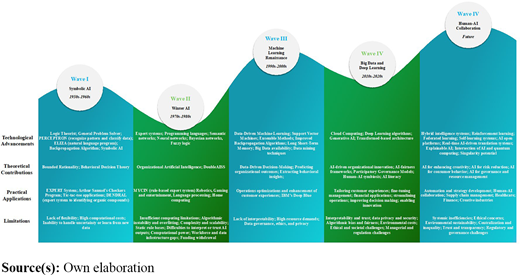
The wave framework shown in Figure 1 and explained in the following subsections provides a structured lens to historically explore the cyclical nature of AI trajectory in management and organizational studies and practices. By conceptualizing AI’s evolution as a series of five waves – the symbolic AI and early theoretical foundations, the AI Winter and narrow applications, the machine learning renaissance, the big data and deep learning transformations, and the emerging phase of human–AI collaboration and responsible AI – the framework captures the dynamic interplay between technological breakthroughs, scholarly contributions and organizational adoptions. Each wave reflects distinct milestones and challenges, offering insights into how AI technologies have evolved, reshaped management practices and driven theoretical advancements.
3.1 The first wave: symbolic AI and theoretical foundations (1950s–1960s)
The first wave of AI began in the 1950s, rooted in the post–Second World War technological and scientific revolution (Rabunal et al., 2009; Felt and Irwin, 2024). Early contributions from Norbert Wiener in cybernetics during the 1940s and 1950s laid foundational ideas for AI by exploring feedback loops and control systems. Cybernetics focused on studying communication and control in biological and mechanical systems, providing critical insights into how machines could mimic human decision-making processes. AI’s formal origins are traced to the 1956 Dartmouth Summer Research Project on Artificial Intelligence, where the term “Artificial Intelligence” was coined by organizer John McCarthy. Alongside Marvin Minsky, Nathaniel Rochester and Claude Shannon, the conference sought to explore how machines could simulate human intelligence, marking the founding of AI as a field. Symbolic AI emerged as the dominant paradigm, relying on rules, symbolic representations and logical inference to mimic human reasoning. John McCarthy’s development of LISt Processing (LISP) in 1958 provided a critical programming language for AI research, excelling in tasks like theorem proving and problem-solving through its seamless handling of symbols, lists and memory management (McCarthy, 1978).
Early AI systems, like the Logic Theorist and the General Problem Solver, emerged as direct results of this foundational effort, showcasing the potential of AI by replicating human reasoning processes. The Logic Theorist, developed by Shaw et al. (1958), is considered the first AI program to prove theorems from Principia Mathematica. It used heuristics to mimic human reasoning and successfully proved 38 theorems, some more efficiently than humans, marking a milestone in AI by demonstrating machines could replicate logical problem-solving. The General Problem Solver, developed by Newell and Simon (1961), was designed as a search-based approach to problem-solving, using techniques such as means-ends analysis to break complex problems into smaller, more manageable sub-problems. The General Problem Solver worked by defining problems in terms of an initial state, a goal state and a set of operators for transforming one state into another. For example, the General Problem Solver could solve mathematical proofs, play logic-based games and address puzzles, showcasing its versatility and early potential in AI. Another first success was in game playing, with Arthur Samuel’s Checkers Program in the 1950s that used strategies like minimax search and heuristics. It became renowned for its ability to learn from experience. Similarly, simple AI programs were created to play tic-tac-toe (e.g. MENACE; Matchbox Educable Noughts and Crosses Engine, developed by Donald Michie), demonstrating fundamental decision-making processes. By the late 1960s, AI progressed into expert systems like DENDRAL, which assisted chemists in identifying organic compounds using spectrographic data, marking a significant step toward specialized problem-solving tools.
In parallel, Frank Rosenblatt, an American psychologist and computer scientist, pioneered AI in the 1950s and 1960s by developing the PERCEPTRON, one of the first artificial neural networks. Introduced in 1957 at the Cornell Aeronautical Laboratory, this artificial neural network could learn to recognize patterns and classify data, forming the foundation for modern ML algorithms. However, the system was limited by its reliance on predefined rules and structured environments, struggling with real-world complexity and ambiguity. In addition, Joseph Weizenbaum developed ELIZA, an early natural language processing program designed to simulate conversation. It showcased the potential of AI in human–computer interaction and laid the groundwork for modern chatbots. Neural networks experienced a resurgence in the 1980s when advances in computing and the development of the backpropagation algorithm by Rumelhart et al. (1986) enabled the training of multi-layered networks. This breakthrough addressed key limitations of early neural networks, such as their inability to model complex, nonlinear relationships, paving the way for their later dominance in machine learning. A Cold War agenda drove these innovations, as governments and academic institutions prioritized scientific advancements to maintain strategic superiority (Edwards, 1996). Symbolic AI, emphasizing formal logic and rule-based reasoning, dominated this era, reflecting the optimism of a time captivated by the promise of automation and rationalization in military and industrial contexts.
The academic study of AI in management and organizational studies gained traction during this wave, influenced by interdisciplinary contributions from computer science, cognitive psychology and management theory. Simon’s (1955) concept of bounded rationality played a pivotal role in shaping the theoretical foundations of AI in organizational contexts. Simon challenged the traditional economic assumption of perfect rationality, arguing that cognitive limitations and environmental constraints shaped decision-making processes (Cristofaro, 2017). This perspective aligned closely with symbolic AI’s emphasis on modeling decision-making as a series of logical steps, bridging computational capabilities with managerial insights (Newell and Simon, 1972). Another key contribution was the integration of symbolic AI into behavioral decision theory, which emphasized the interplay between individual cognition and organizational decision-making. Early academic efforts sought to model how managers processed information and made decisions under uncertainty, leveraging symbolic AI as a tool to simulate these processes (March and Simon, 1958). These studies highlighted the potential of AI to enhance managerial decision-making but also pointed to the need for more nuanced models that accounted for context-specific factors and human judgment (Cyert and March, 1963). Academically, the emphasis on formal logic and structured problem-solving drew criticism for its inability to capture managerial decision-making’s nuanced and context-dependent nature. Scholars called for more adaptive and flexible approaches to AI, recognizing the need to bridge the gap between computational models and real-world organizational challenges (Simon, 1960; Newell and Simon, 1972).
Symbolic AI’s practical applications included expert systems, among the first widely implemented AI tools in organizational contexts. These systems encoded human expertise into rules and used logical frameworks to draw conclusions or provide recommendations, such as decision-support systems for inventory control and production planning, leveraging rule-based algorithms to optimize operations (Simon, 1960). A practical example of early symbolic AI adoption is the EXPERT system, developed by Digital Equipment Corporation in the late 1960s. This rule-based expert system was designed to assist engineers in diagnosing hardware issues in PDP-series minicomputers by analyzing input data and providing troubleshooting recommendations. While EXPERT significantly improved support efficiency and reduced downtime, it struggled to adapt to new or unanticipated problems and required frequent manual updates to its rule base.
In addition, the high computational costs and its rigid logic made integration into broader decision-making processes challenging, highlighting symbolic AI’s limitations in scalability and flexibility (Nilsson, 1982). Moreover, the inability of symbolic AI systems to handle uncertainty or learn from new data further constrained their utility in complex organizational settings (McCorduck, 2004). Therefore, organizations during this period faced difficulties integrating symbolic AI into broader organizational decision-making processes. While early applications provided valuable insights into specific operational problems, the inability of symbolic AI to handle ambiguity and adapt to changing contexts hindered its wider adoption. These limitations underscored a critical gap between symbolic AI’s technological capabilities and organizational environments’ complex needs.
Despite early promise, this first wave of AI concluded in the late 1960s, as practical limitations and rising skepticism about its feasibility curtailed progress (Newell and Simon, 1959). The lessons learned from this era – particularly the importance of aligning technological potential with practical applications and theoretical insights – paved the way for subsequent waves of AI innovation.
3.2 The second wave: the AI Winter and narrow applications (1970s–1980s)
The second wave of AI, spanning the 1970s and 1980s, is often called the “AI Winter.” This period was driven by disillusionment with the overpromised potential of early AI advancements (Turban and Watkins, 1986). In the 1970s, researchers developed expert systems that used rules to simulate human decision-making in specialized areas like medical diagnosis (e.g. MYCIN). These systems demonstrated the ability to capture expert knowledge and automate complex tasks. Logic programming languages like Prolog and LISP were introduced to simplify AI development, while new methods for knowledge representation, such as semantic networks, helped systems organize and reason about information. In the 1980s, AI regained momentum with advancements like neural networks as researchers rediscovered backpropagation (Werbos, 1988). AI also expanded into robotics, with early autonomous systems demonstrating navigation capabilities, and into natural language processing, which aimed to help computers understand human language (e.g. the Stanford Cart, one of the first robots to navigate obstacles autonomously). The decade saw further innovations in handling uncertainty, such as fuzzy logic (dealing with vagueness, e.g. “How hot is hot?”) and Bayesian networks (managing probabilistic uncertainty, e.g. “What is the likelihood of disease X given symptom Y?”), which enabled AI systems to manage uncertainty, a critical limitation in early AI systems. Specialized hardware, like the LISP Machine, was developed to improve computational efficiency for AI tasks. Overall, this period transitioned AI from primarily theoretical to real-world applications, paving the way for today’s technologies.
Academically, the AI Winter prompted a reevaluation of the theoretical foundations of AI in management and organizational studies. Critiques spurred interest in alternative approaches, such as probabilistic reasoning and machine learning, emphasizing adaptability and data-driven insights. For instance, Bayesian networks and other probabilistic models gained traction to address uncertainty and variability in organizational contexts (Pearl, 1988). The AI Winter also underscored the importance of interdisciplinary collaboration in advancing AI research and its applications. Scholars and practitioners recognized that addressing the limitations of symbolic AI required insights from computer science, cognitive psychology, and management theory.
In addition, the stagnation in technological progress prompted researchers to focus on foundational issues, such as the ethical implications of AI and the potential for human–AI collaboration (McCorduck, 2004). However, this period was also marked by the presence of pioneering scholars such as Holloway (1983), who highlighted the potential of AI to revolutionize management theory and practice, particularly in strategic management, by integrating vast data sets, reasoning capabilities and intuitive decision-making, emphasizing that AI could not only replicate but also surpass human cognitive functions in some areas, thereby challenging traditional views of executive roles and decision-making processes and reflecting a broader theoretical shift toward viewing AI as a transformative tool in organizational strategy. Similarly, Orsini (1986) emphasized the pivotal role of value systems in shaping AI applications, proposing that strategic planning could be significantly enhanced by AI systems designed to integrate human motivations, perceptions and ethical considerations with his concept of “Organizational Artificial Intelligence” demonstrating how interdisciplinary insights could be translated into practical tools for effective planning and decision-making. In this period, it is also worth noting the contribution of Masuch and LaPotin (1989), who developed the DoubleAISS model, which integrated symbolic AI with organizational theory to simulate complex dynamics, addressing bounded rationality and decision ambiguity while highlighting challenges like computational demands and scalability.
In practice, the adoption of AI in organizations became increasingly narrow during this period. One notable example is the deployment of MYCIN, a rule-based expert system developed at Stanford University in the 1970s to assist in medical diagnostics (Shortliffe, 1976). MYCIN used a knowledge base of approximately 600 rules to recommend antibiotic treatments for bacterial infections based on patient data. While it demonstrated impressive accuracy, often outperforming human specialists in specific cases, MYCIN highlighted symbolic AI’s practical limitations. Its reliance on static rules required constant updates to remain relevant, and its complexity made it difficult to implement outside research environments.
In addition, the lack of trust in MYCIN’s recommendations – partly due to its opaque reasoning process and inability to adapt to new medical knowledge – limited its adoption in clinical practice (Hayes-Roth et al., 1983). Another notable example of symbolic AI’s potential was Shakey the Robot, developed in the late 1960s and early 1970s at the Stanford Research Institute. Shakey combined perception, planning and action, making it one of the first robots capable of reasoning about its actions to navigate an environment. By integrating symbolic AI techniques with sensory input and physical motion, Shakey could perform tasks such as moving objects and navigating obstacles, showcasing the application of AI beyond purely computational tasks. However, its high computational demands and reliance on structured environments highlighted symbolic AI systems’ scalability and adaptability challenges in practical, unstructured settings. Beyond organizational use, AI applications such as rudimentary language translation tools and essential personal assistants in home computing systems began appearing in daily life. These systems showcased the potential of AI but were often limited by static rule bases and an inability to adapt to real-world complexity, reflecting the broader challenges of symbolic AI in this era. This illustrates the potential of symbolic AI for specialized tasks and the barriers to its broader organizational use.
The second wave faced significant setbacks, as unmet expectations in AI research prompted governments and private institutions, particularly in the USA and the UK, to withdraw financial support, deepening the AI Winter. The 1973 UK Lighthill Report criticized AI’s limited progress and recommended significant funding cuts (Lighthill, 1973), while the U.S. Defense Advanced Research Projects Agency redirected resources to more immediate technological priorities. These financial setbacks discouraged researchers and practitioners, stalling progress in the field. Compounding this stagnation were unique challenges in the second wave, such as algorithmic instability and overfitting. Early machine learning approaches, like Bayesian inference and neural networks in their infancy, often failed to generalize beyond their training data, leading to inconsistent results (Nilsson, 1984). Moreover, the growing complexity of these systems compounded the “black box” problem, where stakeholders found it difficult to interpret or trust AI outputs, echoing but deepening the trust issues from the first wave (Hayes-Roth et al., 1983). These challenges underscored the need for technological improvements and advances in data infrastructure, computational power, and workforce education. The second wave also emphasized aligning AI capabilities with organizational needs. For example, while PROSPECTOR successfully aided geologists in identifying mineral deposits (Duda et al., 1979), its narrow focus and high development costs limited its adoption in other industries. While often characterized as a period of stagnation, the second wave was instrumental in reshaping the trajectory of AI in management and organizational studies. Highlighted issues prompted the necessity of developing AI systems that were not only powerful but also practical and adaptable, lessons that would inform the breakthroughs of the third wave in the 1990s and beyond (Nilsson, 1984).
3.3 The third wave: the machine learning renaissance (1990s–2000s)
The third wave of AI, spanning the 1990s and 2000s, marked a pivotal shift from symbolic, rule-based systems to data-driven machine learning. Unlike earlier approaches relying on predefined rules, machine learning models used statistical and probabilistic methods to identify patterns, make predictions and adapt to new data (Rabunal et al., 2009; Felt and Irwin, 2024). Key innovations included support vector machines (Cortes and Vapnik, 1995), ensemble methods like random forests (Breiman, 2001), improved backpropagation algorithms that revitalized neural networks for training multi-layered models (Rumelhart et al., 1986) and long short-term memory by Hochreiter and Schmidhuber in 1997. This latter addressed the vanishing gradient problem in recurrent neural networks, enabling the retention of information over long sequences. With memory cells and gating mechanisms, long short-term memory transformed AI applications such as speech recognition, natural language processing and time-series forecasting, making it a foundational milestone in sequence modeling. These breakthroughs enabled AI systems to perform more flexibly and efficiently across various tasks. The availability of large data sets, often called “big data,” was instrumental in advancing data mining techniques, allowing businesses to uncover patterns and gain insights from these extensive data resources. A notable demonstration of these advancements came in 1997 when IBM’s Deep Blue defeated world chess champion Garry Kasparov. By leveraging vast data sets of past chess games and evaluating millions of possible moves per second, Deep Blue showcased how access to large-scale data, coupled with powerful computational capabilities, could enable AI to rival and surpass human decision-making in complex strategic domains (Campbell et al., 2002).
Academically, the third wave spurred a renewed interest in AI’s implications for management and organizational studies. Scholars explored how ML could enhance decision-making, foster innovation and improve efficiency. The work of Davenport and Harris (2007) on “competing on analytics” emphasized the strategic importance of data-driven decision-making, arguing that organizations that effectively used analytics could achieve superior performance. Early studies like Tam and Kiang’s (1992) on neural networks for predicting bank failures demonstrated AI’s potential for exceptional accuracy and adaptability. Still, they highlighted challenges in interpretability, stressing the importance of AI systems that complement rather than replace human expertise. Building on these ideas, Cui et al. (2006) showed how Bayesian networks and evolutionary programming could combine predictive accuracy with interpretability, enabling managers to adapt dynamically in direct marketing contexts. Similarly, Das and Chen (2007) demonstrated AI’s ability to extract behavioral insights from sentiment analysis of online discussions, linking investor sentiment to market activity and enhancing strategic foresight. These contributions illustrated the interplay between human decision-makers and AI systems.
Between the 1990s and 2000s, AI in organizations shifted toward leveraging data-driven technologies to optimize operations and enhance customer experiences. Companies like Amazon and Walmart pioneered predictive analytics, applying ML to streamline supply chains, improve inventory management and tailor marketing strategies, thereby gaining significant competitive advantages (Agrawal et al., 2018). These innovations enhanced operational efficiency and enabled more precise forecasting and decision-making, setting new industry standards for competitive practices. This period also saw the emergence of recommendation systems as a transformative application of AI, with platforms like Netflix and Amazon using collaborative filtering and ML algorithms to personalize user experiences, increase customer engagement and drive revenue growth (Amatriain and Basilico, 2012). Beyond organizational contexts, AI began influencing daily life through personalized experiences such as tailored shopping recommendations, media suggestions on platforms like YouTube and early virtual assistants like Apple’s Siri and Microsoft’s Clippy, marking the transition of AI into consumer-centric applications.
The barriers of the third wave of AI were distinct from those encountered in the first and second waves, reflecting the evolving nature of AI technologies and their integration into organizational contexts. A key challenge of the third wave was the “black-box” nature of advanced machine learning models, particularly deep learning algorithms, which lacked interpretability. This opacity made it difficult for managers to understand or trust AI-driven decisions, leading to skepticism and resistance within organizations (Burrell, 2016). Another unique barrier of the third wave was the significant resource demands required to implement AI systems. Unlike the first wave, which was constrained by limited computational power, and the second wave, which lacked quality data sets and mature algorithms, the third wave required substantial investments in infrastructure, such as high-performance computing and scalable data storage, as well as skilled talent for development and maintenance. These requirements often excluded smaller organizations or those in less technology-intensive sectors, creating a digital divide. Moreover, the third wave introduced pressing concerns about data governance, ethics and privacy, largely absent in earlier waves. The widespread adoption of AI systems raised questions about bias, fairness and the societal impacts of data-driven decision-making. Scholars like Friedman and Nissenbaum (1996) emphasized the importance of aligning AI systems with ethical principles through value-sensitive design.
3.4 The fourth wave: big data and deep learning transformations (2010s–2020s)
The fourth wave of AI, beginning in the 2010s, is defined by the convergence of deep learning, big data and cloud computing, which have significantly expanded AI’s capabilities and applications. This era has been fueled by the rapid digitization of businesses and the explosion of internet-based platforms, generating unprecedented volumes of data (Rabunal et al., 2009; Felt and Irwin, 2024). Advances in hardware, particularly GPUs, and cloud computing platforms like Amazon Web Services democratized access to computational resources, accelerating AI adoption. Deep learning’s hallmark achievements, driven by algorithms such as convolutional neural networks (LeCun et al., 2015) and recurrent neural networks (Hochreiter and Schmidhuber, 1997), revolutionized tasks like image recognition and natural language processing. A transformative development within this wave has been the rise of Generative AI (Gen AI) – a class of AI systems designed to generate new content based on patterns learned from existing data. Generative models like Generative Adversarial Networks (GANs), introduced by Goodfellow et al. (2014), enabled the synthesis of realistic images and videos, while transformer-based architectures such as Generative Pre-trained Transformer (GPT), a type of AI model developed by OpenAI, used self-attention mechanisms and large-scale pretraining to generate human-like text and perform complex analytical tasks (Vaswani et al., 2017).
Gen AI represents the culmination of these innovations, extending AI’s capabilities into creative and generative domains. Applications include text generation, image synthesis and drug discovery, demonstrating AI’s potential to move beyond predictive analytics into content creation and problem-solving. Tools like Codex and GitHub Copilot further illustrate this by streamlining software development through code generation and debugging, enhancing developers’ productivity. These advancements have been underpinned by the explosion of data from sources such as customer interactions, Internet of Things devices and social media platforms, creating an ecosystem where Gen AI thrives. Tools like Hadoop and Spark (Chen et al., 2012) have facilitated the handling of big data, enabling organizations to derive actionable insights from vast data sets. These technological innovations have propelled AI to play a central role in driving organizational innovation, efficiency, and creativity. By 2021, innovations like OpenAI’s DALL·E pushed boundaries further, integrating text and image generation and showcasing AI’s creative potential. Meanwhile, foundation models like OpenAI’s GPT-4 and Google’s Bard demonstrate a leap in AI’s generalization capabilities, reducing the need for task-specific training, while multimodal AI systems like OpenAI’s DALL·E 3 and DeepMind’s Gato integrate text, image, audio and video understanding, enabling richer interactions and applications across industries. Building on these seminal advancements, the field eventually witnessed the emergence of DeepSeek, a leading Chinese AI company. DeepSeek is a cost-effective, open-source alternative to OpenAI’s models, offering competitive performance at a lower price. However, critics raise concerns over its mandatory login requirements, arguing that this practice poses data security risks compared to OpenAI’s more established, secure systems (Gibney, 2025).
The fourth wave has stimulated a rich academic discourse in management and organizational studies. Scholars have explored the role of AI in driving organizational innovation, particularly its ability to speed up product development and enhance learning through data-driven insights (Cristofaro et al., 2025). At the same time, ethical concerns have become increasingly important, with studies showing how AI can embed biases from training data or diminish human expertise when overused (Crawford, 2016). In response, frameworks for responsible AI have emerged, such as Binns’ (2018) fairness framework, which incorporates stakeholder perspectives, and participatory governance models proposed by Whittlestone et al. (2019). The human–AI symbiosis concept emphasizes AI’s potential to complement human strengths rather than replace them, offering a more collaborative approach (Shneiderman, 2020). Researchers have also stressed the importance of fostering AI literacy among managers and employees to close the gap between technical knowledge and organizational needs, ensuring AI is effectively integrated into decision-making (Syed et al., 2021). These discussions underline the need to align AI technologies with ethical principles and organizational goals to maximize their potential benefits while addressing risks.
AI applications in the current fourth wave demonstrate its transformative impact across various industries. Companies like Amazon and Alibaba have used deep learning to tailor customer experiences, fine-tune pricing and improve inventory management. In healthcare, AI-driven diagnostic tools, such as those studied by Esteva et al. (2017), have matched or surpassed human accuracy in identifying diseases, leading to better patient outcomes. Financial institutions rely on AI for tasks like fraud detection, risk analysis and algorithmic trading, showcasing its ability to manage complex challenges (Brynjolfsson and McAfee, 2014). AI also plays a key role in marketing, supply chains, and talent management, helping businesses streamline operations and make better decisions. Beyond business, AI has reshaped everyday life, powering tools like Spotify’s music recommendations, Google Assistant and smart home devices like Alexa and Google Nest. Tools like ChatGPT, Stable Diffusion and MidJourney have enabled high-quality text, image and video generation in creative fields. These models are also transforming content creation, marketing and software development. Codex and GitHub Copilot assist developers by generating and debugging code, enhancing productivity.
However, the fourth wave of AI also brings unique challenges. Deep learning models’ “black-box” nature has made interpreting or trusting their decisions difficult, especially compared to earlier waves’ simpler, rule-based systems (Doshi-Velez and Kim, 2017). This lack of transparency poses problems for managers and regulators, particularly in high-stakes industries like healthcare and finance. The reliance on large data sets raises data privacy and security concerns, especially under strict regulations like the General Data Protection Regulation, a comprehensive data privacy and security law enacted by the European Union in 2018. Ethical issues, such as algorithmic bias and fairness, are more pressing than ever as large-scale systems risk deepening societal inequalities (Crawford, 2016). Another emerging issue is the environmental cost of AI, with deep learning models requiring significant energy resources. These challenges are distinct from those faced in earlier waves, where limitations were primarily technical. In this era, the focus has shifted to societal, ethical, and sustainability concerns. Addressing these issues requires strong governance frameworks and collaborative efforts to ensure AI is used responsibly, balancing innovation with accountability (Binns, 2018; Whittlestone et al., 2019).
3.5 The emerging fifth wave: human–AI collaboration and responsible AI (future)
The fifth wave of AI, emerging in the 2020s, represents a paradigm shift toward human–AI collaboration and integrating AI technologies into complex decision-making processes (Rabunal et al., 2009; Felt and Irwin, 2024). This wave envisions AI as a collaborative partner, augmenting human capabilities rather than replacing them. Advances in hybrid intelligence systems, where human expertise and AI converge, are expected to play a central role in addressing multifaceted challenges. Technologies like reinforcement learning are anticipated to evolve further, optimizing strategies in applications such as autonomous systems and adaptive logistics (Silver et al., 2016). Federated learning, which preserves data privacy during decentralized AI model training, is also set to expand its influence in sensitive fields such as healthcare and finance, where ethical data handling remains critical (Kairouz et al., 2021). Self-learning systems, representing the next step in AI’s evolution, will play a transformative role in this future. These systems autonomously adapt by learning from data and interactions, enabling AI to tackle dynamic environments and respond to new challenges (LeCun et al., 2015). Applications range from autonomous vehicles refining navigation in real time to precision healthcare tools that evolve with patient needs. Leveraging reinforcement learning and neural networks, self-learning systems are expected to drive innovation in climate modeling, disaster response and ethical decision-making, addressing complex global challenges (Goodfellow et al., 2016). Platforms like OpenAI and DeepSeek have further advanced human–AI collaboration, with tools like Codex and ChatGPT enhancing productivity, creativity and decision-making across industries. In addition, real-time AI-driven translation systems, like those developed by Google Translate using neural machine translation, are breaking language barriers, fostering global communication and enabling seamless cross-cultural collaboration.
As these systems advance, they could contribute to realizing the singularity. At this point, AI surpasses human intelligence, enabling exponential technological growth and presenting profound societal implications that demand careful ethical and strategic oversight. The future of AI will also hinge on advancements in Explainable AI (XAI), which aims to make AI systems interpretable and understandable. XAI fosters trust and accountability by providing transparent outputs, helping users comprehend AI-driven decisions. Its roots lie in early interpretable models like decision trees and rule-based systems, which were far more straightforward than today’s neural networks. As deep learning became dominant in the 2010s, leading to critiques of “black box” models, XAI methodologies like SHAP (Lundberg and Lee, 2017) and LIME (Ribeiro et al., 2016) emerged to address these challenges. While Gen AI focuses on content creation with models like Generative Adversarial Networks and Generative Pre-trained Transformers, XAI emphasizes understanding and trust by making AI outputs interpretable. Together, they reflect AI’s dual priorities: enabling creativity while ensuring accountability. In the coming decade, advancements in XAI are expected to enhance human–AI collaboration, driving innovation and confidence in AI solutions. Simultaneously, the intersection of AI with quantum computing holds transformative potential, as quantum algorithms could exponentially accelerate AI processes like optimization, data analysis and complex simulations, paving the way for drug discovery, logistics and cryptography breakthroughs.
Academically, the fifth wave inspires new lines of inquiry in management and organizational studies (see Table 1). Scholars increasingly identify critical areas where AI could transform management and organizational studies and practice, calling for research to address emerging questions in ethics, entrepreneurship, innovation, marketing, organizational behavior, strategic management and supply chain management. For example, entrepreneurship research should examine how AI fosters creativity, optimizes resource acquisition and empowers resource-poor entrepreneurs while addressing its dual effects on idea diversity and societal costs (Lévesque et al., 2022; Obschonka et al., 2024). Similarly, in innovation management, scholars should investigate how AI might reduce risks in product development and its role in R&D (Ameen et al., 2024; Babina et al., 2024). In marketing, researchers should study how AI configurations affect consumer behavior, including adoption and resistance, while addressing the ethical implications of AI in customer journeys (Marvi et al., 2024; Mohammadi et al., 2024). While in strategic management, future work should explore how AI improves foresight, reduces biases and redefines frameworks like the resource-based view while addressing governance challenges (Doshi et al., 2024; Krakowski et al., 2023).
In the coming years, the fifth wave of AI is expected to redefine industries and organizational processes, with advancements in large language models showcasing AI’s ability to automate tools, generate high-quality strategies and deliver human-like evaluations. Empirical studies highlight AI’s capacity to accelerate decision-making and improve weaker strategies by enhancing cognitive processes like search, representation and aggregation (Csaszar et al., 2024). However, Desjardins and Gould (2024) caution that systemic inefficiencies (i.e. functional stupidity, organizational incompetence and performative practices) can undermine AI’s potential by exacerbating inefficiencies and limiting its benefits. Consequently, while AI’s advancements promise transformative collaboration between humans and systems, understanding contextual factors, establishing ethical frameworks and ensuring robust organizational preparation are essential to realizing these benefits fully. Together, these perspectives highlight the opportunities and challenges of AI’s transformative potential to complement human expertise, setting the stage for a new era of collaboration between humans and intelligent systems.
At the heart of this transformation lies the potential for human–AI collaboration to become central to decision-making. AI tools act as augmentative agents to empower managers while ensuring they retain ultimate control (Ren et al., 2023). For instance, AI could dynamically recommend equitable hiring practices in human resources, identify skill gaps and design personalized training programs to foster inclusivity and workforce innovation (Chowdhury et al., 2023). AI-enabled supply chains are poised to become more adaptive, leveraging predictive analytics to anticipate disruptions, recommend solutions and facilitate agile responses, transforming operations into dynamic ecosystems (Ahmed et al., 2022). In healthcare, AI-driven diagnostic systems are anticipated to further revolutionize disease detection and treatment planning by combining data-driven precision with human expertise, as seen in current systems developed by Google Health (Esteva et al., 2017). In finance, the evolution of robo-advisors will likely lead to hybrid models, where personalized insights from human advisors complement AI-generated investment strategies. These applications demonstrate the potential for future AI systems to harmonize algorithmic rigor with contextual human judgment, creating symbiotic decision-making processes. Beyond traditional sectors, Gen AI and XAI are expected to play an increasing role in creative industries, from generating personalized content to innovating in areas like drug discovery and design.
While the fifth wave offers immense potential, it also presents significant challenges that must be addressed for AI to realize its full promise. One critical issue is the environmental sustainability of AI. The energy-intensive processes in training large models raise pressing concerns about their carbon footprint. Developing green AI practices, such as optimizing computational efficiency and leveraging renewable energy, will ensure sustainable AI adoption (Strubell et al., 2019). The centralization of AI capabilities within a few tech giants also poses risks related to monopolistic behavior and unequal access, requiring regulatory frameworks to foster equitable distribution of AI benefits. Ethical considerations will remain paramount, with a growing emphasis on ensuring that AI technologies align with fairness, accountability and inclusivity principles. As regulations like the European Union’s Guidelines for Trustworthy AI gain traction, policymakers must create agile governance frameworks that can adapt to rapid technological advancements (Whittlestone et al., 2019). Collaborative governance models that engage diverse stakeholders will be crucial to addressing ethical dilemmas and ensuring that AI systems reflect shared societal values. The future of the fifth wave will depend on addressing these challenges while fostering innovation, ensuring that AI remains a tool for enhancing human potential and achieving global goals. The fifth wave offers a pathway toward a human-centric AI landscape that prioritizes collaboration, equity and shared prosperity by focusing on sustainable, inclusive and ethical practices.
4. Lessons from the historical evolution of AI
The historical analysis of the AI trajectory offers unique insights into why specific challenges and opportunities in management and organizational studies persist and how they are deeply rooted in patterns of technological advancement, theoretical developments and organizational adaptations. The historical analysis identifies what has happened and explains why these patterns recur, providing a foundation for better alignment between AI’s potential and its application; see Table 2.
One key insight from the historical analysis is the cyclical nature of AI’s evolution, characterized by alternating waves of enthusiasm and disillusionment. This pattern arises because technological breakthroughs often outpace the readiness of organizations and society to adapt to them. For example, during the first wave of symbolic AI, the theoretical advancements of Newell and Simon (1956) were constrained by the computational limitations of the time, leaving organizations unable to realize the potential of rule-based systems fully. Similarly, the AI Winter of the 1970s and 1980s emerged because early expectations, inflated by the hype surrounding expert systems, failed to account for the immense infrastructural and contextual demands required for successful implementation (Crevier, 1993). The historical perspective reveals that this misalignment is not merely a consequence of technological immaturity but a structural feature of innovation cycles, where enthusiasm often leads to over-promises that practical realities cannot meet.
Another critical insight from historical analysis is the persistent gap between theory and practice. Understanding why this gap exists helps explain organizations’ challenges in integrating AI into their operations. During the third wave, ML ushered in transformative applications like predictive analytics (Mitchell, 1997). However, lacking theoretical grounding in management and organizational studies meant these tools were often deployed without understanding their long-term organizational and societal implications. Historical analysis demonstrates that this gap is rooted in the divergent pace of development: technological advancements evolve rapidly, while theoretical frameworks, which require interdisciplinary collaboration and empirical validation, develop more slowly. This lag explains why organizations frequently adopt AI tools without fully grasping their strategic implications, leading to issues like reliance on opaque models and challenges in building trust (Burrell, 2016).
Historical analysis also better explains the recurring challenges of trust and ethics in AI adoption. Why do these issues persist despite growing awareness and regulatory interventions? The history of AI reveals that ethical concerns evolve in tandem with technological capabilities, often lagging behind advancements in functionality. For instance, ethical concerns were largely absent in the early days of symbolic AI because the systems lacked the autonomy to make impactful decisions. Only in later waves, as AI began influencing critical organizational and societal outcomes, questions of fairness, accountability and inclusivity gained prominence (Friedman and Nissenbaum, 1996). This historical progression explains why contemporary debates about responsible AI often feel reactive: ethical frameworks have traditionally been developed in response to observed failures rather than proactively addressing emerging risks. Recognizing this pattern underscores the importance of embedding ethical considerations into the development process from the outset.
A historical perspective also explains why specific organizations adopt and leverage AI more successfully than others. For example, firms that embraced AI during the big data era often had pre-existing capabilities, such as robust data infrastructures and a culture of experimentation, which allowed them to integrate AI more seamlessly (Brynjolfsson and McAfee, 2014). Historical analysis reveals that these advantages are not incidental but stem from the cumulative effects of organizational learning and resource alignment across previous technological waves. Organizations that lagged in earlier waves often face compounded challenges, such as a lack of AI literacy and outdated infrastructure, which explain their slower adoption and integration in later waves.
Finally, historical analysis provides insights into why human–AI collaboration has emerged as a central theme in the current wave. Unlike earlier phases, where AI was framed as a tool to replace human labor or decision-making, the growing emphasis on augmentation reflects lessons learned from past failures. For example, the black-box nature of ML models in the third wave led to resistance and mistrust as managers struggled to understand and interpret AI-driven decisions (Burrell, 2016). The historical realization that AI systems work best when complementing human expertise rather than replacing it explains why the fifth wave is focused on building symbiotic relationships between humans and AI (Shneiderman, 2020). This shift is not merely a response to technological advancements but a more profound acknowledgment of the limitations and risks inherent in fully autonomous systems, as illuminated by decades of experimentation and critique.
5. Implications and concluding remarks
For academic scholars, the wave framework highlights the importance of preempting stagnation by actively engaging with the rapidly evolving technological landscape. Scholars should focus on bridging the recurring misalignment between studies and practice by developing dynamic theoretical models that anticipate emerging AI technologies’ impact on organizations (Rudko et al., 2024). History has shown that technological advancements often outpace academic research, leading to outdated theories that fail to capture real-world complexities. Thus, scholars must adopt a forward-looking approach, leveraging historical patterns to predict how AI will reshape industries, governance and labor markets. For instance, understanding the interplay between human–AI collaboration and management studies in the fifth wave offers fertile ground for advancing frameworks that integrate ethical concerns and augmentative roles of AI (Caputo et al., 2024; Magni et al., 2024). Lessons from past industrial revolutions, particularly the Second Industrial Revolution (1870–1914), illustrate that failure to integrate ethical considerations early in technological adoption leads to regulatory backlash, public distrust and unintended societal consequences. During this period, rapid industrialization led to exploitative labor conditions, unchecked monopolies and environmental degradation. The absence of ethical foresight resulted in widespread public outrage, prompting landmark regulatory reforms such as the Sherman Antitrust Act (1890) in the USA and early labor protections across Europe. This historical precedent underscores the necessity for scholars to anticipate the broader societal impact of AI, ensuring that ethical considerations are embedded in AI development from the outset. Scholars must, therefore, move beyond theoretical abstraction and engage in interdisciplinary collaborations that address AI’s ethical, social and economic dimensions. Interdisciplinary research, particularly between computer science, law and social sciences, is critical to developing robust frameworks that proactively mitigate risks associated with AI, such as bias, surveillance misuse and economic displacement. Scholars should also take inspiration from figures like John Stuart Mill, whose advocacy for individual freedoms influenced labor reforms, as a model for balancing technological progress with human well-being. To further guide scholarly efforts, we furnish scholars with a comprehensive set of research questions to stimulate inquiry into the evolving dynamics of AI integration in management and organizational studies (Jain et al., 2024). In this regard, we emphasize the need for researchers to prioritize longitudinal studies to capture how organizations adapt to AI over time, ensuring that theoretical insights remain relevant as technology advances.
The historical analysis of the evolution of AI provides critical insights for practitioners seeking to integrate AI effectively into organizational contexts. Lessons from past innovation cycles highlight the importance of aligning technological advancements with organizational readiness and priorities (Scuotto et al., 2024). The failure of past disruptive technologies, such as the dot-com bubble or the struggles of early automation, reveals that enthusiasm alone does not translate into sustainable success. Organizations must establish clear AI strategies for technological potential and human adaptation challenges. Organizations can learn from earlier waves, such as the overpromises of symbolic AI in the first wave or the transparency challenges of ML in the third wave, to anticipate better and navigate barriers to effective implementation. Managers should prioritize building collaborative environments where AI systems augment human expertise rather than replace it, a lesson emphasized in the emerging fifth wave of human–AI collaboration (Caputo et al., 2024; Magni et al., 2024). For instance, integrating explainable AI tools can address trust issues that were barriers in previous waves, while investing in workforce AI literacy – drawing on lessons from the big data era – can ensure employees are equipped to align AI capabilities with organizational goals. History demonstrates that organizations failing to invest in employee reskilling during disruptive technological transitions often suffer from resistance, operational inefficiencies and reputational damage. Therefore, proactive AI literacy programs and change management strategies must be prioritized for seamless transition. Iterative learning from adoption processes, informed by past failures and successes, will help organizations align operational strategies with the rapidly evolving potential of AI systems. Firms that treat AI adoption as an iterative, learning-based process rather than a one-time investment will be better positioned to adapt to evolving AI landscapes and shifting market conditions.
For policymakers, the wave framework highlights the urgent need for AI governance to keep pace with rapid technological change. Yet regulation remains slow and reactive, allowing a handful of firms to dominate AI development and raising concerns about economic competition, labor markets and national sovereignty. Historical evidence from past technological revolutions, such as the Gilded Age monopolies and early 20th-century antitrust battles, underscores the dangers of allowing unchecked corporate concentration in emerging industries. Without robust intervention, AI risks becoming another domain controlled by a few dominant players, stifling innovation and limiting equitable access. These issues were central to discussions at the AI Action Summit in France in February 2025. Still, existing policies overlook the structural imbalances that enable this concentration of power. Addressing these imbalances requires more than voluntary guidelines or narrow risk-based approaches – it demands enforceable regulations that promote competition and accountability. This includes investing in open-source AI, supporting decentralized innovation and strengthening public-sector research to ensure that AI development serves broad societal interests rather than reinforcing corporate dominance. Lessons from the industrial era demonstrate that without proactive public investment and regulatory oversight, technological advancements can exacerbate social inequalities rather than alleviate them. Policymakers must ensure that AI benefits are equitably distributed, avoiding the historical pitfalls of wealth concentration in new technological frontiers. Transparency alone is not enough; real accountability is needed to prevent a future where a select few capture AI’s benefits. Without stronger intervention, the unchecked concentration of AI power will limit economic opportunities, stifle innovation, and have a disproportionate influence on private actors. Governments must actively foster fair AI ecosystems, implement structural safeguards that prevent monopolization and encourage diverse participation in AI development and deployment. Policymakers must move beyond passive oversight and establish governance models that promote fair access, democratic accountability and long-term societal resilience.
Consequently, scholars, practitioners and policymakers must actively shape a future in which technology enhances human potential, promotes ethical progress and drives sustainable innovation. The true power of AI is not merely in its technical capabilities but in how it is deployed for the greater good (Scuotto et al., 2024). By integrating historical lessons into AI strategies, stakeholders can prevent past mistakes and ensure AI fosters broad societal progress rather than deepening inequalities.
In this regard, the present article wants to offer a first attempt to do so. However, it is not exempt from limitations. While the wave framework provides a structured lens for understanding AI’s historical trajectory, it may oversimplify the nuanced and overlapping dynamics that occur, particularly across different sectors and geopolitical contexts. In addition, by emphasizing major technological waves, the framework may inadvertently neglect incremental advancements that can significantly influence theory and practice. A systematic literature analysis can help uncover these less visible yet impactful paths, offering a more comprehensive view of AI’s evolution. Future research should adopt a granular, longitudinal approach to explore these dynamics in greater depth, focusing especially on underexamined industries and regions to provide more prosperous and actionable insights. Finally, prioritizing works published in high-ranking journals for the literature analysis may have excluded valuable insights from lower-ranked or interdisciplinary outlets. Moreover, journals ranked 4 or 4* in the ABS list today may not have held the same relevance or influence in past decades, potentially overlooking important contributions from historically significant sources. While this approach ensures a focus on established and widely recognized scholarship, it may inadvertently miss emerging perspectives or alternative interpretations that could provide a more comprehensive understanding of AI’s evolution.
Note
Artificial intelligence has been defined in numerous ways, with new definitions emerging as the field advances and develops; see Chhillar and Aguilera (2022).