This study conceptualizes how the implementation of digitalization strategy acts as both an enabler and a catalyst for tensions within service ecosystems. It adopts a holistic, multi-actor perspective to articulate the complexity of ecosystem orchestration in the digital era.
This study develops a conceptual model building on theoretical discussions regarding inter-organizational tensions and empowerment, synthesizing the implications of four critical aspects of digitalization strategies: digital resources, information architecture, digital platforms, and Corporate Digital Responsibility (CDR).
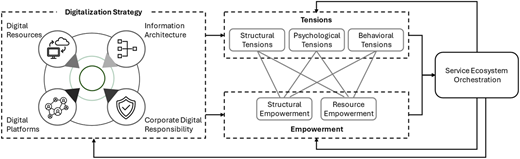
The conceptual model illustrates that digitalization strategies enable value creation via resource and structural empowerment while simultaneously generating structural, psychological, and behavioral tensions. The study posits that the interplay between empowerments and tensions shapes governance and investment decisions, which influence how firms and their business partners collaboratively orchestrate service ecosystems when implementing new digitalization strategies.
This research develops a comprehensive conceptual model elucidating how different aspects of digitalization strategies act as both an enabler and a catalyst for tension within service ecosystems. A key theoretical contribution lies in identifying the strategic alignment between empowerment mechanisms and emerging tensions as the central mechanism for the digital transformation of service ecosystems. This perspective reframes strategy implementation as a continuous and iterative process of achieving and reinforcing this alignment. Furthermore, the study extends the literature on CDR by positioning it as a critical factor across the wider ecosystem rather than an initiative by a single firm.
1. Introduction
Digitalization has transformed the interconnectedness of service ecosystems, which now transcend traditional industry boundaries (Kohtamäki et al., 2019). It enables firms to offer novel solutions across industries in collaboration with existing suppliers and new technology partners by facilitating continuous connectivity and data flows, giving rise to non-ownership services and servitized business models (Bohnsack et al., 2024; Kolagar et al., 2022). For instance, Siemens Xcelerator Marketplace exemplifies an open ecosystem that brings together global partners, SMEs, and individual developers to tackle customer challenges collaboratively with innovative and scalable solutions (Siemens, 2025). In this ecosystem, Siemens acts as the curator and orchestrator, guiding interactions between partners and customers to facilitate collaboration and drive growth across thirty industries. The Marketplace marks a shift from traditional partnerships with a limited set of actors toward a more open platform. Despite its advantages, established partners may perceive this openness as a threat to existing business models, intensifying competition and tensions. Moreover, integrating diverse partners and enabling secure data sharing increases governance complexities, potentially constraining the ecosystem's scalability and success (Bohnsack et al., 2024). As in the case of Siemens' Xcelerator Marketplace, digitalization represents a complex and multi-actor phenomenon embedded within service ecosystems.
To integrate and leverage digital technologies for offering new services, firms have increasingly embarked on digitalization strategies that aim to transform both their internal structure and processes and their broader service ecosystem (Mann et al., 2022). Existing research indicates that the adoption of new digital technologies, enterprise architecture, and decentralized digital platforms creates new opportunities whilst simultaneously introducing challenges that generate tensions. Such tensions become particularly salient as firms reconfigure their ecosystems and renegotiate roles, relationships, and value creation processes (Cennamo and Santaló, 2019; Volberda et al., 2021). Tensions are characterized as persistent imbalance or disagreements that emerge from competing demands, interests, or values among actors within a service ecosystem (Tóth et al., 2022). Extant literature views the tension as a complex phenomenon that can manifest as strategic, operational, or ethical facets (Breidbach and Maglio, 2020; Pressey and Vanharanta, 2016; Tóth et al., 2022). Although tensions are intrinsic to ecosystem dynamics, when they exceed a certain tipping point, they can damage business relationships and destabilize the service ecosystem. To prevent this, tensions warrant deliberate monitoring and timely intervention as needed.
In a similar vein, the digital transformation of service ecosystems requires careful attention to ethical and responsible practices. Orchestrating an ecosystem and enabling data sharing among partners necessitates new codes of conduct and governance principles to safeguard privacy, ensure transparency, and align value between the firm and its partners. In this regard, the concept of Corporate Digital Responsibility (CDR) has gained growing attention over recent years as the collection of shared values and norms that guide the development and implementation of new digitalization strategies ethically (Lobschat et al., 2021). Whilst CDR can support collaboration with service ecosystems through introducing new practices, it may simultaneously provoke new tensions. Prior research has highlighted tensions, such as in relation to control versus openness and flexibility versus integration (e.g. Parker et al., 2017), and has begun to conceptualize empowerment mechanisms to address them (Cennamo and Santaló, 2019). However, an integrated perspective that brings together empowerment mechanisms and tensions related to new digitalization strategies and CDR within service ecosystems remains underdeveloped.
Despite growing research on service ecosystems and digitalization, little is known about: How does digitalization strategy act as both an enabler and a catalyst for tensions within the service ecosystems? Our study aims to address this question by investigating the implications of implementing new digitalization strategies on the service ecosystem orchestration from a multi-actor perspective. Service ecosystems are conceptualized as sets of interconnected actors that interact to offer services to customers (Filosa et al., 2025; Huber et al., 2017). We adopt the premise that a service ecosystem's overarching architecture is often shaped by the hub firm as curator and orchestrator (e.g. Siemens in Xcelerator Marketplace, Amazon in AWS Marketplace). At the same time, individual actors retain their autonomy and independence, provided they conform to shared protocols and rules of engagement (Hein et al., 2019; Jacobides et al., 2018; Kohtamäki et al., 2019). Following the premise, our unit of analysis is the service ecosystem gravitating around the hub firm, which plays a pivotal role in advancing digitalization strategies and in reconfiguring the ecosystem's structure and dynamics (see comparable approach in Baraldi et al., 2018).
This study offers four contributions to the literature. First, we adopt a service ecosystem perspective and a multi-actor lens to advance the understanding of how a hub firm's digitalization strategy reshapes roles, interdependencies, and value creation, exchange, and capture across both customer-facing actors and back-end partners in the ecosystem. Second, drawing on the integrative literature review approach (Torraco, 2005; Ciuchita et al., 2023), we synthesize four core aspects of digitalization strategies (i.e. digital resources, information architecture, digital platforms, and CDR) into a comprehensive conceptual model. Our study extends prior research that has examined these aspects in isolation by demonstrating how technical aspects (resources and platforms) must be structurally aligned via information architecture and ethically grounded via CDR to ensure ecosystem stability.
Third, grounded in inter-organizational tensions and empowerment theories (e.g. Conger and Kanungo, 1988; Li et al., 2024; Pressey and Vanharanta, 2016), we theorize digitalization strategy as having a dual role: each aspect can enable value creation through resource and structural empowerment, whilst also triggering structural, psychological, and behavioral tensions that can impede ecosystem governance. We contend that successful ecosystem orchestration does not rely upon eliminating these tensions, but on the continuous alignment of empowerment mechanisms with governance adjustments to manage them. This perspective reframes strategy implementation as a continuous and iterative process that supports alignment between empowerment and tensions and fosters orchestration as the ecosystem evolves.
Fourth, we extend emerging research on CDR in service ecosystems by explicating that responsible digitalization is not enacted by a single firm, but emerges from interdependencies amongst the hub firm, customers, and diverse business partners engaged in ongoing service and data exchange. We identify related tensions and specify empowerment mechanisms that translate ethical commitments into shared, actionable practices across ecosystem actors.
Together, these contributions provide a solid foundation for future research concerning the implications of digitalization strategies in service ecosystems. We conclude this study by outlining a research agenda that highlights key areas for future exploration and potential extensions of our conceptual model.
2. Conceptual background
This study does not seek to review the existing literature systematically. However, we adopted an integrative literature review approach, which is well-suited for synthesizing diverse theoretical perspectives and identifying conceptual linkages across multiple research streams (Torraco, 2005; Ciuchita et al., 2023). This approach enabled the synthesis of research streams covering service ecosystems, digitalization strategies, and CDR to conceptualize how different aspects of digitalization strategy (i.e. new digital resources, information architectures, digital platforms, and CDR) act as both enablers and catalysts for tensions within service ecosystems. We conducted a structured search on Web of Science and Scopus using keywords related to digitalization strategy, service ecosystems, CDR, and empowerment and tension dynamics. To focus on quality publications, we included articles from journals ranked 2 and over in the British Academic Journal Guide. Articles that focused exclusively on technical implementation without organizational or ecosystem implications were excluded. We also screened reference lists of relevant papers to identify additional sources. The following sections summarize these research streams.
2.1 Perspectives on service ecosystems
An ecosystem refers to a set of interdependent actors, with varying degrees of multilateral complementarities, that interact to enable the realization of a focal value proposition (Adner, 2017; Jacobides et al., 2018). This study focuses on service ecosystems as sets of interconnected actors that interact to develop and offer services to customers (Filosa et al., 2025; Huber et al., 2017). A service ecosystem can be understood as a self-governed and self-adjusting system of resource-integrating actors connected by shared institutional arrangements and mutual value creation through service exchange (Vargo and Lusch, 2016; Vink et al., 2020). Within this perspective, actors—including a hub firm, suppliers, partners, individuals, and customers—engage in adaptive resource integration and emergent collaboration, governed by shared norms, rules, and values (Jacobides et al., 2018). Service ecosystems such as Microsoft's Azure Marketplace and Siemens' Xcelerator Marketplace exemplify open, collaborative platforms that are created and orchestrated by a hub firm to enable value co-creation across a set of interdependent actors.
Whilst the service ecosystem perspective traditionally foregrounds inter-organizational interactions, it also underscores intra-firm dynamics (i.e. interaction between different business units) (Sklyar et al., 2019). Particularly, the orchestration of front- and back-office capabilities and the integration of resources inside the hub firm constitute what can be conceptualized as “internal service ecosystems” (Jovanovic et al., 2022). Such intra-firm ecosystems, for example, across internal business units, enable capability development by aligning customer-facing teams with internal operational functions (Valtakoski and Witell, 2018). Importantly, these processes highlight that ecosystem dynamics are not confined to inter-firm relationships but also emerge from coordinated resource integration within firms (Jovanovic et al., 2022; Sklyar et al., 2019).
Additionally, the development, acquisition, and integration of resources take place both internally within the firm's business units and externally through collaborations with business partners (Vink et al., 2020; Sklyar et al., 2019). To enable value co-creation, firms must orchestrate these internal and external resources by orchestrating their business units and ecosystem partners at the same time (Kohtamäki et al., 2019). There is a broad recognition that service ecosystems rely upon providers of complementary innovations, products, or services. These providers may belong to different industries and may not be bound by formal contractual arrangements, yet demonstrate pronounced interdependence (Jacobides et al., 2018). For instance, firms such as Philips Lighting must simultaneously coordinate and share resources across internal units—such as Philips' Professional Services and Signify divisions—and with external partners in the Lab Partner ecosystem, to co-create innovative digital lighting solutions while navigating governance and privacy challenges.
Service ecosystems are the alignment structure based on mutual agreement amongst actors concerning their roles and resource flows (Adner, 2017). The collaboration of diverse actors facilitates the emergence of a “system-level outcome”—a coherent and synergistic result that cannot be produced by individual actors working in isolation (Thomas et al., 2022). Ecosystems are shaped by different types of complementarities, which can be unique or super-modular, unidirectional or bidirectional, and influence the ecosystem's value proposition and dynamics between its members. Jacobides et al. (2018) view ecosystems as thriving in environments characterized by modularity, allowing the separation of different components where diverse actors can coordinate activities without strict hierarchical control. Whilst the overarching architectural parameters of a business ecosystem are typically set via a hub firm, individual actors retain their autonomy and independence, so long as they interconnect with others in agreed and predefined ways. Although coordination challenges are inevitable, ecosystems typically offer processes and rules for resolution, fostering alignment through common rules of engagement (Filosa et al., 2025; Hein et al., 2019).
Collaboration with customers, suppliers, and other partners is at the center of digitalization literature (Bohnsack et al., 2024; Heirati et al., 2024). Therefore, service ecosystem design has become increasingly critical in addressing how customer value is generated and monetized in a technology-driven world. Firms must identify the drivers of customer value, whilst deciding whether to charge end-users directly (business-to-consumer, B2C) or to monetize through third parties (business-to-business, B2B). For instance, firms may charge partners willing to pay for client information, access, or affiliation with value-adding services (B2B2C). These dynamics necessitate the formation of ecosystems where rules, roles, monetization strategies, and the nature of interconnections are essential components of business model design (Parker et al., 2017).
The evolution of service ecosystems is shaped by mutual adjustments among participants and multidirectional interactions between actors and their environment. These dynamics, described as coevolution (Thomas et al., 2022), are driven by technological innovations and new management styles, including innovations in governance, contracting, and inter-organizational coordination (Holgersson et al., 2022). Such innovations can reshape the boundaries and interdependencies of actors within service ecosystems. Kolagar et al. (2022) synthesize research on ecosystem transformation and contend that a hub firm should develop effective mechanisms (e.g. organizational culture, business models, and capabilities) to facilitate this transformation.
2.2 Perspectives on digitalization strategy
Digitalization strategy is viewed as a comprehensive “organizational strategy formulated and executed by leveraging digital resources to create differential value” (Bharadwaj et al., 2013, p. 472). Digitalization strategies are essential for building innovative business models, improving customer experiences, and achieving operational efficiencies (Bohnsack et al., 2024; Wünderlich et al., 2025). Extant research has considered digital resources, information architecture, and platforms as three key aspects of digitalization strategies (Piccoli et al., 2022; Kowalkowski et al., 2024; Tiwana et al., 2010). These aspects transform a firm's value offerings, organization structure, and inter-organizational interactions.
First, many studies assert that a critical aspect of a digitalization strategy involves evaluating and formulating the ways in which new digital resources (e.g. technologies and information systems) enhance or replace existing resources while restructuring organizational processes (e.g. Kowalkowski et al., 2024; Piccoli et al., 2022). For instance, the integration of 5G connectivity, blockchain technology, 3D printing services, machine learning algorithms, cloud-based data analytics, and IoT infrastructure significantly broadens the capability of organizations to streamline and orchestrate operations. Following Piccoli et al. (2022), we view digital resources as assets and capabilities that are available and useful in implementing digital transformation. Digital assets are tangible or intangible technologies, software, and information systems, while digital capabilities stem from human and organizational competencies (e.g. software development skills). An effective strategy must articulate the criteria for selecting and integrating relevant digital resources within organizational operations, considering the changing environment and the malleable nature of digital technologies, to outline approaches for refining existing processes or developing new ones to facilitate successful implementation (Hund et al., 2021).
Furthermore, a digitalization strategy should delineate how digital technologies enhance the firm's ability to generate, disseminate, and apply information and data to meet customer needs (Porter and Heppelmann, 2014). Such strategies affect various organizational aspects, such as product or service delivery, customer experience, supplier integration, or even the entire business model (Bharadwaj et al., 2013; Verhoef et al., 2021). Whilst new digital resources (i.e. both digital assets and capabilities) are integral to the development and implementation of digitalization strategies, firms need to implement carefully curated overarching governance frameworks and leverage platforms to integrate these resources within both their organizational operations and broader ecosystems.
Second, several studies have focused on enterprise architecture as another essential aspect of a digitalization strategy. This serves as a framework of high-level norms that guide the coherent design and implementation of organizational processes, information management, and technology deployment within a firm (Foorthuis et al., 2016). These norms encompass prescriptions such as principles, models, and policy directives (e.g. the use of technology X for workflow management). Enterprise information architecture subsequently defines the information-centric principles, models, standards, and processes guiding cross-organization IT decisions (Lockwood et al., 2010), such as the design and integration of digital platforms. However, enterprise architecture, as a collection of documented guidelines, holds no intrinsic value unless actively utilized in practice (Pattij et al., 2022).
The advantages of a well-structured enterprise architecture include enhanced transparency in documentation and improved alignment between business operations and information technology (Pattij et al., 2022). The role of enterprise architects is to collect and analyze the necessary data to document the current (“as-is”) architecture, which serves as a critical input for both strategic and operational decision-making. Additionally, they are responsible for gathering insights, functional and non-functional requirements, to design—to “architect”—the future (“to-be”) architecture of the firm and establish a roadmap for its transformation (Foorthuis et al., 2016; Pattij et al., 2022).
Digital platforms transcend traditional categorizations of resources or processes, functioning instead as dynamic systems that integrate technological infrastructure, human expertise, and adaptive workflows to drive innovation and competitive advantage (Derave et al., 2024). They facilitate co-creation by allowing organizations, customers, and suppliers to generate value collaboratively (Sklyar et al., 2019). Digital platforms provide a structured environment that integrates a variety of resources, such as IoT, cloud computing, application programming interfaces (APIs), and data analytics tooling, that unlock new forms of inter-firm collaboration and seamless information sharing (Kohtamäki et al., 2019; Sklyar et al., 2019). For instance, whilst IoT devices serve as crucial resources by enabling automation and real-time data collection, their value is more fully realized when the data they capture is channeled and shared with other suppliers through digital platforms (Porter and Heppelmann, 2014). This integration not only deepens understanding of customers' needs but also fosters the co-creation of effective solutions, demonstrating how technological resources attain significant importance when integrated into a comprehensive digital ecosystem. Therefore, digital platforms as part of a digitalization strategy can disrupt traditional value chains by creating networked relationships where the hub firm, its partners, and its customers co-create value (Derave et al., 2024). In such open digital platforms, information and data governance plays a key role, supporting taking advantage of opportunities generated by the abundance of data (Sklyar et al., 2019), though collaborators must define an overarching framework, accountabilities, formalize policies, guidelines, procedures, and processes, and manage data standards and their definitions against corporate vision and mission (Abraham et al., 2019). Firms that successfully implement new information architecture and digital platforms as part of their digitalization strategy position themselves as the architect and orchestrator of their service ecosystem (Derave et al., 2024).
Finally, extant literature has shown that the implementation of new digitalization strategies affects a firm's business model, including its value offerings, organization structures, and how it manages business relationships with its partners (e.g. suppliers, distributors) and customers. On the one hand, information system technologies strengthen a firm's relationship management and collaboration with business partners by enhancing communication, data use and sharing, and operational efficiency. For example, digital platforms facilitate interactions and knowledge exchange between firms and customers, allowing firms to gain deeper insights into customer needs and to offer tailored solutions. On the other hand, digitalization reshapes the firm's approach to outsourcing activities to external partners. For instance, certified resellers and service suppliers enable firms to expand their offerings across different geographical locations (e.g. Xerox-certified resellers who facilitate the maintenance of printing machines). However, emerging technologies such as IoT and predictive analytics enable firms to monitor product performance directly and to deliver value-added services to customers without relying on intermediary service suppliers. Therefore, digitalization serves as a catalyst for transformation, enabling firms across industries to reconfigure their traditional ecosystems and develop innovative modes of interaction with suppliers and customers.
Although the literature advances our understanding of the transformational role of digitalization strategies, only a few studies highlight the challenges of the data lifecycle, irresponsible data usage, and privacy risks during digitalization transformation of service ecosystems (e.g. Lobschat et al., 2021; Wirtz et al., 2023).
2.3 The increasing importance of corporate digital responsibility
The widespread integration of digital technologies across diverse organizational contexts has positioned CDR as a pivotal framework for addressing the ethical dilemmas inherent in the application of such technologies within contemporary business environments (Lobschat et al., 2021; Wirtz et al., 2023). Digital tools provide firms with transformative capabilities that surpass human limitations, enabling enhanced personalization of service offerings, improved economic performance, and cost efficiency (e.g. Kunz and Wirtz, 2024). Despite these advancements, critical challenges persist regarding technology and data usage, particularly concerning ethical considerations, privacy, transparency, bias, and accountability (Belk, 2021; Lobschat et al., 2021; Tóth and Blut, 2024).
The extensive data collection practices in service ecosystems have intensified the risks of privacy and transparency. Concerns such as the excessive collection of unrelated data, the retention of sensitive records beyond their intended purpose, and data breaches underline the critical importance of addressing these challenges (Breidbach and Maglio, 2020; Wirtz et al., 2023). Moreover, a lack of transparency can obscure systemic biases, including those related to gender, race, and ethnicity, thereby perpetuating existing inequities (Lobschat et al., 2021; Wirtz et al., 2023). For example, biases within financial services may result in discriminatory practices in the allocation of loans and in financial decision-making processes (Tóth and Blut, 2024).
In response to these challenges, scholars have introduced CDR to address the unethical dimensions of technology and data utilization. CDR is defined as a collection of shared values and norms that guide firms in the development, deployment, assessment, and enhancement of digital technologies in an ethically sound manner (Lobschat et al., 2021). In service industries, the implementation of CDR assumes heightened significance due to the substantial volume of customer data involved and the complex nature of digital technologies utilized in service delivery (Belk, 2021; Kunz and Wirtz, 2024). Hence, CDR within the service context is characterized as “the principles underpinning a service firm's ethical, fair, and protective use of data and technology when engaging with customers within their digital service ecosystem” (Wirtz et al., 2023, p. 173).
Overall, research on CDR in the context of service ecosystems remains nascent, yet several critical themes have emerged. First, concerns related to ethics, privacy, transparency, and accountability intensify the necessity for robust CDR practices prioritized by the hub firm. Second, collaborative partnerships are essential for tackling shared digital challenges, as firms within ecosystems can jointly develop ethical standards, share best practices, and co-create solutions. Additionally, in the formulation of performance goals for the ecosystem, the implications of CDR should guide and structure the roles of different actors and the rules governing the ecosystem.
2.4 Perspectives on Empowerment–Tension dynamics in service ecosystems
Prior research has examined digitalization strategies across a diverse range of contexts, from platform ecosystems (Cennamo and Santaló, 2019; Hein et al., 2019) and service ecosystem design (Vink et al., 2020) to digital servitization (Heirati et al., 2025; Tóth et al., 2022) and innovation ecosystems (Svahn et al., 2017) (see Table 1). These studies show that new digitalization strategies can both enable firms to collaborate with other actors within an ecosystem to offer novel solutions to customers, as well as trigger tensions. Tensions refer to “stress, anxiety, discomfort, or tightness in making choices, responding to, and moving forward” (Putnam et al., 2016, p. 5). They are incited by contradictory forces and conflicting demands within organizational and inter-organizational relationships and structures, often requiring strategic management to resolve them (Alimadadi et al., 2019). Enablers represent mechanisms that the hub firm can undertake to motivate, empower, and orchestrate its partners to co-create potential tensions in the service ecosystem (Hein et al., 2019; Li et al., 2024; Oberländer et al., 2025).
Extant research has identified three types of tensions: Structural, psychological, and behavioral (Pressey and Vanharanta, 2016). Structural tensions pertain to governance issues and to the intricate relationship between horizontal and vertical connections, intertwined with control mechanisms and managerial practices. The interrelation between horizontal and vertical relational perspectives has been a persistent challenge in business relationships (Putnam et al., 2016). Psychological tensions may arise from dislike, mistrust, and other perceptions or attitudes that actors hold towards one another. These tensions can impact ecosystem dynamics significantly. Behavioral tensions relate to the operational aspects, including working practices and the communication methods employed by actors (Pressey and Vanharanta, 2016). Whilst some tensions can potentially yield positive outcomes, they may also impede cooperation and orchestration unless actors can overcome their disparities.
To align actors towards new service ecosystem goals and mitigate the potential tensions that arise due to new digitalization strategies, the hub firm (and other actors in the service ecosystem) should leverage new mechanisms (i.e. enablers) to empower and orchestrate all ecosystem actors (Hein et al., 2019; Li et al., 2024; Mann et al., 2022; Oberländer et al., 2025). Building upon empowerment literature (Conger and Kanungo, 1988; Li et al., 2024), we focus on structural and resource empowerment as two forms of enablers for successful digital transformation of the service ecosystem. Structural empowerment refers to the decentralization of decision-making and delegation of authority through new digital platforms and information systems (Li et al., 2024). Resource empowerment involves both financial investment and the sharing of new technologies, resources, and data to motivate and mobilize other actors (Oberländer et al., 2025).
Table 1 also shows that several studies address the role of CDR in digitalization and ecosystem orchestration, for instance, by linking ethical data practices to responsible digital governance (Wirtz et al., 2023) or by promoting transparency in data sharing (Smania et al., 2024). These studies suggest that CDR, alongside new digitalization strategies, can simultaneously act as the enabler and as a trigger for tensions in service ecosystems.
To sum up, Table 1 indicates that prior research has highlighted the role of different aspects of digitalization strategies in generating distinct, and often isolated, forms of tensions or empowerment. A limited number of studies have examined the impacts of digital servitization on multiple forms of tension and empowerment (Smania et al., 2024; Tóth et al., 2022). However, a comprehensive understanding remains underdeveloped regarding how different aspects of digitalization strategy act as both enablers and catalysts of tensions within service ecosystems. Drawing on the integrative literature review approach (Torraco, 2005; Ciuchita et al., 2023), we synthesize distinct research streams to provide a foundation for elucidating the implications of digitalization strategies for different types of empowerments (resources, structural) and tensions (structural, psychological, and behavioral). Rather than treating tensions and empowerment as isolated phenomena, we examine them as interdependent dynamics that co-evolve within the service ecosystem. In the following sections, we explain how different forms of tensions and empowerment emerge, and how their interplay shapes digital transformation and the orchestration of service ecosystems.
3. The digital service ecosystem model
We adopt the service ecosystem perspective to examine digitalization strategy implementation through a holistic, multi-actor lens and to emphasize the systemic, dynamic, and contextual aspects of the model as influenced by the interactions between a hub firm and its customers, complementors, and external business partners. The ecosystem perspective illuminates the structural flexibility and integrity of digital systems (Bohnsack et al., 2024; Jacobides et al., 2018; Huikkola and Kohtamäki, 2018). Viewing firms as networks of spatially dispersed entities explains how digitalization strategies can transform service ecosystems.
The digital transformation in many sectors changes product or service offerings, data exchanges, and industry architectures, influencing how value is created and captured in service ecosystems. Traditionally, core product or service offerings were designed around modular architectures and complementary assets, where bottlenecks determined who profited from innovation (Bohnsack et al., 2024). In such settings, firms adhere to modular product architectures and operate within market-based or hierarchical value systems (Jacobides et al., 2018) or within service ecosystems with coordinated interdependencies (Adner, 2017). In the digital era, core product or service offerings emerge in a layered modular architecture, with innovation profits shifting to those who own control points (Bohnsack et al., 2024). The shift towards emerging layered modular architectures is transforming ecosystems, turning them into digitalized service ecosystems.
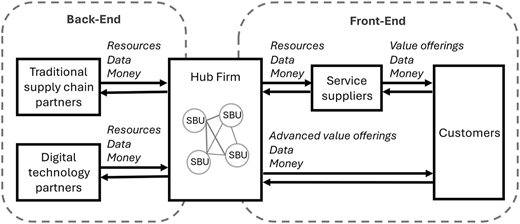
Digitalized service ecosystems are characterized by vast and heterogeneous participants from diverse industries with varying business models, resulting in industry convergence and shifting customer preferences. Such ecosystems represent a sociotechnical network of actors and technologies that collaboratively co-create value, transcending the traditional view of digitalized technologies as merely being part of value creation (Bohnsack et al., 2024). Inspired by the work of Bohnsack et al. (2024) and Wirtz et al. (2023), Figure 1 illustrates the central value exchanges within the digitalized service ecosystem and explains how a focal firm (i.e. the hub) coordinates value creation, exchange, and capture whilst governing customers, complementors, service suppliers, and external business partners, both with digital technology and a more traditional supply chain.
Our unit of analysis in this model is the service ecosystem gravitating around the hub firm, which plays a pivotal role in orchestrating and developing new digitalization strategies (see a comparable approach in Baraldi et al., 2018). This model portrays the hub firm's business model through two lenses: Front-end and back-end, with associated flows of services, assets, data, and money. The front-end consists of the customer-facing service delivery system and interface, whilst the back-end addresses the hub firm's relationships with business partners. These dynamics are essential in understanding the transformational role of digitalization strategies with service ecosystems.
The Front-end: Customer and Hub Firm Exchanges. Customers pay money to receive the core offering, and they allow sharing of their operational data with the hub firm and its suppliers to receive customized solutions. For example, Siemens uses IoT and cloud-based digital platforms to provide predictive maintenance services, enabling customers to understand their needs in real time and optimize their operations. Customers receive value through digitally optimized service delivery via customization, optimization, and enhanced convenience (Bohnsack et al., 2024). The data are not only useful for the firm's own service delivery but can also serve as input for business partners at the back-end of the ecosystem, where they open opportunities for further data analytics and optimizing predictive models (Wirtz et al., 2023). Although consumers may sometimes be able to opt out of their data being used by the firm and its business partners, this typically does not apply to anonymized data. These kinds of data can be re-purposed for various outputs (e.g. predictive analytics), unrelated to the service transaction upon which they are based (Andrew and Baker, 2021).
The Back-end: Business Partner Exchanges. The back-end of the service ecosystem encompasses two main groups of business partners and their interactions with the hub firm. First, traditional supply chain partners complement the hub firm by providing raw materials and services that contribute to the value chain. In return, they receive monetary compensation from the hub firm. Sharing market information and analytics with traditional suppliers can enhance the supply chain's planning and productivity (Wirtz et al., 2023). Second, digital technology partners deliver advanced services and innovative technologies designed to augment the hub firm's core offerings whilst providing cost-effective solutions. For instance, service firms such as banks utilize self-service technologies and chatbots to enhance customer interactions. Rather than developing and manufacturing these technologies in-house, banks collaborate with specialized technology providers, such as IBM's WatsonX, an AI software solution, to implement cutting-edge customer-facing solutions. The design and functionality of these technologies frequently dictate how a hub firm engages with its customers and the types of data collected. Digital technology partners not only deliver solutions that benefit the hub firm but also leverage the data provided by the firm to improve their own market offerings and technology optimizations (Wirtz et al., 2023).
The service ecosystem model demonstrates how the hub firm coordinates value creation, exchange, and capture whilst governing front-end interactions with customers and back-end interactions with diverse traditional supply chain and digital technology partners. Significant value creation and capture potential exist when a hub firm effectively orchestrates and governs its ecosystem. Consequently, aligning all actors and technologies within the ecosystem becomes essential as the hub firm pursues new digitalization strategies.
4. Conceptual model of digitalization strategy in service ecosystems
Existing literature suggests that firms gradually evolve and adapt their service ecosystems (Kolagar et al., 2022; Mann et al., 2022). They start by formulating digitalization strategies internally and then communicate the formulated strategies to their business partners to gain external legitimacy (Mann et al., 2022). As part of this process, the hub firm may incorporate new actors, refine the roles of existing actors, and, if necessary, replace some actors within the ecosystem. Whilst the integration of new actors and reconfiguration of the role of existing actors enables the hub firm to pursue digital transformation of the service ecosystem, several tensions may arise between new and existing actors as well as between new and existing ecosystem governance processes.
Grounded in inter-organizational tensions (Pressey and Vanharanta, 2016) and empowerment (Conger and Kanungo, 1988; Li et al., 2024) perspectives, this study proposes a conceptual model (Figure 2) to elucidate how different aspects of a digitalization strategy act as both enablers and catalysts for tensions within service ecosystems. Understanding the implications of these strategies is essential for the hub firm to understand how to pursue digital transformation by empowering actors within the ecosystem and managing tensions between governance processes and stakeholders. Instead of treating tensions and empowerment as isolated phenomena, they are assessed in the context of interdependent dynamics that co-evolve in the multi-actor service ecosystem. The following sections and Table 2 outline how different aspects of a digitalization strategy act as both enablers and catalysts for tensions within service ecosystems.
4.1 The impacts of digitalized resources on service ecosystem orchestration
New digitalized technology resources, such as IoT, cloud computing, and advanced information systems, serve as powerful enablers of ecosystem orchestration by facilitating data sharing, automating processes, and interconnecting equipment and machinery (Kamalaldin et al., 2020; Kowalkowski et al., 2024). These technologies can provide structural empowerment by decentralizing and automating decision-making through real-time data sharing (Kowalkowski et al., 2024). For instance, IoT enables real-time data collection, monitoring, and automation, while 5G connectivity accelerates data transmission, and cloud-based computing enhances accessibility and provides digital control points (Paiola and Gebauer, 2020). These elements furnish firms' necessary infrastructure for rapid responses to market changes and improve service processes (Piccoli et al., 2022). Furthermore, the modular design and self-contained value of digital resources facilitate their integration, allowing for collaborations and co-creation of novel solution offerings (Kamalaldin et al., 2020; Li et al., 2024). This collaborative approach enables firms to create and capture value effectively within increasingly complex digitalized service ecosystems.
Whilst digitalized resources promote ecosystem coordination, they may also create structural tensions associated with ecosystem governance and control (Tiwana et al., 2010). The interrelation between horizontal and vertical connections within service ecosystems can become a source of friction, particularly when dominant firms establish control points that limit the autonomy of smaller participants (Volberda et al., 2021). For example, hub firms may centralize critical infrastructure and dictate terms of resource access for other actors within ecosystems, which can restrict the strategic flexibility of smaller suppliers. These access controls can constrain the ability of smaller firms to innovate and compete effectively. Beyond structural tensions, psychological tensions may also emerge within ecosystems, stemming from the lack of transparency, mistrust, and strategic misalignment among actors (e.g. Kamalaldin et al., 2020). This can, in turn, lead to behavioral tensions such as active resistance to the integration of digitalized resources. For instance, while digital passports are designed to enhance security and interoperability, they can also exacerbate psychological tensions if firms perceive that differing standards create unequal advantages, leading to reluctance in adoption. These tensions can erode cooperation, reducing the effectiveness of service ecosystems in fostering innovation and value co-creation (Piccoli et al., 2022).
Despite such challenges, firms that strategically manage digitalized resources can mitigate tensions whilst leveraging structural and resource empowerment to enhance ecosystem orchestration (Li et al., 2024). Establishing clear governance frameworks, promoting data-sharing agreements and data standardization, and ensuring equitable access to digital infrastructures can help alleviate structural tensions. Trust-building initiatives, such as transparent communication and collaborative innovation, help mitigate psychological and behavioral tensions, ensuring service ecosystems remain resilient, inclusive, and sustainable. The use of digital resources can enhance efficiency, though their successful integration depends upon effective management to address governance, control, and inter-organizational relationship complexities.
4.2 The impacts of information architectures on service ecosystem orchestration
Enterprise information architecture focuses on information-centric principles, models, standards, and processes guiding cross-organization IT decisions. It can guide the coherent design and implementation of organizational resources, processes, and information management within a firm. The planning and implementation of digitalization strategies tends to produce clashes between digital and non-digital means and various interests in a service ecosystem (Kohtamäki et al., 2019), and architectures can serve both as enablers and simultaneously generate structural, psychological, and behavioral tensions.
A key structural tension arises with respect to control of architectures, shifting from the hegemony of individual firms to the broader ecosystem level. This transition intensifies the complexity of intertwining technology with human and exacerbating psychological tensions amongst systemic actors engaged in co-opetition for service contracts (Kowalkowski et al., 2024; Tóth et al., 2022). The case of Airbus exemplifies this with Skywise, where a hub firm develops an environment and new policies (as part of their information architecture) for sharing real-time data across airlines and suppliers. Despite being collaborative, this sparked behavioral tensions as partner airlines questioned their data sovereignty, fearing a data monopoly (Tóth et al., 2022; Airbus, 2025).
Additionally, Tóth et al. (2022) found that information superabundance, although an enabler, paradoxically creates psychological and behavioral tensions for customers. Their study shows that a maritime firm perceived the increased transparency of its digital ecosystem as both a blessing and a curse, as customers gained the ability to scrutinize every fault in their equipment, potentially harming the firm's reputation and customer relationships. There are also cases where apprehensions about reliance on an information system owned by a powerful actor in an ecosystem (e.g. the TradeLens system co-owned by IBM and Mærsk) can lead other actors to resist participation in favor of broader governance models (Kowalkowski et al., 2024). These cases underline structural tensions related to architecture, as firms navigate the trade-offs between operational continuity, openness, robust data governance, and cybersecurity.
Despite these tensions, information architecture enables substantive advancements across service ecosystems. For example, BBVA bank has leveraged a digital accounts API to facilitate co-development of mobile banking apps with its business partners, but also to comply with the EU's PSD2 regulation regarding controlled exposure of customer data (Piccoli et al., 2022). Similarly, the engineering firm ABB leveraged enterprise architecture to provide maritime customers with smoother operations and improved fleet control. By integrating marine solutions that enhanced navigation, ABB orchestrated a complex service ecosystem through structural and resource empowerment, exemplified by the delegation of authority to fleet managers and investment in digital infrastructure (Huikkola and Kohtamäki, 2018). Likewise, CEMEX Go software, through its various apps, integrates customer and operational systems to streamline customer account management. It tracks and monitors resource allocations for efficient customer order processing, thus enhancing satisfaction in different ecosystems (Zaki, 2019).
4.3 The impacts of digital platforms on service ecosystem orchestration
Digital platforms serve as central hubs for integrating different digital resources as well as actors within ecosystems, aggregating customers at the front-end and business partners at the back-end (Tian et al., 2021). The openness of platforms to external partners lays a foundation for fostering diverse digital offerings (Filosa et al., 2025). These platforms enable firms to collect data from customers' connected equipment (Porter and Heppelmann, 2014) and integrate digital resources from partners. The data and resources, leveraging data analytics, help firms offer tailored and differentiated solutions for customers (Jovanovic et al., 2022).
From the resource empowerment perspective, digital platforms facilitate equitable resource distribution by providing access to resource pools, allocating new roles for ecosystem development, and attracting external resources (Heikinheimo et al., 2024). For example, Scania uses APIs as a platform governance tool to facilitate interactions amongst the customers and service providers, ensuring regulated data-sharing (Skjutar, 2024). They enable hub firms to expand ecosystems, enforce data governance, and ensure compliance with legal and regulatory requirements (Jovanovic et al., 2022).
Digital platforms, from the structural empowerment perspective, enable firms to transition from linear value chains to dynamic and open ecosystems that foster greater collaboration and efficiency (Heikinheimo et al., 2024). By decentralizing decision-making and facilitating real-time data exchange, these platforms empower various actors (e.g. back-end suppliers, front-end service providers) to engage in more responsive and informed interactions. For example, Caterpillar globally connects 1.2 million customers' equipment and 160 solution partners via their CatConnect platform. The platform facilitates the collection of high-volume equipment data from customers and enhances services in collaboration with partners to improve customers' operations (Caterpillar, 2023). This structural empowerment strengthens partnerships and drives service innovation and operational efficiency by harnessing digital connectivity and enabling distributed decision-making across the service ecosystem.
Despite these benefits, digital platforms often create tensions. First, structural tensions can arise due to the openness of digital platforms, resulting in a free rider effect, when different actors misuse customer data for their own benefit, diminishing the hub firm's incentive to make the entire platform open to all suppliers (Cennamo and Santaló, 2019). Psychological tensions can be caused by insufficient transparency in operations and algorithms (Bamberger et al., 2025; Schmück et al., 2025). Such opacity undermines trust amongst ecosystem partners, exacerbating concerns regarding potential data privacy issues, breaches, unauthorized access, and data misappropriation by participating actors (Filosa et al., 2025), recapitulating the free rider effect.
Additionally, behavioral tensions may also emerge from inadequate communication between back-end suppliers and customers, when each actor follows differing organizational processes and norms. A high number of actors and activities can lead to communication overload, making it hard to filter relevant information (Smania et al., 2024). Decentralized communication, such as mixed use of digital channels (e.g. email, Chat channels), further contributes to inconsistencies and inefficiency (Heikinheimo et al., 2024). The resulting tensions collectively impede value co-creation by disrupting coordination and diminishing the overall effectiveness of digital ecosystems (Cenamor et al., 2017).
To mitigate tensions through resources and structural empowerment, a hub firm should establish clear enterprise data governance policies and standards to manage data collection, storage, sharing, and usage, addressing concerns such as privacy and ownership (Smania et al., 2024; McCullough, 2024). Effective platform governance requires both formal controls, such as formal contracts and informal governance mechanisms, including shared norms and values (Marzi et al., 2023; Huber et al., 2017).
4.4 The impacts of CDR on service ecosystem orchestration
The hub firm may play a central role in ethical accountability, yet CDR cannot be enacted in isolation; instead, it is embedded within a network of interdependent actors who collectively influence digital responsibility (Breidbach and Maglio, 2020). Within a service ecosystem, interactions between the hub firm, customers, and business partners involve a continuous exchange of services and data (Wirtz et al., 2019). These exchanges can give rise to structural tensions, particularly concerning the trade-off between data monetization and customer privacy (Wirtz et al., 2023). While data-driven innovation generates significant value, it may simultaneously cultivate a predatory culture of data collection (Andrew and Baker, 2021). The issues of overcollection of data and opaque data usage are particularly heightened when business partners prioritize analytics-driven monetization over data protection.
A second layer of tension arises from psychological and behavioral misalignment amongst ecosystem actors. Psychological tensions may occur when stakeholders perceive discrepancies in priorities and values regarding the benefits of CDR and possible opportunity costs (Wirtz et al., 2023). Behavioral tensions can manifest when technology partners prioritize proprietary control over algorithms (Breidbach and Maglio, 2020). From creation and operation to refinement, retention, and end-of-life destruction, the data lifecycle must be managed with transparency. However, inconsistencies in transparency and digital literacy across an ecosystem can engender ambiguous accountability (Hartley et al., 2024), leading to mistrust and behavioral misalignment. Moreover, in the absence of consistent governance mechanisms and adequate digital literacy, smaller business partners may struggle to adhere to CDR guidelines, while larger technology providers may resist oversight, thereby further complicating accountability structures.
To mitigate these tensions and foster the adoption of CDR strategies, a hub firm must implement empowerment strategies that align actors toward shared ethical responsibilities. These can include financial incentives, capability-building investments, strategic allocation of digital resources, and data and knowledge-sharing mechanisms that promote ethical development. In the context of the hub firm-customer relationship, empowering consumers through the provision of agency and alternative methods for accessing services, while simultaneously informing them about the data collected regarding their interactions, serves as a form of resource empowerment (Breidbach and Maglio, 2020; Wirtz et al., 2023). In the context of the hub firm-business partners' relationships, digital tools (e.g. blockchain-based data verification systems) can be used to decentralize datasets without transferring sensitive customer data (Wirtz et al., 2023). For instance, Apple introduced its Privacy Manifests tool and privacy-preserving Software Development Kits to ensure that third-party applications uphold data protection standards (Apple Developer, 2023).
Resource empowerment becomes more effective when combined with structural empowerment (Li et al., 2024), such as governance frameworks, training, and accreditation systems that institutionalize CDR practices across the ecosystem. The hub firm must actively engage business partners through educational programs, including digital literacy training and the dissemination of CDR policies (Hartley et al., 2024; Wirtz et al., 2023). Such empowerment ensures compliance while fostering trust and aligning values. Furthermore, accreditation programs that acknowledge responsible practices can address visibility gaps, enabling smaller firms with ethical standards to gain credibility (Li et al., 2024).
4.5 Interplay and alignment between enablers and tensions
We contend that the central challenge for a hub firm is not the elimination of tensions, as they are intrinsic to ecosystem evolution, but their effective management. Successful digital transformation and service ecosystem orchestration depend on aligning enablers with empowerment mechanisms. Alignment occurs when empowerment does not outpace legitimate concerns and when tensions are treated as useful signals that guide governance and investment. Misalignment arises when empowerment magnifies unresolved tensions or when tensions are muted without changes in strategy or architecture. This view extends the prior research by positioning alignment as the central mechanism that enables hub firms to pursue digitalization in service ecosystems successfully.
Alignment is contingent on the specific focus of the digitalization strategy. When digital resources take the lead, alignment depends on clear control points and access rights, while using resource empowerment to provide fair infrastructure and data visibility. When information architectures are central, alignment requires transparent rules for data origin and data sharing, supported by structures that define decision rights, data governance, controls, and compliance pathways. As digital platforms continue to shape the ecosystem, alignment depends on platform governance that balances openness with safeguards and communication practices that reduce information overload and ambiguity. When CDR is in focus, alignment relies on auditable processes, accreditation, and capability building so that ethical commitments become actionable across diverse partners. In each case, the hub firm designs both the technical configuration and the social contract that legitimizes participation.
Viewing strategy implementation through this lens creates a feedback loop. The outcomes of service ecosystem orchestration provide insights for iterative adjustment. Managerial learning unfolds on two levels. First, managers can refine the strategy itself. If a new information architecture triggers behavioral tensions, such as information overload between actors, managers can redesign communication workflows, data protocols, and data governance mechanisms. Second, managers must keep working on the alignment between enablers and tensions. If new digital resources do not produce collaboration because mistrust persists, firms should reinforce structural empowerment through transparent data agreements or joint innovation projects that build confidence.
Over time, alignment becomes a continuing routine rather than a one-off intervention. It is not a static match, but an ongoing process in which empowerment mechanisms are tuned to evolving tensions as strategies unfold. The hub firm can institutionalize such regular sense-making routines that compare intended and experienced governance, monitor indicators of psychological safety and trust, and connect these observations to clear escalation and redesign procedures. By embedding these routines into platform governance and information architectures, the ecosystem develops a shared capacity to rebalance empowerment and constraint as conditions change. In this way, digital transformation remains both responsible and resilient, enabling service ecosystem orchestration to progress with reduced friction.
5. Theoretical contributions and future research agenda
This study offers several theoretical contributions. We advance the literature by adopting the service ecosystems lens to conceptualize how firms implement digitalization strategies not in isolation, but through systemic and dynamic interactions with ecosystem partners. Prior literature often treats digitalization as a firm-level initiative (e.g. Cenamor et al., 2017), overlooking the relational complexities across the service ecosystem. In contrast, we propose a conceptual model that maps value exchanges within the service ecosystem and details how a hub firm coordinates value creation, exchange, and capture between both the front-end (customer-facing) service delivery actors and the back-end relationships with traditional and digital technology partners. This extends research on service ecosystems by articulating how digitalization strategy transforms interdependencies and actor roles.
Our study goes beyond research that has explored various aspects of digitalization strategies in isolation (e.g. digital platforms in Cenamor et al., 2017; Filosa et al., 2025) by synthesizing four aspects of digitalization strategies into a comprehensive conceptual model (i.e. digital resources, information architecture, digital platforms, and CDR). We explain that each aspect of a digitalization strategy can act as the empowerment mechanism and a source of tension when reconfiguring ecosystem orchestration. We distinguish between different types of empowerments (resources, structural) as well as different types of tensions (structural, psychological, and behavioral). Based on the synthesis of extant research (Table 2), we outline how these tensions and empowerment effects can occur. Above and beyond, we propose that alignment between enablers and tensions is the central mechanism in digital transformation and service ecosystem orchestration. We move beyond treating tensions as barriers by showing how hub firms can manage them with intent through coupled empowerment and governance adjustments. We contend that the interplay and alignment between empowerment and tension shape governance and investment decisions, which ultimately influence how hub firms and their business partners collaboratively orchestrate service ecosystems when implementing new digitalization strategies. Furthermore, we reframe strategy implementation as a continuous and iterative process that focuses on refining strategy content, supporting the alignment between empowerment and tensions, and fostering orchestration as the service ecosystem evolves.
Finally, our study contributes to the evolving literature on CDR (e.g. Wirtz et al., 2023). We assessed CDR using the service ecosystem lens to explain how its challenges originate and manifest within the broader ecosystem, how hub firms can design empowerment mechanisms to mobilize actors towards responsible digitalization, and how tensions related to data monetization, privacy, and ethical technology development can be addressed through ecosystem-wide CDR initiatives. We contend that ethical challenges are not limited to single firms but emerge from the complex interdependencies among a hub firm, its customers, and various partners. Hub firms can address potential tensions that arise from digital transformation of the ecosystem by establishing robust data governance frameworks, enhancing transparency, and implementing targeted capability-building programs. Such measures promote both resource and structural empowerment, ensuring that responsible digital practices become an integral part of the ecosystem's transformation.
To this end, our study provides an advanced understanding of relational dynamics involved in implementing digitalization strategies within the service ecosystem. By elucidating how digital resources, information architectures, platforms, and CDR can act as both enablers and sources of tensions, our study not only deepens theoretical insights but also informs practical strategies for effective ecosystem governance. These findings offer valuable guidance for both researchers and practitioners navigating the complexities of digital transformation and ecosystem management in today's rapidly evolving business environment.
Moving forward, we outline several promising avenues for future research across three themes in Table 3. The proposed research agenda explains how our conceptual model provides a foundation for further empirical investigations and theoretical advancements in this domain. First, digitalization strategies play a dual role in shaping service ecosystems, as they empower firms whilst simultaneously creating tensions that must be managed through appropriate governance mechanisms. Future research should explore how firms reconcile these tensions by adopting relevant enabling mechanisms (e.g. governance models), particularly in the context of evolving digital platforms and enterprise information architectures. Given that fully or largely autonomous technologies such as Agentic AI are fundamentally reshaping collaboration dynamics, it is essential to understand how these technologies influence value co-creation for customers and other ecosystem actors. The shift from firm-centric control to ecosystem-level governance raises critical questions regarding power distribution, collaboration, and the equitable capture of value in a stridently digitalized era. Future studies should investigate how digital platforms can balance openness and control whilst mitigating potential governance conflicts, such as free-rider effects and data misuse.
Second, customer perceptions represent another critical area for further investigation. As firms accelerate digital transformation, understanding how customers perceive and respond to these changes becomes increasingly important. Future research should explore the conditions under which customers view digitalization as a means for firms to serve their own interests instead of enhancing customer value. Additionally, firms should ensure customer readiness before embarking on large-scale digital initiatives, yet research on how they can manage this transition effectively remains limited. Investigating the governance mechanisms that facilitate collaboration between firms and customers in co-developing digitalization strategies will also be crucial. This line of inquiry should include an assessment of contractual agreements, trust-building strategies, governance, information architecture, and co-creation mechanisms that ensure digitalization remains customer-centric.
Third, CDR in digitalized service ecosystems warrants further scholarly attention. As firms integrate digitalization strategies, ensuring compliance with CDR principles amongst business partners presents a significant challenge. Future research should examine the role of shared governance models in fostering mutually beneficial CDR adherence and the extent to which ethical and unethical CDR practices influence the engagement of key ecosystem actors such as suppliers and customers. Additionally, emerging concerns about “machine washing”—where firms use AI-driven digitalization to create a misleading impression of ethical responsibility—must be explored in greater depth. Scholars should investigate which actors within different industries are more susceptible to violating CDR principles and why this may be. Lastly, the role of technology partners in ensuring responsible digitalization through contractual and other governance mechanisms, such as information and data governance, contract penalty clauses, and liability shifting, remains an underexplored area with important managerial, policy, and transformation implications.
Given that the discourse on CDR remains in its early stages, this is an apt time to develop standardized metrics to systematically evaluate the effectiveness of CDR implementation. Establishing such measurement frameworks would facilitate cross-industry comparisons, ensuring that CDR initiatives are assessed in terms of governing strategic alignment, trustworthiness, and fairness in ecosystems. These principles represent operational practices and essential safeguards against surveillance capitalism, a concept coined by Zuboff (2019) that describes the practice of reducing individuals to sources of predictive raw material through excessive behavioral data extraction. This results in dehumanization, structural injustice, algorithmic discrimination, and privacy concerns (Wirtz et al., 2023). Without standardized CDR frameworks, the handling of vast volumes of sensitive data by service industries becomes particularly susceptible to the systematic exploitation of consumer vulnerabilities under the guise of digital innovation.
Finally, the empirical testing of the conceptual work presented in this study (Figures 1 and 2) can be approached through multiple complementary methods. Multi-actor case studies can provide in-depth insights into how the hub firm orchestrates value creation, exchange, and capture across front-end customer and back-end partner interactions as well as how hub firms leverage digitalization to empower actors while managing structural, psychological, and behavioral tensions in the service ecosystem. Structured questionnaires can quantify perceptions of empowerment, tension, and orchestration effectiveness among relevant actors. Network analysis can map relational structures, interdependencies, and flows within the ecosystem, highlighting the centrality of the hub firm and interaction patterns. Longitudinal data analysis allows for examining the evolution of tensions and the impact of digitalization strategies on ecosystem performance over time, while experimental designs can potentially test causal effects of specific interventions.
6. Managerial implications
Digital transformation often extends beyond a firm's boundaries, requiring data sharing with business partners, integration of services through APIs, and collaboration via digital platforms. Although these capabilities can facilitate value creation, they also introduce complexities and tensions within the broader service ecosystem. Our study emphasizes that successful digital transformation requires empowerment of business partners and customers whilst proactively managing tensions across the service ecosystem. This study provides managers with a comprehensive understanding of how emerging digital resources, platforms, and enterprise information architectures can both facilitate and challenge service delivery.
First, proactive identification of various types of tensions is essential for effective digitalization. Although such awareness alone does not constitute a solution, it represents a critical preliminary step toward refining digitalization strategies and establishing effective tension management processes. The tensions identified during the implementation of new strategies and service ecosystem orchestration require managers to adjust different aspects of digitalization strategies and to work on the alignment between enablers and these tensions. Execution exposes where design assumptions fail, which tensions are productive, and which require further action. Managers should treat early orchestration frictions as diagnostic information that reveals whether the current mix of structural and resource empowerment fits the emerging governance reality of the ecosystem. Rather than interpreting resistance as a barrier to be removed, managers can read it as evidence of a misspecified process, an opaque algorithmic rule, or an imbalanced allocation of value that calls for recalibration.
Managerial adjustment proceeds along two intertwined paths. The first path refines the digitalization strategy itself. Managers revisit choices about data granularity, interface openness, modularity of resources, and scope of platform capabilities, making targeted changes that reduce unnecessary interdependence and clarify rights and obligations. The second path strengthens alignment. This includes establishing forums that make tensions discussable, building shared vocabularies for risk and value, and sequencing empowerment and governance so that investments in access, training, and verification arrive in step with new responsibilities. Together, these adjustments convert tensions from sources of breakdown into deliberate design inputs that improve ecosystem orchestration.
Second, to manage the complexity of digital transformation and alignment between enabling mechanisms and tensions, firms increasingly need leadership roles that go beyond general technology oversight. New specialized leadership roles, such as Chief Data Officer, Head of Enterprise Architecture, and Head of Enterprise Information Architecture (these roles are likely to be director-level in practice), alongside Chief Technology Officers, provide the dedicated accountability needed to address different aspects of digitalization. In 2025, the increasing number of job postings for Chief Data Officer and Head of Enterprise Architecture roles on employment platforms, such as Indeed.com and LinkedIn.com, suggests that many leading firms (e.g. SAP, Aviva, and Sainsbury) are actively establishing these positions to support their digitalization strategies. These roles work in tandem to ensure internal readiness (e.g. robust information and data governance and architectural alignment) and external effectiveness (e.g. orchestrating the digital ecosystem and ensuring that CDR principles are in place). The Chief Technology Officer role alone is often insufficient to address the comprehensive scope of digital transformation challenges.
Lastly, our study recommends that managers embed CDR proactively within their internal policies and across the wider ecosystem by promoting transparency, privacy, fairness, and accountability. While new practices, standards, and decision-making processes can strengthen ethical conduct, they may also disrupt established routines and create new tensions. To address this, managers should take practical steps such as offering digital literacy programs for employees and partners, developing explicit ethical guidelines and codes of conduct (with particular emphasis on data and AI ethics and governance), and providing structured training on responsible technology use and governance. The CDO can play a pivotal role in this process by championing policies for responsible data sharing that protect customers and partners, embedding data ethics, security, and compliance into organizational practices, and strengthening trust and collaboration across the service ecosystem. By institutionalizing CDR in these ways, managers can build trust, ease potential tensions, and foster a responsible digital transformation that benefits all stakeholders. Beyond organizational benefits, standardizing CDR in service ecosystems can have profound societal implications, such as mitigating social exclusion, surveillance capitalism, and structural injustice.