


Besides the direct physical health consequences, through social isolation COVID-19 affects a considerably larger share of consumers with deleterious effects for their psychological well-being. Two vulnerable consumer groups are particularly affected: older adults and children. The purpose of the underlying paper is to take a transformative research perspective on how social robots can be deployed for advancing the well-being of these vulnerable consumers and to spur robotic transformative service research (RTSR).
This paper follows a conceptual approach that integrates findings from various domains: service research, social robotics, social psychology and medicine.
Two key findings advanced in this paper are (1) a typology of robotic transformative service (i.e. entertainer, social enabler, mentor and friend) as a function of consumers' state of social isolation, well-being focus and robot capabilities and (2) a future research agenda for RTSR.
This paper guides service consumers and providers and robot developers in identifying and developing the most appropriate social robot type for advancing the well-being of vulnerable consumers in social isolation.
This study is the first to integrate social robotics and transformative service research by developing a typology of social robots as a guiding framework for assessing the status quo of transformative robotic service on the basis of which it advances a future research agenda for RTSR. It further complements the underdeveloped body of service research with a focus on eudaimonic consumer well-being.
COVID-19 acts as a major disruptive factor for service consumers. The concerted world-wide quarantine measures that impose on consumers to live in social isolation have immediate and long-term detrimental psychological health consequences (Brooks et al., 2020). These negative effects are exacerbated for vulnerable consumer groups, particularly older adults and children (Holmes et al., 2020). Even with easing of the COVID-19 measures, a significant share of vulnerable consumers likely continues to live under restricted social contact and suffers from durable negative psychological health outcomes (e.g. older adults who represent a high-risk group; World Health Organization, 2020a).
A promising avenue to counter the adverse consequences of social isolation for vulnerable consumers is provided by the field of social robotics (e.g. de Graaf et al., 2015). Social robots are physically embodied agents designed for assisting and engaging in social interactions with humans in their everyday lives (Fong et al., 2003). An example is Pepper [1], a social robot that can interact with humans through conversation and its touch screen. Social robots can provide service to consumers without human interaction and may, thus, be deployed to create uplifting changes for consumer well-being during COVID-19 and beyond.
Even though the past decade of service research has witnessed the foundation and surge of how service can transform the well-being of consumers (Anderson, 2010; Anderson et al., 2013; Anderson and Ostrom, 2015; Gustafsson et al., 2015), alongside an increasing accentuation of the role of robots in service (Čaić et al., 2018; Mende et al., 2019; van Doorn et al., 2017; Wirtz et al., 2018), a systematic integration of social robots and transformative service research (TSR) is still in a nascent stage. As a consequence, the question of how social robots might assist vulnerable consumers to attenuate, or even reverse the negative psychological health consequences of social isolation and advance well-being, remains unaddressed.
The underlying paper draws from the fields of social robotics (e.g. de Graaf et al., 2015), medicine (e.g. Hawkley; Cacioppo, 2010), social psychology (Ryan and Deci, 2001) and service research (e.g. Anderson et al., 2013) to derive interdisciplinary insights into how social robot service may improve vulnerable consumer well-being when facing social isolation. In doing so, it aims to contribute to service theory and practice by advancing a social robot perspective of TSR: robotic TSR (RTSR), which we define as the integration of social robot and transformative service research that focuses on well-being-relevant outcomes of consumer and employee interactions with social robots. First, this study synthesizes findings from social robotics based on a typology of robotic transformative service to derive an understanding of the status quo and future potential of transforming vulnerable consumer well-being in social isolation. Second, it extends this synthesis and identifies a future research agenda for the newly identified sub-area of RTSR.
COVID-19 and social isolation
Extended periods of social distancing and isolation can seriously deteriorate the psychological well-being of individuals (Brooks et al., 2020). The consequences of the worldwide measures to combat COVID-19 force consumers into a deficiency of social contact or objective social isolation (Hawkley and Cacioppo, 2010; Steptoe et al., 2013). Though few individuals may lead solitary lives without feeling lonely, generally recent evidence documents a significant predictive effect of social disconnectedness on subjective social isolation (Santini et al., 2020). The latter is equated with loneliness or the distress concerning the quality or quantity of one's social relationships.
In particular, this subjective state of social isolation is associated with severe negative implications for physical, psychological and cognitive health (Hawkley and Cacioppo, 2010). Various longitudinal studies suggest subjective social isolation as a risk factor for physical health deterioration and mortality (e.g. Cacioppo et al., 2002; Holt-Lunstad et al., 2015; Steptoe et al., 2013). Further, it is associated with increased moodiness and depression (Cacioppo et al., 2006), faster cognitive decline and an intensified sensitivity to social threats (Bassuk et al., 1999; Cacioppo and Hawkley, 2009). Subjective social isolation is most prevalent among children and older adults (Pinquart and Sorensen, 2001), making them a particularly vulnerable consumer group during COVID-19.
Vulnerable consumer needs and well-being
Consumer vulnerability can be described as “a state in which consumers are subject to harm because their access to and control over resources are restricted in ways that significantly inhibit their ability to function in the marketplace” (Hill and Sharma, 2020, p. 1). Thus, this paper focuses on those consumers who are especially prone to suffer mental health consequences during COVID-19; non-adolescent children before puberty and people of 65 years of age and older (Holmes et al., 2020), which will be simply referred to as children and older adults in the remainder of the paper (Kabadayi et al., 2020). Depending on their degree of agency and autonomy, these groups may, particularly, struggle with accessing services that can help them overcome suffering through resource losses (e.g. Henkel et al., 2017); hence, they both deserve specific attention from service research and offer ample potential for service to positively transform their well-being (Anderson et al., 2013). Accordingly, the World Health Organization (2020b) emphasized the potential repercussions of COVID-19 measures on the mental health of exactly these two vulnerable groups and advocated their guidance.
Research on well-being is broadly approached from one of two perspectives: hedonic and eudaimonic (Ryan and Deci, 2001). Hedonic well-being is equated with pleasure and happiness and often operationalized as satisfaction and positive affect or the absence thereof (Diener, 2012; Diener and Lucas, 1999). The eudaimonic form defines well-being along a set of dimensions that promote meaning and self-realization (e.g. environmental mastery, personal growth and positive social relations; Ryff, 1989) to advocate fully functioning individuals (Rogers, 1963). Integrating both approaches, the underlying study explores the potential of service to promote the well-being of vulnerable consumers. Depending on the circumstances they are facing, vulnerable consumers may benefit most from services with an emphasis on hedonic (e.g. entertainment) or eudaimonic (e.g. life-coaching) well-being in order for them to overcome the negative consequences of social isolation and thrive in the marketplace. Yet, particularly eudaimonic consumer needs may become significantly more pronounced during periods of crises (Barnes et al., 2020). The next section discusses one particularly promising angle of how service can achieve this goal by deploying social robots.
The transformative potential of social robots
As a consequence of COVID-19, human service delivery became potentially harmful or in its extremes even lethal to both service providers and consumers (Miriri, 2020). Hence, a particularly promising avenue for service research to support vulnerable consumers during COVID-19 and beyond lies in social robot service. Social robots may increase consumers' access to and control over resources and decrease their vulnerability without violating physical distancing or isolation in their pursuit of well-being (Henkel et al., 2017; Hill and Sharma, 2020). Indeed, findings from social robotics in the context of vulnerable consumers report various ways for social robots to promote well-being. For instance, robots that promote social connectedness (e.g. telepresence robots and socially assistive robots) may decrease objective and subjective social isolation for vulnerable consumers including older adults (e.g. Robinson et al., 2014) and children (e.g. Moerman et al., 2019).
Prior research shows that social robots can function as emotional and social actors (Čaić et al., 2019; de Graaf et al., 2015) with a clear transformative mission. They demonstrate social behavior, following the norms of human social interaction (e.g. touch and emotional reactions; Wang and Rau, 2019). With these abilities, social robots create social presence and are perceived as social agents (van Doorn et al., 2017), particularly by children (Kahn et al., 2012) and older adults (Heerink et al., 2009). There is ample evidence in the field of social robotics that vulnerable consumers in social isolation not only promote hedonic (e.g. cheering up) but also eudaimonic well-being. For instance, robots may stimulate environmental mastery and personal growth through advancing communication skills and learning experiences (Baxter et al., 2017; Crompton et al., 2018; Khaksar et al., 2019). They may also help to form positive social relationships, such as assuming roles in socialization, companionship, developing emotional relationships, comforting, coping with stress, anxiety and other negative emotional experiences and supporting ties with other people (Cañamero and Lewis, 2016; Crossman et al., 2018; D'onofrio et al., 2019; Khaksar et al., 2016; Melson et al., 2009).
Robotic transformative potential in times of COVID-19 and beyond – a typology
This section synthesizes findings in the social robotics literature that are relevant for the well-being of vulnerable consumers facing social isolation. Structuring the status quo and the required future roles of transformative robotic service along three dimensions resulted in four distinct types of robotic transformative service. As depicted in Figure 1, the types are a function of (1) the predominant state of social isolation (i.e. objective vs. subjective), (2) the desired or required well-being emphasis (i.e. hedonic vs. eudaimonic) and (3) robot physical and psychosocial capabilities. As theorized here, the transformative potential of social robots is dependent on future technological advancements, particularly for those consumers who encounter severe subjective social isolation and who require structural support to attain eudaimonic well-being goals. Importantly, the different types resemble the authors' interpretation of respective findings in the literature, and they do not imply a corresponding construal from an emic perspective.
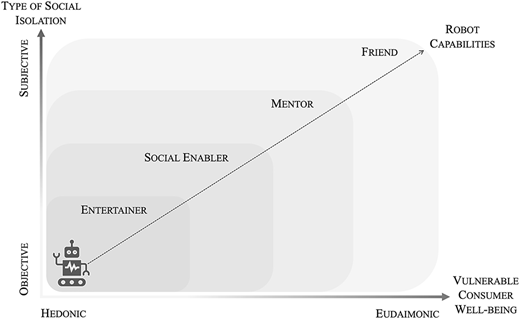
To date, robots with empathetic artificial intelligence (AI) (Huang and Rust, 2018) and human-level physical capabilities (Adalgeirsson and Breazeal, 2010; He et al., 2017) are not yet market ready. However, exactly these types of social robots could provide complex transformative service, based on physical touch, social expressiveness and relationship building (Huang and Rust, 2018). Below, we delineate in detail the transformative potential of each robot type for vulnerable consumers in social isolation, starting with those already being deployed to provide transformative service (i.e. entertainer and social enabler), and concluding with the types that are subject to current (i.e. mentor) and future (i.e. friend) research and development.
Market-ready robotic transformative service roles
Entertainer. The entertainer robot might be most suitable to serve consumers who face imposed social disconnectedness and, hence, merely experience minor psychological discomfort (e.g. boredom). The entertainer's social capabilities are limited since this robot type is preprogrammed to perform simple and repetitive social tasks. The entertainer may also be less equipped to console consumers through its touch due to its confined physical dexterity and basic embodiment. Its main transformative potential is hedonically oriented and lies in amusing consumers to increase their momentary affect as an end in itself (e.g. enjoyment when playing a game; Leite et al., 2008; dissipation in states of momentary solitude; Odekerken-Schröder et al., in press). It might be deployed to prevent both older adults and children from experiencing minor psychological discomfort during isolation periods (Heljakka and Ihamäki, 2020). An example is Alibaba's DWI Dowellin, a small robot on wheels which entertains users by singing and dancing (Alibaba, 2020).
Social enabler. As a social enabler, the robot may unfold its transformative potential by mediating social interactions for vulnerable consumers. The social enabler robot is not yet imbued with empathetic intelligence; however, with its improved physical capabilities (i.e. physical touch and mirroring social gestures) it can resemble authentic social contact (Rosenthal-von der Pütten et al., 2018). For instance, it can simultaneously display social contacts on screen and simulate their gestures and expressions through its artificial limbs (Adalgeirsson and Breazeal, 2010). During social isolation, this robot type may enable children to continue interacting with their peers and tutors and connect older adults with family, friends, and healthcare service providers from a distance. It might, thus, help socially isolated vulnerable consumers form and maintain positive social relations, and thereby improve academic performance (Furrer and Skinner, 2003) and affective well-being (Schmidt et al., 2019) for children and diminish the negative effects of social isolation on physical (Cornwell and Waite, 2009) and mental (McInnis and White, 2001) health for older adults. Hence, the social enabler bears the potential to transform aspects of both hedonic and eudaimonic consumer well-being. An example is the MeBot, a small robot with two controllable arms and a big display that shows the interaction partner's face (Adalgeirsson and Breazeal, 2010).
Future-oriented robotic transformative service roles
Mentor. Assuming a mentor role, transformative robotic service is predominantly directed at supporting vulnerable consumers in overcoming threats to their pursuit of eudaimonic well-being. During social isolation, both children and older adults are deprived of transformative, self-actualizing services which usually require the presence of a professional service provider (e.g. education, physio- and psycho-therapy). A mentor robot type may autonomously engage consumers on a professional, social and empathetic level while exhibiting nearly human-level physical capabilities (e.g. navigation, touch and object manipulation). With such capabilities, mentor robots could embody school teachers and hobby instructors (Niemiec and Ryan, 2009) or physiotherapists (Bhuvaneswari et al., 2013).
Recent findings document that social educational robots can increase consumers' productivity, language skills and physical, cognitive and social–emotional learning experiences (Baxter et al., 2017; Crompton et al., 2018; Khaksar et al., 2019). Likewise, regular physical activity with mentor type robots has been shown to ensure older adults' mobility (Bhuvaneswari et al., 2013; Lopez Recio et al., 2013) prolonging their ability to live independently. Although vulnerable consumers may experience hedonic pleasure during these interactions (Čaić et al., 2019), mentor robots may particularly promote long-term eudaimonic well-being outcomes for children and older adults alike. While such robots are used in research, no fully autonomous version that integrates all mentor-type capabilities exists in the marketplace yet that could substitute a human service provider (Čaić et al., 2019). In the future, an example robot for children and older consumers could be physically advanced versions of ICP's Keeko (Low, 2018) or Pal Robotics' GrowMu (Georgiadis et al., 2016), respectively. Both robots combine human-like facial features with verbal communication abilities.
Friend. As a friend, the robot unfolds its transformative potential for vulnerable consumers who experience psychological distress (e.g. loneliness and lack of relatedness) due to both objective and subjective social isolation (Brooks et al., 2020). A friend robot may mitigate these negative consequences through quasi-social interactions. As envisioned here, this type of transformative robotic service would require an empathetic intelligence for rapport building and human-level haptic behaviors (e.g. touching and hugging) to provide solace through physical touch (Tanaka et al., 2007). As a friend, the robot could help alleviate the negative effects of social isolation by providing both hedonic and eudaimonic well-being in the form of genuine care and emotional comfort (Lehoux and Grimard, 2018), personalized service (Robinson et al., 2014; Sorell and Draper, 2014) and rebuilding self-esteem (Leite et al., 2012). Initial evidence suggests that children and older adults may perceive prototypes of such autonomous robots as social beings (Kahn et al., 2012) and friends (Cañamero and Lewis, 2016; Sinoo et al., 2018). While robots assuming a mentor role may predominantly provide eudaimonically oriented professional transformative service, as genuine, loving companions, friend type robots could cater to the entirety of well-being aspects (Crossman et al., 2018; Kachouie et al., 2014). In the future, such a robot might be a significantly advanced version of Pepper, equipped with an empathetic AI.
Discussion and future research agenda
Vulnerable consumers routinely face adverse circumstances in the marketplace. With the advent of COVID-19, increased social distancing has raised the hurdles to participate in the marketplace for all consumers, and it has exacerbated the social isolation of vulnerable consumers in particular. This study advances a typology of transformative robotic service that integrates work on social isolation (e.g. Hawkley; Cacioppo, 2010), well-being (Ryan and Deci, 2001) and social robotics (e.g. de Graaf et al., 2015) with the aim to cater to the underrepresented group for vulnerable consumers in service research (Rosenbaum et al., 2017).
The typology is derived based on two of the most affected vulnerable consumer groups during COVID-19: children and older adults (Holmes et al., 2020; World Health Organization, 2020a), and its main objective is to guide service researchers, practitioners and consumers on the potential of robotic service to offset the negative consequences of social isolation (Brooks et al., 2020) now and in the future. Figure 2 provides an overview of the conceptual integration of the robot typology into the transformation of hedonic and eudaimonic well-being of vulnerable consumers in the (post) COVID-19 reality. With an increasing level of sophistication of capabilities, social robots are already equipped to provide transformative service as entertainers and social enablers and in the foreseeable future also as mentors. However, the full spectrum of eudaimonic well-being will likely only be provided by a friend-type robot which does not yet exist in the marketplace. We therefore encourage social robot research and development to focus on designing such a service with the aim to better support vulnerable consumers with a comprehensive focus on eudaimonic well-being.
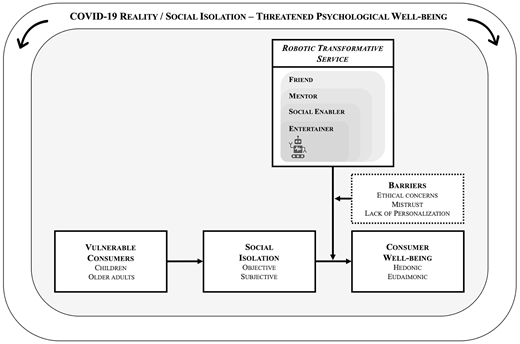
The theoretical integration of social robot service and well-being suggests a novel, interdisciplinary perspective on the role of service in creating uplifting changes for consumers (Anderson, 2010; Anderson et al., 2013; Anderson and Ostrom, 2015; Gustafsson et al., 2015). Traditionally, a majority of service research has documented predominantly ephemeral, positive (e.g. Oliver et al., 1997) or negative hedonic effects on consumer affect (e.g. Bougie et al., 2003) – mostly as an unintended consequence of service. This study offers an integrative well-being perspective to service and thereby also supplements research on the eudaimonic well-being of consumers (e.g. Guo et al., 2013; Henkel et al., 2017). Through identifying context-dependent (i.e. state of social isolation/well-being emphasis) transformative roles of social robots, the underlying paper identifies a new sub-area for TSR: robotic transformative service research (RTSR).
In accord with the literature review in the field of social robotics on the various roles that transformative robotic service can assume in enhancing the well-being of vulnerable consumers, Table 1 advances an illustrative compilation of future research avenues for RTSR. The agenda is organized along three main topics: (1) the transformative potential of social robots as entertainers, social enablers, mentors and friends, (2) barriers to robotic transformative service potential and (3) eudaimonic consumer well-being. In two additional columns, the table condenses the existing knowledge on each respective topic with exemplary research findings and outlines concrete future research avenues for RTSR. These questions are grouped in themes ranging from robot to service design, over consumer perceptions, ethical considerations and the assessment of robot-facilitated well-being. Rather than providing an exhaustive overview, Table 1 is meant as a catalyst to stimulate research on RTSR.
Status quo and future research agenda on RTSR in times of COVID-19 and beyond
| Topic | What we know | Future research agenda | |
|---|---|---|---|
Transformative potential of social robots as
| Robot roles
| Service context
| |
| Barriers to robotic transformative potential | Dehumanization and loss of privacy
| Ethical concerns
| |
| Eudaimonic well-being | Psychosocial health
| Measuring well-being
| |
The COVID-19 crisis offers a futuristic perspective on the changing role of service. While many services are provided remotely, some are suspended entirely (e.g. Hall et al., in press). For those services that service consumers and providers are still able and required to cocreate physically, social distance is the first priority (cf. Bove and Benoit, in press). It is conceivable that consumers may continue to hold an increased sensitivity toward social interactions with service providers that outlasts COVID-19 (cf. Hazée and van Vaerenbergh, 2020), which may in turn also affect employee well-being (Tuzovic and Kabadayi, in press). Eventually, these developments may surge service innovation (cf. Heinonen and Strandvik, in press). A rapid adoption of automated service may be a consequence. While the underlying paper advances a typology of such robotic service to cater to the well-being of vulnerable consumers facing the abyss of the consequences of social isolation, in the future, transformative robotic service may be considered for creating uplifting changes in well-being for consumers at large.
This paper forms part of a special section “The Coronavirus Crisis and Beyond: Implications for Service Research and Practice”, guest edited by Dr. Volker G. Kuppelwieser and Dr. Jörg Finsterwalder.The authors want to express their gratitude to the organizers of the 2018 Let's Talk About Service (LTAS) workshop in Ghent (Belgium), and particularly Prof. Bart Larivière, for facilitating the collaboration that has led to this project. Further, the authors want to thank Niloofar Borghei Razavi for her valuable feedback on an earlier draft of this paper.Funding: This research was supported by the Province of Limburg, The Netherlands, under grant number SAS-2019-00247 and the Foundation for Economic Development, Finland (lsr.fi).

