


This study examine how provider- and customer-related factors interact to influence servitization success. It adopts the transaction cost theory along with a configurational approach and hypothesizes that different configurations of five key conditions—service offering, specific investments, perceived customer opportunism, willingness for integration and demand uncertainty—can lead to servitization success or failure.
The study applies fuzzy-set Qualitative Comparative Analysis (fsQCA) to a sample of 143 German manufacturers, addressing the complex causalities involved in servitization success.
The analysis identifies six sufficient configurations for servitization success and five for servitization failure. The findings reveal that servitization can succeed through various types of service offerings. While opportunism does not hinder success, the decision to offer an extensive service portfolio is influenced by anticipated opportunism and complex customer needs. Specific investments function primarily as drivers for success, particularly when combined with a limited service offering and complex customer needs. However, these investments can increase transaction costs when linked to an extensive service portfolio. Though not essential, customer integration emerges as a relevant success factor, acting as a safeguard against opportunism.
Servitization can be successful even with opportunism. Developing methods to assess customers’ readiness for integration can mitigate opportunistic behavior and foster successful servitization.
This study advances servitization research by addressing the often-overlooked interplay between provider- and customer-related factors. Applying the transaction cost theory and a cutting-edge fsQCA, it contributes to the theoretical and methodological plurality of the field.
1. Introduction
In response to competitive pressures from low-cost economies and the commoditization of physical products (Luoto et al., 2017), manufacturers are increasingly pursuing servitization—the shift from product-centric to service-centric business models (Kowalkowski et al., 2017). This transition aims to generate stable revenues (Fang et al., 2008) and enhance competitiveness by delivering unique customer value (Kowalkowski et al., 2015). While companies such as Rolls Royce, ABB and IBM exemplify successful servitization, others encounter the “servitization paradox,” where expected higher returns fail to materialize (Brax et al., 2021). For instance, ThyssenKrupp divested its industrial solutions unit and KONE scaled back modular solutions (Gomes et al., 2021; Kowalkowski et al., 2017).
Although meta-analyses confirm a positive link between servitization and performance (Wang et al., 2018; Faramarzi et al., 2023), the mechanisms driving success or failure in this context remain poorly understood (Lexutt, 2020; Salonen et al., 2021). The purpose of this study is to shed light on the complex causal mechanisms of servitization success and failure.
This study addresses four key limitations in servitization literature. First, most servitization research prioritizes provider-related success factors (Fliess and Lexutt, 2019), despite the acknowledged importance of customer co-evolution with suppliers for successful outcomes (Matthyssens and Vandenbempt, 2010; Petri and Jacob, 2016). While recent literature reviews highlight this dynamic (Garcia Martin et al., 2019; Raddats et al., 2019), empirical studies on the customer’s role remain sparse. The present study explicitly considers the interplay of provider- and customer-related factors.
Second, existing studies often adopt a resource- and capabilities-based perspective (e.g. Raddats et al., 2017; Forkmann et al., 2017; Elgeti et al., 2020), emphasizing customer relationships as sources of knowledge (Böhm et al., 2017) and capabilities (Raddats et al., 2017). Although valuable, such approaches overlook critical challenges, including heightened tensions (Stegehuis et al., 2023), risks (Worm et al., 2017) and uncertainties (Kreye, 2018) inherent in close supplier–customer collaboration. Moreover, they fail to address the interplay of service offerings, specific investments and opportunism—factors that significantly raise transaction costs and can hinder servitization success (Faramarzi et al., 2023). Furthermore, when prominent recipes for success are widely disseminated within an industry, competitive advantage deteriorates over time (Faramarzi et al., 2023). Thus, it is crucial to consider multiple theoretical perspectives to produce managerially relevant insights (Rabetino et al., 2021a, b).
To this end, the present study employs a transaction cost approach. Transaction cost theory or transaction cost economics (TCE), is a well-established theory in marketing and management research (Williamson and Ghani, 2012). However, its application to servitization research is underutilized (Kohtamäki et al., 2019a), with few notable exceptions (e.g. Zhang et al., 2019; Wang et al., 2018; Heirati et al., 2023; see Faramarzi et al., 2023 for a detailed review).
TCE suggests opposing effects on servitization performance (Faramarzi et al., 2023), with specific investments for service provision playing a crucial role in it. On one hand, these investments increase the risk of opportunistic customer behavior, raise transaction costs and may impede servitization success (Williamson, 1981). On the other hand, they contribute to building trust in the relationship and may even reduce transaction costs, positively impacting servitization success (Palmatier et al., 2007). These dynamics are further complicated by the presence or absence of opportunism, reciprocal investments and demand uncertainty (Cuypers et al., 2021). This indicates that the causal mechanisms underlying servitization success from a TCE standpoint are non-linear and complex, necessitating a configurational approach (Furnari et al., 2021).
Therefore, this study adopts a neo-configurational approach, combining configuration theory with set-theoretic methodology (Misangyi et al., 2017). Drawing on TCE, it examines configurations of providers’ service offerings and specific investments, alongside customers’ perceived opportunism, willingness for integration and demand uncertainty to understand servitization success and failure. Servitization success is conceptualized as a causally complex phenomenon, characterized by equifinality, conjunctural causation and asymmetry (Furnari et al., 2021). Empirically, the concept is studied using fuzzy-set Qualitative Comparative Analysis (fsQCA) (Misangyi et al., 2017).
Existing quantitative research predominantly adopts net-effects approaches, which are insufficient for capturing complex causality (Lexutt, 2020). Even though the neo-configurational approach has gained momentum in recent servitization research (Brax et al., 2021; Kohtamäki et al., 2019a; Kramer et al., 2024; see Salonen et al., 2021 for an overview), none of the studies examining servitization success configurationally fully address the aforementioned research gaps (see Table 2).
Overview of configurational studies on servitization success
| Configurational studies of servitization success | Research focus | Research gaps adressed | ||
|---|---|---|---|---|
| Focus on provider and customer-related success factors | Theoretical/conceptual approach | Successful and unsuccessful cases examined | ||
| Böhm et al. (2017) | Configurations of service strategy, resources and knowledge for service revenue growth | Yes | Resource-based view | No |
| Forkmann et al. (2017) | Configurations of service offering, service pricing, service capabilities and the servitization process for mutual value creation | Yes | Capabilities | Yes |
| Ambroise et al. (2018) | Configurations of service strategy and customer-oriented organizational design elements for overall profitability | No | Customer-oriented organizational design | No |
| Bustinza et al. (2019) | Configurational examination of the make-or-buy decision in servitization and its impact on performance | No | Capabilities | No |
| Sjödin et al. (2019) | Identify innovation governance, relational governance and market-based governance strategies as equifinal paths to success for advanced service providers | Yes | Relational governance and institutional theory | No |
| Lexutt (2020) | Configurations of SSP, SSC, the existence of a separate service organization, decentralization, management commitment, service culture for financial, non-financial and overall service success | No | Contingency theory | Yes |
| Heirati et al. (2023) | Configurations of organization architectures (make-or-buy) and different servitization approaches for high financial performance | No | TCE | No |
| This study | Configurations of providers service offering and specific investments and customers opportunism, integration and demand uncertainty for servitization success | Yes | TCE | Yes |
Source(s): The above table was created by the author
Strikingly, causal asymmetry is often neglected in configurational studies on servitization success, which only report results on successful cases (Böhm et al., 2017; Ambroise et al., 2018; Bustinza et al., 2019; Sjödin et al., 2019; Heirati et al., 2023). Causal asymmetry is critical for grasping servitization success and an important pillar of fsQCA, which circumvents logical contradictions while facilitating robust findings and contributions. Extant case-based research also predominantly focuses on successful cases, limiting our understanding of servitization success as a causally asymmetric phenomenon (Lexutt, 2020). To address this, the present study explicitly examines both successful and unsuccessful cases.
Section 2 presents a literature review on TCE in the context of servitization and introduces the neo-configurational approach, succeeded by a presentation of the configurational model. Section 3 outlines the methodology—fsQCA. Results are outlined in Section 4, followed by the discussion in Section 5. Section 6 concludes with suggestions for management and future research.
2. Theoretical and conceptual background
2.1 Transaction cost theory
The fundamental premise of TCE is that economic actors set organizational boundaries by “assigning transactions (which differ in their attributes) to governance structures (the adaptive capacities and associated costs of which differ) in a discriminating way” (Williamson, 1985, p. 18) to minimize transaction costs and, consequently, enjoy performance benefits. TCE builds on two behavioral assumptions: bounded rationality and opportunism (Cuypers et al., 2021). Bounded rationality means that economic actors are “intendedly rational, but only limitedly so” (Williamson, 1981, p. 553). Besides costs associated with gathering and processing information, TCE posits that actors have limited analytical and data-processing abilities, which constrain information processing and complex problem-solving, even when the necessary information is available (Cuypers et al., 2021). This also means decision-makers’ perceptions of uncertainty or opportunism can deviate from objective reality, constituting perceptual measures particularly relevant for TCE research (Cuypers et al., 2021).
The second behavioral assumption, opportunism (defined as seeking self-interest with guile) (Williamson, 1979), implies that actors do not always disclose complete information, provide impartial assessments of likely results or behave cooperatively in economic exchanges (Cuypers et al., 2021). TCE, therefore, acknowledges that individuals have varying propensities for opportunism, which can pose hazards for their exchange partners.
TCE centers around the idea that establishing and maintaining contracts for exchange incurs search, information, contracting and enforcement costs, which are referred to as transaction costs (Williamson, 1996). The level of transaction costs depends on three key characteristics: the type and degree of transaction or relation-specific assets, the level of uncertainty in the exchange and the frequency of transactions (Williamson, 1979).
Asset specificity, or the extent of specific investments made, is considered the most important driver of transaction costs (Williamson, 1981; Cuypers et al., 2021). These investments represent assets that are committed and cannot be redeployed within the exchange relationship (Palmatier et al., 2007). Their value in alternative uses is significantly lower than in specialized uses, leading to a state of “lock-in” within the relationship (Williamson, 1981). This situation exposes the actors to opportunistic behavior from their exchange partners (Artz and Norman, 1999).
Consequently, it becomes imperative to establish safeguards, such as reciprocal investments (Williamson, 2010; Cuypers et al., 2021). When both providers and customers make relationship-specific investments, a “mutual reliance relation” is formed (Williamson, 1996). This mutual reliance reduces the likelihood of opportunistic behavior from either party, as the potential for opportunism can be offset with retaliatory measures (Artz and Norman, 1999). Ultimately, the success of an exchange is influenced by the level of specific investments made by the exchange partners and the occurrence of opportunistic behaviors (Palmatier et al., 2007).
These effects are exacerbated by environmental uncertainty, as uncertainty in technological, legal and demand aspects increases the risk of opportunistic actors exploiting their information advantages (Cuypers et al., 2021). While Williamson (1981) originally differentiated between behavioral and environmental uncertainty, most studies on TCE focus on the latter due to the significant overlap between behavioral uncertainty and the assumption of opportunism (Cuypers et al., 2021). The current study also follows this approach, focusing on demand uncertainty as the customer-related element of environmental uncertainty.
The third transaction characteristic, frequency has received little attention in theoretical and empirical work even though it is an inherent part of TCE (Cuypers et al., 2021) and is not considered in this study as well.
2.2 Examining servitization success through a transaction cost lens
TCE is famously employed to explain strategic decisions, specifically “make-or-buy” decisions and governance mechanisms for establishing and maintaining contracts (Williamson, 1981; Cuypers et al., 2021). This approach is also prevalent in servitization research. In the context of the solution business, Salonen and Jaakkola (2015) employ TCE and governance costs to explore the preferable approach for managing interdependence among solution elements. Sjödin et al. (2019) focus on relational governance and identify three alternative configurations of governance strategies for achieving financial performance with advanced servitization. Heirati et al. (2023) examine the make-or-buy decisions of servitized equipment manufacturers and identify configurations of organizational architectures and different servitization approaches to achieve high financial performance.
The present study follows a stream of research that applies TCE to predict organizational performance (e.g. Artz and Norman, 1999; Palmatier et al., 2007; Noordewier et al., 1990). In the context of servitization, it is often argued that the increased transaction costs that accompany a more complex and integrative service offering are responsible for low performance (e.g. Zhang et al., 2019; Li et al., 2021) or failure (Benedettini et al., 2015). Zhang et al. (2019) found a negative servitization-performance relationship at both low and high levels of servitization and attributed this finding to increased adjustment and coordination costs, respectively. Particularly, a complex service offering incurs coordination costs (Zhang et al., 2019), arising from establishing effective linkages and managing task interdependencies between the product and service business (Raddats et al., 2017). They also arise from increased interactions with customers and suppliers (Kohtamäki et al., 2019b). This is echoed by Korkeamäki et al. (2021), who suggest that the complexity endemic in outcome-based services increases transaction costs, which may be a hurdle to achieving profitability. Additionally, Kohtamäki et al. (2019b) propose that the coordination and integration required in an ecosystem for autonomous smart solutions offerings entail high transaction costs.
In contrast, servitization is also posited to reduce transaction costs by emphasizing long-term customer relationships (Oliva and Kallenberg, 2003). This notion is corroborated by Boehmer et al. (2020), who find that long-term service agreements enabled by the Internet of Things (IoT) foster trust in the relationship, consequently lowering costs associated with searching, adapting, monitoring and controlling. Similarly, Huikkola et al. (2022) propose that proper alignment among products, services and software can alleviate the initially higher transaction costs associated with offering smart solutions.
When applying TCE to the servitization context, the crux of the matter lies in specific investments. Generally, specific investments increase transaction costs, negatively impacting servitization success (Worm et al., 2017). On the other hand, they improve cooperation and commitment (Palmatier et al., 2007), positively impacting servitization success. These opposing effects are further complicated by opportunism, reciprocal investments and uncertainty (Cuypers et al., 2021). The complex theoretical mechanisms suggested by the study are discussed below and summarized in Table 1.
Opposing effects on servitization success postulated by TCE
| Conditions | Postulated theoretical mechanism | |
|---|---|---|
| Negative effect on servitization success | Positive effect on servitization success | |
| Service offering (SSP and SSC) | Offering services incurs transaction costs, which can offset profitability effects. (Zhang et al., 2019) Offering services, particularly SSC, transfers risks to the provider, increasing transaction costs. (Worm et al., 2017) | Offering services fosters long-term cooperation with customers, reducing the frequency of transactions and transaction costs. (Boehmer et al., 2020) |
| Specific investments | Offering services requires specific investments, more so for advanced services (SSC) than for basic services (SSP). (Worm et al., 2017; Kamalaldin et al., 2020), increasing transaction costs | Specific investments lead to improved cooperation and trust between the partners, reducing transaction costs (Palmatier et al., 2007) |
| Customer opportunism | Specific investments expose providers to opportunism, increasing transaction costs (Worm et al., 2017) | |
| Customer integration | High levels of customer integration increase transaction costs (Li et al. (2021) | The customers’ willingness for integration serves as a safeguard against opportunism, as a mutual reliance relation is formed (Williamson, 1996) |
| Demand uncertainty (Complexity of customer needs) | Demand uncertainty increases the risk of specific investments, increasing transaction costs, (Williamson, 1996) Demand uncertainty increases the risk of opportunism (Mungra and Yadav, 2023) | Under demand uncertainty, the presence of crucial information shared within a partnership becomes more valuable and amplifies the positive impact of specific investments on performance (Palmatier et al., 2007) |
Source(s): The above table was created by the author
Compared to products, services exhibit a higher level of asset specificity, owing to the integration of customer factors into the service process (Li et al., 2021). The adaptations and modifications made by service providers to their processes and practices to foster mutual value creation with a specific customer (Grönroos and Helle, 2010) are considered specific investments. Direct interactions between the provider and customer are often essential (site and temporal specificity); developing and delivering services necessitate specialized knowledge and investments in human capital (human asset specificity); and customization typically involves the use of specialized components (dedicated assets) (Faramarzi et al., 2023). Particularly advanced, customer process-related services and solutions require a substantial level of relation-specific investments and co-specialized assets (Worm et al., 2017; Kamalaldin et al., 2020). Furthermore, providing process-related services often entails assuming responsibility for the customer’s processes and transferring the risks from customer to provider (Worm et al., 2017; Pieringer and Totzek, 2022). As a consequence, while specific investments are inherent in the solutions business, they may increase risk exposure (Boehmer et al., 2020), raise transaction costs and pose challenges to profitability and servitization success (Worm et al., 2017).
Despite their impact on transaction costs, relation-specific investments also signal the commitment of exchange partners and enhance the exchange’s value-creation potential (Palmatier et al., 2007). Partners’ investments in training, customized procedures or specialized interfaces improve the exchange relationship’s functional capabilities, resulting in value creation through lower interaction costs and improved innovations, which ultimately yields higher performance (Palmatier et al., 2007).
Specific investments increase the provider’s dependence on a particular customer, making them vulnerable to potential customer opportunism (Worm et al., 2017; Pieringer and Totzek, 2022). As a result, power imbalances can arise (Boehmer et al., 2020). The possibility of opportunistic behavior undermines commitment to the co-creation process, as concerns about being exploited erode trust in the relationship (Rönnberg Sjödin et al., 2016). This is especially critical for advanced solutions and outcome-based contracts, where the customer may manipulate information regarding usage or costs to reduce payment to the provider (Pieringer and Totzek, 2022; Hypko et al., 2010; Reim et al., 2018). On the other hand, specific investments have been shown to foster trust and relational norms among buyers (Rindfleisch and Heide, 1997), which helps mitigate the risk of opportunistic behavior.
Therefore, to achieve success in servitization, a provider must not only secure customer cooperation but also mitigate the occurrence of opportunistic behavior effectively. This can be achieved by implementing safeguards like reciprocal investments and by fostering customer integration (Boehmer et al., 2020).
Servitization entails a value co-creation process (Kowalkowski et al., 2012), where value is jointly created with customers and partners (Vargo and Lusch, 2008). The effective integration of provider–customer resources and processes is therefore essential for successful servitization (Tuli et al., 2007). Significant interdependencies are created when both parties make relation-specific investments, such as sharing information, dedicating specific resources or adjusting processes, leading to a relationship of mutual reliance (Williamson, 1996). These interdependencies serve as catalysts for nurturing firm commitment and cooperation, ultimately resulting in more stable and productive working relationships (Heide and John, 1992). Reciprocal investments have been found to positively impact performance (Artz and Norman, 1999). Kamalaldin et al. (2020) argue from a relational view that reciprocal relation-specific investments are critical for advanced digital services.
Conversely, this means that if the customer does not participate in service development, production and delivery, value co-creation cannot take place (Grönroos and Voima, 2013). Customers’ willingness to engage in value co-creation fluctuates, with customers potentially reducing information flows or withdrawing completely from co-creation efforts (Burton et al., 2016). Li et al. (2021) argue from a TCE perspective that high levels of customer integration harm profitability from basic services, as the corresponding information sharing and openness of the provider may lead to opportunistic behaviors from the customer.
The propensity of actors to behave opportunistically is increased by environmental uncertainty (Mungra and Yadav, 2023). Demand uncertainty in particular increases the level of uncertainty in transactions—and consequently, transaction costs—because the risk of specific investments and opportunistic exploitation is higher when customer needs change rapidly and unpredictably (Williamson, 1996). Demand uncertainty poses challenges for decision-makers’ information processing due to bounded rationality (Rindfleisch and Heide, 1997), resulting in opposing effects. In uncertain environments, sharing crucial information within a partnership becomes more valuable and amplifies the impact of specific investments on performance (Palmatier et al., 2007). Conversely, in stable environments where knowledge is evenly distributed, the potential of relationship-specific investments to enhance performance by leveraging a partner’s asymmetric information is limited (Dyer, 1996). Indeed, relation-specific investments have been found to generate higher returns in dynamic, heterogeneous environments characterized by complex customer needs (Palmatier et al., 2007).
In servitization, customers’ increasing changes in how they want to satisfy their needs and define their core competencies amplify the need for service outsourcing (Fischer et al., 2010). Complex customer needs, therefore, drive the demand for services and are also causally related to performance (Gebauer et al., 2011). Zhang et al. (2019) find that the dynamism and complexity of customer preferences moderate the servitization-performance relationship, with servitization becoming more effective under high demand uncertainty.
2.3 Neo-configurational approach to servitization success
The previous discussion shows that service offerings, asset specificity, customer opportunism, customer integration and demand uncertainty interact in complex ways, increasing or decreasing transaction costs depending on their presence or absence as well as on how they are aligned with each other. These factors ultimately affect servitization success. The opposing theoretical mechanisms and inconclusive empirical findings clearly indicate complex causality that cannot be captured with traditional net-effects approaches that assume linear causality (Misangyi et al., 2017). Furthermore, the phenomenon of servitization success is inherently complex, underlining the prevalence of complex causality (Lexutt, 2020).
As illustrated in Table 2, few studies examine servitization success configurationally, adopting appropriate set-theoretic methodology (e.g. Böhm et al., 2017; Forkmann et al., 2017; Ambroise et al., 2018; Bustinza et al., 2019; Sjödin et al., 2019; Lexutt, 2020; Heirati et al., 2023). Most of them do not consider customer-related success factors (Ambroise et al., 2018; Bustinza et al., 2019; Lexutt, 2020; Heirati et al., 2023). Only Heirati et al. (2023) explicitly follow a TCE approach, while Sjödin et al. (2019) draw on institutional theory, which is closely related to TCE.
Lexutt (2020) shares conceptual and methodological similarities with this study, particularly in its use of configurational logic and approach to conceptualizing and measuring servitization success, SSP and SSC. However, it still does not address the identified gaps (see Table 2). Rooted in contingency theory, it focuses exclusively on provider-related conditions. Given that configurational logic inherently accommodates multiple pathways to success, it is crucial to examine the causally complex phenomenon of servitization success from diverse theoretical perspectives to gain a multi-faceted, comprehensive view. Thus, Lexutt (2020) and the present paper are complementary in understanding servitization success through a configurational lens.
The neo-configurational approach of this study examines the complex causalities underlying servitization success from a TCE perspective, addressing both provider and customer-related factors.
Configurations are defined as “inherently multidimensional entities in which key attributes are tightly interrelated and mutually reinforcing” (Dess et al., 1993, p. 784). The configurational approach explicitly addresses complex causality (Furnari et al., 2021), which is characterized by equifinality, conjuncturality and asymmetry (Schneider and Wagemann, 2012).
Equifinality is the most widely recognized element of complex causality in servitization research (Brax et al., 2021; Kohtamäki et al., 2019a). It means that different configurations of causal factors can lead to the same result (Ragin, 2008), i.e. several equifinal paths can lead to servitization success (Lexutt, 2020; Ambroise et al., 2018; Forkmann et al., 2017; Böhm et al., 2017).
Conjuncturality implies that a causal condition might exert an effect only in conjunction with other causal conditions or that its effect differs depending on the conditions with which it is combined (Schneider and Wagemann, 2012).
Finally, asymmetric causation means the presence and absence of an outcome are explained by different combinations of causal conditions (Schneider and Wagemann, 2012). Many configurational studies in servitization do not fully account for causal asymmetry, as they do not report analyses for the absence of the outcomes (Böhm et al., 2017; Ambroise et al., 2018; Bustinza et al., 2019; Sjödin et al., 2019). However, to fully grasp the causalities underlying servitization success, it is crucial to examine both successful and unsuccessful cases, as done in this study.
The outcome of interest in this study is servitization success. Servitization is defined as successful if it demonstrates both a positive direct impact on the financial performance of the service business, indicating profitable services (Oliva et al., 2012), as well as a positive indirect impact on firm performance, including customer acquisition, retention and contributions to the product business (Raddats et al., 2015). Like Lexutt (2020), who endorses the importance of a configurational approach for studying servitization success, as well as for conceptualizing and measuring it in terms of both financial and non-financial performance, the present study closely follows this approach.
As TCE suggests opposing mechanisms on service profitability through increased or decreased transaction costs, as well as “soft” effects on relationship quality, both financial and non-financial servitization success are considered. While the primary objective of servitization is to achieve higher profitability through service offerings (Oliva et al., 2012), there are cases where services aim to strengthen the product-related business instead (Salonen and Jaakkola, 2015; Salonen et al., 2017). Furthermore, the potential negative effects of servitization on relational performance can counteract its otherwise beneficial impact on financial performance (Harrmann et al., 2023). Hence, it is also crucial to consider the indirect, non-financial or “soft” performance implications of services (Harrmann et al., 2023).
This study employs the stages of Scoping and Linking of the configurational theorizing process (Furnari et al., 2021) to build the configurational model (see Figure 1). In the Scoping phase, TCE is used as a theoretical anchor to identify attributes that form causally relevant configurations for servitization success. The key explanatory attribute is asset specificity. In the configurational model, specific investments capture the provider’s investments in customer relationships regarding training, customized support and personal relationships (Palmatier et al., 2007). The focus lies on temporal and human asset specificity, which are particularly relevant in the service context (Faramarzi et al., 2023).
 The figure shows two columns on the left that contain three ovals vertically. The two columns of oval shapes are placed under the respective headings “Provider-related” and “Customer-related”. Under “Provider-related”, the top oval is labeled “Services supporting the product (Antioco et alia 2008)”, followed by a second oval labeled “Services supporting customer processes (Antioco et alia 2008)”, and a third oval labeled “Specific investments (Palmatier et alia 2007)”. Under “Customer-related”, the top oval is labeled “Opportunistic behavior (Palmatier et alia 2007)”, followed by a second oval labeled “Willingness for integration (Tuli et alia 2007; Helander and Möller 2008)”, and the bottom oval labeled “Complexity of customer needs (Gebauer et alia 2011)”. A right-pointing arrow labeled “Set relations” arises from these two columns and points to a Venn diagram with two overlapping circles. The left circle is labeled “Financial service success (Oliva et alia 2012)”. The right circle is labeled “Non-financial service success (Raddats et alia 2015)”. The middle space where the two circles overlap is labeled “Servitization success (Lexutt 2020)”.
Configurational model based on TCE
The figure shows two columns on the left that contain three ovals vertically. The two columns of oval shapes are placed under the respective headings “Provider-related” and “Customer-related”. Under “Provider-related”, the top oval is labeled “Services supporting the product (Antioco et alia 2008)”, followed by a second oval labeled “Services supporting customer processes (Antioco et alia 2008)”, and a third oval labeled “Specific investments (Palmatier et alia 2007)”. Under “Customer-related”, the top oval is labeled “Opportunistic behavior (Palmatier et alia 2007)”, followed by a second oval labeled “Willingness for integration (Tuli et alia 2007; Helander and Möller 2008)”, and the bottom oval labeled “Complexity of customer needs (Gebauer et alia 2011)”. A right-pointing arrow labeled “Set relations” arises from these two columns and points to a Venn diagram with two overlapping circles. The left circle is labeled “Financial service success (Oliva et alia 2012)”. The right circle is labeled “Non-financial service success (Raddats et alia 2015)”. The middle space where the two circles overlap is labeled “Servitization success (Lexutt 2020)”.Configurational model based on TCE
The fact that specific investments are required for successful service provision helps identify further connected attributes in the Linking stage. These include service offering, opportunism, reciprocal investments (i.e. customer integration) and demand uncertainty, which are interconnected.
Focusing on different types of service offerings is often perceived as indicative of different service strategies (Lexutt, 2020; Kohtamaki et al., 2015). While numerous typologies and taxonomies exist, the distinction between services supporting the product (SSP) and services supporting the client (SSC) by Mathieu (2001) is widely applied in quantitative servitization studies (e.g. Forkmann et al., 2017; Lexutt, 2020; Wang et al., 2018), as it subsumes several of the commonalities between existing taxonomies (Raddats et al., 2019). SSP “… ensure the proper functioning of the product and/or facilitate the client’s access to the product,” while SSC aim at supporting different processes, actions and strategies of the customer (Mathieu, 2001, p. 40). Focusing on different types of service offerings carries strategic implications for the organization (Mathieu, 2001), customer integration (Salonen and Jaakkola, 2015) and effects on performance (Forkmann et al., 2017; Lexutt, 2020; Wang et al., 2018; Faramarzi et al., 2023).
Opportunism captures the provider’s perception of the customer’s propensity to opportunistically alter facts, negotiate to meet self-interests and breach formal or informal agreements to benefit themselves (Palmatier et al., 2007).
Customers’ willingness for integration consists of their willingness to share information, adjust processes, provide resources and capabilities and possess a basic understanding of the provider’s business (Tuli et al., 2007; Grönroos and Helle, 2010; Helander and Möller, 2008).
As a source of demand uncertainty, the complexity of customers’ needs is examined. This is an element of a company’s external environment. It captures the extent to which customer requirements change over time, new customers’ needs differ substantially from those of existing customers and customers tendency to constantly seek new offerings (Jaworski and Kohli, 1993).
Due to the limited number of relevant attributes that can be meaningfully interpreted in a configuration (Furnari et al., 2021), reducing complexity requires focusing on providers’ perceptions of customer-related factors. How they perceive customer opportunism, willingness for integration and need complexity influences their strategic and operational decisions, such as the service offering and specific investments, which ultimately impact servitization success. This approach is common, aligning with TCE logic (Cuypers et al., 2021), and has been successfully applied to capture customer characteristics (Elgeti et al., 2020; Powers et al., 2016).
3. Methodology
3.1 Data collection and construct measurement
Data were gathered through an online survey of the German manufacturing sector, with the assistance of a decision-maker panel provider who disseminated the questionnaire to appropriate respondents. The target population consisted of CEOs and upper management of servitizing manufacturers who possess extensive knowledge about the service business and the firm’s financial performance. Respondents were screened based on the core business of their company (only manufacturing sector, NACE-code C), their position in the company (CEOs, upper management, service management) and their knowledge of the service business and financial performance of the firm (high or very high on a scale from 1 to 5). After eliminating questionnaires with a response time of less than half of the median (3 min) (Zhang and Conrad, 2014), the sample consisted of 143 cases.
The sample [1] was diverse, consisting of electrical engineering (43.4%), mechanical engineering (28.7%), automotive (20.3%) and chemical production (7.7%) companies. Among them, 39.9% had fewer than 250 employees, 44% had between 250 and 1,000 employees and 16.1% over 1,000 employees. To test for non-response bias, independent sample t-tests for early and late respondents were conducted. No significant differences were found, so non-response bias does not appear to be an issue in the sample (Hair et al., 2014).
Operationalizations from the extant literature were used for all measures except willingness for customer integration. The measurement scales, items, loadings and composite reliabilities are found in Appendix A. Service profitability is measured with two items from Oliva et al. (2012). Non-financial service success is measured with the construct “success of services” by Raddats et al. (2015). Servitization success is calculated as the conjunction of service profitability and non-financial service success (Lexutt, 2020). Business orientation on SSP and SSC was measured as an index of the number of actively offered services in each category, based on Antioco et al. (2008). Providers’ specific investments and customers’ perceived opportunism were captured by three items each, from Palmatier et al. (2007). The perceived complexity of customer needs was measured with three items from Gebauer et al. (2011). To measure customers’ perceived willingness for integration, four items based on the conceptualizations by Tuli et al. (2007), Helander and Möller (2008) and Grönroos and Helle (2010) were formulated. Providers’ perceptions of customer characteristics were measured. To simplify the following discussion, the variable names do not include the “perceived” qualifier.
For performance, self-reported measures were used. This is a common approach in both marketing (Powers et al., 2016) and operations management literature (Oliva et al., 2012; Shah et al., 2020). Furthermore, managers have been found to accurately assess the performance of their organizations (Singh et al., 2016).
To assess the reliability and validity of the latent constructs, a confirmatory factor analysis (CFA) was conducted. Composite Reliabilities (CR) and Average Variance Extracted (AVE) for the latent constructs, as well as factor loadings for the items (see Appendix for the results), are above established thresholds (Hair et al., 2014). Model fit for the measurement model is satisfactory, given the sample size and the number of constructs (Hair et al., 2014) (x2/df = 1.34; Comparative Fit Index (CFI) = 0.967, Tucker–Lewis Index (TLI) = 0.959, RMSEA = 0.049, SRMR = 0.045). Business orientation on SSP and SSC was measured as an index of the offered services, and therefore, is not included in the CFA.
3.2 Data analysis: capturing complex causality with fsQCA
In line with the neo-configurational approach (Misangyi et al., 2017), this paper applies fsQCA to study configurations for successful and unsuccessful servitization. FsQCA is a case-based method that conceptualizes cases as set-theoretic configurations (Misangyi et al., 2017). Specifically, it applies Boolean algebra and the set-theoretic rules of logical minimization to identify configurations of conditions that are necessary or sufficient for the occurrence and non-occurrence of an outcome (Schneider and Wagemann, 2012). Contrary to the most widely applied statistical methods, fsQCA is capable of capturing complex causality (Mahoney and Goertz, 2006; Woodside, 2015). This study follows the guidelines for best practices as exemplified by Lexutt (2020), Greckhamer et al. (2018) and Schneider and Wagemann (2010).
A core element of the neo-configurational approach is the measurement of cases’ set memberships through calibration (Misangyi et al., 2017). FsQCA uses fuzzy sets that, in addition to the “crisp” set approach of full membership and full non-membership, incorporate degrees of membership of cases in the examined sets (i.e. conditions) (Ragin, 2008). This study applies direct calibration to transform the data into fuzzy-set membership scores (Ragin, 2008). For direct calibration, three thresholds must be established by the researcher: the threshold for full membership (1), the threshold for full non-membership (0) and the point of maximum ambiguity, where membership is 0.5 (Ragin, 2008). Calibration should always be informed by theoretical reasoning and the researcher’s qualitative knowledge of the constructs (Ragin, 2008).
The items for the conditions and for financial and non-financial service success were expressed on a 5-point Likert scale, whose endpoints were used as thresholds for full membership (5 on the scale) and full non-membership (1 on the scale), with 3.9 as the crossover point.
To calibrate the set memberships for SSP and SSC, information from Eggert et al. (2011) and Eggert et al. (2014) on the average number of SSP and SSC offered by German manufacturing companies was compared with present data. For a case to be considered more in than out of the set of high focus of the service offering on SSP (or SSC, respectively), it must actively offer an above-average number of services in each category (Antioco et al., 2008). For SSP, the crossover point was thus set at 2.9 and for SSC at 1.9. Full non-membership was set at 0 services offered in the respective category, while full membership was set at all services offered (12 for SSP and 9 for SSC).
The outcome servitization success was calculated as the conjunction of the two calibrated sets—service profitability and non-financial service success—and did not require calibration.
Viewing causality in terms of necessity and sufficiency relations between sets is the third pillar of the neo-configurational approach (Misangyi et al., 2017). Necessity means an outcome cannot be achieved without the condition, while sufficiency means whenever the condition is observed, the outcome is also observed (Schneider and Wagemann, 2012).
The analyses for necessity and sufficiency are performed separately (Schneider and Wagemann, 2010; Greckhamer et al., 2018). The Set Methods (Oana et al., 2023) and QCA packages (Dusa, 2023) in R have been used to assess both necessary and sufficient configurations for the outcomes. The necessity and sufficiency of subset relations are evaluated through the set-theoretic measures of consistency and coverage. Consistency captures “how closely a perfect subset relation is approximated” (Ragin, 2008, p. 44); coverage reflects the “empirical relevance or importance” of each (unique coverage) or multiple equifinal (solution coverage) configurations (Ragin, 2008, p. 45). These measures are similar to the evaluations of significance and strength in regression analysis (Ragin, 2008).
In the analyses of sufficiency, the inclusion cut-off is set at consistency 0.94, which is well above the recommended 0.80 threshold and is supported by the data (Greckhamer et al., 2018; see truth tables in online supplementary material). A frequency threshold of two cases is applied to avoid drawing conclusions from single cases (Fiss, 2011; Lexutt, 2020).
To account for causal asymmetry, the absence of the outcomes (i.e. unsuccessful cases) is examined in separate analyses (Schneider and Wagemann, 2010). This enables comparisons between success and failure cases and helps uncover the underlying causal mechanisms of the phenomena.
Methodologically, analyses of the presence and absence of the outcome are required to avoid simultaneous subset relations and logical contradictions (Schneider and Wagemann, 2012), particularly concerning contradictory truth table rows. These aspects are mostly neglected in current fsQCA studies in servitization (e.g. Heirati et al., 2023; Forkmann et al., 2017; Böhm et al., 2017; Ambroise et al., 2018; Bustinza et al., 2019; Sjödin et al., 2019). To avoid logical contradictions, this study performs both the Standard Analysis and the Enhanced Standard Analysis as required (Schneider and Wagemann, 2012).
To check for robustness, the protocol by Oana and Schneider (2021) was applied. Robustness tests were performed for alternative models with conceptually justifiable alterations in calibration, raw consistency and inclusion frequency, based on the identified sensitivity ranges. The tests resulted in good fit-oriented robustness (RF_cons 0.933), details of which can be found within the online supplementary material.
4. Results
4.1 Analyses of necessity
No necessary conditions were identified, as no condition or its negation passed the threshold consistency necessity of 0.9 (Schneider and Wagemann, 2012). The results are reported in the Supplementary material. Tests were also conducted to identify supersubset relations (Oana et al., 2021), but no meaningful overarching theoretical constructs were identified. In this study, no single condition (or its absence) is a necessary prerequisite for either servitization success or failure. It is common in applied fsQCA not to identify necessary conditions (Oana et al., 2021), aligning with the assumption of complex, conjunctural causation. Therefore, the absence of necessary conditions does not influence the quality or validity of the sufficiency analyses, which are reported next.
4.2 Analyses of sufficiency
Table 3 illustrates the results of the sufficiency analyses for successful and unsuccessful cases, with the intermediate solution reported. Explanations for directional expectations, the truth tables and Boolean expressions for the different solution types can be found in the supplementary material.
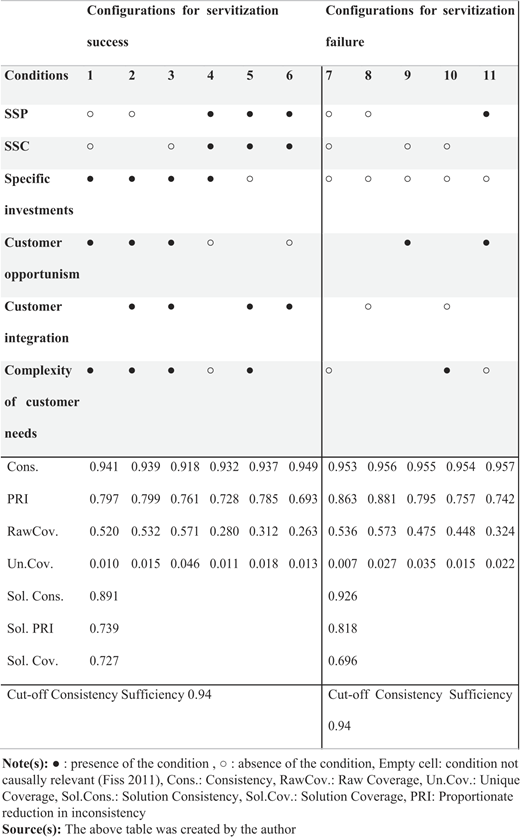
Six configurations were identified that consistently lead to servitization success (Configurations 1–6) and five that consistently lead to servitization failure (Configurations 7–11) in the examined cases (see Table 3). All parameters of fit were well above established thresholds (Schneider and Wagemann, 2010; Greckhamer et al., 2018). For success, configurations with both limited (Configurations 1–3) and advanced (Configurations 4–6) service offerings were identified. The configurations are discussed in detail in the following section.
5. Discussion
5.1 Configurations with a limited service offering
Configurations 1, 2 and 3 (see results in Table 3) indicate a limited service offering, as there is no strong focus on either product- or process-related services. In Configuration 1, neither type of service is offered extensively; in Configurations 2 and 3, the offering of SSP or SSC, respectively, is limited, while the other type of offering is causally irrelevant.
In the examined cases, some companies consistently achieve high servitization performance with a limited service offering, aligning with the findings of Lexutt (2020). It is evident that opting for the most advanced services is not the only path to success for all companies (Kowalkowski et al., 2017). Existing quantitative research often assumes that performance can only be attained through an extensive service offering (e.g. Fang et al., 2008) or with advanced services (e.g. Shah et al., 2020). Heirati et al. (2023) identify product-supporting services as a necessary condition for financial performance, while Faramarzi et al. (2023) find that servitization’s effect on performance is stronger for SSC than SSP. Other studies suggest a non-linear relationship, often finding a U-shaped relationship between service offerings and performance (e.g. Visnjic Kastalli and van Looy, 2013; Fang et al., 2008; Zhou et al., 2020). An inverted U-shaped relationship, where servitization is most successful at intermediate service offerings, has also been suggested (Zhang et al., 2019). By adopting a configurational approach, the present study sheds light on these contradictory findings, demonstrating that multiple paths to success exist with different types of service offerings. Therefore, it is not the service offering itself that determines success, but rather its combination with other relevant factors.
Configurations 1–3 exhibit a combination of highly complex customer needs, customer opportunism and specific investments. According to Williamson (1996), farsighted firms typically seek reciprocal commitments from their counterparts to protect their specific investments under conditions of high uncertainty and the risk of opportunistic behavior (Williamson, 1996; Kang et al., 2009).
Companies in Configuration 1, however, achieve servitization success under such conditions, regardless of reciprocal commitments in the form of customer integration. In practice, unilateral specific investments are not uncommon. Firms are likely to make such investments when they expect to yield positive spillovers for other transactions, either with the same or with other exchange partners (Kang et al., 2009). By investing in the relationship with their customers, the provider benefits from knowledge spillovers, learning and capability development (Kang et al., 2009). This can contribute to the successful completion of future projects with the same or new exchange partners, specifically enhancing the non-financial elements of servitization success (Raddats et al., 2015). Reputation spillovers (Kang et al., 2009) further make the provider an attractive partner for new customers, which can be a stepping stone to entering new markets (Nickerson et al., 2001) and advancing on their servitization journey.
Comparing Configuration 1 to Configuration 7 reveals that the key differentiating factors between success and failure with a limited service offering are the absence of specific investments and, surprisingly, low complexity of customer needs. Indeed, relation-specific investments have been found to generate higher returns in dynamic, heterogeneous environments characterized by complex customer needs (Palmatier et al., 2007). The present findings align with research indicating that complex customer needs are beneficial for servitization (Gebauer et al., 2011; Zhang et al., 2019).
In Configurations 2 and 3, the exchange is symmetrical, as the high customer willingness for integration functions as a reciprocal investment. The findings of this study indicate that both partners’ relation-specific investments contribute to servitization success, regardless of the type of service offering, as long as it is not highly focused on either SSP or SSC.
Comparing Configurations 2 and 3 with Configurations 8 and 10 reaffirms this conclusion. The absence of specific investments, coupled with a lack of customer integration, differentiates success from failure. This is in line with the relational view (Dyer and Singh, 1998) and underscores the significance of provider–customer co-evolution for successful value co-creation in servitization (Matthyssens and Vandenbempt, 2010).
In comparing Configuration 3 to Configuration 9, it becomes evident that the lack of specific investments from the provider distinguishes success from failure when the service offering does not primarily focus on SSC. Even though specific investments are not found to be individually necessary for servitization success, they emerge as a critical success factor in configurations involving a limited service offering. This finding aligns with Palmatier et al. (2007), who identified relation-specific investments as immediate precursors to performance.
Lastly, consistent with the findings of Palmatier et al. (2007), opportunism is not identified as a detrimental factor for success. It is observed in Configurations 1–3 and Configuration 9, but it does not play a decisive role in determining success or failure in any of these configurations.
In Configurations 1–3, opportunism and demand complexity coexist with a limited service offering. An advanced service offering, including SSC, often entails assuming a part of the customers’ processes and subsequently transferring risks from the customers to the providers (Raddats et al., 2019). Customers could exploit their information advantages by hiding or misrepresenting relevant information to benefit from lower prices or reduced costs for service delivery (Pieringer and Totzek, 2022). This is even more likely in uncertain environments (Mungra and Yadav, 2023). A limited service offering mitigates these risks.
5.2 Configurations with an advanced service offering
Configurations 4, 5 and 6 exemplify an extensive service offering that encompasses both product-oriented and process-oriented services. Such an offering requires close and trustful cooperation with the customer (Wirtz and Kowalkowski, 2022) and is therefore only provided under favorable circumstances.
In Configuration 4, the risk from the customer side is low due to the absence of opportunistic behavior and complexity in customer needs. Under such conditions, success is primarily driven by the provider’s advanced service offering and specific investments, irrespective of customer integration. With low customer-side risk, one-sided specific investments do not place the provider at a disadvantageous bargaining position (Kang et al., 2009), rendering reciprocal investments in the form of customer integration irrelevant to success in this configuration. Compared to Configuration 1, as previously discussed, it becomes apparent that offering an extensive service portfolio is interrelated with anticipated opportunism and the complexity of customer needs.
In contrast, Configuration 5 exhibits a customer-dominant dynamic, where the customer’s complex needs and strong willingness for integration play a significant role. Opportunistic behavior is irrelevant, as the provider does not make specific investments. The absence of specific investments contributes to success in these cases.
This is unexpected, as the provision of advanced services typically involves relation-specific investments (Kamalaldin et al., 2020), such as specialized knowledge about customer operations (Rönnberg Sjödin et al., 2016). However, specific investments also increase risk exposure and may demonstrate diminishing returns after a certain point (Boehmer et al., 2020). Moreover, an extensive service offering is more complex and incurs high coordination costs (Zhang et al., 2019). This combination of high coordination costs and a high degree of specific investments leads to increased transaction costs and potentially decreased profitability with advanced services (Worm et al., 2017). Rapidly changing customer needs exacerbate this effect, as more intra-firm coordination would be required to keep up with demand changes. Investments to adjust to specific customers’ needs would therefore become less effective.
These findings provide additional nuance to the seemingly contradictory role of specific investments as both drivers of performance (Palmatier et al., 2007) and transaction costs (Worm et al., 2017). In Configuration 5, the transaction-cost driving role of specific investments is dominant with an extensive service offering. This distinction becomes evident when comparing Configuration 5 to Configurations 2 and 3, where specific investments are contributing factors to success with a limited service offering under similar conditions of customer integration and complexity of customer needs. As opportunism is causally irrelevant, the type of service offering distinguishes between Configuration 5 and Configurations 3 and 4.
Additionally, relation-specific investments are less critical in relationships with customers who have a strong willingness for integration. In mature relationships, investments in training and educating the customer become obsolete. Collaboration and commitment furthermore reduce transaction costs (Artz and Norman, 1999) and drive performance (Palmatier et al., 2007), making customer integration a contributing factor for success in Configuration 5.
These findings demonstrate that, while both specific investments and customer integration contribute to success, they are not individually responsible for it. Different cases may prioritize one over the other. This showcases the ability of fsQCA to uncover causal mechanisms that net-effects approaches cannot capture.
Finally, in Configuration 6, the findings reveal that an advanced service offering, combined with a high willingness for integration and the absence of opportunism, leads to success, regardless of demand uncertainty or specific investments. This is congruent with literature emphasizing the importance of close collaboration with customers in value co-creation for services and servitization (e.g. Aarikka-Stenroos and Jaakkola, 2012; Vargo and Lusch, 2008) and considers customer integration a requirement in the service industry (Moeller, 2008; Fließ and Kleinaltenkamp, 2004) and consequently also for successful servitization (Jacob, 2006).
This line of research applies to situations of low opportunism. In the absence of opportunism, transaction-cost theoretic aspects do not necessarily determine performance, as long as a strong willingness for integration is present. However, the configurational approach recognizes that additional factors come into play in the presence of opportunism, as discussed earlier. This demonstrates the ability of the configurational approach to account for theoretical plurality and provide alternative conceptual explanations.
Furthermore, the present findings challenge the notion that customer integration is more relevant or beneficial for advanced services (Li et al., 2021; Shah et al., 2020). The willingness of the customer for integration is found to be causally relevant for both limited and extensive service offerings. However, customer integration is not individually responsible for success or failure, but only in conjunction with other conditions.
5.3 Configurations leading to servitization failure
Contrary to most existing research, this study goes beyond analyzing successful outcomes and also examines configurations that lead to servitization failure. Servitization is considered unsuccessful when it fails to generate positive financial or non-financial performance effects.
Unsurprisingly, Configurations 7–10 demonstrate that not actively offering specific services or making specific investments generally does not result in servitization success. Achieving servitization success requires strategic intent and managerial commitment (Lexutt, 2020).
In Configuration 11, although SSP are actively offered, they are not supported by specific investments, customers exhibit opportunistic behavior and customers’ needs are not complex. Compared to Configuration 4, it becomes evident that, under stable demand conditions, the provider must take control of the relationship by investing in educating and training the customer to avoid failure. Otherwise, customer opportunism can impede success. This holds true for Configuration 11 regardless of whether advanced services are offered or customers exhibit a strong willingness for integration.
Comparing Configuration 11 to Configuration 9, we observe that opportunism becomes a risk factor for servitization failure primarily when combined with a lack of specific investments. This shows that not only can providers’ unilateral investments drive servitization success, but their absence can also contribute to failure in certain cases.
6. Conclusions
6.1 Theoretical contributions
This study contributes to servitization research by examining the intricate interplay between provider- and customer-related factors for servitization success from a transaction cost theory perspective. Specifically, it advances our understanding of how specific investments, perceived opportunism, complexity of customer needs and customer integration influence servitization success and failure, considering different types of service offerings, leading to the following contributions.
First, the results and discussion show that the opposing effects on servitization success suggested by TCE coexist and depend on how the examined conditions align with each other. Table 4 summarizes the findings. This highlights the strength of the neo-configurational approach compared to more conventional net-effects methodologies, as it allows seemingly contradictory explanations to coexist while elucidating the effects prevalent within specific conditions.
Summary of findings
| Conditions | Findings |
|---|---|
| Service offering (SSP and SSC) | There are multiple paths to success with different types of service offerings. It is not the service offering itself that determines success, but the combination with other relevant factors |
| Specific investments | The positive impact of specific investments on cooperation and customer relationship appears to outweigh the risk and transaction cost-enhancing effects Specific investments contribute to servitization success with a limited (Configurations 1–3) as well as an advanced service offering (Configuration 4) With a limited service offering, specific investments exhibit their performance-enhancing effect when combined with opportunism, demand uncertainty (Configuration 1) and customer integration (Configurations 2–3) With an extensive service offering, specific investments contribute to servitization success when combined with low opportunism and demand uncertainty (Configuration 4) Not making specific investments contributes to failure in Configurations 7–11. Only in combination with an extensive service offering, customer integration and complex customer need is a lack of specific investments conducive to success (Configuration 5) |
| Customer opportunism | Opportunism is not a detrimental factor to servitization success and can also coexist with specific investments, still leading to success Under conditions of high demand uncertainty and combined with a limited service offering, specific investments (Configuration 1) and customer integration (Configurations 2–3), companies are successful also in the presence of opportunism A lack of opportunism contributes to success with an advanced offering, either with specific investments under stable demand conditions (Configuration 4) or with customer integration (Configuration 6) Its presence contributes to failure when combined with a limited service offering and a lack of specific investments (Configuration 9) or an offering focused on SSP, a lack of specific investments and stable demand conditions (Configuration 11) |
| Customer integration | Customer integration does not contribute to failure, but its absence does (Configurations 8 and 10) Customer integration is not necessarily required as a safeguard, even under high opportunism (Configuration 1) Customer integration is a contributing factor for success, with a limited (Configurations 2–3) as well as an extensive service offering (Configurations 5–6) |
| Demand uncertainty (Complexity of customer needs) | In the presence of demand uncertainty, an extensive service offering is combined with a lack of specific investments and customer integration (Configuration 5), while in the absence of demand uncertainty and opportunism, an extensive service offering is combined with specific investments (Configuration 4), indicating a higher perceived risk of combining an extensive offering with specific investments under high demand uncertainty The positive reinforcing effect of demand uncertainty on specific investments is observed with a limited service offering and in the presence of opportunism (Configurations 1–3) |
Source(s): The above table was created by the author
Therefore, the study contributes to the much-needed methodological diversity in servitization (Rabetino et al., 2021b). The state-of-the-art fsQCA examines both successful and unsuccessful cases, considering causal asymmetry, which is often neglected in configurational servitization success research. It deviates from dominant assumptions of automatic benefits of servitization (Rabetino et al., 2021a). This approach facilitates reliable interpretations and conclusions, strengthening the argument for the configurational and complex causality of servitization success and contributing to the consolidation of a configurational theory of servitization (Brax et al., 2021).
Second, by adopting a TCE approach, this study adds to the currently limited theoretical plurality of the field (Rabetino et al., 2021b; Kowalkowski et al., 2017). It provides empirical evidence for the role of often-overlooked success factors such as specific investments, customer opportunism and demand uncertainty. By considering demand uncertainty, it contributes to the sparse literature on the role of contextual conditions (Kohtamäki et al., 2019a). It offers an alternative theoretical angle to the commonly adopted value-co-creation literature. In the presence of opportunism, it is important to consider both customer integration and transaction cost theoretic aspects to gain a comprehensive understanding of the causal mechanisms driving servitization success and failure.
Third, considering customer-related success factors in this context enriches our understanding of servitization-related decision-making. Perceived opportunism is not detrimental to success, but rather a common challenge to be managed, in line with classic TCE (Williamson, 1996). The decision to offer an extensive service portfolio, however, is influenced by anticipated opportunism and demand uncertainty. Under these conditions, successful providers limit their service offerings to mitigate risks.
Finally, contrary to some previous studies’ suggestions that there is an optimal level or degree of servitization (Fang et al., 2008; Visnjic Kastalli and van Looy, 2013; Zhou et al., 2020), this study finds that servitization success can be achieved with both limited and advanced service offerings. Moreover, it is not solely the offering of advanced services that contribute to success but rather their combination with basic, product-supporting services. This finding supports the notion of servitization as reinforcement rather than transformation (Salonen et al., 2017), enhancing our understanding of alternative paths and offering combinations for positive servitization outcomes (Raddats et al., 2019).
6.2 Managerial implications
Based on the findings of this study, several managerial implications can be drawn to enhance servitization success:
Recognizing the Importance of Customer-Related Factors: Managers should acknowledge the critical role customers play in achieving servitization success. By understanding and addressing customer opportunism, willingness for integration and complexity of customer needs, managers can design appropriate strategies to mitigate risks.
Assessing Customers’ Readiness for Integration: Managers should develop methods to assess customers’ readiness for integration, as customer integration serves as a safeguard against opportunism. By identifying customers open to collaborative relationships, managers can establish effective partnerships and co-create value.
Considering the Complexity of Customer Needs: Servitization is particularly suitable under high demand uncertainty. Understanding complex customer needs can help tailor service offerings and develop solutions that meet specific customer requirements, leading to increased servitization success.
Evaluating Specific Investments Strategically: Managers should carefully evaluate the cost-benefit trade-offs of specific investments based on the service offering and customer dynamics. With a limited service offering and under high demand uncertainty, specific investments can act as drivers for success. However, in cases with an advanced service offering and dominant customers, specific investments may increase transaction costs and can be avoided.
Balancing Risks and Opportunities: Managers should adopt a balanced approach to managing risks and opportunities in servitization. While mitigating the risks associated with opportunistic behavior, they should also recognize the potential benefits of expanding the service portfolio. By carefully considering anticipated opportunism and the complexity of customer needs, managers can make informed decisions regarding the scope and extent of their service offerings.
Reinforcing Basic, Product-Supporting Services: Success in servitization is not solely dependent on offering advanced services. Combining advanced services with basic, product-supporting services contributes to positive outcomes. Managers should strengthen the foundation of their service offerings by providing reliable and supportive services that complement the core product.
Embracing a Configurational Perspective: Instead of pursuing a one-size-fits-all approach, managers should adopt a configurational perspective when developing servitization strategies. They should consider the unique combination of factors that contribute to success in their specific contexts.
6.3 Limitations and future research
Despite its contributions, this study is not without limitations. Even though it takes into account customer-related success factors, the unit of analysis is the provider organization. Although it is the anticipation of opportunistic behavior, not actual opportunism, that impacts transaction costs and performance (Williamson, 1996), future studies should adopt a dyadic approach and measure customer-related factors from the customers’ perspective.
Other actors in the ecosystem also play a role in determining a provider’s servitization success (Kohtamäki et al., 2019a; Salonen et al., 2021; Raddats et al., 2019). Future studies should examine the role of other supply-chain partners in servitization success from a configurational perspective. Additionally, the impact of servitization on outcomes for the customer company or other network partners warrants further investigation (Kohtamäki et al., 2019a).
This study purposefully concentrates on specific investments, opportunistic behavior and demand uncertainty as factors impacting transaction costs and, consequently, servitization success (Faramarzi et al., 2023; Cuypers et al., 2021). TCE, however, has much more to offer. Providers making one-sided specific investments, particularly when expecting opportunistic behavior, would require formal contracts or ex-post governance mechanisms (Williamson, 1979), which are not examined in this study. Future research should study different contract types and governance mechanisms for successful servitization. As servitization occurs within networks and ecosystems, hybrid (Kohtamäki et al., 2019b) or relational (Johnson et al., 2021) governance forms can be examined further. Future research can also investigate additional elements of environmental uncertainty (Kohtamäki et al., 2019a) and draw conclusions on the different governance mechanisms for different service strategies, in line with Sjödin et al. (2019).
The make-or-buy decision in servitization (e.g. Heirati et al., 2023) also warrants further attention, possibly combining TCE with resource- or capabilities-based explanations (e.g. Jacobides, 2008). To shed further light on the dark side of close collaborations in servitization (Johnson et al., 2021), agency theory can be applied to study the impact of information asymmetries and opportunistic behavior (e.g. Pieringer and Totzek, 2022). Finally, alternative theoretical explanations such as the resource-based view, transaction cost theory, contingency theory, dynamic capabilities and/or cost-based explanations (e.g. Jacobides, 2008; Faramarzi et al., 2023) can be compared in a configurational study.
Furthermore, the findings are limited by the sample—the German manufacturing sector. This population focus was motivated by a traditional understanding of servitization as originating in manufacturing (Vandermerwe and Erixon, 2023). Future studies can examine different sectors or concentrate on success factors for digital servitization as an emerging research stream (Kowalkowski et al., 2024). More research from emerging economies is also needed (Heirati et al., 2023).
Finally, despite the results of the QCA being robust and well above established parameters of fit, the identified subset relations are not perfect (as is mostly the case in social sciences). Future studies can benefit from the case-based nature of QCA by combining it with process tracing (Schneider and Rohlfing, 2013) and conducting an in-depth study of deviating cases to uncover further causal mechanisms of servitization outcomes.
This research was supported by funding from the Gesellschaft der Freunde der Fernuniversität e.V (GdF). The funding source had no involvement in study design; in the collection, analysis and interpretation of data; in the writing of the report; or in the decision to submit the article for publication.
Notes
Data from the same large-scale survey has been previously published in Lexutt (2020), however, with different conditions, different covered cases and a different theoretical focus.
References
Appendix
Operationalizations
| Construct | CR | AVE | Item | Loading | Adapted from |
|---|---|---|---|---|---|
| Service profitability | 0.785 | 0.647 | The services we offer are profitable | 0.831 | Oliva et al. (2012) |
| A large fraction of our total profit is generated by our service business | 0.781 | ||||
| Non-financial service success | 0.835 | 0.562 | Services enable my company to sell new products to existing customers | 0.712 | Raddats et al. (2015) |
| Services enable my company to win business with new customers | 0.779 | ||||
| Services help my company to retain existing customers | 0.788 | ||||
| My company’s services enhance the performance of our product | 0.707 | ||||
| Perceived complexity of customer needs | 0.801 | 0.570 | The needs of our customers change considerably over time | 0.683 | Gebauer et al. (2011) |
| Our customers tend to look for new offerings all the time | 0.817 | ||||
| New customers tend to have needs that are different from those of our existing customers | 0.771 | ||||
| Perceived customer opportunistic behavior | 0.841 | 0.647 | In working with us, our customers often alter facts in order to meet their own goals and objectives | 0.731 | Palmatier et al. (2007) |
| In working with us, our customers often promise to do things without actually doing them later | 0.847 | ||||
| In working with us, our customers don’t negotiate from a good faith bargaining perspective | 0.822 | ||||
| Perceived customer integrativety | 0.804 | 0.507 | Our customers are willing to share with us all the relevant information we need to provide a high-quality service | 0.737 | Own items, formulation based on Tuli et al. (2007), Helander and Möller (2008) |
| Our customers have sufficient knowledge and resources to facilitate mutual value creation | 0.718 | ||||
| Our customers have a high understanding of our business | 0.709 | ||||
| Our customers are willing to adapt their internal processes to facilitate mutual value creation | 0.688 | ||||
| Provider’s specific investments | 0.823 | 0.611 | We have invested significant resources in providing ongoing training for our customers | 0.759 | Palmatier et al. (2007) |
| We have invested significant resources in providing customized support for our customers | 0.822 | ||||
| We have invested significant resources in improving personal relations between us and our customers | 0.764 | ||||
| Business orientation toward SSP | NA (index) | How actively do you offer the following services? (0 = not offered, 5 offered very actively) Product documentation | NA | Antioco et al. (2008) | |
| Product transportation/delivery | |||||
| Product installation | |||||
| Help desk/call center/customer service hotline | |||||
| Product inspection/diagnosis | |||||
| Product repair and spare parts delivery | |||||
| Product upgrades | |||||
| Product refurbishing | |||||
| Product recycling and dismantling/machine brokering | |||||
| Preventive maintenance | |||||
| Condition monitoring | |||||
| Process-oriented engineering (testing, optimizing and simulating) | |||||
| Business orientation toward SSC | NA (index) | How actively do you offer the following services? (0 = not offered, 5 offered very actively) | NA | Antioco et al. (2008) | |
| Financing services/Leasing | |||||
| Management of spare parts | |||||
| Process-oriented training (quality-driven including technology | |||||
| Business oriented training (financially driven/management training | |||||
| Process oriented consulting (quality-driven including technology | |||||
| Business oriented consulting (financially driven/management consulting) | |||||
| Managing the customer’s maintenance function | |||||
| Research and Development services for customers | |||||
| Fully managing customer’s product-related operations (complete outsourcing and ownership of product by vendor) |
Source(s): The above table was created by the author
The supplementary material for this article can be found online.

