Skip to article sections
Purpose

This study aims to explore the facilitating and hindering conditions that interact in the implementation of a gender-responsive budgeting (GRB) process for incorporating a gender perspective into the accounting system to improve gender equality (GE) in the health sector.

Design/methodology/approach

A case study approach applying multi-qualitative methods was adopted to analyse the GRB initiative implemented jointly by three Italian health organisations. Hindering and facilitating conditions and managing types were identified through the lens of the public value (PV) strategic triangle of Moore (1995) and a crystallisation perspective.

Findings

The GRB initiative studied contributes to PV creation by considering the alignment of the three dimensions of Moore’s PV strategic triangle. The centrality of political and governance commitment to legitimise the GRB process emerges. Moreover, the operational capacity of organisations is supported by civil servants’ engagement. The GRB initiative has steered the three organisations towards achieving GE goals. Consequently, their strategies and programmes align with collective interests, fostering trust institutionally and within the community. However, some resistance to introducing a new accounting practice emerged, highlighting how GRB requires a high level of commitment from both governance and civil servants to contribute to the improvement of GE and, thus, PV creation.

Originality/value

This research adds to the accounting literature, providing an original contribution to GRB as a process for PV creation within the health sector. It also discusses the conditions favouring and hindering the implementation of a GRB process.

Ensuring gender equality (GE) fosters a fair, prosperous and inclusive society. By prioritising GE, public institutions and organisations contribute to the collective well-being and uphold fundamental human rights. Moore (1995) asserted that public organisations should create desirable social outcomes, such as welfare, well-being, social inclusion and equity. Thus, promoting GE is essential to creating public value (PV), as GE is a fundamental element directly contributing to its formation (Sharma and Kaur, 2024) and driving sustainable development and societal progress (Kolovich et al., 2020; Belingheri et al., 2021). GE enhances labour productivity and economic performance by reducing inefficiencies and optimising talent allocation (O’Hagan and Klatzer, 2018). Moreover, gender-equitable societies strengthen democratic participation through high social trust and civic engagement.

PV, variously conceptualised (Hartley et al., 2017), shifts the focus from efficiency to outcomes (Alford and Yates, 2014; van Gestel et al., 2024), with attention to equity, ethics and accountability issues (Broucker et al., 2018; Steccolini, 2019a). PV requires addressing stakeholders’ needs while maintaining economic balance (Meynhardt, 2009; Cluley and Radnor, 2021). It also has ethical and narrative dimensions, reinforcing commitment and sustainability (Fischer and Grant, 2013; Alford and O’Flynn, 2009; Gherardi et al., 2021). However, research on stakeholder involvement in PV creation remains limited (Oppi and Galizzi, 2024; Sharma and Kaur, 2024).

Moore’s (1995) PV strategic triangle has been widely studied (e.g. Alford and Greve, 2017), yet the role of accounting in PV creation remains underexplored (Bracci et al., 2019; Spano, 2009). Accounting is crucial in identifying, shaping and translating diverse stakeholder perspectives, particularly for marginalised groups (Bracci et al., 2014). Sharma and Kaur (2024) emphasised PV’s connection with equity, accountability and ethos. In this context, gender-responsive budgeting (GRB) supports GE by embedding gender considerations into financial decisions and fostering accountability for GE commitments (Sharp, 2003; Rubin and Bartle, 2005; Kalifha and Scarparo, 2021). Despite its potential to enhance PV (Oppi and Galizzi, 2024), GRB implementation remains uncertain in public organisations (Polzer et al., 2023). Limited research on GRB exists in public management, especially within the health sector (Galizzi et al., 2021; Khalifa and Scarparo, 2021; Nolte et al., 2020; Siboni et al., 2016). The health sector remains highly gender segregated because of structural and cultural factors (European Institute for Gender Equality [EIGE], 2017a, b; World Health Organization [WHO], 2019b). However, there is little research on the conditions facilitating or hindering GRB from being an effective tool for advancing GE in this sector. Therefore, this study addresses the following research question:

RQ1.

What are the facilitating and hindering conditions that interact in the implementation of GRB across the three dimensions of the PV triangle?

Using Moore’s strategic triangle as an analytical framework (Höglund et al., 2021), this study examines GRB implementation in the health sector. It explores the facilitating and hindering conditions identified in other fields (Galizzi et al., 2023; Polzer et al., 2023) and applies them to a case study involving three Italian health organisations. This initiative represents a novel example of interorganisational GRB implementation, supporting claims that PV requires collaboration among multiple institutions (Benington, 2009; Bryson et al., 2017). This study contributes to the accounting literature by positioning GRB as an accounting and managerial tool for fostering GE in the health sector. It also provides a unique case study within a gender-segregated public sector.

The rest of the paper is structured as follows. Section 2 reviews the background on GRB and PV, and Section 3 outlines the research design. Section 4 presents the findings, and Section 5 discusses the results. Finally, Section 6 concludes with directions for future research.

The public sector accounting literature has seen an increasing application of the gender perspective (McDonald et al., 2024). From its mere acknowledgement as a variable (Parker, 2008), organisations and research have moved to radicalise the gender perspective in the agenda (Broadbent, 2016) and incorporated it into the budgeting process through GRB (Rubin and Bartle, 2023). GRB extends beyond incorporating gender considerations into budgets for GE and resource allocation (O’Hagan and Klatzer, 2018; Sharp, 2003). Instead, it scrutinises organisations’ internal structures and community needs through a gender lens, evaluating policy impacts on GE (Rubin and Bartle, 2005).

GRB is structured in four phases: (1) context analysis using gender indicators to identify disparities within the organisations and their activities’ impacts, (2) formulation of strategies and resource allocation, (3) implementation and monitoring and (4) measurement of impact (Rubin and Bartle, 2005; Steccolini, 2019b; Galizzi et al., 2023). The first phase results in a Gender Report that informs policy development and execution.

Over time, GRB has been implemented in various countries and organisations using diverse approaches (Galizzi et al., 2021; Brenton, 2023; McDonald et al., 2024). The standardisation of GRB remains challenging because of the contextual nature of gender inequalities (Acker, 1990, 2006) and the contested nature of GRB metrics (Khalifa and Scarparo, 2021; McDonald et al., 2024). The absence of clear benchmarks risks misinformation and weakens accountability, necessitating participatory approaches to define relevant indicators and ensure legitimacy in budgeting practices. Accordingly, legitimate stakeholders should collaboratively determine which aspects should be budgeted and accounted for (McDonald et al., 2024).

Despite the significance of GRB, studies on it in public sector accounting remain scarce (e.g. Polzer et al., 2023), particularly in the health sector (Leoni et al., 2021). Crespí-Lloréns et al.’s (2021) review identified a lack of sex-disaggregated data and gender inequality indexes, impeding effective policy development. Other studies have emphasised the limited empirical evidence of GRB’s impact on health outcomes (Cassano and Fornasari, 2022; Naciti et al., 2022; Gupta et al., 2024). Research predominantly focuses on low- and middle-income countries, where gender disparities in health access persist (Nolte et al., 2020). In these contexts, Gupta et al. (2024) revealed that increased health expenditures and universal health coverage have reduced inequalities. However, in Western countries, gender disparities in workforce composition and service delivery remain despite the large amount of funds allocated to healthcare (WHO, 2019a; EIGE, 2021). In these settings, GRB can help ensure equitable resource distribution and address internal workforce disparities.

Prior studies have identified the facilitating and hindering conditions challenging GRB implementation (Galizzi et al., 2023; Martìnez Guzman, 2024a). Institutionalising GRB enhances its effectiveness (Steccolini, 2019b), requiring legal frameworks and regulatory support (Galizzi et al., 2021; Moser and Korac, 2021; Martìnez Guzman, 2024a). Traditional budgeting derives legitimacy from laws and regulations (McDonald et al., 2024), and GRB also requires visibility for gender issues (Steccolini, 2019b; Khalifa and Scarparo, 2021). Participatory and inclusive approaches are crucial, as normative values shape budgeting decisions (McDonald et al., 2024).

A GE-friendly climate is essential for GRB adoption. This climate is ensured by political commitment to GE, a legal framework and financial support (Galizzi et al., 2023; Jorge et al., 2023). Successful integration into accounting systems depends on civil servants’ engagement (Galizzi et al., 2018) and tailored management practices (Steccolini, 2019b). The availability of gender-disaggregated data is vital for defining gender indicators and assessing policy impacts (Steccolini, 2019b; Galizzi et al., 2023). In some cases, external expertise can aid GRB adoption, offering insights and training (O’Hagan and Klatzer, 2018).

In European case studies, leadership is crucial for successful GRB implementation, with political support aiding diffusion but not guaranteeing full potential realisation (Elomäki and Ylöstalo, 2021; Polzer and Seiwald, 2021). In South Korea, GRB was introduced because of external pressures, but it lacked internal consensus (Martìnez Guzman, 2024b). Resistance among civil servants also affects GRB adoption. Fernandez-Gutierrez and Van de Walle (2019) found that European public officials prioritise efficiency over equity. These conditions, taken individually, are not determinants or deterrents of GRB success but interact dynamically within a complex system without any order of priority.

This study investigates the facilitating and hindering conditions that interact in the implementation of a GRB initiative within three Italian health organisations. As previous research has demonstrated the utility of Moore’s triangle in analysing management control practices (Höglund et al., 2021), we apply it to provide an in-depth understanding of the dynamics influencing the pursuit of GE as PV creation.

According to Moore (1995), public managers and civil servants must create PV, supported by managerial, accounting and accountability tools. An accounting tool like GRB alone cannot create PV, but the implementation process can contribute to achieving GE as a form of PV. Moore’s strategic triangle emphasises that PV is the ultimate objective and an integral part of the process. Thus, implementing GRB has the potential to shape organisational practices in a way that aligns the pursuit of GE with PV creation. While some PV scholars, such as Benington and Moore (2011, p. 14), have highlighted its broad societal relevance as what the public values, Moore’s strategic triangle focuses on the internal and managerial dynamics of PV creation.

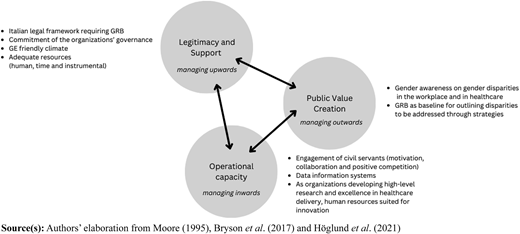
Moore traces the boundary of the PV frame within three dimensions: (1) PV created within the socioeconomic system, which produces objectively valid results for stakeholders; (2 legitimacy and support for public action from citizens and different types of internal and external stakeholders (which include governance, managers and civil servants), who provide financial resources, consensus and support; and (3) the operational capacity of public organisations to deliver services efficiently. Moore considered the triangle’s three vertices fundamental for conceiving of a sustainable, value-creating strategy. These dimensions must be aligned and mutually supported, without a top-down hierarchy along them. Indeed, the three vertices are interdependent and connected through bidirectional arrows, indicating dynamic and continuous interaction. Each dimension is essential and mutually reinforces the others to generate PV effectively. This configuration suggests that achieving PV relies on the synergistic balance between legitimacy, operational capacity and the strategic alignment of the organisation’s goals towards PV. Accordingly, governance is a collaborative effort in which public organisations, citizens and stakeholders unite to create PV. It also emphasises the role of policymakers and public managers in creating PV, supporting policy definitions and undertaking goal-setting activities (Bryson et al., 2017).

Therefore, Moore encouraged the management of public organisations to “manage upwards” to the formal authorising environment, to “manage outwards” to the public and other stakeholders and to “manage inwards” to ensure that the organisation has the operational capacity to deliver PV (Bryson et al., 2017).

While the PV literature has largely overlooked the importance of understanding PV in accounting (Bruns, 2014; Bracci et al., 2019; Steccolini, 2019a), a body of research has started applying Moore’s strategic triangle to empirical cases (e.g. Williams and Shearer, 2011; Hartley et al., 2017). In the public management literature, some studies have challenged the positions of public managers and policymakers in creating PV by adapting the strategic triangle to multi-actor contexts (Bryson et al., 2017; Chohan and Jacobs, 2017). These studies emphasise the role of politics in strategising PV and supporting the alignment of the strategic triangle’s dimensions. Spano (2009) and Höglund et al. (2021) found that performance measurements tend to create a misalignment among the three dimensions and that negotiations between politicians, central officers and public managers tend to generate short-term goals and an increased focus on measurable output, hence depriving PV creation. Oppi and Galizzi (2024) reported that in Italian higher education institutions, GRB primarily serves as a tool for stakeholder accountability. Here, GE strategies were based on a top-down approach rather than an iterative process between organisations and their internal and external stakeholders. The scarce visibility of the GE strategy results in a misalignment in stakeholders’ involvement and emphasises the shortcomings of operational capacity.

Empirical research is needed on the alignment of strategic dimensions with public managers’ actions, the conditions shaping this alignment and its impact on effective management (Hartley et al., 2017). Further investigation into the role of accounting in PV creation, particularly through Moore’s strategic triangle, is needed. However, the contribution of accounting to the health sector has received inadequate attention compared to its contribution to PV creation in the public sector (Bracci et al., 2014; Höglund et al., 2021). It is therefore crucial to explore how organisations in the health sector can leverage accounting instruments to pursue strategic objectives while accommodating stakeholders’ needs and expectations from a gender perspective. Gender accounting tools, such as GRB, have the potential to address this issue, particularly nowadays, when there is an increasing urgency to mitigate social challenges (Bebbington and Unerman, 2020; Carnegie et al., 2024).

The health sector exhibits significant gender segregation, shaped by structural and cultural factors. Women represent 70% of the global health workforce but remain underrepresented in leadership, holding only 18.2% of the top roles in Italy (Italian Ministry of Health, 2017; WHO, 2019a). Occupational segregation is particularly deep, with men dominating technical and executive positions (Boniol et al., 2019). Gender norms contribute to persistent horizontal and vertical segregation in the European Union (EU) (EIGE, 2017a, b), where the gender pay gap in healthcare is 29% higher than that in other sectors, limiting women’s career advancement (WHO, 2019b). These disparities extend to healthcare access and outcomes—women face longer waiting times, economic barriers and caregiving burdens, leading to higher unmet healthcare needs and poorer health despite longer life expectancy (Collicelli, 2022; EIGE, 2021). Gender biases in clinical practices further exacerbate these inequalities (Collicelli, 2022).

Italian regulations mandate public organisations to promote GE through mechanisms such as the Guarantee Committee for Equal Opportunities (Italian acronym: CUG), which is responsible for proposing Positive Action Plans (PAP). Since 2009, GRB has been integrated into performance systems. Public organisations must develop a Gender Equality Plan (GEP) and disclose gender-disaggregated organisational data. From 2022, the first phase of the GRB process (Gender Report) became mandatory for Italian public organisations for hiring and funding under the National Recovery and Resilience Plan, aligned with the European Gender Equality Strategy (2020–2025).

Although there are no penalties for noncompliance, adherence is crucial for public funding. A lack of standard guidelines leaves organisations unable to navigate GRB implementation independently, thus limiting its adoption.

Since 2022, three Italian health organisations have voluntarily implemented GRB, collaborating on a joint Gender Report, which forms the basis of our case study. These organisations include a local health authority, a university hospital and an orthopaedic institute, all public and part of the Italian National Health Service, with distinct roles, specialised qualifications and separate data systems.

An explanatory case study approach (Creswell, 2009; Yin, 2017) was used to examine the GRB initiative. The chairs of the three CUGs started the Gender Report process through a semi-bottom-up approach involving the staff. Two academic experts (among the authors) served as trainers in GE accounting and as facilitators for the initiative’s development (Parker, 2017). This close involvement provided insight into both formal and informal organisational dynamics (Merriam and Tisdell, 2016; Yin, 2017).

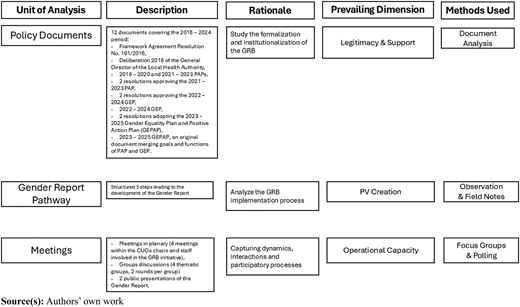
The GRB initiative was structured into three units of analysis, each aligned with a PV strategic triangle dimension (Figure 1), to allow for an in-depth examination of interactions, facilitating/hindering conditions and management types.

Data collection relied on multiple complementary sources (Scapens, 1990) and various qualitative methods to ensure validity (Stake, 1995). It covered the entire GRB initiative, including document analysis, participant observation, focus groups, interactive feedback tools and field notes.

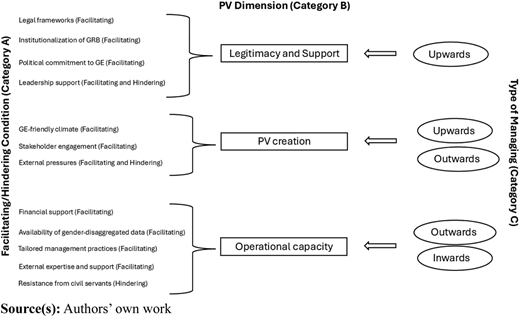
The qualitative analysis followed Gioia et al.’s (2013) framework, which prioritises participants’ descriptions of their experiences and in which researchers act as sense makers, ensuring that theory development is deeply grounded in empirical data (Eisenhardt, 1989). The collected material was analysed using thematic analysis (Lehner et al., 2022). The coding was conducted without a hierarchical structure (Saldaña, 2016). Through a deductive approach, predefined categories were established concerning GRB’s hindering/facilitating conditions (category A), Moore’s PV strategic triangle dimensions (category B) and managing types (category C). An inductive approach combined these three categories into a matrix to facilitate analysis by applying a fuzzy matching logic (Ragin, 2008). It was also used to map the content of empirical research into predefined categories, identify emerging patterns and reveal their complex interplay. Figure 2 presents the coding scheme developed, which served as a framework for analysing the collected materials.

The findings were derived from both the prevalence of categories and their interconnections, allowing for an exploration of relationships and dynamic interactions. To ensure a critical perspective, the third author, who did not participate in the data collection, reviewed the materials and the coding categories, providing an outsourcing perspective reinforcing the research’s analytical rigour (Vaismoradi et al., 2016).

The document analysis confirmed that GRB is formalised through regulatory frameworks, aligning with legitimacy and support dimension. In the Gender Report pathway, the focus was on strengthening operational capacity to facilitate PV rather than achieving it immediately. Conversely, plenary and subgroup interactions, aimed at enhancing operational capacity, primarily emphasised PV creation, highlighting GRB’s transformative impact on organisations and society.

Documents formalising GRB implementation reflect facilitating conditions from the literature, mainly tied to legitimacy and support (19 instances) through GRB institutionalisation and to operational capacity (10 instances) via tailored management practices. Table 1 provides illustrative quotes on this interplay.

In detail, CUG’s formalisation in 2016 marked a commitment to GE initiatives through active collaboration “to harmonise their gender equality initiatives, aiming to standardize practices and behaviours for employees across the city’s healthcare system” (Deliberation, 2018 of the General Director of the Local Health Authority). This collaboration evolved through successive PAPs and GEPs, culminating in the 2023–2025 GEPAP, which merged both frameworks to minimise redundancy and foster alignment across the diverse missions of the three organisations and address both internal needs and broader societal shifts. As noted in the GEP (2022–2024), “Through this collaboration, they create synergies and multiply resources and opportunities to achieve the objectives outlined in the GEP”.

Integrating regulatory adherence with strategic engagement reveals a nuanced understanding of GE’s benefits. One key quote explains, “Gender equality is, primarily, a matter of protecting a fundamental right, but it is also a matter of technological development and progress, of widespread improvement of human living conditions, and of economic growth” (GEP, 2022–2024). Beyond compliance, they use external mandates as opportunities to embed GE into broader strategic priorities.

GE is thus portrayed as central to fostering inclusive organisational cultures and enhancing workforce well-being. Initiatives in this arena extend beyond obligatory measures; they promote economic growth and human development through participatory approaches that engage staff extensively, thereby strengthening the legitimacy of the strategies. Concurrently, tailored bottom-up and interorganisational practices build operational capacity, ensuring that GE efforts lead to tangible improvements in both the workplace and the broader community.

The document analysis highlights key facilitating conditions, including regulatory provisions, collaboration and political commitment. Contrary to expectations (Martínez Guzman, 2024b), external pressures did not play a significant role, as strong internal consensus prevented these conditions from becoming either triggers or hindrances to GRB implementation. In this study, external pressures were exerted solely by national and supranational bodies mandating gender reporting tools, while internal alignment was strong. Additionally, this stage of the GRB initiative faced no resistance from civil servants, a hindrance identified by Fernandez-Gutierrez and Van de Walle (2019), that impacts Operational Capacity.

Ambivalence also characterises other facilitating and hindering conditions. Tensions between mandatory compliance and voluntary engagement have sometimes complicated internal acceptance and slowed implementation (Martínez Guzman, 2024b). For instance, “For research entities, adopting a GEP became a prerequisite for accessing funding—not because it affects project evaluations, but because it is required when signing the Grant Agreement” (GEP, 2022–2024). Consequently, governance within the three organisations empowered the CUG chairs to launch the GRB initiative, culminating in the Gender Report and building on established practices.

Efforts to integrate various frameworks aim to streamline processes, as noted by Elomäki and Ylöstalo (2021) and Polzer and Seiwald (2021), but they also introduce complexities in harmonising objectives and preventing redundancies. Divergent institutional mandates further complicate this balance between integration and differentiation. As one resolution states, “The inter-organizational Gender Equality Plan Team is tasked with potentially revising objectives and actions across different intervention areas based on the implementation status in the three organizations and in close coordination with the inter-organizational governance board” (Various documents).

Another significant challenge is the availability of gender-disaggregated data, which are crucial for planning and monitoring according to EU guidelines (Steccolini, 2019b). As one document emphasises, “To meet the requirements of the European Commission, it is, therefore, necessary to indicate gender equality actions specifically and to adopt these actions based on a programming and monitoring process that must be based on gender-disaggregated data” (GEPAP, 2023–2025). The health sector faces difficulties because of a lack of standardised methodologies, rendering collecting and analysing such data a challenging task.

In summary, compliance requirements, external mandates and strong institutional backing confirm legitimacy and support as the key drivers of the GRB initiative. Their central role is evident in the continuous adaptation of GRB tools to align with broader frameworks. The operational capacity dimension emerges from an ingrained organisational propensity for collaboration that, while already established for other purposes, is now directed towards advancing GE goals.

Rather than managing up to the formal authorising environment (Bryson et al., 2017), the three public organisations align with the GE orientation promoted by external institutions and internal governance. They focus on managing inwards to ensure the capacity required for effective PV delivery and on managing outwards to reconcile their diverse missions with the community’s and other stakeholders’ needs.

The Gender Report process outlines key steps, specifying timing, tasks, actors and settings (Table 2). Categorisation relies on an inductive approach and fuzzy logic. The observational nuances recorded in the field notes column suggest that a descriptive analysis is more suitable than frequency counts.

Academic experts provided knowledge that was not available internally. As noted in the 2022 Gender Report, “This includes original elements: (1) no established model exists for such a report in the health sector; (2) no prior experience unifies the activities of diverse health organizations; (3) no precedent in developing a Gender Report that combines health research with healthcare services”.

Maintaining an interorganisational approach, the CUG chairs employed a semi-bottom-up strategy to engage staff, involve experts and keep governance informed, securing approval for key steps like the report’s table of contents and final document. While experts guided the participants, the initiative was formally led by the CUG chairs, who represented GE policy at every meeting. External expertise not only supported the GRB initiative (O’Hagan, 2018) but also enhanced the process by motivating staff and legitimising the final product: “This work is further qualified by the support of the University of (…), represented by (…), highlighting the value of collaboration between institutions, especially to avoid starting from scratch each time, as if there were no established practices already in place” (2022 Gender Report).

The CUG chairs selected approximately 40 civil servants across the three organisations to draft the report. Academic experts conducted four plenary meetings with chairs and participants to build gender knowledge and foster commitment to the GRB process. These sessions aligned internal efforts towards GE, activating operational capacity. During these meetings, the participants formed informal, self-managed working groups to propose a table of contents, considering the relevance and feasibility of gender inequalities in healthcare. This approach strengthened interorganisational relationships and tackled the challenge of gender-disaggregated data—a significant hindering condition noted in the literature (Steccolini, 2019b). Experts consolidated subgroup discussions into a proposed table of contents, which was submitted to CUG chairs for approval and then further refined in a plenary session with all the participants, reinforcing internal and external legitimacy.

Following approval, the scope of analysis, financial and nonfinancial data requirements and a working schedule were defined. The schedule assigned responsibilities and designated offices and deadlines, ensuring participants’ collaboration and engagement, thereby reinforcing operational capacity.

In March 2023, the CUG chairs submitted the finalised table of contents for governance approval, a step corresponding to managing upwards and activating legitimacy and support.

Subsequently, four thematic improvement groups were established, covering (1) human resources, (2) research and publications, (3) healthcare services and (4) service production costs (with 6–15 people each). Some participants joined later without prior plenary training. Their inclusion was communicated through emails and calls to senior managers, an example of managing inward, which intersects legitimacy and support with the operational capacity to create PV.

In the first round of focus group meetings, the participants addressed gender-disaggregated data availability and identified substitute data where necessary. Academic experts processed these data, which were refined in the second round of meetings. Discussions ensured that information representation reflected each organization’s characteristics, with co-designed indicators emphasising gender-related issues. Operational capacity was reinforced through stakeholder engagement, aligning efforts with the PV dimension.

Academic experts then analysed the data, sending the output for group feedback. After two rounds of revisions, the Gender Report was finalised. The CUG chairs and experts jointly reviewed the document by the end of 2023, further activating legitimacy and support, as well as a form of managing outward. At this stage, experts, acting as external stakeholders, assessed whether initial objectives aligned with final outcomes, as literature suggests.

The Gender Report was subsequently approved by governance bodies, followed by dissemination events organised by the CUG chairs. An internal presentation to the organisations’ staff occurred in November 2023, coinciding with the International Day for the Elimination of Violence against Women. Then, a public presentation in May 2024 involved stakeholders, such as institutions, trade unions, patient associations and the press. During this event, future actions derived from the report were discussed through a roundtable with the general directors of the three organisations, the city’s councillor for welfare and health and the equality plan coordinator, with academic experts providing an overview of the process. This reinforced legitimacy and support by managing inwards to benefit internal staff, managing upwards to institutional figures ensuring PV for the community and managing outwards to align broader efforts towards PV creation.

Operational capacity was central in the initial stages. Legitimacy and support became more significant later, particularly during governance approval and dissemination. The PV dimension remained integral throughout, as the Gender Report aimed to promote GE and generate positive organisational and societal impact.

Operational capacity functioned as the driving force, with organisations managing inwards to develop the expertise and engagement necessary for PV creation (Bryson et al., 2017). Meanwhile, managing upwards strengthened legitimacy in governance, and managing outwards validated outcomes with external stakeholders and communicated findings to the wider community.

Plenary meetings emphasised the rationale behind the GRB initiative, which was primarily tied to compliance with institutional funding requirements. This relates to the legitimacy and support dimension, ensuring adherence to governance and regulations. Although this dimension reflects a political commitment to GE, it does not play a proactive role. During a plenary presentation, academic experts detailed the regulatory measures requiring GRB, and the audience frequently requested access to these slides, indicating limited prior knowledge. Conversely, when gender disparity data in science and healthcare were presented, the participants displayed full awareness, suggesting an existing GE-friendly climate based on prior experiences and ethical perspectives.

When existing Gender Reports in healthcare were introduced, some participants confidently stated, “We will do much better than these!” This confidence likely stemmed from past interorganisational collaboration and an innovation-driven mindset. During the plenary meetings, expectations regarding the final document were collected through an interactive tool. These responses, categorised in Table 3 according to PV triangle strategic dimensions, highlighted key expectations. The legitimacy and support dimension called for accurate and action-driven Gender Report with measurable and verifiable commitments. Operational capacity emphasised data access, advanced reporting tools and progress tracking over time. The PV dimension focused on social impact, improving working conditions and cultural change. Therefore, the Gender Report was perceived not only as a monitoring tool but also as a driver of inclusive workplace transformation.

The analysis revealed that legitimacy and support played a lesser role than the transparency and communication of gender policies within and outside the organisations, while operational capacity was crucial in creating a robust and practical tool. The PV dimension emerged as a key driver, reinforcing the commitment to GE and employee well-being as the foundation of the Gender Report initiative.

Some facilitating and hindering conditions emerged, although less prominently than in Moore’s strategic triangle analysis. Stakeholder engagement, a GE-friendly climate, tailored management practices and previous GE initiatives were identified as interlinked facilitators. The second group demonstrated heightened sensitivity to GE issues, focusing on research and publication metrics. This area was novel, given the dual role of these organisations as healthcare providers and research institutions, resembling universities more than hospitals. The group also navigated gender-disaggregated research funding regulations, in which such data are often absent despite known gender segregation. Their approach balanced building on past experience with the desire to set a benchmark for similar organisations.

The institutionalisation of GRB was closely tied to staff expertise, based on previous GE documents. Across all groups, veteran participants reacted strongly when newcomers questioned well-established metrics. Data extraction delays also emerged when this task was assigned to external staff. This confirmed that including civil servants from the outset is a crucial facilitating factor (Galizzi et al., 2023).

While many digital datasets were immediately processable by gender, some relevant data were unavailable because of gaps in information systems. This issue was tied to the political commitment to GE. For example, the participants sought transparency in career progression and leadership access, but discussions revealed the absence of public repositories for managerial applications and selection committee compositions. Addressing such data gaps required additional efforts, often necessitating senior manager authorisation, which was not always granted because of operational or political priorities.

Operational and political considerations also influenced data systems differently across the three organisations. For example, data on staff exposure to aggression and work-related injuries varied between institutions because of differing reporting protocols. Similar discrepancies emerged for the staff of universities, whose policies followed separate gender regulations, and gender pay gap calculations. Measuring tenure-based glass ceiling effects across staff categories posed additional challenges.

At times, existing gender-disaggregated data were deemed irrelevant by group members, reflecting gender bias or insensitivity despite supporting literature. This issue was observed in discussions about emergency room waiting times and patients leaving before being diagnosed. While collaboration remained high overall, this aligns with the literature describing civil servant resistance as a hindering factor (Fernandez-Gutierrez and Van de Walle, 2019). Despite these challenges, collaboration and structured discussions facilitated problem resolution. Clear task division and timelines effectively reduced workload burdens.

Leadership support played an ambiguous role—while CUG chairs primarily participated as peers, they assumed a more directive stance when resolving deadlocks. Their continuous presence, active participation and facilitation of fieldwork with academic experts were key facilitating factors.

The semi-bottom-up approach proved essential to the GRB initiative. It fostered synergy across all three PV dimensions and effectively implemented managing upwards, inwards and outwards, reinforcing the legitimacy, operational capacity and PV creation of the Gender Report.

This study focuses on how GRB, as a process of incorporating a gender perspective into the accounting system to improve GE, can contribute to creating PV in the health sector. As such, the paper seeks to address both the lack of GRB studies in public sector accounting and the limited attention given to the health sector in terms of GRB and PV creation research. Using Moore’s strategic triangle as a theoretical and analytical framework to improve the understanding of the conditions fostering and hindering GRB, this study provides interesting insights into the delicate interplay between the different stakeholders and dimensions involved in PV creation. It facilitates an improved understanding of the GRB process and its accounting implications in PV creation and contributes to managerial practices related to strategic GRB and PV processes.

Triangulating the collected material revealed some novel elements (Figure 3). The legitimacy and support dimension frames the legal requirement for GRB as a facilitating condition, but it is primarily compliance driven rather than a proactive or voluntary effort, as interpreted in the literature (Galizzi et al., 2021; Martínez Guzman, 2024a; Moser and Korac, 2021). The lack of GRB experience in the Italian health sector thus far suggests that neither the legal framework nor the financial subsidy per se is sufficient to establish a GRB initiative. Undoubtedly, in this case, the GRB initiative has taken place thanks to the organisations’ political commitment, who commissioned the three CUGs. In their statements, compliance to secure public funding is masked as a commitment towards GE.

In their institutional role and GRB commitment, the CUG chairs have been crucial in advancing the process towards the organisations’ governance and effectively implementing it. Aligning with prior literature (Elomäki and Ylöstalo, 2021; Martínez Guzman, 2024b; Polzer and Seiwald, 2021), leadership support is a facilitating condition. The CUG chairs ensured the participation of civil servants, which was essential for developing the Gender Report, even though it represented an additional workload.

In the case studied, maintaining interorganisational collaboration has paved the way for institutionalising GRB, which subsequently ensures the visibility of gender issues and supports decision making and resource allocation (Galizzi et al., 2023; Khalifa and Scarparo, 2021; Steccolini, 2019b). This collaboration triggers the organisations’ political commitment to GE (Elomäki and Ylöstalo, 2021; Jorge et al., 2023; Polzer and Seiwald, 2021). The GE-friendly climate (Jorge et al., 2023) also stems from prior experiences and the staff’s innovation-oriented mindset.

The involvement of both internal and external stakeholders ensures the feasibility and sustainability of GRB initiatives (Galizzi et al., 2018), particularly through liaisons with academic experts and the external presentation of the final output.

Within the operational capacity dimension, gender-disaggregated data availability is crucial (Steccolini, 2019b) as both a facilitating and a hindering condition. Data availability is closely tied to the political commitment to GE, including the internal commitment of the staff responsible for producing such data. Conversely, resistance from civil servants (Fernandez-Gutierrez and Van de Walle, 2019; Martìnez Guzmàn, 2024b) can arise from a lack of understanding of the motivations underlying GRB initiatives. Moreover, hindering conditions were encountered when data extraction was entrusted to staff external to the groups’ members. Thus, including civil servants early in the GRB process is a key facilitator.

The staff’s willingness to pursue the initiative fosters tailored management practices (Galizzi et al., 2023; Steccolini, 2019b; Galizzi et al., 2023), consistent with the organization’s innovation-oriented mindset). The civil servants’ engagement played a crucial role, given their cooperation in selecting the data, defining metrics, and data extraction and interpretation according to the peculiarities of the three organisations. Accordingly, the semi-bottom-up approach supported the participants’ motivation and collaboration and set a positive competition mode. Indeed, participants were willing to see the gender inequalities addressed in their workplace, which legitimated the GRB process.

This approach reinforced their commitment to quality, comparable data for identifying gender imbalances while easing the workload of adopting a new accounting tool. Additionally, external support from academic experts, a bottom-up approach and CUG chairs’ monitoring were essential to the process.

In this case, external pressures came only from institutional mandates for GRB, facilitating conditions without internal disagreement (Martínez Guzman, 2024b). Resistance from civil servants (Fernandez-Gutierrez and Van de Walle, 2019), a hindering factor in operational capacity, was minimal.

From a crystallisation perspective, these findings form a prism (Table 4), offering multiple angles of analysis rather than a triangle converging on a single truth (Murphy and Maguire, 2011). This prism highlights the dynamic interplay of PV dimensions, facilitating and hindering conditions and managing types—all interacting dynamically rather than remaining confined to specific dimensions.

While primarily linked to legitimacy and support, managing upwards also influences operational capacity by securing resources and institutional commitment. It extends to PV by establishing external trust and credibility. Managing inwards strengthens operational capacity through internal collaboration and tailored practices while reinforcing legitimacy by demonstrating the initiative’s viability. Its outcomes feed into PV by producing tangible results that resonate with external audiences. Managing outwards, closely tied to PV, also reinforces legitimacy through transparent communication and strengthens operational practices by encouraging feedback and continuous improvement. Furthermore, this prism highlights the interconnectedness of facilitating and hindering conditions across dimensions and management approaches. This interplay allows the GRB initiative to navigate organisational complexities, foster internal consensus, and amplify its external impact.

Reading the GRB initiative through Moore’s triangle highlights these interdependencies while addressing the facilitating and hindering conditions within each dimension. Among the facilitating conditions, regulatory frameworks and political commitment stand out as foundational. Clear mandates and support from national and supranational institutions provide legitimacy and support to the initiative, ensuring alignment with external expectations. This alignment is further strengthened by the collaborative propensity within the organisations, which supports the operational capacity needed to implement GE goals. Staff expertise, especially from those with prior experience in similar initiatives, fosters a culture of shared knowledge and innovation. Leadership participation, particularly the active involvement of CUG chairs, is also key. Leaders act as mediators, ensuring group cohesion and facilitating progress while leveraging their institutional knowledge to guide decision making. Transparency in reporting and the emphasis on gender-disaggregated data further enhance stakeholder engagement, building internal and external trust and reinforcing the initiative’s alignment with broader societal expectations.

As for the hindering conditions, fragmented data systems and inconsistencies in reporting across organisations slow progress and undermine operational capacity. Scepticism about the relevance of certain metrics and a lack of sensitivity to gender-related issues occasionally disrupt collaboration and highlight underlying biases. Gaps in gender-disaggregated data, particularly in areas like leadership composition and research outputs, weaken the initiative’s ability to measure potential gender disparities. These gaps not only hinder transparency but also limit accountability capacity.

Within the prism, managing upward benefits from regulatory support and political commitment, which bolster legitimacy and support. However, the absence of transformative external pressures limits opportunities to challenge and resolve organisational ambivalence. Managing inwards is driven by collaborative practices and expertise, which strengthen operational capacity, but data fragmentation and occasional resistance expose vulnerabilities that require careful attention. Managing outwards, focused on engaging stakeholders and demonstrating impact, amplifies the PV dimension but is constrained by data gaps, undermining the initiative’s ability to present comprehensive results.

This study describes the Gender Report implemented jointly by three Italian health organisations, which is the first phase of the GRB initiative, aimed at GE awareness among the governance and stakeholders within the organisations (Rubin and Bartle, 2005). The initiative has been analysed using the PV strategic triangle as a theoretical and analytical framework to understand facilitating and hindering conditions in depth. This research provides a foundation for advancing both the theoretical understanding and the practical application of GRB as a tool for achieving GE and creating PV.

This work extends the literature on PV and GRB in the health sector, a context with significant gender segregation that is underexplored in both PV and GRB research. It contributes to the literature by proposing a prism framework that explores the interplay of Moore’s strategic triangle dimensions in the context of GRB. Unlike a static triangle with fixed vertices, the prism reveals the dynamic interactions between the dimensions and managing types. This perspective enriches the understanding of how facilitating and hindering conditions are interconnected with PV creation, offering a nuanced view of the alignment and trade-offs required in complex organisational contexts, such as the health sector.

The findings underscore the value of integrating GRB in health organisations through a semi-bottom-up approach that enhances stakeholder engagement and institutional collaboration. However, its effectiveness depends on a cooperative environment. Challenges include the lack of standardised GRB metrics, data inconsistencies and weak GE mandates. External expert support remains crucial.

For policymakers, the study underscores the importance of a supportive regulatory framework, political commitment and stakeholder engagement to institutionalise GRB. It emphasises that external pressures alone, without internal alignment and operational capacity, are insufficient. The findings advocate creating standardised guidelines and improving gender-disaggregated data systems to ensure effective implementation.

This research is based on a single case study of three Italian health organisations, which may limit generalisability. In addition, the study focuses exclusively on GRB preparers’ perspectives. Although this limitation is closely related to the theoretical framework, as Moore’s strategic triangle primarily considers an internal perspective of PV creation (Benington and Moore, 2011), further research may consider both internal organisational dynamics and external societal perceptions, such as those of patients in the health sector, when analysing GRB implementation.

Future research could also explore GRB implementation across diverse sectors and regions to validate the findings and understand the influence of varying institutional and cultural contexts. The interplay between facilitating and hindering conditions warrants further exploration, particularly in diverse organisational settings with varying readiness levels, resource availability and stakeholder engagement. This could uncover how different combinations of conditions affect the trajectory and success of GRB initiatives. Lastly, developing standardised frameworks for GRB metrics and gender-disaggregated data collection is essential to enhance comparability and effectiveness. These frameworks would address current data collection and reporting inconsistencies, offering clear guidelines that facilitate organisations to better measure, monitor, and communicate their progress toward gender equity. Standardisation would also facilitate cross-sector and cross-national comparisons, contributing to a cohesive body of evidence in the field.

The authors would like to thank the General Directors of the three health organisations involved in the study, with special appreciation to the Chairs of the CUGs – Sabrina Colombari, Lorena Landi and Elisa Porcu – and all participants in the Gender Report process for their valuable contributions. Acknowledgement is also given to Giorgia Angelini, undergraduate student in Economics at the University of Bologna – Forlì Campus, for her support in note-taking during the focus groups. The authors also wish to acknowledge the constructive feedback provided by the anonymous reviewers of the Journal of Public Budgeting, Accounting and Financial Management, which contributed to improving the quality of the manuscript. This paper is one of the research outputs of the grant “A performance measurement system to the health care and research outputs for evaluating IRCCSs” co-funded by the Department of Management of the University of Bologna. Paola Canestrini is profoundly grateful for the financial support received during the preparation and publication of this research.
Acker
,
J.
(
1990
), “
Hierarchies, jobs, bodies: a theory of gendered organizations
”,
Gender and Society
, Vol. 
4
No. 
2
, pp. 
139
-
158
, doi: .
Acker
,
J.
(
2006
), “
Inequality regimes: gender, class, and race in organizations
”,
Gender and Society
, Vol. 
20
No. 
4
, pp. 
441
-
464
.
Alford
,
J.
and
Greve
,
C.
(
2017
), “
Strategy in the public and private sectors: similarities, differences and changes
”,
Administrative Sciences
, Vol. 
7
No. 
4
, 35, doi: .
Alford
,
J.
and
O'Flynn
,
J.
(
2009
), “
Making sense of public value: concepts, critiques and emergent meanings
”,
International Journal of Public Administration
, Vol. 
32
Nos
3-4
, pp. 
171
-
191
, doi: .
Alford
,
J.
and
Yates
,
S.
(
2014
), “
Mapping public value processes
”,
International Journal of Public Sector Management
, Vol. 
27
No. 
4
, pp. 
334
-
335
, doi: .
Bebbington
,
J.
and
Unerman
,
J.
(
2020
), “
Advancing research into accounting and the UN sustainable development goals
”,
Accounting, Auditing and Accountability Journal
, Vol. 
33
No. 
7
, pp. 
1657
-
1670
, doi: .
Belingheri
,
P.
,
Chiarello
,
F.
,
Fronzetti Colladon
,
A.
and
Rovelli
,
P.
(
2021
), “
Twenty years of gender equality research: a scoping review based on a new semantic indicator
”,
PLoS One
, Vol. 
16
No. 
9
, e0256474, doi: .
Benington
,
J.
(
2009
), “
Creating the public in order to create public value?
”,
International Journal of Public Administration
, Vol. 
32
Nos
3-4
, pp. 
232
-
249
, doi: .
Benington
,
J.
and
Moore
,
M.
 
(Eds)
(
2011
),
Public Value: Theory and Practice
,
Palgrave Macmillan
,
Basingstoke
.
Boniol
,
M.
,
McIsaac
,
M.
,
Xu
,
L.
,
Wuliji
,
T.
,
Diallo
,
K.
and
Campbell
,
J.
(
2019
), “
Gender equity in the health workforce: analysis of 104 countries
”,
World Health Organization
,
available at:
 https://iris.who.int/handle/10665/311314
Bracci
,
E.
,
Gagliardo
,
E.D.
and
Bigoni
,
M.
(
2014
), “Performance management systems and public value strategy: a case study”, in
Public Value Management, Measurement and Reporting. Studies in Public and Non-profit Governance
,
Emerald
,
Leeds
, Vol. 
3
, pp. 
129
-
157
, doi: .
Bracci
,
E.
,
Papi
,
L.
,
Bigoni
,
M.
,
Gagliardo Deidda
,
E.
and
Bruns
,
H.J.
(
2019
), “
Public value and public sector accounting research: a structured literature review
”,
Journal of Public Budgeting, Accounting and Financial Management
, Vol. 
31
No. 
1
, pp. 
103
-
136
, doi: .
Brenton
,
S.
(
2023
), “
The institutionalization of gender budgeting and prospects for intersectional analysis
”,
Public Money and Management
, Vol. 
43
No. 
6
, pp. 
533
-
542
, doi: .
Broadbent
,
J.
(
2016
), “
A gender agenda
”,
Meditari Accountancy Research
, Vol. 
24
No. 
2
, pp. 
169
-
181
, doi: .
Broucker
,
B.
,
De Wit
,
K.
and
Verhoeven
,
J.C.
(
2018
), “
Higher education for public value: taking the debate beyond new public management
”,
Higher Education Research and Development
, Vol. 
37
No. 
2
, pp. 
227
-
240
, doi: .
Bruns
,
H.J.
(
2014
), “
Accounting change and value creation in public services – do relational archetypes make a difference in improving public service performance?
”,
Critical Perspectives on Accounting
, Vol. 
25
Nos
4-5
, pp. 
339
-
367
, doi: .
Bryson
,
J.
,
Sancino
,
A.
,
Benington
,
J.
and
Sorenson
,
E.
(
2017
), “
Attitudes towards a multifactor theory of public value co-creation
”,
Public Management Review
, Vol. 
19
No. 
5
, pp. 
640
-
654
, doi: .
Carnegie
,
G.D.
,
Gomes
,
D.
,
Parker
,
L.D.
,
McBride
,
K.
and
Tsahuridu
,
E.
(
2024
), “
How accounting can shape a better world: framework, analysis and research agenda
”,
Meditari Accountancy Research
, Vol. 
32
No. 
5
, pp. 
1529
-
1555
, doi: .
Cassano
,
R.
and
Fornasari
,
T.
(
2022
), “
Non-financial communication in health care companies: a framework for social and gender reporting
”,
Sustainability
, Vol. 
15
No. 
1
, p.
475
, doi: .
Chohan
,
U.W.
and
Jacobs
,
K.
(
2017
), “
Public value in politics: a legislative budget office approach
”,
International Journal of Public Administration
, Vol. 
40
No. 
12
, pp. 
1063
-
1073
, doi: .
Cluley
,
V.
and
Radnor
,
Z.
(
2021
), “
Rethinking co-creation: the fluid and relational process of value co-creation in public service organizations
”,
Public Money and Management
, Vol. 
41
No. 
7
, pp.
563
-
572
, doi: .
Collicelli
,
C.
(
2022
), “
Women and health in Italy: steps taken and challenges to be faced
”,
Journal of Sex- and Gender-Specific Medicine
, Vol. 
8
, pp. 
2112
-
2122
.
Crespí-Lloréns
,
N.
,
Hernández-Aguado
,
I.
and
Chilet-Rosell
,
E.
(
2021
), “
Have policies tackled gender inequalities in health? A scoping review
”,
International Journal of Environmental Research and Public Health
, Vol. 
18
No. 
1
, p.
327
, doi: .
Creswell
,
J.W.
(
2009
),
Research Design
,
Sage
,
Los Angeles
.
Eisenhardt
,
K.M.
(
1989
), “
Building theories from case study research
”,
Academy of Management Review
, Vol. 
14
No. 
4
, pp. 
532
-
550
, doi: .
Elomäki
,
A.
and
Ylöstalo
,
H.
(
2021
), “
Gender budgeting in the crossroad of gender policy and public financial management: the Finnish case
”,
Public Money and Management
, Vol. 
41
No. 
7
, pp. 
516
-
526
, doi: .
EIGE - European Institute for Gender Equality
(
2017a
),
Gender Budgeting
,
Publications Office
,
available at:
 https://data.europa.eu/doi/10.2839/07916
EIGE - European Institute for Gender Equality
(
2017b
), “
Gender in health
”,
available at:
 https://eige.europa.eu/publications-resources/publications/gender-health
EIGE - European Institute for Gender Equality
(
2021
), “
Gender and intersecting inequalities in access to health services
”,
available at:
 https://eige.europa.eu/publications/gender-and-intersecting-inequalities-access-health-services
Fernandez-Gutierrez
,
M.
and
Van de Walle
,
S.
(
2019
), “
Equity or efficiency? Explaining public officials' values
”,
Public Administration Review
, Vol. 
79
No. 
1
, pp. 
25
-
34
, doi: .
Fisher
,
J.
and
Grant
,
B.
(
2013
), “
Public value: recovering the ethical for public sector managers
”,
International Journal of Public Administration
, Vol. 
36
No. 
4
, pp. 
248
-
255
, doi: .
Galizzi
,
G.
,
Bassani
,
G.
and
Cattaneo
,
C.
(
2018
), “
Adoption of gender-responsive budgeting (GRB) by an Italian municipality
”,
Administrative Sciences
, Vol. 
8
No. 
4
, p.
68
, doi: .
Galizzi
,
G.
,
Meliou
,
E.
and
Steccolini
,
I.
(
2021
), “
Experiences and challenges with gender budgeting and accounting. Moving towards gender-responsive forms of accountability?
”,
Public Money and Management
, Vol. 
41
No. 
7
, pp. 
499
-
501
, doi: .
Galizzi
,
G.
,
Bassani
,
G.
and
Cattaneo
,
C.
(
2023
), “
How to integrate gender budgeting in the public agenda: insights from an Italian local government
”,
Public Money and Management
, Vol. 
43
No. 
6
, pp. 
551
-
558
, doi: .
Gherardi
,
L.
,
Linsalata
,
A.M.
,
Deidda Gagliardo
,
E.
and
Orelli
,
R.L.
(
2021
), “
Accountability and reporting for sustainability and public value: challenges in the public sector
”,
Sustainability
, Vol. 
13
No. 
3
, p.
1097
, doi: .
Gioia
,
D.A.
,
Corley
,
K.G.
and
Hamilton
,
A.L.
(
2013
), “
Seeking qualitative rigor in inductive research: notes on the Gioia methodology
”,
Organizational Research Methods
, Vol. 
16
No. 
1
, pp. 
15
-
31
, doi: .
Gupta
,
I.
,
Ranjan
,
A.
and
Barman
,
K.
(
2024
), “Are gender budgets necessary for reducing inequalities in health outcomes? An exploratory analysis”, in
Dev
,
S.M.
,
Ganesh-Kumar
,
A.
and
Pandey
,
V.L.
(Eds),
Achieving Zero Hunger in India. India Studies in Business and Economics
,
Springer
,
Singapore
.
Hartley
,
J.
,
Alford
,
J.
,
Knies
,
E.
and
Douglas
,
S.
(
2017
), “
Towards an empirical research agenda for public value theory
”,
Public Management Review
, Vol. 
19
No. 
5
, pp. 
670
-
685
, doi: .
Höglund
,
L.
,
Mårtensson
,
M.
and
Thomson
,
K.
(
2021
), “
Strategic management, management control practices and public value creation: the strategic triangle in the Swedish public sector
”,
Accounting, Auditing and Accountability Journal
, Vol. 
34
No. 
7
, pp. 
1608
-
1634
, doi: .
Italian Ministry of Health
(
2017
), “Personale delle A.S.L. e degli Istituti di ricovero pubblici ed equiparati”, in
Direzione Generale delle Digitalizzazione del Sistema Informativo Sanitario e della Statistica
,
available at:
 https://eige.europa.eu/publications/gender-and-intersecting-inequalities-access-health-serviceshttps://www.pnes.salute.gov.it/imgs/C_17_pubblicazioni_2870_allegato.pdf
Jorge
,
S.
,
Coelho
,
L.
and
Pimentel
,
L.
(
2023
), “
The institutional environment of gender budgeting: learning from the Portuguese experience
”,
Public Money and Management
, Vol. 
43
No. 
6
, pp. 
576
-
585
, doi: .
Khalifa
,
R.
and
Scarparo
,
S.
(
2021
), “
Gender responsive budgeting: a tool for gender equality
”,
Critical Perspectives on Accounting
, Vol. 
79
 
C
, pp.
1
-
13
, doi: .
Kolovich
,
L.
,
Malta
,
V.
,
Newiak
,
M.
and
Robinson
,
D.
(
2020
), “
Gender equality and macroeconomic outcomes: evidence and policy implications
”,
Oxford Review of Economic Policy
, Vol. 
36
No. 
4
, pp. 
743
-
759
, doi: .
Lehner
,
O.M.
,
Ittonen
,
K.
,
Silvola
,
H.
,
Ström
,
E.
and
Wührleitner
,
A.
(
2022
), “
Artificial intelligence based decision-making in accounting and auditing: ethical challenges and normative thinking
”,
Accounting, Auditing and Accountability Journal
, Vol. 
35
No. 
9
, pp. 
109
-
135
, doi: .
Leoni
,
G.
,
Lai
,
A.
,
Stacchezzini
,
R.
,
Steccolini
,
I.
,
Brammer
,
S.
,
Linnenluecke
,
M.
and
Demirag
,
I.
(
2021
), “
Accounting, management and accountability in times of crisis: lessons from the COVID-19 pandemic
”,
Accounting, Auditing and Accountability Journal
, Vol. 
34
No. 
6
, pp. 
1305
-
1319
, doi: .
Martínez Guzmán
,
J.P.
(
2024a
), “
Can gender-responsive budgeting change how governments budget? Lessons from the case of Ecuador
”,
Public Administration
, Vol. 
102
No. 
2
, pp. 
388
-
404
, doi: .
Martínez Guzmán
,
J.P.
(
2024b
), “
Gender-responsive budgeting implementation challenges: evidence from South Korea
”,
Journal of Public Budgeting, Accounting and Financial Management
, Vol. 
36
No. 
2
, pp. 
177
-
194
, doi: .
McDonald
,
B.
III
,
Ferry
,
L.
,
McCandless
,
S.
,
Jordan
,
M.
,
Steccolini
,
I.
,
Bartle
,
J.
,
Ahrens
,
T.
,
Haslam
,
J.
,
Joyce
,
P.
and
Polzer
,
T.
(
2024
), “
A polyphonic debate on social equity budgeting
”,
Public Administration
, pp. 
1
-
13
, doi: .
Merriam
,
S.B.
and
Tisdell
,
E.J.
(
2016
),
Qualitative Research: A Guide to Design and Implementation
, (4th ed.) ,
Jossey-Bass
.
Meynhardt
,
T.
(
2009
), “
Public value inside: what is public value creation?
”,
International Journal of Public Administration
, Vol. 
32
Nos
3-4
, pp. 
192
-
219
, doi: .
Moore
,
M.
(
1995
),
Creating Public Value: Strategic Management in Government
,
Harvard University Press
,
Cambridge, MA
.
Moser
,
B.
and
Korac
,
S.
(
2021
), “
Introducing gender perspectives in the budgetary process at the central government level’
”,
International Journal of Public Administration
, Vol. 
44
No. 
14
, pp. 
1274
-
1285
, doi: .
Murphy
,
L.
and
Maguire
,
W.
(
2011
), “
Applying mixed methods research in evaluating clinical trials'
”,
Qualitative Research in Accounting and Management
, Vol. 
8
No. 
1
, pp. 
72
-
90
, doi: .
Naciti
,
V.
,
Noto
,
G.
,
Vermiglio
,
C.
and
Barresi
,
G.
(
2022
), “
Gender representation and financial performance: an empirical analysis of public hospitals'
”,
International Journal of Public Sector Management
, Vol. 
35
No. 
5
, pp. 
603
-
621
, doi: .
Nolte
,
I.M.
,
Polzer
,
T.
and
Seiwald
,
J.
(
2020
), “
Gender budgeting in emerging economies-a systematic literature review and research agenda
”,
Journal of Accounting in Emerging Economies
, Vol. 
11
No. 
5
, pp. 
799
-
820
, doi: .
Oppi
,
C.
and
Galizzi
,
G.
(
2024
), “
Gender-responsive budgeting for public value creation: insights from higher education
”,
Financial Accounting and Management
, Vol. 
40
No. 
1
, pp. 
85
-
104
, doi: .
O'Hagan
,
A.
and
Klatzer
,
E.
 
(Eds)
(
2018
),
Gender Budgeting in Europe: Developments and Challenges
.
Palgrave Macmillan
.
Parker
,
L.D.
(
2008
), “
Strategic management and accounting processes: acknowledging gender
”,
Accounting, Auditing and Accountability Journal
, Vol. 
21
No. 
4
, pp. 
611
-
631
, doi: .
Parker
,
L.D.
(
2017
),
Participant Observation at the Coalface. The Routledge Companion to Qualitative Accounting Research Methods
,
Routledge
,
New York, NY
.
Polzer
,
T.
and
Seiwald
,
J.
(
2021
), “
Gender-responsive budgeting in Austria: the narrow line between implementation and confirmation
”,
Public Money and Management
, Vol. 
41
No. 
7
, pp. 
527
-
538
, doi: .
Polzer
,
T.
,
Nolte
,
I.M.
and
Seiwald
,
J.
(
2023
), “
Gender budgeting in public financial management: a literature review and research agenda
”,
International Review of Administrative Sciences
, Vol. 
89
No. 
2
, pp. 
450
-
466
, doi: .
Ragin
,
C.
(
2008
),
Redesigning Social Inquiry: Fuzzy Sets and beyond
,
University of Chicago Press
,
Chicago, IL
.
Rubin
,
M.M.
and
Bartle
,
J.R.
(
2005
), “
Integrating gender into government budgets: a new perspective
”,
Public Administration Review
, Vol. 
65
No. 
3
, pp. 
259
-
272
, doi: .
Rubin
,
M.M.
and
Bartle
,
J.R.
(
2023
), “
Gender-responsive budgeting: a budget reform to address gender inequity
”,
Public Administration
, Vol. 
101
No. 
2
, pp. 
391
-
405
, doi: .
Saldaña
,
J.
(
2016
),
The Coding Manual for Qualitative Researchers
,
Sage Publications
.
Scapens
,
R.W.
(
1990
), “
Research in management accounting practice: the role of case study methods
”,
The British Accounting Review
, Vol. 
22
No. 
3
, pp. 
259
-
281
, doi: .
Sharma
,
U.
and
Kaur
,
A.
(
2024
), “
Public value and public sector accountability in New Zealand
”,
Journal of Public Budgeting, Accounting and Financial Management
. doi: .
Sharp
,
R.
(
2003
),
Budgeting for Equity. Gender Budget Initiatives within a Framework of Performance-Oriented Budgeting
,
United Nations Development Fund for Women
,
New York, NY
.
Siboni
,
B.
,
Sangiorgi
,
D.
,
Farneti
,
F.
and
de Villiers
,
C.
(
2016
), “
Gender (in) accounting: insights, gaps and an agenda for future research
”,
Meditari Accountancy Research
, Vol. 
24
No. 
2
, pp. 
158
-
168
, doi: .
Spano
,
A.
(
2009
), “
Public value creation and management control systems
”,
International Journal of Public Administration
, Vol. 
32
Nos
3-4
, pp. 
328
-
348
, doi: .
Stake
,
R.
(
1995
),
The Art of Case Study Research
,
Sage
,
Thousand Oaks, CA
.
Steccolini
,
I.
(
2019a
), “
Accounting and the post-new public management: Re-considering publicness in accounting research
”,
Accounting, Auditing and Accountability Journal
, Vol. 
32
No. 
1
, pp. 
255
-
279
, doi: .
Steccolini
,
I.
(
2019b
), “
New development: gender (responsive) budgeting—a reflection on critical issues and future challenges
”,
Public Money and Management
, Vol. 
39
No. 
5
, pp. 
379
-
383
, doi: .
Vaismoradi
,
M.
,
Jones
,
J.
,
Turunen
,
H.
and
Snelgrove
,
S.
(
2016
), “
Theme development in qualitative content analysis and thematic analysis
”,
Journal of Nursing Education and Practice
, Vol. 
6
No. 
5
, pp. 
100
-
110
, doi: .
van Gestel
,
N.
,
Ferlie
,
E.
and
Grotenbreg
,
S.
(
2024
), “
A public value strategy for sustainable development goals: transforming an existing organization?
”,
British Journal of Management
, Vol. 
35
No. 
2
, pp. 
839
-
853
, doi: .
Williams
,
I.
and
Shearer
,
H.
(
2011
), “
Appraising public value: past, present and futures
”,
Public Administration
, Vol. 
89
No. 
4
, pp. 
1367
-
1384
, doi: .
World Health Organization
(
2019a
),
Delivered by Women, Led by Men: A Gender and Equity Analysis of the Global Health and Social Workforce
,
Global Health Workforce Network, Women in Global Health
,
available at:
 https://www.who.int/publications/i/item/9789241515467
World Health Organization
(
2019b
),
Gender Equity in the Health Workforce
,
Global Health Workforce Network’s Gender Equity Hub
,
available at:
 www.who.int/news/item/20-03-2019-two-new-reports-provide-insights-into-the-current-state-of-gender-equity-in-the-health-workforce
Yin
,
R.K.
(
2017
),
Case Study Research and Applications. Design and Methods
,
Sage
,
London
.
European Union – European Commission
(
2020
), “
A union of equality: gender equality strategy 2020-2025
”,
available at:
 https://commission.europa.eu/strategy-and-policy/policies/justice-and-fundamental-rights/gender-equality/gender-equality-strategy_en
Published by Emerald Publishing Limited. This article is published under the Creative Commons Attribution (CC BY 4.0) licence. Anyone may reproduce, distribute, translate and create derivative works of this article (for both commercial and non-commercial purposes), subject to full attribution to the original publication and authors. The full terms of this licence may be seen at http://creativecommons.org/licences/by/4.0/legalcode

Data & Figures

Figure 1
A table with five columns: “Unit of Analysis”, “Description”, “Rationale”, “Prevailing Dimension”, and “Methods Used”.The row-wise entries are as follows: Row 1: Unit of Analysis: “Policy Documents”. Description: “12 documents covering the 2016 to 2024 period: Framework Agreement Resolution No. 191 slash 2016, Deliberation 2018 of the General Direction of the Local Health Authority., 2018 to 2020 and 2021 to 2023 P A Ps., 2 resolutions approving the 2021 to 2023 P A P., 2 Resolutions approving the 2022 to 2024 G E P., 2022 to 2024 G E P, 2 resolutions adopting the 2023 to 2025 Gender Equality Plan and Positive Action Plan (G E P A P)., 2023 to 2025 G E P A P, an original document merging goals and functions of P A P and G E P”. Rationale: “Study the formalization and institutionalization of the G R B”. Prevailing Dimension: “Legitimacy and Support”. Methods Used: “Document Analysis”. Row 2: Unit of Analysis: “Gender Report Pathway”. Description: “Structured 5 steps leading to the development of the Gender Report”. Rationale: “Analyze the G R B implementation process”. Prevailing Dimension: “P V Creation”. Methods Used: “Observation and Field Notes”. Row 3: Unit of Analysis: “Meetings”. Description: “Meetings in plenary (4 meetings within the C U Gs chairs and staff involved in the G R B initiative), Groups discussions (4 thematic groups, 2 rounds per group), 2 Public presentations of the Gender Report”. Rationale: “Capturing dynamics, interactions and participatory processes”. Prevailing Dimension: “Operational Capacity”. Methods Used: “Focus Groups and Polling”.

Units of analysis and methods applied

Figure 1
A table with five columns: “Unit of Analysis”, “Description”, “Rationale”, “Prevailing Dimension”, and “Methods Used”.The row-wise entries are as follows: Row 1: Unit of Analysis: “Policy Documents”. Description: “12 documents covering the 2016 to 2024 period: Framework Agreement Resolution No. 191 slash 2016, Deliberation 2018 of the General Direction of the Local Health Authority., 2018 to 2020 and 2021 to 2023 P A Ps., 2 resolutions approving the 2021 to 2023 P A P., 2 Resolutions approving the 2022 to 2024 G E P., 2022 to 2024 G E P, 2 resolutions adopting the 2023 to 2025 Gender Equality Plan and Positive Action Plan (G E P A P)., 2023 to 2025 G E P A P, an original document merging goals and functions of P A P and G E P”. Rationale: “Study the formalization and institutionalization of the G R B”. Prevailing Dimension: “Legitimacy and Support”. Methods Used: “Document Analysis”. Row 2: Unit of Analysis: “Gender Report Pathway”. Description: “Structured 5 steps leading to the development of the Gender Report”. Rationale: “Analyze the G R B implementation process”. Prevailing Dimension: “P V Creation”. Methods Used: “Observation and Field Notes”. Row 3: Unit of Analysis: “Meetings”. Description: “Meetings in plenary (4 meetings within the C U Gs chairs and staff involved in the G R B initiative), Groups discussions (4 thematic groups, 2 rounds per group), 2 Public presentations of the Gender Report”. Rationale: “Capturing dynamics, interactions and participatory processes”. Prevailing Dimension: “Operational Capacity”. Methods Used: “Focus Groups and Polling”.

Units of analysis and methods applied

Close modal
Figure 2
A coding diagram linking facilitating conditions, P V dimensions, and managing types through grouped arrows.The figure shows three sections. On the left, under the heading “Facilitating or Hindering Condition (Category A)”, the listed conditions are: “Legal frameworks (Facilitating)”, “Institutionalization of G R B (Facilitating)”, “Political commitment to G E (Facilitating)”, “Leadership support (Facilitating and Hindering)”, “G E-friendly climate (Facilitating)”, “Stakeholder engagement (Facilitating)”, “External pressures (Facilitating and Hindering)”, “Financial support (Facilitating)”, “Availability of gender-disaggregated data (Facilitating)”, “Tailored management practices (Facilitating)”, “External expertise and support (Facilitating)”, and “Resistance from civil servants (Hindering)”. These conditions are grouped into three brackets that point toward the middle column labeled “P V Dimension (Category B)”. The first four conditions bracket to the box “Legitimacy and Support”. The next three brackets to the box “P V creation”. The last five brackets to the box “Operational capacity”. On the right, under the heading “Type of Managing (Category C)”, the ovals are labeled “Upwards”, “Outwards”, and “Inwards”. Arrows from the ovals point toward the corresponding P V Dimension boxes: The oval “Upwards” points to “Legitimacy and Support”. The ovals “Upwards” and “Outwards” point to “P V creation”. The ovals “Outwards” and “Inwards” point to “Operational capacity”.

Coding scheme

Figure 2
A coding diagram linking facilitating conditions, P V dimensions, and managing types through grouped arrows.The figure shows three sections. On the left, under the heading “Facilitating or Hindering Condition (Category A)”, the listed conditions are: “Legal frameworks (Facilitating)”, “Institutionalization of G R B (Facilitating)”, “Political commitment to G E (Facilitating)”, “Leadership support (Facilitating and Hindering)”, “G E-friendly climate (Facilitating)”, “Stakeholder engagement (Facilitating)”, “External pressures (Facilitating and Hindering)”, “Financial support (Facilitating)”, “Availability of gender-disaggregated data (Facilitating)”, “Tailored management practices (Facilitating)”, “External expertise and support (Facilitating)”, and “Resistance from civil servants (Hindering)”. These conditions are grouped into three brackets that point toward the middle column labeled “P V Dimension (Category B)”. The first four conditions bracket to the box “Legitimacy and Support”. The next three brackets to the box “P V creation”. The last five brackets to the box “Operational capacity”. On the right, under the heading “Type of Managing (Category C)”, the ovals are labeled “Upwards”, “Outwards”, and “Inwards”. Arrows from the ovals point toward the corresponding P V Dimension boxes: The oval “Upwards” points to “Legitimacy and Support”. The ovals “Upwards” and “Outwards” point to “P V creation”. The ovals “Outwards” and “Inwards” point to “Operational capacity”.

Coding scheme

Close modal
Figure 3
A figure shows three linked circles for legitimacy, public value creation, and operational capacity with contextual factors.The top circle is labeled “Legitimacy and Support” with the subtitle “managing upwards”. To its lower right is a circle labeled “Public Value Creation” with the subtitle “managing outwards”. Below both is a circle labeled “Operational capacity” with the subtitle “managing inwards”. There are bidirectional arrows between all three circles: from “Legitimacy and Support” to “Public Value Creation”, from “Public Value Creation” to “Operational capacity”, and from “Operational capacity” back to “Legitimacy and Support”. On the left side of the circle “Legitimacy”, a bulleted list reads: “Italian legal framework requiring G R B”, “Commitment of the organizations’ governance”, “G E friendly climate”, and “Adequate resources (human, time and instrumental)”. On the right side of the circle “Public Value Creation”, another bulleted list reads: “Gender awareness on gender disparities in the workplace and in healthcare” and “G R B as baseline for outlining disparities to be addressed through strategies”. On the right side of the circle “Operational capacity”, another bulleted list reads: “Engagement of civil servants (motivation, collaboration and positive competition)”, “Data information systems”, and “As organizations developing high-level research and excellence in healthcare delivery, human resources suited for innovation”.

Moore’s PV strategic triangle dimensions and managing types integrated with the GRB process

Figure 3
A figure shows three linked circles for legitimacy, public value creation, and operational capacity with contextual factors.The top circle is labeled “Legitimacy and Support” with the subtitle “managing upwards”. To its lower right is a circle labeled “Public Value Creation” with the subtitle “managing outwards”. Below both is a circle labeled “Operational capacity” with the subtitle “managing inwards”. There are bidirectional arrows between all three circles: from “Legitimacy and Support” to “Public Value Creation”, from “Public Value Creation” to “Operational capacity”, and from “Operational capacity” back to “Legitimacy and Support”. On the left side of the circle “Legitimacy”, a bulleted list reads: “Italian legal framework requiring G R B”, “Commitment of the organizations’ governance”, “G E friendly climate”, and “Adequate resources (human, time and instrumental)”. On the right side of the circle “Public Value Creation”, another bulleted list reads: “Gender awareness on gender disparities in the workplace and in healthcare” and “G R B as baseline for outlining disparities to be addressed through strategies”. On the right side of the circle “Operational capacity”, another bulleted list reads: “Engagement of civil servants (motivation, collaboration and positive competition)”, “Data information systems”, and “As organizations developing high-level research and excellence in healthcare delivery, human resources suited for innovation”.

Moore’s PV strategic triangle dimensions and managing types integrated with the GRB process

Close modal
Table 1

Categories’ frequencies from the documentary analysis

Facilitating/hindering condition (category A)PV dimension (category B)Type of managing (category C)FrequencyExamples of quotes
Institutionalisation of GRB (Facilitating)Legitimacy and supportInwards6“The GEP builds on and expands the objectives and actions outlined in the 2021–2023 PAP, following a logic of continuity and synergy between the two planning documents” (Resolution approving the 2022–2024 GEP)
Leadership support (Facilitating and Hindering)Legitimacy and supportInwards4“Since 2020, the three organisations have adopted a shared PAP. In 2023, the CUGs of the three organizations proposed to their respective managements the Gender Equality and Positive Action Plan, merging the PAP and GEP into a single planning document” (Resolution adopting the GEPAP, 2023–2025)
Political commitment to GE (Facilitating)Legitimacy and supportOutwards4“Gender equality is, primarily, a matter of protecting a fundamental right, but it is also a matter of technological development and progress, of widespread improvement of human living conditions, and of economic growth” (GEP, 2022-2024)
Legal frameworks (Facilitating)Legitimacy and supportInwards3“To develop this document, the three healthcare organisations established a Board comprised of the Governance of the three organisations and an inter-organisational GEP Team, appointed following the guidelines of the Horizon Europe Guidance on Gender Equality Plans prepared by the Directorate-General for Research and Innovation of the European Commission. The GEP Team integrated the objectives outlined in the PAP for the same time frame into the GEP itself, in compliance with the Horizon guidelines’ requirements” (GEPAP, 2023–2025)
GE-friendly climate (Facilitating)Legitimacy and supportInwards2“Since 2016, the CUGs of the three organizations have actively collaborated to harmonize their gender equality initiatives, aiming to standardize practices and behaviours for employees across the city’s healthcare system” (Deliberation, 2018 of the General Director of the Local Health Authority, also quoted in PAP, 2018–2020)
Stakeholder engagement (Facilitating)Legitimacy and supportOutwards1“The attached PAP is the result of the work carried out by the CUGs of the University Hospital, the Local Health Authority, and the Orthopaedic Institute, which over the past three years have initiated a constructive integration process to harmonise initiatives and behaviours toward the employees of the city’s healthcare system” (Resolution approving the 2021–2023 PAP)
Tailored management practices (Facilitating)Operational capacityInwards6“To support the Team, the organisations have engaged structures already involved in transformation processes for greater gender equity, such as the Metropolitan Unified Service for Legal Administration of Personnel, the Metropolitan Unified Service for Economic Administration of Personnel, the Planning and Control Unit, and the Communication Service” (GEP, 2022–2024)
Availability of gender-disaggregated data (Facilitating)Operational capacityInwards1“To meet the requirements of the European Commission, it is therefore necessary to specifically indicate gender equality actions and to adopt these actions on the basis of a programming and monitoring process that must be based on gender-disaggregated data” (GEPAP, 2023–2025)
External expertise and support (Facilitating)Operational capacityInwards1“It is resolved to potentially integrate the organisational component of the Gender Equality Plan Team when specific expertise is required for monitoring and evaluation activities” (Resolution of the General Director of the Orthopaedic Institute for adopting the 2022–2024 GEP)
Financial support (Facilitating)Operational capacityInwards1“It is resolved to delegate the identified organisational units to implement the planned actions, following the preparation of specific plans and the estimation of any related economic costs” (Resolution approving the 2021–2023 PAP)

Source(s): Authors’ own work

Table 2

Pathway leading to the gender report

# StepPeriodTaskActors involvedSettingField notesFacilitating or hindering condition (category A)PV dimension (category B)Type of managing (category C)
1stSeptember 2022–February 2023Knowledge sharing on gender disparities, fostering commitment to GE and defining the Gender Report’s content
  • Organisations’ governance

  • CUG chairs

  • Academic experts

  • Civil servants

  • Meetings with

    1. CUG chairs-organisational governance

    2. CUG chairs-academic experts

  • Plenary meetings led by academic experts within the staff of the three organisations

Engaging stakeholders and fostering commitment to GEFacilitating: institutionalisation of GRB, leadership support,
external expertise and support
GE-friendly climate
Operational Capacity, PV creationUpwards and Inwards
2ndMarch 2023–May 2023Data identification and definition of the indicator protocol for the Gender Report
  • CUG chairs

  • Academic experts

  • Civil servants

  • Four thematic focus groups led by an academic expert

Involving experts for effective data identification and measurementFacilitating: external expertise and support, a GE-friendly climateOperational capacityInwards
3rdMay 2023–August 2023Data collection and analysis and Gender Report drafting
  • CUG chairs

  • Academic experts

  • Civil servants

  • Four thematic focus groups led by an academic expert

  • Several CUG chair-academic expert meetings

Collaborative data analysis and report draftingFacilitating: tailored management practices
Hindering: availability of gender-disaggregated data, resistance from civil servants
Operational capacityInwards
4thSeptember 2023–October 2023Gender Report review, approval and final document layout
  • Organisations’ governance

  • CUG chairs, academic experts

  • Civil servants

  • Meetings with

    1. CUG chairs-academic experts

    2. Organisations’ governance-CUG chairs

Securing internal and external legitimacy through formal approvalsFacilitating: legal frameworks, leadership supportLegitimacy and supportUpwards and Inwards
5thNovember 2023–May 2024Dissemination events of the Gender Report and communication of strategies to address gender imbalances
  • Organisations’ governance

  • CUG chairs

  • Academic experts

  • Civil servants

  • City government officials

  • Organisations’ stakeholders

  • Internal presentation within one of the three organisations

  • External presentation at the town hall

Promoting transparency and public engagement to support GE goalsFacilitating: stakeholder engagement,
a GE-friendly climate
external pressures
Legitimacy and support, PV creationUpwards and Outwards

Source(s): Authors’ own work

Table 3

The participants’ expectations regarding the gender report, collected through interactive audience response polling

Key insightsFacilitating/hindering condition (category A)PV dimension (category B)Type of managing (category C)
Ensuring the visibility of gender issues and supporting decision making and resource allocationInstitutionalisation of GRB (Facilitating)Legitimacy and supportUpwards
Defining gender indicators and assessing the impact of policies on women and menAvailability of gender-disaggregated data (Facilitating)Operational capacityInwards
Resistance from civil servants prioritising efficiency over equity, slowing down GRB implementationResistance from civil servants (Hindering)Operational capacityInwards
Engagement of internal and external stakeholders to ensure the feasibility and sustainability of gender initiativesStakeholder engagement (Facilitating)PV creationOutwards
Political commitment as a driver for reforms but insufficient to fully realise GRB’s potentialPolitical commitment to GE (Facilitating)Legitimacy and supportUpwards
Leadership involvement as both an enabler and a barrierLeadership support (Facilitating and Hindering)PV creationOutwards

Source(s): Authors’ own work

Table 4

Interconnectedness among the PV strategic dimensions, managing types and facilitating and hindering conditions

 Facilitating/hindering conditions by dimensionFacilitating/hindering conditions and managing typesManaging type by dimension
DimensionFacilitatingHinderingPrimarily typeSecondary type
Legitimacy and support
  • Regulatory frameworks providing formal legitimacy

  • Strong political commitment from governance

  • Institutional alignment with national and supranational mandates on gender reporting

  • Stakeholder engagement reinforcing transparency

  • A compliance-focused mindset limiting innovation and proactive engagement

  • Weak external pressures for the voluntary and transformative adoption of GE practices

  • Dependence on institutional governance for approval and momentum

  • Ambiguities in systematic data collection

UpwardsAligns with governance, regulatory frameworks and political support
  • Outwards: Builds trust and accountability with external stakeholders

Operational capacity
  • Collaborative practices

  • Experienced staff with prior GE initiative involvement

  • Civil servants’ active engagement in data selection, definition of metrics and analysis

  • An innovation-oriented organisational mindset supporting tailored practices

  • Fragmented data systems and inconsistencies in reporting across organisations

  • Resistance to change from civil servants unfamiliar with GE goals or metrics

  • Dependence on external staff for data extraction and processing

InwardsStrengthens internal structures, expertise and collaboration
  • Upwards: Secures resources and institutional support

  • Outwards: Provides feedback and external validation for process improvement

PV creation
  • Transparency and open communication of results to external stakeholders

  • Alignment with broad organisational and societal goals enhancing the initiative’s public relevance

  • External validation through engagement with stakeholders

  • Gaps in gender-disaggregated data limiting the ability to demonstrate impact

  • Ambiguities in leadership roles complicating external communication

  • Difficulty measuring gender disparities because of inconsistent data

OutwardsEngages external stakeholders and communicates societal impact
  • Inwards: Ensures high-quality processes for external outcomes

  • Upwards: Secures legitimacy and resources to deliver impactful results

Source(s): Authors’ own work

Supplements

References

Acker
,
J.
(
1990
), “
Hierarchies, jobs, bodies: a theory of gendered organizations
”,
Gender and Society
, Vol. 
4
No. 
2
, pp. 
139
-
158
, doi: .
Acker
,
J.
(
2006
), “
Inequality regimes: gender, class, and race in organizations
”,
Gender and Society
, Vol. 
20
No. 
4
, pp. 
441
-
464
.
Alford
,
J.
and
Greve
,
C.
(
2017
), “
Strategy in the public and private sectors: similarities, differences and changes
”,
Administrative Sciences
, Vol. 
7
No. 
4
, 35, doi: .
Alford
,
J.
and
O'Flynn
,
J.
(
2009
), “
Making sense of public value: concepts, critiques and emergent meanings
”,
International Journal of Public Administration
, Vol. 
32
Nos
3-4
, pp. 
171
-
191
, doi: .
Alford
,
J.
and
Yates
,
S.
(
2014
), “
Mapping public value processes
”,
International Journal of Public Sector Management
, Vol. 
27
No. 
4
, pp. 
334
-
335
, doi: .
Bebbington
,
J.
and
Unerman
,
J.
(
2020
), “
Advancing research into accounting and the UN sustainable development goals
”,
Accounting, Auditing and Accountability Journal
, Vol. 
33
No. 
7
, pp. 
1657
-
1670
, doi: .
Belingheri
,
P.
,
Chiarello
,
F.
,
Fronzetti Colladon
,
A.
and
Rovelli
,
P.
(
2021
), “
Twenty years of gender equality research: a scoping review based on a new semantic indicator
”,
PLoS One
, Vol. 
16
No. 
9
, e0256474, doi: .
Benington
,
J.
(
2009
), “
Creating the public in order to create public value?
”,
International Journal of Public Administration
, Vol. 
32
Nos
3-4
, pp. 
232
-
249
, doi: .
Benington
,
J.
and
Moore
,
M.
 
(Eds)
(
2011
),
Public Value: Theory and Practice
,
Palgrave Macmillan
,
Basingstoke
.
Boniol
,
M.
,
McIsaac
,
M.
,
Xu
,
L.
,
Wuliji
,
T.
,
Diallo
,
K.
and
Campbell
,
J.
(
2019
), “
Gender equity in the health workforce: analysis of 104 countries
”,
World Health Organization
,
available at:
 https://iris.who.int/handle/10665/311314
Bracci
,
E.
,
Gagliardo
,
E.D.
and
Bigoni
,
M.
(
2014
), “Performance management systems and public value strategy: a case study”, in
Public Value Management, Measurement and Reporting. Studies in Public and Non-profit Governance
,
Emerald
,
Leeds
, Vol. 
3
, pp. 
129
-
157
, doi: .
Bracci
,
E.
,
Papi
,
L.
,
Bigoni
,
M.
,
Gagliardo Deidda
,
E.
and
Bruns
,
H.J.
(
2019
), “
Public value and public sector accounting research: a structured literature review
”,
Journal of Public Budgeting, Accounting and Financial Management
, Vol. 
31
No. 
1
, pp. 
103
-
136
, doi: .
Brenton
,
S.
(
2023
), “
The institutionalization of gender budgeting and prospects for intersectional analysis
”,
Public Money and Management
, Vol. 
43
No. 
6
, pp. 
533
-
542
, doi: .
Broadbent
,
J.
(
2016
), “
A gender agenda
”,
Meditari Accountancy Research
, Vol. 
24
No. 
2
, pp. 
169
-
181
, doi: .
Broucker
,
B.
,
De Wit
,
K.
and
Verhoeven
,
J.C.
(
2018
), “
Higher education for public value: taking the debate beyond new public management
”,
Higher Education Research and Development
, Vol. 
37
No. 
2
, pp. 
227
-
240
, doi: .
Bruns
,
H.J.
(
2014
), “
Accounting change and value creation in public services – do relational archetypes make a difference in improving public service performance?
”,
Critical Perspectives on Accounting
, Vol. 
25
Nos
4-5
, pp. 
339
-
367
, doi: .
Bryson
,
J.
,
Sancino
,
A.
,
Benington
,
J.
and
Sorenson
,
E.
(
2017
), “
Attitudes towards a multifactor theory of public value co-creation
”,
Public Management Review
, Vol. 
19
No. 
5
, pp. 
640
-
654
, doi: .
Carnegie
,
G.D.
,
Gomes
,
D.
,
Parker
,
L.D.
,
McBride
,
K.
and
Tsahuridu
,
E.
(
2024
), “
How accounting can shape a better world: framework, analysis and research agenda
”,
Meditari Accountancy Research
, Vol. 
32
No. 
5
, pp. 
1529
-
1555
, doi: .
Cassano
,
R.
and
Fornasari
,
T.
(
2022
), “
Non-financial communication in health care companies: a framework for social and gender reporting
”,
Sustainability
, Vol. 
15
No. 
1
, p.
475
, doi: .
Chohan
,
U.W.
and
Jacobs
,
K.
(
2017
), “
Public value in politics: a legislative budget office approach
”,
International Journal of Public Administration
, Vol. 
40
No. 
12
, pp. 
1063
-
1073
, doi: .
Cluley
,
V.
and
Radnor
,
Z.
(
2021
), “
Rethinking co-creation: the fluid and relational process of value co-creation in public service organizations
”,
Public Money and Management
, Vol. 
41
No. 
7
, pp.
563
-
572
, doi: .
Collicelli
,
C.
(
2022
), “
Women and health in Italy: steps taken and challenges to be faced
”,
Journal of Sex- and Gender-Specific Medicine
, Vol. 
8
, pp. 
2112
-
2122
.
Crespí-Lloréns
,
N.
,
Hernández-Aguado
,
I.
and
Chilet-Rosell
,
E.
(
2021
), “
Have policies tackled gender inequalities in health? A scoping review
”,
International Journal of Environmental Research and Public Health
, Vol. 
18
No. 
1
, p.
327
, doi: .
Creswell
,
J.W.
(
2009
),
Research Design
,
Sage
,
Los Angeles
.
Eisenhardt
,
K.M.
(
1989
), “
Building theories from case study research
”,
Academy of Management Review
, Vol. 
14
No. 
4
, pp. 
532
-
550
, doi: .
Elomäki
,
A.
and
Ylöstalo
,
H.
(
2021
), “
Gender budgeting in the crossroad of gender policy and public financial management: the Finnish case
”,
Public Money and Management
, Vol. 
41
No. 
7
, pp. 
516
-
526
, doi: .
EIGE - European Institute for Gender Equality
(
2017a
),
Gender Budgeting
,
Publications Office
,
available at:
 https://data.europa.eu/doi/10.2839/07916
EIGE - European Institute for Gender Equality
(
2017b
), “
Gender in health
”,
available at:
 https://eige.europa.eu/publications-resources/publications/gender-health
EIGE - European Institute for Gender Equality
(
2021
), “
Gender and intersecting inequalities in access to health services
”,
available at:
 https://eige.europa.eu/publications/gender-and-intersecting-inequalities-access-health-services
Fernandez-Gutierrez
,
M.
and
Van de Walle
,
S.
(
2019
), “
Equity or efficiency? Explaining public officials' values
”,
Public Administration Review
, Vol. 
79
No. 
1
, pp. 
25
-
34
, doi: .
Fisher
,
J.
and
Grant
,
B.
(
2013
), “
Public value: recovering the ethical for public sector managers
”,
International Journal of Public Administration
, Vol. 
36
No. 
4
, pp. 
248
-
255
, doi: .
Galizzi
,
G.
,
Bassani
,
G.
and
Cattaneo
,
C.
(
2018
), “
Adoption of gender-responsive budgeting (GRB) by an Italian municipality
”,
Administrative Sciences
, Vol. 
8
No. 
4
, p.
68
, doi: .
Galizzi
,
G.
,
Meliou
,
E.
and
Steccolini
,
I.
(
2021
), “
Experiences and challenges with gender budgeting and accounting. Moving towards gender-responsive forms of accountability?
”,
Public Money and Management
, Vol. 
41
No. 
7
, pp. 
499
-
501
, doi: .
Galizzi
,
G.
,
Bassani
,
G.
and
Cattaneo
,
C.
(
2023
), “
How to integrate gender budgeting in the public agenda: insights from an Italian local government
”,
Public Money and Management
, Vol. 
43
No. 
6
, pp. 
551
-
558
, doi: .
Gherardi
,
L.
,
Linsalata
,
A.M.
,
Deidda Gagliardo
,
E.
and
Orelli
,
R.L.
(
2021
), “
Accountability and reporting for sustainability and public value: challenges in the public sector
”,
Sustainability
, Vol. 
13
No. 
3
, p.
1097
, doi: .
Gioia
,
D.A.
,
Corley
,
K.G.
and
Hamilton
,
A.L.
(
2013
), “
Seeking qualitative rigor in inductive research: notes on the Gioia methodology
”,
Organizational Research Methods
, Vol. 
16
No. 
1
, pp. 
15
-
31
, doi: .
Gupta
,
I.
,
Ranjan
,
A.
and
Barman
,
K.
(
2024
), “Are gender budgets necessary for reducing inequalities in health outcomes? An exploratory analysis”, in
Dev
,
S.M.
,
Ganesh-Kumar
,
A.
and
Pandey
,
V.L.
(Eds),
Achieving Zero Hunger in India. India Studies in Business and Economics
,
Springer
,
Singapore
.
Hartley
,
J.
,
Alford
,
J.
,
Knies
,
E.
and
Douglas
,
S.
(
2017
), “
Towards an empirical research agenda for public value theory
”,
Public Management Review
, Vol. 
19
No. 
5
, pp. 
670
-
685
, doi: .
Höglund
,
L.
,
Mårtensson
,
M.
and
Thomson
,
K.
(
2021
), “
Strategic management, management control practices and public value creation: the strategic triangle in the Swedish public sector
”,
Accounting, Auditing and Accountability Journal
, Vol. 
34
No. 
7
, pp. 
1608
-
1634
, doi: .
Italian Ministry of Health
(
2017
), “Personale delle A.S.L. e degli Istituti di ricovero pubblici ed equiparati”, in
Direzione Generale delle Digitalizzazione del Sistema Informativo Sanitario e della Statistica
,
available at:
 https://eige.europa.eu/publications/gender-and-intersecting-inequalities-access-health-serviceshttps://www.pnes.salute.gov.it/imgs/C_17_pubblicazioni_2870_allegato.pdf
Jorge
,
S.
,
Coelho
,
L.
and
Pimentel
,
L.
(
2023
), “
The institutional environment of gender budgeting: learning from the Portuguese experience
”,
Public Money and Management
, Vol. 
43
No. 
6
, pp. 
576
-
585
, doi: .
Khalifa
,
R.
and
Scarparo
,
S.
(
2021
), “
Gender responsive budgeting: a tool for gender equality
”,
Critical Perspectives on Accounting
, Vol. 
79
 
C
, pp.
1
-
13
, doi: .
Kolovich
,
L.
,
Malta
,
V.
,
Newiak
,
M.
and
Robinson
,
D.
(
2020
), “
Gender equality and macroeconomic outcomes: evidence and policy implications
”,
Oxford Review of Economic Policy
, Vol. 
36
No. 
4
, pp. 
743
-
759
, doi: .
Lehner
,
O.M.
,
Ittonen
,
K.
,
Silvola
,
H.
,
Ström
,
E.
and
Wührleitner
,
A.
(
2022
), “
Artificial intelligence based decision-making in accounting and auditing: ethical challenges and normative thinking
”,
Accounting, Auditing and Accountability Journal
, Vol. 
35
No. 
9
, pp. 
109
-
135
, doi: .
Leoni
,
G.
,
Lai
,
A.
,
Stacchezzini
,
R.
,
Steccolini
,
I.
,
Brammer
,
S.
,
Linnenluecke
,
M.
and
Demirag
,
I.
(
2021
), “
Accounting, management and accountability in times of crisis: lessons from the COVID-19 pandemic
”,
Accounting, Auditing and Accountability Journal
, Vol. 
34
No. 
6
, pp. 
1305
-
1319
, doi: .
Martínez Guzmán
,
J.P.
(
2024a
), “
Can gender-responsive budgeting change how governments budget? Lessons from the case of Ecuador
”,
Public Administration
, Vol. 
102
No. 
2
, pp. 
388
-
404
, doi: .
Martínez Guzmán
,
J.P.
(
2024b
), “
Gender-responsive budgeting implementation challenges: evidence from South Korea
”,
Journal of Public Budgeting, Accounting and Financial Management
, Vol. 
36
No. 
2
, pp. 
177
-
194
, doi: .
McDonald
,
B.
III
,
Ferry
,
L.
,
McCandless
,
S.
,
Jordan
,
M.
,
Steccolini
,
I.
,
Bartle
,
J.
,
Ahrens
,
T.
,
Haslam
,
J.
,
Joyce
,
P.
and
Polzer
,
T.
(
2024
), “
A polyphonic debate on social equity budgeting
”,
Public Administration
, pp. 
1
-
13
, doi: .
Merriam
,
S.B.
and
Tisdell
,
E.J.
(
2016
),
Qualitative Research: A Guide to Design and Implementation
, (4th ed.) ,
Jossey-Bass
.
Meynhardt
,
T.
(
2009
), “
Public value inside: what is public value creation?
”,
International Journal of Public Administration
, Vol. 
32
Nos
3-4
, pp. 
192
-
219
, doi: .
Moore
,
M.
(
1995
),
Creating Public Value: Strategic Management in Government
,
Harvard University Press
,
Cambridge, MA
.
Moser
,
B.
and
Korac
,
S.
(
2021
), “
Introducing gender perspectives in the budgetary process at the central government level’
”,
International Journal of Public Administration
, Vol. 
44
No. 
14
, pp. 
1274
-
1285
, doi: .
Murphy
,
L.
and
Maguire
,
W.
(
2011
), “
Applying mixed methods research in evaluating clinical trials'
”,
Qualitative Research in Accounting and Management
, Vol. 
8
No. 
1
, pp. 
72
-
90
, doi: .
Naciti
,
V.
,
Noto
,
G.
,
Vermiglio
,
C.
and
Barresi
,
G.
(
2022
), “
Gender representation and financial performance: an empirical analysis of public hospitals'
”,
International Journal of Public Sector Management
, Vol. 
35
No. 
5
, pp. 
603
-
621
, doi: .
Nolte
,
I.M.
,
Polzer
,
T.
and
Seiwald
,
J.
(
2020
), “
Gender budgeting in emerging economies-a systematic literature review and research agenda
”,
Journal of Accounting in Emerging Economies
, Vol. 
11
No. 
5
, pp. 
799
-
820
, doi: .
Oppi
,
C.
and
Galizzi
,
G.
(
2024
), “
Gender-responsive budgeting for public value creation: insights from higher education
”,
Financial Accounting and Management
, Vol. 
40
No. 
1
, pp. 
85
-
104
, doi: .
O'Hagan
,
A.
and
Klatzer
,
E.
 
(Eds)
(
2018
),
Gender Budgeting in Europe: Developments and Challenges
.
Palgrave Macmillan
.
Parker
,
L.D.
(
2008
), “
Strategic management and accounting processes: acknowledging gender
”,
Accounting, Auditing and Accountability Journal
, Vol. 
21
No. 
4
, pp. 
611
-
631
, doi: .
Parker
,
L.D.
(
2017
),
Participant Observation at the Coalface. The Routledge Companion to Qualitative Accounting Research Methods
,
Routledge
,
New York, NY
.
Polzer
,
T.
and
Seiwald
,
J.
(
2021
), “
Gender-responsive budgeting in Austria: the narrow line between implementation and confirmation
”,
Public Money and Management
, Vol. 
41
No. 
7
, pp. 
527
-
538
, doi: .
Polzer
,
T.
,
Nolte
,
I.M.
and
Seiwald
,
J.
(
2023
), “
Gender budgeting in public financial management: a literature review and research agenda
”,
International Review of Administrative Sciences
, Vol. 
89
No. 
2
, pp. 
450
-
466
, doi: .
Ragin
,
C.
(
2008
),
Redesigning Social Inquiry: Fuzzy Sets and beyond
,
University of Chicago Press
,
Chicago, IL
.
Rubin
,
M.M.
and
Bartle
,
J.R.
(
2005
), “
Integrating gender into government budgets: a new perspective
”,
Public Administration Review
, Vol. 
65
No. 
3
, pp. 
259
-
272
, doi: .
Rubin
,
M.M.
and
Bartle
,
J.R.
(
2023
), “
Gender-responsive budgeting: a budget reform to address gender inequity
”,
Public Administration
, Vol. 
101
No. 
2
, pp. 
391
-
405
, doi: .
Saldaña
,
J.
(
2016
),
The Coding Manual for Qualitative Researchers
,
Sage Publications
.
Scapens
,
R.W.
(
1990
), “
Research in management accounting practice: the role of case study methods
”,
The British Accounting Review
, Vol. 
22
No. 
3
, pp. 
259
-
281
, doi: .
Sharma
,
U.
and
Kaur
,
A.
(
2024
), “
Public value and public sector accountability in New Zealand
”,
Journal of Public Budgeting, Accounting and Financial Management
. doi: .
Sharp
,
R.
(
2003
),
Budgeting for Equity. Gender Budget Initiatives within a Framework of Performance-Oriented Budgeting
,
United Nations Development Fund for Women
,
New York, NY
.
Siboni
,
B.
,
Sangiorgi
,
D.
,
Farneti
,
F.
and
de Villiers
,
C.
(
2016
), “
Gender (in) accounting: insights, gaps and an agenda for future research
”,
Meditari Accountancy Research
, Vol. 
24
No. 
2
, pp. 
158
-
168
, doi: .
Spano
,
A.
(
2009
), “
Public value creation and management control systems
”,
International Journal of Public Administration
, Vol. 
32
Nos
3-4
, pp. 
328
-
348
, doi: .
Stake
,
R.
(
1995
),
The Art of Case Study Research
,
Sage
,
Thousand Oaks, CA
.
Steccolini
,
I.
(
2019a
), “
Accounting and the post-new public management: Re-considering publicness in accounting research
”,
Accounting, Auditing and Accountability Journal
, Vol. 
32
No. 
1
, pp. 
255
-
279
, doi: .
Steccolini
,
I.
(
2019b
), “
New development: gender (responsive) budgeting—a reflection on critical issues and future challenges
”,
Public Money and Management
, Vol. 
39
No. 
5
, pp. 
379
-
383
, doi: .
Vaismoradi
,
M.
,
Jones
,
J.
,
Turunen
,
H.
and
Snelgrove
,
S.
(
2016
), “
Theme development in qualitative content analysis and thematic analysis
”,
Journal of Nursing Education and Practice
, Vol. 
6
No. 
5
, pp. 
100
-
110
, doi: .
van Gestel
,
N.
,
Ferlie
,
E.
and
Grotenbreg
,
S.
(
2024
), “
A public value strategy for sustainable development goals: transforming an existing organization?
”,
British Journal of Management
, Vol. 
35
No. 
2
, pp. 
839
-
853
, doi: .
Williams
,
I.
and
Shearer
,
H.
(
2011
), “
Appraising public value: past, present and futures
”,
Public Administration
, Vol. 
89
No. 
4
, pp. 
1367
-
1384
, doi: .
World Health Organization
(
2019a
),
Delivered by Women, Led by Men: A Gender and Equity Analysis of the Global Health and Social Workforce
,
Global Health Workforce Network, Women in Global Health
,
available at:
 https://www.who.int/publications/i/item/9789241515467
World Health Organization
(
2019b
),
Gender Equity in the Health Workforce
,
Global Health Workforce Network’s Gender Equity Hub
,
available at:
 www.who.int/news/item/20-03-2019-two-new-reports-provide-insights-into-the-current-state-of-gender-equity-in-the-health-workforce
Yin
,
R.K.
(
2017
),
Case Study Research and Applications. Design and Methods
,
Sage
,
London
.
European Union – European Commission
(
2020
), “
A union of equality: gender equality strategy 2020-2025
”,
available at:
 https://commission.europa.eu/strategy-and-policy/policies/justice-and-fundamental-rights/gender-equality/gender-equality-strategy_en

Languages

or Create an Account

Close Modal
Close Modal