The contact centre industry is a high-intensity, resource-constrained environment that faces growing challenges in balancing effective coaching to improve employee performance with retention while maintaining productivity. Traditional coaching methods are often limited by cost and time constraints. Given these challenges, AI coaching chatbots could provide a scalable and cost-effective solution. However, despite the promise of AI coaching, the barriers to adoption of these technologies amongst individuals in the contact centre environment are not well understood.
This study explores the factors influencing individual propensity to use AI coaching chatbots in the contact centre environment by combining an adapted version of the unified theory of acceptance and use of technology (UTAUT2) model with the technology adoption propensity (TAP) index. Partial least squares structural equation modelling (PLS-SEM) was used for the analysis of a cross-sectional survey (n = 139).
The results revealed that performance expectancy (can the chatbot help me?), effort expectancy (is it easy to use?) and hedonic motivation (is it fun to use?) directly influence the intention to use the chatbot. The study also found that vulnerability (the fear of potentially harmful impacts of technology) influences the intention to use a coaching chatbot, highlighting a clear need for transparent data usage policies and procedures.
This study informs strategies to facilitate the adoption of AI coaching chatbots in contact centres and potentially other high-pressure environments and contributes to a scarce but growing body of knowledge on the context and user sensitivity of AI coaching.
Introduction
Contact centres face challenges such as high staff turnover driven by work pressure, strict performance metrics and emotional labour, all of which contribute to employee burnout (Dhanpat et al., 2018). Retaining talent is crucial for competitive advantage, with key factors including compensation, career growth, work–life balance, supervisor support and training (Dhanpat et al., 2018; Das et al., 2013; Takawiara et al., 2014). A key element is supervisor support, which entails personalised attention, emotional backing and coaching (Görgens-Ekermans and Kotzé, 2020).
Coaching, defined as a one-on-one structured conversation between a coach and client with the aim of facilitating sustainable change for the individual and potentially other stakeholders (Bachkirova et al., 2014), can effectively support contact centre employees. However, its effectiveness often depends on the coach’s skills and their ability to balance quality with efficiency in high-pressure environments as well as their availability (McDonnell et al., 2013; Liu and Batt, 2010). A potential solution to these challenges is artificial intelligence (AI) coaching.
The application of AI in coaching aims to emulate human coaches through conversational agents (chatbots) and offers benefits such as anonymity, flexible access and lower costs compared to traditional coaching (Graßmann and Schermuly, 2021; Passmore and Tee, 2023; Terblanche, 2020). Despite these advantages, its adoption in contact centres remains largely untested. Given the rapid pace of technological change, organisations that can accurately predict demand and user acceptance of new technologies gain a competitive edge while reducing the risks of failed implementations (Ratchford and Barnhart, 2012). Assessing whether AI coaching tools would be embraced or rejected in contact centres is therefore essential.
To explore user acceptance of AI coaching chatbots, this study applies the unified theory of acceptance and use of technology (UTAUT), which identifies factors influencing technology adoption decisions. Additionally, the technology adoption propensity (TAP) index helps measure individual traits related to technology predisposition. Both models are grounded in foundational theories like Davis’ (1986) technology acceptance model (TAM) and Ajzen and Fishbein’s (1980) theory of reasoned action (TRA). The study aims to investigate contact centre employees’ propensity to adopt AI coaching chatbots as a means to address high attrition rates. The central research question is: Which UTAUT and TAP factors most influence the likelihood of individuals using AI coaching chatbots in contact centres?
Failed technology implementations can be costly, both financially and in terms of operational disruption and employee morale. This study contributes to understanding the factors that influence AI coaching adoption in contact centres, thereby supporting more successful implementation and employee retention strategies in high-pressure, resource-constrained environments.
Contact centre industry
Richardson et al. (2000) define contact centres as operations that are set up by organisations to deliver specific services over the phone, which replace the need for face-to-face interactions with customers. Over the past decade, white-collar employment in contact centres has increased considerably, and contact centres have gained the attention of local and regional economic development agencies due to their ability to generate employment opportunities which mitigate unemployment (Sobral et al., 2019).
The diverse characteristics of contact centre work have a significant impact on the degree of skills needed and consequently on the quality of work (Benner et al., 2007). Contact centre agents face considerable job demands, including the pressure to meet performance targets while handling difficult customers. Their roles, often defined by strict adherence to scripts and protocols, offer limited autonomy, which can result in decreased motivation, high turnover rates, absenteeism and burnout (Deery et al., 2002). Additionally, the emotional labour involved in suppressing genuine feelings to display expected emotions adds to their stress, especially when dealing with hostile clients (Deery et al., 2002).
Coaching in the context of contact centres
To support contact centre employees, team leaders often rely on coaching – a process where supervisors provide personalised guidance to enhance performance (Liu and Batt, 2010). This type of coaching is known as “manager-as-coach” or “leader-as-coach” (Grant and Hartley, 2013; McCarthy and Milner, 2013), where managers and leaders employ a coaching approach and use coaching skills to help employees set clear goals, offering constructive feedback, providing resources and helping them understand broader organisational objectives (Ellinger et al., 2003). Effective coaching improves performance, role clarity, satisfaction and organisational commitment, leading to higher retention rates (Pousa et al., 2017). Despite its benefits, coaching is limited in contact centres due to cost and time constraints. With labour costs accounting for up to 60% of total expenses in service industries (Batt, 2000), companies focus on cost reduction and high call volumes to maximise efficiency.
Given these constraints, AI coaching emerges as a promising alternative or supplement to traditional coaching. It offers scalable, consistent and cost-effective solutions, standardising coaching quality across large teams while providing detailed analytics to enhance ROI – making it appealing to cost-sensitive organisations.
AI and coaching
AI can be defined as a set of technologies, including computer vision, language processing, robotics, robotic process automation and virtual agents that have the ability to imitate cognitive human capabilities (Bughin, 2017). Conversational agents or chatbots are computer software that engages with people using natural language, either through text, speech or both (Chung and Park, 2019). Chatbots commonly accept queries in normal human language, link them with a repository of information and then provide a response (Fryer and Carpenter, 2006). The combination of AI and chatbots to create AI coaches is gaining popularity and is used to deliver structured, personalised and scalable coaching (Graßmann and Schermuly, 2021). More specifically, AI systems can provide guidance in areas such as goal setting, progress tracking and feedback (Diller and Passmore, 2023; Terblanche et al., 2022a, b).
AI coaches are designed to offer continuous and personalised coaching at a fraction of the cost compared to human coaches, which makes them more accessible and scalable (Terblanche et al., 2022a). The potential of AI coaching was confirmed in two systemic literature reviews of AI coaching. Passmore et al. (2025, p. 1) found that “AI coaches can be effective, accepted, useful and match human coaches in competence for specific tasks”. Plotkina and Ramalu (2024, p. 833) found that “AI coaching chatbots and tools are effective for narrow tasks such as goal attainment, support for various psychological conditions and induction of reflection processes”. However, not everyone is convinced about the abilities of AI coaching. Diller et al. (2024) found that human coaches exhibit a negative response to the idea of AI coaching, while Terblanche et al. (2024) found that human coaches anticipate AI coaches having a negative influence on the coach-client working alliance. Bachkirova and Kemp (2024) go further and question whether AI coaching as currently conceptualised in research can even be classified as “coaching”. Clearly, there is still much debate about the nature, application and efficacy of AI coaching.
Research on AI coaching in contact centres is limited. Luo et al. (2020) found that middle-skilled agents benefit most, top performers resist it and lower-skilled agents struggle with information overload. Despite growing interest in AI coaching, adoption of AI chatbots in this setting remains underexplored, highlighting the need for further research on user attitudes and influencing factors.
Technology adoption
The determinants of technology adoption have been widely studied, with the technology acceptance model (TAM) being one of the most commonly used. TAM focuses on how perceived usefulness, ease of use and attitude influence the intention to adopt technology (Davis et al., 1989). To address fragmented research, the unified theory of acceptance and use of technology (UTAUT) was developed (Venkatesh et al., 2003). UTAUT includes four key constructs: performance expectancy, effort expectancy, social influence and facilitating conditions. UTAUT2 adds hedonic motivation, price value and habit (Venkatesh et al., 2012).
Another model, the technology adoption propensity (TAP) focuses on psychological factors influencing technology adoption (Ratchford and Barnhart, 2012). TAP assesses traits like proficiency, optimism, dependency and vulnerability. Integrating TAP with UTAUT enhances the ability to predict and understand user behaviours in technology acceptance.
Hypotheses
Based on existing theories, we propose the following hypotheses:
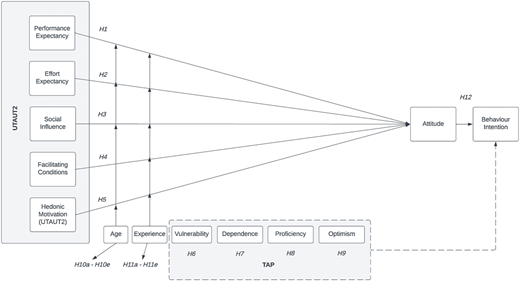
Performance expectancy (UTAUT) refers to the belief that using technology will improve job performance (Venkatesh et al., 2003). Studies have shown its positive impact on the adoption of social media (Borrero et al., 2014), mobile banking (Yu, 2012), service-oriented chatbots (Kasilingam, 2020) and AI coaching (Terblanche and Kidd, 2022). We propose that:
Higher performance expectancy of the AI coaching chatbot will positively influence contact centre employees’ attitudes towards the AI coaching chatbot.
Effort expectancy (UTAUT) refers to the perceived ease of using a system (Venkatesh et al., 2003). Research shows that user-friendly systems are more likely to be adopted (Davis et al., 1989; Kuberkar and Singhal, 2020). Therefore, we expect that:
Higher effort expectancy of the AI coaching chatbot will positively influence employees’ attitudes towards the AI coaching chatbot.
Social influence (UTAUT) relates to how much an individual believes that important others think they should use a technology (Venkatesh et al., 2003). It significantly affects adoption in contexts like mobile banking (Yu, 2012) and AI coaching (Terblanche and Kidd, 2022). We expect that:
Higher social influence relating to the AI coaching chatbot will positively affect employees’ attitudes towards the AI coaching chatbot.
Facilitating conditions (UTAUT) refer to the belief that the necessary infrastructure exists to support technology use (Venkatesh et al., 2003). It is a key factor in mobile banking (Joshua and Koshy, 2011), wearable tech (Guest et al., 2018) and AI coaching chatbots (Terblanche and Kidd, 2022). We expect that:
Stronger facilitating conditions will positively impact employees’ attitudes towards the AI coaching chatbot.
Hedonic motivation (UTAUT2) refers to the enjoyment derived from using a technology, which influences acceptance (Brown and Venkatesh, 2005). It’s linked to user engagement in information systems (Van der Heijden, 2004) and AI coaching chatbots. We expect that:
Higher hedonic motivation will positively influence employees’ attitudes towards the AI coaching chatbot.
Vulnerability (TAP) relates to concerns about the potential risks of technology, such as data breaches (Ratchford and Barnhart, 2012). Lower vulnerability perceptions encourage adoption; therefore, we expect that:
Lower perceived vulnerability will positively affect employees’ intention to use the AI coaching chatbot.
Dependence (TAP) measures feelings of over-reliance on technology (Ratchford and Barnhart, 2012). Excessive dependence can lead to resistance, while lower dependence fosters acceptance. We expect that:
Lower technology dependence will positively influence employees’ intention to use the AI coaching chatbot.
Proficiency (TAP) refers to confidence in learning and using new technologies (Ratchford and Barnhart, 2012). Higher proficiency predicts greater technology adoption; therefore:
Higher technology proficiency will positively influence employees’ intention to use the AI coaching chatbot.
Optimism (TAP) is the belief that technology enhances life by offering greater control and flexibility (Ratchford and Barnhart, 2012). Optimism is linked to positive technology adoption behaviours. We expect that:
Higher technology optimism will positively affect employees’ intention to use the AI coaching chatbot.
Demographics (age and experience): Age and contact centre experience may moderate the relationships between the above factors and technology adoption (Venkatesh et al., 2003). Terblanche and Kidd (2022) found that age moderates effort expectancy; therefore:
Behavioural intent: This refers to an individual’s motivation to use a technology, a strong predictor of actual usage (Venkatesh et al., 2003). We expect that:
A positive attitude towards the AI coaching chatbot will increase behavioural intent.
These hypotheses are summarised in the conceptual model in Figure 1:
Research method
This study followed an exploratory quantitative research design and used structural equation modelling (SEM) to analyse primary data obtained from a cross-sectional survey that captured demographics, TAP and UTAUT constructs.
Population, sample and measurements
Non-probability sampling was used in this study, specifically judgement sampling, as it targeted participants from the contact centre industry only. To participate in this study, recruits had to hold a contact centre agent role within a business process outsourcing (BPO) setting. A single contact centre with 200 employees based in South Africa was targeted. The demographics of the population consisted of a random mix of sales and customer service agents, both male and female, aged between 18 and 50.
An online, self-completion survey questionnaire was created and distributed to participants via email and Microsoft Teams. This survey consisted of four sections and a total of 47 questions. Section 1 collected demographics (age, gender and experience). Section 2 used the 14-item TAP scale (optimism, proficiency, dependence and vulnerability) with strong reliability (Cronbach’s alpha: 0.73–0.87). Section 3 showed a five-minute demo video of an AI coaching chatbot highlighting its setup, data security, goal-setting and reflection features. Participants confirmed video completion to proceed. Section 4 included 33 UTAUT-based questions covering performance expectancy, effort expectancy, social influence and other constructs. Items were adapted for coaching chatbot context, with internal consistency above 0.75. A five-point Likert scale (1–5) was used, consistent with prior TAP and UTAUT research.
Data collection, analysis and ethics
The survey was completed online and took 15–20 min to complete. The survey was considered complete when a respondent had completed all sections and watched the demonstration video. The survey was also piloted by five users to validate the structure and flow as well as user understanding of how to navigate the survey.
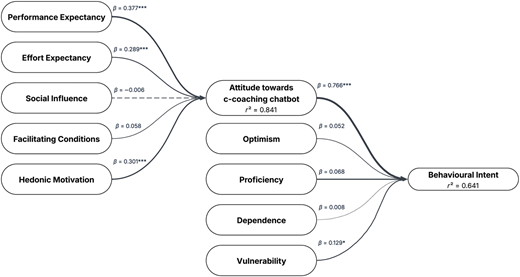
Partial least squares structural equation modelling (PLS-SEM) was used to investigate the model presented in Figure 2. The mediation was tested between each UTAUT2 independent variable and the participants’ attitude towards e-coaching chatbots, followed by their behavioural intent. The TAP independent variables were also tested against behavioural intent directly. The moderating effects of age and experience were then measured against the nine independent variables to assess their respective influences. Data analysis was conducted using the SEMinR tool.
Ethics approval was obtained from the researchers’ institution (reference SBER-31242).
Results
Realised sample
About 61% of the respondents were aged between 26 and 35, 32% were aged between 18 and 25 and only 7% were aged between 36 and 45. Millennials were the predominant generational group in this study. About 65% of the respondents were female, 34% were male and 1% were other. The high participation rate of females is primarily indicative of the hiring practices of the organisation and not necessarily based on interest in completing the survey. About 35% of respondents had between 0 and 3 years of experience, 21% had between 4 and 6 years of experience, 25% had between 7 and 10 years of experience and 19% had more than 11 years of experience.
Reliability of data
PLS-SEM follows a two-step process (Hair et al., 2017), assessing both the outer and inner models. This section evaluates the outer model to test the reliability of the measurement model. Outer loadings, Cronbach’s alpha, composite reliability and average variance extracted were assessed (see Tables 1 and 2). Of 47 outer loadings, only one – social influence 3 (SI3) – had a low p-value (0.013), below the recommended threshold of p < 0.05. However, SI3 was retained, as it remained part of a coherent construct. Discriminant validity was tested using the heterotrait-monotrait ratio (HTMT) method (Henseler et al., 2015). Confidence intervals were calculated, and any upper limit above 1 would indicate a lack of discrimination. All variables passed this test, confirming discriminant validity across the model.
Table 2 consolidates the key reliability and validity metrics of CA, CR and AVE for each latent variable in the model. The Cronbach’s alpha was used to assess the internal consistency and reliability of the proposed measurement model as well as its individual constructs. According to Tavakol and Dennick (2011), a CA value below 0.70 raises concerns about data reliability, primarily due to poor inter-relatedness between items, heterogeneous constructs or a low number of questions. A coefficient closer to 1.0 suggests a stronger internal consistency between the questions and the construct being measured. The reliability analysis was conducted using SPSS and is summarised in Table 2. Based on the Cronbach’s alpha results, all constructs met the 0.70 threshold, except for vulnerability (0.58) and social influence (0.67). This is likely due to the fewer items measured within these constructs, as mentioned above. These margins fall within an acceptable range; therefore, the internal consistency and reliability of the proposed research model are deemed satisfactory. Furthermore, all constructs met the composite reliability threshold of minimum 0.7 (Haji-Othman and Yusuff, 2022), and all bar one construct met the average variance extracted threshold of minimum 0.5 (Chung and Park, 2019). Facilitating conditions were 0.45, which is merely a limiting factor, and did not influence the overall reliability of the model.
Measurement model
Figure 2 represents a structural equation model that depicts the relationships between the different variables influencing behavioural intent to use an e-coaching chatbot. The diagram is divided into two main sections: UTAUT2 constructs predicting attitude towards e-coaching chatbots and TAP constructs predicting behavioural intent. The lines and arrows indicate the strength and direction of the effect.
The path coefficients in Table 3 indicate the strength and direction of the relationships depicted in Figure 2. This is specifically the case between the independent UTAUT2 and TAP variables and the dependent variables of attitude towards e-coaching chatbots and behavioural intent. The significance of these relationships is indicated by the p-values. The following relationships, indicated with an (*), were found to be statistically significant:
H1: performance expectancy → attitude towards e-coaching chatbot (coefficient = 0.38, p < 0.001);
H2: effort expectancy → attitude towards e-coaching chatbot (coefficient = 0.29, p < 0.001);
H5: hedonic motivation → attitude towards e-coaching chatbot (coefficient = 0.3, p < 0.001);
H6: vulnerability → behavioural intent (coefficient = 0.13, p = 0.025)
H12: attitude towards e-coaching chatbot → behavioural intent (coefficient = 0.77, p < 0.001).
We therefore accept the above hypotheses. The other relationships were not found to be statistically significant, and we reject the hypotheses linked to them (H3, H4, H7, H8 and H9).
Although not part of the initial model, a moderation analysis was done to show the impact that the TAP (optimism, proficiency, dependence and vulnerability) variables and the two demographic variables (age and experience) have on the relationship between the UTAUT2 variables and attitude towards e-coaching chatbots. In this case, none of these moderating effects were statistically significant at 95%, and we reject H10 and H11.
Table 4 summarises the hypotheses outcomes.
Discussion
This study explored the factors influencing individuals’ intent to use AI coaching chatbots in contact centre environments. Understanding these factors is vital for organisations aiming to successfully implement AI coaching solutions. The study tested five constructs from the UTAUT2 model, finding that performance expectancy, effort expectancy and hedonic motivation significantly influenced users’ attitudes towards AI coaching, which in turn affected their behavioural intent.
Participants were more likely to adopt the chatbot if they believed it would help them achieve their goals (performance expectancy), be easy to use (effort expectancy) and be enjoyable (hedonic motivation). Amongst these, performance expectancy was the strongest predictor. These findings align with previous studies (Terblanche and Kidd, 2022; Kuberkar and Singhal, 2020), although those studies also identified social influence and facilitating conditions as significant – unlike this study. This difference may stem from the contact centre context, where system usage is often mandated and necessary resources are typically provided.
In high-pressure environments like contact centres, employees value tools that help them work more efficiently without adding complexity. AI coaching chatbots can support performance without compromising quality, addressing the dual demands of speed and accuracy (Houlihan, 2002). Agents often handle large call volumes under tight time metrics (Liu and Batt, 2010), making ease of use critical to adoption. If the chatbot is simple and intuitive, it is more likely to become a regular part of development practices.
Hedonic motivation also played a significant role in shaping attitudes. Contact centre roles can be repetitive and stressful, so enjoyment and novelty may offer a buffer against burnout and disengagement (McDonnell et al., 2013). Chatbots that are enjoyable to use may increase engagement and motivation – particularly in environments where team leaders are stretched thin and traditional coaching is limited (Holman, 2002). This also supports broader coaching goals around employee satisfaction and retention (Harney and Jordan, 2008).
The second part of the study examined the impact of four TAP constructs – optimism, proficiency, dependence and vulnerability – on behavioural intent. Only vulnerability was statistically significant. This aligns with Berenyi et al. (2021), who found that perceived risks, such as data security concerns, can deter technology adoption. Respondents who feared misuse of personal data or technological harm were less inclined to use AI chatbots.
This finding suggests that optimism (general positivity towards technology) and proficiency (confidence in using technology) may not overcome concerns about privacy and data security. While these traits may increase openness to new tools, they do not directly address underlying fears about safety and exploitation. As Lam et al. (2008) noted, security concerns often outweigh ease of use or confidence in adoption decisions.
Dependence or the extent to which individuals feel reliant on technology, was also not a significant predictor. While users may depend on technology in general, this does not necessarily translate into willingness to adopt every new tool – especially ones that raise privacy concerns.
In summary, organisations looking to implement AI coaching chatbots in contact centres should prioritise tools that clearly demonstrate performance value, are easy to use and offer a positive user experience. However, they must also address security and privacy concerns directly, as these can be significant barriers to adoption, regardless of users’ general comfort with technology.
Practical implications and recommendations
This study provides new insights and evidence into the application of AI coaching in the workplace, specifically in the contact centre environment where employees face high-paced, high-pressure demands. In future, as AI coaches become more sophisticated and context aware, it is foreseeable that they could become a first port of call for contact centre agents needing immediate assistance when their team leads are not available. AI coaches could assist with knowledge dissemination, motivation and performance tracking of agents, in the process improving agent performance while also assisting with agent well-being. AI coaching could fundamentally transform the way agents are managed and supported, at a fraction of the cost and with more consistency and availability compared to human support.
Contact centre agents
AI coaching chatbots can significantly support contact centre agents, with adoption influenced by performance expectancy, effort expectancy, hedonic motivation and vulnerability. Clear performance benefits are the key to driving adoption. The agent’s experience level affects the effort required and whether they prioritise functionality or enjoyment. While training is essential, incorporating gamification can boost motivation, especially for less experienced agents. Security and trust also play a critical role; providing FAQs, security demonstrations and clear data usage policies can help alleviate concerns and foster acceptance.
Organisations
Given the cost pressures in contact centres, AI coaching chatbots offer a cost-effective alternative to human coaches, providing continuous, personalised support. They can improve performance, standardise coaching quality and enhance talent retention. Success depends on effective deployment and addressing security concerns. Organisations should track performance metrics linked to chatbot usage to demonstrate tangible benefits. Targeted training for less experienced agents and transparent communication about data security are also crucial for adoption.
Developers
For successful adoption, developers must prioritise performance outcomes, as this is the most influential factor. The chatbot should enhance agent performance, cater to varying experience levels and ensure data security with transparent policies. Clear messaging around privacy, FAQs and security features builds trust. Testing with diverse focus groups can identify real-world challenges, while engaging content and demos can showcase the chatbot’s ease of use, performance benefits and user-friendly features, encouraging adoption.
Limitations and further research
This study collected primary data through non-probability sampling, yielding 139 completed online survey responses. While statistically satisfactory, a larger sample would enhance credibility. All responses came from a single BPO organisation, limiting generalisability, as organisational culture may influence perceptions of AI adoption. Including multiple BPO providers in future research could reduce cultural biases. Participants were introduced to the AI coaching chatbot via a five-minute demonstration video, specifically to investigate the perceptions of using this type of technology after the initial invitation. However, this exposure does not fully reflect real-world experiences and could have affected factors such as social influence and facilitating conditions. Live interactions will provide deeper insights, especially regarding long-term adoption, and could be the focus of future research. That would also enable a more direct comparison to the Terblanche and Kidd (2022) study.
The present study focused on factors influencing AI coaching chatbot adoption in the contact centre industry. To better understand sustained engagement, future research should explore the dynamics within the chatbot coaching relationship. Additionally, validating these findings after long-term implementation could offer comparative insights and strengthen the results.
Conclusion
This study set out to explore the factors influencing the individual propensity to use AI coaching chatbots in the contact centre environment. Traditional coaching methods are often constrained by skill or time limitations; however, the emerging trend of AI coaching chatbots is showing potential in addressing these challenges. The main findings are that performance expectancy, effort expectancy and hedonic motivation directly influence the intention to use the chatbot. The study also found that the fear of potentially harmful impacts of technology and distrust in its security are common concerns amongst the respondents, and that vulnerability may serve as a barrier to technology adoption. It is hoped that the results of this study will provide useful insights for the adoption of AI coaching chatbots based on user perceptions and behaviours.