The study aims to investigate the role of techno-stressors (techno-overload, techno-invasion, techno-complexity, techno-insecurity and techno-uncertainty) in inducing cyberloafing behaviour among employees.
A cross-sectional survey of 416 IT professionals in India has been conducted and analysed using structural equation modelling in AMOS v23. The study operationalised validated techno-stressors and cyberloafing scales and tested hypotheses grounded in the job demands-resources model and the transactional model of stress and coping.
All techno-stressors significantly lead to cyberloafing. Among them, techno-complexity emerged as the strongest driver, followed by techno-overload, techno-invasion, techno-insecurity and techno-uncertainty. These findings underscore how specific techno-stressors uniquely contribute to counterproductive work behaviours in the digital workplace.
Organisations need to reduce techno-complexity through user-friendly tools and training, manage techno-overload via workload assessments and establish boundaries to curb techno-invasion. Transparent communication about technological changes and upskilling initiatives can alleviate insecurity and uncertainty, while stress-management programmes may help mitigate cyberloafing.
This study is among the first to empirically differentiate the impact of each techno-stressor on cyberloafing, particularly in the Indian IT sector. This study makes a novel contribution by integrating the job-demand resource model with the transactional stress and coping model to provide a theoretically enriched and contextually relevant explanation of how distinct techno-stressors drive cyberloafing behaviour.
1. Introduction
In the present era of Industry 4.0 and the emerging Industry 5.0, the workplace is increasingly shaped by artificial intelligence (AI), automation, and human–machine collaboration (Chahal & Mahajan, 2024). These technological shifts have made digital tools and platforms an integral part of organisational life (Gupta, Lakhera, & Sharma, 2024). With the expanding use of information and communication technologies (ICTs), the internet now serves both instrumental and recreational functions, supporting task performance while also facilitating personal activities during work hours (Kumar, Akhouri, Yadav, & Chauhan, 2025). Although internet connectivity enhances efficiency and access to information, it has also enabled a growing tendency among employees to engage in cyberloafing, which is the use of the internet for personal purposes during working time (Lim & Teo, 2024a; Sarfraz, Khawaja, & Um-E-Farwah, 2023). Traditionally framed as counterproductive work behaviour, cyberloafing has gained renewed scholarly attention due to its rising prevalence and evolving meaning (Bhattacharjee & Sarkar, 2024). For example, surveys reported that approximately 64% of employees access non-work-related websites daily during work hours, resulting in estimated productivity losses of $85 billion annually (Lim & Teo, 2024a; Zhou, Li, Hai, Wang, & Niu, 2023). Initially, cyberloafing has been defined as the use of a company’s internet access for personal use during office hours (Lim, 2002). However, with the blurring of boundaries between work and non-work domains, particularly in digital, hybrid, or remote work environments, contemporary definitions now include any online activity that distracts from work-related responsibilities (Lim & Teo, 2024b).
Importantly, cyberloafing is no longer viewed solely as counterproductive (Uslu, 2025). Emerging research positions it as a potentially constructive coping mechanism, used by employees to manage digital fatigue, alleviate job-related stress, or reclaim autonomy in highly stressful environments (Hessari, Daneshmandi, Busch, & Smith, 2024; Mishra & Tageja, 2022). In such contexts, cyberloafing has become a common behavioural response to techno-stress, a type of stress caused by difficulty in using, adapting to, or keeping up with rapidly changing technologies (Jyoti, Ahmad, & Choudhary, 2024; Tarafdar, Stich, Maier, & Laumer, 2024).
As workplaces become increasingly digitised, understanding the drivers of cyberloafing in technology-intensive environments is both timely and crucial. Recent research by Uslu (2025) suggests that workplace stressors can be antecedents of cyberloafing. However, despite this growing interest, our understanding of which specific techno-stressors trigger cyberloafing and how they operate within different occupational and cultural contexts remains fragmented. Therefore, examining the factors that lead to cyberloafing is crucial to understanding why this behaviour occurs, particularly in the Indian information technology (IT) sector, where employees experience role overload, work-life imbalance, constant digital engagement, and stress-related issues (Bhattacharjee & Sarkar, 2025).
Several critical gaps motivate this research. First, the meta-analysis by Nastjuk, Trang, Grummeck-Braamt, Adam, and Tarafdar (2023) highlighted that most prior studies treat techno-stress as a single construct, overlooking the specific effects of its dimensions on behavioural outcomes. Second, the systematic literature review by Lim and Teo (2024a) suggested the need for more industry-specific research to explore the factors that drive employees to engage in cyberloafing. Particularly in the information technology sector, where the nature of work often involves continuous computer usage and internet access (Kumar et al., 2025). Third, the direct link between specific techno-stressors and cyberloafing has been underexplored (Güğerçin, 2019). Fourth, Zhang, Guo, Ma, and Zhang (2024) specifically underline the need to utilise and integrate theoretical perspectives to understand cyberloafing. Lastly, Li and Liu (2022) recommended future research on techno-stress and cyberloafing by taking a wider sample from distinct cultural backgrounds. The study fulfils the above-mentioned gaps in the literature by addressing the following research question:
What factors contribute to cyberloafing behaviour among employees of IT sector?
How do specific dimensions of techno-stress influence cyberloafing among employees?
How does cyberloafing function as a coping mechanism in response to techno-stress?
Thus, the study aims to examine the impact of five techno-stressors (techno-overload, techno-invasion, techno-complexity, techno-insecurity, and techno-uncertainty) on cyberloafing, with a specific focus on the Indian IT sector, a rapidly growing industry characterised by high digital dependency, remote work adoption, and continuous AI-driven automation. Furthermore, the study builds on two theoretical foundations: the Job Demands–Resources (JD-R) model (Bakker & Demerouti, 2007) and the Transactional Stress and Coping (TSC) model (Lazarus & Folkman, 1984), which together offer a robust explanation of how techno-stressors perceived as job demand and prompt emotion-focused coping behaviours like cyberloafing. The insights generated are relevant not only to the Indian IT industry but also to similar sectors globally that are undergoing digital acceleration, thereby offering both theoretical depth and contextual relevance.
The rest of the article is structured as follows: The next section discusses the detailed literature review, which includes the theoretical background. Thereafter, the study elaborates on the hypothesis development and outlines the research methodology. In the fifth section, the data analysis and findings are presented. This is followed by discussing the findings and their theoretical and practical implications. Lastly, the study offers directions for future research.
2. Literature review
2.1 Techno-stressors
Techno-stressors are ICT-related stimuli or factors (sources of stress) which create stress from using technology (Mahapatra & Ford, 2024; Tarafdar, Tu, Ragu-Nathan, & Ragu-Nathan, 2007). Ragu-Nathan, Tarafdar, Ragu-Nathan, and Tu (2008) classified techno-stressors into five dimensions, namely techno-overload, techno-invasion, techno-complexity, techno-insecurity, and techno-uncertainty. Techno-overload arises when employees feel overwhelmed by excessive ICT demands (Alhammadi, Bani-Melhem, Mohd-Shamsudin, & Ramanathan, 2025), leading to mental fatigue, while techno-invasion blurs work-life boundaries, causing disruptions (Nayak, Budhwar, & Malik, 2025). Techno-complexity arises when employees find it challenging to adjust to new technologies (Chandra, Shirish, & Srivastava, 2019; Wei & Zheng, 2025), leading to frustration and a sense of incompetence. Similarly, techno-insecurity arises from fears of job displacement due to rapid technological advancements (Ramesh, Ananthram, Vijayalakshmi, & Sharma, 2021), increasing anxiety and lowering job satisfaction. Techno-uncertainty, driven by unpredictable technological changes, creates instability and stress (Tarafdar et al., 2024). Collectively, these stressors lead to behavioural responses, which can also be counterproductive in nature (Cadieux et al., 2024; Güğerçin, 2019; Li & Liu, 2022; Mahapatra & Ford, 2024), emphasising the need for strategies to mitigate their impact.
2.2 Cyberloafing
Cyberloafing is the use of the personal internet for non-work activities during work hours, such as browsing social media, online shopping, or personal communication (Zhang et al., 2024). It is often considered counterproductive as it diverts attention from tasks and reduces efficiency (Lim & Teo, 2024a). However, some researchers argue that short periods of cyberloafing can serve as a coping mechanism, helping employees recharge and regain focus (Andel, Kessler, Pindek, Kleinman, & Spector, 2019; Kumar et al., 2025; Uslu, 2025). Despite this potential benefit, excessive cyberloafing poses risks, including lower productivity, cybersecurity threats, and decreased workplace morale (Zhang et al., 2024; Zhou et al., 2023). Its prevalence has increased with greater ICT accessibility, with factors like job overload, role overload, emotional exhaustion, job stress, and techno-stress playing a significant role in its occurrence (Bhattacharjee & Sarkar, 2025; Li & Liu, 2022; Zhang et al., 2024).
Furthermore, cross-cultural studies reveal that the prevalence, motivations, and perceptions of cyberloafing vary significantly across socio-cultural environments. For instance, Lim and Teo (2005) documented that in collectivist Asian contexts like Singapore, employees often perceive cyberloafing as normal behaviour that does not consume much time or harm the organisation. Later, Blanchard and Henle (2008) found that U.S. employees engage in cyber-slack in response to coworker and supervisor norms that endorse cyberloafing. Recently, the literature review by Lim and Teo (2024a) emphasised that cultural differences impact both the extent and the nature of cyberloafing as Internet restrictions, usage norms, and workplace cultures differ across countries. Cyberloafing has also been shown to vary across cultures and genders in the existing literature. For instance, Ugrin et al. (2018) found that employees from cultures with low power distance and feminine values engage in cyberloafing more frequently than those from cultures with high power distance and masculine values. Further, Rahimnia and Mazidi (2015) found that women in Iran engage in cyberloafing more than men. Additionally, Metin et al. (2016) showed that Turkish employees reported higher levels of cyberloafing than Dutch employees. However, an Indian study by Mishra and Tageja (2022) and Bhattacharjee and Sarkar (2025) reported cyberloafing as a culturally tolerated micro-break, especially in IT environments, thereby serving as a coping mechanism against overwhelming digital demands. These cultural nuances suggest that cyberloafing is a global phenomenon which is filtered through cultural beliefs, workplace norms, and coping traditions. Understanding these dynamics is essential for organisations to develop balanced strategies that maintain productivity while acknowledging the role of cyberloafing in stress relief.
2.3 Theoretical framework
This study integrates the JD-R model (Bakker & Demerouti, 2007) and the TSC model (Lazarus & Folkman, 1984) to explain the direct impact of techno-stressors on cyberloafing. The JD-R model positions techno-stressors (e.g., techno-overload, techno-invasion, techno-complexity) as job demands that deplete employees’ psychological and cognitive resources when supportive job resources are insufficient (Mahapatra & Ford, 2024). In such contexts, cyberloafing emerges as a resource-conserving behaviour. The TSC model (Folkman, 2013) complements this by providing a psychological explanation of the techno-stress process (Zhu, Zhao, Wu, Shi, & Leung, 2023). The study posits that individuals engage in a two-stage appraisal process when facing techno-stress: primary appraisal (evaluating the stressor as a threat or challenge) and secondary appraisal (assessing coping options). When employees perceive techno-stressors as a threat (primary appraisal), they resort to emotion-focused coping strategies (secondary appraisal), such as cyberloafing to avoid the stressor and regain mental balance (Sharma & Gupta, 2023).
The five techno-stressors have been selected based on the well-established multidimensional framework developed by Ragu-Nathan et al. (2008). These dimensions align with the Job Demands aspect of the JD-R model, representing resource-draining stressors in the work environment (Bakker & Demerouti, 2007). Cyberloafing has been selected as the primary outcome because it is a prevalent coping behaviour in technology-rich settings. Drawing on the TSC model (Lazarus & Folkman, 1984), cyberloafing is conceptualised as an emotion-focused response to techno-stressors, especially when employees perceive they lack the resources to actively manage or reduce the stressors. The framework, therefore, hypothesises that techno-stressors increase the likelihood of cyberloafing. This integrated approach is complementary, allowing the model to simultaneously account for structural stress-inducing factors (via the JD-R model) and individual behavioural responses (via the TSC model), providing a robust foundation for understanding how specific digital demands lead to counterproductive behaviours in IT-intensive workplaces.
3. Hypotheses development
3.1 Techno-overload and cyberloafing
Techno-overload refers to the feeling of being overwhelmed by excessive ICT demands (Alhammadi et al., 2025). Employees experiencing techno-overload often face constant interruptions, high workloads, and the pressure to stay connected, which lead to mental fatigue and stress (Thurik, Benzari, Fisch, Mukerjee, & Torrès, 2023). To cope with these demands, employees engage in cyberloafing to mentally disengage or take a break from their overwhelming tasks and stressors (Bhattacharjee & Sarkar, 2025; Lim & Teo, 2024a; Pee, Woon, & Kankanhalli, 2008). For instance, Zhang et al. (2024) found a positive and significant relationship between work overload and cyberloafing. More recently, the systematic literature review by Uslu (2025) highlighted workplace stressors such as workload, role overload, interruption overload, job stress, and techno-stress as antecedents of cyberloafing. Specifically, Li and Liu (2022) study on college students found that techno-overload has a positive and significant impact on cyberloafing. Consequently, it is hypothesised that:
Techno-overload has a positive and significant impact on cyberloafing.
3.2 Techno-invasion and cyberloafing
Techno-invasion occurs when the lines between work and personal life become blurred because of the pervasive nature of technology (Ramesh et al., 2021), such as the expectation to respond to work-related communications outside of working hours (Tarafdar et al., 2024). This constant intrusion into personal time can lead to burnout and a lack of control over one's work-life balance (Kumar, 2024). Employees who experience techno-invasion may engage in cyberloafing during work hours to reclaim personal time or compensate for the loss of boundaries. Previous research has indicated that techno-invasion is positively linked to deviant workplace behaviours, including cyberloafing, as employees attempt to restore a sense of autonomy (Chen, Wang, Benitez, Luo, & Li, 2022; Gugercin, 2019). Thus, it is hypothesised that higher levels of techno-invasion will lead to increased cyberloafing.
Techno-invasion has a positive and significant impact on cyberloafing.
3.3 Techno-complexity and cyberloafing
Techno-complexity refers to employees’ difficulty adapting to and using new or complex technologies (Ragu-Nathan et al., 2008). When employees struggle to understand or operate technological tools, they may experience frustration, anxiety, and a sense of incompetence (Yuan, Kong, Liu, & Jiang, 2023). These negative emotions can reduce job satisfaction and increase the likelihood of disengagement from work tasks. As a result, employees may turn to cyberloafing to escape the frustration caused by techno-complexity or to seek temporary distractions (Lim & Teo, 2024a; Mishra & Tageja, 2022; Pee et al., 2008). Furthermore, in a study of technology-enhanced learning of college students, Li and Liu (2022) found that techno-complexity has a positive and significant impact on cyberloafing. However, whether this relationship exists among IT sector employees is yet to be tested. Therefore, it is hypothesised that:
Techno-complexity has a positive and significant impact on cyberloafing.
3.4 Techno-insecurity and cyberloafing
Techno-insecurity arises when employees fear job displacement or skill obsolescence due to rapid technological advancements (Tarafdar et al., 2024). This fear can lead to anxiety, reduced job satisfaction, and a lack of motivation to engage in work tasks (Yuan et al., 2023). Employees who feel insecure about their technological skills or job stability may engage in cyberloafing as a way to cope with their anxiety or to avoid tasks that highlight their perceived inadequacies (Lim & Teo, 2024a). Thus, it is hypothesised that higher levels of techno-insecurity will lead to increased cyberloafing.
Techno-insecurity has a positive and significant impact on cyberloafing.
3.5 Techno-uncertainty and cyberloafing
Techno-uncertainty refers to the anxiety caused by rapid and unpredictable changes in technology, such as the introduction of new systems or tools that employees must learn and adapt to (Kumar, 2024). This constant state of change can create a sense of instability and stress as employees struggle to keep up with evolving technological demands (Yuan et al., 2023). When employees experience high levels of techno-uncertainty, they may resort to cyberloafing as a form of psychological escape. This parallels the conservation of resources theory (Hobfoll, 1989), which suggests that individuals engage in behaviours that help them conserve cognitive and emotional resources. Therefore, it is hypothesised that higher levels of techno-uncertainty will be associated with increased cyberloafing.
Techno-uncertainty has a positive and significant impact on cyberloafing.
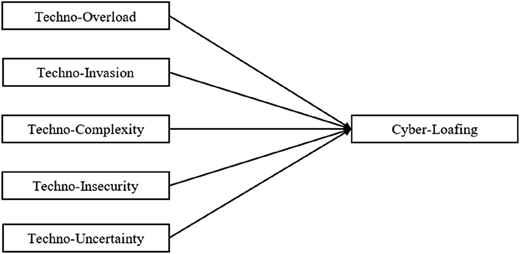
In light of the above-discussed arguments, the following conceptual framework has been established (see Figure 1).
4. Methodology
4.1 Statistical tools and techniques
The data has been analysed using SPSS v23.0 and AMOS v23.0 software. Initial screening involved normality tests, outlier detection and multicollinearity checks. Following this, a Confirmatory Factor Analysis (CFA) has been performed using AMOS v23.0 to assess the reliability and validity of the measurement model. For hypothesis testing, the study employed Covariance-Based Structural Equation Modelling (CB-SEM), which is suitable for theory-driven models. CB-SEM is preferred over PLS-SEM due to its ability to assess overall model fit and validate complex theoretical models (Hair, Black, Babin, & Anderson, 2019). Fit indices such as Normed Chi-Square (CMIN/df), Comparative Fit Index (CFI), Goodness of Fit Index (GFI), Normed Fit Index (NFI), Tucker–Lewis Index (TLI), Root Mean Square Error of Approximation (RMSEA), and Root Mean Square Residual (RMR) have been used to assess model adequacy.
4.2 Measurement development
The study employed previously validated scales to ensure content and construct validity. Techno-stressors have been measured using a 23-item scale (see Table 1) adapted from Ragu-Nathan et al. (2008), which is distributed across five dimensions (see Table 1), namely techno-overload (5 items), techno-invasion (4 items), techno-complexity (5 items), techno-insecurity (5 items), and techno-uncertainty (4 items). Cyberloafing has been assessed using 8-items (see Table 1) adapted from Lim (2002). All items have been recorded on a 5-point Likert scale ranging from 1 (“strongly disagree”) to 5 (“strongly agree”), which offers an optimal balance between response precision and respondent burden. Revilla, Saris, and Krosnick (2013) recommended using a 5-point scale as it is simple, easy to understand, reduces confusion and yields better quality data. Furthermore, in survey research, Hair et al. (2019) highlighted that the Likert scale is a common format for operationalising the latent constructs. Additionally, prior studies have validated the reliability of the 5-point Likert scale in operationalising the techno-stress and cyberloafing constructs effectively (Ragu-Nathan et al., 2008; Lim, 2002).
4.3 Sample and data collection procedure
Data has been collected through an online questionnaire using Google Forms. The link was circulated via professional networks, official WhatsApp groups, LinkedIn, and IT employee forums in Delhi and Chandigarh, two prominent technology hubs in India. Snowball sampling technique has been adopted to ensure that the sample accurately represents the IT workforce in terms of gender, experience, and organisational size. The decision to adopt snowball sampling is based on two key considerations. First, the absence of a centralised or publicly accessible sampling frame for IT professionals made it difficult to apply probability-based sampling techniques. Second, access to IT firms is highly restricted due to organisational gatekeeping policies, security protocols, and confidentiality norms, which often limit direct researcher entry or internal survey distribution within companies. To reduce social desirability and response bias, participants have been assured full anonymity and confidentiality. Some items have been reverse-coded to minimise acquiescence bias.
A total of 813 IT employees have been invited, out of which 466 submitted responses, resulting in a response success rate of 57.32%. After screening for outliers using boxplot analysis (n = 50 removed), the final sample consisted of 416 valid responses. Table 2 presents a complete overview of the sample characteristics. The study has 61.06% male (n = 254) and 38.94% female (n = 162) respondents. The majority of respondents are aged between 26–33 years (48.80%, n = 203), have a bachelor's degree (76.92%, n = 320), and are married (53.61%, n = 223). Regarding work experience, 47.84% (n = 199) have 3 years of experience (see Table 2).
5. Data analysis and results
5.1 Common method bias (CMB)
Since all variables in this study have been assessed through self-reports, response biases represent a significant threat to the integrity of the analysis. We use single-factor Harman's test (Harman, 1976) and the Common Latent Factor (CLF) method (Podsakoff, MacKenzie, Lee, & Podsakoff, 2003) for evaluating CMB. Harman's test revealed that a single factor explains only 35.02% of the variance, notably below the suggested 50% threshold (Harman, 1976; Kautish, Thaichon, & Soni, 2023). Additionally, the CLF method has been used in AMOS v23 to check the CMB. When comparing standardised regression weights (SRW) from models with and without the CLF, the differences fall below the suggested threshold of 0.2, indicating that CMB is not a significant concern in this study (Gaudioso, Turel, & Galimberti, 2017).
5.2 Multicollinearity test
To assess multicollinearity among the independent variables (techno-overload, techno-invasion, techno-complexity, techno-insecurity, and techno-uncertainty), the Variance Inflation Factor (VIF) values have been calculated. All VIF values have been found to be well below the recommended threshold of 5, indicating no serious multicollinearity concerns (Hair et al., 2019).
5.3 Measurement model evaluation: reliability and validity
The analysis unfolds in two phases: Initially, the measurement model’s reliability and validity have been assessed, followed by testing the hypotheses through the structural model (Chang, 2024; Hair et al., 2019). The reliability of all constructs has been established, with Cronbach alpha and composite reliability values exceeding the 0.70 thresholds (Fornell & Larcker, 1981; Hair et al., 2019) (see Table 1). Moreover, the average variance extracted (AVE) for every construct exceeded the 0.50 threshold suggested by Malhotra, Nunan, and Birks (2017) and Hair et al. (2019), thereby confirming convergent validity (see Table 1). Discriminant validity has also been assessed using the Fornell and Larcker (1981) criterion, which specifies that the square root of AVE for each construct must be greater than its correlations with other constructs (Malhotra et al., 2017). As presented in Table 3, all constructs adhere to this criterion, confirming discriminant validity. Furthermore, the goodness-of-fit indices of the measurement model showed an excellent fit (see Table 4), with CMIN/df = 2.643, GFI = 0.953, CFI = 0.966, NFI = 0.967, TLI = 0.969, RMR = 0.051, and RMSEA = 0.057, all meeting the suggested threshold criteria (Ghali, 2023; Hair et al., 2019).
5.4 Structural path model assessment and hypotheses testing
The hypothesis testing has been conducted using Full Structural Equation Modelling in AMOS (v23) software. The outcomes of the structural path model revealed an excellent model fit (see Table 4), with CMIN/df = 3.718, GFI = 0.945, CFI = 0.947, NFI = 0.955, TLI = 0.950, RMR = 0.055, and RMSEA = 0.060. All these metrics meet the recommended thresholds, confirming model fitness (Ghali, 2023; Hair et al., 2019).
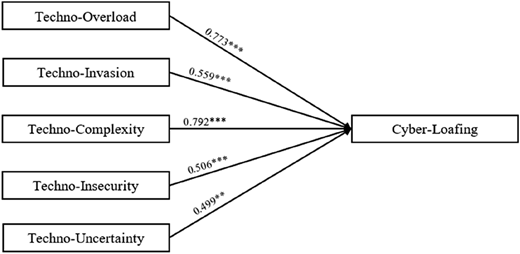
The results of the structural path modelling, presented in Table 5, reveal significant positive relationships between all five techno-stressors and cyberloafing, supporting all hypotheses (H1 to H5). Specifically, techno-overload (SRW = 0.773, p < 0.001), techno-complexity (SRW = 0.792, p < 0.001), techno-invasion (SRW = 0.559, p < 0.001), techno-insecurity (SRW = 0.506, p < 0.001), and techno-uncertainty (SRW = 0.499, p < 0.001) each exhibit significant positive effects on cyberloafing (see Figure 2). These results confirm that among these techno-stressors, techno-complexity and techno-overload emerge as the most influential factors, underscoring their critical role in driving cyberloafing behaviours.
6. Discussion
The study makes a significant contribution to the techno-stress literature by empirically demonstrating how specific dimensions of techno-stress (techno-overload, techno-invasion, techno-complexity, techno-insecurity, and techno-uncertainty) influence cyberloafing, a relationship that is underexplored in the IT context (Kumar et al., 2025; Uslu, 2025). While earlier studies acknowledged a general link between digital stress and counterproductive work behaviours (Chen et al., 2022; Zhou et al., 2023), our findings offer granular insights. Specifically, the study finds that techno-complexity and techno-overload have the most substantial impact on cyberloafing, followed by techno-invasion, techno-insecurity, and techno-uncertainty. These findings reveal that cyberloafing is not a uniform response to general techno-stress but is more likely when employees feel cognitively overwhelmed or technically inadequate. This reframes cyberloafing as a situationally induced coping mechanism, not merely a deliberate act of misconduct.
The results are particularly relevant in emerging digital economies like India, where IT professionals operate in high-pressure environments characterised by rapid automation, AI integration, remote work routines, and evolving job expectations (Bhattacharjee & Sarkar, 2025). The study results validated in the IT sector have transferability to other contexts, such as global business process outsourcing, telemedicine, fintech, and education, where similar patterns of techno-stressors emerge. For example, Li and Liu (2022) examined that in technology-enhanced learning, college students’ techno-stress has a positive and significant influence on cyberloafing.
The study identified techno-complexity as the strongest predictor of cyberloafing. This suggests that employees experiencing stress and frustration due to overly complex technologies are more likely to engage in cyberloafing as a means to escape the cognitive demands of navigating intricate systems. Cyberloafing, in this case, is due to two reasons: either to cope with techno-complexity or to escape the cognitive load associated with it. In the first scenario, complex technology may compel employees to devote more time to adapting or learning new technology through cyberloafing activities, such as browsing the internet or watching YouTube to find technological solutions. In the other scenario, the employee engages in mindless scrolling on social media for personal enjoyment and rejuvenation.
Similarly, the strong effect of techno-overload underscores the role of excessive technology-driven workloads in fostering cyberloafing. This relationship is consistent with Zhang et al. (2024), who confirm the significant relationship between workload and cyber-slacking. This suggests that when technology compels employees to work faster or complete more tasks, combined with tight work schedules, it leads to cyberloafing among employees. When employees perceive technology as a source of relentless demands (e.g., constant notifications and unmanageable tasks), they strategically disengage to reclaim a sense of autonomy. Furthermore, cognitive exhaustion and frustration push individuals to seek mental relief through non-work activities, such as browsing social media or personal websites during work hours. The findings suggest that cyberloafing acts as a way for employees to cope with techno-overload or get even against organisations that cause these stressors.
The remaining stressors, such as techno-invasion, techno-insecurity, and techno-uncertainty, demonstrated significant but comparatively weaker effects on cyberloafing. Techno-invasion reflects the blurring of work-life boundaries brought about by technology, prompting employees to reclaim personal time through non-work-related internet use. This finding parallels that of Chen et al. (2022) and Güğerçin (2019), who identified techno-invasion as a predictor of cyberloafing. These findings suggest that employees engage in cyberloafing as a means to manage the blurred boundary between work and non-work activities.
The findings also revealed that techno-insecurity and techno-uncertainty drive employees to engage in cyberloafing (e.g. entertainment, infotainment, investment). This is tied to the fear of underperformance and/or job displacement due to changes in hardware or software in the organisation. Additionally, the constant need to update skills keeps employees on the edge, and they even indulge in searching for alternative job opportunities.
Thus, the study not only fills empirical gaps but also provides a scalable lens to understand and manage the behavioural consequences of techno-stress in the evolving future of work.
7. Implications
7.1 Theoretical implications
This research offers significant insights into the fields of techno-stress and cyberloafing literature. First, it advances techno-stress research by demonstrating the differential impacts of its dimensions on cyberloafing, thereby addressing the research gaps highlighted by Nastjuk et al. (2023).
Second, by contextualising techno-stress and cyberloafing within the Indian IT industry, this study also responds to the calls of Kumar et al. (2025), Li and Liu (2022) and Lim and Teo (2024a) for industry-specific and cross-cultural investigations, offering insights into how techno-stress manifests in high-tech work environments.
Third, this study enriches the counterproductive work behaviour literature by framing cyberloafing as a threat-driven coping strategy rather than merely deviant workplace behaviour. This perspective aligns with and extends Güğerçin (2019) argument that cyberloafing can serve as a behavioural response to workplace stressors.
Finally, this research integrates the JD-R model (Bakker & Demerouti, 2007) and the TSC Model (Lazarus & Folkman, 1984) to offer a more comprehensive theoretical lens for understanding cyberloafing. In doing so, it addresses Zhang et al.’s (2024) call for a theoretically grounded exploration of cyberloafing. Thus, the findings reveal cyberloafing as a threat-driven coping behaviour, where employees engage in cyberloafing as an adaptive response to mitigate perceived stress. The study deepens our understanding of cyberloafing's role in workplace dynamics, positioning it as a nuanced behavioural outcome of techno-stress rather than a purely discretionary or deviant act.
7.2 Practical implications
This study offers several practical insights for managers, HR professionals, and technology leaders aiming to manage techno-stress, which can enhance employee engagement and reduce cyberloafing. First, the finding that techno-complexity is the strongest driver of cyberloafing highlights the urgent need to simplify digital systems. Organisations should conduct usability audits and invest in user-friendly tools for enterprise software. Regular hands-on training, digital onboarding, and peer mentoring programmes can equip employees with the skills and confidence to navigate complex technologies, reducing frustration and disengagement.
Second, the significant role of techno-overload calls for better workload management and digital boundary-setting. Organisations can implement “right to disconnect” policies, regulate after-hours communication, and automate task prioritisation systems that balance performance demands without overwhelming employees. Promoting micro-breaks and focus windows during work hours can help employees manage mental fatigue and reduce reliance on informal coping like cyberloafing. Organisations can also implement cognitive load audits using analytics (e.g. task-switching frequency, user metrics) to identify and redesign overly complex technologies.
Third, given the impact of techno-invasion, companies should promote work-life balance through digital hygiene policies and boundary-setting (e.g. scheduled email silencing or notification controls). HR teams should develop well-being frameworks that acknowledge the emotional toll of constant digital availability, especially in hybrid or remote work settings.
Fourth, to address techno-insecurity and uncertainty, organisations must provide transparent upskilling pathways and communicate clearly about upcoming technological changes. Leadership should emphasise a culture of continuous learning and psychological safety, ensuring employees view automation as an opportunity rather than a threat. This may reduce anxiety-induced disengagement and foster resilience.
Finally, monitoring cyberloafing trends via ethical analytics (e.g. time-on-task, site-blocking patterns) should not be used punitively but rather as an indicator of digital fatigue. When used with sensitivity and consent, such data can help HR teams design targeted interventions to support employee well-being.
8. Limitations and future research directions
While this study offers important insights into the relationship between techno-stress and cyberloafing, some limitations warrant consideration from future researchers.
First, although this study establishes direct relationships between specific techno-stressors and cyberloafing, it does not account for potential mediating or moderating variables that may shape these relationships. For instance, moderators such as organisational support, digital literacy, or mediators, such as individual coping strategies (e.g. problem-focused or emotion-focused), may influence how employees experience and respond to techno-stress. Incorporating such variables in future models would provide deeper insights into the underlying mechanisms.
Second, the use of a non-probability (snowball) sampling technique limits the statistical generalizability of the findings. Although snowball sampling was appropriate due to restricted access to IT organisations, it may have introduced selection bias, potentially affecting the representativeness of the sample.
Third, the study was conducted exclusively within the Indian IT sector, which, although relevant to digital work, may not accurately reflect other industries or cultural contexts. Therefore, it is advisable to be cautious when applying these findings to other contexts.
Fourth, the cross-sectional design of the study prevents the ability to make causal inferences. While structural equation modelling reveals statistically significant associations, the directionality and long-term effects of techno-stress on cyberloafing would benefit from longitudinal or experimental designs in future research.
Lastly, to improve generalizability, future studies could replicate this model in different sectors across multiple countries and use probability-based sampling methods. Additionally, comparative cross-cultural studies would help assess whether the strength and nature of these relationships vary in diverse institutional and technological environments.
9. Conclusion
This study provides empirical evidence on how distinct techno-stressors significantly contribute to cyberloafing in digitally intensive work settings. The research not only highlights the unique effects of techno-complexity and techno-overload but also draws attention to often-overlooked stressors such as techno-insecurity and techno-uncertainty. By integrating the JD-R and TSC models, the research offers a robust theoretical lens to understand cyberloafing not merely as counterproductive work behaviour, but as a coping response to persistent techno-stressors in the workplace. While the findings are contextually situated, they are also transferable to technology-reliant domains worldwide. The findings call for organisations to redesign digital systems, offer stress management resources, and promote healthier technology integration strategies to mitigate the risk of techno-stress. Future research is encouraged to build on this foundation by exploring mediators and moderators, incorporating longitudinal data, and expanding across various cultural and industrial contexts. In sum, this research advances our understanding of techno-stress and behavioural adaptation in the evolving digital era.