


The main purpose of this paper is to test the relationship between leadership competencies and effectiveness, with constraints as a mediating variable, and to introduce the main assumptions of the Bounded Leadership Model (BLM).
The total sample included 242 leaders in a top managerial position. Data were collected directly from leaders via self-reports. In total, five hypotheses were formed which related to the relationship between leadership competencies and effectiveness and the role of constraints. Hypotheses were tested by analysing several regression models and mediation effects. Moreover, internal consistency and construct validity were assessed by calculating Cronbach’s alpha and assessing the intercorrelations between study variables.
The study results demonstrate that leader’s competencies are positively related to leadership effectiveness. The authors also found an indirect effect of leadership competencies on effectiveness via constraints. Overall, it can be concluded that the scales included in the BLM have satisfactory reliability and validity indicators.
The paper examined the relationship between leadership competencies and effectiveness with constraints as a mediator. Moreover, it introduces the BLM which takes a broader view on leadership and includes variables that seem to play an important role in leaders’ adjustment and success. These findings can be applied in different training processes and also in assessment and development centres to serve as a facilitator in the process of enhancing leadership competencies and effectiveness and in overcoming leadership constraints.
The study overcomes previous research limitations because it offers a selection of leadership competencies that play an important role in leadership effectiveness, as well as may serve as a potential facilitator in the process of overcoming individual constraints. This knowledge can be used for future research and practical purposes.
Introduction
Several leadership theories emphasise the leaders’ charisma, situations in which they operate or their behaviour (e.g. Johnson and Dipboye, 2008; Blanchard, 2008; Bass, 1990). According to the Global Leadership Forecast 2021, digital transformation has a substantial influence on leadership at all organisational levels (DDI, 2021). Today’s leaders experience the speed of information flow (Carter et al., 2015), scale (Schotter et al., 2017) and complexity (Baltaci and Balcı, 2017) in their professional environments. Drucker (2012) states that most management theories do not offer organisations solutions to their current problems. Thus far, existing leadership theories offer narrow definitions that refer to specific leadership elements, such as leaders’ characteristics (Wyatt and Silvester, 2018), styles (Anderson and Sun, 2017), leader–member exchange (Vidyarthi et al., 2014) and authenticity (Yagil and Medler-Liraz, 2014). To discuss this further, we briefly describe three leadership theories: situational leadership theory, transformational leadership theory and authentic leadership theory.
First, the situational leadership theory indicates that leaders adjust their style to their followers’ abilities, knowledge, skills, confidence and motivation (Blanchard et al., 1993). However, several empirical studies have failed to find links between this theory and their research findings (Graeff, 1997). This can be explained by the fact that other organisational factors influence the relationships between leaders and followers, such as office politics (Sinnicks, 2018) or culture (Hartnell et al., 2016), which may force the leader to adopt a specific leadership style. Furthermore, leaders’ individual characteristics, such as emotions, motivation and access to information are not taken into consideration.
Second, the transformational leadership theory provides some solutions to the problems identified above by suggesting that leaders use behaviours such as individualised consideration (listening to followers’ needs and providing support), intellectual stimulation (challenging current assumption and stimulating new idea generation), inspirational motivation (creating and expressing optimistic vision) and idealised influence (providing a role model for followers) (Bass, 1999; Northouse, 2012). Although transformational behaviours may overcome organisational problems, such as those related to corporate climate or culture (Deinert et al., 2015), there has been some criticism of this theory that focuses on the importance of ethics and the abuse of a leader’s power to manipulate followers’ behaviour (Boddy, 2017). Previous studies have also demonstrated that transformational leadership theory does not consider networking behaviours (Anderson and Sun, 2015). Thus, issues related to power at the organisational and inter-organisational levels cannot be solved with the support of transformational leaders.
Finally, the authentic leadership theory incorporates ethics (May et al., 2003); however, it underscores the fact that leaders develop a form of self-regulation based on their moral values (Sparrowe, 2005). The theory also includes self-awareness (i.e. knowing one’s passions, values and internal motivations), transparency (i.e. demonstrating one’s authentic self to others) and balanced processing (i.e. the ability to consider various aspects of relevant information before making a decision) (Walumbwa et al., 2008). Although the authentic leadership theory considers numerous characteristics that have been left unaddressed by other theories, such as ethics or information processing, the effectiveness of power has not been included in the theory.
Considering the current problems with existing leadership theories, a comprehensive model that simultaneously considers different aspects of leadership is needed. Therefore, this article introduces the Bounded Leadership Model (BLM) which is based on a broader view of leadership and includes the important missing elements from the above-mentioned theories. These include leadership competencies, constraints and effectiveness.
Theoretical framework and hypotheses
Leadership constraints
Drawing upon the behavioural complexity theory (Denison et al., 1995) and leaderplex model (Hooijberg et al., 1997) that indicate that leaders’ behavioural complexity mediates the relationship between social and cognitive complexities and leaders’ effectiveness, this study examines the mediation effect of leadership constraints on the relationship between leadership competencies and effectiveness.
Based on the current literature review, seven types of constraints related to leadership can be distinguished: political, cultural, emotional, motivational, entitlement, ethical and informational.
Political constraints are the result of an organisational and industry power play that affects corporate leaders (Pfeffer, 2010). Such constraints are often formed during power plays when leaders form coalitions on different levels of organisational structure (Gotsis and Kortezi, 2010), thereby increasing the impact zone and authority (Brandon and Seldman, 2004). Several different coalitions decrease a leader’s effectiveness, especially at the organisational level.
Cultural constraints are related to an organisational culture that standardises employees’ behaviours according to specific norms and values (Yildiz, 2014). Cultural constraints prove difficult for anyone to break even if they do not support organisational effectiveness (Bryant and Higgins, 2010). Leaders operating within the set of specific norms that are deeply rooted in the organisation experience limited effectiveness, that is, they can influence their team only when they act in line with these norms.
Emotional constraints are associated with irrational behaviour caused by emotional attitudes towards some issues. Some scholars (e.g. Goleman, 1998) argued that leaders often cannot recognise and control their emotions or those expressed by their subordinates. In such situations, leaders have limited effectiveness in terms of their plans, goals and team performance.
Motivational constraints appear when leaders experience problems with their motivation or the motivation of their followers. George (2007) indicates that leaders often face difficulties in finding the right balance between external (such as remuneration) and internal motivational factors (such as personal growth or social relations), thereby causing motivational issues. As motivational constraints appear in each team and organisation, leaders are often charged with the task of motivating employees to perform well. While management skills may be sufficient for task-related issues, motivation requires leadership competence (Shin and McClomb, 1998). However, if a leader has difficulties overcoming motivation constraints, it could result in lower effectiveness.
Entitlement constraints can be the result of legal rules or organisational formalisation that defines responsibilities and hierarchy. As leaders operate in formal frameworks and have defined authorities (Shamir and Eilam-Shamir, 2017), they are often not allowed to undertake actions that are outside their roles. Entitlement constraints, understood as the result of organisational formalisation, are particularly visible in bureaucratic organisations where the leaders have limited impact on the team and the organisation. Previous studies conducted in the public sector, where over-formalisation appears quite often, revealed that such constraints impede leadership effectiveness (van der Voet, 2016; Moynihan et al., 2012).
Ethical constraints cause leaders to not perform some activities which are not in line with their moral values. The clarification of these values, as well as efforts to act according to them, is one of the key priorities of leaders (George, 2003). However, they limit leaders’ options that might be applied to solve some of the organisational problems quickly and easily. While analysing why some organisational projects fail, Ballesteros-Sánchez et al. (2019) found that it mainly occurred due to ethical shortcomings, which in turn, were the reason for the lower effectiveness and lead to a failure in the long term.
Finally, informational constraints influence leaders’ functioning as their ability to collect and process information is limited. Today, the amount of data is increasing (Hashem et al., 2015); thus, these constraints are becoming increasingly important. Although leaders have access to sophisticated software for analysing data (Cook, 2017), the number of possibilities for data collection and analysis limits leadership decision-making. Moreover, Walther (2015) claims that an effective leader can obtain information from various sources (i.e. cope with informational constraints). Several studies have demonstrated that experts have better information extraction and superior pattern recognition than non-experts (Farrow et al., 2005; Allard et al., 1980; Williams and Elliott, 1999). If a leader cannot cope with the overwhelming amount of information, he or she is not effective in the decision-making process.
While working on the BLM, Kozmiński (2015) postulated that leadership competencies are related to leadership effectiveness and constraints. More specifically, leaders’ effectiveness depends on their competencies and constraints. It was postulated that competent leaders can overcome their constraints in a better manner and are more effective at the workplace.
Leadership competencies and effectiveness
Several scholars have studied leadership competencies as potential factors influencing leadership effectiveness (Amagoh, 2009; Kragt and Guenter, 2018). Leadership competencies are considered a promising predictor of a leader’s performance and the organisation’s functionality (Boyatzis and Ratti, 2009). Employees who follow and evaluate their leader’s competencies positively, perform their tasks better, feel a high level of job satisfaction, are more motivated, and actively support cooperation and communication between all participants in the organisation (Boal and Hooijberg, 2000; Hunt and Dodge, 2000; Osborn et al., 2002; Waldman et al., 2004).
The previous work of Kozminski (2015) focused on qualitative interviews with recognisable Polish leaders representing politics, business, culture, religion, sports or local authorities. They included two former presidents of Poland, one prime minister in the Polish government, a cardinal of the Catholic Church and CEOs of important institutions, among others. The leaders were asked to provide descriptions of particular situations and leadership behaviour patterns. Their responses were coded, analysed and subsequently classified into five categories of competencies. Based on these findings, five leadership competencies that might be important in terms of leadership effectiveness have been identified: anticipation, visionary, value-creation, mobilisation and self-reflection.
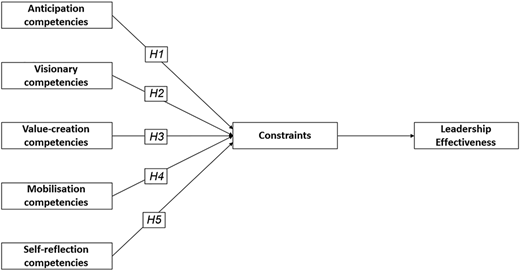
Anticipation competencies are related to the ability to possess foresight to intercept future circumstances and conditions influencing the leadership process. They help leaders create appropriate conditions for implementing change (Nadler and Tushman, 1990), facilitating the introduction of innovative solutions (Ramos, 2013) and supporting the process of building a competitive advantage (Kandampully and Duddy, 1999). Anticipation competencies hold special significance in increasingly turbulent environments, especially when leaders experience different obstacles related to their functioning. Savage and Sales (2008) argued that leaders endowed with this competence understand the dynamics in the organisation’s environment, which is often concerned with cultural constraints, discern patterns and trends in various industries linked to overcoming information constraints, and can predict interactions among various forces that help to handle political constraints. Anticipative leaders might be very influential, especially at the stakeholder level. Thus, it is hypothesised as follows:
Anticipation competencies are positively related to leadership effectiveness, and this relationship is mediated by the perceived impact of constraints.
A leader’s vision competencies translate into the ability to create future visions for oneself and one’s followers, making them sufficiently distant and attractive to mobilise followers to act. Westley and Mintzberg (1989) emphasise that these competencies require the creation of a certain idea that will be communicated to employees in a manner that will inspire them to undertake specific actions aimed at putting this idea into practice. Groves (2006) explains that to generate this kind of inspiration, leaders should express their emotions. Emotions need not necessarily be positive, but they should be strongly related to the final goal defined by the leader. Visionary competencies boost leaders’ impact on employees’ satisfaction (Cheema et al., 2015) and their bond with the organisation (Dvir et al., 2004).
Visionary competencies play an important role in leaders’ effectiveness, and many leadership studies (Hallinger and Heck, 2002) cite vision as one of the key factors explaining the differential effectiveness of organisations. Strange and Mumford (2002) assume that outstanding leadership is linked to viable vision. Great leaders have the following in common: they have the vision to achieve large-scale ideas that they dream of accomplishing, and they have the personal power to enact them (Gibson et al., 2012). Leaders who have visionary competencies change their status quo and influence others who transform the environment. This environment might be related to power play (political constraints), bureaucracy (entitlement constraints), motivational problems (motivational constraints) and uncertainty (informational constraints). Therefore, the following hypothesis is proposed:
Visionary competencies are positively related to leadership effectiveness, and this relationship is mediated by the perceived impact of constraints.
Value-creation competencies are related to the ability to propose norms, values and patterns of behaviour to ensure the effective impact of the leader on his/her followers. Recent research has revealed that these skills can help lead organisations with limited resources. Thus, the leader often has to decide how to divide the resources to achieve the set goal. Smith et al. (2016) argue that leaders with value-creating competencies can increase the pool of resources through a variety of alliances and cooperation with individuals who share similar values.
Value-creation competencies are especially important when leaders are responsible for establishing standards of conduct and values that guide the behaviour of employees (Mautz and Sharaf, 1961). In this way, leaders may overcome cultural constraints. Similarly, Nogalski and Dunal (2012) emphasised that to share core values and maintain organisational cohesion, the leader and his/her followers need to speak the same language. It might help deal with motivational, informational and political constraints. Thus, value-creation competence allows leaders to find common ground with employees, overcome constraints and ensure leaders’ effectiveness at the team and organisation levels. Therefore, we propose the following hypothesis:
Value-creation competencies are positively related to leadership effectiveness, and this relationship is mediated by the perceived impact of constraints.
Mobilisation competencies refer to the leader’s ability to generate an extraordinary degree of commitment among followers – to the point of personal sacrifice – for the benefit of the organisation. Existing literature often identifies these competencies in the education (Clark, 2013), health (Giles, 2010) and politics sectors (Rucht, 2012). This may be explained by the fact that modest remuneration or even voluntary work is not uncommon in these sectors and this requires exceptional mobilisation skills from leaders. In commercial organisations, these competencies are also important as they are related to employee performance (Bruch and Vogel, 2011).
Research on leadership has a long history in the study of leadership effectiveness and the leader’s success in mobilising followers for collective ends (McClelland and Boyatzis, 1982). Leadership researchers claim that effective leadership may also include a strong emotional, ethical and cultural component which great leaders usually use to mobilise followers (Goleman et al., 2002; Stubbs-Koman and Wolff, 2008). Effective leaders have mobilisation competencies which they use to overcome emotional, ethical and cultural constraints. They thus encourage followers to sacrifice and achieve great goals (Miao et al., 2018). Moreover, to be effective in mobilising others, leaders need to handle informational constraints related to their employees’ personal needs and ambitions (Bass, 1999). Furthermore, leaders who are able to mobilise their employees deal well with power plays (linked to political constraints) (Korzynski et al., 2021) and do not need formal rules (entitlement constraints) (Noe et al., 2017). Therefore, the following hypothesis is proposed:
Mobilisation competencies are positively related to leadership effectiveness, and this relationship is mediated by perceived impact constraints.
Self-reflection competencies are associated with the leader’s ability to analyse and learn from successes and failures. Reflecting on oneself is strongly emphasised in the theory of authentic leadership, popularised by George (2007). According to his concept, authentic leaders analyse their life experiences and, by doing so, get to know themselves. Sparrowe (2005) adds that leaders engage in specific dialogue with themselves, which enables them to become authentic.
Luthans and Avolio (2003) claim that self-reflection competencies create important positive psychological capacities and build the self-awareness of effective leaders. Self-reflective leaders use introspection to assess themselves and are aware of their strengths and weaknesses (Hinojosa et al., 2014). They can also create a transparent and honest relationship with others and have the ability to overcome emotional constraints. This authentic attitude is effective in gaining the acceptance and trust of followers, which may increase the quality of social exchange between leaders and followers and lower the impact of entitlement limitations. Moreover, self-reflective leaders fully understand the art of balance; for example, they process affairs in such a way that all followers’ suggestions receive equal consideration (Gardner et al., 2005). The perception of fairness and balance may alleviate tension and anxiety among followers and make them more likely to feel recognised and appreciated (Avolio et al., 2004). In this way, leaders could first overcome motivational constraints and then influence the team, organisation and environment. Based on the above arguments, the following hypothesis is proposed:
Self-reflection competencies are positively related to leadership effectiveness, and this relationship is mediated by the perceived impact of constraints.
A graphical representation of the five hypotheses described above is shown in Figure 1.
Methodology
Sample and procedure
The total sample included 242 participants (61% male) aged 23–64 years (M = 39.75, SD = 6.95), whose length of work in a top managerial position differed from 3 to 24 years (M = 9.18; SD = 5.6). All participants were former MBA students who graduated from Kozminski University in Warsaw, Poland, within the last five years. They were carefully selected among top managers (i.e. holding positions of divisional directors, deputy chairs or chairs) or on fast-track career paths in middle or large enterprises. This study was approved by the Ethical Committee of Kozminski University.
Measures
Competencies
The Leadership Competencies Questionnaire (LCQ) includes 25 items that measure five competencies: anticipation (5 items, e.g. “Considers various possibilities and action plans”), visionary (5 items, e.g. “Has intuition and predicts the future accurately”), value-creation (5 items, e.g. “Sets high operating standards”), mobilisation (5 items, e.g. “Effectively encourages others to work hard”) and self-reflection (5 items, e.g. “Draws accurate conclusions from past experience”). Responses are provided on a 7-point Likert scale ranging from 1− = very dissimilar to me to 7− = very similar to me (for all items, please see the Appendix).
Effectiveness
The Leadership Effectiveness Questionnaire (LEQ) includes 12 items that measure leadership effectiveness (e.g. “Creates solutions that improve work throughout the company”). Responses are provided on a 7-point Likert scale ranging from 1− = very dissimilar to me to 7− = very similar to me (for all items, please see the Appendix).
Constraints
The Leadership Constraints Index (LCI) includes seven items that measure seven types of constraints: political “To what extent do you feel inhibited by situations in which the effectiveness of your actions is constrained by battles for power, resources or existing coalitions?”, cultural “To what extent do you feel inhibited by comments from other members of the organisation that a certain course of action is inappropriate or improper when you consider it to be the most effective or convenient?”, emotional “To what extent does your emotional engagement in business matters inhibit you in working effectively, for example, loyalty to your boss/colleagues, antipathy towards certain people or institutions?”, motivational “How strongly do your ambitions and aspirations, or conversely, your fears and apprehensions, inhibit your actions?”, entitlement “How much do you feel constrained by the scope of duties and responsibilities assigned to you?”, ethical “To what extent do you feel inhibited by situations in which the effectiveness of your actions is constrained by battles for power, resources or existing coalitions?”, and informational “How much is the effectiveness of your work limited in terms of access to information and the possibility of processing, recovering and utilizing it?”. Responses are provided on a 5-point Likert scale ranging from 1 (not inhibited) to 5 (very inhibited).
Results
The assumptions of hypotheses H1, H2, H3, H4 and H5, relating to the association between leaders’ self-perceived competencies and leadership effectiveness, were tested via multiple regression models using calculations performed by the statistical package IBM SPSS version 26. Additionally, mediation models were analysed by a widely used logistic regression path analysis modelling tool PROCESS macro v3.5 (Hayes, 2018). Considering the item content of the LCI and the type of analyses that were run, we treated the constraints as a latent variable based on the mean scores.
Preliminary analyses
Before testing the hypotheses, we checked the reliability and validity of the scales used in the study.
Internal consistency was assessed by calculating Cronbach’s alpha coefficient. An alpha of at least 0.60 has been considered to represent a satisfactory degree of internal consistency (Griethuijsen et al., 2014). The leadership competencies, measured using the LCQ, had the following reliability estimates: anticipation α = 0.70, visionary α = 0.76, value-creation α = 0.78, mobilisation α = 0.81 and self-reflection α = 0.70. The reliability estimate of self-perceived constraints, measured with the LCI, was α = 0.74, and the reliability of the leadership effectiveness, measured with the LEQ, was α = 0.80; thus, it can be concluded that all the measures used in the study have satisfactory reliability indices.
Construct validity was checked by assessing the direction and strength of the relationships between the study variables. Table 1 indicates the intercorrelations among leadership competencies, effectiveness and constraints.
Correlation coefficients between leadership competencies, effectiveness and constraints
| 1 | 2 | 3 | 4 | 5 | 6 | 7 | |
|---|---|---|---|---|---|---|---|
| (1) Anticipation competencies | – | ||||||
| (2) Visionary competencies | 0.67** | – | |||||
| (3) Value-creation competencies | 0.64** | 0.53** | – | ||||
| (4) Mobilisation competencies | 0.53** | 0.63** | 0.69** | – | |||
| (5) Self-reflection competencies | 0.63** | 0.53** | 0.57** | 0.54** | – | ||
| (6) Leadership effectiveness | 0.42** | 0.46** | 0.31** | 0.48** | 0.32** | – | |
| (7) Constraints | −0.13* | −0.12 | −0.10 | −0.21* | −0.05 | −0.24** | – |
| M | 5.81 | 5.66 | 5.96 | 5.64 | 5.95 | 5.26 | 2.85 |
| SD | 0.67 | 0.71 | 0.71 | 0.79 | 0.65 | 0.78 | 0.70 |
Note(s): *p < 0.05, **p < 0.01 two-tailed. Competencies and leadership effectiveness were measured on a 7-point and constraints on a 5-point Likert scale
The results showed that effectiveness had significant positive correlations with all five types of competencies and a significant negative correlation with constraints. Regarding leadership competencies, the highest positive correlation was found between value-creation and mobilisation competencies (r = 0.69; p < 0.01). Leaders’ self-perceived constraints correlated negatively with mobilisation competencies (r = −0.21; p < 0.05).
Predicting leadership effectiveness
Regression models with direct effects
| Relationship | B | SE | Beta | t | p |
|---|---|---|---|---|---|
| H1. Anticipation com → Effect | 0.26 | 0.10 | 0.22 | 2.56 | 0.01 |
| H2. Visionary com → Effect | 0.18 | 0.09 | 0.17 | 2.02 | 0.04 |
| H3. Value-creation com → Effect | −0.19 | 0.09 | −0.18 | −2.08 | 0.04 |
| H4. Mobilisation com → Effect | 0.38 | 0.08 | 0.38 | 4.48 | 0.00 |
| H5. Self-reflection com → Effect | −0.01 | 0.09 | −0.01 | −0.12 | 0.91 |
Note(s): Com = competencies, Effect = leadership effectiveness
The results showed that four out of five competencies – anticipation, visionary, value-creation and mobilisation, and visionary – served as significant predictors of leadership effectiveness. Mobilisation competencies were the strongest positive predictor, while value-creation competencies were the weakest negative predictors of leadership effectiveness. Self-reflection competencies did not predict leadership effectiveness; therefore, all hypotheses were supported, except for H5. Overall, competencies explained 29% (R2 = 0.29) of the total variance in leadership effectiveness.
The role of self-perceived constraints in leadership effectiveness
We applied Model 4 in PROCESS macro v3.5 (Hayes, 2018) to test the mediating role of constraints (Table 3).
Regression models with indirect effects
| Moderation | Mediation effect | SE | LLCI | ULCI |
|---|---|---|---|---|
| H1. Anticipation com → Cons → Effect | 0.03 | 0.02 | 0.00 | 0.07 |
| H2. Visionary com → Cons → Effect | 0.03 | 0.02 | −0.00 | −0.06 |
| H3. Value-creation → Cons → Effect | 0.02 | 0.02 | −0.00 | 0.06 |
| H4. Mobilisation com → Cons → Effect | 0.03 | 0.02 | 0.01 | 0.07 |
| H5. Self-reflection com → Cons → Effect | 0.01 | 0.02 | −0.02 | 0.06 |
Note(s): Com = competencies, Cons = constraints, Effect = leadership effectiveness
We tested five different mediation models following H1, H2, H3, H4 and H5. There was a negative link between all types of competencies and constraints (a path), a negative link between constraints and effectiveness (b path), and a positive direct link between all types of competencies and effectiveness (c path).
The mediation results showed a significant indirect effect in two of the five models which were analysed (Figure 2).
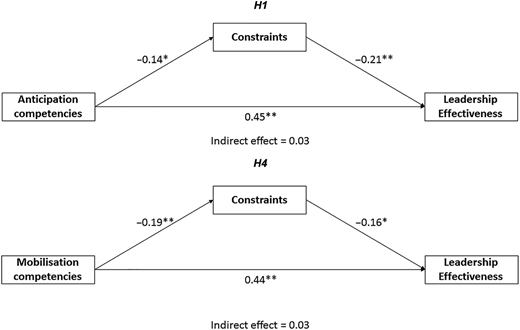
The relationship between anticipation competencies and effectiveness was mediated by constraints at β = 0.03, SE = 0.02, 95% CI [LLCI 0.00, ULCI 0.07], R2 = 0.20, p < 0.001. Thus, H1 was fully supported, and it can be concluded that anticipatory competencies and leaders’ self-perceived constraints explain 20% of the total variance in leadership effectiveness. The relationship between mobilisation competencies and effectiveness was mediated by constraints at β = 0.03, SE = 0.02, 95% CI [LLCI 0.00, ULCI 0.07], R2 = 0.23, p < 0.001. Thus, H4 was fully supported, and it can be concluded that mobilisation competencies and leaders’ self-perceived constraints explain 23% of the total variance in leadership effectiveness.
Discussion
This article aimed to assess the relationship between leadership competencies and effectiveness via individual constraints and to introduce the BLM. The BLM takes a broader view of leadership and includes the leaders’ competencies, constraints and effectiveness that are all needed for leaders’ adjustment and effectiveness (Miao et al., 2018). We sought the possible predictors of leadership effectiveness. The results show that four out of five competencies predict leadership effectiveness; therefore, the hypotheses were partly supported. Our findings (29% of the total variance explained) suggest that other variables play an important role in leadership effectiveness.
Our research highlights the symbolic paradigm of management rather than an omnipotent view. The symbolic paradigm is based on the belief that leaders symbolise control and influence. Overall, leaders who were assessed belong to the managerial level. They try to develop the vision, mobilise employees, anticipate changes and set proper norms and standards, but their decisions and actions are constrained. External constraints arise from the organisational environment and internal constraints come from themselves.
To assess the model further, we wanted to check whether constraints mediate the relationship between leadership competencies and effectiveness. We found that there was a significant indirect effect in the case of two leadership competencies: anticipation and mobilisation. Our findings are consistent with those of previous studies on anticipation. Nadler and Tushman (1990) claimed that anticipation helps leaders create appropriate conditions for implementing change, facilitating the introduction of innovative solutions and supporting the process of building a competitive advantage. Moreover, anticipation is of special significance in increasingly turbulent environments, especially when leaders experience different obstacles related to their functioning (Zhang and Fishbach, 2010). If they manage to overcome these obstacles, they may not only reach the next career level but also impact their companies’ performance. In light of the results obtained, it is important to add that all managers in our study were on fast-track career paths in middle or large enterprises. Their anticipation and accurate decisions could be treated in their organisation as a gate that opens the opportunity to reach the next career level.
The significant indirect effect between mobilisation and effectiveness is also consistent with previous research. Bruch and Vogel (2011) highlighted that in commercial organisations, mobilisation competencies are crucial because they are related to employee performance. The results play the most important part in the commercial organisation and managers mainly take care of achieving them. According to Miao et al. (2018), effective leaders have mobilisation competencies which they use to overcome emotional, ethical and cultural constraints; in this way, they encourage followers to sacrifice and achieve great goals.
Theoretical and practical implications
This study shows the relationship between leadership competencies and effectiveness via individual constraints and introduces the BLM which takes a broader view on leadership and includes the leaders’ competencies, constraints and effectiveness that are all needed for leaders’ adjustment and effectiveness. The assumptions of the BLM compensate for some weaknesses that can be found in the existing literature regarding leadership theories, such as the lack of reference to leaders’ traits in situational leadership theory (Thompson and Glasø, 2018), the underlined importance of office politics and power plays in transformational and authentic leadership theories (Hinojosa et al., 2014). Therefore, we believe that our empirical findings, the theoretical framework of the BLM and the set of measures introduced in this paper will help managers to identify their constraints and evaluate their competencies to overcome the former ones.
Furthermore, the BLM can be applied in assessment and development centres and is treated as a reference to some leadership development programmes which are currently becoming increasingly popular (Tingle et al., 2019). These programmes aim to help leaders enhance their competencies and effectiveness as well as overcome their constraints. An example of such a programme is currently being implemented at Kozminski University in Warsaw called “360 Leadership Program” which aims to evaluate managerial and leadership competencies, identify boundaries and demonstrate how leaders can improve their effectiveness (more details at https://leadership.kozminski.edu.pl/pl/).
Limitations and future research
Although we put the best effort to carry out the study, we are also aware of these limitations. First, we based our results on self-reports. Assessments including multi-rater feedback and the 360-degree formula have received increasing attention in leadership research and practice (Connelly et al., 2016) because they include various perspectives and therefore minimise the risk that some important factors influencing leadership effectiveness would be omitted. Second, the data were collected from participants who graduated from the MBA programme at Kozminski University. During the MBA programme, students improved their leadership competencies as they participated in several workshops and lectures. As a result, we observed relatively high evaluations of individual leadership competencies among the participants. It can therefore be assumed that they already developed quite high abilities to mobilise people to achieve established goals, skills to overcome constraints, and build effectiveness in the organisation. Third, our sample included participants from a single university working in for-profit organisations based in Poland; therefore, to make our model less homogeneous and more representative, it would be worth testing leaders from various types of institutions, such as public authority institutions and social service institutions from different countries.
This study was supported by National Center of Science (UMO-2017/25/B/HS4/02393).
References
Appendix
The Leadership Competencies Questionnaire (LCQ) and the Leadership Effectiveness Questionnaire (LEQ) items
| Anticipation competencies |
|
|
|
|
|
| Visionary competencies |
|
|
|
|
|
| Value-creation competencies |
|
|
|
|
|
| Mobilisation competencies |
|
|
|
|
|
| Self-reflection competencies |
|
|
|
|
|
| Effectiveness |
|
|
|
|
|
|
|
|
|
|
|
|

