Ensuring student retention is crucial for higher education institutions' (HEIs) survival and success. Central to this is the level of service quality that students receive during their educational journey at HEIs. However, the literature provides limited guidance on the service quality criteria that affect student retention in HEIs in the United Arab Emirates (UAE). Therefore, this study aims to examine the impact of service quality dimensions on student retention and the mediating role of student satisfaction using a modified SERVQUAL model.
The study employed an online survey to collect responses from students at different study levels in public and private universities in the UAE. In total, 196 responses were received and analysed using structural equation modelling.
The analysis reveals that none of the five service quality dimensions had a direct impact on student retention. However, tangibility, empathy and responsiveness of HEI services positively influence student satisfaction, whereas reliability and assurance of HEI services do not. Moreover, student satisfaction fully mediates the relationships between tangibility and student retention, and between responsiveness and student retention.
This study was limited to the perspectives of service recipients (students), five dimensions of service quality and the country of the UAE. Therefore, future research can extend this study by considering the perspective of other stakeholders (e.g. staff), other service quality dimensions (e.g. accessibility) and other countries.
This study emphasises the critical role of service quality in higher education and offers guidelines for improving student satisfaction and retention in the developing world context.
1. Introduction
Higher education (HE) plays a crucial role in the development of individuals and nations. It equips individuals with the necessary skills and competencies (Kabak & Dağdeviren, 2014) and significantly improves their employment prospects, income and quality of life (Nutakor, Zhou, Larnyo, Addai-Danso, & Tripura, 2023; Yang, Zheng, Wang, & Li, 2022). HE also enhances the nation's competitiveness by stimulating technical developments and innovation and cultivates graduates who contribute meaningfully to economic sectors (Smolentseva, 2023). Evidence suggests a positive relationship between HE rate and gross domestic product per capita (Wang, 2023). Therefore, the HE sector occupies a prominent place in public policy, and its sustainability is a top priority for development and growth around the world.
Given the role of HE in both individuals' and societies' development, there has been a notable increase in higher education institutions' (HEIs), leading to fierce competition for student enrolment and retention (Darawong & Sandmaung, 2019). Students increasingly view themselves as discerning consumers of educational services (Bueno, 2023), underscoring the importance of exceptional educational experiences, given HE's critical role in national development (Chentukov, Omelchenko, Zakharova, & Nikolenko, 2021). Students actively seek universities offering distinctive educational experiences, recognising the critical role of high-quality education services in achieving academic success (Conefrey, 2021). However, the student dropout rates that HEIs experience are a significant concern worldwide, posing a major challenge for HEIs' survival and success (Borishade, Ogunnaike, Salau, Motilewa, & Dirisu, 2021; Uzir et al., 2021). This underscores the significance of prioritising student retention efforts within HEIs. Improving student satisfaction is essential for promoting student retention in HEIs. To ensure higher retention rates, it is crucial to effectively satisfy students' needs (Twum & Peprah, 2020).
In an era of fierce competition among HEIs, outstanding service quality has emerged as a crucial strategy for meeting student demands and gaining a competitive edge in today's educational landscape. Consistently delivering high-quality service allows universities to differentiate themselves, build student loyalty and foster growth. Moreover, maintaining service quality promotes student satisfaction and loyalty, increasing retention, reducing dropout rates and enhancing institutional reputation. In HE, the connection between service quality and student happiness has become increasingly significant, with researchers placing particular emphasis on this relationship (Kitcharoen, 2004). HEIs must be well-managed and dedicated to ongoing development to ensure that higher quality education is provided. This involves building solid mechanisms for evaluating academic programmes in terms of quality, services and research, such as frequent system reviews, service quality assessments and accreditation. Evaluation and enhancement of service quality are becoming increasingly common as institutions strive to establish exciting and supportive environments for students, faculty and staff alike. Service quality is vital for attracting and maintaining students, providing a suitable learning atmosphere and assuring educational satisfaction.
Service quality in HE from the students' perspective has been the subject of growing empirical research attention over the last decade. The SERVQUAL model (short for Service Quality) is a widely recognised framework proposed by Parasuraman, Zeithaml, and Berry (1988) for measuring service quality and customer satisfaction within various industries, including HE. The aim of the model is to analyse service quality dimensions and perceptions of service delivery, enabling institutions to pinpoint opportunities for enhancement and improvement of the overall student experience. The model evaluates service quality across five key dimensions: reliability, assurance, tangibility, empathy and responsiveness, which are critical to evaluating service quality and closing the gap between client expectations and requirements.
However, a significant research gap exists in understanding how service quality influences student satisfaction and retention across diverse HE contexts. Furthermore, there is a notable scarcity of studies employing the SERVQUAL model in HEIs within the UAE's competitive, internationalised and service-driven HE context. This study aims to address these gaps by utilising the SERVQUAL model to systematically evaluate different dimensions of service quality and their impacts on student satisfaction and retention, offering valuable insights for enhancing service delivery and optimising the student experience within UAE HEIs. Examining various aspects of quality services, the study aims to give significant insights and recommendations for improving service quality and increasing student satisfaction and retention within the UAE HEI context. The goal of this research is to provide HEIs with the tools to establish a nurturing learning atmosphere, foster student achievement and bolster their competitive positions within the HE sector through a thorough examination of these elements. This study seeks to address the following research questions (RQs):
What is the impact of service quality dimensions on student retention in HEIs in the UAE?
Does student satisfaction with HEI services mediate the relationship between service quality dimensions and student retention in HEIs in the UAE?
To answer these questions, the study employed an online survey to collect responses from students at different study levels (e.g. undergraduate and postgraduate) in public and private universities in the UAE. In total, 196 responses were received, which were analysed using structural equation modelling. The UAE education market was valued at approximately $7.3 billion in 2020, with growth expected to continue due to population growth, increased numbers of expatriate families and rising income levels. With e-learning and rising demand driving development, the UAE's education industry is predicted to grow by $718 million between 2022 and 2026 at a 5% CAGR (Embassy of the United Arab Emirates, 2024). Understanding the dimensions of service quality that significantly influence student satisfaction and the nature of their relationship in this unique context is essential to universities' ability to tailor their offerings effectively. By examining the elements of service quality that are most important to students and their influence on satisfaction, the study can offer practical insights to universities that might allow them to improve service delivery and student experiences. By identifying specific aspects of service quality affecting student satisfaction, institutions can develop targeted strategies to enhance retention rates. This proactive approach contributes to the overall success and sustainability of HEIs. This, in turn, could contribute to the overall competitiveness and success of HEIs in the UAE.
The study proceeds in the following order. In the following section, a literature review is provided. Section 3 develops the hypotheses. Section 4 describes the methodology. Section 5 presents the analysis and results. Section 6 discusses the results. Section 7 provides the implications. Section 8 outlines the study limitations and recommends future research opportunities. Finally, Section 9 draws the conclusions.
2. Literature review
2.1 Student retention
Student retention is crucial for both learners and HEIs. It directly influences funding, reputation and accreditation by sustaining enrolment and graduation rates (Aljohani, 2016). A clear understanding of retention and progression is critical for advancing equitable access in HEIs and improving graduation outcomes (Branson & Whitelaw, 2024). Retention is commonly defined as a student's ability to remain enrolled at their institution until graduation (Addison & Williams, 2023; Tompson & Brownlee, 2013); it is also defined as the continuation of studies into the next academic year (Branson & Whitelaw, 2024). As a performance metric, retention reflects institutional effectiveness by indicating how many students persist in their academic programmes (Bowrey & Clements, 2020). It is typically measured through year-to-year enrolment tracking and is often supplemented by indicators such as course completion and graduation rates (Addison & Williams, 2023; Branson & Whitelaw, 2024). Higher retention rates reflect programme success and influence institutional rankings and reputation. Accreditation bodies consider retention rates a key indicator of educational quality (Ltifi, 2013). Therefore, HEIs must continually devise strategies to enhance retention rates to maintain competitiveness and uphold their reputation for providing quality education.
2.2 Student satisfaction
Understanding students' expectations before they enrol in HE is a key factor in ensuring that HEIs meet their expectations (Haniya & Said, 2022). Students spend considerable time on campus, so their quality of life there profoundly influences their perceptions of the institution, and indeed their satisfaction with it. Student satisfaction reflects the emotional response experienced when individuals perceive that the performance or outcome they have encountered has met their expectations (Kotler & Clarke, 1987). This perception is influenced by the comparative levels of expectations and perceived performance. Weerasinghe and Fernando (2017) perceive student satisfaction to encompass their overall happiness with their educational journey and the services and facilities provided. Harmen, Agustini, and Aprinawati (2019) see student satisfaction as a complex concept, encompassing subjective perception and response to learning achievement. It reflects how students' needs and expectations regarding the quality of service or learning provided by HEIs are met. This definition highlights the nuanced nature of student satisfaction, which extends beyond mere fulfilment of expectations to include a sense of pleasure, satisfaction and relief experienced by students throughout the learning process, encompassing both physical and non-physical services provided during lectures. When students choose a university, they typically have certain expectations based on the institution's public perception and commitments (Saoud & Sanséau, 2019). Prospective students often have certain expectations about a university based on its public image and the promises it makes. The quality of services that can affect student satisfaction includes the expertise of teachers, available subjects, learning environment and classroom facilities (Massoud & Ayoubi, 2019). The gap between students' expectations and the university's capacity to deliver them impacts students' satisfaction. The primary factors affecting service quality are anticipated and perceived services. When the service aligns with students' expectations, it is perceived positively; by contrast, if the service fails to meet expectations, students perceive it negatively. Therefore, service quality relies on the service provider's consistent delivery of students' expectations (Yunaningsih, Surahman, Budiana, & Septiawan, 2022).
2.3 Service quality
In the contemporary business landscape, delivering high-quality services is indispensable for success and customer satisfaction (Noorossana, Saghaei, Shadalouie, & Samimi, 2023). As such, it becomes incumbent upon organisations to integrate quality into their broader strategic orientation, especially in light of growing competitive pressures in the marketplace (Samat, Ramayah, & Saad, 2006). In acknowledging that service quality represents a critical factor in the firm's ability to meet its customers' requirements and demands, the importance of the concept of quality improvement moves beyond the issue of income generation and competitive advantage. It becomes an integral part of customer satisfaction and loyalty, as it plays an important role in determining how valuable a firm's service offering is viewed by its customers (Yesitadewi & Widodo, 2024).
A commitment to consistently providing high-quality service allows a corporation to differentiate itself, build customer loyalty and foster growth and success. Ensuring good service quality promotes customer loyalty, increases revenue, reduces costs, attracts talent and strengthens the company's brand. A strategic goal for organisations must be to align with what customers expect and assess the service provided (Saliba & Zoran, 2018).
In general, a service is an intangible activity or benefit that one party offers to another, while quality is the extent to which an offering meets expectations. However, defining service quality proves daunting. Despite numerous attempts over the years to establish a universally accepted definition of service quality, a consensus still needs to be reached in this regard. Service quality is not uniformly defined or quantified; rather, it is dependent on perceived quality; this is an individual assessment of the undeniable superiority of a high-quality service. The quality results from contrasting client expectations before getting service with the service delivery experience. Perceived quality is linked to contentment rather than satisfaction (Iqbal, Ashfaq, Azlan Bin Taib, & Rizal Razalli, 2023). A company's service is deemed high quality if it consistently meets or exceeds clients' expectations (Twum & Peprah, 2020). Thus, service quality can be defined by the degree to which a service provider meets or exceeds its customer's expectations. This perspective is very closely linked to evaluations made by consumers regarding the extent of match between their service expectations and their service experience. The approach draws from the concept of perceived quality, which is based on the evaluations made by consumers about an organisation's experience or superiority. As such, the importance of subjectivity in evaluating service quality is highlighted.
Understanding the difference between service and product quality can deepen the understanding of service quality. Kotler and Keller (2011) assert that a product's reliability, accuracy, simplicity of use and maintenance and other important features are directly tied to its quality. At this point, product quality is a collection of attributes and qualities of services that satisfy customers' demands. While service quality is about customers' interactions, product quality is about functional characteristics, which are measurable. Service quality uses objective criteria (e.g. specifications, defect rates, etc.) followed by periodic feedback. However, product quality depends on subjective criteria (e.g. customer satisfaction, perceived value, etc.) followed by continuous feedback that facilitates continuous improvements. While service quality focuses on consumers' needs (Mahsyar & Surapati, 2020), product quality focuses on consumer satisfaction and product functionality. When organisations understand the difference between service and product quality, they can develop effective plans and meet customers' needs and expectations (Akmal, Panjaitan, & Ginting, 2023).
2.4 Service quality in higher education
Service quality has received considerable interest from various sectors, including businesses, government agencies and other commercial activities. Similarly, the increased emphasis on the concept has found its way into HEIs in an effort to improve the education services offered at such institutions, in terms of the related policies and procedures. HEIs have been faced with a continuously changing environment characterised by financial constraints, high competition and a diverse composition of students (Camilleri, 2019). As part of the changing environment, HEIs are involved in the global competition of securing economic resources as well as attracting more students (Doris, 2022; Hägg & Schölin, 2018). As a result of the above, HEIs have incorporated many business practices by using business language in marketing, setting goals for resource management and focussing on customer orientation (Lynch, 2015). These efforts are meant to increase the quality of services offered by HEIs to students.
Service quality can be viewed as an important strategic factor and a performance measure in achieving educational excellence. However, HEIs' executives face a significant challenge in discerning students' service quality expectations. As emphasised by Rutter, Roper, and Lettice (2016), one needs to separate quality from satisfaction as the latter depends on the particular interaction or transaction. According to Karapetrovic and Willborn (1997), HEIs encountering similar problems like the services organisation can improve their quality measurement efforts by working with students to set up crucial “zero defect” objectives through statistical process control techniques. They suggest defining and evaluating the skills needed in each department explicitly. Nonetheless, success reporting of students can vary and evaluations of many courses may not always align with the goals of the organisation. While the method provides information about the performance of students at an institutional level, it may not necessarily apply in some fields where skills cannot be clearly defined. Today, universities face the challenge of differentiation and establishing a competitive advantage in the marketplace (Cubillo-Pinilla, Zuniga, Losantos, & Sanchez, 2009). The sector of education, considered as one of the key components of economic development for a long time now, has undergone tremendous change, with many nations making the switch from a manufacturing economy to a service economy. Therefore, universities are considered to play a very important part in their societies, and the sector of education gains equal importance to that of any other economic sector.
Several compelling reasons justify the emphasis on evaluating administrative service quality within universities. The first point of interaction between students and the institution occurs when they apply for admission and registrar services. In such a case, offering excellent services helps shape the first impression about the university that students gain and creates a good basis for their journey through the university. Besides, it should be noted that administration helps support students during their learning process until they graduate. The provision of good administration services is highly needed since the satisfaction of students increases with their retention, which helps boost the performance of the institutions. Another reason why administration services need to be evaluated is due to their connection with university reputation and image. Offering excellent services helps build the reputation of the institution among potential students, faculty members and other partners, whereas poor administration services lead to damaging the image. Bhuian (2016) highlights the increasing competition in the HE market, as students carefully consider evidence of service quality before choosing a university. Alves and Raposo (2010) supported this view by emphasising the importance of service quality in HE and identifying it as a pillar of academic success.
2.5 The SERVQUAL model and its implementation in higher education
This study is underpinned by the SERVQUAL model developed by Parasuraman et al. (1988), which provides a comprehensive framework for understanding and evaluating service quality from the perspective of service recipients. In analysing the level of service quality, it is typical for academics and organisations to rely on frameworks developed in the field of business and services. The SERVQUAL model is among the most popular approaches. SERVQUAL is selected for this analysis because of its sound theoretical foundations and effective use for service quality assessment. This model is known as a foundational framework for researching service quality, especially within HEIs. SERVQUAL is a well-established approach for assessing service quality and satisfaction (Gürbüz & Bayraktar, 2023). The gaps identified by the SERVQUAL model are addressed through interventions. Initially evaluated in the restaurant sector in 1988, the SERVQUAL model has evolved into an area of interest for many researchers exploring consumer satisfaction in different areas (Nautwima & Asa, 2022). In general, SERVQUAL is referred to as a research approach for studying customer expectations and perceptions of the quality of services provided to them. This model is one of the most common instruments for assessing the level of service quality at both national and international levels. Service quality, according to the SERVQUAL model, should be assessed against five criteria, namely tangibility, reliability, responsiveness, assurance and empathy. Tangibility refers to the tangible aspects of service provision. Reliability represents the ability to perform the service consistently. Responsiveness refers to the readiness to offer clients timely and beneficial services. Assurance signals the willingness to offer prompt service and assist customers. Empathy involves providing caring and individualised attention to customers.
Previous studies examined service quality in HEIs across different regions. In Thailand, Yousapronpaiboon (2014) conducted a study involving 350 students from a private university, focussing on the five aspects of the SERVQUAL model. The results underscored the importance of tangible assets, namely infrastructure and machinery, in closing gaps in service quality. Similarly, in Bosnia and Herzegovina, Đonlagić and Fazlić (2015) highlighted substantial negative gaps in the empathy and reactivity dimensions, reflecting deficiencies in staff behaviour towards students. Green (2014) modified the SERVQUAL model in South Africa to evaluate 280 students' opinions and found that students were generally dissatisfied. Physical and educational services showed the most unfavourable disparity. Hasan, Ilias, Rahman, and Razak (2008) studied the relationship between service quality and student satisfaction in private HEIs in Malaysia. Their investigation highlighted a correlation between student satisfaction and the dimensions of the SERVQUAL model. Focussing on Pakistani HEIs, Malik, Danish, and Usman (2010) found that students' satisfaction was shaped by tangibles, assurance, reliability and empathy in services. Asaduzzaman, Moyazzem, and Mahabubur (2013) conducted a similar investigation within Bangladesh's non-government universities, drawing insights from 550 business students. Employing SERVQUAL dimensions, their research unveiled a notable connection between all dimensions and student satisfaction.
3. Hypothesis development
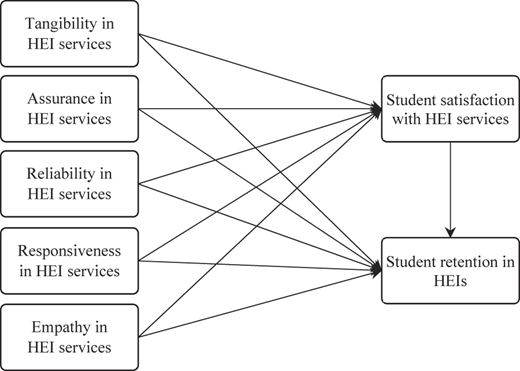
This work presents a conceptual model to understand student satisfaction with and retention in HEIs in the UAE (see Figure 1). Based on the SERVQUAL model, this study proposes that higher levels of perceived service quality dimensions enhance students' satisfaction with institutional services. The SERVQUAL model suggests that students evaluate the quality of institutional services based on their perceptions of service delivery across different dimensions, including tangibility, reliability, responsiveness, assurance and empathy. These evaluations shape students' overall satisfaction with their educational experience. Building on this logic, satisfaction represents the mechanism through which students' perceptions of service quality are translated into behavioural intentions, including their intention to continue their studies. Therefore, while service quality reflects students' evaluations of specific service attributes, student satisfaction captures their overall affective response to these experiences, which subsequently influences retention decisions.
3.1 Service quality and student retention
Tangibility in HEI services reflects the physical characteristics, including the outside appearance of buildings, facilities (e.g. classrooms), tools (technology) and personnel that students can see, touch and experience while receiving services in an institution. It represents the physical facilities, equipment, appearance of personnel and communication materials, which constitute the tangible physical evidence that students can directly observe when interacting with HEI services (Datta & Vardhan, 2017; Setiono & Hidayat, 2022). This involves adapting to new technological environments in teaching and learning, such as intelligent classrooms, well-equipped laboratories that meet the requirements of each academic programme, learning resources, campus infrastructure and the professional manner in which faculty and staff interact with students (Kanori, Kimani, & Kalai, 2020). Ngo et al. (2025) also added that students' perceptions of the adequacy and modernity of institutional facilities, the accessibility of technology and the overall quality of educational resources are crucial. These characteristics impact how students perceive service quality and influence their entire learning experience. When students have positive perceptions about the level of service quality, then there are positive behavioural intentions that are noted for them (Hwang & Choi, 2019). From this information, it can be concluded that students who see high levels of tangible service quality are likely to stay enrolled in their schools. This is why the following hypothesis should be put forward:
Tangibility of HEI services has a positive effect on student retention in HEIs.
Assurance in HEI services refers to an institution's ability to build trusting relationships with students through pleasant and informative communication. When assurance of services in HEIs is mentioned, it means that the faculty and other employees demonstrate competence, courtesy and professionalism, and they have the ability to establish trust between themselves and students. This concept includes such elements as effective communication, credibility, security and guidance throughout the entire learning journey of the students (Saliba & Zoran, 2018). Tan, Choong, and Chen (2022) stated that service quality perception of students positively impacts student satisfaction and intentions. These findings support the argument that improving service quality in HEIs may strengthen students' intentions to remain enrolled, recommend the institution to others and maintain a positive relationship with it. Furthermore, previous studies have indicated that trust in institutional processes, academic credibility and confidence in service delivery enhance students' commitment to their institution and promote positive retention-related behaviours, including continued enrolment and institutional loyalty (Conefrey, 2021; Darawong & Sandmaung, 2019). Therefore, stronger perceptions of assurance in HEI services may positively influence students' willingness to remain enrolled in their institution. Accordingly, the following hypothesis is proposed:
Assurance in HEI services has a positive effect on student retention in HEIs.
Reliability in HEI services can be defined as an institution's capacity to provide services accurately and consistently in a promised way. In HEI, it refers to fulfilling promises made to students by the academic and administrative staff, making sure services are delivered on time, keeping records accurate and ensuring that academic and administrative processes run smoothly and efficiently (Saliba & Zoran, 2018). It also reflects the extent to which students can trust that the institution will perform as expected (Parasuraman et al., 1988). When students perceive an institution as reliable, they develop greater trust, which positively influences their behavioural intentions, including continued enrolment and willingness to recommend the institution (Zeithaml et al., 1996; Petrovicova & Vladimir, 2021). Accordingly, it can be suggested that:
Reliability in HEI services has a positive effect on student retention in HEIs.
Responsiveness in HEI services indicates the institution's ability to assist students and offer prompt services and responses to them, ensuring that their needs and concerns are addressed efficiently (Amin, Khuwaja, & Afridi, 2020; Dzakwan & Ubit, 2025). Responsiveness in educational establishments is achieved by way of fast communication, efficient management processes, availability of educational assistance and immediate responses to students' queries. Gregory (2019) emphasises the importance of perceived service quality for the formation of student satisfaction and image, pointing to the necessity of efficient services as a key factor in improving students' performance. Satisfaction with the quality of academic counselling services, in turn, was found to be associated with students' positive perceptions of service quality and student assistance services (Al-Ghonmein, Al-Moghrabi, & Alrawashdeh, 2023). Responsiveness has also been recognised as a fundamental component of service quality affecting student satisfaction and perceptions of institutions (Malik et al., 2010; Gürbüz & Bayraktar, 2023). When students perceive that an institution responds promptly and effectively to their needs, they are more likely to develop trust in the institution and maintain a positive relationship with it. Therefore, stronger perceptions of responsiveness in HEI services may positively influence students' willingness to remain enrolled. Accordingly, the following hypothesis is proposed:
Responsiveness in HEI services has a positive effect on student retention in HEIs.
Empathy in HEI services refers to the institution's ability to treat students as if they were its own. This includes providing individualised care and attention to students, understanding their needs, offering appropriate solutions, ensuring fairness and quality in service delivery, maintaining effective communication and handling student concerns with sensitivity and confidentiality (Windasari et al., 2024). In HEIs, students often face academic, social and personal challenges that may affect their engagement and continuity in their studies (Sá, 2023). Empathy fosters-positive teacher–student relationships, enhances student engagement and creates a supportive learning environment. Students who feel understood, valued and supported are more likely to develop a stronger sense of belonging and remain committed to their institution (Hossain, Ansari, Khan, & Sarkar, 2024). Previous research has also suggested that empathy positively influences students' perceptions of service quality, engagement and institutional loyalty (Đonlagić & Fazlić, 2015; Bharwana, Bashir, & Mohsin, 2013). Since students are more likely to remain in environments where they feel understood, respected and supported, empathy is expected to positively influence student intention in HEIs. Accordingly, the following hypothesis is proposed:
Empathy in HEI services has a positive effect on student retention in HEIs.
3.2 Service quality and student satisfaction with HEIs
A well-maintained campus is crucial to fostering a good learning environment and enhancing student satisfaction (Al-Haddad, Taleb, & Badran, 2018). UAE students highly value modern classrooms, modern libraries and technologically enriched learning environments as such physical facilities have a significant influence on their overall learning experience (Parahoo & Tamim, 2012). A strong institutional commitment to high-quality infrastructural facilities is an indication of a commitment to academic excellence. Al-Shamsi, Al-Hawari, Aderibigbe, and Omar (2022) indicated that established facilities are important for student retention. Additionally, continuous investment in cutting-edge learning environments has been linked to greater student engagement and academic performance (Amin et al., 2020; Datta & Vardhan, 2017). Borishade et al. (2021) conclude that good facilities result in students being institutionally committed in the long term. Bwachele, Chong, and Krishnapillai (2023) affirm that concrete factors contribute significantly to overall satisfaction. In light of this, this study considers tangibility to be a primary motivator of student satisfaction in UAE HEIs, leading to institutional success and student retention in the long term. Accordingly, it can be suggested that:
Tangibility of HEI services has a positive effect on student satisfaction with HEI services.
Assurance is a SERVQUAL determinant of service quality focussing on staff expertise, professionalism and institutional credibility (Parasuraman et al., 1988). When staff and instructors provide consistent assistance, students feel more assured and have increased confidence in studying (Al-Haddad et al., 2018). Trust in academic and administrative services is crucial to student satisfaction and retention in the UAE (Al-Shamsi et al., 2022). Clarity and transparency allow students to progress through their academic journeys with confidence (Clewes, 2003). Positive student-faculty relationships enhance engagement and academic performance (Conefrey, 2021). This is crucial in international HEI programmes, where institutional credibility directly affects student satisfaction (Darawong & Sandmaung, 2019). Besides, service quality has a direct influence on student behaviour and overall satisfaction (Gürbüz & Bayraktar, 2023). High assurance standards in a university establish a positive academic experience and enhance student trust. Accordingly, it can be proposed that:
Assurance in HEI services has a positive effect on student satisfaction with HEI services.
Borishade et al. (2021) assert that student satisfaction is influenced by how responsive faculties are to student questions, keeping records accurately, effective instruction, honesty among employees and promise keeping. SERVQUAL regards reliability as a basic dimension in service quality, with a focus on promise keeping and student expectation fulfilment (Parasuraman et al., 1988). Empirical studies have established that good academic and administrative services develop confidence and enhance student satisfaction (Al-Haddad et al., 2018). Reliability is crucial to student retention in the UAE (Al-Shamsi et al., 2022). Yousapronpaiboon (2014) showed that service reliability inconsistencies have a negative impact on student perceptions, and hence, consistency is a key feature in educational service quality. Additionally, effective communication and consistent improvement of student performance enhance student engagement (Clewes, 2003). Reliability is crucial for universities aiming to improve student satisfaction and maintain competitiveness (Mohamed, 2014). Therefore, prioritising reliability through staff training, implementing efficient systems and ensuring clear communication channels is essential for fostering student satisfaction and upholding a positive institutional reputation. If HEIs address student expectations in a continuous manner, satisfaction and loyalty are increased (Darawong & Sandmaung, 2019). Given this, the study argues that:
Reliability in HEI services has a positive effect on student satisfaction with HEI services.
Responsiveness is one of the dimensions of service quality in SERVQUAL, with an emphasis on timely service and readiness to solve students' problems (Gürbüz & Bayraktar, 2023). Research shows that timely responses to students' questions enhance satisfaction and confidence in HEIs (Borishade et al., 2021). Responsive academic and administrative UAE services directly impact student retention (Al-Shamsi et al., 2022). Students expect collaboration, friendliness of administrative staff and prompt responses from the institution. Malik et al. (2010) have reported that responsiveness within an education system is an important driver of student satisfaction. Effective course registration management, academic advising and student support services enhance student engagement (Clewes, 2003). Proactive student support from an institution allows for a more effective learning experience (Gürbüz & Bayraktar, 2023). Khan, Ahmed, and Nawaz (2011) established a positive relationship between responsiveness and student satisfaction, with responsive management of student challenges and problems enriching their experience. Therefore, the study suggests:
Responsiveness in HEI services has a positive effect on student satisfaction with HEI services.
Nicholas, Hartono, Vincent, and Gui (2022) and Magasi, Mashenene, and Ndengenesa (2022) conclude that clients who prefer personalised service expect to be treated with thoughtfulness and care. Their research confirms the positive relationship between empathy and satisfaction and how a responsive and caring service influences consumers' experience. Bharwana et al. (2013) state that highly empathetic institutions have increased student engagement and satisfaction. Empathy in HEIs is a demonstration of an institution's commitment to personalised attention, care and concern, making students feel understood and valued (Đonlagić & Fazlić, 2015). Empathy is a salient service quality dimension according to the SERVQUAL model, with an emphasis on genuine student interactions and staff attentiveness (Shaari, 2014). Empathetic academic and administrative services directly affect student retention and overall experience in the UAE (Al-Shamsi et al., 2022). Individualised academic counselling and advice lead to strengthened student confidence and satisfaction (Haddad, Sturzu, Bisch, Yasukawa, & Baudet, 2023). Empathetic pedagogic strategies and administrative support further enhance student engagement (Khan et al., 2011). HEIs with a student-centred learning strategy through empathy build trust, engagement and academic success in the long term. It, therefore, can be suggested that:
Empathy in HEI services has a positive effect on student satisfaction with HEI services.
3.3 Student satisfaction and retention
Student retention is the continuous engagement of students with an educational institution (Hagedorn, 2005). It can be measured through the percentage of students who complete their study programmes within a specific timeframe (Crosling, Heagney, & Thomas, 2009), the ongoing enrolment over multiple academic terms (Addison & Williams, 2023) and/or the proportion of students who leave or do not re-enrol. Client satisfaction stands out as the primary and vital measure by which to understand how clients perceive a service (Gupta & Zeithaml, 2006). Satisfied clients show positive behaviour and intentions to use it again (Nguyen & Leblanc, 2001; Wu, 2013). The higher the client satisfaction, the higher their retention rate (Ranaweera & Prabhu, 2003). Therefore, ensuring client satisfaction is crucial to retaining customers. Students will be willing to continue their studies and succeed academically when their universities meet their needs (Addison & Williams, 2023). Satisfaction and retention are closely linked, particularly when students feel that their college or university supports them in the achievement of their educational goals. Student satisfaction determines whether students decide to complete their academic programmes (Hwang & Choi, 2019). According to Rane, Achari, and Choudhary (2023) and Leisen Pollack (2009), there exists an interconnected relationship between customer satisfaction, loyalty and productivity. In a simplified template, it can be illustrated that satisfied clients transition into loyal clients, ultimately driving profitability for the institution. Hawkins and Hoon (2019) propose that enhancing client satisfaction can improve client retention and market share. Leninkumar (2017) and Carranza, Díaz, and Martín-Consuegra (2018) highlight satisfaction as a key influencer, contributing partially to client loyalty. Based on the above, it can be proposed that:
Student satisfaction with HEI services has a positive effect on student retention in HEIs.
Student satisfaction is an essential component for any HEI and is associated with the quality of the services provided. With increasing competition in the field of HE, student satisfaction has emerged as a key element for maintaining the competitiveness of HEIs (Rouf, Rahman, & Uddin, 2016). It refers to the extent to which students perceive that their educational experiences and institutional services meet or exceed their expectations. Forid, Hafez, and Khan (2022) found that student satisfaction has a positive and significant influence on student retention, indicating that students who are satisfied with the quality of educational services are more likely to continue their studies at the same institution. Previous research has shown that student satisfaction is positively associated with student loyalty, persistence and retention (Hwang & Choi, 2019; Tan et al., 2022). Furthermore, students who are satisfied with the quality of academic and support services are more likely to continue their studies and less likely to consider transferring to another institution (Sá, 2023). Therefore, higher levels of student satisfaction are expected to contribute positively to student retention in HEIs. Accordingly, the following hypothesis is proposed:
Student satisfaction with HEI services mediates the relationship between (a) tangibility, (b) assurance, (c) reliability, (d) responsiveness and empathy in HEI services and student retention in HEIs.
4. Methodology
4.1 Research procedure and sample
This study is based on a deductive approach. It develops a modified SERVQUAL model to formulate and test the research hypotheses with primary data from the UAE's HE context. By starting with an established model on service quality and its implications, this study aims to substantiate specific relationships within hypotheses, contributing to theory validation and progression in service quality within the HE sector. The study was conducted in the UAE, and it is obvious that several governing bodies, including the Ministry of Education and the Commission for Academic Accreditation, oversee HE in the UAE. These bodies ensure that institutions meet specific standards and provide quality education. In the UAE, HEIs can be divided into two groups depending on their source of funding; thus, there are public and private universities. Private universities are funded privately, while public universities are state-funded and managed. These universities offer numerous undergraduate and postgraduate programmes; hence, they significantly contribute to the overall education system of the UAE. Many private universities in the country are engaged in international collaboration in order to improve the quality of education. Given the fast-changing nature of the HE system in the UAE, which is internationalised, service-oriented and focused on developing skills, this environment presents an excellent setting to study the effects of the SERVQUAL model on student satisfaction and retention.
The target population in this study is the primary recipients (students) of HEI services in the UAE. The study included students who were currently enrolled in public or private HEIs. Only currently enrolled students were invited to participate because they had direct and recent experience with the educational services provided by their institutions, enabling them to evaluate the service quality dimensions, their satisfaction and their intention to continue their studies. Students from different study levels were included to capture a broader range of experiences and improve the diversity of the sample. However, reaching every member of the student population was both practically and economically unfeasible (Saunders, Lewis, & Thornhill, 2012). Some universities were unwilling to share student registers due to privacy concerns. As a result, a non-probability sampling approach was adopted to obtain responses from students in the UAE HEIs. Given the absence of a comprehensive sampling frame, the findings should be interpreted as evidence from the surveyed students rather than as statistically representative of all students in UAE HEIs (Taherdoost, 2016). Specifically, this study utilised a non-probability sampling approach as it was not feasible to obtain a comprehensive list of the students in the UAE's HEIs.
To collect the required data from students in the UAE's HEIs, an online questionnaire (see Table A1) was prepared. The questionnaire measurement items were adopted from prior studies in the English language with a slight modification to fit the HEI service context (see Section 3.2). The questionnaire includes three parts. The initial section outlined the study's objectives and the target participants. The second section focused on demographic information such as age, gender and level of study. The third section included thirty-five questions aiming to capture the constructs in the model. To ensure the clarity and appropriateness of questionnaire instructions and questions for potential participants, a pilot study was conducted (Bryman & Bell, 2015), which involved an in-person administration of the initial questionnaire to three faculty members with extensive experience in quality management and five students at an HEI in the UAE. Feedback received was crucial in refining the questionnaire to ensure it was easily understood and effectively addressed the constructs.
The questionnaire was administered in the English language using Google Forms during the period of April-May 2025. There are two key reasons for using an online survey instead of a self-administered one. Firstly, an online survey can reach a large segment of students across different universities in different geographical areas in the UAE (Saunders et al., 2012), facilitating the collection of a more representative sample of students. Secondly, online surveys ensure a higher level of student anonymity, reducing potential bias in responses and increasing the number of responses (Saunders et al., 2012). The questionnaire invitation explained the purpose of the study, emphasised that participation was voluntary and assured respondents that their responses would remain confidential and would only be used for academic research purposes.
The study received 203 responses from students enrolled in HEIs in the UAE. However, after careful scrutiny of the collected data, seven responses were discarded due to implausible information provided by respondents (e.g. reporting an age of 19 years while indicating a PhD study level) and evidence of careless response patterns, such as selecting the same extreme response across all measurement items. Consequently, 196 valid responses were retained for the final analysis. The sample size was justified using three complementary criteria. First, the study obtained 196 usable responses for 35 measurement items, giving an item-to-response ratio of approximately 5.6:1. Second, the structural model included five predictors of student satisfaction, and the achieved sample exceeded the commonly used minimum rule of thumb based on the number of predictors. Third, a G*Power-based assessment for multiple regression with five predictors, α = 0.05, statistical power = 0.80 and a medium effect size indicated a minimum required sample size of approximately 92 responses. Therefore, the sample was considered adequate for testing the proposed relationships.
Table 1 provides a demographic analysis of the students who participated in the survey. The analysis reveals a relatively balanced gender distribution in the sample, with 52.6% male and 47.4% female students. The analysis also demonstrates that the majority of the students are within the 18–21 years range (41.8%), followed by students aged between 22 and 25 years (33.2%) and students over 25 years (25 %). Regarding the study level, the analysis shows that 67.9% of the students in this study are undergraduate students, 17.9% are masters students, 10.2% are diploma students and 4.1% are Ph.D. candidates. This demographic composition indicates a predominantly young and undergraduate-dominated sample, with a relatively even gender balance. However, because nationality, residency status and local versus international student status were not collected, the demographic profile cannot determine whether respondents were Emirati or international students.
4.2 Research instruments
The present study explored the influence of the five dimensions of service quality outlined in the SERVQUAL model on student retention in HEIs and the mediating role of student satisfaction with HEI services in the UAE. To accomplish this, the study used 35 existing scale items to measure the variables from prior empirical research (see Table A1). The decision to employ existing measurement scales is supported by the fact that these scales have been empirically validated multiple times across different contexts (Bryman & Bell, 2015) and allow the study's findings to be compared with those of previous studies (Sekaran & Bougie, 2016). Tangibility in HEI services was measured using five items based on the work of Datta and Vardhan (2017), Hasan et al. (2008), Bwachele et al. (2023) and Pedro, Mendes, and Lourenço (2018). Assurance in HEI services was measured using five items from Hasan et al.’s (2008) study. Reliability in HEI services was assessed through a five-item scale developed based on the work of Datta and Vardhan (2017) and Hasan et al. (2008). Responsiveness in HEI services was measured using five questions from Hasan et al. (2008). Empathy in HEI services was captured using five items informed by Datta and Vardhan (2017), Hasan et al. (2008) and Bwachele et al.’s (2023) work. Student satisfaction with HEI services was measured using five items based on Hasan et al.’s (2008) work. Finally, student retention in HEIs was captured using five items from Eresia-Eke, Ngcongo, and Ntsoane (2020). All the scale items have been slightly altered to meet the context of service quality in HE and were measured using a five-point Likert scale that ranged from “Strongly Disagree = 1” to “Strongly Agree = 5”, with the exception of student satisfaction with HEI services, which was measured using a five-point Likert scale that ranged from “Very Dissatisfied = 1” to “Very Satisfied = 5”.
4.3 Common method bias
The research design in this study involved the use of one survey to collect all the data on the constructs from one student per institution. However, this design may give rise to common method bias (CMB) (Podsakoff, MacKenzie, & Podsakoff, 2012), which occurs when the variance explained in the model is due to the survey method rather than to the actual constructs (Podsakoff et al., 2012). To mitigate this issue, we assured students of anonymity and confidentiality in the survey cover letter (e.g. no identifying information was requested), carefully worded the measurement items to be clear and non-leading and emphasised that there were no right or wrong answers (Podsakoff et al., 2012). However, consistent with best practices, we also statistically examined the data for potential CMB. Specifically, we relied on Harman's single-factor analysis. Following this analysis, the 35 measurement items of the constructs were subjected to factor analysis to identify if a single factor explained a large part of the variance in the model. The analysis demonstrated that no factor produced more than the cutoff value of 50%, indicating that CMB is not present in the data.
To provide further evidence regarding the absence of CMB, we conducted Kock's (2015) full collinearity assessment approach. This method is recommended for studies that employ variance-based structural equation modelling techniques. According to this approach, the Variance Inflation Factor (VIF) values should be estimated for all constructs in the model, with values of 3.3 or below indicating the absence of CMB. The results indicate that none of the constructs exceeded the recommended VIF threshold, suggesting that CMB is not a concern in this study.
5. Analysis and results
5.1 Reliability and validity
Reliability refers to whether a research tool consistently generates the same result when measuring a concept multiple times (Heale & Twycross, 2015). Cronbach's Alpha is the most commonly used method to assess reliability, specifically internal consistency. To test reliability, this study calculated Cronbach's Alpha for each service quality dimension, student satisfaction with HEI services and student retention in HEIs. To be considered acceptable, the internal consistency must fall within the range of 0.7 to 1. According to the reliability analysis (see Table 2), all the study's constructs surpass the generally acknowledged threshold of 0.7 for a satisfactory degree of internal consistency. This implies the good reliability of each and every measurement item for the constructs (Hair, Black, Babin, & Anderson, 2014).
Another dimension that can be used to determine whether the constructs were correctly measured is validity, in its convergent and discriminant forms. The convergent form of validity was assessed using standardised loadings and the average variance extracted (AVE) for the items and construct, respectively (Hair et al., 2014). The assessment revealed that the measurement for all the constructs is valid according to the standardised loadings and the AVE values reported in Table 2. The discriminant form of validity was evaluated using the Fornell and Larcker (1981) approach, which perceives a construct measurement to be valid when the square root of its AVE is higher than its correlation with other constructs. As presented in Table 3, no construct has a square root of its AVE (diagonal line) less than its correlation (off-diagonal line) with other constructs, establishing validity in the discriminant form.
5.2 Hypotheses testing
5.2.1 Direct effect hypotheses
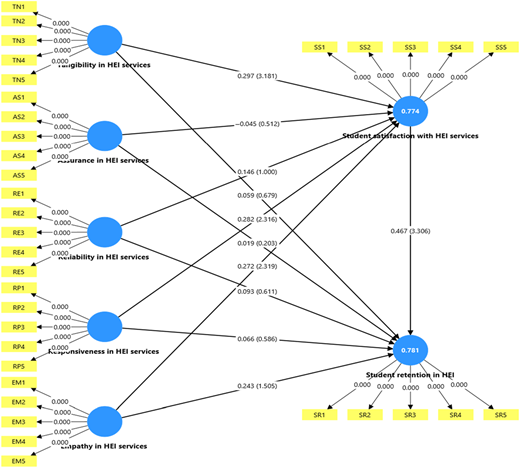
To examine the direct impact of service quality dimensions on student retention in HEIs and student satisfaction with HEI services and student satisfaction with HEI services on student retention in HEIs, we carried out the analysis employing PLS-SEM estimation using SmartPLS 4.0. The analysis demonstrates that tangibility in HEI services (β = 0.059, p = 0.497), assurance in HEI services (β = 0.019, p = 0.839), reliability in HEI services (β = 0.093, p = 0.541), responsiveness in HEI services (β = 0.066, p = 0.558) and empathy in HEI services (β = 0.243, p = 0.132) have not impact on student retention in HEIs (see Table 4 and Figure 2). These results provide no support for H1a, H1b, H1c, H1d and H1e. The analysis also reveals that tangibility of HEI services (β = 0.297, p = 0.001), responsiveness in HEI services (β = 0.282, p = 0.021) and empathy in HEI services (β = 0.272, p = 0.02) have a positive impact on student satisfaction, while assurance in HEI services (β = −0.045, p = 0.609) and reliability in HEI services (β = 0.146, p = 0.318) have not impact (see Table 4 and Figure 2). These results provide support for H2a, H2d and H2e but not for H2b and H2c. Additionally, the analysis uncovers that student satisfaction with HEI services (β = 0.467, p = 0.001) has a positive impact on student retention in HEIs.
5.2.2 Mediating effect hypotheses
The study also examines the mediating role of student satisfaction with HEI services in the relationship between service quality dimensions and student retention in HEIs as formulated in H4a–e. The analysis reveals that student satisfaction with HEI services mediates only the relationship between tangibility of HEI services and student retention in HEIs (β = 0.139, p = 0.016) and the relationship between responsiveness in HEI services and student retention in HEIs (β = 0.132, p = 0.041) (see Table 5). This is also supported by the lower limit (LL) and upper limit (UL) values of the bias-corrected 95% confidence intervals for the mediating effect of student satisfaction with HEI services on the relationship between tangibility of HEI services and student retention in HEIs (LL = 0.051, UL = 0.286), and between responsiveness in HEI services and student retention in HEIs (LL = 0.017, UL = 0.313), as neither interval includes zero. Since the direct effects of tangibility and responsiveness in HEI services on student retention in HEIs remained insignificant after including student satisfaction with HEI services, we conclude that student satisfaction with HEI services fully mediates the relationships between tangibility of HEI services and student retention in HEIs, and between responsiveness in HEI services and student retention in HEIs.
6. Discussion
Evaluating students' contentment with their educational experiences poses certain challenges, yet it can significantly help universities in fostering solid connections with both current and potential students. The present study empirically examined the impact of HEI service quality dimensions (i.e. tangibility in HEI services, assurance in HEI services, reliability in HEI services, responsiveness in HEI services and empathy in HEI services) on student satisfaction and, in turn, on student retention in the UAE. The study reported, based on the analysis of 196 students' responses, mixed results regarding the impact of service quality dimensions on student satisfaction, while confirming the positive impact of student satisfaction on student retention in HEIs.
6.1 The impact of service quality on student retention in HEIs
The study results show that none of the five dimensions of HEI service quality has a direct influence on the retention of students. It is noteworthy that previous relevant studies showed positive connections between service quality and the retention of students in HE (Clewes, 2003; Darawong & Sandmaung, 2019; Hossain et al., 2024). One can assume that accredited universities in the UAE work within a highly regulated and competitive HE environment. This environment consists of minimum standards relating to academic quality, learning resources, student services and institutional governance, expected across institutions (Al-Shamsi et al., 2022). Therefore, students' perspectives may incorporate various aspects of service quality as basic institutional expectations, not as distinguishing characteristics that can potentially and independently influence their decision to continue their studies. In addition, the study's findings indicate that decisions regarding retention are more complex and also likely affected by numerous factors, such as broader academic, financial, career-related and personal factors that extend beyond service quality alone (Tinto, 2012; Thomas, 2012). The most important mediating role of student satisfaction also indicates that service quality indirectly impacts retention as it helps improve students' overall educational experience rather than directly influencing their continuation decisions in their universities.
The analysis of the findings showed that tangibility in HEI service had no important direct effect on student retention. This misaligns with previous research studies, which have indicated that modern facilities, learning technologies and physical infrastructure increase students' commitment to keep their enrolment (Hwang & Choi, 2019; Ngo et al., 2025). The present findings imply that these tangible resources have become standard institutional expectations, not competitive differentiators within the UAE HE. Therefore, students may appreciate high-quality physical facilities, but decisions about their continuation appear to depend more on the overall value of their learning experiences than on physical resources alone. The important indirect effect through student satisfaction supports this interpretation, and indicates that tangible resource influence retention, as it enhances satisfaction rather than directly influencing enrolment decisions.
Assurance in HEI service also showed no direct effect on student retention. Assurance includes staff competence, professionalism, credibility and the ability to build trust with students. Although institutional trust has previously been associated with student commitment and loyalty (Conefrey, 2021; Darawong & Sandmaung, 2019), students in accredited universities may perceive professional academic and administrative services as basic institutional obligations, not factors influencing their decision to remain enrolled. Students may place greater emphasis on a number of important factors, including academic outcomes, graduate employability, programme reputation and career prospects, when making continuation decisions.
Reliability in HEI service delivery did not equally influence student retention. It represents the institution's ability to deliver services in an accurate and consistent manner, and as promised. Reliability has formally been known as a core dimension of service quality (Parasuraman et al., 1988), yet students may consider reliable academic and administrative processes as a baseline of institutional requirements, not added-value sources. Similar to Herzberg's hygiene factor perspective, reliability may prevent dissatisfaction when present but may not independently motivate students to continue their studies unless the service fails (Herzberg, Mausner, & Snyderman, 1959).
A non-significant relationship was found between responsiveness in HEIs and student retention. The implication here is that effective communication and quick response to students' enquiries are now viewed as normal in digital university environments. Learning management systems and other technologies have greatly improved responsiveness, and they cannot be used to differentiate one institution from another in order to impact retention rate. Instead, responsiveness seems to affect retention indirectly through satisfaction.
Empathy in HEI service was found not to have any significant direct impact on student retention. In previous studies, it has been found that personalised care and supportive relationships tend to make students more engaged in the learning process and more committed to their institutions (Đonlagić & Fazlić, 2015; Hossain et al., 2024); however, according to the results obtained in this study, empathy alone is not enough for determining students' continuation decisions. Though students appreciate a supportive relationship with professors and administration staff, the decisions to continue studying or not can be driven by factors such as academic success, affordability, quality of programmes, career opportunities, etc.
6.2 The impact of service quality on student satisfaction with HEI services
The analysis demonstrated that tangibility in HEI services, which encompasses physical facilities and amenities, has a positive impact on student satisfaction in HEIs in the UAE; indeed, tangibility in HEI services exerted the highest impact on student satisfaction compared to other service quality dimensions, indicating that physical facilities, such as buildings, libraries and classrooms, which are major determinants of student satisfaction in HE. Tangibility has a significant relationship with satisfaction as it complements the services offered in HE, increasing overall satisfaction. Investing in facilities and physical infrastructure significantly improves users' perceptions and motivates them to utilise the services offered by HEIs. Therefore, institutions aiming to elevate student satisfaction should prioritise enhancing their tangible assets. This finding is supported by a broad body of research, on the role of physical aspects of services in enhancing clients' overall satisfaction with a service (e.g. Khairusy & Febriani, 2023; Magasi et al., 2022). In the HE context, Mulyono, Hadian, Purba, and Pramono (2020) argue that external characteristics and facilities can directly influence the perception of higher institutions' quality.
The study results show that surprisingly, assurance in HEI services does not increase student satisfaction. As such, the ability to build trusting relationships with students through pleasant and informative communication in the UAE HE context does not seem important in terms of developing satisfied students. There are several reasons that could explain the lack of influence of assurance on student satisfaction. First, students are more influenced by how services make them feel than by the technical competence or courtesy provided by the institution (Victor, 2024). This suggests that emotional factors (e.g. respect) are more significant drivers of satisfaction than formal service delivery. Second, students place greater importance on functional issues such as facilities and responsiveness compared to other factors of service quality (Fatmawati & Murfi, 2025). Third, students may be able to view assurance as a standard expectation rather than a value-added factor enhancing their experience (Abu-Rumman & Qawasmeh, 2022). Fourth, in competitive HE markets such as the UAE, students may expect a level of professionalism as a default, which may reduce the perceived impact of assurance on satisfaction. Finally, students in multicultural environments like in the UAE may be disposed to favour personal connection and culturally attuned relationships over institutional reputation. The results of this study differ from those published by Haron, Abdul Subar, and Ibrahim (2020) and Bwachele et al. (2023) on the positive role of assurance in HEI services in driving student satisfaction.
The analysis, contrary to expectations, also indicated that reliability in HEI services, which reflects the consistent accuracy and dependability in delivering promised services, does not influence student satisfaction. However, Sheng and Fauzi (2024) emphasised that while reliability is traditionally recognised as a core dimension of service quality, its impact on student satisfaction in HE is not always significant. Students often perceive reliability, such as the timely and accurate delivery of services as a basic institutional obligation rather than a value-adding feature. As such, although its absence may lead to dissatisfaction, its presence is typically taken for granted and may thus have only a limited effect on overall satisfaction. This interpretation is further supported by Isniah, Supriatna, Prawesti, and Dhuha (2025), who found no significant influence of reliability on student satisfaction, suggesting that reliability is viewed as a standard institutional function. Additionally, students may assign greater importance to more emotionally engaging aspects of service. Students often view reliability as a baseline expectation rather than a distinguishing factor. What tends to influence their satisfaction more are experiences where they feel supported, understood and personally engaged. These aspects create stronger impressions and may outweigh the impact of consistently reliable service. While some studies identify that students generally rate service reliability positively (e.g. Madzik & Hrnciar, 2015), other studies have reported that service reliability and accessibility do not significantly affect student satisfaction (e.g. Ali, Basu, & Ware, 2018). Our results support the latter studies. However, the result of a lack of influence of reliability in HEI services on student satisfaction may be context-dependent.
The results also show that responsiveness in HEI services, the willingness and ability to provide prompt service significantly enhance student satisfaction in HE. This emphasises the importance of timely feedback and effective replies to student queries are particularly important in shaping student satisfaction. Timely feedback, quick resolution of issues and prompt responses to enquiries demonstrate to students that their concerns are valued. Research indicates that responsiveness fosters a supportive environment, increasing satisfaction. Institutions can enhance responsiveness through efficient communication channels, staff training and technology. Prioritising responsiveness improves student satisfaction, retention rates and institutional reputation. According to Pan (2025), responsiveness entails meeting customers' demands as swiftly as possible and ensuring that staff members are always accessible to assist without causing any inconvenience. This includes promptly recognising and addressing client needs and taking responsibility for handling consumer queries (Kumar, Tat Kee, & Taap Manshor, 2009). Their interactions with consumers strongly influence employees' impressions of service quality.
The analysis of the data also shows that empathy in HEI services increases student satisfaction. This highlights the importance of understanding and responding to the needs of students in a caring, respectful and human-centred manner during service delivery. This is particularly relevant in the UAE cultural context, which places a high value on social bonds, respect and interpersonal relationships in interactions. Student satisfaction depends on empathy, shown through care, understanding and student-friendly policies. Urban (2010) argues that a company's friendly and helpful attitude aligns with employees' eagerness and efforts to engage with clients. Administrative staff who positively engage with students build trust, thereby improving consumer evaluations of the institution's level of service (Onditi & Wechuli, 2017). The result of the impact of empathy in HEI services is consistent with the findings of Darawong and Widayati (2022), Magasi et al. (2022) and Yılmaz and Temizkan (2022), who found that the service model's empathy component had the most beneficial impact on students' satisfaction.
6.3 The impact of student satisfaction on student retention
The study also finds that student satisfaction - how well students feel their expectations and needs are being met by educational services and experiences provided by HEIs – plays a major role in ensuring student retention. Student retention measures the ability of HEIs to keep enrolled students over a specific period, typically indicating the proportion of students who continue their studies or return for subsequent terms. According to Kitana (2016), research conducted in the UAE highlights that students' satisfaction with the quality of services significantly influences their decision to remain enrolled. Similarly, Azam (2018), who focused on Saudi Arabia, discovered a positive correlation between student satisfaction and retention rates. These findings underline the importance of student satisfaction in HEIs' efforts to maintain student retention.
7. Implications
7.1 Theoretical implications
This study contributes to the HE service quality literature by extending the application of the SERVQUAL framework beyond examining the direct effects of service quality on students' behavioural outcomes. While previous studies have widely applied SERVQUAL to assess students' perceptions of institutional service quality, limited attention has been given to explaining the mechanism through which service quality perceptions influence student retention. By incorporating student satisfaction as a mediating mechanism, this study provides a more comprehensive understanding of how service quality translates into retention intentions.
The findings provide several theoretical insights. First, the results demonstrate that service quality dimensions do not necessarily exert direct effects on student retention. Although previous research has often assumed that improved service quality directly enhances students' willingness to remain with their institutions, this study reveals that the relationship is more complex. Specifically, none of the five SERVQUAL dimensions had a significant direct effect on student retention, suggesting that service quality attributes alone may be insufficient to influence retention decisions. Instead, students appear to evaluate their overall educational experience through their satisfaction with the services provided by their institutions.
Second, this study extends the SERVQUAL framework by demonstrating the central role of student satisfaction as an explanatory mechanism. The findings show that tangibility and responsiveness influence student retention indirectly through satisfaction, indicating that students' perceptions of physical facilities, resources and institutional responsiveness contribute to retention only when they generate positive overall evaluations of the educational experience. This finding refines the application of SERVQUAL in HE by highlighting that service quality dimension function as antecedents of satisfaction, which subsequently shape students' retention intentions.
Finally, the findings provide a more nuanced understanding of the relative importance of different SERVQUAL dimensions in HE. While tangibility, responsiveness and empathy in HEI service were found to enhance student satisfaction, reliability and assurance did not demonstrate significant effects. This suggests that students may place greater emphasis on visible service elements, timely support and personalised attention when evaluating their institutional experience. Therefore, the findings contribute to the refinement of SERVQUAL by indicating that the relevance of specific service quality dimensions may vary depending on the service context and the characteristics of service recipients.
7.2 Managerial implications
This study provides several practical implications for HEI managers seeking to enhance student satisfaction and retention. The findings demonstrate that service quality does not directly influence student retention; rather, its influence occurs through student satisfaction. Therefore, HEI managers should focus on improving service quality dimensions that contribute to a positive student experience, as satisfaction represents the mechanism through which service quality perceptions are translated into retention intentions.
First, HEI managers should prioritise the tangibility dimension of service quality, as the findings indicate that tangibility has a significant positive effect on student satisfaction and contributes to student retention indirectly through satisfaction. This suggests that students' perceptions of physical and visible aspects of service delivery, including university facilities, learning environments, libraries and technological resources, play an important role in shaping their overall institutional experience. Accordingly, HEIs should continuously modernise and maintain their physical infrastructure to ensure that facilities meet students' expectations. Regular assessment of students' perceptions of campus facilities through surveys and feedback mechanisms can help managers identify areas requiring improvement and allocate resources more effectively.
Second, HEI managers should strengthen responsiveness in service delivery, as responsiveness was found to significantly enhance student satisfaction and indirectly influence retention through satisfaction. This finding highlights the importance of timely and effective responses to students' academic and administrative needs. To improve responsiveness, HEIs should establish clear service standards regarding response times for student enquiries, academic feedback and administrative requests. In addition, implementing structured academic advising systems can facilitate continuous communication between students and advisors, enabling an early identification of student concerns and providing appropriate support. Digital platforms for feedback submission, request tracking and communication can further enhance institutional responsiveness by ensuring that student concerns are addressed efficiently.
Finally, HEIs should promote empathy as an essential component of student-centred service delivery. Although empathy did not demonstrate a direct effect on retention, the findings indicate that it contributes positively to student satisfaction. Therefore, universities should develop policies and training programmes that encourage academic and administrative staff to provide personalised support and demonstrate an understanding of individual student needs. Staff development initiatives focussing on communication skills, professionalism and student engagement can help create supportive service encounters that enhance students' overall satisfaction with their institution.
7.3 Pedagogical and practical implications
The study findings offer useful pedagogical and practical guidance for HEIs in the UAE. The significant effects of tangibility, responsiveness and empathy in HE service on student satisfaction highlight that the learning environment and student support are integral components of the overall educational experience. Accordingly, HEIs should give greater attention to these areas to enhance both teaching and learning. In particular, HEIs should ensure that their physical infrastructure, institutional environment, classrooms equipped with appropriate instructional technologies, library facilities, Information and Communication Technology resources and other learning resources effectively support teaching and learning and enhance the quality of education (Hanaysha & Eli, 2025). From a pedagogical perspective, academic staff should be readily available to address students' academic needs, provide timely feedback and offer appropriate guidance and support throughout the learning process. In the diverse HE environment of the UAE, adopting responsive and empathetic teaching and student-support practices can help create a more inclusive and supportive learning environment, thereby improving students' learning experiences and satisfaction. Since student satisfaction also contributes to student retention, these practices may encourage students to remain engaged with their studies and successfully complete their programmes at the institution.
8. Limitations and future research
Firstly, because of the unique policy, institutional and regulatory framework of the UAE, where the proposed model was empirically tested, the findings may have limited generalisability beyond this context. Consequently, further empirical validation of the conceptual model is needed to determine whether the findings hold across different countries and HE settings. Moreover, although the sample included students from different universities and study levels, the use of convenience sampling may have limited the representativeness of the sample and consequently the generalisability of the findings within the UAE. Furthermore, although the study collected demographic information such as age, gender and level of study, it did not collect data on nationality, residency status or local/international student status. Therefore, the findings cannot distinguish between Emirati, expatriate and international students. Future research should include these variables to enable subgroup analyses and provide a more nuanced understanding of potential differences across student groups.
Secondly, this study relied on the service recipients' perspective to understand service quality in HEIs, that is, the students. Future research may consider the perspective of service providers, such as academic and administrative staff in HEIs, when studying service quality. This perspective would offer insights into the processes, challenges and factors affecting HEI service delivery. Additionally, future research could consider the perspective of both students and staff, which could help to identify gaps between perceived and actual service delivery in HEIs.
Thirdly, this study examined five dimensions of overall service quality in the context of HEIs. Future studies may explore more dimensions of service quality (e.g. accessibility, customisation and convenience) in HE, leading to more accurate assessments and better decision-making. Furthermore, future studies could explore the factors that influence service quality of a specific aspect of university services (e.g. learning environment, teaching effectiveness and student support services), which could yield insightful results.
Finally, although this study sought the participation of students from both public and private HEIs, it was not possible to conduct a comparison between them with regard to service quality due to the relatively small sample size. It would thus be advisable to carry out a comparative empirical analysis of public and private HEI students to understand whether service quality dimensions exert the same influence on satisfaction in each of these settings.
9. Conclusion
This study sought to understand how service quality dimensions impact student retention in HEIs and whether student satisfaction mediates this impact. To address these RQs, the study developed a modified SERVQUAL model and analysed data collected from 196 students in public and private HEIs in the UAE using structural equation modelling. The findings demonstrate that none of the five service quality dimensions had a significant direct effect on student retention. However, tangibility, responsiveness and empathy in HEI services had significant positive effects on student satisfaction, whereas assurance and reliability in HEI services showed no significant effects. Student satisfaction, in turn, had a significant positive effect on student retention. The analysis further reveals that student satisfaction mediated the relationships between tangibility and student retention and between responsiveness and student retention. Overall, these findings demonstrate that service quality influences student retention primarily through student satisfaction rather than through direct effects.
These findings highlight that improving student retention requires HEIs to move beyond delivering service quality alone and instead focus on creating positive student experiences that foster satisfaction. Investments in modern facilities and learning resources, together with responsive and timely support services, appear to be particularly important for strengthening students' satisfaction and encouraging them to continue their studies. Accordingly, university managers and policymakers should prioritise initiatives that enhance these aspects of the student experience as part of their retention strategies.
Declaration or statement
Data collection was carried out in accordance with the ethical guidelines of City University Ajman. All participants were informed of the purpose and procedures of the study, their rights to withdraw at any time and the confidentiality of their responses. Informed consent was obtained from all participants prior to their involvement in the study.
The supplementary material for this article can be found online.