In the past few decades, the concept of corporate social responsibility (CSR) has received substantial interest in the competitive business environment. This study aims to empirically examine the impact of CSR on corporate image, organizational commitment and organizational performance in ocean freight forwarders.
Five critical CSR dimensions were identified based on factor analysis: consumer interests, employee interests, environmental management, disclosure and corporate commitment and sponsorship. Structural equation modelling was subsequently performed to examine the hypothesized relationships among CSR, corporate image, organizational commitment and organizational performance.
Results indicated that CSR had significantly positive effects on corporate image and organizational commitment, whereas corporate image was positively related to organizational commitment and organizational performance, respectively. Organizational commitment was also positively related to organizational performance. However, CSR did not have a significant direct effect on organizational performance.
This study intended to conduct a survey on logistics service providers; however, due to the limited availability of research on ocean freight forwarding service providers, the present sample was limited to ocean freight forwarding enterprises.
From a theoretical perspective, this study contributes to the field by identifying the important dimensions of CSR and their effects on corporate image, organizational commitment and organizational performance. Particularly, it demonstrated the effect of CSR on ocean freight forwarding employees’ organizational commitment.
1. Introduction
In the past few decades, the concept of corporate social responsibility (CSR) has received substantial interest in the competitive business environment. Consequently, several firms now take an active approach toward fulfilling their social responsibility (Fjørtoft et al., 2020). Enterprises mainly tend to pursue profits; however, considering socioeconomic factors, the social responsibilities of an organization go beyond making profits. Thus, enterprises are expected to engage in CSR activities to fulfill their economic, legal, ethical and philanthropic responsibilities. With an increase in awareness regarding consumer interests, employee interests and threats to the environment, several firms have adopted the principle of CSR to achieve sustainable development.
Employees are perceived as valuable assets for the service industry. However, as compared to other industries, employee turnover is high in the logistics service industry because it is often viewed to entail dirty, strenuous, dangerous and low-paid work (Lu, 2009). For instance, the annual employee turnover rate is as high as 27% in the forwarding industry in Greater China (Shang et al., 2016). Employee turnover entails high costs for the logistics service business (Kuo et al., 2020). Therefore, logistics service providers (LSPs) have to control their employee turnover rate so reliable and customized services can be provided to their clients. Several studies have concluded that involvement in CSR activities could improve a firm’s reputation (Perrini et al., 2006; Phan et al., 2020; Singh and Misra, 2021). From those literature, a firm’s good reputation has been found to enhance employees’ commitment to the organization. In the field of organizational behavior and industrial psychology, organizational commitment is defined as an individual’s psychological attachment to the organization. Organizational commitment predicts work variables such as turnover, organizational citizenship behavior and job performance (Porter et al., 1974).
Although the concept of CSR has been strongly emphasized in the field of strategic management, most prior research has focused on evaluating the effect of CSR on organizational performance. Few studies have examined its effects on employees’ commitment to the organization, especially in the context of LSPs (Lu et al., 2009; Latif and Sajjad, 2018; Lai et al., 2020). Prior research suggests a strong relationship among company reputation or image, customer satisfaction and firm performance (Homburg et al., 2005). A firm’s corporate image can affect its ability to increase prices for consumers and can create mobility barriers within the industry (Peloza, 2006). Some researchers have investigated the relationship between CSR and firm performance; however, the findings are inconclusive (Mahoney and Roberts, 2007; Jacobs et al., 2010; Chen and Wang, 2011). Therefore, to fill the gap in the literature, the main objectives of this study were to identify the important dimensions of CSR for LSPs and to examine the impact of CSR on corporate image, organizational commitment and organizational performance.
This study focused on Taiwan, which is an island-based economic entity located in the center of the Asia-Pacific region. Its prosperity is highly dependent on foreign trade. LSPs offer several value-added services to shippers, such as storage, cargo tracking, inland transport, customs clearance, packing and documentation (Lu, 2003). They play an important role in providing integrated logistics-related services to shippers or their clients (Lu et al., 2016; Kuo et al., 2020; Lai et al., 2020). According to the Ministry of Economic Affairs (2020) in Taiwan, the service industry contributed 62.72% of its gross domestic product (GDP) in 2019 and the annual revenue generated from this industry reached US$30bn, which accounted for 7.2% of the GDP. As there are limited barriers to entering the logistics service market in Taiwan, this industry has become highly competitive. Further, the competition within the logistics industry has continued to increase as Taiwan joined the World Trade Organization and signed the Economic Cooperation Framework Agreement with Mainland China in 2010 (Yang, 2012). Thus, it is imperative for LSPs to increase their competitive advantage and pursue sustainable development. As demonstrated by previous studies, CSR initiatives lead to win-win situations by bringing about social welfare and improving employees’ organizational performance (Lu et al., 2009; McWilliams and Siegel, 2001). Therefore, LSPs should integrate CSR initiatives into their strategy to create a competitive advantage. Due to the limited availability of research in this context, the present study focused on enterprises from the ocean freight forwarding industry.
The remainder of this paper is structured as follows: Section 2 reviews the literature on CSR, corporate image, organizational commitment and organizational performance. A conceptual framework and research hypotheses are also presented in this section. Section 3 describes the research methodology, including questionnaire design, sampling technique and methods of analysis. Section 4 presents the results of the analyzes; it is followed by the conclusions and implications in the final section.
2. Literature review and research
2.1 Corporate social responsibility
CSR is defined as the:
[…] consideration of, and response to, issues beyond narrow economic, technical and legal requirements of the firm to accomplish social (and environmental) benefits along with the traditional economic gains which the firm seeks (Aguilera et al., 2007).
Thus, a firm is expected to go beyond its legal and economic obligations to engage in activities that benefit society. CSR includes economic, legal, ethical and philanthropic dimensions (Carroll, 1979). Based on a factor analysis, Lu et al. (2009) identified three dimensions of CSR in the field of container shipping and examined their impacts on organizational performance. These three dimensions were community involvement and environment, disclosure and employee and consumer interests. Mishra and Suar (2010) proposed a composite measure of CSR to evaluate its effects on organizational performance. Their tool included six dimensions, namely, employees, customers, investors, community, natural environment and suppliers.
Among the maritime-related industries, CSR has been steadily introducing. From United Nations (UN), 2030 Agenda and 17 sustainable development goals (SDGs), refers to a significant regulatory development, which has generated a drastic diffusion of CSR in shipping. Based on SDGs, the International Maritime Organization’s (IMO’s) also emphasized its vision and commitment to establish a CSR mindset in shipping. Moreover, CSR has been recognized by IMO as a vital component for the achievement of a sustainable shipping industry (IMO 2013). However, comparing to other industries, research on CSR implementation in shipping is still fragmented (Fafaliou et al., 2006). Progoulaki and Roe (2011) suggested that CSR is considered by shipping companies as a key to distinguish their service to customers and assure environmental compliance and efficiency. Moreover, Lund-Thomsen et al. (2016) revealed that, with the exception of the container and cruise sectors, which appear to be at a more advanced state, there is not much research undertaken to investigate shipping companies’ perceptions over the drivers and barriers influencing their decision to adopt a CSR policy and reporting program.
Several principles or guidelines pertaining to CSR have been proposed and discussed in the literature. For example, the UN proposed 10 principles for global businesses, which included practices related to human rights, labor, the environment and anticorruption (Rasche and Kell, 2010). The Organization for Economic Co-operation and Development (OECD, 2011) also proposed 10 guidelines for multinational enterprises, which pertained to disclosure, human rights, employment and industrial relations, environment, combating bribery, bribe solicitation and extortion, consumer interests, science and technology and competition. The World Business Council for Sustainable Development (WBCSD, 2000) also suggested that the CSR activities of enterprises should address human rights, employee interests, environment, community, supplier relations, auditing and stakeholders’ interest for improving their core value. Based on a review of the literature related to CSR, 30 attributes were selected for use in a questionnaire survey in the present study. Related findings have been presented in the following section.
2.2 Corporate image
Worcester (1972) defined the corporate image as the interconnection of a consumer’s experiences, opinions, feelings, beliefs and knowledge about a corporation. Dowling (1986) regarded corporate image as a set of beliefs, emotions and feelings held by a consumer toward a corporation. As a corporate image is a mixture of a consumer’s perception and his/her perspective toward a corporation, everything that then comes to mind when people think of a company is part of its corporate image (Chiu and Hsu, 2010). Based on these academic definitions, the concept of “image” does not seem to entail detailed specifications; rather, it is a holistic description and set of ideas. Therefore, the image could be viewed as the public’s subjective and holistic perception about a subject. Accordingly, the corporate image can reflect an evaluation of corporations from the market’s perspective. Some researchers have investigated the relationship between CSR and firm performance; however, their work revealed inconclusive findings (Aguinis and Glavas, 2012; Frynas and Yamahaki, 2016). Recent studies have also explored the influence of other variables, such as corporate reputation or image, on the relationship between CSR and firm performance (Alamgir and Uddin, 2017; Kim et al., 2017). Some researchers argue that CSR has a strong impact on a corporate image by creating positive customer perceptions (Chiu and Hsu, 2010; Wang, 2020). Further, reputation has been found to have a positive impact on a firm’s market share and its market returns in terms of assets and equity (Frynas and Yamahaki, 2016).
2.3 Organizational commitment
Organizational commitment can be defined as the willingness of an employee to exert high levels of effort on behalf of the organization, a strong desire to stay with the organization and an acceptance of its goals and values (Buchanan, 1974). Thus, it refers to a person’s affective reactions to characteristics of his/her using organization (Cook and Wall, 1980). Organizational commitment involves affective, continuous and normative components (Allen and Meyer, 1990). Buchanan (1974) and Cook and Wall (1980) suggested that organizational commitment comprises three components, namely, identification, involvement and loyalty. Moreover, Porter et al. (1974) argued that organizational commitment could be measured by value commitment, effort commitment and retention commitment. Based on previous studies, the present study adopted the scale proposed by Cook and Wall (1980) to assess organizational commitment. In addition, the organizational commitment was assumed to include three components, namely, organizational identification, job involvement and organizational loyalty.
2.4 Organizational performance
Performance pertains to the measurement and comparison of actual levels of achievement of specific objectives. It can be assessed using financial and non-financial indicators (Venkatraman and Ramanujam, 1986). Dess and Robinson (1984) recommended a comprehensive measure of a firm’s performance. Accordingly, the present study used a combination of financial and non-financial or customer service measures to evaluate the performance of LSPs.
Based on a review of prior research on CSR, the following four commonly-used performance indicators were used to measure customer service performance: service quality, customer satisfaction, customer loyalty and competitive position (Lu et al., 2009; Mishra and Suar, 2010; Yang, 2013). In addition, three indicators were used to measure financial performance: profit rate, market share and sales growth rate (Lu et al., 2009; Mishra and Suar, 2010; Yang, 2013).
2.5 Research hypotheses
Several previous studies on CSR concluded that a firm could increase its performance and competitive advantage by adopting CSR initiatives (Ullmann, 1985; Lu et al., 2009; Mishra and Suar, 2010). Ullmann (1985) reported a positive relationship between CSR and financial performance. Although CSR activities could impose additional costs on firms, integrating such initiatives into its strategy could typically lead a firm to higher revenue generation in the long term (McWilliams and Siegel, 2001). Lu et al. (2009) noted that disclosure, community involvement and environmental initiatives were positively related to container carriers’ financial performance. In addition, activities related to employee and consumer interests were positively related to non-financial performance.
Involvement in CSR activities has also been found to improve a firm’s reputation (Javalgi et al., 1994; Perrini et al., 2006). A firm with a good image or reputation can enhance employees’ commitment to the organization. Brammer et al. (2007) found that the adoption of CSR initiatives significantly influenced employees’ commitment to the organization. Kim et al. (2010) reported that a firm’s CSR initiatives increased employee–company identification, which, in turn, increased employees’ commitment to their organization. Youn et al. (2018) found that employees’ perceptions on CSR can significantly enhance their commitment to the organization in the casino industry. Carter and Jennings (2002) reported that logistics-related social responsibility had a direct positive effect on job satisfaction and employee motivation.
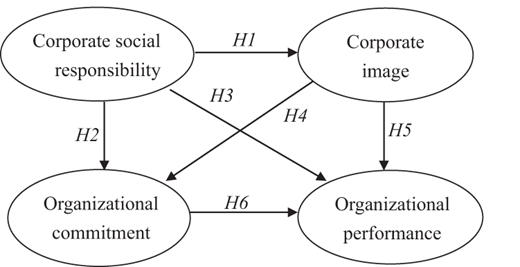
Accordingly, based on these previous studies, a conceptual model (Figure 1) and the following six hypotheses were proposed:
CSR has a positive effect on ocean freight forwarding service providers’ corporate image.
CSR has a positive effect on ocean freight forwarding service providers’ organizational commitment.
CSR has a positive effect on ocean freight forwarding service providers’ organizational performance.
Corporate image has a positive effect on ocean freight forwarding service providers’ organizational commitment.
Corporate image has a positive effect on ocean freight forwarding service providers’ organizational performance.
Ocean freight forwarding service providers’ organizational commitment has a positive effect on their organizational performance.
3. Methodology
3.1 Questionnaire design and measures
Following Churchill and Iacobucci (2010), a self-administered questionnaire comprising five sections was designed to collect the data for this study. Notably, to ensure the validity and reliability of research constructs, all questionnaire items related to the CSR (Lu et al., 2009; OECD, 2011; Yang, 2013), corporate image (Nguyrn and Leblanc, 2001), organizational commitment (Cook and Wall, 1980; Yang, 2013) and organizational performance (Yang, 2013) of ocean freight forwarders (OFFs) were drawn from prior studies. Moreover, an interview was conducted with executives and experts in this industry. The questionnaire was pre-tested by distributing a draft to five shipping experts. The final version of the questionnaire included four sections. The first section pertained to the demographic information of the respondents and their companies. The second section assessed the CSR activities of OFFs. The third section focused on corporate image and organizational commitment, while the final section assessed organizational performance.
In total, 30 items were used to measure ocean freight forwarding’s CSR activities following Yang (2013). The corporate image was assessed using the following three items adapted from Nguyrn and Leblanc (2001): CI1: I have always had a good impression of our company; CI2: In my opinion, our company has a good image in the minds of consumers; CI3: I believe that our company has a better image than its competitors. A nine-item scale adopted from Cook and Wall’s (1980) work was used to assess organizational commitment, including three dimensions: organizational identification, job involvement and organizational loyalty. Each item assessing CSR, corporate image and organizational commitment used a five-point Likert scale ranging from “1 = strongly disagree” to “5 = strongly agree.”
With respect to organizational performance, seven-item scales were adapted from prior studies to measure customer service performance and financial performance.
3.2 Sampling techniques
The sample of OFFs was selected from the Members of the International Ocean Freight Forwarders and Logistics Association in Taiwan. The questionnaire was distributed to 500 managers, from which, 136 usable responses were obtained, yielding a response rate of 27.2%. The issue of non-response bias could have influenced the present questionnaire survey. Therefore, a t-test was subsequently applied to deal with this bias. The respondents were divided into the following two groups based on response waves (Armstrong and Overton, 1977): early (n = 74, 54.4%) and late (n = 62, 45.6%) respondents. The results revealed no significant differences between the two groups’ perceptions on questionnaire items at the 5% significance level, implying that the non-response bias did not influence the present study.
3.3 Research methods
To evaluate the impact of CSR activities on organizational commitment and to further test the research hypotheses, exploratory factor analysis and a two-step structural equation modeling (SEM) were conducted. Specifically, exploratory factor analysis was performed to identify CSR dimensions that were important for OFFs. Subsequently, a confirmatory factor analysis (CFA) was performed to verify the validity and reliability of the measurement model (Anderson and Gerbing, 1988). Finally, SEM was performed to assess the relationships among latent variables.
4. Results of the empirical analysis
4.1 Characteristics of respondents
The profile of respondents, displayed in Table 1, showed that nearly 78% of the respondents held the title of the manager (39.7%) and vice president or above (38.2%). Considering that managers are actively involved in the operations and strategic planning of businesses, the survey findings can be deemed reliable. In addition, over 65% of the respondents had worked in the shipping and forwarding industry for more than 10 years, indicating that they had sufficient practical experience about their companies’ CSR activities and were capable of answering the questions appropriately. The majority of the responding firms (38.2%) had been in operation for 11–20 years. Further, approximately 87% of the responding firms had been in operation for more than 10 years. Around 62% of the responding firms had fewer than 50 employees, while only 6.6% employed more than 501 employees. Further, 58.9% of the responding companies’ annual revenue was below NT$100m, for 25.6% it was between NT$101m and NT$1bn and for 14% it was greater than NT$1bn.
4.2 Important corporate social responsibility dimensions for ocean freight forwarders
In total, 30 CSR attributes for OFFs were identified based on the literature review and expert interviews. To identify the most important CSR dimensions for OFFs, exploratory factor analysis was performed in this study. Following Churchill and Iacobucci’s (2002), an eigenvalue greater than one was used to determine the number of factors. Moreover, to aid interpretation, a varimax rotation was used and variables with loadings of 0.5 or greater on only one factor were extracted (Hair et al., 2010). The initial results yielded five factors that accounted for 72.55% of the total variance. However, three items were found to load on two factors or they had a factor loading lower than 0.5. Accordingly, these three items were dropped from further analyses. Finally, as shown in the Appendix, five CSR dimensions were found to be important for OFFs, which accounted for 70.83% of the total variance.
Factor 1 had eight items pertaining to customer interests. Therefore, this factor was labeled as “consumer interests.” It accounted for 19.91% of the total variance. Factor 2 consisted of five items related to employee interests. Therefore, it was labeled as “employee interests.” It accounted for 14.82% of the total variance. Factor 3 comprised six items related to environmental management practices. Thus, this factor was labeled as “environmental management.” It accounted for 14.32% of the total variance. Factor 4 consisted of five items related to disclosure activities and commitment to CSR activities. Therefore, this factor was named “disclosure and corporate commitment.” It accounted for 13.31% of the total variance. The last factor included three items related to sponsorship activities. Thus, this factor was named “sponsorship.” It accounted for 8.47% of the total variance.
4.3 Descriptive statistics and reliability test
The descriptive statistics and reliability test results with corrected item-total correlation (CITC) coefficients and Cronbach’s α values have been presented in Table 2. Regarding CSR dimensions, the results indicated that OFFs performed well on consumer interests (mean = 4.343) in the current situation, followed by employee interests (mean = 4.049), sponsorship (mean = 3.767), environmental management (mean = 3.721) and disclosure and corporate commitment (mean = 3.400). As most OFFs were small and medium enterprises with a capital of NT7.5m and they were not listed on the Taiwan Stock Exchange, they did not perform well on the CSR disclosure dimension.
Table 2 also presents the respondents’ agreement level with their firms’ image and organizational commitment. Results indicated that the respondents perceived corporate image (mean = 4.314) as the most agreeable dimension, followed by job involvement (mean = 4.257), organizational identification (3.988) and organizational loyalty (mean = 3.948). Moreover, OFFs exhibited better customer service performance (mean = 4.046) rather than financial performance (mean = 3.514).
To assess the consistency and reliability of each factor and dimension, a reliability test with CITC coefficients and Cronbach’s α values was conducted. As evident from Table 1, the CITC coefficient for each dimension was larger than 0.5 and all Cronbach α values were well above the suggested threshold of 0.8, implying that the present results are reliable (Churchill and Iacobucci, 2002).
4.4 Analysis of the measurement model
Before testing the research hypotheses, it is important to establish the unidimensionality, reliability and validity of the measurement model (Anderson and Gerbing, 1988). Thus, a CFA was performed to purify the measurement model. Common goodness-of-fit indices, namely, χ2, normed χ2 and p-value were used to assess the fit of the measurement model. Results showed that the χ2 value (χ2 = 142.613, df = 59, p = 0.000) was statistically significant at the 0.05 level of significance, implying that the initial model needed to be modified. Accordingly, by inspecting the standardized residuals and modification indices, the variable “disclosure and corporate commitment” was eliminated because the highest residual value (4.500) exceeded the threshold of 2.58 (Hair et al., 2010). The revised model exhibited adequate goodness of fit on several indices (χ2 = 76.066, df = 48, p = 0.006, The goodness of fit index (GFI) = 0.916, comparative fit index (CFI) = 0.976, the root mean square residual (RMR) = 0.016, root mean square error of approximation (RMSEA) = 0.066), implying that the proposed model (PM) was credible. The subsequent tests of validity, reliability and unidimensionality were conducted as described below.
The CFA results (Table 3) indicated that the CFI, IFI and TLI values were well above the recommended cut-off value of 0.90 and the RMR and RMSEA values were all below the recommended threshold of 0.08, implying that all the constructs were unidimensional (Anderson and Gerbing, 1988). Regarding convergent validity, as evident in Table 3, all composite reliability values were significant on the factor loadings at the 0.05 level, suggesting that the measured variable or factor represented the underlying construct. Moreover, except for financial performance, all R2 values were above 0.3. Considering the profit rate, market share and sales growth rate are common and important items for measuring financial performance in prior studies, the financial performance was not removed and the results are marginally acceptable. The average variance extracted (AVE) values ranged from 0.535 to 0.789, exceeding the 0.50 threshold value. These indices suggest that all indicators measured the same construct, thus providing satisfactory evidence of convergent validity (Fornell and Larcker, 1981; Anderson and Gerbing, 1988; Hair et al., 2010).
A rigorous and commonly-used method to assess discriminant validity entails comparing the AVE values with the squared correlation between research constructs (Fornell and Larcker, 1981; Koufteros, 1999). As evident in Table 4, the highest squared correlation was observed between corporate image and organizational commitment at 0.588. This was significantly lower than their individual AVEs, which were 0.789 and 0.737, respectively. Accordingly, the results prove the discriminant validity of the study constructs. Composite reliability refers to the internal consistency and homogeneity of the items comprising a scale. As shown in Table 4, all constructs exceeded the recommended level of 0.6 (Bagozzi and Yi, 1988; Hair et al., 2010), implying that all indicators measured the same latent construct. In sum, the overall results of the goodness-of-fit and assessment of the measurement model lend substantial support to the PM.
4.5 Structural equation modeling: hypotheses testing
After confirming a good model fit for the PM, this study proceeded to test the hypothesized relationships among the proposed structural model. Results displayed a good model fit with χ2 = 76.066, df = 48, χ2/df = 1.585, p = 0.006, GFI = 0.916, CFI = 0.976, RMR = 0.016, RMSEA = 0.066. However, two of six hypothesized coefficients were found to be insignificant, namely, the effect of CSR on organizational performance (standardized β = 0.114, p = 0.521 > 0.05) and the organizational commitment on organizational performance (standardized β = 0.244, p = 0.283 > 0.05), respectively. Given the fact that engaging in CSR activities could impose additional costs on firms, a competing model without the direct relationship between CSR and organizational performance was re-estimated.
The competing model also exhibited a series of goodness-of-fit indices (χ2 = 76.454, df = 49, χ2/df = 1.560, p = 0.007, GFI = 0.916, CFI = 0.976, RMR = 0.017, RMSEA = 0.064). To determine the best model, a χ2 difference test suggested by Anderson and Gerbing (1988) was conducted. Table 5 showed that the competing model (Δχ2 = 0.388, df = 1, p > 0.05) was not significantly better than the PM. Scholars argued out that when equivalent modes have equal values of fit indices, it is not possible to determine the best model through a χ2difference test (Kline, 2011; Nunkoo and So, 2016). In contrast, it should be based on both theoretical and quantitative criteria (Hershberger, 2006; Kline, 2011; Nunkoo and So, 2016). As prior studies offered theoretical support for the removal of the direct relationship between CSR activities and organizational performance (Mehralian et al., 2016; Wang et al., 2020), a competing model was subsequently proposed and found to have a good model fit. Moreover, both the Akaike information criteria (AIC) and the Browne–Cudeck criterion (BCC) were commonly used to compare different possible models and determine which one is the best fit (Akaike, 1987; Browne and Cudeck, 1989; Nunkoo and So, 2016). Results showed that the AIC and BCC for the competing mode were better than those in the PM.
Results, shown in Table 6, derived from the competing model indicated that five path relationships proposed in the model were all found to be significant. Results revealed the CSR was found to have significant positive impacts on corporate image (standardized β = 0.773, C.R. > 1.96) and organizational commitment (standardized β = 0.529, C.R. > 1.96). Meanwhile, corporate image was found positively related to organizational commitment (standardized β = 0.448, C.R. > 1.96) and organizational performance (standardized β = 0.517, C.R. > 1.96). Moreover, a significant positive relationship between organizational commitment and organizational performance was also found in this study (standardized β = 0.352, C.R. > 1.96).
Results derived from the competing model indicated that CSR activities had a positive impact on the corporate image (H1) and organizational commitment (H2). This finding implies that OFFs can significantly improve their corporate image and enhance employees’ commitment to the organization by engaging in CSR activities. Thus, OFFs’ involvement in CSR activities related to employee interests, consumer interests, environment management and sponsorship can significantly improve their corporate image and organizational commitment. This finding is consistent with that reported by previous studies (Carter and Jennings, 2002; Brammer et al., 2007; Kim et al., 2010; Chiu and Hsu, 2010; Youn et al., 2018; Wang, 2020). The present results also showed that corporate image was positively related to organizational commitment (H4) and organizational performance (H5), implying that OFFs with a good corporate image can not only create positive customer perceptions but also enhance employees’ commitment to the organization. In turn, these would improve the OFFs’ customer service performance and financial performance. This finding is consistent with those reported by previous studies (Brammer et al., 2007; Kim et al., 2010; Frynas and Yamahaki, 2016). Finally, the present results revealed that organizational commitment was positively related to organizational performance (H6), implying that employees with a higher commitment to the organization are more satisfied with their organization and that they have lower turnover intention. These results suggest that OFF employees’ high organizational identification, job involvement and organizational loyalty could lead to better organizational performance in terms of customer service and financial performance. This finding is consistent with that reported by previous studies (Mayer and Schoorman, 1992; Brammer et al., 2007; Kim et al., 2010).
However, the direct effect of CSR on organizational performance (H3) was not supported in this study, which implies that involvement in CSR activities does not directly influence organizational performance. It is not surprising because CSR activities could impose additional costs on firms, and therefore, such activities could not provide superior performance in the short term. This finding is consistent with that of previous studies (McWilliams and Siegel, 2001; Yang, 2013; Mehralian et al., 2016; Wang et al., 2020).
5. Conclusions and discussions
This study aimed to examine the impact of CSR on corporate image, organizational commitment and organizational performance in ocean freight forwarding service providers, from their employees’ perspective. The main findings have been summarized below.
An exploratory factor analysis was performed to identify the CSR dimensions that are important for OFFs. Five such CSR dimensions were identified, namely, consumer interests, employee interests, environmental management, disclosure and corporate commitment and sponsorship. The findings also showed that OFFs providers perform well with regard to consumer interests in the current situation, followed by employee interests, sponsorship, environmental management and disclosure and corporate commitment. Notably, they did not perform well on CSR disclosure, possibly because most of them were not listed on the Taiwan Stock Exchange.
SEM was subsequently used to evaluate the hypothesized relationships among CSR, corporate image, organizational commitment and organizational performance in OFFs. The PM revealed that two of six relationships were not significant. As prior theoretical studies argued that engaging in CSR activities could impose additional costs on firms and that CSR did not have a direct impact on organizational performance, a competing model was proposed and it was found to exhibit adequate model fit.
The present study was the first to examine the impact of CSR on corporate image, organizational commitment and organizational performance in LSPs, specifically OFFs. It contributes to the literature by demonstrating the absence of a direct relationship between CSR activities and organizational performance in OFFs. Further, it proved that, according to employees, engaging in CSR activities can significantly enhance their organization’s corporate image and organizational commitment. Though they may not lead to superior organizational performance in the short term, CSR activities were found to improve the corporate image by creating positive customer perceptions and enhancing employees’ commitment to the organization. Thus, OFFs can exert more efforts to address employee and consumer interests, environment management and sponsorship to enhance employees’ commitment to the organization, which would, in turn, lead to superior organizational performance in the long term. In particular, top sales representatives and senior shipping operators are valuable assets to the OFF industry. Given that the employee turnover rate is high in OFFs as compared to other industries, they are suggested to engage in CSR activities to achieve sustainable development.
From a theoretical perspective, this study contributes to the field by identifying CSR dimensions that are important for the OFF industry and by examining their impact on corporate image, organizational commitment and organizational performance. However, it has several limitations. First, the different-sized OFFs included in this study may have had different resources for engaging in CSR activities. Therefore, future research should assess the effects of organizational characteristics on CSR activities. Second, this study did not observe the direct impact of CSR on organizational performance. Indeed, CSR could indirectly impact organizational performance through corporate image and organizational commitment. Therefore, a worthwhile avenue for future research could involve testing the mediating effects of corporate image and organizational commitment in the PM.
This research was supported by the Chung-Ang University Research Grants in 2020.