The aim of this research is to develop a comprehensive, data-driven framework for analyzing and mitigating piracy and armed robbery incidents in high-risk maritime corridors, particularly the Strait of Malacca. The study integrates Bayesian network (BN) analysis with the Technique for Order Preference by Similarity to Ideal Solution (TOPSIS) to objectively identify key risk factors, simulate various scenarios and rank effective strategies for reducing piracy incidents.
The study employs a combined BN-TOPSIS approach. First, a tree-augmented Bayesian network model is constructed using influential risk factors related to piracy attacks, extracted from historical incident data, to determine probabilistic dependencies. Sensitivity analyses then identify the mutual information values that are used as objective weights for the criteria in the TOPSIS multi-criteria decision-making model. TOPSIS is then applied to systematically evaluate and rank potential intervention strategies under multiple simulated scenarios.
The integrated BN-TOPSIS framework effectively identifies critical factors, such as “ship area boarded” and “crew response,” as high-impact variables. Among the proposed solutions, ship-level interventions, such as improved crew readiness and physical ship security, are significantly more effective at reducing successful attacks than broader external coordination measures, such as joint patrols. The model confirms that, despite current preventive measures, the probability of successful piracy remains high (approximately 57%), highlighting the urgent need for strategic improvements.
The model presently focuses on technical and operational factors extracted from incident reports, omitting broader socio-political and economic dimensions influencing piracy risks. Additionally, it is tailored to Southeast Asian maritime conditions and requires customization before applying to other piracy-prone regions. Future work should incorporate macro-level variables and adapt the framework for generalized geographic contexts.
This integrated BN-TOPSIS framework provides policymakers and maritime security stakeholders with a robust, evidence-based tool for prioritizing anti-piracy measures. The quantitative insights promote the effective allocation of resources toward ship-specific defenses and crew training, enabling faster, data-supported decision-making. Streamlining reporting systems and enhancing joint task forces can complement these core interventions, further strengthening maritime safety and resilience in critical trade routes.
By combining the probabilistic modeling capabilities of BN with the objective ranking abilities of TOPSIS, the approach overcomes the limitations of each method when used individually. Unlike previous approaches that relied heavily on subjective expert judgment, this framework uses real-world incident data and a quantitative method to provide an unbiased evaluation of risk and strategy. It also enables scenario-based testing to prioritize interventions quantitatively, which is a novel approach in maritime security research.
1. Introduction
Piracy and armed robbery activities remain serious problems for maritime security. In 2023, numerous incidents of piracy and armed robbery happened throughout several regions in the world, namely the Horn of Africa, the Gulf of Aden, West Africa and Southeast Asia (ICC, 2024). The Straits of Malacca and Singapore are two of the areas of particular concern due to their importance as the connectors of global trade activities both from and to Asia. Efforts to eradicate piracy and armed robbery in the area have been applied on various scales. Measures such as anti-piracy systems, layered protection and crew training for boarding situations have been recommended to prevent such incidents (BIMCO et al., 2018). Moreover, coordinated cooperation to share mutual information and capacity-building, such as the Regional Cooperation Agreement on Combating Piracy and Armed Robbery against Ships in Asia (ReCAAP), has been established (Poonnawatt, 2023).
Despite these measures, the region is still marred by piracy and armed robbery. From 2014 to 2023, 379 incidents happened in the area, making it one of the most active hotspots globally (ReCAAP ISC, 2023). Such incidents show no reduction, with incidents increasing from 55 in 2022 to 63 in 2023 (ReCAAP ISC, 2023). This indicates that the current measures are insufficient for the area, impacting maritime transportation security as a whole (Jiang and Lu, 2020). Potential negative impacts include economic loss, casualties and congested traffic (Pristrom et al., 2016a). Due to this complexity, a comprehensive analysis focusing on finding those influential factors is paramount to measuring the risk posed by such threats (Jiang and Lu, 2020).
The Bayesian network (BN) is used for predictive and diagnostic analysis of the analyzed problem (Fan et al., 2023a), which integrates quantitative and probabilistic data from incident reports of piracy and armed robbery. The Technique for Order of Preference by Similarity to Ideal Solution (TOPSIS) is a multi-criteria decision-making method capable of mathematically assessing various solutions. This enables TOPSIS to produce rank-validated strategies for piracy and armed robbery (Fan et al., 2023). Integrating BN and TOPSIS enables a thorough probabilistic analysis and strategy ranking for the proposed solutions.
Based on these advantages, this study aims to conduct a data-driven analysis of piracy and armed robbery in the Straits of Malacca and Singapore. The analysis includes the identification of key factors, probability analysis through a BN-based model, ranking solutions through TOPSIS, and reapplication of ranked solutions to the BN model to observe the reduction in piracy and armed robbery attack probability.
This research advances previous studies in three ways:
Key factors are selected using a machine learning method instead of human interpretation;
Suppression of subjective intervention in the model creation and solution generation process and
Adaptation of the proposed model to simulate different scenarios for other areas, such as the Red Sea, West Africa, etc.
The remainder of the paper is divided as follows: Section 2 discusses relevant studies on piracy and armed robbery and the application of BN and TOPSIS. Section 3 focuses on the methodologies. Section 4 describes the data and the analysis for the study. Section 5 presents the key findings. Section 6 discusses the results, and Section 7 provides the conclusion of the research and future research directions.
2. Literature review and research gaps
This section reviews several studies relevant to this research. They are selected based on their findings, methodologies and contributions to the research field. This section provides a comprehensive understanding of recent developments in piracy and armed robbery studies. It is divided into three areas: piracy and armed robbery studies, BN and the TOPSIS method. Each of them will be reviewed to identify research findings and gaps.
2.1 Studies related to piracy and armed robbery
Piracy, according to the United Nations Convention on the Law of the Sea (UNCLOS), is an illegal act of violence exercised against a vessel or its crew on the high seas (UNCLOS, 1982). Armed robbery involves similar acts occurring within the territory, archipelagic or internal sea of a littoral state (IMO, 2009). Aside from the jurisdictional area, both have similar characteristics; hence, they can be treated as the same. Piracy and armed robbery still exist globally and continue to threaten maritime safety and security, necessitating further analysis to improve the existing conditions. Table 1 shows several studies that analyze piracy and armed robbery through qualitative and data-based analysis.
2.2 Bayesian network
BN is one of the methods used for risk assessment that utilizes sets of nodes and edges to form a probabilistic network that can evaluate uncertainties (Animah, 2024). As previously mentioned, nodes and edges are important aspects of a BN and serve multiple purposes. Nodes represent the seemingly random variables that are connected by edges to form a causal connection among them (Animah, 2024). The network formed by a series of nodes and edges becomes one of the key strengths of the BN: its ability to be highly dynamic and adaptable to various new scenarios, something that traditional risk assessment methods cannot do.
Piracy and armed robbery incidents are highly complex problems that involve a multitude of factors. A BN is deemed effective as it is highly adaptable and dynamic to real-time data. Therefore, as shown in Table 2, multiple studies have utilized this method to achieve satisfactory findings.
Several past studies have concluded that the BN is an effective tool in predicting the probability of an incident, including piracy and armed robbery, while also explaining the influence that each factor has on the problem. It can also explain the causal relationship of all nodes that affect the outcome of an event. Therefore, the utilization of the BN is ideal for helping identify influential factors and providing a solid base of argumentation for the creation of solutions for piracy and armed robbery.
2.3 Technique for order of preference by similarity to an ideal solution (TOPSIS)
Multi-criteria decision making (MCDM) is an important method commonly used to rank a series of criteria or alternatives objectively. One of the techniques of the MCDM is the technique for order preference by similarity to an ideal solution or TOPSIS. It is an MCDM method that compares sets of alternatives or criteria by calculating them using a mathematical process and comparing them to an ideal solution, which sets a benchmark for those alternatives. The calculation result is then compared to the ideal value to rank the alternatives according to their relative performance against the ideal state. Table 3 shows that various studies have been conducted using the TOPSIS method in diverse fields, such as maritime safety, piracy and armed robbery prevention and strategy formulation.
2.4 Research gaps
BN has been extensively utilized in various piracy and armed robbery research due to its ability to identify influential nodes that represent the risk factors of the said problem. However, it is also noted that BN is unable to create mathematical calculations to create comprehensive, data-backed solutions. TOPSIS has also proven to be a powerful tool in determining the best solution or alternative by ranking all the possibilities against the ideal state to solve a problem, in this case, the incident of piracy and armed robbery. TOPSIS, however, has some limitations. A notable issue with this method is its reliance on other sources to determine the numerical value of weight to place the priority of each solution. Something that is often solved by incorporating subjective judgment from the experts, which can reduce its accuracy.
Given both BN and TOPSIS strengths and limitations and their potential to work as complementary for each method, combining the two methods offers a comprehensive analysis of the piracy and armed robbery incident analysis since both methods can identify influential risk factors, provide a probability analysis of piracy and armed robbery and also provide a ranked-based solution to the said problem.
There are two key novelties of the proposed method. First, it incorporates new data, which is a diverse dataset that captures key issues analyzed with machine learning methods from all cases reported to the International Maritime Organization (IMO) or ReCAAP. This can help the model learn new patterns and improve its predictive capabilities. Second, it combined an analysis using both BN and TOPSIS to produce several solutions that are impactful in altering the possibility of piracy and armed robbery. The analysis will also produce the most effective and efficient solution that is backed using a mathematical approach.
3. Methods
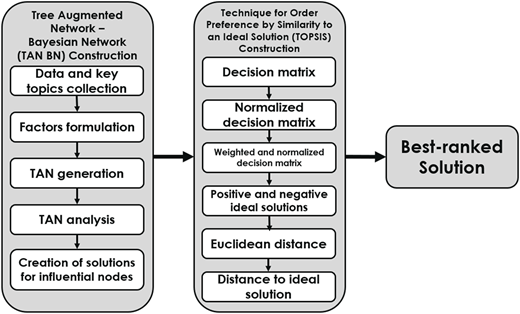
The research utilized both BN and TOPSIS methods, as shown in Figure 1. The combination enables the research to use the advantages that both methods have to complement each other to achieve a comprehensive analysis and effective solution generation. The BN model is constructed to obtain the probability analysis of piracy and armed robbery incidents and to provide a list of influential factors that are represented by the nodes. The result from the BN model can then be utilized to create an objective TOPSIS model that does not rely on expert knowledge anymore for its weight value estimation. This approach provides an objective and data-backed result for the piracy and armed robbery analysis.
3.1 BN construction
The nodes that formed the BN can be constructed in numerous ways. As shown in Table 4, various past studies mainly relied on three main sources to construct the nodes in the BN model: expert knowledge, literature review and historical data. Expert knowledge is useful for identifying the structure of the BN and explaining the relationship among the root nodes (Fan et al., 2023a). However, relying on expert knowledge will provide a bias since every expert will have a different interpretation of the factors that cause piracy and armed robbery incidents. Thus, relying heavily on expert knowledge will result in a variety of network shapes of the BN model.
The construction of the BN model in this research relied on a combination of past research and historical data on piracy and armed robbery incidents. This is due to its objective and less biased nature compared to expert knowledge. It also provides real-life insight by incorporating the analysis of reports of the incidents.
As previously mentioned, a standard naïve BN has one notable weakness in that it cannot explain the causality between each root node that came from identified risk factors. Moreover, it also needs to be constructed by manually defining each edge that affects the end node. Therefore, it is highly reliant on expert knowledge and subjective interpretation to construct one.
A tree-augmented network (TAN) type of BN can be utilized to answer the subjectivity issue since it relies on a machine learning process from the provided initial data. More importantly, it can recognize the causality of every root node by providing connecting edges for each node through the machine-learning process (Cao et al., 2023). Considering TAN's aforementioned strengths and to maintain the objective nature of BN model construction, the TAN model will be used in the research.
The BN will be constructed through several steps:
Data and keywords collection: Data and keywords related to piracy and armed robbery incidents are collected from the analysis of incident reports. The identification of risk factors will be based on these findings.
Factor formulation: Factors were formulated based on the findings obtained from the keywords list. To further back the findings, numerous past research studies and real-life incident reports were also utilized to form a list of risk factors that will be used to build the nodes for the TAN network.
BN generation: The BN model is formed through the machine learning process by utilizing the available data of risk factors that shape the outcome of the attack. The TAN model is generated using the Netica software algorithm, which results in an objective network based only on data-backed factors.
BN analysis: Through the creation of TAN, the analysis of probability for piracy and armed robbery incidents can be obtained. Moreover, sensitivity analysis can be done to identify influential nodes and to obtain the mutual information value, which will then be used in the TOPSIS model to replace the weight value that is typically obtained through expert knowledge.
Creation of solutions for influential nodes: To reduce the probability of piracy and armed robbery incidents, the influence nodes' prior probability needs to be altered to a satisfactory level. To do so, several solutions will be created to represent the new and dynamic probability analysis under altered conditions.
3.2 TOPSIS construction
The TOPSIS model is utilized as an MCDM method to analyze numerous solutions formulated from the previous model. It ranks solutions by calculating the value of each solution relative to the proximity from the ideal state and the distance from the negative ideal solution (NIS) (Fan et al., 2023a).
The TOPSIS model will be constructed through several steps:
3.2.1 Decision matrix
The decision matrix (D), which will become the basis of all the analysis in the TOPSIS model, will be formed through all of the nodes that underwent multiple probability analysis calculations in the TAN model in light of new evidence that is represented by numerous proposed solutions.
3.2.2 Normalized decision matrix
Normalization of the matrix is important to ensure the proportional value of each solution. It is formulated as
represents the value of i-th solution for the j-th criterion, with m being the total number of solutions and n being the number of criteria in the matrix. The value of represents the normalized value of .
3.2.3 Weighted decision matrix
The weighted decision matrix (D′) can be obtained using the following formula:
represents the weight of the j-th criterion. The weight was obtained through the analysis of the BN model.
3.2.4 Positive and negative ideal solutions
The ideal solutions (A), both positive and negative, set a benchmark value for each proposed solution. The formulas are as follows:
J1 and J2 represent the value of positive benefits and negative costs, respectively.
3.2.5 Euclidean distance
The distances measured between the positive ideal solution (PIS) and the negative ideal solution (NIS) and the solution can be formulated as follows:
3.2.6 Distance to an ideal solution
The distance between the solution and the ideal solution (Si) represents the solution's effectiveness in reducing the problem of piracy and armed robbery. The higher the value, the higher its effectiveness, thus placing it high on the ranking system. The formula for this is as follows:
4. Data
In order to construct the TAN mode, the key topics must first be identified to form the basis of the factor formulation. To this end, data on 583 piracy and armed robbery incidents from 2007 to 2023 were obtained from various intergovernmental organizations, including the annual reports on piracy and armed robbery from the Regional Cooperation Agreement on ReCAAP and the Global Integrated Shipping Information System from the IMO. These reports were written according to the standards set by both organizations regarding the reporting flows from the distressed vessel to the reporting center, ensuring the quality of the report itself. As discussed in Fahreza and Hirata (2024), the topics were identified and clustered using machine learning and natural language processing techniques. These topics were adopted for further analysis in this study and are listed in Table 5.
As indicated in Table 5, the key topics that indicate the influencing factors for piracy and armed robbery incidents were analyzed using natural language processing and machine learning algorithms to obtain 14 main topics divided into 3 clusters. After the clustering process, we were able to obtain several initial influencing factors that play an important role in piracy and armed robbery in the Strait of Malacca. They are as follows:
The ship's own risk influences the probability of a successful attack;
Geographical constraint that increases the probability;
Crew response that will determine whether the attack will succeed;
Authorities' responses to piracy and armed robbery attacks and
Safety, both during navigating and anchoring, influences the outcome of the attack.
5. Findings and discussions
The results obtained from the analysis are mainly divided into two models: the TAN model and the TOPSIS model. The findings are as follows:
5.1 Key topics for factor formulation
The key topics that form the basis of the factor formulation process for the construction of the TAN model are obtained first using the method described in Section 4.
5.2 Factor formulation and TAN construction
Key topics that have been obtained need to be interpreted into real-life factors that can be validated through piracy and armed robbery incident reports. The formulation of the factors is based on data and factors obtained from past research. As shown in Table 6, the factors that will be used for TAN construction mainly come from three primary sources: factors adapted from past research, factors adapted from data findings and validated by past research and factors adapted from data findings only.
Factors that are related to external environmental conditions, such as wind, time and rain intensity, were adopted from past research. Other factors, such as authority-related response, number of pirates, type of ship and crew response, were formulated through key factors and had previously also existed in past research. The existence of those factors in both data findings and past research proved their importance as key factors.
The last type is the factor obtained only from the data. This new factor hasn't been considered by past research to be incorporated into the analysis. The factor that falls into this category is the ship area boarded, which indicates the most vulnerable place of the ship in the event of an attack occurring.
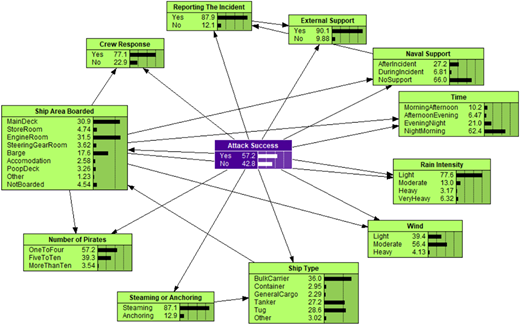
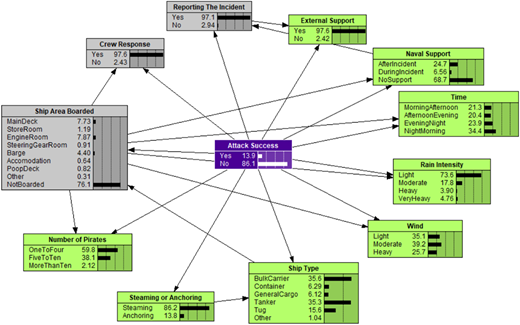
The result is calculated using software called Netica. A TAN model is created (Figure 2) based on machine learning capabilities. The data used for the model construction were obtained through numerous key factors that have been interpreted. It acts as a root node that influences the probability of piracy and armed robbery incidents. The model was then validated using the “test with cases” feature on Netica software. Under this scenario, 1,000 probable cases were generated. The target node (“attack success”) of the model will then be tested using all the cases to find out the accuracy of the model. From the validation process, the model could predict “true positive” and “true negative” (Yes and No in the “attack success” node, respectively) cases of 533 and 295. The “false positive” and “false negative” cases numbered around 48 and 124. From this simulation, the average accuracy of the model stands at 82.8%. Specifically, the model predicted the positive cases correctly for 81% of the time and the negative cases correctly for 86.0%. Thus, the model can be deemed robust enough to be used for the rest of the study.
The probability calculation from the TAN network showed that under the current conditions, the probability of a successful piracy or armed robbery attack being successful is 57.2%. This shows that under the current conditions and current preventive measures, it is not effective enough to prevent the piracy attack from succeeding.
5.3 Solutions generation
The result of the initial TAN model already obtained a 57.2% probability of the attack succeeding. Several solutions need to be formulated to reduce the possibility of a successful attack in the future. These solutions will act as alternatives under numerous scenarios that will form the basis of the TOPSIS model at a later stage.
Since the factors can be categorized into environmental-related and non-environmental-related factors, the solutions proposed will focus on controlling non-environmental-related issues. The proposed solutions are as follows:
S1 (maintain strict compliance with the ship security plan and mandatory application of the restricted area feature): This solution will primarily focus on the ship's own ability to defend itself, as its first response is the fastest way to handle any possible attack attempt. Proper crew response, swift reporting of the attack to the authorities and preventing the pirates or armed robbers from getting on board the ship becomes the priority in this scenario.
S2 (cutting down bureaucracies of the reporting system and forming a unified crisis response center for a fast-reporting system): The current system that is being implemented to report an incident of piracy or armed robbery in the Strait of Malacca can be considered too long and overlapping with each other since it involves numerous authorities. Expediting the process will enable a swift response to the attack and give more time for the authorities to prevent piracy or armed robbery attempts.
S3 (constant joint patrol in territorial seas with all three nations (Malaysia, Singapore and Indonesia) participating, forming an effective task force system on the Singapore Strait with constant escorts): Naval patrol frequency can be increased with the Strait of Malacca and Singapore as the primary focus area. In doing so, instead of acting reactively to an attack, the naval forces of the littoral states will be a preventive force to tackle any possible piracy or armed robbery attempt.
5.4 Performance of the solutions under the TOPSIS model
The TOPSIS simulations to measure the performance of each solution will be done under 25%, 50% and 75% reduction of all affected factors as a result of the simulated conditions by each solution.
5.4.1 Decision matrix
The initial value of the decision matrix (D) needs to be obtained first; this can be seen under an initial scenario in Table 7 and the 25% scenario example in Table 8. The maximum value of all nodes is 1, and all solutions affect different nodes. S1 affects “reporting the incident,” “crew response” and “ship area not boarded” nodes. S2 affects the “external support” node. S3 affects the “naval support” node.
5.4.2 Normalized decision matrix
The normalization process needs to be done to ensure that all the values are evenly distributed according to all scenarios applied under numerous solutions. Using Equation (1) for the normalized decision, the matrix can be obtained, as shown in Table 9.
5.4.3 Weighted and normalized decision matrix
The weight value can be obtained through the sensitivity analysis of each affected factor represented on the TAN model as nodes. The sensitivity analysis, as shown in Table 10, showed the mutual information value, which indicates how much influence a node can have on the “attack success” node. By repeating the analysis for all solutions' scenarios and using Equation (2), the weighted and normalized matrix can be formed, as shown in Table 11.
5.4.4 Positive and negative ideal solutions
The value of PIS and NIS can be obtained by applying each node's value in the weighted and normalized matrix and applying the ideal solution's equations of (3) and (4). This resulted in PIS and NIS values, as shown in Table 12.
5.4.5 Euclidean distances
The values for Euclidean distance are needed to determine the distance between each solution to the PIS and NIS. Using the Euclidean distance equations of (5) and (6), the values were obtained, as shown in Table 13.
5.4.6 Proximity to an ideal solution
The last calculation for the proximity value (Si) is needed to know which solution has the greatest impact on reducing the possibility of a successful attack, thus making it the most efficient solution. By applying Equation (7), the result can be obtained as shown in Table 14. This enables all of the solutions to be ranked as well.
Simulations were also performed under 50 and 75% scenarios, which showed that S1 always consistently ranked 1st in the TOPSIS model, followed by other solutions. This can be seen in Table 15. Based on the analysis obtained from the simulations, the most effective solution to the piracy and armed robbery problem in the Strait of Malacca is to maintain strict compliance with the ship security plan and mandatory application of the restricted area feature, followed by constant joint patrol in territorial seas with participation from littoral states and lastly by cutting down bureaucracies of the reporting system and forming a unified crisis response center for a fast-reporting system.
5.5 Solutions under different scenarios
Once the steps have been established to determine the best solution, other simulations can be performed under different conditions. In this case, 50 and 75% reductions of all affected factors were observed. Besides the simulation for affected nodes, another simulation regarding the change in probability of the “attack success” node in light of new values of the affected nodes. By doing so, the whole picture of the best solutions and probability values under three different scenarios can be observed.
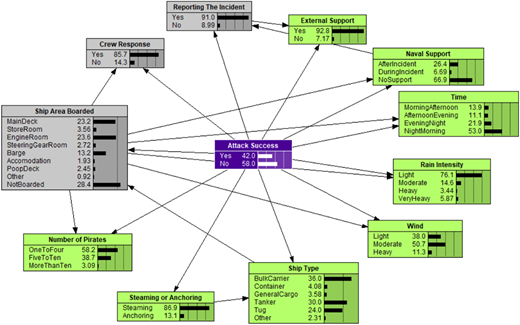
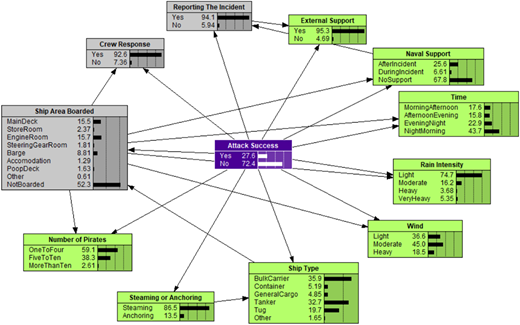
The simulations of the S1 solution to the TAN model were conducted with different scenarios to observe the magnitude of changes in the value of the “attack success” node, as shown in Figure 3–5, respectively. By applying the same workflow to other solutions, S2 and S3, respectively, the values of the “attack success” node were obtained, as shown in Table 16. It shows that S1 can reduce the probability of the “attack success” node across multiple scenarios, in which the magnitude of the reduction increases along with the simulation intensity. The probability of the node decreases from 57.2% to 42.04%, 27.57%, and 13.91% under 25%, 50%, and 75% scenarios, respectively. Meanwhile, such changes cannot be observed with S2 and S3. Applying S2 to the network under three different scenarios shows negligible changes to the “attack success” node, with the probability remaining above 56%, indicating its effectiveness in tackling the attacking attempt to the ship. Despite its superior performance to S2, S3 is still well below S1 in terms of the reduction magnitude, suggesting only moderate reductions under the said scenario. The results highlight the S1 superiority as the most effective solution among the three, owing to its ability to reduce the successful attack by a large margin under different simulation scenarios.
6. Discussion
This study employed an integrated BN-TOPSIS-based multi-criteria decision analysis to identify and prioritize effective countermeasures against piracy and armed robbery in the Strait of Malacca. The methodology allowed for both probabilistic modeling of causal factors and quantitative ranking of intervention strategies.
6.1 Key findings and interpretation
Under current conditions, our TAN model estimated a 57.2% probability of a successful attack, highlighting the persistent vulnerability of maritime operations in the study area despite past efforts and policy initiatives. Through the construction of the TOPSIS model, the solutions were simulated under three different scenarios and were ranked based on their performance in reducing the probability of a successful attack. Several strategies were generated to address numerous key factors influencing piracy and armed robbery attempts that mainly come from non-environment-related issues. The basis of the solution generation process was derived mainly to tackle non-environmental nodes, which were further divided into three categories: direct response from the ship itself, indirect external response that involves streamlined distress reporting procedures and direct external response that involves naval intervention. These solutions were chosen to reflect the improvement of direct response procedures, the improvement of external response under a limited resources pool that reflects the current condition and the introduction of a novel external procedure under an improved resource pool. The solutions are as follows:
S1: Maintain strict compliance with the ship security plan and mandatory application of the restricted area feature;
S2: Cutting down the bureaucracies of the reporting system and forming a unified crisis response center for a fast-reporting system and
S3: Constant joint patrol in territorial seas with all three nations (Malaysia, Singapore and Indonesia)
The implementation of all the scenarios can be tested by simulating them using the TAN model. The results showed that from the base value of 57.2% for the “attack success” node, solution S1 could bring it down to 13.9%. Meanwhile, S2 and S3 can reduce it to 56.4% and 51.5%, respectively. This proves the superiority of S1 in preventing piracy or armed robbery attempts.
These findings emphasize the superior effectiveness of ship-level interventions over external coordination efforts, at least in the short term. Mutual information analysis also showed that “ship area boarded” and “crew response” were high-impact factors, underscoring the importance of physical ship security and immediate onboard action.
These findings emphasize the superior effectiveness of ship-level interventions over external coordination efforts, at least in the short term. Mutual information analysis also showed that “ship area boarded” and “crew response” were high-impact factors, underscoring the importance of physical ship security and immediate onboard action.
6.2 Comparison with existing literature
Our results are consistent with prior research showing the impact of crew readiness and vessel-specific measures in mitigating attacks (Lewis, 2016; Pristrom et al., 2016a, b). However, the integrated BN-TOPSIS model extends these insights by allowing scenario-based testing and quantitative prioritization of strategies using real-world incident data, which is an advance over earlier qualitative or regression-based approaches.
Notably, while the model considered technical and operational risk factors, it did not take into account broader political, economic or social drivers of maritime security hazards. Consequently, while naval coordination and reporting reforms are crucial, the simulation results indicate that these measures alone are inadequate for countering piracy without robust ship-level deterrence measures.
6.3 Practical and policy implications
6.3.1 Integration with IMO conventions and SOLAS
Our research findings on ship security protocols contribute directly to the fulfillment of the mandatory requirements of the International Ship and Port Facility Security (ISPS) Code under International Convention for the Safety of Life at Sea (SOLAS) Chapter XI-2. Our research empirically demonstrates the effectiveness of appointing Company Security Officers and Ship Security Officers, thereby supporting the case for the strengthening of security measures under SOLAS Chapter XI-2. Additionally, the restricted area strategy aligns with the requirements of the ISPS Code for clearly marked and controlled restricted areas. Our quantitative analysis provides evidence-based support for increasing security measures from Level 1 to Level 2 in high-risk areas such as the Strait of Malacca, where 95 incidents were recorded in the first half of 2025, accounting for 83% of Asia's total incidents.
6.3.2 Advancing regional agreements
Our findings support the Association of Southeast Asian Nations (ASEAN) Political-Security Community (APSC) Blueprint 2025 objectives to strengthen maritime cooperation. The quantitative evidence that this research provides aids the refinement of the ASEAN Maritime Forum's capacity-building and information-sharing initiatives through the implementation of prioritized, data-driven strategies.
6.3.3 ReCAAP integration
Our research findings on improving reporting systems are consistent with the operational objectives of the ReCAAP. Our research highlights the importance of real-time incident reporting and offers empirical evidence to support expanding ReCAAP's membership beyond its current 21 contracting parties. This would further strengthen the center's position as a “Centre of Excellence” in regional maritime information sharing.
Based on these findings, the study recommends that policymakers and regional maritime authorities prioritize investment in training and capacity building for ship-based security operations, strengthen enforcement and compliance with ISPS standards and maintain robust, real-time, cross-border data-sharing frameworks to enhance onboard preparedness and regional coordination.
6.4 Model limitations and future research
However, this research also comes with its limitations. While it has successfully combined BN and TOPSIS as an effective method to tackle the piracy and armed robbery problem, the current model only considers technical-related aspects in the analysis due to its strong connection with each incident. Non-technical and more macro-inclined factors, such as the current political climate, socio-economic situation, etc., have yet to be incorporated. This is because broader factors require a larger dataset and more complex analysis due to their comprehensive nature. Moreover, the model is made to cater to the threat of piracy and armed robbery in Southeast Asia. While it can be applied to other piracy-prone regions, such as the Red Sea, West Africa and the Horn of Africa, it needs to be adjusted by incorporating influencing factors specific to those respective regions, which may differ from those in the Straits of Malacca and Singapore.
Therefore, by addressing those limitations, future research could be done by adapting additional factors that influence piracy and armed robbery. In addition, the BN-TOPSIS approach used in this study could be applied to other regions, such as the Red Sea, with some adjustments, to identify and model region-specific risk factors such as geopolitical instability, limited naval resources and vulnerabilities at critical chokepoints such as the Bab-el-Mandeb Strait. This allows for a more comprehensive analysis through a broader simulation, which in turn will produce a broader range of solutions as well, providing deeper insights to improve security for maritime trade in general and help stakeholders develop targeted, data-driven security measures.
7. Conclusions
This research employed a combination of the TAN-BN model and the TOPSIS model to analyze piracy and armed robbery incidents in the Strait of Malacca. The TAN model revealed that, under current conditions, the likelihood of a successful piracy or armed robbery attempt is 52.7%, highlighting the ongoing vulnerability of the region despite various countermeasures implemented by stakeholders. Using the TOPSIS model, we simulated three intervention scenarios and found that Strategy S1, which focuses on strict adherence to ship security plans and the mandatory application of restricted area protocols, can reduce the probability of a successful attack from a base value of 57.2% to just 13.9%.
Our analysis provides empirical support for enforcing compliance with international maritime security frameworks, particularly the ISPS code. Furthermore, our results advocate operational readiness at the ship level as a primary defense measure, supported by improved regional coordination and rapid response systems. While the findings are primarily applicable to the Southeast Asian context, the modeling approach can be adapted to other maritime regions. To ensure broader utility and strategic insight, future research should integrate socio-economic, geopolitical and governance-related factors into risk evaluation. Ultimately, this framework provides evidence-based guidance for maritime security policymakers, shipping companies and international agencies seeking to enhance disaster risk reduction efforts in global maritime corridors.
With the increased connectivity between nations in terms of trade, particularly in Asia, rectifying the approach to handling piracy and armed piracy problems in the Straits of Malacca and Singapore has never been more important. The current security procedures can be deemed inadequate. This can be seen from the fact that from January to June 2025, there have been a total of 95 incidents, which is an increase of 83% compared to the same period in the previous year (ReCAAP ISC, 2025). Thus, this research provides a novel approach to analyze piracy and armed robbery using real-life data, which in turn might serve as a basis to develop an improved framework on how to suppress piracy and armed robbery more effectively and efficiently.