


This paper critically examines the empirical literature on the human resource (HR) function during organizational change, identifying the competence required for HR practitioners and pinpointing gaps in previous research.
The paper is based on an integrative literature review of empirical research. The review utilizes a competence model comprising three key elements: skills, motivation and the opportunities created by organizational conditions.
The review shows that while there is an ongoing discussion about the competence required by HR practitioners in organizational change, significant gaps remain in our understanding of how this competence translates into HR change agency. The typical normative descriptions of the role can be viewed as unrealistic as they fail to consider crucial contextual factors and the routine, rather mundane nature of HR change agency.
It is necessary to develop an understanding of the context and avoid wishful thinking when initiating change efforts. Furthermore, HR practitioners require enhanced training in crucial areas such as interpersonal skills, including communication, coaching and managing emotions.
The paper presents a new conceptual framework and research propositions, advocating a dynamic approach to understanding HR’s role in change. It explores how HR’s change competence, in terms of their skills and motivation to manage change, is linked to their opportunities to participate in change initiatives.
Introduction
In the rapidly evolving landscapes of global business and labor markets, several authors have proposed a central role for the Human Resource (HR) function in managing workforce dynamics and driving organizational change (Ammirato et al., 2023; Murugesan et al., 2023). The global disruptions from the COVID-19 pandemic, combined with the rapid pace of digital and green transformations, have highlighted the critical role of HR in actively guiding and facilitating change processes to help organizations survive and thrive in these new realities (Bouncken and Qiu, 2021; Marques et al., 2021; Wallo et al., 2024). In particular, the COVID-19 experience highlighted the crucial role the HR function has in maintaining organizational resilience in times of crisis and change, for instance, by managing employees’ well-being, health and safety, implementing new work arrangements, handling furloughs and layoffs, and adapting HR policies and procedures (Aitken-Fox et al., 2022; Maddox-Daines, 2021).
The HR function’s involvement in change processes is often conceptualized through the lens of HR practitioners as change agents (cf. Caldwell, 2001; Storey, 1992; Ulrich, 1997). The term “HR change agency” refers to the capability of HR practitioners to actively initiate, manage, and stabilize change within an organization by leveraging their unique position at the intersection of strategic management and employee advocacy (cf. Wylie et al., 2014; Wylie and Sturdy, 2018).
However, the prevailing literature, often influenced by normative contributions like the Ulrich model (Ulrich, 1997; Ulrich and Brockbank, 2005), tends to oversimplify the role of HR in these processes (Caldwell, 2001). The Ulrich model categorizes HR roles into strategic partners, change agents, administrative experts, and employee champions (Ulrich, 1997; Ulrich and Brockbank, 2005), suggesting a clear-cut delineation of HR functions that often do not hold up under the messy realities of daily organizational life. This model, while influential, has been criticized for its romantic view that does not necessarily align with the nuanced and often contradictory roles HR practitioners find themselves performing in their daily work (cf. Ferm et al., 2023; Wallo and Coetzer, 2023).
Furthermore, while there are many competence maps outlining specific skill sets required for HR practitioners involved in change processes (e.g. Cohen, 2015; Ulrich et al., 2012), there is a notable scarcity of in-depth analyses that integrate these skills into a cohesive framework, thereby providing a holistic perspective on the interconnectivity of different aspects of professional competence and the factors that enable or constrain their practical applications in daily work.
Given these gaps, we argue that there is a compelling need to reevaluate existing research through an integrative literature review that critically dissects prior empirical studies. By doing so, we can discuss the competence necessary for HR practitioners to effectuate and sustain organizational change effectively and contribute to the understanding of how HR change agency is contextually situated (cf. Kim et al., 2017).
This article adheres to the methodological guidelines proposed by Callahan (2010) and Torraco (2016) for conducting integrative literature reviews. Our aim is twofold: First, we aim to critically review the empirical literature that focuses on the HR function in organizational change, highlighting necessary competence for HR practitioners and deficiencies of prior studies. Second, building on the review, we will outline potential directions for future research on HR change agency. This future research should be contextualized and study the varying organizational conditions that influence HR’s opportunities and strategies in leading change. From the review, we will develop a heuristic conceptual framework, and a set of research propositions designed to guide and focus subsequent empirical inquiries.
By reevaluating and expanding the understanding of HR’s role in organizational change, this paper seeks to contribute significantly to both theoretical development and practical applications, enhancing the impact of HR practitioners in transformative contexts.
The remainder of the paper is structured as follows: Initially, we outline the paper’s key concepts. This part is followed by an account of the method used in the literature review. Then, the main body of the paper delves into the review findings. The paper ends with discussing the findings and formulating a conceptual framework and research propositions.
Key concepts
In the following section, we outline and define the two key concepts used in the integrative literature review and subsequent discussion: change agency and competence.
Change agency
The concept of change agency in HRM literature varies significantly based on the research approach. Essentially, two strands of literature shape our understanding of this concept.
First, there is the normative strand, featuring research with a positive outlook on HR change agency, which is mainly concerned with the performative question of how HRM can be optimized for maximum effectiveness. In this strand, we find the previously mentioned Ulrich model (Ulrich, 1997; Ulrich and Brockbank, 2005) that emphasizes the strategic role of HR as change agents, aligning organizational goals with employee performance, and suggesting that HR’s involvement is crucial to the successful implementation of change initiatives. In this role, HR practitioners are expected to go beyond administrative duties and act as catalysts for change, fostering a culture that is receptive to new ideas and methods. They play a strategic part in helping the organization transition from current to desired future states. This involves identifying and responding to changes in the external environment, such as technological advancements, market dynamics, and regulatory changes, as well as promoting internal changes that align with the organization’s strategic goals.
Second, there is a more critical strand of research, which scrutinizes HRM’s inherent unitarist approach, challenging the assumption of an alignment between employee relationships and organizational performance. Proponents of critical research have a less optimistic view of the HR function as a change agent. For example, Legge’s (1978) questioning of the HR function’s autonomy has been highly influential to the critical strand. Legge argued that HR’s lack of power and status connects to factors related to opportunities, such as ambiguities in the role, difficulties in measuring the outcomes of HR’s work, challenges in attracting the best to the profession and the historically feminine perception and gendering of the HR function. This lack of power has led to an obsession with credibility in the field, a point also raised by Watson (1977). Recent analyses challenge this static perception and identify a need to apply a gendered perspective when examining HR work (Ainsworth and Pekarek, 2022). A critical perspective can also be linked to the emerging field of HRM-as-practice (Wallo and Coetzer, 2023), which emphasizes the daily, often mundane aspects of HR work (cf. Alvesson and Sveningsson, 2003). This approach shifts the focus from grand strategic roles to the practical, routine activities that HR practitioners engage in, offering a more grounded view of how HR contributes to organizational change.
Integrating the two strands, we can formulate a working definition that encompasses the dynamic and multifaceted role of HR practitioners. HR change agency refers to the ability of HR practitioners to initiate, support and manage organizational change, effectively leveraging their strategic position at the intersection of managing organizational goals and advocating for employee needs. This definition recognizes the dual nature of HR’s role: as strategic partners who align organizational change with external market forces and internal objectives and as advocates who address and navigate the complexities of employee relations and cultural shifts.
HR change competence
The concept of competence has been argued to be difficult to define (Delamare Le Deist and Winterton, 2005). Yet, there are theoretical models which have gained traction in previous research. In this paper, we draw on the competence taxonomy proposed by Ellström (1997) because it offers an empirically tested (e.g. Martin, 2019; Tillberg et al., 2024) foundation for understanding how professional competence is formed.
According to Ellström (1997, p. 267), competence can be defined as “the potential capacity of an individual (or a collective) to successfully (according to certain formal or informal criteria, set by oneself or by somebody else) handle certain situations or complete a certain task or job.”. Competence is made up of perceptual-motor skills (e.g. dexterity), social skills (e.g. communicative and cooperative skills), cognitive factors (different types of knowledge and intellectual skills), affective factors (e.g. attitudes, motivations), and personality traits (e.g. self-confidence). However, competence cannot simply be reduced to a static attribute of an individual or collective. Instead, as the definition implies, it is a concept that should be understood as a dynamic interaction between the individual’s or collective’s potential skills and motivations and the job’s specific opportunities (Ellström, 1997, p. 267). For example, opportunities for HR working with change are influenced by external factors, like societal trends, and internal factors, such as task specifics, job design, resources, and the work environment. These elements provide HR with the flexibility to act. The nature of these opportunities determines HR’s room to maneuver, either facilitating or limiting their impact. From this perspective, change competence is thus conceptualized as the capacity of an individual or collective not only to utilize existing competence but also to develop new competence in response to internal demands for change and to build resilience against external pressures for change (Reineholm et al., 2024).
For our integrative literature review, we have simplified Ellström’s (1997) competence model to concentrate on three key elements: skills, motivation, and the opportunities created by organizational conditions. By narrowing the focus to these components, the model allows us to explore how these elements interact and shape HR practitioners’ ability to act as change agents within their organizations. This approach enhances clarity and helps us gain deeper insights into the dynamics of HR change agency.
Materials and methods
An integrative literature review of empirical research is a form of research that reviews, critiques, and synthesizes representative literature on a topic in an integrated way to generate novel frameworks and perspectives (Torraco, 2016). This type of review is broader than the traditional systematic literature review and seeks to offer a more holistic view of a phenomenon (Callahan, 2010; Torraco, 2016).
The steps in the review have been guided by Torraco (2016). The first step of the review process was to establish focus, content, and limitations following the aim of the study. Second, criteria for inclusion and exclusion were formulated. Included studies needed to have a focus on the HR function and its role or contribution in relation to either (1) organizational change, (2) employee behavioral changes on an organizational level, (3) innovation processes or practices, (4) organizational transformation, (5) mergers and acquisitions, and (6) downsizing. By including multiple dimensions of change, we ensured extensive representation of the HR function’s breadth of involvement. Our exclusion criteria eliminated studies that did not detail the HR function’s contribution in the change process and those concerning changes restricted to HR practices that did not examine the impact on the organization.
Furthermore, to ensure rigor, reliability, and accessibility of the included data, the studies had to be peer-reviewed articles published in academic journals, written in English, and based on empirical data. To ensure relevance and quality, only studies published between 2002 and 2023 were included. Over the past 20 years, the HR function and organizations have undergone transformative changes—such as advancements in technology, strategic shifts, and significant devolvement of HRM responsibilities to managers—making older research potentially less relevant and of uncertain quality.
The searches were conducted in October 2023 in the Scopus and Web of Science databases. The search terms used to capture the HR function were, for example, variations of “HR professional”, “HR practitioner”, “HR partner”, or “HR manager”. Examples of search terms used to capture change were variations of “change agent”, “change management”, “organizational change”, “organizational development”, “organizational transformation”, or “innovation”. These terms were generated through a multifaceted approach. Initially, researchers with extensive knowledge and specialization in the field, along with librarians, were consulted to compile a comprehensive list of relevant terms. In addition to this, prior to starting the study we analyzed published studies that we were already familiar with to identify commonly used terms within the literature. The initial phase of the search included a broader array of terms; those yielding no results were subsequently excluded.
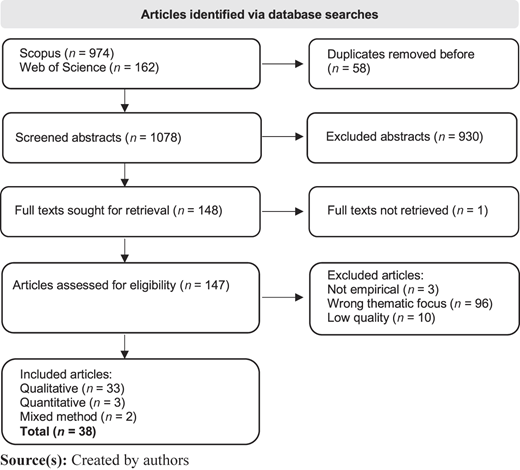
The unique studies (n = 1,078) were meticulously screened based on title and abstract in Rayyan, a piece of software for reviews and meta-analyses (Ouzzani et al., 2016), to determine whether the criteria for inclusion were met. All studies were screened using Rayyan’s predetermined categories: include, exclude, or maybe. The maybe category was used for studies where the decision to include or exclude was uncertain. Studies marked as maybe, along with those where team members had different assessments, were then discussed in the research team until consensus was reached. Following this comprehensive process, 148 studies were chosen for a detailed relevance check.
After reviewing the full texts for relevance, a total of 49 studies met all inclusion criteria. Each of these studies also underwent a rigorous quality assessment to ensure that the empirical and methodological foundations were sound. Ten studies were excluded in this step due to methodological weaknesses, such as a lack of a complete method description. The argument for excluding these studies is that a lack of a method section makes evaluating methodological credibility impossible. In the end, 38 studies were deemed to meet the standards and were included in the review. The search process is summarized in Figure 1.
The included studies were read thoroughly in the first step of the analysis. Information about the purpose, method of analysis, and results of each study was compiled in tabular form following a narrative synthesis method, which is used for synthesizing primary studies and descriptively exploring their heterogeneity (Booth et al., 2022).
The second step involved coding basic data such as the method used, theories, type of change, and findings. The findings were organized into themes based on Ellström’s (1997) competence model. In this step, because many articles focused on the tasks the HR function performed or needed to perform, rather than directly expressing these as skills, we clustered the highlighted tasks before interpreting what skills these tasks required. The same process was followed for motivation, where we interpreted the perspectives that HR was described as taking and clustered these. Regarding opportunities, we clustered both positive and negative factors into thematic categories. The studies we reviewed included a mix of individual and functional levels regarding the level at which conclusions were drawn and how respondents perceived the different levels. In the findings section, we present results regarding both the individual and functional levels. We synthesize key themes and contradictions concerning skills, motivation, and opportunities in the third and final step.
Findings
Starting with an overview of the included studies, the oldest was published in 2004, and the latest study in 2023. The papers were published in several different journals, not just within the field of HRM. Most of the papers were published in the International Journal of Human Resource Management, with eight papers; Personnel Review, with five papers; and the Journal of Organizational Change Management, with three papers.
Regarding the studied contexts, most studies were carried out in large private companies. About one-third of the studies were conducted in either the UK or Australia. Italy, the USA, and the Netherlands followed closely, with three studies conducted in each country. Additionally, several studies focused on multinational companies or non-specified countries.
The following sections present key findings from the reviewed studies relating to the skills, motivation, opportunities, and tasks the HR practitioners carried out.
Skills
We categorized the skills as cognitive, such as intellectual skills, or social, such as communication, supporting managers, emotion management, ability to influence stakeholders, cooperation and involvement, and leadership behaviors. Table 1 presents the skills and the change-related tasks they are relevant for.
Skills identified in the review
| Skills | Task | Description | Studies |
|---|---|---|---|
| Cognitive knowledge-based skills | Provide operational support | Functioning day-to-day support requires operational knowledge and is key to gaining managers trust to be invited to contribute to change initiatives | Antila and Kakkonen (2008), Björkman and Søderberg (2006) |
| Knowledge of compliance and labour legislation | Knowledge of labour law and compliance aid in regulatory processes, M&A, downsizing or contractual changes | Abugre (2014), Alfes et al. (2010), Antila (2006), Barratt-Pugh and Bahn (2015), Roche and Teague (2012) | |
| Be able to manage negotiation and downsizing processes | Manage the process and negotiate with unions in downsizing | Roche and Teague (2012) | |
| Support M&A process | HR managers’ own capabilities and activities to support in M&A process affect involvement, while management is responsible | Antila (2006), Antila and Kakkonen (2008) | |
| Utilise knowledge about business and culture | Understand the culture and business well enough to be able to create the right HRM activities supportive of the change | Antila and Kakkonen (2008), Arrowsmith and Parker (2013), Paik and Belcher (2012), Torka et al. (2008) | |
| Intellectual skills (analytical skills) | Be creative | Rapidly reinvent and digitalise people, information and performance management to support working from home | Misra et al. (2023) |
| Construct and negotiate | Exercise analytical skills to manage changes in regulatory processes or contracts | Abugre (2014), Alfes et al. (2010), Antila (2006), Barratt-Pugh and Bahn (2015) | |
| Design and implement | Use strategic skills to create HRM practices supportive of the change | Andreescu (2004), Arrowsmith and Parker (2013), Sarvaiya et al. (2021) | |
| Social communication | Disseminate information | Inform employees of changes | Brown et al. (2017) |
| Facilitate perceptions | Facilitate employees’ and managers’ perceptions, trust, and motivation | Arrowsmith and Parker (2013), Bagdadli et al. (2014), Paik and Belcher (2012), Ripamonti et al. (2020) | |
| Communicate and mediate | Communicate with employees and leaders in a timely and transparent manner. Act as a liaison | Abugre (2014), Alfes et al. (2010), Rees and Johari (2010) | |
| Cooperation and involvement | Manage involvement | Promote involvement and widespread participation of organisational members to achieve buy-in for change or support innovative progress | Andreescu (2004), Ripamonti et al. (2020) |
| Work with management | Work with top management and supervisors to ensure positive reception of HRM innovation initiatives | Stirpe et al. (2013) | |
| Cooperate with stakeholder | Cooperate with unions, through good negotiation and problem-solving | Alfes et al. (2010), Antila (2006), Antila and Kakkonen (2008), Roche and Teague (2012) | |
| Influence stakeholders | Negotiate HR’s role | Use influencing techniques, e.g. credibility building, agenda management and continuous delivery, to negotiate HRs role | Andreescu (2004) |
| Legitimise HR | Proactivity and active participation in change processes not only increase awareness of HR issues but also promote future HR involvement, thereby legitimizing HR and its concerns within the organization’s power dynamics | Alfes et al. (2010), Antila and Kakkonen (2008), Heizmann and Fox (2019) | |
| Raise credibility | Individual HR with a high level of expertise can positively affect management view of the HR function, give legitimacy, and raise credibility | Andreescu (2004), Gollan et al. (2015) | |
| Understand expectations | HR functional-level learning capabilities can enable better understanding of internal stakeholder expectations | Amarakoon et al. (2018) | |
| Convince managers | Convince top management to support and invest resources early in change | Shook and Roth (2011), Torka et al. (2008) | |
| Use productivity-outcomes as persuasion | Use focus on productivity-related outcomes or dominating discourses to persuade managers of the merits of change initiatives | Arrowsmith and Parker (2013), Francis (2007), Heizmann and Fox (2019) | |
| Support and monitor managerial behaviour | Build capability | Develop HRM activities for building manager capability as change leaders | Barratt-Pugh and Bahn (2015), Francis and Baum (2018), Gollan et al. (2015) |
| Monitor interpretations | Implement activities and monitor managers’ interpretation of HRM | Bagdadli et al. (2014), Gollan et al. (2015) | |
| Ensure adapted leadership | Employ behavioural counselling to ensure managers adapt their leadership to the virtual workplace | Misra et al. (2023) | |
| Coaching | Use coaching skills to support managers | Barratt-Pugh and Bahn (2015), Francis and Baum (2018) | |
| Facilitate sensemaking | Facilitate leaders and middle managers to engage in sensemaking, ensure leaders engage long term in strategic change | Kieran et al. (2022) | |
| Leadership behaviours | Set an example | Act as role models for the desired behavioural change, to build credibility and understand what the change entails | Edgley-Pyshorn and Huisman (2011), Francis and Baum (2018), Parkes and Davis (2013), Rees and Johari (2010) |
| Lead change effort | Take a leading change agent role, explain the change needs, provide clear direction, involve stakeholders, shape employees’ behaviours to enable change | Alfes et al. (2010), Zhang (2020) | |
| Manage emotions | Reduce change resistance | Convey a sense of fairness and reduce anxiety and resistance to change | Abugre (2014), Amarakoon et al. (2018), Antila (2006), Barratt-Pugh and Bahn (2015), Paik and Belcher (2012) |
| Support emotions | HR support others’ emotions, keep employee morale and productivity up through relations and administrative solutions | D’angelo et al. (2022), Misra et al. (2023) | |
| Manage emotional burden | Cope with ambiguity, tensions, and emotional burden of supporting others when change is unpredictable in a complex environment | D’angelo et al. (2022), Francis and Baum (2018), Ripamonti et al. (2020) | |
| Handle tensions | Balance goals | Balance business interests and employee well-being | D’Cruz et al. (2014), Misra et al. (2023) |
| Balance critique and good relationships | Challenge and critique managers, while forming good relationships and partnerships | Arrowsmith and Parker (2013), Gollan et al. (2015), van Gestel and Nyberg (2009) | |
| Balance role contradictions | Develop professional identity that allow performing in competing roles | Roche and Teague (2012) | |
| Manage ambiguity | Various roles can lead to role ambiguity, need to assess how to respond | Baran et al. (2019) |
Source(s): Created by authors
As shown in Table 1, the identified tasks, with corresponding skills, are extensive, with the majority categorized as social skills, which depend on performance in relation to others. Still, technical and functional expertise also appear as vital (Abugre, 2014; Arrowsmith and Parker, 2013; Barratt-Pugh and Bahn, 2015; Björkman and Søderberg, 2006), together with the creation of HR practices supportive of the specific change (Abugre, 2014; Arrowsmith and Parker, 2013; Misra et al., 2023).
Social skills are highlighted mainly for three reasons: to manage emotions relating to change (Amarakoon et al., 2018; Paik and Belcher, 2012; Ripamonti et al., 2020), build credibility and trust to be invited as contributors to change driven by others (Gollan et al., 2015; Heizmann and Fox, 2019), and convince management to invest in the HR functions change initiatives (Shook and Roth, 2011; Torka et al., 2008). The emphasis on skills needed to influence stakeholders illustrates that the HR function is expected to influence both their mandate and stakeholder engagement in the specific change initiative.
The reviewed studies, with a few exceptions (Alfes et al., 2010; Zhang, 2020), did not emphasize skills specific to change management. However, some studies demonstrated HR tasks of managing emotions in change, such as reducing anxiety and resistance (Barratt-Pugh and Bahn, 2015; Paik and Belcher, 2012), keeping employee morale up in times of crisis (D’Angelo et al., 2022; Misra et al., 2023), and managing their own feelings of ambiguity and tension while supporting others (D’Angelo et al., 2022; Francis, 2007).
Motivation
We found that the reviewed studies contained limited findings regarding motivation. However, Table 2 presents some recurring aspects concerning the HR function’s professional ethos, role development, and learning orientation.
Motivation identified in the review
| Motivation | Perspective | Description | Studies |
|---|---|---|---|
| Professional ethos | Managerial perspective | Taking the managerial perspective when implementing change | Alfes et al. (2010), van Gestel and Nyberg (2009) |
| Implementing management goals | Assuming a role of implementing top management goals and belief systems | Shook and Roth (2011) | |
| Get ahead | Motivated by desire for company to get ahead of competitors | Amarakoon et al. (2018) | |
| Building a professional position | Building a professional position rather than acting on behalf of employees | D’Cruz et al. (2014) | |
| Business focus | Business and operational focus viewed as too strong in relation to strategic focus | Rees and Johari (2010) | |
| Employee well-being | Motivated by contributing to the well-being of employees | Bagdadli et al. (2014), D’angelo et al. (2022), Misra et al. (2023), Roche and Teague (2012), Shook and Roth (2011) | |
| Stakeholder balancing | HR strives to act with decency and integrity, blending employee and business focused roles | Roche and Teague (2012) | |
| Finding solutions for stakeholders | Wanting to find solutions that fit different stakeholders | Alfes et al. (2010) | |
| Compliance | Viewed as more interested in legislative compliance than employee good | Bajawa and Woodall (2006) | |
| Role development | Motivation affect role | Individual HR actors’ strong motivation is a key driver, positively affecting the legitimisation of the function and successful contribution to change initiatives | Alfes et al. (2010), Gollan et al. (2015), Harris (2005) |
| Role affects attitudes | HR Business Partner loyalty with the units they reported to rather than HR | Björkman and Søderberg (2006) | |
| Leadership affects role motivation | Fear of repercussions, outsourcing, and management view on HR can affect what role HR is motivated to take on, even if the personal motivation is differing | Abugre (2014), Arrowsmith and Parker (2013), Harris (2005), Parkes and Davis (2013) | |
| Learning orientation | Low | Low motivation to learn about CSR affect partnership with CSR function negatively | Sarvaiya et al. (2021) |
| High | Actively taking measures to learn from external sources, from their own and others’ experiences, and be up to date with regulations and industry standards | Amarakoon et al. (2018) |
Source(s): Created by authors
A key finding is that the HR function is generally willing to partake in organizational change initiatives (Alfes et al., 2010; van Gestel and Nyberg, 2009; Roche and Teague, 2012). The professional ethos of the HR function is mainly linked to the managerial, business-oriented perspective (Alfes et al., 2010; van Gestel and Nyberg, 2009; Roche and Teague, 2012) and the employee well-being perspective (Bagdadli et al., 2014; Shook and Roth, 2011), although at times found to be more invested in legislative compliance (Bajawa and Woodall, 2006).
A few examples demonstrate that HR balances interests from both the managerial and employee side, striving to find solutions that fit multiple stakeholders (Alfes et al., 2010; Roche and Teague, 2012).
Findings also highlight how HR role development can be affected by individual HR practitioners’ motivation (Gollan et al., 2015; Harris, 2005), that loyalty can be affected by organizational belonging (Björkman and Søderberg, 2006), and individual motivation stifled by organizational leadership (Abugre, 2014; Arrowsmith and Parker, 2013). HR learning orientation is emphasized in two studies (Amarakoon et al., 2018; Sarvaiya et al., 2021).
Opportunities
Exploring the factors that affect the HR function’s prospects of contributing, that is, the opportunities, the reviewed studies provide examples of discourses and culture, organizational characteristics, management view and support of HR, HR status and resources, HR role design, and involvement in change efforts (Table 3).
Opportunities identified in the review
| Opportunities | Factor | Description | Studies |
|---|---|---|---|
| Discourses and culture | A profit discourse | A profit or market discourse, low prioritisation of people issues, measurability culture, macho culture, and departmentalism negatively affect HR contribution | Andreescu (2004), Barton and Delbridge (2006), Francis (2007), Harris (2005), Heizmann and Fox (2019) |
| Exclusion of softer people issues | Using the dominating discourses to get influence and resources risks not including the softer parts of people issues, and success can be reversed by external events | Francis (2007), Heizmann and Fox (2019) | |
| Co-creation of dominating discourse | HR use of dominant discourses risks co-creating these | Parkes and Davis (2013) | |
| Consider culture locally | Local culture needs to be considered when adopting HRM models | Rees and Johari (2010) | |
| Organisational characteristics | Policies and standards | Policies and standards in favour of the intended change act as support and are more common in large organisations | Parkes and Davis (2013) |
| Lack of steering | A wide range of accountabilities, unclear reporting lines, large team sizes, insufficient performance measures and lack of consequences hinder change initiatives | Arrowsmith and Parker (2013) | |
| Public sector | A stronger effect of the HR change agent role is observed in the public sector, whereas a weaker position for HR is found in higher educational institutions | Edgley-Pyshorn and Huisman (2011), Sarvaiya et al. (2021), Zhang (2020) | |
| Private sector | A weak position for the HR function in the private sector | D’Cruz et al. (2014) | |
| Cost pressures | The labour intensity of the industry and cost pressures induce a need to balance progressive HR initiatives | Francis and Baum (2018) | |
| Management view and support of HR and HRM | Management fails to involve HR | Management expected cultural issues would solve themselves and did not involve HR | Shook and Roth (2011) |
| Management fails to recognize negative results | Management not recognising results can affect negatively, even when motivated to implement HR-related change | Bondarouk et al. (2009) | |
| Top management support | Top management’s view of, and advocacy for the HR function, can enable HR to establish legitimacy | Antila and Kakkonen (2008), Gollan et al. (2015) | |
| Supervisor support | Low supervisor support can negatively moderate the effect of top management support, as they meet the employees | Stirpe et al. (2013) | |
| Management skill levels | Previous bad management of changes combined with lacking management skills affected the culture change negatively | Barratt-Pugh and Bahn (2015) | |
| HR status and resources | Strong status | Status, credibility, and resources of the HR function important to succeed with change | Sarvaiya et al. (2021), Stirpe et al. (2013), Torka et al. (2008) |
| A place in the top management | A place in the top management team or in steering groups is important for the HR function to gain credibility, and signals to the organisation that value is put on HR issues | Antila and Kakkonen (2008), Francis (2007), Francis and Baum (2018) | |
| Weak status | Weak status affects opportunities negatively | D’Cruz et al. (2014), Edgley-Pyshorn and Huisman (2011) | |
| Digital resources | Digital resources can help effectiveness, contribute to a stronger strategic HR role, but do not ease tensions between managers and HR regarding who should do what | Francis and Baum (2018) | |
| Devolution of HRM free up time | Devolving HRM to managers can free up time for strategic work and increase the legitimacy of the HR function, even when decreasing HR resources | Gollan et al. (2015), Ruël and Gbur (2017) | |
| Devolution leads to distance | Positive effects of devolution counteracted by increased demand for HR services, more managers to support, time-consuming activities, and a greater distance to managers and employees | Francis and Baum (2018), Harris (2005) | |
| Autonomy, recognition, and resources | Autonomy, recognition, and resources motivate HR professionals to develop HR innovations | Amarakoon et al. (2018) | |
| HR role design | The HR business partner role | HRBP role can give increased business knowledge, credibility, clearer managerial expectations, and opportunity to influence HR processes | Andreescu (2004) |
| Dual reporting structures | Dual reporting structures can lead to unclear roles, and a need to negotiate between managers and headquarter HR | Barton and Delbridge (2006) | |
| Closeness to line managers | Good relationships and trust with line managers important to be involved in M&As decided at their level | Antila and Kakkonen (2008) | |
| Managerial role positive for role as change agent | HR managers, compared to non-managers, to a higher degree viewed their role in change as change agents | Baran et al. (2019) | |
| Involvement in change effort | Early involvement in change | Early involvement in changes emphasised as important on both a strategic and operational level | Alfes et al. (2010), Antila (2006) |
| Not involved in planning or decisions | HR not involved in planning or decision-making | Barton and Delbridge (2006), D’angelo et al. (2022), Shook and Roth (2011) | |
| Strict employment laws | Changes subject to strict legal regulation create a need for HR knowledge and involvement, this can still be reactive | Paik and Belcher (2012), Roche and Teague (2012) | |
| HR competence needed | The HR function’s competence perceived as needed in change that have focus on people issues, e.g. a focus on emotions and rapid implementation of new work practices | D’angelo et al. (2022), Misra et al. (2023), Ripamonti et al. (2020) | |
| Focus on people issues | Focus on people issues in M&As strengthened by a high level of integration, a longer time perspective, a standardised process, the project involves many people or is led by experienced project leader | Antila (2006), Antila and Kakkonen (2008) | |
| Cross-border acquisitions | Cultural issues in focus when the acquired organisation is in another country, induces integrating work and HR involvement | Antila and Kakkonen (2008) | |
| Non-involvement of local HR | Foreign acquirers have pre-planned processes and do not involve local HR | Abugre (2014), Łupina-Wegener (2013) |
Source(s): Created by authors
As illustrated by Table 3, many studies portray factors that impact the HR function’s ability to contribute to change. Some of the main themes are the level of prioritization of people and cultural issues (Andreescu, 2004; Francis, 2007; Heizmann and Fox, 2019; Ripamonti et al., 2020; Shook and Roth, 2011); the management’s view of the HR function and of change initiatives (Bondarouk et al., 2009; Gollan et al., 2015; Stirpe et al., 2013); and the specific characteristics of the change (Antila, 2006; Łupina-Wegener, 2013; Paik and Belcher, 2012). For example, focusing on people issues in a change causes HR involvement to be perceived as necessary (D’Angelo et al., 2022; Misra et al., 2023). Additionally, the status and resources of the HR function are vital (D’Cruz et al., 2014; Edgley-Pyshorn and Huisman, 2011; Sarvaiya et al., 2021). Status can be signaled to the organization through a presence in the top management team and steering groups (Antila and Kakkonen, 2008; Francis, 2007; Francis and Baum, 2018), while digital tools and devolution of HRM to managers can free up time for strategic work (Francis and Baum, 2018; Ruël and Gbur, 2017). HR is sometimes not involved at the planning and decision-making stage (Barton and Delbridge, 2006; Shook and Roth, 2011), or at all (Baran et al., 2019).
Discussion
Building on our integrative literature review of HR change agency, we now place the main findings within a larger theoretical discussion and outline a conceptual framework and research propositions. Together, these represent a first attempt to develop an empirically grounded understanding of HR change agency.
Required competence for HR change agency
The competence required for HR practitioners to effectively act as change agents encompasses many skills, emphasizing intellectual and social abilities. Analytical skills are necessary for operational success (e.g. Abugre, 2014; Alfes et al., 2010), but social competence, like communication, coaching, and managing role contradictions, are equally important (e.g. Barratt-Pugh and Bahn, 2015; Rees and Johari, 2010). Effective HR change agents must also navigate interpersonal dynamics and facilitate stakeholder collaboration, which is critical in driving organizational change (Andreescu, 2004; Ripamonti et al., 2020).
A less emphasized but crucial skill involves managing emotions during change processes, such as building trust, mitigating anxiety, and addressing resistance. This skill, often overlooked, is a key factor in the success of change initiatives (e.g. D’Angelo et al., 2022; Francis and Baum, 2018). Contrary to Ulrich’s (1997) emphasis on HR’s need for strong business knowledge, recent studies highlight the importance of functional expertise over business acumen (Abugre, 2014; Arrowsmith and Parker, 2013). Skills in understanding human behaviour and labor legislation and operational effectiveness are seen as more central to HR’s ability to implement their own or contribute to others’ change initiatives. The motivation of individual HR practitioners also plays a critical role, with those who possess a strong professional ethos and learning orientation contributing more actively to change efforts. However, when organizational leadership undermines motivation, HR’s effectiveness diminishes (e.g. Harris, 2005; Parkes and Davis, 2013). Overall, the findings reveal a managerial bias in the literature, with less focus on employee well-being and advocacy. Despite this, some studies suggest HR’s role in crisis management is evolving to include a greater focus on employee health and well-being, particularly in enhancing organizational resilience during crises, thereby highlighting the potential for HR practitioners to make a significant impact (Aitken-Fox et al., 2022; Maddox-Daines, 2021).
The context sensitive nature of HR change agency
The review highlights the significant role of HR practitioners in contributing to organizational change and the need for a context-sensitive HR change agency. It emphasizes the importance of providing HR practitioners with the appropriate opportunities to contribute to change, noting that prioritizing people and culture within organizations (e.g. Barton and Delbridge, 2006; Francis, 2007) enhances HR’s ability to engage in change activities. However, HR’s efforts are often hindered by organizational barriers such as unclear reporting lines, large team sizes, inadequate performance metrics, and the generally weak status of HR (e.g. Arrowsmith and Parker, 2013; D’Cruz et al., 2014).
The review also underscores the relational nature of HR’s role in change, where balancing control and consent from key stakeholders, particularly managers, is critical. This balance is further complicated by the growing involvement of managers in HRM practices, which forces HR to continually prove its value to management. The need to establish credibility can affect HR practitioners’ ethos and their ability to lead change (Watson, 1977). Their ethos includes advocating for fair employee treatment, ensuring compliance with labor regulations, and aligning with organizational policies. HR’s impact on change is more pronounced when it operates according to this professional ethos.
While the appeal of a general theory of HR change agency is clear, such models often fall short in practice, which may explain the scarcity of successful cases. This review shows that HR’s role within an organization is crucial, yet it can vary widely. In some cases, HR may be confined to an administrative role with limited influence on strategy or organizational change, as highlighted by D’Cruz et al. (2014) and Edgley-Pyshorn and Huisman (2011). In contrast, in people-oriented organizations that prioritize competence development, employer attractiveness, and employee motivation, HR’s expertise is more valued and actively sought (cf. Barton and Delbridge, 2006; Francis, 2007; Heizmann and Fox, 2019).
The risks of wishful thinking in HR change agency
While the literature does not provide examples of highly successful HR change agency, it features several key factors to consider. One crucial point is the complexity of HR’s involvement in organizational initiatives, such as restructuring, and mergers (Antila, 2006; Björkman and Søderberg, 2006; Paik and Belcher, 2012; Shook and Roth, 2011). Ignoring these complexities is a form of wishful thinking that can result in costly organizational failures.
Another unrealistic expectation is the belief that HR can seamlessly switch between roles—serving managerial interests in one instance and advocating for employees in another. The reviewed articles provide no evidence supporting this flexibility. HR primarily aligns with managerial perspectives, often reinforcing management dominance rather than promoting employee-centric approaches (Alfes et al., 2010; van Gestel and Nyberg, 2009; Shook and Roth, 2011).
The dominance of a managerial viewpoint does not imply that HR lacks its voice in business matters. However, HR’s legitimacy is linked to its trustworthiness and alignment with established power structures rather than challenging them. To exert influence, HR must contribute to the organizational agenda through consistent actions rather than attempting to juggle multiple demanding roles.
A final example of wishful thinking is the notion that HR should act as master strategists, possessing deep expertise in HR processes and overall business operations. This would require HR to integrate business strategy with HR activities and guide managerial decisions. Contrary to Ulrich’s (1997) suggestion, the studies reviewed did not emphasize HR’s business acumen. Instead, functional expertise was more valued (Abugre, 2014; Arrowsmith and Parker, 2013; Björkman and Søderberg, 2006). While business knowledge is valuable, HR practitioners cannot be expected to master both business strategy and HR integration. Instead, HR should collaborate closely with managers and professionals outside the function to make joint decisions.
Is HR change agency a rather mundane activity?
Books on management and leadership often portray senior executives as heroic figures, making bold, wise, flawlessly executed decisions. These narratives overlook challenges such as uncertainty, unintended consequences, power struggles, conflicts, and competence gaps (cf. Tengblad, 2012). Our review showed that HR’s contribution to change is more grounded in day-to-day work (cf. Wallo and Coetzer, 2023). In fact, empirical research has yet to capture any form of “heroic” HR change agency, and we strongly doubt that such a concept exists empirically. The power of the HR function is typically limited, and in broader change efforts beyond HR, HR practitioners are rarely given the responsibility to lead.
Viewing the role of HR change agency as a routine, everyday activity is consistent with other empirical research on managerial work (Alvesson and Sveningsson, 2003). From this perspective, HR contributes to change not by leading, directing, or guiding others, but by supporting, facilitating, persuading, and executing regular HR tasks. These tasks include recruiting, training, communicating, navigating regulatory issues, negotiating, and managing emotions. Moreover, HR responsibilities are often delegated to line managers, requiring HR to negotiate and persuade rather than make unilateral decisions (Stirpe et al., 2013; Francis, 2007; Heizmann and Fox, 2019). As evident in the reviewed articles, this dependence on the line management perspective forces HR to prove the value of people-related issues to managers continually. This ongoing need for credibility may influence HR’s professional ethos (Watson, 1977).
Introducing a competence-based framework for HR change agency and propositions for future research
To create a foundation for guiding future research, we propose a conceptual framework (Figure 2) and research propositions that build on the insights from the review. The framework positions HR change agency at the intersection of two critical factors: HR change competence and organizational conditions (Ellström, 1997). HR change competence (cf. Reineholm et al., 2024) encompasses the skills and motivation needed for HR practitioners to effectively navigate change processes, including intellectual, social, and emotional skills, and professional ethos. On the other hand, organizational conditions shape the opportunities for HR to act as change agents, influenced by factors such as culture, managerial support, and HR status within the organization.
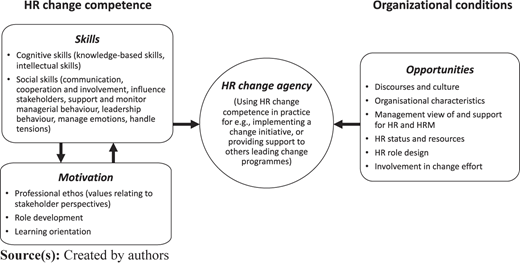
The framework highlights how the interplay between HR’s competence and the organizational context shapes how HR can successfully contribute to change. Skills equip HR practitioners with the necessary means to perform their roles. However, without the motivation to lead and the right opportunities to apply these skills, their potential impact on organizational outcomes will likely be limited. This holistic and situated approach highlights the importance of aligning HR change competence with the organization’s specific conditions. It also stresses the need to consider how these factors relate to the role in the change process. Leading a change initiative requires different skills, motivation, and opportunities than supporting a change led by others or managing externally imposed outcomes.
Based on this line of argument, we propose the following:
By focusing on the interplay between skills, motivation and opportunities, organizations can more effectively enhance the contributions of HR practitioners in change processes, thereby optimizing their role as change agents.
Although skills and motivation may mutually reinforce each other, enhancing overall HR change competence, the practical application of this competence is contingent upon favorable opportunities. Ultimately, conducive opportunities are critical, as they can outweigh the impact of competence alone.
A suggestion for future research based on these propositions is to longitudinally explore how the interplay between HR change competence and organizational opportunities influences the efficacy of change initiatives within various organizational contexts over extended periods.
Based on the analysis of the articles included in this review, the typical normative descriptions of the change agent’s role (Ulrich, 1997; Ulrich and Brockbank, 2005) can be viewed as unrealistic as they fail to consider crucial contextual factors and nor do they address how skills and motivation interrelate in forming competence. To what extent do these results mirror the more prescriptive arguments where factors such as line managers’ conservative approach, insufficient budgets, and unreasonable demands on HR practitioners’ skills are downplayed? These models often wishfully portray HR roles in a somewhat normative manner, suggesting distinct responsibilities and a linear process of change management. However, the realities of organizational life mean that HR roles are often more fluid and contested than these models suggest (Wallo and Coetzer, 2023). Furthermore, our review further illustrates how the devolution of HRM responsibilities to managers increases constraints on HR’s role and their dependence on working through managers to achieve HRM goals.
Based on the above arguments, we propose the following:
The understanding of HR change agency must be grounded in empirical accounts that capture the mundane realities of practice and examine how acts of situated agency vary across different types and scales of change, moving beyond traditional prescriptive roles of change agents to understand the practical nuances of change agency in diverse organizational contexts.
The increased devolvement of responsibilities in actuating HRM practices necessitates analysis of how an HR change agency is a collaborative venture of HR practitioners and managers.
To empirically investigate these propositions, we recommend conducting in-depth studies of HR practices. This approach should include shadowing or other direct observation techniques to gather detailed data on the execution of HR change agency across various types of change contexts. Additionally, these studies should examine how HR practitioners and managers collaboratively utilize change competence, focusing on the shared responsibilities and interactions that facilitate effective change management.
Finally, the integrative review elucidates that the articles examining HR change agency have not applied a critical gender perspective, nor explicitly examined the effect of masculine-coded and feminine-coded values, priorities, and norms (Ainsworth and Pekarek, 2022). These will likely impact the intra-organizational gendered culture, discourse, and HR’s status and resources. However, the review revealed that gendered coded practices, such as the management of emotions, are essential for reducing change resistance and coping with ambiguity, tensions, and the emotional burden of supporting others when change is unpredictable in a complex environment (D’Angelo et al., 2022; Francis and Baum, 2018; Ripamonti et al., 2020).
Based on the arguments presented above, we propose the following:
The management of emotions should be regarded as a specialized task that may necessitate specific skills as part of HR change competence.
To address the gaps concerning the incorporation of gender perspectives, we recommend conducting mixed-methods studies. Combining qualitative and quantitative approaches will provide a comprehensive understanding of the complexities surrounding emotion management as a key skill within HR change competence. In-depth interviews with HR practitioners and managers can offer rich, contextual insights into how emotional responses are managed during organizational changes. Surveys can help quantify the prevalence and impact of these practices across diverse organizational settings.
To further extend the conceptual framework and research propositions, we suggest a set of research questions in Table 4. These questions address the role of HR’s social skills, motivation, and organizational conditions in facilitating change. They also explore the effects of delegating HRM tasks to line managers, the gendered dynamics of emotional management in change, and the collaborative potential between HR and line managers. These questions offer a roadmap for advancing theoretical and practical insights into HR’s role in organizational change.
Suggested future research
| Future research area | Research question | Commentary |
|---|---|---|
| Interplay of skills and organizational impact | How do specific skills of HR practitioners affect organizational change outcomes? | This question addresses the need to evaluate specific HR skills (e.g. functional and social skills) and their effectiveness in organizational change |
| Role of motivation in change efforts | To what extent does HR motivation influence the success and sustainability of change initiatives? | Understanding how motivation impacts HR’s long-term engagement in change initiatives may reveal critical factors that enhance or diminish change efficacy |
| Contextual opportunities and HR change agency effectiveness | How do organizational conditions moderate HR’s change agency? | This question explores how organizational conditions (e.g. HR’s structural positioning and managerial support) enable or limit HR’s contributions to change initiatives |
| Devolution of change responsibilities | What is the impact of devolving HRM responsibilities on HR’s ability to lead versus support organizational change initiatives? | This question considers how delegation to managers affects HR’s influence and effectiveness, particularly in change management roles |
| HR as collaborative change partners with line managers | How can HR and line managers co-create change initiatives to maximize organizational impact? | This question encourages exploration into collaborative approaches, aligning with the conceptual framework’s emphasis on shared responsibilities in change agency |
| Gender and emotion management in HR practices | How does the gendered context of HR work affect HR practitioners’ emotion management roles in change processes? | Investigating gender dynamics may highlight challenges or strengths in emotion management that are influenced by the gender coding of HR work |
| The nature of the change | How does type, content and scale of change affect HR change agency? | Identifying how the type of change (planned, emergent, or imposed), content focus (HR-related or technical), and scale (size and impact) influence HR’s involvement and responsibilities is essential to understanding HR change agency |
Source(s): Created by authors
Practical implications
The integrative literature review reveals several practical implications. First, managers must be aware of contextual factors and tailor change efforts accordingly, avoiding simplistic, one-size-fits-all models. A thorough examination of the contextual influences on change is essential to adapt strategies that fit each organization’s unique circumstances.
Second, acknowledging that organizational change efforts are complex, time-consuming, and resource-intensive is crucial. Change initiatives must be approached with determination, endurance, and resourcefulness. The HR function should carefully assess its resources to determine what it can and cannot offer to support these initiatives. Furthermore, HR practitioners require enhanced training in various vital skills for managing change effectively. This includes developing interpersonal skills such as communication, coaching, and emotion management—essential for handling change and addressing resistance.
Third, HR functions should avoid adopting a “heroic” role or assuming that grandiose efforts will guarantee success. Such approaches often meet resistance and may lead to scapegoating the HR function if things do not go as planned. While individual HR practitioners can positively influence the legitimization of HR’s role in change (Alfes et al., 2010; Harris, 2005), external factors can easily reverse any progress (Francis, 2007). Instead, HR should focus on supporting and facilitating change through communication, counseling, and consistent operational HR work. Increasing HR’s influence depends more on sustained, long-term negotiations and cooperation with other organizational actors (Andreescu, 2004). A practical implication of this is that HR practitioners also need to stay abreast of the new technology being introduced in HR practice, as technological competence will be crucial to their effectiveness in managing contemporary change initiatives.
Finally, this review suggests that organizations should elevate HR’s role in strategic decision-making, especially during times of transition. Involving HR early in a change process allows the function to shape strategies that reflect long-term goals and align management expectations with HR capabilities. By implementing these strategies, organizations can empower HR as effective change agents equipped with the skills and the motivation to contribute to impactful organizational change.
Contributions and conclusion
This paper significantly contributes to understanding the competence required of the HR function in organizational change. The first contribution is the detailed identification of factors that enable HR to contribute effectively to change, supported by a review of empirical studies that have investigated this topic directly or indirectly. We identified, categorized, and analyzed the empirical findings using a competence-based approach.
The second contribution is the development of an empirically-based framework for HR change agency, which broadens our understanding of how and under what conditions the HR function can act as a change agent. Our analysis suggests that typical normative descriptions of the change agent role are often unrealistic, as they fail to account for crucial contextual factors and do not adequately address the interrelation between skills and motivation in forming competence. Our proposed conceptual framework challenges the traditional static and prescriptive view of HR’s role, advocating for a more dynamic understanding that integrates individual skills, motivation, and context. This approach inspires a more open-minded view of HR’s role, underscoring the importance of considering HR’s motivations and professional ethos in specific change scenarios, as well as the impact of devolving significant responsibilities to line managers.
The third contribution lies in the propositions for future research, identifying the types of studies needed to further expand knowledge about how HR can contribute to organizational change. Our study provides a foundation for future research that integrates individual and contextual factors to deepen our understanding of HR’s impact on organizational change.
In conclusion, this integrative literature review addresses the knowledge gap regarding how and under what conditions the HR function contributes to change, referred to as HR change agency. We achieved this by synthesizing findings from previous empirical studies. The main findings are that HR change agency is context-dependent, that idealized expectations should be avoided, and that HR change agency is generally a routine, rather mundane activity. Although previous research offers valuable insights into how HR change agency is practiced, significant gaps remain in our understanding. Future research should address these gaps by adopting a more realistic and nuanced perspective on HR’s role in complex, dynamic and gendered organizational settings.
Funding: This research has been partly financed by the Swedish Transport Administration (Borlänge, SE) GRANT_NUMBER: TRV 2020/15310.
References
The articles included in the review are marked with *.

