The purpose of this study is to examine the connection between algorithmic management and informal learning among gig workers in India’s location-based platforms economy – whether how workers adjust, gain knowledge and navigate algorithmically managed platform systems through informal learning processes.
A systematic literature review (SLR) was carried out using the preferred reporting items for systematic reviews and meta-analyses (PRISMA) protocol. Relevant studies were gathered from – Scopus, Web of Science and Google Scholar based on specific inclusion and exclusion criteria – 45 peer-reviewed studies on algorithmic management, digital labour, gig work and informal learning were included for thematic analysis. The input–mediator–outcome framework helped organise the relationship among algorithmic systems, informal learning processes and worker outcomes.
The review shows that algorithmic management generates necessity-driven informal learning environments, and not just intensifying labour insecurity and surveillance. Through experiential learning and collective knowledge-sharing practices, workers try to adapt themselves in this survival-oriented work environment, whereby an increased algorithmic surveillance often stimulated stronger peer-learning and adaptive coping networks among workers. However, the strength and direction of these relationships are moderated by socio-economic vulnerabilities and structural inequalities.
Findings highlight transparent algorithmic design, participatory governance models, explainable rating systems with feedback visibility and policy interventions that acknowledge and consider informal learning as pivotal to sustainable platform work.
This study demonstrates how algorithmic management converts informal learning from socially embedded workplace learning into algorithmically mediated adaptive and survival-oriented learning in emerging economies. It further conceptualises algorithms – not just as a system of labour control but also as an indirect learning environment.
1. Introduction
Location-based platforms (LBPs) like Uber, Ola, Swiggy and Zomato have revolutionised labour organisation in India’s rapidly changing digital economy through algorithmic management, a system that uses real-time data, ratings and automated decision-making to assign tasks and track worker performance (Lee et al., 2015). For example, Swiggy optimises delivery routes to reduce time and expenses, frequently putting platform efficiency ahead of worker well-being (Hussain, 2024), whereas Ola’s algorithms dynamically allocate trips based on proximity and ratings (Surie and Koduganti, 2016). With over seven million people used in ride-hailing, food delivery and logistics businesses, these platforms have grown to be essential to India’s gig economy (Kalleberg and Dunn, 2016). On the other hand, platform work has increased labour precarity through unstable earnings, information asymmetry, performance-based penalties and ongoing digital surveillance, which is reminiscent of Foucault’s panopticon of constant surveillance, even though it offers employment flexibility and income opportunities (Wood et al., 2019; Erwin, 2015).
Issues of algorithmic control, worker exploitation and autonomy within platform economies has extensively been examined within existing scholarship (Rosenblat, 2018; Srnicek, 2017; Woodcock and Graham, 2020). However, limited attention is devoted in understanding how algorithmic management reshapes gig workers’ learning processes and knowledge acquisition in such working environments. This gap is important because informal learning often serves as a crucial mechanism through which workers can adapt to survive the demands and uncertainties related to platform work. But unlike conventional workplaces which is often attributed with human supervision, mentorship and structured developmental opportunities, platform economies however radically rely on algorithmic coordination, data-driven performance evaluation and automated feedback (Watkins and Marsick, 1993). Therefore, in such contexts, workers must adapt and learn to interpret algorithmic signals, navigate opaque decision-making systems, manage customer ratings, avoid deactivation and respond to fluctuating incentives, but the presence of continuous digital surveillance and algorithmic performance monitoring commodify labour in ways that is reminiscent to Marx’ notion of alienated labour (Marx, 1867). Whereby, this further constrain worker autonomy and thus consequently, learning within such platform environments may extensively serves as an adaptive response to survive algorithmic uncertainty, labour insecurity and the challenges of sustaining participation in digitally mediated work rather than just obtaining skills and expertise for development and growth.
Furthermore, socio-economic inequalities such as caste hierarchies, gender disparities and rural–urban divides; shape workers’ access to digital opportunities, in an emerging economy context like India (Crenshaw, 1989; Radhakrishnan and Sinha, 2023). Algorithmic systems may further perpetuate these disparities by embedding biases and prejudices knowingly or unknowingly, that disproportionately disadvantage or harm women, lower caste workers and rural participants (Buolamwini and Gebru, 2018; Brougham and Haar, 2018). Such disparities in digital infrastructure and technological access continue to constrain informal learning opportunities, especially in rural regions where unstable internet connectivity limits workers’ ability to access mobile applications, peer-learning forums and digital training resources, widening the existing digital skill gaps (Ahuja and Yadav, 2019; Asrani, 2022; UNESCO, 2020).
Despite growing global scholarship on algorithmic labour (Rosenblat, 2018), India-specific studies examining the relationship between algorithmic management and informal learning remain limited. Existing research has primarily focused on labour exploitation and surveillance, while intersectional dimensions such as caste, gender and regional inequalities remain underexplored (Ahmed and Islam, 2020). This study therefore addresses this gap by identifying how algorithmic systems fundamentally alter the nature, process and equity dimensions of adaptive informal learning within India’s LBP economy and how gig workers in such platforms, not only learn how to improve task performance and maximise earnings but also develop adaptive strategies to navigate ratings systems, algorithmic allocation mechanisms and survive platform uncertainties and how the presence of socio-economic and regional inequalities widened the gap.
1.1 Research questions
How does algorithmic management in India’s location-based platforms shape informal and survival-oriented adaptive learning practices among gig workers?
What forms of adaptive learning strategies do gig workers develop to navigate algorithmic control, uncertainty and platform-based performance systems?
How do structural inequalities such as caste, gender and rural–urban divides influence access to informal learning opportunities and learning outcomes within platform labour systems in India?
How does worker agency mediate or moderate the relationship between algorithmic management and informal learning outcomes in India’s gig economy?
What are the implications of algorithmic management and informal learning for equitable digital labour, inclusion and policy development in India’s platform economy?
To address these existent gap and questions, this study integrates existing scholarships through an input–mediator–outcome (IMO) paradigm and performs a systematic literature review using the PRISMA protocol. Whereby, it conceptually repositions algorithms as indirect learning environments rather than just some labour control systems, the study contributes theoretically by extending informal learning literature into algorithmically governed labour environments.
2. Literature review
Rather than a study-by-study analysis, the reviewed studies were evaluated using a thematic and concept-centric approach (Webster and Watson, 2002; Snyder, 2019) and according to recurring themes, key findings and areas of scholarly debate, articles were categorised that further, establishes five interrelated conceptual streams:
algorithmic control and digital surveillance;
worker agency, resistance and adaptive behaviour;
survival-oriented adaptive informal learning in platform economies;
structural inequality and learning exclusion; and
competing perspectives on algorithmic management: efficiency, flexibility and control.
Through this manner of organising the literature it expedites a better and deeper understanding of the relationships between algorithmic governance, learning processes and labour outcomes while showcasing key research gaps within the Indian platform economy context.
2.1 Algorithmic control and digital surveillance
The expanding literature on platform economies demonstrates that algorithmic management has transformed traditional managerial tasks into automated systems of surveillance, assessment and behavioural control (Kellogg et al., 2020; Meijerink and Bondarouk, 2023). With algorithms in LBPs assigning tasks, using geolocation technologies to track employee movement, evaluating performance via customer ratings and using dynamic pricing systems to regulate incentives (Duggan et al., 2023). Such platforms govern labour using data-driven decision-making frameworks that influence worker behaviour in real time, as opposed to relying on direct human supervision (Wood et al., 2019).
A significant stream of studies across disciplines – management, sociology and labour studies, conceptualises algorithmic management as a digitally intensified form of labour control, whereby, factors like – opacity, asymmetrical information flows and automated discipline (Rahman, 2021; Kellogg et al., 2020), leads to lack of knowledge among workers regarding how ratings are calculated, how tasks are allocated or how deactivation decisions are made, creating forms of informational precarity that increases uncertainty and reliance on platform systems (Veen et al., 2019). In the Indian context, within food-delivery platforms such as Swiggy and Zomato, they use automated order allocation, real-time surveillance and geo-fencing which maximise efficiency while simultaneously limiting worker autonomy (Hussain, 2024; Garg and Agarwal, 2019).
Algorithmic management is further conceptualised within broader systems of capitalism, surveillance and digital risk extraction. With, Curran (2023) arguing that platform economies operate through continuous data extraction, behavioural forecasting and predictive analytics (Nanda et al., 2025), allowing platforms to intensify labour monitoring beyond conventional managerial oversight. This approach strengthens the unequal power dynamics between platforms and labour by turning worker action itself into a source of commodified data. Similarly, Heiland (2022) demonstrates how location-based delivery platforms use temporal and geospatial algorithmic controls to manage workers through real-time mobility tracking and place-based scheduling regimes. Such a system not only optimise labour extraction but also reshape workers’ spatial autonomy by linking productivity directly to algorithmically monitored movement patterns.
Furthermore, the role of gamification mechanisms and behavioural nudging within platform governance is highlighted (Pilatti et al., 2024). Whereby, algorithms gently influence worker conduct and behaviour by encouraging self-disciplining behaviours rather than overt managerial coercion through reward thresholds, surge incentives and performance targets. This enriches our understanding of algorithmic control to include more psychologically embedded forms of digital governance rather than just simple surveillance. With scholars increasingly argue that algorithmic control produces psychological and affective consequences or “algorithmic paranoia”, beyond just operational efficiency, which, Alacovska et al. (2024) describe it as, workers exhibiting anxiety and distrust towards opaque systems that constantly monitor and track their performance. Similarly, automated evaluation systems intensify – emotional strain, income volatility and behavioural self-monitoring as highlighted by Zhang et al. (2022). These dynamics expand the notion of economic precarity into emotional and cognitive dimensions, where workers must continuously adapt to erratic algorithmic demands.
However, within existing scholarship – with regards to how workers learn to navigate algorithmic systems is significantly less focused, instead surveillance and labour exploitation is mostly concentrated upon. Even if multiple studies have identified behavioural adaptation and strategic compliance, the learning processes that underlies these adaptations are still poorly understood, especially in rising economies like India.
2.2 Worker agency, resistance and adaptive behaviour
Gig workers are often depicted as passive subjects of algorithmic control, however, in contrast to this view – emerging studies highlights “worker agency” – the ability of workers to actively adapt, negotiate and respond to organisational or algorithmic control within their work environments (Wood et al., 2019; Kellogg et al., 2020) – that includes, resistance and adaptive behaviour within platform economies as well (Parth et al., 2023; Rahman, 2021). Whereby, workers often devise informal strategies such as; selective task acceptance, scheduling labour during surge pricing periods, manipulating multiple applications simultaneously and exchanging algorithmic insights via peer networks, to decipher platform algorithms, optimise earnings, avoid penalties and manage client ratings (Veen et al., 2019).
Rather, than just merely complying with platform demands, gig workers respond to opaque algorithmic evaluation systems by strategically monitoring themselves and adapting their behaviour according to circumstance and actively interpret algorithmic signals and develop tacit knowledge regarding platform operations (Rahman, 2021). Therefore, platform labour is not perceived simply as being controlled or dominated by an algorithmic mechanism, but is rather understood as a negotiated and adaptive process shaped by worker responses and platform dynamics.
Furthermore, collective resistance which refers to individuals collaboratively challenge, negotiate or adapt to dominant organisational or algorithmic control mechanisms and exchange information either through online or offline solidarity networks, represents another dimension of coordinated worker agency (Parth et al., 2023). Whereby, gig workers share information about incentives, deactivation risks, customer behaviour and routing strategies through digital forums, WhatsApp groups and informal worker communities in which such, communities function as both resistance mechanisms and decentralised learning ecosystems that make up for the lack of official organisational support (Tassinari and Maccarrone, 2020). Platform workers actively create alternative organisational support systems outside of official platform institutions, as evidenced by the rise of worker solidarity networks. According to Raval (2020), platform labour encompasses issues of identity, moral behaviour and socio-economic survival in addition to economic exchange. Therefore, in precarious work situations, workers engage in adaptation activities not just to maximise earnings but also to maintain dignity, social belonging and long-term livelihood sustainability. These adaptive communities often serve as unofficial forums for experiential learning, group problem-solving and emotional support.
However, several views of worker agency’s efficacy are present across multiple literature. While some scholars argue that adaptive techniques may momentarily increase worker autonomy and profits, others suggest that by forcing workers to internalise algorithmic expectations, will eventually promote platform dependency (Woodcock and Graham, 2020). This implies that rather than being completely liberating, worker agency in algorithmic systems is conditional and limited.
2.3 Survival-oriented adaptive informal learning in platform economies
Conventional literature defines informal learning as learning that occurs outside formal training structures, it conceptualises learning as an experiential, socially embedded and practice-oriented process (Marsick and Watkins, 1990; Eraut, 2004). In such traditional organisational settings, informal learning emerges through mentorship, workplace interaction, observation and collaborative problem-solving (Watkins and Marsick, 1993). However, the emergence of algorithmically managed platform work, challenges these assumptions. Besides, gig workers often lack stable organisational membership, formal training systems or consistent supervisory support, this forces them to rely on alternative ways of learning and upskilling themselves within digital labour processes.
Within such limited settings and to navigate uncertain digital labour systems, workers increasingly learn through trial-and-error methods, peer interactions, customer ratings, platform feedback systems, incentive structures, adaptive coping mechanisms and repeated exposure to algorithmic settings (Ghosh, 2020; Rahman, 2021). For instance – a ride-hailing driver in Delhi adapts to customer preferences through repeated interactions or a delivery worker in Mumbai might learn efficient routing via app feedback (Ghosh, 2020). Consequently, learning becomes survival-oriented, often focused on navigating uncertainty, maximising earnings and avoiding algorithmic penalties (Rahman, 2021; Ghosh, 2020). This study conceptualises these processes as survival-oriented adaptive informal learning, where gig workers learn not primarily for career advancement or professional development but by the need to sustain participation within precarious platform environments. However, opportunities for long-term skill development and upward mobility remain constrained by opaque algorithmic systems attributed through – unpredictable deactivation, biased rating mechanisms and limited transparency (Woodcock and Graham, 2020; Kellogg et al., 2020). These issues extend beyond labour control into broader concerns surrounding autonomy, inclusion and learning equity, whereby, learning becomes both a coping mechanism and a survival strategy.
Furthermore, peer-based and tacit knowledge exchange remains significant across digital labour systems. Whereby, informal worker communities facilitate the circulation of experiential knowledge regarding platform rules, incentive optimisation and risk mitigation (Parth et al., 2023). These decentralised learning mechanisms thus compensate for the lack of formal training and organisational support in platform economies, thus, it enables workers to collectively adapt to evolving platform demands.
Subsequently, this study argues that survival-oriented adaptive informal learning represents a distinct form of workplace learning that significantly differs from conventional workplace learning, in which learning under algorithmic governed labour systems shifts from being developmental to necessity-driven and knowledge acquisition is primarily tied to resilience, sustaining employability, maintain ratings, avoid deactivation and stabilise earnings. This suggests that informal learning serves as a crucial adaptive mechanism within the gig economy.
2.4 Structural inequality and learning exclusion
A significant amount of research studies contends that rather than creating universally accessible digital opportunities, platform economies instead perpetuate and exacerbate already-existing structural inequalities (Lata et al., 2022; Liu et al., 2024). Although, algorithmic systems are often perceived as technologically neutral, inclusive and accessible – however, researchers increasingly demonstrate that rating mechanisms, task allocation systems and incentive structures may reflect larger societal hierarchies related to caste, gender, class, digital literacy and technological access (Van Dijk, 2005).
In India, these inequalities are particularly significant because platform work operates within already informalised labour markets characterised by uneven access to technology, education and social protection codes (Sharma and Sharma, 2025). With gender inequalities further shape platform labour experiences whereby, women workers especially encounter mobility restrictions, safety concerns, discriminatory ratings and unequal access to lucrative working hours (Radhakrishnan and Sinha, 2023). These conditions limit not only earning opportunities but also exposure to experiential learning and algorithmic adaptation.
Consequently, algorithmic visibility – the extent to which workers are favoured by platform systems – becomes unevenly distributed across social groups. With lower caste and rural workers often face barriers associated with digital literacy and technological access (Liu et al., 2024). Where, workers possessing stronger digital competencies, smartphone literacy and urban familiarity often adapt more successfully to algorithmic environments; while, workers from marginalised socio-economic backgrounds may experience reduced access to learning opportunities and weaker adaptation capacities (Rani et al., 2019). Therefore, access to informal learning opportunities depends heavily on digital infrastructure, peer networks and technological competence and workers with limited smartphone literacy, unstable internet connectivity or weak social networks may struggle to decode algorithmic systems effectively (Latif, 2024).
As a result, marginalised workers often experience limited opportunities for skill development, adaptive learning and economic mobility, which leads to forms of learning precarity. This, highlighted learning exclusion as an emerging dimension of platform inequality. Nevertheless, there is still a limited source of empirical studies, that directly links inequality with informal learning outcomes and a majority of existing research predominantly concentrates on labour precarity and algorithmic bias, while little attention is paid to how structural inequalities shape workers’ ability to learn, adapt and participate effectively within platform ecosystems.
2.5 Competing perspectives on algorithmic management: Efficiency, flexibility and control
While critical viewpoints predominate in algorithmic management conversations, the current study offers a more nuanced evaluation of the dual effects of platform-based labour arrangements. Duggan et al. (2019), stated that algorithmic system improve operational efficiency, optimise service delivery and provide workers with flexible scheduling opportunities and expanded income-generating possibilities. With gig platforms often creating labour market access for individuals excluded from conventional employment structures due to limited formal employment opportunities and high levels of informal labour participation especially within developing economies such as India (Surie and Koduganti, 2016; Sharma and Sharma, 2025). Furthermore, flexible work arrangements and dynamic pricing systems provide workers with greater temporal autonomy and opportunities to maximise earnings during periods of high demand (Wood et al., 2019).
Algorithmic systems may also generate perceptions of procedural consistency and managerial neutrality because platform decisions are often presented as automated, standardised and data-driven rather than dependent on subjective human judgement (Alizadeh et al., 2025; Meijerink and Bondarouk, 2023). Whereby, workers may perceive algorithmic systems as less arbitrary or discriminatory than traditional managerial arrangements, particularly within informal labour environments characterised by inconsistent supervision and unequal treatment (Surie and Koduganti, 2016). Such perspectives challenge purely exploitative interpretations of platform labour by emphasising worker flexibility, entrepreneurial opportunity and perceived fairness within digitally mediated work systems.
However, critical studies also exist which questioned whether these benefits are equitable, stable or universally accessible across different worker groups. With previous research suggesting that positive platform outcomes are often conditional upon workers’ ability to strategically navigate algorithmic systems, digital competence, geographical location and technological access (Woodcock and Graham, 2020; Van Deursen and Van Dijk, 2014). With workers having stronger digital literacy, urban connectivity and social support networks are typically privileged to benefit from platform opportunities, while marginalised workers remain disproportionately exposed to insecurity, informational asymmetries and learning precarity (Liu et al., 2024; Asrani, 2022). Moreover, within algorithmic systems, data-driven performance metrics like; customer ratings, behavioural tracking and engagement metrics embedded within the systems despite claims of procedural neutrality may reproduce broader socio-economic inequalities related to gender, caste and digital access (Ahmed and Islam, 2020; Kaur and Singh, 2020).
The apparent objectivity and neutrality of algorithmic management is often argued by critics that it may obscure more nefarious forms of surveillance, behavioural control and economic dependency embedded in platform labour systems (Kellogg et al., 2020; Mayer and Timan, 2021). With automated performance monitoring, opaque rating mechanisms and data-driven behavioural nudges often limiting workers’ ability to understand or challenge platform decisions, thereby increasing asymmetries of informational power between workers and platforms (Rahman, 2021; Rosenblat, 2018). Hence, workers often use informal learning strategies, peer-based knowledge sharing and adaptive coping techniques to navigate algorithmic uncertainty and minimise economic risks (Ghosh, 2020; Zhang et al., 2022).
Through these tensions it signifies that algorithmic management cannot be reduced to being purely empowering or wholly exploitative; instead, its consequences and effects remain uneven, contingent on context and shaped by workers’ adaptive capabilities, socio-economic realities and access to informal learning resources within digitally mediated labour settings. This persistent tension underscores the need for integrative research into how algorithmic management, informal learning practices and structural inequalities intersect in India’s LBP economy.
3. Methodology
In this SLR, PRISMA guidelines (Moher et al., 2009) is followed. Through Scopus, Web of Science and Google Scholar, database searched is conducted from 2010 to 2025. The timeline from 2010 was selected as it marks the consolidation phase of platform-based gig work and the expansion of algorithmic management scholarship in management and labour studies (Kadolkar et al., 2024). The 2010–2025 timeframe was strictly applied to the PRISMA-guided database search and screened data set only, while foundational theoretical works that are published outside this period were cited for conceptual grounding and model development, such as intersectionality scholarship and labour process theory, but were not included in the systematically reviewed sample. Similarly, UNESCO’s Global Education Monitoring Report 2020 and the Fairwork Project – Fairwork India Ratings 2023, were referenced for contextual insights on inclusion and platform labour conditions but were excluded from the final SLR sample of 45 peer-reviewed studies.
3.1 Search terms combined algorithmic and learning aspects
TITLE-ABS-KEY ((“algorithmic management” OR “algorithmic control” OR “algorithmic mechanism”) AND (“location-based platform” OR “uber” OR “ola” OR “swiggy”) AND (“informal learning” OR “workplace learning” OR “skill acquisition” OR “experiential learning”) AND (“gig economy” OR “gig work” OR “platform economy”) AND (“India” OR “Indian”)).
3.2 Inclusion criteria
To ensure methodological rigor and conceptual relevance. Studies were included if:
they examined “algorithmic management or control”, “labour vulnerability or precarity”;
focused on “platform labour or location-based platforms”, “informal/workplace learning” or “digital platform work within gig or platform-mediated labour contexts”;
they addressed informal learning, or informal knowledge acquisition or worker adaptation;
India-focused and international studies were selected that advanced theoretical development or offered empirically grounded insights relevant to emerging economies; and
they are peer-reviewed English-language journal articles.
3.3 Exclusion criteria
non-peer-reviewed;
focused solely on “technical algorithm design without labour implications”;
addressed traditional employment contexts unrelated to digital platform mediation;
emphasised “consumer experience” or “firm performance perspectives without worker-level analysis” or “failed to address worker experiences”; and
lacked substantive theoretical or empirical contribution and methodological clarity.
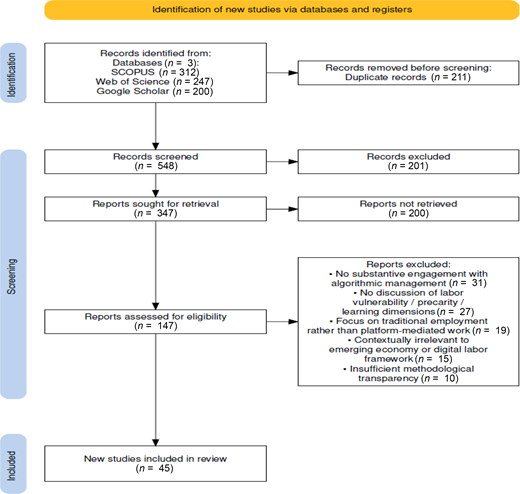
As shown in Figure 1 the initial database search yielded 759 records. After the removal of 211 duplicate records, 548 studies remained for title and abstract screening. In this screening stage, 201 records were excluded because they clearly fell outside the scope of the review, with studies that focused primarily on technical algorithm design without labour implications, traditional employment settings unrelated to platform-mediated work, consumer or firm-performance perspectives lacking worker-level analysis. Subsequently, 347 reports were being sought for retrieval after the exclusion, of which 200 reports were not retrieved due to accessibility limitations or insufficient availability of full-text sources. Afterwards, 147 reports were assessed for full-text eligibility using the predefined inclusion and exclusion criteria. During this stage, 102 studies were excluded for lacking substantial engagement with algorithmic management (n = 31), failing to address labour vulnerability or worker precarity (n = 27), focusing on conventional employment contexts rather than platform-mediated work (n = 19), demonstrating limited contextual relevance to gig economy and digital labour frameworks in emerging economies (n = 15), or lacking sufficient methodological rigor and analytical transparency (n = 10). Following this multi-stage screening and eligibility assessment process, a final sample of 45 studies was retained for systematic synthesis and analysis.
3.4 Quality assessment/methodological rigor and bias evaluation
The included empirical and review studies were subjected to a quality appraisal process enhancing transparency and methodological rigor of this systematic literature review (Tranfield et al., 2003). Following recommendations from PRISMA reporting protocols and systematic review approaches in management research, studies were evaluated based on several criteria mentioned in Table 1.
Given the interdisciplinary nature of the literature on algorithmic management, platform labour and informal learning, a qualitative appraisal approach was adopted instead of statistical risk-of-bias tools. The reviewed studies included qualitative research, ethnographies, conceptual analyses, policy reports and systematic reviews. Therefore, methodological rigor was assessed using criteria (Table 1) appropriate to management, labour studies, sociology and information systems research.
Table 2 presents a selected sample of core studies to illustrate the quality appraisal process applied in this review based on the stipulated criteria (Table 1). To ensure transparency and methodological consistency throughout the systematic review process, quality assessment and methodological rigor evaluation were conducted for all 45 included studies (see Appendix). In which, each study was categorised as demonstrating either having – high, moderate, or limited methodological rigor.
However, despite these limitations (Table 3), the studies reviewed collectively offer valuable insight into algorithmic control, informal learning, worker adaptation and digital labour inequalities within India’s platform economy. It further highlights the relevance of examining structural inequalities within his context. Notably, caste, gender, rural labour and digitally marginalised worker remain underrepresented, across existing scholarship which indicates that there is an uneven treatment of access to informal learning opportunities and adaptive workplace practices. These gaps reinforce the importance of the study’s research question on – how structural inequalities shape learning experiences and outcomes in algorithmically managed gig work settings.
4. Theoretical framework
To explain how algorithmic management reshapes informal learning processes within India’s platform economy, this review draws on multiple interdisciplinary theories. The framework conceptualises platform labour as an algorithmically governed environment where learning becomes increasingly adaptive, survival-oriented and structurally unequal – rather than treating gig work simply as a new employment arrangement.
Labour process theory highlights how managerial systems under capitalism – control, monitor and intensify labour processes (Braverman, 1974). Within platform work, this control is exercised through an algorithmic system that regulate or track workers, assign tasks, enforces ratings and measure performance. The reviewed studies show that such mechanisms restrict worker autonomy while simultaneously push and compel workers to develop adaptive learning strategies – essential for sustaining earnings, avoiding penalties and staying visible within opaque platform systems.
Foucault’s panopticon theory (Erwin, 2015) sheds light on algorithmic surveillance, showing how behavioural control operates through constant visibility and self-regulation. In platform work, this takes shapes as workers internalise algorithmic monitoring via GPS tracking, customer ratings and incentive systems. Subsequently, this resulted in engagement in anticipatory learning where workers continuously adjust behaviour to avoid – deactivation, reduced visibility or economic instability (Woodcock and Graham, 2020).
Informal learning theory views learning as experiential, unstructured and embedded within everyday work practices (Marsick and Watkins, 1990). Yet, under algorithmic governance, informal learning shifts away from collaborative professional growth towards individualised and defensive or survival-oriented adaptation. With workers primarily learn through trial-and-error, peer networks and predictive behavioural adjustments to navigate and cope with algorithmic uncertainty.
Digital divide theory highlights how inequalities in technological access, digital literacy and information resources create disparities in opportunity (Van Dijk, 2005). The synthesis shows that workers with stronger digital literacy, urban mobility and social networks can adapt more effectively to such platform systems, while rural and digitally marginalised workers face reduced access to informal learning opportunities.
Intersectionality explains how overlapping social inequalities – such as caste, gender and class –shape lived experiences and exclusion (Crenshaw, 1989). The reviewed studies reveal that algorithmic systems are not socially neutral, as women workers, lower-caste workers and rural workers often encounter unequal access to high-demand zones, ratings visibility, safety and adaptive learning opportunities.
4.1 Contextual adaptations to India
This theoretical framework is applied and adapted to India’s gig economy, where LBPs operate within the dynamics of rapid urbanisation, caste hierarchies and digital informality (Kalleberg and Dunn, 2016). Key contextual factors include the dominance of informal labour (Pilz et al., 2015), gender disparities in ride-hailing (Radhakrishnan and Sinha, 2023) and persistent rural–urban divides (Ahuja and Yadav, 2019). For instance, digital divide theory underscores – how only 50% of Indians have internet access, with opportunities for informal learning remaining limited, especially in rural regions (UNESCO, 2020). Intersectionality further highlights how caste – algorithm dynamics, such as discriminatory and biased deactivation practices (Ahmed and Islam, 2020), amplify exclusions in outputs.
India’s regulatory landscape, marked by limited protections for gig workers (Sharma and Sharma, 2025), provides a backdrop for labour process theory, where algorithmic systems perpetuate precarity in the absence of union representation (Fairwork India, 2023; Tassinari and Maccarrone, 2020). Furthermore, Foucault’s notion of surveillance is evident in GPS tracking technologies, which fosters self-discipline among workers (Mayer and Timan, 2021; Curran, 2023). Meanwhile, informal learning thrives in peer networks (Pilatti et al., 2024), yet literacy barriers hinders its potential (Sindakis and Showkat, 2024; Van Deursen and Van Dijk, 2014).
4.2 Theoretical contribution
Collectively, these theoretical perspectives, especially the integration of labour process theory, informal learning and intersectionality perspectives reinforce the study’s central claim that algorithmic management governs not only labour processes but also learning trajectories. The review therefore reframes informal learning within gig work as a survival-oriented adaptive mechanism shaped by algorithmic control, precarious conditions and entrenched structural inequality.
5. Conceptual framework
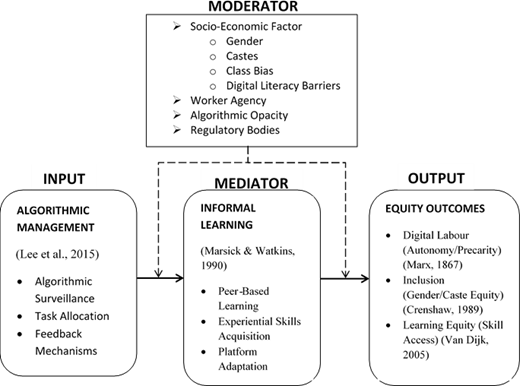
Figure 2 presents a tailored conceptual framework that illustrates how algorithmic management and informal learning interact and how this shapes digital labour, inclusion and learning equity. This model offers a structured way to analyse how inputs influence outputs through mediating processes, offering a dynamic, process-oriented approach that aligns with the SLR’s thematic synthesis from 45 peer-reviewed sources.
The IMO model, as articulated by Ilgen et al. (2005), posits that organisational inputs (e.g. resources and structures) shape processes (mediators) that, in turn, produce outcomes (e.g. performance and equity). Although, originally developed within team effectiveness research, Mathieu et al. (2008) extended this framework to emphasise feedback loops and contextual factors, making it apt for complex, adaptive systems like gig economies and to examine interactions between structural conditions, mediating processes and behavioural outcomes. In this SLR, the model is contextualised to India’s socio-economic milieu, where caste, gender and digital divides amplify algorithmic effects (Crenshaw, 1989; Radhakrishnan and Sinha, 2023; Van Dijk, 2005). Unlike linear models, IMO accounts for interactions and contingencies, mirroring the iterative nature of informal learning in gig work (Marsick and Watkins, 1990). This adaptation addresses gaps, such as the lack of integrative frameworks for non-western gig contexts.
Inputs (algorithmic management systems): The input dimension consists of the algorithmic management mechanisms embedded within platforms such as Uber, Ola, Swiggy and Zomato. These include surveillance systems (e.g. GPS tracking), automated task allocation, route optimisation, rating systems, incentive structures, dynamic pricing, feedback loops and deactivation thresholds (Lee et al., 2015). The reviewed studies show that these systems prioritise efficiency, behavioural monitoring and labour optimisation while simultaneously intensifying worker precarity and reducing autonomy. In the Indian context, several studies indicate that algorithmic systems often reproduce urban and socio-economic biases by privileging workers with greater mobility, digital literacy and platform familiarity while marginalising rural and lower-caste workers (Bhattacharya, 1998; Brougham and Haar, 2018). This aligns with Foucauldian notions of disciplinary surveillance and labour process theory, where algorithmic systems function as mechanisms of behavioural control and labour commodification (Braverman, 1974; Erwin, 2015; Marx, 1867).
Mediators (informal and adaptive learning): The mediator dimension captures the informal learning processes workers develop to navigate algorithmic uncertainty. Informal learning refers to experiential, unstructured and workplace-embedded knowledge acquisition occurring through trial-and-error adaptation, peer interaction and everyday work experiences (Marsick and Watkins, 1990; Watkins and Marsick, 1993). Unlike conventional workplace learning models, the framework conceptualises informal learning not as a developmental organisational process, but as a survival-oriented adaptive mechanism emerging under conditions of algorithmic precarity, surveillance and structural inequality. The synthesis reveals that workers engage in adaptive learning practices such as route optimisation, customer interaction management, incentive prediction and rating management to maintain earnings and platform visibility (Ghosh, 2020). Learning frequently occurs through WhatsApp groups, peer communities and informal digital networks rather than through formal organisational support. However, the opacity of platform systems, low digital literacy, caste inequalities and regional disparities limit workers’ ability to access and utilise adaptive knowledge effectively (Pilatti et al., 2024; Kadolkar et al., 2024). Consequently, the review identifies informal learning as both a resilience mechanism and a site of inequality within algorithmically governed labour environments.
Outputs (labour, learning and inclusion outcomes): The output dimension reflects the broader consequences of algorithmic management and informal learning on digital labour conditions, inclusion and learning equity (Woodcock and Graham, 2020). The reviewed studies consistently demonstrate that algorithmic governance contributes to reduced autonomy, intensified surveillance, economic insecurity and behavioural dependency on platform systems, particularly within precarious contractual arrangements in India’s gig economy (Fairwork India, 2023; Tassinari and Maccarrone, 2020; Marx, 1867). The findings further reveal uneven learning and inclusion outcomes shaped by gender, caste, digital literacy and rural–urban divides (Crenshaw, 1989; Gupta and Jain, 2019; Radhakrishnan and Sinha, 2023). Women workers, lower-caste workers and rural platform workers often experience reduced access to high-demand zones, weaker peer-learning networks and greater barriers to adaptive skill acquisition (Ahuja and Yadav, 2019). Consequently, algorithms may enhance learning opportunities for digitally privileged urban workers while widening inequalities for marginalised groups in low-connectivity contexts (Asrani, 2022; Sindakis and Showkat, 2024). The framework further incorporates feedback loops (Mathieu et al., 2008), suggesting that worker adaptation, resistance practices and collective feedback may gradually influence platform governance structures and algorithmic adjustments over time.
Overall, the framework illustrates how algorithmic management systems shape workers’ adaptive learning practices, which subsequently influence labour precarity, inclusion and learning equity outcomes within India’s platform economy (Woodcock and Graham, 2020). These relationships are further moderated by socio-economic inequalities, worker agency, algorithmic opacity and regulatory environments. Gendered constraints such as safety concerns, mobility restrictions and domestic labour responsibilities significantly affect how female gig workers access platform opportunities and engage in informal learning compared to male workers (Radhakrishnan and Sinha, 2023; Gupta and Jain, 2019), while caste, class and digital literacy barriers influence workers’ ability to navigate platform systems effectively (Ahuja and Yadav, 2019; Pilatti et al., 2024). Worker agency moderates the framework through adaptive resistance, peer-learning networks and collective knowledge-sharing practices developed to negotiate platform asymmetries (Veen et al., 2019). At the same time, algorithmic opacity intensifies dependence on informal learning due to limited transparency in ratings, task allocation and deactivation systems (Lee et al., 2015; Kadolkar et al., 2024). Regulatory institutions further shape the framework by influencing platform accountability, worker protection and equitable access to learning opportunities within algorithmically governed labour environments (Fairwork India, 2023; Tassinari and Maccarrone, 2020).
5.1 Propositional relationships derived from the input–mediator–outcome framework
Algorithmic management systems within India’s location-based platforms shape workers’ informal and adaptive learning practices through continuous performance monitoring, ratings and incentive structures (Marsick and Watkins, 1990; Lee et al., 2015).
Informal learning practices mediate the relationship between algorithmic management and inclusion outcomes by enabling workers to navigate platform asymmetries, although learning opportunities remain uneven across marginalised groups (Crenshaw, 1989; Radhakrishnan and Sinha, 2023).
The relationship between informal learning and learning equity outcomes is moderated by socio-economic inequalities such as caste, gender, digital literacy and rural–urban divides (Van Dijk, 2005; Sindakis and Showkat, 2024; Bhattacharya, 1998).
Worker agency, including peer-learning networks and adaptive resistance practices, moderates the impact of algorithmic management on labour precarity and learning outcomes within platform work environments (Woodcock and Graham, 2020; Veen et al., 2019).
6. Findings
6.1 Algorithmic management and adaptive learning (RQ1)
The review demonstrates that algorithmic management systems function not only as labour coordination mechanisms but also as indirect learning environments. Across the 45 studies, workers consistently adapted behaviour based on opaque ratings, dynamic incentives, GPS surveillance and deactivation risks. A key synthesis finding is that algorithmic uncertainty itself becomes a learning trigger: workers learn primarily through repeated exposure to penalties, incentive fluctuations and behavioural monitoring rather than through formal organisational support. This reveals a counter-intuitive dynamic where intensified surveillance simultaneously produces stronger survival-oriented adaptive learning behaviours. Rather than eliminating worker agency, opaque algorithmic systems compel workers to continuously decode platform logic to remain economically viable. These findings support P1 and extend existing gig economy literature by positioning algorithms as systems that govern learning itself rather than merely labour performance.
6.2 Survival-oriented learning strategies (RQ2)
The synthesis reveals that informal learning within platform work is fundamentally survival-oriented rather than developmental. Workers learn how to optimise routes, predict surge pricing, manage customer interactions, avoid penalties and maintain ratings visibility to stabilise earnings within precarious environments. A significant finding emerging across the reviewed studies is that algorithmic precarity unintentionally stimulates collective learning ecosystems. Despite the individualised nature of gig work, workers frequently form WhatsApp groups, Telegram channels and peer-support networks to collectively interpret algorithmic changes and share coping strategies. Thus, systems designed to individualise labour paradoxically generate informal solidarity and decentralised learning infrastructures. However, these adaptive strategies often reinforce dependency on platform systems because workers internalise algorithmic expectations to maintain employability. These findings support P2 regarding the mediating impact of survival-oriented adaptive informal learning on the relationship between algorithmic management and learning equity, while it also partially supports P4 regarding the moderating impact of peer-learning networks and collective adaptive strategies.
6.3 Structural inequality, bias and learning precarity (RQ3)
The review demonstrates that access to adaptive learning opportunities remains structurally unequal across gender, caste, class and rural–urban divides. Workers with stronger digital literacy, urban familiarity and social networks generally adapt more effectively to platform systems, while marginalised workers experience informational, economic and learning precarity. Female gig workers face safety concerns, domestic labour burdens and mobility restrictions that fundamentally alter their informal learning trajectories compared to male workers. Similarly, rural and lower-caste workers often encounter weaker connectivity, lower algorithmic visibility and limited access to peer-learning ecosystems. The synthesis therefore demonstrates that algorithms are not socially neutral; instead, platform systems frequently reproduce and intensify existing socio-economic inequalities through biased visibility, unequal access and differentiated learning opportunities. These findings strongly support P3 regarding the moderating role of structural inequalities on learning equity outcomes.
6.4 Worker agency, surveillance and the autonomy paradox (RQ4)
The findings reveal that workers actively negotiate algorithmic control through selective task acceptance, multi-app strategies, behavioural adaptation and collective information sharing. However, worker agency remains conditional rather than fully emancipatory or rather worker agency is seen to be constrained because workers continue operating within opaque and highly surveilled systems. A major finding emerging from the synthesis is the existence of an autonomy paradox: platforms promote flexibility and independence while simultaneously intensifying behavioural dependency through surveillance, ratings systems and uncertainty. Algorithmic control therefore extends beyond operational monitoring into psychological regulation, as workers internalise platform expectations through anticipatory self-monitoring and defensive adaptation. The review consequently identifies worker agency as constrained and both a resilience mechanism and a form of algorithmically induced self-discipline. These findings partially support P4 regarding the moderating role of worker agency.
6.5 Learning equity and inclusive digital labour (RQ5)
The review highlights broader implications for equitable digital labour governance within India’s platform economy. A central synthesis insight is that platform systems currently externalise the burden of adaptation onto workers while maintaining opaque governance structures. Workers are expected to self-learn, self-regulate and continuously adapt despite limited transparency regarding ratings, incentives and deactivation systems. Consequently, equitable digital labour requires explainable rating mechanisms, transparent deactivation procedures, digital literacy support, anti-bias governance frameworks and worker-centred learning infrastructures. The findings therefore suggest that future platform regulation must address not only labour rights and economic precarity, but also inequalities in access to adaptive learning opportunities.
7. Discussion
This review extends existing algorithmic management literature by demonstrating that platform algorithms govern not only labour processes but also informal learning processes themselves. Unlike traditional workplace learning, which is collaborative and developmental, learning within platform work becomes reactive, individualised and survival-oriented under conditions of surveillance, uncertainty and behavioural monitoring. A major theoretical contribution emerging from the synthesis is the counter-intuitive finding that intensified algorithmic surveillance frequently stimulates stronger peer-learning networks and collective adaptive behaviour among workers. Thus, systems designed to individualise labour unintentionally generate decentralised solidarity and informal learning ecosystems as workers collectively respond to shared precarity and algorithmic opacity.
The review further reconceptualises precarity as multidimensional, extending beyond economic instability to include informational, learning and psychological precarity. Workers continuously adapt to opaque systems without meaningful transparency regarding ratings, task allocation or deactivation processes. This creates an autonomy paradox where workers appear flexible while remaining behaviourally dependent on invisible algorithmic governance structures. The findings also demonstrate that algorithmic systems are deeply embedded within broader socio-economic inequalities. Female gig workers, lower-caste workers, rural workers and digitally marginalised workers experience uneven access to adaptive learning opportunities due to mobility restrictions, safety concerns, digital literacy barriers and weaker platform visibility. By integrating labour process theory, informal learning theory, intersectionality and digital divide perspectives, this study extends the IMO framework into a structurally unequal emerging economy context and positions informal learning as both a survival mechanism and a collective adaptive response to algorithmic precarity.
8. Practical implications
8.1 Platform design and algorithmic governance
The findings demonstrate that algorithmic precarity is intensified by opaque rating systems, unpredictable incentives, surveillance mechanisms and limited worker feedback visibility. Platforms such as Uber, Ola, Swiggy and Zomato should therefore move beyond efficiency-oriented governance towards more transparent and worker-centred algorithmic systems. This includes implementing explainable rating mechanisms, transparent deactivation procedures with human review, worker-facing feedback dashboards and real-time explanations for task allocation and incentive changes. Such interventions may reduce informational precarity and workers’ dependency on speculative peer-learning networks.
8.2 Inclusive and bias-sensitive platform systems
The review highlights the need for platform systems that are sensitive to structural inequalities. Female gig workers experience safety-related mobility constraints and domestic labour burdens that affect access to learning opportunities and profitable work zones. Similarly, rural and digitally marginalised workers face weaker connectivity and lower algorithmic visibility. Platforms should therefore introduce localised safety support systems, multilingual interfaces, low-data platform features and digital literacy support programs. In addition, anti-bias audits and fairness monitoring mechanisms should be integrated into algorithmic governance structures to identify discriminatory outcomes relating to caste, gender and regional disparities.
8.3 Policy and labour governance implications
The findings suggest that future labour governance should address not only economic precarity but also inequalities in adaptive learning access. Regulatory bodies should mandate algorithmic transparency standards, appeal mechanisms for worker deactivation, worker data rights protections and independent audits of platform governance systems. The review further demonstrates that peer-learning networks and collective worker forums function as informal resilience mechanisms within opaque labour environments. Consequently, labour policy frameworks should recognise worker participation and collective representation as important components of equitable digital labour governance.
9. Research gaps and future research avenues
9.1 Sectoral and contextual gaps
Existing studies remain heavily concentrated on urban ride-hailing and food-delivery platforms, particularly Uber, Ola, Swiggy and Zomato. Future research should therefore expand towards rural platform labour, domestic gig work, logistics platforms and emerging forms of AI-mediated labour to develop a more diversified understanding of platform economies.
9.2 Methodological and longitudinal gaps
The literature remains methodologically dominated by qualitative and exploratory case studies. More longitudinal, mixed-method and comparative research is needed to examine how adaptive learning practices evolve over time under changing algorithmic systems. Future studies should particularly investigate how workers transition from initial adaptation to long-term behavioural dependency or resistance within platform environments.
9.3 Intersectional and inequality-focused gaps
The review reveals significant underrepresentation of caste-sensitive, gendered and regionally marginalised experiences. Future research should conduct intersectional analyses examining how caste, gender, domestic labour burdens, safety concerns and digital literacy inequalities shape workers’ access to adaptive learning opportunities differently across India’s platform economy.
9.4 Intervention and governance-oriented research
Limited research currently examines intervention-based or governance-oriented solutions. Future studies should evaluate the effectiveness of explainable rating systems, anti-bias audits, participatory platform governance, worker-facing learning dashboards and algorithmic transparency mechanisms. Such intervention-focused research would move beyond descriptive critiques and contribute towards designing more equitable and worker-centred digital labour systems.
10. Conclusion
This systematic literature review examined how algorithmic management within India’s LBP economy shapes informal learning, worker adaptation and labour precarity. Synthesising evidence from 45 studies, the review demonstrates that platform algorithms govern not only work allocation and performance, but also workers’ access to knowledge, learning opportunities and economic survival.
A major contribution of the study is the identification of a counter-intuitive dynamic whereby, instead of enabling a flexible and independent working environment which is often promised by gig platforms, intensified algorithmic control binds workers to the algorithm thereby, deepens behavioural dependence on the platform. Thus, while platforms erode formal worker agency through algorithmic control, they inadvertently provoke new forms of constrained agency enacted through survival-oriented adaptive informal learning mechanisms, manifested through peer-learning networks and collective adaptive strategies among workers to navigate algorithmic surveillance, uncertainty and opaque governance structures. However, the capacity to exercise such agency and to adapt such mechanisms remains unevenly distributed across gender, caste, digital literacy and rural–urban divides, revealing that platform systems frequently reproduce existing socio-economic inequalities rather than functioning as neutral technological systems.
By integrating labour process theory, informal learning theory, intersectionality and digital divide perspectives through an IMO framework, the study extends existing scholarship on algorithmic management within emerging economy contexts. The review further highlights the need for transparent, inclusive and worker-centred platform governance systems that address not only labour precarity, but also inequalities in adaptive learning access. Consequently, equitable digital labour futures will depend on balancing technological efficiency with algorithmic accountability, social inclusion and learning justice within platform-mediated work environments.