Live-streaming commerce reshapes buyer–seller relationships, yet the relational mechanisms underpinning these dynamics remain undertheorized. Drawing on commitment–trust theory (CTT), the purpose of this study is to investigate how live shopping marketplace design, governance and community dynamics configure CTT antecedents and outcomes in a shoppertainment context.
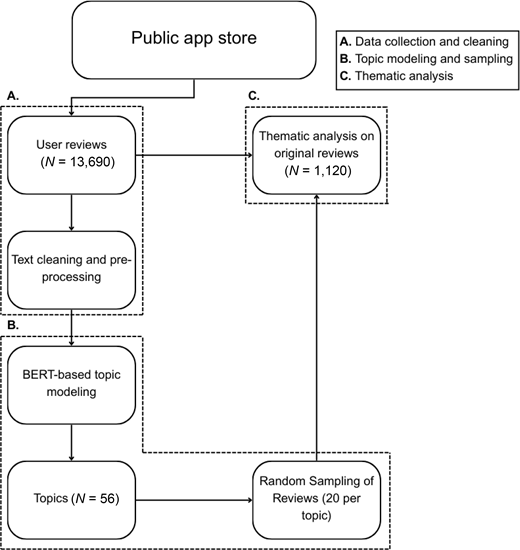
A hybrid qualitative approach analyzed 13,690 user reviews from Whatnot (2020–2025) via BERTopic modelling, generating 56 topics. Equal-allocation stratified sampling yielded 1,120 reviews for thematic analysis, combining inductive exploration of marketplace dynamics with deductive CTT-guided coding of antecedents and outcomes.
Five themes reveal trust operating as a dual-object phenomenon directed simultaneously at individual sellers and the platform as intermediary. Dual-role participation reshapes trust criteria; embedded capital and interactional immediacy extend CTT antecedents to synchronous exchange; and marketplace design simultaneously enables relational value and consumer harm through dark patterns, addiction discourse and gambling-like mechanics.
The findings of this study inform platform governance decisions, seller trust-building practice and regulatory frameworks addressing mystery-box mechanics and compulsive buying risk.
Explicit user reports of addiction, fear of missing out exploitation and gambling-like mechanics indicate live shopping platforms are sites of genuine consumer vulnerability demanding ethical platform design and policy intervention.
This study illustrates how BERTopic can support a principled qualitative sampling strategy and applies CTT to live-streaming commerce, proposing embedded capital and interactional immediacy as context-specific constructs. A tentative proposition is offered that commitment and trust may operate as performance-sensitive rather than purely enduring states in this setting, warranting longitudinal investigation.
1. Introduction
Live shopping represents a paradigm shift in digital commerce, integrating real-time entertainment with transactional functionality to create immersive retail environments (Gu et al., 2024). Unlike traditional e-commerce, where consumers interact with static product information, live shopping marketplaces enable synchronous interaction between sellers and buyers through live auctions, product demonstrations and real-time Q&A (Wongkitrungrueng and Assarut, 2020; Hou et al., 2024). This convergence of social engagement and commerce – often termed “shoppertainment” – has experienced explosive growth, with the global live-streaming commerce market projected to reach US$2.46tn by 2033 (Grand View Research, 2025). Platforms such as Whatnot, TikTok Shop and Amazon Live exemplify this transformation, leveraging live interaction to facilitate transactions, build consumer trust and cultivate platform loyalty (Wang et al., 2024; Cai et al., 2018; Na et al., 2025).
These environments offer a qualitatively distinct consumption experience. Increased interaction enhances perceptions of social presence, reduces informational asymmetry and strengthens purchase intentions (Li et al., 2024). Real-time streamer responsiveness – and, increasingly, AI-powered virtual influencers – creates immersive, emotionally resonant contexts in which shoppers experience both utilitarian and hedonic value (Xie and Desouza, 2025; Zhang et al., 2025). Yet these same dynamics may foster parasocial relationships, compulsive buying tendencies and fear of missing out (FOMO), suggesting that live shopping marketplaces host both relational value and consumer vulnerability (Hou et al., 2024; Beyens et al., 2016; Faber and O'Guinn, 1992).
In contrast to conventional online retail, where buyer–seller encounters are often episodic, live-streaming commerce foregrounds relationship processes long central to relationship marketing scholarship. Classic work conceptualizes buyer–seller relationships as multi-stage processes moving from awareness through commitment, emphasizing trust, cooperation and mutual adaptation (Dwyer et al., 1987). Foundational studies identify relational “connectors” – including information exchange, operational linkages, cooperation and relationship-specific adaptations – that differentiate relationship types and shape satisfaction outcomes (Cannon and Perreault, 1999). Meta-analytic evidence further confirms that trust and commitment function as central mediators of long-term relationship performance (Palmatier et al., 2006; Gummesson, 2017). By reshaping buyer–seller interaction dynamics, live shopping marketplaces have the potential to redefine relational exchange from discrete transactions to ongoing relational phases.
Despite rapid growth and increasing scholarly attention, significant gaps persist. Existing research has predominantly examined technological features affecting trust and user experience (Li et al., 2024; Zhang et al., 2025; Khamitov et al., 2024), streamer characteristics driving purchase intention (Hou et al., 2024) and platform affordances enabling engagement (Gu et al., 2024). These studies exhibit three interrelated limitations. First, they adopt fragmented theoretical lenses – ranging from stimulus–organism–response frameworks to uses and gratifications theory – that preclude holistic understanding of relational dynamics. Second, they rely heavily on experimental and survey-based methodologies that capture intended rather than lived behaviors, limiting ecological validity. Third, and most critically, they undertheorize the marketplace itself as an active agent in shaping buyer–seller relationships, treating platforms as neutral backdrops rather than as infrastructures that govern interactions, structure trust-building opportunities and mediate relational outcomes (Täuscher and Laudien, 2018; Constantinides et al., 2018). Crucially, research has focused on short-term outcomes in isolation – purchase intention, perceived enjoyment and individual streamer trust – while offering limited understanding of how marketplace design and governance configure commitment–trust antecedents and outcomes over time or how “dark-side” mechanisms jointly shape relationship quality, stability and risk in live shopping contexts.
To address these gaps, the present study investigates how live shopping marketplaces shape buyer–seller relationships through the lens of commitment–trust theory (CTT) (Morgan and Hunt, 1994). CTT posits that enduring relational exchange emerges when parties perceive high levels of trust and commitment, which reduce uncertainty, foster cooperation and enhance long-term outcomes. Its ten dimensions – five antecedents (relationship termination costs, relationship benefits, shared values, communication and opportunistic behavior) and five outcomes (acquiescence, propensity to leave, cooperation, functional conflict and uncertainty) – offer systematic coverage of relational mechanisms applicable across exchange contexts. CTT has been applied in online retailing (Mukherjee and Nath, 2007), mobile commerce (Cui et al., 2020), social media (Rashidi-Sabet and Bolton, 2024) and the metaverse (Saha and Jublee, 2025), yet its application to live-streaming commerce remains nascent, with existing studies typically addressing trust or commitment in isolation rather than examining their interplay within marketplace-governed relationships.
Drawing on user-generated reviews from a prominent live shopping platform, Whatnot, this study investigates how marketplace design, streamer behaviors and community dynamics configure CTT antecedents and outcomes in practice. Specifically, 13,690 app store reviews (2020–2025) are analyzed using bidirectional encoder representations from transformers (BERT)-based topic modelling to identify key experiential themes, followed by a hybrid thematic analysis combining inductive exploration of marketplace roles and community dynamics with deductive coding of CTT constructs (Fereday and Muir-Cochrane, 2006; Corbin and Strauss, 2015; Basu et al., 2025). This design capitalizes on the ecological validity of naturally occurring electronic word-of-mouth while preserving the depth and interpretive nuance characteristic of qualitative market research.
Two research questions guide the investigation:
What types of buyer–seller relationships are experienced by participants in live shopping marketplaces?
How do commitment–trust factors shape buyer–seller relationships within live shopping marketplaces?
This study makes three principal contributions. First, it applies and elaborates CTT in a live-streaming commerce context, illustrating how marketplace design and governance may condition commitment–trust mechanisms, responding to calls for more contextualized theory development in digital relationship marketing (Palmatier et al., 2006; Gummesson, 2017). Second, methodologically, this study demonstrates the use of topic modelling as a principled sampling aid: identified topics serve as sampling strata, with reviews allocated equally across topics to yield a topic-stratified qualitative sample that enhances coverage of experiential diversity, which is then subjected to thematic analysis. This integration of computational and interpretive methods aims to strengthen rigor in qualitative market research by combining the coverage of large-scale user-generated content with the depth of human analysis. Third, it develops a conceptual framework explicating how marketplace-level factors shape CTT antecedents and determine relational outcomes – surfacing both value-creating dynamics and problematic patterns such as compulsive buying and FOMO – thereby addressing the undertheorizing of marketplace effects in live-streaming commerce research.
This paper proceeds as follows. Section 2 critically reviews literature on live-streaming commerce and relationship marketing, positioning CTT within broader theoretical conversations. Section 3 outlines the hybrid research design. Sections 4 and 5 present the analysis and findings. Section 6 discusses theoretical and managerial implications, limitations and directions for future research. Section 7 concludes.
2. Literature review
2.1 Prior studies on live shopping
The burgeoning literature on live-streaming commerce has predominantly adopted variable-centered approaches, cataloguing engagement factors without adequately theorizing relational mechanisms. Early studies established the foundational appeal of live shopping – entertainment value (shoppertainment), real-time personalization through Q&A, uncertainty reduction and exclusive deals – as primary participation motivators (Wongkitrungrueng and Assarut, 2020; Gu et al., 2024). Consumers attend live streams to obtain product information, observe real-time demonstrations and engage in auction-based pricing, creating immersive experiences through social interaction (Hou et al., 2024; Pacheco et al., 2025; Shi et al., 2025).
Critical examination reveals significant internal tensions. Studies diverge on the relative importance of utilitarian versus hedonic motivations: while some foreground information-seeking and uncertainty reduction (Li et al., 2024; Na et al., 2025; Cai et al., 2018), others emphasize entertainment and parasocial interaction (Hou et al., 2024; Zhang et al., 2025). This inconsistency suggests motivational heterogeneity may be context-dependent, yet few studies have examined these moderating conditions systematically.
Socially, parasocial relationships between digital creators and followers influence purchase and word-of-mouth intentions (Hwang and Zhang, 2018), while community learning from peer cues shapes both cognitive and affective responses in social commerce contexts (Chen et al., 2017). Building on Hwang and Zhang (2018), recent studies (Hou et al., 2024; Xie and Desouza, 2025) demonstrate that live streaming intensifies parasocial bonds through real-time responsiveness and performative authenticity. The present study extends this work by examining how such bonds interact with CTT antecedents (shared values and communication) and outcomes (acquiescence and cooperation) within a marketplace-governed environment. These dynamics remain undertheorized for live streaming, where synchronous co-presence may intensify parasocial bonds beyond those documented in asynchronous contexts. Behavioral patterns including compulsive buying, FOMO and gambling-like bidding have similarly received insufficient grounding in established consumer behavior theory. Faber and O'Guinn’s (1992) diagnostic framework for compulsive buying and Beyens et al.'s (2016)FOMO research both identify mechanisms – scarcity cues, social pressure and anxiety-driven engagement – that live shopping’s real-time auction formats plausibly amplify among vulnerable consumers. The field has largely treated these as novel phenomena rather than as manifestations of well-established constructs, a gap with both theoretical and ethical consequences.
As summarized in Appendix 2, prior live shopping studies reveal that only a handful have tangentially examined buyer–seller relationships, and fewer still have used qualitative or review-based approaches (Pei et al., 2025; Ji et al., 2023; Ma et al., 2025). Without understanding relational substrates, platforms cannot design governance mechanisms that foster sustainable relationships while mitigating harmful consumption patterns. The present study addresses this gap through commitment–trust factors, using text mining and thematic analysis of user reviews to access authentic experiential accounts absent from experimental designs.
2.2 Theoretical background on live shopping
2.2.1 Relationship marketing foundations.
Relationship marketing scholarship provides canonical insights into how buyer–seller ties form and mature. Dwyer et al. (1987) established that relationships evolve through distinct phases – awareness, exploration, expansion, commitment and dissolution – characterized by shifting communication patterns, power dynamics and bonding mechanisms. This developmental perspective is directly relevant to live shopping, where relationships may form rapidly through intense parasocial interaction yet remain fragile because of platform-mediated discontinuities. Cannon and Perreault (1999) further specified relational connectors – information exchange, operational linkages, cooperation and relationship-specific adaptations – demonstrating that relationships cluster into qualitatively distinct types, which is especially pertinent to live shopping where configurations vary substantially across seller types and platform architectures.
Meta-analytic evidence supports the centrality of relational investment while revealing important contingencies (Palmatier et al., 2006). Critically for the present context, relationship marketing effectiveness is greater when relationships are built with identifiable individuals rather than firms – a finding directly germane to live shopping, where ties typically form with individual streamers, potentially amplifying relational effects.
2.2.2 Commitment–trust theory.
CTT, articulated by Morgan and Hunt (1994), posits that relationship commitment and trust are key mediating variables between five antecedent precursors – relationship termination costs, relationship benefits, shared values, communication and opportunistic behavior – and five outcomes: acquiescence, propensity to leave, cooperation, functional conflict and uncertainty. Trust is defined as confidence in an exchange partner’s reliability and integrity; commitment as an enduring desire to maintain a valued relationship. The theory’s parsimony lies in identifying these two constructs as central mechanisms through which diverse antecedents exert their effects, rather than enumerating numerous direct pathways.
CTT was selected because it captures a holistic, multi-dimensional view of buyer–seller relationships with demonstrated applicability across digital exchange contexts, including online retailing (Mukherjee and Nath, 2007; Elbeltagi and Agag, 2016), mobile commerce (Cui et al., 2020), social media brand communities (Rashidi-Sabet and Bolton, 2024) and metaverse environments (Saha and Jublee, 2025). Live-streaming commerce, however, presents distinctive features – synchronous interaction, performative demonstrations, auction-based pricing and community co-presence – that constitute a substantially different relational environment. While some studies have addressed trust-related contexts or commitment in isolation within live streaming (Lai et al., 2025; Guo et al., 2021), none have examined the full set of CTT precursors and outcomes or their combinatorial configurations, within a live shopping marketplace.
2.2.3 Trust typologies and their implications for live shopping.
To operationalize CTT rigorously, this study integrates complementary trust conceptualizations from adjacent literatures. Mayer et al. (1995) distinguish trust from its antecedents – the trustee’s perceived ability, benevolence and integrity – enabling differentiation of, for instance, a streamer trusted for product knowledge (ability) but not for genuine concern for viewers’ interests (benevolence). McKnight et al. (2002) extend trust to e-commerce through a multidimensional model distinguishing institution-based trust – rooted in structural assurances – from interpersonal trusting beliefs, a distinction especially relevant where trust in the platform and trust in individual streamers may interact in complex ways. Gefen et al. (2003) further show that trust operates alongside perceptions of usefulness and ease of use, with interface features and perceived integrity jointly shaping behavioral intentions. Collectively, these frameworks establish that trust in live shopping is not a unitary construct directed at a single target but a multi-layered phenomenon simultaneously directed at individual streamers and at platform governance structures – a distinction with direct implications for how CTT dimensions manifest in this context.
2.2.4 Platform governance as a structural moderator.
Live shopping marketplaces are active architectural agents whose governance choices shape incentive structures, interaction possibilities and trust signals available to all participants. Scholarship on digital platforms emphasizes how multi-sided market structures, governance regimes and architectural choices enable and constrain participation and shape value creation (Constantinides et al., 2018), while empirical taxonomies reveal substantial heterogeneity in how marketplaces create and capture value – heterogeneity that plausibly alters relational dynamics among participants (Täuscher and Laudien, 2018).
Platform governance mechanisms map directly onto CTT constructs, reputational systems and seller verification strengthen institution-based trust and raise relationship termination costs; monetization mechanics – commissions, tipping and pay-per-promotion features – alter seller incentives in ways that may increase opportunistic behavior; community affordances such as persistent chat and loyalty badges can foster shared values while simultaneously amplifying FOMO-driven acquiescence. The present study treats marketplace governance as a contextual moderator rather than a neutral backdrop – a perspective conspicuously absent from existing live-streaming commerce research.
2.2.5 Consumer vulnerability, dark patterns and the double-edged nature of live shopping.
The theoretical framework must also engage with live shopping’s darker relational dimensions. Parasocial attachments and community belonging simultaneously enable relational depth and create pathways for consumer harm. Platform-engineered scarcity signals and real-time countdowns may exploit consumers’ needs to belong (Beyens et al., 2016), producing coerced acquiescence – compliance driven by design nudges and social pressure rather than genuine trust or commitment. Live shopping’s auction-like mechanics may similarly amplify the emotion-regulatory consumption patterns identified by Faber and O'Guinn (1992), particularly among psychologically vulnerable participants. These dynamics suggest that CTT’s relational benefits may be systematically entangled with consumption risks that current frameworks do not adequately theorize. Dark patterns scholarship provides relevant grounding: manipulative interface designs – artificial scarcity countdowns, friction-free one-click purchasing and social proof nudges – are engineered to exploit cognitive biases and override deliberate choice (Gray et al., 2018; Mathur et al., 2019), and Witte et al. (2025) demonstrate that such patterns systematically erode consumer autonomy and trust in online retailing. Live shopping platforms, where these design features co-exist with genuine community and relational value, are a particularly consequential site for examining how dark patterns interact with – and potentially corrupt – the relational mechanisms CTT theorizes, motivating the present study’s ethically grounded approach.
2.2.6 Synthesis and positioning of the present study.
Prior live-shopping research has produced valuable descriptive accounts but remains limited in three consequential respects: trust is treated as a single-construct variable rather than a multi-sourced, multi-dimensional phenomenon; platform governance is rarely treated as a formal moderator of relational processes; and studies seldom juxtapose relational benefits with consumer-harm pathways within a unified account. The present research positions live shopping marketplaces as socio-technical systems in which marketplace design, governance structures, streamer behavior and community dynamics co-produce buyer–seller relationships – fostering beneficial relational outcomes and problematic consumption dynamics that prior scholarship has examined only in isolation. Table 1 presents the ten CTT dimensions with operational definitions adapted for live shopping contexts.
3. Research design
This study investigates the commitment-trust factors underpinning buyer–seller relationships in live shopping marketplaces. Given the nascent and digitally mediated nature of this context, an inductive, computationally intensive theory-building approach was adopted (Berente et al., 2019; Basu et al., 2025; Abbasi et al., 2019). The design proceeds in three integrated phases: data collection and cleaning; topic modeling and sampling; and thematic analysis. The overall research sequence is illustrated in Figure 1.
3.1 Platform selection
Whatnot was selected as the research context based on three criteria: market significance, relational distinctiveness and theoretical suitability. With projected gross merchandise volume exceeding $6bn (Del Rey, 2025), Whatnot represents a substantively important live shopping context. Critically, its community-based architecture – centering direct buyer–seller interaction through live video, chat functionality and immediate purchasing capabilities (e.g. auctions and “buy now” during streams) across collectibles, fashion and trading cards – distinguishes it from influencer-driven platforms (TikTok Shop) and live-streaming extensions of traditional retail (Amazon Live) (Wang et al., 2024; Gu et al., 2024). These design features create conditions in which trust and commitment are especially salient, making Whatnot a theoretically appropriate site for examining CTT mechanisms. Where platform-specific features may bound the generalizability of findings, this is acknowledged explicitly in Section 6.4.
3.2 Data collection and preprocessing
User-generated reviews were selected as the data source because they provide naturalistic, unobtrusive access to buyers’ expressed experiences of marketplace relationships (Basu et al., 2025). Unlike interviews or surveys, which are mediated by researcher questioning and may elicit socially desirable responses, reviews represent spontaneous articulations of user experiences framed by users themselves (Tirunillai and Tellis, 2014). This is particularly appropriate for examining buyer–seller relationships, as reviews often narrate specific interaction episodes, evaluations of seller behavior and expressions of trust or distrust (Villarroel Ordenes et al., 2019). Reviews, thus, offer direct insight into how buyers perceive and evaluate the relational dimensions of marketplace exchanges, aligning with CTT’s focus on subjective assessments of relationship quality.
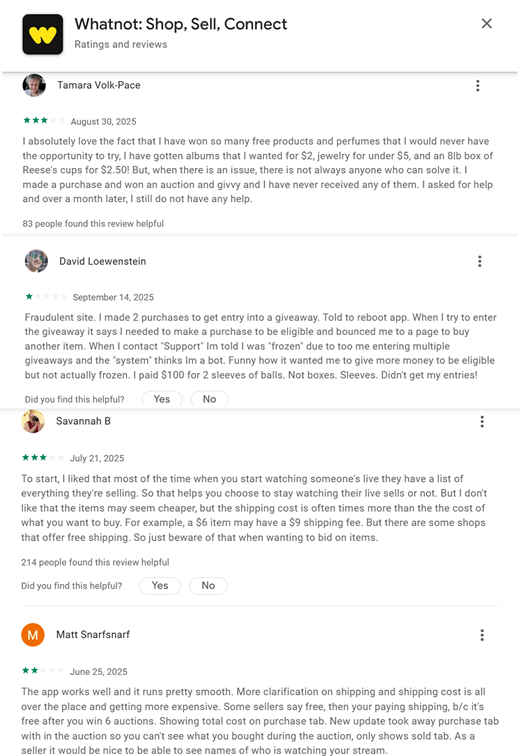
Data was collected from the Google Play Store using the Python package google_play_scraper. All English-language reviews posted between January 2020 and September 10, 2025 were retrieved, yielding an initial corpus of 13,690 reviews. The 2020–2025 timeframe encompasses both pandemic-era online shopping (2020–2021) and the post-pandemic normalization period (2022–2025). Appendix 1 presents sample reviews.
Preprocessing followed established protocols for textual data analysis (Berger et al., 2019). Using Python: duplicate and empty reviews were removed; text was tokenized; special characters and excessive whitespace were eliminated; parts-of-speech filtering with spaCy was applied to retain nouns, verbs and adjectives (the key meaning-carrying elements); and stop words were removed while retaining contextually significant terms (e.g. “not” was preserved to maintain negation). The cleaned data set comprised 10,159 reviews.
3.3 Topic modeling
In the second phase of the research (Figure 1), an unsupervised Natural Language Processing approach (topic modeling) was used to summarize the textual corpus and extract latent themes from online reviews, which were then mapped to the relevant factors proposed by CTT. The BERT topic model was used because it captures context more effectively than bag-of-words models such as Latent Dirichlet Allocation (Oh et al., 2023). BERTopic is built on BERT embeddings and leverages transformers and attention-based mechanisms. It uses a zero-shot topic-modelling approach using the “facebook/bart-large-mnli” method, a HuggingFace transformer model. In this study, the “paraphrase-all-MiniLM-L6-v2” sentence transformer model produced 56 topics.
To ensure that only sufficiently large and stable topics were retained, the minimum topic size was set to 30 documents – that is, at least 30 individual user reviews per topic. This threshold prevents spurious or idiosyncratic topics and enhances the reliability of subsequent thematic analysis. For interpretability, the ten most representative words for each topic were also extracted and are reported in Appendix 4.
3.4 Sampling strategy
From each of the 56 identified topics, 20 reviews were randomly selected for qualitative analysis, yielding a final sample of 1,120 reviews ( Appendix 5). Selection used stratified random sampling using topic_prob in Python – the posterior probability that a given document belongs to its assigned topic cluster.
The decision to sample 20 reviews per topic equally, rather than proportionally to topic size, reflects a deliberate methodological choice aligned with the study’s analytic aims. Proportional sampling would over-represent large, potentially generic topics (e.g. general platform satisfaction) while under-representing smaller, substantively distinctive topics that may reveal novel or niche phenomena (e.g. specific trust violations and unique community practices). Equal allocation ensures that the analytic sample captures the full thematic diversity of user experiences, including minority perspectives that might otherwise be obscured (Sandelowski, 1995). This approach prioritizes theoretical coverage over statistical representation, consistent with qualitative research objectives of capturing phenomenon complexity rather than estimating population parameters (Patton, 2015).
4. Data analysis
This study applies thematic analysis to systematically identify patterns within the 1,120 sampled Whatnot reviews (Braun and Clarke, 2006), selected for its flexibility in capturing both emergent patterns and theory-informed constructs in qualitative data (Braun et al., 2016). The analysis combines inductive and deductive procedures following a hybrid approach (Fereday and Muir-Cochrane, 2006). Inductive analysis explored themes emerging directly from the data without reference to a theoretical framework, capturing experiences, community dynamics and dual-role behaviors in live shopping marketplaces. Deductive analysis was guided by CTT, focusing on the antecedents and outcomes of buyer–seller relationship commitment and trust – an approach aligned with contemporary qualitative marketing research practice when analyzing large-scale user-generated data (Venkatesh et al., 2013; Miles et al., 2019).
The two analytical phases served distinct functions. Inductive coding surfaced what users experienced – trust, community belonging and role fluidity – without theoretical imposition. The deductive CTT phase provided the antecedent-outcome architecture needed to explain why those patterns occurred and how marketplace factors moderated their relational consequences. For instance, community policing of seller conduct emerged inductively as a recurring pattern; the CTT lens revealed it as a mechanism through which opportunistic behavior (Theme 4) was collectively suppressed, strengthening cooperation and reducing uncertainty (Theme 5) – a relational pathway that description alone could not account for. The hybrid design thus moves from experiential pattern identification toward relational mechanism explanation.
Analysis proceeded in three stages with the support of NVIVO 14 software. First, repeated reading of each review supported immersion in the data, followed by open coding to identify initial concepts and categories through constant comparison to refine category boundaries and ensure conceptual coherence (Corbin and Strauss, 2015). Second, codes were organized into a codebook ( Appendix 3) from which themes were derived through two complementary processes: Themes 1–3 emerged inductively, capturing patterns in buyer–seller interactions, marketplace experience and community dynamics; Themes 4–5 were developed deductively, guided by CTT’s antecedents and outcomes framework (Aronson, 1995; Braun and Clarke, 2006, 2019). Third, theorizing was conducted by interpreting and integrating both theme sets: inductively derived themes surfaced emergent marketplace dynamics independent of CTT, while deductively derived themes mapped these dynamics onto commitment–trust mechanisms. Multiple coding iterations ensured interpretive consistency, culminating in the conceptual framework linking marketplace dynamics with CTT antecedents and outcomes (Corbin and Strauss, 2015). The 56 BERTopic topics were consolidated into the five final themes through iterative coding; a topic-to-theme mapping with representative examples is provided in Appendix 6.
Rigor follows Patton’s (1990) criteria of internal homogeneity and external heterogeneity: codes were assessed for coherence within each theme and for clear distinctions between themes, with sufficient evidence supporting each theme to accurately reflect the underlying data.
4.1 Reflexivity statement
This study was conducted by a marketing scholar with prior experience researching digital platforms, but no personal experience participating in Whatnot marketplace. This observer positioning may orient the analysis toward structural and institutional dynamics over granular consumer practices – a boundary condition acknowledged throughout interpretation. The author holds no affiliation with Whatnot or commercial interests in the live shopping industry. Reflexive analytic memos were maintained throughout to document and revisit assumptions concerning trust, opportunism and consumer vulnerability, enabling critical examination of how researcher positionality might shape interpretation of contested phenomena such as addiction discourse and gambling-like mechanics and ensuring that interpretations remained grounded in the data. To mitigate single-coder bias, peer debriefing was conducted by an independent qualitative researcher. This researcher reviewed the codebook and a random 20% sample of coded reviews (224 reviews). The debriefing led to refinement of one sub-code under Theme 4 (opportunistic behavior), with no major theme changes required.
5. Findings
The findings are organized around five themes:
dual roles of participants;
marketplace experience and community;
trust in live shopping marketplaces;
antecedents of relationship commitment–trust; and
outcomes of relationship commitment–trust.
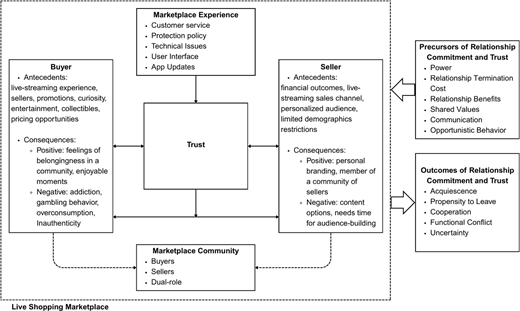
This thematic structure reflects the study’s hybrid inductive–deductive approach. The equal-allocation sampling design – 20 reviews per topic across 56 topics – prioritizes thematic coverage and theoretical saturation over prevalence estimation (Patton, 2015), meaning theme frequency should be interpreted indicatively rather than representatively. Theme 2 (marketplace experience and community) was the most pervasive, appearing across reviews linked to more than 30 topics; Themes 1 and 4 each characterized roughly one-quarter of the sample. Figure 2 presents the conceptual framework linking these themes.
5.1 Dual-role in live shopping marketplace
A central pattern across the data was role fluidity: reviewers described themselves as buyers, sellers, or both (dual-role), with some explicitly narrating a transition “from buyer to seller” over time. Dual-role participation was especially visible in collectibles and niche hobby markets; in more utilitarian categories, participation skewed toward pure buyers. This configuration shaped users’ awareness of both the opportunities and vulnerabilities of the live shopping environment, positioning them as particularly reflexive commentators on marketplace dynamics.
5.1.1 Divergent entry pathways: Platform affordances and motivational asymmetry.
Buyers’ entry motivations clustered around experiential consumption – the live-streaming format itself serving as the primary attractor rather than specific product needs:
if you’re looking for fun and to buy what your look for this is the app (R8).
Another buyer framed live auctions as a format innovation that re-enchanted routine purchasing:
I love the live bids I think its a refreshing take on shopping (R24).
Sellers, by contrast, articulated instrumental motivations centered on market access and the format’s capacity to circumvent traditional retail barriers through real-time product demonstration. This instrumental orientation was most pronounced in high-authenticity categories (collectibles and luxury goods), where live interaction reduces the information asymmetry that typically disadvantages online sellers. In low-involvement categories, motivational statements were more symmetrical, with both parties emphasizing transactional efficiency.
5.1.2 The community-commerce reinforcement loop.
The positive consequences of participation reveal a reinforcement loop in which social integration drives continued engagement, which in turn deepens social ties. When users describe the platform as “greatest community I’ve ever been a part of” (R378), they articulate how persistent chat functionality and recurrent seller streams cultivate parasocial interaction that evolves into perceived genuine relationships. Notably, buyers and sellers experience community differently: buyers describe affective belonging, while sellers frame community instrumentally – as a mechanism for customer retention “Great way to build a loyal community!” (R376). Dual-role users’ language vividly featured reciprocity terms (e.g. “give and take” and “support each other”) – a pattern observed consistently in reviews from Topics 4 and 12, where role-hybridity reviewers explicitly linked buying and selling experiences.
5.1.3 The dark side of engagement: Platform-enabled harms.
A particularly striking negative pattern is the explicit framing of engagement in addiction discourse, concentrated among mobile app users who also mentioned evening streaming:
Be Careful! It’s Addictive!♥ (R101).
One reviewer elaborated:
Very fun, but very shady. This site feeds off FOMO to make money and anyone not treading carefully can end up spending too much money. There are also a lot of “mystery box” streams that are very blatantly just unregulated gambling. Not a good look at all for a site that isn’t strictly 18+ (R876).
These streams gamify purchasing through randomized outcomes, representing an extreme manifestation of design-amplified vulnerability. Users mentioning mystery boxes tended to express financial regret (see R876 and parallel reviews in Topic 50), indicating a qualitatively distinct risk profile from those discussing standard auctions. For sellers, negative consequences took a different form: “Awesome to buy on but very hard to sell on as a new seller.” (R257). Analysis of seller reviews by tenure suggests that, in this data set, visibility algorithms and reputation systems contribute to winner-take-most dynamics that concentrate engagement among early entrants, creating structural disadvantages for new entrants.
5.1.4 Dual-role participation and trust dynamics.
Role experience shapes trust formation in theoretically significant ways. Dual-role users’ trust assessments emphasized systemic platform factors – dispute resolution, enforcement and governance – over individual seller characteristics, because experience as a seller makes visible the platform-level constraints within which any seller operates. This creates a nested trust structure, in which trust in a given seller is partially mediated by assessment of the platform’s capacity to constrain opportunistic behavior – a relational architecture invisible to single-role users.
5.2 Marketplace experience and community
5.2.1 Infrastructure as relationship mediator.
The marketplace emerges not as a neutral backdrop but as an active relational infrastructure whose features, policies and technical performance enable or constrain buyer–seller relationships. The intensity of language in negative reviews is particularly revealing:
[…]CUSTOMER SERVICE IS THE WORST. I WAS SHIPPED THE COMPLETE WRONG SHOES AND THEY REFUSE TO REFUND. THEY ALSO DON’T REFUND DAMAGED ITEMS. BEWARE, THEY WILL STEAL YOUR MONEY AGAINST THEIR RETURN POLICY. (R126).
The use of “steal” and “BEWARE” transforms a service complaint into a warning about platform trustworthiness, signaling that users perceive the platform as a fiduciary actor responsible for transactional integrity. Device-specific variation reinforced this dynamic: users reporting technical issues tended to be mobile app users (evident in reviews from Topics 14, 22 and 32), with synchronization failures the most frequently cited frustration:
Buggy. After the last update the timer does not synch properly on any auction, making it impossible to bid. It is perpetually about 2 seconds behind. Please fix this asap (R206).
This matters relationally because mobile users experiencing technical failures during live auctions often described reluctance to return to that seller, even when sellers bore no responsibility. This spillover attribution effect – platform failures partially attributed to sellers by association – demonstrates that relational assessments of human partners are shaped by non-human infrastructure performance.
5.2.2 Community as relational container and informal governance.
Community functions as more than rhetorical flourish – it operates as a relational container shaping interaction norms and expectations:
Amazing app. Friendly, fun community of seller’s, shoppers and knowledgeable people who are willing and to help. It is like one big party!! (R1086).
A great community of buyers and sellers! (R1093).
The party metaphor is analytically noteworthy: it implies informality, mutual enjoyment and suspended status hierarchies – contrasting sharply with conventional e-commerce discourse of “transactions.” This suggests that live shopping platforms cultivate festival-related commerce: exchange embedded in celebratory sociality. Community discourse varied systematically by category: collectibles communities emphasized shared expertise and mutual authentication (serving risk-reduction functions), while fashion communities emphasized affiliation and emotional support (serving belonging functions).
Beyond affective function, community also operated as an informal governance mechanism. In high-involvement categories, norms around authenticity and grading were actively policed by participants, who warned each other about problematic sellers and amplified trustworthy reputations. Users who explicitly referenced community belonging (Themes 2.2 and 2.3; e.g. “great community” and “one big party,” Topics 18 and 54) consistently described constructive conflict resolution and continued engagement (deductively coded, Theme 5.4.1) – a co-occurrence evident in reviews including R1086 and R1091, indicating relational stickiness that transcends individual transactions. These community dynamics are not independent of CTT antecedents: the same infrastructure that produces belonging and informal governance simultaneously reshapes termination costs, amplifies relationship benefits and moderates opportunistic behavior, linking marketplace experience directly to the antecedent conditions examined in Section 5.4.
5.3 The role of trust in live shopping marketplaces
Trust emerged at two distinct but interconnected levels: trust in the marketplace as intermediary and trust in individual buyer–seller relationships. Platform-level trust frequently operated as a prerequisite for dyadic trust, yet the two could diverge – users sometimes trusted specific sellers while remaining skeptical of the platform and vice versa. This dual-object trust structure extends CTT’s dyadic focus to account for the platform as a third relational actor.
5.3.1 Platform trust: The invisible hand or the invisible fist?
Users actively monitored platform governance as a trust indicator, holding platforms vicariously responsible for seller misconduct:
They do not check their sellers. I was burned by one. The seller locked me out and did not refund my order. I do not recommend this app. (R123).
Beware the customer service for this app is very poor. They do not hold sellers accountable and won’t give refunds even if seller never shipped the item. This has happened to me several times where I have not received my orders and Whatnot will not refund me. Don’t use this app (R137).
Where refunds were denied or delayed, users inferred that the platform tolerated opportunism, prompting exits or warnings to others. Conversely, swift and fair adjudication produced what users described as the platform “having your back,” strengthening perceived trustworthiness even when individual transactions failed. Reviews expressed satisfaction with platform dispute resolution. These users tended to be longer-tenured reviewers who referenced multiple prior resolutions – suggesting that platform trust is experience-calibrated: users who witness consistent intervention develop resilient trust that survives occasional failures.
5.3.2 Seller trust: The live advantage.
At the dyadic level, trust was grounded in observable seller behavior during streams, prior transaction histories and community reputational signals. One review illustrates three trust-enhancing mechanisms distinctive to live formats:
best comic friend ever met and looks to be binding! most honest seller on WhatNot and his store is all for his family. just got 3 shirts from him. meant to have him sign them but I gotta wear them! his offers and “runs” are outta this human world. packing? a crow bar couldn’t break the seal! LOL. give him a visit on WhatNot. (R621).
This quote reveals: performed authenticity – real-time stream conduct interpreted as evidence of character; transparency enactment – live product inspection reducing information asymmetry beyond what static images permit; and narrative embedding – personal stories creating biographical coherence that invites trust through perceived shared humanity. A portfolio approach to trust emerged among experienced users:
grade A + service. every time I haven’t gotten a product that I purchased 100% of the money was refunded. I trust Whatnot completely. you just need to weed through the streamers to find one right and good for you. (R862).
Here, platform- and seller-level trust are jointly managed – experienced users differentiate between the two, maintaining each through separate assessment processes. A small number of reviewers trusted specific sellers despite skepticism toward the platform, indicating that strong dyadic trust can partially offset weak marketplace trust – but only up to a point. These trust levels are inputs, not endpoints: high trust produced acquiescence and cooperation (Sections 5.5.1 and 5.5.3); eroded trust triggered propensity to leave and heightened uncertainty (Sections 5.5.2 and 5.5.5); and the dual-object trust structure shaped whether functional conflict reinforced or fractured commitment (Section 5.5.4). The configuration of platform- and seller-level trust, thus, determines which CTT outcomes a relationship moves toward, as the conceptual framework (Figure 2) makes explicit
5.4 Precursors of relationship commitment and trust in live shopping marketplaces
CTT’s five antecedents – relationship termination costs, relationship benefits, shared values, communication and opportunistic behavior – are clearly recognizable in the data yet reshaped by live-streaming affordances and platform governance. Social and emotional elements of termination cost, and the public visibility of opportunistic behavior, are particularly salient.
5.4.1 Relationship termination cost.
Switching barriers in live shopping extend beyond sunk costs to encompass embedded capital – relational assets that cannot be transferred to alternative platforms. The declaration “I love this app, since I have found this app I haven’t shopped anywhere else” R493, when read alongside collectibles reviewers who described completing multiple collections, reflects not mere habit but active platform capture. Inductive coding placed this statement within the community-commerce reinforcement loop (Theme 1.4), where exclusive-use language repeatedly co-occurred with references to completed collections and non-transferable community ties.
Whatnot is Awesome and whatnot! I have completed quite a few collections and met a ton of really cool people and sellers on here! Such a cool app. (R274).
Termination cost, thus, incorporates loss of community status (recognition in chat), access to trusted curation and the integrity of physical collections. This variation was evident when cross-referencing Theme 4.1 codes with category-specific topics: in collectibles (Topics 3, 13 and 41) termination was framed through collection integrity (R274); in social/hobby categories it centered on community status loss (R378). The intertwining of economic and socio-emotional stakes helps explain why some buyers tolerate repeated negative experiences before exiting.
5.4.2 Relationship benefits: The reciprocity spiral.
Relationship benefits extend beyond transactional advantages to include interactional capital: benefits derived from ongoing interaction that cannot be formalized:
been great and made lots great friends on here and get deals (R223).
Participating in live auctions and bidding in real time is genuinely engaging; enhancing the shopping experience is always a worthwhile pursuit. (R34).
Buyers consistently framed preferential treatment as earned through loyalty rather than randomly distributed – a crucial distinction from algorithmic personalization in conventional e-commerce, where benefits appear system-generated rather than relationally negotiated. Reciprocity was reinforced by regular buyers who received better deals, early access or personalized shout-outs, making the relationship feel mutually beneficial and strengthening commitment accordingly. Users mentioning relationship benefits prominently referenced mobile use, consistent with the portability enabling frequent micro-interactions (Topics 0 and 11).
5.4.3 Shared values: Value performance as trust signal.
In live shopping, shared values are not merely asserted but also behaviorally performed through live interaction – creating observable evidence of alignment that static profiles cannot replicate:
always a good time on the Beastsquad site. good music, lots of interaction, and great cards and variety. quick delivery, great grading of the slabs. (R63).
A place to get great items. They take care of custmers and have pride in their work. Quality people in my eyes (R497).
Buyers actively sought value congruence, using grading transparency, chat moderation conduct and charitable initiatives as value alignment cues. Perceived alignment reduced risk and increased repeat engagement. Reviews described value claims that proved false, with users expressing heightened betrayal precisely because initial alignment had elevated expectations – suggesting that value-based trust violations may be more difficult to repair than competence-based ones.
5.4.4 Communication: The live difference.
Real-time, two-way communication during live streams constitutes interactional immediacy – the perception of unmediated seller access that generates relational closeness rapidly:
I love watching the auctions and choppin it up with fellow Funko Pop Finatics. Still has some kinks to work out but overall pretty solid. (R390).
get place to buy and watch streams. make friends and chat. (R674).
The colloquial “choppin it up” signals that chat interaction serves relationship maintenance as much as information exchange. Conversely, delayed or dismissive responses were treated as warning signals – buyers explicitly avoided “rude sellers” who failed to answer questions. The richness of synchronous video and chat provides substantially more interactional data for trust judgments than static e-commerce, magnifying communication quality’s role as a commitment precursor. Critically, communication failures in live contexts carry particular weight precisely because the immediacy of the format generates relational closeness so rapidly.
5.4.5 Opportunistic behavior: Collective detection in transparent environments.
Opportunistic behavior – non-disclosure of defects, misleading descriptions and repeated quality problems – appeared across a non-trivial subset of reviews and severely eroded trust:
Some of the vendors don’t disclose everything on the products sold. (R945).
The app is riddled with scammers, and the company who owns the app has repeatedly ruled in favor of keeping proven scammers. Avoid at all costs. (R316).
Had to stop buying from Whatnot. More times than not the pops are damaged and you can’t tell until you receive them or the plastic that’s holds them on the inside is ripped and damaged and not disclosed by sellers. Some good trustworthy sellers also. (R843).
Despite live streaming’s transparency features, the marketplace remains vulnerable to seller misconduct. A key interpretive finding is the collective detection mechanism: users share information about problematic sellers, creating informal reputational systems that supplement formal governance. Equally, the live format enables real-time accountability: sellers who publicly acknowledged mistakes during streams and offered visible remedies could partially restore trust. This public, performative management of opportunism suggests that live shopping can simultaneously exacerbate and mitigate misconduct, depending on how sellers and the platform respond in view of the community.
5.5 Outcomes of relationship commitment and trust
The five CTT outcomes – acquiescence, propensity to leave, cooperation, functional conflict and uncertainty – are consistently evident in the data, with live streaming and community dynamics rendering them visible, sometimes performative, rather than privately calibrated.
5.5.1 Acquiescence.
Strong trust and commitment produced high willingness to accept seller guidance – agreeing to alternative products, following release advice, purchasing curated bundles:
Absolutely amazing app, and my favorite seller Head_over_deals has the best created merchandise on the planet. (R243).
Acquiescence was framed as voluntary and relationally grounded – buyers emphasized that trusted sellers “have my back,” interpreting recommendations as interest-aligned. In expertise-intensive categories (comics and collectibles), acquiescence manifested as explicit expert deference; in categories with objective quality standards, it took the form of habitual purchasing. In the live setting, acquiescence is publicly visible to co-present viewers, reinforcing seller reputation and encouraging similar behavior from others – amplifying the commercial impact of trust beyond the individual dyad.
5.5.2 Propensity to leave: Fragility and threshold effects.
Trust erosion manifested in both gradual disengagement and dramatic exit performances:
Asked for refund whatnot has never stepped up and the seller @kkcardvault has no communication skills so I will not be using this app moving forward (R135).
At first it was great, but after someone starts hacking your account more than once, I had to delete the app. (R427).
Compounded failures – platform inaction plus seller inadequacy – were particularly potent triggers, illustrating that exit decisions frequently involve dual-level failures. In the live context, exit is sometimes enacted publicly (announcing unfollows in chat), with reputational spillovers beyond the immediate dyad. Reviews described leaving then returning, citing the community and improved conditions as motivations – suggesting that exit is often temporary and conditional rather than permanent, with users maintaining partial commitment that enables re-entry when circumstances improve.
5.5.3 Cooperation: Peer production of relational value.
Cooperation extended beyond seller–buyer dyads to encompass peer-to-peer assistance functioning as community-level relationship maintenance:
Whatnot is a nice selling community. people are helpful also if there are problems. Whatnot will help. Their response time is awesome. I like it there. (R1091).
Amazing app. Friendly, fun community of seller’s, shoppers and knowledgeable people who are willing and to help. It is like one big party!! (R1086).
In committed streams, regulars acted as informal co-hosts – greeting newcomers, advising on bidding etiquette and defusing tensions. Cooperation mentions frequently involved mobile users, consistent with the hypothesis that constant chat availability facilitates helping behaviors. Such cooperative practices strengthen relational bonds not only between buyers and sellers but also among buyers themselves, reinforcing commitment to specific communities and, by extension, to the platform.
5.5.4 Functional conflict: Transparent resolution as commitment reinforcement.
Conflict was pervasive, but its consequences varied with the underlying trust and commitment level. Committed relationships absorbed conflict when resolution was perceived as fair:
amazing app. but why are the sellers allow to block a buyer when we give honest comments. I bought a speaker from a seller and a piece of it broke so I gave him a 3 star but got blocked[…]. I’ve bought multiple things from this seller over times. Sellers should not allow to ban people that give honest opinions. (R1048).
I’m addicted. Also as a warning you gotta watch prices because i have found a few of those sellers being rude about their products when asked questions about the products. a note to the sellers you say bid responsibly and repect bids but dont respect your customers. I wont buy from rude sellers and I warn my fam and friends. Thankfully whatnot does work with you if something is wrong. (R1043).
The second review is analytically revealing: the buyer continues platform use while selectively avoiding problematic sellers and warning others – illustrating functional conflict that reshapes relationship portfolios rather than prompting total exit. Reviews describing constructively resolved conflicts shared a common structure: problem identification, public negotiation and visible remedy. This transparent resolution pattern transforms conflict from relationship threat to relationship evidence – users who witness fair resolution may increase commitment through observed fairness. Notably, the seller behavior of blocking buyers who leave critical feedback generated pronounced resentment, undermining the very trust the live format is designed to cultivate.
5.5.5 Uncertainty reduction: Trust as cognitive ease.
Trust functioned as an uncertainty-reducing mechanism particularly consequential in live shopping, where purchases are made rapidly and with limited post-purchase recourse. Buyers who trusted both platform and sellers described confidence during bidding and willingness to purchase at higher values:
I pretty much buy everything I need here. Such a great community of people and I’m able to afford great products without leaving my home. Chats are fun and you really get to review your item before bidding on it. I’m addicted!❤ (R1100).
Concrete, observable signals “Freaky Fast Shipping and Extremely Professional. Highly Recommend” (R176) served as decision heuristics, enabling transactional confidence without repeated due diligence. Where such signals were absent or contradictory, buyers hedged (limiting purchases to one-off trials, placing smaller bids) or exited. Uncertainty reduction, thus, enabled risk-taking in the form of higher and more frequent bids, while heightened uncertainty suppressed engagement – a pattern consistent with CTT’s theorization of uncertainty as a negative outcome of low trust, here observed as a dynamic that responds directly to the visible performance cues distinctive to live commerce.
6. Discussion
6.1 Theoretical contributions
This study advances three main contributions, with a fourth offered as a tentative proposition, positioning CTT in ways that speak to the distinctive features of live shopping marketplaces. First, the findings suggest that trust operates as a dual-object phenomenon in this live shopping context. Users simultaneously assess the trustworthiness of individual sellers and the platform itself as an intermediary, with each assessment dynamically influencing the other. This extends CTT beyond its original dyadic focus by demonstrating that in multi-sided digital markets, platform-level trust – rooted in credibility, protection policies and community safeguards – functions as both a precursor to and moderator of interpersonal trust. While prior live shopping research has examined streamer characteristics, parasocial interaction and shoppertainment (Gu et al., 2024; Zhang et al., 2025; Chen et al., 2025), the interplay between platform governance and dyadic commitment–trust dynamics has remained largely undertheorized. This finding advances relationship marketing theory by positioning the marketplace as a critical relational agent rather than a neutral transaction conduit, resonating with McKnight et al.'s (2002) distinction between institution-based trust and interpersonal trusting beliefs while extending it to demonstrate how these trust objects interact dynamically in real-time, socially dense environments.
Second, the identification of users’ dual roles as both buyers and sellers represents a theoretically meaningful pattern within this data set, with potential implications beyond the immediate context. Participants who occupied both roles demonstrated systematically different trust criteria and relational orientations compared to single-role users. Specifically, dual-role users’ trust assessments emphasized systemic factors (platform policies, dispute resolution mechanisms) over individual seller characteristics, reflecting their heightened awareness of how platform governance structures constrain or enable seller behavior. This finding contributes to relationship marketing scholarship by suggesting that role hybridity cultivates more sophisticated mental models of exchange relationships, wherein trust is partially mediated by assessments of the platform’s ability to constrain opportunistic behavior (Palmatier et al., 2006). For the broader field of social commerce research, this finding implies that participant role configurations may systematically moderate the effectiveness of relational investments – a contingency that extant variable-centered studies have largely overlooked (Cheng et al., 2025; Zhang et al., 2025).
Third, this study suggests that core CTT antecedents are reshaped by live-streaming affordances in this context. In this setting, relationship termination costs appear to extend beyond monetary sunk costs to encompass embedded capital – community status, chat recognition and collection access that cannot transfer to alternative platforms – illustrating how Cannon and Perreault’s (1999) underline relational connector taxonomy can be read in synchronous, community-mediated exchange. Communication as a trust antecedent appears similarly shaped by interactional immediacy: real-time, publicly performed exchange generates relational closeness more rapidly than asynchronous alternatives while making communication failures particularly salient, raising questions for prior treatments of communication quality as a relatively stable construct (Morgan and Hunt, 1994; Mukherjee and Nath, 2007).
Fourth, and offered as a tentative proposition for future research rather than a firm finding: in environments characterized by real-time interaction, entertainment-driven engagement and algorithmic visibility, commitment and trust may benefit from reconceptualization. Where Morgan and Hunt (1994) define commitment as an enduring desire and trust as stable confidence, the present data suggest these constructs may operate as more provisional, performance-sensitive states – continuously calibrated through live, publicly visible interaction rather than accumulated over time. This study tentatively proposes that, in synchronous, entertainment-driven marketplaces, commitment and trust may function as interactionally sustained accomplishments rather than stable relational states, a proposition that resonates with Gummesson’s (2017) call for network-sensitive theory development and warrants longitudinal investigation.
6.2 Practical implications
This study offers strategic guidance for three stakeholder groups. Recommendations are grounded in lived user experience and reflect the governance trade-offs inherent in platform design decisions (Abbasi et al., 2019). For platform managers, trust in the marketplace itself – not merely in individual sellers – emerges as a central driver of sustained participation. Investment in dispute resolution transparency and seller verification should be treated as trust-signaling opportunities, not compliance functions. The evidence that users who witness consistent platform intervention develop more resilient trust that survives occasional failures indicates that making resolution processes visible – through published complaint metrics, enforcement transparency or community governance dashboards – can convert back-office operations into competitive relational assets. Additionally, the finding that mobile app users experienced technical failures, which were associated with a decline in sellers’ likelihood of receiving returns even when the sellers bore no responsibility, highlights platform reliability as a relational variable rather than merely a technical one. Operational investment should priorities mobile synchronization and streaming stability accordingly. Whatnot’s strategic differentiation within an increasingly competitive landscape lies in its relational density; governance investments that protect community ties will retain users whose embedded capital – community status, collection integrity and trusted seller relationships – cannot be transferred to rivals. More specific design proposals in this section – including community governance dashboards and opt-out purchase velocity controls – represent directional propositions beyond what the review data directly evidence and should be treated as hypotheses warranting empirical evaluation before implementation.
For sellers, the findings identify three trust-building mechanisms distinctive to live formats: performed authenticity (consistent, enthusiastic stream conduct interpreted as evidence of character), transparency enactment (real-time product inspection that reduces information asymmetry beyond what static images permit) and narrative embedding (personal stories that create biographical coherence inviting trust through perceived shared humanity). Given that communication functions as a hygiene factor – its absence guarantees dissatisfaction – sellers should prioritize responsiveness in chat, particularly on product condition and authenticity, as these interactions directly reduce uncertainty. The public, real-time nature of live commerce also enables accountability performances: sellers who acknowledge mistakes during streams and offer visible remedies can partially restore trust, transforming conflict into commitment reinforcement. The practice of blocking buyers who leave critical feedback – documented in the data as generating pronounced resentment – is counterproductive and should be avoided. New sellers should expect asymmetric entry conditions and focus on building dense communities of regulars through personalized interaction rather than maximizing immediate reach.
For policymakers and regulators, the identification of explicit addiction discourse, FOMO manipulation and gambling-like mechanics through mystery boxes indicates that live shopping platforms are sites of genuine consumer vulnerability, not merely entertainment. The finding that users mentioning mystery boxes also expressed financial regret, compared with those discussing standard auctions, indicates that uncertainty-based selling formats generate qualitatively different harm profiles. Regulatory consideration should extend to: age-gating for streams incorporating chance-based mechanics with mandatory odds disclosure; opt-out purchase velocity limits analogous to deposit limits mandated for online gambling; and standardized dispute-resolution timelines with transparent escalation pathways. These recommendations align with emerging frameworks such as the EU Digital Services Act and would reduce harm while preserving the legitimate relational commerce this research also documents.
6.3 Ethical and societal implications
The findings raise questions about the design and governance of live shopping platforms that extend beyond commercial strategy. The analysis confirms that these marketplaces can foster genuine community, friendship and mutual support – outcomes with clear consumer welfare benefits – but it also reveals systematic patterns of harm that demand scholarly and regulatory attention.
Addiction mentions appeared primarily among mobile users and evening streamers, while engagement with mystery boxes was associated with financial regret in a substantial portion of mentions. These patterns align with the literature on compulsive buying (Faber and O'Guinn, 1992) and platform dark patterns (Witte et al., 2025): interface designs that exploit cognitive biases to increase spending at the expense of user welfare. The “mystery box” mechanic, in particular, blurs the boundary between entertainment and gambling – users themselves describe it in precisely these terms – raising questions about whether existing consumer protection regimes adequately address this emerging grey zone.
The social architecture of live streams amplifies both benefits and harms. Risky behaviors – chasing losses in mystery boxes, competitive bidding wars – occur in front of an audience that may normalize and socially reinforce them, distinguishing live shopping from solitary e-commerce in ways that complicate straightforward consumer sovereignty arguments. That some users simultaneously recognized these risks and remained susceptible to them indicates awareness and vulnerability coexist – a finding that places ethical responsibility squarely on platform design choices rather than individual consumer behavior alone. Platforms that architecturally enable and profit from these engagement patterns cannot defensibly claim that users bear sole responsibility for resulting harms.
6.4 Limitations and future research agendas
Three principal limitations bound the present findings. First, the data derive from a single English-language platform – Whatnot – whose community-based, collectibles-focused architecture may reflect dynamics not generalizable to platforms structured around influencer-driven discovery (e.g. TikTok Shop) or algorithmic mass-market retail (e.g. Amazon Live) or to the Asian markets where live shopping operates at considerably larger scale. Cross-cultural validation is particularly urgent, given that relational norms, communication styles and attitudes toward chance-based mechanics may differ substantially from the Western contexts reflected here. Second, qualitative theme development relied on a single primary coder. Future studies should use multiple coders with intercoder reliability assessment. Third, the review data provide cross-sectional snapshots of relational states rather than longitudinal trajectories; this study cannot directly track how commitment and trust evolve, fracture or recover over time. Fourth, app store reviews carry inherent epistemological constraints: they are brief, unsolicited and predominantly written at moments of salient experience – satisfaction peaks or frustration troughs – rather than as reflective relational accounts (Tirunillai and Tellis, 2014). Addressed to other consumers rather than researchers, they foreground salience over nuance. These characteristics make reviews ecologically valid as naturalistic data but unsuited to the full interpretive depth that interviews or longitudinal methods would permit; accordingly, the findings should be interpreted as context-bound and indicative rather than exhaustive accounts of buyer–seller relationships.
Three research directions follow most directly from these limitations and from this study’s core theoretical findings. The most theoretically pressing concerns the reconceptualization of commitment and trust in synchronous, entertainment-driven contexts: future research should investigate whether commitment becomes more provisional and performance-sensitive than Morgan and Hunt (1994) “enduring desire” formulation implies and how the visibility of others’ trust behaviors – conflict resolution, community sanctions – shapes individual trust formation vicariously. Longitudinal ethnographic observation of streamer–viewer interactions and repeated interviews tracking relationship trajectories are methodologically indicated. The most urgent applied direction concerns consumer vulnerability: the prevalence and severity of compulsive buying in live shopping, the design features that moderate these outcomes and the regulatory interventions that would effectively constrain harmful patterns without eliminating the positive relational benefits documented here require interdisciplinary investigation combining large-scale surveys, in-depth qualitative work with vulnerable populations and legal-policy scholarship. Finally, cross-platform comparative research – particularly including Asian live commerce ecosystems such as Taobao Live and Shopee Live – is needed to assess whether the dual-object trust structure, embedded capital mechanisms and community governance dynamics identified here generalize or reflect platform-specific and culturally specific conditions.
Extended future research directions – including temporal dynamics, emerging technology effects and platform governance mechanisms – are presented (Table 2) for readers wishing to pursue these lines of inquiry.
7. Conclusion
This study investigated buyer–seller relationships in live shopping marketplaces through hybrid qualitative–computational analysis of Whatnot user reviews, using CTT as an organizing framework. The findings extend CTT by revealing trust as a dual-object phenomenon encompassing both interpersonal and platform-level dimensions, while identifying embedded capital and interactional immediacy as constructs specific to synchronous digital exchange. Critically, the analysis also surfaces serious ethical concerns: explicit user reports of addiction, FOMO exploitation and unregulated gambling mechanics through mystery boxes indicate that live shopping platforms are sites of both genuine community and systematic consumer vulnerability. These findings carry implications for platform governance, seller practice and regulatory oversight, demanding that relational benefits be pursued without legitimizing design choices that produce harm. Methodologically, this study demonstrates the utility of combining computational text analysis with qualitative interpretation for theory development in emerging digital contexts. As live commerce evolves, this research provides a foundation for future work at the intersection of relationship marketing, platform governance and consumer welfare.
References
Appendix 1
Appendix 2
Appendix 3
Appendix 4
Appendix 5
Appendix 6
References
Chen, P., Xie, L., Dai, L. and Song, Z. (2025), “How live-streaming commerce interacts with two-period pricing when selling to strategic customers”, European Journal of Operational Research, Vol. 327 No. 1, pp. 148-161, doi: 10.1016/j.ejor.2025.05.042.
Chen, Y., Hu, S., Wang, L., Yang, S., Zhou, S. and Hu, P. (2025), “The power of nonverbal cues: Evidence from video mining in live streaming e-commerce”, Journal of Retailing and Consumer Services, Vol. 87, pp. 104405, doi: 10.1016/j.jretconser.2025.104405.
Chen, J., Li, X., Zhang, Y. and Zhi, B. (2025), “Live streaming channel strategies in the presence of the dual effect of influencers”, Journal of Retailing and Consumer Services, Vol. 87, pp. 104418, doi: 10.1016/j.jretconser.2025.104418.
Chen, Z., Ji, C., Zhang, L. and Zhang, J. (2025), “Strategic choices in live-streaming e-commerce: Balancing live-streaming selling mode and return-freight insurance strategy”, Journal of Retailing and Consumer Services, Vol. 86, pp. 104347, doi: 10.1016/j.jretconser.2025.104347.
Chen, J., Huang, Z., Liu, L. and Chen, S. (2025), “Traditional e-commerce or live e-commerce? Online sales model selection strategies considering streamers’ bargaining behaviors”, Electronic Commerce Research, Vol. 25, doi: 10.1007/s10660-025-10012-4.
Cheng, S., Guo, Q. and Anderson, C.K. (2025), “When and should streamers choose high-quality products? Effects of streamer types”, European Journal of Operational Research, Vol. 327 No. 3, pp. 971-985, doi: 10.1016/j.ejor.2025.05.057.
Gu, Z., Zhao, X. and Wu, D.J. (2024), “A model of shoppertainment live streaming”, Management Science, Vol. 71 No. 8, doi: 10.1287/mnsc.2023.01724.
Gao, W., Jiang, N. and Guo, Q. (2025), “How cool virtual streamer influences customer in live-streaming commerce? An explanation of stereotype content model”, Journal of Retailing and Consumer Services, Vol. 82, p. 104139, doi: 10.1016/j.jretconser.2024.104139.
Hou, F., Li, B., Guan, Z., Chong, A.Y.L. and Phang, C.W. (2024), “The role of Para-social relationship in live streaming virtual gift purchase: a two-stage SEM-neural network analysis”, Internet Research, Vol. 34 No. 6, pp. 2298-2340, doi: 10.1108/INTR-09-2022-0709.
Hao, S. (2025), “What inhibits live-streaming commerce from winning consumers? An investigation from the stressor-strain-outcome perspective”, Electronic Markets, Vol. 35 No. 1, p. 38, doi: 10.1007/s12525-025-00785-9.
Ji, M., Liu, Y. and Chen, X. (2025), “An eye-tracking study on the role of attractiveness on consumers’ purchase intentions in e-commerce live streaming”, Electronic Commerce Research, Vol. 25 No. 3, pp. 1485-1520, doi: 10.1007/s10660-023-09738-w.
Li, N., Xuan, C. and Chen, R. (2024), “Different roles of two kinds of digital coexistence: the impact of social presence on consumers’ purchase intention in the live streaming shopping context”, Journal of Retailing and Consumer Services, Vol. 80, pp. 103890, doi: 10.1016/j.jretconser.2024.103890.
Liu, C., Sun, K. and Liu, L. (2025), “Promoting or hindering? Understanding the effects of multicommunicating on customer engagement into e-commerce livestreaming”, Information Technology and Management, Vol. 26 No. 3, pp. 379-390, doi: 10.1007/s10799-024-00418-1.
Luo, X., Cheah, J.-H., Lim, X.-J., Ramayah, T. and Dwivedi, Y.K. (2024), “Inducing shoppers’ impulsive buying tendency in live-streaming: Integrating signaling theory with social exchange theory”, Internet Research, Vol. 35 No. 1, pp. 318-348, doi: 10.1108/INTR-04-2023-0260.
Luo, X., Cheah, J.-H. and Lim, X.-J. (2025), “Unboxing gender differences toward impulsive buying tendency in live-streaming shopping”, International Journal of Consumer Studies, Vol. 49 No. 3, p. e70055, doi: 10.1111/ijcs.70055.
Ma, Y., Li, J., Li, Z., Gong, Y., Zhao, Z. and Wang, X. (2025), “Mining online reviews by deep learning-based UIE-ERNIE for AI-empowered live streaming product selection”, Journal of Retailing and Consumer Services, Vol. 87, pp. 104382, doi: 10.1016/j.jretconser.2025.104382.
Na, R., Hu, A., Zeng, Q., Ge, R. and Hao, R. (2025), “Unveiling the relationship between virtual streamer characteristics and consumer purchase intention in live streaming commerce: Insights from source credibility perspective”, Electronic Markets, Vol. 35 No. 1, pp. 68, doi: 10.1007/s12525-025-00813-8.
Pacheco, D.C., Moniz, A., da Silva, O.D.L., Caldeira, S.N. and Bigné, E. (2025), “Impulsivity in live shopping: How envy, happiness, and hedonic consumption influence gen Z purchases”, International Journal of Consumer Studies, Vol. 49 No. 5, pp. e70113, doi: 10.1111/ijcs.70113.
Pei, Y., Wu, J., Wang, F. and Wang, S. (2026), “Unwavering interests in influencers: Influencer-focused barrages in social media product review videos”, Journal of Retailing and Consumer Services, Vol. 88, pp. 104485, doi: 10.1016/j.jretconser.2025.104485.
Shi, W., Li, F. and Hu, M. (2025), “The influence of atmospheric cues and social presence on consumers’ impulse buying behaviors in e-commerce live streaming”, Electronic Commerce Research, Vol. 25 No. 4, pp. 3325-3353, doi: 10.1007/s10660-023-09793-3.
Wang, R. and Tai, Y. (2025), “How does blockchain mitigate false advertising in live streaming E-commerce? A tripartite stochastic evolutionary game approach”, Journal of Retailing and Consumer Services, Vol. 85, p. 104287, doi: 10.1016/j.jretconser.2025.104287.
Wang, X.-W. and Guo, Y. (2026), “Beyond the screen: Understanding consumer engagement with live-stream shopping from the perspective of the information system success model”, Journal of Retailing and Consumer Services, Vol. 88, p. 104515, doi: 10.1016/j.jretconser.2025.104515.
Xiao, L., Yang, X. and Wang, J. (2025), “How to ensure streamers tell the truth? Compensation design for E-commerce streamers”, Journal of Retailing and Consumer Services, Vol. 87, p. 104433, doi: 10.1016/j.jretconser.2025.104433.
Xie, Y. and Desouza, K.C. (2025), “Feeling grounded when watching live streaming shows of highly anthropomorphic interactive virtual influencers: an exploratory study on customer opinions”, Journal of Business Research, Vol. 199, pp. 115507, doi: 10.1016/j.jbusres.2025.115507.
Xu, Y., Zeng, K., Guo, J., Li, X., Dong, L. and Jiang, W. (2023), “Whether live streaming has a better performance? An examination of product presentation modes on cross-border e-commerce platform”, International Journal of Human–Computer Interaction, Vol. 41 No. 1, pp. 69-84, doi: 10.1080/10447318.2023.2295686.
Xu, Q. and Liang, Y. (2025), “Impacts of product presentation duration on livestream efficiency: Evidence from the largest Chinese livestream platform”, European Journal of Marketing, Vol. 59 No. 7, pp. 1774-1805, doi: 10.1108/EJM-11-2023-0863.
Yu, J., Wang, L., Zhang, W. and Zhou, C. (2025), “Winning markets via live-streams: Competitive manufacturers’ channel strategies”, Journal of Retailing and Consumer Services, Vol. 87, p. 104391, doi: 10.1016/j.jretconser.2025.104391.
Zhang, Y., Wang, X. and Zhao, X. (2025), “Supervising or assisting? The influence of virtual anchor driven by AI–human collaboration on customer engagement in live streaming e-commerce”, Electronic Commerce Research, Vol. 25 No. 4, pp. 3047-3070, doi: 10.1007/s10660-023-09783-5.
Zhang, K., Luo, B., Yan, J. and Weng, X. (2025), “The art and impact of narrative: How streamer narrative styles shape consumers’ purchase intention”, Journal of Retailing and Consumer Services, Vol. 87, pp. 104357, doi: 10.1016/j.jretconser.2025.104357.
Zhang, C., Zhao, X. and Xu, H. (2025), “Optimal product quality and live streaming introduction strategy for brand owners considering information interaction and deceptive promotion”, Managerial and Decision Economics, Vol. 46 No. 6, pp. 3666-3682, doi: 10.1002/mde.4551.
Zhang, Q., Ye, F., Li, X. and Gao, P. (2026), “Demand forecasting in cross-border live streaming commerce: an explainable multimodal AI framework for market segmentation”, Journal of Retailing and Consumer Services, Vol. 88, p. 104481, doi: 10.1016/j.jretconser.2025.104481.