Research on generative AI (GenAI) in higher education has largely focused on teaching. A gap remains in understanding its impact on teaching and research among education faculty who shape pedagogy and prepare future educators. This study explored how faculty in colleges and schools of education interpret GenAI's influence on their scholarship and the broader higher education landscape.
A convergent mixed-method design was employed. Sixty-nine faculty from 15 higher education institutions in Florida completed an online survey, and a sub-sample of eight GenAI users participated in semi-structured interviews. Quantitative and qualitative data were analyzed separately and integrated to identify convergence, divergence and complementarity.
Convergence emerged around efficiency gains and ethical concerns, with participants reporting time-saving benefits in lesson planning, assessment design and literature review processes. Qualitative findings complemented these results by revealing selective integration into teaching, research workflows and student support practices not captured in the survey. Partial convergence appeared in innovation, teaching quality and student engagement. Divergence emerged between users and non-users, with users describing more experience-based use and non-users emphasizing potential risks. Participants highlighted concerns about hallucinations, academic integrity and limited institutional guidance.
Findings suggest that education faculty conceptualized GenAI as a double-edged technology that enhances efficiency while introducing ethical and pedagogical tensions. The study captured a transitional phase in which faculty are moving beyond experimentation toward more intentional integration that is reshaping scholarly workflows and roles. Future research should examine how institutional supports and increasingly agentic AI capabilities may influence practice and teacher–student relationship.
Introduction
Evolving discussions around artificial intelligence in education (AIED) have prompted educators to reconsider their roles within an increasingly AI-infused academic environment. AIED has been a subject of global interest for decades, with scholarship dating to the late 20th century, from early conversational systems such as ELIZA in the 1960s (Xiaoyu, Zainuddin, & Leng, 2025) and rule-based expert systems (Zhai et al., 2021) to the sustained development of intelligent tutoring systems over the past 30 years (Adamakis & Rachiotis, 2025; Feng & Law, 2021; Zawacki-Richter, Marín, Bond, & Gouverneur, 2019). This trajectory reflects a gradual shift from narrow, task-specific tools to more versatile systems capable of supporting complex educational functions (Adamakis & Rachiotis, 2025).
Despite AIED's long history, the public release of OpenAI's ChatGPT in 2022 marked a significant shift in AI's role in higher education. ChatGPT reached one million users within five days and surpassed 100 million monthly users within two months (Hu, 2023; Chow, 2023), with continued exponential growth documented through 2025 (Duarte, 2026). Its accessibility and ease of use lowered technical barriers, enabling faculty and students across disciplines to engage directly with AI tools in everyday academic tasks.
Generative AI (GenAI) tools, such as ChatGPT, are powered by large language models (LLMs) and differ from earlier AI applications in that they deliver sophisticated, human-like outputs through intuitive interfaces accessible to non-experts. Unlike prior systems that required programming knowledge or institutional infrastructure, GenAI platforms allow users to generate text, images and video, code and sound; analyze information and support tasks conversationally (Stryker & Scapiccio, n.d.). Although these systems simulate aspects of reasoning, they remain statistical pattern-recognition technologies rather than entities capable of genuine understanding (Amirizanian, Martin, Sivachenko, Mashhadi, & Shah, 2024; Gendron, Bao, Witbrock, & Dobbie, 2023; Yan, Wang, Huang, & Zhang, 2024; Schwartz, 2025). Nonetheless, their functional utility has transformed AI from a specialized tool into one that educators can readily integrate into teaching and research.
Prior to ChatGPT, faculty recognized AI's potential for personalization and administrative efficiency, with research largely focused on predictive analytics, assessment and adaptive learning systems (Crompton & Burke, 2023; Zawacki-Richter et al., 2019). However, these earlier tools often required technical expertise and were frequently developed outside pedagogical contexts, leaving many educators underprepared for meaningful integration (Feng & Law, 2021; Zawacki-Richter et al., 2019). Following ChatGPT's release, AI adoption expanded rapidly across higher education, supporting tasks such as lesson planning, feedback, academic writing, assessment and research productivity (Adamakis & Rachiotis, 2025; Bobula, 2024; Celik, Dindar, Muukkonen, & Järvelä, 2022; Marchena Sekli, Godo, & Véliz, 2024; Yusuf, Pervin, Román-González, & Noor, 2024). Emerging multimodal systems further extend these capabilities, positioning AI not only as a support tool but as a potential collaborator in scholarly and pedagogical work (Bobula, 2024; Marchena Sekli et al., 2024; Xiaoyu et al., 2025).
At the same time, literature reviews have highlighted challenges related to academic integrity, copyright, data privacy, hallucinated outputs and algorithmic bias (Abbas & Taeihagh, 2024; Adamakis & Rachiotis, 2025; Bittle & El-Gayar, 2025; Bond et al., 2024; Chen, Lewis, West, & Zilles, 2024; Xiaoyu et al., 2025). Concerns also include the possibility that overreliance on GenAI may diminish students' critical thinking and creativity (Bittle & El-Gayar, 2025; Bond et al., 2024; Heung & Chiu, 2025; Jiang, 2024; Nasr et al., 2025; Szmyd & Mitera, 2024; Tian & Zhang, 2025; Yusuf et al., 2024). The rise of multimodal AI introduces additional risks such as deepfakes and synthetic media (Abbas & Taeihagh, 2024; Babei et al., 2025; Xiaoyu et al., 2025).
Although research has documented patterns of adoption and ethical concern, gaps remain. Much of the literature focuses on teaching while overlooking the impact of GenAI on both teaching and research activities. Limited attention has also been given to education faculty, who operate at the intersection of pedagogy, curriculum development, instructional design, educational technology and teacher preparation. Because these faculty shape both classroom practice and the preparation of future educators, their experiences provide critical insight into GenAI's broader implications for higher education at a time when many are moving beyond initial reactions toward active integration, adaptation and critical evaluation in their scholarship.
Purpose and questions
The purpose of this mixed-method study was to explore higher education faculty experiences and interpretations of GenAI's impact on their scholarship (i.e. teaching and research) and the broader higher education landscape.
How have education faculty integrated GenAI into their scholarship?
How do education faculty interpret the impact of GenAI on their scholarship?
How do education faculty interpret the impact of GenAI in higher education?
Methodology
A convergent mixed-method design (Creswell & Plano Clark, 2007), also referred to as a parallel or concurrent mixed design (Thierbach, Hergesell, & Baur, 2020), was employed. Following IRB approval, quantitative and qualitative data were collected concurrently within the same timeframe and analyzed separately and were then integrated to identify convergence, divergence and complementarity.
Participants
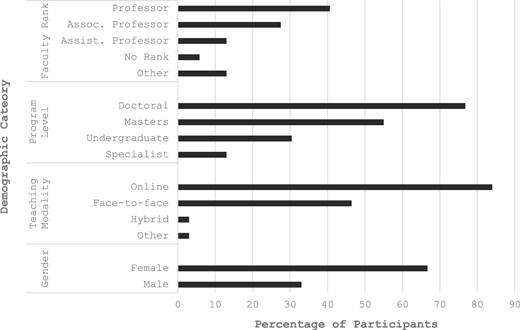
Participants were faculty from colleges or schools of education at 15 public and private higher education institutions in Florida, US Invitations were emailed to 745 faculty using publicly available departmental directories. Sixty-nine completed an online survey, and eight participated in follow-up interviews. Figure 1 shows participant demographics; Table 1 summarizes department or program affiliation across seven categories.
Interviewees included four females and four males with an average of 22.12 years of teaching experience. Ranks included five professors, two associate professors and one assistant professor. Programs represented included curriculum and instruction, instructional technology, school counseling, applied behavior analysis, distance education and educational leadership.
Instruments and procedures
Quantitative survey data were collected using the GenAI Questionnaire (GENAI-Q), and qualitative data were gathered through 45-min semi-structured Zoom interviews using the GenAI Interview Protocol Guide (GENAI-IPG). To ensure content validity, two higher education faculty with expertise in AI in education reviewed both instruments for clarity, relevance and alignment with the study's purpose and research questions.
The GENAI-Q included five sections addressing demographics, faculty use of GenAI, student use, perceived impacts on teaching and research and broader impacts on higher education. Participants could indicate interest in follow-up interviews.
The GENAI-IPG included 16 questions aligned with the study's research questions. Interview transcripts were reviewed for accuracy, and member checking was conducted.
Survey data were analyzed using descriptive statistics. Interview transcripts were coded and thematically analyzed using an inductive approach (Saldaña, 2021) supported by DELVE software (https://delvetool.com). Comparative analyses enabled identification of convergence, divergence and complementarity between quantitative and qualitative findings.
Findings
Of the 69 respondents, 53 reported using GenAI for teaching or research, while 16 had not used it for either activity. All eight interviewees were GenAI users. The findings and discussion are presented per research question. The discussion is based on the comparative analyses, as recommended by Creswell and Plano Clark (2007).
GenAI integration in teaching and research
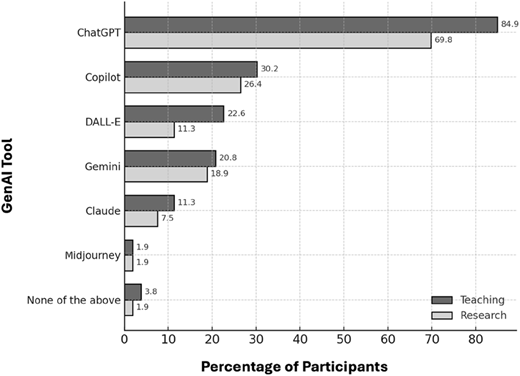
Among respondents, 3.77% reported not using GenAI for teaching and 13.2% reported not using it for research. On average, on a scale from 1 = Rarely to 5 = Always, GenAI users reported a moderate use for teaching and research (M = 2.9). Figure 2 illustrates the proportion of respondents reporting GenAI tool use for teaching and research, per tool.
Table 2 presents common teaching and research activities in which participants have used GenAI.
Regarding awareness of their students' GenAI use, 51 participants responded. Of these, 19.23% reported not knowing whether their students used GenAI, 23.07% knew students used it but were unsure how and 55.76% were aware of their students' use. Regarding frequency, 9.41% did not know how often students used GenAI, 23.4% reported never or almost never, 31.37% were neutral and 17.64% indicated always or almost always.
Table 3 shows the qualitative themes that emerged from the inductive qualitative coding guided by RQ1.
Interview data revealed additional ways faculty have incorporated GenAI in their professional practice, the challenges encountered and lessons learned from their use. These emergent themes extend the scope of integration from teaching and research to departmental collaboration, administrative work and counseling contexts. However, the themes point to recurring issues such as accuracy verification, embedded bias and ethical safeguards (see Table 4).
GenAI integration in teaching
Convergence emerged between quantitative findings on create content and plan lessons and the qualitative theme instructional design and faculty use. Both datasets indicated that content generation, assessment design and lesson planning remain the most common integration points. Interviewees described using GenAI to create instructional materials, grade assignments and develop rubrics. Such uses confirm survey trends of early post-ChatGPT studies where lesson planning, assessment creation and grading assistance were dominant (Bin-Nashwan, Sadallah, & Bouteraa, 2023; Celik et al., 2022; Crompton & Burke, 2023; Kerr & Kim, 2025; Marchena Sekli et al., 2024). Studies suggests these uses persist because they directly reduce time spent on repetitive tasks (Marchena Sekli et al., 2024; Aghaee, Vrågård, & Brorsson, 2024). Instructional efficiency was expanded by participant comments describing GenAI as “a supplement… to grade student projects” and “a way to validate what I'm already doing” (Participant 3), while another noted its ability to “quickly generate a rubric… making grading easier” (Participant 1).
Qualitative findings extended quantitative findings by highlighting student empowerment and AI skill-building practices not captured in the GENAI-Q. The theme student skill development revealed uses such as AI tutoring, writing support and AI literacy skill-building. Participants described using GenAI to scaffold writing and support multilingual learners, positioning it as “their own personal tutor” for revision and feedback (Participant 2). This aligns with scholarship identifying GenAI as a “transformative tool” capable of providing tailored support and personalized learning pathways (Aghaee et al., 2024). Another described encouraging doctoral students to use GenAI to “rewrite around clear sentences” to improve clarity and structure (Participant 3).
Interviewees also described situational strategies that can be seen as strategies to facilitate active learning, such as ethics discussions, demonstrations and guided verification of AI outputs. Participant 2 noted teaching students to use AI to “find inconsistencies… in their writing,” while Participant 3 observed that it provides “a safe environment before being graded.”
Participants further described integration within course-based research, including using ChatGPT to “brainstorm ways to interpret SPSS outputs” (Participant 3), drafting ESL learning prompts (Participant 6) and helping pre-service teachers “gather examples quickly” for lesson planning analysis (Participant 8).
A theme of readiness of GenAI use emerged solely from interviews. Participants described phased adoption and reflective trial use, including integrating tools into unit planning to assess student perceptions (Participant 1) and allowing limited AI use to “teach students how to use it responsibly” (Participant 8). Others reflected on still learning GenAI's implications for their work (Participant 3) or exploring how it might support school counselors (Participant 4).
These adoption trajectories mirror patterns reported in the literature where faculty move from exploratory testing of AI capabilities toward more sustained pedagogical integration as their individual familiarity and social reinforcement grow (Lee et al., 2025; Shata & Hartley, 2025), a progression consistent with innovation diffusion theory (Rogers, 2003). However, the uneven awareness of student GenAI uses and institutional preparedness gap (Lee et al., 2025; Aghaee et al., 2024) may affect how effectively faculty guide responsible integration and align technology use with intended learning outcomes.
GenAI integration in research
The qualitative themes converged with or added depth to participants' integration of GenAI for research captured in the GENAI-Q. Both quantitative and qualitative data showed GenAI is widely used to accelerate literature reviews and identify relevant sources. Participants most frequently reported using GenAI for literature-related tasks, including searching, evaluation and synthesis. These findings align with studies showing GenAI reduces time spent on literature discovery and summarization, though often requiring verification to address inaccuracies.
Qualitative findings reflected similar uses. Participant 1 noted that AI helps avoid “reading articles that were not applicable,” as it “already does all that curating.” Participant 7 described using AI to “summarize… the most important parts of an article” to “manage heavy reading demands.” Participants also reported using GenAI for instrument design or development, which also emerged in the qualitative data where participants shared that GenAI assisted in creating draft data collection instruments, including surveys and interview protocols. Similarly, the qualitative theme Writing the abstract can be seen as part of dissemination, writing the research paper or publication from the GENAI-Q. For example, Participant 4 used it to draft an abstract, noting it “helped me get started when I had writer's block,” even though most of the output required revision.
Other aspects that emerged from the interviews, not captured in the GENAI-Q, included several participants expressing caution about relying on GenAI-generated content. Several noted the need to verify factual accuracy and check for potential errors. Participant 2 noted that AI can “make up citations,” requiring everything to be double-checked, while Participant 5 explained that AI summaries may “change the meaning,” requiring review of original sources. This reflects a recurring pattern in the literature where GenAI is viewed as a productivity amplifier but not a fully reliable academic partner (Adamakis & Rachiotis, 2025; Bin-Nashwan et al., 2023; Bobula, 2024; Marchena Sekli et al., 2024). The necessity of factchecking is often framed as a pedagogical opportunity, with some scholars suggesting that verification exercises can themselves foster critical AI literacy among students (Adamakis & Rachiotis, 2025; Bobula, 2024; Marchena Sekli et al., 2024; Nasr et al., 2025).
GenAI impact on teaching and research
GenAI impact on teaching
Quantitative results showed that faculty most strongly agreed GenAI improved teaching efficiency by saving time and resources (M = 3.65). This was followed by innovation in teaching approaches (M = 3.49), moderate improvement in teaching quality (M = 3.12) and broader impact on teaching practices (M = 3.26). Student engagement received the lowest rating (M = 2.91).
Comparative analysis revealed convergence around efficiency. Faculty described how GenAI streamlined course preparation, assessment design and grading. Participant 1 illustrated this in pre-service teacher education, noting that using GenAI reduced the number of students unable to get started on unit plans, helping the semester begin “faster and on a better footing.”
Quantitative findings on innovation (M = 3.49) aligned with qualitative accounts describing more tailored instruction and adaptive scaffolding. Participants emphasized using GenAI to customize support and provide individualized feedback.
Although there was a modest agreement that GenAI improved teaching quality (M = 3.12), qualitative data suggested improvements in student work when GenAI was used responsibly. Faculty observed better-structured writing and clearer arguments, particularly among multilingual learners. However, concerns about overreliance were also noted. Participant 7 described how students may submit AI-generated comparisons of learning theories “without doing the cognitive process themselves.”
These tensions were reflected in theme Ineffectiveness and Concerns That Must Be Addressed, that included reduced cognitive engagement and unclear student understanding. This balance between productivity gains and potential erosion of critical thinking echoes broader literature (e.g. Gerlich, 2025; Lee et al., 2025; Szmyd & Mitera, 2024).
Improvements in teaching quality and student engagement were less consistent. Quantitative data reflected modest agreement (M = 3.12), while qualitative data emphasized improved student outcomes more than perceived teaching quality. Efficiency and innovation were affirmed across data types, but qualitative findings introduced additional pedagogical dimensions not fully captured in the GENAI-Q. Participants suggested that engagement depends less on the technology itself and more on how it is integrated in teaching.
Participant 8 described GenAI as “an additional tool… where students and I share what we discover,” noting that restricting its use would be “a misfortune” for learning. Participant 5 reflected that GenAI has changed classroom dynamics, requiring them to “focus more on watching students do the work” and adapting how class time is used. Similarly, Participant 6 emphasized placing greater weight on live application activities because they “don't fully trust written work” to reflect student understanding.
Themes not captured in the GENAI-Q included plagiarism concerns, unclear institutional policies and increased workload. Participants expressed uncertainty about boundaries between student work and AI assistance. As Participant 2 noted, “Where do you draw the line between what a student should be producing themselves and what the AI produces for them?” Participant 4 described “struggling with the boundary between doing the work and plagiarizing,” especially if AI generates most of an assignment.
Participants also highlighted the challenge of keeping pace with rapid GenAI developments. Participant 5 explained that they had not anticipated AI would “give you fake articles,” adding that “part of the problem is… it's hard to keep up.”
Others emphasized the need for institutional guidance. Participant 7noted that without clear policies, some students responsibly compare their work with AI, while others “leave the assignments… for [GenAI] to do,” undermining the learning process. Participant 8 reflected that while ethical and academic integrity concerns are widely recognized, “policy… hasn't caught up” with AI use.
GenAI impact on research
Qualitative and quantitative data converged in emphasizing efficiency as a primary research benefit. Participants agreed that GenAI improved research efficiency (M = 3.65), particularly by saving time and streamlining repetitive tasks. This aligned with qualitative accounts describing how GenAI accelerated literature reviews, reduced manual searching and facilitated faster production of scholarly outputs. As Participant 1 explained, GenAI made it possible to “write… conceptual papers faster,” noting that generating annotated bibliographies now saves time previously spent “doing it ourselves.”
Convergence was especially strong around time savings. Participants described using GenAI to support literature discovery, produce summaries and draft annotated bibliographies. These practices allow researchers to move through early project stages more quickly and devote more time to higher-level analysis and writing, a pattern consistent with literature identifying literature review acceleration as a key GenAI application (Marchena Sekli et al., 2024; Aghaee et al., 2024).
This increased efficiency also appeared to support innovation. Innovation emerged as the second-highest area of agreement (M = 3.20), with both strands highlighting GenAI's role in drafting abstracts, designing data collection instruments and supporting brainstorming. Participants described these uses as enabling faster transitions from idea generation to project initiation. They also moderately agreed that GenAI had impacted how they conduct research (M = 3.20), with qualitative accounts suggesting gradual integration across additional stages of the research process.
However, perceived improvements in research quality were less consistent (M = 3.06). While some acknowledged productivity gains, others expressed caution about reliability. Participant 1 noted that without human verification, AI-generated outputs may include “false citations,” emphasizing that unless AI content is accurate and free from hallucinations, it cannot meaningfully improve research quality without a human check.
GenAI impact on higher education
Table 7 shows GenAI users' and non-users’ perspectives on the impact of GenAI on teaching and research in higher education. Table 8 presents the qualitative themes that emerged from inductive qualitative coding guided by RQ3.
A comparative analysis of GenAI's impact in higher education was conducted between users and non-users using findings from Tables 7 and 8. Among GenAI users, responses reflected strong agreement that GenAI has transformed higher education (M = 3.89) and introduced significant challenges to academic integrity (M = 4.23) and ethical use (M = 3.70). In contrast, non-users expressed lower agreement regarding its impact on teaching (M = 2.64), research (M = 2.57) and overall transformation (M = 3.07).
Despite these differences, convergence was evident around ethical, academic integrity and privacy concerns. Even without direct experience, non-users acknowledged potential risks. However, users tended to frame these risks operationally, such as integrating plagiarism detection or drafting AI-specific honor codes, while non-users viewed them as systemic threats requiring institutional responses. Qualitative data reinforced these shared concerns and highlighted issues not captured in the GENAI-Q, including institutional readiness and the pace of adaptation. Participant 3 reflected that higher education often struggles to respond to emerging technologies, noting that institutions are frequently “on to a new technology” before fully addressing the last.
Experience with GenAI appeared to shape interpretations. Users rated GenAI as moderately impactful (M = 3.25, teaching; M = 3.31, research; M = 3.89 overall), aligning with qualitative themes of workflow change and productivity gains. Non-users rated these impacts lower (M = 2.57–3.07), suggesting a more limited perception of influence. Non-users tended to emphasize theoretical risks and uncertainty about educational value, whereas users described both practical benefits and limitations. Participant 4 illustrated this balance by expressing concern about overreliance and describing an intentional approach to use, noting that they sometimes choose to “do it myself” to preserve the learning process, even when AI could provide faster answers. They explained using AI primarily when they already understand the task and need efficiency, rather than as a substitute for thinking or skill development.
Regarding perceptions of student learning, non-users rated engagement impacts lower (M = 2.57–2.64), while users reported modest gains (M = 2.94) and accessibility benefits (M = 3.29). Interview data showed partial convergence: some participants described AI as supporting learners who lack foundational skills, such as helping students “produce the topic outline” needed for effective writing (Participant 3). Others expressed concern that polished AI-generated writing may mask learning gaps, raising questions about whether writing skills are being “devaluated” when tools can produce high-quality output (Participant 6).
Overall, these contrasts suggest that direct use fosters experience-based interpretations, whereas non-users rely more on second-hand information or broader discourse. This pattern mirrors innovation adoption theory (Rogers, 2003), in which early adopters balance productivity gains with pedagogical trade-offs, while non-adopters emphasize hypothetical risks.
Conclusions
Participants represented seven department categories across colleges or schools of education from 15 higher education institutions in Florida. The convergent mixed-method design enabled an integrated understanding of faculty experiences and interpretations of GenAI's impact on teaching, research and higher education.
Convergence emerged around efficiency gains and ethical risks, while partial convergence appeared in innovation, teaching quality and student engagement. Divergence was most evident between GenAI users and non-users, suggesting that direct experience fosters a more balanced view of benefits and risks.
Participants generally regarded GenAI as a transformative yet double-edged force that enhanced efficiency and innovation while raising concerns about academic integrity, hallucinations and institutional readiness. Beyond efficiency gains, findings suggest that GenAI is beginning to reshape scholarly workflows, supporting more selective and intentional use rather than passive reliance. Many noted limited policy guidance and professional development, leaving faculty to navigate integration independently.
Participants also emphasized the need for verification and human oversight, particularly as GenAI capabilities evolve. While GenAI was widely viewed as useful, its pedagogical value remains under examination as faculty move toward more deliberate and policy-aware integration. Concerns extended to potential shifts in the teacher–student relationship. As one participant reflected: “I can envision a time when AI changes how we teach… where faculty interact less with students and instead supervise interactions with AI. Is that really what we want? What happens to the teacher–student relationship?”
Given the study's limited geographic scope and voluntary participation, findings should be interpreted as context specific. As institutions move from reactive experimentation toward strategic adoption, future research should examine how GenAI can be integrated in ways that are sustainable, measurable and aligned with higher education's core values. In particular:
How institutional supports (policy, governance, professional development) shape faculty integration practices. Comparative studies across institutions with varying levels of GenAI readiness may help identify which supports most effectively promote innovative, ethical and sustainable adoption while addressing faculty concerns and mitigating risk at scale.
Whether efficiency gains translate into measurable improvements in teaching, research productivity and student outcomes. Experimental or longitudinal designs could determine whether reported efficiency gains translate into measurable improvements in scholarship and student learning outcomes, thereby basing discussions of impact in observable evidence rather than perception alone.
How increasingly agentic AI systems may influence faculty roles, decision-making and the balance between human judgment and AI-supported instruction. This includes exploring scenarios in which GenAI assumes greater instructional or research responsibilities and assessing how such changes may influence academic integrity, learning quality and institutional mission.
Ultimately, the question is not whether GenAI will shape higher education, but whether faculty will intentionally shape its integration in ways that preserve the human, ethical and scholarly foundations of teaching and research.