
My Reward scheme boosts productivity at RS
Article Type: Rewards From: Strategic HR Review, Volume 11, Issue 3
Short case studies and research papers that demonstrate best practice in rewards
As the world’s leading high service distributor of electronics and maintenance products, RS Components (RS), the trading brand of Electrocomponents plc, is acutely aware of the importance of retaining good staff and recruiting new talent. With around 6,000 employees worldwide, and over a third of these in the UK, the company serves 1.6 million customers worldwide through operations in 32 countries and 17 warehouses.
In a challenging economic climate and in response to an evolving business, RS looked to new HR strategies and activities to help support the company by improving employee engagement and building its employer brand. A fundamental element of this was the development of a total reward package that would encompass every benefit and positive aspect of working for RS. The scheme would prove to be instrumental in helping to re-engage the company’s workforce while also meeting its business needs.
The HR challenge
In 2008, the economic downturn was taking its toll on all UK service industries, and RS was no different. For its employees, it meant redundancies,pay freezes and no bonuses. In such a challenging environment, the company needed to leverage the support and motivation of its employees, but instead it faced an increasingly disillusioned, insecure workforce that needed encouragement to be passionate and confident about the future.
Research highlighted that the company’s existing benefits scheme provision was inadequate – communication and delivery were both flawed. RS also had little discernable employer brand or ability to differentiate from other employers in an increasingly competitive recruitment market.
Focusing on rewards to boost morale
Based on research, external data and longer term aspirations, the RS UK people management forum (UKPMF) made the decision to focus on rewards. It was realized that the right reward strategy would help contribute to employee engagement by addressing insecurities and restoring confidence in the workforce. It could also help strengthen the company’s employer brand and enable RS to better compete for recruits with valuable skills to help it achieve its goals. Most significantly, with a challenging economy, it could contribute to improving organizational performance by giving RS a competitive edge as it embraced ecommerce and, with it, future growth.
From the outset, RS had a clear vision to develop a new, bespoke reward and benefits scheme that would ensure it was able to communicate, encourage and reward those behaviors, skills and performance that lead to the achievement of its business goals. The company wanted employees to know that reward represents significantly more than pay and benefits by building a picture of all that working for RS could mean.
A total reward package
RS conducted extensive stakeholder research to help determine how best to align the new reward strategy with its business goals and culture. This included interviews with the company’s group executive committee (GEC), externally facilitated focus groups with managers, and discussion forums with UK-based HR teams. It also took into account the pay audit for FY08, which provided a complete breakdown of all the costs and allocations of rewards across the company. The research illustrated that a total reward package, which incorporates all rewards and benefits into one comprehensive and easily accessible scheme, would best combine both employee and business needs –see Figure 1.
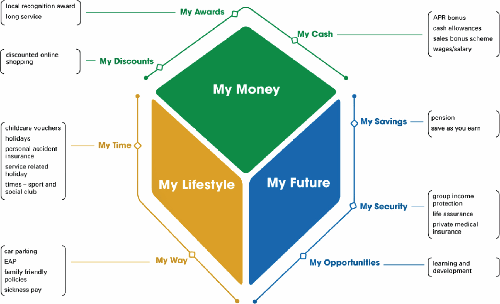
The new reward package, “My Reward,” encompasses a range of benefits and facilities specifically aligned to the company’s wider people management and business priorities – see Figure 2. These include:improving employee health and wellbeing; reducing the company’s CO2footprint; improving communication and media; and increasing employee engagement and motivation.
A significant innovation was the introduction of non-financial rewards, which link employee performance to the company’s business objectives. These include: offering employee self-help, online learning and development opportunities; rewarding long service with the company; awarding employees points for high performance and excellent behaviors that can be used to purchase merchandise and vouchers; and providing free support and advice to employees and their families.
Support and communication key
Senior level commitment was vital for a successful scheme, so from the outset My Reward was implemented with strong support from the GEC, senior representation on the HR leadership team, and a dedicated in-house team. The UKPMF had significant input into its review and implementation, including staff communications, by holding regular meetings and updates throughout the process.
Communication of the reward strategy was a key challenge. Previously, this had been an area of weakness for RS. With My Reward, this was addressed by firstly developing a well branded and recognizable family of employee schemes. Information on the package was communicated quickly and efficiently through online bulletins, email and forums, and by tailoring entire sections of the company intranet. RS also developed an internet based portal to provide access to the scheme.
To ensure that the company continues to offer and communicate the right support for its diverse population, My Reward operates a continuous improvement strategy and is constantly evolving in response to employee feedback and physical change. This has already led to fundamental improvements in the scheme.
Record take up and engagement levels
The success of My Reward could be demonstrated primarily with the record take-up of the strategy. Of its eligible UK employees, 74 percent are enrolled in one or both of the healthcare benefits while 46 percent have taken up My Holidays in its first year. A significant number of employees have registered for the car share and cycle to work schemes and the take up of the My Discounts scheme increased by 39 percent throughout 2009-2010. The total spend on employee recognition from April to December 2010 was £115,000, while the scheme as a whole has returned £366,419 in NI (National Insurance) savings alone across all salary sacrifice products.
My Reward has helped to motivate employees, increase job satisfaction and drive improved performance. This has been reflected in record employee engagement scores. The annual staff survey revealed a 17 percent increase in the perception that rewards are now clearly linked to employee performance. The scheme has also been instrumental in helping RS to retain its best people, with staff turnover stabilized at 5 percent compared to around 11 percent of employees being made redundant in 2008-2009. This improvement has been reflected in the company’s new starters with 85 percent stating that they could see themselves still at RS 12 months after joining.
Internal and external recognition
My Reward has played a strong part in improving recruitment. Having surveyed its new recruits in 2010, 91 percent rated the reward scheme as “good to excellent,” 84 percent considered the benefits package as a factor in them choosing to work at RS, and 94 percent rated the variety of benefits on offer as“good to excellent.” Eighty-three percent of those able to compare rated the benefits scheme as “better at RS” than at their former employers. There was also a 28 percent increase in the number of new recruits referred by an existing employee in 2010, with 68 percent of new recruits stating that they would recommend working at RS to a friend.
As a result of its success, My Reward has gained industry acclaim, winning the Most Effective Total Reward Strategy at the Employee Benefits Awards 2011,run by Employee Benefits magazine, and Most Effective Benefits Strategy at the HR Excellence Awards 2011, run by HR magazine. Not only does it encompass every benefit and positive aspect of working for RS, giving employees greater visibility and control in the way that they are rewarded, the scheme also compliments the company’s growth strategy and has initiated a cultural change at RS.
It has helped to enhance the company’s HR delivery model through the improvement of employee self-service and by establishing a single point of contact for reward matters. It has also built a foundation for improving end-to-end processes (employee to payroll) and managing base pay reviews on a total reward basis.
Ian WatsonGeneral Manager Group HR at Electrocomponents.
About the author
Ian Watson is General Manager Group HR at Electrocomponents. He has responsibility for attracting, retaining and developing quality people for the Electrocomponents Group. Watson oversees the delivery of organization development programs and manages the group’s compensation and benefit schemes. Before joining Electrocomponents in 2004, Watson held senior roles at Vodafone plc. and Thomas Cook. Ian Watson can be contacted at: ian.watson@electrocomponents.com


