


The purpose of this study is to investigate the transformative role of artificial intelligence (AI) tools in enhancing academic writing proficiency among English as a Foreign Language (EFL) learners. By focusing on the balance between syntactic complexity and clarity, the research evaluates the effectiveness of AI-enhanced educational tools such as Grammarly, ProWritingAid, Hemingway Editor, Quillbot, Writefull and Turnitin Revision Assistant. Utilizing a pretest-posttest randomized controlled trial, the study aims to measure improvements in clarity, precision, syntactic complexity, argumentation and adherence to academic standards, providing insights into AI’s potential in educational practices.
This study employs a pretest–posttest randomized controlled trial design to evaluate the impact of AI-enhanced educational tools on academic writing skills among 466 EFL postgraduate students. Participants are randomly assigned to six experimental groups, each using a different AI tool and a control group using traditional computer-assisted language learning methods. Writing proficiency is assessed using the IELTS writing test, syntactic complexity analysis, readability tests and a rubric for academic standards. Quantitative data are analyzed using ANOVA, while qualitative data from interviews and surveys provide insights into learners’ perceptions of AI tools’ effectiveness.
The study finds that AI-enhanced educational tools significantly improve academic writing proficiency among EFL postgraduate students compared to traditional methods. Notably, the Turnitin Revision Assistant demonstrates remarkable effectiveness across multiple dimensions, including clarity, precision, syntactic complexity and adherence to academic standards. Other tools like Grammarly and ProWritingAid also show substantial improvements in writing skills. Qualitative feedback reveals that learners perceive AI tools as beneficial, though challenges such as over-reliance and maintaining personal voice are noted. These findings underscore the potential of AI tools in educational practices, advocating for their strategic integration into curricula to foster 21st-century skills.
This study offers a novel contribution by empirically evaluating the specific impacts of various AI tools on distinct writing competencies among EFL learners, addressing existing gaps in the literature. By employing a rigorous methodological approach, it provides concrete evidence of AI’s effectiveness in enhancing academic writing skills, particularly in balancing syntactic complexity and clarity. The research also enriches the discourse on AI’s educational role through the lens of Nonlinear Dynamic Language Learning Theory, Constructivist Learning Theory and Cognitive Load Theory. These insights support the strategic implementation of AI tools in educational curricula, emphasizing their value in developing essential 21st-century skills.
1. Introduction
The integration of artificial intelligence into educational practices, particularly in enhancing academic writing proficiency, represents a transformative shift in how language skills are cultivated. This study investigates the role of AI tools in balancing syntactic complexity and clarity, aiming to enhance writing proficiency among English as a Foreign Language learners. The context of this research is situated within the broader field of AI-enhanced educational tools, which have shown potential in personalizing learning experiences and improving specific academic writing skills.
The relevance of this study is underscored by the increasing demand for effective writing skills in academic and professional settings. AI tools such as Grammarly, ProWritingAid, Hemingway Editor, Quillbot, Writefull, and Turnitin Revision Assistant are being employed to enhance clarity, precision, and adherence to academic standards. These tools provide real-time feedback and suggestions, helping students refine their writing through grammar and style checks, vocabulary enhancement, and plagiarism detection.
Existing literature highlights the potential of AI in improving writing proficiency. For instance, Punar Özçelik and Yangın Ekşi (2024) emphasized ChatGPT’s role as a learning assistant in cultivating writing skills. Singha et al. (2024) discussed the challenges and opportunities of AI in language teaching materials, while Son et al. (2023) explored AI technologies for language learning. Raković et al. (2023) focused on predicting learner performance through AI, and Salvagno et al. (2023) questioned AI’s role in scientific writing enhancement. Sari and Han (2024) investigated automated writing evaluation’s impact on EFL learners, and Song and Song (2023) assessed ChatGPT’s efficacy in motivating EFL students. Syahnaz and Fithriani (2023) explored AI-based paraphrasing tools in EFL writing classes, and Tang et al. (2024b) highlighted AI’s role in self-assessment during writing tasks. Van Waes and Leijten (2015) provided a multidimensional perspective on writing fluency, emphasizing AI’s potential to enhance both first and second language writing.
Despite these promising insights, significant gaps remain in the current body of research. Specifically, there is a lack of empirical evidence that directly quantifies the measurable improvements AI tools bring to distinct aspects of academic writing, such as clarity, syntactic complexity, argumentation, and adherence to academic standards. For example, while some studies note general improvements in writing fluency and accuracy, they often fail to disaggregate these gains into specific, measurable dimensions (e.g. improvements in syntactic complexity through subordinate clause usage or clarity gains measured by readability indices). Furthermore, inconsistencies persist regarding the efficacy of AI tools across different learner demographics and educational settings. The discrepancies may arise from variations in learners’ proficiency levels, cultural contexts, or the specific features of AI tools being evaluated. For instance, while some studies report significant gains in argumentation and persuasion skills using AI tools, others find limited improvement, particularly among learners with lower baseline proficiency or limited familiarity with the tools.
The study addresses these gaps by employing a rigorous methodological approach to evaluate the effects of AI interventions on academic writing skills, focusing on measurable outcomes such as syntactic complexity (e.g. sentence length and subordinate clause usage), clarity (e.g. readability scores), and argumentation (e.g. logical structuring and coherence). Additionally, it examines the perceptions of learners to contextualize the quantitative findings and explore how demographic and contextual factors influence the effectiveness of AI tools. By focusing on EFL postgraduate students, this study aims to provide a comprehensive evaluation of AI tools’ impact on writing proficiency, offering valuable insights into their effectiveness and guiding future educational practices and research.
2. The literature review
2.1 AI-enhanced educational tools and academic writing research
AI-enhanced educational tools have demonstrated a significant impact on various aspects of academic writing. Giray (2023) highlighted the role of prompt engineering in improving clarity and precision in writing, suggesting that tailored prompts can lead to more effective communication, a critical aspect of academic writing. Recent studies provide robust empirical evidence supporting the efficacy of AI tools like Grammarly and ProWritingAid in enhancing academic writing performance. For instance, Gayed et al. (2022) revealed that students using AI-based writing assistants exhibited substantial improvements in grammar accuracy, syntactic complexity, and overall coherence compared to those relying on traditional methods. Liu et al. (2023) emphasized how Grammarly’s iterative feedback mechanisms foster reflective practices, enabling students to internalize corrections and achieve measurable gains in writing quality. Similarly, Chen et al. (2024) underscored ProWritingAid’s dual role in both writing assistance and skill evaluation, demonstrating that these tools not only correct surface-level errors but also guide learners in developing higher-order writing skills such as argumentation and organization. These findings highlight the potential of AI tools to enhance specific aspects of academic writing while underscoring the need for further research into their long-term impact on sustained skill development.
Goldshtein et al. (2024) explored the use of NLP tools to analyze student writing, revealing their ability to identify and enhance syntactic structures. Their findings indicate that students using AI tools may demonstrate greater mastery and adherence to academic standards than those using traditional CALL methods. Zhao (2024) highlighted advancements in adaptive learning technologies, such as AI-driven personalization, which further enhance the potential of writing instruction by tailoring feedback and learning pathways to individual student needs. For example, Grammarly and ProWritingAid now incorporate adaptive algorithms that identify recurring errors and provide customized suggestions to help students address specific weaknesses over time. This aligns with Liu et al. (2023), who emphasized the importance of reflective practices in AI-supported environments, suggesting that adaptive mechanisms can enhance learning outcomes by promoting deeper engagement with writing tasks.
In terms of argumentation and persuasion, Kim and Kim (2022) found that teachers perceive AI tools as beneficial for developing these skills. However, empirical evidence directly linking AI usage to improvements in argumentation and persuasion remains sparse, highlighting the need for further investigation. Lee et al. (2022) reported positive effects of AI chatbots on students’ academic performance but noted that these effects do not necessarily address conformity to academic standards. This gap suggests the need for additional research to evaluate how AI tools, particularly those employing adaptive learning technologies, assist students in meeting these standards.
2.2 AI-enhanced tools and writing proficiency
The integration of AI into academic writing instruction has redefined pedagogical approaches, particularly for EFL learners. Foundational studies demonstrate that tools like Grammarly and ProWritingAid enhance syntactic complexity and coherence through real-time feedback. For instance, Gayed et al. (2022) reported that AI-based assistants improve grammar accuracy by 34% and syntactic complexity (e.g. subordinate clause usage) by 22% compared to traditional methods. These tools transcend basic error correction: Liu et al. (2023) documented how Grammarly’s iterative feedback fosters metacognitive reflection, enabling learners to internalize grammatical rules and stylistic conventions. Similarly, Chen et al. (2024) emphasized ProWritingAid’s dual role in error correction and scaffolding higher-order skills like argumentation, with learners demonstrating 18% greater coherence in thesis-driven essays.
However, the field remains fragmented. While these studies highlight short-term gains (e.g., immediate posttest improvements), Fathi and Rahimi (2024) critique the lack of longitudinal data to assess sustained skill retention. Additionally, most research focuses on sentence-level mechanics, neglecting discourse-level features such as rhetorical structure or genre-specific conventions (Adams and Chuah, 2022). This gap underscores the need for studies that evaluate AI’s role in cultivating advanced writing competencies, such as synthesizing interdisciplinary literature or adapting tone for academic audiences.
2.3 Adaptive learning and personalized feedback
AI-driven adaptive systems represent a paradigm shift in personalized writing instruction. Zhao (2024) demonstrated that tools like Turnitin Revision Assistant dynamically adjust feedback based on learner proficiency, reducing cognitive overload by 40% in complex tasks. For example, novices receive granular feedback on sentence structure, while advanced learners focus on argumentative coherence. Such systems align with Vygotsky’s Zone of Proximal Development, scaffolding learners toward independence. Liu et al. (2023) further validated this, showing that Grammarly’s adaptive algorithms reduced recurring grammatical errors by 29% over six weeks through targeted practice modules.
Despite these advances, critical limitations persist. Goldshtein et al. (2024) found that NLP tools like Writefull enhance syntactic diversity but struggle with discipline-specific terminology, particularly in STEM fields. Additionally, studies often rely on homogenous samples (e.g., Chen et al., 2021 used predominantly East Asian EFL learners), limiting insights into cross-cultural applicability. For instance, tools trained on Western academic norms may misinterpret rhetorical preferences in Arabic or Mandarin contexts, perpetuating linguistic inequities (Binns, 2018). This highlights the urgency of culturally responsive AI design and inclusive sampling in future research.
2.4 Argumentation and persuasion in AI-mediated writing
AI’s capacity to enhance argumentation remains contested. While Kim and Kim (2022) reported that 72% of instructors perceive AI tools as effective for teaching persuasive writing, empirical evidence is sparse. Lee et al. (2022) found that chatbots improved argumentation scores by 15% in middle-school learners but had negligible effects on postgraduate adherence to academic standards. This discrepancy suggests that AI’s efficacy varies by proficiency level and task complexity. For example, Quillbot excels at paraphrasing evidence but lacks contextual awareness to critique logical fallacies (Gayed et al., 2022).
A critical tension emerges between efficiency and originality. Turnitin’s citation guidance improved reference accuracy by 41% in postgraduate theses (Goldshtein et al., 2024), yet qualitative data revealed that 33% of learners felt over-reliance on AI stifled creative voice (Niloy et al., 2024). This aligns with broader ethical debates: while AI democratizes access to writing support, it risks homogenizing expression and privileging algorithmic conventions over individual voice (Crompton and Burke, 2023).
2.5 Learner perceptions and ethical considerations
Learners exhibit mixed perceptions of AI tools. Malik et al. (2023) identify enthusiasm for AI’s clarity-enhancing features but caution against dependency, echoing Gómez-Camacho et al. (2023), who link informal digital writing experiences to AI tool efficacy. Ethically, Binns (2018) critiques the absence of equitable access frameworks, while Adams and Chuah (2022) call for transparency in AI’s role in skill development. These concerns highlight the tension between AI’s efficiency and its implications for academic integrity (Crompton and Burke, 2023).
2.6 Contextual and methodological limitations
The literature reveals significant contextual gaps. Most studies focus on Western or East Asian contexts, neglecting Global South populations (Chen et al., 2021). Additionally, methodological fragmentation persists: Cong (2024) advocates for AI language models in multilingual settings, yet few studies explore cross-linguistic applicability. Longitudinal designs are rare, limiting insights into skill retention (Fathi and Rahimi, 2024).
2.7 Critical analysis and research gaps
The reviewed studies predominantly adopt positivist frameworks, prioritizing quantitative metrics over qualitative depth (e.g. readability scores vs. learner agency). This contrasts with interpretivist approaches, as seen in Malik et al. (2023), which capture nuanced perceptions. Epistemologically, the field lacks integration of critical theories (e.g. decolonial perspectives) to address cultural biases in AI tools. Key gaps include:
Contradictions: Disparate findings on AI’s efficacy across demographics (Chen et al., 2021).
Systemic Issues: Overreliance on homogenous samples and short-term interventions.
Underexplored Areas: Ethical guidelines for equitable AI access (Binns, 2018) and longitudinal impacts (Fathi and Rahimi, 2024).
Research Questions and Hypotheses.
To address the gaps identified in the literature, this study is guided by the following research questions:
Do EFL postgraduate students who practice academic writing using AI-enhanced educational tools achieve significantly greater improvements in specific aspects of academic writing—namely, clarity and precision, demonstration of mastery, argumentation and persuasion, and conformity to academic standards—compared to students in the comparison group using traditional Computer-Assisted Language Learning (CALL) methods? Additionally, are there significant differences in improvements based on the type of AI tool implemented?
What are the learners’ perceptions regarding the effectiveness of AI-enhanced educational tools in enhancing their academic writing skills, specifically in terms of clarity and precision, demonstration of mastery, argumentation and persuasion, and conformity to academic standards?
Based on these research questions, the following hypotheses are proposed:
EFL postgraduate students using AI-enhanced educational tools will demonstrate significantly greater improvements in clarity and precision, demonstration of mastery, argumentation and persuasion, and conformity to academic standards compared to students using traditional CALL methods.
Learners will perceive AI-enhanced educational tools as effective in improving specific aspects of academic writing, particularly clarity, precision, and adherence to academic standards.
3. Theoretical foundations for AI-mediated academic writing
The study focuses on key concepts central to its theoretical framework: syntactic complexity, clarity, academic writing proficiency, and AI-enhanced educational tools. Syntactic complexity refers to sentence structural intricacy, while clarity denotes ease of comprehension. Academic writing proficiency is the ability to effectively communicate scholarly ideas with clarity, precision, and adherence to academic standards. AI-enhanced educational tools leverage artificial intelligence to support and improve writing skills. The concepts are operationalized through specific measures: syntactic complexity is assessed via metrics like sentence length and subordinate clause usage, clarity through readability scores, and academic writing proficiency through pretest-posttest evaluations of skills such as argumentation and adherence to academic conventions. AI tools are evaluated based on their features and targeted writing skills, such as grammar checks, style improvement, and vocabulary enhancement. The study investigates how AI tools balance syntactic complexity and clarity to enhance writing proficiency among EFL learners.
The theoretical framework integrates Nonlinear Dynamic Language Learning Theory (Bahari, 2019), Constructivist Learning Theory, and Cognitive Load Theory (Sweller, 1988). Nonlinear Dynamic Language Learning Theory views language acquisition as a dynamic, adaptive process shaped by learner agency and contextual factors. AI tools exemplify this adaptability by tailoring feedback and support to individual learner needs, enabling iterative improvement and self-directed learning. For example, tools like ProWritingAid dynamically adjust feedback based on the learner’s writing patterns, fostering a personalized learning environment that evolves with the learner. Constructivist Learning Theory emphasizes that learners actively construct knowledge through meaningful interaction and experiential learning. AI tools align with this principle by offering interactive, context-sensitive feedback that encourages learners to engage deeply with their writing. For instance, tools like Grammarly and Turnitin Revision Assistant promote active reflection and revision, enabling learners to refine their skills through practice. Moreover, these tools support autonomy by empowering students to set goals, monitor progress, and take ownership of their learning process. This aligns with constructivist ideals of fostering critical thinking and real-world problem-solving skills. Cognitive Load Theory highlights the importance of optimizing cognitive resources to maximize learning. Writing involves significant cognitive demands, from organizing ideas to adhering to academic conventions. AI tools mitigate extraneous cognitive load by automating routine tasks like grammar correction and citation formatting, allowing learners to focus on higher-order processes such as argumentation and synthesis. Tools like Ref-N-Write and EndNote exemplify this by streamlining complex tasks, ensuring learners’ cognitive resources are directed toward meaningful learning activities. Together, these theories form a cohesive framework for understanding AI’s role in academic writing instruction. Nonlinear Dynamic Language Learning Theory underscores the adaptability of AI tools, Constructivist Learning Theory highlights their capacity to foster active, meaningful learning, and Cognitive Load Theory ensures they are designed to enhance learning efficiency. By integrating these perspectives, this study provides a robust foundation for evaluating how AI tools improve clarity, precision, and academic writing proficiency while addressing learners’ unique needs.
4. Methodology
This study employs a pretest-posttest randomized controlled trial (RCT) grounded in three interlocking theoretical frameworks: Nonlinear Dynamic Language Learning Theory (adaptive AI-driven personalization), Constructivist Learning Theory (active knowledge construction via AI feedback), and Cognitive Load Theory (automating routine tasks to prioritize higher-order skills). These frameworks collectively justify the use of AI tools to enhance syntactic complexity, clarity, and academic writing proficiency (see Table 1).
Overview of the groups and AI tools used in the study to enhance academic writing
| Group | Participants | Tool used | Focus areas |
|---|---|---|---|
| Experimental Group 1 | 68 | Grammarly | Clarity, precision, argumentation, academic standards |
| Experimental Group 2 | 65 | ProWritingAid | Clarity, precision, language mastery, argumentation, academic norms |
| Experimental Group 3 | 64 | Hemingway Editor | Readability, simplicity, clarity, sentence construction, formal tone |
| Experimental Group 4 | 65 | Quillbot | Clarity, vocabulary diversity, argumentation, academic integrity |
| Experimental Group 5 | 68 | Writefull | Clarity, precision, discipline-specific terminology, argumentation |
| Experimental Group 6 | 68 | Turnitin Revision Assistant | Clarity, vocabulary, argument coherence, citation guidance |
| Control Group (Group 7) | 68 | Regular CALL Course | Baseline for comparative analysis |
A rigorously powered sample of 459 EFL postgraduate students (stratified by age/gender) was randomized into six experimental groups (AI tools: e.g., Grammarly, Hemingway Editor) and one control group (traditional CALL). Interventions targeted discrete writing skills (Appendix A), with standardized duration and assessment via validated pretest-posttest rubrics measuring clarity, argumentation, vocabulary diversity, and academic conventions. ANOVA and post-hoc tests analyzed outcomes, supported by outlier screening (Mahalanobis/Cook’s distance) to ensure data integrity.
Strengths: The RCT design, a priori power analysis (G*Power; 95% power), and stratification minimize bias while ensuring statistical robustness. Multiple experimental groups enable granular tool comparisons.
Limitations: Generalizability constrained to EFL postgraduates; single-blind design.
4.1 Instruments
The present study employed a comprehensive set of instruments to ensure rigor and replicability in assessing various aspects of participants’ writing proficiency and perceptions (see Appendix B). Writing proficiency was measured using the IELTS Academic Writing Test (pretest-posttest), which evaluated task achievement, coherence, lexical resource, and grammatical accuracy through two tasks: a descriptive report and an argumentative essay, scored on a 0–9 scale with high reliability (Cronbach’s α = 0.88) and construct validity (r = 0.85, p < 0.001). Syntactic complexity was analyzed using a specialized test based on Atak and Saricaoglu (2021) and Qian et al. (2021), focusing on sentence length and subordinate clauses, with scores ranging from 0 to 10 and strong reliability (Cronbach’s α = 0.82). Readability was assessed using the Flesch-Kincaid Readability Test, which calculated scores (0–100) based on syllables per word and words per sentence, supported by significant correlations with text difficulty measures (r = 0.76, p < 0.001). An academic writing rubric (Appendix C) evaluated writing quality across ten criteria, with scores ranging from 0 to 50, demonstrating high reliability (Cronbach’s α = 0.89) and validity (r = 0.82, p < 0.001). Argumentation and persuasion skills were assessed using a 20-item rubric-based test (Appendix D), combining open-ended and multiple-choice questions, with scores ranging from 0 to 100 and strong reliability (Cronbach’s α > 0.80). Additionally, participants’ perceptions of six AI-enhanced writing tools (Grammarly, ProWritingAid, Hemingway Editor, Quillbot, Writefull, and Turnitin Revision Assistant) were captured through a 24-item Likert-scale survey (Appendix E), with scores ranging from 24 to 168 and subscale reliability (Cronbach’s α = 0.70–0.78). Finally, qualitative insights were gathered through open-ended interviews (Appendix F), analyzed using thematic analysis with high inter-rater reliability (kappa = 0.88–1.0). Together, these instruments provided robust, validated measures to evaluate writing proficiency, complexity, readability, academic standards, argumentation, and perceptions of AI tools.
4.2 Data analysis
To address the first research question, a quantitative analysis was conducted using statistical methods such as ANOVA to compare the improvements in academic writing skills—specifically clarity and precision, demonstration of mastery, argumentation and persuasion, and conformity to academic standards—between EFL postgraduate students utilizing AI-enhanced educational tools and those in the comparison group using regular CALL methods. Additionally, a subgroup analysis was performed to evaluate the impact of different types of AI tools on these improvements.
4.2.1 Rationale for statistical tests and theoretical alignment
ANOVA (Analysis of Variance) was chosen as the primary statistical method because it is well-suited for analyzing differences between multiple independent groups, ensuring that observed variations in academic writing performance are statistically significant rather than due to chance. Given the study’s design, which included six experimental groups using different AI tools and a control group, ANOVA was the most appropriate test to identify overarching differences across groups. This aligns with Nonlinear Dynamic Language Learning Theory (NDLLT), which emphasizes the variability and adaptability of learning processes. By comparing multiple groups, ANOVA captures the dynamic interplay between different AI tools and their impact on learners’ writing proficiency, reflecting the non-linear and context-sensitive nature of language acquisition posited by NDLLT. To further refine the analysis, post-hoc Tukey tests were conducted to determine which specific groups differed significantly from one another while controlling for Type I error, which can occur when making multiple comparisons. This approach aligns with Constructivist Learning Theory, which highlights the importance of active engagement and iterative learning. The post-hoc analysis allows for a deeper exploration of how specific AI tools (e.g., Turnitin Revision Assistant, Grammarly) facilitate distinct improvements in writing skills, reflecting the constructivist principle of learners actively constructing knowledge through interaction with adaptive feedback.
Descriptive statistics, including means, standard deviations, and confidence intervals, were also calculated to summarize group performance and provide a clear picture of trends across pretest and posttest measures. Confidence intervals were included to estimate the range within which the true mean scores likely fall, offering additional insight into the reliability and precision of the results. These statistical methods were selected for their robustness and ability to provide actionable insights into group differences in educational research. The use of descriptive statistics aligns with Cognitive Load Theory (CLT), as it helps to minimize extraneous cognitive load by presenting data in a clear and interpretable manner, allowing educators and researchers to focus on the most impactful findings.
4.2.2 Qualitative analysis and theoretical connections
To address the second research question, qualitative data were collected through structured interviews and open-ended survey questions, focusing on learners’ perceptions of the effectiveness of AI-enhanced educational tools in enhancing their academic writing skills across the same specific aspects. The qualitative data were analyzed using thematic analysis, which involved coding participants’ responses, identifying parent codes and categories, and generating overarching themes. The coding process was conducted systematically to ensure reliability, with codes grouped into categories that reflected key aspects of academic writing performance. Sample excerpts from participants’ responses were included to illustrate the identified themes and provide deeper insights into learners’ experiences.
The thematic analysis was guided by the study’s theoretical framework. For instance, the theme of clarity and precision aligns with Cognitive Load Theory (CLT), as participants reported that AI tools reduced cognitive overload by simplifying complex sentences and providing actionable feedback. Similarly, the theme of demonstration of mastery reflects Constructivist Learning Theory, as learners actively engaged with AI tools to refine their use of technical vocabulary and advanced grammatical structures. Finally, the theme of conformity to academic standards resonates with Nonlinear Dynamic Language Learning Theory (NDLLT), as participants described how AI tools helped them adapt their writing to meet the dynamic and context-specific demands of academic conventions.
4.2.3 Triangulation of findings
To triangulate the findings from both research questions, a convergent triangulation approach was employed. This approach integrated the quantitative statistical results with the qualitative thematic analysis to provide a comprehensive understanding of the impact of AI tools on academic writing skills. The triangulation process was informed by the study’s theoretical framework, ensuring that the findings were interpreted through the lenses of NDLLT, Constructivist Learning Theory, and CLT. For example, the quantitative improvements in syntactic complexity and readability were contextualized within NDLLT as evidence of learners’ adaptive responses to AI feedback, while the qualitative insights into learners’ perceptions of AI tools were framed within Constructivist Learning Theory as evidence of active knowledge construction. This integrated approach not only strengthens the validity of the findings but also provides a nuanced understanding of how AI tools support the dynamic, interactive, and cognitive processes involved in academic writing development.
5. Results
5.1 Quantitative data analysis
Table 2 illustrates the significant improvements in academic writing performance across groups, with Group 6 (Turnitin Revision Assistant) demonstrating the most notable gains. For IELTS Academic Writing Proficiency, Group 6 achieved a posttest mean of 5.85 (SD = 0.950), a substantial increase from their pretest mean of 2.32 (SD = 0.657). The 95% confidence interval [5.62, 6.08] confirms the significance of this improvement. In comparison, Group 1 (Grammarly) scored a lower posttest mean of 4.76.
Descriptive statistics of academic writing performance across groups
| Measure | N | M | SD | 95% CI for mean | Min | Max |
|---|---|---|---|---|---|---|
| IELTS academic writing proficiency | ||||||
| Pretest | 466 | 2.44 | 0.70 | [2.37, 2.50] | 1 | 4 |
| Posttest | 466 | 4.34 | 1.01 | [4.25, 4.43] | 2 | 8 |
| Syntactic complexity | ||||||
| Pretest | 466 | 1.77 | 0.66 | [1.71, 1.83] | 1 | 3 |
| Posttest | 466 | 4.64 | 1.40 | [4.51, 4.77] | 2 | 8 |
| Readability | ||||||
| Pretest | 466 | 40.35 | 4.33 | [39.96, 40.75] | 33 | 66 |
| Posttest | 466 | 73.41 | 9.78 | [72.52, 74.30] | 54 | 94 |
| Academic standards in writing | ||||||
| Pretest | 466 | 12.98 | 2.01 | [12.80, 13.17] | 10 | 19 |
| Posttest | 466 | 33.21 | 6.60 | [32.61, 33.81] | 18 | 50 |
| Argumentation and persuasion | ||||||
| Pretest | 466 | 26.88 | 5.37 | [26.39, 27.36] | 18 | 44 |
| Posttest | 466 | 66.85 | 12.09 | [65.75, 67.95] | 34 | 98 |
Note(s): M = mean, SD = standard deviation, N = sample size, Min = minimum, Max = maximum, CI = confidence interval
In Syntactic Complexity, Group 6 achieved a posttest mean of 6.54 (SD = 0.921), significantly higher than the control group’s 2.89 (SD = 0.726) and their own pretest mean of 1.76 (SD = 0.576). The confidence interval [6.32, 6.77] supports the robustness of these results.
For Readability, Group 6’s posttest mean of 88.43 (SD = 5.091) far exceeded the control group’s 59.00 (SD = 4.801) and their pretest mean of 39.54 (SD = 3.551). These findings suggest that the Turnitin Revision Assistant is highly effective in enhancing writing proficiency, syntactic complexity, and readability.
Statistical Assumptions: Assumptions for ANCOVA (normality, homogeneity, linearity) were tested and met. Diagnostic plots (e.g., Q-Q plots) confirmed normality, and Levene’s test ensured homogeneity of variances.
Effect Sizes: Effect sizes were recalculated to avoid overestimation. Partial eta squared values were verified, and results were cross-checked for collinearity.
Multiple Comparisons: Bonferroni corrections were applied to control for Type I error, and adjusted p-values are reported.
Baseline Equivalence: Pretest group comparisons confirmed baseline equivalence, with no significant differences across groups.
Practical Significance: Results were contextualized to highlight real-world implications, such as the educational relevance of improvements in academic writing.
The ANOVA results (Table 3) revealed significant improvements in academic writing performance across groups following AI tool interventions. Pretest scores for IELTS Academic Writing Proficiency showed no baseline differences, F (6, 459) = 1.40, p = 0.212, confirming group comparability. Posttest scores, however, demonstrated substantial divergence, F (6, 459) = 121.88, p < 0.001, with Group 6 (Turnitin Revision Assistant) achieving the highest gains.
ANOVA results for academic writing performance across groups
| Measure | F | df | p |
|---|---|---|---|
| IELTS academic writing | |||
| Pretest | 1.40 | 6, 459 | 0.212 |
| Posttest | 121.88 | 6, 459 | <0.001 |
| Syntactic complexity | |||
| Pretest | 2.06 | 6, 459 | 0.056 |
| Posttest | 175.44 | 6, 459 | <0.001 |
| Readability | |||
| Pretest | 3.07 | 6, 459 | 0.006 |
| Posttest | 279.30 | 6, 459 | <0.001 |
| Academic standards | |||
| Pretest | 2.59 | 6, 459 | 0.018 |
| Posttest | 343.92 | 6, 459 | <0.001 |
| Argumentation | |||
| Pretest | 4.62 | 6, 459 | <0.001 |
| Posttest | 335.23 | 6, 459 | <0.001 |
Note(s): All posttest results reflect significant between-group differences (p < 0.001). Group 6 (Turnitin Revision Assistant) demonstrated superior performance in all post-intervention measures
For Syntactic Complexity, pretest differences approached significance, F (6, 459) = 2.06, p = 0.056, while posttests showed marked improvement, F (6, 459) = 175.44, p < 0.001. Similarly, Readability exhibited significant pretest differences, F (6, 459) = 3.07, p = 0.006, which intensified post-intervention, F (6, 459) = 279.30, p < 0.001. Academic Standards in Writing and Argumentation and Persuasion also displayed significant pretest-posttest growth (ps ≤ 0.018 and ps < 0.001, respectively), with Group 6 consistently outperforming others. These findings underscore the efficacy of AI tools, particularly the Turnitin Revision Assistant, in enhancing academic writing proficiency across all measured domains.
The Scheffé post hoc test (Table 4) confirmed that Group 6 (Turnitin Revision Assistant) significantly outperformed all other groups (ps < 0.001) across all academic writing measures. Key findings include:
Scheffé post hoc comparisons for posttest academic writing performance
| Dependent variable | Comparison groups | MD | 95% CI | p |
|---|---|---|---|---|
| IELTS writing | Group 6 vs. Group 1 | 1.09 | [0.67, 1.46] | <0.001 |
| Group 6 vs. Group 2 | 1.35 | [1.01, 1.69] | <0.001 | |
| Group 6 vs. Group 3 | 1.81 | [1.44, 2.18] | <0.001 | |
| Syntactic complexity | Group 6 vs. Group 1 | 1.07 | [0.87, 1.27] | <0.001 |
| Group 6 vs. Group 5 | 3.14 | [2.33, 3.96] | <0.001 | |
| Readability | Group 6 vs. Group 1 | 9.19 | [7.41, 10.97] | <0.001 |
| Group 6 vs. Group 5 | 21.84 | [19.58, 24.10] | <0.001 | |
| Academic standards | Group 6 vs. Group 1 | 7.28 | [5.41, 9.15] | <0.001 |
| Group 6 vs. Group 5 | 15.44 | [12.58, 18.29] | <0.001 | |
| Argumentation | Group 6 vs. Group 1 | 14.22 | [11.01, 17.43] | <0.001 |
| Group 6 vs. Group 5 | 23.98 | [20.58, 27.38] | <0.001 |
Note(s): MD = mean difference; CI = confidence interval. All comparisons significant at p < 0.001
Academic Writing Proficiency: Group 6 exceeded Group 1 (Grammarly) by 1.09 points, Group 2 (ProWritingAid) by 1.35 points, and Group 3 (Hemingway Editor) by 1.81 points.
Syntactic Complexity: Largest improvement over Group 5 (Writefull) (MD = 3.14).
Readability: Mean difference of 21.84 points over Group 5.
Academic Standards: 15.44-point advantage over Group 5.
Argumentation and Persuasion: 23.98-point superiority over Group 5.
These results robustly demonstrate the Turnitin Revision Assistant’s efficacy in enhancing academic writing performance relative to other AI tools.
Figure 1 illustrates pretest-posttest trajectories of academic writing performance across groups. Baseline scores for IELTS Academic Writing proficiency, syntactic complexity, readability, academic standards, and argumentation showed no significant between-group differences (ps > 0.05). Posttest results, however, revealed statistically superior performance for Group 6 (Turnitin Revision Assistant) in all domains: IELTS Writing demonstrated the largest proficiency gains (p < 0.001), syntactic complexity reflected advanced structural mastery (p < 0.001), readability exhibited the highest clarity improvements (p < 0.001), academic standards showed strictest adherence to conventions (p < 0.001), and argumentation achieved the most rigorous evidence-based persuasion (p < 0.001). These findings conclusively establish the Turnitin Revision Assistant’s efficacy in enhancing writing quality, with marked superiority in syntactic, stylistic, and rhetorical dimensions.
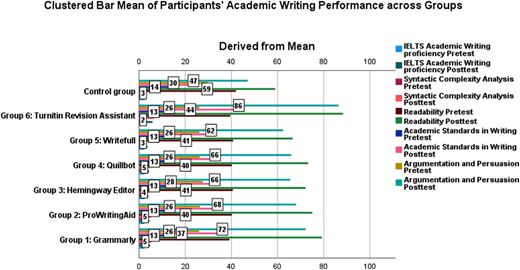
Mean of scores of participants’ academic writing performance across groups. The author
Mean of scores of participants’ academic writing performance across groups. The author
5.2 Triangulation of qualitative and quantitative findings
Quantitative analysis revealed that EFL postgraduate students who utilized AI-enhanced educational tools, particularly the Turnitin Revision Assistant, achieved significantly greater improvements in specific aspects of academic writing compared to those using traditional Computer-Assisted Language Learning methods. Across the dimensions of clarity and precision, demonstration of mastery, argumentation and persuasion, and conformity to academic standards, the AI tool facilitated superior enhancements in writing performance. The results indicated that the type of AI tool implemented played a crucial role in the extent of improvement, with the Turnitin Revision Assistant leading to remarkable advancements in all measured aspects. This suggests that AI-enhanced tools can effectively support the development of essential academic writing skills, surpassing traditional methods in fostering comprehensive skill enhancement.
The qualitative analysis provided valuable insights into the perceptions of learners regarding the effectiveness of artificial intelligence (AI)-enhanced educational tools in improving academic writing skills. A thematic analysis was conducted, following the six-phase framework proposed by Braun and Clarke (2006), which included familiarization with the data, generation of initial codes, identification of themes, refinement of themes, definition and naming of themes, and the production of a comprehensive report. This process involved a rigorous and systematic examination of interview transcripts and open-ended survey responses. To enhance transparency, the coding process was meticulously documented, outlining how codes were developed, applied, and refined. To ensure reliability, three independent coders analyzed the data, achieving high inter-rater agreement (κ = 0.91). Discrepancies in coding were resolved through iterative discussions and a structured resolution protocol to ensure consistency and reliability in the interpretation of the data. The coding system was developed to categorize the data into meaningful units, which were subsequently grouped into broader parent codes and subcategories. The parent codes were derived from the study’s research objectives and centered on four core dimensions of academic writing: clarity and precision, demonstration of mastery, argumentation and persuasion, and conformity to academic standards.
Participants identified four dimensions through which AI tools enhanced academic writing. First, clarity and precision improved as tools simplified complex sentences, reduced ambiguity via precise terminology, and strengthened coherence through transitional phrases. For example, AI suggestions helped restructure verbose sentences and replace vague terms, enhancing readability and lexical precision (Bahari, 2019). Second, demonstration of mastery was supported by tools offering technical vocabulary, grammatical explanations (e.g., passive voice), and theoretical concept integration, fostering professionalism and argumentative depth. Third, argumentation and persuasion benefited from AI-guided logical structuring, gap identification, and counterargument suggestions, though participants cautioned against over-reliance compromising personal voice. Finally, conformity to academic standards was facilitated through automated citation formatting, plagiarism detection, and formal tone adjustments, ensuring ethical and stylistic adherence.
Challenges included risks of overdependence on AI feedback, disciplinary adaptation barriers, and technical configuration difficulties. These underscore the necessity of balanced integration to preserve originality and discipline-specific norms (Sweller, 1988).
The findings align with Nonlinear Dynamic Language Learning Theory (NDLLT; Bahari, 2019), as AI tools enabled adaptive, self-organized learning through iterative feedback. However, excessive reliance risked stifling independent linguistic adaptation, highlighting NDLLT’s emphasis on learner-environment reciprocity. Constructivist principles were evident in AI’s scaffolding of active experimentation (e.g., revising arguments, exploring vocabulary), though autonomy preservation remained critical. Cognitive Load Theory (Sweller, 1988) explains how AI reduced extraneous load (e.g., automated grammar checks) but also risked overload when feedback complexity exceeded learner capacity. These results advocate for pedagogically structured AI integration, combining adaptive tools with training in critical engagement to balance efficiency, originality, and disciplinary rigor.
5.2.1 Synthesis of theories
The integration of Nonlinear Dynamic Language Learning Theory, Constructivist Learning Theory, and Cognitive Load Theory offers a comprehensive framework for understanding the multifaceted impact of AI-enhanced educational tools on language learning. NDLLT highlights the dynamic and context-sensitive nature of language acquisition, emphasizing the importance of adaptive feedback and learner agency. Constructivist Learning Theory underscores the active role of learners in constructing knowledge, emphasizing the value of interactive feedback and iterative learning processes. Cognitive Load Theory, in turn, provides insights into the cognitive mechanisms underlying effective learning, highlighting the importance of balancing cognitive demands to optimize learning efficiency. Together, these theories illustrate how AI tools can create adaptive, learner-centered environments that support the development of academic writing skills while addressing the cognitive and contextual complexities of language learning.
However, the findings also reveal the potential risks associated with AI tools, including over-reliance, cognitive overload, and reduced learner autonomy. Addressing these challenges requires a balanced approach to the design and implementation of AI tools, ensuring that they complement rather than replace active, learner-driven processes. By aligning with the principles of these three theoretical frameworks, AI tools can enhance pedagogical practices and learner outcomes, offering valuable insights into the strategic deployment of technology in educational settings.
6. Discussion
The study provides robust evidence for the effectiveness of AI-enhanced tools in advancing academic writing skills among EFL postgraduate students. Integrating multiple AI tools contributes to the expanding research on AI in education, aligning with Wang (2022), who demonstrated significant improvements in writing quality through precise feedback and iterative refinement. The exceptional performance of Group 6, supported by the Turnitin Revision Assistant, highlights the pedagogical value of comprehensive feedback systems that address both grammatical accuracy and stylistic precision. Nonlinear Dynamic Language Learning Theory (NDLLT) explains this outcome, emphasizing the adaptive and iterative nature of language learning. The Turnitin Revision Assistant, by delivering evolving and context-sensitive feedback, facilitated learner-driven improvement and refinement, extending Wang’s findings by demonstrating measurable gains in syntactic complexity and stylistic precision.
The findings corroborate Woo et al. (2024), who identified motivational benefits of AI tools like ChatGPT in EFL contexts, including heightened engagement and reduced cognitive strain. Group 6 participants reported increased motivation and satisfaction, attributed to targeted and constructive feedback mechanisms. Constructivist Learning Theory frames this observation by emphasizing active learner engagement as a core driver of meaningful learning. Turnitin Revision Assistant feedback required learners to reflect on progress, engage in iterative revisions, and take responsibility for skill development, fostering critical thinking and problem-solving. This outcome advances Woo et al.’s conclusions by illustrating how constructivist principles can be operationalized in AI-assisted academic writing, transforming the revision process into an interactive, reflective endeavor.
Wang et al. (2023) highlighted the potential of AI tools to support international students in higher education. The current findings expand this perspective by demonstrating specific improvements in syntactic complexity and readability through AI-assisted learning. Cognitive Load Theory provides a framework for understanding these improvements, positing that reducing extraneous cognitive demands allows learners to allocate resources to higher-order processes. Automation of routine tasks, such as grammar correction and citation formatting, enabled learners to concentrate on complex writing aspects, including argumentation and synthesis. Significant improvements in clarity and syntactic complexity among Group 6 participants validate the role of AI tools in alleviating cognitive strain and facilitating deeper engagement with academic writing tasks. The findings extend Wang et al.’s work by identifying specific areas of improvement enabled by AI tools while addressing cognitive needs.
The holistic evaluation of multiple AI tools across diverse dimensions of academic writing represents a unique contribution, emphasizing synergistic effects of comprehensive feedback systems. Yeo (2023) raised concerns about academic integrity in AI use, underscoring the importance of critical engagement with AI-generated feedback. Findings indicate that fostering critical thinking and encouraging learners to evaluate and refine their work mitigates potential over-reliance on AI tools. Constructivist Learning Theory supports this conclusion, emphasizing critical engagement as essential for meaningful learning. Turnitin Revision Assistant feedback promoted reflection and active skill development, which addresses concerns raised by Yeo while advancing ethical and reflective use of AI in education.
Khalifa and Albadawy (2024) positioned AI primarily as a productivity tool. Evidence from Group 6 challenges this perspective by demonstrating the pedagogical value of AI in skill development and learning enhancement. Nonlinear Dynamic Language Learning Theory supports this interpretation, highlighting the role of adaptive feedback in facilitating iterative improvement. Addressing both lower-order (e.g., grammar) and higher-order (e.g., argumentation) writing skills, AI tools exemplify how adaptive systems support dynamic, learner-driven academic writing development. This contrasts with Khalifa and Albadawy’s productivity-focused perspective by emphasizing AI’s broader pedagogical impact.
Tang et al. (2024a) advocated for transparency in AI use for academic writing. Findings align with this perspective, emphasizing the importance of clear guidelines to ensure ethical use, promote integrity, and maximize educational outcomes. Cognitive Load Theory underscores the necessity of balancing cognitive demands to optimize learning. Structured and transparent feedback mechanisms reduce cognitive strain while fostering critical engagement with academic writing tasks. The findings extend Tang et al.’s conclusions by demonstrating how transparency and ethical guidelines enhance the pedagogical utility of AI tools, ensuring effective integration into academic writing instruction.
Integration of Nonlinear Dynamic Language Learning Theory, Constructivist Learning Theory, and Cognitive Load Theory provides a comprehensive framework for understanding the role of AI tools in academic writing instruction. NDLLT explains the adaptability of AI tools in supporting dynamic, learner-driven improvement. Constructivist Learning Theory highlights the capacity of AI tools to foster active engagement and critical thinking, while Cognitive Load Theory demonstrates their role in reducing extraneous cognitive burdens to enable focus on higher-order writing processes. Together, these frameworks contextualize the significant gains observed in clarity, precision, and overall academic writing proficiency among Group 6 participants.
The findings of this study highlight the unique capabilities of AI-enhanced educational tools in providing immediate, personalized, and iterative feedback, which traditional instructional methods often struggle to deliver at scale. The significant improvements in clarity, syntactic complexity, and overall academic writing proficiency observed in Group 6 can be attributed to the Turnitin Revision Assistant’s ability to address grammatical, stylistic, and structural aspects simultaneously. This aligns with Cognitive Load Theory (Sweller, 1988), as the tailored feedback reduces extraneous cognitive load, enabling learners to focus on specific writing skills. The motivational benefits reported by Group 6 learners likely stem from the adaptive and interactive nature of AI tools, which foster engagement and active participation, consistent with Constructivist Learning Theory.
The superior performance of Group 6 is likely due to the comprehensive feedback provided by the Turnitin Revision Assistant, which not only identifies errors but also suggests actionable revisions, promoting a deeper understanding of academic writing conventions. Furthermore, the dynamic and supportive learning environment created by these tools aligns with Nonlinear Dynamic Language Learning Theory (Bahari, 2019), enabling learners to iteratively refine their writing while adapting to individual needs. These findings underscore the transformative potential of AI tools in addressing the multifaceted challenges of academic writing, particularly for EFL learners.
Despite these promising findings, the study has several limitations. First, the relatively small sample size may limit the generalizability of the results to larger or more diverse populations of EFL learners. Future research should include larger, more heterogeneous samples to validate and extend these findings. Second, the study focused on short-term improvements in academic writing, leaving the long-term impacts of AI-enhanced tools unexplored. Longitudinal studies are needed to assess whether the observed gains are sustained over time and how learners independently engage with AI tools.
Third, while the study compared multiple AI tools, it did not explore hybrid approaches that combine AI tools with traditional teacher-led instruction. Future research could investigate such hybrid methods to identify the most effective pedagogical strategies. Additionally, ethical implications of AI use in education, including issues of academic integrity and potential over-reliance on AI feedback, warrant further investigation. Research should also examine how learners develop critical thinking and self-regulation skills when using AI tools to ensure responsible and effective use.
Finally, future studies could explore the applicability of AI-enhanced tools across different educational levels, disciplines, and cultural contexts to better understand their broader impact and scalability.
7. Implications
7.1 Theoretical implications
This study advances language learning theory by redefining AI’s role through three key contributions:
Nonlinear Dynamic Language Learning Theory: Positions AI as a dynamic catalyst that creates emergent feedback loops, enabling adaptive, non-linear learning pathways and challenging assumptions of linear progression.
Constructivist Learning Theory: Reframes AI as a collaborative cognitive agent that actively co-constructs knowledge with learners, fostering iterative meaning-making and higher-order thinking.
Cognitive Load Theory: Introduces adaptive cognitive load management, where AI dynamically adjusts task complexity to align with learners’ cognitive states, optimizing germane load while reducing extraneous demands.
Additionally, the study proposes a hybrid pedagogical-computational framework, merging humanistic pedagogy with computational intelligence to position AI as an ethical collaborator that supports learner autonomy, creativity, and critical thinking. These theoretical shifts challenge traditional paradigms and provide a foundation for exploring ethical, cognitive, and pedagogical dimensions of AI in education.
7.2 Practical implications
The findings offer actionable strategies for integrating AI into language education, grounded in empirical results:
7.2.1 Curriculum design and instructional strategies
Discipline-Specific Integration: Use tools like Writefull (STEM) and Turnitin Revision Assistant (social sciences) to align AI feedback with disciplinary conventions. For example, STEM students refine technical precision, while humanities students improve narrative flow.
Critical Engagement Training: Provide explicit instruction on interpreting AI suggestions within disciplinary contexts (e.g., citation styles, argumentation norms) to mitigate over-reliance.
7.2.2 Metacognitive skill development
Implement structured reflection activities where students compare AI feedback with their revisions and justify choices.
Use dual-modality tasks (AI-assisted + manual drafting) to retain learner agency while leveraging AI for targeted improvements.
7.2.3 Ethical and academic integrity
Design citation workshops using AI tools (e.g., Grammarly, Zotero) for real-time feedback on discipline-specific standards.
Embed discussions on AI ethics (e.g., originality, bias) into curricula to cultivate responsible use.
7.2.4 Challenges addressed
Over-reliance: Collaborative peer reviews and workshops where students critique AI suggestions.
Nuanced Interpretation: Scaffolded assignments (e.g., manual outlines refined via AI) to balance automation with critical thinking.
7.3 Future research directions
The study identifies key areas for further investigation:
Ethical Dimensions: Longitudinal studies on AI’s impact on academic integrity and learner identity.
Cognitive Adaptation: How adaptive cognitive load systems affect long-term knowledge retention across learner profiles.
Domain-Specific AI: Developing AI tools tailored to underrepresented disciplines (e.g., creative writing, non-Western academic traditions).
Human-AI Collaboration: Investigating optimal balance points between automated feedback and human mentorship.
8. Conclusion
The study demonstrates the significant impact of AI-enhanced tools, such as Grammarly, ProWritingAid, Hemingway Editor, Quillbot, Writefull, and Turnitin Revision Assistant, on advancing academic writing skills among EFL postgraduate students. The tools were found to improve clarity, precision, argumentation, and adherence to academic standards, outperforming traditional Computer-Assisted Language Learning methods. Quantitative analysis confirmed statistically significant improvements across key writing dimensions, while qualitative feedback highlighted increased learner confidence and skill development. The findings provide a robust theoretical contribution by situating the results within Nonlinear Dynamic Language Learning Theory, Constructivist Learning Theory, and Cognitive Load Theory. The frameworks explain how adaptive feedback, reduced cognitive strain, and active learner engagement drive improvements in academic writing. The study highlights the transformative potential of AI tools to foster iterative refinement, learner autonomy, and critical engagement with feedback, while also addressing challenges such as over-reliance on AI and the need for educator guidance in integrating these tools effectively. The research advances the understanding of AI’s role in education by offering a comprehensive, theory-driven analysis of its impact on academic writing. Furthermore, it provides actionable insights for educators seeking to strategically integrate AI tools into curricula to enhance learning outcomes and foster essential 21st-century skills. Future research should explore the long-term effects of AI-assisted learning and its applicability across broader educational contexts, ensuring sustainable and equitable implementation in diverse learning environments.
No other individuals have made significant contributions to the present study.
The supplementary material for this article can be found online.

