The organic food market is gaining momentum in advanced and developing economies. This study aims to unfold the determinants explicitly associated with consumers and organic food products (OFPs) that influence consumers’ attitudes and purchase intentions in a developing economy.
The stimulus–organism–response (SOR) is modified to examine the reasons behind the consumers’ purchase intentions of OFPs. Consumer-specific and product-specific stimuli are considered to find their influence on the orgasmic state of the consumers in the form of attitude and, finally, their purchase intentions in the form of response. A simple random sampling procedure was used during January and February 2024 to obtain the study-related responses from the participants from six major cities in India. Three hundred eighty-two questionnaires were deemed suitable for the study after excluding any outliers and incomplete responses from the completed survey. After screening and validating the collected data in IBM SPSS statistics 23, Amos version 23.0 was used to analyze the study’s hypotheses.
The findings showed that consumers’ specific stimuli, such as environmental concern, health consciousness and food safety concerns, positively motivate consumers’ attitudes. Also, product-specific stimuli such as nutritional content and awareness of OFPs positively affect the attitude of the consumers. Surprisingly, price fairness is revealed to have no substantial impact on the consumers’ attitudes. Finally, it is revealed that the consumers’ attitude positively impacts their purchase intentions of OFPs.
The study’s findings will assist OFP marketing professionals in comprehending the significant impact of consumer-specific and product-specific aspects of the products in shaping consumers’ attitude towards OFPs. The research discoveries are expected to offer valuable insights to aid decision makers in marketing OFPs to consumers in developing economies like India.
The present work has uniquely modified the SOR model by considering the consumer-specific and product-specific aspects of OFPs and empirically validated that both aspects are significant in shaping consumer attitudes, especially in developing economies like India.
1. Introduction
In this modern era of the 21st century, consumers’ attitudes are shifting positively towards organic food products (OFPs) due to increased knowledge and availability of OFPs and consumers’ health and environmental consciousness (Liu et al., 2020). The demand for OFPs has steadily risen over the past few decades, leading to increased production and consumption worldwide (Khan et al., 2023). Organic food items are manufactured using organic farming standards; therefore, they are regarded as environmentally friendly items that are fresh, nutritious and have a lower ecological impact, resulting in reduced environmental contamination (Chetioui et al., 2023). The demand in the OFPs category has witnessed tremendous growth due to the COVID-19 pandemic because consumers now see these products as safe and immunity boosters which ultimately help in fighting diseases (Grinberga-Zalite et al., 2021; Parashar et al., 2023). World Health Organization (2020) expects the organic food industry to touch US$189.8bn with a growth rate of 14.1%. Researchers, academicians and marketers believe that OFPs benefit consumers and other stakeholders of the organic food industry (Cachero-Martínez, 2020; Parashar et al., 2023).
The importance of food quality and safety has increased significantly due to increased health consciousness among consumers (Liu et al., 2020; Wang et al., 2024). OFPs are frequently seen by consumers as being more nutritious and healthier than conventional food (Grinberga-Zalite et al., 2021). The acceptance of organic and environmentally friendly food products is growing exponentially in advanced countries like Europe and North America, followed by emerging countries (Khan et al., 2023). Therefore, the available data shows that the organic foods and beverage market has increased revenues from US$71.2bn in 2012 to US$161.5bn by 2018 (Willer and Sahota, 2020). Consistent demand for OFPs is seen in Latin America, Asia and South Africa (Mohd Suki et al., 2022).
As people get educated, more and more information flows down among consumers that nonorganic foods are detrimental to the environment and health (Khan et al., 2023). Such concerns and protests related to environmental safety led the human population to rethink and relook at food consumption; therefore, consumers are shifting towards OFPs because they are now more health-conscious and environmentally friendly, leading to an upsurge in the OFPs market (Parashar et al., 2023). Organic product demand is negligible in most developing nations; however, it is expanding in select high-income segments of the population (Aschemann‐Witzel and Zielke, 2017). This makes marketers curious about consumers’ attitudes, consumption patterns and purchase decisions of OFPs (Pahari et al., 2023). Furthermore, understanding consumer attitudes is significant because it helps understand why consumers create preferences (Baş et al., 2024). They also provide insight into the factors influencing customers’ propensity to accept organic products (Khan et al., 2023). Marketing and communication are also affected by attitudes (Liu et al., 2020). In both situations, attitudes help us forecast future intentions and understand how to influence present behaviour to promote organic product use or avoid consuming non-organic products (Chetioui et al., 2023).
Prior works have shown that food consumption is a complicated phenomenon because it is influenced by various consumer-specific factors like moral and subjective norms, health and environmental consciousness and social, cultural and geographical factors (Khan et al., 2023; Pahari et al., 2023; Parashar et al., 2023), and also various product-specific factors like price, availability, nutritional content and awareness of the product play a substantial role in determining food consumption patterns of consumers (Lee and Yun, 2015; Asif et al., 2018; Raj et al., 2024). In the food categories, the exponential growth in demand for OFPs opens up opportunities to inspect the patterns of consumers’ organic food purchases and the factors influencing these patterns (Baş et al., 2024). To better explain the factors encouraging the consumption of OFPs, earlier works have indicated a necessity to design sophisticated theoretical frameworks, including additional variables and aspects (Parashar et al., 2023; Yadav and Pathak, 2016). Hence, researchers used theories like the theory of reasoned action (TRA), the theory of planned behaviour (TPB) and the stimulus–organism–response (SOR) consequence framework in explaining complexities associated with consumers’ OFPs purchase patterns (Talwar et al., 2021; Gundala et al., 2022).
India’s OFCs market, in terms of production and consumption, has increased; now, the circumstances and situations are different from earlier, and consumers now have different lifestyles and attitudes (Raj et al., 2024). Their concern about health and food safety has been increasing daily, and they show interest in consuming OFPs because they perceive them as healthy and have other environmental benefits (Parashar et al., 2023). The demand for OFPs is growing, therefore; researchers and marketers opined to explore further critical factors influencing the purchase patterns of consumers in different settings, which will facilitate marketing specialists, government officials, suppliers and other stakeholders of OFPs in designing and implementing strategies to enhance the consumption of these products (Wang et al., 2024). Also, the existing literature indicates that researchers from developed and under-developed economies have thoroughly investigated the organic food domain, examining consumer concerns and behaviour by using human psychology theories and providing valuable suggestions to marketers. (Liu et al., 2020; Grinberga-Zalite et al., 2021; Gundala et al., 2022). In the available literature, it is also evident that factors directly associated with OFPs impacting the attitude and behaviour of consumers have not been thoroughly explored (Khan et al., 2023; Pahari et al., 2023). In developing economies like India, aspects like content, awareness, price and availability of the products and services play a critical role in shaping the attitude and purchase behaviour of the consumers (Konuk, 2018; Setiawan et al., 2020; Parashar et al., 2023). Hence, to better comprehend and enhance the understanding of OFP consumption patterns in developing economies like India, there is a need to investigate these patterns by focusing on consumer concerns and other critical factors directly associated with OFPs that influence consumers’ attitudes and purchase decisions.
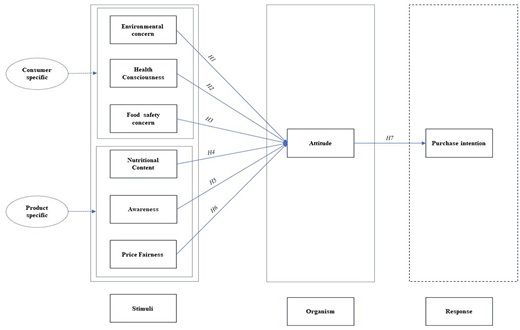
Agrarian economies like India have the potential to do organic farming, and it is expected to create demand for OFPs by providing proper knowledge and marketing (Arora et al., 2021). Therefore, to better explain the consumption patterns of OFPs in India’s developing economy and to fill the research gaps mentioned above, the present study used the modified SOR framework in the conceptual model (Russell and Mehrabian, 1977). Considering the need of the current work, one set of factors like environmental concern, health consciousness and food safety concerns directly linked with consumers and another set of factors like awareness, nutritional content and price fairness directly associated with OFPs are taken as the stimuli. Consumer’s attitude is taken as their orgasmic state, and their purchase intention is taken as their response. These attributes are relevant to the food product and influence the attitude and purchase behaviour of the consumers significantly (Parashar et al., 2023; Wang et al., 2024). Also, these attributes are significantly related to food selection; when consumers intend to purchase food, they consider these attributes, especially OFPs (Baş et al., 2024).
Hence, the present work uniquely modifies the SOR model in filling the literature gap on consumer behaviour in the context of OFP purchase decisions by bifurcating factors into consumer and OFP-specific stimuli that impact consumers’ attitudes. Furthermore, it deepens the understanding of OFP marketing based on consumers’ concerns and highlights the importance of OFP-specific factors shaping consumers’ attitudes and purchase intentions in a developing economy like India. Additionally, the study’s findings are unique and helpful for OFP marketers in comprehending the specific effect of consumer and product-related factors in the consumer’s decision to purchase OFPs, which will help them formulate marketing strategies. Furthermore, it is noteworthy that a significant percentage of the world’s population belongs to developing economies, including the middle-income group, so understanding the drivers of their food choices becomes vital (Prakash et al., 2023). Hence, the findings of the current work can provide marketers with a better understanding of the factors that shape the consumer’s purchase decisions of OFPs in emerging and developing economies like India.
2. Stimulus organism response model and hypothesis development
Russell and Mehrabian (1977) proposed the SOR framework, which tries to explain that the stimuli (S) influence the individual orgasmic (feeling and emotions) state (O), which in turn motivates their actual decisions in the form of response (R). Stimuli are the internal and external factors associated with a product or service that motivate individuals’ feelings (positive or negative) towards the product, service or technology. At the same time, the orgasmic state of an individual can be measured in the form of their attitude or behaviour towards a specific product, service or technology. The magnitude of the orgasmic state influences the final decisions of the individuals in the form of their response towards a product, service or technology. So, the SOR model provides a unique flexibility for different sets of stimuli depending upon the context of the product and services. Also, in the SOR model, orgasmic states and the ultimate decisions (responses) of the consumers can be considered as per the domain and need of the study.
The applicability of the SOR model has already been tested by authors, who have provided valuable suggestions to various players of OFPs and other related domains. Depending upon the need of the study, authors have used multiple constructs related to OFPs as stimuli, organisms and responses in their conceptual models to better explain the pre and post-purchase patterns of consumers in developing and developed economies (Liang and Lim, 2021; Talwar et al., 2021). For instance, Sultan et al. (2021) showed that marketing communication sources and organic food in the form of stimuli of organic food stimulate the orgasmic feeling of the consumers in the form of hedonic and utilitarian attitudes, and ultimately, their response in the form of behavioural intentions. In another study on OFPs, health consciousness and food safety taken as stimuli have a significant influence on the orgasmic state of consumers in the form of openness to change and ethical self-identity of the consumers, and finally, impacting the purchase patterns of the consumers (Talwar et al., 2021). In most of the previous studies discussed above, authors have used either the aspects of consumers or OFPs as the stimuli in their conceptual framework, thus, ignoring to specifically combine consumer-specific aspects and organic food-specific aspects to present the stimuli of the OFPs.
Therefore, the current work intends to explore how the consumer-specific factors and determinants of OFPs influence consumers’ attitude towards these products, especially in India’s developing economy. Furthermore, it also intends to explore the influence of their attitude in their actual response towards the product. Therefore, the modified SOR model is used in the present study’s conceptual model. For the above purpose, factors such as environmental concern, health consciousness and food safety concern are taken as the stimuli representing the consumer’s specific stimuli. Also, factors like nutritional content, awareness and price fairness are taken as the OFP-specific stimuli. Attitude is considered the orgasmic state of the consumer, which is formed due to the above two types of stimuli, and the purchase intention is taken as the consumers’ responses, which are formed due to their orgasmic state, i.e. attitude (see Figure 1). The further sub-sections demonstrate the relationship and frame the hypotheses between different constructs taken in the conceptual model.
2.1 Stimuli–organism (hypotheses development of H1 to H6)
The background and development of H1 to H6 are discussed in this section. For better clarity, this section is divided into two sections. Sub-section 2.1.1 represents the consumer-specific concerns and their connection with consumers’ attitudes towards OFPs. Sub-section 2.1.2 represents the specific aspects of OFPs and their association with consumers’ attitudes. These are as follows.
2.1.1 Consumer-specific (H1 to H3).
2.1.1. 1 Environmental concerns and attitude.
Environmental concern (EC) is the feeling of a person related to the issues of the environment, concerned with mitigating these issues and favouring the efforts to improve and preserve the environment (Mohd Suki et al., 2022). At the same time, attitude is a person’s predisposition to react favourably or unfavourably towards an object, product or service based on various psychological factors, including principles, values and emotional attachments (Vergura et al., 2020). Consumers’ pro-environmental behaviour affects their evaluation and purchase of products; therefore, environmentally conscious consumers often connect OFPs with the sustainability of the environment, which in turn positively motivates their attitude towards these products (Cachero-Martínez, 2020). Earlier literature has shown that concerns for the environment positively shape the attitudes of consumers towards eco-friendly products (Vergura et al., 2020). In the case of OFPs, the consumers’ concerns are found to positively enhance their attitudes because they perceive these products to be environmentally friendly (Liang and Lim, 2021). Therefore, considering the arguments presented in earlier literature and the aspects of consumer behaviour, we argue that consumers’ EC will positively impact their attitude towards OFPs. Hence, we proposed the following hypothesis:
Consumers’ environmental concern is positively associated with their attitude towards OFPs.
2.1.1.2 Health consciousness.
Health consciousness (HC) can be explained as a person’s care for their health; therefore, healthy and nutritional food comes to their mind to help maintain appropriate health (Wang et al., 2024). OFPs often enter consumers’ minds due to their safety, high nutritional value and reduced presence of pesticides and chemicals (Akter et al., 2023). Consumers have developed a heightened awareness of their health in recent years and view OFPs as healthier and more nutritious than regular food; hence, they show a favourable attitude towards these products (Parashar et al., 2023). Therefore, prior works have stated that HC positively enhances consumers’ attitudes concerning organic food among consumers in developed and developing countries (Yadav and Pathak, 2016; Chetioui et al., 2023). Considering the findings and suggestions from prior studies mentioned above, it is believed that the HC of consumers in India will directly and positively impact their attitude towards OFPs. Hence, the following hypothesis is proposed:
Consumers’ health consciousness positively influences their attitude towards OFPs.
2.1.1.3 Food safety concerns.
Food safety is about taking care of food, from preparation to handling, and the best way to store food so that foodborne illnesses can be eliminated. Consumers’ food safety concern is their anxiety about foods being produced and processed using unhealthy means, which will harm them (Talwar et al., 2021). Authors have opined that consumers, first and foremost, think of food safety as food free from pesticides, chemical fertilizers, artificial colouring and additives (Yadav and Pathak, 2016). In literature, it is evident that consumers generally perceive that organically produced goods are favourable to health and less risky to consume compared to regular foods, which ultimately enhances their attitude towards these goods (Chen et al., 2014). In prior studies regarding OFPs, it was found that consumers with food safety concerns acknowledge that OFPs are safe for consumption, and hence, their attitude towards these products shifted positively (Ueasangkomsate and Santiteerakul, 2016). We accept the importance of food safety concerns in this new era, and, therefore, we believe that Indian consumer’s food safety concern will positively impact their attitude towards OFPs. Hence, the following hypothesis is formulated:
Consumers’ food safety concerns will positively influence their attitude towards OFPs.
2.1.2 Products specific (H4 to H6).
2.1.2.1 Nutritional content.
Nutritional contents are the substances in the food that are beneficial for health (Akter et al., 2023). Health-conscious consumers are interested in knowing the nutritional content of their food; therefore, they tend to show a favourable attitude towards nutrient-rich foods (Craig and Fresán, 2021). Also, health-conscious consumers are curious to know the nutrients in their foods; therefore, they search for nutritional information about the food they consume (Lee and Yun, 2015). Earlier works stated that the availability of information concerning the food’s nutrients positively shapes the consumer’s attitude (Ali et al., 2021). Consumers in developing and developed economies are aware of the importance of nutritional content in the food they consume, and they perceive OFPs as nutrient-rich because they are produced naturally, which positively enhances their attitude towards these products (Akter et al., 2023). Furthermore, food products’ qualities, like using fewer additives, fewer pesticides and being naturally produced, are linked to motivating consumers to perceive these products as more nutritious, ultimately influencing their attitude towards them (Liang and Lim, 2021). We anticipate that Indian consumers are mindful of the importance of nutritional content in their food; hence, it is believed that when consumers perceive that OFP’s nutritional content is higher than other traditional food products, their attitude towards these products are positively enhanced. Thus, we formulated the following hypothesis:
The nutritional content of OFPs will positively influence consumers’ attitudes.
2.1.2.2 Awareness.
Awareness of consumers’ environmental and health-related concerns is defined as recognition and striving for health and environmental solutions (Zheng et al., 2023). In the realm of OFPs, awareness can be explained as the consumer’s knowledge and idea that these products are being produced and consumed eco-friendly and are beneficial for their health. Studies have shown that several consumers know about OFPs, but many do not have sufficient knowledge (Parashar et al., 2023). Consumers’ beliefs and awareness earned during their life span shape their attitude and behaviour towards OFPs, whether favourable or unfavourable and, therefore, greater awareness is expected to be responsible for the growth of the production and consumption of OFPs and other eco-friendly products (Zheng et al., 2023). Earlier authors have shown a clear connection between consumer’s awareness and their food consumption and emphasized that awareness of the OFPs directly and positively enhances their attitude towards OFPs (Asif et al., 2018). Awareness campaigns have risen after COVID-19 (a type of pandemic), and the effect of that campaign is that people are now more aware and health-conscious and show a favourable attitude towards OFPs (Chaturvedi et al., 2021). Therefore, in emerging economies like India, proper awareness of OFPs is expected to influence consumers’ attitudes. Considering the findings and suggestions of the earlier studies and other reasons mentioned above, we have formulated the following hypothesis:
Awareness of OFPs will positively influence consumers’ attitudes.
2.1.2.3 Price fairness.
Price fairness in the realm of OFPs can be explained as a consumer’s subjective evaluation of the product’s reasonable price (Konuk, 2018). Past related works have shown that when consumers perceive organic product prices as fair based on their subjective assessment of its cost and benefits, they tend to show a positive attitude and purchase intention (Aschemann‐Witzel and Zielke, 2017; Konuk, 2019). Therefore, when consumers perceive unfairness in the prices of these organic products, they tend to show a negative attitude towards the product (Yadav and Pathak, 2016; Lee and Yun, 2015). Furthermore, the COVID-19 pandemic has enhanced the consumer’s consciousness regarding their environmental, health and food consumption responsibilities (Chaturvedi et al., 2021); hence, consumers now assess the prices of organic products with their expected health and environmental benefits and a favourable evaluation of the price fairness of the organic product impacts their attitude positively (Śmiglak-Krajewska and Wojciechowska-Solis, 2021). Additionally, in the recent related works, price fairness is revealed to be an essential element that significantly affects consumer attitude towards foods (Grashuis, 2024), especially OFPs, because they believe these products’ prices are reasonable (Eberle et al., 2023). Therefore, in the current work, it is anticipated that consumers in India’s developing economy who favourably evaluate the price of OFPs as fair compared to its environmental and health benefits will show a positive attitude towards the OFPs. Hence, the following hypothesis is proposed:
Price fairness of OFPs will positively influence consumers’ attitudes.
2.2 Organism–response (H7)
2.2.1 Attitude and purchase intention.
An attitude can be explained as a tendency to respond in a praised or ill-disposed manner to an object or persons in one’s surroundings. Attitude plays a pivotal role in positively or negatively shaping intentions; as Fishbein and Ajzen (1977) explained, attitude is a learned tendency to react constantly, praising positively or negatively concerning a given object. Attitude strongly correlates with consumer purchase intent; most past works have shown a positive association between consumers’ attitudes and purchase intent of organic food (Khan et al., 2023). In recent decades, it has been found that consumer attitudes formed because of the health and environmental advantages of OFPs positively influence consumers’ purchase intent (Chetioui et al., 2023). A thorough review of prior work focusing on consumers’ purchase patterns revealed that the consumers’ attitude is the critical factor influencing the purchase decisions of consumers (Vergura et al., 2020; Khan et al., 2023; Raj et al., 2024). Due to the limitation of watching actual consumer purchase behaviour, purchase intention is used in this work to assess the possibility of customer purchases. Considering the experiences of prior studies and other reasons discussed earlier, it is expected that the favourably motivated attitude of the consumers will positively influence their purchase intentions of OFPs. Hence, we proposed the following hypothesis:
The attitude of the consumers will positively influence their purchase intentions.
3. Research methodology
3.1 Research design
The research design used in the current work is exploratory and descriptive. Firstly, an exploratory research approach was used as the most critical factors associated with consumers and OFPs influencing consumers’ attitudes were unclear. Considering the keyword search method used in the previous works on systematic literature reviews, it was considered suitable to explore the OFPs domain using the keyword search method (Alkhowaiter, 2020). Hence, the following keywords were used in the Scopus database to filter out relevant related works: “Organic Food” OR “Organic Food Products” AND “Consumer attitude” OR “Purchase intentions”, which returned a total of 94 documents. Out of these 94 documents, only 22 were found, primarily focusing on India. A detailed review of the previously obtained documents helped us understand the critical factors associated with OFP and consumers’ purchase decisions. Furthermore, discussions with two senior researchers in the related field and three academic experts in the marketing field were tapped regarding the conceptual model of the present work. Hence, grounded on the SOR model, the conceptual model of the current work was finalized by bifurcating the stimuli into consumer and OFP-specific factors.
After extracting the vital aspects, current work evolved into descriptive research, analyzing the phenomenon by exploring how the variables correlate. For the collection of cross-sectional data, the present work identified six cities from the east, west, south and north of India, representing New Delhi and Mumbai as cosmopolitan cities, Bengaluru and Kolkata representing metropolitan cities and Lucknow and Patna representing state capitals from northern India because prior works have suggested that these cities attract people from various parts of the country with different languages and economic backgrounds and, thus, they provide a view of the national population (Madan and Yadav, 2018).
3.2 Sampling
The current study used the simple random sampling procedure for gathering study-related data because of time and monetary limitations. Most participants were approached outside the restaurants, malls, grocery stores and supermarkets in the cities mentioned above. Furthermore, before collecting data from the participants, awareness of OFPs of the participants was checked by asking filtering questions like Are you aware of OFPs? Subsequently, participants who were found eligible were included in the survey, and the study-related data was gathered. Earlier authors have presented different opinions on the minimum sample size required for acceptable statistical outcomes. For example, regarding consumer behaviour surveys, authors have suggested that a minimum of two hundred to three hundred responses or a minimum of ten responses per item should be collected (RVSPK et al., 2020). The number of items explicitly focusing on the factors of the study was 22, and the valid responses of the current work were found to be 382. Considering the opined minimum sample size in the earlier works mentioned above (either ten responses per item or a minimum of 200–300), the sample size of the present work was found satisfactory and fit for further analysis.
3.3 Measurement instrument
The questionnaire was divided into two portions; the first was to collect the participants’ demographic details, and the study’s factors-related data statements with the five-point Likert scale ranging from 1 (strongly disagree) to 5 (strongly agree) were presented in the second portion. Authors in prior studies have agreed and opined that to generalize the study findings, the scales’ content validity must be ensured and that the chosen items accurately reflect the concepts (Fahad and Shahid, 2022). Hence, the items used in the present work are adapted from well-respected prior literature to maintain the validity of the content. Three items to measure attitude in the form of consumers’ mental position towards OFPs and three items to measure purchase intention in the form of consumer’s willingness to purchase OFPs were adapted from the prior work of Peña-García et al. (2020). Three items to measure the consumers’ environmental concerns in the form of their knowledge of environmental issues were adapted from Roberts and Bacon (1997). Three items to measure awareness in the form of consumer knowledge of the OFP and its qualities are adapted from another work by Asif et al. (2018). The health consciousness of the consumers in the form of consumer care about their health was measured using two items adapted from the work of Lee (2016). Three items adapted from the research of Konuk (2018) and Setiawan et al. (2020) were used to measure consumers’ OFP price fairness in the form of their thoughts about the prices of OFPs being reasonable. Three items representing consumers’ food safety concerns are adapted from the work of Ueasangkomsate and Santiteerakul (2016). Two items representing nutritional content in the form of consumer awareness about the nutritional capabilities of OFPs were adapted from Lee and Yun (2015). The factor loadings of the items and Cronbach’s alphas of the above-mentioned factors are presented in Table 1 and were found within the suggested limit of above 0.70 (Hair et al., 2012).
3.4 Data collection
For better understanding and clarity on questionnaire items, a pilot survey of 42 samples, including researchers, academicians and research scholars, was conducted before the final distribution of the questionnaire. Pilot survey findings revealed the reliability of the questionnaire items as the Cronbach’s alpha of the pilot survey questionnaire exceeds the values of 0.70 (Hair et al., 2012). Furthermore, considering the inputs gathered from the academic experts during the pilot survey and after adjusting the questionnaire items, the questionnaire was distributed for the survey. Furthermore, to keep the collected data free from any biases, responses from the pilot survey were not added to the responses collected at the final stage.
For the present work, 640 questionnaires were distributed during January to February 2024 in the cities mentioned in sub-section 3.1, and 445 questionnaires were collected back with a response rate of 69%. Initial screening of the collected questionnaire revealed that some incomplete questionnaires were present; therefore, they were removed. Some possible outliers in opting for extraordinarily high or low values throughout the questionnaire items were also identified and removed in the screening process. Finally, 382 filled questionnaires were found valid and fit for further analysis. A simple statistical analysis of the questionnaire revealed that 58% of the participants were male, and considering the age group, 65% of the respondents belonged to the age group of 18–29. The educational qualifications of the respondents were as follows: 21% were up to intermediate pass-outs, 33% were graduates, 32% were post-graduates and the remaining had PhD and above degrees. Forty-five percent of the participants were full-time salaried, and more than half of the participants (52%) opted for the income group “Up to Rs 30,000”. The complete demographic details of the participants are presented in Table 2 of the study.
3.5 Data analysis
The primary goal of the present work was to examine consumers’ attitudes and purchase intentions of OFPs in India’s emerging economy. A questionnaire-based survey was conducted to gather data from the respondents. As opined in the prior studies, a two-step approach was followed for the current study’s data analysis by using IBM SPSS version 23.0 and AMOS 23.0 (Anderson and Gerbing, 1988). In the first step, confirmatory factor analysis (CFA) was performed to test the validity and reliability of the data and the model. Finally, the study’s hypotheses were evaluated using the structural equation modelling (SEM) approach, and hypotheses were analyzed by focusing on standardized regression weights (β) and p-values found in AMOS 23.0.
4. Results of the study
4.1 Common bias method
The Harman single-factor test is a commonly used approach for assessing the presence of common method bias (CMB) in data (Fahad and Shahid, 2022; Podsakoff et al., 2003). Therefore, the Harman single-factor procedure was used to assess the CMB for the present work. The test outcome indicated that a single factor accounted for 40.94% of the total variance; the above-obtained result is well beyond the threshold limits suggested in prior literature, i.e. less than 50% (Podsakoff et al., 2003), thus, indicating no question of biasness in the collected data set.
4.2 Measurement model
A good and strong model fit ensures a good fit between a theoretical model and empirical data. In earlier works, certain limits are suggested regarding a good model fit for any given model, which is as follows: chi-square/degree of freedom (CMIN/DF) should be equal to or smaller than three (≤3). GFI, NFI and CFI should be greater than or at least equal to 0.90 (≥ 0.90). AGFI should be greater than or equal to 0.80 (≥ 0.80), and RMSEA should be smaller or equal to 0.08 (≤ 0.08) (Hair et al., 2012). For the present work, all the above-mentioned fit indices were within the recommended limits (see Table 3), thus, confirming a good model fit between the proposed theoretical model and the study’s empirical data.
4.3 Validity and reliability of factors and items
Certain threshold limits are suggested in the prior works to ensure the reliability and validity of the study’s data (Fornell and Bookstein, 1982; Hair et al., 2012). For the reliability of the study’s data, the following are the suggestions to be ensured: loading of the factor items should be greater than 0.50, and composite reliability (CR) values should be greater than 0.70. For the convergent validity, it is suggested that average variance extracted (AVE) values should be greater than 0.50 (Hair et al., 2012). As shown in Table 4 of the study, the following conditions are fulfilled by the data obtained during the present survey, confirming the reliability and validity of the data.
The following are the suggested criteria for checking the discriminant validity of the data. The correlation coefficient between any two constructs must be less than the square root of the AVE of that construct (bold values in Table 4 of the present work). Furthermore, the MSV and ASV values must be smaller than the construct’s AVE, and the square root of AVE must be greater than the correlation values between the construct (Fornell and Bookstein, 1982). The findings shown in Table 4 indicate that the present work’s measures successfully met the above criteria, confirming the discriminant validity.
4.4 Structural model analysis
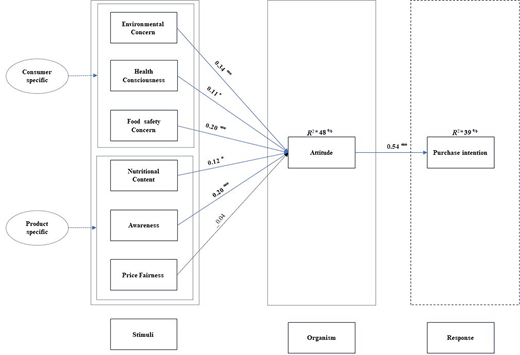
The structural model of the present work is evaluated in the second stage to test and confirm the results of the hypothesis and model. The fit indices of the structural model presented in Table 3 are found within the suggested limits (Hair et al., 2012). Path coefficient analysis was used to test the main causal path of the study (see Table 5). The SEM analysis revealed that consumer-specific factors (H1 to H3), namely, environmental concerns, health consciousness and food safety concerns, positively impact consumers’ attitude towards OFPs. Also, product-specific factors (H4 and H5), namely, nutritional content and awareness, directly and positively impact consumers’ attitude towards OFPs. Surprisingly, price fairness (H6) is found to have no impact on the consumers’ attitudes. Furthermore, attitude (H7) significantly influences consumers’ purchase intentions for OFPs (see Table 5). Also, the R2 value for attitude is revealed to be 48%, and for purchase intention, the R2 value is found to be 39%. Both R2 values are within the acceptable range of 0.25–0.50, as Hair et al. (2012) suggested (see Figure 2).
5. Discussion and conclusion
5.1 Discussion
The current work focused on empirically understanding consumers’ intentions of OFPs from a developing country’s perspective. Furthermore, it also aimed to recognize the vital factors impacting consumers’ attitudes about OFPs, ultimately influencing their purchase decisions. Therefore, the current work used the modified form of the SOR model by dividing the stimuli into consumer (H1 to H3) and product-specific (H4 to H6) aspects in understanding consumer’s attitude towards OFPs and, finally, the influence of attitude on their purchase intentions (H7). The study results revealed that H1, H2 and H3 are accepted, thus, confirming that consumer-specific aspects positively influence the consumer’s attitude towards OFPs. Hence, it establishes the importance of environmental concerns, health consciousness and food safety concerns among consumers. The acceptance of H1 is in line with prior related work and confirms that environmental-conscious consumers in developing economies also perceive OFPs to be produced and consumed in such a way that there is no or very minimal environmental depletion and, therefore, they show a positive attitude towards OFPs (Liang and Lim, 2021; Mohd Suki et al., 2022). Also, the acceptance of H2 is supported by contributions of the prior work indicating that consumers in developing economies also perceive OFPs to fit their diet and ultimately benefit their health; therefore, the health consciousness of the consumers is found to positively impact their attitude towards OFPs (Yadav and Pathak, 2016; Chetioui et al., 2023). Furthermore, the acceptance of H3 indicates that consumers perceive OFPs as safe for consumption; therefore, similar to the results of earlier works, food safety concerns are found to influence the consumers’ attitude towards OFPs positively (Chen et al., 2014).
By focusing on product-specific aspects, the study findings showed that H4 and H5 are accepted, thus, confirming the importance of nutritional content and awareness of OFPs in positively shaping the consumer’s attitude. The acceptance of H4 aligns with the contribution of earlier works indicating that consumers perceive the nutritional contents of OFPs as superior to those of traditional food products and form a positive attitude towards the products (Liang and Lim, 2021; Craig and Fresán, 2021; Akter et al., 2023). Furthermore, acceptance of H5 indicates that awareness of OFPs positively influences the consumers’ attitude towards the products. It acknowledges the value addition of the prior work and confirms that consumers aware of OFPs and their features like content, quality, environmental impact and availability tend to have a positive attitude towards them (Chaturvedi et al., 2021; Zheng et al., 2023). H6 was not accepted, indicating that price fairness does not directly impact consumers’ attitudes in India’s developing economy and that the price of OFPs does not significantly shape the consumers’ attitudes. Surprisingly, this result is not in line with the prior study’s outcomes; it is expected that this might be because the OFPs market is still developing in India’s emerging economy, and, therefore, price fairness is not a significant concern at this evolving stage (Eberle et al., 2023; Grashuis, 2024). H7 of the current work is accepted, showing that consumers’ attitude is positively enhancing their decision related to the purchase of OFPs, confirming the outcomes of the prior works; this result indicates that positively motivated consumers are in favour of OFPs and they intend to purchase it (Vergura et al., 2020; Khan et al., 2023; Raj et al., 2024).
5.2 Conclusion
The present work explored the factors influencing consumers’ attitudes and subsequent purchase intentions regarding OFPs in India’s developing economy. Based on the findings of the present work, it is concluded that the proposed stimuli (both consumer and product-specific factors) are pivotal in shaping consumer attitude towards OFPs. Notably, environmental concerns, health consciousness, food safety concerns, nutritional content and awareness of OFPs emerged as significant determinants impacting consumer attitudes in India’s developing economy, indicating that consumer and product-specific factors are critical in shaping consumer attitude towards OFPs, which ultimately affects their purchase intention of the products. These findings highlight consumers’ growing inclination to purchase OFPs that align with their subjective environmental, health and food-related responsibilities. Therefore, marketers are advised to consider these insights when developing and promoting OFP offerings. Furthermore, marketers can effectively tap into the increasing demand for sustainable food options by enhancing awareness of OFPs and emphasizing health and environmental benefits.
The current work has also shown that the SOR model is valuable for comprehending and forecasting consumers’ intention towards OFPs. It also revealed that the division of the stimuli based on the aspects of the product and consumer could enhance the reliability and prediction power of the SOR model, as the same is proposed and established in the current work by dividing the stimuli of the OFPs into consumers and product-specific aspects. Furthermore, most prior work on OFPs was conducted in developed economies. The present work attempted to find the association between factors of OFPs and consumers’ attitudes, and finally, consumers’ purchase intentions from a developing economy perspective of India. The findings of the current work can be applied to other developing economies with cultural and socio-economic conditions similar to India’s, such as Bangladesh and Bhutan. Finally, the current work contributes to the discussion on achieving sustainable global food consumption, primarily focusing on OFPs for growing populations in developing economies like India.
6. Implications of the study
6.1 Theoretical implications
In the current work, after applying the modified SOR model and receiving the findings, it is evident that most of the considered constructs are essential in the purchase decisions of OFPs in the current context of India’s developing economy. Hence, it enhances the understanding of the marketing and pricing of OFPs from a developing country’s perspective. Most of the results obtained in the analysis align with the hypotheses of the current work, with some vital contributions. The following are the ways in which current work has contributed theoretically. Firstly, to enhance the understanding of consumers’ intentions to purchase OFPs in India’s developing economy, the study presented a novel conceptual model using the modified form of the SOR model. The present work’s conceptual model has widened the application of SOR by bifurcating the stimuli into two main sets: concerning consumers and products. Secondly, the study has explained that not only are the product-specific stimuli the reasons behind the consumers’ attitudes, but they are also dependent on the specific concerns of the consumer towards OFPs specifically and any consumer products in general. In this way, the present study’s framework has enhanced the understanding and applicability of the SOR model towards environmentally friendly products and other related domains. Thirdly, we argue that this framework can be applied in studies focusing on the intentions and behaviour of consumer towards any given product or service. Finally, the present work has comprehensively demonstrated the importance of nutritional content, awareness about OFPs and consumer-specific concerns like health, environment and food safety in the consumers’ attitude and decision process of OFPs.
6.2 Practical implications
The study has implications for managers and other stakeholders in understanding consumer and product-specific concerns related to OFP consumption patterns from a developing economy’s perspective. The study result highlighted the vital role of consumers’ health and environmental consciousness and food safety concerns in shaping their attitude towards OFPs. Therefore, in developing economies like India, domestic and international OFP marketers are suggested to highlight the importance of health benefits consumers may gain by consuming their OFP. Furthermore, marketers are advised to highlight their OFP’s contribution to environmental and ecological safety, as consumers who are conscious of the need for environmental safety tend to show positive attitude towards OFPs because they perceive that OFPs are being produced and consumed in an eco-friendly way. Therefore, while developing marketing strategies for the product, OFP marketers may highlight the environmentally friendly materials and procedures adopted during the production and processing of their products. Furthermore, the consumers’ concerns regarding food safety are found vital in positively enhancing their attitude towards OFPs; therefore, marketers are suggested to highlight the methods, materials and procedures adopted in manufacturing, processing, preserving and packaging their OFPs to make their products safer than other regular food products. For instance, they may use advertisements or secondary and tertiary packaging of the product to highlight the organic material, safer production, processing and packaging involved during the production and distribution of their OFP, and finally, its positive impacts on the health and environment after the consumption.
The outcomes of the current work indicated that the nutritional content of OFPs has a vital and positive impact on the attitudes of the consumers; therefore, while developing marketing strategies, marketers are suggested to highlight how everyday foods do not fulfil consumers’ nutritional needs and ultimately explain how their OFPs’ nutritional content, quality and capabilities fulfil consumers’ dietary needs. Furthermore, awareness of the OFPs is found to have a significant positive effect on consumers’ attitudes. Therefore, marketers are suggested to use mass media, social media and other platforms to conduct awareness drives about their OFP; they may explain that while their OFP is safer to consume, it has a vital positive impact on the environment and their health. In the current context of India, price fairness is not found influential, but prior literature suggests price fairness is necessary to survive in the market in the long run (Eberle et al., 2023; Grashuis, 2024). Therefore, OFP marketers are advised to maintain price fairness because, in the long run, it will keep attracting potential consumers to their products. Furthermore, marketers are advised to conduct programs and events to inculcate the health, environment and food safety-related importance and benefits of OFPs in consumers’ minds because aware consumers intend to buy them. The government and concerned departments are suggested to promote and highlight the importance of OFPs for the health of consumers and the environment; for this purpose, they may conduct awareness programs and events at the country and state levels. Furthermore, they may provide subsidies to manufacturers of the OFPs because it will ultimately lead to sustainable consumption in the economy. The main conclusions and implications of the study are presented in Table 6.
7. Limitations and future research directions
Even though the present work has several implications for different stakeholders to enhance and extend the consumption of OFPs, the observed limitations may pave the way for research. The current study has used the modified SOR model in the conceptual model of the current work; future research may combine the current study’s conceptual model with other human psychological frameworks like the TPB, TRA, self-determination theory for better comprehension and understanding of the consumer’s attitude and behaviour towards OFPs (Fishbein and Ajzen, 1977; Ajzen, 1991; Khan et al., 2023). Since the sample of the present work is limited to India only, future research may use the framework of the present work to conduct a cross-country analysis. Present work has not considered the role of gender; future research is suggested to focus on gender-specific results in the developing country’s context because the role of gender is found to be significant in the consumption of products and services (Gundala et al., 2022). Also, in the present work, only a limited set of consumer and product concern stimuli are included; future research may use other vital factors like trust, perceived knowledge, personal innovativeness, etc. (Prakash et al., 2023). The nature of the present work is cross-sectional; therefore, a longitudinal design may be used in future research to better explain OFP consumption patterns.