Skip to Main Content
Purpose

The metaverse is reshaping the fashion industry, offering new insights into innovation diffusion. This study aims to examine how perceived innovation characteristics influence unrestrained buying behavior, using flow as a mediator. By integrating innovation diffusion and flow theory, it explores how technostress and self-control moderate the impact of innovation characteristics on flow.

Design/methodology/approach

A cross-sectional, quantitative study was conducted using multistage sampling to examine unrestrained purchase behavior. Data from 457 Asian consumers were collected via surveys and analyzed using SPSS 22.0, AMOS V.24 and MACRO PROCESS.

Findings

This study indicates that although the metaverse website’s perceived characteristics of innovation increase user flow and encourage unrestrained buying behavior, technostress and self-control weaken the relationship between how users perceive innovation (in terms of its benefits like relative advantage and compatibility) and their ability to experience flow. However, when it comes to complexity, both technostress and self-control do not significantly moderate the relationship between complexity and flow.

Practical implications

This study reveals how metaverse innovation is reshaping Asian consumers’ views of the fashion industry. It helps marketers and advertisers understand the metaverse’s impact on unrestrained buying behavior and its growing importance for the fashion sector.

Originality/value

This study offers a framework for understanding how Asian consumers’ adoption of metaverse technology is transforming the fashion industry. It adds to the literature by assessing innovation attributes and their impact on unrestrained purchasing in virtual worlds.

Comportamiento de compra sin restricciones en el metaverso: explorando el papel moderador del tecnostres y el autocontrol

Objetivo

El Metaverso está remodelando la industria de la moda, ofreciendo nuevas perspectivas sobre la difusión de la innovación. Este estudio examina cómo las características percibidas de la innovación influyen en el comportamiento de compra sin restricciones, utilizando el flujo como mediador. Al integrar la Teoría de la Difusión de la Innovación y la Teoría del Flujo, explora cómo el tecnostres y el autocontrol moderan el impacto de las características de innovación sobre el flujo.

Metodología de investigación

Se realizó un estudio cuantitativo y transversal utilizando muestreo por etapas múltiples para examinar el comportamiento de compra sin restricciones. Se recolectaron datos de 457 consumidores asiáticos a través de encuestas y se analizaron utilizando SPSS 22.0, AMOS V.24 y MACRO PROCESS.

Resultados

El estudio indica que, aunque las características percibidas de la innovación del sitio web del metaverso aumentan el flujo de los usuarios y fomentan el comportamiento de compra sin restricciones, el tecnostres y el autocontrol debilitan la relación entre cómo los usuarios perciben la innovación (en términos de sus beneficios como ventaja relativa y compatibilidad) y su capacidad para experimentar flujo. Sin embargo, en lo que respecta a la complejidad, tanto el tecnostres como el autocontrol no moderan significativamente la relación entre la complejidad y el flujo.

Implicaciones prácticas

El estudio revela cómo la innovación en el Metaverso está remodelando las percepciones de los consumidores asiáticos sobre la industria de la moda. Ayuda a los profesionales del marketing y la publicidad a comprender el impacto del Metaverso en el comportamiento de compra sin restricciones y su creciente importancia para el sector de la moda.

Originalidad/valor

Este estudio ofrece un marco para comprender cómo la adopción de la tecnología del metaverso por los consumidores asiáticos está transformando la industria de la moda. Aporta a la literatura evaluando los atributos de innovación y su impacto en las compras sin restricciones en mundos virtuales.

元宇宙中的无节制购买行为:技术压力与自我控制的调节作用探究

研究目的

元宇宙正在重塑时尚产业, 并为创新扩散提供了新的见解。本研究探讨感知创新特征如何影响无节制购买行为, 并将“心流”作为中介变量。此外, 研究融合了创新扩散理论与心流理论, 进一步分析技术压力与自我控制如何调节创新特征对心流的影响。

研究方法

本研究采用横断面定量研究方法, 并运用多阶段抽样策略以考察无节制购买行为。通过问卷调查收集了来自457名亚洲消费者的数据, 并利用SPSS 22.0、AMOS V.24和MACRO PROCESS进行数据分析。

研究发现

研究结果表明, 元宇宙网站的感知创新特征能够增强用户的心流体验, 从而促进无节制购买行为。然而, 技术压力与自我控制削弱了用户对创新的感知(如相对优势和兼容性)与其心流体验之间的关系。然而, 在复杂性维度上, 技术压力与自我控制对复杂性与心流之间的关系并未表现出显著的调节作用。

研究意义

本研究揭示了元宇宙创新如何重塑亚洲消费者对时尚产业的认知, 为营销人员和广告商提供了关于元宇宙如何影响无节制购买行为的见解, 并凸显了其在时尚行业日益增长的重要性。

研究原创性

本研究构建了一个分析框架, 以理解亚洲消费者对元宇宙技术的采纳如何推动时尚产业的变革。研究通过评估创新特征及其对虚拟世界中无节制购买行为的影响, 进一步丰富了相关文献。

The metaverse’s growing popularity in recent years has attracted the attention of several businesses, including fashion and retail. The word metaverse gained popularity in the business sector in 2020; since its gloomy beginnings in Stephenson’s (1992) science fiction novel Snow Crash, it has been portrayed as a completely new internet, a novel concept for how people will interact with and use technology in a simulated virtual environment (Dwivedi et al., 2022). This virtual universe allows users to socialize, engage in commerce, game, communicate and explore through avatars, marking a significant milestone (Efendioglu, 2023).

The fashion sector has realized the enormous scope of a metaverse for business growth in the fashion industry (Kolk, 2023). By providing digital products and immersive brand experiences, fashion brands are using metaverse (Park and Lim, 2023; Aleem et al., 2024). Numerous major fashion brands, such as Nike, Zara, Adidas, Forever21 and Boohoo, have used metaverse platforms to boost global product sales (Raghwan, 2022). With the fashion market forecast to reach $6.61bn with an annual growth rate of 36.47% in 2021–2026 and the Asia-Pacific region likely to become the biggest player in virtual and metaverse economies by 2030, the metaverse is predicted to create $2.8tn in global gross domestic product (GDP) by 2031 (Lab, 2023).

Most researchers focus on the impact of perceived innovation attributes on customer adoption and behavioral intentions, but little research has explored how these characteristics lead to unrestrained buying behavior through flow. Dwivedi et al. (2022) noted the need to identify which attributes significantly contribute to developing flow practices in the metaverse, emphasizing the importance of studying flow consciousness’s influence on impulsive purchases and user sentiments in this context. Furthermore, technostress can disrupt the flow experience of users, even when innovations are perceived as beneficial (Johnson et al., 2020; Tarafdar et al., 2015). In contrast, self-control allows users to stay focused and avoid distractions, which may improve their ability to experience flow (Hohnemann et al., 2024).

The metaverse is a modern innovation that has been growing with an exclusive diffusion among users which offers experience of flow (Akour et al., 2022; Pourfakhimi et al., 2020). Considering, Innovation diffusion theory (IDT) it highlights how factors like relative advantage, complexity and compatibility shape an individual’s decision to adopt new technology, such as the metaverse. Whereas, flow theory explains a state of deep engagement or immersion in an activity. In the metaverse, users are likely to enter this flow state, characterized by focused attention, a sense of control and a loss of self-consciousness, leading to a heightened level of engagement. Likewise, the growing usage of these immersive technologies, resulting in detrimental effects such as technostress (Khan, 2023) and lack of self-control (Feng, 2021).

This study aims to address the gap mentioned above by formulating the following research questions:

RQ1.

How is the experiential state of flow among users influenced by their perceptions of innovation attributes, consequently shaping unrestrained buying inclinations?

RQ2.

Do self-control and technostress modify how perceived innovation characteristics relate to the experience of flow?

Leveraging the IDT with flow theory, this study aims to validate and elucidate the factors underpinning individuals’ spontaneous acts within the metaverse, probing into the intricacies of their unplanned behaviors.

The rapid advancement of technology and the emergence of the metaverse have created gaps in understanding its marketing and research implications (Giang et al., 2023). Addressing the research questions adds to the existing literature in several ways. First, this study provides empirical evidence on how perceived innovation characteristics influence unrestrained purchasing behavior among Asian consumers, highlighting the mediating role of flow in the metaverse context. Second, it identifies self-control and technostress as significant moderating factors, serving fashion firms understand the challenges consumers face while purchasing fashion products through metaverse platforms. To our knowledge, this is the first study to examine how innovation characteristics affect unrestrained buying behavior through flow among Asian consumers.

After the theoretical background and literature review, the subsequent sections include the conceptual framework and related hypotheses, followed by a detailed discussion of the study methodology, data analysis and results. Finally, the study addresses its limitations while considering the theoretical and practical implications of the findings.

Rogers (1996) developed IDT to explain how consumers adopt new behaviors or products. To determine how well an invention is received, Rogers (1983) has outlined five characteristics of innovation, including relative advantage, complexity, compatibility, triability and observability, which have been identified as major determinants of acceptance behavior. Relative advantage, complexity and compatibility are the only innovative qualities that Tornatzky and Klein (1982) identified reliably correlating with innovation and adoption behavior in their IDT meta-analysis. These three IDT variables are used in the current investigation.

This theory has been widely applied in studies exploring purchase intentions for electric vehicles (Arora et al., 2022) and behavioral intentions, such as travel consumers’ willingness to adopt or experience VR programs (Kim et al., 2020). Despite its potential, this framework has not been widely applied to the metaverse concept. As an emerging technology, the metaverse exhibits a distinct pace of diffusion and acceptance (Akour et al., 2022). The study enriches the IDT literature by contextualizing it within the metaverse, where user adoption significantly influences engagement with features such as unrestrained buying. Unlike models such as TAM or UTAUT, which prioritize ease of use and utility, IDT is particularly well-suited due to its focus on social influence and communication networks. The key constructs of IDT – relative advantage, complexity and compatibility – offer significant insights into how users assess and adopt new behaviors in the metaverse (Handoko et al., 2023).

A “flow experience” is when someone becomes fully engaged in what they are doing, rejecting all unimportant things and concentrating on what is in their mind. This leads to positive psychological, emotional and cognitive outcomes (Bretos et al., 2024; Hoang et al., 2023). Csikszentmihalyi and Csikszentmihalyi (1992) describe this state for online customers as a pleasurable blend of mind and action, where the physical environment fades away. In the current study, “flow” is defined as a cognitive state of complete absorption in the metaverse, characterized by focused attention, deep engagement with the digital environment, intrinsic enjoyment and reduced distractions (Pourfakhimi et al., 2020). The use of flow theory has led to numerous insights regarding consumer immersion in emerging technologies. Prior studies have examined that the flow experience influences the immersion of virtual reality (VR) (Guerra-Tamez, 2023), flow experiences creates more trust in augmented reality (AR) apps (Arghashi and Yuksel, 2022), and Serravalle et al. (2023) argued that AR flow experience strengthens the intention to revisit the retailer’s website and purchase intent.

This theory was adopted in the current study as it focuses on how immersive experiences might result in unrestricted consumer purchasing behavior. Consequently, flow emerges as a critical psychological element that could enhance the influence of innovation diffusion factors on consumer behavior. The incorporation of aspects related to the spread of innovation and the concept of flow would contribute to a comprehensive understanding of consumers’ overall impression regarding the adoption of the metaverse.

Relative advantage is the extent to which an innovation is considered superior to the concept it substitutes (Chan-Olmsted and Chang, 2006). It has recently been used extensively in discussing new information technology (IT) products and services offered (Lin et al., 2020). The relative advantage of the technologies, through their enhanced material and visual flexibility, directly boosts users’ flow experience (Lu and Hsiao, 2022; Arora et al., 2022) and users’ perceptions of immersive technology like VR or metaverse as user-friendly and simple to use increase their flow experience (Alvi, 2024). Thus, our study proposes that users’ flow experience is influenced by the level of relative advantage that they experience in the metaverse. Therefore:

H1.

Relative advantage would positively affect users’ flow experience.

According to Rogers (1995), compatibility refers to the application of new digital services or products by users by their prior experiences. Consumers enter a state of flow when they become completely immersed in a 360-degree platform that offers compatibility with their current patterns and fashion tastes (Lu and Hsiao, 2022). Through seamless integration of immersive technology into users’ patterns and surroundings, compatibility provides a positive flow experience (Arora et al., 2022; Alvi, 2024). Therefore, consumers’ flow experience is enhanced when they understand that they may engage with metaverse technology and make use of its features for purchases. Therefore:

H2.

Compatibility would positively affect users’ flow experience.

The extent to which a product or service is subjectively thought to be comparatively difficult to use is recognized as its level of complexity (Jamshidi and Kazemi, 2020). Whenever a technology system’s interface appears difficult to use, users are more likely to be dissatisfied and form a negative perception of it, which adversely affected their experience of flow (Hang et al., 2024). Moreover, difficulties related to particular technological advances decrease consumers’ overall experience of being in the flow (Alvi, 2024). Therefore, our study illustrates that users’ flow experience is adversely affected by the obstacles associated with accessing metaverse technology. Hence:

H3.

Complexity negatively influences users’ flow experience.

Flow experience has become crucial in recent years to improve the online purchasing experience (Wu et al., 2020). Immersion is an aspect of flow experiences and when a consumer experiences a similar state of flow, they feel delighted (Gao and Bai, 2014; Shin, 2019). By fostering an immersive, entertaining and stimulating retail atmosphere, the flow experience positively affects the impulse to buy (Cui et al., 2022; Hong et al., 2022). Using advanced technology to create an immersive shopping experience can increase impulsive purchases as customers lose track of time and enjoy the virtual world (Nurlaili and Wulandari, 2024). Therefore, we posit that:

H4.

Flow experience positively influences impulsive purchasing behavior.

Flow, a condition of full involvement and pleasure in an activity, significantly affects compulsive purchasing (Lapasha et al., 2024). The use of cutting-edge technology, like metaverse can solve the lack of interpersonal interaction found in usual online purchasing (Lee et al., 2016). Here, interactive and immersive environments may induce compulsive buying behavior (Min and Tan, 2022; Chen et al., 2017). Therefore, flow experience leads to compulsive buying behavior among consumers as they feel engaged within metaverse technology. Based on this, we hypothesized:

H5.

Flow experience positively influences compulsive buying behavior.

Studying impulsive buying behavior in metaverse commerce enables researchers and businesses to adapt to the evolving consumer landscape, ensuring their strategies remain effective and relevant (Kakaria et al., 2023). Individuals with high levels of impulsivity tend to exhibit characteristics such as having more extensive shopping lists, being more responsive to unplanned and unforeseen purchasing suggestions and being more inclined to respond to impulsive purchase behaviors (Bearden and Netemeyer, 1999) that can impact compulsive buying behavior (Shehzadi et al., 2016; Ristiyani et al., 2021). Compulsive buying is a stronger version of impulsive buying (Kshatriya and Shah, 2023). Therefore:

H6.

Impulsive purchasing behavior positively influences compulsive purchasing behavior.

The only characteristics of innovation that have been found to consistently correspond with innovation are compatibility, relative advantage and complexity, according to Tornatzky and Klein (1982). The technologies’ relative advantage directly improves users’ flow experience which favorably influences the act of buying impulsively (Lu and Hsiao, 2022; Hong et al., 2022). Likewise, when users fully immerse themselves in a 360-degree environment that provides compatibility based on their current lifestyles they achieve a state of flow that leads to impulsive shopping behavior (Alvi, 2024; Serravalle et al., 2023). Whereas, users are more likely to get unsatisfied and develop a negative view of a technology system when it appears difficult to use, which detrimentally impacts their sense of flow and lowers their propensity to suggest such technology to family and friends (Hang et al., 2024; Li et al., 2024). Based on this, we posit:

H7a.

Flow acts as a mediator between relative advantage and impulsive buying behavior.

H7b.

Flow acts as a mediator between compatibility and impulsive buying behavior.

H7c.

Flow negatively mediates between complexity and impulsive buying behavior.

Immersion technologies, including VR and the metaverse, are perceived by users as easy to use, relatively advantageous and user-friendly, which improves their flow experience that may lead to compulsive buying behavior (Alvi, 2024; Lapasha et al., 2024). Furthermore, compatibility offers an optimal flow experience by effortlessly integrating immersive technology into users’ activities and the experience of flow leads to compulsive purchases (Lu and Hsiao, 2022; Min and Tan, 2022). Contrary to the above factors, customers’ overall sense of being in the flow falls whenever they have challenges with specific innovations in technology (Alvi, 2024). Based on this, we posit:

H8a.

Flow acts as a mediator between relative advantage and compulsive buying behavior.

H8b.

Flow acts as a mediator between compatibility and compulsive buying behavior.

H8c.

Flow negatively mediate between complexity and compulsive buying behavior.

The relative advantage measures how much a potential adopter thinks the innovation has an edge over earlier methods of carrying out the same work (Rogers, 1983). This perceived benefit can facilitate a flow experience among users, who become fully immersed and engaged with the innovation (Hosseini and Fattahi, 2014). The flow experience, in turn, has been shown to influence impulsive purchasing behavior (Wu et al., 2020; Hong et al., 2022). As impulsive purchasing becomes more frequent, it may escalate into compulsive buying behaviors (Ristiyani et al., 2021). Therefore, the relative advantage offered by the metaverse fosters a flow experience that triggers impulsive purchasing, ultimately escalating into compulsive buying behavior among consumers. Therefore:

H9.

The association between relative advantage and compulsive buying behavior is serially mediated by flow and impulsive buying behavior.

The extent to which an invention is thought to be compatible with the requirements, principles and previous encounters of possible adopters is measured by its compatibility (Rogers, 1983). The compatibility of the technology enables an optimal flow experience, which promotes impulsive purchasing behaviors and may eventually lead to the development of compulsive buying tendencies (Alvi, 2024; Cui et al., 2022; Shehzadi et al., 2016). Therefore:

H10.

The association between compatibility and compulsive buying behavior is serially mediated by flow and impulsive buying behavior.

According to Jamshidi and Kazemi (2020), the degree of perceived difficulty that the buyer of a good or service is seen to have when using it is known as its degree of complexity. The flow experience is adversely affected by excessively complex technology, which lowers the chance of impulsive purchases and, eventually, the possibility of compulsive purchasing behavior (Li et al., 2024; Hang et al., 2024). Therefore:

H11.

The association between complexity and compulsive buying behavior is negatively serially mediated by flow and impulsive buying behavior.

Technostress can be conceptually characterized as a negative psychological state that arises from the incompatibility between an individual and their IT environment (Ayyagari et al., 2011). Previous studies have frequently examined technostress and stressors in the context of techno-overload, techno-invasion, techno-insecurity, techno-uncertainty and techno-complexity (Tarafdar et al., 2015; Ahmad et al., 2014). Research shows that persons with higher tech stress levels are more prone to experience the psychological effects of reduced engagement (Tarafdar et al., 2015). The relative advantages and complexity give rise to technostress (Ayyagari et al., 2011). According to Kim and Park (2018), the limited relative advantage of novel technology is expected to exert a favorable impact on techno-stressors, and the complexity of novel technology is anticipated to benefit the techno-stress phenomenon. The degree of technostress encountered by retailers is significantly influenced by compatibility. However, if individuals regard digital currencies as incongruent with their business operations, then they may probably encounter technostress (Wu et al., 2022). Hence:

H12a.

Technostress moderates the positive influence of relative advantage on flow. The stronger the technostress, the weaker the positive effect of the relative advantage on flow.

H12b.

Technostress moderates the positive influence of compatibility on flow. The stronger the technostress, the weaker the positive effect of the compatibility on flow.

H12c.

Technostress moderates the positive impact of complexity on flow. The stronger the technostress is, the stronger the negative effect of complexity on flow.

Self-control can carefully analyze one’s options and their long-term effects before acting (Salehudin and Alpert, 2022). According to Hsiao et al. (2022), compatible interactions may be used as a self-control technique to enhance users’ cognitive capacities. Individuals may be able to make wiser financial judgments if they have strong self-control regarding money and spending (Rey-Ares et al., 2021). The regulatory depletion theory asserts that exercising self-control causes temporary exhaustion of regulatory resources, which in turn affects subsequent self-control behavior (Vohs et al., 2018). Previous studies have presented compelling evidence for emotional commitment as a source that mitigates the negative impacts of self-control (Rivkin et al., 2018; Robinson and Demaree, 2007) as flow experiences represent maxima of inherent motivation and serve as the mechanism that drives the positive benefits of emotional commitment (Rivkin et al., 2018). Hence, we can say that self-control acts as a moderator between perceived characteristics of innovation and flow:

H13a.

Self-control moderates the positive influence of relative advantage on flow. The stronger the self-control, the weaker the positive effect of the relative advantage on flow.

H13b.

Self-control moderates the positive influence of compatibility on flow. The stronger the self-control, the weaker the positive effect of the compatibility on flow.

H13c.

Self-control moderates the positive impact of complexity on flow. The stronger the self-control is, the stronger the negative effect of complexity on flow.

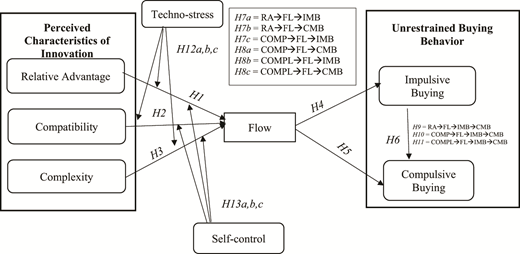
Prior research has primarily concentrated on immersive technology, such as learner experiences and e-vehicle purchase intentions (Alvi, 2024; Arora et al., 2022). This study investigates both direct and indirect impacts by integrating IDT and flow theory to the metaverse, a topic that has not been previously examined. The metaverse’s immersive and interactive nature enhances the effect of relative advantage, compatibility and complexity as compared to conventional digital platforms. As given in Figure 1, flow serves as an important mediator in this context, enhancing impulsive and compulsive purchasing as consumers get immersed in the virtual experience.

To measure unrestrained buying behavior and its relation to perceived characteristics of innovation via flow, the fashion companies that offer users a unique experience through metaverse technology to the Asian consumers were the focus of the research. Finding respondents using metaverse technology across Asian nations was difficult due to varying levels of adoption. In addition, identifying offline respondents for in-store interactions posed challenges, especially in areas with limited access to the technology. The respondents come from various Asian countries with notable economic and cultural differences, which likely impact their metaverse usage. For example, Japan and China, with advanced digital infrastructures, see higher adoption of virtual environments, while India and Afghanistan are at different stages of digital growth, with varied access to technology. While there are cultural differences among the countries, such as linguistic, ethnic and racial biases, consumers share a common psychology when it comes to technological adoption (Petrescu et al., 2023). Despite these differences, all countries are experiencing increased digitalization, providing common ground for analyzing metaverse engagement collectively (Bielialov et al., 2023) and reflects a significant range of experiences. To overcome these issues, we implemented multistage sampling method to ensure diverse data collection.

Multistage sampling helps us efficiently manage a large and geographically diverse population, ensuring broad coverage across India, Japan, China and Afghanistan. Purposive sampling allows us to select individuals with relevant expertise, while snowball sampling aids in reaching hard-to-access respondents (Valerio et al., 2016), especially within the emerging technology space. As per Staniford et al. (2011), for research investigations these two methods were used to attract difficult-to-reach subjects. Together, these methods ensure our sample is both relevant and comprehensive, supporting the objectives of our study. First, we ensured diversity by targeting a wide range of participants across different demographics and geographical locations. Second, we used purposive sampling to focus on participants who fit the study’s criteria, reducing the risk of overrepresentation of any particular group.

To determine the sample size, we used Daniel Soper’s free statistical sample size calculator for SEM. Based on an expected effect size of 0.25, a statistical power level of 0.95, 37 observed variables, a type I error rate of 0.05, and 8 latent variables, the required sample size was 256 (Soper, 2024). To strengthen the questionnaire, we consulted four academic experts in digital marketing and three industry professionals, including two from foreign nations and one from India. The academic experts contributed insights from their research experience, ensuring theoretical rigor and practical relevance. Feedback from both academic and industry experts refined the questionnaire to align with current trends, improving its validity and reliability. Furthermore, for the online survey, the key data-gathering tools used were hashtags #metaverse, #metaversegeneration, #metaverseasia and #metaversegames on various social media sites like Facebook and Instagram. By doing the online and offline surveys, we were able to locate the appropriate respondents for our study. We distributed 550 questionnaires at offline brand stores, inquiring about their use of the respective brand’s metaverse platform. However, 505 were received back, and 457 of those (with a response rate of 83.09%) were selected for further analysis after the screening (Table 1). The sample represents broader metaverse users by including participants from both advanced and emerging digital ecosystems, offering insights into how different economic and cultural contexts influence metaverse interaction, thus enhancing the generalizability of the findings. By using purposive and snowball sampling, we carefully selected participants who fit the specific criteria of the study across both channels. This approach ensures a diverse representation of respondents. First, we ensured diversity by targeting a wide range of participants across different demographics and geographical locations. Second, we used purposive sampling to focus on participants who fit the study’s criteria, reducing the risk of overrepresentation of any particular group.

Meta fashion is becoming increasingly popular in the Indian market (Prashar and Prashar, 2024). Consumers from various Asian areas who reside in India but are citizens of their home countries provided the data, which was gathered over six months (November 2023 to April 2024). Participants had already visited the metaverse website during the preceding six months. They had used any intangible assets, free or paid, for their avatar to be eligible for involvement in the study.

Strong internal consistency was achieved by developing the instrument’s measurements using existing scales from previous research. For instance, the four items of Relative Advantage (Meuter et al., 2005; Moore and Benbasat, 1991), four items of Compatibility (Moore and Benbasat, 1991; Meuter et al., 2005) and four items of Complexity (Moore and Benbasat, 1991; Meuter et al., 2005). Five items of Impulse Buying (Rook and Fisher, 1995), six items of Compulse buying (Ridgway et al., 2008), five items of Self-control (Tangney et al., 2004) and five items of Techno-stress (Cohen et al., 1983; Agogo and Hess, 2015). We have used the scale of Chen and Lin (2018) for the measurement of Flow.

The study used Harman’s one-factor test to assess common method variance, revealing that the first component accounted for 39.845% of the total variance, below the 50% threshold (Podsakoff et al., 2003). In addition, variance inflation factor values for all constructs were below the 3.3 threshold (Kock, 2017), indicating that common method bias does not significantly affect the results.

The current study used AMOS 24.0, SPSS 23.0 software and structural equation modeling (SEM) method to analyze the information gathered through the survey. CFA was conducted to evaluate the measurement model fit in AMOS 24.0. Using SEM, a multivariate analytical method, researchers examined interactions among various latent components (Hair et al., 2010). PROCESS analysis was used to assess the expected effects (Hayes, 2017), using PROCESS macro-Model 1 to analyze the linkages. Standardized evaluations generated the data, and bootstrapping was applied to confirm the statistical significance of each effect.

This section describes the details of the normalcy, reliability and validity tests. Discriminant and convergent validity tests were performed to evaluate the survey instrument further. By examining Cronbach’s alpha (CA), composite reliability (CR) and average variance extracted (AVE), convergent validity was demonstrated. For all research variables, Table 2 shows the factor loadings, AVE, CR, CA and maximum shared variance (MSV). Each CR value was higher than the suggested threshold of 0.70 (Nunally and Bernstein, 1978), demonstrating the reliability of all constructs. A frequently used measure of convergent and discriminant validity is the AVE. According to Fornell and Larcker (1981), a construct with a 0.50 AVE value or above exhibits significant convergent validity by explaining more than half of the variation of its component items. All of the AVEs, which are displayed in Table 2 and range from 0.65 to 0.83, are higher than the advised value of 0.50 and MSV should be smaller than AVE (Hair et al., 2010). For the measurement model, the model fit indices were as follows: RMSEA = 0.052, chi-square = 2.248, GFI = 0.861, AGFI = 0.837, CFI = 0.950 and TLI = 0.944. All indicators fell under the suggested threshold values set by Hair et al. (2010). Moreover, the SRMR value is 0.0376 that is an acceptable fit of ≤0.5 (Schwartz and Graham, 2020).

The uniqueness of the variables is tested using discriminant validity, which compares the square root of AVE with the square correlation coefficient (Hair et al., 2010). The discriminant validity calculation for each pair of constructs is shown in Table 3. The variables are unique and distinct as the values of the average variance recovered are smaller than the square of all conceivable pairings of constructs (Fornell and Larcker, 1981). Also, using heterotrait and monotrait (HTMT) analysis, we confirmed discriminant validity, shown in Table 4. Hair et al. (2017) discovered that all constructs had suitable HTMT values of less than 1. Results of the HTMT inference at the 95% confidence level were gathered by carrying out a full bootstrapping process using 5,000 samples.

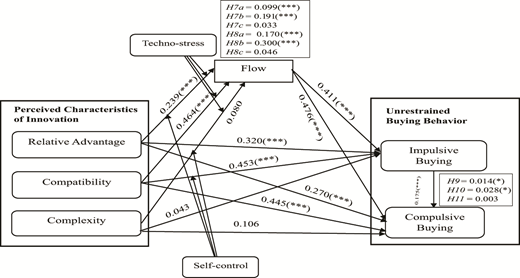
We investigated the direct and indirect effects of perceived innovation characteristics on consumers’ unrestrained purchasing behavior via flow as a mediator. A parallel and serial mediation model was conducted using SEM. As demonstrated in Figure 2 and Table 5, path analysis and variances are explained to evaluate each hypothesis. Evaluation of the direct impact model revealed a relative advantage (β = 0.239; p < 0.001) and compatibility (β = 0.464; p < 0.001) which have a significant effect on flow, supporting H1 and H2. On the other hand, complexity does not significantly affect flow as its p-value is greater than 0.05. In addition, impulsive buying behavior (β = 0.175; p < 0.001) also has a significant effect on compulsive buying behavior.

The findings reveal that relative advantage (β = 0.099; p < 0.001) and compatibility (β = 0.191; p < 0.001) indirectly influence impulsive buying via flow, supporting H7a and H7b. Similarly, relative advantage (β = 0.170; p < 0.001) and compatibility (β = 0.300; p < 0.001) indirectly affect compulsive buying via flow, supporting H8a and H8b. Complexity, however, does not significantly impact impulsive or compulsive buying through flow (p > 0.05). Serial mediation for RA→FL→IMB→CMB (β = 0.014; p < 0.05) and CM→FL→IMB→CMB (β = 0.028; p < 0.05) is significant, supporting H9 and H10, while H11 was unsupported, as complexity does not lead to compulsive buying through flow and impulsive buying. Bootstrapping was used to assess these mediation effects, as shown in Table 5.

According to Hayes (2013) and Wang et al. (2018), the presence of one or both of the two patterns indicated moderated mediation the path between perceived qualities of innovation and flow was moderated by self-control and techno-stress, and/or the path between flow and unrestrained buying behavior. In this current study, the first path of moderated mediation is analyzed. Using Hayes’ PROCESS Macro Model 1 for the SPSS technique, the current research validated the moderating role of techno-stress and self-control on the link between perceived innovation and flow variables.

5.4.1 Association between perceived characteristics of innovation and flow, and the role of self-control.

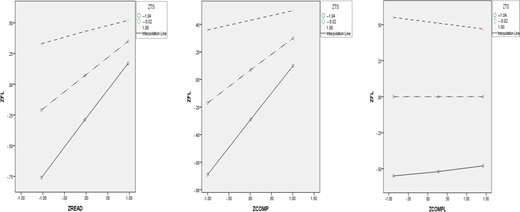
Table 6 and Figure 3 illustrates the substantial positive impact that relative advantage had on flow (0.28, p < 0.001). The interaction effect between relative advantage and self-control had a negative significant effect on flow (−0.19, p < 0.001). It can be seen that self-control moderates the relationship between relative advantage and flow. Furthermore, compatibility was found to have a positive significant effect on flow (0.24, p < 0.001). The interaction effect between compatibility and self-control had a negative significant effect on flow (−0.16, p < 0.001). The interaction term between complexity and self-control had a negative insignificant effect on flow (−0.03, p > 0.05).

5.4.2 Association between perceived characteristics of innovation and flow, and the role of techno-stress.

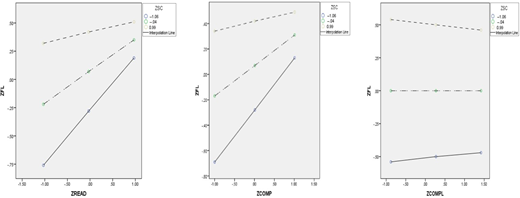
Table 6 indicates that there was a considerable favorable impact of relative advantage on flow (0.28, p < 0.001). The interaction term between relative advantage and techno-stress had a negative significant effect on flow (−0.18, p < 0.001). The link between relative advantage and flow is revealed to be moderated by self-control. Furthermore, compatibility was found to have a positive significant effect on flow (0.23, p < 0.001). A significant negative impact on flow was seen when compatibility and technostress interacted (−0.16, p < 0.001). It can be seen that technostress moderates the relationship between compatibility and flow. As indicated in Figure 3, flow was negatively and insignificantly impacted by the complexity and technostress interaction term (−0.03, p > 0.05).

As shown in Figure 2, relative advantage and compatibility increased, flow also increased, but with steeper slopes at lower levels of self-control. But when we saw complexity, the value was insignificant where the interaction of complexity and self-control show insignificant p-value. As in this, it was also revealed that the lower the self-control, the flatter the slope of the increase in flow as complexity increased and when the value of self-control increases the slope starts moving in the downward direction.

Technostress moderated the relationship between relative advantage, compatibility and flow. At all levels, as relative advantage and compatibility increased, flow also increased (Figure 4). However, lower technostress resulted in a steeper increase in flow, even with the same level of relative advantage. In contrast, complexity showed no significant relationship, as lower technostress led to a flatter slope in flow as complexity increased.

The motive is to study the effect of perceived characteristics of innovation influencing unrestrained buying behavior (impulsive and compulsive behavior), taking flow as a mediator and how techno-stress and self-control act as a moderator between perceived characteristics of innovation and flow. We analyzed the relationship based on the theoretical background, i.e. IDT (relative advantage, compatibility and complexity) and flow theory with unplanned buying behavior (impulsive and compulsive buying). As discussed above, fashion brands in Asian regions have increasingly marketed their products using metaverse technology. Research by Lu and Hsiao (2022) demonstrates that consumers achieve a state of flow when using 360-degree immersive platforms that align with their preferences, such as fashion tastes. Alvi (2024) further supports this, noting that technological challenges can disrupt the flow experience, whereas user-friendly features of immersive environments, like the metaverse, enhance it. In addition, the flexibility of immersive technologies in providing rich visual and interactive experiences has been shown to increase users’ flow (Arora et al., 2022).

First, out of the three perceived characteristics of innovation, relative advantage and compatibility have a significant effect on flow. These findings agree with past studies (Arora et al., 2022; Lu and Hsiao, 2022) which suggests that consumers are more likely to engage in flow experience when they perceive clear benefits or alignment with their needs. Furthermore, complexity has a statistically insignificant effect on flow. This is in line with Hang et al. (2024), which states that the technology which is highly complex decreases the flow experiences among users. As described by Zhou et al. (2022), the metaverse is an intricate system that depends on multiple auxiliary technologies. The complexity increases with the amount of interaction between digital and physical elements where users may feel disrupted, reducing their likelihood to engage in impulsive buying. This suggests that simplifying the user experience could foster more spontaneous purchases.

The results showed that flow mediates the relationship between relative advantage, compatibility and unrestrained buying, supporting prior findings that these factors enhance satisfaction and drive impulse and compulsive buying (Lu and Hsiao, 2022; Min and Tan, 2022; Chen et al., 2017). This suggests that when consumers perceive clear benefits or a strong alignment between the technology and their needs, they are more likely to experience flow. In addition, the results exhibit that flow does not mediate the link between complexity and unrestrained buying behavior. As when the technology is too complex, consumers are less likely to experience flow, reducing their propensity for impulsive or compulsive buying.

Third, the study confirmed a sequential mediation, showing that relative advantage and compatibility positively impact flow, leading to increased impulse and compulsive buying (Shehzadi et al., 2016). Complexity had no effect on flow or buying behavior. Compatibility emerged as a stronger predictor than relative advantage. Flow partially mediated the relationship between relative advantage and compatibility in unrestrained buying, and fully mediated the link between complexity and unrestrained buying.

Furthermore, there is scarcity of studies that empirically test models suited to the unique features of immersive metaverse technologies, with most relying on frameworks that may not fully capture the complexities of user engagement in these virtual spaces. In the metaverse context, technostress and self-control play critical roles in shaping consumer behavior, particularly with regard to unrestrained buying. High technostress makes it harder for users to engage, leading to fewer unrestrained purchases, while low technostress allows smoother experiences, encouraging more buying. Similarly, people with high self-control are less likely to make unrestrained purchases, even in immersive environments, while those with low self-control are more likely to buy impulsively. This study goes beyond exploring the direct relationship between technostress and self-control by testing their moderating effects on perceived innovation and flow. It highlights how technostress and self-control weaken the impact of these factors. While previous research has explored technostress and self-control in social media or online shopping settings, our study reveals how these factors operate in a more interactive and immersive virtual world (Al-Youzbaky et al., 2022). The key finding of this study is that self-control and technostress moderate the relationship between perceived innovation and flow. Both factors negatively impact unrestrained buying behavior by weakening the positive effects of relative advantage, compatibility and flow, which is consistent with the literature (Ishfaq et al., 2022; Kim and Park, 2018). Also, complexity and both moderators (techno-stress and self-control) have a negative insignificant effect on flow.

First, our main empirical results add to the body of literature on IDT (Choshaly, 2019; Arora et al., 2022) and flow theory (Rodríguez-Torrico et al., 2023). These theories clarify the behavior of IT adoption as well as situations where users engage themselves entirely in their work. However, not many studies have looked at how innovation is viewed and how it affects unrestrained buying behavior among Asian consumers. The scope of flow has been included in this study to assess the innovation characteristics that create a flow experience. Moreover, while IDT clarifies why people adopt the metaverse, it does not fully capture their behavioral changes after adoption. Conversely, flow theory illustrates how deep engagement in the metaverse can lead to impulsive buying but does not explain why users enter the metaverse in the first place. By combining both theories, this paper can analyze the entire consumer journey from adopting the metaverse to becoming immersed in it and, ultimately, engaging in unrestrained purchasing behavior. As such, the research provides valuable insights into the process of developing an innovation that is presently transforming the fashion industry in Asian regions. On top of that, by taking into account the technostress and self-control experienced by consumers when purchasing fashion products via their metaverse website, this paper adds to our growing understanding of the complex problem of self-control as fashion brands trade in exclusive and trendy products goods that affect the self-control behavior of a customer.

First, our findings provide a thorough understanding of the elements that influence Asian users’ propensity to become part of the metaverse. The insights of our study advance the comprehension of the metaverse and have practical implications for stakeholders across several industries. Businesses hoping to use the metaverse in their business plans could manage these difficulties more successfully by using the research approach and getting insights into possible psychological signals of consumers. Businesses can enhance user experience by creating intuitive, immersive interfaces that simplify navigation and reduce cognitive effort. Personalized experiences, like tailored content and product recommendations, can further increase engagement. In addition, incorporating interactive tutorials, smooth onboarding and real-time customer support will help users feel more comfortable and confident when navigating the metaverse. To ensure the earliest iterations of metaverse platforms, the requirements and preferences of tech-savvy users and developers might concentrate on features that are appealing to innovators and early adopters.

Second, this study provides practical recommendations for metaverse managers and companies in virtual environments. To boost user engagement and encourage unrestrained buying, managers should focus on enhancing flow experiences by creating intuitive, user-friendly interfaces that reduce complexity, a key barrier to engagement. Emphasizing innovation diffusion factors like relative advantage and compatibility is vital. Offering free trials or time-limited experiences, which were not provided by previous technologies like AR and VR but metaverse offers relative advantage that can help users explore the metaverse’s benefits and highlight features that distinguish it from traditional digital platforms, driving interest and adoption. Contrary to that complexity in metaverse seems difficult to use compared to prior technologies, which creates dissatisfaction among consumers. Likewise, addressing technostress is crucial. Managers can reduce user anxiety by providing educational resources, onboarding support and responsive customer service. In addition, tools like spending limits or alerts can help users manage self-control and prevent excessive spending while promoting healthy buying behavior.

Third, the research adds to the larger discourse about technology adoption. The present research focuses on the undesirable scenario that the person perceives as a result of their inability to adjust to new technology effectively. Understanding self-control in virtual spaces can help prevent addiction and encourage healthy online habits, while offering guidance to consumers trying to limit impulse buying. Furthermore, our findings can help policymakers create ethical regulations for the growing metaverse. As adoption increases, new rules will be needed to protect consumers, with regulators and developers working together to ensure responsible design and prevent flow-driven impulse buying.

The study has limitations, and future research is essential to explore how businesses can effectively market and engage with customers in the evolving metaverse, which is set to transform customer interactions and marketing strategies. The sample predominantly includes female respondents, highlighting their heightened interest in fashion-related products in virtual environments. Participants were sourced from East and South Asian nations, but future studies could take the respondents from Central, Southeast and Western Asia. Also, longitudinal and experimental studies should be used in future research since customer buying intentions fluctuate over time.

Future research could include users from Western nations or regions with different technological infrastructures to compare how cultural and economic factors influence global metaverse usage. Exploring other sectors associated with the growth of the metaverse in different countries could offer industry-specific insights into metaverse adoption. In addition, future studies could examine moderators such as user experience or personality traits to understand better their impact on the relationship between innovation characteristics and flow in virtual environments.

In conclusion, our study shows that relative advantage and compatibility in the metaverse positively influence flow, leading to unrestrained buying behavior, while complexity does not significantly affect flow. Technostress and self-control weaken the link between innovation and flow, reducing impulsive and compulsive buying. This underscores the need to balance innovation with ease of use and manage technostress to enhance positive user experiences.
Agogo
,
D.
and
Hess
,
T.J.
(
2015
), “
Technostress and technology induced state anxiety: scale development and implications
”,
Thirty sixth international conference on information systems
, pp.
1
-
11
.
Ahmad
,
U.N.U.
,
Amin
,
S.M.
and
Ismail
,
W.K.W.
(
2014
), “
Moderating effect of technostress inhibitors on the relationship between technostress creators and organisational commitment
”,
Sains Humanika
, Vol.
67
No.
1
.
Akour
,
I.A.
,
Al-Maroof
,
R.S.
,
Alfaisal
,
R.
and
Salloum
,
S.A.
(
2022
), “
A conceptual framework for determining metaverse adoption in higher institutions of Gulf area: an empirical study using hybrid SEM-ANN approach
”,
Computers and Education: artificial Intelligence
, Vol.
3
, p.
100052
.
Aleem
,
A.
,
Loureiro
,
S.M.C.
and
Bilro
,
R.G.
(
2024
), “
Luxury fashion consumption: a review, synthesis and research agenda
”,
Spanish Journal of Marketing - ESIC
, Vol.
28
No.
2
, pp.
144
-
164
.
Alvi
,
I.
(
2024
), “
Investigating students’ adoption of virtual reality for L2-learning in India
”,
Education and Information Technologies
, Vol.
29
No.
7
, pp.
8035
-
8056
.
Al-Youzbaky
,
B.A.
,
Hanna
,
R.D.
and
Najeeb
,
S.H.
(
2022
), “
The effect of information overload, and social media fatigue on online consumers purchasing decisions: the mediating role of technostress and information anxiety
”,
Journal of System and Management Sciences
, Vol.
12
No.
2
, pp.
195
-
220
.
Arghashi
,
V.
and
Yuksel
,
C.A.
(
2022
), “
Interactivity, inspiration, and perceived usefulness! How retailers’ AR-apps improve consumer engagement through flow
”,
Journal of Retailing and Consumer Services
, Vol.
64
, p.
102756
.
Arora
,
S.C.
,
Sharma
,
M.
and
Singh
,
V.K.
(
2022
), “
Using diffusion of innovation framework with attitudinal factor to predict the future of mobility in the Indian market
”,
Environmental Science and Pollution Research
, Vol.
30
No.
44
, pp.
98655
-
98670
.
Ayyagari
,
R.
,
Grover
,
V.
and
Purvis
,
R.
(
2011
), “
Technostress: technological antecedents and implications
”,
MIS Quarterly
, Vol.
35
No.
4
, pp.
831
-
858
.
Bearden
,
W.O.
and
Netemeyer
,
R.G.
(
1999
),
Handbook of Marketing Scales: Multi-Item Measures for Marketing and Consumer Behavior Research
,
Sage publications
,
USA
.
Bielialov
,
T.
,
Kalina
,
I.
,
Goi
,
V.
,
Kravchenko
,
O.
and
Shyshpanova
,
N.
(
2023
), “
Global experience of digitalization of economic processes in the context of transformation
”,
International Journal of Professional Business Review
, Vol.
8
No.
6
, p.
10
.
Bretos
,
M.A.
,
Ibáñez-Sánchez
,
S.
and
Orús
,
C.
(
2024
), “
Applying virtual reality and augmented reality to the tourism experience: a comparative literature review
”,
Spanish Journal of Marketing - ESIC
, Vol.
28
No.
3
, pp.
287
-
309
.
Chan-Olmsted
,
S.M.
and
Chang
,
B.H.
(
2006
), “
Audience knowledge, perceptions and factors affecting the adoption intent of terrestrial digital television
”,
New Media and Society
, Vol.
8
No.
5
, pp.
773
-
800
.
Chen
,
C.C.
and
Lin
,
Y.C.
(
2018
), “
What drives live-stream usage intention? The perspectives of flow, entertainment, social interaction, and endorsement
”,
Telematics and Informatics
, Vol.
35
No.
1
, pp.
293
-
303
.
Chen
,
C.
,
Zhang
,
K.Z.
,
Gong
,
X.
,
Zhao
,
S.J.
,
Lee
,
M.K.
and
Liang
,
L.
(
2017
), “
Understanding compulsive smartphone use: an empirical test of a flow-based model
”,
International Journal of Information Management
, Vol.
37
No.
5
, pp.
438
-
454
.
Choshaly
,
S.H.
(
2019
), “
Applying innovation attributes to predict purchase intention for the eco-labeled products
”,
International Journal of Innovation Science
, Vol.
11
No.
4
, pp.
583
-
599
.
Cohen
,
S.
,
Kamarck
,
T.
and
Mermelstein
,
R.
(
1983
), “
A global measure of perceived stress
”,
Journal of Health and Social Behavior
, Vol.
24
No.
4
, pp.
385
-
396
.
Csikszentmihalyi
,
M.
and
Csikszentmihalyi
,
I.S.
(Eds), (
1992
),
Optimal Experience: Psychological Studies of Flow in Consciousness
,
Cambridge University Press
,
Cambridge
.
Cui
,
Y.
,
Liu
,
Y.
and
Gu
,
M.
(
2022
), “
Investigating the key drivers of impulsive buying behavior in live streaming
”,
Journal of Global Information Management (Management)
, Vol.
30
No.
1
, pp.
1
-
18
.
Dwivedi
,
Y.K.
,
Hughes
,
L.
,
Baabdullah
,
A.M.
,
Ribeiro-Navarrete
,
S.
,
Giannakis
,
M.
,
Al-Debei
,
M.M.
,
Dennehy
,
D.
,
Metri
,
B.
,
Buhalis
,
D.
,
Cheung
,
C.M.
and
Conboy
,
K.
(
2022
), “
Metaverse beyond the hype: multidisciplinary perspectives on emerging challenges, opportunities, and agenda for research, practice and policy
”,
International Journal of Information Management
, Vol.
66
, p.
102542
.
Efendioglu
,
I.H.
(
2023
), “Metaverse concepts and marketing”,
Handbook of Research on Consumer Behavioral Analytics in Metaverse and the Adoption of a Virtual World
,
IGI Global
,
Malaysia
, pp.
224
-
252
.
Feng
,
J.
(
2021
), “
Research on the influence of VR scenarios in online shopping on consumer impulsive purchase behavior: the perspective of flow experience
”,
International Journal of Business Marketing and Management
, Vol.
6
No.
8
, pp.
51
-
57
.
Fornell
,
C.
and
Larcker
,
D.F.
(
1981
), “
Evaluating structural equation models with unobservable variables and measurement error
”,
Journal of Marketing Research
, Vol.
18
No.
1
, pp.
39
-
50
.
Gao
,
L.
and
Bai
,
X.
(
2014
), “
Online consumer behaviour and its relationship to website atmospheric induced flow: insights into online travel agencies in China
”,
Journal of Retailing and Consumer Services
, Vol.
21
No.
4
, pp.
653
-
665
.
Giang
,
K.G.
,
Hang
,
T.
and
Shah
,
D.
(
2023
), “
Marketing in the metaverse: conceptual understanding, framework, and research agenda
”,
Journal of Business Research
, Vol.
155
, p.
113420
.
Guerra-Tamez
,
C.R.
(
2023
), “
The impact of immersion through virtual reality in the learning experiences of art and design students: the mediating effect of the flow experience
”,
Education Sciences
, Vol.
13
No.
2
, p.
185
.
Hair
,
J.F.
,
Black
,
W.C.
,
Babin
,
B.J.
and
Anderson
,
R.E.
(
2010
),
Multivariate Data Analysis
, (7th ed.) ,
Prentice Hall
,
Australia
.
Hair
,
J.F.
 Jr.
,
Matthews
,
L.M.
,
Matthews
,
R.L.
and
Sarstedt
,
M.
(
2017
), “
PLS-SEM or CB-SEM: updated guidelines on which method to use
”,
International Journal of Multivariate Data Analysis
, Vol.
1
No.
2
, pp.
107
-
123
.
Handoko
,
B.L.
,
Lindawati
,
A.S.L.
,
Sarjono
,
H.
and
Mustapha
,
M.
(
2023
), “
Innovation diffusion and technology acceptance model in predicting auditor acceptance of metaverse technology
”,
Journal of System and Management Sciences
, Vol.
13
No.
5
, pp.
443
-
456
.
Hang
,
Y.
,
Unenbat
,
B.
,
Tang
,
S.
,
Wang
,
F.
,
Lin
,
B.
and
Zhang
,
D.
(
2024
), “
Exploring the neural correlates of flow experience with multifaceted tasks and a single-channel prefrontal EEG recording
”,
Sensors
, Vol.
24
No.
6
, p.
1894
.
Hayes
,
A.F.
(
2013
),
An Introduction to Mediation, Moderation, and Conditional Process Analysis: A Regression-Based Approach
,
Guilford
,
New York, NY
.
Hayes
,
A.F.
(
2017
),
Introduction to Mediation, Moderation, and Conditional Process Analysis: A Regression-Based Approach
,
Guilford publications
,
New York
.
Hoang
,
T.D.L.
,
Nguyen
,
H.T.
,
Vu
,
D.T.
and
Le
,
A.T.T.
(
2023
), “
The role of mindfulness in promoting purchase intention
”,
Spanish Journal of Marketing-ESIC
, (
ahead-of-print
).
Hohnemann
,
C.
,
Rivkin
,
W.
and
Diestel
,
S.
(
2024
), “
An energizing microintervention: how mindfulness fosters subjective vitality through regulatory processes and flow experience at work
”,
Journal of Occupational Health Psychology
, Vol.
29
No.
1
, p.
45
.
Hong
,
J.C.
,
Juan
,
H.C.
and
Hung
,
W.C.
(
2022
), “
The role of family intimacy in playing collaborative e-sports with a switch device to predict the experience of flow and anxiety during COVID-19 lockdown
”,
Computers in Human Behavior
, Vol.
132
, p.
107244
.
Hosseini
,
S.M.
and
Fattahi
,
R.
(
2014
), “
Databases’ interface interactivity and user self-efficacy: two mediators for flow experience and scientific behavior improvement
”,
Computers in Human Behavior
, Vol.
36
, pp.
316
-
322
.
Hsiao
,
W.H.
,
Lin
,
Y.H.
and
Wu
,
I.L.
(
2022
), “
Advergame for purchase intention via game and brand attitudes from antecedents of system design, psychological state, and game content: interactive role of brand familiarity
”,
Journal of Organizational Computing and Electronic Commerce
, Vol.
32
No.
1
, pp.
45
-
68
.
Ishfaq
,
R.
,
Davis‐Sramek
,
B.
and
Gibson
,
B.
(
2022
), “
Digital supply chains in omnichannel retail: a conceptual framework
”,
Journal of Business Logistics
, Vol.
43
No.
2
, pp.
169
-
188
.
Jamshidi
,
D.
and
Kazemi
,
F.
(
2020
), “
Innovation diffusion theory and customers’ behavioral intention for Islamic credit card: implications for awareness and satisfaction
”,
Journal of Islamic Marketing
, Vol.
11
No.
6
, pp.
1245
-
1275
.
Johnson
,
C.D.
,
Bauer
,
B.C.
and
Singh
,
N.
(
2020
), “
Exploring flow in the mobile interface context
”,
Journal of Retailing and Consumer Services
, Vol.
53
, p.
101744
.
Kakaria
,
S.
,
Saffari
,
F.
,
Ramsøy
,
T.Z.
and
Bigné
,
E.
(
2023
), “
Cognitive load during planned and unplanned virtual shopping: evidence from a neurophysiological perspective
”,
International Journal of Information Management
, Vol.
72
, p.
102667
.
Khan
,
B.A.
(
2023
),
Emergence of Technostress in Multi-User VR Environments for Work-Related Purposes
,
Tampere University
,
Finland
.
Kim
,
K.
and
Park
,
H.
(
2018
), “
The effects of technostress on information technology acceptance
”,
Journal of Theoretical and Applied Information Technology
, Vol.
96
No.
24
, pp.
8300
-
8312
.
Kim
,
M.J.
,
Lee
,
C.K.
and
Preis
,
M.W.
(
2020
), “
The impact of innovation and gratification on authentic experience, subjective well-being, and behavioral intention in tourism virtual reality: the moderating role of technology readiness
”,
Telematics and Informatics
, Vol.
49
, p.
101349
.
Kock
,
N.
(
2017
), “Common method bias: a full collinearity assessment method for PLS-SEM”,
Partial Least Squares Path Modeling: Basic Concepts, Methodological Issues and Applications
,
Springer International Publishing
, pp.
245
-
257
.
Kolk
,
A.
(
2023
), “
How fashion brands are entering the metaverse
”, [
Online
],
available at:
https://epiprodux.com/blog/how-fashion-brands-are-entering-themetaverse/
Kshatriya
,
K.
and
Shah
,
P.S.
(
2023
), “
A study of the prevalence of impulsive and compulsive buying among consumers in the apparel and accessories market
”,
Vilakshan - XIMB Journal of Management
, Vol.
20
No.
1
, pp.
2
-
24
.
Lab
,
F.
(
2023
), “
FutureTales LAB - 2030: fashion industry in metaverse
”,
available at:
www.futuretaleslab.com/articles/2030fashionmetaverse
Lapasha
,
B.M.
,
Tanuarto
,
M.Y.
,
Wiranata
,
S.
and
Burhamsyah
,
R.B.
(
2024
), “
A study of flow and its factors towards compulsive buying based on player behavior of mobile legends in-game items
”,
Dinasti International Journal of Management Science
, Vol.
5
No.
3
, pp.
738
-
753
.
Lee
,
A.R.
,
Son
,
S.M.
and
Kim
,
K.K.
(
2016
), “
Information and communication technology overload and social networking service fatigue: a stress perspective
”,
Computers in Human Behavior
, Vol.
55
, pp.
51
-
61
.
Li
,
G.
,
Mei
,
Z.
and
Zhen
,
F.
(
2024
), “
Friend or foe? A mixed-methods study on the impact of digital device use on Chinese–Canadian children’s heritage language learning
”,
Digital Studies in Language and Literature
, Vol.
1
Nos
1/2
, pp.
55
-
84
.
Lin
,
W.R.
,
Lin
,
C.Y.
and
Ding
,
Y.H.
(
2020
), “
Factors affecting the behavioral intention to adopt mobile payment: an empirical study in Taiwan
”,
Mathematics
, Vol.
8
No.
10
, p.
1851
.
Lu
,
X.
and
Hsiao
,
K.L.
(
2022
), “
Effects of diffusion of innovations, spatial presence, and flow on virtual reality shopping
”,
Frontiers in Psychology
, Vol.
13
, p.
941248
.
Meuter
,
M.L.
,
Bitner
,
M.J.
,
Ostrom
,
A.L.
and
Brown
,
S.W.
(
2005
), “
Choosing among alternative service delivery modes: an investigation of customer trial of self-service technologies
”,
Journal of Marketing
, Vol.
69
No.
2
, pp.
61
-
83
.
Min
,
Y.
and
Tan
,
C.C.
(
2022
), “
Research and application of compulsive buying behaviors of consumers in e-commerce livestreaming on big data
”,
Human-Centric Intelligent Systems
, Vol.
2
Nos
3/4
, pp.
113
-
123
.
Moore
,
G.C.
and
Benbasat
,
I.
(
1991
), “
Development of an instrument to measure the perceptions of adopting an information technology innovation
”,
Information Systems Research
, Vol.
2
No.
3
, pp.
192
-
222
.
Nunally
,
J.C.
and
Bernstein
,
I.H.
(
1978
),
Psychometric Theory
,
McGraw-Hill
,
New York, NY
.
Nurlaili
,
M.
and
Wulandari
,
R.
(
2024
), “
The impact of promotion, product quality, and trust toward online impulsive buying decisions: the mediating role of flow experience
”,
International Journal of Management Science and Application
, Vol.
3
No.
2
, pp.
54
-
83
.
Park
,
H.
and
Lim
,
R.E.
(
2023
), “
Fashion and the metaverse: clarifying the domain and establishing a research agenda
”,
Journal of Retailing and Consumer Services
, Vol.
74
, p.
103413
.
Petrescu
,
M.
,
Namin
,
A.
and
Richard
,
M.O.
(
2023
), “
Technology within cultures: segmenting the wired consumers in Canada, France, and the USA
”,
Journal of Business Research
, Vol.
164
, p.
113972
.
Podsakoff
,
P.M.
,
MacKenzie
,
S.B.
,
Lee
,
J.Y.
and
Podsakoff
,
N.P.
(
2003
), “
Common method biases in behavioral research: a critical review of the literature and recommended remedies
”,
Journal of Applied Psychology
, Vol.
88
No.
5
, p.
879
.
Pourfakhimi
,
S.
,
Duncan
,
T.
,
Ould
,
L.
,
Allan
,
K.
and
Coetzee
,
W.
(
2020
), “Acceptance and adoption of eTourism technologies”,
Handbook of e-Tourism
,
Springer International Publishing
,
USA
, pp.
1
-
31
.
Prashar
,
A.
and
Prashar
,
A.
(
2024
), “
Digital fashion and metaverse platforms: do platform attributes drive shopper’s purchase intention?
”,
Australian Journal of Management
, p.
3128962241246696
.
Raghwan
,
R.
(
2022
), “
Introduction to the metaverse and metaverse shopping
”,
available at:
https://acowebs.com/metaverse-shopping/.:1–2
Rey-Ares
,
L.
,
Fernández-López
,
S.
,
Castro-González
,
S.
and
Rodeiro-Pazos
,
D.
(
2021
), “
Does self-control constitute a driver of millennials’ financial behaviors and attitudes?
”,
Journal of Behavioral and Experimental Economics
, Vol.
93
, p.
101702
.
Ridgway
,
N.M.
,
Kukar-Kinney
,
M.
and
Monroe
,
K.B.
(
2008
), “
An expanded conceptualization and a new measure of compulsive buying
”,
Journal of Consumer Research
, Vol.
35
No.
4
, pp.
622
-
639
.
Ristiyani
,
I.
,
Hadi
,
P.
and
Ishak
,
R.M.
(
2021
), “
An empirical study for impulsive buying and its effect on compulsive buying
”,
International Journal of Innovative Science and Research Technology
, Vol.
6
No.
10
, pp.
973
-
979
.
Rivkin
,
W.
,
Diestel
,
S.
and
Schmidt
,
K.H.
(
2018
), “
Which daily experiences can foster well-being at work? A diary study on the interplay between flow experiences, affective commitment, and self-control demands
”,
Journal of Occupational Health Psychology
, Vol.
23
No.
1
, p.
99
.
Robinson
,
J.L.
and
Demaree
,
H.A.
(
2007
), “
Physiological and cognitive effects of expressive dissonance
”,
Brain and Cognition
, Vol.
63
No.
1
, pp.
70
-
78
.
Rodríguez-Torrico
,
P.
,
San José Cabezudo
,
R.
,
San-Martín
,
S.
and
Trabold Apadula
,
L.
(
2023
), “
Let it flow: the role of seamlessness and the optimal experience on consumer word of mouth in omnichannel marketing
”,
Journal of Research in Interactive Marketing
, Vol.
17
No.
1
, pp.
1
-
18
.
Rogers
,
E.
(
1983
),
Diffusion of Innovations
, (3rd ed.) ,
The Free Press
,
New York, NY
.
Rogers
,
E.M.
(
1995
), “Diffusion of innovations: modifications of a model for telecommunications”,
Die Diffusion Von Innovationen in Der Telekommunikation
,
Springer Nature
,
India
, pp.
25
-
38
.
Rogers
,
E.M.
(
1996
),
Communication Technology: The New Media Society
,
Free Press
,
New York, NY
.
Rook
,
D.W.
and
Fisher
,
R.J.
(
1995
), “
Normative influences on impulsive buying behavior
”,
Journal of Consumer Research
, Vol.
22
No.
3
, pp.
305
-
313
.
Salehudin
,
I.
and
Alpert
,
F.
(
2022
), “
Perceived aggressive monetization: why some mobile gamers won’t spend any money on in-app purchases
”,
Electronic Commerce Research
, Vol.
24
No.
3
, pp.
1
-
23
.
Schwartz
,
D.A.
and
Graham
,
A.L.
(
2020
), “
Potential maternal and infant outcomes from coronavirus 2019-nCoV (SARS-CoV-2) infecting pregnant women: lessons from SARS, MERS, and other human coronavirus infections
”,
Viruses
, Vol.
12
No.
2
, p.
194
.
Serravalle
,
F.
,
Vanheems
,
R.
and
Viassone
,
M.
(
2023
), “
Does product involvement drive consumer flow state in the AR environment? A study on behavioural responses
”,
Journal of Retailing and Consumer Services
, Vol.
72
, p.
103279
.
Shehzadi
,
K.
,
Ahmad-Ur-Rehman
,
M.
,
Cheema
,
A.M.
and
Ahkam
,
A.
(
2016
), “
Impact of personality traits on compulsive buying behavior: mediating role of impulsive buying
”,
Journal of Service Science and Management
, Vol.
9
No.
5
, p.
416
.
Shin
,
D.
(
2019
), “
How do users experience the interaction with an immersive screen?
”,
Computers in Human Behavior
, Vol.
98
, pp.
302
-
310
.
Soper
,
D.S.
(
2024
), “
A-priori sample size calculator for structural equation models [software]
”,
available at:
www.danielsoper.com/statcalc
Staniford
,
L.J.
,
Breckon
,
J.D.
,
Copeland
,
R.J.
and
Hutchison
,
A.
(
2011
), “
Key stakeholders’ perspectives towards childhood obesity treatment: a qualitative study
”,
Journal of Child Health Care
, Vol.
15
No.
3
, pp.
230
-
244
.
Stephenson
,
N.
(
1992
), “
Snow crash
”,
The Journal of Popular Culture
, Vol.
41
No.
5
, pp.
854
-
877
.
Tangney
,
J.P.
,
Baumeister
,
R.F.
and
Boone
,
A.L.
(
2004
), “
Self-control scale
”,
Current Psychology: A Journal for Diverse Perspectives on Diverse Psychological Issues
.
Tarafdar
,
M.
,
Pullins
,
E.B.
and
Ragu‐Nathan
,
T.S.
(
2015
), “
Technostress: negative effect on performance and possible mitigations
”,
Information Systems Journal
, Vol.
25
No.
2
, pp.
103
-
132
.
Tornatzky
,
L.G.
and
Klein
,
K.J.
(
1982
), “
Innovation characteristics and innovation adoption-implementation: a meta-analysis of findings
”,
IEEE Transactions on Engineering Management
, Vol.
EM-29
No.
1
, pp.
28
-
45
.
Valerio
,
M.A.
,
Rodriguez
,
N.
,
Winkler
,
P.
,
Lopez
,
J.
,
Dennison
,
M.
,
Liang
,
Y.
and
Turner
,
B.J.
(
2016
), “
Comparing two sampling methods to engage hard-to-reach communities in research priority setting
”,
BMC Medical Research Methodology
, Vol.
16
No.
1
, pp.
1
-
11
.
Vohs
,
K.D.
,
Baumeister
,
R.F.
,
Schmeichel
,
B.J.
,
Twenge
,
J.M.
,
Nelson
,
N.M.
and
Tice
,
D.M.
(
2018
), “Making choices impairs subsequent self-control: a limited-resource account of decision making, self-regulation, and active initiative”,
Self-Regulation and Self-Control
,
Routledge
,
New York
, pp.
45
-
77
.
Wang
,
J.J.
,
Wang
,
L.Y.
and
Wang
,
M.M.
(
2018
), “
Understanding the effects of eWOM social ties on purchase intentions: a moderated mediation investigation
”,
Electronic Commerce Research and Applications
, Vol.
28
, pp.
54
-
62
.
Wu
,
L.
,
Chiu
,
M.L.
and
Chen
,
K.W.
(
2020
), “
Defining the determinants of online impulse buying through a shopping process of integrating perceived risk, expectation-confirmation model, and flow theory issues
”,
International Journal of Information Management
, Vol.
52
, p.
102099
.
Wu
,
R.
,
Ishfaq
,
K.
,
Hussain
,
S.
,
Asmi
,
F.
,
Siddiquei
,
A.N.
and
Anwar
,
M.A.
(
2022
), “
Investigating e-retailers’ intentions to adopt cryptocurrency considering the mediation of technostress and technology involvement
”,
Sustainability
, Vol.
14
No.
2
, p.
641
.
Zhou
,
P.
,
Zhu
,
J.
,
Wang
,
Y.
,
Lu
,
Y.
,
Wei
,
Z.
,
Shi
,
H.
,
Ding
,
Y.
,
Gao
,
Y.
,
Huang
,
Q.
,
Shi
,
Y.
and
Alhilal
,
A.
(
2022
), “
Vetaverse: a survey on the intersection of metaverse, vehicles, and transportation systems
”,
arXiv preprint arXiv:2210.15109
.
Published by Emerald Publishing Limited. This article is published under the Creative Commons Attribution (CC BY 4.0) licence. Anyone may reproduce, distribute, translate and create derivative works of this article (for both commercial and non-commercial purposes), subject to full attribution to the original publication and authors. The full terms of this licence maybe seen at Link to the terms of the CC BY 4.0 licenceLink to the terms of the CC BY 4.0 licence.

Data & Figures

Figure 1.
A conceptual framework diagram showing the relationships between perceived characteristics of innovation, techno stress, flow, self-control, and unrestrained buying behaviour.A conceptual framework with directional arrows showing paths between constructs. On the left, a box titled Perceived Characteristics of Innovation contains three sub-boxes labelled Relative Advantage, Compatibility, and Complexity. Arrows labelled H 1, H 2, and H 3 extend from these three variables to a central box labelled Flow. Above the centre, a box labelled Techno stress has arrows directed toward the paths between the perceived characteristics and Flow, labelled H 1 2 a b c. Near the Techno stress box, the listed relationships are H 7 a, Relative Advantage to Flow to Impulsive Buying, H 7 b, Relative Advantage to Flow to Compulsive Buying, H 7 c, Compatibility to Flow to Impulsive Buying, H 8 a, Compatibility to Flow to Compulsive Buying, H 8 b, Complexity to Flow to Impulsive Buying, and H 8 c, Compatibility to flow to compulsive Buying. Below the centre, a box labelled Self-control has arrows directed toward the relationship between Flow and perceived characteristics, labelled H 1 3 a b c. From Flow, arrows labelled H 4 and H 5 extend to the right toward a box titled Unrestrained Buying Behaviour. This box contains two sub-boxes labelled Impulsive Buying and Compulsive Buying. Inside this box, the listed relationships are H 9, Relative Advantage to Flow to Impulsive Buying to Compulsive Buying, H 1 0, Compatibility to Flow to Impulsive Buying to Compulsive Buying, and H 1 1, Complexity to Flow to Impulsive Buying to Compulsive Buying. An arrow labelled H 6 connects Impulsive Buying to Compulsive Buying.

Conceptual framework

Figure 1.
A conceptual framework diagram showing the relationships between perceived characteristics of innovation, techno stress, flow, self-control, and unrestrained buying behaviour.A conceptual framework with directional arrows showing paths between constructs. On the left, a box titled Perceived Characteristics of Innovation contains three sub-boxes labelled Relative Advantage, Compatibility, and Complexity. Arrows labelled H 1, H 2, and H 3 extend from these three variables to a central box labelled Flow. Above the centre, a box labelled Techno stress has arrows directed toward the paths between the perceived characteristics and Flow, labelled H 1 2 a b c. Near the Techno stress box, the listed relationships are H 7 a, Relative Advantage to Flow to Impulsive Buying, H 7 b, Relative Advantage to Flow to Compulsive Buying, H 7 c, Compatibility to Flow to Impulsive Buying, H 8 a, Compatibility to Flow to Compulsive Buying, H 8 b, Complexity to Flow to Impulsive Buying, and H 8 c, Compatibility to flow to compulsive Buying. Below the centre, a box labelled Self-control has arrows directed toward the relationship between Flow and perceived characteristics, labelled H 1 3 a b c. From Flow, arrows labelled H 4 and H 5 extend to the right toward a box titled Unrestrained Buying Behaviour. This box contains two sub-boxes labelled Impulsive Buying and Compulsive Buying. Inside this box, the listed relationships are H 9, Relative Advantage to Flow to Impulsive Buying to Compulsive Buying, H 1 0, Compatibility to Flow to Impulsive Buying to Compulsive Buying, and H 1 1, Complexity to Flow to Impulsive Buying to Compulsive Buying. An arrow labelled H 6 connects Impulsive Buying to Compulsive Buying.

Conceptual framework

Close modal
Figure 2.
A three-panel line graph showing the moderation effect of self-control on the relationships between Z R E A D, Z C O M P, Z C O M P L, and Z F L.Three side-by-side line graphs show the moderation effect of self-control. The vertical axis in all panels is labelled Z F L. The left panel has a horizontal axis labelled Z R E A D. The middle panel has a horizontal axis labelled Z C O M P. The right panel has a horizontal axis labelled Z C O M P L. Each panel displays three lines representing levels of Z S C at minus 1.06, minus 0.04, and 0.99, as indicated in the legend, along with an interpolation line. In the left panel, all three lines increase from left to right, with the steepest increase at Z S C minus 1.06 and the highest values at Z S C 0.99. In the middle panel, all three lines increase from left to right, with the steepest increase at Z S C minus 1.06 and the highest values at Z S C 0.99. In the right panel, the line at Z S C 0.99 shows a slight decrease from left to right, the line at Z S C minus 0.04 remains nearly flat, and the line at Z S C minus 1.06 shows a slight increase from left to right.

Moderation effect of self-control

Figure 2.
A three-panel line graph showing the moderation effect of self-control on the relationships between Z R E A D, Z C O M P, Z C O M P L, and Z F L.Three side-by-side line graphs show the moderation effect of self-control. The vertical axis in all panels is labelled Z F L. The left panel has a horizontal axis labelled Z R E A D. The middle panel has a horizontal axis labelled Z C O M P. The right panel has a horizontal axis labelled Z C O M P L. Each panel displays three lines representing levels of Z S C at minus 1.06, minus 0.04, and 0.99, as indicated in the legend, along with an interpolation line. In the left panel, all three lines increase from left to right, with the steepest increase at Z S C minus 1.06 and the highest values at Z S C 0.99. In the middle panel, all three lines increase from left to right, with the steepest increase at Z S C minus 1.06 and the highest values at Z S C 0.99. In the right panel, the line at Z S C 0.99 shows a slight decrease from left to right, the line at Z S C minus 0.04 remains nearly flat, and the line at Z S C minus 1.06 shows a slight increase from left to right.

Moderation effect of self-control

Close modal
Figure 3.
A three-panel line graph showing the moderation effect of techno stress on the relationships between Z R E A D, Z C O M P, Z C O M P L, and Z F L.Three side-by-side line graphs show the moderation effect of techno stress. The vertical axis in all panels is labelled Z F L. The left panel has a horizontal axis labelled Z R E A D. The middle panel has a horizontal axis labelled Z C O M P. The right panel has a horizontal axis labelled Z C O M P L. Each panel displays three lines representing levels of Z T S at minus 0.14, minus 0.02, and 1.00, as indicated in the legend, along with an interpolation line. In the left panel, all three lines increase from left to right, with the steepest increase at Z T S minus 0.14 and the highest values at Z T S 1.00. In the middle panel, all three lines increase from left to right, with the steepest increase at Z T S minus 0.14 and the highest values at Z T S 1.00. In the right panel, the line at Z T S 1.00 shows a slight decrease from left to right, the line at Z T S minus 0.02 remains nearly flat, and the line at Z T S minus 0.14 shows a slight increase from left to right.

Moderation effect of Techno-stress

Figure 3.
A three-panel line graph showing the moderation effect of techno stress on the relationships between Z R E A D, Z C O M P, Z C O M P L, and Z F L.Three side-by-side line graphs show the moderation effect of techno stress. The vertical axis in all panels is labelled Z F L. The left panel has a horizontal axis labelled Z R E A D. The middle panel has a horizontal axis labelled Z C O M P. The right panel has a horizontal axis labelled Z C O M P L. Each panel displays three lines representing levels of Z T S at minus 0.14, minus 0.02, and 1.00, as indicated in the legend, along with an interpolation line. In the left panel, all three lines increase from left to right, with the steepest increase at Z T S minus 0.14 and the highest values at Z T S 1.00. In the middle panel, all three lines increase from left to right, with the steepest increase at Z T S minus 0.14 and the highest values at Z T S 1.00. In the right panel, the line at Z T S 1.00 shows a slight decrease from left to right, the line at Z T S minus 0.02 remains nearly flat, and the line at Z T S minus 0.14 shows a slight increase from left to right.

Moderation effect of Techno-stress

Close modal
Figure 4.
A model testing results diagram showing path coefficients between perceived characteristics, techno stress, flow, self-control, and unrestrained buying behaviour.A model testing results diagram with directional arrows and standardised path coefficients. On the left, a box titled Perceived Characteristics of Innovation contains three sub-boxes labelled Relative Advantage, Compatibility, and Complexity. Arrows extend from these variables to Flow and to the buying behaviour variables with coefficients shown beside each path. The path from Relative Advantage to Flow is 0.239 with three asterisks. The path from Compatibility to Flow is 0.464 with three asterisks. The path from Complexity to Flow is 0.080. The path from Relative Advantage to Impulsive Buying is 0.320 with three asterisks. The path from Compatibility to Impulsive Buying is 0.453 with three asterisks. The path from Complexity to Impulsive Buying is 0.043. The path from Relative Advantage to Compulsive Buying is 0.270 with three asterisks. The path from Compatibility to Compulsive Buying is 0.445 with three asterisks. The path from Complexity to Compulsive Buying is 0.106. A central box labelled Flow has a path to Impulsive Buying with coefficient 0.411 with three asterisks and a path to Compulsive Buying with coefficient 0.476 with three asterisks. Above Flow, a box labelled Techno stress lists moderation effects: H 7 a equals 0.099 with three asterisks, H 7 b equals 0.191 with three asterisks, H 7 c equals 0.033, H 8 a equals 0.170 with three asterisks, H 8 b equals 0.300 with three asterisks, and H 8 c equals 0.046. Below, a box labelled Self-control is connected to the model with moderating paths. On the right, a box titled Unrestrained Buying Behaviour contains two sub-boxes labelled Impulsive Buying and Compulsive Buying. Between these two, the path coefficient is 0.137 with three asterisks. A small box lists H 9 equals 0.014 with one asterisk, H 1 0 equals 0.028 with one asterisk, and H 1 1 equals 0.003.

Model testing results

Figure 4.
A model testing results diagram showing path coefficients between perceived characteristics, techno stress, flow, self-control, and unrestrained buying behaviour.A model testing results diagram with directional arrows and standardised path coefficients. On the left, a box titled Perceived Characteristics of Innovation contains three sub-boxes labelled Relative Advantage, Compatibility, and Complexity. Arrows extend from these variables to Flow and to the buying behaviour variables with coefficients shown beside each path. The path from Relative Advantage to Flow is 0.239 with three asterisks. The path from Compatibility to Flow is 0.464 with three asterisks. The path from Complexity to Flow is 0.080. The path from Relative Advantage to Impulsive Buying is 0.320 with three asterisks. The path from Compatibility to Impulsive Buying is 0.453 with three asterisks. The path from Complexity to Impulsive Buying is 0.043. The path from Relative Advantage to Compulsive Buying is 0.270 with three asterisks. The path from Compatibility to Compulsive Buying is 0.445 with three asterisks. The path from Complexity to Compulsive Buying is 0.106. A central box labelled Flow has a path to Impulsive Buying with coefficient 0.411 with three asterisks and a path to Compulsive Buying with coefficient 0.476 with three asterisks. Above Flow, a box labelled Techno stress lists moderation effects: H 7 a equals 0.099 with three asterisks, H 7 b equals 0.191 with three asterisks, H 7 c equals 0.033, H 8 a equals 0.170 with three asterisks, H 8 b equals 0.300 with three asterisks, and H 8 c equals 0.046. Below, a box labelled Self-control is connected to the model with moderating paths. On the right, a box titled Unrestrained Buying Behaviour contains two sub-boxes labelled Impulsive Buying and Compulsive Buying. Between these two, the path coefficient is 0.137 with three asterisks. A small box lists H 9 equals 0.014 with one asterisk, H 1 0 equals 0.028 with one asterisk, and H 1 1 equals 0.003.

Model testing results

Close modal
Table 1.

Respondents basic information (n = 457)

DemographicsVariablesN%
Age18–24 years old17037.2
25–35 years old22549.2
36–45 years old5512.1
Above 46 years old71.5
GenderFemale32070.0
Male13730.0
OccupationService18440.2
Business12928.3
Student11525.2
Other296.3
Marital statusUnmarried27460.0
Married18340.0
Monthly income (₹)Less than 50,00030566.7
50,000–100,00011926.0
Above 100,000337.3
Geographic regionUrban24253.0
Semi-urban12327.0
Rural9220.0
Table 2.

Outcomes of the measurement model and the questionnaire’s measurements

ConstructItemsFactor loadingCRAVECAMSV
Relative advantage (READ)Using metaverse would enable me to shop quickly compared to offline0.8210.9140.7270.8340.421
Using metaverse would be advantageous compared to offline0.861
Using metaverse would improve my online shopping experience compared to offline0.897
Using metaverse would make it easier to shop online compared to offline0.830
Compatibility (COMP)It would be compatible with me to use metaverse in this situation0.8040.9260.7570.8880.335
My needs would be satisfied by using metaverse0.892
It would be compatible with my shopping habits to use metaverse0.893
Using metaverse would be compatible with my lifestyle0.889
Complexity (COMPL)Using metaverse for shopping would be hard0.8750.9470.8170.9240.421
I think it would be tough to learn how to use the metaverse0.904
I believe using metaverse would be cumbersome to use0.933
Using metaverse for shopping would be easy0.903
Flow (FL)Metaverse provides me with a temporary escape from the real environment0.8090.8770.6640.8520.570
When using metaverse, I do not realize how time passes0.796
While using metaverse, I am not distracted easily by other things0.829
When using metaverse, I frequently forget the work I must do0.824
Self-control (SC)I often act without thinking through the alternatives0.7740.9060.6580.8920.469
I deny things that are bad for myself0.802
I do a few things that are awful for me, if they are fun0.831
I spend too much money0.842
I change my mind fairly often0.806
Technostress (TS)You have experienced that you were NOT on top of things because of the metaverse0.8200.9060.6600.8860.469
You have lost confidence in your ability to perform well using Metaverse0.828
You have been distressed because something happened unusually when using Metaverse0.738
You have sensed that you were incapable to control the metaverse as well as you want0.850
You have felt nervous and “stressed” because of the metaverse0.822
Impulsive buying (IMB)I purchase things according to how I sense at the moment0.8550.9520.7980.9010.421
“I see it, I buy it” depicts me0.917
“Buy now, think about it later” depicts me0.908
I frequently purchase things without thinking0.925
“Just do it” defines the way I pay for things0.859
Compulsive buying (CMB)Several people might describe me as a shopaholic0.8070.9370.7150.9230.570
Buying things is a major aspect of my life0.889
My closet has unopened shopping bags in it0.909
I purchase things I don’t require0.844
I acknowledge myself as an impulse buyer0.883
I buy things I did not plan to purchase.0.728 

Note(s):

CR: composite reliability; MSV: maximum shared variance; AVE: average variance extracted

Table 3.

Discriminant validity based on Fornell–Larcker criterion

TSREADCOMPCOMPLFLIMBSCCMB
TS0.813       
READ0.2780.853      
COMP0.2420.5540.870     
COMPL0.3250.6490.3890.904    
FL0.2420.5180.5790.3710.815   
IMB0.1720.5040.5590.3420.6490.893  
SC0.6850.2260.2810.3180.2390.2150.811 
CMB0.2410.5080.5440.3760.7550.5630.2620.846

Note(s):

Italic values indicate the “Discrimination of constructs”

Table 4.

Discriminant validity based on heterotrait-monotrait ratio

READCOMPCOMPLFLIMBSCTSCMB
READ        
COMP0.570       
COMPL0.6590.399      
FL0.5200.5860.376     
IMB0.5030.5660.3420.655    
SC0.2350.2830.3200.2400.218   
TS0.2920.2520.3280.2360.1780.697  
CMB0.5290.5620.3790.7730.5770.2730.246 
Table 5.

Path analysis

PathsStandardized path
coefficients (β)
95% confidence level
(lower bound, upper bound)
Direct effect
RA → FL0.239***(0.112, 0.364)
CM → FL0.464***(0.299, 0.586)
CX → FL0.080(−0.037, 0.205)
RA → IMB0.221***(0.124, 0.335)
CM → IMB0.262***(0.115, 0.414)
CX → IMB0.010(−0.083, 0.110)
RA → CMB0.100*(−0.010, 0.233)
CM → CMB0.145**(0.012, 0.269)
CX → CMB0.060(−0.045, 0.158)
FL → IMB0.411***(0.246, 0.574)
FL → CMB0.476***(0.314, 0.649)
IMB → CMB0.175***(0.019, 0.355)
Indirect effect
RA → FL → IMB0.099***(0.043, 0.186)
CM → FL → IMB0.191***(0.115, 0.292)
CX → FL → IMB0.033(−0.011, 0.093)
RA → FL → CMB0.170***(0.095, 0.261)
CM → FL → CMB0.300***(0.198, 0.416)
CX → FL → CMB0.046(−0.021, 0.116)
RA → FL → IMB → CMB0.014*(0.002, 0.038)
CM → FL → IMB → CMB0.028*(0.003, 0.064)
CX → FL → IMB → CMB0.003(−0.001, 0.015)

Note(s):

***p < 0.001, **p < 0.01, * p < 0.05

Table 6.

Moderated mediation effect

Btp-valueLLCIULCI
1. Moderating effect of self-control
(a) Interaction effect of RA*SC on FL (outcome)−0.19−6.260.00−0.24−0.13
Conditional effect of RA on FL at different levels EffectBoot SELLCIULCI
 −1 SD (−1.06 SC)0.47***0.040.390.56
 Mean (−0.04 SC)0.28 ***0.040.210.36
 +1 SD (0.99 SC)0.090.06−0.020.21
(b) Interaction effect of COMP* SC (outcome)−0.16−5.120.00−0.22−0.10
Conditional effects of COMP on FL at different levels−1 SD (−1.06 SC)0.41***0.040.320.49
 Mean (−0.04 SC)0.240.040.150.33
 +1 SD (0.99 SC)0.070.06−0.050.20
(c) Interaction effect of COMPL* SC (outcome)−0.03−0.980.33−0.100.03
2. Moderating effect of techno-stress
(a) Interaction effect of RA*TS on FL (outcome)−0.18−6.180.00−0.24−0.12
Conditional effect of RA on FL at different levels−1 SD (−1.04 TS)0.46***0.040.380.55
 Mean (−0.02 TS)0.28***0.040.200.36
 +1 SD (1.00 TS)0.090.06−0.020.20
(b) Interaction effect of COMP*TS on FL (outcome)−0.16−5.000.00−0.22−0.10
Conditional effect of RA on FL at different levels−1 SD (−1.04 TS)0.390.04***0.310.48
 Mean (−0.02 TS)0.230.04***0.150.32
 +1 SD (1.00 TS)0.070.06−0.050.20
(c) Interaction effect of COMPL*TS on FL (outcome)−0.03−0.090.33−0.100.03

Supplements

References

Agogo
,
D.
and
Hess
,
T.J.
(
2015
), “
Technostress and technology induced state anxiety: scale development and implications
”,
Thirty sixth international conference on information systems
, pp.
1
-
11
.
Ahmad
,
U.N.U.
,
Amin
,
S.M.
and
Ismail
,
W.K.W.
(
2014
), “
Moderating effect of technostress inhibitors on the relationship between technostress creators and organisational commitment
”,
Sains Humanika
, Vol.
67
No.
1
.
Akour
,
I.A.
,
Al-Maroof
,
R.S.
,
Alfaisal
,
R.
and
Salloum
,
S.A.
(
2022
), “
A conceptual framework for determining metaverse adoption in higher institutions of Gulf area: an empirical study using hybrid SEM-ANN approach
”,
Computers and Education: artificial Intelligence
, Vol.
3
, p.
100052
.
Aleem
,
A.
,
Loureiro
,
S.M.C.
and
Bilro
,
R.G.
(
2024
), “
Luxury fashion consumption: a review, synthesis and research agenda
”,
Spanish Journal of Marketing - ESIC
, Vol.
28
No.
2
, pp.
144
-
164
.
Alvi
,
I.
(
2024
), “
Investigating students’ adoption of virtual reality for L2-learning in India
”,
Education and Information Technologies
, Vol.
29
No.
7
, pp.
8035
-
8056
.
Al-Youzbaky
,
B.A.
,
Hanna
,
R.D.
and
Najeeb
,
S.H.
(
2022
), “
The effect of information overload, and social media fatigue on online consumers purchasing decisions: the mediating role of technostress and information anxiety
”,
Journal of System and Management Sciences
, Vol.
12
No.
2
, pp.
195
-
220
.
Arghashi
,
V.
and
Yuksel
,
C.A.
(
2022
), “
Interactivity, inspiration, and perceived usefulness! How retailers’ AR-apps improve consumer engagement through flow
”,
Journal of Retailing and Consumer Services
, Vol.
64
, p.
102756
.
Arora
,
S.C.
,
Sharma
,
M.
and
Singh
,
V.K.
(
2022
), “
Using diffusion of innovation framework with attitudinal factor to predict the future of mobility in the Indian market
”,
Environmental Science and Pollution Research
, Vol.
30
No.
44
, pp.
98655
-
98670
.
Ayyagari
,
R.
,
Grover
,
V.
and
Purvis
,
R.
(
2011
), “
Technostress: technological antecedents and implications
”,
MIS Quarterly
, Vol.
35
No.
4
, pp.
831
-
858
.
Bearden
,
W.O.
and
Netemeyer
,
R.G.
(
1999
),
Handbook of Marketing Scales: Multi-Item Measures for Marketing and Consumer Behavior Research
,
Sage publications
,
USA
.
Bielialov
,
T.
,
Kalina
,
I.
,
Goi
,
V.
,
Kravchenko
,
O.
and
Shyshpanova
,
N.
(
2023
), “
Global experience of digitalization of economic processes in the context of transformation
”,
International Journal of Professional Business Review
, Vol.
8
No.
6
, p.
10
.
Bretos
,
M.A.
,
Ibáñez-Sánchez
,
S.
and
Orús
,
C.
(
2024
), “
Applying virtual reality and augmented reality to the tourism experience: a comparative literature review
”,
Spanish Journal of Marketing - ESIC
, Vol.
28
No.
3
, pp.
287
-
309
.
Chan-Olmsted
,
S.M.
and
Chang
,
B.H.
(
2006
), “
Audience knowledge, perceptions and factors affecting the adoption intent of terrestrial digital television
”,
New Media and Society
, Vol.
8
No.
5
, pp.
773
-
800
.
Chen
,
C.C.
and
Lin
,
Y.C.
(
2018
), “
What drives live-stream usage intention? The perspectives of flow, entertainment, social interaction, and endorsement
”,
Telematics and Informatics
, Vol.
35
No.
1
, pp.
293
-
303
.
Chen
,
C.
,
Zhang
,
K.Z.
,
Gong
,
X.
,
Zhao
,
S.J.
,
Lee
,
M.K.
and
Liang
,
L.
(
2017
), “
Understanding compulsive smartphone use: an empirical test of a flow-based model
”,
International Journal of Information Management
, Vol.
37
No.
5
, pp.
438
-
454
.
Choshaly
,
S.H.
(
2019
), “
Applying innovation attributes to predict purchase intention for the eco-labeled products
”,
International Journal of Innovation Science
, Vol.
11
No.
4
, pp.
583
-
599
.
Cohen
,
S.
,
Kamarck
,
T.
and
Mermelstein
,
R.
(
1983
), “
A global measure of perceived stress
”,
Journal of Health and Social Behavior
, Vol.
24
No.
4
, pp.
385
-
396
.
Csikszentmihalyi
,
M.
and
Csikszentmihalyi
,
I.S.
(Eds), (
1992
),
Optimal Experience: Psychological Studies of Flow in Consciousness
,
Cambridge University Press
,
Cambridge
.
Cui
,
Y.
,
Liu
,
Y.
and
Gu
,
M.
(
2022
), “
Investigating the key drivers of impulsive buying behavior in live streaming
”,
Journal of Global Information Management (Management)
, Vol.
30
No.
1
, pp.
1
-
18
.
Dwivedi
,
Y.K.
,
Hughes
,
L.
,
Baabdullah
,
A.M.
,
Ribeiro-Navarrete
,
S.
,
Giannakis
,
M.
,
Al-Debei
,
M.M.
,
Dennehy
,
D.
,
Metri
,
B.
,
Buhalis
,
D.
,
Cheung
,
C.M.
and
Conboy
,
K.
(
2022
), “
Metaverse beyond the hype: multidisciplinary perspectives on emerging challenges, opportunities, and agenda for research, practice and policy
”,
International Journal of Information Management
, Vol.
66
, p.
102542
.
Efendioglu
,
I.H.
(
2023
), “Metaverse concepts and marketing”,
Handbook of Research on Consumer Behavioral Analytics in Metaverse and the Adoption of a Virtual World
,
IGI Global
,
Malaysia
, pp.
224
-
252
.
Feng
,
J.
(
2021
), “
Research on the influence of VR scenarios in online shopping on consumer impulsive purchase behavior: the perspective of flow experience
”,
International Journal of Business Marketing and Management
, Vol.
6
No.
8
, pp.
51
-
57
.
Fornell
,
C.
and
Larcker
,
D.F.
(
1981
), “
Evaluating structural equation models with unobservable variables and measurement error
”,
Journal of Marketing Research
, Vol.
18
No.
1
, pp.
39
-
50
.
Gao
,
L.
and
Bai
,
X.
(
2014
), “
Online consumer behaviour and its relationship to website atmospheric induced flow: insights into online travel agencies in China
”,
Journal of Retailing and Consumer Services
, Vol.
21
No.
4
, pp.
653
-
665
.
Giang
,
K.G.
,
Hang
,
T.
and
Shah
,
D.
(
2023
), “
Marketing in the metaverse: conceptual understanding, framework, and research agenda
”,
Journal of Business Research
, Vol.
155
, p.
113420
.
Guerra-Tamez
,
C.R.
(
2023
), “
The impact of immersion through virtual reality in the learning experiences of art and design students: the mediating effect of the flow experience
”,
Education Sciences
, Vol.
13
No.
2
, p.
185
.
Hair
,
J.F.
,
Black
,
W.C.
,
Babin
,
B.J.
and
Anderson
,
R.E.
(
2010
),
Multivariate Data Analysis
, (7th ed.) ,
Prentice Hall
,
Australia
.
Hair
,
J.F.
 Jr.
,
Matthews
,
L.M.
,
Matthews
,
R.L.
and
Sarstedt
,
M.
(
2017
), “
PLS-SEM or CB-SEM: updated guidelines on which method to use
”,
International Journal of Multivariate Data Analysis
, Vol.
1
No.
2
, pp.
107
-
123
.
Handoko
,
B.L.
,
Lindawati
,
A.S.L.
,
Sarjono
,
H.
and
Mustapha
,
M.
(
2023
), “
Innovation diffusion and technology acceptance model in predicting auditor acceptance of metaverse technology
”,
Journal of System and Management Sciences
, Vol.
13
No.
5
, pp.
443
-
456
.
Hang
,
Y.
,
Unenbat
,
B.
,
Tang
,
S.
,
Wang
,
F.
,
Lin
,
B.
and
Zhang
,
D.
(
2024
), “
Exploring the neural correlates of flow experience with multifaceted tasks and a single-channel prefrontal EEG recording
”,
Sensors
, Vol.
24
No.
6
, p.
1894
.
Hayes
,
A.F.
(
2013
),
An Introduction to Mediation, Moderation, and Conditional Process Analysis: A Regression-Based Approach
,
Guilford
,
New York, NY
.
Hayes
,
A.F.
(
2017
),
Introduction to Mediation, Moderation, and Conditional Process Analysis: A Regression-Based Approach
,
Guilford publications
,
New York
.
Hoang
,
T.D.L.
,
Nguyen
,
H.T.
,
Vu
,
D.T.
and
Le
,
A.T.T.
(
2023
), “
The role of mindfulness in promoting purchase intention
”,
Spanish Journal of Marketing-ESIC
, (
ahead-of-print
).
Hohnemann
,
C.
,
Rivkin
,
W.
and
Diestel
,
S.
(
2024
), “
An energizing microintervention: how mindfulness fosters subjective vitality through regulatory processes and flow experience at work
”,
Journal of Occupational Health Psychology
, Vol.
29
No.
1
, p.
45
.
Hong
,
J.C.
,
Juan
,
H.C.
and
Hung
,
W.C.
(
2022
), “
The role of family intimacy in playing collaborative e-sports with a switch device to predict the experience of flow and anxiety during COVID-19 lockdown
”,
Computers in Human Behavior
, Vol.
132
, p.
107244
.
Hosseini
,
S.M.
and
Fattahi
,
R.
(
2014
), “
Databases’ interface interactivity and user self-efficacy: two mediators for flow experience and scientific behavior improvement
”,
Computers in Human Behavior
, Vol.
36
, pp.
316
-
322
.
Hsiao
,
W.H.
,
Lin
,
Y.H.
and
Wu
,
I.L.
(
2022
), “
Advergame for purchase intention via game and brand attitudes from antecedents of system design, psychological state, and game content: interactive role of brand familiarity
”,
Journal of Organizational Computing and Electronic Commerce
, Vol.
32
No.
1
, pp.
45
-
68
.
Ishfaq
,
R.
,
Davis‐Sramek
,
B.
and
Gibson
,
B.
(
2022
), “
Digital supply chains in omnichannel retail: a conceptual framework
”,
Journal of Business Logistics
, Vol.
43
No.
2
, pp.
169
-
188
.
Jamshidi
,
D.
and
Kazemi
,
F.
(
2020
), “
Innovation diffusion theory and customers’ behavioral intention for Islamic credit card: implications for awareness and satisfaction
”,
Journal of Islamic Marketing
, Vol.
11
No.
6
, pp.
1245
-
1275
.
Johnson
,
C.D.
,
Bauer
,
B.C.
and
Singh
,
N.
(
2020
), “
Exploring flow in the mobile interface context
”,
Journal of Retailing and Consumer Services
, Vol.
53
, p.
101744
.
Kakaria
,
S.
,
Saffari
,
F.
,
Ramsøy
,
T.Z.
and
Bigné
,
E.
(
2023
), “
Cognitive load during planned and unplanned virtual shopping: evidence from a neurophysiological perspective
”,
International Journal of Information Management
, Vol.
72
, p.
102667
.
Khan
,
B.A.
(
2023
),
Emergence of Technostress in Multi-User VR Environments for Work-Related Purposes
,
Tampere University
,
Finland
.
Kim
,
K.
and
Park
,
H.
(
2018
), “
The effects of technostress on information technology acceptance
”,
Journal of Theoretical and Applied Information Technology
, Vol.
96
No.
24
, pp.
8300
-
8312
.
Kim
,
M.J.
,
Lee
,
C.K.
and
Preis
,
M.W.
(
2020
), “
The impact of innovation and gratification on authentic experience, subjective well-being, and behavioral intention in tourism virtual reality: the moderating role of technology readiness
”,
Telematics and Informatics
, Vol.
49
, p.
101349
.
Kock
,
N.
(
2017
), “Common method bias: a full collinearity assessment method for PLS-SEM”,
Partial Least Squares Path Modeling: Basic Concepts, Methodological Issues and Applications
,
Springer International Publishing
, pp.
245
-
257
.
Kolk
,
A.
(
2023
), “
How fashion brands are entering the metaverse
”, [
Online
],
available at:
https://epiprodux.com/blog/how-fashion-brands-are-entering-themetaverse/
Kshatriya
,
K.
and
Shah
,
P.S.
(
2023
), “
A study of the prevalence of impulsive and compulsive buying among consumers in the apparel and accessories market
”,
Vilakshan - XIMB Journal of Management
, Vol.
20
No.
1
, pp.
2
-
24
.
Lab
,
F.
(
2023
), “
FutureTales LAB - 2030: fashion industry in metaverse
”,
available at:
www.futuretaleslab.com/articles/2030fashionmetaverse
Lapasha
,
B.M.
,
Tanuarto
,
M.Y.
,
Wiranata
,
S.
and
Burhamsyah
,
R.B.
(
2024
), “
A study of flow and its factors towards compulsive buying based on player behavior of mobile legends in-game items
”,
Dinasti International Journal of Management Science
, Vol.
5
No.
3
, pp.
738
-
753
.
Lee
,
A.R.
,
Son
,
S.M.
and
Kim
,
K.K.
(
2016
), “
Information and communication technology overload and social networking service fatigue: a stress perspective
”,
Computers in Human Behavior
, Vol.
55
, pp.
51
-
61
.
Li
,
G.
,
Mei
,
Z.
and
Zhen
,
F.
(
2024
), “
Friend or foe? A mixed-methods study on the impact of digital device use on Chinese–Canadian children’s heritage language learning
”,
Digital Studies in Language and Literature
, Vol.
1
Nos
1/2
, pp.
55
-
84
.
Lin
,
W.R.
,
Lin
,
C.Y.
and
Ding
,
Y.H.
(
2020
), “
Factors affecting the behavioral intention to adopt mobile payment: an empirical study in Taiwan
”,
Mathematics
, Vol.
8
No.
10
, p.
1851
.
Lu
,
X.
and
Hsiao
,
K.L.
(
2022
), “
Effects of diffusion of innovations, spatial presence, and flow on virtual reality shopping
”,
Frontiers in Psychology
, Vol.
13
, p.
941248
.
Meuter
,
M.L.
,
Bitner
,
M.J.
,
Ostrom
,
A.L.
and
Brown
,
S.W.
(
2005
), “
Choosing among alternative service delivery modes: an investigation of customer trial of self-service technologies
”,
Journal of Marketing
, Vol.
69
No.
2
, pp.
61
-
83
.
Min
,
Y.
and
Tan
,
C.C.
(
2022
), “
Research and application of compulsive buying behaviors of consumers in e-commerce livestreaming on big data
”,
Human-Centric Intelligent Systems
, Vol.
2
Nos
3/4
, pp.
113
-
123
.
Moore
,
G.C.
and
Benbasat
,
I.
(
1991
), “
Development of an instrument to measure the perceptions of adopting an information technology innovation
”,
Information Systems Research
, Vol.
2
No.
3
, pp.
192
-
222
.
Nunally
,
J.C.
and
Bernstein
,
I.H.
(
1978
),
Psychometric Theory
,
McGraw-Hill
,
New York, NY
.
Nurlaili
,
M.
and
Wulandari
,
R.
(
2024
), “
The impact of promotion, product quality, and trust toward online impulsive buying decisions: the mediating role of flow experience
”,
International Journal of Management Science and Application
, Vol.
3
No.
2
, pp.
54
-
83
.
Park
,
H.
and
Lim
,
R.E.
(
2023
), “
Fashion and the metaverse: clarifying the domain and establishing a research agenda
”,
Journal of Retailing and Consumer Services
, Vol.
74
, p.
103413
.
Petrescu
,
M.
,
Namin
,
A.
and
Richard
,
M.O.
(
2023
), “
Technology within cultures: segmenting the wired consumers in Canada, France, and the USA
”,
Journal of Business Research
, Vol.
164
, p.
113972
.
Podsakoff
,
P.M.
,
MacKenzie
,
S.B.
,
Lee
,
J.Y.
and
Podsakoff
,
N.P.
(
2003
), “
Common method biases in behavioral research: a critical review of the literature and recommended remedies
”,
Journal of Applied Psychology
, Vol.
88
No.
5
, p.
879
.
Pourfakhimi
,
S.
,
Duncan
,
T.
,
Ould
,
L.
,
Allan
,
K.
and
Coetzee
,
W.
(
2020
), “Acceptance and adoption of eTourism technologies”,
Handbook of e-Tourism
,
Springer International Publishing
,
USA
, pp.
1
-
31
.
Prashar
,
A.
and
Prashar
,
A.
(
2024
), “
Digital fashion and metaverse platforms: do platform attributes drive shopper’s purchase intention?
”,
Australian Journal of Management
, p.
3128962241246696
.
Raghwan
,
R.
(
2022
), “
Introduction to the metaverse and metaverse shopping
”,
available at:
https://acowebs.com/metaverse-shopping/.:1–2
Rey-Ares
,
L.
,
Fernández-López
,
S.
,
Castro-González
,
S.
and
Rodeiro-Pazos
,
D.
(
2021
), “
Does self-control constitute a driver of millennials’ financial behaviors and attitudes?
”,
Journal of Behavioral and Experimental Economics
, Vol.
93
, p.
101702
.
Ridgway
,
N.M.
,
Kukar-Kinney
,
M.
and
Monroe
,
K.B.
(
2008
), “
An expanded conceptualization and a new measure of compulsive buying
”,
Journal of Consumer Research
, Vol.
35
No.
4
, pp.
622
-
639
.
Ristiyani
,
I.
,
Hadi
,
P.
and
Ishak
,
R.M.
(
2021
), “
An empirical study for impulsive buying and its effect on compulsive buying
”,
International Journal of Innovative Science and Research Technology
, Vol.
6
No.
10
, pp.
973
-
979
.
Rivkin
,
W.
,
Diestel
,
S.
and
Schmidt
,
K.H.
(
2018
), “
Which daily experiences can foster well-being at work? A diary study on the interplay between flow experiences, affective commitment, and self-control demands
”,
Journal of Occupational Health Psychology
, Vol.
23
No.
1
, p.
99
.
Robinson
,
J.L.
and
Demaree
,
H.A.
(
2007
), “
Physiological and cognitive effects of expressive dissonance
”,
Brain and Cognition
, Vol.
63
No.
1
, pp.
70
-
78
.
Rodríguez-Torrico
,
P.
,
San José Cabezudo
,
R.
,
San-Martín
,
S.
and
Trabold Apadula
,
L.
(
2023
), “
Let it flow: the role of seamlessness and the optimal experience on consumer word of mouth in omnichannel marketing
”,
Journal of Research in Interactive Marketing
, Vol.
17
No.
1
, pp.
1
-
18
.
Rogers
,
E.
(
1983
),
Diffusion of Innovations
, (3rd ed.) ,
The Free Press
,
New York, NY
.
Rogers
,
E.M.
(
1995
), “Diffusion of innovations: modifications of a model for telecommunications”,
Die Diffusion Von Innovationen in Der Telekommunikation
,
Springer Nature
,
India
, pp.
25
-
38
.
Rogers
,
E.M.
(
1996
),
Communication Technology: The New Media Society
,
Free Press
,
New York, NY
.
Rook
,
D.W.
and
Fisher
,
R.J.
(
1995
), “
Normative influences on impulsive buying behavior
”,
Journal of Consumer Research
, Vol.
22
No.
3
, pp.
305
-
313
.
Salehudin
,
I.
and
Alpert
,
F.
(
2022
), “
Perceived aggressive monetization: why some mobile gamers won’t spend any money on in-app purchases
”,
Electronic Commerce Research
, Vol.
24
No.
3
, pp.
1
-
23
.
Schwartz
,
D.A.
and
Graham
,
A.L.
(
2020
), “
Potential maternal and infant outcomes from coronavirus 2019-nCoV (SARS-CoV-2) infecting pregnant women: lessons from SARS, MERS, and other human coronavirus infections
”,
Viruses
, Vol.
12
No.
2
, p.
194
.
Serravalle
,
F.
,
Vanheems
,
R.
and
Viassone
,
M.
(
2023
), “
Does product involvement drive consumer flow state in the AR environment? A study on behavioural responses
”,
Journal of Retailing and Consumer Services
, Vol.
72
, p.
103279
.
Shehzadi
,
K.
,
Ahmad-Ur-Rehman
,
M.
,
Cheema
,
A.M.
and
Ahkam
,
A.
(
2016
), “
Impact of personality traits on compulsive buying behavior: mediating role of impulsive buying
”,
Journal of Service Science and Management
, Vol.
9
No.
5
, p.
416
.
Shin
,
D.
(
2019
), “
How do users experience the interaction with an immersive screen?
”,
Computers in Human Behavior
, Vol.
98
, pp.
302
-
310
.
Soper
,
D.S.
(
2024
), “
A-priori sample size calculator for structural equation models [software]
”,
available at:
www.danielsoper.com/statcalc
Staniford
,
L.J.
,
Breckon
,
J.D.
,
Copeland
,
R.J.
and
Hutchison
,
A.
(
2011
), “
Key stakeholders’ perspectives towards childhood obesity treatment: a qualitative study
”,
Journal of Child Health Care
, Vol.
15
No.
3
, pp.
230
-
244
.
Stephenson
,
N.
(
1992
), “
Snow crash
”,
The Journal of Popular Culture
, Vol.
41
No.
5
, pp.
854
-
877
.
Tangney
,
J.P.
,
Baumeister
,
R.F.
and
Boone
,
A.L.
(
2004
), “
Self-control scale
”,
Current Psychology: A Journal for Diverse Perspectives on Diverse Psychological Issues
.
Tarafdar
,
M.
,
Pullins
,
E.B.
and
Ragu‐Nathan
,
T.S.
(
2015
), “
Technostress: negative effect on performance and possible mitigations
”,
Information Systems Journal
, Vol.
25
No.
2
, pp.
103
-
132
.
Tornatzky
,
L.G.
and
Klein
,
K.J.
(
1982
), “
Innovation characteristics and innovation adoption-implementation: a meta-analysis of findings
”,
IEEE Transactions on Engineering Management
, Vol.
EM-29
No.
1
, pp.
28
-
45
.
Valerio
,
M.A.
,
Rodriguez
,
N.
,
Winkler
,
P.
,
Lopez
,
J.
,
Dennison
,
M.
,
Liang
,
Y.
and
Turner
,
B.J.
(
2016
), “
Comparing two sampling methods to engage hard-to-reach communities in research priority setting
”,
BMC Medical Research Methodology
, Vol.
16
No.
1
, pp.
1
-
11
.
Vohs
,
K.D.
,
Baumeister
,
R.F.
,
Schmeichel
,
B.J.
,
Twenge
,
J.M.
,
Nelson
,
N.M.
and
Tice
,
D.M.
(
2018
), “Making choices impairs subsequent self-control: a limited-resource account of decision making, self-regulation, and active initiative”,
Self-Regulation and Self-Control
,
Routledge
,
New York
, pp.
45
-
77
.
Wang
,
J.J.
,
Wang
,
L.Y.
and
Wang
,
M.M.
(
2018
), “
Understanding the effects of eWOM social ties on purchase intentions: a moderated mediation investigation
”,
Electronic Commerce Research and Applications
, Vol.
28
, pp.
54
-
62
.
Wu
,
L.
,
Chiu
,
M.L.
and
Chen
,
K.W.
(
2020
), “
Defining the determinants of online impulse buying through a shopping process of integrating perceived risk, expectation-confirmation model, and flow theory issues
”,
International Journal of Information Management
, Vol.
52
, p.
102099
.
Wu
,
R.
,
Ishfaq
,
K.
,
Hussain
,
S.
,
Asmi
,
F.
,
Siddiquei
,
A.N.
and
Anwar
,
M.A.
(
2022
), “
Investigating e-retailers’ intentions to adopt cryptocurrency considering the mediation of technostress and technology involvement
”,
Sustainability
, Vol.
14
No.
2
, p.
641
.
Zhou
,
P.
,
Zhu
,
J.
,
Wang
,
Y.
,
Lu
,
Y.
,
Wei
,
Z.
,
Shi
,
H.
,
Ding
,
Y.
,
Gao
,
Y.
,
Huang
,
Q.
,
Shi
,
Y.
and
Alhilal
,
A.
(
2022
), “
Vetaverse: a survey on the intersection of metaverse, vehicles, and transportation systems
”,
arXiv preprint arXiv:2210.15109
.

Languages

or Create an Account

Close Modal
Close Modal

Gift article access

As a benefit of your subscription, you can share temporary access to restricted articles.

Each link will stop working after 30 days or 10 uses. You may create up to 10 links in a 30 day period.

Please sign in to your personal account to gift article access.

Register

Gift article access

As a benefit of your subscription, you can share temporary access to restricted articles.

Each link will stop working after 30 days or 10 uses. You may create up to 10 links in a 30 day period.

Gift articles remaining: --

Gift article access

Each link will stop working after 30 days or 10 uses. You may create up to 10 links in a 30 day period.

Gift articles remaining: --

Gift article access

As a benefit of your subscription, you can share temporary access to restricted articles.

Each link will stop working after 30 days or 10 uses.

You have reached the limit of 10 links within a 30 day period.