Skip to article sections
Purpose

This study aims to investigate the differences in guest sentiments between smart and traditional hotels and to understand the factors that influence these differences.

Design/methodology/approach

Sentiment analysis was conducted on a data set comprising 8,147 reviews collected from TripAdvisor, with 3,664 reviews about smart hotels and 4,483 reviews about traditional hotels from 2016 to 2021. Data extraction was performed using Python with the Selenium package for web scraping.

Findings

The findings revealed no significant differences in guest sentiments between smart and traditional hotels across dimensions, including overall sentiment, cleanliness, value for money, room quality, sleep quality and location. However, traditional hotels received significantly higher sentiment scores in service quality than smart hotels. In addition, a significant positive relationship was found between sentiments towards each dimension and overall sentiments for both smart and traditional hotels.

Originality/value

Although research has investigated guest perceptions of smart and high-tech hotels, there has been no comparative study of perceptions between smart and traditional hotels. This study addresses this gap by using comparative sentiment analysis on online reviews. The findings provide academics and practitioners with essential insights into the performance of smart hotels compared to their traditional counterparts.

The hospitality industry has transformed with smart hotels leveraging advanced technologies to enhance guest experiences and operations (Law et al., 2022). Smartness in hospitality has gained attention due to global trends in service innovation (Stylos et al., 2021). Unlike traditional hotels, smart hotels use synchronized technologies for data-driven personalization, improving efficiency and customer satisfaction (Kabadayi et al., 2019). Understanding guest perceptions of smart technologies is critical to tailoring services and maintaining competitiveness (Bharwani and Mathews, 2021; Han et al., 2021).

Online reviews have emerged as a key factor influencing guest attitudes and perceptions towards hotels (Tajeddini et al., 2021), serving as a trusted reference for potential guests seeking informed choices (Guerreiro and Rita, 2020). Consequently, hotels with positive reviews and high ratings are better positioned to attract potential customers (Gavilan et al., 2018).

Despite growing research on smart hospitality, comparative studies between smart and traditional hotels remain scarce. Prior work has explored guest acceptance of smart hotels (Elshaer and Marzouk, 2022) or analysed sentiments in high-tech hotels (Luo et al., 2021; Mariani and Borghi, 2021; Qi and Mo, 2021), but lacks authentic comparisons of guest experiences. This study addresses this gap by analysing online reviews to compare sentiments between traditional and smart hotels across six key categories identified by Ho et al. (2020), namely, cleanliness, value for money, room quality, sleep quality, service quality and location, and thus understanding their impact on the overall guest sentiment. Specifically, it aims to answer the following questions:

Q1.

How do hotel smart technologies enhance guest reviews?

Q2.

Do guest reviews vary by hotel type?

Q3.

Which categories most impact sentiment for each hotel type?

As digital transformation reshapes the hospitality landscape, understanding the comparative advantages of smart and traditional hotels is the key to strategic adaptability in an era of shifting guest demands (Elshaer and Marzouk, 2022). This study advances academic understanding and offers actionable insights into enhancing service delivery and guest experiences.

Emerging in the late 2000s, smart hotels represent a technological evolution in hospitality, using artificial intelligence (AI) and the Internet of Things (IoT) to transform guest experiences and operational efficiency (Yang et al., 2021). Kim and Han (2020) defined a smart hotel as an establishment that delivers technology-oriented and unconventional customer experiences. These hotels employ various intelligent solutions like delivery robots, chatbots and voice-activated systems (Kim et al., 2020). Özen and Özgül Katlav (2023) suggested that these establish and enhance satisfaction through innovation.

AI’s potential in hospitality depends on the presence of human expertise and the alignment with guest expectations (Jabeen et al., 2022). Positive experience with smart services drives loyalty and recommendations (Hernandez‐Ortega and Ferreira, 2021). Meanwhile, post-pandemic demand for contactless services further accelerated adoption (Chen et al., 2021). Although existing studies recognize the competitive advantages of smart hospitality services (Luo et al., 2021; Mariani and Borghi, 2021; Qi and Mo, 2021), there is a gap in the comparative examination of guest satisfaction and operational effectiveness between smart and traditional hotels.

Word of mouth (WOM) refers to the informal discussions about products or services among consumers (Guo et al., 2022), while electronic word-of-mouth (eWOM) extends this through online reviews and social media, influencing purchase decisions (Guerreiro and Rita, 2020; Roy et al., 2021). However, the absence of nonverbal cues in eWOM, such as voice tone and facial expressions, may hinder emotional interpretation (Mukhopadhyay et al., 2023).

Despite efforts made in previous studies to explore various aspects of eWOM, such as the influence of age (Israeli et al., 2019), travel patterns (Phillips et al., 2020) and cultural background (Antonio et al., 2018), the specific attributes of eWOM in smart hotels, compared to traditional service feedback, have not been thoroughly researched. This research aims to fill that gap by focusing on how eWOM reflects customer interactions with technological innovations in smart hotels and how they contrast with traditional services feedback.

Sentiment analysis involves applying natural language processing and text mining to identify sentiments within texts (Rita et al., 2023). Tools like Leximancer score review phrases and highlight sentiment patterns, enabling analysis of unstructured hospitality data such as guest reviews (Cheng and Jin, 2019; Ma et al., 2018). Hospitality research is increasingly applying these techniques, particularly with TripAdvisor data, given its significant impact on consumer decision-making (Mehraliyev et al., 2022). Ho et al. (2020) identified six key categories from TripAdvisor reviews for sentiment analysis, including cleanliness, value for money, room, sleep, service and location, while Rita et al. (2022) compared sentiments and tone of voice between reviews on Link to BookingLink to the website of Booking and TripAdvisor, revealing that the tone varied with hotel category.

Existing studies on sentiment analysis within the hospitality industry have used various methodologies to understand customer perceptions of smart hotel services. Mariani and Borghi (2021) applied logistic regression to assess guest evaluations of hotel AI services and Qi and Mo (2021) used the Python programming language to analyse Ctrip user reviews of smart hotels. Luo et al. (2021) used a rule-based model, VADER, for analysing sentiments related to robot service attributes. However, research targeting high-tech hotels using sentiment analysis remains scarce. In particular, these analyses did not consider critical factors like hotel types (smart/traditional) and specific attributes, which can impact the overarching sentiment (Kim et al., 2021). This study addresses these gaps by providing a comparison of sentiments towards smart and traditional hotels, focusing on critical factors influencing guest satisfaction and operational efficiency.

Ho et al. (2020) identify six key aspects of hotel reviews that contribute to understanding guest satisfaction: cleanliness, value for money, room quality, sleep quality, service quality and location. Cleanliness remains fundamental, particularly for health and safety (Han et al., 2021). Value for money directly impacts guests’ overall experience and revisit intentions (Kim and Canina, 2015). Room and sleep quality are linked to comfort (Zhang et al., 2023), and service quality reflects staff performance (Nunkoo et al., 2020). Finally, location influences convenience and overall satisfaction (Alvarez Leon et al., 2021). Recent literature emphasizes the importance of these dimensions in both traditional and smart hotel settings (Chen et al., 2018; Cheong and Law, 2023). Existing research shows mixed results regarding the impact of smart technology. While Özen and Özgül Katlav’s (2023) study revealed guest satisfaction, Chan and Tung (2019) indicated drawbacks like technical failures and reduced human interaction. Our analysis will evaluate these trade-offs while assessing overall guest sentiment towards both hotel categories across the six attributes.

3.1.1 Overall sentiment.

La et al. (2022) defined sentiment as “a person’s attitude towards certain things after cognitive participation, which does not change instantaneously” (p. 465). This study analyses overall sentiment through both review text (qualitative) and star ratings (quantitative), offering complementary insights (Rita et al., 2022). While sentiment analysis provides detailed emotional feedback on specific aspects of satisfaction (Gunasekar and Sudhakar, 2019), star ratings offer a simplified satisfaction metric (Lai et al., 2021).

Smart hotels employ advanced technologies to deliver personalized services and operational efficiency (Yang et al., 2021). Their interactive and tech-enhanced experiences typically generate greater satisfaction (Qi and Mo, 2021; Özen and Özgül Katlav, 2023) and memorable stays through tailored services (Elshaer and Marzouk, 2022). Although technical issues and reduced human interaction remain concerns (Chan and Tung, 2019), benefits generally outweigh drawbacks, fostering more positive sentiments (Elshaer and Marzouk, 2022). Therefore, we posit:

H1.

Overall sentiment will be more positive for smart hotels than traditional ones.

3.1.2 Cleanliness.

Cleanliness is critical for customers’ decision-making and satisfaction (Manolitzas et al., 2022). Smart hotels leverage technologies to enhance cleanliness perception through contactless services and automated cleaning systems (Chen et al., 2021), reducing contamination risks (Pillai et al., 2021). Traditional hotels counter with human cleaners’ adaptability to specific needs (Hoang and Tran, 2022). While smart hotels offer technological efficiency, traditional hotels provide a more personalized experience. We hypothesize:

H2.

The sentiment towards cleanliness will be more positive for smart hotels than traditional hotels.

H2a.

Cleanliness in smart hotels has a positive impact on overall sentiment.

H2b.

Cleanliness in traditional hotels has a positive impact on overall sentiment.

3.1.3 Value for money.

Value for money refers to the balance between price and perceived quality (Kim and Canina, 2015). Studies suggested that smart hotels might be perceived as offering better value for money due to their tech-driven efficiencies and modern amenities (de Kervenoael et al., 2020; Li et al., 2022), while traditional hotels rely on personalized services and a human touch, which cater to specific guest needs and create a sense of warmth and hospitality (Fan and Mattila, 2021; Pelet et al., 2021). Thus, we posit:

H3.

The sentiment towards value for money will be more positive for smart hotels than traditional ones.

H3a.

The value for money in smart hotels has a positive impact on overall sentiment.

H3b.

Value for money in traditional hotels positively impacts overall sentiment.

3.1.4 Room quality.

Room quality significantly influences guest satisfaction through tangible amenities (Kim et al., 2023). Smart hotels equipped with intelligent guest bedrooms and customizable amenities have an edge over traditional hotels regarding room quality sentiment, such as voice-activated devices, customizable room ambience and virtual support interfaces (Rajesh et al., 2022), though technical issues may occur (Chan and Tung, 2019). Conversely, traditional hotels, while less technologically advanced, maintain broad appeal through consistent, reliable room quality and personalized experiences (Pelet et al., 2021; Zhang et al., 2023). Thus, we posit:

H4.

The sentiment towards room quality will be more positive for smart hotels than traditional ones.

H4a.

Room quality in smart hotels positively impacts overall sentiment.

H4b.

Room quality in traditional hotels positively impacts overall sentiment.

3.1.5 Sleep quality.

Yang et al. (2021) defined sleep quality as the effectiveness and comfort of the sleep experience, regardless of the length of sleep. It affects guest satisfaction as a core hotel service (Chen et al., 2018). Smart hotels enhance sleep through customizable environments like digital soundproofing and adjustable lighting (Kim et al., 2021; Kim and Han, 2020), while the fundamentals of sleep quality, such as bedding, mattresses and pillows, are traditionally essential components that ensure a restful sleep experience (Pallesen et al., 2016). Thus, we propose:

H5.

The sentiment towards sleep quality will be more positive for smart hotels than traditional hotels.

H5a.

Sleep quality in smart hotels positively impacts overall sentiment.

H5b.

Sleep quality in traditional hotels positively impacts overall sentiment.

3.1.6 Service quality.

Service quality reflects how well the service meets or exceeds expectations (Nunkoo et al., 2020). Smart hotels use technologies such as rapid response systems, robots and self-service kiosks to offer convenience and improve guest satisfaction (Zhang et al., 2023). However, traditional hotels excel in human touch and attention to detail (Fan and Mattila, 2021). Accordingly, we posit:

H6.

The sentiment towards service quality will be more positive for smart hotels than traditional ones.

H6a.

Service quality in smart hotels positively impacts overall sentiment.

H6b.

Service quality in traditional hotels positively impacts overall sentiment.

3.1.7 Location.

In the hospitality industry, location refers to the physical site of a hotel, which involves various geographic and environmental factors that can affect guests’ decision to stay and their overall satisfaction (Alvarez Leon et al., 2021; Yang et al., 2018). Smart technologies enhance location value through beacon systems and digital concierges that personalize experiences (Ercan, 2019; Pai et al., 2020; Han et al., 2021), while traditional hotels compensate for accessibility limitations with services like shuttles and parking (Yang et al., 2018). Hence, we posit:

H7.

The sentiment towards location will be more positive for smart hotels than traditional ones.

H7a.

Location in smart hotels has a positive impact on overall sentiment.

H7b.

Location in traditional hotels has a positive impact on overall sentiment.

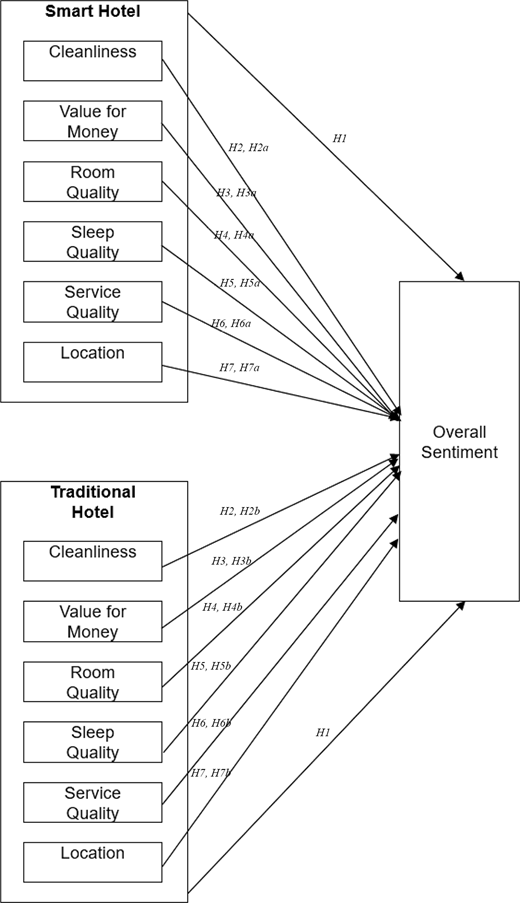
Accordingly, the conceptual model is shown in Figure 1.

The primary challenge of this study was identifying hotels that used both traditional and smart service offerings. Following Kabadayi et al. (2019), we defined smart hotels by their technology-driven, proactive services (smart rooms, robots and IoT devices), contrasting with traditional hotels’ human-centric approach. We focused on US hotels due to their widespread adoption of hospitality technologies (Cheong and Law, 2023), selecting properties based on four website sources:

  1. On the cutting edge: The four most high-tech hotels in the USA (Richard, 2017).

  2. Innovative stays: The 12 most high-tech hotels in the World (Muoio, 2016).

  3. Future-ready lodging: The nine most futuristic high-tech hotels in the World (Hollander, 2023).

  4. Guest insights: What do guests say about the ten most high-tech hotels in the World? (SiteMinder, 2023).

The study selected a hotel sample from sources that listed US high-tech properties meeting the analytical criteria. From an initial pool of 35 smart hotels identified through these sources, the final sample included 10 smart hotels and 10 traditional counterparts. The selection of the 10 smart hotels was based on three key criteria: geographical limitation to the US market for consistency and technological concentration, exclusion of properties with insufficient TripAdvisor reviews to ensure reliable sentiment data and prioritization of hotels that demonstrated recent technological implementation through online activity verification. The sample maintained geographic diversity by including two smart and two traditional hotels from each of New York and California, states with high smart hotel density, along with one representative property from other states, such as Connecticut. To enable direct comparison, each selected smart hotel (e.g. citizenM New York) was paired with a comparable traditional property located in the same area. The complete list of hotels is shown in Table 1.

We compiled a comprehensive data set spanning 2016–2021 in July 2022. A total of 8,614 reviews were initially extracted from TripAdvisor using systematic web scraping, chosen for its popularity and data reliability (Xiang et al., 2017). After data cleaning, the data set was reduced to 8,147 reviews across 20 selected hotels. Reviews were filtered by removing duplicates, empty texts, emojis and special characters, applying text normalization (lowercasing and trimming whitespace) and excluding non-English content to ensure consistency in sentiment analysis. The final data set comprised 3,664 reviews from smart hotels and 4,483 from traditional hotels.

Although Web scraping enables large-scale data collection, selecting 20 hotels ensured a balanced and methodologically sound comparison. To examine sentiment differences between smart and traditional hotels, an equal split of ten in each category was essential. Expanding the sample risked inconsistencies from variations in classification, location and technology, which could undermine comparability. Therefore, the data set focuses on a controlled yet diverse selection of hotels to yield meaningful insights.

Data was extracted using Python and the Selenium package (Selenium, n.d.), which automates Web browsers and supports JavaScript, enabling efficient scraping from TripAdvisor. Selenium’s ability to simulate mouse clicks allowed seamless navigation through review pages. The Python script, adapted from Gambino (2022), was customized to handle multiple hotels. Separate CSV files were generated for smart and traditional hotels, followed by a cleaning process. Since each row’s data was stored in a single comma-separated cell, the content was reorganized into a tabular format and converted to Excel. Occasionally, review texts spilled into adjacent cells; instead of discarding these rare cases, the fragments were merged back into the original cell. Missing values were addressed, and the TRIM function was used to remove excess spaces in review texts. For analysis, a binary “Hotel Type” column was added (1) for smart hotels and (0) for traditional hotels, before merging the two files into a single data set covering all 20 hotels. The data set description is shown in Table 2.

Following data preparation, sentiment analysis was conducted with a focus on category-specific insights. Reviews were parsed into phrases using spaCy (Honnibal and Montani, 2017), which enabled text preprocessing and sentence tokenization. Each sentence was placed in a new row, preserving the review’s metadata. Once a sentence-level data set was created, sentiment scores were assigned using VADER, a rule- and lexicon-based Python package (Hutto and Gilbert, 2014). VADER’s ability to detect punctuation, capitalization and negation eliminated the need for lemmatization or stopword removal. It generated sentiment scores including positive, negative and neutral, but only the normalized compound score (ranging from −1 to + 1) was retained, reflecting overall sentiment polarity. Sentences with no detectable sentiment were given a score of 0. This scoring method was also applied to the unsegmented data set to enable broader sentiment comparison.

To analyse sentiments by category, a keyword dictionary was developed to identify frequent and relevant terms. Only category-indicative words were retained. Ahn’s (2018) term frequency solution, which excludes stopwords, was applied via CountVectorizer from Scikit-learn (Pedregosa et al., 2011) to tokenize sentences. Selected keywords for each category are listed in Table 3. For instance, the term “check” was contextually recoded as “check-in” and “check-out” to fit the sleep quality category. Reviews were filtered using category-specific keywords, and average sentiment scores were calculated in Excel. Statistical analysis was performed in Python. Descriptive statistics summarized the data, and comparative analyses evaluated whether sentiment differences between smart and traditional hotels were statistically significant.

The review data is summarized in Table 4, highlighting the distribution of reviews across various states. Notably, New York and California account for the highest concentration of reviews, with 21.93% and 18.50% of the total, respectively. This significant concentration can be attributed to the strategic selection of a smarter and more traditional hotel in each location, which reflects the diverse accommodation preferences and tourism dynamics in these major states. We can gain insights into regional trends and customer preferences by analysing these distributions, providing a foundation for targeted marketing strategies and service enhancements.

We analyse the overall sentiment using two distinct approaches: sentiment analysis based on the content of the reviews and sentiment analysis based on the star ratings provided by the guests.

5.2.1 Overall sentiments by reviews.

Before analysing the target categories, the sentiment of the reviews was obtained without sentence parsing to provide an overall view of both hotel types. It is important to note that there is a difference in the number of hotel reviews retrieved. This difference is because some smart hotels did not have as many reviews as traditional ones, since few were relatively new. The results in Table 5 indicate that the sentiment is higher in hotels that do not use smart technologies. Accordingly, the reviews for smart hotels present an average sentiment of approximately 0.74, while the traditional ones have an average of 0.79. Both show a relatively positive sentiment. Despite the technological advancements and differences in offerings between smart and traditional hotels, the overall sentiments do not differ significantly between the two types of hotels (p = 0.153, p > 0.05).

5.2.2 Overall sentiments by review ratings.

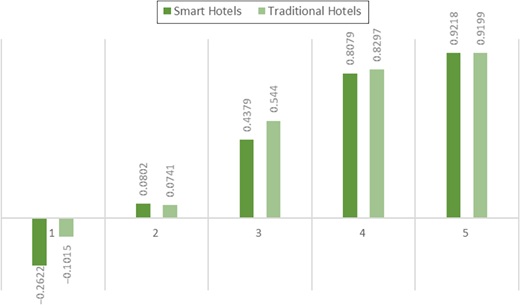
Each review includes an overall rating, a crucial measure of customer satisfaction. Overall sentiments between smart hotels and traditional hotels were systematically compared across different review ratings, ranging from 1-star to 5-star reviews, respectively. Figure 2 illustrates the average sentiment scores corresponding to each guest rating. The sentiment associated with 2-star and 5-star reviews shows a marginal preference for smart hotels, though the sentiment discrepancy is relatively minor. For 1-star, 3-star and 4-star reviews, the sentiment is more favourable towards traditional hotels. Notably, 1-star reviews for smart hotels exhibit a lower compound sentiment score than those for traditional hotels, indicating significantly more negative discourse for the former. The findings suggest that while smart hotels slightly edge out in higher-ranked reviews, the significant dissatisfaction reflected in the lower sentiment scores for 1-star reviews indicates potential areas for improvement in smart hotel services to align better with customer expectations.

5.2.3 Overall sentiments across the study period.

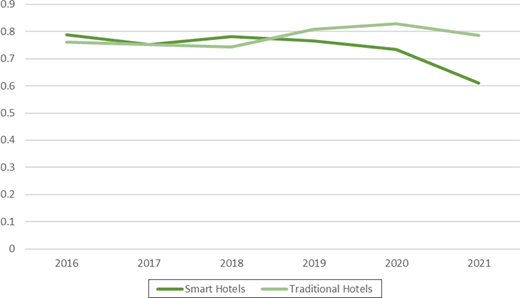
Evaluating sentiments over time offers valuable insights into guests’ perceptions of different types of hotels. Figure 3 displays the overall sentiment scores of smart and traditional hotels from 2016 to 2021, by year. Sentiment levels remained relatively consistent until 2019, when divergence between the two hotel types emerged. Sentiment for both types declined after 2020, with smart hotels experiencing the most significant drop. The analysis does not identify the reasons for this notable decline. However, this trend suggests that the unprecedented challenges of the period following 2020 May have disproportionately affected the guest experience at smart hotels, possibly due to the higher expectations associated with technology-reliant services (Song et al., 2022).

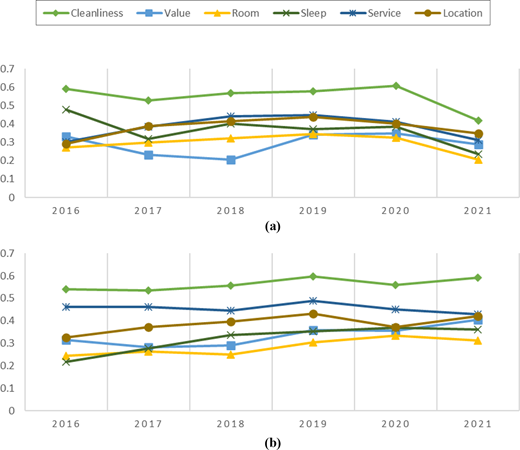
The average sentiment scores for all factors associated with smart hotels declined after 2020, as shown in Figure 4. This downturn correlates with the trends illustrated in Figure 3, suggesting that the cleanliness category may have played a significant role in the marked reduction of overall sentiment. In contrast, the sentiment scores for traditional hotels exhibit more stability. Following 2020, sentiments for specific categories, including cleanliness, value and location, have shown an upward trajectory. Moreover, it is crucial to acknowledge that, over the years, cleanliness consistently holds the highest average sentiment for both types of hotels. Additionally, the sentiment towards cleanliness in traditional hotels increased from 2020 to 2021. This surge could explain the lesser decline in the overall sentiment for traditional hotels.

Although technology enhances guest safety with a seamless and contactless experience, prioritizing cleanliness and reducing physical interactions in hospitality services during the pandemic era (Pillai et al., 2021), the apparent decline in cleanliness sentiment scores at smart hotels, in contrast to traditional ones, may be attributed to guests’ trust in the efficacy of smart technology (Elshaer and Marzouk, 2022). Considering the hotel guests’ heightened emphasis on cleanliness during the pandemic, traditional hotels might have more effectively met their heightened expectations for hygiene emphasizing the visible presence of cleaning staff, which serves as an essential cue for cleanliness to guests (Yang et al., 2024).

As shown in Table 6, 33,653 phrases were identified using the previously established keywords. The most frequently mentioned categories were “room” and “service quality”, comprising 37.27% and 25.46%, respectively. Despite the higher overall sentiment compound score for traditional hotels, it is worth noting that smart hotels scored higher in three categories: room quality, sleep quality and location, although the latter two showed only a slight difference. This may indicate that the primary positive impacts of smart technologies are most noticeable in the rooms, given the association between sleep quality and room quality. The reason for the higher room quality sentiment in smart hotels may be attributed to their ability to personalize the sleeping environment to meet the individual needs of guests using cutting-edge technology (Kim et al., 2023). Consistent with Rajesh et al. (2022), smart hotels with intelligent features and adaptable room amenities generally offer a more satisfying experience.

Overall, most categories exhibit slight differences in sentiment between smart and traditional hotels, with none being statistically significant, except for service quality (p = 0.000, p < 0.05). In terms of service quality, smart hotels score significantly lower in sentiment than traditional hotels, indicating that customers experienced or perceived lower service quality in smart hotels (average sentiment = 0.398) compared to traditional hotels (average sentiment = 0.456). The findings suggest that guests may still prefer the human service offered by traditional hotels over the automated services provided by smart technologies. Such a phenomenon may be explained by the fact that human interaction and adaptability in service are still valued by guests, mainly when their demands are high or when the situation calls for a flexible and personalized response (Fan et al., 2022). Accordingly, except for H6, H1, H2, H3, H4, H5 and H7 are rejected.

For a more comprehensive analysis, the Pearson correlation coefficients were computed to assess the relationship between the sentiment scores for individual categories and the overall satisfaction ratings given by reviewers. As shown in Table 7, the coefficients are all positive and significant at the 0.01 level, suggesting a strong positive relationship between the sentiments in the individual categories and overall sentiments for both smart and traditional hotels. Cleanliness and service quality were the most influential factors across both hotel types, suggesting a stronger impact on overall guest satisfaction. Location had the weakest correlation, particularly in traditional hotels. In addition to cleanliness and service, sleep quality and room quality significantly contribute to guest satisfaction, with greater emphasis on smart hotels. The findings support studies indicating the importance of memorable experiences and the emotional aspect of guests’ stay in smart hotels (Han et al., 2021; Kim and Han, 2020).

5.5.1 Cleanliness.

The significant positive correlation suggests that cleanliness is strongly associated with overall ratings in smart hotels. A previous study by Chen et al. (2021) suggested that cleanliness is crucial to guest satisfaction in technologically advanced hotels. Similarly, cleanliness is also important in traditional hotels, although it is slightly less so. This finding is consistent with a previous study that the competence of human cleaners is a key determinant of guest satisfaction (Wu et al., 2015). Accordingly, H2a and H2b are supported.

5.5.2 Value for money.

The correlation indicates a moderate positive relationship between value for money and overall ratings in smart hotels. Li et al. (2022) suggest that guests perceive hotels offering advanced technological amenities as having higher value, supporting this finding. A similar moderate positive correlation is observed in traditional hotels. This aligns with the findings by Li et al. (2013), who noted that value for money is a critical factor in determining guest satisfaction in both luxury and budget hotels. Accordingly, H3a and H3b are supported.

5.5.3 Room quality.

The correlation shows a strong relationship between room quality and overall ratings in smart hotels, consistent with previous research that room quality, enhanced by smart technology, significantly impacts guest satisfaction (Rajesh et al., 2022). Similarly, the correlation is slightly lower but still strong for traditional hotels. This emphasized the importance of traditional elements of room quality, including well-maintained rooms and well-prepared room amenities in the overall customer experience, as suggested by existing findings (Kim et al., 2023). Thus, H4a and H4b are supported.

5.5.4 Sleep quality.

The strong positive correlation suggests that sleep quality is highly associated with overall ratings in smart hotels. This is supported by research from Zhang et al. (2021), which highlights the adoption of smart technologies in improving sleep quality. Similarly, sleep quality also strongly correlates with overall ratings in traditional hotels. This finding aligns with research by Chen et al. (2018), who studied factors influencing business travellers’ sleep quality and overall hotel satisfaction. Accordingly, H5a and H5b are supported.

5.5.5 Service quality.

The results indicate a strong positive relationship between service quality and overall ratings in smart hotels, as well as a slightly lower but still strong correlation for traditional hotels. Rajesh et al. (2022) consistently argued that technology-enhanced service quality is crucial for guest satisfaction in smart hotels. Likewise, Fan and Mattila (2021) highlighted that traditional hotels prioritize personalized service and attention to detail, significantly boosting guest satisfaction. Thus, H6a and H6b are supported.

5.5.6 Location.

The correlation shows a moderate positive relationship between location and overall ratings in smart hotels. This is somewhat supported by research by Pai et al. (2020), who suggested that while location is important, smart technology can somewhat mitigate the impact of a less optimal location. A weaker correlation is observed for traditional hotels, which aligns with findings by Yang et al. (2018), who noted that location is often a critical factor for traditional hotel guests, and traditional hotel amenities such as shuttle services can offset the disadvantages of a less convenient location, thus enhancing customer satisfaction. Thus, H7a and H7b are supported.

This study aims to bridge a gap in the smart hospitality literature by comparing guest sentiments towards smart and traditional hotels. A sentiment analysis of online reviews was conducted to compare the experiences of customers across smart and traditional hotels in the USA, focusing on key factors such as cleanliness, value for money, room quality, sleep quality, service quality and location. Contrary to expectations, the comparative analysis revealed no significant differences in guest sentiments between the two hotel settings across dimensions, including overall sentiment, cleanliness, value for money, room quality, sleep quality and location, except for service quality, where traditional hotels received significantly higher sentiment scores than smart hotels. Additionally, the findings reveal a significant positive correlation between sentiments in individual categories and overall sentiments for both smart and traditional hotels.

The research findings make significant theoretical contributions to the existing body of literature on hospitality management and technology adoption. Firstly, the findings revealed that while overall guest sentiment does not differ significantly between smart and traditional hotels, subtle differences emerge in service quality, where traditional hotels maintain an advantage. This underscores the persistent importance of human interaction in customer satisfaction (Park et al., 2022), suggesting the complex dynamics in technology acceptance where perceived usefulness and ease do not translate to greater satisfaction in all service aspects, as observed from previous research (de Kervenoael et al., 2020). Secondly, this study reinforces the critical role of cleanliness in shaping guest sentiment. While cleanliness remains a universally important factor, traditional hotels may more effectively communicate trust and hygiene through tangible cleaning efforts, particularly in an era where health and safety concerns have become more prominent (Yang et al., 2024). This supports emerging theories that visibility and perceived cleanliness in hospitality settings continue to influence satisfaction in tech-enhanced environments (Magnini and Zehrer, 2021). Thirdly, the findings contribute to the understanding of how smart technologies enhance specific aspects of guest experience, particularly room quality and sleep quality. The ability to personalize room settings using smart features appears to be a driver of positive sentiment, supporting the idea that smart hotels can leverage technology to enhance service personalization and guest comfort (Yang et al., 2021). Fourthly, this research advances the discourse on the interplay between human services and technology, offering insights into the evolving service quality frameworks in an era increasingly shaped by smart technologies (Pillai et al., 2021). Finally, the study addresses the gap in comparative research between smart and traditional hotels, providing empirical evidence on the strengths and limitations of each hotel type. While smart hotels offer innovative experiences in certain aspects, traditional service elements, such as personalized human interaction, continue to play a crucial role in overall guest satisfaction.

From a managerial standpoint, the findings suggest that while smart hotels excel in certain aspects, such as room quality, traditional hotels continue to lead in perceived service quality. This emphasizes the importance of balancing technological innovation with personalized service, particularly in an era where customer expectations around service adaptability and personalization are high (Fan et al., 2022). Therefore, hotel managers, especially those operating smart hotels, should consider strategies to enhance the human element of their service, even in an automated environment. For example, using chatbots for basic inquiries but ensuring a staff member is readily available for complex issues or personal engagement. Also, staff should be trained with the skills necessary to provide exceptional, personalized service that complements technological conveniences. Furthermore, managers should recognize the critical role of cleanliness and ensure that cleaning protocols are visible to guests to enhance trust. For smart hotels, leveraging their technological strengths is key. Offering more customizable room settings, improving the seamless integration of smart features, and ensuring that guests find these innovations intuitive and easy to use can help differentiate smart hotels in a competitive market. For traditional hotels, the findings suggest that maintaining their strengths in personalized service and consistent cleanliness practices remains essential. Managers should focus on training staff to provide exceptional service and ensure rigorous housekeeping standards. Moreover, integrating selective smart technologies that enhance guest comfort without compromising the traditional hospitality experience can provide a balanced approach to meeting diverse guest preferences. Thus, both smart and traditional hotels must continually adapt to evolving guest expectations, striking a balance between innovation and the core values of hospitality.

Table 8 summarizes the research conclusions and implications.

This study presents several limitations. Firstly, the sample includes an imbalance in the number of reviews. Albeit modest, it could potentially skew the representativeness of the findings. Secondly, although the sample size is restricted to 20 hotels, the insights obtained are still valid for this specific group and offer a valuable understanding of their operational dynamics. It is acknowledged that representing the broader industry would require a larger sample in future studies. Thirdly, reliance on average sentiment scores may oversimplify the complexity of guest experiences and overlook nuanced feedback. Future research could address these limitations by conducting qualitative studies to gain deeper insights and performing comparative analyses across different regions, generations or cultures (Antonio et al., 2018; Israeli et al., 2019). Finally, future studies could leverage these insights to investigate the aspects where smart hotels outperform, such as room and sleep quality and location, to guide technological advancements that align with guest preferences, which could be pivotal in developing strategies for smart hotels to personalize guest experiences while maintaining the human touch that appears to be a significant factor in guest satisfaction.
Ahn
,
J.
(
2018
), “
Sentiment-Analysis-for-Hotel-Reviews/sentiment Analysis - Hotel reviews.ipynb at master · joonilahn/Sentiment-Analysis-for-Hotel-Reviews · GitHub
”,
Github
,
available at:
Link to Sentiment-Analysis-for-Hotel-Reviews/sentiment_Analysis-Hotel reviews.ipynb at master_·_joonilahn/Sentiment-Analysis-for-Hotel-Reviews · GitHubLink to the cited article.
Alvarez Leon
,
I.
,
Cavallin
,
A.
and
Louzao
,
N.
(
2021
), “
City or beach hotel? Location as a determinant of customer satisfaction and room rate
”,
International Journal of Tourism Cities
, Vol.
7
No.
2
, pp.
278
-
293
.
Antonio
,
N.
,
de Almeida
,
A.
,
Nunes
,
L.
,
Batista
,
F.
and
Ribeiro
,
R.
(
2018
), “
Hotel online reviews: different languages, different opinions
”,
Information Technology and Tourism
, Vol.
18
Nos
1-4
, pp.
157
-
185
.
Bharwani
,
S.
and
Mathews
,
D.
(
2021
), “
Techno-business strategies for enhancing guest experience in luxury hotels: a managerial perspective
”,
Worldwide Hospitality and Tourism Themes
, Vol.
13
No.
2
, pp.
168
-
185
.
Chan
,
A.P.H.
and
Tung
,
V.W.S.
(
2019
), “
Examining the effects of robotic service on brand experience: the moderating role of hotel segment
”,
Journal of Travel and Tourism Marketing
, Vol.
36
No.
4
, pp.
458
-
468
.
Chen
,
H.S.
,
Severt
,
K.
,
Shin
,
Y.H.
,
Knowlden
,
A.
and
Hilliard
,
T.W.
(
2018
), “
How’d you sleep?” measuring business travelers’ sleep quality and satisfaction in hotels
”,
Journal of Hospitality and Tourism Insights
, Vol.
1
No.
3
, pp.
188
-
202
.
Chen
,
S.-H.
,
Tzeng
,
S.-Y.
,
Tham
,
A.
and
Chu
,
P.-X.
(
2021
), “
Hospitality services in the post COVID-19 era: are we ready for high-tech and no touch service delivery in smart hotels?
”,
Journal of Hospitality Marketing and Management
, Vol.
30
No.
8
, pp.
905
-
928
.
Cheng
,
M.
and
Jin
,
X.
(
2019
), “
What do Airbnb users care about? An analysis of online review comments
”,
International Journal of Hospitality Management
, Vol.
76
, pp.
58
-
70
.
Cheong
,
F.
and
Law
,
R.
(
2023
), “
Human employees versus robotic employees: customers and hotel managers’ perceived experience at unmanned smart hotels
”,
Cogent Social Sciences
, Vol.
9
No.
1
, p.
2202937
.
de Kervenoael
,
R.
,
Hasan
,
R.
,
Schwob
,
A.
and
Goh
,
E.
(
2020
), “
Leveraging human-robot interaction in hospitality services: Incorporating the role of perceived value, empathy, and information sharing into visitors’ intentions to use social robots
”,
Tourism Management
, Vol.
78
, p.
104042
.
Elshaer
,
A.M.
and
Marzouk
,
A.M.
(
2022
), “
Memorable tourist experiences: the role of smart tourism technologies and hotel innovations
”,
Tourism Recreation Research
, Vol.
49
No.
3
, pp.
1
-
13
.
Ercan
,
F.
(
2019
), “Smart tourism technologies: applications in hotel business”, In
Krystev
,
V.
,
Efe
,
R.
and
Atasoy
,
E.
(Eds),
Theory and Practice in Social Sciences
,
St. Kliment Ohridski University Press
,
Sofia
, pp.
528
-
546
.
Fan
,
A.
and
Mattila
,
A.S.
(
2021
), “
Touch versus tech in service encounters
”,
Cornell Hospitality Quarterly
, Vol.
62
No.
4
, pp.
468
-
481
.
Fan
,
H.
,
Gao
,
W.
and
Han
,
B.
(
2022
), “
How does (im) balanced acceptance of robots between customers and frontline employees affect hotels’ service quality?
”,
Computers in Human Behavior
, Vol.
133
, p.
107287
.
Gambino
,
G.
(
2022
), “
GitHub - giuseppegambino/Scraping-TripAdvisor-with-python-2020: Python implementation of web scraping of TripAdvisor with selenium in a new 2019 website
”,
available at:
Link to GitHub - giuseppegambino/Scraping-TripAdvisor-with-python-2020: Python implementation of web scraping of TripAdvisor with selenium in a new 2019 websiteLink to the cited article.
Gavilan
,
D.
,
Avello
,
M.
and
Martinez-Navarro
,
G.
(
2018
), “
The influence of online ratings and reviews on hotel booking consideration
”,
Tourism Management
, Vol.
66
, pp.
53
-
61
.
Guerreiro
,
J.
and
Rita
,
P.
(
2020
), “
How to predict explicit recommendations in online reviews using text mining and sentiment analysis
”,
Journal of Hospitality and Tourism Management
, Vol.
43
, pp.
269
-
272
.
Gunasekar
,
S.
and
Sudhakar
,
S.
(
2019
), “
Do hotel attributes impact customer satisfaction: a sentiment analysis of online reviews
”,
Journal of Global Scholars of Marketing Science
, Vol.
29
No.
2
, pp.
180
-
195
.
Guo
,
J.
,
Susilo
,
Y.
,
Antoniou
,
C.
and
Pernestål
,
A.
(
2022
), “
Word of mouth and behavioural intentions of the automated bus service
”,
Cities
, Vol.
126
, p.
103668
.
Han
,
D.
,
Hou
,
H.
,
Wu
,
H.
and
Lai
,
J.H.K.
(
2021
), “
Modelling tourists’ acceptance of hotel experience-enhancement smart technologies
”,
Sustainability
, Vol.
13
No.
8
, p.
4462
.
Hernandez‐Ortega
,
B.
and
Ferreira
,
I.
(
2021
), “
How smart experiences build service loyalty: the importance of consumer love for smart voice assistants
”,
Psychology and Marketing
, Vol.
38
No.
7
, pp.
1122
-
1139
.
Ho
,
R.C.
,
Withanage
,
M.S.
and
Khong
,
K.W.
(
2020
), “
Sentiment drivers of hotel customers: a hybrid approach using unstructured data from online reviews
”,
Asia-Pacific Journal of Business Administration
, Vol.
12
Nos
3-4
, pp.
237
-
250
.
Hoang
,
C.
and
Tran
,
H.-A.
(
2022
), “
Robot cleaners in tourism venues: the importance of robot-environment fit on consumer evaluation of venue cleanliness
”,
Tourism Management
, Vol.
93
, p.
104611
.
Hollander
,
J.
(
2023
), “
The 9 most futuristic high tech hotels in the world
”,
Hotel Tech Report
,
available at:
Link to The 9 most futuristic high tech hotels in the worldLink to the cited article.
Honnibal
,
M.
and
Montani
,
I.
(
2017
), “
spaCy 2: natural language understanding with bloom embeddings, convolutional neural networks and incremental parsing
”,
To Appear
, Vol.
7
No.
1
, pp.
411
-
420
.
Hutto
,
C.
and
Gilbert
,
E.
(
2014
), “
Vader: A parsimonious rule-based model for sentiment analysis of social media text
”,
Proceedings of the International AAAI Conference on Web and Social Media
, Vol.
8
No.
1
, pp.
216
-
225
.
Israeli
,
A.A.
,
Lee
,
S.A.
and
Bolden
,
I.I.
(
2019
), “
The impact of escalating service failures and internet addiction behavior on young and older customers’ negative eWOM
”,
Journal of Hospitality and Tourism Management
, Vol.
39
, pp.
150
-
157
.
Jabeen
,
F.
,
Al Zaidi
,
S.
and
Al Dhaheri
,
M.H.
(
2022
), “
Automation and artificial intelligence in hospitality and tourism
”,
Tourism Review
, Vol.
77
No.
4
, pp.
1043
-
1061
.
Kabadayi
,
S.
,
Ali
,
F.
,
Choi
,
H.
,
Joosten
,
H.
and
Lu
,
C.
(
2019
), “
Smart service experience in hospitality and tourism services: a conceptualization and future research agenda
”,
Journal of Service Management
, Vol.
30
No.
3
, pp.
326
-
348
.
Kim
,
J.J.
and
Han
,
H.
(
2020
), “
Hotel of the future: exploring the attributes of a smart hotel adopting a mixed-methods approach
”,
Journal of Travel and Tourism Marketing
, Vol.
37
No.
7
, pp.
804
-
822
.
Kim
,
J.J.
,
Lee
,
J.-S.
and
Han
,
H.
(
2023
), “
Tangible and intangible hotel in-room amenities in shaping customer experience and the consequences in the with-corona era
”,
International Journal of Contemporary Hospitality Management
, Vol.
35
No.
2
, pp.
657
-
681
.
Kim
,
J.J.
,
Lee
,
M.J.
and
Han
,
H.
(
2020
), “
Smart hotels and sustainable consumer behavior: testing the effect of perceived performance, attitude, and technology readiness on word-of-mouth
”,
International Journal of Environmental Research and Public Health
, Vol.
17
No.
20
, p.
7455
.
Kim
,
J.J.
,
Montes
,
A.A.
and
Han
,
H.
(
2021
), “
The role of expected benefits towards smart hotels in shaping customer behavior: comparison by age and gender
”,
Sustainability
, Vol.
13
No.
4
, p.
1698
.
Kim
,
J.-Y.
and
Canina
,
L.
(
2015
), “
An analysis of smart tourism system satisfaction scores: the role of priced versus average quality
”,
Computers in Human Behavior
, Vol.
50
, pp.
610
-
617
.
La
,
L.
,
Xu
,
F.
,
Ren
,
Q.
,
Zhen
,
F.
and
Lobsang
,
T.
(
2022
), “
Understanding consumers’ sentiment expressions in online reviews: a hybrid approach
”,
Journal of International Consumer Marketing
, Vol.
34
No.
4
, pp.
465
-
479
.
Lai
,
X.
,
Wang
,
F.
and
Wang
,
X.
(
2021
), “
Asymmetric relationship between customer sentiment and online hotel ratings: the moderating effects of review characteristics
”,
International Journal of Contemporary Hospitality Management
, Vol.
33
No.
6
, pp.
2137
-
2156
.
Law
,
R.
,
Ye
,
H.
and
Chan
,
I.C.C.
(
2022
), “
A critical review of smart hospitality and tourism research
”,
International Journal of Contemporary Hospitality Management
, Vol.
34
No.
2
, pp.
623
-
641
.
Li
,
H.
,
Ye
,
Q.
and
Law
,
R.
(
2013
), “
Determinants of customer satisfaction in the hotel industry: an application of online review analysis
”,
Asia Pacific Journal of Tourism Research
, Vol.
18
No.
7
, pp.
784
-
802
.
Li
,
M.
,
Yin
,
D.
,
Qiu
,
H.
and
Bai
,
B.
(
2022
), “
Examining the effects of AI contactless services on customer psychological safety, perceived value, and hospitality service quality during the COVID‐19 pandemic
”,
Journal of Hospitality Marketing and Management
, Vol.
31
No.
1
, pp.
24
-
48
.
Luo
,
J.M.
,
Vu
,
H.Q.
,
Li
,
G.
and
Law
,
R.
(
2021
), “
Understanding service attributes of robot hotels: a sentiment analysis of customer online reviews
”,
International Journal of Hospitality Management
, Vol.
98
, p.
103032
.
Ma
,
E.
,
Cheng
,
M.
and
Hsiao
,
A.
(
2018
), “
Sentiment analysis–a review and agenda for future research in hospitality contexts
”,
International Journal of Contemporary Hospitality Management
, Vol.
30
No.
11
, pp.
3287
-
3308
.
Magnini
,
V.P.
and
Zehrer
,
A.
(
2021
), “
Subconscious influences on perceived cleanliness in hospitality settings
”,
International Journal of Hospitality Management
, Vol.
94
, p.
102761
.
Manolitzas
,
P.
,
Glaveli
,
N.
,
Palamas
,
S.
,
Talias
,
M.
and
Grigoroudis
,
E.
(
2022
), “
Hotel guests’ demanding level and importance of attribute satisfaction ratings: an application of multiple-criteria satisfaction analysis on TripAdvisor’s hotel guests ratings
”,
Current Issues in Tourism
, Vol.
25
No.
8
, pp.
1203
-
1208
.
Mariani
,
M.
and
Borghi
,
M.
(
2021
), “
Customers’ evaluation of mechanical artificial intelligence in hospitality services: a study using online reviews analytics
”,
International Journal of Contemporary Hospitality Management
, Vol.
33
No.
11
, pp.
3956
-
3976
.
Mehraliyev
,
F.
,
Chan
,
I.C.C.
and
Kirilenko
,
A.P.
(
2022
), “
Sentiment analysis in hospitality and tourism: a thematic and methodological review
”,
International Journal of Contemporary Hospitality Management
, Vol.
34
No.
1
, pp.
46
-
77
.
Mukhopadhyay
,
S.
,
Pandey
,
R.
and
Rishi
,
B.
(
2023
), “
Electronic word of mouth (eWOM) research–a comparative bibliometric analysis and future research insight
”,
Journal of Hospitality and Tourism Insights
, Vol.
6
No.
2
, pp.
404
-
424
.
Muoio
,
D.
(
2016
), “
The most High-Tech hotels in the world
”,
Business Insider
,
available at:
Link to The most High-Tech hotels in the worldLink to the cited article.
Nunkoo
,
R.
,
Teeroovengadum
,
V.
,
Ringle
,
C.M.
and
Sunnassee
,
V.
(
2020
), “
Service quality and customer satisfaction: the moderating effects of hotel star rating
”,
International Journal of Hospitality Management
, Vol.
91
, p.
102414
.
Özen
,
İA.
and
Özgül Katlav
,
E.
(
2023
), “
Aspect-based sentiment analysis on online customer reviews: a case study of technology-supported hotels
”,
Journal of Hospitality and Tourism Technology
, Vol.
14
No.
2
, pp.
102
-
120
.
Pai
,
C.-K.
,
Liu
,
Y.
,
Kang
,
S.
and
Dai
,
A.
(
2020
), “
The role of perceived smart tourism technology experience for tourist satisfaction, happiness and revisit intention
”,
Sustainability
, Vol.
12
No.
16
, p.
6592
.
Pallesen
,
S.
,
Larsen
,
S.
and
Bjorvatn
,
B.
(
2016
), “
I wish I’d slept better in that hotel”–guests’ self-reported sleep patterns in hotels
”,
Scandinavian Journal of Hospitality and Tourism
, Vol.
16
No.
3
, pp.
243
-
253
.
Park
,
S.
,
Kwun
,
D.J.
,
Park
,
J.-Y.
and
Bufquin
,
D.
(
2022
), “
Service quality dimensions in hotel service delivery options: Comparison between human interaction service and self-service technology
”,
International Journal of Hospitality and Tourism Administration
, Vol.
23
No.
5
, pp.
931
-
958
.
Pedregosa
,
F.
,
Varoquaux
,
G.
,
Gramfort
,
A.
,
Michel
,
V.
,
Thirion
,
B.
,
Grisel
,
O.
,
Blondel
,
M.
,
Prettenhofer
,
P.
,
Weiss
,
R.
and
Dubourg
,
V.
(
2011
), “
Scikit-learn: machine learning in python
”,
The Journal of Machine Learning Research
, Vol.
12
, pp.
2825
-
2830
.
Pelet
,
J.-É.
,
Lick
,
E.
and
Taieb
,
B.
(
2021
), “
The Internet of Things in upscale hotels: its impact on guests’ sensory experiences and behavior
”,
International Journal of Contemporary Hospitality Management
, Vol.
33
No.
11
, pp.
4035
-
4056
.
Phillips
,
P.
,
Antonio
,
N.
,
de Almeida
,
A.
and
Nunes
,
L.
(
2020
), “
The influence of geographic and psychic distance on online hotel ratings
”,
Journal of Travel Research
, Vol.
59
No.
4
, pp.
722
-
741
.
Pillai
,
S.G.
,
Haldorai
,
K.
,
Seo
,
W.S.
and
Kim
,
W.G.
(
2021
), “
COVID-19 and hospitality 5.0: redefining hospitality operations
”,
International Journal of Hospitality Management
, Vol.
94
, p.
102869
.
Qi
,
H.
and
Mo
,
R.
(
2021
), “
Exploring customer experience of smart hotel: a text big data mining approach
”,
E3S Web of Conferences
, Vol.
251
, p.
1034
.
Rajesh
,
S.
,
Abd Algani
,
Y.M.
,
Al Ansari
,
M.S.
,
Balachander
,
B.
,
Raj
,
R.
,
Muda
,
I.
,
Bala
,
B.K.
and
Balaji
,
S.
(
2022
), “
Detection of features from the Internet of Things customer attitudes in the hotel industry using a deep neural network model
”,
Measurement: Sensors
, Vol.
22
, p.
100384
.
Richard
,
M.
(
2017
), “
On the cutting edge: the 4 most high-tech hotels in the United States - The manual
”,
The Manual
,
available at:
Link to On the cutting edge: the 4 most high-tech hotels in the United States - The manualLink to the cited article.
Rita
,
P.
,
Ramos
,
R.
,
Borges-Tiago
,
M.T.
and
Rodrigues
,
D.
(
2022
), “
Impact of the rating system on sentiment and tone of voice: a booking. com and TripAdvisor comparison study
”,
International Journal of Hospitality Management
, Vol.
104
, p.
103245
.
Rita
,
P.
,
Vong
,
C.
,
Pinheiro
,
F.
and
Mimoso
,
J.
(
2023
), “
A sentiment analysis of Michelin-starred restaurants
”,
European Journal of Management and Business Economics
, Vol.
32
No.
3
, pp.
276
-
295
.
Roy
,
G.
,
Datta
,
B.
,
Mukherjee
,
S.
and
Basu
,
R.
(
2021
), “
Effect of eWOM stimuli and eWOM response on perceived service quality and online recommendation
”,
Tourism Recreation Research
, Vol.
46
No.
4
, pp.
457
-
472
.
SiteMinder
(
2023
), “
10 of the worlds most high-tech and futuristic hotels – SiteMinder
”,
available at:
Link to 10 of the worlds most high-tech and futuristic hotels - SiteMinderLink to the cited article.
Song
,
Y.
,
Liu
,
K.
,
Guo
,
L.
,
Yang
,
Z.
and
Jin
,
M.
(
2022
), “
Does hotel customer satisfaction change during the COVID-19? A perspective from online reviews
”,
Journal of Hospitality and Tourism Management
, Vol.
51
, pp.
132
-
138
.
Stylos
,
N.
,
Fotiadis
,
A.K.
,
Shin
,
D.D.
and
Huan
,
T.-C.T.C.
(
2021
), “
Beyond smart systems adoption: enabling diffusion and assimilation of smartness in hospitality
”,
International Journal of Hospitality Management
, Vol.
98
, p.
103042
.
Tajeddini
,
K.
,
Rasoolimanesh
,
S.M.
,
Gamage
,
T.C.
and
Martin
,
E.
(
2021
), “
Exploring the visitors’ decision-making process for Airbnb and hotel accommodations using value-attitude-behavior and theory of planned behavior
”,
International Journal of Hospitality Management
, Vol.
96
, p.
102950
.
Wu
,
Y.-C.
,
Tsai
,
C.-S.
,
Hsiung
,
H.-W.
and
Chen
,
K.-Y.
(
2015
), “
Linkage between frontline employee service competence scale and customer perceptions of service quality
”,
Journal of Services Marketing
, Vol.
29
No.
3
, pp.
224
-
234
.
Xiang
,
Z.
,
Du
,
Q.
,
Ma
,
Y.
and
Fan
,
W.
(
2017
), “
A comparative analysis of major online review platforms: Implications for social media analytics in hospitality and tourism
”,
Tourism Management
, Vol.
58
, pp.
51
-
65
.
Yang
,
Y.
,
Lin
,
M.S.
and
Magnini
,
V.P.
(
2024
), “
Do guests care more about hotel cleanliness during COVID-19? Understanding factors associated with cleanliness importance of hotel guests
”,
International Journal of Contemporary Hospitality Management
, Vol.
36
No.
1
, pp.
239
-
258
.
Yang
,
Y.
,
Mao
,
Z.
and
Tang
,
J.
(
2018
), “
Understanding guest satisfaction with urban hotel location
”,
Journal of Travel Research
, Vol.
57
No.
2
, pp.
243
-
259
.
Yang
,
Y.
,
Mao
,
Z.
and
Zhang
,
X.
(
2021
), “
Better sleep, better trip: the effect of sleep quality on tourists’ experiences
”,
Annals of Tourism Research
, Vol.
87
, p.
103153
.
Zhang
,
X.
,
Tavitiyaman
,
P.
and
Tsang
,
W.Y.
(
2023
), “
Preferences of technology amenities, satisfaction and behavioral intention: the perspective of hotel guests in Hong Kong
”,
Journal of Quality Assurance in Hospitality and Tourism
, Vol.
24
No.
5
, pp.
545
-
575
.
Zhang
,
Y.
,
Han
,
M.
and
Liu
,
X.
(
2021
), “
Study on demand and intelligence of light environment in guest rooms of high-end resort hotels
”,
Forest Chemicals Review
, pp.
1682
-
1694
.
Published in Spanish Journal of Marketing – ESIC. Published by Emerald Publishing Limited. This article is published under the Creative Commons Attribution (CC BY 4.0) licence. Anyone may reproduce, distribute, translate and create derivative works of this article (for both commercial and non-commercial purposes), subject to full attribution to the original publication and authors. The full terms of this licence may be seen at Link to the terms of the CC BY 4.0 licenceLink to the terms of the CC BY 4.0 licence.

Data & Figures

Figure 1.
A hotel sentiment model links smart and traditional hotel features to overall sentiment through hypotheses H 1 to H 7.The model compares smart hotel and traditional hotel features linked to overall sentiment. Each hotel type includes cleanliness, value for money, room quality, sleep quality, service quality and location. Smart hotel connects directly to overall sentiment through H 1. Its feature paths connect to overall sentiment through H 2 and H 2 a, H 3 and H 3 a, H 4 and H 4 a, H 5 and H 5 a, H 6 and H 6 a, and H 7 and H 7 a. Traditional hotel connects directly to overall sentiment through H 1. Its feature paths connect to overall sentiment through H 2 and H 2 b, H 3 and H 3 b, H 4 and H 4 b, H 5 and H 5 b, H 6 and H 6 b, and H 7 and H 7 b.

Conceptual framework

Figure 1.
A hotel sentiment model links smart and traditional hotel features to overall sentiment through hypotheses H 1 to H 7.The model compares smart hotel and traditional hotel features linked to overall sentiment. Each hotel type includes cleanliness, value for money, room quality, sleep quality, service quality and location. Smart hotel connects directly to overall sentiment through H 1. Its feature paths connect to overall sentiment through H 2 and H 2 a, H 3 and H 3 a, H 4 and H 4 a, H 5 and H 5 a, H 6 and H 6 a, and H 7 and H 7 a. Traditional hotel connects directly to overall sentiment through H 1. Its feature paths connect to overall sentiment through H 2 and H 2 b, H 3 and H 3 b, H 4 and H 4 b, H 5 and H 5 b, H 6 and H 6 b, and H 7 and H 7 b.

Conceptual framework

Close Figure 1.
Figure 2.
A bar chart compares smart hotels and traditional hotels across ratings 1 to 5, with values rising from negative scores to about 0.92.The bar chart compares smart hotels and traditional hotels across rating categories 1, 2, 3, 4 and 5. The legend entries are Smart Hotels and Traditional Hotels. For category 1, smart hotels are negative 0.2622 and traditional hotels are negative 0.1015. For category 2, smart hotels are 0.0802 and traditional hotels are 0.0741. For category 3, smart hotels are 0.4379 and traditional hotels are 0.544. For category 4, smart hotels are 0.8079 and traditional hotels are 0.8297. For category 5, smart hotels are 0.9218 and traditional hotels are 0.9199.

Average sentiment scores by review rating (ranging from 1-star to 5-star) between smart hotels and traditional hotels

Figure 2.
A bar chart compares smart hotels and traditional hotels across ratings 1 to 5, with values rising from negative scores to about 0.92.The bar chart compares smart hotels and traditional hotels across rating categories 1, 2, 3, 4 and 5. The legend entries are Smart Hotels and Traditional Hotels. For category 1, smart hotels are negative 0.2622 and traditional hotels are negative 0.1015. For category 2, smart hotels are 0.0802 and traditional hotels are 0.0741. For category 3, smart hotels are 0.4379 and traditional hotels are 0.544. For category 4, smart hotels are 0.8079 and traditional hotels are 0.8297. For category 5, smart hotels are 0.9218 and traditional hotels are 0.9199.

Average sentiment scores by review rating (ranging from 1-star to 5-star) between smart hotels and traditional hotels

Close Figure 2.
Figure 3.
A line chart compares smart hotels and traditional hotels from 2016 to 2021, with smart hotels falling to 0.61 and traditional hotels ending near 0.79.The line chart compares smart hotels and traditional hotels from 2016 to 2021. The vertical axis ranges from 0 to 0.9. Smart hotels have values of about 0.79 in 2016, 0.75 in 2017, 0.78 in 2018, 0.77 in 2019, 0.74 in 2020 and 0.61 in 2021. Traditional hotels have values of about 0.76 in 2016, 0.75 in 2017, 0.74 in 2018, 0.81 in 2019, 0.83 in 2020 and 0.79 in 2021.

Overall sentiment scores of smart and traditional hotels from 2016 to 2021

Figure 3.
A line chart compares smart hotels and traditional hotels from 2016 to 2021, with smart hotels falling to 0.61 and traditional hotels ending near 0.79.The line chart compares smart hotels and traditional hotels from 2016 to 2021. The vertical axis ranges from 0 to 0.9. Smart hotels have values of about 0.79 in 2016, 0.75 in 2017, 0.78 in 2018, 0.77 in 2019, 0.74 in 2020 and 0.61 in 2021. Traditional hotels have values of about 0.76 in 2016, 0.75 in 2017, 0.74 in 2018, 0.81 in 2019, 0.83 in 2020 and 0.79 in 2021.

Overall sentiment scores of smart and traditional hotels from 2016 to 2021

Close Figure 3.
Figure 4.
Two line charts compare hotel feature scores from 2016 to 2021 for cleanliness, value, room, sleep, service and location.The two-line charts are labelled panel a and panel b. Both charts compare cleanliness, value, room, sleep, service and location from 2016 to 2021, with the vertical axis ranging from 0 to 0.7. In panel A, cleanliness ranges from about 0.42 to 0.61, value from about 0.20 to 0.34, room from about 0.20 to 0.34, sleep from about 0.23 to 0.48, service from about 0.30 to 0.45 and location from about 0.28 to 0.45. In panel B, cleanliness ranges from about 0.54 to 0.60, value from about 0.28 to 0.41, room from about 0.24 to 0.33, sleep from about 0.22 to 0.36, service from about 0.43 to 0.49 and location from about 0.33 to 0.43.

Average sentiments by category from 2016 to 2021 for (a) smart hotels and (b) traditional hotels

Figure 4.
Two line charts compare hotel feature scores from 2016 to 2021 for cleanliness, value, room, sleep, service and location.The two-line charts are labelled panel a and panel b. Both charts compare cleanliness, value, room, sleep, service and location from 2016 to 2021, with the vertical axis ranging from 0 to 0.7. In panel A, cleanliness ranges from about 0.42 to 0.61, value from about 0.20 to 0.34, room from about 0.20 to 0.34, sleep from about 0.23 to 0.48, service from about 0.30 to 0.45 and location from about 0.28 to 0.45. In panel B, cleanliness ranges from about 0.54 to 0.60, value from about 0.28 to 0.41, room from about 0.24 to 0.33, sleep from about 0.22 to 0.36, service from about 0.43 to 0.49 and location from about 0.33 to 0.43.

Average sentiments by category from 2016 to 2021 for (a) smart hotels and (b) traditional hotels

Close Figure 4.
Table 1.

List of hotels under study

StateSmart hotelsStarsTraditional hotelsStars
ConnecticutJ House Greenwich4Omni New Haven Hotel at Yale4
New YorkYOTEL New York3The Jewel Hotel4
New YorkCitizenM4Arlo NoMad4
VirginiaHilton McLean Tysons Corner4The Berkeley Hotel4
CaliforniaAloft Cupertino3Harbor House Inn3
WashingtonHotel 10004Lake Quinault Lodge3
NevadaAria Resort & Casino5Mizpah Hotel3
North CarolinaCharlotte Marriott City Center4Haywood Park Hotel4
CaliforniaHotel Zetta4The Mosser3
IllinoisVirgin Hotels Chicago4The Whitehall Hotel4
Table 2.

Description of the data set

FieldDescription
Hotel nameThe name of the hotel was extracted for each review
Hotel ratingThe overall rating provided by the customer ranges from 1 to 5
Review dateDate when the review was posted
Review titleTitle of the written review
Review contentWritten review where the sentiment analysis is performed
Hotel typeA binary column was added to distinguish the smart (1) and traditional hotels (0)
Table 3.

Dictionary of categories

CleanlinessClean
Value for MoneyPrice, value
Room qualityRoom, bathroom, shower, toilet, amenities, suite, TV
Sleep qualitySleep, bed
Service qualityStaff, service, desk, valet, check in, check out
LocationLocation, city, walk, street, located
Table 4.

Number of hotel reviews by state

StateNo. of reviewsTotal% of total
Smart hotelsTraditional hotels
Connecticut45044989911.03
New York9008871,78721.93
Virginia45045090011.05
California6088991,50718.50
Washington36945081910.05
Nevada2974507479.17
North Carolina3004507509.21
Illinois2904487389.06
Total3,6644,4838,147
Table 5.

Overall sentiments and Kruskal–Wallis statistical results per hotel type

Hotel typeNo. of reviews% of totalAverage sentimentSDStatisticsp-value
Smart3,66444.970.7370.4892.0040.153
Traditional4,48355.030.7860.423
Total8,147
Table 6.

Average sentiments by category and Kruskal–Wallis statistical results of smart hotels and traditional hotels

No. of phrasesAverage sentimentSD
CategoryST% of totalSTDiff. (S − T)STStatisticsp-value
Cleanliness1,3221,6598.860.5410.574−0.0320.3670.3433.3650.067
Value for money5117953.880.3180.325−0.0060.4250.4280.1550.694
Room quality5,5606,98337.270.2960.2890.0070.4320.4211.6810.195
Sleep quality1,1141,4047.480.3360.3280.0080.4600.4371.1360.286
Service quality4,0984,47025.460.3980.456−0.0580.4320.41035.7330.000*
Location2,0073,73017.050.4060.4020.0040.3920.3810.7870.375
Total14,61219,041
Note(s):

p-values marked with an asterisk (*) indicate the statistical significance and S = smart hotels; T = traditional hotels

Table 7.

Pearson correlation coefficients for the individual category and overall sentiments by hotel type

CategoryCorrelation coefficients
Smart hotelsTraditional hotels
Cleanliness0.551**0.485**
Value for money0.396**0.375**
Room quality0.474**0.435**
Sleep quality0.521**0.453**
Service quality0.539**0.471**
Location0.330**0.195**
Note(s):

**Correlation is significant at the 0.01 level

Table 8.

Conclusions and theoretical and managerial implications

ConclusionsTheoretical and managerial implications
No significant differences in guest sentiments between smart and traditional hotels (cleanliness, value, room/sleep quality and location), but traditional hotels’ service quality scored higherTheoretical: Confirms human interaction’s enduring role
Managerial: Smart hotels integrate human-assisted options to complement automation, and traditional hotels maintain service strengths
Service quality sentiment is higher in traditional hotelsTheoretical: Supports the human touch in customer satisfaction
Managerial: Train staff in personalization, and use technology to augment, not replace
Cleanliness strongly impacts satisfaction in bothTheoretical: Reinforces hygiene’s pivotal role post-pandemic
Managerial: Promote customization; traditional hotels adopt smart room features
Smart hotels excel in room/sleep quality (tech-enabled personalization)Theoretical: Validates technology’s role in comfort and customization
Managerial: Smart hotels promote customization; traditional hotels adopt smart room features
Positive correlation between category sentiments (service and cleanliness) and overall satisfactionTheoretical: Confirms multi-dimensional service quality frameworks
Managerial: Prioritize high-performing areas (e.g. cleanliness) to boost overall satisfaction

Supplements

References

Ahn
,
J.
(
2018
), “
Sentiment-Analysis-for-Hotel-Reviews/sentiment Analysis - Hotel reviews.ipynb at master · joonilahn/Sentiment-Analysis-for-Hotel-Reviews · GitHub
”,
Github
,
available at:
Link to Sentiment-Analysis-for-Hotel-Reviews/sentiment_Analysis-Hotel reviews.ipynb at master_·_joonilahn/Sentiment-Analysis-for-Hotel-Reviews · GitHubLink to the cited article.
Alvarez Leon
,
I.
,
Cavallin
,
A.
and
Louzao
,
N.
(
2021
), “
City or beach hotel? Location as a determinant of customer satisfaction and room rate
”,
International Journal of Tourism Cities
, Vol.
7
No.
2
, pp.
278
-
293
.
Antonio
,
N.
,
de Almeida
,
A.
,
Nunes
,
L.
,
Batista
,
F.
and
Ribeiro
,
R.
(
2018
), “
Hotel online reviews: different languages, different opinions
”,
Information Technology and Tourism
, Vol.
18
Nos
1-4
, pp.
157
-
185
.
Bharwani
,
S.
and
Mathews
,
D.
(
2021
), “
Techno-business strategies for enhancing guest experience in luxury hotels: a managerial perspective
”,
Worldwide Hospitality and Tourism Themes
, Vol.
13
No.
2
, pp.
168
-
185
.
Chan
,
A.P.H.
and
Tung
,
V.W.S.
(
2019
), “
Examining the effects of robotic service on brand experience: the moderating role of hotel segment
”,
Journal of Travel and Tourism Marketing
, Vol.
36
No.
4
, pp.
458
-
468
.
Chen
,
H.S.
,
Severt
,
K.
,
Shin
,
Y.H.
,
Knowlden
,
A.
and
Hilliard
,
T.W.
(
2018
), “
How’d you sleep?” measuring business travelers’ sleep quality and satisfaction in hotels
”,
Journal of Hospitality and Tourism Insights
, Vol.
1
No.
3
, pp.
188
-
202
.
Chen
,
S.-H.
,
Tzeng
,
S.-Y.
,
Tham
,
A.
and
Chu
,
P.-X.
(
2021
), “
Hospitality services in the post COVID-19 era: are we ready for high-tech and no touch service delivery in smart hotels?
”,
Journal of Hospitality Marketing and Management
, Vol.
30
No.
8
, pp.
905
-
928
.
Cheng
,
M.
and
Jin
,
X.
(
2019
), “
What do Airbnb users care about? An analysis of online review comments
”,
International Journal of Hospitality Management
, Vol.
76
, pp.
58
-
70
.
Cheong
,
F.
and
Law
,
R.
(
2023
), “
Human employees versus robotic employees: customers and hotel managers’ perceived experience at unmanned smart hotels
”,
Cogent Social Sciences
, Vol.
9
No.
1
, p.
2202937
.
de Kervenoael
,
R.
,
Hasan
,
R.
,
Schwob
,
A.
and
Goh
,
E.
(
2020
), “
Leveraging human-robot interaction in hospitality services: Incorporating the role of perceived value, empathy, and information sharing into visitors’ intentions to use social robots
”,
Tourism Management
, Vol.
78
, p.
104042
.
Elshaer
,
A.M.
and
Marzouk
,
A.M.
(
2022
), “
Memorable tourist experiences: the role of smart tourism technologies and hotel innovations
”,
Tourism Recreation Research
, Vol.
49
No.
3
, pp.
1
-
13
.
Ercan
,
F.
(
2019
), “Smart tourism technologies: applications in hotel business”, In
Krystev
,
V.
,
Efe
,
R.
and
Atasoy
,
E.
(Eds),
Theory and Practice in Social Sciences
,
St. Kliment Ohridski University Press
,
Sofia
, pp.
528
-
546
.
Fan
,
A.
and
Mattila
,
A.S.
(
2021
), “
Touch versus tech in service encounters
”,
Cornell Hospitality Quarterly
, Vol.
62
No.
4
, pp.
468
-
481
.
Fan
,
H.
,
Gao
,
W.
and
Han
,
B.
(
2022
), “
How does (im) balanced acceptance of robots between customers and frontline employees affect hotels’ service quality?
”,
Computers in Human Behavior
, Vol.
133
, p.
107287
.
Gambino
,
G.
(
2022
), “
GitHub - giuseppegambino/Scraping-TripAdvisor-with-python-2020: Python implementation of web scraping of TripAdvisor with selenium in a new 2019 website
”,
available at:
Link to GitHub - giuseppegambino/Scraping-TripAdvisor-with-python-2020: Python implementation of web scraping of TripAdvisor with selenium in a new 2019 websiteLink to the cited article.
Gavilan
,
D.
,
Avello
,
M.
and
Martinez-Navarro
,
G.
(
2018
), “
The influence of online ratings and reviews on hotel booking consideration
”,
Tourism Management
, Vol.
66
, pp.
53
-
61
.
Guerreiro
,
J.
and
Rita
,
P.
(
2020
), “
How to predict explicit recommendations in online reviews using text mining and sentiment analysis
”,
Journal of Hospitality and Tourism Management
, Vol.
43
, pp.
269
-
272
.
Gunasekar
,
S.
and
Sudhakar
,
S.
(
2019
), “
Do hotel attributes impact customer satisfaction: a sentiment analysis of online reviews
”,
Journal of Global Scholars of Marketing Science
, Vol.
29
No.
2
, pp.
180
-
195
.
Guo
,
J.
,
Susilo
,
Y.
,
Antoniou
,
C.
and
Pernestål
,
A.
(
2022
), “
Word of mouth and behavioural intentions of the automated bus service
”,
Cities
, Vol.
126
, p.
103668
.
Han
,
D.
,
Hou
,
H.
,
Wu
,
H.
and
Lai
,
J.H.K.
(
2021
), “
Modelling tourists’ acceptance of hotel experience-enhancement smart technologies
”,
Sustainability
, Vol.
13
No.
8
, p.
4462
.
Hernandez‐Ortega
,
B.
and
Ferreira
,
I.
(
2021
), “
How smart experiences build service loyalty: the importance of consumer love for smart voice assistants
”,
Psychology and Marketing
, Vol.
38
No.
7
, pp.
1122
-
1139
.
Ho
,
R.C.
,
Withanage
,
M.S.
and
Khong
,
K.W.
(
2020
), “
Sentiment drivers of hotel customers: a hybrid approach using unstructured data from online reviews
”,
Asia-Pacific Journal of Business Administration
, Vol.
12
Nos
3-4
, pp.
237
-
250
.
Hoang
,
C.
and
Tran
,
H.-A.
(
2022
), “
Robot cleaners in tourism venues: the importance of robot-environment fit on consumer evaluation of venue cleanliness
”,
Tourism Management
, Vol.
93
, p.
104611
.
Hollander
,
J.
(
2023
), “
The 9 most futuristic high tech hotels in the world
”,
Hotel Tech Report
,
available at:
Link to The 9 most futuristic high tech hotels in the worldLink to the cited article.
Honnibal
,
M.
and
Montani
,
I.
(
2017
), “
spaCy 2: natural language understanding with bloom embeddings, convolutional neural networks and incremental parsing
”,
To Appear
, Vol.
7
No.
1
, pp.
411
-
420
.
Hutto
,
C.
and
Gilbert
,
E.
(
2014
), “
Vader: A parsimonious rule-based model for sentiment analysis of social media text
”,
Proceedings of the International AAAI Conference on Web and Social Media
, Vol.
8
No.
1
, pp.
216
-
225
.
Israeli
,
A.A.
,
Lee
,
S.A.
and
Bolden
,
I.I.
(
2019
), “
The impact of escalating service failures and internet addiction behavior on young and older customers’ negative eWOM
”,
Journal of Hospitality and Tourism Management
, Vol.
39
, pp.
150
-
157
.
Jabeen
,
F.
,
Al Zaidi
,
S.
and
Al Dhaheri
,
M.H.
(
2022
), “
Automation and artificial intelligence in hospitality and tourism
”,
Tourism Review
, Vol.
77
No.
4
, pp.
1043
-
1061
.
Kabadayi
,
S.
,
Ali
,
F.
,
Choi
,
H.
,
Joosten
,
H.
and
Lu
,
C.
(
2019
), “
Smart service experience in hospitality and tourism services: a conceptualization and future research agenda
”,
Journal of Service Management
, Vol.
30
No.
3
, pp.
326
-
348
.
Kim
,
J.J.
and
Han
,
H.
(
2020
), “
Hotel of the future: exploring the attributes of a smart hotel adopting a mixed-methods approach
”,
Journal of Travel and Tourism Marketing
, Vol.
37
No.
7
, pp.
804
-
822
.
Kim
,
J.J.
,
Lee
,
J.-S.
and
Han
,
H.
(
2023
), “
Tangible and intangible hotel in-room amenities in shaping customer experience and the consequences in the with-corona era
”,
International Journal of Contemporary Hospitality Management
, Vol.
35
No.
2
, pp.
657
-
681
.
Kim
,
J.J.
,
Lee
,
M.J.
and
Han
,
H.
(
2020
), “
Smart hotels and sustainable consumer behavior: testing the effect of perceived performance, attitude, and technology readiness on word-of-mouth
”,
International Journal of Environmental Research and Public Health
, Vol.
17
No.
20
, p.
7455
.
Kim
,
J.J.
,
Montes
,
A.A.
and
Han
,
H.
(
2021
), “
The role of expected benefits towards smart hotels in shaping customer behavior: comparison by age and gender
”,
Sustainability
, Vol.
13
No.
4
, p.
1698
.
Kim
,
J.-Y.
and
Canina
,
L.
(
2015
), “
An analysis of smart tourism system satisfaction scores: the role of priced versus average quality
”,
Computers in Human Behavior
, Vol.
50
, pp.
610
-
617
.
La
,
L.
,
Xu
,
F.
,
Ren
,
Q.
,
Zhen
,
F.
and
Lobsang
,
T.
(
2022
), “
Understanding consumers’ sentiment expressions in online reviews: a hybrid approach
”,
Journal of International Consumer Marketing
, Vol.
34
No.
4
, pp.
465
-
479
.
Lai
,
X.
,
Wang
,
F.
and
Wang
,
X.
(
2021
), “
Asymmetric relationship between customer sentiment and online hotel ratings: the moderating effects of review characteristics
”,
International Journal of Contemporary Hospitality Management
, Vol.
33
No.
6
, pp.
2137
-
2156
.
Law
,
R.
,
Ye
,
H.
and
Chan
,
I.C.C.
(
2022
), “
A critical review of smart hospitality and tourism research
”,
International Journal of Contemporary Hospitality Management
, Vol.
34
No.
2
, pp.
623
-
641
.
Li
,
H.
,
Ye
,
Q.
and
Law
,
R.
(
2013
), “
Determinants of customer satisfaction in the hotel industry: an application of online review analysis
”,
Asia Pacific Journal of Tourism Research
, Vol.
18
No.
7
, pp.
784
-
802
.
Li
,
M.
,
Yin
,
D.
,
Qiu
,
H.
and
Bai
,
B.
(
2022
), “
Examining the effects of AI contactless services on customer psychological safety, perceived value, and hospitality service quality during the COVID‐19 pandemic
”,
Journal of Hospitality Marketing and Management
, Vol.
31
No.
1
, pp.
24
-
48
.
Luo
,
J.M.
,
Vu
,
H.Q.
,
Li
,
G.
and
Law
,
R.
(
2021
), “
Understanding service attributes of robot hotels: a sentiment analysis of customer online reviews
”,
International Journal of Hospitality Management
, Vol.
98
, p.
103032
.
Ma
,
E.
,
Cheng
,
M.
and
Hsiao
,
A.
(
2018
), “
Sentiment analysis–a review and agenda for future research in hospitality contexts
”,
International Journal of Contemporary Hospitality Management
, Vol.
30
No.
11
, pp.
3287
-
3308
.
Magnini
,
V.P.
and
Zehrer
,
A.
(
2021
), “
Subconscious influences on perceived cleanliness in hospitality settings
”,
International Journal of Hospitality Management
, Vol.
94
, p.
102761
.
Manolitzas
,
P.
,
Glaveli
,
N.
,
Palamas
,
S.
,
Talias
,
M.
and
Grigoroudis
,
E.
(
2022
), “
Hotel guests’ demanding level and importance of attribute satisfaction ratings: an application of multiple-criteria satisfaction analysis on TripAdvisor’s hotel guests ratings
”,
Current Issues in Tourism
, Vol.
25
No.
8
, pp.
1203
-
1208
.
Mariani
,
M.
and
Borghi
,
M.
(
2021
), “
Customers’ evaluation of mechanical artificial intelligence in hospitality services: a study using online reviews analytics
”,
International Journal of Contemporary Hospitality Management
, Vol.
33
No.
11
, pp.
3956
-
3976
.
Mehraliyev
,
F.
,
Chan
,
I.C.C.
and
Kirilenko
,
A.P.
(
2022
), “
Sentiment analysis in hospitality and tourism: a thematic and methodological review
”,
International Journal of Contemporary Hospitality Management
, Vol.
34
No.
1
, pp.
46
-
77
.
Mukhopadhyay
,
S.
,
Pandey
,
R.
and
Rishi
,
B.
(
2023
), “
Electronic word of mouth (eWOM) research–a comparative bibliometric analysis and future research insight
”,
Journal of Hospitality and Tourism Insights
, Vol.
6
No.
2
, pp.
404
-
424
.
Muoio
,
D.
(
2016
), “
The most High-Tech hotels in the world
”,
Business Insider
,
available at:
Link to The most High-Tech hotels in the worldLink to the cited article.
Nunkoo
,
R.
,
Teeroovengadum
,
V.
,
Ringle
,
C.M.
and
Sunnassee
,
V.
(
2020
), “
Service quality and customer satisfaction: the moderating effects of hotel star rating
”,
International Journal of Hospitality Management
, Vol.
91
, p.
102414
.
Özen
,
İA.
and
Özgül Katlav
,
E.
(
2023
), “
Aspect-based sentiment analysis on online customer reviews: a case study of technology-supported hotels
”,
Journal of Hospitality and Tourism Technology
, Vol.
14
No.
2
, pp.
102
-
120
.
Pai
,
C.-K.
,
Liu
,
Y.
,
Kang
,
S.
and
Dai
,
A.
(
2020
), “
The role of perceived smart tourism technology experience for tourist satisfaction, happiness and revisit intention
”,
Sustainability
, Vol.
12
No.
16
, p.
6592
.
Pallesen
,
S.
,
Larsen
,
S.
and
Bjorvatn
,
B.
(
2016
), “
I wish I’d slept better in that hotel”–guests’ self-reported sleep patterns in hotels
”,
Scandinavian Journal of Hospitality and Tourism
, Vol.
16
No.
3
, pp.
243
-
253
.
Park
,
S.
,
Kwun
,
D.J.
,
Park
,
J.-Y.
and
Bufquin
,
D.
(
2022
), “
Service quality dimensions in hotel service delivery options: Comparison between human interaction service and self-service technology
”,
International Journal of Hospitality and Tourism Administration
, Vol.
23
No.
5
, pp.
931
-
958
.
Pedregosa
,
F.
,
Varoquaux
,
G.
,
Gramfort
,
A.
,
Michel
,
V.
,
Thirion
,
B.
,
Grisel
,
O.
,
Blondel
,
M.
,
Prettenhofer
,
P.
,
Weiss
,
R.
and
Dubourg
,
V.
(
2011
), “
Scikit-learn: machine learning in python
”,
The Journal of Machine Learning Research
, Vol.
12
, pp.
2825
-
2830
.
Pelet
,
J.-É.
,
Lick
,
E.
and
Taieb
,
B.
(
2021
), “
The Internet of Things in upscale hotels: its impact on guests’ sensory experiences and behavior
”,
International Journal of Contemporary Hospitality Management
, Vol.
33
No.
11
, pp.
4035
-
4056
.
Phillips
,
P.
,
Antonio
,
N.
,
de Almeida
,
A.
and
Nunes
,
L.
(
2020
), “
The influence of geographic and psychic distance on online hotel ratings
”,
Journal of Travel Research
, Vol.
59
No.
4
, pp.
722
-
741
.
Pillai
,
S.G.
,
Haldorai
,
K.
,
Seo
,
W.S.
and
Kim
,
W.G.
(
2021
), “
COVID-19 and hospitality 5.0: redefining hospitality operations
”,
International Journal of Hospitality Management
, Vol.
94
, p.
102869
.
Qi
,
H.
and
Mo
,
R.
(
2021
), “
Exploring customer experience of smart hotel: a text big data mining approach
”,
E3S Web of Conferences
, Vol.
251
, p.
1034
.
Rajesh
,
S.
,
Abd Algani
,
Y.M.
,
Al Ansari
,
M.S.
,
Balachander
,
B.
,
Raj
,
R.
,
Muda
,
I.
,
Bala
,
B.K.
and
Balaji
,
S.
(
2022
), “
Detection of features from the Internet of Things customer attitudes in the hotel industry using a deep neural network model
”,
Measurement: Sensors
, Vol.
22
, p.
100384
.
Richard
,
M.
(
2017
), “
On the cutting edge: the 4 most high-tech hotels in the United States - The manual
”,
The Manual
,
available at:
Link to On the cutting edge: the 4 most high-tech hotels in the United States - The manualLink to the cited article.
Rita
,
P.
,
Ramos
,
R.
,
Borges-Tiago
,
M.T.
and
Rodrigues
,
D.
(
2022
), “
Impact of the rating system on sentiment and tone of voice: a booking. com and TripAdvisor comparison study
”,
International Journal of Hospitality Management
, Vol.
104
, p.
103245
.
Rita
,
P.
,
Vong
,
C.
,
Pinheiro
,
F.
and
Mimoso
,
J.
(
2023
), “
A sentiment analysis of Michelin-starred restaurants
”,
European Journal of Management and Business Economics
, Vol.
32
No.
3
, pp.
276
-
295
.
Roy
,
G.
,
Datta
,
B.
,
Mukherjee
,
S.
and
Basu
,
R.
(
2021
), “
Effect of eWOM stimuli and eWOM response on perceived service quality and online recommendation
”,
Tourism Recreation Research
, Vol.
46
No.
4
, pp.
457
-
472
.
SiteMinder
(
2023
), “
10 of the worlds most high-tech and futuristic hotels – SiteMinder
”,
available at:
Link to 10 of the worlds most high-tech and futuristic hotels - SiteMinderLink to the cited article.
Song
,
Y.
,
Liu
,
K.
,
Guo
,
L.
,
Yang
,
Z.
and
Jin
,
M.
(
2022
), “
Does hotel customer satisfaction change during the COVID-19? A perspective from online reviews
”,
Journal of Hospitality and Tourism Management
, Vol.
51
, pp.
132
-
138
.
Stylos
,
N.
,
Fotiadis
,
A.K.
,
Shin
,
D.D.
and
Huan
,
T.-C.T.C.
(
2021
), “
Beyond smart systems adoption: enabling diffusion and assimilation of smartness in hospitality
”,
International Journal of Hospitality Management
, Vol.
98
, p.
103042
.
Tajeddini
,
K.
,
Rasoolimanesh
,
S.M.
,
Gamage
,
T.C.
and
Martin
,
E.
(
2021
), “
Exploring the visitors’ decision-making process for Airbnb and hotel accommodations using value-attitude-behavior and theory of planned behavior
”,
International Journal of Hospitality Management
, Vol.
96
, p.
102950
.
Wu
,
Y.-C.
,
Tsai
,
C.-S.
,
Hsiung
,
H.-W.
and
Chen
,
K.-Y.
(
2015
), “
Linkage between frontline employee service competence scale and customer perceptions of service quality
”,
Journal of Services Marketing
, Vol.
29
No.
3
, pp.
224
-
234
.
Xiang
,
Z.
,
Du
,
Q.
,
Ma
,
Y.
and
Fan
,
W.
(
2017
), “
A comparative analysis of major online review platforms: Implications for social media analytics in hospitality and tourism
”,
Tourism Management
, Vol.
58
, pp.
51
-
65
.
Yang
,
Y.
,
Lin
,
M.S.
and
Magnini
,
V.P.
(
2024
), “
Do guests care more about hotel cleanliness during COVID-19? Understanding factors associated with cleanliness importance of hotel guests
”,
International Journal of Contemporary Hospitality Management
, Vol.
36
No.
1
, pp.
239
-
258
.
Yang
,
Y.
,
Mao
,
Z.
and
Tang
,
J.
(
2018
), “
Understanding guest satisfaction with urban hotel location
”,
Journal of Travel Research
, Vol.
57
No.
2
, pp.
243
-
259
.
Yang
,
Y.
,
Mao
,
Z.
and
Zhang
,
X.
(
2021
), “
Better sleep, better trip: the effect of sleep quality on tourists’ experiences
”,
Annals of Tourism Research
, Vol.
87
, p.
103153
.
Zhang
,
X.
,
Tavitiyaman
,
P.
and
Tsang
,
W.Y.
(
2023
), “
Preferences of technology amenities, satisfaction and behavioral intention: the perspective of hotel guests in Hong Kong
”,
Journal of Quality Assurance in Hospitality and Tourism
, Vol.
24
No.
5
, pp.
545
-
575
.
Zhang
,
Y.
,
Han
,
M.
and
Liu
,
X.
(
2021
), “
Study on demand and intelligence of light environment in guest rooms of high-end resort hotels
”,
Forest Chemicals Review
, pp.
1682
-
1694
.

Languages

or Create an Account

Close subscription notice
Close access options