


The purpose of this study is to delve into the intricacies of consumer shopping behavior within the metaverse, aiming to uncover how virtual environments influence decision-making processes. By examining psychological, social and technological factors, this study seeks to provide a comprehensive understanding of consumer experiences in digital realms and to propose a forward-looking research agenda.
Using a systematic literature review (SLR) grounded in the Theory, Context, Characteristics and Methods (TCCM) framework, complemented by thematic analysis, this study scrutinizes 96 articles sourced from Scopus, spanning the period from 2003 to 2024.
The metaverse engenders unique consumer behaviors, driven by immersive experiences, personalization and social presence. Virtual shopping fosters heightened engagement, loyalty and satisfaction, with emotional and ethical considerations significantly influencing purchase decisions. Key themes such as virtual economies, psychological ownership and trust underscore the delicate balance between digital convenience and privacy concerns. Notably, consumers exhibit impulse and exploratory tendencies, with a marked inclination toward prosocial and ethical choices.
The findings of this study provide actionable insights for businesses to leverage immersive technologies, address privacy concerns and foster consumer trust. Strategies emphasizing personalization, ethical consumption and virtual asset ownership are pivotal in enhancing consumer engagement in digital environments.
This study pioneers the integration of emerging theories with practical insights, advancing the understanding of virtual commerce dynamics. This study elucidates the evolving interplay between technology and consumer behavior, offering a strategic application in metaverse.
1. Introduction
The accelerated transformation of virtual commerce is reshaping the landscape of consumer engagement, compelling scholars, innovators and businesses to deepen their understanding of consumer behavior in digital realms. The metaverse, an evolving nexus of virtual reality (VR), augmented reality (AR), mixed reality (MR) and immersive digital interaction, is redefining the shopping experience by offering consumers unprecedented autonomy and personalization in selecting products and services within these highly interactive environments (Ball, 2022). This expansion in consumer choice necessitates an in-depth analysis of consumer behavior within these spaces, illuminating how avatars, gamification and immersive technologies influence decision-making and purchasing patterns (del Castillo Rodríguez, 2023).
Consumer behavior examines how individuals, groups and organizations select, purchase, use and dispose of goods, services and experiences to fulfill specific needs and desires. However, the emergence of the metaverse introduces new experiential and psychological dimensions to consumer behavior that extend beyond traditional social, cultural and economic influences. Shopping behavior, a subset of consumer behavior, involves specific activities and preferences individuals exhibit when purchasing products or services. The metaverse, however, adds distinct layers of complexity through hyper-personalized shopping experiences, gamified engagements and avatar-driven interactions (Prados-Castillo et al., 2024).
The metaverse is a persistent and interconnected digital ecosystem where physical and virtual realities merge to create a seamless consumer experience (Rafique and Qadir, 2024). It allows consumers to interact with brands, explore virtual stores and purchase digital assets in real time, enabling businesses to craft immersive hybrid experiences (Vishwakarma et al., 2024). As companies increasingly shift toward virtual retail, understanding consumer navigation and decision-making within these interactive environments has become critical. For instance, in a virtual fashion store, examining how consumers interact with virtual garments, assess fit using digital avatars and finalize purchases via blockchain-based smart contracts offers essential insights for retailers designing next-generation virtual storefronts to maximize engagement and conversions.
A crucial yet underexplored aspect of shopping in the metaverse is the role of gamification – the application of game-design elements in non-gaming contexts to enhance user engagement. Gamification mechanics such as reward systems, leaderboards and immersive challenges create a more interactive and engaging shopping experience (Villalustre and Del Moral, 2017). For instance, retailers in the metaverse use gamification through interactive quests that allow consumers to earn loyalty points, exclusive discounts or even digital assets (NFTs) based on their shopping behaviors. This engagement-driven approach significantly enhances brand loyalty and incentivizes users to return to virtual shopping platforms (Dunleavy et al., 2009).
Additionally, avatar-based interactions redefine consumer identity in digital spaces (Castillo et al., 2024). Avatars function as digital representations of users, allowing consumers to engage in virtual shopping environments in highly personalized ways. Through AI-driven customization tools, consumers can modify their avatars’ physical appearance, clothing and accessories, fostering a deeper psychological connection to their virtual purchases (Ramadan and Ramadan, 2025). The psychological implications of avatar-driven shopping, particularly in relation to self-perception, digital embodiment and consumer identity, necessitate further exploration (Yao et al., 2024).
Moreover, MR blends physical and virtual elements, offering a hybrid retail experience where consumers can visualize and interact with digital products in their real-world environment (Flavián et al., 2019). Unlike AR and VR, which are either purely digital or purely immersive, MR enables a seamless transition between real and virtual shopping experiences (Hoyer et al., 2020). For example, furniture retailers using MR allow customers to place digital versions of furniture in their actual homes before making a purchase, thereby enhancing decision-making accuracy and reducing return rates (Prados-Castillo et al., 2024).
While the metaverse offers unprecedented opportunities, it also raises critical ethical concerns, particularly regarding privacy, digital ownership and algorithmic biases (Zhuk, A., 2024). AI-driven recommendation systems not only personalize shopping experiences but also raise questions regarding consumer data security and manipulation (Vashishth et al., 2025). Furthermore, the use of blockchain-based virtual currencies in transactions introduces challenges related to regulatory oversight and financial inclusivity (del Castillo Rodríguez, 2023). As such, researchers and policymakers must address these ethical dilemmas to ensure a responsible and equitable metaverse commerce ecosystem.
The metaverse has ushered in a transformative era in consumer behavior, blending elements of VR, AR, MR, gamification and AI-driven personalization to create immersive and interactive digital shopping environments. However, despite its potential, gaps remain in understanding how digital presence, avatar-driven shopping and gamification influence long-term consumer engagement and purchasing behaviors.
To address the research gap, this study aims to systematically explore customers’ shopping behavior in the metaverse. To accomplish the aims, the following research questions (RQs) have been formulated:
What are the key theoretical foundations that influence customers’ shopping behavior in the metaverse?
How do various factors affect customers’ decision-making processes in metaverse shopping?
What are the key methodologies used in the study of customers’ shopping behavior in the metaverse?
What future research directions can be established to further investigate customers’ shopping behavior in the metaverse?
By integrating concepts from immersive technologies, gamification and avatar-driven identity, this study offers a unique framework for understanding how psychological, social and technological factors shape consumer decision-making in virtual environments. The research also contributes to the development of new concepts in virtual commerce, addressing the complexities of digital presence, personalized engagement and ethical considerations. By addressing the challenges of privacy concerns, digital asset ownership and consumer trust, this study offers insight for retailers, marketers and policymakers to enhance consumer satisfaction, engagement and long-term loyalty in the metaverse. These insights provide invaluable in navigating the intersection of technology, ethics and commerce, paving the way for inclusive virtual consumer experiences.
2. Methodology
To accomplish the aim, this study carried out in two phases. First, a framework-based systematic literature review (SLR) is applied. A framework-based SLR systematically analyzes and synthesizes existing research to identify key theories, geographical contexts, study characteristics and methodologies (Paul et al., 2021). By applying a structured framework, this approach ensures a comprehensive examination of the literature, helping to categorize and compare findings across studies. It provides an understanding of the theoretical foundations, research designs and global perspectives within the field, facilitating the identification of gaps and guiding future research directions.
The search period is set between 2003 and 2024 to capture a comprehensive range of literature on the topic, spanning from the emergence of virtual environments to the present day, thereby ensuring inclusivity and relevance of findings. Further, this study has chosen Scopus as the database for gathering literature, as it provides extensive coverage of academic literature across multiple disciplines, offering a diverse range of scholarly sources for analysis (Vishwakarma et al., 2024). This database has been used in the recent studies in behavioral studies (Medias et al., 2024).
Scientific Procedures and Rationales for Systematic Literature Reviews (SPAR-4-SLR) (Paul et al., 2021) protocol is used as the technique for data extraction, as it provides a systematic and transparent approach to extracting relevant data from identified literature sources, ensuring consistency and accuracy in data analysis.
This study conducted a search for literature, using the keyword frame TITLE-ABS-KEY (((((virtual AND shop*) OR (metaverse*)) AND ((customer*) OR (consumer*) OR (buyer*) OR (purchaser*) OR (user*) OR (client*) OR (patron*) OR (visitor*) OR (guest*)) AND (experience*) AND (behavior*)))).
The initial search results of 445 studies. Filtering English language and articles only narrowed down to 242; after filtering for the business and management category, it further narrowed down to 119 articles. Further, no full access to the article and SLR articles, book chapters, conference proceedings, editorials, etc., are excluded in the SLR. Following quality assessment via abstract reading, 96 studies were identified as the final sample for data extraction, as shown in Figure 1 for the SLR.
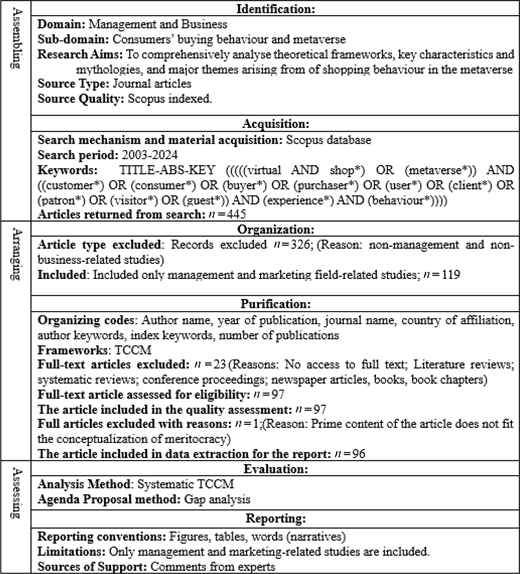
Following earlier SLR studies in this field (Vyas et al., 2024), this study adopted the theory, context, characteristics and methods (TCCM) to organize the findings and to set the future research framework. The TCCM framework, as adopted in this SLR, provides a structured approach to organizing and analyzing research findings while setting a foundation for future studies. Theory identifies the foundational concepts and theoretical underpinnings that guide the study. Context situates the research within specific themes and geographical settings, ensuring relevance to real-world applications and diverse environments. Characteristics delineates the key variables, including antecedents, mediators, moderators and outcomes, which help in understanding the causal relationships and dynamics within the study. Finally, Methods outlines the research design, methodologies, tools and techniques used, ensuring methodological rigor and transparency. By using the TCCM framework, this study synthesizes existing knowledge and provides a clear roadmap for future research in the evolving domain of metaverse shopping behavior.
In the Second phase, thematic analysis is used to identify the major behavioral themes emerging in metaverse shopping. Adopting deductive research approach, the thematic analysis builds on the primary focus and the major findings of the previous studies. Thematic analysis is a qualitative research method that helps identify, analyze and interpret patterns or themes within data (Castleberry and Nolen, 2018). The process begins with familiarizing with the data by reading and re-reading it to gain an overall understanding. Next, initial codes are generated by identifying meaningful segments of data that are relevant to the research question. These codes are then organized into potential themes by grouping similar codes together and identifying broader patterns. Once themes are developed, the researcher reviews them to ensure they accurately reflect the data, refining and redefining them. After finalizing the themes, the analysis is written up, where each theme is described and supported with relevant excerpts from the data, explaining how they relate to the research objective. Throughout the process, flexibility was maintained to ensure the analysis is comprehensive and reflects the data’s complexity (Naeem et al, 2023).
The SLR, guided by the TCCM framework, systematically synthesizes existing research, providing a structured examination identifying research gaps. Thematic analysis, drawing on SLR findings, qualitatively delves into the emergent behavioral patterns, offering rich insights into consumer motivations and actions within virtual environments.
3. Findings
This study’s findings are presented in two sections: the first the SLR and in the second thematic analysis.
3.1 Systematic literature reviews
Following earlier SLR, the findings are organized in TCCM framework (Vyas et al., 2024).
3.1.1 Theories.
In this section, fundamental concepts/theories applied in the previous studies are discussed. Among the prominent theories, the Stimulus–Organism–Response (S-O-R) paradigm stands out for its comprehensive approach to understanding how environmental stimuli trigger internal psychological states, subsequently influencing consumers’ shopping behavior. Chen (2023) integrates this paradigm with theories of media richness, presence, perceived risk, flow and social presence to construct a nuanced model elucidating how virtual presence impacts purchase behavior. Chen (2023) provides valuable insights into the complex dynamics of consumer interactions within virtual environments by examining website features and their influence on perceptions of telepresence and social presence.
Another significant theoretical lens is the gamification framework, as Thomas et al. (2023) explored. Drawing from principles of positive psychology and the metaverse, this framework sheds light on how gamification positively influences user behavior. Further, psychological ownership, construal level theory and consumption value theory contribute to understanding consumer shopping behavior in the metaverse. These theories highlight the importance of individual perceptions, cognitive processes and value assessments in shaping consumer experiences within virtual environments. For instance, Cai et al. (2024) emphasize how psychological ownership influences consumer attitudes and behaviors toward virtual objects, while Huang et al. (2023) explore the impact of modality richness on sensory simulation schema, affecting consumer responses.
Furthermore, the Unified Theory of Acceptance and Use of Technology (UTAUT) is a pivotal theoretical framework for understanding consumer acceptance of metaverse technology. Calderón-Fajardo et al. (2024) apply UTAUT to analyze the factors influencing technology adoption, particularly in tourism. By comprehensively examining constructs, this study provides valuable insights into the drivers of consumer acceptance within metaverse applications.
3.1.2 Context.
In this section, primary focus of previous research on metaverse shopping behavior is presented. Researchers (Qin et al., 2021; Schultz and Kumar, 2024) delve into the influence of immersive technologies like AR and VR on consumer decision-making processes and purchase intentions. These studies emphasize the transformative impact of technology on consumer behavior and the need to understand user engagement with digital experiences.
Jang (2023) and Flavián et al. (2024) explore how sensory stimuli, interactivity and customization contribute to users’ immersion and satisfaction. These studies shed light on the psychological mechanisms underlying consumer engagement and loyalty within the metaverse by investigating users’ visual behavior and experiential value in virtual environments. Studies by Nayak et al. (2022) and Thomas et al. (2023) examine the impact of virtual try-on technology and gamification on purchase intentions. These studies underscore the importance of providing engaging and interactive features to enhance the online shopping experience, thereby fostering positive consumer attitudes and behaviors. Upadhyay et al. (2023) and Vilnai-Yavetz et al. (2024) address cyberbullying, privacy and inclusivity issues, highlighting the importance of creating a safe and respectful digital environment for all users. These studies aim to promote responsible and equitable consumer interactions within virtual spaces by addressing these societal implications.
3.1.3 Characteristics.
In exploring consumers’ shopping behavior within the metaverse, researchers have unearthed a plethora of variables. In this section, antecedents, mediators, moderators and outcomes variables of previous studies are discussed. These elements collectively contribute to understanding the complex dynamics shaping user interactions and decision-making processes in virtual environments.
Antecedents: Antecedents encompass various factors influencing consumers’ shopping behavior within the metaverse. These include technological innovations such as VR and AR and individual characteristics like technology acceptance and trust. For instance, studies by Kwon et al. (2015) and Dang Quan et al. (2024) highlight technological features and online trust as antecedents to impulsive buying behavior and user engagement in virtual environments. Further, environmental stimuli such as store layout and ambiance shape consumer perceptions and attitudes in physical and virtual retail settings (Bigne et al., 2016; Van Kerrebroeck et al., 2017).
Mediators: Mediating processes elucidate the mechanisms through which antecedent variables translate into consumer responses and outcomes. Factors such as website telepresence, social presence and emotional experiences are intermediaries in shaping users’ internal psychological states and purchase intentions (Chen, 2023; Spillinger and Parush, 2012). These mediating variables are pivotal in enhancing user engagement and satisfaction within virtual shopping environments.
Moderators: Moderating factors influence the strength or direction of relationships between antecedents, mediators and outcomes, thereby adding nuance to our understanding of consumer behavior in the metaverse. Variables like shopping motivation, fashion involvement and user experience moderate the effects of stimulus variables on user experiences and satisfaction levels (Jang, 2023). Similarly, individual characteristics such as gender and product type may moderate the impact of technological interventions on consumer perceptions and behaviors (Guadagno et al., 2011; Li and Meshkova, 2013).
Outcome variables: Outcome variables encompass a diverse range of consumer responses, including purchase intentions, satisfaction and loyalty toward brands and retailers operating in the metaverse. These indicators serve as crucial metrics for evaluating the effectiveness of marketing strategies, technological interventions and environmental stimuli in shaping consumers’ shopping behavior in virtual shopping environments (Moodley and Naidoo, 2023; Farah and Ramadan, 2020). Further, user engagement, conversion rates and prosocial behaviors enrich our understanding of consumer interactions within virtual spaces (Baek et al., 2020; Yoo et al., 2015).
4. Methods
Understanding consumers’ shopping behavior in the metaverse demands a multifaceted approach, necessitating diverse research methods and data analysis techniques. Researchers use quantitative, qualitative and mixed methods to capture the intricacies of user interactions and decision-making processes within virtual environments. In this section, research methods adopted in the previous research are analyzed.
Quantitative methods, including surveys, experiments and structural equation modeling (SEM), serve as pillars for empirically examining relationships between variables and testing theoretical models (Chen, 2023). By using experimental designs, researchers can analyze the effects of stimulus variables on consumer perceptions and behaviors within online shopping environments, providing valuable insights into user responses (Chen, 2023). Moreover, SEM enables the assessment of complex relationships between constructs such as intrinsic needs and behavioral intentions, contributing to a deeper understanding of consumer behavior in the metaverse (Lau and Ki, 2021).
Qualitative methods, such as interviews, focus groups and thematic analysis, complement quantitative approaches by delving into subjective experiences and perceptions (Thomas et al., 2023). Through interviews with experienced designers, researchers can explore concepts like the “gameful experience” within the metaverse era, identifying key themes and theoretical categories (Thomas et al., 2023). Thematic analysis further elucidates underlying psychological processes driving consumer behavior, offering nuanced insights into user experiences and attitudes (Flavián et al., 2024).
Mixed-method approaches emerge as a powerful tool for triangulating findings and providing a comprehensive understanding of consumers’ shopping behavior in the metaverse (Qin et al., 2021). By integrating quantitative surveys with qualitative analyses, researchers can uncover insights into user experiences and decision-making processes, enriching our understanding of virtual shopping environments (Qin et al., 2021).
Advanced statistical techniques, including SEM and partial least squares path modeling, are instrumental in testing theoretical models and analyzing complex relationships between variables (Bui and Kemp, 2013; Kim et al., 2021). These techniques enable researchers to assess the validity and reliability of measurement instruments, fostering rigorous research practices in the study of consumer behavior in the metaverse.
4.1 Thematic analysis
As we discussed in the methodology section, the thematic analysis builds upon the primary focus and major findings of previous studies. Using Nvivo software, thematic analysis was conducted. The thematic analysis illustrates how the metaverse and digital platforms are transforming consumer experiences, while also emphasizing the enduring importance of emotional, cognitive and social factors in shaping shopping behavior. The analysis underscores the multidimensionality of consumer preferences, reflecting the influence of emerging technologies alongside the persistent relevance of traditional shopping experiences.
Figure 2 presents the result of the thematic analysis.
 The diagram is divided into four colour coded segments. Metaverse represents 12 percent, shopping represents 21 percent, consumer represents 27 percent, and behaviour represents 40 percent. The largest segment is behaviour, followed by consumer, shopping, and metaverse as the smallest. The relative shares are clearly shown through the differing sizes of the segments, all connecting around a central void to highlight the proportional distribution.
Representation of the thematic analysis
The diagram is divided into four colour coded segments. Metaverse represents 12 percent, shopping represents 21 percent, consumer represents 27 percent, and behaviour represents 40 percent. The largest segment is behaviour, followed by consumer, shopping, and metaverse as the smallest. The relative shares are clearly shown through the differing sizes of the segments, all connecting around a central void to highlight the proportional distribution.Representation of the thematic analysis
The major themes, sub-themes, its applications and relevant examples are discussed in Table 1.
Major themes, sub-themes, applications and examples
| Core themes | Sub-themes | Applications | Examples |
|---|---|---|---|
| Metaverse | Metaverse technology | Development of immersive virtual environments using VR/AR technologies to enhance consumer engagement |
|
| Metaverse era | Transitioning businesses to operate within the metaverse, creating new marketplaces and consumer touchpoints | ||
| Metaverse fidelity | Ensuring high-quality, realistic virtual experiences to meet consumer expectations for immersion | ||
| Metaverse tourism | Offering virtual travel experiences, allowing consumers to explore destinations from their homes | ||
| Shopping | Virtual shopping | Leveraging virtual reality to create immersive shopping experiences, such as virtual fitting rooms |
|
| In-app shopping: | Integrating seamless purchasing options within mobile applications to enhance convenience | ||
| Web-based shopping | Optimizing e-commerce platforms for user-friendly navigation and personalized recommendations | ||
| Physical shopping environments | Designing retail spaces that regulate emotions and enhance sensory engagement | ||
| Duty-free shopping | Offering exclusive products and experiences in duty-free zones, both physically and virtually | ||
| Repeat shopping | Implementing loyalty programs and personalized marketing to encourage repeat purchases | ||
| Cloth shopping | Using virtual try-on technologies to improve the online clothing shopping experience | ||
| Consumer | Consumer response | Analyzing real-time feedback from consumers to adapt marketing strategies and improve user experience |
|
| In-app purchase intention | Designing app interfaces that simplify the purchasing process and reduce friction | ||
| Consumer flow state | Creating engaging and immersive experiences that captivate consumers and prolong their interaction with the platform | ||
| Consumer perception | Building brand trust through transparency and high-quality virtual experiences | ||
| Consumer decision making | Using data analytics to understand the factors influencing purchase decisions | ||
| Consumer willingness | Offering incentives and personalized offers to increase consumer willingness to engage with new technologies | ||
| Consumer belief | Aligning brand values with consumer beliefs to foster loyalty and trust | ||
| Consumer reaction | Monitoring immediate responses to new features or products to quickly address any issues | ||
| Consumer experience | Ensuring a seamless and enjoyable journey across all touchpoints, both digital and physical | ||
| Behaviour | Impulse buying behavior | Designing marketing campaigns that capitalize on spontaneous purchasing tendencies, such as limited-time offers |
|
| Repeat purchase behavior | Implementing subscription models and loyalty rewards to encourage repeat business | ||
| Spontaneous purchase behavior | Creating engaging and interactive content that triggers impulsive buying decisions | ||
| Exploratory behavior | Offering new and innovative products to satisfy consumer curiosity and drive exploration | ||
| In-store shopping behavior | Enhancing the in-store experience through personalized service and interactive displays | ||
| Patronage behavior | Building strong brand loyalty through consistent quality and positive consumer experiences | ||
| Prosocial behavior | Promoting ethical and sustainable practices to attract socially conscious consumers |
4.1.1 Metaverse.
The metaverse, mentioned four times, comprises themes that highlight the potential of virtual environments as a new frontier in consumer experiences. Themes such as “Metaverse technology” and “Metaverse era” suggest that the metaverse is seen as both an innovative platform and a transformative shift in digital interactions. “Metaverse fidelity” implies a consumer preference for high-quality, realistic virtual experiences, while “Metaverse tourism” points to emerging opportunities for travel and exploration within these immersive spaces. These themes underscore the potential of the metaverse to reshape traditional consumer activities and introduce novel avenues for engagement.
4.1.2 Shopping.
Shopping, with 13 mentions, emerged as a particularly prominent concept with a wide range of themes addressing various shopping modalities and experiences. Key themes such as “Shopping Factors” and “Virtual shopping” underscore the growing influence of digital spaces on consumer shopping habits. Themes like “In-app shopping,” “Web-based shopping” and “Online shopping experiences” highlight the convenience and diversity of digital platforms. Meanwhile, themes like “Physical shopping environments” and “Shopping mall emotion regulations” remind us of the enduring importance of in-person shopping, emphasizing emotional regulation and sensory engagement in physical spaces. Other themes such as “Duty-free shopping,” “Repeat shopping” and “Cloth shopping” reflect specific shopping scenarios and preferences, suggesting a nuanced approach to understanding shopping behavior across different settings.
4.1.3 Consumer.
Consumer, mentioned 11 times, centers on consumer attitudes, intentions and responses in the digital age. Themes such as “Consumer response” and “Consumer in-app purchase intention” reflect the impact of digital platforms on purchasing decisions. “Consumer experience” and “Consumer flow state” highlight the importance of enjoyment and immersion, indicating that a satisfying user experience can influence consumer loyalty. Themes like “Consumer decision making” and “Consumer willingness” further explore the cognitive and emotional factors that shape purchasing behavior, while “Consumer belief” and “Consumer reaction” suggest that personal values and immediate responses also play crucial roles in shaping consumer actions. These themes depict a multifaceted understanding of consumers, taking into account their rational choices, emotional responses and intentions in digital and physical shopping contexts.
4.1.4 Behavior.
Behavior, with eight mentions, reveals specific patterns of consumer actions. “Impulse buying behavior” and “Repeat purchase behavior” highlight tendencies toward spontaneous and recurring purchases, influenced by both digital and physical shopping environments. Other themes, such as “Spontaneous purchase behavior” and “Exploratory behavior,” suggest that consumers are often driven by curiosity and impulsivity, especially in response to new stimuli. “In-store shopping behavior” and “Patronage behaviour” emphasize loyalty and preference for certain brands or stores, suggesting that brand affiliation remains important even in an increasingly digital world. The inclusion of “Prosocial behaviour” indicates that some consumers are influenced by ethical considerations, highlighting a growing trend toward socially responsible consumption.
The findings illustrate how the metaverse and digital platforms are reshaping traditional shopping and consumer experiences, while also highlighting the emotional, cognitive and social dimensions that drive behavior in both digital and physical realms. This analysis emphasizes the multidimensionality of consumer preferences, reflecting both the influences of emerging technologies and the persistent relevance of in-person shopping experiences.
5. Future research agenda
This section discusses theories, themes, variables and methods relevant to shopping behavior in the metaverse that were not addressed in previous studies. Building on an earlier SLR (Vyas et al., 2024), this study applies the TCCM framework to establish the future research agenda (Table 2).
Future research agenda framework
| Framework | Research agenda |
|---|---|
| Theories: |
|
| Self-Determination Theory (SDT) suggests that consumers are motivated by intrinsic needs for autonomy, competence and relatedness in their purchasing decisions (Ryan and Deci, 2017; Gilal et al., 2019). SDT provides insights into how these needs drive behavior in both physical and virtual marketplaces, informing strategies to enhance consumer engagement, satisfaction and loyalty | |
| Value Expectancy Theory (Wigfield and Eccles, 2000) posits that individuals’ intentions are influenced by their expectations and the value they place on outcomes. In the metaverse, this theory helps understand how users’ expectations and perceived value shape their behavior and satisfaction, enabling businesses to tailor offerings to align with consumer preferences | |
| Social Identity Theory (Tajfel, 1981) suggests that individuals’ self-concept is shaped by their membership in social groups, influencing behaviors and attitudes. In the metaverse, users’ virtual identities affect their interactions and consumption behaviors, offering insights into the role of social identity in shaping consumer behavior | |
| Context: |
|
| Virtual sustainability and ethical consumption focus on environmentally sustainable and ethical practices in virtual environments (Scurati et al., 2021). Research explores users’ attitudes and behaviors toward responsible consumption, guiding strategies to promote sustainability in the metaverse | |
| The virtual economy involves activities like virtual currency, asset trading and property ownership (Scarle et al., 2012). Research explores digital consumption, purchasing motivations and its impact on real-world economics, helping businesses monetize virtual experiences in the metaverse | |
| Characteristics: |
|
| Antecedents: AI-powered assistants and personalized experiences influence engagement (Sung et al., 2021). Digital literacy, including navigation and privacy protection, affects users’ interactions and decision-making (Tella et al., 2023) | |
| Mediators: High cognitive load reduces decision-making and engagement (Chang et al., 2017). Perceived risk, such as privacy concerns, impacts trust and willingness to engage (X. Zhang and Yu, 2020). Brand perception shapes purchase intentions and loyalty (Ha, 2004) | |
| Moderators: Experience affects how users interact with virtual environments (Kim et al., 2021), while virtual identity shapes responses to stimuli and social interactions (Buisine and Guegan, 2020). Psychological traits, such as personality and cognition, impact user behavior and susceptibility to persuasion (Oyibo and Vassileva, 2019) | |
| Outcomes: Virtual assets hold economic, social and symbolic value (Watkins et al., 2016). WOM influences perceptions and behaviors (Gupta and Harris, 2010). The virtual economy includes currency exchanges, asset trading and property ownership (Scarle et al., 2012). Brand equity affects user preferences and behaviors (Arya et al., 2024) | |
| Methods: |
|
| MCDM techniques like AHP, TISM and IRP help businesses evaluate and prioritize factors influencing consumer behavior in the metaverse (Saaty, 2004; Sushil, 2012, 2009) | |
| Brain imaging and physiological measurements reveal users’ cognitive and emotional responses to virtual experiences, aiding in the design of engaging environments (Bohil et al., 2011; Huang et al., 2022) | |
| Ethnographic methods provide qualitative insights into users’ behaviors, social interactions and cultural practices in virtual environments (Williams, 2007; Hossain et al., 2024) | |
| VR prototyping allows businesses to test and refine virtual shopping experiences, improving usability and user engagement (Seth et al., 2011) |
6. Discussions and implications
The metaverse is seen as an expansive virtual environment that redefines the boundaries between digital and physical interactions. Factors influencing shopping in the metaverse are diverse, including product discovery, social interaction and virtual storefronts. Digital currencies and blockchain technologies are beginning to reshape how transactions are handled in these spaces. Themes such as In-Game Purchases and Digital Currencies highlight the integration of virtual economies within the metaverse. Consumers are not only purchasing goods but also engaging in virtual economies where digital assets have real-world value. This highlights the necessity for businesses to adapt to these new payment systems and models, fostering a new realm for consumer transactions.
The consumer behavior in the metaverse is influenced by various psychological, social and technological factors. Themes like User Engagement and Consumer Trust are central to understanding how users interact with virtual environments and brands. High engagement levels are often achieved through personalized content, interactivity and immersive experiences, while trust is a key determinant in consumer decisions within these digital spaces.
Consumers are motivated by different factors in virtual shopping, such as Social Presence, where the ability to interact with other users or avatars creates a sense of community and belonging. This is similar to traditional social shopping but with an added layer of digital engagement. Social presence also facilitates co-shopping experiences, where groups of people can browse and shop together in the metaverse, despite physical distance.
Another critical aspect is the role of Psychological Ownership in shaping virtual consumer behaviors. Just as consumers take ownership of physical items, virtual possessions in the metaverse also create a sense of identity and personal attachment. This form of ownership is influenced by customization options, where consumers can modify avatars, virtual spaces and products to reflect their personal tastes.
The overall consumer behavior in the metaverse reflects traditional consumer patterns, but with new dynamics shaped by virtual environments. Purchase Intentions and Satisfaction are fundamental outcomes studied in the metaverse, with studies indicating that higher levels of interactivity, engagement and personalization lead to stronger purchase intentions and greater customer satisfaction (Schultz and Kumar, 2024). Additionally, Emotional Experiences play a pivotal role in shaping consumer engagement, with positive emotions arising from enjoyable and seamless interactions leading to increased brand loyalty.
Moreover, Trust and Privacy Concerns are significant determinants in virtual shopping behavior. As more data are collected through virtual interactions, consumers are becoming more concerned about the security of their personal and financial information. This introduces challenges for brands in creating secure, transparent and user-friendly virtual environments. The metaverse represents a new frontier in retail, offering unique opportunities for marketers to innovate and create personalized, immersive shopping experiences. However, the study also underscores the importance of addressing privacy and ethical concerns to ensure that consumer trust is maintained as this digital ecosystem evolves.
6.1 Theoretical implications
The S-O-R model helps analyze consumer behavior in metaverse shopping. It suggests that environmental stimuli, like virtual store design and avatars, influence consumers’ psychological states, which then affect their decisions, emotions and purchase behavior. In the metaverse, immersive elements like avatars and gamified rewards enhance engagement and emotional responses, driving purchase intentions. By applying the S-O-R model, we can understand the impact of virtual factors on consumer behavior, offering insights to optimize virtual shopping experiences. The emphasis on theories such as the S-O-R paradigm, gamification and psychological ownership demonstrates the field’s focus on psychological and experiential aspects of virtual shopping.
Future research can build on these frameworks to address new dimensions of consumer behavior, including emotional attachment to virtual assets and the role of AI in personalization within the metaverse. Additionally, the concentration of research in technologically advanced regions suggests a need for theory adaptation that considers regional disparities in infrastructure, digital literacy and cultural differences.
Themes like “Metaverse technology,” “Metaverse fidelity” and “Metaverse tourism” suggest a shift toward immersive, high-quality virtual experiences that influence consumer engagement, satisfaction and loyalty. This evolution calls for new frameworks that integrate virtual environments into existing consumer behavior models, focusing on trust, emotional connection and identity formation in digital spaces. The metaverse introduces a new era of consumer interaction, where digital fidelity and engagement redefine traditional concepts of involvement and attachment.
The proposed research agenda introduces key theories to explore consumer behavior in the metaverse. The Self-Determination Theory highlights how intrinsic needs for autonomy, competence and relatedness drive consumer engagement and satisfaction in virtual environments. Future research may investigate how these psychological needs influence purchasing decisions in the metaverse. The Value-Expectancy Theory helps understand how expectations and perceived value shape satisfaction and purchasing intentions. Research should examine how virtual experiences affect consumer behavior. The Social Identity Theory emphasizes the role of virtual identities and social group affiliations in shaping consumption behaviors. Understanding these dynamics will provide insights into identity formation in digital spaces.
Additionally, research should address virtual sustainability and ethical consumption, which are critical in shaping responsible consumption in virtual environments. The virtual economy, including digital currency and asset trading, offers opportunities to explore new theories on digital consumption and its broader economic impact.
6.2 Practical implications
This study has broad utility, offering valuable insights for a wide range of industries as discussed below:
Retail sector: In the retail sector, the metaverse offers a groundbreaking opportunity to redefine how businesses interact with consumers. Virtual stores allow brands to offer immersive shopping experiences, where consumers can try products virtually and make instant purchases. The findings of this study on gamification and avatar-driven shopping experiences can be directly applied to enhance customer engagement and loyalty programs in both virtual and physical stores. Retailers can leverage immersive technologies, such as AR and MR, to create hybrid shopping environments that blend the best aspects of online and offline shopping. However, the limitations of metaverse technology, such as bandwidth and device compatibility, may restrict the full realization of these innovations. Retailers must balance immersive experiences with accessibility for all consumer segments. In this context, businesses need to ensure that both the technological infrastructure and customer support systems are robust to accommodate varying levels of technological literacy among their customer base (Ball, 2022).
Tourism and hospitality: In tourism and hospitality, the findings of this study can contribute to enhancing customer experiences through virtual travel experiences, allowing potential travelers to explore destinations before making booking decisions. For example, consumers can take virtual tours of hotels or resorts, experience local attractions in immersive three-dimensional (3D) environments and attend virtual events or concerts. This can help reduce consumer uncertainty and increase engagement with brands. However, as Ball (2022) highlights, the current limitations of metaverse technology in terms of sensory realism may hinder the ability to deliver fully immersive experiences. Additionally, privacy concerns in virtual tourism, where personal preferences are shared with providers for tailored experiences, must be addressed to protect user data. Therefore, while the metaverse holds vast potential for this sector, it requires careful attention to both technological advancements and ethical concerns surrounding data security and privacy.
Education and training: In the education sector, metaverse-based virtual classrooms and training simulations can provide interactive and engaging learning experiences. This can be particularly impactful for industries requiring practical skill development, such as health care, engineering and manufacturing, where real-life training scenarios can be replicated in a virtual environment. The findings related to immersive technologies and avatar-based interactions can help educational institutions create customized learning experiences, increasing student engagement and knowledge retention. Nevertheless, as highlighted in this study, the technological limitations in terms of accessibility and user-friendliness must be overcome to ensure these innovations are scalable and usable by diverse student populations. In this sector, investments in both hardware and software infrastructure will be critical for successfully implementing metaverse-based education and training programs.
Real estate: In real estate, virtual property tours and the ability to interact with architectural designs in the metaverse offer significant opportunities for both buyers and sellers. By incorporating the study’s findings on gamification and virtual try-on technologies, real estate companies can create virtual models of homes that allow potential buyers to engage with properties in ways that traditional methods do not offer. However, technological limitations such as the resolution of virtual models and the accuracy of real-world interactions in virtual environments could pose challenges. To overcome these, real estate companies should focus on developing high-quality virtual environments that replicate real-world physical interactions as closely as possible.
Health care: In health care, the metaverse could revolutionize the way patients interact with health-care services, providing virtual consultations and mental health therapy in a more immersive and accessible format. The ability to engage in avatar-driven consultations can help patients feel more at ease, particularly in mental health care, where stigma might prevent face-to-face interactions. Drawing from the findings on avatar identity and self-perception, health-care providers can leverage virtual platforms to offer personalized care in a way that is both engaging and empathetic. However, health-care systems must also consider the ethical implications of virtual care, particularly around the collection and use of sensitive patient data.
Financial services: In the financial services sector, banks and fintech companies can use the metaverse to offer virtual financial advice, investment simulations and personalized financial products in immersive environments. The findings on gamification can be directly applied to create reward systems for users who complete financial literacy programs or achieve savings goals in virtual environments. However, as Ball (2022) notes, concerns about data security and regulatory oversight in the metaverse may limit full-scale adoption, particularly in sectors like banking that handle sensitive financial data. Hence, while opportunities are abundant, these concerns must be adequately addressed to ensure consumer trust in these virtual financial platforms.
Manufacturing and supply chain: The manufacturing and supply chain sectors can also benefit from the integration of metaverse technologies. For example, virtual simulations can allow companies to model their production lines, supply chain logistics and even customer service interactions before implementing them in the physical world. This can help to optimize processes and identify potential issues without the need for costly physical prototypes. Drawing on the study’s findings on the impact of sensory engagement, businesses can create more effective simulations that increase decision-making accuracy. However, the metaverse’s limited ability to accurately replicate real-world scenarios may pose challenges for certain types of simulations, particularly those requiring a high level of tactile or real-time sensory feedback.
This study has considerable practical applicability in a wide range of sectors. However, for the metaverse to reach its full potential in these industries, it is essential to overcome the existing technological limitations, such as device compatibility, sensory realism and privacy concerns. The findings of this study can provide valuable guidance for businesses seeking to enhance their consumer engagement strategies in the metaverse, but their implementation will require careful consideration of both technological advancements and ethical standards. By exploring the limitations of the technology and providing sector-specific applications, this study contributes to a more comprehensive understanding of how the metaverse can shape consumer behavior across various industries.
7. Conclusions
This study has provided a comprehensive exploration of consumer behavior within the metaverse, highlighting the transformative role of immersive technologies, gamification and avatar-driven experiences in reshaping shopping behavior. The metaverse, as an evolving digital ecosystem, offers a unique and dynamic environment where consumers navigate complex virtual spaces that blend augmented, virtual and mixed realities. Through this investigation, it has become evident that consumer engagement in the metaverse is significantly influenced by personalized interactions, gamified experiences and the use of avatars to create deeper emotional connections to products and services. The major implications of the study are highlighted in Table 3.
Conclusions and implications
| Conclusions | Theoretical/managerial implications |
|---|---|
| The metaverse reshapes shopping behavior through immersive tech, gamification and avatars | Theoretical: S-O-R, UTAUT and psychological ownership frameworks explain virtual consumer behavior |
| VR, AR and MR enhance immersive experiences, altering traditional shopping patterns | Managerial: Retailers should adopt virtual try-ons, gamified rewards and personalized interactions |
| Gamification boosts engagement, loyalty and satisfaction in virtual shopping | Managerial: Implement gamified strategies (e.g. rewards and leaderboards) to enhance consumer engagement |
| Ethical concerns (privacy, data security and algorithmic biases) need addressing | Managerial: Ensure transparency, data security and ethical AI use to build consumer trust |
| Future research should explore long-term effects of avatar-driven shopping | Theoretical: Investigate emotional attachment, loyalty and psychological well-being in virtual spaces |
| Limitations include reliance on Scopus, potentially excluding relevant studies | Theoretical: Future studies should use multiple databases for broader, more generalizable insights |
In addressing the key research questions, this study has demonstrated that various theoretical frameworks, such as the S-O-R paradigm, gamification models and psychological ownership theories, offer crucial insights into consumer decision-making processes in virtual retail environments. Additionally, the UTAUT provides a solid foundation for understanding the adoption of metaverse technologies by consumers. These frameworks illuminate how environmental stimuli, emotional experiences and individual perceptions of technology acceptance shape shopping behaviors in the metaverse.
This study has also underscored the significant role of technological features, such as VR, AR and MR, in enhancing consumers’ immersive experiences and altering traditional shopping patterns. The integration of these technologies into retail strategies allows consumers to engage with products in innovative ways, such as through virtual try-ons or real-time product placements in their own environments, which fosters more informed purchasing decisions and reduces the likelihood of returns. Furthermore, the role of gamification within the metaverse has proven to be a powerful tool for increasing consumer engagement, loyalty and overall satisfaction, as consumers are incentivized to participate in interactive shopping experiences that reward them with digital assets or exclusive benefits.
However, this study also brings to light several ethical concerns associated with virtual commerce, particularly in relation to privacy, data security and algorithmic biases. The use of AI-driven recommendation systems, while enhancing personalization, raises significant questions about consumer autonomy and the potential for manipulation. Moreover, the growing prevalence of blockchain technology and digital currencies in virtual transactions necessitates ongoing attention to regulatory oversight and inclusivity to ensure equitable access to the metaverse’s commercial opportunities.
In terms of future research, this study calls for deeper investigations into the long-term effects of avatar-driven shopping, gamified interactions and immersive experiences on consumer loyalty, purchase intentions and psychological well-being. Further exploration into the ethical dimensions of virtual commerce, particularly regarding data privacy, digital ownership and the socio-economic impacts of blockchain-based transactions, is crucial to ensuring the responsible evolution of the metaverse as a retail space.
A notable constraint lies in the exclusive reliance on the Scopus database for data collection. While Scopus is a reputable and comprehensive source, its exclusive use may inadvertently exclude relevant studies indexed in other databases, such as Web of Science, PubMed or Google Scholar. This limitation could affect the breadth and diversity of the literature reviewed, potentially overlooking significant contributions from alternative sources. Future research could address this by incorporating multiple databases, thereby enhancing the robustness and generalizability of the findings.
The metaverse represents both immense potential and significant challenges for consumer behavior and retail. The insights gained from this study offer valuable contributions to understanding how digital technologies are reshaping the shopping experience, while also emphasizing the need for continuous ethical considerations. As the metaverse continues to develop, it is imperative for retailers, marketers and policymakers to address these complexities to create engaging, responsible and inclusive virtual environments for consumers.
Figure 3 presents a comprehensive conceptual framework for understanding consumer shopping behavior in the metaverse, organizing key aspects into interconnected dimensions: practical applications, theoretical foundations, influencing factors, thematic insights and research methodologies. This structured view highlights the multifaceted nature of metaverse shopping, where consumer behavior is not only influenced by digital innovations but also rooted in psychological, social and ethical dimensions.
 The central box is labelled consumer shopping behavior in the metaverse. From it, five categories extend. At the top left, practical applications include retail, tourism, education, real estate, healthcare, financial services, and manufacturing. To the left, thematic insights cover metaverse, shopping, consumer, and behavior themes. At the top right, theoretical foundations list the stimulus organism response model, gamification theory, psychological ownership, and unified theory of acceptance and use of technology. At the bottom right, influencing factors are divided into technological, psychological, social, and ethical aspects. At the bottom, methodologies include quantitative, qualitative, and mixed methods. Dotted lines connect these elements, showing the structured relationships among applications, insights, theories, influences, and methods in analysing consumer shopping behavior in the metaverse.
Summary of the study
The central box is labelled consumer shopping behavior in the metaverse. From it, five categories extend. At the top left, practical applications include retail, tourism, education, real estate, healthcare, financial services, and manufacturing. To the left, thematic insights cover metaverse, shopping, consumer, and behavior themes. At the top right, theoretical foundations list the stimulus organism response model, gamification theory, psychological ownership, and unified theory of acceptance and use of technology. At the bottom right, influencing factors are divided into technological, psychological, social, and ethical aspects. At the bottom, methodologies include quantitative, qualitative, and mixed methods. Dotted lines connect these elements, showing the structured relationships among applications, insights, theories, influences, and methods in analysing consumer shopping behavior in the metaverse.Summary of the study
Consumer shopping behavior in the metaverse revolves around how individuals interact, assess and purchase products or services within immersive virtual spaces. These behaviors are enabled by unique digital features such as avatars, 3D environments, real-time interactions and virtual ownership, marking a shift from traditional to experiential retail formats.
Key theories underpinning metaverse consumer behavior include the S-O-R model, which explains how virtual stimuli affect emotions and actions; gamification theory, which emphasizes engagement through game-like elements; psychological ownership theory, highlighting attachment to digital goods; and UTAUT, which explains technology adoption behavior. Behavior is influenced by technological factors (e.g. VR/AR usability), psychological elements (e.g. trust and motivation), social dynamics (e.g. peer influence and community) and ethical concerns (e.g. privacy, sustainability and digital well-being).
A range of research methodologies supports the study of this behavior. Quantitative methods test hypotheses and attitudes, while qualitative approaches explore deeper consumer experiences. Mixed methods are increasingly valuable for capturing the complexity of the metaverse. Thematic insights are categorized into metaverse (e.g. immersion and decentralization), shopping (e.g. personalization and virtual trials), consumer (e.g. identity and trust) and behavioral themes (e.g. impulse buying and prosocial actions), offering a layered understanding of digital consumer behavior.
Figure 4 illustrates how metaverse applications vary in their level of immersion and sensory engagement, offering distinct implications for consumer shopping behavior. Starting from limited immersion, virtual storefronts provide consumers with interactive and immersive shopping experiences, including virtual product trials that enhance decision-making. As immersion deepens, applications like virtual tours and virtual classrooms facilitate more engaging experiences – such as 3D travel previews or skill-based product training – fostering informed and emotionally resonant consumer choices. Moving toward full immersion, tools like virtual property tours and virtual consultations allow personalized, real-time interactions (e.g. evaluating real estate or accessing avatar-led health advice), strengthening consumer trust and satisfaction. At the highest level, virtual financial advice and production line simulations incorporate gamified and sensory-rich environments that not only personalize financial services but also enhance product transparency and credibility in manufacturing. Together, these layered applications demonstrate how increasing immersion in the metaverse can transform consumer expectations, decision-making and engagement in digital shopping ecosystems.
 The sequence begins with limited immersion on the left, followed by virtual storefronts that enable shopping with trial options. Next are virtual tours offering immersive destination experiences, and virtual property tours highlighting interactive architectural designs for potential buyers. Moving further, virtual classrooms present simulations for skill development, followed by virtual consultations where avatars support mental health therapy. Virtual financial advice illustrates gamified investment simulations. At the far right, production line simulations deliver sensory rich experiences for process optimisation, marking the point of full immersion. Each stage includes a label and description, showing a clear progression from basic to advanced immersive experiences.
Applications of metaverse in various fields and levels of immersion
The sequence begins with limited immersion on the left, followed by virtual storefronts that enable shopping with trial options. Next are virtual tours offering immersive destination experiences, and virtual property tours highlighting interactive architectural designs for potential buyers. Moving further, virtual classrooms present simulations for skill development, followed by virtual consultations where avatars support mental health therapy. Virtual financial advice illustrates gamified investment simulations. At the far right, production line simulations deliver sensory rich experiences for process optimisation, marking the point of full immersion. Each stage includes a label and description, showing a clear progression from basic to advanced immersive experiences.Applications of metaverse in various fields and levels of immersion
This visual framework offers a strategic lens to interpret and investigate consumer shopping behavior in the metaverse. It integrates industry use cases, psychological and technological underpinnings, social and ethical factors, emerging behavioral themes and rigorous methodological strategies. Such a comprehensive view is essential for businesses, researchers and policymakers aiming to design impactful and consumer-centric metaverse experiences that align with the needs and motivations of digital shoppers.

