This paper conducts a systematic literature review (SLR) to present the academic development of Overall Equipment Effectiveness (OEE) as a core manufacturing performance metric. The research examines the implementation of OEE within performance management systems, alongside digital transformation and sustainable production frameworks. The review presents a novel approach that combines an SLR with bibliometric mapping to study OEE's development across the digitalisation age, AI predictive maintenance, and sustainable practices.
The research used an SLR, searching Scopus and Web of Science with Boolean queries and inclusion/exclusion criteria, and employing a snowball sampling approach. The research included 81 studies found through a systematic screening of peer-reviewed articles, which were subjected to qualitative synthesis, while bibliometric tools such as VOSviewer, RabbitResearch, and Litmaps supported conceptual mapping and trend identification.
Results demonstrated that OEE frameworks have evolved from a basic TPM scorecard into a live digital OEE system. While lean-agile integration, predictive maintenance, and Industry 4.0 concepts are taking root in research, there are wide sectoral gaps in the blend of disciplines, the suitability of adaptation for batch production and high-margin industries, and the link to financial decision-making.
This study is one of the very few SLRs on OEE research using bibliometric techniques, and the paper extends a systematic mapping study to identify performance metrics that map to digital and strategic business goals in contemporary manufacturing. The paper advances by combining systematic screening, citation, and keyword analyses, demonstrating how OEE has evolved from TPM-based indicators into a digitally driven performance framework.
1. Introduction
The manufacturing industry recognises Overall Equipment Effectiveness (OEE) as an essential component for improving performance across various operational contexts. The concept entered the field as part of total productive maintenance systems to provide a single metric that links equipment availability and performance to quality results. The formal definition of OEE comprises three components that evaluate equipment effectiveness by measuring planned output rates, defect-free operation, and continuous production. (Nakajima, 1988). Although the OEE framework has gained widespread use across industries, its implementation in batch production systems and high-margin industries requires additional research. The particular operational settings present unique working patterns that often need customised performance assessment and improvement approaches.
Digital instruments, together with real-time analytic capabilities and automation technologies, have substantially transformed how performance indicators are operationalised and maintained. Logistics 4.0 frameworks also reflect these pressures, combining decentralised data flows and system-wide orchestration to meet volatility demands (Winkelhaus and Grosse, 2020).
This SLR aims to synthesise existing academic work on the theme while examining its connections to performance management, digital transformation, and sustainable operational practices (Ghobakhloo et al., 2021). The review uses a systematic screening process, along with bibliometric and thematic analyses, to detect patterns in authorship and conceptual changes, as well as research maturity. The research combines a protocol-based SLR with bibliometric network and momentum analyses to study OEE for the first time, while linking it to Industry 4.0/5.0, AI-based maintenance, digital twins, and sustainability. The study provides extended time coverage until 2024, measures conceptual clusters and their development stages, and links methods to themes and sectors to extract new managerial and theoretical insights that previous reviews did not include.
The research by Muchiri and Pintelon (2008) and Ng Corrales et al. (2020) established fundamental knowledge about OEE definitions and calculation methods, and industrial applications. Research conducted in the past did not include the current digital transformation and sustainability aspects, or cross-industry methods, which have developed since then. The review fills this knowledge gap through systematic and bibliometric analyses to examine conceptual changes, methodological expansion, and industrial implementation from 2024 to the present. Earlier reviews provided essential groundwork on OEE development but remained limited to specific industrial applications and did not account for the rise of digital and sustainability-oriented research. This research conducts an updated and expanded review of OEE studies through systematic and bibliometric analyses to better understand the development and methodological growth of the field.
This inquiry is structured around the following research questions.
How has research on OEE evolved in relation to performance improvement and digital system integration?
What are the main conceptual and methodological approaches applied in OEE studies?
Which areas of OEE implementation remain underdeveloped across industrial contexts?
This review investigates these research questions to enhance understanding of OEE implementation and research while providing an overview and thematic analysis of 81 academic articles.
2. Methodology
2.1 Systematic review design
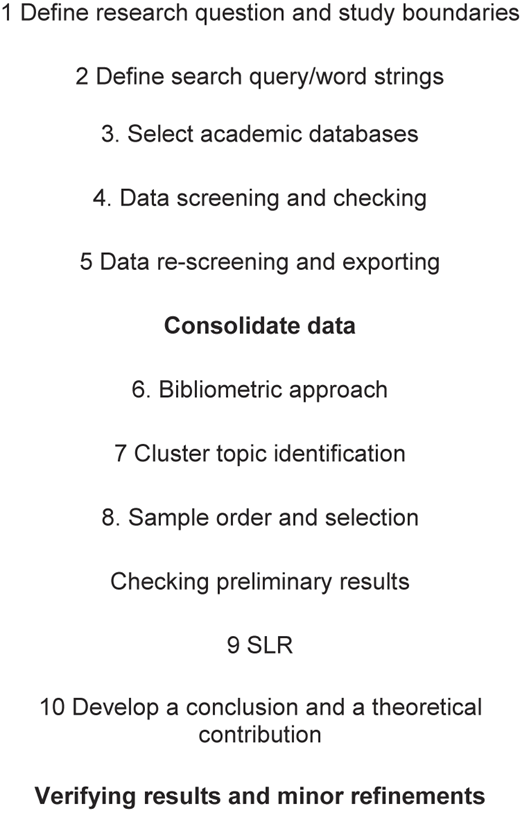
This study uses an SLR to explore academic literature, with a specific focus on performance improvement, digital transformation, and industrial operations. The review follows PRISMA 2020 guidelines and is combined with the Marzi et al. (2025) bibliometric-SLR framework to achieve methodological transparency and reproducibility through structured reporting. The dual alignment between these 2 approaches provides both methodological precision and conceptual understanding. Merging SLR with bibliometric mapping improves evidence quality and traceability, while bibliometrics provide visualisation for concept development.
2.2 Marzi et al. Bibliometric framework
Following the 10 steps in Figure 1 from the Marzi et al. (2025) framework, we scrutinised the literature on OEE to build an overview of the research stream and to identify a set of representative keywords for database research. The inclusion/exclusion criteria were defined before approaching the data collection process (step 2). As a result, we defined the search query as follows: different keywords related to performance measurement, industrial management, digital manufacturing, and OEE (step 3), and limited the documents to those published in English and to peer-reviewed journals from 1900 onwards (step 4).
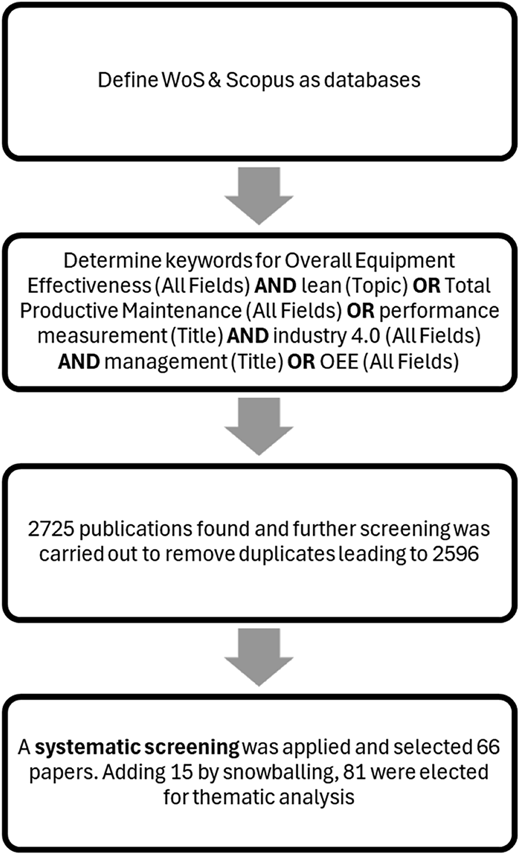
We extracted a raw database of 2,725 from WoS and Scopus (Step 5), cross-validated the search results against the academic databases (as presented in Step 4), and removed duplicates and ineligible documents.
The Web of Science (WoS) and Scopus databases were chosen as the primary sources of information. Google Scholar was excluded as the main data source because it relies on untraceable indexing and inconsistent metadata, which make reproducibility and accurate bibliometric mapping challenging (Halevi et al., 2017; Martín-Martín et al., 2018). From the raw databases, we removed studies that did not fall within the boundaries of our selected topic, consistent with our inclusion/exclusion criteria (Figure 2). The authors have carried out this process independently, checking their agreement with inter-rater reliability. This has resulted in a final dataset of 81 papers (completing step 5 of the B-SLR). Next, we moved to bibliometric analysis in VOSviewer, as per step six of the B-SLR. After independently reading the extracted documents, we identified the key research topic within each cluster. Once a satisfactory level of agreement among authors was reached (step seven of the B-SLR, e.g. minimum cluster size, etc., we assessed and ranked the documents based on our thematic and coding areas (step eight of the B-SLR). Next, the clusters have been reviewed, following the prescriptions of SLR by mapping the state of knowledge and grasping the content of the literature (step ten of the B-SLR), thereby providing further insights into the topic under exploration and developing an original conceptual advancement to the field.
2.3 Analytical tools and process
After confirming the 81-paper final set, the study continued through both quantitative and qualitative stages. The analytical framework evaluated both large-scale academic structures, such as collaboration networks, author citation patterns, and conceptual groupings, and small-scale research elements, including thematic content, methodological practices, and application areas.
Multiple analytical tools operated as part of this multi-layered approach. VOSviewer generated bibliometric visualisations through co-authorship maps, keyword co-occurrence networks, and temporal overlays, which revealed important developments in concepts.
RabbitResearch served to display both the thematic organisation and historical placement of fundamental and contemporary works, as well as to analyse the literature's structure.
Microsoft Excel was used to perform manual content coding and classification tasks on the entire dataset, while bibliometric tools provided supporting functionality. Researchers reviewed each paper to assign codes for publication year, methodology, industrial focus, and contribution type, which included empirical studies, framework proposals, and review papers. Following Leite Junior et al. (2025), a scoring system was developed with predefined criteria to evaluate paper relevance and analytical potential during analysis. The method enabled us to define and weight tailored evaluation criteria. The tables in Appendix show that this evaluation criterion, based on scoring thresholds of 1, 30, and 50, was chosen to create meaningful distinctions between papers based on their citation influence, source quality, and relevance. When multiplied across metrics such as citation count, journal impact factor, and indexing score, these values yield a broad score range that accentuates differences in academic weight and research maturity, and increases analytical rigour (Leite Junior et al., 2025). The review maintains depth and quality in its synthesis by first focusing on the top 10% of high-scoring papers while still incorporating the broader dataset to ensure thematic completeness. Using the Journal Impact Factor (JIF) as the most commonly used metric for assessing scientific journals (Gould, 2023) and SJR and h-index (Leite Junior et al., 2025), we defined ranking criteria to aid in our review of high-impact literature.
3. Findings and analysis
3.1 Descriptive overview of the literature
The annual research output on manufacturing systems has shown a steep upward trend in recent years. The publication rate showed consistency throughout the 1990s and early 2000s but rose dramatically after 2019.
The recent surge in publications coincides with the increasing adoption of digital technologies, real-time monitoring systems, and data analytics, which have revitalised the field of operational efficiency.
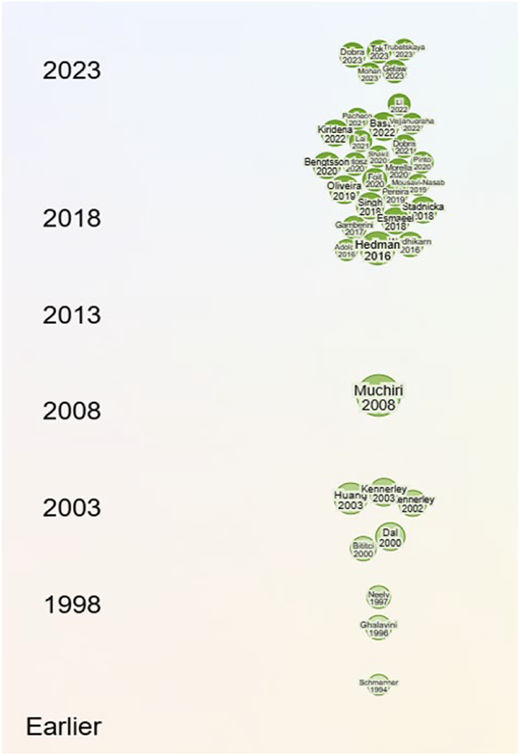
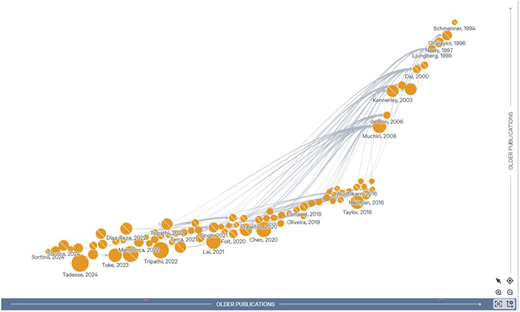
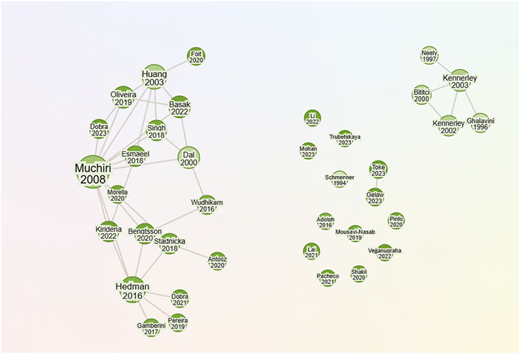
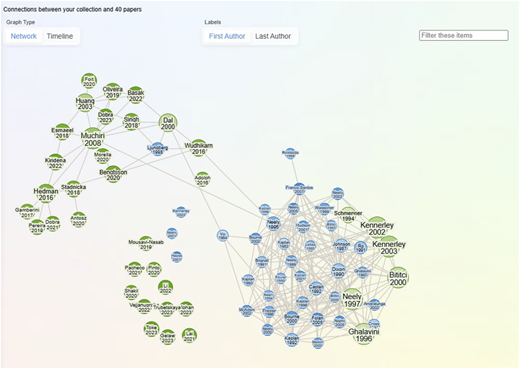
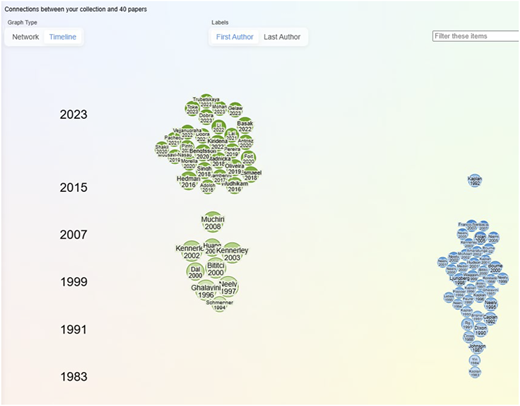
The timeline of selected papers presented in Figure 3 by RabbitResearch and Figure 4 by Litmaps both show this generational transformation.
The analysis by RabbitResearch shows that the literature developed over three distinct time periods: theoretical foundations between 1994 and 2003, between 2008 and 2016, and finally from 2019 through 2024. The Litmaps visualisation shows how authors such as Kennerley and Neely (2003), and Muchiri and Pintelon (2008) established the foundational principles that guide current research. These authors remain fundamental citation nodes shaping present-day research.
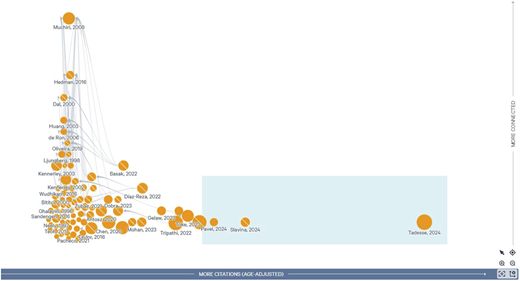
The analysis of citations demonstrates the extent of influence. Muchiri and Pintelon (2008) emerges as the central work that links traditional TPM to modern manufacturing intelligence, according to Figure 4. Figure 5: Age-Adjusted Momentum Analysis reveals how a new generation of influential scholarship is developing sustainable and predictive performance practices.
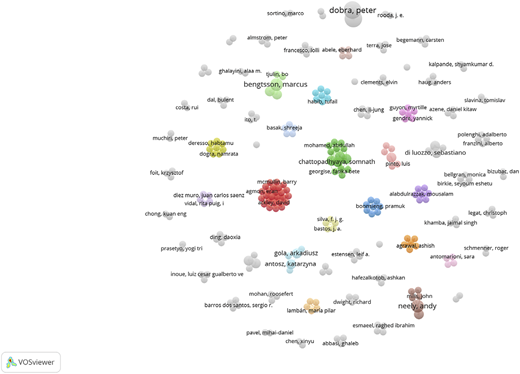
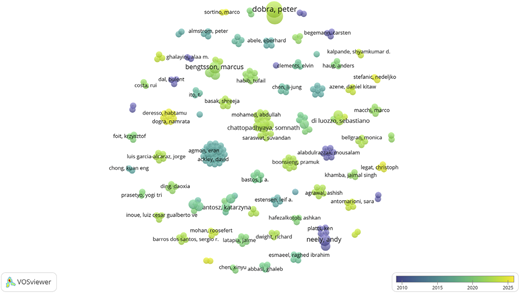
Research collaborations regarding authorship provide unique perspectives into how scholars work together. The Co-authorship Network constructed from VOSviewer data displays several dense clusters which surround the researchers Dobra (2022), Hedman et al. (2016) and Muchiri and Pintelon (2008) in Figure 6. The clusters present interconnected links among different authors and research fields, facilitating methodological and perspective exchange. The temporal development of co-authorship relationships is depicted in Figure 7 through an overlay visualisation, which shows how established authors remain central. At the same time, new contributors push boundaries toward smart sensors, data-driven, and other themes.
Research questions 1 and 2 are addressed in Tables 1–3, which present research on OEE evolution in relation to performance improvement and digital system integration (RQ1) and outline the main conceptual and methodological approaches used in OEE studies (RQ2).
The title-based citation analysis presented in Table 1 shows that. Ghalayini and Noble (1996), Neely et al. (1997), and Kennerley and Neely (2003) established the fundamental principles that continue to dominate the field, as evidenced by their high citation counts. Table 2 shows where the authors published.
The research field of OEE evolved from its production-management roots into a diverse, multidisciplinary domain that integrates digitalisation, automation, and data analytics.
The established research domains focus on lean manufacturing, total productive maintenance and performance optimisation because they have developed strong theoretical and empirical foundations (traditional stream). The field of OEE research now focuses on artificial intelligence, digital twins, and predictive analytics as it advances toward smart, data-driven, adaptive manufacturing systems.
The research indicates that literature is shifting toward an integrated performance management framework which unites conventional efficiency metrics with modern digital and intelligent systems.
The connection analysis presented in Figure 8 shows that the selected papers maintain internal consistency and demonstrate how this literature fits into the larger academic discussion.
The relationships between these documents show that this dataset stands as an active research core embedded deeply inside mainstream industrial performance and digital transformation studies.
3.2 Conceptual and keyword mapping
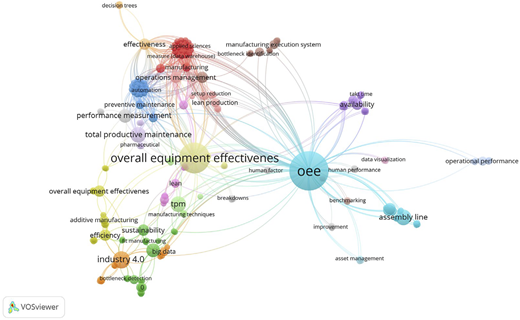
The VOSviewer keyword co-occurrence network display (Figure 9) shows a clear, well-organised conceptual framework that centres on the dominant use of both “OEE” and its equivalent term “overall equipment effectiveness.” The two terms emerge as the most frequently used in the corpus, with 24 and 16 occurrences, respectively, and demonstrate the highest total link strength values of 127 and 108, respectively. The co-occurrence map positions these core conceptual anchors at its centre, while their strong connectivity proves their role as fundamental field concepts. These terms function as more than labels for the domain since they establish the thematic relationships between operational efficiency, manufacturing processes, and performance monitoring.
The research on OEE has evolved through three distinct periods, which showcase technological and managerial practice improvements (Table 3).
The conceptual clusters and similar work connections presented in Figures 10 and 11 from RabbitResearch help extend this mapping by showing which publications share common thematic characteristics. A major cluster examines simulation-based predictive performance through empirical methods. This publication group focuses on OEE policy and decision-making, as well as its strategic implementation.
The timeline report shows that the screening process was based on the last 10 years of paper publication, which corroborates the rigour of the SLR.
The three visualisations (Similar, earlier and later) present an equilibrium between how earlier works function as intellectual foundations and how recent publications drive thematic growth and specialisation.
3.3 Thematic synthesis
The review collects data from six key manufacturing optimisation themes (Table 4), which are presented in this section, and contributes to answering research question 1 regarding emerging themes. The research indicates that performance improvements stem from aligning exact metrics with real-time monitoring and predictive maintenance, and from strategic alignment across these areas. The current research shows that operational execution connects to long-term strategic goals through structured frameworks, which include balanced scorecards and hybrid models. The collected evidence supports the need for manufacturing systems to evolve into data-driven, flexible, context-sensitive operations. Below is the table showing the themes grouped and explored in the next subchapters.
3.4 Optimising overall equipment effectiveness and performance metrics
The research material offers thorough evidence regarding performance metrics to detect operational inefficiencies, enhance system dependability, and optimise organisational alignment. Several studies indicate that integrating these indicators with MES systems, Lean Six Sigma methodologies, IoT infrastructure, and predictive maintenance technology yields quantifiable benefits for productivity enhancement, waste reduction, and improved decision quality. Authors also identify the constraints of traditional approaches and support standardised definitions, system-level perspectives, and broader conceptual frameworks to describe firm-specific dynamics and market-driven variations. The analysis demonstrates that precise data classification, technological implementation, and strategic alignment across organisational levels constitute the key to real performance optimisation. A selection of thematic authors on optimising OEE and performance metrics is presented in Table 5.
3.5 Lean manufacturing and process optimisation strategies
The additional research demonstrates that measurement systems, maintenance frameworks, and strategic integration methods drive improvements in manufacturing performance. Studies repeatedly demonstrate that dynamic metrics, alongside simulation tools and lean methodologies, and advanced planning techniques, lead to improved responsiveness, reduced inefficiencies, and better organisational goal alignment. However, evidence from other sectors, such as healthcare, shows that lean practices may produce inconsistent results unless paired with proper implementation context and support structures from leadership to the front line. (Moraros et al., 2016). The effectiveness of specific interventions emerges as a dominant theme when predictive maintenance teams use real-time detection and structured training to solve complex operational problems. The implementation of these methods relies on integrating technical enablers with workforce development and adaptable measurement frameworks to achieve sustainable operational excellence. Some selected thematic authors on Lean and process optimisation are shown in Table 6.
3.6 Artificial intelligence and machine learning in manufacturing
The last group of contributions examines the rapid expansion of artificial intelligence and machine learning technologies, along with advanced analytics, for optimising manufacturing performance. The research shows that predictive intelligent algorithms produce more accurate results than human estimates and simultaneously reduce downtime and boost planning accuracy, while allowing real-time adaptations. The food industry has shown promising applications for machine learning in process optimisation and traceability (Menon et al., 2020). Machine learning adoption across supply chains reveals comparable performance gains, particularly for classification and anomaly detection tasks (Sharma et al., 2020). Organisations can sustain reliable operations at scale by proactively responding to operational variances when learning models are embedded in forecasting, classification, and anomaly detection processes (Zonta et al., 2020). Digital intelligence emerges as a crucial driver of lean and adaptive systems through these modern technological developments, which support previous research.
The literature on AI and ML in relation to OEE and operational efficiency is shown in Table 7.
3.7 Industry 4.0 and intelligent production Systems
These papers share how human adaptability interacts with digital technology and system integration to produce operational excellence. The research reveals that generational responsiveness, digital tools, and strategic alignment are essential factors, together with Industry 4.0 technologies and flexible systems, for boosting performance, reducing waste, and enhancing sustainability. (Jamwal et al., 2021). The research findings demonstrate that technical solutions need organisational readiness and robust optimisation frameworks to achieve measurable improvements. Smart factory models exemplify these systems, integrating adaptive data flow with synchronised control strategies to respond to dynamic production needs. (Osterrieder et al., 2020).
The research in Bizubac and Hoermann (2021) examines how different generations adapt to new technologies, showing that millennials quickly adapt, while non-millennial workers need extra guidance. The research demonstrates that digital tools fail to produce operational excellence when used without cultural adaptability, as both elements are essential for success. The research in Li et al. (2022) demonstrates how SCADA systems reduce unexpected equipment failures and optimise production workflows to support organisational strategic goals. The empirical research presented in Mendonça et al. (2022) demonstrates that better performance metrics directly correlate with lead time efficiency: a 44% reduction in metric values yields a 75% increase in lead time, underscoring the need for well-designed optimisation frameworks.
3.8 Digital twins and smart manufacturing systems
These papers show how digitalisation plays a strategic role in manufacturing by implementing Industry 4.0 enablers, such as MES and digital twins, and integrating key performance indicators. The research demonstrates how traditional metrics and advanced digital capabilities converge to create an operational model that delivers precision, traceability, and cost efficiency. (Liu et al., 2023; Semeraro et al., 2021). The research emphasises complete integration by showing how different systems and tools work together to enable strong decision-making and continuous process optimisation.
The research presented in Neely et al., 1997 ) shows how balanced scorecards enhance strategic alignment and operational fit, producing better results across different organisational settings. The research in Schmenner and Vollmann (1994) supports this finding by demonstrating that multiple performance dimensions help organisations reduce inefficiencies and create a unified strategic direction.
The research in Singh et al. (2022) demonstrates how integrated metrics serve as essential tools for maximising resource efficiency by providing multi-dimensional value.
3.9 Cross-theme links and emerging insights
The methodological analysis demonstrates how various research approaches create additional knowledge about OEE in manufacturing (Table 8). The distribution shows case studies with 29 papers and empirical research with 22 papers, which together account for more than 60% of the dataset. Grounded evidence, along with performance data, stems from these methods, which then support abstract frameworks that Theoretical Discussions and Simulation-Based Studies develop.
Empirical Research and Data-Driven Analysis show strong methodological alignment because they both use real-time monitoring tools, predictive analytics, and KPI dashboards. Studies that use real-time data also integrate Simulation-Based Studies, which employ Digital Twins and IoT systems to verify theoretical concepts in virtual, controlled spaces. (Tange et al., 2020). The methodological synergy enables continuous improvement loops that connect data insights with model-based predictions through an ongoing cycle of feedback.
Case Studies serve as testing grounds for MES software and Lean Six Sigma (DMAIC) and KPI tracking tools. Theoretical discussions are refined by practical applications, which then guide the development of Cyber-Physical Systems, adaptive performance metrics, and strategic alignment models. Recent surveys confirm that combining machine learning and deep learning architectures yields flexible and robust solutions for predictive maintenance in cyber-physical environments. (Tercan and Meisen, 2022). The convergence in the literature demonstrates a systemic change toward performance ecosystems that use digital solutions for holistic approaches (10).
4. Discussion
4.1 Research gaps and fragmentation
This section brings together the main thematic gaps identified in the analysis of 81 studies across six central themes. It addresses the research questions regarding the evolution of OEE and the gaps. Research demonstrates the current model distribution, while Table 9 below summarises the principal research gaps.
The literature research gaps demonstrate a shift from older, more traditional operations management, automation integration, and application, towards a more digitised and data-analytical approach to operational management. These distinct areas are starting to integrate, with greater adoption of newer digitalisation and big data approaches in line with automated production management.
The existing research gaps reveal how fragmented current studies remain. The current research landscape shows disciplinary isolation, as studies rarely combine analysis of digital technologies with observations of operational practice and organisational strategic elements. Theoretical research in production management often does not align with the practical problems faced by production environments, and empirical studies are scarce. The lack of connection between academic solutions and industrial applications particularly affects batch and high-margin production systems because of their limited transferability. The limitations of such studies limit their value in practice.
The research methods in the analysed studies reveal ongoing methodological constraints which block both theoretical advancement and empirical development. The majority of research investigations use single-case or descriptive quantitative designs, although qualitative, longitudinal and simulation-based studies occur infrequently. The literature contains only a few studies that use machine learning, artificial intelligence and digital twin modelling to predict performance degradation and validate operational systems. Advanced methods would improve analytical accuracy by processing data in real time and through human-machine and contextual integration. The combination of mixed-method and hybrid research approaches enables the connection of quantitative data with experiential knowledge to enhance theoretical understanding and practical implementation.
The Total Quality Management (TQM) indicator has evolved from a tool-based measurement to a comprehensive assessment of process performance and system reliability. The integration of availability, performance and quality dimensions supports the TQM philosophy of continuous improvement and zero-defect manufacturing. The literature indicates that the automotive, food, and electronics sectors have adopted this approach in their quality-focused operational systems, yet service and hybrid production environments require further investigation.
The research lacks information on sustainability and environmental performance assessment. The framework has been studied in only a few research projects, which link it to resource efficiency, waste reduction and energy consumption metrics. Research into sustainable and circular manufacturing performance models linked to environmental KPIs has yielded promising results, but these findings appear as isolated pieces of information throughout the literature. The research should advance to create performance assessment systems which unite quality standards with sustainability metrics and digital intelligence capabilities.
4.2 Theoretical implications
The overall summary of the literature, as outlined above, demonstrates a lack of empirical studies on the practice and application of real-life operational management best practices, automation, digitisation, and data analytics. However, there is a body of theoretical work that can inform practice. More research is needed on the link between OEE and digital transformation, and on how Industry 4.0 is progressing toward Industry 5.0 in the context of OEE (Table 10).
4.3 Practical implications
This research demonstrates that for a company to meet its full OEE potential, it must do so in the live operational system environment to create operational transparency. Leveraging learnings enables businesses to understand the importance of transitioning from reactive management to predictive models to succeed.
This research also highlights that when transitioning to predictive OEE models, a company must develop a dynamic measurement model in collaboration with its cross-functional teams. Also, a company should ensure its operations team aligns its digitalisation program with their strategy.
Organisations must forge the right change management process to realise performance returns from digitisation initiatives.
An organisation can leverage the methods discussed in this research to design relevant operational methods that enable analysis of process data to yield measurable results.
For example, an organisation can learn that it can transition from reactive troubleshooting to predictive, value-driven management by implementing cross-functional data standards and operating under a single monitoring system that tracks quality, sustainability, and cost indicators.
4.4 Future research directions
This section uses the thematic synthesis and research gaps to develop a structured set of future research directions. The goal is to advance OEE-related research by pinpointing critical areas that require additional study, methodological development, and empirical evidence. The directions stem from both quantitative gaps and qualitative thematic weaknesses found in the literature.
Table 10 presents future research suggestions, along with explanations, to guide scholars seeking to unite current fragmentation while advancing knowledge in manufacturing performance, digitalisation, and operational excellence. Linking to the 3 research questions, we can see how the research has evolved (RQ1), the methods and concepts used (RQ2), and the areas of OEE that remain undeveloped (RQ3).
5. Conclusion
The research makes its primary contribution through a unique approach that unites systematic and bibliometric analyses of OEE data from 1994 to 2024 to identify six thematic clusters and three generational shifts within digital transformation and sustainability frameworks. The research presents a step-by-step bibliometric framework that separates fundamental publications from more recent studies to analyse thematic development and conceptual changes. The research combines methodological patterns with thematic clusters to reveal both mainstream perspectives and new research directions. The research provides a fair evaluation of knowledge gaps alongside practical applications and potential interdisciplinary connections.
However, some limitations remain. Combining bibliometrics with SLR can lead to complex analyses and interpretations of results, requiring researchers to be experienced in both bibliometric and SLR methods in both manuscript writing and the peer review process. The focus on peer-reviewed, indexed literature resulted in academic quality but potentially omitted important practitioner knowledge and grey literature. The final corpus likely faced restrictions on inclusivity due to database limitations and disciplinary silos, despite using snowballing and manual curation methods. The use of citation-based metrics introduces inherent biases that favour older or more established publications.
Multiple high-impact research directions emerge from the collected data. The current situation requires stronger links between operational measurement systems and financial planning and strategic planning. Research that links performance indicators to cost-effectiveness, capital investment decisions, and long-term resource allocation would create substantial organisational alignment benefits.
Additional research is required to deploy intelligent technologies effectively in variable production environments. Research must advance from the proof-of-concept stage to study how adaptive models with digital twins, AI, and telemetry operate in complex resource-constrained environments.
The sustainability aspect needs immediate attention in future research. Future research should analyse how operational performance frameworks support environmental goals, workforce development, and systemic resilience. Research that integrates circular economy principles or life-cycle thinking into performance measurement systems would help Industry 5.0 achieve its goal of defining value creation through social and ecological outcomes (Zhang et al., 2023).
The field stands at a critical crossroads. The available tools for performance measurement transformation exist, but the necessary supporting frameworks to use them meaningfully remain unfinished. Systemic context-aware performance ecosystems require interdisciplinary collaboration and methodological integration, along with a shift in focus from isolated efficiency gains.