The rise of the experience economy has prompted tourism destinations to leverage smart technologies to attract visitors. Yet empirical evidence on metaverse-based virtual tourism experiences converted into concrete travel intentions remains limited. This study aims to bridge this gap by investigating the factors triggering travel intention in a metaverse environment.
Specifically, it applies and extends the Stimulus-Organism-Response (SOR) framework to analyze how attributes of metaverse experiences (stimuli) affect users’ psychological states (organism) and subsequent real-world travel intentions (response), drawing on data from 700 tourists who experienced the Hoi An Metaverse.
The findings demonstrate that perceived metaverse attributes–informativeness, accessibility, interactivity, personalization and telepresence–significantly enhance users’ trust in and satisfaction with, the destination. Moreover, the results identify technology optimism as a critical individual-level boundary condition, whereby higher optimism toward technology significantly strengthens the effect of trust on travel intention.
The research contributes to theory by extending the SOR framework to virtual tourism contexts, aligning with and enriching emerging work on metaverse experiences, cognitive processing and loyalty by seamlessly bridging the virtual and real worlds. These findings examine the pivotal role of individual attitudes in shaping behavioral responses to tourism technologies, highlighting that technology optimism can amplify the effectiveness of metaverse-based destination marketing. For destination marketing organizations and technology developers, the results provide empirical support for the idea that strategic investment in metaverse experiences is an effective means to cultivate destination trust and satisfaction, which, in turn, stimulates sustainable physical travel and complements real-world visitation rather than replacing it.
1. Introduction
The rapid advancement of digital technologies has progressively reshaped how tourists imagine, explore, evaluate and plan travel experiences prior to physical travel (Jeong and Shin, 2019). Beyond traditional promotional media such as brochures, guidebooks, websites and social media imagery, the emergence of the metaverse as a persistent, avatar-mediated and socially synchronous virtual ecosystem enables users to engage with destinations through persistent, interactive and embodied virtual experiences, offering a qualitatively different mode of tourism engagement (Prados-Castillo et al., 2024). With interactive features such as gamification and real-time social exchange, the metaverse’s capacity for persistence and social co-presence fosters a profound “sense of place” long before a visitor arrives physically, deepening users’ engagement and sense of connection with a destination (Zheng et al., 2023). This new form of tourism, known as metaverse tourism, leverages advanced technologies such as virtual reality (VR), augmented reality (AR), artificial intelligence (AI) and blockchain to create immersive digital environments that blend physical and digital realities (Buhalis et al., 2025). Rather than offering isolated digital services, the metaverse enables users to traverse seamlessly between real-world and virtual environments (Buhalis et al., 2025), creating unprecedented opportunities for destination exploration, engagement and value co-creation (Buhalis et al., 2023a; Gursoy et al., 2023; T. Jung et al., 2024; Kılıçarslan et al., 2024). Tourism organizations increasingly use these environments for virtual tours, enhancing accessibility and supporting destination branding (Buhalis et al., 2025).
Extant research has examined the metaverse’s potential across various dimensions of the tourism experience, including travelers’ expectations, engagement and decision-making at different stages of the travel journey (Buhalis et al., 2023b; Lee et al., 2020). Most current studies, however, remain exploratory and qualitative, focusing on marketing, customer relationship management and HR management in hospitality (Buhalis et al., 2025), thus, providing strong evidence for the metaverse’s applications in virtual experiences and destination marketing (Buhalis et al., 2025). Despite this growing interest, the role of metaverse experiences in shaping tourists’ intention to visit physical destinations remains theoretically ambiguous due to limited empirical evidence on whether such experiences translate into actual travel intentions and behaviors (Zhu et al., 2023). The integration of the Technology Acceptance Model (TAM), Flow Theory and the Theory of Planned Behavior (TPB) is widely adopted to understand metaverse tourism, focusing on technological factors and perceived usefulness or user attitudes (Deng et al., 2024) and often treating travel intention as a direct outcome. However, the specific motivations driving consumers to use the metaverse for travel planning and how such use shapes visit intentions within immersive, avatar-mediated environments, remain largely unexplored (Buhalis et al., 2025).
Empirical research consistently demonstrates that features such as accessibility, informativeness, interactivity and personalization significantly enhance tourists’ psychological responses, including satisfaction, engagement and loyalty (Jeong and Shin, 2019; Torabi et al., 2022). Tourists’ perceptions of these technology attributes are closely associated with perceived value, satisfaction and destination loyalty (Nieves-Pavón et al., 2023). Nevertheless, the relationship between virtual (metaverse) experiences and actual travel behavior remains a complex psychological and behavioral phenomenon that requires systematic investigation (Wu et al., 2023). As destinations embrace smart tourism amid increased traveler use of smart technologies, understanding how metaverse attributes shape satisfaction, trust and optimism is vital for understanding contemporary travel behaviors (Buhalis et al., 2025).
Building on identified gaps in the literature, this study provides empirical evidence on the relationships between perceived value attributes of metaverse experiences and travelers’ destination-related psychological responses, specifically trust and satisfaction; the effects of these responses on travel intention; and the moderating role of technological optimism in the relationship between destination trust and travel intention. This research contributes to the tourism and technology literature in different aspects. First, it extends the SOR framework to metaverse-based virtual tourism environments for cross-reality settings, where stimuli originate in virtual worlds but behavioral responses materialize in physical ones. It further refines the SOR framework by conceptualizing metaverse experiences as stimuli for perceived experiential value rather than as technological features, thereby shifting the focus from functional affordances to user-centered value perceptions. Second, the study identifies a mechanism of affective dominance in immersive environments, in which satisfaction, as an affective organismic state, has a much stronger influence on behavioral intention than trust, a cognitive state. This finding challenges the common assumption in SOR models that different mediators exert relatively equivalent effects. Third, by conceptualizing technological optimism as a boundary condition, the study further accounts for individual differences in how destination trust formed through virtual experiences translates into travel intention.
Conducted within metaverse Hoi An, a virtual recreation of Vietnam’s UNESCO World Heritage town, this research examines metaverse-based tourism in a developing-country heritage context where destination value is deeply connected to symbolic meaning and experiential richness. Beyond serving as an empirical setting, Hội An provides a meaningful context for examining whether virtual heritage experiences can generate sufficient trust and satisfaction to motivate physical travel, particularly regarding digital authenticity and the reproduction of cultural value across virtual and physical realities. Within this context, metaverse Hoi An incorporates five experiential value attributes, including informativeness, accessibility, interactivity, personalization and telepresence, which are conceptualized as experience-based stimuli grounded in SOR logic rather than as platform-specific features. From a practical perspective, the findings offer guidance for destination marketing organizations (DMOs) and metaverse technology developers on designing metaverse experiences that foster trust and satisfaction. This, in turn, can enhance revisit intentions and positioning metaverse tourism as a complement to, rather than a substitute for, physical travel.
2. Literature review
2.1 Metaverse experiences in tourism
In tourism research, the metaverse is becoming a game-changer by offering immersive experiences with embodied presence, multisensory interaction and social co-experience (Buhalis et al., 2025). Unlike traditional VR’s isolated, ephemeral encounters, the metaverse offers an interactive and lasting space for travelers to engage with destinations through avatars (Van Huy et al., 2024). This builds a lasting “sense of place” that links virtual previews to physical destinations, influencing how users perceive and evaluate travels over time, differentiating it from other virtual forms (Go and Kang, 2022). Prior research identifies three key functional phases in metaverse tourism: exchange, interaction and integration from the virtual to the real (Buhalis et al., 2025). Within this environment, users can explore destinations, interact socially and participate in tourism activities through digital representations, generating a sense of presence that supports destination evaluation and travel decision-making (Buhalis et al., 2025). In this regard, the metaverse is less often treated as a specific technology and more as a large-scale, interactive, experiential setting in which tourism engagement unfolds in ways that differ fundamentally from standalone virtual or augmented reality applications (Gursoy et al., 2023).
As immersive engagement becomes central to consumer behavior, tourism organizations are reorienting marketing and service strategies toward metaverse-driven experiences (Koo et al., 2023). Metaverse tourism enriches the experience economy by blending imagination with reality (Buhalis et al., 2025), thereby enhancing perceived presence, emotional engagement and visit intentions (Tsaih and Hsu, 2018). Through virtual exploration and interaction, users can form impressions that resemble pre-visit experiences (Deng et al., 2024), which can bolster confidence in destination choice and subsequent visit intention. This shift is uniquely driven by the metaverse’s capacity for social continuity and avatar mediation, building trust in destinations that exceeds the capabilities of traditional digital media (Buhalis et al., 2025).
Prior research on digital and smart tourism shows that certain experiential qualities strongly shape how people perceive and evaluate immersive environments (Jeong and Shin, 2019; Prados-Castillo et al., 2024). In virtual tourism, attributes such as informativeness, accessibility, interactivity, personalization and telepresence are especially important: they influence how users engage with a destination and their overall responses (Prados-Castillo et al., 2024). Drawing on experience-value theory, they are seen as drivers of perceived value, emerging from how users interact with their surroundings rather than being just technical features. They highlight the way information is shared, the nature of interactions, the degree of participation and how present a user feels in the virtual space. Existing studies suggest that technology-mediated tourism experiences, primarily virtual tourism, can enhance their value, boosting travel intentions (Zheng et al., 2023) and improving destination marketing effectiveness (Casais et al., 2025).
Within the SOR framework, stimuli are environmental cues that influence psychological states and guide decision-making (Jung et al., 2024). Prior research in tourism and digital experiences suggests that such attributes shape users’ judgments by structuring how destination information is interpreted (informativeness), reducing cognitive effort during engagement (accessibility), enhancing perceived control and involvement (interactivity), increasing perceived relevance through self-congruence (personalization) and supporting immersive mental simulation of the destination (telepresence), rather than through direct technological effects (Huang et al., 2017; Jeong and Shin, 2019; No and Kim, 2015; An et al., 2021). Given the immersive and embodied nature of metaverse environments, telepresence is incorporated as an additional dimension to capture the sense of “being there,” extending beyond traditional smart-technology tourism attributes. Collectively, these factors serve as stimuli that shape psychological responses (organism) toward destinations, influencing behavioral intentions (response). However, existing SOR applications in tourism have primarily examined such attributes in non-immersive or single environment settings (e.g. websites, social media, conventional VR), where stimuli, organismic states and responses are confined to either online or offline contexts (Nieves-Pavón et al., 2023; Zheng et al., 2023).
2.2 Stimulus-organism-response framework
Originating in environmental psychology, the SOR framework explains how environmental cues (stimuli) shape individuals’ internal psychological states (organism), which in turn drive behavioral responses (Mehrabian and Russell, 1974). In tourism, it is widely applied to examine how experiential environments affect tourists’ emotions, evaluations and behavioral intentions across physical and digital settings (Nieves-Pavón et al., 2023). In metaverse tourism, stimuli (S) encompass technologically mediated elements shaping virtual destination experience, including the richness, fidelity and vividness of cultural and historical representations (Nieves-Pavón et al., 2023); the opportunity to explore virtual landmarks, join cultural activities and interact with virtual characters (Buhalis et al., 2025); high-resolution visuals, realistic soundscapes and multisensory elements that foster presence (Dhingra, 2024); social connectivity and content-sharing features; and user-friendly, cross-device interfaces ensuring seamless engagement (Rather et al., 2024). The organism (O) captures tourists’ internal psychological states, such as perceived enjoyment and benefit (Buhalis et al., 2023b); desire for physical visitation, existing destination beliefs and emotions (Zhu et al., 2023) and concerns regarding cost, safety or authenticity (Hailey Shin et al., 2021). These states mediate responses (R), including travel intentions, positive word-of-mouth, information-seeking and trip planning (Zhu et al., 2023).
While established technology adoption theories, such as the TAM (Davis (1989) and the Unified Theory of Acceptance and Use of Technology (UTAUT) (Venkatesh et al. (2003) effectively explained information systems use through cognitive beliefs, they offer a limited lens for immersive, experience-driven contexts. Their explanation power rests largely on instrumental and goal-oriented evaluations. By contrast, metaverse tourism extends beyond functional system adoption into persistent, embodied, socially interactive environments. In this setting, the SOR framework complements TAM and UTAUT by capturing how experiential cues, rather than purely instrumental assessments, shape behavior in complex virtual environments (Moghavvemi and Huang, 2025; Nieves-Pavón et al., 2023). Destination trust and satisfaction act as the psychological link that turns virtual experiences into real-world visitation intentions (Casais et al., 2025; Go and Kang, 2022). The SOR framework, therefore, extends adoption-based explanations by capturing the transformation of experiential stimuli into psychological and behavioral outcomes of what users feel and subsequently do. Prior SOR work has seldom examined individual traits as moderators of the organism–response link; thus, this study addresses this by modeling technology optimism as a boundary condition on the trust–intention relationship, recognizing that users with more positive views of technology are more likely to act on trust formed in the metaverse.
2.3 Hypothesis development
Informativeness, accessibility, interactivity and personalization are consistently used in prior smart tourism research as core functional and experiential drivers of digital tourism experiences (Jeong and Shin, 2019; Prados-Castillo et al., 2024). Existing studies on tourism and digital experiences show these attributes guide user judgments not as isolated technical features, but as active sources of perceived value that emerge through user-environment interaction (Huang et al., 2017; Jeong and Shin, 2019; No and Kim, 2015). Given the immersive and embodied nature of metaverse environments, telepresence is incorporated as an additional dimension to capture the sense of “being there,” extending beyond the attributes of traditional smart tourism technologies.
Informativeness (H1a) is defined as the provision of relevant, accurate and timely information, which plays a crucial role in reducing uncertainty and building cognitive trust in a destination (Jeong and Shin, 2019). In metaverse environments, high perceived informativeness enables users to assess destination offerings more effectively through real-time content and contextually tailored information (Zhang et al., 2025). When destination information is comprehensive and credible, users experience lower uncertainty and greater confidence in the destination, which, in turn, fosters trust.
Accessibility (H1b) is a critical factor in the metaverse, enabling users from different geographic locations to engage with virtual environments (Tran, 2024). Accessibility reflects the perceived ease with which users can navigate and engage within the metaverse. Rather than a technical property, accessibility operates psychologically by reducing cognitive effort and frustration during interaction (Rather et al., 2024). From a social sustainability perspective, enhanced virtual accessibility promotes inclusive tourism by enabling individuals with mobility impairments or geographic constraints to experience UNESCO heritage sites such as Hoi An in a meaningful, embodied way (Prados-Castillo et al., 2024).
Interactivity (H1c) is a core feature of the metaverse, enabling real-time interactions with the environment and other users. This high level of interactivity fosters a sense of presence and engagement, which is crucial for building trust (Moghavvemi and Huang, 2025; Rather et al., 2024). Interactive experiences in the metaverse, especially when personalized, can significantly impact tourist engagement and satisfaction (Zhang et al., 2025). Through interactive exploration and manipulation of virtual destination elements, users develop a deeper understanding and emotional connection to destinations, strengthening their trust in those destinations’ offerings.
Personalization (H1d) is the ability to tailor the virtual experience to individual user preferences, enhancing perceived relevance and deepening emotional connection, leading to higher satisfaction (Dwivedi et al., 2023; Koo et al., 2023). Personalization enhances satisfaction and trust by making users feel valued and understood (Moghavvemi and Huang, 2025) while reflecting personal preferences (Koo et al., 2023). Research indicates that personalization, along with immersiveness, is associated with increased user engagement in the metaverse. When metaverse experiences are tailored to individual preferences, interests and needs, users perceive greater relevance and authenticity, which leads to enhanced trust in the destination. However, managing the “privacy paradox” is essential; ensuring that personalization does not compromise user data privacy is a prerequisite for maintaining long-term digital trust (Buhalis et al., 2023b).
Telepresence (H1e) denotes the perceived sense of “being there” within the virtual environment (Zhu et al., 2023). A strong sense of presence enhances realism and experiential credibility, allowing users to evaluate destinations as if they were physically present (Gursoy et al., 2023), positively influences perceived enjoyment, which, in turn, stimulates intentions to use VR and to visit the physical destination (Zhao et al., 2024). In the metaverse, telepresence is uniquely characterized by “social co-presence,” in which shared experiences with other avatars create a collective sense of place that bridges virtual and physical realities more effectively than static digital media (Zhu et al., 2023). A high sense of telepresence makes the virtual destination feel more real and credible, fostering trust and simultaneously enhancing the enjoyment and engagement, leading to greater satisfaction (Zhang et al., 2025).
The metaverse strengthens these dynamics by providing immersive, interactive environments that foster trust in destinations, which significantly affects brand identification, purchase intentions and tourists’ intentions to visit destinations (Gursoy et al., 2023). Immersive metaverse features, such as virtual tours, reduce uncertainty by providing realistic previews, thereby enhancing confidence in travel decisions and reinforcing trust:
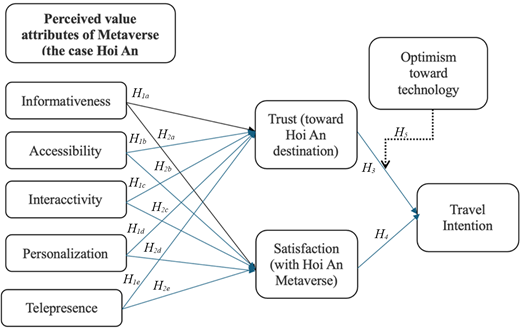
Informativeness (H1a), Accessibility (H1b), Interactivity (H1c), Personalization (H1d) and Telepresence (H1e) offered by the Metaverse positively influence users’ trust toward a destination.
Satisfaction in metaverse tourism arises from the quality and effectiveness of virtual destination experiences. Immersion, escapism and enjoyment enhance satisfaction and loyalty (Jafar and Ahmad, 2023). Virtual previews of destinations and services improve booking confidence and enjoyment (Zhu et al., 2023). Presence and telepresence shape conative, affective and conative destination images (Jafar and Ahmad, 2023):
Informativeness (H2a), Accessibility (H2b), Interactivity (H2c), Personalization (H2d) and Telepresence (H2e) offered by the Metaverse positively influence users’ satisfaction with the Metaverse.
Trust and satisfaction act as psychological mediators linking stimuli to behavioral responses. Trust reduces perceived risk and uncertainty in destination evaluation (Nieves-Pavón et al., 2025), while satisfaction reinforces positive affect and motivates behavioral continuation (Torabi et al., 2022; Zhang et al., 2025). Destination trust mitigates perceived risk and uncertainty associated with travel decision-making, particularly in virtual contexts where physical verification is absent (Prados-Castillo et al., 2024). In virtual environments, trust in a destination via live streaming (Zheng et al., 2023) or a metaverse experience (Shin et al., 2024) can further affect visit intention, as they perceive less risk in visiting it in person, thereby strengthening their intention to travel.
Satisfaction similarly motivates continuation of virtual experiences into physical travel (Tsaih and Hsu, 2018; Zhu et al., 2023). Satisfaction with the metaverse experience reflects affective reinforcement derived from positive virtual engagement. Prior research suggests that satisfying pre-consumption experiences generate motivational momentum toward real-world consumption (Buhalis et al., 2023a). This mediating structure confirms that trust and satisfaction serve as the internal psychological bridge that translates virtual engagement into real-world behavioral momentum, thereby addressing the causal pathway from virtual satisfaction to physical intention (Buhalis et al., 2025; Wu et al., 2023). Thus, this study proposes these hypotheses:
Users’ trust in a destination (H3) and their satisfaction with the Metaverse (H4) positively influence their travel intention.
2.4 Optimism toward technology
Optimism reflects positive beliefs that technology enhances control, efficiency and flexibility (Parasuraman, 2000). As a key facet of technology readiness, optimism fosters perceived ease of use and usefulness, thereby fostering trust and satisfaction (Chung et al., 2015). Within the SOR framework, technology optimism serves as a “cognitive filter” that determines how internal organismic states translate into behavioral responses (Kim et al., 2020).
Individuals high in optimism are more likely to evaluate technological experiences positively and to fully act on the trust they develop in a virtual destination, making optimism a stronger predictor of behavioral intention (Kim et al., 2020). This favorable predisposition operates as a psychological catalyst that bridges the “reality gap” uncertainty over whether the physical heritage experience will align with virtual stimuli. By fostering self-efficacy and reducing skepticism toward digital simulations, optimism helps ensure that trust established in the metaverse effectively drives real-world visitation (Buhalis et al., 2023a; Rather et al., 2024). Thus:
Optimism toward technology positively moderates trust toward the destination and the intention to visit.
Thus, this study proposes the research model in Figure 1.
3. Methodology
3.1 Study site
This study was conducted within the Hoi An Metaverse, a virtual tourism platform that digitally reconstructs Hội An, a UNESCO World Heritage Site in Vietnam. The platform enables immersive exploration through interactive features, including avatar-based navigation, real-time information and customizable interface elements. As a metaverse-based destination, Hoi An metaverse provides an appropriate empirical setting for examining tourists’ psychological and behavioral responses to virtual destination experiences, consistent with the SOR framework.
The metaverse provides a structured experiential context in which users encounter key perceived value attributes, including informativeness, accessibility, interactivity, personalization and telepresence. These experiential features enable users to engage with the virtual destination and form internal evaluations, such as trust in the destination and satisfaction with the experience, which may subsequently influence their intention to visit the physical destination. Accordingly, Hoi An metaverse serves as a relevant and suitable study site for investigating how metaverse-based tourism experiences shape travel-related psychological processes and behavioral intentions.
3.2 Sampling and data collection
Data for this study were collected via an online survey of active users of the Hoi An metaverse platform. Convenience sampling was used to target individuals with direct experience of the virtual environment. Participants were recruited via various online channels, including official announcements within the Hoi An metaverse community, relevant online forums and direct invitations to active users. While convenience sampling allowed efficient access to metaverse users, it may limit the generalizability of the findings to broader tourist populations, a common tradeoff in emerging tech studies (Buhalis et al., 2023a; Rather et al., 2024).
Screening questions confirmed that respondents had engaged with the Hoi An Metaverse and all participants provided informed consent before completing the questionnaire. To support data quality, the survey included attention-check items. An initial pool of 745 responses was collected; after rigorous data cleaning, which removed incomplete responses, straight-lining, failures on attention checks and substantial missing values, a final sample of 700 valid responses was retained for analysis. This large sample size ensured sufficient statistical power to test technology optimism’s moderating effects (H5) and bolstered Partial Least Squares Structural Equation Modeling (PLS-SEM) estimate stability in our exploratory study (Hair et al., 2024), while offsetting convenience-sampling biases to better detect nuanced interactions between destination trust and travel intention.
The sample reflected a wide demographic range, with participants aged 18 to over 60, with a relatively balanced gender distribution (52.6% female; 47.4% male). The largest age group was 31–40, followed by 18–30 and 41–50. Descriptive demographic statistics are presented in Table 1.
This study adhered to institutional and journal ethical guidelines for research involving human participants. Prior to participation, respondents received clear information on the study’s purpose, procedures, voluntary nature, anonymity and their right to withdraw at any time. Informed consent was obtained electronically and data were all collected anonymously; no personally identifiable information was recorded and all responses were stored securely for academic research purposes only. Data collection was conducted in collaboration with local travel agencies in Vietnam. When potential tourists showed interest in visiting Hoi An, staff invited them to try metaverse Hoi An as a virtual preview and then provided a QR code linking to the online survey. Participation was entirely voluntary and respondents completed the questionnaire on their own devices.
3.3 Measures and instrument development
A structured questionnaire was developed using validated scales from prior studies. Items were rated on a 5-point Likert scale from 1 (strongly disagree) to 5 (strongly agree). The instrument was drafted in English, translated into Vietnamese and back-translated to ensure accuracy. The questionnaire was first reviewed by experts in tourism and technology to ensure clarity and cultural appropriateness (Zhao et al., 2024), following pilot testing with metaverse users to refine wording and comprehensibility (Buhalis et al., 2025). The final questionnaire covered perceived value attributes, internal states (trust, satisfaction, technology optimism) and travel intention. To curb common method bias upfront, we assured respondents of anonymity, provided clear instructions and randomized the order of items for key constructs (Buhalis et al., 2023b). Measurement details and sources appear in Table 2.
3.4 Data analysis
The research model was analyzed using PLS-SEM, which is well-suited for predictive research and for testing complex relationships, including moderating effects, in emerging research fields (Hair et al., 2024). Compared with covariance-based SEM, PLS-SEM is more tolerant of non-normal data and is commonly used in exploratory and theory-development studies (Hair et al., 2024). Analyses were performed in R (version 4.2.0) using the seminar package (version 2.3.7). Prior to the primary analyses, the data were screened for completeness and quality. The analysis proceeded in two stages:
Measurement model assessment assessed indicator reliability, internal consistency, convergent validity and discriminant validity and checked for signs of common method bias to ensure the soundness of the measurement model.
Structural model evaluation examined multicollinearity, R2 values, effect sizes (f2) and the structural paths. Path significance was tested using bootstrapping with 5,000 resamples. The moderating role of technology optimism was tested using an interaction term and further explored with simple slopes analysis. Following recent PLS-SEM guidelines, including the inverse square root criterion, the sample size was deemed adequate to provide sufficient statistical power (Hair et al., 2024).
4. Results
4.1 Measurement model
The measurement model was rigorously assessed for reliability and validity, in accordance with PLS-SEM reporting standards.
The results of the measurement model assessment are presented in Table 3.
As shown in Table 3, the indicator reliability of each indicator was confirmed with outer loadings meeting the recommended threshold. The Cronbach’s alpha and rhoC values for all constructs exceeded the conventional thresholds, indicating adequate internal consistency. AVE values ranged from 0.794 to 0.877, well above the 0.50 benchmark, showing that each construct explained more than half of the variance in its indicators. Furthermore, the exceptional psychometric properties observed in this large-scale sample (n = 700) minimize concerns regarding measurement error and provide a solid foundation for testing complex interaction effects. Overall, the measurement model satisfied standard reliability and validity criteria (Hair et al., 2024), providing a sound basis for the structural analysis.
4.2 Discriminant validity (Heterotrait-Monotrait Ratio)
After confirming indicator reliability and convergent validity, we rigorously assessed discriminant validity using the Heterotrait-Monotrait Ratio (HTMT), prized for its sensitivity (Hair et al., 2024; Table 4). Most values fell below 0.85, but TRUST–INFORM (0.978) and PERS–INTER (0.971) exceeded 0.90, expected in immersive contexts, as information quality underpins trust and personalization merges with interactivity in SOR dynamics (Jeong and Shin, 2019). Bootstrapping (5,000 resamples) confirmed that all 95% CIs remained below 1.0, demonstrating an empirical distinction despite conceptual overlap (Hair et al., 2024; Seočanac, 2024). All constructs proceeded to hypothesis testing, though findings merit caution given these interrelations in metaverse settings.
4.3 Structural model evaluation
The structural model was evaluated following established reporting standards for PLS-SEM (Hair et al., 2024).
First, collinearity was assessed using variance inflation factor values to ensure that multicollinearity among predictor constructs did not unduly inflate parameter estimates. As shown in Table 5, VIFs for the predictors of travel intention were all well below the conservative threshold of 5. For the metaverse experiential attributes predicting destination trust and satisfaction, some VIFs were slightly higher, with a maximum of 5.912 for informativeness predicting destination trust. Other values for accessibility, interactivity, personalization and telepresence also indicated moderate correlations among these predictors. These findings should be interpreted within the context of PLS-SEM, where experiential attributes are conceptually connected aspects of the metaverse experience and are therefore expected to exhibit moderate correlations in their influence on trust and satisfaction. Crucially, all VIF values, while exceeding 5 in some cases, remained well below the more lenient threshold of 10 commonly accepted in PLS-SEM, a method chosen for its robustness to multicollinearity in predictive models with complex constructs (Hair et al., 2024). The individual contributions of highly correlated predictors warrant cautious interpretation, aligning with methodological recommendations for PLS-SEM in exploratory contexts (Hair et al., 2024).
Second, the model’s explanatory power was assessed using the coefficient of determination (R2). As shown in Table 6, the endogenous constructs exhibited a notable level of explanatory power.
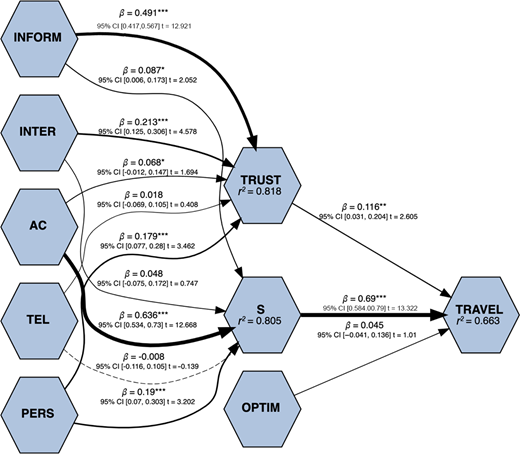
For the main-effects model, metaverse experiential attributes collectively explain 81.8% of the variance in destination trust and 80.5% of the variance in satisfaction with the metaverse experience. In turn, 66.3% of the variance in travel intention is accounted for by its direct predictors. These R2 values indicate strong explanatory power for both the organismic states and the behavioral response, highlighting the meaningful contribution of metaverse stimuli in shaping trust, satisfaction and intention. The additional variance in travel intention explained by the interaction term (technology optimism × destination trust) is reported and discussed in Section 4.4, highlighting the additional explanatory value of including the moderating role of technology optimism (Hair et al., 2024).
Third, the effect sizes (f2) were examined to assess the relative contribution of each predictor. As summarized in Table 7, the impacts differ across the endogenous constructs as follows:
For destination trust: Informativeness exerts a large effect, positioning as the primary driver of trust; interactivity shows a small effect, while accessibility, personalization and telepresence exhibit no effects. This pattern highlights the pivotal role of comprehensive information in fostering trust toward virtual destinations.
For satisfaction with the metaverse experience: Personalization demonstrates a medium effect, indicating that customized experiences substantially boost satisfaction; informativeness and telepresence have small effects, whereas accessibility and interactivity are negligible.
For travel intention: Satisfaction with the metaverse experience has a significant effect, emerging as the dominant direct predictor; destination trust and technology optimism show negligible effects, with the destination trust × technology optimism interaction displaying a small moderating effect.
These effect sizes follow Cohen’s guidelines, as commonly applied in PLS-SEM literature (Hair et al., 2024).
Overall, these findings suggest that the structural relationships are substantively meaningful, particularly highlighting the powerful influence of informativeness on trust, personalization on satisfaction and most notably, satisfaction with the metaverse experience on travel intention. Finally, technology optimism was included in the structural model as an antecedent of travel intention prior to testing the interaction effect. Figure 2 illustrates the estimated structural model with main effects, including the standardized path coefficients and R2 values.
4.4 Moderation analysis
The moderation analysis examined the interaction effect between destination trust and technology optimism. As reported in Table 8, the interaction term is positive and statistically significant, as further supported by the 95% CI, which does not include zero. This result indicates that technology optimism positively moderates the relationship between destination trust and travel intention. The f2 value for this interaction is 0.040, which corresponds to a small moderating effect based on established PLS-SEM guidelines (Hair et al., 2024).
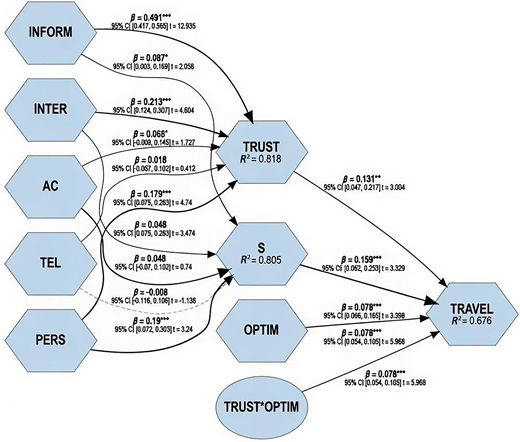
Figure 3 illustrates the bootstrapped structural model including the interaction effect between destination trust and technology optimism. The figure presents standardized path coefficients, 95% confidence intervals and R2 values for the endogenous constructs, visually depicting the positive moderating effect. Consistent with Table 8, the interaction term is statistically significant, providing strong support for Hypothesis 5.
After introducing the interaction term, the explained variance in travel intention increased slightly. Specifically, R2 for travel intention in the main-effects model was 0.663. After incorporating the moderation effect of technology optimism, it increased to 0.676 in the moderated model. This 0.013 increase indicates a modest improvement in predictive accuracy, showing that including technology optimism as a moderator adds some explanatory value. As Table 9 and Figure 3 illustrate, destination trust has a stronger positive effect on travel intention among users with higher technology optimism, whereas the effect is weaker among users with lower technology optimism.
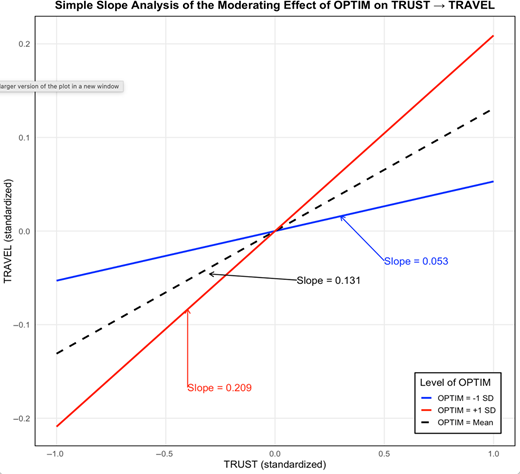
Figure 4 illustrates the moderating effect of technology optimism on the link between destination trust and travel intention. The plot illustrates that when technology optimism is low, the positive effect of destination trust on travel intention is weakest. It becomes stronger at moderate levels and is strongest for users with high technology optimism. These simple slope patterns indicate that as technology optimism increases, destination trust translates into travel intention more strongly.
5. Discussion
This study examined how metaverse experiential attributes shape travel intention through underlying psychological mechanisms, with particular attention to the mediating roles of destination trust and satisfaction with the metaverse travel experience, as well as the moderating role of technology optimism. Grounded in the SOR framework, the findings provide empirical insights into how immersive virtual tourism experiences translate into behavioral intention in a metaverse context. Beyond applying SOR, the results refine the conceptualization of stimuli, organismic states and responses at the intersection of virtual and physical realities.
Consistent with the SOR framework, the results demonstrate that perceived value attributes in the metaverse serve as salient experiential stimuli that shape users’ cognitive and affective evaluations. Attributes such as informativeness, accessibility, interactivity, personalization and telepresence contribute to the formation of destination trust and satisfaction with the metaverse experience. Specifically, informativeness strongly enhances destination trust (β = 0,491), while accessibility emerges as the primary driver of satisfaction (β = 0,636), underscoring the importance of accurate information for virtual experience. These findings highlight that not all experiential attributes contribute equally to psychological outcomes and their specific roles must be carefully considered in metaverse design. Importantly, these results affirm that metaverse tourism is an experiential system, not just tech, in which psychological immersion and value perceptions drive user responses. Thus, this study redefines the “S” component of SOR from a focus on functional traits to an emphasis on cognitive, participatory and immersive experiences, thereby enhancing our understanding of how metaverse environments, which are more permanent and integrated into our social lives, differ from temporary virtual reality experiences. By validating trust and satisfaction as pivotal organismic states that connect metaverse experiences to travel intentions, we advance prior smart tourism and VR studies toward richer, persistent, socially interactive virtual realms.
Second, trust in the virtual destination had a smaller effect on travel intention (β = 0.131), while satisfaction exerts a much stronger influence (β = 0.663), aligning with studies by Zheng et al. (2023); Prados-Castillo et al. (2024) and Zhu et al. (2023). Trust in digital platforms is a modest yet consistent predictor of virtual tourism engagement, reflecting users’ cognitive evaluations of destination credibility, while satisfaction captures affective responses to the overall quality of the experience. This result refines the “O”-“R” link by highlighting the unequal impacts of organismic components on behavioral responses, the importance of psychological processes in technology-mediated tourism decision-making, where direct physical experience is absent. Specifically, affective responses to the metaverse experience exert a stronger influence on real-world travel intentions than rational evaluations of destination credibility. The Hoi An metaverse experience proves more influential in driving travel intentions than destination trust alone, making investment in metaverse development a strategic priority. Thus, this study extends research on smart tourism and VR into a more immersive, persistent and socially interactive virtual context.
Finally, the findings also reveal that technology optimism positively moderates the relationship between destination trust and travel intention. Simple slope analysis shows the effect of trust on intention is weakest at low optimism (−1 SD; slope = 0.053), moderate at the mean (0 SD; slope = 0.131) and strongest at high optimism (+1 SD; slope = 0.209), indicating that trust becomes more influential as optimism increases. This aligns with Van Huy et al. (2024) and Chung et al. (2015), who found that users with positive technology beliefs rely more heavily on digitally mediated information when forming travel judgments, amplifying the behavioral impact of destination trust. Theoretically, this supports technology readiness theory and reinforces the SOR framework by positioning optimism as an individual-level boundary condition that strengthens the link between cognitive evaluations and behavioral responses. In addition, the moderating role of technology optimism clarifies that the translation of virtual evaluations into intentions to travel physically varies across individuals. Specifically, destination trust becomes more behaviorally influential among users who hold a more positive disposition toward technology. This study refines the organism–response relationship by showing that its strength depends in part on individual technological readiness in immersive environments.
6. Implications and conclusions
6.1 Theoretical implications
This study advances the SOR framework by extending its explanatory scope to metaverse tourism and clarifying how experiential mechanisms operate in immersive, persistent environments. Rather than treating SOR as a static stimulus–response structure, the findings position it as a dynamic process shaped by cross-domain experience, structured experiential value and individual predispositions.
First, the study refines the conceptualization of stimuli in immersive settings by framing metaverse attributes as experiential value dimensions rather than mere technical features, shifting the focus from functional VR/smart tourism engagement to user-centered mechanisms. Building on experience value and presence perspectives, these dimensions capture cognitive (informativeness, accessibility), participatory (interactivity, personalization) and immersive (telepresence) value, which jointly shape user evaluations. This integrated lens explains why these attributes function as core stimuli and differentiates metaverse environments from episodic VR experiences, where interaction is less persistent and socially embedded. Accordingly, SOR in cross-reality contexts is reimagined as interconnected, multi-layered bundles of value rather than isolated features within a single environment. In doing so, the study shows how metaverse experiences generate trust and satisfaction that extend beyond the virtual space, influencing real-world travel intentions and narrowing the intention-action gap.
Second, the study highlights the importance of technology optimism as a key moderator that significantly alters the strength of the relationship between trust and travel intention. The results indicate that the impact of trust on travel intention varies across levels of technological predisposition, highlighting that experiential translation is contingent on user readiness toward digital environments. This extends SOR by embedding individual differences into the organism–response relationship, highlighting important implications for modeling consumer behavior in an increasingly metaverse-integrated ecosystem. While trust typically plays a central role in destination choice, its predictive power weakens among tech-optimistic users. This nuance deepens tourism theory by showing that cognitive-affective pathways in digital tourism are not one-size-fits-all but hinge on personal tech optimism and digital readiness. At the same time, satisfaction outpaces trust in driving travel intention, highlighting the dominance of emotional and cognitive responses in immersive experience as primary drivers rather than ancillary factors in travel decision-making.
Third, the findings contribute to virtual tourism adoption research by empirically validating the role of perceived value attributes, particularly telepresence and interactivity, in shaping behavioral intention. These dimensions appear particularly influential in digital tourism settings, reinforcing calls to reconceptualize destination experience not only in physical settings but also across virtual and hybrid formats. In this way, the study complements and extends prior research that has primarily focused on website or social media interactivity to the more immersive and socially embedded setting of the metaverse.
6.2 Practical implications
The findings offer several practical implications for tourism practitioners, DMOs, technology providers and broader society by showing how metaverse features, individual traits and psychological factors work together to shape travel intentions.
First, the strong effects of perceived value attributes highlight the critical need to invest in high-quality, immersive design rather than technological sophistication. Users should feel engaged and involved in their experiences, with a strong emphasis on informativeness and personalization to build trust and satisfaction regarding a destination. As effective metaverse experiences depend not only on visual realism but also on how clearly destination information is communicated and how relevant the experience feels to users, practitioners should therefore prioritize coherent destination narratives, interactive storytelling and purpose-driven simulations over purely technical enhancements.
Second, the significant mediating roles of destination trust and satisfaction with the metaverse experience highlight the need for DMOs to actively manage credibility and the user experience within virtual environments. Metaverse platforms serve as well-organized touchpoints where accurate information, consistent narratives and user-centered design build confidence, foster positive emotional and interactive responses and manage expectations through continuous feedback, resulting in strengthening the translation of virtual interactions into intentions to visit in person.
Third, the moderating effect of technology optimism indicates that segmented metaverse tourism strategies are particularly important. For highly technology-optimistic users, immersive and innovative features can enhance their engagement and their desire to explore. On the other hand, users who are less comfortable with technology need more straightforward navigation, better usability and reassurance to build trust and reduce uncertainty. This suggests that a one-size-fits-all design approach is insufficient and that segmentation by technological readiness is critical to maximizing effectiveness.
Beyond managerial applications, the findings highlight broader societal and sustainability implications, particularly for heritage destinations such as Hoi An. Metaverse tourism has the potential to expand access to cultural heritage while partially alleviating physical pressure on vulnerable sites, contributing to overtourism mitigation and inclusive participation. However, virtual experiences can foster broader cultural engagement, not replacing the need for physical tourism. Importantly, these opportunities must be balanced against ethical concerns related to unequal access, data privacy and potential cultural misrepresentation. The findings, therefore, emphasize the importance of responsible metaverse development, grounded in authenticity, inclusivity and user empowerment, to promote sustainability and uphold ethical values in tourism development, ultimately enabling a wider audience to engage with and appreciate our rich cultural heritage.
6.3 Limitations and future research
Despite offering valuable insights, this study is subject to several limitations that should be acknowledged and addressed in future research.
First, the study used a cross-sectional survey design, which limits the ability to draw causal inferences. While the findings align with the SOR framework, future studies could adopt longitudinal or experimental designs to capture how trust, satisfaction and travel intention evolve over repeated or prolonged engagement with the metaverse. Second, the sample was drawn from users of a single metaverse platform, which may constrain the generalizability of the findings. Future research could extend the model across different destinations, destination types or cultural contexts to examine its robustness. Third, while the study focuses on key psychological constructs such as trust, satisfaction and optimism toward technology, it does not account for other potential variables, including technological anxiety, cultural affinity or prior travel experience, which may also influence virtual experiences and travel intentions. Future research could integrate these dimensions into extended models to enrich the explanatory power of SOR theory in digital tourism. Fourth, reliance on self-reported measures may introduce common method or social desirability biases. Although procedural remedies were applied, future research could complement survey data with behavioral indicators, such as navigation patterns or time spent in virtual environments, to enhance measurement objectivity. Finally, the empirical setting is specific to a heritage-based metaverse destination (Hoi An), which may limit applicability to other metaverse tourism contexts, such as urban, nature-based or entertainment-oriented platforms. Future studies could compare different metaverse destination typologies to explore whether experiential mechanisms vary across virtual tourism formats. Additionally, future studies are encouraged to conduct multi-group analysis in comparative designs to investigate potential contextual and cultural variations.
Funding
The author(s) receive no financial support for the research, authorship, and/or publication of this article.
AI usage declaration
Artificial intelligence tools were used solely for language editing and proofreading purposes and did not contribute to the study’s conceptualization, analysis or interpretation.
Author contributions
The first author (Anh Tram Huynh Diep) was responsible for conceptualization, data collection and writing the methodology and discussion sections. The corresponding author (Trang Huong Pham) contributed to the writing of the introduction, the development of theoretical implications and the revision of the manuscript. The third author (Ha Van Quach) wrote the literature review and practical implications. The fourth author (Quoc Tuan Cong Le) conducted the data analysis and prepared the results section.