The purpose of this study is to investigate the impact of sustainability virtual influencers (SVIs)’ source credibility on young female consumers’ pro-environmental motivations predicting to engagement with the SVI’s.
Combining source credibility and goal-framing theory, the study conducted an online scenario-based survey, collecting 366 responses via the Prolific platform after exposing participants to a stimulus of fictional SVI. The study conducted structural equation modeling analysis and mediation analysis using SPSS and Amos.
The study found that young female consumers are driven by different pro-environmental motivations when engaging with SVIs, which is particularly mediated by hedonic and normative goal motivations.
The study found that young female consumers are driven by different pro-environmental motivations when responded to engagement with the SVI’s content, which is particularly mediated by hedonic and normative goal motivations.
The study examined the SVI’s qualities and underlying pro-environmental motivations of young female consumers, offering practical implications for the strategic use of SVIs in social media green marketing and sustainability awareness initiatives.
The present study bridges a gap by combining source credibility and goal-framing theory to examine motivational mechanisms underlying young female consumers’ engagement with the SVI.
1. Introduction
With social media having become a significant means of communication, the global influencer marketing approach has doubled since 2019 (Dencheva, 2023). The expanding influencer market has led many businesses to use social media for green marketing. The contemporary global green marketing market is expected to reach approximately US$60.8bn by 2027 (Business Research Insights, 2024). Indeed, the influence of “greenfluence,” specialized pro-environmental social media movement (Hartmann et al., 2025), is bringing changes in the way that businesses communicate and implement green marketing on social media.
Virtual influencers (VIs), as computer-generated characters demonstrating human traits and personalities (Thomas and Fowler, 2021), are one of the exemplary factors driving these changes. VIs have become a new form of green activism on social media. Many top brands have begun to present green campaigns using VIs (Kelly, 2023). For example, Burberry developed VIs to emphasize the brand’s investment in environmental initiatives (Ruggeri, 2022). Hyundai also partnered with the virtual supermodel Shudu to promote the upcycled vehicles (Ruggeri, 2022). The popularity of VIs could be driven by several managerial benefits. They allow brands to control messages more easily, provide a higher degree of creative freedom, save some of the enormous costs of advertising budgets, and lower the risk of reputational crisis (Yang et al., 2023). Within this vein, VIs may offer unique advantages in sustainability communication. Their digital nature inherently aligns with concepts of reduced material consumption and environmental impact (Hwang et al., 2024). Unlike human influencers (HIs), VIs can consistently embody sustainable values without personal lifestyle contradictions, potentially enhancing message credibility in green marketing contexts.
However, questions have been raised concerning the effectiveness of VIs. Besides the benefits VIs provide for marketers and retailers (Jhawar et al., 2023), a limited perspective in understanding what factors motivate consumers to engage with VIs, particularly sustainability virtual influencers (SVI)s promoting green marketing, has been offered. Previous literature on social media green marketing has predominantly focused on investigating brand promotion strategies, determinants of consumer green purchasing behavior, and examining the effectiveness of green messages (Kang and Kim, 2017; Salem and Alanadoly, 2021). Past literature on VIs has primarily focused on comparing the effectiveness of endorsements by VIs and HIs (e.g. Alboqami, 2023; Franke et al., 2022), or investigating VIs’ traits in shaping social engagement (Lin et al., 2024; Nguyen and Hoang, 2025). Another stream of research has investigated VIs’ anthropomorphic attributes and provided useful insights (e.g. Arsenyan and Mirowska, 2021; Dabiran et al., 2024; El Hedhli et al., 2023; Kim and Park, 2024). Nevertheless, the key research question investigating the driving forces behind the popularity of VIs that specifically focuses on sustainability and green marketing, remains underexplored.
With that in mind, this research investigates consumers’ pro-environmental motivations that lead to engaging with SVIs that promote sustainability. Specifically, this study adopts source credibility (Ohanian, 1990) and goal-framing theory (Lindenberg and Steg, 2007) to test the hypothesized model using an online survey approach. Based on the integration of two theoretical frameworks, this study aims to offer insights into how SVIs can foster engagement, shape environmental consciousness and inspire pro-environmental actions among young female consumers, a crucial area of inquiry as the role of artificial entities in promoting social and ecological well-being continues to evolve. In doing so, this research contributes to literature by expanding the knowledge concerning VIs, social media green marketing and source credibility. Furthermore, the research results have beneficial implications for marketers seeking novel insights for successfully integrating VIs into authentic green marketing strategies.
2. Literature review
2.1 Sustainability virtual influencers
According to Brown and Hayes (2008), the term influencer refers to a third party that exerts meaningful influence on consumers’ purchasing decisions while remaining largely unaccountable for the consequences. With the prolific growth of social media marketing, human influencers who are real individuals have built credibility through their unique characteristics, interpersonal relationships whereas VIs are digitally created characters embodying visual realism and interactive capabilities similar to those of human (Thomas and Fowler, 2021). Unlike traditional human influencers, VIs operate through a combination of AI, computer-generated imagery and human supervision. Through AI integration, VIs can produce content, analyze user responses and optimize engagement strategies on a large scale (Arsenyan and Mirowska, 2021; Lou et al., 2023). At more sophisticated stages of development, they move beyond pre-scripted avatars and display semi-autonomous, interactive functions enabled by generative AI (Sorosrungruang et al., 2024). These capabilities allow VIs to maintain consistent digital presence, adapt to audience preferences and operate continuously without human limitations (Su, 2025).
Furthermore, VIs, through their capacity to emulate human-like traits, have reshaped consumer engagement by fostering parasocial relationships. These one-sided connections draw on social dynamics to generate perceived reciprocity and rapport comparable to face-to-face interactions (Horton and Richard wohl, 1956). Emerging research indicates that such illusory interpersonal bonds can be as persuasive in advertising as human-led communication, with consumers often experiencing heightened immersion and intimacy driven by the anthropomorphic qualities of VIs (Ma and Li, 2024; Zhang et al., 2025). Although the authenticity of VIs is frequently questioned due to their lack of a genuine identity (Lou et al., 2023), a growing body of evidence highlights their effectiveness in enabling dynamic consumer engagement that extends beyond traditional marketing approaches (Lim and Lee, 2023; Zhang et al., 2025). Nevertheless, research specifically examining SVIs remains in its early stages.
While green advocacy has gained significant momentum on social media, SVIs remain conceptually underdefined despite the growing presence of VIs who adopt sustainability-oriented personas. For example, Noonoouri (@noonoori) is an animation-like SVI that promotes climate change campaigns and has collaborated with top brands’ sustainability collections (Ruggeri, 2022). Zoe Dvir (@zoedvir) and Vida.Kit (@vida.kit) are SVIs that proclaim to be vegetarians and share posts to educate environmental activists, while Be, the bee-influencer (@bee_nfluencer) advocates for environmental causes such as bee conservation (Korenewsky, 2024). These influencers are frequently portrayed as young women in their twenties and are designed with human-like or stylized cartoon appearances. Such recurring characteristics tend to align with the demographic profile of their primary target audience, young female consumers, who become increasingly responsive to visually curated, aesthetically driven representations of eco-conscious lifestyles. (Leggett and Davies, 2024; Huh and Kim, 2024).
Because SVIs remain a relatively rare identity-based persona in practice, research specifically examining SVIs is limited. Moreover, studies examining VIs more broadly within sustainability contexts also remain limited (see Table 1). A stream of research examining VI features as a tool to leverage social goods or motivate prosocial behavior has been a dominant interest in the human–machine interaction literature, with only a few studies in the marketing field investigating VIs in the context of pro-environmental behavior (Gerrath et al., 2024; Quach et al., 2024), green product endorsement (Dabiran et al., 2024; Jiang et al., 2024; Kılıç and Gürlek, 2023) and corporate social responsibility messaging (Yang et al., 2023).
In this vein, the present study conceptualizes SVIs as a distinct influencer subtype defined not only by their digital embodiment but also by sustainability positioning embedded at the identity level. Such positioning is expected to shape consumers’ perceived credibility and pro-environmental motivation differently from the effects of sporadic sustainability messaging conveyed by general (virtual) influencers.
2.2 Source credibility and goal-framing theory
Emerging from environmental psychology, goal framing theory has been used to account for pro-environmental and prosocial actions (Jain and Rathi, 2023). Goal-framing theory postulates that three goal systems, gain goal (GG), hedonic goal (HG) and normative goal (NG), guide humans with different pro-environmental motivations (Lindenberg and Steg, 2007). The GG frame activates an individual’s behavior toward benefit maximization, and the HG frame activates an individual’s motivation for immediate pleasure (Lindenberg and Steg, 2007). The NG frame is driven by altruistic motivations and respecting social norms (Jain and Rathi, 2023).
Unlike prior studies that have relied on frameworks such as the theory of planned behavior, theory of consumption values or value–belief–norm theory to explain pro-environmental actions, goal-framing theory is particularly useful for addressing the motivation–behavior gap in sustainable consumption (Yang et al., 2020). In particular, prior research highlights the distinction between egoistic and altruistic appeals as a salient contributor to the motivation–behavior gap (Schlaile et al., 2018; Wang et al., 2019). Goal frames emphasizing personal benefits versus moral expectations may steer behavioral responses differently and operate through distinct motivational pathways, a dynamic that is well captured by goal-framing theory (Lindenberg and Steg, 2007). Furthermore, values function as overarching principles that extend across contexts (Bargh et al., 2001), while goals are defined as cognitively represented desired outcomes toward which individuals direct their efforts (Schwartz, 1992). As such, goals are typically more situationally specific, incorporating behavioral intentions, informational considerations and evaluative processes (Kopetz et al., 2012). Therefore, goal-framing theory is useful in understanding the interplay across different pro-environmental motivations in a single framework (Do Canto et al., 2023).
Within this vein, the present study integrates source credibility with goal-framing theory to examine how specific attributes of SVIs are associated with distinct forms of pro-environmental motivation. According to source credibility that examines the effectiveness of endorsements based on an endorser’s positive characteristics (Ohanian, 1990), three source characteristics drive the endorsement effect of source credibility. Perceived expertise reflects an endorser’s competence and authority, perceived attractiveness captures their physical appeal, and perceived trustworthiness denotes their believability and integrity (Ohanian, 1990). Driven by these characteristics, source credibility postulates that endorsers’ credibility could influence audiences’ beliefs, attitudes and behavioral change. While source credibility has often been integrated with theories assuming consumers’ rational choice such as the theory of planned behavior or the theory of reasoned action (e.g. Kumar, Kaushal and Kumar, 2023; Wong et al., 2020), prior research has also demonstrated its relevance in shaping attitudinal and behavioral intention processes underlying persuasive message effects (e.g. Phua et al., 2018; Wang and Scheinbaum, 2018). However, less attention has been given to how source credibility may integrate with motivational goal structures underlying pro-environmental behavior.
SVIs represent a paradigm shift from traditional influencer marketing models, necessitating a theoretical reconsideration of established persuasion mechanisms. In contrast to human influencers, whose effectiveness in green advocacy is grounded in expertise derived from lived experiences and consistent engagement in ethical and normative behaviors (Yang et al., 2023), SVIs function as algorithmically designed advocates devoid of material self-interest. This structural distinction may enhance perceptions of objectivity in promoting prosocial behaviors, while their visually appealing, aesthetically optimized appearances further strengthen consumer engagement (Lou et al., 2023). This fundamental difference in motivational structure introduces distinctive credibility dynamics, whereby traditional source characteristics – such as expertise, attractiveness and trustworthiness – may operate through alternative psychological pathways when the source is explicitly artificial yet purposefully engineered for advocacy. The intersection of source credibility and goal-framing theories in SVI contexts thus offers novel insights into how artificial entities may transcend conventional persuasion constraints.
Integrating source credibility with goal-framing theory, therefore, provides a meaningful perspective not only for understanding the underlying pro-environmental behavior toward SVIs but also for linking SVIs’ specific source characteristics to the activation of distinct motivational orientations, thereby suggesting its potential as a guiding framework for designing motivation-directed behavioral change interventions in social marketing contexts (Do Canto et al., 2023). That is, integrating source credibility with goal-framing theory suggests that persuasive effectiveness may depend not only on the content of SVI posts but also on how the unique credibility characteristics of SVIs activate particular goal frames. In this regard, the present study contributes to explaining how SVIs, as an emerging form of digitally constructed green advocacy actors, may function as salient digital cues that facilitate the shaping of pro-environmental motivation and engagement in social media contexts (Tate et al., 2014). Accordingly, the hypothesized research model examines how SVIs’ perceived expertise, attractiveness, and trustworthiness associate with consumers’ pro-environmental motivations and subsequent engagement with SVIs through differentiated motivational pathways.
3. Hypotheses development
Previous literature on pro-environmental behavior has emphasized the significant influence of human values, beliefs and norms on individuals’ intentions and behavior (Stern, 2000). In general, egoistic and altruistic value orientations can be referenced to explain pro-environmental behavior (Snelgar, 2006). For example, people with a strong egoistic value orientation (i.e. self-enhancement) are assumed to value economic costs and benefits, while those with a strong altruistic value orientation (i.e. self-transcendent) value moral and societal expectations in pursuing pro-environmental behavior (De Groot and Steg, 2009).
In this respect, the GG motivation aligns with an egoistic value orientation. First, individuals motivated by a GG frame engage in pro-environmental behavior to seek utilitarian benefits such as financial or intangible beneficiaries (Lindenberg and Steg, 2007). For example, such consumers may purchase a green product made of organic materials because it offers health improvement and superior performance (Khan et al., 2023). Similarly, individuals motivated by an HG frame seek instant pleasure such as tastiness and positive feelings (Lindenberg and Steg, 2007). In contrast, an NG motivation aligns with an altruistic value orientation. Individuals with an altruistic value orientation engage in pro-environmental behavior because they believe sustainable choices could contribute to a better world (Lindenberg and Steg, 2007).
In this regard, perceived expertise is likely to enhance the salience of GG frames by signaling functional effectiveness and outcome utility, while perceived attractiveness may activate HG frames through affective appeal and aspirational identification. In contrast, perceived trustworthiness may reinforce NG frames by conveying sincerity, integrity and ethical responsibility. Accordingly, expertise and attractiveness can be interpreted as credibility cues associated with egoistic appeals, whereas trustworthiness may operate as a credibility cue aligned with altruistic appeals in sustainability communication contexts.
3.1 Egoistic appeals (self-directed values)
In the context of social media green marketing, consumers have been found to perceive SVIs that provide practical knowledge and green marketing content as beneficial informants demonstrating expertise. For instance, SVIs regularly share posts informing users of the brand’s launch of a new green product, serving as objective and standard measures for consumers committed to pro-environmental behavior (Filieri et al., 2023). Therefore, when SVIs demonstrate expertise by sharing useful information, they likely motivate consumers toward a GG motivation.
Similarly, SVIs that demonstrate expertise in sustainability may appeal to consumers who seek hedonic pleasure in pursuing pro-environmental behavior. For example, SVIs that share unconventional and distinct content compared with HIs’ sponsored posts (Franke et al., 2022). Consequently, when SVIs demonstrate expertise through innovative content, they are likely to motivate consumers toward an HG motivation:
SVIs’ expertise will positively influence consumers’ egoistic appeals, specifically a) gain and b) hedonic goal motivations.
As characters that are digitally fabricated using computer graphic techniques, in general, VIs demonstrate strong visual attractiveness (Thomas and Fowler, 2021). Moreover, as they are often designed with idealized features and lifestyles, SVIs can serve as aspirational figures, presenting elevated lifestyles by sharing luxurious green products with sensual designs. Consumers may be drawn to SVIs that represent a socially accepted and admired standard. The attractiveness of SVIs indicates their sense of aesthetics and sophisticated preference (Berlyne, 1974), which appeals to consumers who are interested in the latest trends and tastes (Ki and Kim, 2019). Furthermore, by associating with an SVI that has strong visual attractiveness, consumers can enhance their own social image and gain approval, aligning with egoistic, GG motivations (Jain and Rathi, 2023). Therefore, when SVIs demonstrate attractiveness by sharing the latest content and aesthetic tastes, they likely induce consumers’ GG motivation.
An SVI’s attractive appearance and compelling content is inherently entertaining. SVIs often share posts in visually appealing ways. For example, SVIs feature digitally designed clothing and accessories in their posts, adding a fanciful atmosphere that is difficult to implement in real life (Suh, 2020). In addition, SVIs share green campaigns in a video format featuring robotic voices to convey environmental messages and engage consumers. Consumers seeking vicarious satisfaction from memorable experiences may be more inclined toward attractive SVIs (Miao and Wei, 2013), fulfilling a need for pleasure and emotional gratification (Lindenberg and Steg, 2007). Therefore, when SVIs demonstrate attractiveness when sharing virtual content and green campaigns entertainingly, they likely induce consumers’ HG motivation:
SVIs’ attractiveness will positively influence consumers’ egoistic appeals, specifically a) gain and b) hedonic goal motivations.
3.2 Altruistic appeals (other-directed values)
With the emerging trend of de-influencing – discouraging consumers from buying certain products or sharing negative reviews (Karimi, 2023) – the amount of consumer skepticism toward HIs with mega followers or inconsistent sponsorship has increased. In contrast, SVIs that demonstrate environmental justice could be more effective in establishing and maintaining trustworthiness because the SVI operator can curate green messages coherently and manage sponsored green ads using a strategic plan. Moreover, the nature of SVIs that present virtually created green products and travel to other countries in a virtual environment may appeal to consumers since they are not wasting outfits or products that are worn or used only once, which HIs typically do (Ameen et al., 2023). Given that NG motivation is associated with appropriateness and setting a good example (Lindenberg and Steg, 2007), SVIs’ trustworthiness may appeal to consumers who are motivated to fulfill their social responsibility. Therefore, when SVIs demonstrate trustworthiness by sharing environmental activism in a virtual environment, they are likely to induce consumers’ NG motivation:
SVIs’ trustworthiness will positively influence consumers’ altruistic appeals, specifically normative goal motivation.
3.3 Sustainability virtual influencer engagement
In the context of social media green marketing, several factors drive consumers to engage with influencers. Previous studies have reported that consumers engage with influencers for various reasons, including acquiring utilitarian benefits, entertainment value, building emotional connections, attaining social approval and affirming personal identity (e.g. Mirowska and Arsenyan, 2023; Yu et al., 2024). Consequently, consumers engaged with SVIs are likely to read, like, and share posts as well as purchase green products (Chen et al., 2021). In summary, different types of pro-environmental goal motivations facilitate consumers’ engagement with SVIs:
Consumers’ higher gain goal motivation will lead to higher SVI engagement.
Consumers’ higher hedonic goal motivation will lead to higher SVI engagement.
Consumers’ higher normative goal motivation will lead to higher SVI engagement.
Three goal frames, a) gain, b) hedonic and c) normative goal motivation, will mediate the relationship between each of the source credibility factors and SVI engagement.
4. Method
The present study focuses on pro-environmental motivations toward SVIs, whose real-world representations vary widely, ranging from animated characters to computer-generated graphics and increasingly AI-generated human-like personas. To isolate the proposed psychological mechanisms, the sampling frame was purposefully bounded to young female social media users within the age range of 18–40 years old residing in the USA. This demographic group has been shown to exhibit relatively higher engagement with social media influencers and sustainability-related consumption content (Djafarova and Rushworth, 2017; Hageman et al., 2024), and thus serves as a theoretically meaningful boundary condition.
This research also used scenario-based survey, exposing participants to a single Instagram post featuring a fictional human-like SVI created using Midjourney, which allowed the study to minimize potential confounds associated with pre-existing attitudes toward real influencers or memory recall bias (Balaji et al., 2017; Sajid et al., 2024), thereby enabling a more controlled examination of source-related motivational processes. The stimulus depicted the SVI promoting an eco-friendly organic cotton bag, selected as a recognizable sustainability cue capable of activating pro-environmental perceptions (Karmarkar and Bollinger, 2015).
4.1 Procedures
In the beginning of the survey, participants were asked to report the name of a VI they currently follow on Instagram to ensure familiarity with the phenomenon and confirm their prior social media experience. Then, participants were exposed to the stimulus of a fictional SVI promoting an eco-friendly organic cotton bag. Finally, the participants were presented with a series of questions.
4.2 Measures
Perceived expertise, perceived attractiveness, perceived trustworthiness were measured using five items in each construct, and GG, HG and NG motivation measurements were adapted from various sources which were revised based on feedback provided by two professors. Finally, engagement with SVI measurement was adapted from a previous study, reflecting participants’ engagement intentions toward the presented SVI stimulus in the current study (see Table 2). All items were measured using a seven-point Likert scale (1 = strongly disagree–7 = strongly agree).
4.3 Data collection
A total of 366 participants were recruited using the Prolific platform. Most of the participants were young (Mage = 29.8), white (53.8%), had earned a bachelor’s degree (38.8%), with household incomes ranging from $20,000–$80,000 (55.8%). Participants responded that they had been following VIs for more than six months (36.9%), checked VIs’ posts once a week (63.9%), and spent less than 10 min a day watching VIs’ posts (76.0%).
5. Results
Data analysis was conducted using SPSS 29.0 and Amos 26.0. To assess common method bias, Harman’s single-factor test showed that the first factor accounted for 44.59% of the variance, below the 50% threshold (Di et al., 2024; Podsakoff and Organ, 1986). Additionally, the single-factor model showed poor fit, whereas the hypothesized multi-factor model demonstrated good fit, and the significant chi-square difference between two models (Δχ2 = 4038.18, Δdf = 21, p < 0.001) suggested that common method bias was unlikely to be a major concern (Podsakoff et al., 2003; Pang et al., 2024).
The fit indices suggested that the measurement model was a good fit to the data (χ2 = 926.18, df = 470, p < 0.001, CMIN/df = 1.97, CFI = 0.96, TLI = 0.95, RMSEA = 0.05, SRMR = 0.04). Table 2 presents factor loadings and the reliability of all constructs as measured by Cronbach’s alpha, composite reliability (CR). Although the factor loadings for gain goal motivation ranged from 0.47–0.77, meeting the minimum acceptable threshold (Hinkin, 1995; Howard, 2016), Cronbach’s alpha values of the scale items were also above the recommended threshold of 0.70, supporting the reliability of the measures (Nunnally and Bernstein, 1978).
Table 3 represents the results for average variance extracted (AVE), convergent validity and discriminant validity assessed using both the Fornell–Larcker criterion and the heterotrait–monotrait (HTMT) ratio, with a threshold value of 0.85 (Henseler et al., 2015). The AVE for gain goal motivation was below the recommended level of 0.50, indicating comparatively weaker convergent validity than the other constructs. However, given that AVE considered a more conservative indicator of convergent validity than CR (Bagozzi and Yi, 1988; Fornell and Larcker, 1981; Hair et al., 2010), and consistent with prior research that has retained constructs with AVE values below 0.50 when composite reliability was acceptable (e.g. Elayat and Elalfy, 2025; Sharma and Srivastava, 2025), the overall discriminant and convergent validity of the measurement model was considered acceptable.
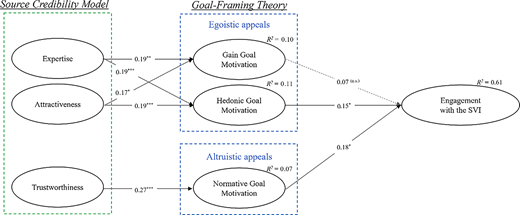
Structural equation modeling (SEM) results demonstrated a good model fit (χ2 = 941.74, df = 474, p < 0.001, CMIN/df = 1.99, CFI = 0.96, RMSEA = 0.05, SRMR = 0.06). Path analysis revealed that perceived expertise was positively associated with GG (β = 0.19, t = 2.70. p < 0.01) and HG motivation (β = 0.19, t = 3.44. p < 0.001), supporting H1a and H1b. Perceived attractiveness was positively associated with GG (β = 0.17, t = 2.54. p < 0.05) and HG motivation (β = 0.19, t = 3.69. p < 0.001), supporting H2a and H2b. Perceived trustworthiness was positively associated with NG motivation (β = 0.27, t = 5.16. p < 0.001), supporting H3. HG (β = 0.15, t = 2.00. p < 0.05), and NG motivation were positively associated with engagement (β = 0.18, t = 2.46. p < 0.05), respectively, supporting H5 and H6. However, GG motivation did not have an association with engagement (β = 0.07, t = 0.94. p = .35), not supporting H4 (see Figure 1). Finally, the model explained 61.2% of the variance in engagement (R2 = 0.61), indicating strong overall explanatory power (Meyvis and Van Osselaer, 2018).
We conducted mediation analysis using 5,000 bootstrapped samples with a 95% bias-corrected confidence interval (Preacher and Hayes, 2008). Perceived expertise and perceived attractiveness had a significant indirect effect on engagement through HG motivation. Perceived trustworthiness also had a significant indirect effect on engagement through NG motivation, supporting H7b and H7c (see Table 4).
6. Discussion and conclusion
6.1 Discussions on key findings
Using scenario-based survey method, this study examined young female consumers’ pro-environmental motivations to engage with the SVI based on the integrated framework of source credibility and goal-framing theory. The findings indicate that, within the context of stimulus presented in this study, young female consumers’ engagement with the SVI’s content was closely associated with HG and NG, which were linked to different perceived source characteristics of the SVI.
The results supported all hypotheses with the exception of H4 and H7a. Perceived expertise and perceived attractiveness were associated with GG and HG motivations, indicating similar motivational patterns whereby the SVI may be perceived as both functionally informative and experientially engaging sources in sustainability contexts (Jiang et al., 2024; Kim and Park, 2024). The SVI’s ability to simultaneously activate utilitarian and hedonic motivations highlights the versatility of their persuasive appeal. Interestingly, perceived expertise and perceived attractiveness were associated with engagement with the SVI mediated by HG motivation, suggesting emotionally rewarding component may play a role. In addition, the distinctive and idealized characteristics associated with the SVI (e.g. hyper-realistic appearance or unique virtual personas) may provide contextual cues in promoting engagement with SVIs (Nguyen and Hoang, 2025).
Perceived trustworthiness showed the strongest association to NG motivation, suggesting the potential viability of SVIs’ staged credibility for effective green marketing on social media (Lou et al., 2023). As the only motivation grounded in altruistic intent, the direct link between NG motivation and SVI engagement underscores the continued importance of trustworthiness in fostering meaningful connections. This suggests that trustworthiness remains a central driver of impactful engagement, even in the context of digitally rendered influencers. Perceived trustworthiness was also associated with engagement with the SVI mediated by NG motivation, indicating that the SVI could convey a consistent ethical image consistent with the prior study suggesting that SVIs could appeal to consumers seeking value-based content (Wan et al., 2025).
However, GG motivation did not have an association with engagement with the SVI. This could be attributed to several reasons. First, while current SVIs may able to activate utilitarian, self-interested motives GG frames may not be the primary drivers of consumer engagements, not providing a sufficient level of beneficial content to establish an engaged relationship with them. Instead, the results reveal that NG and HG goal frames exert meaningful, albeit modest, effects on engagement, highlighting their practical importance.
Overall, the key findings of the research suggest that different credibility dimensions of the SVI are associated with distinct motivational orientations underlying pro-environmental engagement. Specifically, experiential and value-related motivations were more closely related to engagement than purely utilitarian motivations. This pattern is similar with recent studies on sustainability-oriented VIs (Jiang et al., 2024; Riyat et al., 2025), and further aligns with broader evidence highlighting the importance of hedonic value in VI marketing contexts (Kim et al., 2025; Zhang et al., 2025).
6.2 Theoretical contributions
This work offers several theoretical contributions to the fields of VI marketing, social media green marketing and source credibility. First, the findings contribute to the VI marketing literature. Previous literature has primarily focused on examining the effectiveness of marketing between HIs and VIs (Alboqami, 2023; Yang et al., 2023) or investigating the endorsement effectiveness of VIs (Jiang et al., 2024; Gerrath et al., 2024). Building on this stream, the present study provides additional insights by examining SVIs as a specific subtype and exploring how different perceived source characteristics are associated with distinct motivational orientations. In doing so, the findings contribute to a more nuanced understanding of how SVIs may be perceived in social media contexts, offering novel directions for future research.
Second, this study contributes to the social media green marketing literature. Prior research has predominantly investigated the effectiveness of green marketing on social media by focusing solely on the normative influences or green campaigns initiated by businesses (Akhtar et al., 2024; De Groot and Steg, 2009; Rienda et al., 2023). This study contributes by shifting analytical focus to the motivational processes by adopting psychologically grounded perspectives, providing further exploration of motivation-based mechanisms in social media green marketing literature.
Finally, this study contributes to the source credibility literature by integrating source credibility with goal-framing theory, broadening research applications. Traditionally, this model has been employed to assess how the persuasiveness of endorsers influenced followers’ attitudes and behaviors (Kumar, 2023; Mainolfi and Vergura, 2022). By incorporating goal-framing theory, the integrated framework provides a process-focused perspective and deeper psychological insights, addressing the limitations of source credibility and enhancing our understanding of the current knowledge on SVIs.
6.3 Managerial implications
The research findings provide practical insights for brand marketers as well as organizations engaged in social marketing initiatives that apply marketing principles to promote socially beneficial behaviors such as sustainability among young audiences. In particular, the results indicate that key source characteristics manifest differently in SVIs, underscoring the need for tailored influencer communication strategies.
Specifically, brands can leverage SVIs in green marketing more effectively by prioritizing visually appealing and engaging representations, rather than emphasizing financial benefits or relying solely on the SVI’s expertise. SVI-generated content can promote digitized green products and cultivate excitement around sustainable fashion. For instance, a recent Coach campaign employed creative storytelling in a simulated setting to promote its Spring bag collection (Braun, 2024). Similarly, incorporating gamification into sustainability campaigns may offer an effective complementary approach. These insights could be leveraged by public institutions and educational programs to refine environmental awareness campaigns (Kotler and Lee, 2008; White et al., 2019). For nonprofit and educational organizations, these results highlight the importance of utilizing SVIs to trigger normative and hedonic motivations rather than focusing solely on functional gains. Taken together, these findings indicate that pro-environmental initiatives may be effectively communicated through social media.
Second, because NG is motivated by altruistic sentiment and the valuation of social norms, brand marketers could implement value-based marketing in their promotional strategies to educate consumers and build strong relationships with them, affirming the perspective that SVIs could appeal to those seeking emergent ethical standards in a digital environment (Wagman, 2020). As such, brand marketers could use SVIs to highlight socially responsible practices such as Fair Trade and veganism by effectively signaling consistency and authenticity. In doing so, SVIs can enable brand marketers to build trust and credibility on issues that matter to their target audiences. Beyond commercial contexts, these strategies may also support social marketing initiatives aimed at reinforcing social norms related to responsible consumption and environmental stewardship.
Finally, the research results demonstrated that SVIs are not necessarily ideal for building connections through informativeness. Therefore, brand marketers could consider hybrid promotional strategies that incorporate both SVIs and HIs to reach a broad group of consumers with varying motivations underlying their pro-environmental behaviors. For instance, brands can collaborate with, or create an SVI with visually aligning core brand values to promote a compelling campaign while HIs provide the nuanced, expert-led details of sustainability initiatives. These hybrid approaches align with sustainability communication and social marketing strategies designed to encourage informed and sustained pro-environmental behavior, particularly in public sustainability campaigns and educational initiatives aimed at engaging young audiences.
6.4 Limitations and directions for future studies
This study provided valuable insights by addressing the unique features of VIs in the context of sustainability, which has been underexplored. Nevertheless, the study had a few limitations. First, this study employed a fictional human-like SVI as the stimulus. However, SVIs in the current real-life circumstances vary in appearances, identities, and ethnicities. Accordingly, future research may benefit from examining SVIs with more clearly specified attributes to enhance external validity or from employing research designs that incorporate interactions with real-world influencers to provide additional insights into potential causal mechanisms.
Second, the relatively low AVE for gain goal motivation suggests that this construct may require further refinement and validation in future research. Although prior studies have retained constructs with AVE values below recommended thresholds when other measurement criteria were acceptable (Bagozzi and Yi, 1988; Fornell and Larcker, 1981), this issue should nevertheless be acknowledged as a measurement limitation of the present study.
Third, the exclusive focus on young female consumers represents a theoretically meaningful boundary condition. Future research may extend the study by examining whether the observed relationships hold across more diverse demographic groups.
Fourth, the reliance on cross-sectional, self-reported data poses certain methodological limitations. Since data were collected at a single point in time, this study precludes the establishment of definitive causal inferences between SVI source characteristics and consumer motivations. Future research could address these constraints by employing longitudinal designs or experimental manipulations to more rigorously validate the causal pathways identified in this study.
Finally, while SVIs may enhance pro-environmental motivation, the increasing use of AI-driven agents also raises concerns regarding transparency, accountability and potential liability for misleading sustainability claims. In particular, issues surrounding accountability and liability for misleading or exaggerated environmental messaging warrant greater scholarly and regulatory attention as AI-mediated communication becomes more prevalent (Guglyvatyy, 2026). Future research may further examine these issues from regulatory perspectives.