This research explores the intricate relationship between awareness of plagiarism, using plagiarism prevention techniques and promoting the academic integrity of university students. The study also investigates the mediating role of techniques to avoid plagiarism in ensuring academic integrity and Institutional consequences.
This study's research design was primarily quantitative, utilizing an online survey to gather numerical data from a sample of students. Data was collected from students enrolled at Noakhali Science and Technology University, a public university in Bangladesh, through an online survey. The questionnaire was distributed via email invitations and chat groups. The researchers employed the SmartPLS-4 software to implement structural equation modelling techniques.
The results indicated that a significant proportion of participants, namely N = 152 out of N = 199 respondents, exhibited an understanding and awareness about “plagiarism”. Measurement model evaluation demonstrated that each construct had Cronbach's alpha values over 0.700, and AVE exceeded 0.500, indicating a strong level of internal consistency and strong convergent validity. The analysis of the structural model's findings revealed that most R2 values reach or surpass the 0.1 threshold, showing strong predictive capacity for TAP, LIC and EAI. Additionally, the Q2 values of EAI, LIC and TAP highlight the strong predictive relevance of the relevant constructs. Furthermore, the mediation analysis yielded compelling evidence to support hypotheses and highlighted the crucial function of techniques to avoid plagiarism as a mediator in these connections.
By investigating the mediating function of plagiarism avoidance strategies, this study offers an innovative perspective on the shift from knowledge to action in combating plagiarism.
Introduction
Plagiarism, the act of accepting someone else's work and presenting it as one's own, is a serious issue in educational settings. It undermines the credibility of academic publications and can have serious repercussions for those involved in such unethical conduct. Concern over plagiarism among college students has grown recently (Mulenga and Shilongo, 2024; Juyal et al., 2015). Additionally, plagiarism has become a severe concern in higher education worldwide. Numerous studies have found that many pupils lack knowledge about plagiarism and proper source citation. Upholding academic integrity and the norms of honesty, justice and scholarly rigour are paramount in the academic setting. Plagiarism seriously threatens academic integrity worldwide since it involves the unauthorized use or duplication of another person's work without proper attribution (Mbutho and Hutchings, 2021). Research consistently demonstrates that many students lack adequate understanding of what constitutes plagiarism and how to properly cite sources, even in the face of tremendous efforts to address this issue (Sun and Hu, 2020; Coughlin, 2015). The validity and reputation of higher education institutions are under threat because of the many examples of academic dishonesty brought about by this lack of knowledge. Plagiarism among students and academics is also significantly influenced by other aspects, such as academic constraints and rewards, as well as institutional and legal repercussions. Legal and institutional consequences such as disciplinary actions, low grades, or displacement are intended to prevent plagiarism by harshly penalizing people who engage in unethical behaviour (McIntire et al., 2024; Miles et al., 2022; Garner and Hubbell, 2013; Berlinck, 2011).
There is a lack of studies in Bangladesh about the transition from awareness to action regarding plagiarism avoidance tactics. This study gap also includes knowing how these methods maintain academic integrity and guarantee institutional and legal repercussions. Despite several research efforts (e.g. Akter, 2021; Sayeda, 2024; Ahmed et al., 2023; Mostofa et al., 2021), a comprehensive analysis of this emerging issue is still lacking. The research gap in Bangladesh pertains to the absence of practical investigations that thoroughly analyse the levels of awareness, attitudes, behaviours and institutional responses to academic integrity and ways to discourage plagiarism. However, this research broadly examines the interconnected dynamics of students' plagiarism knowledge, utilization of plagiarism prevention strategies and academic integrity promotion in institutions of higher learning. It explores the extent to which simple awareness is insufficient unless implemented into applicable practices that effectively prevent academic dishonesty. By examining the mediating role of plagiarism prevention measures, the study illuminates not only how these measures individualize responsibility but also how they complement institutional efforts in fostering an environment of integrity. Moreover, it raises the broader stakes for universities to make policies, curriculum planning and governing academic standards that collectively safeguard education quality as well as institutional reputation.
Literature review and hypothesis development
Theoretical underpinning
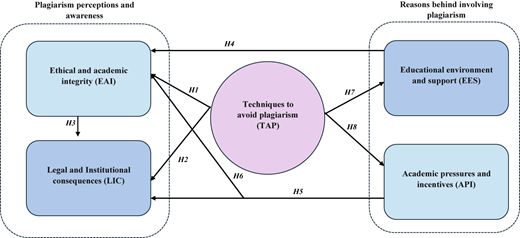
The study's theoretical framework was formed from the International Centre for Academic Integrity (ICAI, 2021) model of academic integrity, Huemer's (2001) “Theory of Perception”, and Wangaard and Stephens' (2011) Achieving with Integrity (AWI) model, see Figure 1. The ICAI model offers a thorough framework for comprehending and advancing academic integrity in educational institutions. In addition, Huemer's theory outlines a practical understanding of the cognitive mechanisms that drive moral decision-making and behaviour. Huemer's (2001) method emphasizes the importance of human viewpoints and ethical sense in determining ethical problems by highlighting perceptual understandings' direct and immediate nature. Incorporating this theory into the study authorizes a deeper understanding of how individuals perceive and respond to integrity-related issues. Besides, the AWI model proposes a systematic approach to promoting academic integrity, explicitly emphasizing raising awareness, cultivating willingness and performing implementation. By including this model in the research, scientists can analyse how plagiarism avoidance tactics mediate the connection between knowledge and action in upholding integrity norms. The AWI model's focus on practical methods to promote integrity initiatives aligns with the study's aim to investigate concrete ways for protecting academic integrity and reducing legal and institutional consequences. Even yet, much work has been done over the years to provide details on academic integrity, ethical behaviour and decision-making. Therefore, we hope to advance existing knowledge and theory by examining how strategies for avoiding plagiarism affect students' behaviour regarding academic and ethical integrity, legal and institutional consequences, the educational environment and support, and academic pressures and incentives. However, the following Table 1 illustrates your hypotheses' significance and theoretical foundation by connecting them to the ICAI Model, Huemer's Theory of Perception, and the AWI Model. A synopsis of how the theories as a whole provide credence to the hypotheses follows.
Perceptions and awareness about plagiarism among university students
Plagiarism can be concisely defined as the act of closely imitating someone else's idea, writing or music, and it also includes the act of taking someone else's work. Hu and Lei (2015) observed significant disciplinary differences in students' comprehension of plagiarism and their beliefs about its underlying causes among participants from two Chinese universities in their research. In addition, they found that the cultural environment impacted how plagiarism was viewed and judged. Specifically, they observed that senior students were more lenient in their evaluations than junior students. Besides, Idiegbeyan-Ose et al. (2016) discovered that postgraduate students' awareness of plagiarism was moderate, and the level of training they received influenced this awareness. They identified pressure to meet deadlines, poor writing skills, and a lack of understanding of plagiarism as contributing factors. Importantly, their research revealed a direct relationship between awareness and perception of plagiarism, suggesting that increased awareness leads to a more positive view of plagiarism. However, avoiding plagiarism has a practical influence on students' ethical and academic integrity. According to existing research, techniques to avoid plagiarism are connected to more significant satisfaction with one's understanding of plagiarism (Ahmad and Ullah, 2014). Navigating the ethical landscape of academic or scholarly papers requires comprehending the different types of plagiarism, such as intentional, accidental, and self-plagiarism (Ahmad and Ullah, 2014). Careful notetaking, innovative writing and proper citation practices are modes to control plagiarism. Students and research scholars can uphold academic integrity and effectively forge ethical work by implementing these techniques (Karnik, 2024). Therefore, this study anticipated that the following-
Techniques to avoid plagiarism significantly impact the ethical and academic integrity of the students.
Techniques to avoid plagiarism significantly influence the legal and Institutional consequences.
Ismail (2018) drew attention to the lack of understanding of plagiarism and its legal consequences among undergraduate medical and nursing students in Erbil. The study found a high incidence of plagiarism, with 54.3% of students involved. Male students and medical students were slightly more likely to engage in plagiarism. Alarmingly, a significant percentage of students demonstrated a lack of knowledge about plagiarism and its legal implications. Academic integrity infringements can significantly influence individual, professional workplace, ethical, and legal life (Geethalakshmi, 2018). Academic institutions are vital in addressing this issue by promoting academic integrity through regulations, procedures and programming connected to ethical principles (Seider et al., 2013). Therefore, this study formulated the following-
Ethical and academic integrity greatly influenced the legal and Institutional consequences.
Causes behind involving plagiarism among the university's students
Many undergraduate students often struggle with differentiating between paraphrasing and summarizing due to insufficient instruction in these approaches. As a result, individuals frequently unintentionally repeat their own words when trying to rephrase or summarise, which can cause confusion for their readers. This is a common mistake pointed out by Xu et al. (2012). Moreover, it is of utmost importance to conduct thorough research or develop a high-quality thesis that includes ample paraphrasing, all accompanied by proper documentation. Neglecting this crucial aspect could lead to the paraphrased sections being perceived as dishonest, as pointed out by Vieyra et al. (2013). This underscores the gravity of the issue and the need for your careful attention to this matter. In addition, Farahian et al. (2020) conducted a study to examine the elements that contribute to plagiarism. They identified several significant determinants, including motivation, social environment, self-efficacy, institutional regulations, supervision and control of theses, culture, creativity, education, technology and socioeconomic level. The prevalence of plagiarism has increased due to the widespread availability of online and digital resources. When it comes to academic papers and thesis writing, students struggle to understand the correct referencing methods and to appropriately give credit to sources. Therefore, we anticipated the following:
Educational environment and support are significantly influenced by Ethical and academic integrity.
Academic pressures and incentives significantly influenced the legal and institutional consequences.
Furthermore, they discovered notable disparities among university instructors of different academic ranks in their views on how personal qualities affect the occurrence of plagiarism. Amiri and Razmjoo (2016) emphasized different variables contributing to plagiarism, including faculty members' inadequate understanding of plagiarism, students' weak writing and research capabilities, peer influence, the pressure to create outstanding work and the perception that plagiarism is easy. Furthermore, Babaii and Nejadghanbar (2017) underlined that students' scarcity of understanding about the notion and importance of plagiarism was the primary aspect contributing to its prevalence. Some people think that the advantages of academic success exceed the threats of being noticed, especially when there is a lot of pressure to excel. Hence, this study formulates the following:
Academic pressures and incentives greatly impacted the students' ethical and academic integrity.
Avoiding plagiarism in academic activities
Nakitare and Otike (2023) highlighted the widespread nature of plagiarism in Kenyan universities, a phenomenon that significantly damages the quality of education, learning and research. Despite this recognition, there remains a notable absence of cohesive strategies, tactics and implementation plans among these institutions to combat this issue effectively. Each educational institution must resort to its unique approach, including policy formulation, software utilization and capacity building, to manage plagiarism. Again, Malik et al. (2021) highlighted the crucial role of faculty members in the fight against plagiarism. They advocated for a proactive strategy that prioritizes the education and training of these educators in detecting and preventing plagiarism. The recommendation was to incorporate discussions on plagiarism and citation conventions into various course plans, ensuring students are well-informed about these issues. Additionally, Bradley (2015) proposed utilizing computer simulations as a highly effective and engaging technique to teach students about plagiarism and the methods to control academic dishonesty. This creative method has been successful in many schools, colleges and universities, providing complimentary open-source games and simulations that can be incorporated into course tasks or activities to explicitly instruct students on the accurate methods for citing sources, thereby establishing a sense of academic integrity. Therefore, this study formulates the followings:
Techniques to avoid plagiarism significantly impact the educational environment and support.
Techniques to avoid plagiarism significantly impact academic pressures and incentives.
Moreover, the connection between academic pressures and incentives and legal and institutional consequences is complex. Stringent institutional regulations safeguard academic integrity, although these efforts may be undermined by the pressure to perform well. Institutions must, therefore, provide clear policies regarding the penalties for plagiarism and support networks that reduce undue academic pressure (Carter et al., 2019; Berlinck, 2011). Students are less likely to engage in dishonest behaviour when a balanced approach is used, and an environment where integrity is respected can be developed in the classroom. Additionally, avoiding plagiarism is essential for maintaining academic integrity and forming a moral knowledge environment. Many investigations demonstrate that awareness of plagiarism correlates to the frequency of using plagiarism avoidance techniques (Ahmad and Ullah, 2014). A thorough approach with clear methodological guidance, academic initiatives and institutional aid is required to execute academic integrity regulations (Roik and Kuzmina, 2023). Violations of academic integrity can lead to personal, professional and legal consequences. Some of the factors that influence academic dishonesty include peer pressure, performance anxiety and a lack of knowledge about consequences (Geethalakshmi, 2018). Additionally, Duliba et al. (2022) stated that the rule of law, legal culture, education quality and academic framework have a clear interrelation. Hence, the authors formulated the following hypotheses-
Techniques to avoid plagiarism mediate the relationship between ethical and academic integrity and educational environment and support.
Techniques to avoid plagiarism mediate the relationship between legal and Institutional consequences and academic pressures and incentives.
Methodology
Research design
This study's research design was primarily quantitative, utilizing an online survey to gather numerical data from a sample of students. The authors guided the investigation through a self-developed conceptual framework based on various theoretical frameworks. University students were given an online survey methodically as part of the data collection process. The purpose of the survey was to collect data on three key areas: students' attitudes and knowledge of plagiarism, the motivations behind their plagiarism and the tactics they use to reduce it. The data that was gathered was examined using a two-step technique. Data was first gathered using an online poll to guarantee a comprehensive representation of the variables of interest. Partial least squares structural equation modelling (PLS-SEM) was then used to examine the data. The choice to use PLS-SEM was intentional, based on its flexibility and effectiveness in analysing intricate models, especially when working with relatively small sample numbers, as found in this investigation.
Sampling and data collection
The study was conducted at Noakhali Science and Technology University (2024) in Bangladesh. NSTU is recognized as one of the top public universities in the country, offering a wide range of academic specialties through its 28 departments. The survey endeavour covered September 2024 to January 2025. During this period, a deliberate attempt was made to involve the university's student population in the survey procedure. About 450 survey invitations were distributed through email and Facebook Messenger to NSTU students to encourage their involvement and gather their valuable perspectives, and 199 valid replies. However, to calculate the margin of error (MoE) for the survey data provided, we use the standard formula for a proportion at a 95% confidence level. Here's the step-by-step breakdown:
Key details
Total population (N): 7,000
Sample size drawn: 1,300
Respondents (n): 199
Confidence level: 95% (z-score = 1.96)
Proportion (p): 0.5 (most conservative estimate for maximum variability).
Margin of error formula
The MoE for a proportion is calculated as:
Calculation
Plug in values
Simplify: MoE = √1.96⋅0.001256 = 1.96⋅0.0355 ≈ 0.0696 (or ±6.96%)
Finite population correction (FPC)
When the sample size exceeds 5% of the population, apply the FPC:
Here, 1997000 ≈ 2.8%7000199 ≈ 2.8%, so the FPC adjustment is minor:
Adjusted MoE: MoE = 6.96%⋅ 0.9858 ≈ ±6.86%
Therefore, Margin of Error (95% confidence): ±6.96% (or ±7% when rounded). With FPC: ±6.86% (difference is negligible).
Instrument
An online version of the questionnaire was designed to gather data from the students of different faculties and institutes. The questionnaire items were selected from the previous studies (e.g. see Table 2). The questionnaire contained two broader sections (Section 1: Demographic information of the students and Section 2: Student’s perceptions and awareness about plagiarism) include the following items:
Demographic characteristics such as gender, age, faculty and location and way of getting access to the internet;
Do you comprehend the basic meaning of the term “plagiarism”?;
When did you first come to know about the term plagiarism?;
Agreement or disagreement with the perceptions and awareness about plagiarism;
Agreement or disagreement with the reasons behind involving plagiarism; and
Agreement or disagreement with the steps that are helpful to avoid plagiarism.
However, there were five survey questions that were formulated for data collection, excluding demographic information. For question No. 2, the answer option was “Yes”, “No” and “Unsure” respectively and for question No. 3, the answer options were “During post-graduate degree”, “During graduate degree”, and “During this survey“.
Plagiarism perceptions and awareness: Additionally, students were explicitly asked to employ a 5-point Likert scale to submit their responses within the terms of the “4″ categories, i.e. Plagiarism perceptions and awareness Statements. The scale ranges from 1 (“Strongly disagree”) to 5 (“Strongly agree”). In this section, there were eight statements about Plagiarism perceptions and awareness statements. Plagiarism perceptions and awareness statements are also divided into two subpoints (see Table 2), i.e. ethical and academic integrity (EAI, five statements) and legal and institutional consequences (LIC, three statements).
Reasons behind involving plagiarism: In Section 5 , university students were asked about reasons behind involving plagiarism. Authors collected data about this question through 12 statements. The scale ranges from 1 (“Strongly disagree”) to 5 (“Strongly agree”). Authors divided the reasons by including two subsections (see Table 2), i.e. Educational environment and support (EES, six statements) and Academic pressures and incentives (API, six statements).
Common method bias or variance
Since the present investigation usually utilizes self-reported information from respondents concerning their understanding of academic integrity, how they prevent plagiarism in their educational activities, and the consequences of their actions, common method bias (CMB) may skew the results. Due to a specific data-gathering mode, CMB may falsely exaggerate relationships between awareness, avoidance techniques, and perceived consequences if students give feedback similarly to each question. Furthermore, Eichhorn (2014) recommends against utilizing measurement items from a single or one source because some could not be practical in diverse research situations, which could lead to bias. In order to maintain the intended measurement of the items, the questionnaire statements and the study main construct items were modified from different sources; for example, see Table 1. Additionally, the Cronbach alpha’s values [according to Hair et al. (2013) between 0.813 and 0.950; >0.70] for measurement items were given in Table 3.
Data analysis
This study explores the dynamics of moving from awareness to action in the context of academic integrity, with a particular focus on plagiarism prevention. By using SmartPLS software, data analysis was done. Researchers investigate the impact of individuals' awareness of plagiarism on their commitment to academic integrity and compliance with legal and institutional standards by analysing the function of plagiarism avoidance approaches as mediators. Specifically, this paper investigates how individuals' adoption of proactive measures is influenced by their awareness of plagiarism. By doing thorough model assessment, route analysis and bootstrapping techniques, researchers have identified the complex connections between these concepts, offering detailed insights into the factors contributing to successful plagiarism prevention initiatives.
Ethical considerations
The study ensures all participants' anonymity, informed consent and voluntary participation. To preserve individual identities, data was anonymized and stored securely. Survey respondents are free to leave at any time. Additionally, the authors declared that in Bangladesh, some of the students enrolled in university at the age of about 17 or 18. Since the authors were unable to confirm the precise age of every respondent, this age range was set to gather data. Parental approval was not necessary because students gave their own feedback.
Results
Students' demographic and academic information
Table 3 provides a thorough analysis of the demographic characteristics of the students. Among the 199 responses, 111 (55.8%) were female students, while 88 (44.2%) were male respondents. Further examining the demographics, the data reveals that a significant proportion of the participants, N = 168, were between the ages of 21 and 25, while 20 students were in the 16–20 age spectrum. Regarding academic domains, the Institute of Information Sciences had the highest number of students, with 85. This was followed by the Faculty of Science, 38 students, and the Faculty of Engineering and Technology, 33 students. In addition, N = 175 were undergraduate students, while the remaining 24 were postgraduate students. Remarkably, the study discovered that a large proportion of students, N = 152, were aware of the concept of “plagiarism”. This stresses the importance of the research in understanding students' awareness levels. The survey evaluated respondents' awareness of plagiarism and looked at the original sources from which they learned about it. According to the findings, most students N = 124 were aware of plagiarism while pursuing their graduate degrees. Additionally, 35 participants said they were aware of the notion of plagiarism through the current study survey, whereas 40 respondents stated that they first encountered the phrase during their postgraduate studies.
Measurement model assessment
Confirming the precision of latent components in SEM requires evaluating the accuracy and dependability of estimation tools (Ahmad et al., 2016; Janadari et al., 2016; Hair et al., 2021). The evaluation of the measurement model confirms that the observed variables faithfully capture the theoretical concepts. The validity of the variables was assessed using Cronbach's alpha and composite reliability (CR), both of which had values above the necessary cutoff of 0.700. Additionally, all constructs have Cronbach's alpha values above 0.700, which suggests strong internal consistency. Additionally, all constructs showed strong convergent validity, with the average extracted variance (AVE) being more significant than 0.500.
A comprehensive overview of the validity and reliability evaluations, including the factor loadings for every item, is given in Table 4. These evaluations are essential for ensuring the measurement model's robustness and precision. Furthermore, a thorough discriminant validity assessment was conducted using the heterotrait-monotrait method (HTMT) by the standards established by Fornell and Larcker (1981), as indicated in Table 5. This methodology makes it easier to determine how distinct each metric is from the others. Besides, a multicollinearity analysis showed that all indicator variance inflation factors (VIFs) were below 5, except for the indicator EAI3, which had a VIF of 5.846. Generally, VIF scores higher than 5 or 10 indicate a significant level of multicollinearity, which means there is a substantial correlation among the predictor variables (Kim, 2019). But other viewpoints from studies by Hair et al. (2016, 2021) provide a different understanding. Based on their research, specific indicators may have acceptable VIF levels even if they surpass 5. Therefore, this perspective agrees with the idea that VIF values greater than 5 can still be considered appropriate. These studies argue that certain indicators within a model may show higher degrees of multicollinearity, and multicollinearity difficulties are not always indicated merely by VIF values over 5. Additionally, Table 6 and Figure 2 provide comprehensive data on the cross-factor loadings of each item. Significantly, each factor loading surpassed its matching cross-loading, demonstrating strong discriminant validity among the constructs. These thorough evaluations jointly guarantee the dependability, accuracy and ability to differentiate the measurement model, establishing a strong basis for further analyses and interpretations.
Structural model assessment
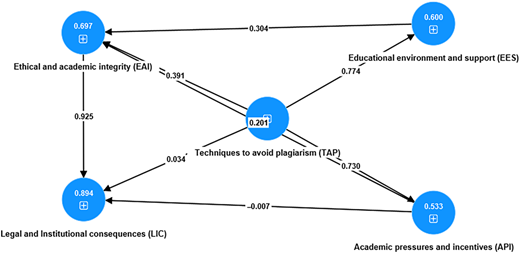
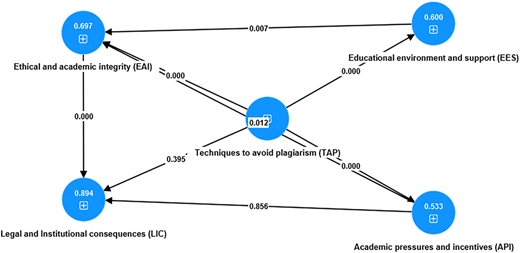
The analysis of the structural model's findings began after confirming the accuracy and consistency of its components. At first, the model was used to predict internal constructs. Afterwards, a thorough analysis was conducted to determine several metrics, including the coefficient of determination (R2), the predictive relevance (Q2) of external influences on internal ones, effect sizes (f2), path coefficients (β) and their statistical significance. Afterwards, standardized path coefficients were used to assess the theoretical pathways in the study framework. Each structural method significantly improved the model's overall resilience (Gallardo-Vázquez and Sánchez-Hernández, 2014). The evaluation of the structural model entails examining the relationships between core concepts and assessing their consistency with empirical data. The main focus of PLS-SEM is not only on the model's explanatory and predictive powers but also on the importance and relevance of path coefficients. The importance and applicability of these route coefficients are primarily assessed using metrics such as R-squared (R2) values for endogenous variables, as recommended by Briones Peñalver et al. (2018), who propose a threshold of 0.1, as described by Falk and Miller (1992). According to Table 7 analysis, most R2 values reach or surpass the 0.1 threshold, showing strong predictive capacity for API (R2 = 0.533), EES (R2 = 0.600), LIC (R2 = 0.894) and EAI (R2 = 0.697). This observation is consistent with the suggestions made by Cohen (1988), Chin (1998) and Hair et al. (2011, 2013). Moreover, exploring the analysis of Q2 values provides a more profound understanding of the predictive relevance of internal constructs inside the structural model. Q2 values greater than 0.1 are considered significant indicators of predictive importance. For example, the Q2 values, such as Q2 EAI = 0.569, Q2 LIC = 0.542, Q2 EES = 0.591 and Q2 API = 0.523, highlight the strong predictive relevance of the relevant constructs, suggesting a significant level of predictive ability. In order to give further background information, Hair et al. (2013) have devised a set of standards for assessing Q2 values. Based on these benchmarks, values of 0.02, 0.15 and 0.35 indicate different degrees of predictive relevance. More precisely, a score of 0.02 indicates a low level of predictive relevance, 0.15 shows a moderate level of predictive power and 0.35 marks a high level of predictive relevance for each effect. It is important to note that a Q2 value greater than zero indicates that there is predictive relevance inside the model. The results shown in Table 7 and Figure 3 highlight the overall importance of the predictive abilities within the structural model, confirming its effectiveness in predicting outcomes.
To comprehensively evaluate the model's suitability, the hypotheses were carefully examined to ascertain the relevance of the relationships. Hypothesis 1 (H1) sought to clarify the significant influence of strategies to avoid plagiarism (TAP) on ethical and academic integrity (EAI). The research revealed strong evidence, demonstrating a substantial impact of TAP on EAI (β = 0.391, t = 4.641, p = 0.000), hence offering strong support for H1. On the other hand, Hypothesis 2 (H2) aimed to determine if plagiarism avoidance tactics have a notable influence on legal and institutional consequences (LIC). The results revealed no association, demonstrating that TAP does not significantly impact LIC (β = 0.040, t = 0.850, p = 0.395), thus not supporting H2.
Hypothesis 3 (H3) investigates the extent to which the students' ethical and academic integrity influences the legal and Institutional consequences. The result indicated a strong, significant relationship, i.e. (β = 0.925, t = 23.286, p = 0.000). On the other hand, H4 and H5 have no significant relationship, i.e. represented as H4: EES → EAI (p = 0.007) and H5: API → LIC (p = 0.856). Thus, these two hypotheses are not supported. However, a significant relationship was also found in the case of H6, H7 and H8, represented as H6: API → EAI (p = 0.012); H7: TAP → EES (p = 0.000) and H8: TAP → API (p = 0.000). Therefore, we can say that H6, H7 and H8 support the proposed theory.
Effect size f2
Structural modelling (SM) involves excluding a particular external construct to evaluate its impact on endogenous constructs. This impact is measured by the effect size, referred to as f2, described by Hair et al. (2018). Cohen (1992) states that f2 values offer information about the extent of influence: 0.02 indicates a small effect, a range between 0.02 and 0.15 suggests a moderate effect, and values greater than 0.15 indicate a significant effect. The investigation revealed significant effects with f2 values of 2.528 (EAI → LIC) and 1.497 (TAP → EES), and f2 values of 1.141(TAP → API), indicating substantial influence and big effect sizes. On the other hand, a moderate effect was observed with a f2 value of 0.201 (TAP → EAI), indicating a medium impact. Furthermore, a minimal effect was observed with a f2 value of 0.000, 0.004, 0.020 and 0.039, as shown in Table 8. These findings highlight the importance of the links between the constructs investigated in the structural model. The significant effect sizes observed for TAP's influence on API and EES and EAI on LIC emphasize the substantial impact of TAP on these internal constructs, indicating strong linkages within the model. On the other hand, the smaller impact sizes for other associations suggest that these effects are relatively weaker but still noticeable, offering a valuable understanding of how variables interact inside the model.
Goodness of fit
Evaluating the reliability and validity of measurement instruments, especially in verifying convergent validity, requires assessing the goodness of fit. The requirement to apply pertinent criteria to assess the degree of alignment between the measured values and the expected ones (Cai and Hansen, 2013) is highlighted by Mérigot et al. (2010). Essential metrics for evaluating the model's fit adequateness are displayed in Table 9. The model seems to fit well based on the Chi-square value of 700.526, the Non-match Index value of 0.872, and the standardized root mean square value of 0.050. The findings show a favourable agreement between the model's assumptions and the observed data since they fall below the suggested minimum cutoff value of 0.85 Sun (2005). Together, these metrics effectively indicate the measurement tool's outstanding convergent validity since it accurately depicts and correctly captures the relationships between the intended concepts. The reliability and accuracy of the measurement gadget are further guaranteed by this discovery, increasing its applicability for research goals.
Mediation analysis
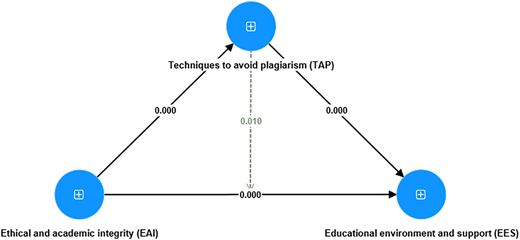
A mediation study was conducted to investigate the mediating role of techniques to avoid plagiarism (TAP) in the relationship between ethical and academic integrity (EAI) and the educational environment and support (EES). Moreover, the investigation also examined how TAP supports the connection between legal and institutional consequences (LIC) and academic pressures and incentives (API). The information obtained from the data shown in Table 10 provides a better understanding of this complex interaction.
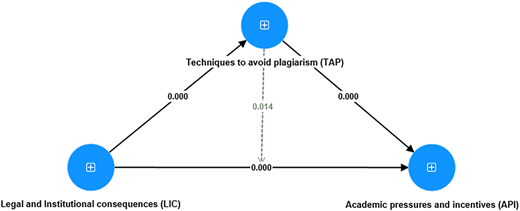
At first, it was noticed that EAI substantially impacted EES (H5: β = 0.699, t = 11.400, p < 0.001). After including the mediating variable TAP in the analysis, the effect of EAI on EES remained statistically significant (β = 0.427, t = 4.660, p < 0.001). Furthermore, there were notable results when analysing the indirect impact of EAI on EES through TAP, as demonstrated by the route EAI → TAP → EES (β = 0.273, t = 3.913, p < 0.001). These findings indicate that TAP has a moderating effect on the association between EAI and EES. Therefore, the analysis provides strong evidence in favour of hypothesis H5, which suggests that TAP plays a role in mediating this connection, see Figures 4 and 5.
In addition, it was discovered that LIC had a significant impact on API (H6: β = 0.640, t = 9.977, p < 0.001). Despite considering the mediating variable TAP in the study, the effect of LIC on API remained statistically significant (β = 0.371, t = 4.157, p < 0.001). Furthermore, notable results were found when evaluating the indirect impact of LIC on API through TAP, as seen by the LIC → TAP → API pathway (β = 0.270, t = 3.621, p < 0.001). These findings indicate that TAP also moderates the link between LIC and API. Therefore, the examination provides strong evidence in Favor of hypothesis H6, emphasizing the significance of TAP as a mediator in this link.
Discussion
The objective of this research is to delve into the intricate relationship among awareness of plagiarism, the utilization of plagiarism prevention techniques, and the promotion of academic integrity. The study's focus lies in understanding how strategies for avoiding plagiarism serve as a bridge, transforming awareness into proactive measures against academic dishonesty. The results indicated that many participants, specifically N = 152, exhibited knowledge and understanding of “plagiarism”. This highlights the importance of this research project in assessing the degrees of awareness among students. This study result matches the results of Ahmed et al. (2023). Furthermore, the findings indicated that the highest percentage of awareness, particularly 124 respondents, was noticed among students involved in postgraduate courses. In addition, 40 participants stated that they were introduced to the notion during their postgraduate studies. Nevertheless, this study developed a strong and comprehensive theoretical framework to investigate the relationships between different elements thoroughly. Within this framework, six hypotheses were developed to clarify the possible connections between these concepts. Hypothesis 1 sought to elucidate the substantial impact of plagiarism avoidance methods (TAP) on ethical and academic integrity (EAI). The result demonstrates a significant influence of TAP on EAI. On the other hand, Hypothesis 2 aimed to investigate whether strategies to avoid plagiarism significantly impact legal and institutional consequences (LIC). The results showed a strong and significant relationship, with TAP having a substantial effect on LIC. Additionally, Hypothesis 3 investigated the extent to which strategies for deterring plagiarism significantly impact the educational environment and support (EES). Early research also found that academic integrity is critical in educational environments because it shapes students' ethical fibre and prospective behaviour in the workplace (Petrushenko et al., 2024; Theart and Smit, 2012). Faculty members are essential in fostering the student's academic integrity because of their commitment to moral principles and honest dialogue (Petrushenko et al., 2024). The educational environment significantly affects faculty perspectives and how ethics instruction is enforced, including departmental culture and leadership (Polmear, 2023; Polmear et al., 2021). Additionally, H4 examined the influence of efforts to prevent plagiarism on academic pressures and incentives (API). The results indicated that the impact of TAP on API was not statistically significant, hence failing to support the confirmation of H4. Further, the present research findings line with the previous investigations revealed that educational constraints significantly impact students' morals and integrity. Besides, existing research also focused on the fact that students' academic integrity and ethics are significantly influenced by academic stresses. Research demonstrates that time management concerns, high-grade anxiety and peer pressure contribute to students' morality in academic behaviour (Click, 2014; Razek, 2014). Additionally, the study was conducted to investigate the role of plagiarism avoidance strategies (TAP) in mediating the relationship between ethical and academic integrity (EAI) and the educational environment and support (EES). Early studies demonstrated a relationship between the frequency of using plagiarism avoidance techniques and awareness of plagiarism (Ahmad and Ullah, 2014). Academic integrity principles must be implemented with a comprehensive plan that includes clear methodological criteria, instructional initiatives, and institutional support (Roik and Kuzmina, 2023). The study also looked at how TAP makes it possible to link academic pressures and incentives (API) with legal and institutional repercussions (LIC). The results demonstrated the critical role of TAP as a mediator in these relationships and offered compelling evidence in support of hypotheses H5 and H6. Prior research revealed a connection between students' mitigation, their awareness of plagiarism and the frequency of their avoidance strategies (Ahmad and Ullah, 2014). By making their plagiarism rules straightforward and asking authors to sign declarations of original work, scholarly journals can support efforts to prevent plagiarism (Shahabuddin, 2009). However, students see plagiarism as a practical threat mitigation strategy rather than an ethical predicament due to the intimidation to do well and the potential repercussions of failing (McIntire et al., 2024). Academic malfeasance is also impacted by cultural variables and a disparity between moral beliefs and behaviour as mentioned by a previous study by Razek (2014).
Theoretical contributions and practical implication
The outcomes of the study bring theoretical and practical segments to advancing the knowledge of plagiarism avoidance tactics. Theoretically, the study contributes to research on academic integrity by demonstrating the mediating role of plagiarism avoidance techniques in determining awareness and action. By positioning plagiarism avoidance as not merely a compliance instrument but as a practice of change, the study enhances prevailing theories of academic ethics and integrity. This research paves the way for subsequent researchers to explore how awareness of ethical standards translates into ongoing academic behaviour and to conduct comparative studies in various learning and cultural contexts.
Practically, the findings are of significant significance to the world of academia, policy-makers and society at large. They encourage the application of pedagogical methods that enable students to apply their knowledge of plagiarism, thereby strengthening academic curricula and incorporating such techniques as part of coursework in all disciplines. Institutions can use these results to enhance educational policy, construct sound training programs and bolster student services so that academic integrity is not just instructed but applied. Societally, the far-reaching consequences are experienced outside of the academy, instilling a culture of honesty, accountability and ethical responsibility that allows students to uphold integrity in their professional and community lives.
Limitations and future studies
The scope of research is limited by the focus on recent policies and technology, which may require an explanation of new developments that shield privacy or changing user privacy problems that potentially transform the industry. However, future research could overcome these limitations by enlarging the sample to comprise more comprehensive demographic data, such as users from various academic and non-academic contexts and users from national and international levels. Long-term investigation may offer an understanding of how privacy benchmarks and problems extend over time in response to constitutional and technological advancements.
Conclusion
While the study reveals that a significant number of respondents felt confident about their understanding of plagiarism, many were still uncertain about the term. This lack of clarity underscores the urgent need for educational interventions that comprehensively address the definition, implications, and various types of plagiarism, along with associated concepts. To effectively foster desired values and behaviours within an institution, it is imperative to include precise descriptions of actions and behaviours that constitute plagiarism in institutional declarations (Atkinson, 2020). To achieve substantial results, it's essential to embed teaching on attitudes, beliefs, and behaviours that foster the prevention of plagiarism throughout the entire curriculum at all levels of education. This is not a short-term fix, but a long-term commitment (Prashar et al., 2023; Chien, 2014). In the future, students must develop a solid understanding of the fundamental principles of academic writing, nurture their own unique writing style and master the correct methods of citing sources (Chauhan, 2022). This study's findings offer crucial insights into student perceptions of academic dishonesty. However, given the exploratory nature of the study, it is important to exercise caution when drawing final conclusions. Despite this, the data does contribute significantly to our understanding of students' views on plagiarism. It is worth noting that the study was conducted exclusively through questionnaires, with a relatively limited sample size from a single university in Bangladesh. Therefore, it's prudent to be cautious when generalizing conclusions. Further research efforts that encompass a broader range of circumstances could strengthen and validate these findings.
The researchers especially appreciate the survey respondents for their participation.