
Skip to Main Content
Purpose

The article aimed to elucidate the United Kingdom government’s proposed direction for the “Public Money for Public Goods” approach and future implications for livestock systems post-Brexit by identifying the overall coherence between post-Brexit livestock policies.

Design/methodology/approach

A systematic policy review of post-Brexit livestock policies on gov.uk was undertaken. Of 505 policy documents initially identified, 44 were included in the final review after removing duplicates and applying exclusion criteria. A policy document analysis was conducted to iteratively build an a priori list of thematic categories discussing livestock and post-Brexit changes. Policy Narratives were produced, supporting these data with grey and academic literature.

Findings

UK livestock policy overlooks the diverse needs of different farming systems. Public goods definitions related to livestock systems remain ill-defined. Policies often conflict and lack ambition for a comprehensive public goods transition.

Research limitations/implications

The rapid pace at which government policy evolves imposed difficulty in reviewing new or updated policies. Also, policy terminology varied between documents, including an inherent vagueness of language. Both factors required substantial interpretation, potentially introducing bias.

Practical implications

Failure to address the gaps identified across policies will lead to uneven social, economic and environmental outcomes for the animal-based farming sectors.

Originality/value

Agricultural policy design needs to incorporate a critical food systems approach to ensure post-Brexit livestock policies and the public goods transition support different scales and types of farming businesses.

British agricultural and subsidy support is undergoing one of the biggest changes in recent history following the United Kingdom (UK) exiting the European (EU) on January 30th, 2020 (Ojo et al., 2021). The complex post-Brexit policy landscape centres around a shift toward a new “Public Money for Public Goods” (PMPG) approach to directly replace the EU Common Agricultural Policy (CAP) Basic Payment Scheme (BPS). The BPS previously paid farmers on the basis of land (acreage) owned, leading to criticisms that payments favoured wealthy landowners (Bateman and Balmford, 2018; Greenpeace, 2019; Coulson and Milbourne, 2022). PMPG was introduced in Department for Environment, Food and Rural Affairs’ (Defra’s) 2018 Health and Harmony report (Dobbs and Petetin, 2018; Gravey, 2022) and is legislated in the Agriculture Act. The agricultural transition period from 2021 to 2027 will allow farmers time to adjust to the new financial support schemes, and scope for greater self-sufficiency without prolonged reliance on external support (Hubbard, 2019; Smith, 2023). This provides an ambitious opportunity for the UK agriculture sector to redefine its role in land use for food production alongside ecosystem enhancement (Kam et al., 2023). It challenges the well-established notion of “agricultural exceptionalism” upon which basis historically state subsidies supported the farming sector, due to unique economic challenges such as fluctuating market prices, low incomes and extreme weather events compared to other sectors (Attorp and McAreavey, 2020; Gravey, 2022). Instead of using taxpayers’ money as an income supplement for farmers to deal with these challenges, PMPG is intended to support farmers in becoming more efficient and profitable whilst greening agriculture by managing land that can mitigate the threats of climate change (Dobbs and Petetin, 2018; Antonopoulos et al., 2022). This environmental focus was celebrated; however, a common concern among stakeholders was fair allocation of funds across the schemes, recognising the different farm types, sizes and geographies across the country and ensuring that payments for actions sufficiently compensated the income foregone by taking land out of production or changing agricultural practices (Countryside and Community Research Institute, 2021).

By 2027 Defra aims to have enrolled 70,000 farms into the Agri-Environment Schemes (AES), with 65–80% of UK farmers managing land in “nature friendly farming” methods “… on at least 10–15% of their land by 2030” (Defra, 2023). Despite the overwhelming uptake of AES, with 65,400 agreements covering 102,400 farms in England (Wheeler and Collas, 2025; Defra, 2024b), uncertainty remains across the farming community. A recent Defra farming opinion poll showed 50% of farmers feel apprehensive about the future of their farm, “… a quarter plan to reduce the size of their businesses and 14% plan to leave farming in the next 3–5 years” (Defra and The Rt Hon Steve Reed OBE MP, 2024). This trend is driven by a combination of reduced direct payments from the CAP, rising input costs, increased bureaucracy and frequent changes to the design of the Environmental Land Management Schemes (ELMs), making it difficult for farmers to plan for their long-term future.

There is a time-limited opportunity to develop an evidence base that addresses how the government’s public goods approach can be strengthened. While previous analyses of the agricultural transition have examined the broad policy shift towards PMPG and its implications for the farming sector (Bateman and Balmford, 2018; Kam et al., 2023), there has been limited focus on how the government conceptualises the PMPG approach for livestock production post-Brexit. Therefore, this policy landscape review addressed the question: What is the ecosystem of post-Brexit livestock policies, and how do they align with the proposed direction of a public money for public goods approach? It systematically mapped the ecosystem of post-Brexit livestock policies to identify the direction proposed and how PMPG will be operationalised. It further assessed alignment of strategies proposed across post-Brexit livestock, overall coherence of the PMPG approach and the potential consequences across sectors. Building on the works of several authors (Antonopoulos et al., 2022; Bateman and Balmford, 2018; Kam et al., 2023; Petetin and Dobbs, 2022) that have critically assessed the practicalities and consequences of the change in agricultural governance since Brexit, the gaps identified in this review offer an evidence-base that can facilitate the government in achieving a more coherent public goods vision for future livestock systems.

The International Food Policy Research Institute (IFPRI) rapid review resource was followed (Verstraeten et al., 2021). The search was conducted between November 22, 2022 and April 13, 2023 on the UK government’s website gov.uk for policy documents published since the Brexit vote, i.e. between January 2016 and April 2023, capturing key developments in agricultural and environmental policies during the post-Brexit transition. Appendix A includes the PRISMA flowchart results of the policy review screening process of gov.uk. The first stage search was broad to be inclusive of all policies that discussed post-Brexit changes in supporting livestock and animal production futures. Using the search terms “animal” and “livestock”, 505 policy documents were identified initially. After removing 69 duplicates, 436 policy documents were assessed for eligibility against inclusion criteria in two phases. First, each document was screened internally and excluded if it made no references to animals or livestock. Documents that incorporated terrestrial farmed livestock species, including cattle, sheep, pigs and poultry were included while excluding documents related to (non-farm) domestic animals, farmed fish, equine species, gamebirds and wildlife birds. Only policy documents with an active status were included. To maintain consistency and analytical clarity, only English-language policy papers were included. Policy documents that articulated a government position on how livestock systems are framed were included, while excluding consultations, calls for evidence and legislative documents, such as Bills, as representing the policy-making and debating process rather than a final government position. Given the divergence and complexity in agricultural and environmental policies across devolved administrations, the study focused only on England, incorporating UK-level policies where relevant. This initial screening removed 293 documents, leaving 143 for full-text screening.

A secondary criterion excluded policy documents that did not directly address post-Brexit changes affecting livestock farming or documents that mentioned livestock or animals in a general sense but did not provide specific details on post-Brexit livestock production, farming, or policy changes. Additionally, documents that included similar or duplicate information to their primary policy counterpart were excluded. These secondary exclusion criteria removed 99 documents, leaving a total of 44 policy documents included in this review (see appendix A). Dalglish et al.’s (2021) “READ” document approach was used to analyse the 44 documents systematically (Dalglish et al.’s (2021), p. 1424). READ is defined as “(1) Ready your materials, (2) Extract data, (3) Analyse data and (4) Distil your findings” acted as a four-step guide to support the analysis from start to finish (Dalglish et al.’s (2021), p. 1424).

During analysis, documents were read carefully with the research question in mind. Drawing inspiration from Braune and Clarke’s (2019) reflexive Thematic Analysis (TA) method, topics were identified, reflected upon and refined in multiple stages. TA is an interpretive and flexible approach used to draw meaning from data and, through iteration, reflection and engagement with the wider literature, critically appraise and validate topics (Pearson et al., 2025). Through familiarisation with the documents, an a priori list of topics reflecting high-level details of the content discussed was iteratively built. This initial list was further developed inductively to identify recurring emerging topics, including any additional or wider topics unanticipated by the a priori list. As patterns became evident, a deductive process refined these topics and any sub-topics into distinct categories based on established areas of focus in agricultural policy discourse, resulting in six categories of content. The categories were adjusted and clarified to ensure they accurately captured the scope of discussions across the 44 final policy documents. Occasionally, a policy document encompassed multiple categories, as some policies addressed multiple topics. Subsequently, key, detailed and conceptual information was extracted across each document, including any reference made to different livestock species (cattle, sheep, pig and poultry) and against the six categories identified, and organised into an Excel spreadsheet. Each document was analysed to understand how government departments described livestock and post-Brexit changes; the language associated with policy priorities, objectives and strategies proposed across the six content categories. Policy Narratives exploring the context behind the policy priorities and strategies were produced in consultation with grey (e.g. policy news and blogs) and academic literature (section 4).

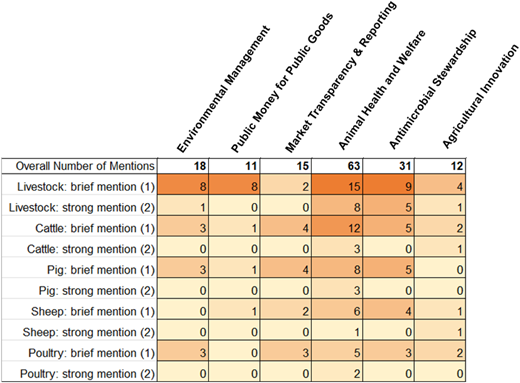
A scoring system was created to quantify how much attention each livestock species received and identify underrepresented species and gaps in policy discussions across the six categories. Each document was scored for cattle, sheep, pigs and poultry, or when species were not specified, the generic term “livestock”. Scores were assigned as 0 = no mention; 1 = brief mention, where a livestock species was mentioned but not the primary focus of the document; and 2 = strong mention, where a livestock species was discussed in detail.

Figure 1 illustrates the frequency and depth of discussion of livestock across the documents reviewed, where shading represents frequency of references to the category from more (darker) to less (lighter). This illustrates that livestock reference across policy documents was mostly superficial, with very few documents engaging with livestock in any serious or detailed way. When livestock were mentioned, discussions were overwhelmingly concentrated in the animal health and welfare category for all species, but particularly for cattle and for livestock as a general grouping. Cattle were the most frequently discussed species, followed by pigs and sheep, though their mentions are often brief and lacking in detail. Poultry received the least attention. Notably, discussions remained at a macro level, with little engagement in species-specific considerations, including the individual management needs of different species in different farming systems. This suggests that despite the structural changes affecting UK agriculture, government policies can risk being too broad and generic, with few documents seriously considering livestock’s future, risking suboptimal outcomes for a holistic sustainable transition (Petetin and Dobbs, 2022).

The six categories identified are considered below in order of most to least frequently discussed across a number of policy documents. Where a policy document is referenced, the number assigned to it in appendix B is used instead of the full policy name for ease of reading.

  1. Animal Health and Welfare

    Documents in this category discussed the importance of improving livestock wellbeing, reducing disease across the sectors and strengthening biosecurity interventions. The Animal Health and Welfare Pathway (AHWP), co-designed by government and industry is a core policy with four main strands and aims to support farmers in making continuous improvements in health, welfare and productivity while reducing emissions (#3) (see Appendix C for further details of what each strand includes). Several trade agreements also featured in this category (#5, #8, #41) and reinforced commitments to maintaining high animal welfare standards and sanitary measures. Other documents discussed specific diseases such as Bovine Tb, Avian Influenza and Newcastle disease and the strategies mitigate these, including improving surveillance and vaccination (#9, #4, #21) or broadly reiterated biosecurity, surveillance and uptake in vaccination as strategies to improve animal health and welfare across the sector (#15, #21, #33, #37, #38).

  2. Antimicrobial Stewardship

    The central theme here was improving antimicrobial stewardship initiatives to combat antimicrobial resistance (AMR) in livestock and agriculture, advocating a One Health approach that links human, animal and environmental health (#5, #8, #28, #34, #35, #39, #42). Given the global threat of AMR and considering recent trade agreements, documents outlined commitments to responsible antimicrobial use and cooperation to monitor antimicrobials globally (#5, #8) or discussed long-term plans to build transparent food systems and improve responsible antibiotic use primarily through improving surveillance (#7, #16, #19, #20, #35, #36). The development and coordination of data collection systems to monitor antibiotic use for each sector and to better understand the types of antibiotics prescribed for specific conditions were promoted in other policy documents (#33, #34, #37, #38).

  3. Environmental Management

    Documents in this category discussed land reform strategies to improve the agricultural practices and environmental outcomes across landscapes. The ELMs are a primary policy that aims to use public money to support farmers in delivering environmental public goods, such as improving biodiversity and clean water (#1). For livestock, ELMs have two key schemes available – the Sustainable Farming Incentive (SFI) and Countryside Stewardship (CS) (see Appendix D timeline and connections between policy schemes). Several other documents detailed the government’s intentions to improve catchment-sensitive farming by improving regulations on fertiliser use, and animal slurry management to reduce key pollutants such as nitrogen, ammonia and phosphate (#10, #11, #12, #22, #27, #31, #32). These same policy documents, including (#30), also highlighted intentions to extend environmental permits and invest in slurry infrastructure technologies as ways of reducing nutrient pollution from livestock. Research and Development (R&D) discussed in this category encompassed improving knowledge on regenerative farming practices, particularly the integration of cover crops used in the ELMs and what they deliver for the environment (#29), and the use of native breeds and the potential ecosystem services they can support (#14).

  4. Public Money for Public Goods

    Documents in this category emphasised use of public funds to incentivise and reward land managers and farmers to deliver outcomes that contribute to public goods that benefit the public, nature and the environment. Several policy documents outlined animal health and welfare as a specific public good for the livestock sector (#11, #12, #13, #16, #20). The AHWP highlighted the potential for specific species to deliver wider public goods, such as climate change mitigation, antimicrobial resistance and biosecurity improvements (#3). Other documents outlined a broader set of public goods to be delivered across the new ELMs, including enhancing water quality, improving flood management, sequestering carbon, strengthening biodiversity and improving air quality (#10, #11, #12, #13). Protecting existing antimicrobials through robust stewardship was outlined as a global public good in two Antimicrobial Resistance action plans (#33, #36).

  5. Agricultural Innovation

    Documents here discussed the need to “level-up” the food system by increasing international work visas for the poultry sector and investing in innovative technologies to boost productivity and lower emissions across livestock production. Several documents outlined future investments into alternative proteins, gene editing, methane reduction technologies, and alternative feed additives – all aiming to decarbonise livestock systems (#13, #29) and the Government Response to the National Food Strategy discussed that the Farming Innovation Program £270 million investment fund will support these priorities (#7). Other documents discussed the importance of advancing R&D efforts into collecting data on different breeds and their material traits (#14, #20, #27).

  6. Market Transparency and Reporting

    The central theme in this category discussed the need to improve transparency in the supply chain through better regulations and reporting between industry and government. Documents discussed the need to meet consumer demand for higher welfare products, and the potential initiatives, including improving the metrics displayed on labelling and building better procurement contracts (#3). Proposed broader food system reforms included requiring large food companies to report on nutrition, sustainability and food waste metrics to support consumer awareness and drive corporate accountability (#13) and the responding Government Food Strategy outlined the government’s future intention to consult on mandatory public reporting for large food companies (#7). This document further outlined recent regulatory measures in fair trading, particularly in dairy and pork, to create more equitable risk-sharing between producers and processors (#7). Improved industry collaboration in setting and integrating standards for responsible antibiotics use in the poultry, pig and dairy industries into assurance schemes was discussed alongside improving open reporting on antibiotic usage data (#38).

This section critically engages with the six thematic categories identified in the policy review, drawing on peer-reviewed literature to analyse the broader implications of the policies and question the extent to which they align with the realities of livestock farming and structural challenges faced across the sector. The narratives formed provide a deeper understanding of the tensions that emerge in practice around the government’s PMPG approach.

The conceptualisation of public goods across reviewed policy documents was predominantly centred around regulating ecosystem services, such as flood prevention, carbon sequestration and biodiversity enhancement (#10, #11, #12, #13). These types of services are important from a human-wellbeing perspective, but the tangible benefits are difficult to quantify, and the strict environmental focus can risk underinvesting in other critical material services (Leroy et al., 2018b). Other documents broadened this definition to encompass animal health and welfare, explaining that the use of public funds is justified when the market fails to adequately provide these goods (#11, #16, #13, #20). Whilst these public goods are crucial, the definition remains narrow and overlooks the multifaceted potential of livestock systems to deliver a broader and more ambitious range of benefits. Livestock systems offer intrinsic value to landscapes, including “… food security, protection of landscape and heritage, efficient energy and water use, high animal welfare, nutritional quality of products and farm business resilience” (Norton et al., 2022, p. 2). These aspects underscore the characteristics of pasture-based systems and are essential for policymakers to engage with, as they could transform the existing ambiguity in the current policy framework towards a holistic definition regarding the role of livestock in society, landscapes and food systems. A further gap that the government needs to reconcile is the lack of specificity in which species contribute to specific public goods and under what management systems. This becomes more pertinent considering the above-mentioned evidence by Norton et al. (2022) – whilst pasture-based livestock systems offer interconnected benefits, several caveats must be acknowledged. Alongside grass-based forage, pasture-based systems generally rely on biomass that humans cannot eat to support self-sufficiency and lower feed-to-food conversion, for example by consuming cover crops or by-products derived from intensive arable cropping (Leroy et al., 2022). However, in reality, this is dependent on external and variable factors, such as rainfall patterns affecting drought and quality of crop production, and stocking density affecting feed availability (Leroy et al., 2022, Bernués et al., 2011). Low stocking rates are often advocated for in pasture-based systems to reduce grazing pressure to account for natural forage availability and minimise reliance on costly feed inputs, but this also means these systems depend on some form of government support to “prop-up” farm income (Rivero and Lee, 2022). Pasture-based systems offer the potential for an animal to experience higher levels of welfare, but again caution should be applied as labour, management decisions and weather can lead to welfare failings (Rivero and Lee, 2022).

Cusworth and Dodsworth (2021) used the “good farmer” concept to explore farmers’ attitudes and perceptions around the meaning of public goods, especially in relation to how these views affect engagement and uptake in AES. They explain that farmer participation in AES rests on a financial business case for incorporating public goods into their land, which is dictated by the location, quality and potential of the land and itself. Other studies suggest that farmers have diverse conceptualisations of public goods, largely influenced by agriculture’s primary role (Parlevliet, 2020). This role is often framed as a binary choice between two approaches: food production or environmental stewardship (Parlevliet, 2020). Without clear policy direction, some farmers may perceive the AES as a threat to food production, leading to decision paralysis or resistance in adopting conservation practices (Parlevliet, 2020). Others may choose to participate, but in a fragmented way, limiting the government’s potential to achieve the environmental targets (Clements, 2022). Absence of clear public good definitions in the context of post-Brexit policy change and shifts in leadership that frequently alter the design of policy incentives can impact farmer trust in government and negatively impact farmer engagement in the schemes (Kam et al., 2023; Clarke, 2024).

For the PMPG approach to be effective, the government must be explicit and consistent in the definition and objectives of public goods, to ensure the window of opportunity is not missed to enhance the full spectrum of public benefits from livestock farming. Farmers should understand how to balance and integrate food production alongside delivering the ecosystem services outlined by government and more ambitious public goods. To address this, a land use strategy is essential. This should outline how certain management practices can support different bundles of goods and services and how farmers’ efforts in delivering for the environment will be protected from trade agreements that compete for similar market share.

The UK’s farming sector contributes to environmental degradation, including responsibility for 25% of phosphate, 50% of nitrate and 75% of sediment loadings in English water bodies, posing a threat to ecosystems (Rutter et al., 2022). These environmental disservices have been associated with modern livestock farming practices, especially the mismanagement of manure on farms (Madjar et al., 2024) and over-reliance, misuse or blanket application of pharmaceuticals (antibiotics, parasiticides, etc.) (British Veterinary Association, 2025) and agricultural fertilisers and pesticides. In response, the 25 Year Environment Plan outlines six core environmental goals: clean air, clean water, thriving wildlife, reduced environmental hazards such as flooding, sustainable resource use, and enhanced engagement with nature (Antonopoulos et al., 2022). Mechanisms for achieving these goals discussed within documents include improving the management of animal slurry to reduce pollution or restricting livestock from accessing watercourses (#10, #12, #22, #30). These documents discuss available funds, such as the slurry infrastructure grant [1] which will support farmers in improving manure storage or investing in modern spreading equipment to reduce emissions (#12, #30). High stocking density and overall herd sizes that exceed the carrying capacity of certain landscapes have direct links with soil compaction and erosion – causing excessive run off from farms and polluting waterways (Minea et al., 2022). To reverse this trend, a number of additional measures can be taken, including reducing livestock numbers, limiting how long and how often livestock graze throughout the year – and removing them from areas of land during extreme wet weather events, and including buffer strips between grazing areas and freshwater habitats (Pulley et al., 2021). For these mechanisms to successfully drive lasting change and work collectively, a coherent land use strategy is needed. Given the flexibility of picking different environmental actions in the ELMs, such as the SFI, a land use strategy could guide farmers in their decision-making to understand how bundles of actions will lead to optimum outcomes for the environment whilst making financial business sense (Food Farming and Countryside Commission, 2023). This is about connecting the provisional goods outlined at the macroeconomic level with a mechanism that can assess how provisioning for certain goods works at the microeconomic level among diverse farming landscapes and contexts. Several scholars argue that for landscapes to deliver a broad range of benefits, the concept of multifunctionality should be drawn upon (Dumont et al., 2019; Hejnowicz and Hartley, 2018; Leroy et al., 2024).

Multifunctionality views landscapes through a land sharing approach, whereby food production, environmental goods and social and cultural benefits are all delivered on the same piece of land (Hejnowicz and Hartley, 2018). How all the components intersect varies across regions and socio-economic contexts (Dumont et al., 2019; Leroy et al., 2024; Vanni, 2014). Regardless of the scale of a farm business, trade-offs exist between all the components (Dumont et al., 2019). Practically, multifunctionality draws on agroecological principles and promotes management systems that include introducing livestock into arable rotations to promote soil health and reduce reliance on synthetic fertilisers, or the implementation of rotational or holistic grazing techniques alongside adjustments in livestock density to enhance biodiversity in grassland-based systems (Dumont et al., 2019). Such multifunctional approaches, in the long term, greatly improve overall farm productivity by reducing the need for chemical inputs and providing more stable and varied food supplies, strengthening food security and farm income (Leroy et al., 2024). To enhance bundles of services and achieve landscape scale multifunctionality, traditional, dual-purpose breeds should be adopted (Leroy et al., 2024; Schulze et al., 2021) and stocking rates lowered especially in regions where evidence shows negative environmental impacts such as the overgrazing of habitats because of livestock density – heathland habitats in UK upland systems are typical examples (Lake et al., 2022). This should also be approached with balance, as livestock abandonment has also been shown to have negative outcomes such as homogenising landscapes (Leroy et al., 2018a; Rodríguez-Ortega et al., 2014). The government’s recently published land use consultation [2], represents an opportunity to gain a broader understanding of how stakeholders envision livestock’s role in the landscape, particularly alongside other competing interests such as delivering food security, housing and energy (Rutter et al., 2022).

Integrating the multifunctionality into a land use strategy is the first critical gap that the government needs to address to fully realise the public goods potential from different scales and types of livestock systems. Further, a land use strategy is essential to show how the AES fits within the wider policy framework that promotes international trade agreements. The UK’s recent trade deals with Australia and New Zealand, and the Comprehensive and Progressive Agreement for Trans-Pacific Partnership (CPTPP), removing tariffs across nine countries in the Indo-Pacific region, all underscore tensions and areas of policy incoherence. Specifically, between liberalising trade and export opportunities and domestic commitments to a just and sustainable agricultural transition (Gravey et al., 2017; Smith, 2023).

Whilst the Australia and New Zealand agreements include “non-regression and non-derogation” [3] clauses to uphold environmental protections (#5, #8), concerns remain regarding the levels of duty-free imports guaranteed for the beef and sheep sectors (AHDB, 2021; Shohet, 2023). Policies that prioritise imported goods produced to lower standards compared to UK products and sold more cheaply create an uneven playing field for domestic farmers who struggle to compete, leading to unfair and distorted prices (Antonopoulos et al., 2022; Petetin and Dobbs, 2022). This could undermine efforts to achieve the aforementioned environmental goals, as economic pressure may discourage some farmers from participating in the schemes to focus strictly on producing food. The National Food Strategy (NFS), government-commissioned but independent review of food system strategies for the UK, stressed the importance of not undermining farmers’ efforts in the transition, asserting that trade deals should clearly define and defend a set of “core minimum standards … [that cut across the intersection of] … animal welfare, environment, health protection, carbon emissions, antimicrobial resistance and zoonotic disease risk …” (#13). The responding Government Food Strategy, outlines that in the interests of,

… consumers and existing producers. We will use the full range of levers at our disposal – including tariffs, quotas and safeguards. Decisions on the liberalisation of products through FTAs will consider factors such as climate change, animal welfare and the environment alongside the broader economic and strategic benefits of our trading relationships (#7).

Specifics of core standards that the government is willing to protect remain unknown at the time of writing this article. The NFS suggests that 94% of the public expressed a strong interest in the government safeguarding food standards in trade deals (#13). Farmers are being asked to meet high environmental standards whilst competing in a market where consumers, despite expressing concern for these standards, are often swayed by price and certain consumption preferences (Abeyesinghe et al., 2025). The heterogeneity of food labels and the different standards that exist across assurance and certification schemes, combined with competing trade deals, make it difficult for the average consumer to navigate the retail environment with confidence in their purchasing choices (McCulloch, 2024). To instil confidence in farmers and build coherence across the policy landscape, the government must be accountable for strengthening international relationships with trade partners to an extent that sets priorities to deliver higher welfare, environmental and antibiotic stewardship standards at home and globally (Gravey et al., 2017; Petetin and Dobbs, 2022). Outlining these in a land use strategy would showcase the government’s priorities in protecting farmer livelihoods and the overall resilience of British farming, strengthening public trust and committing to the environmental objectives outlined throughout many post-Brexit policy documents in this review.

Across the policy domain a recurring theme was the conflation and interchangeability of animal health and animal welfare. It is often assumed in policy documents that by provisioning for health, welfare is resolved (#3, #20, #29). Although interconnections exist, addressing health is not the totality of the implementations needed to ensure good welfare. How animals experience welfare is multidimensional and complex (Arndt et al., 2022), resulting in a debate around a fundamental definition of the term. Scientific conceptualisation of animal welfare is grouped into 3 interrelated categories – Biological Functioning (health), Affective State (feelings) and Naturalness (Weary and Robbins, 2019). Biological functioning relates to an animal’s ability to adapt to a particular environment, whereby its welfare is determined by its ability to maintain normal bodily functions and the associated biological cost (Broom, 1991). Affective state considers an animal’s subjective wellbeing, focussing on mitigating negative and promoting positive emotional experiences such as socialising with other animals, where animals are social (Ross and Mason, 2017). Naturalness focuses on the animal’s intrinsic nature, arguing that enhanced welfare is associated with the ability to express species-specific behaviours and ancestral or natural environments (Rollin, 2007), though naturalistic environments are considered less relevant for animals that have undergone selective breeding for specific traits, such as high productivity. Fraser et al. (1997) argue that all three concepts overlap and should be considered as one pluralistic whole. Through this lens, to promote welfare an animal “… should be provided the conditions that allow them to feel well, function well, and to express species-specific behaviours” (Weary and Robbins, 2019, p. 34).

An exclusive focus on prioritising disease reduction, which falls into the biological functioning sphere, remains in the AHWP; however, the strategies presented, such as biosecurity and diagnostic testing, imply that overall welfare improvements will be achieved (#3, #20, #29). For example,

farmers [will receive] funding for an annual visit from a vet of their choice to consider the health and welfare of their animals (this includes carrying out diagnostic testing, reviewing biosecurity and the use of medicines (#3).

Whilst the management of some diseases can certainly be improved through specific biosecurity interventions, which indeed will positively impact both animal health and the improvement of farmer income and livelihoods, the experience of disease is only a small part of what welfare encompasses.

Moving towards practical policy solutions is not straightforward, mostly because of the challenge in identifying “sweet spots” (synergies) or tensions (trade-offs) between delivering on all three welfare spheres, not just health, whilst meeting other key priorities in a farming business, such as profitability, productivity and efficiency, and Net Zero objectives (Ducrot et al., 2024). Future research priorities should address how to deliver on this multidimensional framework.

The conceptual gap that can be strengthened within the post-Brexit policy context is providing for the mental well-being, including positive affective states, of animals. Frameworks such as the Five Needs and the Five Domains model (Fordyce, 2017; Mellor et al., 2020) allow operationalisation of fundamental concepts of animal welfare, ensuring a comprehensive consideration of all factors that may impact welfare. The Five Needs framework is a strong starting point for the United Kingdom, considering it is legislated in the Animal Welfare Act (2006). The Five Needs ensure an animal is afforded a suitable environment, a healthy diet, has the ability to express normal and natural behaviours, has appropriate company amongst conspecifics, and is protected from suffering, pain, injury and disease (Fordyce, 2017). The Five Needs, facilitate closer attention to the whole animal experience, and to the provisioning to ensure not only mitigating negative experiences, but promoting at least some opportunities for animals to thrive (Mellor, 2016). We now understand that as a society we should strive to ensure that animals are raised in farmed environments where they have opportunities to experience pleasure, play, social bonding, comfort and more (Mellor, 2016). Dawkins (2017) argues that policy needs to support an economic case for investing in welfare improvements beyond those specifically related to health. Evidence shows that providing enrichments such as ramps, quality bedding and straw in environments where lambs are raised not only improves welfare but also contributes to increased weight gain per day, and higher fattening scores (Aguayo-Ulloa et al., 2014). Interventions of this kind are included in the capital grant payments in the AHWP and could be scaled up across all species to support greater opportunities in improving farm economics welfare with certain provisions, shifting the common conception that welfare is an ‘ethical extra’ (Aguayo-Ulloa et al., 2014, p. 205). There are of course cases where welfare and productivity gains do not align. For example, pasture-based systems, where grazing livestock outdoors provides greater potential in improving welfare, require greater levels of labour to manage extreme weather, and to ensure the regular movement of livestock to fresh pasture to mitigate disease build-up, both potentially impacting economic viability (Lawrence and Stott, 2009). Farmers face greater pressures of rising inputs across all farming types; therefore, greater evidence is needed to show what type of investments align to deliver welfare outcomes across the Five Needs whilst simultaneously supporting a profitable farm business.

First developed as a concept in 2008, One Health emerged in response to addressing disease threats across human, animal and environmental health (Kamenshchikova et al., 2019). Tackling disease threats across these domains was further supported by the Food and Agriculture Organisation (FAO), World Organisation for Animal Health (OIE) and World Health Organisation (WHO) through a joint Tripartite in 2010 to instate international collaboration against a Wicked problem [4] (Nzietchueng et al., 2023). Policy documents did not include a strict definition of One Health and when discussed, it was in relation to addressing the linkages between antimicrobial use and resistant organisms causing antimicrobial resistance (AMR) across the animal, environment and people domains. The UK 5-year National Action Plan for Antimicrobial Resistance 2019 to 2024 (#33) underpins the 20-year Vision Plan and outlines the commitments (see appendix E for details on government focus and actions) in delivering a One Health approach for AMR in animals and agriculture.

Whilst many interventions outlined in the documents are beneficial, they remain only part of the puzzle in tackling the AMR and antibiotic use problem through a One Health lens because of the top-down and narrow framework they exist within. Although scholars such as Chien (2013) argue this has helped to build consensus and a common language around the problem, biomedical and technical solutions are not enough. What is missing is a larger enquiry into why farmers use antimicrobials in the first place (Galaz et al., 2015; Littmann et al., 2020) and understanding the complex social and cultural drivers of disease that keep farmers locked into a system of treating symptoms rather than embedding health and resilience from the ground up (Hinchliffe and Ward, 2014).

Amongst others Kock (2015) and Wallace et al. (2015) call for a Structural One Health approach that connects the macro context of improving surveillance systems and diagnostic tools, such as those outlined in the 5-year National Action Plan, with building an evidence base that draws on the social science dimensions of disease and ill-health (Hinchliffe et al., 2018; Kingsley and Taylor, 2017; Roger et al., 2016). As Kingsley and Taylor (2017) argue, a Structural One Health approach puts the political economy at the centre of global health questions, “… giving primacy to poverty, inequality, and the interests of capital drivers of disease...[and] asks fundamental questions of the livestock industry itself” (p. 8). The most pressing issue to address is the intensification cycle that farmers are caught in. This includes international trade deals that allow for the importation of food produced to lower standards and sold cheaper than domestic products, creating a volatile market that distorts the true cost of food and creates unfair competition (Antonopoulos et al., 2022). This is further exacerbated through an unregulated supermarket system that sets its own standards of production in contracts, asking farmers to produce to certain specifications of produce type and size in a strict timeframe. These conditions create a “structural dependency on drugs that are too often used as “quick fixes” for unsustainable … food systems” (Fortané, 2020: no pagination). More work is needed to assess the political economy of how market forces influence antimicrobial use and drive poor health outcomes in food systems (Hinchliffe et al., 2018; Tompson and Chandler, 2021), alongside the limitations in progressing toward delivering public goods across the environment, animal health and welfare and antimicrobial stewardship.

A Structural One Health approach could also help to contextualise what is currently a macro and global problem and make it locally relevant. The lack of a clear definition of One Health in policy is one reason it has proven difficult to communicate its relevance and tangible benefits to farming communities (Destoumieux-Garzón et al., 2018). One Health is only partially institutionalised in government, where most of the discussion regarding the interventions resides in the Department of Health and Social Care. One obvious step would be to show the linkages between the actions set in the 5 Year National Action Plan and policies that tackle the animal-human-environment nexus, such as ELMs and the AHWP. Another could offer alternative routes to building health and resilience in production systems, such as policies that support new genetics, or crossbreeding to strengthen immunity and provide disease resistance, or policies that improve the physical infrastructure on farm in the way housing and bedding (Woods, 2019) is already offered in the capital grants scheme of the AHWP.

The One Health concept should not continue to be reduced to a single disciplinary and single departmental problem. It is an interdisciplinary and cross-departmental problem and needs solutions that move beyond the technical. One Health needs to be joined up to speed up the rate of public good delivery and show farmers how the concept can support healthier outcomes for their animals and land alongside better economics (Nzietchueng et al., 2023). Policies such as ELMs and the AHWP are the starting point in farmers transitioning to delivering public goods, but to strengthen these policies, a roadmap could show how certain actions lead to lower levels of disease incidence and thus lower levels of antibiotic use.

Within the broader £2.4 billion annual farming budget exists the Farming Innovation Programme, which has been allocated £270 million to advance sustainable agri-food solutions across the food industry (#7). The government emphasises creating enabling regulatory environments for gene editing and feed additives as innovative steps toward targeting methane as a problematic source of emissions (#7, #29). The Government Food Strategy outlines,

Our Farming Futures research and development … Fund … will help the livestock and proteins sectors embrace “climate smart farming” and innovative technologies … [including] the use of feed additives and materials that can reduce methane emissions from livestock … [in addition to] unlock[ing] the benefits of technologies such as gene editing (#7).

The Genetic Technology (Precision Breeding) Bill [5] was passed as an Act in 2023, introducing a new regulatory framework to support “… the release and marketing of … precision bred plants and animals, and the marketing of food and feed produced from such plants and animals” (Genetic Technology Precision Breeding Act, 2023, p. 1). The Genetic Technology Act (2023) promises potential in improving animal health and welfare, reducing disease burden, improving productivity and enhancing environmental adaptation.

Studies in the United States are already underway, developing a gene for pigs that is resistant to Porcine Reproductive and Respiratory Syndrome (PRRS) (FAO, 2022) – a disease that affects the health and welfare of pigs, and according to 2018 AHDB figures, can cost EU farmers £80 per sow (AHDB, n.d.). Reducing disease, of course, has wider One Health benefits, including public health as a result of less zoonotic transmission and a potential reduction in the use of antibiotics (British Veterinary Association, 2024; Osterhaus et al., 2020). In fact, a One Health lens should be used to assess the broader implications of gene editing. Some studies also suggest that gene editing can improve an animal's ability to adapt to climatic pressures such as heat stress, which can have multiple burdens such as reduced productivity and efficiency, and negative impacts on animal welfare (Karavolias et al., 2021).

Whilst food production levels have remained at an all-time high, partially related to selective breeding and technological advancements in housing and feed inputs, the government policy landscape has traded off other critical components of a sustainable food system. Some of these trade-offs include compromises to animal welfare, for example where chickens suffer from leg disorders related to the selection for rapid growth, and loss of genetic diversity where, for instance, native breeds have been displaced, threatening cultural and ecosystem values and adaptation (British Veterinary Association, 2024). Selecting for specific traits could have implications in trading off other important standards such as animal welfare (British Veterinary Association, 2024). Further, a narrow focus on desirable traits can also lead to corporate control dominating research priorities and limiting the gene pool (FAO, 2022). There is already limited focus on R&D to protect the gene pool of native breeds, and research shows that when native breeds are reared in a particular locality, they deliver vast benefits. For example, they add to landscape character, can be easier and more rewarding to handle from a livestock management perspective, are more resilient against disease, require less conventional feed input and thrive better on pasture and in harsh climate conditions (Kawęcka et al., 2022). Experts argue that more should be done to preserve these traits in the animals themselves and biobanks, because “… once lost, it is impossible to recover” (British Veterinary Association, 2024).

This study has systematically analysed a large volume of policy documents across diverse thematic categories, providing a comprehensive overview of the post-Brexit policy landscape. The findings reveal several crucial insights underscoring the opportunities, challenges and tensions that arise when aligning diverse policy goals with practical implementation. An important part of the public goods discourse, including the evidence and language used, is that farmers feel recognised for their expertise in provisioning complementary and dual outcomes for both food and the environment. For the public goods discourse to be integrated fully across farmed landscapes and embraced by farmers, it is the responsibility of policy to be explicit about the definitions of public goods related to livestock systems.

Given the narrow interpretation of public goods, and the lack of a land use strategy to guide and support farmers in their decision-making across the AES, combined with the loss of basic payment from the legacy of CAP, which reduced to 50% in 2024, financial hardship is a crippling reality for some farmers (Petetin and Dobbs, 2022). Petetin and Dobbs (2022) illustrate, “… that the top, most profitable, 25% of English farmers will hardly feel the change in policy since they are already productive and resilient, whilst the 50% of farmers in the middle are likely to succeed in moving away from direct payments to environmental payments as they become more business-minded and profitable. It is, however, possible that the bottom 25% of farms that currently struggle or only survive because of the receipt of direct payments could disappear” (p. 145). Phil Stocker from the National Sheep Association presented oral evidence at the Health and Harmony Defra Committee in 2018, stating, “… many sheep farms would see around 70% of their income made up from [BPS] support … [and] removal of that support could have really damaging impacts on our sector” (Oral evidence – Work of DEFRA: Health and Harmony – 2018). According to Defra figures, as of June 2023, 32 million sheep and lambs were farmed in the United Kingdom, contributing the largest proportion of farmed ruminants (Defra, 2024a). From an equity perspective, it will be crucial for government to ensure the vulnerability of farmers in this sector is addressed, especially in the context of the broader policy framework of agreed trade policies that are set to economically compete and undermine farmers ability to deliver public goods whilst producing food and receiving a fair price (Hill, 2022).

A comprehensive public goods transition involves building in governance structures that facilitate the inclusion of local actors (farmers, local councils), and not just large food producers, in designing and implementing policies. This might also include dynamic and social science-based methods that can unpack the differences among individuals’ worldviews, values and perspectives, and build clarity into how these factors shape attitudes and particular solutions towards the livestock sector (Blair et al., 2024). The absence of a structural One Health approach in both the ELMs and the AHWP is an obvious place to build clarity in how the actions in both schemes interlink to enhance the provisions of higher welfare systems and reduce disease burden on farm. Cross-departmental collaboration would help to build “… closer engagement between policies and sectors [and] facilitate a holistic approach towards agri-food issues and challenges” (Petetin, 2022, p. 56). Another example of where greater alignment with the public goods approach could happen is in the role of technological innovations, particularly gene editing. While often framed as a tool for sustainability, gene editing carries risks that could directly contradict the broader public goods agenda. There is little clarity on how gene editing aligns with environmental and animal welfare goals, raising concerns that it could be leveraged to entrench rather than transform intensive farming systems. The danger lies in using genetic interventions as a means to adapt animals to unsuitable farming conditions, rather than addressing the underlying husbandry practices that create welfare concerns in the first place (Bruce, 2013; Devolder, 2021). These incoherences can be reconciled by government departments adopting “… transformation-focused modes of evaluation …” that build in a process of due diligence to assess more accurately how policy is working for different farming communities (Buckton et al., 2024, p. 15) and achieve the overarching goals of the agricultural transition. Without these steps, the public goods transition will be undermined, potentially stifling innovation on farms, where those farmers who have the financial and social capital to be self-sufficient and independent from state support continue business as usual, leading to uneven and inequitable outcomes across the sectors (Clements, 2022; Smith, 2023).

Whilst the article largely focuses on production/supply-side framings of livestock, it is important to highlight that in developing coherence across post-Brexit policies to ensure the public goods transition is ambitious, demand-side measures also need addressing. For example, shifts in consumption and dietary changes toward “less but better” meat – incorporated into an improved transparent labelling system with clear indicators of environmental impact (Trewern et al., 2022). In the context of the recent Government Food Strategy (Defra, 2025), outcome five highlights government objectives to develop national procurement policies by implementing improved environmental criteria across buying standards for different businesses. Considering the school system “… spend around 60% of the total £5 billion annual spend on public sector food procurement …” (Quince, 2024, p. 3), an obvious place to start would be for government to set “less but better” criteria across school buying standards, steering consumption toward lower-impact products. If the government consults the reduction in livestock numbers where appropriate, alongside breed adaptation (Leroy et al., 2024; Schulze et al., 2021) as a pathway to a more multifunctional and regenerative shift of livestock production – in regions where livestock is the primary agricultural activity, such as northern Wales, other policy measures will be needed. For example, directing public money into research and development (R&D) and specifically in areas of “… raising the quality of animal diets, breed and species diversification, and improved land-use practices…” (Thornton et al., 2025, p. 228). The ability for livestock farmers to financially invest in technological improvements is dependent on socio-economic status, geography and awareness of and access to social networks. It is government’s responsibility to recognise these equity dimensions of a just transition and the underlying technical, financial, social and even psychological constraints they face.

Reflecting on the research process, it is worth highlighting the limitations of this study. Reviewing and synthesising a large volume of documents whilst ensuring analytical depth across multiple categories is a challenging process. This was mitigated by developing a clear inclusion and exclusion criteria to ensure documents were selected in a structured and transparent way. The rapid pace at which government policy evolves also imposed difficulty in reviewing new or updated policies. This difficulty was addressed by keeping up to date with policy changes by revisiting gov.uk. In addition, policy terminology varies between documents, and overall, there is an inherent vagueness of language within policy. Both factors have required greater interpretation and may have introduced the risk of bias. These limitations have been mitigated by consulting with the wider literature and engaging with knowledgeable colleagues on the subject-matter to reduce potential bias.

This article set out to answer the question, what is the ecosystem of post-Brexit. livestock policies, and how do they align with the proposed direction of a public money for public goods approach? The analysis shows a future of animal-based systems that are included in the vision of using taxpayers’ money to deliver public goods. However, within the public goods discourse, there is a lack of clarity and ambition in how specific livestock species can be best supported across different farming systems to deliver a bolder set of public goods. Across the thematic categories identified, the government has made attempts at developing strategies that will support animal-based systems toward a more sustainable future. However, for a more comprehensive public goods transition, the policy landscape needs greater alignment between policies and the strategies proposed, and more sophisticated collaboration between departments to facilitate interdisciplinary knowledge exchange. This can be facilitated by taking a systems approach to resolving complex interconnected challenges that support clearer understandings of the linkages and tensions across the food system (Parsons et al., 2018). Further, a critical food systems approach that pays attention to the larger socio-political dynamics, including power and class analysis and links between supply and demand side measures for sustainable livestock production and consumption, can help generate appropriate agricultural policies that cater to not only UK’s net zero ambitions but also food security and the future of farming communities.

The first author thanks colleagues at the Royal Veterinary College who asked insightful questions and provided feedback during online webinars discussing this research, ultimately improving the analysis of this paper. This work was supported by the UK Food Systems Centre for Doctoral Training that is funded by the Transforming UK Food Systems Strategic Priorities Fund Programme managed by UKRI [grant number BB/V011391/1]. The outputs in this paper reflect the views only of the authors.

1.

The animal slurry infrastructure grant is connected to the AHWP as part of the broader Farming Equipment and Technology Fund (FETF). https://defrafarming.blog.gov.uk/2024/01/12/slurry-infrastructure-grant-last-chance-to-apply/

3.

In trade policies, these legal terms relate to government commitments to ensure that previous protections to animal welfare standards remain and cannot be lowered as a result of new trade deals.

4.

Wicked problems often relate to complex sustainability issues that can be difficult to define and can have different perceptions among diverse groups of people (Head, 2008). Solutions often involve competing perspectives with policy options favouring quick but short-term answers, often sidelining long-term approaches that address the root cause of the problem (Head, 2008.).

5.

The Genetic Technology (Precision Breeding) Bill did not appear in the search results of the policy review because it was outside the time scale in which the initial search protocol was carried out.

The supplementary material for this article can be found online.
Abeyesinghe
,
S.M.
,
Stanley
,
I.
,
Nicol
,
C.J.
and
Cardwell
,
J.M.
(
2025
), “
Stakeholder views on shifting UK chicken meat production to slower-growing broilers
”,
Frontiers in Animal Science
, Vol. 
6
, 1534108,
available at:
 https://doi.org/10.3389/fanim.2025.1534108(
accessed
 20 August 2025).
Aguayo-Ulloa
,
L.A.
,
Miranda-de la Lama
,
G.C.
,
Pascual-Alonso
,
M.
,
Olleta
,
J.L.
,
Villarroel
,
M.
,
Sañudo
,
C.
and
María
,
G.A.
(
2014
), “
Effect of enriched housing on welfare, production performance and meat quality in finishing lambs: the use of feeder ramps
”,
Meat Science
, Vol. 
97
No. 
1
,
available at:
 https://doi.org/10.1016/j.meatsci.2014.01.001 (
accessed
 13 March 2025).
AHDB
(
2021
), “
Australian beef in the UK
”,
Agriculture and Horticulture Development Board
,
available at:
 https://ahdb.org.uk/news/australian-beef-in-the-uk (
accessed
 2 April 2024).
AHDB
(
n.d.
), “
Porcine reproductive and respiratory syndrome
”,
Agriculture and Horticulture Development Board, available at:
 https://ahdb.org.uk/knowledge-library/porcine-reproductive-and-respiratory-syndrome (
accessed
 1 March 2024).
Animal Welfare Act 2006
(
2006
), “
UK government
”,
available at:
 https://www.legislation.gov.uk/ukpga/2006/45/contents (
accessed
 12 September 2024).
Antonopoulos
,
I.
,
Bell
,
M.
,
Čavoški
,
A.
and
Petetin
,
L.
(
2022
),
The Governance of Agriculture in Post-Brexit UK
,
Routledge
,
London
.
Arndt
,
S.S.
,
Goerlich
,
V.C.
and
van der Staay
,
F.J.
(
2022
), “
A dynamic concept of animal welfare: the role of appetitive and adverse internal and external factors and the animal’s ability to adapt to them
”,
Frontiers in Veterinary Science
, Vol. 
5
,
available at:
 https://www.frontiersin.org/journals/animal-science/articles/10.3389/fanim.2022.908513/full (
accessed
 December 2024).
Attorp
,
A.
and
McAreavey
,
R.
(
2020
), “
Muck, brass and smoke: policy post-exceptionalism in the agri-food sector. 79
”,
Journal of Rural Studies
, Vol. 
79
, pp. 
302
-
310
,
available at:
 https://doi.org/10.1016/j.jrurstud.2020.08.050 (
accessed
 18 February 2024).
Bateman
,
I.J.
and
Balmford
,
B.
(
2018
), “
Public funding for public goods: a Post-brexit perspective on principles for agricultural policy
”,
Land Use Policy
, Vol. 
79
, pp. 
293
-
300
,
available at:
 https://doi.org/10.1016/j.landusepol.2018.08.022 (
accessed
 24 October 2022).
Bernués
,
A.
,
Ruiz
,
R.
,
Olaizola
,
A.
,
Villalba
,
D.
and
Casasús
,
I.
(
2011
), “
Sustainability of pasture-based livestock farming systems in the European mediterranean context: synergies and trade-offs
”,
Livestock science. Special issue
,
Assessment for Sustainable Development of Animal Production Systems
, Vol. 
139
Nos
1-2
, pp. 
44
-
57
,
available at:
 https://doi.org/10.1016/j.livsci.2011.03.018 (
accessed
 22 August 2025).
Blair
,
K.J.
,
Moran
,
D.
and
Alexander
,
P.
(
2024
), “
Worldviews, values and perspectives towards the future of the livestock sector
”,
Agriculture and Human Values
, Vol. 
41
No. 
1
, pp. 
91
-
108
, doi: ,
available at:
 https://www.researchgate.net/publication/371374878_Worldviews_values_and_perspectives_towards_the_future_of_the_livestock_sector (
accessed
 6 April 2024).
Braun
,
V.
and
Clarke
,
V.
(
2019
), “
Reflecting on reflexive thematic analysis
”,
Qualitative Research in Sport Exercise and Health
, Vol. 
11
No. 
4
, pp. 
589
-
597
,
available at:
 https://doi.org/10.1080/2159676X.2019.1628806 (
accessed
 28 August 2025).
British Veterinary Association
(
2024
),
Animal Gene Editing: Research Promising but Health and Welfare Must Remain a Priority
,
Says BVA, British Veterinary Association
,
available at:
 https://www.bva.co.uk/news-and-blog/news-article/animal-gene-editing-research-promising-but-health-and-welfare-must-remain-a-priority-says-bva/ (
accessed
 12 March 2024).
British Veterinary Association
(
2025
), “
BVA urges vets, livestock owners and horse owners to take holistic approach to parasite control to counter environmental damage and drug resistance
”,
British Veterinary Association, available at:
 https://www.bva.co.uk/news-and-blog/news-article/bva-urges-vets-livestock-owners-and-horse-owners-to-take-holistic-approach-to-parasite-control-to-counter-environmental-damage-and-drug-resistance/ (
accessed
 20 August 2025).
Broom
,
D.M.
(
1991
), “
Animal welfare: concepts and measurement
”,
Journal of Animal Science
, Vol. 
69
No. 
10
, pp. 
4167
-
4175
,
available at:
 https://doi.org/10.2527/1991.69104167x (
accessed
 25 November 2023).
Bruce
,
A.
(
2013
), “
The lore of low methane livestock: co-producing technology and animals for reduced climate change impact
”,
Life Sciences Society and Policy
, Vol. 
9
No. 
10
, 10,
available at:
 https://doi.org/10.1186/2195-7819-9-10 (
accessed
 25 November 2022).
Buckton
,
S.J.
,
Fazey
,
I.
,
Doherty
,
B.
,
Bryant
,
M.
,
Banwart
,
S.A.
,
Carmen
,
E.
,
Connolly
,
A.
,
Denby
,
K.
,
Kendrick
,
I.
,
Sharpe
,
B.
,
Wade
,
R.N.
,
Ball
,
P.
,
Bridle
,
S.
,
Gardner
,
G.
,
James
,
A.
,
Morris
,
B.
,
Stewart
,
S.
,
Bremner
,
M.
,
Chapman
,
P.J.
,
Cordero
,
J.P.
,
Geertsema
,
H.
,
Nixon
,
N.
,
Om
,
E.S.
,
Sinclair
,
M.
,
Thornton
,
J.
,
Yap
,
C.
,
Arnott
,
D.
,
Cain
,
M.
,
Ehgartner
,
U.
,
Fletcher
,
B.
,
Garry
,
J.
,
Hawkes
,
C.
,
Kluczkovski
,
A.
,
Lait
,
R.
,
Lovett
,
A.
,
Pickett
,
K.E.
,
Reed
,
M.
,
Atkinson
,
N.
,
Black
,
F.
,
Blakeston
,
M.
,
Burton
,
W.
,
Defeyter
,
M.A.
,
Duncan
,
N.
,
Eastwood
,
G.
,
Everson
,
R.
,
Frankowska
,
A.
,
Frenneux
,
T.
,
Gledhill
,
D.
,
Goodwin
,
S.
,
Holden
,
H.
,
Ingle
,
H.
,
Kane
,
A.
,
Newman
,
R.
,
Parry
,
C.
,
Robertshaw
,
V.
,
Scrope
,
T.
,
Sellstrom
,
P.
,
Slater
,
S.
,
Smith
,
K.
,
Stacey
,
R.
,
Stott
,
G.
,
Trickett
,
A.
and
Wilson
,
J.
(
2024
), “
Transformative action towards regenerative food systems: a large-scale case study
”,
Sustainability and Transformation
, Vol. 
3
No. 
11
, e0000134,
available at:
 https://doi.org/10.1371/journal.pstr.0000134 (
accessed
 6 December 2024).
Chien
,
Y.-J.
(
2013
), “How did international agencies perceive the avian influenza problem? The adoption and manufacture of the ‘One World, One Health’ framework”, in
Pandemics and Emerging Infectious Diseases
,
available at:
 https://doi.org/10.1002/9781118553923.ch5(
accessed
 20 October 2023).
Clarke
,
P.
(
2024
), “
Labour committed to ELM, despite audit office criticism
”,
Farmers Weekly
,
available at:
 https://www.fwi.co.uk/news/farm-policy/labour-committed-to-elm-despite-audit-office-criticism (
accessed
 14 August 2024).
Clements
,
J.
(
2022
), “
Understanding English agri-environment schemes: uptake, engagement and outcomes
”,
ProQuest Dissertations & Theses, available at:
 https://www.proquest.com/openview/367758abe50b722e99bb72dd94a991f6/1?pq-origsite=gscholar&cbl=51922&diss=y (
accessed
 26 November 2024).
Coulson
,
H.
and
Milbourne
,
P.
(
2022
), “
Agriculture, food and land: struggles for UK post-brexit agri-food justice
”,
Geoforum
, Vol. 
131
, pp. 
126
-
135
,
available at:
 https://doi.org/10.1016/j.geoforum.2022.03.007 (
accessed
 18 October 2022).
Countryside and Community Research Institute (CCRI)
(
2021
), “
Supplementary written evidence submitted by the countryside and community research institute (CCRI)
”,
Presented at the Supplementary Written Evidence Submitted to the UK Parliament Committee
,
University of Gloucestershire, available at:
 https://committees.parliament.uk/writtenevidence/36918/default/ (
accessed
 6 March 2025).
Cusworth
,
G.
and
Dodsworth
,
J.
(
2021
), “
Using the ‘good farmer’ concept to explore agricultural attitudes to the provision of public goods. A case study of participants in an English agri-environment scheme
”,
Agriculture and Human Values
, Vol. 
38
No. 
4
, pp. 
929
-
941
,
available at:
 https://doi.org/10.1007/s10460-021-10215-z (
accessed
 6 March 2025).
Dalglish
,
S.L.
,
Khalid
,
H.
and
McMahon
,
S.A.
(
2021
), “
Document analysis in health policy research: the READ approach
”,
Health Policy Plan
, Vol. 
35
No. 
10
, pp. 
1424
-
1431
,
available at:
 https://doi.org/10.1093/heapol/czaa064 (
accessed
 9 December 2024).
Dawkins
,
M.S.
(
2017
), “
Animal welfare and efficient farming: is conflict inevitable?
”,
Animal Production Science
, Vol. 
57
No. 
2
, pp. 
201
-
208
,
available at:
 https://doi.org/10.1071/AN15383 (
accessed
 27 November 2024).
Defra
(
2023
), “
What the environmental improvement plan means for you
”,
Department for Environment, Food and Rural Affairs, available at:
 https://defrafaring.blog.gov.uk/2023/01/31/what-the-environmental-improvement-plan-means-for-you/ (
accessed
 31 July 2023).
Defra
(
2024a
), “
Livestock populations in the United Kingdom at 1 June 2023
”,
Department for Environment, Food and Rural Affairs, available at:
 https://www.gov.uk/government/statistics/livestock-populations-in-the-united-kingdom/livestock-populations-in-the-united-kingdom-at-1-june-2023 (
accessed
 12 October 2024).
Defra
(
2024b
), “
An update on SFI and our agri-environment schemes
”,
Department for Environment, Food and Rural Affairs, available at:
 https://defrafarming.blog.gov.uk/2024/08/05/an-update-on-sfi-and-our-agri-environment-schemes/ (
accessed
 5 March 2025).
Defra
(
2025
), “
A UK government food strategy for England, considering the wider UK food system
”,
Department for Environment, Food and Rural Affairs, available at:
 https://www.gov.uk/government/publications/a-uk-government-food-strategy-for-england/a-uk-government-food-strategy-for-england-considering-the-wider-uk-food-system (
accessed
 4 September 2025).
Defra, The Rt Hon Steve Reed OBE MP
(
2024
), “
Government to restore stability for farmers as confidence amongst sector low
”,
Department for Environment, Food and Rural Affairs, available at:
 https://www.gov.uk/government/news/government-to-restore-stability-for-farmers-as-confidence-amongst-sector-low (
accessed
 14 August 2024).
Destoumieux-Garzón
,
D.
,
Mavingui
,
P.
,
Boetsch
,
G.
,
Boissier
,
J.
,
Darriet
,
F.
,
Duboz
,
P.
,
Fritsch
,
C.
,
Graudoux
,
P.
,
Le Roux
,
F.
,
Morand
,
S.
,
Paillard
,
C.
,
Pontier
,
D.
,
Sueur
,
C.
and
Voituron
,
Y.
(
2018
), “
The one health concept: 10 years old and a long road ahead
”,
Frontiers in Veterinary Science
, Vol. 
5
, 14, doi: ,
available at:
 https://www.frontiersin.org/journals/veterinary-science/articles/10.3389/fvets.2018.0001 (
accessed
 24 November 2023).
Devolder
,
K.
(
2021
), “
Genome editing in livestock, complicity, and the technological fix objection
”,
Journal of Agriculture Environment and Ethics
, Vol. 
34
No. 
16
,
available at:
 https://doi.org/10.1007/s10806-021-09858-z (
accessed
 9 September 2023).
Dobbs
,
M.
and
Petetin
,
L.
(
2018
), “
Written evidence submitted to DEFRA consultation on health and harmony
”,
Queens University Belfast, available at:
 https://pureadmin.qub.ac.uk/ws/portalfiles/portal/155511572/Health_and_Harmony_Final_Petetin_and_Dobbs.pdf (
accessed
 5 December 2023).
Ducrot
,
C.
,
Barrio
,
M.B.
,
Boissy
,
A.
,
Charrier
,
F.
,
Even
,
S.
,
Mormède
,
P.
,
Petit
,
S.
,
Pinard-van der Laan
,
M.H.
,
Schelcher
,
F.
,
Casabianca
,
F.
,
Ducos
,
A.
,
Foucras
,
G.
,
Guatteo
,
R.
,
Peyraud
,
J.L.
,
Vayssier-Taussat
,
M.
,
Veysset
,
P.
,
Friggens
,
N.C.
and
Fernandez
,
X.
(
2024
), “
Animal board invited review: improving animal health and welfare in the transition of livestock farming systems: towards social acceptability and sustainability
”,
Animal
, Vol. 
18
No. 
3
, 101100, doi: ,
available at:
 https://pubmed.ncbi.nlm.nih.gov/38452419/ (
accessed
 14 January 2024).
Dumont
,
B.
,
Ryschawy
,
J.
,
Duru
,
M.
,
Benoit
,
M.
,
Chatellier
,
V.
,
Delaby
,
L.
,
Donnars
,
C.
,
Dupraz
,
P.
,
Lemauviel-Lavenant
,
S.
,
Méda
,
B.
,
Vollet
,
D.
and
Sabatier
,
R.
(
2019
), “
Review: associations among goods, impacts and ecosystem services provided by livestock farming
”,
Animal
, Vol. 
13
No. 
8
, pp. 
1773
-
1784
,
available at:
 https://doi.org/10.1017/S1751731118002586 (
accessed
 25 April 2023).
FAO
(
2022
),
Gene Editing and Agrifood Systems
,
Food and Agriculture Organisation
,
Rome
,
available at:
 https://doi.org/10.4060/cc3579en (
accessed
 12 March 2024).
Food Farming and Countryside Commission
(
2023
), “
The multifunctional land use framework the key to better land use decisions
”,
Food Farming and Countryside Commission
,
available at:
 https://cdn2.assets-servd.host/ffcc-uk/production/assets/downloads/FFCC_The_Multifunctional_Land_Use_Framework_December_2023_final.pdf (
accessed
 30 April 2024).
Fordyce
,
P.S.
(
2017
), “
Welfare, law and ethics in the veterinary intensive care unit
”,
Veterinary Anaesthesia and Analgesia
, Vol. 
44
No. 
2
, pp. 
203
-
211
,
available at:
 https://doi.org/10.1016/j.vaa.2016.06.002 (
accessed
 29 November 2023).
Fortané
,
N.
(
2020
), “
From nightmare to promise. Rethinking AMR narratives
”,
Amagri Antimicrobials in Agriculture
,
available at:
 https://www.amagri.eu/commentaries/from-nightmare-to-promise-rethinking-amr-narratives (
accessed
 15 January 2025).
Fraser
,
D.
,
Weary
,
D.M.
,
Pajor
,
E.A.
and
Milligan
,
B.N.
(
1997
), “
A scientific conception of animal welfare that reflects ethical concerns
”,
Animal Welfare
, Vol. 
6
No. 
3
, pp. 
187
-
205
,
available at:
 https://doi.org/10.1017/S0962728600019795 (
accessed
 11 September 2024).
Galaz
,
V.
,
Leach
,
M.
,
Scoones
,
I.
and
Stein
,
C.
(
2015
), “
The political economy of one health research and policy
”,
STEPS Working Paper 81. Brighton, available at:
 https://www.ids.ac.uk/publications/the-political-economy-of-one-health-research-and-policy/ (
accessed
 15 April 2024).
Genetic Technology (Precision Breeding) Act 2023
(
2023
), “
Parliamentary bills. UK parliament house of commons
”,
Session 2022-2023, available at:
 https://bills.parliament.uk/bills/3167 (
accessed
 9 September 2024).
Gravey
,
V.
(
2022
), “Brexit and the common agricultural policy there and back again”, in
Antonopoulos
,
I.
,
Bell
,
M.
,
Čavoški
,
A.
and
Petetin
,
L.
(Eds),
The Governance of Agriculture in Post-brexit UK
,
Routledge
,
London
.
Gravey
,
V.
,
Brown
,
I.
,
Farstad
,
F.
,
Hartley
,
S.E.
,
Hejnowicz
,
A.P.
,
Hicks
,
K.
and
Burns
,
C.
(
2017
), “
Post-brexit policy in the UK: a new dawn? Agri-environment
”,
Brexit Environment, available at:
 https://www.york.ac.uk/media/yesi/yesioldwebsite/researchoutputs/Brexit%20Agri-Environment%20Brief.pdf (
accessed
 4 March 2025).
Greenpeace
(
2019
), “
Feeding the problem: the dangerous intensification of animal farming in Europe
”,
Greenpeace European Unit
,
available at:
 https://www.greenpeace.org/static/planet4-eu-unit-stateless/2019/02/83254ee1-190212-feeding-the-problem-dangerous-intensification-of-animal-farming-in-europe.pdf (
accessed
 13 September 2023).
Head
,
B.
(
2008
), “
Wicked problems in public policy
”,
Public Policy
, Vol. 
3
,
available at:
 https://www.researchgate.net/publication/43502862_Wicked_Problems_in_Public_Policy (
accessed
 13 January 2025).
Hejnowicz
,
A.
and
Hartley
,
S.
(
2018
), “
New directions: a public goods approach to agricultural policy post-brexit
”,
Brexit Environment, available at:
 https://www.brexitenvironment.co.uk/wp-content/uploads/dlm_uploads/2018/03/Public_Goods_Report_Final.pdf (
accessed
 4 March 2025).
Hill
,
B.
(
2022
), “Studies of the impact of brexit on UK agriculture”, in
Antonopoulos
,
I.
,
Bell
,
M.
,
Čavoški
,
A.
and
Petetin
,
L.
(Eds),
The Governance of Agriculture in Post-brexit UK
,
Routledge
,
London
.
Hinchliffe
,
S.
and
Ward
,
K.J.
(
2014
), “
Geographies of folded life: how immunity reframes biosecurity
”,
Geoforum
, Vol. 
53
, pp. 
136
-
144
,
available at:
 https://doi.org/10.1016/j.geoforum.2014.03.002 (
accessed
 17 May 2023).
Hinchliffe
,
S.
,
Butcher
,
A.
and
Rahman
,
M.M.
(
2018
), “
The AMR problem: demanding economies, biological margins, and co-producing alternative strategies
”,
Palgrave Communications
, Vol. 
41
No. 
4
, 142,
available at:
 https://doi.org/10.1057/s41599-018-0195-4 (
accessed
 15 May 2023).
Hubbard
,
C.
(
2019
), “
Brexit: how might UK agriculture thrive or survive?
”,
Newcastle University, available at:
 https://research.ncl.ac.uk/esrcbrexitproject/outputs/Final%20Report%20Brexit%20and%20Agriculture%20March2019.pdf (
accessed
 14 March 2023).
Kam
,
H.
,
Smith
,
H.
and
Potter
,
C.
(
2023
), “
Public money for public goods: the role of ideas in driving agriculture policy in the EU and post-brexit UK
”,
Land Use Policy
, Vol. 
129
, 106618,
available at:
 https://doi.org/10.1016/j.landusepol.2023.106618 (
accessed
 26 March 2024).
Kamenshchikova
,
A.
,
Wolffs
,
P.F.G.
,
Hoebe
,
C.J.P.A.
and
Horstman
,
K.
(
2019
), “
Anthropocentric framings of one health: an analysis of international antimicrobial resistance policy documents
”,
Critical Public Health
, pp. 
306
-
315
,
available at:
 https://doi.org/10.1080/09581596.2019.1684442 (
accessed
 5 February 2023).
Karavolias
,
N.G.
,
Horner
,
W.
,
Abugu
,
M.N.
and
Evanega
,
S.N.
(
2021
), “
Application of gene editing for climate change in agriculture
”,
Frontiers in Sustainable Food Systems
, Vol. 
5
, 685801,
available at:
 https://doi.org/10.3389/fsufs.2021.685801 (
accessed
 3 December 2024).
Kawęcka
,
A.
,
Pasternak
,
M.
,
Miksza-Cybulska
,
A.
and
Puchała
,
M.
(
2022
), “
Native sheep breeds in Poland—importance and outcomes of genetic resources protection programmes
”,
Animals
, Vol. 
12
,
1510
,
available at:
 https://doi.org/10.3390/ani12121510 (
accessed
 3 December 2024).
Kingsley
,
P.
and
Taylor
,
E.M.
(
2017
), “
One health: competing perspectives in an emerging field
”,
Parasitology
, Vol. 
144
No. 
1
, pp. 
7
-
14
,
available at:
 https://doi.org/10.1017/S0031182015001845 (
accessed
 12 April 2023).
Kock
,
R.
(
2015
), “
Structural one health – are we there yet?
”,
Veterinary Record
, Vol. 
176
No. 
6
, pp. 
140
-
142
,
available at:
 https://doi.org/10.1136/vr.h193 (
accessed
 15 April 2024).
Lake
,
S.
,
Bullock
,
J.
and
Hartley
,
S.
(
2022
), “
Impacts of livestock grazing on lowland heathland in the UK
”,
English Nature Research Papers, NERC Centre for Ecology and Hydrology and Sussex University, available at:
 https://www.britishecologicalsociety.org/applied-ecology-resources/document/20210179490/ (
accessed
 20 August 2025).
Lawrence
,
A.
and
Stott
,
A.
(
2009
), “
Profiting from animal welfare: an animal-based perspective
”,
The Oxford Farming Conference 2009
,
available at:
 https://www.researchgate.net/publication/228339257_Profiting_from_animal_welfare_an_animal-based_perspective (
accessed
 29 November 2024).
Leroy
,
G.
,
Baumung
,
R.
,
Boettcher
,
P.
,
Besbes
,
B.
,
From
,
T.
and
Hoffmann
,
I.
(
2018a
), “
Animal genetic resources diversity and ecosystem services
”,
Global Food Security
, Vol. 
17
, pp. 
84
-
91
, doi: ,
available at:
 https://www.sciencedirect.com/science/article/pii/S2211912417300871 (
accessed
 20 August 2025).
Leroy
,
G.
,
Hoffmann
,
I.
,
From
,
T.
,
Hiemstra
,
S.J.
and
Gandini
,
G.
(
2018b
), “
Perception of livestock ecosystem services in grazing areas
”,
Animal
, Vol. 
12
, pp. 
2627
-
2638
,
available at:
 https://doi.org/10.1017/S1751731118001027 (
accessed
 20 August 2025).
Leroy
,
F.
,
Abraini
,
F.
,
Beal
,
T.
,
Dominguez-Salas
,
P.
,
Gregorini
,
P.
,
Manzano
,
P.
,
Rowntree
,
J.
and
van Vliet
,
S.
(
2022
), “
Animal board invited review: animal source foods in healthy, sustainable, and ethical diets – an argument against drastic limitation of livestock in the food system
”,
Animal
, Vol. 
16
No. 
3
, 100457,
available at:
 https://doi.org/10.1016/j.animal.2022.100457 (
accessed
 26 September 2022).
Leroy
,
G.
,
Boettcher
,
P.
,
Joly
,
F.
,
Looft
,
C.
and
Baumung
,
R.
(
2024
), “
Multifunctionality and provision of ecosystem services by livestock species and breeds at global level
”,
Animal
, Vol. 
18
No. 
1
, 101048,
available at:
 https://doi.org/10.1016/j.animal.2023.101048 (
accessed
 3 April 2024).
Littmann
,
J.
,
Viens
,
A.M.
and
Silva
,
D.S.
(
2020
), “The super-wicked problem of antimicrobial resistance”, in
Euzebiusz
,
J.
(Ed.),
Ethics and Drug Resistance: Collective Responsibility for Global Public Health
,
available at:
 https://doi.org/10.1007/978-3-030-27874-8_26 (
accessed
 15 January 2025).
Madjar
,
R.M.
,
Vasile Scăețeanu
,
G.
and
Sandu
,
M.A.
(
2024
), “
Nutrient water pollution from unsustainable patterns of agricultural systems, effects and measures of integrated farming
”,
Water
, Vol. 
16
No. 
21
,
3146
,
available at:
 https://doi.org/10.3390/w16213146 (
accessed
 20 August 2025).
McCulloch
,
S.
(
2024
), “
Labelling for animal welfare in the UK
”,
Conservative Animal Welfare Foundation, available at:
 https://www.conservativeanimalwelfarefoundation.org/wp-content/uploads/2024/02/CAWF-Labelling-Report-06Feb.pdf (
accessed
 25 April 2025).
Mellor
,
D.J.
(
2016
), “
Updating animal welfare thinking: moving beyond the ‘Five Freedoms’ towards ‘A Life Worth Living’
”,
Animals
, Vol. 
6
, p.
21
,
available at:
 https://doi.org/10.3390/ani6030021 (
accessed
 27 November 2024).
Mellor
,
D.J.
,
Beausoleil
,
N.J.
,
Littlewood
,
K.E.
,
McLean
,
A.N.
,
McGreevy
,
P.D.
,
Jones
,
B.
and
Wilkins
,
C.
(
2020
), “
The 2020 five domains model: including human–animal interactions in assessments of animal welfare
”,
Animals
, Vol. 
10
No. 
10
,
1870
,
available at:
 https://doi.org/10.3390/ani10101870 (
accessed
 29 August 2025).
Minea
,
G.
,
Mititelu-Ionuş
,
O.
,
Gyasi-Agyei
,
Y.
,
Ciobotaru
,
N.
and
Rodrigo-Comino
,
J.
(
2022
), “
Impacts of grazing by small ruminants on hillslope hydrological processes: a review of European current understanding
”,
Water Resources Research
, Vol. 
58
No. 
3
, doi: ,
available at:
 https://agupubs.onlinelibrary.wiley.com/doi/full/10.1029/2021WR030716 (
accessed
 21 August 2025).
Norton
,
L.
,
Maskell
,
L.
,
McVittie
,
A.
,
Smith
,
L.
,
Wagner
,
M.
,
Waterton
,
C.
and
Watson
,
C.
(
2022
), “
Learning from innovative practitioners: evidence for the sustainability and resilience of pasture fed livestock systems
”,
Frontiers in Sustainable Food Systems
, Vol. 
6
, 1012691, doi: ,
available at:
 https://www.frontiersin.org/articles/10.3389/fsufs.2022.1012691 (
accessed
 25 April 2025).
Nzietchueng
,
S.
,
Kitua
,
A.
,
Nyatanyi
,
T.
and
Rwego
,
I.B.
(
2023
), “
Facilitating implementation of the one health approach: a definition of a one health intervention
”,
One Health
, Vol. 
16
, 100491,
available at:
 https://doi.org/10.1016/j.onehlt.2023.100491 (
accessed
 13 January 2025).
Ojo
,
O.M.
,
Hubbard
,
C.
,
Wallace
,
M.
,
Moxey
,
A.
,
Patton
,
M.
,
Harvey
,
D.
,
Shrestha
,
S.
,
Feng
,
S.
,
Scott
,
C.
,
Philippidis
,
G.
,
Davis
,
J.
and
Liddon
,
A.
(
2021
), “
Brexit: potential impacts on the economic welfare of UK farm households
”,
Regional Studies
, Vol. 
55
No. 
9
, pp. 
1583
-
1595
,
available at:
 https://doi.org/10.1080/00343404.2020.1778164 (
accessed
 3 January 2025).
Oral evidence – Work of DEFRA: Health and Harmony – 25 Apr 2018 in: Oral Evidence: Work of Defra: Health and Harmony
(
2018
), “
Presented at the environment, food and rural affairs committee
”,
available at:
 https://data.parliament.uk/writtenevidence/committeeevidence.svc/evidencedocument/environment-food-and-rural-affairs-committee/work-of-defra-health-and-harmony/oral/82218.html (
accessed
 10 December 2024).
Osterhaus
,
A.D.M.E.
,
Vanlangendonck
,
C.
,
Barbeschi
,
M.
,
Bruschke
,
C.J.M.
,
Christensen
,
R.
,
Daszak
,
P.
,
de Groot
,
F.
,
Doherty
,
P.
,
Drury
,
P.
,
Gmacz
,
S.
,
Hamilton
,
K.
,
Hart
,
J.
,
Katz
,
R.
,
Longuet
,
C.
,
McLeay
,
J.
,
Morelli
,
G.
,
Schlundt
,
J.
,
Smith
,
T.
,
Suri
,
S.
,
Umali
,
K.
,
van Aken
,
J.
and
Wagenaar
,
J.A.
(
2020
), “
Make science evolve into a one health approach to improve health and security: a white paper
”,
One Health Outlook
, Vol. 
2
No. 
1
, 6,
available at:
 https://doi.org/10.1186/s42522-019-0009-7 (
accessed
 3 December 2024).
Parlevliet
,
O.
(
2020
), “
Post-brexit agriculture: a study on how farmers in Southeast England conceptualise future farming in the UK and respond to the agricultural policy changes occurring post-Brexit
”,
Master’s Thesis, available at:
 https://www.diva-portal.org/smash/get/diva2:1506001/FULLTEXT01.pdf (
accessed
 25 February 2025).
Parsons
,
K.
,
Barling
,
D.
and
Lang
,
T.
(
2018
), “UK policymaking institutions and their implications for integrated food policy”, in
Advances in Food Security and Sustainability
,
Elsevier
,
available at:
 https://doi.org/10.1016/bs.af2s.2018.09.005 (
accessed
 10 April 2024).
Pearson
,
H.
,
Myall
,
M.
,
Darlington
,
A.-S.
and
Gibson
,
F.
(
2025
), “
The approach and application of analysing inductive and deductive datasets: a worked example using reflexive thematic analysis
”,
Qualitative Research in Psychology
, No. 
4
, pp. 
1
-
45
,
available at:
 https://doi.org/10.1080/14780887.2025.2499265 (
accessed
 19 August 2025).
Petetin
,
L.
(
2022
), “Setting the path for UK and devolved agriculture”, in
Antonopoulos
,
I.
,
Bell
,
M.
,
Čavoški
,
A.
and
Petetin
,
L.
(Eds),
The Governance of Agriculture in Post-Brexit UK
,
Routledge
,
London
.
Petetin
,
L.
and
Dobbs
,
M.
(
2022
),
Brexit and Agriculture
,
Routledge
,
Abingdon, Oxon
.
Pulley
,
S.
,
Cardenas
,
L.M.
,
Grau
,
P.
,
Mullan
,
S.
,
Rivero
,
M.J.
and
Collins
,
A.L.
(
2021
), “
Does cattle and sheep grazing under best management significantly elevate sediment losses? Evidence from the North Wyke farm platform, UK
”,
Journal of Soil and Sediments
, Vol. 
21
No. 
4
, pp. 
1875
-
1889
,
available at:
 https://doi.org/10.1007/s11368-021-02909-y (
accessed
 21 August 2025).
Quince
,
W.
(
2024
), “
Independent review into public sector food procurement
”,
Department for Environment, Food and Rural Affairs, available at:
 https://www.sustainweb.org/assets/independent-review-into-public-sector-food-procurement-may24-1717154707.pdf (
accessed
 18 June 2025).
Rivero
,
M.J.
and
Lee
,
M.R.F.
(
2022
), “
A perspective on animal welfare of grazing ruminants and its relationship with sustainability
”,
Animal Production Science
, Vol. 
62
No. 
18
, pp. 
1739
-
1748
,
available at:
 https://doi.org/10.1071/AN21516 (
accessed
 20 August 2025).
Rodríguez-Ortega
,
T.
,
Oteros-Rozas
,
E.
,
Ripoll-Bosch
,
R.
,
Tichit
,
M.
,
Martín-López
,
B.
and
Bernués
,
A.
(
2014
), “
Applying the ecosystem services framework to pasture-based livestock farming systems in Europe
”,
Animal
, Vol. 
8
, pp. 
1361
-
1372
,
available at:
 https://doi.org/10.1017/S1751731114000421 (
accessed
 11 April 2025).
Roger
,
F.
,
Caron
,
A.
,
Morand
,
S.
,
Pedrono
,
M.
,
de Garine-Wichatitsky
,
M.
,
Chevalier
,
V.
,
Tran
,
A.
,
Gaidet
,
N.
,
Figuié
,
M.
,
de Visscher
,
M.-N.
and
Binot
,
A.
(
2016
), “
One health and ecohealth: the same wine in different bottles?
”,
Infection Ecology and Epidemiology
, Vol. 
6
No. 
1
, p.
30978
,
available at:
 https://doi.org/10.3402/iee.v6.30978 (
accessed
 12 March 2025).
Rollin
,
B.
(
2007
), “
Cultural variation, animal welfare and telos
”,
Animal Welfare
, Vol. 
16
No. 
S1
, pp. 
129
-
133
,
available at:
 https://doi.org/10.1017/S0962728600031833 (
accessed
 29 March 2024).
Ross
,
M.
and
Mason
,
G.J.
(
2017
), “
The effects of preferred natural stimuli on humans’ affective states, physiological stress and mental health, and the potential implications for well-being in captive animals
”,
Neuroscience and Biobehavioral Reviews
, Vol. 
83
, pp. 
46
-
62
,
available at:
 https://doi.org/10.1016/j.neubiorev.2017.09.012 (
accessed
 10 January 2025).
Rutter
,
J.
,
Marshall
,
J.
,
Kane
,
J.
and
Goss
,
D.
(
2022
), “
Agriculture after brexit replacing the CAP
”,
Institute for Government, available at:
 https://www.instituteforgovernment.org.uk/publication/agriculture-after-brexit (
accessed
 25 February 2025).
Schulze
,
M.
,
Spiller
,
A.
and
Risius
,
A.
(
2021
), “
Do consumers prefer pasture-raised dual-purpose cattle when considering meat products? A hypothetical discrete choice experiment for the case of minced beef
”,
Meat Science
, Vol. 
177
, 108494,
available at:
 https://doi.org/10.1016/j.meatsci.2021.108494 (
accessed
 20 August 2025).
Shohet
,
I.
(
2023
), “
Sheep market update: Australia’s sheep production and free trade
”,
Ariculture and Horticulture Development Board
,
available at:
 https://ahdb.org.uk/australia-sheepmeat-production-trade-update (
accessed
 18 October 2023).
Smith
,
F.
(
2023
), “
A new dawn? The UK’s emergent agri-food trade strategy after brexit
”,
Kings Law Journal
, Vol. 
34
No. 
1
, pp. 
30
-
49
,
available at:
 https://doi.org/10.1080/09615768.2023.2188880 (
accessed
 6 April 2024).
Thornton
,
P.
,
Wollenberg
,
E.
,
Cramer
,
L.
and
Flintan
,
F.
(
2025
), “
Options for a just transition for livestock under climate change
”,
Outlook on Agriculture
, Vol. 
54
No. 
3
, pp. 
222
-
233
,
available at:
 https://doi.org/10.1177/00307270251365668 (
accessed
 21 August 2025).
Tompson
,
A.C.
and
Chandler
,
C.I.
(
2021
), “
Addressing antibiotic use: insights from social science around the world
”,
London School of Hygiene & Tropical Medicine, available at:
 https://researchonline.lshtm.ac.uk/id/eprint/4659562 (
accessed
 15 January 2025).
Trewern
,
J.
,
Chenoweth
,
J.
and
Christie
,
I.
(
2022
), “
‘Does it change the nature of food and capitalism?’ Exploring expert perspectives on public policies for a transition to ‘less and better’ meat and dairy
”,
Environmental Science and Policy
, Vol. 
128
, pp. 
110
-
120
,
available at:
 https://doi.org/10.1016/j.envsci.2021.11.018 (
accessed
 7 July 2022).
Vanni
,
F.
(
2014
), “Agriculture and public goods”, in
Vanni
,
F.
(Ed.),
Agriculture and Public Goods: The Role of Collective Action
,
Springer Nature
,
available at:
 https://link.springer.com/chapter/10.1007/978-94-007-7457-5_1 (
accessed
 3 June 2024).
Verstraeten
,
R.
,
Salm
,
L.
and
Booth
,
A.
(
2021
), “
Transform nutrition West Africa rapid reviews: a resource bank
”,
International Food Policy Research Institute, available at:
 https://ebrary.ifpri.org/utils/getfile/collection/p15738coll2/id/134532/filename/134743.pdf#page=2 (
accessed
 14 February 2022).
Wallace
,
R.G.
,
Bergmann
,
L.
,
Kock
,
R.
,
Gilbert
,
M.
,
Hogerwerf
,
L.
,
Wallace
,
R.
and
Holmberg
M.
(
2015
), “
The dawn of structural one health: a new science tracking disease emergence along circuits of capital
”,
Social Science and Medicine
, Vol. 
129
, pp. 
68
-
77
available at:
 https://doi.org/10.1016/j.socscimed.2014.09.047 (
accessed
 23 April 2024).
Weary
,
D.
and
Robbins
,
J.
(
2019
), “
Understanding the multiple conceptions of animal welfare
”,
Animal Welfare
, Vol. 
28
No. 
1
, pp. 
33
-
40
,
available at:
 https://doi.org/10.7120/09627286.28.1.033, (
accessed
 29 November 2024).
Wheeler
,
F.
and
Collas
,
L.
, (
2025
), “
Farming at a crossroads: how farmers are navigating the agricultural transition
”,
Green Alliance, available at:
 https://green-alliance.org.uk/publication/farming-at-a-crossroads-how-farmers-are-navigating-the-agricultural-transition/ (
accessed
 6 February 2025).
Woods
,
A.
(
2019
), “
Decentring antibiotics: UK responses to the diseases of intensive pig production
”,
Palgrave Communications
, Vol. 
5
No. 
1
, 41,
available at:
 https://doi.org/10.1057/s41599-019-0246-5 (
accessed
 15 May 2023).
Harvey
,
D.
and
Hubbard
,
C.
(
2013
), “
The supply chain’s role in improving animal welfare
”,
Animals
, Vol. 
3
, pp. 
767
-
785
,
available at:
 https://doi.org/10.3390/ani3030767 (
accessed
 6 December 2024).
Kyselá
,
E.
,
Ščasný
,
M.
and
Zvěřinová
,
I.
(
2019
), “
Attitudes toward climate change mitigation policies: a review of measures and a construct of policy attitudes
”,
Climate Policy
, Vol. 
19
No. 
7
, pp. 
878
-
892
,
available at:
 https://doi.org/10.1080/14693062.2019.1611534 (
accessed
 9 December 2024).
Norton
,
L.R.
,
Bruce
,
A.
,
Chapman
,
P.J.
,
Lamprinopoulou
,
C.
,
Rothwell
,
S.A.
and
Smith
,
L.G.
(
2024
), “
Identifying levers for change in UK grazing livestock systems
”,
Frontiers Sustainability Food Systems
, Vol. 
8
, 1366204,
available at:
 https://doi.org/10.3389/fsufs.2024.1366204 (
accessed
 25 March 2025).
Rasmussen
,
L.V.
,
Grass
,
I.
,
Mehrabi
,
Z.
,
Smith
,
O.M.
,
Bezner-Kerr
,
R.
,
Blesh
,
J.
,
Garibaldi
,
L.A.
,
Isaac
,
M.E.
,
Kennedy
,
C.M.
,
Wittman
,
H.
,
Batáry
,
P.
,
Buchori
,
D.
,
Cerda
,
R.
,
Chará
,
J.
,
Crowder
,
D.W.
,
Darras
,
K.
,
DeMaster
,
K.
,
Garcia
,
K.
,
Gómez
,
M.
,
Gonthier
,
D.
,
Hidayat
,
P.
,
Hipólito
,
J.
,
Hirons
,
M.
,
Hoey
,
L.
,
James
,
D.
,
John
,
I.
,
Jones
,
A.D.
,
Karp
,
D.S.
,
Kebede
,
Y.
,
Kerr
,
C.B.
,
Klassen
,
S.
,
Kotowska
,
M.
,
Kreft
,
H.
,
Llanque
,
R.
,
Levers
,
C.
,
Lizcano
,
D.J.
,
Lu
,
A.
,
Madsen
,
S.
,
Marques
,
R.N.
,
Martins
,
P.B.
,
Melo
,
A.
,
Nyantakyi-Frimpong
,
H.
,
Olimpi
,
E.M.
,
Owen
,
J.P.
,
Pantevez
,
H.
,
Qaim
,
M.
,
Redlich
,
S.
,
Scherber
,
C.
,
Sciligo
,
A.R.
,
Snapp
,
S.
,
Snyder
,
W.E.
,
Steffan-Dewenter
,
I.
,
Stratton
,
A.E.
,
Taylor
,
J.M.
,
Tscharntke
,
T.
,
Valencia
,
V.
,
Vogel
,
C.
and
Kremen
,
C.
(
2024
), “
Joint environmental and social benefits from diversified agriculture
”,
Science
, Vol. 
384
No. 
6691
, pp. 
87
-
93
,
available at:
 https://doi.org/10.1126/science.adj1914 (
accessed
 13 March 2025).
Published by Emerald Publishing Limited. This article is published under the Creative Commons Attribution (CC BY 4.0) license. Anyone may reproduce, distribute, translate and create derivative works of this article (for both commercial and non-commercial purposes), subject to full attribution to the original publication and authors. The full terms of this license may be seen at Link to the terms of the CC BY 4.0 licence.

Supplementary data

Data & Figures

Figure 1
A table showing overall livestock mentions across six categories with brief and strong counts.The table has eleven rows and seven columns. From left to right, the column headers in the first row are as follows: Column 1: No header; Column 2: Environmental Management; Column 3: Public Money for Public Goods; Column 4: Market Transparency and Reporting; Column 5: Animal Health and Welfare; Column 6: Antimicrobial Stewardship; Column 7: Agricultural Innovation. The row-wise data presented in the table is as follows: Row 1: Column 1: Overall Number of Mentions; Environmental Management: 18; Public Money for Public Goods: 11; Market Transparency and Reporting: 15; Animal Health and Welfare: 63; Antimicrobial Stewardship: 31; Agricultural Innovation: 12. Row 2: Column 1: Livestock: brief mention (1); Environmental Management: 8; Public Money for Public Goods: 8; Market Transparency and Reporting: 2; Animal Health and Welfare: 15; Antimicrobial Stewardship: 9; Agricultural Innovation: 4. Row 3: Column 1: Livestock: strong mention (2); Environmental Management: 1; Public Money for Public Goods: 0; Market Transparency and Reporting: 0; Animal Health and Welfare: 8; Antimicrobial Stewardship: 5; Agricultural Innovation: 1. Row 4: Column 1: Cattle: brief mention (1); Environmental Management: 3; Public Money for Public Goods: 1; Market Transparency and Reporting: 4; Animal Health and Welfare: 12; Antimicrobial Stewardship: 5; Agricultural Innovation: 2. Row 5: Column 1: Cattle: strong mention (2); Environmental Management: 0; Public Money for Public Goods: 0; Market Transparency and Reporting: 0; Animal Health and Welfare: 3; Antimicrobial Stewardship: 0; Agricultural Innovation: 1. Row 6: Column 1: Pig: brief mention (1); Environmental Management: 3; Public Money for Public Goods: 1; Market Transparency and Reporting: 4; Animal Health and Welfare: 8; Antimicrobial Stewardship: 5; Agricultural Innovation: 0. Row 7: Column 1: Pig: strong mention (2); Environmental Management: 0; Public Money for Public Goods: 0; Market Transparency and Reporting: 0; Animal Health and Welfare: 3; Antimicrobial Stewardship: 0; Agricultural Innovation: 0. Row 8: Column 1: Sheep: brief mention (1); Environmental Management: 0; Public Money for Public Goods: 1; Market Transparency and Reporting: 2; Animal Health and Welfare: 6; Antimicrobial Stewardship: 4; Agricultural Innovation: 1. Row 9: Column 1: Sheep: strong mention (2); Environmental Management: 0; Public Money for Public Goods: 0; Market Transparency and Reporting: 0; Animal Health and Welfare: 1; Antimicrobial Stewardship: 0; Agricultural Innovation: 1. Row 10: Column 1: Poultry: brief mention (1); Environmental Management: 3; Public Money for Public Goods: 0; Market Transparency and Reporting: 3; Animal Health and Welfare: 5; Antimicrobial Stewardship: 3; Agricultural Innovation: 2. Row 11: Column 1: Poultry: strong mention (2); Environmental Management: 0; Public Money for Public Goods: 0; Market Transparency and Reporting: 0; Animal Health and Welfare: 2; Antimicrobial Stewardship: 0; Agricultural Innovation: 0.

Policy Mapping Results across Post-Brexit Livestock Policy Documents. Source: Authors’ own work

Figure 1
A table showing overall livestock mentions across six categories with brief and strong counts.The table has eleven rows and seven columns. From left to right, the column headers in the first row are as follows: Column 1: No header; Column 2: Environmental Management; Column 3: Public Money for Public Goods; Column 4: Market Transparency and Reporting; Column 5: Animal Health and Welfare; Column 6: Antimicrobial Stewardship; Column 7: Agricultural Innovation. The row-wise data presented in the table is as follows: Row 1: Column 1: Overall Number of Mentions; Environmental Management: 18; Public Money for Public Goods: 11; Market Transparency and Reporting: 15; Animal Health and Welfare: 63; Antimicrobial Stewardship: 31; Agricultural Innovation: 12. Row 2: Column 1: Livestock: brief mention (1); Environmental Management: 8; Public Money for Public Goods: 8; Market Transparency and Reporting: 2; Animal Health and Welfare: 15; Antimicrobial Stewardship: 9; Agricultural Innovation: 4. Row 3: Column 1: Livestock: strong mention (2); Environmental Management: 1; Public Money for Public Goods: 0; Market Transparency and Reporting: 0; Animal Health and Welfare: 8; Antimicrobial Stewardship: 5; Agricultural Innovation: 1. Row 4: Column 1: Cattle: brief mention (1); Environmental Management: 3; Public Money for Public Goods: 1; Market Transparency and Reporting: 4; Animal Health and Welfare: 12; Antimicrobial Stewardship: 5; Agricultural Innovation: 2. Row 5: Column 1: Cattle: strong mention (2); Environmental Management: 0; Public Money for Public Goods: 0; Market Transparency and Reporting: 0; Animal Health and Welfare: 3; Antimicrobial Stewardship: 0; Agricultural Innovation: 1. Row 6: Column 1: Pig: brief mention (1); Environmental Management: 3; Public Money for Public Goods: 1; Market Transparency and Reporting: 4; Animal Health and Welfare: 8; Antimicrobial Stewardship: 5; Agricultural Innovation: 0. Row 7: Column 1: Pig: strong mention (2); Environmental Management: 0; Public Money for Public Goods: 0; Market Transparency and Reporting: 0; Animal Health and Welfare: 3; Antimicrobial Stewardship: 0; Agricultural Innovation: 0. Row 8: Column 1: Sheep: brief mention (1); Environmental Management: 0; Public Money for Public Goods: 1; Market Transparency and Reporting: 2; Animal Health and Welfare: 6; Antimicrobial Stewardship: 4; Agricultural Innovation: 1. Row 9: Column 1: Sheep: strong mention (2); Environmental Management: 0; Public Money for Public Goods: 0; Market Transparency and Reporting: 0; Animal Health and Welfare: 1; Antimicrobial Stewardship: 0; Agricultural Innovation: 1. Row 10: Column 1: Poultry: brief mention (1); Environmental Management: 3; Public Money for Public Goods: 0; Market Transparency and Reporting: 3; Animal Health and Welfare: 5; Antimicrobial Stewardship: 3; Agricultural Innovation: 2. Row 11: Column 1: Poultry: strong mention (2); Environmental Management: 0; Public Money for Public Goods: 0; Market Transparency and Reporting: 0; Animal Health and Welfare: 2; Antimicrobial Stewardship: 0; Agricultural Innovation: 0.

Policy Mapping Results across Post-Brexit Livestock Policy Documents. Source: Authors’ own work

Close modal

Supplements

Supplementary data

References

Abeyesinghe
,
S.M.
,
Stanley
,
I.
,
Nicol
,
C.J.
and
Cardwell
,
J.M.
(
2025
), “
Stakeholder views on shifting UK chicken meat production to slower-growing broilers
”,
Frontiers in Animal Science
, Vol. 
6
, 1534108,
available at:
 https://doi.org/10.3389/fanim.2025.1534108(
accessed
 20 August 2025).
Aguayo-Ulloa
,
L.A.
,
Miranda-de la Lama
,
G.C.
,
Pascual-Alonso
,
M.
,
Olleta
,
J.L.
,
Villarroel
,
M.
,
Sañudo
,
C.
and
María
,
G.A.
(
2014
), “
Effect of enriched housing on welfare, production performance and meat quality in finishing lambs: the use of feeder ramps
”,
Meat Science
, Vol. 
97
No. 
1
,
available at:
 https://doi.org/10.1016/j.meatsci.2014.01.001 (
accessed
 13 March 2025).
AHDB
(
2021
), “
Australian beef in the UK
”,
Agriculture and Horticulture Development Board
,
available at:
 https://ahdb.org.uk/news/australian-beef-in-the-uk (
accessed
 2 April 2024).
AHDB
(
n.d.
), “
Porcine reproductive and respiratory syndrome
”,
Agriculture and Horticulture Development Board, available at:
 https://ahdb.org.uk/knowledge-library/porcine-reproductive-and-respiratory-syndrome (
accessed
 1 March 2024).
Animal Welfare Act 2006
(
2006
), “
UK government
”,
available at:
 https://www.legislation.gov.uk/ukpga/2006/45/contents (
accessed
 12 September 2024).
Antonopoulos
,
I.
,
Bell
,
M.
,
Čavoški
,
A.
and
Petetin
,
L.
(
2022
),
The Governance of Agriculture in Post-Brexit UK
,
Routledge
,
London
.
Arndt
,
S.S.
,
Goerlich
,
V.C.
and
van der Staay
,
F.J.
(
2022
), “
A dynamic concept of animal welfare: the role of appetitive and adverse internal and external factors and the animal’s ability to adapt to them
”,
Frontiers in Veterinary Science
, Vol. 
5
,
available at:
 https://www.frontiersin.org/journals/animal-science/articles/10.3389/fanim.2022.908513/full (
accessed
 December 2024).
Attorp
,
A.
and
McAreavey
,
R.
(
2020
), “
Muck, brass and smoke: policy post-exceptionalism in the agri-food sector. 79
”,
Journal of Rural Studies
, Vol. 
79
, pp. 
302
-
310
,
available at:
 https://doi.org/10.1016/j.jrurstud.2020.08.050 (
accessed
 18 February 2024).
Bateman
,
I.J.
and
Balmford
,
B.
(
2018
), “
Public funding for public goods: a Post-brexit perspective on principles for agricultural policy
”,
Land Use Policy
, Vol. 
79
, pp. 
293
-
300
,
available at:
 https://doi.org/10.1016/j.landusepol.2018.08.022 (
accessed
 24 October 2022).
Bernués
,
A.
,
Ruiz
,
R.
,
Olaizola
,
A.
,
Villalba
,
D.
and
Casasús
,
I.
(
2011
), “
Sustainability of pasture-based livestock farming systems in the European mediterranean context: synergies and trade-offs
”,
Livestock science. Special issue
,
Assessment for Sustainable Development of Animal Production Systems
, Vol. 
139
Nos
1-2
, pp. 
44
-
57
,
available at:
 https://doi.org/10.1016/j.livsci.2011.03.018 (
accessed
 22 August 2025).
Blair
,
K.J.
,
Moran
,
D.
and
Alexander
,
P.
(
2024
), “
Worldviews, values and perspectives towards the future of the livestock sector
”,
Agriculture and Human Values
, Vol. 
41
No. 
1
, pp. 
91
-
108
, doi: ,
available at:
 https://www.researchgate.net/publication/371374878_Worldviews_values_and_perspectives_towards_the_future_of_the_livestock_sector (
accessed
 6 April 2024).
Braun
,
V.
and
Clarke
,
V.
(
2019
), “
Reflecting on reflexive thematic analysis
”,
Qualitative Research in Sport Exercise and Health
, Vol. 
11
No. 
4
, pp. 
589
-
597
,
available at:
 https://doi.org/10.1080/2159676X.2019.1628806 (
accessed
 28 August 2025).
British Veterinary Association
(
2024
),
Animal Gene Editing: Research Promising but Health and Welfare Must Remain a Priority
,
Says BVA, British Veterinary Association
,
available at:
 https://www.bva.co.uk/news-and-blog/news-article/animal-gene-editing-research-promising-but-health-and-welfare-must-remain-a-priority-says-bva/ (
accessed
 12 March 2024).
British Veterinary Association
(
2025
), “
BVA urges vets, livestock owners and horse owners to take holistic approach to parasite control to counter environmental damage and drug resistance
”,
British Veterinary Association, available at:
 https://www.bva.co.uk/news-and-blog/news-article/bva-urges-vets-livestock-owners-and-horse-owners-to-take-holistic-approach-to-parasite-control-to-counter-environmental-damage-and-drug-resistance/ (
accessed
 20 August 2025).
Broom
,
D.M.
(
1991
), “
Animal welfare: concepts and measurement
”,
Journal of Animal Science
, Vol. 
69
No. 
10
, pp. 
4167
-
4175
,
available at:
 https://doi.org/10.2527/1991.69104167x (
accessed
 25 November 2023).
Bruce
,
A.
(
2013
), “
The lore of low methane livestock: co-producing technology and animals for reduced climate change impact
”,
Life Sciences Society and Policy
, Vol. 
9
No. 
10
, 10,
available at:
 https://doi.org/10.1186/2195-7819-9-10 (
accessed
 25 November 2022).
Buckton
,
S.J.
,
Fazey
,
I.
,
Doherty
,
B.
,
Bryant
,
M.
,
Banwart
,
S.A.
,
Carmen
,
E.
,
Connolly
,
A.
,
Denby
,
K.
,
Kendrick
,
I.
,
Sharpe
,
B.
,
Wade
,
R.N.
,
Ball
,
P.
,
Bridle
,
S.
,
Gardner
,
G.
,
James
,
A.
,
Morris
,
B.
,
Stewart
,
S.
,
Bremner
,
M.
,
Chapman
,
P.J.
,
Cordero
,
J.P.
,
Geertsema
,
H.
,
Nixon
,
N.
,
Om
,
E.S.
,
Sinclair
,
M.
,
Thornton
,
J.
,
Yap
,
C.
,
Arnott
,
D.
,
Cain
,
M.
,
Ehgartner
,
U.
,
Fletcher
,
B.
,
Garry
,
J.
,
Hawkes
,
C.
,
Kluczkovski
,
A.
,
Lait
,
R.
,
Lovett
,
A.
,
Pickett
,
K.E.
,
Reed
,
M.
,
Atkinson
,
N.
,
Black
,
F.
,
Blakeston
,
M.
,
Burton
,
W.
,
Defeyter
,
M.A.
,
Duncan
,
N.
,
Eastwood
,
G.
,
Everson
,
R.
,
Frankowska
,
A.
,
Frenneux
,
T.
,
Gledhill
,
D.
,
Goodwin
,
S.
,
Holden
,
H.
,
Ingle
,
H.
,
Kane
,
A.
,
Newman
,
R.
,
Parry
,
C.
,
Robertshaw
,
V.
,
Scrope
,
T.
,
Sellstrom
,
P.
,
Slater
,
S.
,
Smith
,
K.
,
Stacey
,
R.
,
Stott
,
G.
,
Trickett
,
A.
and
Wilson
,
J.
(
2024
), “
Transformative action towards regenerative food systems: a large-scale case study
”,
Sustainability and Transformation
, Vol. 
3
No. 
11
, e0000134,
available at:
 https://doi.org/10.1371/journal.pstr.0000134 (
accessed
 6 December 2024).
Chien
,
Y.-J.
(
2013
), “How did international agencies perceive the avian influenza problem? The adoption and manufacture of the ‘One World, One Health’ framework”, in
Pandemics and Emerging Infectious Diseases
,
available at:
 https://doi.org/10.1002/9781118553923.ch5(
accessed
 20 October 2023).
Clarke
,
P.
(
2024
), “
Labour committed to ELM, despite audit office criticism
”,
Farmers Weekly
,
available at:
 https://www.fwi.co.uk/news/farm-policy/labour-committed-to-elm-despite-audit-office-criticism (
accessed
 14 August 2024).
Clements
,
J.
(
2022
), “
Understanding English agri-environment schemes: uptake, engagement and outcomes
”,
ProQuest Dissertations & Theses, available at:
 https://www.proquest.com/openview/367758abe50b722e99bb72dd94a991f6/1?pq-origsite=gscholar&cbl=51922&diss=y (
accessed
 26 November 2024).
Coulson
,
H.
and
Milbourne
,
P.
(
2022
), “
Agriculture, food and land: struggles for UK post-brexit agri-food justice
”,
Geoforum
, Vol. 
131
, pp. 
126
-
135
,
available at:
 https://doi.org/10.1016/j.geoforum.2022.03.007 (
accessed
 18 October 2022).
Countryside and Community Research Institute (CCRI)
(
2021
), “
Supplementary written evidence submitted by the countryside and community research institute (CCRI)
”,
Presented at the Supplementary Written Evidence Submitted to the UK Parliament Committee
,
University of Gloucestershire, available at:
 https://committees.parliament.uk/writtenevidence/36918/default/ (
accessed
 6 March 2025).
Cusworth
,
G.
and
Dodsworth
,
J.
(
2021
), “
Using the ‘good farmer’ concept to explore agricultural attitudes to the provision of public goods. A case study of participants in an English agri-environment scheme
”,
Agriculture and Human Values
, Vol. 
38
No. 
4
, pp. 
929
-
941
,
available at:
 https://doi.org/10.1007/s10460-021-10215-z (
accessed
 6 March 2025).
Dalglish
,
S.L.
,
Khalid
,
H.
and
McMahon
,
S.A.
(
2021
), “
Document analysis in health policy research: the READ approach
”,
Health Policy Plan
, Vol. 
35
No. 
10
, pp. 
1424
-
1431
,
available at:
 https://doi.org/10.1093/heapol/czaa064 (
accessed
 9 December 2024).
Dawkins
,
M.S.
(
2017
), “
Animal welfare and efficient farming: is conflict inevitable?
”,
Animal Production Science
, Vol. 
57
No. 
2
, pp. 
201
-
208
,
available at:
 https://doi.org/10.1071/AN15383 (
accessed
 27 November 2024).
Defra
(
2023
), “
What the environmental improvement plan means for you
”,
Department for Environment, Food and Rural Affairs, available at:
 https://defrafaring.blog.gov.uk/2023/01/31/what-the-environmental-improvement-plan-means-for-you/ (
accessed
 31 July 2023).
Defra
(
2024a
), “
Livestock populations in the United Kingdom at 1 June 2023
”,
Department for Environment, Food and Rural Affairs, available at:
 https://www.gov.uk/government/statistics/livestock-populations-in-the-united-kingdom/livestock-populations-in-the-united-kingdom-at-1-june-2023 (
accessed
 12 October 2024).
Defra
(
2024b
), “
An update on SFI and our agri-environment schemes
”,
Department for Environment, Food and Rural Affairs, available at:
 https://defrafarming.blog.gov.uk/2024/08/05/an-update-on-sfi-and-our-agri-environment-schemes/ (
accessed
 5 March 2025).
Defra
(
2025
), “
A UK government food strategy for England, considering the wider UK food system
”,
Department for Environment, Food and Rural Affairs, available at:
 https://www.gov.uk/government/publications/a-uk-government-food-strategy-for-england/a-uk-government-food-strategy-for-england-considering-the-wider-uk-food-system (
accessed
 4 September 2025).
Defra, The Rt Hon Steve Reed OBE MP
(
2024
), “
Government to restore stability for farmers as confidence amongst sector low
”,
Department for Environment, Food and Rural Affairs, available at:
 https://www.gov.uk/government/news/government-to-restore-stability-for-farmers-as-confidence-amongst-sector-low (
accessed
 14 August 2024).
Destoumieux-Garzón
,
D.
,
Mavingui
,
P.
,
Boetsch
,
G.
,
Boissier
,
J.
,
Darriet
,
F.
,
Duboz
,
P.
,
Fritsch
,
C.
,
Graudoux
,
P.
,
Le Roux
,
F.
,
Morand
,
S.
,
Paillard
,
C.
,
Pontier
,
D.
,
Sueur
,
C.
and
Voituron
,
Y.
(
2018
), “
The one health concept: 10 years old and a long road ahead
”,
Frontiers in Veterinary Science
, Vol. 
5
, 14, doi: ,
available at:
 https://www.frontiersin.org/journals/veterinary-science/articles/10.3389/fvets.2018.0001 (
accessed
 24 November 2023).
Devolder
,
K.
(
2021
), “
Genome editing in livestock, complicity, and the technological fix objection
”,
Journal of Agriculture Environment and Ethics
, Vol. 
34
No. 
16
,
available at:
 https://doi.org/10.1007/s10806-021-09858-z (
accessed
 9 September 2023).
Dobbs
,
M.
and
Petetin
,
L.
(
2018
), “
Written evidence submitted to DEFRA consultation on health and harmony
”,
Queens University Belfast, available at:
 https://pureadmin.qub.ac.uk/ws/portalfiles/portal/155511572/Health_and_Harmony_Final_Petetin_and_Dobbs.pdf (
accessed
 5 December 2023).
Ducrot
,
C.
,
Barrio
,
M.B.
,
Boissy
,
A.
,
Charrier
,
F.
,
Even
,
S.
,
Mormède
,
P.
,
Petit
,
S.
,
Pinard-van der Laan
,
M.H.
,
Schelcher
,
F.
,
Casabianca
,
F.
,
Ducos
,
A.
,
Foucras
,
G.
,
Guatteo
,
R.
,
Peyraud
,
J.L.
,
Vayssier-Taussat
,
M.
,
Veysset
,
P.
,
Friggens
,
N.C.
and
Fernandez
,
X.
(
2024
), “
Animal board invited review: improving animal health and welfare in the transition of livestock farming systems: towards social acceptability and sustainability
”,
Animal
, Vol. 
18
No. 
3
, 101100, doi: ,
available at:
 https://pubmed.ncbi.nlm.nih.gov/38452419/ (
accessed
 14 January 2024).
Dumont
,
B.
,
Ryschawy
,
J.
,
Duru
,
M.
,
Benoit
,
M.
,
Chatellier
,
V.
,
Delaby
,
L.
,
Donnars
,
C.
,
Dupraz
,
P.
,
Lemauviel-Lavenant
,
S.
,
Méda
,
B.
,
Vollet
,
D.
and
Sabatier
,
R.
(
2019
), “
Review: associations among goods, impacts and ecosystem services provided by livestock farming
”,
Animal
, Vol. 
13
No. 
8
, pp. 
1773
-
1784
,
available at:
 https://doi.org/10.1017/S1751731118002586 (
accessed
 25 April 2023).
FAO
(
2022
),
Gene Editing and Agrifood Systems
,
Food and Agriculture Organisation
,
Rome
,
available at:
 https://doi.org/10.4060/cc3579en (
accessed
 12 March 2024).
Food Farming and Countryside Commission
(
2023
), “
The multifunctional land use framework the key to better land use decisions
”,
Food Farming and Countryside Commission
,
available at:
 https://cdn2.assets-servd.host/ffcc-uk/production/assets/downloads/FFCC_The_Multifunctional_Land_Use_Framework_December_2023_final.pdf (
accessed
 30 April 2024).
Fordyce
,
P.S.
(
2017
), “
Welfare, law and ethics in the veterinary intensive care unit
”,
Veterinary Anaesthesia and Analgesia
, Vol. 
44
No. 
2
, pp. 
203
-
211
,
available at:
 https://doi.org/10.1016/j.vaa.2016.06.002 (
accessed
 29 November 2023).
Fortané
,
N.
(
2020
), “
From nightmare to promise. Rethinking AMR narratives
”,
Amagri Antimicrobials in Agriculture
,
available at:
 https://www.amagri.eu/commentaries/from-nightmare-to-promise-rethinking-amr-narratives (
accessed
 15 January 2025).
Fraser
,
D.
,
Weary
,
D.M.
,
Pajor
,
E.A.
and
Milligan
,
B.N.
(
1997
), “
A scientific conception of animal welfare that reflects ethical concerns
”,
Animal Welfare
, Vol. 
6
No. 
3
, pp. 
187
-
205
,
available at:
 https://doi.org/10.1017/S0962728600019795 (
accessed
 11 September 2024).
Galaz
,
V.
,
Leach
,
M.
,
Scoones
,
I.
and
Stein
,
C.
(
2015
), “
The political economy of one health research and policy
”,
STEPS Working Paper 81. Brighton, available at:
 https://www.ids.ac.uk/publications/the-political-economy-of-one-health-research-and-policy/ (
accessed
 15 April 2024).
Genetic Technology (Precision Breeding) Act 2023
(
2023
), “
Parliamentary bills. UK parliament house of commons
”,
Session 2022-2023, available at:
 https://bills.parliament.uk/bills/3167 (
accessed
 9 September 2024).
Gravey
,
V.
(
2022
), “Brexit and the common agricultural policy there and back again”, in
Antonopoulos
,
I.
,
Bell
,
M.
,
Čavoški
,
A.
and
Petetin
,
L.
(Eds),
The Governance of Agriculture in Post-brexit UK
,
Routledge
,
London
.
Gravey
,
V.
,
Brown
,
I.
,
Farstad
,
F.
,
Hartley
,
S.E.
,
Hejnowicz
,
A.P.
,
Hicks
,
K.
and
Burns
,
C.
(
2017
), “
Post-brexit policy in the UK: a new dawn? Agri-environment
”,
Brexit Environment, available at:
 https://www.york.ac.uk/media/yesi/yesioldwebsite/researchoutputs/Brexit%20Agri-Environment%20Brief.pdf (
accessed
 4 March 2025).
Greenpeace
(
2019
), “
Feeding the problem: the dangerous intensification of animal farming in Europe
”,
Greenpeace European Unit
,
available at:
 https://www.greenpeace.org/static/planet4-eu-unit-stateless/2019/02/83254ee1-190212-feeding-the-problem-dangerous-intensification-of-animal-farming-in-europe.pdf (
accessed
 13 September 2023).
Head
,
B.
(
2008
), “
Wicked problems in public policy
”,
Public Policy
, Vol. 
3
,
available at:
 https://www.researchgate.net/publication/43502862_Wicked_Problems_in_Public_Policy (
accessed
 13 January 2025).
Hejnowicz
,
A.
and
Hartley
,
S.
(
2018
), “
New directions: a public goods approach to agricultural policy post-brexit
”,
Brexit Environment, available at:
 https://www.brexitenvironment.co.uk/wp-content/uploads/dlm_uploads/2018/03/Public_Goods_Report_Final.pdf (
accessed
 4 March 2025).
Hill
,
B.
(
2022
), “Studies of the impact of brexit on UK agriculture”, in
Antonopoulos
,
I.
,
Bell
,
M.
,
Čavoški
,
A.
and
Petetin
,
L.
(Eds),
The Governance of Agriculture in Post-brexit UK
,
Routledge
,
London
.
Hinchliffe
,
S.
and
Ward
,
K.J.
(
2014
), “
Geographies of folded life: how immunity reframes biosecurity
”,
Geoforum
, Vol. 
53
, pp. 
136
-
144
,
available at:
 https://doi.org/10.1016/j.geoforum.2014.03.002 (
accessed
 17 May 2023).
Hinchliffe
,
S.
,
Butcher
,
A.
and
Rahman
,
M.M.
(
2018
), “
The AMR problem: demanding economies, biological margins, and co-producing alternative strategies
”,
Palgrave Communications
, Vol. 
41
No. 
4
, 142,
available at:
 https://doi.org/10.1057/s41599-018-0195-4 (
accessed
 15 May 2023).
Hubbard
,
C.
(
2019
), “
Brexit: how might UK agriculture thrive or survive?
”,
Newcastle University, available at:
 https://research.ncl.ac.uk/esrcbrexitproject/outputs/Final%20Report%20Brexit%20and%20Agriculture%20March2019.pdf (
accessed
 14 March 2023).
Kam
,
H.
,
Smith
,
H.
and
Potter
,
C.
(
2023
), “
Public money for public goods: the role of ideas in driving agriculture policy in the EU and post-brexit UK
”,
Land Use Policy
, Vol. 
129
, 106618,
available at:
 https://doi.org/10.1016/j.landusepol.2023.106618 (
accessed
 26 March 2024).
Kamenshchikova
,
A.
,
Wolffs
,
P.F.G.
,
Hoebe
,
C.J.P.A.
and
Horstman
,
K.
(
2019
), “
Anthropocentric framings of one health: an analysis of international antimicrobial resistance policy documents
”,
Critical Public Health
, pp. 
306
-
315
,
available at:
 https://doi.org/10.1080/09581596.2019.1684442 (
accessed
 5 February 2023).
Karavolias
,
N.G.
,
Horner
,
W.
,
Abugu
,
M.N.
and
Evanega
,
S.N.
(
2021
), “
Application of gene editing for climate change in agriculture
”,
Frontiers in Sustainable Food Systems
, Vol. 
5
, 685801,
available at:
 https://doi.org/10.3389/fsufs.2021.685801 (
accessed
 3 December 2024).
Kawęcka
,
A.
,
Pasternak
,
M.
,
Miksza-Cybulska
,
A.
and
Puchała
,
M.
(
2022
), “
Native sheep breeds in Poland—importance and outcomes of genetic resources protection programmes
”,
Animals
, Vol. 
12
,
1510
,
available at:
 https://doi.org/10.3390/ani12121510 (
accessed
 3 December 2024).
Kingsley
,
P.
and
Taylor
,
E.M.
(
2017
), “
One health: competing perspectives in an emerging field
”,
Parasitology
, Vol. 
144
No. 
1
, pp. 
7
-
14
,
available at:
 https://doi.org/10.1017/S0031182015001845 (
accessed
 12 April 2023).
Kock
,
R.
(
2015
), “
Structural one health – are we there yet?
”,
Veterinary Record
, Vol. 
176
No. 
6
, pp. 
140
-
142
,
available at:
 https://doi.org/10.1136/vr.h193 (
accessed
 15 April 2024).
Lake
,
S.
,
Bullock
,
J.
and
Hartley
,
S.
(
2022
), “
Impacts of livestock grazing on lowland heathland in the UK
”,
English Nature Research Papers, NERC Centre for Ecology and Hydrology and Sussex University, available at:
 https://www.britishecologicalsociety.org/applied-ecology-resources/document/20210179490/ (
accessed
 20 August 2025).
Lawrence
,
A.
and
Stott
,
A.
(
2009
), “
Profiting from animal welfare: an animal-based perspective
”,
The Oxford Farming Conference 2009
,
available at:
 https://www.researchgate.net/publication/228339257_Profiting_from_animal_welfare_an_animal-based_perspective (
accessed
 29 November 2024).
Leroy
,
G.
,
Baumung
,
R.
,
Boettcher
,
P.
,
Besbes
,
B.
,
From
,
T.
and
Hoffmann
,
I.
(
2018a
), “
Animal genetic resources diversity and ecosystem services
”,
Global Food Security
, Vol. 
17
, pp. 
84
-
91
, doi: ,
available at:
 https://www.sciencedirect.com/science/article/pii/S2211912417300871 (
accessed
 20 August 2025).
Leroy
,
G.
,
Hoffmann
,
I.
,
From
,
T.
,
Hiemstra
,
S.J.
and
Gandini
,
G.
(
2018b
), “
Perception of livestock ecosystem services in grazing areas
”,
Animal
, Vol. 
12
, pp. 
2627
-
2638
,
available at:
 https://doi.org/10.1017/S1751731118001027 (
accessed
 20 August 2025).
Leroy
,
F.
,
Abraini
,
F.
,
Beal
,
T.
,
Dominguez-Salas
,
P.
,
Gregorini
,
P.
,
Manzano
,
P.
,
Rowntree
,
J.
and
van Vliet
,
S.
(
2022
), “
Animal board invited review: animal source foods in healthy, sustainable, and ethical diets – an argument against drastic limitation of livestock in the food system
”,
Animal
, Vol. 
16
No. 
3
, 100457,
available at:
 https://doi.org/10.1016/j.animal.2022.100457 (
accessed
 26 September 2022).
Leroy
,
G.
,
Boettcher
,
P.
,
Joly
,
F.
,
Looft
,
C.
and
Baumung
,
R.
(
2024
), “
Multifunctionality and provision of ecosystem services by livestock species and breeds at global level
”,
Animal
, Vol. 
18
No. 
1
, 101048,
available at:
 https://doi.org/10.1016/j.animal.2023.101048 (
accessed
 3 April 2024).
Littmann
,
J.
,
Viens
,
A.M.
and
Silva
,
D.S.
(
2020
), “The super-wicked problem of antimicrobial resistance”, in
Euzebiusz
,
J.
(Ed.),
Ethics and Drug Resistance: Collective Responsibility for Global Public Health
,
available at:
 https://doi.org/10.1007/978-3-030-27874-8_26 (
accessed
 15 January 2025).
Madjar
,
R.M.
,
Vasile Scăețeanu
,
G.
and
Sandu
,
M.A.
(
2024
), “
Nutrient water pollution from unsustainable patterns of agricultural systems, effects and measures of integrated farming
”,
Water
, Vol. 
16
No. 
21
,
3146
,
available at:
 https://doi.org/10.3390/w16213146 (
accessed
 20 August 2025).
McCulloch
,
S.
(
2024
), “
Labelling for animal welfare in the UK
”,
Conservative Animal Welfare Foundation, available at:
 https://www.conservativeanimalwelfarefoundation.org/wp-content/uploads/2024/02/CAWF-Labelling-Report-06Feb.pdf (
accessed
 25 April 2025).
Mellor
,
D.J.
(
2016
), “
Updating animal welfare thinking: moving beyond the ‘Five Freedoms’ towards ‘A Life Worth Living’
”,
Animals
, Vol. 
6
, p.
21
,
available at:
 https://doi.org/10.3390/ani6030021 (
accessed
 27 November 2024).
Mellor
,
D.J.
,
Beausoleil
,
N.J.
,
Littlewood
,
K.E.
,
McLean
,
A.N.
,
McGreevy
,
P.D.
,
Jones
,
B.
and
Wilkins
,
C.
(
2020
), “
The 2020 five domains model: including human–animal interactions in assessments of animal welfare
”,
Animals
, Vol. 
10
No. 
10
,
1870
,
available at:
 https://doi.org/10.3390/ani10101870 (
accessed
 29 August 2025).
Minea
,
G.
,
Mititelu-Ionuş
,
O.
,
Gyasi-Agyei
,
Y.
,
Ciobotaru
,
N.
and
Rodrigo-Comino
,
J.
(
2022
), “
Impacts of grazing by small ruminants on hillslope hydrological processes: a review of European current understanding
”,
Water Resources Research
, Vol. 
58
No. 
3
, doi: ,
available at:
 https://agupubs.onlinelibrary.wiley.com/doi/full/10.1029/2021WR030716 (
accessed
 21 August 2025).
Norton
,
L.
,
Maskell
,
L.
,
McVittie
,
A.
,
Smith
,
L.
,
Wagner
,
M.
,
Waterton
,
C.
and
Watson
,
C.
(
2022
), “
Learning from innovative practitioners: evidence for the sustainability and resilience of pasture fed livestock systems
”,
Frontiers in Sustainable Food Systems
, Vol. 
6
, 1012691, doi: ,
available at:
 https://www.frontiersin.org/articles/10.3389/fsufs.2022.1012691 (
accessed
 25 April 2025).
Nzietchueng
,
S.
,
Kitua
,
A.
,
Nyatanyi
,
T.
and
Rwego
,
I.B.
(
2023
), “
Facilitating implementation of the one health approach: a definition of a one health intervention
”,
One Health
, Vol. 
16
, 100491,
available at:
 https://doi.org/10.1016/j.onehlt.2023.100491 (
accessed
 13 January 2025).
Ojo
,
O.M.
,
Hubbard
,
C.
,
Wallace
,
M.
,
Moxey
,
A.
,
Patton
,
M.
,
Harvey
,
D.
,
Shrestha
,
S.
,
Feng
,
S.
,
Scott
,
C.
,
Philippidis
,
G.
,
Davis
,
J.
and
Liddon
,
A.
(
2021
), “
Brexit: potential impacts on the economic welfare of UK farm households
”,
Regional Studies
, Vol. 
55
No. 
9
, pp. 
1583
-
1595
,
available at:
 https://doi.org/10.1080/00343404.2020.1778164 (
accessed
 3 January 2025).
Oral evidence – Work of DEFRA: Health and Harmony – 25 Apr 2018 in: Oral Evidence: Work of Defra: Health and Harmony
(
2018
), “
Presented at the environment, food and rural affairs committee
”,
available at:
 https://data.parliament.uk/writtenevidence/committeeevidence.svc/evidencedocument/environment-food-and-rural-affairs-committee/work-of-defra-health-and-harmony/oral/82218.html (
accessed
 10 December 2024).
Osterhaus
,
A.D.M.E.
,
Vanlangendonck
,
C.
,
Barbeschi
,
M.
,
Bruschke
,
C.J.M.
,
Christensen
,
R.
,
Daszak
,
P.
,
de Groot
,
F.
,
Doherty
,
P.
,
Drury
,
P.
,
Gmacz
,
S.
,
Hamilton
,
K.
,
Hart
,
J.
,
Katz
,
R.
,
Longuet
,
C.
,
McLeay
,
J.
,
Morelli
,
G.
,
Schlundt
,
J.
,
Smith
,
T.
,
Suri
,
S.
,
Umali
,
K.
,
van Aken
,
J.
and
Wagenaar
,
J.A.
(
2020
), “
Make science evolve into a one health approach to improve health and security: a white paper
”,
One Health Outlook
, Vol. 
2
No. 
1
, 6,
available at:
 https://doi.org/10.1186/s42522-019-0009-7 (
accessed
 3 December 2024).
Parlevliet
,
O.
(
2020
), “
Post-brexit agriculture: a study on how farmers in Southeast England conceptualise future farming in the UK and respond to the agricultural policy changes occurring post-Brexit
”,
Master’s Thesis, available at:
 https://www.diva-portal.org/smash/get/diva2:1506001/FULLTEXT01.pdf (
accessed
 25 February 2025).
Parsons
,
K.
,
Barling
,
D.
and
Lang
,
T.
(
2018
), “UK policymaking institutions and their implications for integrated food policy”, in
Advances in Food Security and Sustainability
,
Elsevier
,
available at:
 https://doi.org/10.1016/bs.af2s.2018.09.005 (
accessed
 10 April 2024).
Pearson
,
H.
,
Myall
,
M.
,
Darlington
,
A.-S.
and
Gibson
,
F.
(
2025
), “
The approach and application of analysing inductive and deductive datasets: a worked example using reflexive thematic analysis
”,
Qualitative Research in Psychology
, No. 
4
, pp. 
1
-
45
,
available at:
 https://doi.org/10.1080/14780887.2025.2499265 (
accessed
 19 August 2025).
Petetin
,
L.
(
2022
), “Setting the path for UK and devolved agriculture”, in
Antonopoulos
,
I.
,
Bell
,
M.
,
Čavoški
,
A.
and
Petetin
,
L.
(Eds),
The Governance of Agriculture in Post-Brexit UK
,
Routledge
,
London
.
Petetin
,
L.
and
Dobbs
,
M.
(
2022
),
Brexit and Agriculture
,
Routledge
,
Abingdon, Oxon
.
Pulley
,
S.
,
Cardenas
,
L.M.
,
Grau
,
P.
,
Mullan
,
S.
,
Rivero
,
M.J.
and
Collins
,
A.L.
(
2021
), “
Does cattle and sheep grazing under best management significantly elevate sediment losses? Evidence from the North Wyke farm platform, UK
”,
Journal of Soil and Sediments
, Vol. 
21
No. 
4
, pp. 
1875
-
1889
,
available at:
 https://doi.org/10.1007/s11368-021-02909-y (
accessed
 21 August 2025).
Quince
,
W.
(
2024
), “
Independent review into public sector food procurement
”,
Department for Environment, Food and Rural Affairs, available at:
 https://www.sustainweb.org/assets/independent-review-into-public-sector-food-procurement-may24-1717154707.pdf (
accessed
 18 June 2025).
Rivero
,
M.J.
and
Lee
,
M.R.F.
(
2022
), “
A perspective on animal welfare of grazing ruminants and its relationship with sustainability
”,
Animal Production Science
, Vol. 
62
No. 
18
, pp. 
1739
-
1748
,
available at:
 https://doi.org/10.1071/AN21516 (
accessed
 20 August 2025).
Rodríguez-Ortega
,
T.
,
Oteros-Rozas
,
E.
,
Ripoll-Bosch
,
R.
,
Tichit
,
M.
,
Martín-López
,
B.
and
Bernués
,
A.
(
2014
), “
Applying the ecosystem services framework to pasture-based livestock farming systems in Europe
”,
Animal
, Vol. 
8
, pp. 
1361
-
1372
,
available at:
 https://doi.org/10.1017/S1751731114000421 (
accessed
 11 April 2025).
Roger
,
F.
,
Caron
,
A.
,
Morand
,
S.
,
Pedrono
,
M.
,
de Garine-Wichatitsky
,
M.
,
Chevalier
,
V.
,
Tran
,
A.
,
Gaidet
,
N.
,
Figuié
,
M.
,
de Visscher
,
M.-N.
and
Binot
,
A.
(
2016
), “
One health and ecohealth: the same wine in different bottles?
”,
Infection Ecology and Epidemiology
, Vol. 
6
No. 
1
, p.
30978
,
available at:
 https://doi.org/10.3402/iee.v6.30978 (
accessed
 12 March 2025).
Rollin
,
B.
(
2007
), “
Cultural variation, animal welfare and telos
”,
Animal Welfare
, Vol. 
16
No. 
S1
, pp. 
129
-
133
,
available at:
 https://doi.org/10.1017/S0962728600031833 (
accessed
 29 March 2024).
Ross
,
M.
and
Mason
,
G.J.
(
2017
), “
The effects of preferred natural stimuli on humans’ affective states, physiological stress and mental health, and the potential implications for well-being in captive animals
”,
Neuroscience and Biobehavioral Reviews
, Vol. 
83
, pp. 
46
-
62
,
available at:
 https://doi.org/10.1016/j.neubiorev.2017.09.012 (
accessed
 10 January 2025).
Rutter
,
J.
,
Marshall
,
J.
,
Kane
,
J.
and
Goss
,
D.
(
2022
), “
Agriculture after brexit replacing the CAP
”,
Institute for Government, available at:
 https://www.instituteforgovernment.org.uk/publication/agriculture-after-brexit (
accessed
 25 February 2025).
Schulze
,
M.
,
Spiller
,
A.
and
Risius
,
A.
(
2021
), “
Do consumers prefer pasture-raised dual-purpose cattle when considering meat products? A hypothetical discrete choice experiment for the case of minced beef
”,
Meat Science
, Vol. 
177
, 108494,
available at:
 https://doi.org/10.1016/j.meatsci.2021.108494 (
accessed
 20 August 2025).
Shohet
,
I.
(
2023
), “
Sheep market update: Australia’s sheep production and free trade
”,
Ariculture and Horticulture Development Board
,
available at:
 https://ahdb.org.uk/australia-sheepmeat-production-trade-update (
accessed
 18 October 2023).
Smith
,
F.
(
2023
), “
A new dawn? The UK’s emergent agri-food trade strategy after brexit
”,
Kings Law Journal
, Vol. 
34
No. 
1
, pp. 
30
-
49
,
available at:
 https://doi.org/10.1080/09615768.2023.2188880 (
accessed
 6 April 2024).
Thornton
,
P.
,
Wollenberg
,
E.
,
Cramer
,
L.
and
Flintan
,
F.
(
2025
), “
Options for a just transition for livestock under climate change
”,
Outlook on Agriculture
, Vol. 
54
No. 
3
, pp. 
222
-
233
,
available at:
 https://doi.org/10.1177/00307270251365668 (
accessed
 21 August 2025).
Tompson
,
A.C.
and
Chandler
,
C.I.
(
2021
), “
Addressing antibiotic use: insights from social science around the world
”,
London School of Hygiene & Tropical Medicine, available at:
 https://researchonline.lshtm.ac.uk/id/eprint/4659562 (
accessed
 15 January 2025).
Trewern
,
J.
,
Chenoweth
,
J.
and
Christie
,
I.
(
2022
), “
‘Does it change the nature of food and capitalism?’ Exploring expert perspectives on public policies for a transition to ‘less and better’ meat and dairy
”,
Environmental Science and Policy
, Vol. 
128
, pp. 
110
-
120
,
available at:
 https://doi.org/10.1016/j.envsci.2021.11.018 (
accessed
 7 July 2022).
Vanni
,
F.
(
2014
), “Agriculture and public goods”, in
Vanni
,
F.
(Ed.),
Agriculture and Public Goods: The Role of Collective Action
,
Springer Nature
,
available at:
 https://link.springer.com/chapter/10.1007/978-94-007-7457-5_1 (
accessed
 3 June 2024).
Verstraeten
,
R.
,
Salm
,
L.
and
Booth
,
A.
(
2021
), “
Transform nutrition West Africa rapid reviews: a resource bank
”,
International Food Policy Research Institute, available at:
 https://ebrary.ifpri.org/utils/getfile/collection/p15738coll2/id/134532/filename/134743.pdf#page=2 (
accessed
 14 February 2022).
Wallace
,
R.G.
,
Bergmann
,
L.
,
Kock
,
R.
,
Gilbert
,
M.
,
Hogerwerf
,
L.
,
Wallace
,
R.
and
Holmberg
M.
(
2015
), “
The dawn of structural one health: a new science tracking disease emergence along circuits of capital
”,
Social Science and Medicine
, Vol. 
129
, pp. 
68
-
77
available at:
 https://doi.org/10.1016/j.socscimed.2014.09.047 (
accessed
 23 April 2024).
Weary
,
D.
and
Robbins
,
J.
(
2019
), “
Understanding the multiple conceptions of animal welfare
”,
Animal Welfare
, Vol. 
28
No. 
1
, pp. 
33
-
40
,
available at:
 https://doi.org/10.7120/09627286.28.1.033, (
accessed
 29 November 2024).
Wheeler
,
F.
and
Collas
,
L.
, (
2025
), “
Farming at a crossroads: how farmers are navigating the agricultural transition
”,
Green Alliance, available at:
 https://green-alliance.org.uk/publication/farming-at-a-crossroads-how-farmers-are-navigating-the-agricultural-transition/ (
accessed
 6 February 2025).
Woods
,
A.
(
2019
), “
Decentring antibiotics: UK responses to the diseases of intensive pig production
”,
Palgrave Communications
, Vol. 
5
No. 
1
, 41,
available at:
 https://doi.org/10.1057/s41599-019-0246-5 (
accessed
 15 May 2023).
Harvey
,
D.
and
Hubbard
,
C.
(
2013
), “
The supply chain’s role in improving animal welfare
”,
Animals
, Vol. 
3
, pp. 
767
-
785
,
available at:
 https://doi.org/10.3390/ani3030767 (
accessed
 6 December 2024).
Kyselá
,
E.
,
Ščasný
,
M.
and
Zvěřinová
,
I.
(
2019
), “
Attitudes toward climate change mitigation policies: a review of measures and a construct of policy attitudes
”,
Climate Policy
, Vol. 
19
No. 
7
, pp. 
878
-
892
,
available at:
 https://doi.org/10.1080/14693062.2019.1611534 (
accessed
 9 December 2024).
Norton
,
L.R.
,
Bruce
,
A.
,
Chapman
,
P.J.
,
Lamprinopoulou
,
C.
,
Rothwell
,
S.A.
and
Smith
,
L.G.
(
2024
), “
Identifying levers for change in UK grazing livestock systems
”,
Frontiers Sustainability Food Systems
, Vol. 
8
, 1366204,
available at:
 https://doi.org/10.3389/fsufs.2024.1366204 (
accessed
 25 March 2025).
Rasmussen
,
L.V.
,
Grass
,
I.
,
Mehrabi
,
Z.
,
Smith
,
O.M.
,
Bezner-Kerr
,
R.
,
Blesh
,
J.
,
Garibaldi
,
L.A.
,
Isaac
,
M.E.
,
Kennedy
,
C.M.
,
Wittman
,
H.
,
Batáry
,
P.
,
Buchori
,
D.
,
Cerda
,
R.
,
Chará
,
J.
,
Crowder
,
D.W.
,
Darras
,
K.
,
DeMaster
,
K.
,
Garcia
,
K.
,
Gómez
,
M.
,
Gonthier
,
D.
,
Hidayat
,
P.
,
Hipólito
,
J.
,
Hirons
,
M.
,
Hoey
,
L.
,
James
,
D.
,
John
,
I.
,
Jones
,
A.D.
,
Karp
,
D.S.
,
Kebede
,
Y.
,
Kerr
,
C.B.
,
Klassen
,
S.
,
Kotowska
,
M.
,
Kreft
,
H.
,
Llanque
,
R.
,
Levers
,
C.
,
Lizcano
,
D.J.
,
Lu
,
A.
,
Madsen
,
S.
,
Marques
,
R.N.
,
Martins
,
P.B.
,
Melo
,
A.
,
Nyantakyi-Frimpong
,
H.
,
Olimpi
,
E.M.
,
Owen
,
J.P.
,
Pantevez
,
H.
,
Qaim
,
M.
,
Redlich
,
S.
,
Scherber
,
C.
,
Sciligo
,
A.R.
,
Snapp
,
S.
,
Snyder
,
W.E.
,
Steffan-Dewenter
,
I.
,
Stratton
,
A.E.
,
Taylor
,
J.M.
,
Tscharntke
,
T.
,
Valencia
,
V.
,
Vogel
,
C.
and
Kremen
,
C.
(
2024
), “
Joint environmental and social benefits from diversified agriculture
”,
Science
, Vol. 
384
No. 
6691
, pp. 
87
-
93
,
available at:
 https://doi.org/10.1126/science.adj1914 (
accessed
 13 March 2025).

Languages

or Create an Account

Close Modal
Close Modal
