
Skip to Main Content
Purpose

The purpose of this paper is to determine the drivers of the formation of e-loyalty in a tourist destination, providing a model composed of variables that are under the control of the firm along with others that are not fully controllable by professionals.

Design/methodology/approach

The study was carried out with a sample of 497 subjects, university students and online consumers, and with the use of structural equations (partial least squares).

Findings

Results show that young people give a high valuation to all the variables used in the research. These results contribute to the literature on e-loyalty in tourism destinations and improve tourism loyalty in this population segment.

Research limitations/implications

The main limitation of this research has been related to the number of variables and measurement indicators that, according to the literature review, influence e-loyalty. Finally, a balanced and statistically significant model has been developed that has practical utility and analyzes online purchase of tourism products from a process perspective that includes variables that are internal and external to the firm.

Practical implications

The study suggests that young people have a favourable attitude and predisposition towards e-commerce, which, in turn, favours firms’ efforts to promote consumption and loyalty within the framework of the model’s variables.

Originality/value

This research paper has important value by analysing the initiating variables to determine how e-loyalty can be managed in tourist destinations, in addition to analysing an important segment for future tourism development.

Tourism professionals and academics are increasingly interested in studying the process of e-loyalty formation[1]. This is especially relevant in the current context of tougher competition, greater consumer demands, higher costs of capturing new customers and, above all, the ease with which customers can change destinations at a mere “click” (Winnie, 2014; Wu and Hsu, 2015).

In addition, achieving customer e-loyalty is a strategic need and objective for tourism firms because it allows them to increase profitability and obtain competitive advantages over the long term (Sobihah et al., 2015). E-loyalty also favours the creation and maintenance of mutually beneficial relationships (Toufaily et al., 2013) and is considered an indicator of success in tourism marketing (Chen, Yen, Pornpriphet and Widjaja, 2015). However, in spite of efforts to achieve e-loyalty in tourism and the benefits it generates, its study in the tourism industry is recent and limited (Llach et al., 2013; Wu and Hsu, 2015). The few studies that have been carried out have centred almost exclusively on identifying the benefits loyalty offers to tourism firms (Elkhani et al., 2014).

In particular, within the literature on e-loyalty formation in destination tourism, there is a need to study certain segments of potential consumers, as is the case of young people who make up generation “Y”, a segment that has already been studied in some detail in the offline context (Nusair et al., 2013; Bilgihan, 2016). The segment is immersed in online activities (Bansal and Chen, 2011), use e-commerce (Jing et al., 2015) and have great potential to influence and consume tourism, leisure and sports products (Bilgihan, 2016). To delve deeper into this issue, this paper aims to study e-loyalty among young people in the context of destination tourism.

The paper presents a series of novelties. First, it contributes to the literature on the formation of e-loyalty in tourism within the youth segment and how this segment uses e-commerce. Second, we analyse the role of certain drivers over which tourist firms can exercise control (website design, quality of service), along with others whose control is relative (firm or website’s image and reputation). Thus, the proposed model includes initiating drivers or variables (scarcely controllable), intermediate ones (more controllable) as well as outcome or consequential variables.

Finally, the model stands out for its equanimity, which facilitates the operation by the tourist firms, and it is formed by latent variables that include items that, although they have homogeneity with respect to the content, in other works, have been studied in an isolated way. Both aspects have statistical significance according to the results obtained.

In the online context, the two predominant approaches in the literature on the conceptualization of offline loyalty are also accepted: the behavioural approach and the attitudinal approach (Belanche et al., 2012). In the behavioural approach, e-loyalty refers to the actual replication of a purchase on the web, or to a recommendation that is actually made (Yi and Jeon, 2003). According to the attitudinal approach, which is common in the literature, e-loyalty is conceived as a positive and future disposition by the consumer to make a new online purchase on the same website, or to recommend it to other consumers (Llach et al., 2013; Gonçalves et al., 2016). However, in previous studies (Winnie, 2014; Li et al., 2015), the recommendation component is less frequent in the online context than the repeat one.

It is reasonable to assume that certain drivers or variables related to consumers and their socio-cultural context will influence how a website is perceived and thus affect their buying behaviour, satisfaction and loyalty (Kim et al., 2009). Likewise, the perception of a website used by a consumer is relevant, since it is the link between the subject and the product that a tourism firm sells (Afsar et al., 2013; Li et al., 2015).

Among the variables influencing the perception of a website are knowledge (Belanche et al., 2012), experience of the environment (Chen, Chang and Lee, 2015) and technological literacy, understood as proficiency at using technology and the internet (Chang and Chen, 2008a). Additionally, in the study of e-loyalty socio-cultural variables have displaced the variables related to the individual (Lee et al., 2009). Very important in this context is lifestyle, as well as attitudes, subjective norms or social pressure that lead consumers to develop certain habits regarding online shopping (Afsar et al., 2013). Thus:

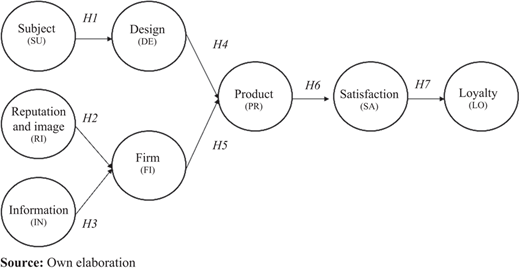
H1.

Lifestyle, online shopping habits and technological literacy have a direct and positive influence on consumers’ perception of a website’s design.

The online reputation of a tourism firm is a variable that bears some relation to its image (De Maeyer, 2012). This variable is related to credibility, reliability and coherence and influences the value and service perceived by a tourist user (Ye et al., 2009). Reputation depends on the user’s own perceptions and experiences on the website, initially or at any point during the purchase process (Dijkmans et al., 2015). It is a critical variable in tourism due to the rapid generation and transmission of ratings and comments about the quality of a site, a firm or a service, among other aspects (Martínez et al., 2016). Therefore, the second hypothesis is stated as follows:

H2.

The reputation of a tourism firm as perceived by consumers and its image or its website’s image directly and positively influences the quality of the service and the value perceived by consumers.

In an online context, the user has more confidence in the information coming from the internet, especially transmitted through social networks, than that received through traditional communication channels (Li and Zhan, 2011). For this reason, opinions, assessments and general information shared on the internet can be considered to influence perceptions about the value and service offered, as well as influencing buying behaviour, satisfaction and loyalty (Gutiérrez et al., 2013). However, the information received through traditional means can still have some influence on this perception (Winnie, 2014). Taking into account the above, the following hypothesis states that:

H3.

The information and comments received by consumers through the website and other means directly and positively influence the service and the value perceived by consumers.

The website is the link between the consumer and the tourism products or services that firms sell or offer (Afsar et al., 2013). Consequently, certain aspects of website design may influence the perception of value and trust regarding some attributes of the products offered, such as the tangibility, variety or availability, satisfaction (Chen, Chang and Lee, 2015) and e-loyalty (Cyr et al., 2008), thus facilitating or hindering purchases (Afsar et al., 2013; Chen and Wang, 2016).

Therefore, the following hypothesis states that:

H4.

Website design influences in a direct and positive way the perception and evaluation that the consumer have of certain attributes of the tourism product.

Certain variables of tourism firms, such as the quality of service and the value perceived by consumers, also exert a significant influence on e-loyalty (Fuentes et al., 2010) and online satisfaction (Li et al., 2015). Regarding perceived value, which means the difference between what the consumer receives and what he brings, this is one of the variables of tourism firms that most influences e-loyalty (Chen and Wang, 2016; Jiang et al., 2016).

Regarding the quality of the online tourism service, consumers take this into account when making purchasing decisions (Llach et al., 2013). Although there is no agreement regarding the definition of service quality in an online tourist context (Barrera Barrera et al., 2014), the construct can be defined as the extent to which the site confirms the expectations of consumers by evaluating the difference between the service expected and service actually received in the online purchase of a product or service, in this case a tourist destination (Sobihah et al., 2015). In the online tourism context, the most widely accepted dimensions of service quality are those included in the e-SERVQUAL model, an adaptation of the SERVQUAL model to the online context (Elkhani et al., 2014; Li et al., 2015).

Bearing in mind the above on firms’ variables, the following hypothesisis stated as follows:

H5.

Consumers’ perceptions of the value and quality of the service directly and positively influence their perception of certain attributes of the product (realism, variety, availability).

The products constitute the nexus of the union between consumers and the results of the shopping experience, that is, their satisfaction and loyalty (Ziaullah et al., 2014). This is emphasised in tourism e-commerce, first, because of the insecurity and absence of real contact in e-commerce, and also due to the intangibility and lack of realism in the case of tourism products (Winnie, 2014).

As discussed, the products synthesise the direct and indirect effects of the above latent variables to generate consumer confidence (Kim et al., 2009), an important aspect for consumers in online shopping because transactions are more impersonal, anonymous and automated (Winnie, 2014). Therefore, the website must provide a certain tangible and realistic character to the products, as well as information on the quantity, variety and availability of products, and on the purchase process (i.e. price, promotions, offers and payment) (Gonçalves et al., 2016). It is for this reason that information about the product must generate in consumers the perception that their expectations will be fulfilled (Kim and Benbasat, 2003). Therefore, the following hypothesis states:

H6.

The perception about prices and certain attributes of the product has a direct and positive influence on consumers’ satisfaction.

In both offline and online contexts, customer satisfaction is the most researched factor in the literature because it is the variable that most influences the formation of e-loyalty (Anderson and Srinivasan, 2003; Wu and Hsu, 2015). Satisfied customers are more committed and willing to repeat the purchase on the same website, and to recommend it (Li et al., 2015; Chen and Wang, 2016). However, some authors claim that the relationship between satisfaction and loyalty is complex, as shown in some studies, because greater satisfaction is not necessarily accompanied by an increase in loyalty due to the reduced costs of destination change (Sobihah et al., 2015). Similarly, some authors have found that dissatisfied customers can remain loyal (Chang and Chen, 2008b).

Satisfaction can be defined in two ways; first, the satisfaction that refers to the psychological state derived from a customer’s pleasure or dislike after an online shopping experience, compared to the shopping experience in traditional stores (Cyr et al., 2008). Second, the satisfaction that refers to the perception of the degree to which a customer’s previous expectations are confirmed after an online shopping experience (Anderson and Srinivasan, 2003). Some studies consider satisfaction from a cumulative and global perspective (Yang et al., 2009) vs approaches that consider satisfaction in relation to the customer experience during the different phases of the purchase (Afsar et al., 2013). Finally, satisfaction is a multi-dimensional variable, since it has affective (Oliver, 1993a, b), hedonic (Jones et al., 2006) and relational components (Flavián et al., 2006).

Consequently, the seventh hypothesis states that:

H7.

Satisfaction in e-commerce has a direct and positive influence on e-loyalty.

Three hypotheses are added to analyse in greater depth the relationships between variables of e-loyalty. First, because the generational cohorts have different values, preferences and buying behaviours, it is an important objective for tourism firms to understand these preferences and generational differences in the young segment. It allows to promote and to offer more adapted products and services regarding e-loyalty and the variables that determine them (Bilgihan, 2016). However, the online behaviour of this “online generation” is still poorly studied (Nusair et al., 2011, 2013; Martínez, 2014).

Taking into account the above about and the results of previous studies (Martínez, 2014; Martínez et al., 2016), the following hypothesis states that:

H8.

Young people attach high importance and value to all the variables included in this study.

Finally, it is important for tourist firms to determine, within the same generational segment, if there are gender differences in the formation of e-loyalty, as this will affect whether integrated management can be carried out or if such management has to be differential (Martínez, 2014). It is also based on the premise that generations as a whole are influenced by similar socio-cultural factors and have homogeneous cognitive, affective and behavioural patterns, both in the offline (Charters et al., 2011) and online contexts (Gurtner and Soyez, 2016). Thus, the following two hypotheses are established:

H9.

There are no significant differences due to gender in the responses that young people give to the items, that is, to the observed variables and latent variables.

H10.

There are no significant gender differences in the causal relationships of the proposed structural model.

The e-loyalty formation model proposed in this paper is shown in Figure 1.

Together with the analysis of structural equations (partial least squares (PLS)), descriptive analysis and discriminant in the context of e-loyalty have been used in this work. The PLS method has been chosen because it is rigorous and reflects the theoretical and empirical conditions of the social sciences in which the theories are not sufficiently established and the available information is scarce (Cepeda and Roldán, 2004).

The study was carried out using a sample of 497 subjects (45 per cent men, 55 per cent women). The size of the sample is in accordance with the “ten-fold rule” (Chin, 1998b; Hair et al., 2014) when using the PLS method, and with studies on the perceptions of young people in tourism (Jaafar et al., 2015) and online contexts (Bilgihan, 2016). Regarding age, 98 per cent of the sample was between 18 and 22 years old.

The entire sample consisted of students from different degrees and years at the University of the La Laguna[2]. This segment is an adequate representation of virtual consumers by age, which brings generational character to the study, and because they have a higher level of education than the general public (Gurtner and Soyez, 2016) (Table I).

An ad-hoc designed questionnaire was used as an instrument for collecting data (Hsu et al., 2006). It should be noted that the scales designed to measure loyalty in e-commerce tourism are based on existing measures in the offline context.

To design the scale, we first worked with two experts to identify the most appropriate variables, relationships and measures for the proposed model, thus guaranteeing the validity of content (Roy et al., 2001). It was taken into account that in the recent literature, the variables included in this study can be measured by a small number of items, thus avoiding the methodological problems and costs derived from the use of multiple indicators (Bergkvist and Rossiter, 2007). Next, the Delphi technique (Chan et al., 2001) was used to construct the definitive relations between items.

A Likert scale of 20 items was obtained with 5 response alternatives. Also included in the scale were two additional items: one related to subjects’ gender and the other related to the degree of tourism consumption (the tourist destination) using the web, social networks or mobile telephony.

The dependent variable, e-loyalty (LO), is measured by two items: repetition of the online purchase on the same website or the recommendation of the site to other people (Allagui and Temessek, 2004; Toufaily et al., 2013). The literature shows that the recommendation component is less frequent in the online context than the repetition one (Winnie, 2014; Li et al., 2015).

The independent latent variable relative to the subject (SU) has been measured with 3 items based on the literature (Yoo et al., 2012). The website design dimension (DE) includes three items following Yi et al. (2006). Image and reputation (RI) constitute the dimension of the firm and have been measured with two items as explained by Toufaily et al. (2013). Regarding information (IN), two items have been used from the work of Goyette et al. (2010). In relation to the dimension of the firm (FI), the perceived value and the quality of the service were measured with three items, following the works of Parasuraman et al. (2005) and Zehir et al. (2014). Satisfaction (SA) has been measured with two items following Elkhani et al. (2014) and Tseng (2017). Finally, for the design of the items related to the product dimension (PR), attributes considered in this paper and contributions of Ziaullah et al. (2014) have been taken into account regarding the influence of product quality on online satisfaction and loyalty.

As can be seen in Table II and in relation to H8, young people state they purchase a moderate number of trips to tourist destinations in the online mode, firstly highlighting purchases through websites, followed by the ones made with mobile phones and, finally, social networks. This reduced or moderate consumption may be due to the young age of the sample, as well as the importance they give to security (Table III, item DE2: security 72.55 per cent), suggesting in any case the potential of future purchases. Additionally, the preference for the purchases using mobile telephony rather than social networks, although reduced, denotes the importance of the former for this population segment.

The data in Table III state that the levels of all variables are average/high, since none of the 20 items scored below 50 per cent of the maximum possible value (497×5=2,485). More than 50 per cent of the items obtained more than 70 per cent of the maximum possible score (2,485), with items related to the subject having the lowest score, but above 60 per cent. Consequently, H8 is confirmed.

Firstly, an exploratory factorial analysis with varimax rotation was carried out using the principal components method (Anderson and Gerbing, 1988). An eight-factor structure was obtained (see Table IV). This factor structure was accepted because the variables that make up the factors have a high correlation with each other (higher than 0.70) and a reduced correlation with other variables (Worthington and Whittaker, 2006, p. 821).

The PLS analysis studied the reliability and validity of the relationships between the observed variables (items) and the latent variables with which they are associated. It was shown that the observed variables reached the required minimum level (λ⩾0.70) (Table IV), thus confirming that the indicators were part of their corresponding constructs. In addition, the composite reliability (CR) study showed that because all values were above 0.70, the measurement model was internally consistent and all the indicators or variables observed were measuring their corresponding latent variable (Hair et al., 2014).

Convergent validity and discriminant validity were also analysed (Fornell and Larcker, 1981). To test the former, average variance extracted (AVE) was used and in all cases the result was higher than 0.50, so it was found that more than 50 per cent of the variance of the construct was due to its indicators (Chin, 2010) (Table IV). In the latter, the square root of AVE (on the diagonal of Table V) was found to be greater than the shared variance between the construct and the other constructs of the model.

Additionally, the matrix of cross-factor loadings (Chin, 1998a) was obtained (Table VI). The indicators were more correlated with their own construct than with the others, showing that the measurement model has an acceptable convergent and discriminant reliability and validity.

Regarding the evaluation of the causal model, it was verified that the exogenous latent variables contributed to explaining the variance of the e-loyalty variable significantly, since the path coefficients (β) reached levels above the acceptable minimum level (β⩾0.2), and even at the optimal level (β⩾0.3) (Table VII).

The highest paths associated the subject (SU) with the perception of the site design (DE) (β=0.440), the firm (FI) with the product (PR) (β=0.434) and, especially, the satisfaction (SA) with loyalty (LO) (β=0.882). In contrast, the lowest causal relationships were those that linked the latent design variable (DE) with the product (PR) (β=0.281) and the product (PR) with satisfaction (SA) (β=0.286).

In addition, in all direct causal relationships, the t-statistic obtained levels that verified their high significance (P<0.01), as evidenced in the bootstrapping analysis carried out with 500 sub-samples and 200 cases. Consequently, all hypotheses relating to the proposed causal model are confirmed.

In the study of the structural model, three additional indicators were calculated (Table VIII): R2, ranging from 0 to 1; Q2, developed by Stone (1974) and Geisser (1975) to measure the predictive relevance of the dependent constructs; and the goodness-of-fit (GoF) test, which also ranges from 0 to 1.

It was found that the previous latent variables explained sufficient variance of the consequent variables, since the basic indicator R2 reached in all cases values above the acceptable minimum level (R2⩾0.19). On the other hand, values above 0 of the indicator Q2 (Q2⩾0) verified the predictive relevance of the model. Finally, a GoF value of 0.507 was obtained, which is higher than the minimum acceptable value (GoF⩾0.360) (Table VIII). Therefore, in addition to confirming hypotheses concerning causal relations (-H7), it can be said that the model has predictive potential.

To test H9, a discriminant analysis was carried out. The results (Table IX) allow us to confirm that there are some significant differences in the responses directly provided by young people for reasons of gender, as evidenced by the levels of self-value (SV) and canonical correlation (CC), and because the level of the Wilks’ Lambda indicator (WL), which moves away from 1. In addition, the significance is high (p⩽0.005).

Based on the above data, it was found that men, unlike women, state that they are accustomed to buying online (SU3), value the perceived reputation of the firm or the site (RI1) and, to a lesser extent, are willing to repeat the purchase (LO2). Women tend to value more than men, the ease and speed of the site (DE3), the information they write and share other people (IN1) and the real and tangible character of the product (PR2). Consequently, H9 is not confirmed, since there are differences in the responses between sexes, although these differences are not excessively significant (Table X).

With respect to H10 regarding gender differences, a multi-group analysis was performed using the analytical method called PLS-MGA (Hair et al., 2014). The results obtained using 5,000 cases and significance level of 0.05 are shown in Table XI.

Taking into account that the path differences, with p⩽0.05 and p⩾0.95, are considered significant, H10 is not confirmed, since most of the causal relationships between latent variables (path) are significantly different between men and women (Table XII).

This paper is a new contribution to the online context of tourism destinations providing a better understanding, both theoretically and practically, of the process of forming e-loyalty among young people, responding with it to the needs and concerns of other authors (Gonçalves et al., 2016; Winnie, 2014; Bilgihan, 2016).

It is concluded that e-commerce is the prevailing form of commerce whether carried out through websites, social or mobile phone networks, therefore tourism firms must continue to strive to develop online loyalty among their customers (Elkhani et al., 2014; Winnie, 2014).

Additionally, researchers and practitioners should research in greater depth the variables that affect e-loyalty in tourism. This is due to the benefits of e-loyalty, the increasing competition of the online market and the greater demands of tourist users (Sobihah et al., 2015; Wu and Hsu, 2015). There are several factors to be considered that are specific to online purchases of tourism products such as the inexistence of face-to-face interactions in e-commerce, as well as the insecurity, complex and intangible nature of the sector itself, and of the products and services that are marketed (Martínez et al., 2016).

Thus, tourism firms must properly manage the variables involved in the formation of e-loyalty, bearing in mind that they do not have full control over some of them. Such management should be carried out on the premise that in the online context, young people constitute the segment of the least loyal consumers, but with the highest potential consumption and influence. In addition, this segment is highly predisposed to carrying out leisure and tourism activities, using e-commerce and regularly using the internet, social networks and mobile phones (Jing et al., 2015).

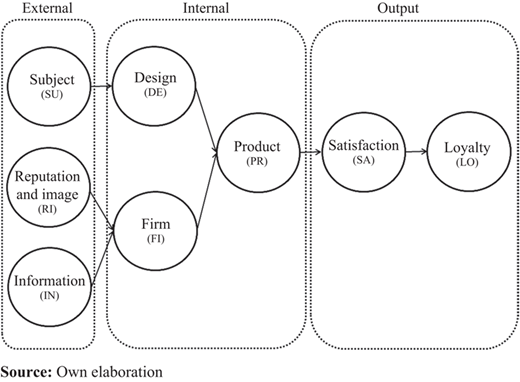
In this paper, a causal model has been generated that is clear and largely approachable at a practical level by tourism managers, as far as most of the controllable variables are concerned. This model has generated three large groups of variables that must be adequately managed by firms (see Figure 2), which include external, internal and output variables.

The “external” variables are that that facilitate or precede loyalty and are characterised by initiating the chain of effects that leads to e-loyalty and to which tourism managers must pay special strategic attention. Thus, to orientate themselves to the online market and the digital consumer, tourism firms should take into account the users when designing their websites and, therefore, integrate information technology professionals with marketing and tourism professionals.

Likewise, tourism firms should, as far as possible, attend to all actions and messages that online tourist users send to and receive from firms and their websites, which could negatively affect the reputation and image as these have an influence on the value and quality of the service perceived by consumers (Çoban, 2012). Moreover, it should be ensured that messages and ratings by other users, on the site or on others, are the most appropriate owing to their influence on young people’s perceptions about the value and quality of service as demonstrated.

As for the “internal” variables, these have greater influence on satisfaction and loyalty as reflected by Chen and Wang (2016). The internal variables that most require attention when targeting the youth segment are: website design, value and quality of service offered, as well as information and presentation of products. Likewise, it is recommended that efforts be made to generate user-friendly websites to generate positive perceptions regarding the tangibility and realism of products, the availability of products and the value of promotions (Li et al., 2015). To the extent that consumers perceive high value and effective and quality service, tourism products will also be perceived positively (Chen, Chang and Lee, 2015), and it will be more feasible to meet the expectations of young people and form loyalty (Jiang et al., 2016).

Tourism firms, following the above, should continue to investigate the perceptions and expectations of their customers so as to satisfy them and only in this way, will online tourist users be satisfied, repeat the purchase on the same site or recommend it to other consumers. From the results of the descriptive analysis, it is concluded that young people make tourism purchases online in a moderate way, highlighting in first place purchases through the web, followed by mobile phones and, lastly, through social networks. This may be due to the limited resources of young people, or because, due to the age of the segment studied, their online experience is still scarce. However, these statements by young people about their consumption neither contradict their potential consumption and influence (Nusair et al., 2011, 2013), nor the characteristics conducive to e-commerce that this segment has (Gurtner and Soyez, 2016).

Furthermore, it is useful for firms to know and take into account that, as well as the causal relationships of the proposed model, young people’s assessments about the variables analysed in this study oscillate around 70 per cent, including satisfaction and loyalty. This suggests that young people have a favourable attitude and predisposition towards e-commerce, which, in turn, favours firms’ efforts to promote consumption and loyalty within the framework of the model’s variables.

Although studies on the formation of offline loyalty in tourism have demonstrated there are not large differences between men and women in a sample similar to that of this study (Martínez, 2014; Martínez et al., 2016), in this online context, there are some gender differences in the responses given by young people, although these differences are not very significant. These differences suggest a pattern of online shopping behaviour related to satisfaction and e-loyalty that is more related to the search for security by women and a greater fit to their own lifestyles for men. Given that there are also some gender differences in the causal relationships of the proposed model, firms should study and understand these differences in more detail to assess the possibility of conducting differential online actions directed at men and women, in order to promote online shopping behaviour, satisfaction and loyalty of the segment.

The main limitation of this study has been related to the number of variables and measurement indicators that, according to the literature, influence e-loyalty. Therefore, as a future line of research, we suggest studies that include other variables in the formation of e-loyalty.

In relation to the age segments, it might be interesting to compare the formation of e-loyalty between different generational segments. Likewise, it would be of interest to analyse in more depth what the gender differences found in direct responses and in causal relations may be due to. Additionally, it would be interesting to conduct a study of online loyalty by differentiating whether the purchasing process is carried out on social networks, mobile telephony or websites.

1.

In this paper, the term e-loyalty is used. Consumer e-loyalty is studied in a global framework, i.e. considering consumer buying behaviour regardless of whether through websites, social networks or mobile phones. The “website” is the specific link that the consumer is using at a given time.

2.

It has been verified that, regardless of studies or academic year, there are no significant differences in the responses of young people of the same age as shown by Martínez (2014) using subjects and variables similar to those included in this study.
Afsar
,
A.
,
Nasiri
,
Z.
and
Zadeh
,
M.O.
(
2013
), “
E-loyalty model in e-commerce
”,
Mediterranean Journal of Social Sciences
, Vol.
4
No.
9
, pp.
547
-
553
.
Allagui
,
A.
and
Temessek
,
A.
(
2004
), “
Testing an e-loyalty intention conceptual framework
”,
Journal of E-Business
, Vol.
4
No.
1
, pp.
1
-
6
.
Anderson
,
J.C.
and
Gerbing
,
D.W.
(
1988
), “
Structural equation modeling in practice: a review and recommended two-step approach
”,
Psychological Bulletin
, Vol.
103
No.
3
, pp.
411
-
423
.
Anderson
,
R.E.
and
Srinivasan
,
S.S.
(
2003
), “
E-satisfaction and e-loyalty: a contingency framework
”,
Psychology and Marketing
, Vol.
20
No.
2
, pp.
123
-
138
.
Bansal
,
G.
and
Chen
,
L.
(
2011
), “
If they trust our e-commerce site, will they trust our social commerce site too? Di erentiating the trust in e-commerce and s-commerce: e moderating role of privacy and security concerns
”,
MWAIS 2011 Proceedings
,
Paper No. 20
.
Barrera Barrera
,
R.
,
Navarro García
,
A.
and
Rey Moreno
,
M.
(
2014
), “
Evaluación de la calidad de servicio electrónico en encuentros de servicio con incidents: diferencias según el perfil sociodemográfico del consumidor online
”,
Revista Europea de Dirección y Economía de la Empresa
, Vol.
23
No.
4
, pp.
184
-
193
.
Belanche
,
D.
,
Casaló
,
L.V.
and
Guinalíu
,
M.
(
2012
), “
Website usability, consumer satisfaction and the intention to use a website: the moderating effect of perceived risk
”,
Journal of Retailing and Consumer Services
, Vol.
19
No.
1
, pp.
124
-
132
.
Bergkvist
,
L.
and
Rossiter
,
J.
(
2007
), “
The predictive validity of multiple-item versus single-item measures of the same constructs
”,
Journal of Marketing Research
, Vol.
44
No.
2
, pp.
175
-
184
.
Bilgihan
,
A.
(
2016
), “
Gen Y customer loyalty in online shopping: an integrated model of trust, user experience and branding
”,
Computers in Human Behavior
, Vol.
61
No.
C
, pp.
103
-
113
.
Cepeda
,
G.
and
Roldán
,
J.L.
(
2004
), “
Aplicando en la práctica la técnica PLS en la administración de empresas
”,
Conocimiento y Competitividad. XIV Congreso Nacional ACEDE
,
Murcia
, pp.
74
-
78
.
Chan
,
A.P.C.
,
Yung
,
E.H.K.
,
Lam
,
P.T.I.
,
Tam
,
C.M.
and
Cheung
,
S.O.
(
2001
), “
Application of Delphi method in selection of procurement systems for construction projects
”,
Construction Management and Economics
, Vol.
19
No.
7
, pp.
699
-
718
.
Chang
,
H.H.
and
Chen
,
S.W.
(
2008a
), “
The impact of customer interface quality, satisfaction and switching costs on e-loyalty: internet experience as a moderator
”,
Computers in Human Behavior
, Vol.
24
No.
6
, pp.
2927
-
2944
.
Chang
,
H.H.
and
Chen
,
S.W.
(
2008b
), “
The impact of online store environment cues on purchase intention: trust and perceived risk as a mediator
”,
Online Information Review
, Vol.
32
No.
6
, pp.
818
-
841
.
Charters
,
S.
,
Fountain
,
J.
,
Kolyesnikova
,
N.
,
Ritchie
,
Thach, C.
and
Dodd
,
T.
(
2011
), “
Generation Y and sparkling wines: a cross-cultural perspective
”,
International Journal of Wine Business Research
, Vol.
23
No.
2
, pp.
161
-
175
.
Chen
,
C.F.
and
Wang
,
J.P.
(
2016
), “
Customer participation, value co-creation and customer loyalty: a case of airline online check-in system
”,
Computers in Human Behavior
, Vol.
62
,
September
, pp.
346
-
352
.
Chen
,
M.H.
,
Chang
,
Y.Y.
and
Lee
,
C.Y.
(
2015
), “
Creative entrepreneurs’ guanxi networks and success: information and resource
”,
Journal of Business Research
, Vol.
68
No.
4
, pp.
900
-
905
.
Chen
,
J.V.
,
Yen
,
D.C.
,
Pornpriphet
,
W.
and
Widjaja
,
A.
(
2015
), “
E-commerce web site loyalty: a cross cultural comparison
”,
Information Systems Frontiers
, Vol.
17
No.
6
, pp.
1283
-
1299
.
Chin
,
W.
(
1998a
), “
Issues and opinion on structural equation modeling
”,
MIS Quarterly
, Vol.
22
No.
1
, pp.
7
-
16
.
Chin
,
W.
(
1998b
), “The partial least approach to structural equation modelling”, in
Marcoulides
,
G.A.
(Ed.),
Moderm Methods for Business Research
,
Lawrence Erlbaum Associates
,
Mahwah, NJ
, pp.
295
-
336
.
Chin
,
W.
(
2010
), “How to write up and report PLS analyses”, in
Esposito Vinzi
,
V.
,
Chin
,
W.
,
Henseler
,
J.
and
Wang
,
H.
(Eds),
Handbook of Partial Least Squares: Concepts, Methods and Application
,
Springer
, pp.
645
-
689
.
Çoban
,
S.
(
2012
), “
The effects of the image of destination on tourist satisfaction and loyalty: the case of Cappadocia
”,
European Journal of Social Sciences
, Vol.
29
No.
2
, pp.
222
-
232
.
Cyr
,
D.
,
Kindra
,
G.S.
and
Dash
,
S.
(
2008
), “
Web site design, trust, satisfaction and e-loyalty: the Indian experience
”,
Online Information Review
, Vol.
32
No.
6
, pp.
773
-
790
.
De Maeyer
,
P.
(
2012
), “
Impact of online consumer reviews on sales and price strategies: a review and directions for future research
”,
Journal of Product & Brand Management
, Vol.
21
No. 2, pp.
132
-
139
.
Dijkmans
,
C.
,
Kerkhof
,
P.
,
Buyukcan-Tetik
,
A.
and
Beukeboom
,
C.J.
(
2015
), “
Online conversation and corporate reputation: a two-wave longitudinal study on the effects of exposure to the social media activities of a highly interactive company
”,
Journal of Computer-Mediated Communication
, Vol.
20
No.
6
, pp.
632
-
648
.
Elkhani
,
N.
,
Soltani
,
S.
and
Hamshidi
,
H.M.S.
(
2014
), “
Examining a hybrid model for e-satisfaction and e-loyalty to e-ticketing on airline websites
”,
Journal of Air Transport Management
, Vol.
37
No.
1
, pp.
36
-
44
.
Flavián
,
C.
,
Guinalíu
,
M.
and
Torres
,
E.
(
2006
), “
How bricks-and-mortar attributes affect online banking adoption
”,
International Journal of Bank Marketing
, Vol.
24
No.
6
, pp.
406
-
423
.
Fornell
,
C.
and
Larcker
,
D.
(
1981
), “
Evaluating structural equation models with unobservable variables and measurement error
”,
Journal of Marketing Research
, Vol.
18
, pp.
39
-
50
.
Fuentes
,
M.
,
Saura
,
I.G.
,
Berenguer
,
G.
and
Moliner
,
B.
(
2010
), “
Measuring the antecedents of e-loyalty and the effect of switching costs on website
”,
The Service Industries Journal
, Vol.
30
No.
11
, pp.
1837
-
1852
.
Geisser
,
S.
(
1975
), “
A predictive sample reuse method with applications
”,
Journal of the American Statistical Association
, Vol.
70
No.
350
, pp.
320
-
328
.
Gonçalves
,
H.
,
Salgueiro
,
M.F.
and
Rita
,
P.
(
2016
), “
Online purchase determinants of loyalty: the mediating effect of satisfaction in tourism
”,
Journal of Retailing and Consumer Services
, Vol.
30
,
May
, pp.
279
-
291
.
Goyette
,
I.
,
Ricard
,
L.
,
Bergeron
,
J.
and
Marticotte
,
F.
(
2010
), “
e-WOM scale: word-of-mouth measurement scale for e-services context
”,
Canadian Journal of Administrative Sciences Revue Canadienne des Sciences de l’administration
, Vol.
27
No.
1
, pp.
5
-
23
.
Gurtner
,
S.
and
Soyez
,
K.
(
2016
), “
How to catch the generation Y: identifying consumers of ecological innovations among youngsters
”,
Technological Forecasting & Social Change
, Vol.
106
,
May
, pp.
101
-
107
.
Gutiérrez
,
D.
,
Bulchand
,
J.
,
Díaz
,
R.
and
Parra
,
E.
(
2013
), “
Antecedentes del uso de los medios sociales por el turista: motivación, oportunidad y capacidad
”,
Cuadernos de Turismo
, Vol.
31
, pp.
153
-
173
.
Hair
,
J.F.
,
Hult
,
G.T.M.
,
Ringle
,
C.M.
and
Sarstedt
,
M.
(
2014
),
A Primer on Partial Least Squares Structural Equation Modeling (PLS-SEM)
,
SAGE Publications Ltd
,
Thousand Oaks, CA
.
Hsu
,
M.
,
Yen
,
C.
,
Chiu
,
C.
and
Chang
,
C.
(
2006
), “
A longitudinal investigation of continued online shopping behavior: an extension of the theory of planned behavior
”,
International Journal of Human Computer Studies
, Vol.
64
No.
9
, pp.
889
-
904
.
Jaafar
,
M.
,
Noor
,
S.
and
Rasoolimanesh
,
S.M.
(
2015
), “
Perception of young local residents toward sustainable conservation programmes: a case study of the Lenggong world cultural heritage site
”,
Tourism Management
, Vol.
48
,
June
, pp.
154
-
163
.
Jiang
,
L.
,
Jun
,
M.
and
Yang
,
Z.
(
2016
), “
Customer-perceived value and loyalty: how do key service quality dimensions’ matter in the context of B2C e-commerce?
”,
Service Business
, Vol.
10
No.
2
, pp.
301
-
317
.
Jing
,
Y.S.
,
Zaidin
,
N.
,
Md Ariff
,
M.S.
,
Zakuan
,
N.
,
Ismail
,
K.
and
Ishak
,
N.
(
2015
), “
Website quality and consumer attitude of online shopping: the Y-generation perspective
”,
Advanced Science Letters
, Vol.
21
No.
10
, pp.
3417
-
3420
.
Jones
,
M.A.
,
Reylonds
,
K.E.
and
Arnold
,
M.J.
(
2006
), “
Hedonic and utilitarian shopping value: investigating differential effects on retail outcomes
”,
Journal of Business Research
, Vol.
59
No.
6
, pp.
974
-
981
.
Kim
,
D.
and
Benbasat
,
I.
(
2003
), “
Trust-related arguments in internet stores: a framework for evaluation
”,
Journal of Electronic Commerce Research
, Vol.
4
No.
2
, pp.
49
-
64
.
Kim
,
H.
,
Kim
,
T.
and
Shin
,
S.W.
(
2009
), “
Modeling roles of subjective norms and eTrust in customers’ acceptance of airline B2C eCommerce websites
”,
Tourism Management
, Vol.
30
No.
2
, pp.
266
-
277
.
Lee
,
H.J.
,
Lim
,
H.
,
Jolly
,
L.D.
and
Lee
,
J.
(
2009
), “
Consumer lifestyles and adoption of high-technology products: a case of South Korea
”,
Journal of International Consumer Marketing
, Vol.
21
No.
2
, pp.
153
-
167
.
Li
,
H.
,
Anyanwu
,
N.A.
,
Tevrizci
,
C.
and
Luo
,
X.
(
2015
), “
The interplay between value and service quality experience: e-loyalty development process through the eTailQ scale and value perception
”,
Electronic Commerce Research
, Vol.
15
No.
4
, pp.
585
-
615
.
Li
,
J.
and
Zhan
,
L.J.
(
2011
), “
Online persuasion: how the written word drives WOM evidence from consumer generated product reviews
”,
Journal of Advertising Research
, Vol.
51
No.
1
, pp.
239
-
257
.
Llach
,
J.
,
Marimon
,
F.
,
Alonso
,
M.M.
and
Bernardo
,
M.
(
2013
), “
Determinants of online booking loyalties for the purchasing of airline tickets
”,
Tourism Management
, Vol.
25
,
April
, pp.
23
-
31
.
Martínez
,
J.A.
(
2014
),
Comportamiento de compra del turista residente. El caso de la Generación ‘Y’ en Canarias: Tesis Doctoral
,
Universidad de La Laguna
,
La Laguna
.
Martínez
,
J.A.
,
Parra
,
E.
and
Buhalis
,
D.
(
2016
), “
The loyalty of young residents in an island tourism destination: an integrated model
”,
Journal of Destination Marketing & Management
, Vol.
6
No.
4
, pp.
445
-
455
,
available at:
file:///C:/Users/user/Downloads/The-loyalty-of-young-residents-in-an-island-destination.pdf
Nusair
,
K.K.
,
Parsa
,
H.G.
and
Cobanoglu
,
C.
(
2011
), “
Building a model of commitment for generation Y: an empirical study on e-travel retailers
”,
Tourism Management
, Vol.
32
No.
4
, pp.
833
-
843
.
Nusair
,
K.T.
,
Bilgihan
,
A.
,
Okumus
,
F.
and
Cobanoglu
,
C.
(
2013
), “
Generation Y travelers’ commitment to online social network websites
”,
Tourism Management
, Vol.
35
,
April
, pp.
13
-
22
.
Oliver
,
R.
(
1993a
), “A conceptual model of service quality and service satisfaction: compatible goals, different concepts”, in
Swartz
,
T.A.
,
Bowen
,
D.E.
and
Brown
,
S.W.
(Eds),
Advances in Services Marketing and Management: Research and Practice
, Vol.
2
,
Jai Press Inc.
,
Greenwich, CT
, pp.
65
-
85
.
Oliver
,
R.
(
1993b
), “
Cognitive, affective, and attribute bases of the satisfaction response
”,
Journal of Consumer Research
, Vol.
20
,
December
, pp.
418
-
430
.
Parasuraman
,
A.
,
Xeithaml
,
V.A.
and
Malhotra
,
A.
(
2005
), “
E-S-QUAL: a multiple-item scale for assessing electronic service quality
”,
Journal of Service Research
, Vol.
7
No.
X
, pp.
1
-
21
.
Roy
,
M.C.
,
Dewit
,
O.
and
Aubert
,
B.A.
(
2001
), “
The impact of interface usability on trust in web retailers
”,
Internet Research
, Vol.
11
No.
5
, pp.
388
-
398
.
Sobihah
,
M.
,
Mohamad
,
M.
,
Ali
,
N.A.M.
and
Ismail
,
W.Z.W.
(
2015
), “
E-commerce service quality on customer satisfaction, belief and loyalty: a proposal
”,
Mediterranean Journal of Social Sciences
, Vol.
6
No.
2
, pp.
260
-
266
.
Stone
,
M.
(
1974
), “
Cross-validatory choice and the assessment of statistical predictions (with discussion)
”,
Journal of the Royal Statistical Society, Series B
, Vol.
36
No.
2
, pp.
111
-
133
.
Toufaily
,
E.
,
Ricard
,
L.
and
Perrien
,
J.
(
2013
), “
Customer loyalty to a commercial website: descriptive meta-analysis of the empirical literature and proposal of an integrative model
”,
Journal of Business Research
, Vol.
66
No.
9
, pp.
1436
-
1447
.
Tseng
,
A.
(
2017
), “
Why do online tourists need sellers’ ratings? Exploration of the factors affecting regretful tourist e-satisfaction Aihua Tseng
”,
Tourism Management
, Vol.
59
No.
C
, pp.
413
-
424
.
Winnie
,
P.M.W.
(
2014
), “
The impact of trustworthiness and customer e-loyalty and e-satisfaction
”,
International Journal of Academic Research in Business and Social Sciences
, Vol.
4
No.
3
, pp.
390
-
408
.
Worthington
,
R.W.
and
Whittaker
,
T.A.
(
2006
), “
Using exploratory and confirmatory factor analysis in scale development research: a content analysis and recommendations for best practices
”,
The Counseling Psychologist
, Vol.
34
No.
6
, pp.
806
-
838
.
Wu
,
C.
and
Hsu
,
C.L.
(
2015
), “
How to improve e-satisfaction and e-loyalty and strengthen the links between them: value from regulatory fit
”,
Human Factors and Ergonomics in Manufacturing & Service Industries
, Vol.
25
No.
3
, pp.
353
-
369
.
Yang
,
H.E.
,
Wu
,
C.C.
and
Wang
,
K.C.
(
2009
), “
An empirical analysis of online game service satisfaction and loyalty
”,
Expert Systems with Applications
, Vol.
36
No.
2
, pp.
1816
-
1825
.
Ye
,
Q.
,
Law
,
R.
and
Gu
,
B.
(
2009
), “
The impact of online user reviews on hotel room sales
”,
International Journal of Hospitality Management
, Vol.
28
No.
1
, pp.
180
-
182
.
Yi
,
M.Y.
,
Fiedler
,
K.
and
Park
,
J.
(
2006
), “
Understanding the role of individual innovativeness in the acceptance of IT-based innovations: compare analyses of models and measures
”,
Decision Sciences
, Vol.
37
No.
3
, pp.
393
-
426
.
Yi
,
Y.
and
Jeon
,
H.
(
2003
), “
Effects of loyalty programs on value perception, program loyalty, and brand loyalty
”,
Journal of the Academy of Marketing Science
, Vol.
31
No.
3
, pp.
229
-
240
.
Yoo
,
Y.
,
Boland
,
R.J. Jr
,
Lyytinen
,
K.
and
Majchrzak
,
A.
(
2012
), “
Organizing for innovation in the digitized world
”,
Organization Science
, Vol.
23
No.
5
, pp.
1398
-
1408
.
Zehir
,
C.
,
Sehitoglub
,
Y.
,
Narcikara
,
E.
and
Zehir
,
S.
(
2014
), “
E-S-quality, perceived value and loyalty intentions relationships in internet retailers
”,
Procedia – Social and Behavioral Sciences
, Vol.
150
,
September
, pp.
1071
-
1079
.
Ziaullah
,
M.
,
Feng
,
Y.
and
Akhter
,
S.N.
(
2014
), “
Online retailing: relationship among e-tailing system quality, e-satisfaction, e-trust and customer’s commitment in China
”,
International Journal of Economics, Commerce and Management
, Vol.
2
No.
10
, pp.
1
-
17
.
Published in the European Journal of Management and Business Economics. Published by Emerald Publishing Limited. This article is published under the Creative Commons Attribution (CC BY 4.0) licence. Anyone may reproduce, distribute, translate and create derivative works of this article (for both commercial and non-commercial purposes), subject to full attribution to the original publication and authors. The full terms of this licence may be seen at http://creativecommons.org/licences/by/4.0/legalcode

Data & Figures

Figure 1

Causal model

Figure 2

Grouping of variables in model

Figure 2

Grouping of variables in model

Close modal
Table I

Variables related to quality website design

VariableFacilitatesAuthors
Utility, ease and speedImproved performanceWu and Hsu (2015) 
InteractivityReciprocal communicationCyr et al.
ParticipationCo-create valueChen and Wang (2016) 
PersonalisationReceive services and register preferencesWinnie (2014) 
AestheticsCapture attention and experienceYang et al. (2009) 
Security reliabilityPrivacy, confidentialityJiang et al. (2016) 
Positive experienceStates of flowBilgihan (2016) 
Brakes to changeInformation, discountsKim et al.

Source: Own elaboration from the literature

Table II

Sample details

Degree year/genderMenWomenTotal (%)
1st82105187
2nd6377140
3rd455196
4th344074
Total (%)224 (45%)273 (55%)497 (100%)

Source: Own elaboration

Table III

Online consumption data

MethodMin.Max.Sum%
Using the web151,48059.56
Using social networks1583233.48
Using mobile phones151,07943.42

Notes:n=497. The percentage refers to the maximum value that the item would have reached if the entire sample had given the item the highest score (5)

Source: Own elaboration

Table IV

Descriptive statistics

Latent variableMin.Max.Sum%AverageDT
Subject (SU)SU1151,52661.413.071.05
 SU2151,72969.583.481.09
 SU3151,67667.443.371.01
Design (DE)DE1151,48459.722.990.88
 DE2151,80372.553.631.01
 DE3251,96178.913.950.87
Reputation and image (RI)RI1251,90576.663.830.87
 RI2151,92777.553.880.92
Information (IN)IN1151,55562.583.131.08
 IN2151,79972.393.620.96
Firm (FI)FI1152,09184.144.211.03
 FI2151,93577.873.890.91
 FI3151,99580.284.010.98
Product (PR)PR1151,97379.403.970.97
 PR2151,93577.873.890.96
 PR3151,95578.673.930.97
Satisfaction (SA)SA1151,64466.163.311.20
 SA2151,70068.413.421.17
Loyalty (LO)LO1151,70868.733.441.14
 LO2151,75870.743.541.19

Source: Own elaboration

Table V

Measurement model: basic data

Latent variableItemsLoading λCRAVE
Subject (SU)SU1: computer and website knowledge0.7100.7620.517
 SU2: the website fits in with my lifestyle0.708  
 SU3: be accustomed to buying online on the site0.739  
Design (DE)DE1: make the website interactive and allow participation0.7240.7970.567
 DE2: security and reliability of website0.756  
 DE3: website is quick and easy to use0.778  
Reputation and image (RI)RI1: perceived reputation of the firm0.8200.8130.685
 RI2: image I have of the firm and website0.835  
Information (IN)IN1: information from other people about the website0.7090.7720.632
 IN2: information received by other means0.872  
Firm (FI)FI1: on the website I receive more than I give0.8060.8480.651
 FI2: the firm provides a good service through the website0.764  
 FI3: the firm complies effectively as promised on the site0.849  
Product (PR)PR1: offers and promotions on certain products0.7100.8150.596
 PR2: real and tangible character of products0.831  
 PR3: variety and availability of products0.770  
Satisfaction(SA)SA1: my expectations have been met0.9450.9460.898
 SA2: I have perceived and felt satisfaction0.950  
Loyalty (LO)LO1: I would recommend the site to other people0.9440.9310.872
 LO2: I would repeat the purchase on the same site0.923  

Source: Fuente: own elaboration

Table VI

Disciminant validity: Fornell Larcker criteria

SUDERIINFIPRSALO
SU0.719       
DE0.4400.753      
RI0.1330.0680.828     
IN0.3290.2500.3340.795    
FI0.3260.3740.4250.4250.807   
PR0.2360.4430.2900.3120.5390.772  
SA0.2090.1150.1420.1220.1880.2860.948 
LO0.1800.1880.0990.0930.0810.2480.8820.934

Source: Own elaboration

Table VII

Cross-factor loadings

Latent variableSUDERIINFIPRSALO
Subject (SU)SU10.7100.2210.1570.1490.1960.0080.2120.234
 SU20.7080.2990.2880.4730.4060.3480.0970.110
 SU30.7390.387−0.0880.1050.1250.1260.1580.085
Design (DE)DE10.3480.7240.1030.1350.1660.313−0.0180.060
 DE20.2620.7560.0190.2490.3020.3910.1560.213
 DE30.3810.7780.0320.1820.3740.2980.1220.152
Reputation and image (RI)RI10.1120.0810.8350.3210.3580.2260.1110.095
 RI20.1080.0300.8200.2300.3450.2550.1240.070
Information (IN)IN10.3100.1190.2030.7090.2720.2110.1050.112
 IN20.2340.2580.3150.8720.3910.2800.0930.049
Firm (FI)FI10.1680.2130.2860.2530.8060.4000.1060.011
 FI20.2540.3800.3260.3000.7640.4780.0650.007
 FI30.3440.2990.4020.4530.8490.4240.2660.162
Product (PR)PR10.1210.3120.2610.1950.3240.7100.1890.090
 PR20.2800.3760.2740.3030.5210.8310.2680.260
 PR30.1140.3340.1310.2080.3720.7700.1940.198
Satisfaction (SA)SA10.2050.0580.1200.1180.1950.2600.9450.815
 SA20.1920.1570.1480.1130.1620.2820.9500.857
Loyalty (LO)LO10.2470.1780.1370.1000.0950.2450.8810.944
 LO20.0760.1730.0420.0720.0540.2160.7580.923

Source: Own elaboration

Table VIII

Effects, significance and confirmation of hypotheses

Latent variablePath (β)Tp-valuesCH
H1 Subject (SU) →Design (DE)0.44013.2050.000YES
H2 Reputation and image (RI)→Firm (FI)0.3187.1690.000YES
H3 Information (IN)→Firm (FI)0.31910.0480.000YES
H4 Design (DE)→Product (PR)0.2816.4830.000YES
H5 Firm (FI)→Product (PR)0.43411.1280.000YES
H6 Product (PR)→Satisfaction (SA)0.2865.7890.000YES
H7 Satisfaction (SA)→Loyalty (LO)0.88285.2250.000YES

Source: Own elaboration

Table IX

R2. Q2 and GoF test indicators

ConstructR2AVEQ2a
Design (DE)0.1940.5670.107
Firm (FI)0.2710.6510.170
Product (PR)0.3590.5960.205
Satisfaction (SA)0.1920.8980.151
Loyalty (LE)0.7790.8720.670
Average0.3590.717
GoF0.507 

Note:aThis test is a measurement of the degree to which the observed values are reproduced by the model and by its estimated parameters

Table X

Discriminant analysis, basic data

Results by sexCentroids
AVCCLWSig.HM
0.3360.5020.7480.0000.649−0.516

Source: Own elaboration

Table XI

Discriminant analysis, standardised coefficients

ItemsSCItemsSC
SU10.280FI10.143
SU20.236FI20.168
SU30.557FI3−0.183
DE10.236PR1−0.260
DE20.087PR2−0.723
DE3−0.464PR30.000
RI10.558SA10.080
RI20.221SA20.112
IN1−0.438LO1−0.237
IN20.166LO20.365

Source: Own elaboration

Table XII

PLS-MGA multi-group analysis (men and women)

Latent variableDif. path (β) (H-M)p-values
H1 Subject (SU) →Design (DE)0.2631.000
H2 Reputation and image (RI)→Firm (FI)0.1410.966
H3 Information (IN)→Firm (FM)0.2330.000
H4 Design (DE)→Product (PR)0.1980.016
H5 Firm (FI)→Product (PR)0.0130.582
H6 Product (PR)→Satisfaction (SA)0.3020.002
H7 Satisfaction (SA)→Loyalty (LE)0.0490.008

Source: Own elaboration

Supplements

References

Afsar
,
A.
,
Nasiri
,
Z.
and
Zadeh
,
M.O.
(
2013
), “
E-loyalty model in e-commerce
”,
Mediterranean Journal of Social Sciences
, Vol.
4
No.
9
, pp.
547
-
553
.
Allagui
,
A.
and
Temessek
,
A.
(
2004
), “
Testing an e-loyalty intention conceptual framework
”,
Journal of E-Business
, Vol.
4
No.
1
, pp.
1
-
6
.
Anderson
,
J.C.
and
Gerbing
,
D.W.
(
1988
), “
Structural equation modeling in practice: a review and recommended two-step approach
”,
Psychological Bulletin
, Vol.
103
No.
3
, pp.
411
-
423
.
Anderson
,
R.E.
and
Srinivasan
,
S.S.
(
2003
), “
E-satisfaction and e-loyalty: a contingency framework
”,
Psychology and Marketing
, Vol.
20
No.
2
, pp.
123
-
138
.
Bansal
,
G.
and
Chen
,
L.
(
2011
), “
If they trust our e-commerce site, will they trust our social commerce site too? Di erentiating the trust in e-commerce and s-commerce: e moderating role of privacy and security concerns
”,
MWAIS 2011 Proceedings
,
Paper No. 20
.
Barrera Barrera
,
R.
,
Navarro García
,
A.
and
Rey Moreno
,
M.
(
2014
), “
Evaluación de la calidad de servicio electrónico en encuentros de servicio con incidents: diferencias según el perfil sociodemográfico del consumidor online
”,
Revista Europea de Dirección y Economía de la Empresa
, Vol.
23
No.
4
, pp.
184
-
193
.
Belanche
,
D.
,
Casaló
,
L.V.
and
Guinalíu
,
M.
(
2012
), “
Website usability, consumer satisfaction and the intention to use a website: the moderating effect of perceived risk
”,
Journal of Retailing and Consumer Services
, Vol.
19
No.
1
, pp.
124
-
132
.
Bergkvist
,
L.
and
Rossiter
,
J.
(
2007
), “
The predictive validity of multiple-item versus single-item measures of the same constructs
”,
Journal of Marketing Research
, Vol.
44
No.
2
, pp.
175
-
184
.
Bilgihan
,
A.
(
2016
), “
Gen Y customer loyalty in online shopping: an integrated model of trust, user experience and branding
”,
Computers in Human Behavior
, Vol.
61
No.
C
, pp.
103
-
113
.
Cepeda
,
G.
and
Roldán
,
J.L.
(
2004
), “
Aplicando en la práctica la técnica PLS en la administración de empresas
”,
Conocimiento y Competitividad. XIV Congreso Nacional ACEDE
,
Murcia
, pp.
74
-
78
.
Chan
,
A.P.C.
,
Yung
,
E.H.K.
,
Lam
,
P.T.I.
,
Tam
,
C.M.
and
Cheung
,
S.O.
(
2001
), “
Application of Delphi method in selection of procurement systems for construction projects
”,
Construction Management and Economics
, Vol.
19
No.
7
, pp.
699
-
718
.
Chang
,
H.H.
and
Chen
,
S.W.
(
2008a
), “
The impact of customer interface quality, satisfaction and switching costs on e-loyalty: internet experience as a moderator
”,
Computers in Human Behavior
, Vol.
24
No.
6
, pp.
2927
-
2944
.
Chang
,
H.H.
and
Chen
,
S.W.
(
2008b
), “
The impact of online store environment cues on purchase intention: trust and perceived risk as a mediator
”,
Online Information Review
, Vol.
32
No.
6
, pp.
818
-
841
.
Charters
,
S.
,
Fountain
,
J.
,
Kolyesnikova
,
N.
,
Ritchie
,
Thach, C.
and
Dodd
,
T.
(
2011
), “
Generation Y and sparkling wines: a cross-cultural perspective
”,
International Journal of Wine Business Research
, Vol.
23
No.
2
, pp.
161
-
175
.
Chen
,
C.F.
and
Wang
,
J.P.
(
2016
), “
Customer participation, value co-creation and customer loyalty: a case of airline online check-in system
”,
Computers in Human Behavior
, Vol.
62
,
September
, pp.
346
-
352
.
Chen
,
M.H.
,
Chang
,
Y.Y.
and
Lee
,
C.Y.
(
2015
), “
Creative entrepreneurs’ guanxi networks and success: information and resource
”,
Journal of Business Research
, Vol.
68
No.
4
, pp.
900
-
905
.
Chen
,
J.V.
,
Yen
,
D.C.
,
Pornpriphet
,
W.
and
Widjaja
,
A.
(
2015
), “
E-commerce web site loyalty: a cross cultural comparison
”,
Information Systems Frontiers
, Vol.
17
No.
6
, pp.
1283
-
1299
.
Chin
,
W.
(
1998a
), “
Issues and opinion on structural equation modeling
”,
MIS Quarterly
, Vol.
22
No.
1
, pp.
7
-
16
.
Chin
,
W.
(
1998b
), “The partial least approach to structural equation modelling”, in
Marcoulides
,
G.A.
(Ed.),
Moderm Methods for Business Research
,
Lawrence Erlbaum Associates
,
Mahwah, NJ
, pp.
295
-
336
.
Chin
,
W.
(
2010
), “How to write up and report PLS analyses”, in
Esposito Vinzi
,
V.
,
Chin
,
W.
,
Henseler
,
J.
and
Wang
,
H.
(Eds),
Handbook of Partial Least Squares: Concepts, Methods and Application
,
Springer
, pp.
645
-
689
.
Çoban
,
S.
(
2012
), “
The effects of the image of destination on tourist satisfaction and loyalty: the case of Cappadocia
”,
European Journal of Social Sciences
, Vol.
29
No.
2
, pp.
222
-
232
.
Cyr
,
D.
,
Kindra
,
G.S.
and
Dash
,
S.
(
2008
), “
Web site design, trust, satisfaction and e-loyalty: the Indian experience
”,
Online Information Review
, Vol.
32
No.
6
, pp.
773
-
790
.
De Maeyer
,
P.
(
2012
), “
Impact of online consumer reviews on sales and price strategies: a review and directions for future research
”,
Journal of Product & Brand Management
, Vol.
21
No. 2, pp.
132
-
139
.
Dijkmans
,
C.
,
Kerkhof
,
P.
,
Buyukcan-Tetik
,
A.
and
Beukeboom
,
C.J.
(
2015
), “
Online conversation and corporate reputation: a two-wave longitudinal study on the effects of exposure to the social media activities of a highly interactive company
”,
Journal of Computer-Mediated Communication
, Vol.
20
No.
6
, pp.
632
-
648
.
Elkhani
,
N.
,
Soltani
,
S.
and
Hamshidi
,
H.M.S.
(
2014
), “
Examining a hybrid model for e-satisfaction and e-loyalty to e-ticketing on airline websites
”,
Journal of Air Transport Management
, Vol.
37
No.
1
, pp.
36
-
44
.
Flavián
,
C.
,
Guinalíu
,
M.
and
Torres
,
E.
(
2006
), “
How bricks-and-mortar attributes affect online banking adoption
”,
International Journal of Bank Marketing
, Vol.
24
No.
6
, pp.
406
-
423
.
Fornell
,
C.
and
Larcker
,
D.
(
1981
), “
Evaluating structural equation models with unobservable variables and measurement error
”,
Journal of Marketing Research
, Vol.
18
, pp.
39
-
50
.
Fuentes
,
M.
,
Saura
,
I.G.
,
Berenguer
,
G.
and
Moliner
,
B.
(
2010
), “
Measuring the antecedents of e-loyalty and the effect of switching costs on website
”,
The Service Industries Journal
, Vol.
30
No.
11
, pp.
1837
-
1852
.
Geisser
,
S.
(
1975
), “
A predictive sample reuse method with applications
”,
Journal of the American Statistical Association
, Vol.
70
No.
350
, pp.
320
-
328
.
Gonçalves
,
H.
,
Salgueiro
,
M.F.
and
Rita
,
P.
(
2016
), “
Online purchase determinants of loyalty: the mediating effect of satisfaction in tourism
”,
Journal of Retailing and Consumer Services
, Vol.
30
,
May
, pp.
279
-
291
.
Goyette
,
I.
,
Ricard
,
L.
,
Bergeron
,
J.
and
Marticotte
,
F.
(
2010
), “
e-WOM scale: word-of-mouth measurement scale for e-services context
”,
Canadian Journal of Administrative Sciences Revue Canadienne des Sciences de l’administration
, Vol.
27
No.
1
, pp.
5
-
23
.
Gurtner
,
S.
and
Soyez
,
K.
(
2016
), “
How to catch the generation Y: identifying consumers of ecological innovations among youngsters
”,
Technological Forecasting & Social Change
, Vol.
106
,
May
, pp.
101
-
107
.
Gutiérrez
,
D.
,
Bulchand
,
J.
,
Díaz
,
R.
and
Parra
,
E.
(
2013
), “
Antecedentes del uso de los medios sociales por el turista: motivación, oportunidad y capacidad
”,
Cuadernos de Turismo
, Vol.
31
, pp.
153
-
173
.
Hair
,
J.F.
,
Hult
,
G.T.M.
,
Ringle
,
C.M.
and
Sarstedt
,
M.
(
2014
),
A Primer on Partial Least Squares Structural Equation Modeling (PLS-SEM)
,
SAGE Publications Ltd
,
Thousand Oaks, CA
.
Hsu
,
M.
,
Yen
,
C.
,
Chiu
,
C.
and
Chang
,
C.
(
2006
), “
A longitudinal investigation of continued online shopping behavior: an extension of the theory of planned behavior
”,
International Journal of Human Computer Studies
, Vol.
64
No.
9
, pp.
889
-
904
.
Jaafar
,
M.
,
Noor
,
S.
and
Rasoolimanesh
,
S.M.
(
2015
), “
Perception of young local residents toward sustainable conservation programmes: a case study of the Lenggong world cultural heritage site
”,
Tourism Management
, Vol.
48
,
June
, pp.
154
-
163
.
Jiang
,
L.
,
Jun
,
M.
and
Yang
,
Z.
(
2016
), “
Customer-perceived value and loyalty: how do key service quality dimensions’ matter in the context of B2C e-commerce?
”,
Service Business
, Vol.
10
No.
2
, pp.
301
-
317
.
Jing
,
Y.S.
,
Zaidin
,
N.
,
Md Ariff
,
M.S.
,
Zakuan
,
N.
,
Ismail
,
K.
and
Ishak
,
N.
(
2015
), “
Website quality and consumer attitude of online shopping: the Y-generation perspective
”,
Advanced Science Letters
, Vol.
21
No.
10
, pp.
3417
-
3420
.
Jones
,
M.A.
,
Reylonds
,
K.E.
and
Arnold
,
M.J.
(
2006
), “
Hedonic and utilitarian shopping value: investigating differential effects on retail outcomes
”,
Journal of Business Research
, Vol.
59
No.
6
, pp.
974
-
981
.
Kim
,
D.
and
Benbasat
,
I.
(
2003
), “
Trust-related arguments in internet stores: a framework for evaluation
”,
Journal of Electronic Commerce Research
, Vol.
4
No.
2
, pp.
49
-
64
.
Kim
,
H.
,
Kim
,
T.
and
Shin
,
S.W.
(
2009
), “
Modeling roles of subjective norms and eTrust in customers’ acceptance of airline B2C eCommerce websites
”,
Tourism Management
, Vol.
30
No.
2
, pp.
266
-
277
.
Lee
,
H.J.
,
Lim
,
H.
,
Jolly
,
L.D.
and
Lee
,
J.
(
2009
), “
Consumer lifestyles and adoption of high-technology products: a case of South Korea
”,
Journal of International Consumer Marketing
, Vol.
21
No.
2
, pp.
153
-
167
.
Li
,
H.
,
Anyanwu
,
N.A.
,
Tevrizci
,
C.
and
Luo
,
X.
(
2015
), “
The interplay between value and service quality experience: e-loyalty development process through the eTailQ scale and value perception
”,
Electronic Commerce Research
, Vol.
15
No.
4
, pp.
585
-
615
.
Li
,
J.
and
Zhan
,
L.J.
(
2011
), “
Online persuasion: how the written word drives WOM evidence from consumer generated product reviews
”,
Journal of Advertising Research
, Vol.
51
No.
1
, pp.
239
-
257
.
Llach
,
J.
,
Marimon
,
F.
,
Alonso
,
M.M.
and
Bernardo
,
M.
(
2013
), “
Determinants of online booking loyalties for the purchasing of airline tickets
”,
Tourism Management
, Vol.
25
,
April
, pp.
23
-
31
.
Martínez
,
J.A.
(
2014
),
Comportamiento de compra del turista residente. El caso de la Generación ‘Y’ en Canarias: Tesis Doctoral
,
Universidad de La Laguna
,
La Laguna
.
Martínez
,
J.A.
,
Parra
,
E.
and
Buhalis
,
D.
(
2016
), “
The loyalty of young residents in an island tourism destination: an integrated model
”,
Journal of Destination Marketing & Management
, Vol.
6
No.
4
, pp.
445
-
455
,
available at:
file:///C:/Users/user/Downloads/The-loyalty-of-young-residents-in-an-island-destination.pdf
Nusair
,
K.K.
,
Parsa
,
H.G.
and
Cobanoglu
,
C.
(
2011
), “
Building a model of commitment for generation Y: an empirical study on e-travel retailers
”,
Tourism Management
, Vol.
32
No.
4
, pp.
833
-
843
.
Nusair
,
K.T.
,
Bilgihan
,
A.
,
Okumus
,
F.
and
Cobanoglu
,
C.
(
2013
), “
Generation Y travelers’ commitment to online social network websites
”,
Tourism Management
, Vol.
35
,
April
, pp.
13
-
22
.
Oliver
,
R.
(
1993a
), “A conceptual model of service quality and service satisfaction: compatible goals, different concepts”, in
Swartz
,
T.A.
,
Bowen
,
D.E.
and
Brown
,
S.W.
(Eds),
Advances in Services Marketing and Management: Research and Practice
, Vol.
2
,
Jai Press Inc.
,
Greenwich, CT
, pp.
65
-
85
.
Oliver
,
R.
(
1993b
), “
Cognitive, affective, and attribute bases of the satisfaction response
”,
Journal of Consumer Research
, Vol.
20
,
December
, pp.
418
-
430
.
Parasuraman
,
A.
,
Xeithaml
,
V.A.
and
Malhotra
,
A.
(
2005
), “
E-S-QUAL: a multiple-item scale for assessing electronic service quality
”,
Journal of Service Research
, Vol.
7
No.
X
, pp.
1
-
21
.
Roy
,
M.C.
,
Dewit
,
O.
and
Aubert
,
B.A.
(
2001
), “
The impact of interface usability on trust in web retailers
”,
Internet Research
, Vol.
11
No.
5
, pp.
388
-
398
.
Sobihah
,
M.
,
Mohamad
,
M.
,
Ali
,
N.A.M.
and
Ismail
,
W.Z.W.
(
2015
), “
E-commerce service quality on customer satisfaction, belief and loyalty: a proposal
”,
Mediterranean Journal of Social Sciences
, Vol.
6
No.
2
, pp.
260
-
266
.
Stone
,
M.
(
1974
), “
Cross-validatory choice and the assessment of statistical predictions (with discussion)
”,
Journal of the Royal Statistical Society, Series B
, Vol.
36
No.
2
, pp.
111
-
133
.
Toufaily
,
E.
,
Ricard
,
L.
and
Perrien
,
J.
(
2013
), “
Customer loyalty to a commercial website: descriptive meta-analysis of the empirical literature and proposal of an integrative model
”,
Journal of Business Research
, Vol.
66
No.
9
, pp.
1436
-
1447
.
Tseng
,
A.
(
2017
), “
Why do online tourists need sellers’ ratings? Exploration of the factors affecting regretful tourist e-satisfaction Aihua Tseng
”,
Tourism Management
, Vol.
59
No.
C
, pp.
413
-
424
.
Winnie
,
P.M.W.
(
2014
), “
The impact of trustworthiness and customer e-loyalty and e-satisfaction
”,
International Journal of Academic Research in Business and Social Sciences
, Vol.
4
No.
3
, pp.
390
-
408
.
Worthington
,
R.W.
and
Whittaker
,
T.A.
(
2006
), “
Using exploratory and confirmatory factor analysis in scale development research: a content analysis and recommendations for best practices
”,
The Counseling Psychologist
, Vol.
34
No.
6
, pp.
806
-
838
.
Wu
,
C.
and
Hsu
,
C.L.
(
2015
), “
How to improve e-satisfaction and e-loyalty and strengthen the links between them: value from regulatory fit
”,
Human Factors and Ergonomics in Manufacturing & Service Industries
, Vol.
25
No.
3
, pp.
353
-
369
.
Yang
,
H.E.
,
Wu
,
C.C.
and
Wang
,
K.C.
(
2009
), “
An empirical analysis of online game service satisfaction and loyalty
”,
Expert Systems with Applications
, Vol.
36
No.
2
, pp.
1816
-
1825
.
Ye
,
Q.
,
Law
,
R.
and
Gu
,
B.
(
2009
), “
The impact of online user reviews on hotel room sales
”,
International Journal of Hospitality Management
, Vol.
28
No.
1
, pp.
180
-
182
.
Yi
,
M.Y.
,
Fiedler
,
K.
and
Park
,
J.
(
2006
), “
Understanding the role of individual innovativeness in the acceptance of IT-based innovations: compare analyses of models and measures
”,
Decision Sciences
, Vol.
37
No.
3
, pp.
393
-
426
.
Yi
,
Y.
and
Jeon
,
H.
(
2003
), “
Effects of loyalty programs on value perception, program loyalty, and brand loyalty
”,
Journal of the Academy of Marketing Science
, Vol.
31
No.
3
, pp.
229
-
240
.
Yoo
,
Y.
,
Boland
,
R.J. Jr
,
Lyytinen
,
K.
and
Majchrzak
,
A.
(
2012
), “
Organizing for innovation in the digitized world
”,
Organization Science
, Vol.
23
No.
5
, pp.
1398
-
1408
.
Zehir
,
C.
,
Sehitoglub
,
Y.
,
Narcikara
,
E.
and
Zehir
,
S.
(
2014
), “
E-S-quality, perceived value and loyalty intentions relationships in internet retailers
”,
Procedia – Social and Behavioral Sciences
, Vol.
150
,
September
, pp.
1071
-
1079
.
Ziaullah
,
M.
,
Feng
,
Y.
and
Akhter
,
S.N.
(
2014
), “
Online retailing: relationship among e-tailing system quality, e-satisfaction, e-trust and customer’s commitment in China
”,
International Journal of Economics, Commerce and Management
, Vol.
2
No.
10
, pp.
1
-
17
.

Languages

or Create an Account

Close Modal
Close Modal
