


This study aims to expand our knowledge on the processes through which work–family policies relate to work–family conflict as well as work–related attitudes among women in management positions returning to work after maternity leave.
A total of 238 women in management positions who recently have returned to work after maternity leave completed a self-reported questionnaire.
Results show that the availability of policies was either directly or indirectly positively related to work attitudes among female managers. Also, findings show that work–family conflict partially mediates the relationship between the availability of communication and psychological support and flexible time management policies with work engagement, and policy availability moderates the relationship between work–family conflict and work engagement.
Managers have a crucial role in conveying the value of work–family policies and in creating a culture supporting the management of work and family. By investigating the processes underlying the role of work–family policies in influencing work attitudes of women in managerial positions, this study sheds light on how the awareness of the available policies might be an important determinant of work-related well-being and organizational commitment.
Introduction
With an increasing number of women in the workforce and the rise of dual-income earners over the past decades (Allen et al., 2014), organizations have started to propose policies aiming to help employees manage work and family more effectively (Clark et al., 2017). Research has provided ample evidence of the role of work–family support policies (WFP) in affecting employees’ work attitudes (Butts et al., 2013; Kelly et al., 2008). However, the understanding of the mechanisms behind such influence remains elusive and requires more systematic investigations (Rofcanin et al., 2017; Paustian-Underdahl and Halbesleben, 2014). Studies investigating how WFP are mediated, translated and enacted in the workplace highlight the key role of managers in shaping the use of existing policies within organizational contexts (ter Hoeven et al., 2017; Kossek et al., 2010). Yet, research conducted to investigate how supervisors may be involved in WFP mainly focused on their role as models who provide emotional and instrumental support to employees (Hammer et al., 2007; Hammer et al., 2009). While supervisors’ behavior (when perceived as family supportive) reduces work–family conflict and turnover intentions (Kossek et al., 2011), and increases job satisfaction and supervisor ratings of employee job performance (Hammer et al., 2009, 2013; Odle-Dusseau et al., 2012), a perspective that focuses on managers’ perceptions of WFP has not received adequate attention in the literature. Hence, little is known about how the availability of WFP influences work attitudes among those in management positions.
The present study aims at increasing this knowledge by investigating the validity of a model linking WFP, work–family conflict and attitudes among managers who are likely to be highly influential in shaping employees’ interpretation and enactment of WFP, i.e. women in management positions who recently become mothers. Understanding of the role of WFP in managing work–family responsibilities and how WFP relate to work outcomes is even more important with regards to managers who are also mothers because they can influence employee awareness of policies and whether using these policies impairs career progress (Butts et al., 2013). Previous research reported that the interference between work and family commitments and responsibilities (i.e. work–family conflict; Frone, 2003) can be related to the slow advancement of women into management positions (Brown, 2010; Schueller-Weidekamm and Kautzky-Willer, 2012). Accordingly, a mother’s organizational re-entry after maternity leave epitomizes a career phase in which the struggle to balance work and family demands can produce psychological distress, increasing work–family conflict and reducing occupational attainment (Jaeckel et al., 2012). Such a transition in an organizational context represents a critical turning point in many women’s lives (Millward, 2006), which inevitably influences individual and collective opinions in policy and decision-making processes (Schueller-Weidekamm and Kautzky-Willer, 2012).
Understanding the role of WFP during women’s organizational re-entry after maternity leave holds importance, especially within national contexts in which the gender gap in pay and employment rates is far from being narrowed. This is the case in Italy, where the present study was conducted. According to the Global Gender Gap Report 2020 (World Economic Forum, 2019), Italy ranks 76 out of the 153 countries considered worldwide with regards to the gap between men and women across economic participation and opportunity, educational attainment, health and survival and political empowerment. In Europe, the overall ranking of Italy is higher only compared to Greece, Malta and Cyprus (World Economic Forum, 2019). Data from 2019 show that despite a higher percentage of women enrolled in tertiary education compared to men (respectively 71.5% vs 53%) and an almost equal percentage of literacy rate (99 % vs 99.4%), such educational attainments do not translate to women’s equal participation to the labor force (respectively 55.7% vs 74.9%), estimated earned income and involvement in professional roles in terms of senior officials and managers (respectively 27% vs 73%; World Economic Forum, 2019). Against this background, research on the potential role for WFP in relation to work perceptions after maternity leave and in a sample of female managers holds important implications for policymakers aiming to reduce the gender gap concerning the development of professional trajectories.
This study contributes to advance our understanding of female leaders’ return to work after maternity leave, yielding implications for both theoretical advancement and policy development. First, we shed light on how female managers who are personally involved in balancing work–family issues experience positive outcomes based on the availability of dedicated policies. Furthering knowledge on such aspects is crucial given that leaders facing the challenges of returning to work after motherhood are likely to identify with employees in the same situation (cf. social identity theory, Ashforth and Mael, 1989). In turn, this can lead to the creation of a supportive environment in which managers, identified as group leaders (Chrobot-Mason et al., 2009), value employees who are striving for a better equilibrium between work and family life (O’Driscoll et al., 2003; Allen, 2001; Thompson et al., 1999), eventually resulting in mutually beneficial outcomes for managers and firms alike (Kossek and Friede, 2006). Second, while prior studies have mainly focused on the investigation of the direct relationship between policies and job satisfaction (Greenhaus et al., 2012; Kossek et al., 2011), the current study extends this research by proposing and testing a process model that considers both mediation and moderation mechanisms behind the role of the availability of WFP in ultimately influencing work attitudes. Understanding the pattern of relationships linking the availability of WFP to work–family conflict and subsequently to work attitudes (i.e. work engagement and organizational commitment) holds implications for the development of organizational initiatives and intervention strategies based on the factors that drive these outcomes (Shockley and Singla, 2011). Specifically, we argue that WFP represent a job resource likely to influence work attitudes not only through a direct path but also as a buffering factor limiting the negative effects of work–family conflict. Our theoretical model is illustrated in Figure 1.
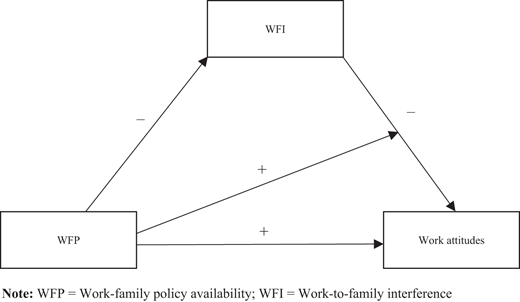
Third, while previous meta-analyses reported mixed findings regarding the hypothesis that single policies were more strongly related to reduced work–family conflict than multiple ones (Butts et al., 2013), the need for investigating the role of different policy types on work–family conflict still requires empirical investigation (Sutton and Noe, 2005). Moreover, recent research posits that policies differ in the way they convey organizational control, with enabling policies giving employees latitude over when, where and how much they work, and enclosing policies that, on the other side, aim to maximize employees’ availability for work by providing services that remove employees’ need to leave work (Bourdeau et al., 2019; Friedman, 2001). This study sets out to provide a first empirical investigation of the extent to which different bundles of policies relate to work–family conflict and different work attitudes. In doing so, this research contributes to advance theoretical and practical knowledge on the types of programs to be implemented to facilitate return to work after maternity leave.
Theoretical background
Relationship between work–family policies and work attitudes
Reflecting the changing workforce demographics, organizations have recently become more responsive to work–family issues, offering a more extensive array of formal WFP (Clark et al., 2017). WFP represent one of the means through which organizations may respond to employee family needs (Swody and Powell, 2007), providing support to reduce conflicts and stress related to employees fulfilling multiple roles in life (Kossek, 2005). When role demands from one domain are incompatible with role demands in the other domain, this may result in adverse interactions between work and family (Greenhaus and Beutell, 1985).
Work–family conflict is highly probable to occur among employed parents who represent a group of people likely to feel the burden of multiple demands from work and non-work domains (Brough et al., 2009). Previous findings report that mothers are more vulnerable to role conflicts (Brough and O’Driscoll, 2005; Brown, 2010; Freudenburg and Davidson, 2007; Losoncz and Bortolotto, 2009; Somech and Drach-Zahavy, 2007), which can be explained according to resource-drain theory postulating that personal resources are finite, and resources expended in one domain are not available in another (Edwards and Rothbard, 2000). That is, resource drain is likely to impact working mothers in the face of competing multiple-role demands, resulting in stress-related outcomes such as work–family conflict (Michel et al., 2011). Women in leadership positions are likely hit especially hard by work–family conflict as these positions entail a significant amount of responsibility to the company’s financial performance, and female managers are more highly scrutinized than their male counterparts (Hoobler et al., 2018).
Building on the job demands–resources (JD-R) theory (Bakker and Demerouti, 2007), we conceptualize WFP as a job resource. The JD-R theory assumes that all job characteristics within the work environment can be classified into job demands and job resources. Job demands are defined as “those physical, social, or organizational aspects of the job that require sustained physical or mental effort and are therefore associated with certain physiological and psychological costs” (Demerouti et al., 2001, p. 501). On the other side, job resources are conceptualized as:
[…] those physical, social, or organizational aspects of the job that either are functional in achieving work goals; reduce job demands and the associated physiological and psychological costs; or stimulate personal growth and development (Demerouti et al., 2001, p. 501).
Whereas job demands are generally the most important predictors of negative work-related outcomes such as exhaustion (Bakker et al., 2003), job resources are generally the most important predictors of work motivation and engagement (Bakker et al., 2007).
Scholars argue that job resources are instrumental in achieving work goals and that they play an intrinsic motivational role because they satisfy the basic human need for either autonomy, relatedness or competence (Schaufeli and Taris, 2014; Deci and Ryan, 2000). In this study, we argue that WFP can represent a means to achieve work goals, for example, when they are perceived as allowing better time-management or a means through which satisfying one’s basic need, e.g. the one for autonomy when they refer to flexible work arrangements. Accordingly, we place WFP as a specific job resource that, if coupled with others such as social support, development opportunities and performance feedback, can serve to stimulate positive work attitudes and reduce the negative impact of work–family conflict (Mauno et al., 2006). Research suggests that adopting the JD-R theory to the study of organizational policies can provide important insights to the design, implementation and monitoring of such policies because it sheds light on the psychological processes underlying the development of work and organization outcomes associated with perceived resources and demands (Costantini et al., 2017). That is, in the context of this study, such a framework allows understanding whether and how specific WFP facilitate female managers’ coping with the job demands associated with motherhood, and if the availability of WFP can be particularly helpful at different levels of such perceived demands, eventually serving to support (or not) higher work-related well-being (Bakker et al., 2003).
In line with such a conceptualization, previous findings showed that the availability of WFP exhibits small but favorable relationships with positive work attitudes (Butts et al., 2013), intentions to stay in the job (Thompson and Prottas, 2006) and a negative relationship with work–family conflict (Thompson et al., 1999). Accordingly, we propose the following:
Policy availability negatively relates to work–family conflict.
Drawing on signaling theory (Spence, 1973), the availability of WFP may be interpreted as a symbol of corporate concern to employees’ family needs, likely to prompt positive work attitudes (Butts et al., 2013). That is, employees may interpret WFP as signals of corporate concern for their employees’ well-being, thereby forming impressions about a company’s motives (Goldberg and Allen, 2008). In turn, employees who feel supported by their organizations may feel obliged to reciprocate, which would translate into positive work and organization outcomes (Blau, 1964; Kossek and Thompson, 2016). Past findings support this argumentation, particularly with regards to the relationship between the availability of work–life benefits and increased organizational commitment (Allen, 2001; Behson, 2005; Casper and Harris, 2008; Grover and Crooker, 1995). Similarly, work engagement, which is substantially influenced by job resources (Schaufeli and Bakker, 2004), i.e. WFP, will be positively related to policy availability. Based on this, we propose the following:
Policy availability positively relates to (a) affective commitment, (b) work engagement and (c) continuance commitment.
Work–family conflict and its relationship with work attitudes
Work–family conflict represents the most commonly studied experience at the work–family interface. Even if it has been defined as inherently non-directional (Greenhaus and Beutell, 1985), once a decision is made for resolving the conflict, it usually results in work-to-family interference (WFI) or family-to-work interference (Grzywacz and Smith, 2016). Several studies investigated how these different forms of conflict relate to organizational outcomes. Findings reported that WFI is positively related to continuance commitment (Casper et al., 2002; Lyness and Thompson, 1997) and that it predicts job dissatisfaction. Such a relationship has been argued to reflect the fact that employees who experience WFI, yet remain employed with their organizations, may attribute their commitment to aspects of “need” (i.e. they feel that they need to continue working in that environment; continuance commitment), as opposed to aspects related to “want” (i.e. the feeling of wanting to work in that environment). This may also suggest that mothers who experience WFI remain with their organizations out of necessity rather than choice (Casper et al., 2002). Research also reported evidence of a negative relationship between WFI and affective commitment, as well as with work engagement (Good et al., 1988; Lyness and Thompson, 1997; Opie and Henn, 2013; Thompson et al., 1999).
Literature defines affective commitment as denoting an emotional attachment to the organization and continuance commitment as denoting the perceived costs associated with leaving it. As WFI represents the type of conflict originating in the work domain, it may be associated with lower emotional attachment (i.e. affective commitment) to the organization (Casper et al., 2002). Moreover, drawing on findings supporting a source attribution perspective in linking WFI and attitudes (Shockley and Singla, 2011), it is likely that people would blame the organization for work interfering with family, eventually reporting lower intention to continue, i.e. lower continuance commitment:
WFI negatively relates to (a) affective and (b) continuance commitment.
Although an extensive body of literature investigated the relationship between WFI and several work outcomes, less attention has been paid to the study of the link between WFI and work engagement. Studies investigating the role of work engagement inside organizations showed its relevance for employees’ well-being and work behavior (Sonnentag, 2003) and that engaged employees transfer their engagement to others in their immediate environment (Bakker and Xanthopoulou, 2009). Even though work engagement does not represent a recurrent outcome associated with WFI, one notable exception is the study conducted by Opie and Henn (2013), who reported that WFI negatively predicts work engagement among mothers. Considering these findings, we propose that:
WFI negatively relates to work engagement.
Model of the psychological mechanisms between work–family policies, work–family conflict and work attitudes
Building on the relationships described in the previous hypotheses, work–family conflict represents a mediator of the relationship between WFP and work attitudes. Accordingly:
Work–family conflict mediates the relationship between the availability of WFP and work attitudes, i.e. organizational commitment and work engagement.
Moreover, drawing on the JD-R framework, we expect that the availability of different bundles of WFP will buffer the negative effects of WFI on affective commitment and work engagement. Indeed, previous findings reported that WFP relate to employee outcomes through lower work–life conflict (Beauregard and Henry, 2009). Along with previous hypotheses, this argument involves a moderated mediation process (MacKinnon, 2008; MacKinnon and Fairchild, 2009; Muller et al., 2005) where:
The availability of work–family policies buffers the negative relationship between WFI and work attitudes, such that the proposed mediation through work–family conflict is stronger when work–family policies are not available (Figure 1).
Materials and method
Participants and procedure
Participation in the study was accomplished via a Web-based survey mailed to 345 female managers from different companies operating throughout Italy in a variety of different segments. On average, it took 20 min to complete the questionnaire. Table 1 sums up the characteristics of the participants. Potential participants were recruited from a national Web-community of female managers, from which we identified those stating in their profile of having at least one child under three-years old. Of the total number of surveys mailed, 238 questionnaires were considered valid and usable for the study for a response rate of 69%. All participants worked in a managerial position, were mothers and reported a mode of one child. A total of 37% of the participants stated they returned to work within the first six months from delivery, 47.6% within the first year, 10.6% within 18 months from delivery and 4.2% within 24 months from delivery. The mean age of respondents was 34 years, ranging from 29 to 52 years.
Characteristics of the participants
| Sample (N = 238) characteristics | % of sample |
|---|---|
| Educational qualification | |
| Junior high school diploma | 2.1 |
| High school diploma | 12.2 |
| Bachelor’s degree | 31.1 |
| Master’s degree | 41.2 |
| Postgraduate’s degree | 8 |
| PhD | 4.2 |
| Other | 1.3 |
| Marital status | |
| Married | 65.5 |
| Live-in partner | 23.9 |
| Single | 6.3 |
| Separated | 2.5 |
| Divorced | 1.7 |
| Partner | |
| Yes | 96.6 |
| No | 3.4 |
| Company’s sector | |
| Agriculture | 0.9 |
| Art, sport and entertainments | 5.3 |
| Building and engineering | 0.6 |
| Companies’ services | 10.6 |
| Education | 8.9 |
| Energy | 1.3 |
| Financial and insurance activities | 4.4 |
| Hotelier and food services | 5.1 |
| Information and communication services | 14.7 |
| Manufacturing | 4.7 |
| Other service activities | 13 |
| Real estate | 8.3 |
| Scientific and technician activities | 5.4 |
| Welfare, health and social services | 9.2 |
| Wholesales and direct market for professional use | 7.6 |
| Company’s size | |
| Micro-size company (less than 10 employees) | 28.6 |
| Small company (11–50 employees) | 22.8 |
| Medium-size company (51–250 employees) | 16.4 |
| Big company (more than 250 employees) | 32.2 |
| Annual income | |
| Less than €50,000 | 4 |
| €50,000–€53,000 | 8.2 |
| €54,000–€57,000 | 13.5 |
| €58,000–€61,000 | 36.8 |
| €62,000–€65,000 | 28.1 |
| More than €66,000 | 9.4 |
Each participant was asked to complete questions on demographic and role-related variables (i.e. age, education and company’s sector), and a questionnaire measuring WFI, work – family enrichment, work engagement and organizational commitment. All participants were given a notice containing a brief explanation of the purpose of the study and a statement ensuring the confidentiality of their results. Items were focused on the moment of organizational re-entry after childbirth by adding the following instruction before each scale:
Please note: These questions are about your overall situation since your return to work after maternity leave. Fill in the statements thinking about how you felt since you came back to work after your youngest child was born.
Question order was counterbalanced to avoid common method bias (Podsakoff et al., 2003).
Measures
Work-to-family interference.
Work interfering with family was assessed with six items of the short version of the work–family balance scale (Zhang et al., 2012). This scale has been developed based on the shortened version (13 items; Wooden, 2003) of Marshall and Barnett’s (1993) 26-item work–family strains and gains scale, which conceptualizes work–family balance as including work–family enrichment and work–family conflict (Grzywacz and Carlson, 2007). As for work–family conflict, the items capture aspects referring to work – family and work–parenting strains, i.e. multiple overloads and multiple-role conflict (Marshall and Barnett, 1993). A sample item is “Because of work, I often fail to take part in family activities.” Response options were on a seven-point rating scale from strongly disagree (1) to strongly agree (7). We also administered the six items measuring work–family enrichment (WFE) from the same scale. A sample item is “Work and family together enrich my life.” Results from a Pearson’s correlation indicated that the two scales were significantly and negatively correlated (r = −0.28; p < 0.01), indicating that, in our sample, those experiencing high WFI also reported low enrichment.
Work engagement.
Work engagement was assessed with 17-items from the Italian version of the Utrecht Work Engagement Scale (Pisanti et al., 2008). This version includes six items for the vigor (e.g. “At my work, I feel bursting with energy”) and absorption (e.g. “I am immersed in my work”) dimensions, and five items for the dedication dimension (e.g. “I am enthusiastic about my job”). Items were scored on a seven-point rating scale ranging from 0 (never) to 6 (always). Based on the results from Schaufeli et al. (2006), showing that the three dimensions are closely related, we used one overall index for work engagement (Cronbach’s α = 0.96).
Organizational commitment.
Seven items developed by Meyer and Allen (1991) assessed affective and continuance commitment. Three items measured the former (e.g. “This organization has a great deal of personal meaning for me”) and four the latter (e.g. “I feel that I have too few options to consider leaving this organization”). Responses were made on a seven-point rating scale from strongly disagree (1) to strongly agree (7). Cronbach’s α for the affective commitment scale was 0.77, and 0.79 for the continuance commitment scale.
Availability of work–family support policies.
We examined multiple policies that referred to different bundles, e.g. flexible time management, training projects on maternity leave and organizational re-entry, parenting and pregnancy policies and organizational facilities. Participants were asked to indicate whether or not each policy was available in their organizations. Table 2 reports the items used to measure policy availability and the results of an exploratory factor analysis (EFA) conducted to examine what policies were perceived as referring to the same bundle in participants’ perceptions. After that, policy availability was treated as a count variable, summing the policies available for each bundle extracted from the EFA. In particular, from the results of the EFA, we extracted six factors (bundles) and summed the policies referred to each of such bundles:
Exploratory factor analysis on the 25 items from the work–family support policy part of the survey
| Items | Factors | |||||
|---|---|---|---|---|---|---|
| 1 | 2 | 3 | 4 | 5 | 6 | |
| Organization’s agreements with child care providers | 0.78 | |||||
| On-site daycare | 0.76 | |||||
| Timesaving services (ironing, laundry, group shopping, purchasing of local products and canteen takeaway meals) supplied either by the organization or by agreed providers | 0.75 | |||||
| Private expressing/breastfeeding room (space at work offering privacy for an employee to breastfeed and providing refrigeration facilities) | 0.69 | |||||
| Supplemental health insurance partially funded by the organization | 0.65 | |||||
| Smart work (no clocking in/out machine, the possibility of flexible working hours and the possibility of working from places other than the corporate office, etc.) | 0.88 | |||||
| Telecommuting (e.g., where an employee can work from home or outside of the central workplace using his/her own or the organization’s equipment) | 0.74 | |||||
| Possibility of videoconferencing by using Web platforms (such as Skype and Join me) | 0.68 | |||||
| Self-rostering and/or staggered start and finish times (picking your own start and finish times and/or days as long as you work an agreed number of hours) | 0.62 | |||||
| Flextime for start and finish times with a core time reduced to a minimum | 0.59 | |||||
| Forms of working hour’s flexibility available to pregnant employees (e.g. possibility to break up holidays and to get special leaves) | 0.88 | |||||
| Particular attention to the handover process before and after the maternity leave period | 0.73 | |||||
| Paternity support policies | 0.65 | |||||
| Realignment of skills with relevant role at the end of the maternity leave period | 0.64 | |||||
| Possibility to break up the maternity leave period in a customized way | 0.59 | |||||
| Appointment of colleagues–tutors who will be responsible for keeping the mother informed on organizational issues | 0.70 | |||||
| Involvement of employees during the maternity leave (invitation to meetings, reception of official communications, possibility to access work e-mail from home, etc.) | 0.66 | |||||
| Establishment of company’s dedicated online forums | 0.64 | |||||
| Specific training on the current regulations relating to maternity, health and safety measures to be taken during pregnancy | 0.59 | |||||
| Provision of motivational and/or psychological support to the new parents | 0.56 | |||||
| Special part-time arrangements in terms of distribution (“vertical” vs traditional part-time) and in terms of total working hours per week (18 h, 20 h, 30 h, etc.) | 0.95 | |||||
| Opportunity to negotiate part-time work for fulltime employees | 0.75 | |||||
| Flexible lunchtime | 0.44 | |||||
| The employee and the organization jointly develop a plan for the employee’s return to work | 0.80 | |||||
| Jointly identifying alternative organizational positions compatible with flexible working | 0.74 | |||||
Notes:
PAF extraction; promax rotation; Kaiser’s normalization; N = 243. Factors = 1 – organizational facilities; 2 – smart working; 3 – parenting and pregnancy policies; 4 – communication and psychological support; 5 – flexible time management; 6 – return to work management
organizational facilities, which refer to policies aiming at providing employees services and spaces to help manage work and family;
smart working, referring to policies aiming at allowing customization of the way in which working time/space is managed;
parenting and pregnancy policies, which refer to the management of the maternity leave period;
communication and psychological support, referring to the ways in which organizations provide specific measures to support information exchange and psychological support during pregnancy and/or maternity;
flexible time management, referring to part-time arrangements and the management of lunch breaks; and
return to work management, which refers to measures allowing a mutual agreement of the return to work phase after maternity leave.
Drawing on the assumption that policy availability must be observed by employees to be used (Thompson et al., 2004), policy availability was assessed as an individual-level measure of perceived availability rather than actual availability at the organizational level.
Controls.
We controlled for a number of demographic variables, including age, marital status, partner and number of children. Our results did not change when including these variables; hence, they were excluded from further analyses.
Results
Table 3 shows the means, standard deviations, internal reliability values and correlations among the variables of interest.
Means, standard deviations, reliabilities (along the diagonal) and correlations
| Variables | M | SD | 1 | 2 | 3 | 4 | 5 | 6 | 7 | 8 | 9 | 10 | 11 | 12 | 13 |
|---|---|---|---|---|---|---|---|---|---|---|---|---|---|---|---|
| Age | 34.37 | 5.60 | |||||||||||||
| Edu | 19.03 | 2.73 | 0.20* | ||||||||||||
| WFP1 | 1.57 | 0.54 | –0.07 | –0.15 | |||||||||||
| WFP2 | 1.11 | 0.34 | 0.09 | 0.07 | 0.39** | ||||||||||
| WFP3 | 1.13 | 0.39 | 0.12 | 0.11 | 0.23* | 0.45** | |||||||||
| WFP4 | 1.54 | 0.67 | 0.14 | 0.17 | 0.17 | 0.27** | 0.11 | ||||||||
| WFP5 | 1.74 | 0.66 | 0.01 | 0.16 | 0.36** | 0.30** | 0.13 | 0.66** | |||||||
| WFP6 | 2.17 | 0.83 | –0.05 | 0.03 | 0.22* | 0.06 | 0.04 | 0.29** | 0.24* | ||||||
| WFI | 4.30 | 1.18 | –0.03 | –0.08 | –0.16 | –0.01 | 0.06 | –0.26** | –0.31** | –0.16 | (0.81) | ||||
| WFE | 4.83 | 1.25 | 0.01 | 0.04 | 0.34** | 0.21* | 0.21* | 0.33** | 0.34** | 0.05 | –0.28** | (0.90) | |||
| CC | 4.68 | 1.39 | –0.01 | –0.07 | –0.07 | –0.10 | –0.05 | –0.29** | –0.27** | 0.03 | 0.33** | –0.32** | (0.79) | ||
| AC | 3.32 | 1.51 | –0.04 | –0.09 | 0.24** | –0.05 | –0.11 | 0.30** | 0.33** | 0.06 | –0.31** | 0.32** | –0.35** | (0.77) | |
| WE | 3.68 | 1.30 | 0.02 | 0.09 | 0.32** | 0.15 | 0.17 | 0.26** | 0.32** | 0.06 | –0.33** | 0.68** | –0.32** | –0.38** | (0.96) |
Notes:
N = 238. Edu = years of education. WFP1 – organizational facilities; WFP2 – smart working; WFP3 – parenting and pregnancy policies; WFP4 – communication and psychological support; WFP5 – flexible time management; and WFP6 – return to work management. WFI = work-to-family interference; WFE = work–family enrichment; CC = continuance commitment; AC = affective commitment; WE = work engagement. **p < 0.01; *p < 0.05
Before testing our hypotheses, we ran confirmatory factor analyses (CFAs) to explore the factorial structures of our measures using AMOS 21.0 with maximum likelihood estimation (Byrne, 2001). As our policy measures are here conceptualized as formative constructs, i.e. explanatory combinations of indicators (Bollen and Bauldry, 2011; Fornell and Bookstein, 1982), we did not include them in the CFA. Accordingly, to check whether our policy measures were distinct from other constructs, we checked the correlation matrix. Results (Table 3) showed that the policy measures are correlated relatively low with other constructs, indicating that they do not substantially overlap.
As for the CFA, we followed established recommendations to report our findings (Hu and Bentler, 1998; Schumacker and Lomax, 2004; Klein et al., 1999). A model including the five study variables (WFI, WFE, affective commitment, continuance commitment and work engagement) supported the discriminant validity of our measures: χ2 (536 df) = 831.70, p < 0.001; comparative fit index = 0.93; Tucker–Lewis index = 0.92, root mean square error of approximation = 0.06 and standardized root mean square residuals = 0.08. (Table 4)
Fit statistics for the study method (N = 238)
| Model | Χ2 | df | Χ2/df | CFI | TLI | RMSEA | SRMR |
|---|---|---|---|---|---|---|---|
| Structural equation models | |||||||
| Measurement model: 5 factors: WFC, WFE, CA, CC and WE | 831.70 | 536 | 1.55 | 0.93 | 0.92 | 0.06 | 0.08 |
| 4 factors: WFC/WFE (combined), CA, CC and WE | 944.44 | 540 | 1.75 | 0.91 | 0.89 | 0.07 | 0.10 |
| 3 factors: WFC/WFE (combined), CA and CC (combined) and WE | 999.67 | 543 | 1.84 | 0.89 | 0.88 | 0.07 | 0.11 |
| 2 factors: WFC/WFE (combined) and CA, CC and WE (combined) | 1116.36 | 545 | 2.05 | 0.87 | 0.85 | 0.08 | 0.11 |
| 1 factor | 1364.01 | 546 | 2.50 | 0.81 | 0.78 | 0.10 | 0.10 |
Notes:
Χ2 = chi-squared; Χ2/df = normed chi-squared; CFI = comparative fit index; TLI = Tucker–Lewis index; RMSEA = root mean square error of approximation; SRMR = standardized root mean square residuals
H1 stated that policy availability should be negatively related to WFI. Results from regression analyses (Table 5) revealed a significant negative beta coefficient for communication and psychological support (β = −0.26, p < 0.01) and flexible time management (β = −0.31, p < 0.01), providing partial support for H1. H2 predicted that the availability of WFP is positively related to affective and continuance commitment, as well as work engagement. Results from regression analyses revealed that the availability of organizational facilities (β = 0.24, p < 0.01), communication and psychological support (β = 0.30, p < 0.01) and flexible time management (β = 0.33, p < 0.001) positively predicted affective commitment, partially supporting H2a. The availability of organizational facilities (β = 0.32, p < 0.001), communication and psychological support (β = 0.26, p < 0.01) and flexible time management (β = 0.32, p < 0.05) was also found to be positively related to work engagement, partially confirming H2b. As for H2c, results showed that the availability of communication and psychological support (β = −0.29, p < 0.01) and flexible time management (β = −0.27, p < 0.01) negatively predicted continuance commitment. H3 stated that WFI is negatively related to organizational commitment and work engagement. Results from the regression analyses showed that continuance commitment was positively related to WFI (β = 0.35, p < 0.001), while work engagement and affective commitment were negatively related to WFI (respectively: β = −0.32, p < 0.001; β = −0.30, p < 0.001).
Hierarchical regression analysis results for availability of work–family policies and work-to-family interference, predicting affective and continuance commitment and work engagement (N = 238)
| Predictor variables | Dependent variables | |||||||||||
|---|---|---|---|---|---|---|---|---|---|---|---|---|
| WFI | Affective commitment | Continuance commitment | Work engagement | |||||||||
| B | SE | β | B | SE | β | B | SE | β | B | SE | β | |
| WFP1 | −0.38 | 0.21 | −0.16 | 0.72** | 0.27 | 0.24** | −0.18 | 0.24 | −0.07 | 0.79*** | 0.22 | 0.32*** |
| WFP2 | −0.03 | 0.34 | −0.08 | −0.23 | 0.44 | −0.05 | −0.38 | 0.37 | −0.10 | 0.59 | 0.36 | 0.15 |
| WFP3 | 0.20 | 0.29 | 0.06 | −0.43 | 0.37 | −0.11 | −0.19 | 0.32 | −0.05 | 0.58 | 0.30 | 0.17 |
| WFP4 | −0.48** | 0.17 | −0.26** | 0.70** | 0.21 | 0.30** | −0.59** | 0.18 | −0.29** | 0.50** | 0.17 | 0.26** |
| WFP5 | −0.57** | 0.17 | −0.31** | 0.79*** | 0.21 | 0.33*** | −0.56** | 0.19 | −0.27** | 0.63** | 0.18 | 0.32** |
| WFP6 | −0.23 | 0.14 | −0.16 | 0.12 | 0.18 | 0.06 | 0.05 | 0.15 | 0.03 | 0.09 | 0.15 | 0.05 |
| WFI | −0.23*** | 0.06 | −0.30*** | 0.30*** | 0.06 | 0.35*** | −0.29*** | 0.07 | −0.32*** | |||
Notes:
Linear regression analysis. WFP1 – organizational facilities; WFP2 – smart working; WFP3 – parenting and pregnancy policies; WFP4 – communication and psychological support; WFP5 – flexible time management; WFP6 – return to work management. ***p < 0.001; **p < 0.01; *p < 0.05
H4 investigated the mediating role of WFI in the relationship between the availability of WFP and work attitudes. To test such a hypothesis, we used a bootstrap estimation approach with 5,000 samples (Preacher and Hayes, 2008). Results are reported in Table 6 and show that, depending on the policy considered, WFI acts as a full mediator between policy availability and work attitudes. Findings showed that the availability of organizational facilities was no longer a significant predictor of affective commitment after controlling for WFI (B = 0.57, SE = 0.26, ns) consistent with a full mediation. Likely, after controlling for WFI, flexible time management policies were no longer significantly associated with continuance commitment (B = −0.33, SE = 0.18, ns). The availability of parenting and pregnancy policies showed to be positively related to work engagement only when controlling for WFI (B = 0.66, SE = 0.28, 95% confidence interval [CI] = 0.09, 1.22) consistent with a partial mediation.
Indirect effects of work–family interference mediating the relationship between policy availability and work attitudes (N = 238)
| Models | Dependent variables | ||||||||
|---|---|---|---|---|---|---|---|---|---|
| Affective commitment | Continuance commitment | Work engagement | |||||||
| B | SE | CI 95% | B | SE | CI 95% | B | SE | CI 95% | |
| WFP1 | 0.57 | 0.26 | 0.05, 1.09 | −0.01 | 0.22 | −0.45, 0.43 | 0.67** | 0.21 | 0.25, 1.09 |
| WFI | −0.40** | 0.11 | −0.62, −0.17 | 0.44*** | 0.10 | 0.25, 64 | −0.32** | 0.09 | −0.51, −0.14 |
| WFP2 | −0.24 | 0.41 | −1.05, 0.57 | −0.37 | 0.34 | −1.04, 0.31 | 0.58 | 0.34 | −0.09, 1.25 |
| WFI | −0.44** | 0.11 | −0.67, −0.21 | 0.44*** | 0.10 | 0.26, 0.63 | −0.37*** | 0.09 | −0.56, −0.18 |
| WFP3 | −0.34 | 0.35 | −1.03, −0.35 | −0.28 | 0.30 | −0.87, 0.31 | 0.66* | 0.28 | 0.09, 1.22 |
| WFI | −0.43*** | 0.11 | −0.65, −0.21 | 0.46*** | 0.09 | 0.28, 0.65 | −0.38*** | 0.09 | −0.56, −0.21 |
| WFP4 | 0.52* | 0.21 | 0.11, 0.93 | −0.40* | 0.18 | −0.75, −0.05 | 0.35* | 0.17 | 0.01, 0.69 |
| WFI | −0.37** | 0.11 | −0.59, −0.14 | 0.40*** | 0.09 | 0.22, 0.59 | −0.32*** | 0.09 | −0.51, −0.14 |
| WFP5 | 0.60** | 0.22 | 0.17, 1.02 | −0.33 | 0.18 | −0.69, 0.04 | 0.46* | 0.18 | 0.10, 0.82 |
| WFI | −0.33** | 0.12 | −0.56, −0.10 | 0.40*** | 0.10 | 0.21, 0.60 | −0.30* | 0.10 | −0.50, −0.11 |
| WFP6 | 0.02 | 0.17 | −0.32, 0.35 | 0.16 | 0.14 | −0.12, 0.44 | −0.01 | 0.14 | −0.28, 0.28 |
| WFI | −0.43*** | 0.11 | −0.65, −0.21 | 0.47*** | 0.09 | 0.28, 0.65 | −0.37*** | 0.09 | −0.56, −0.19 |
Notes:
5,000 bootstrap samples; CI = 95% confidence intervals. WFP1 – organizational facilities; WFP2 – smart working; WFP3 – parenting and pregnancy policies; WFP4 – communication and psychological support; WFP5 – flexible time management; WFP6 – return to work management. ***p < 0.001; **p < 0.01; *p < 0.05
Finally, H5 stated that the availability of WFP moderates the mediation through WFI. To test this hypothesis, we used bootstrapping (Shrout and Bolger, 2002), as suggested by MacKinnon et al. (2007). Results are reported in Table 6.
Results (Table 7) revealed that among all the different policies considered, the availability of communication and psychological support policies and of flexible time management acted as variables influencing WFI and moderating the effects of conflict on work engagement. That is, the availability of communication and psychological support at the organization was significantly related to WFI (B = −0.48, p < 0.001), which in turn was significantly related to work engagement (B = −0.32, p < 0.001). Additionally, flexible time management was significantly related to WFI (B = −0.57, p = 0.001), which in turn was significantly related to work engagement (B = −0.35, p < 0.001). As expected, there was a significant indirect effect of both communication and psychological support and flexible time management on work engagement through WFI [respectively: B = 0.42, p < 0.05; 95% CI (0.08, 0.75); B = 0.50, p < 0.01; 95% CI (0.16, 0.84)], as well as a moderation effect of policy availability on the influence of WFI on work engagement [respectively, for communication and psychological support, B = 0.35, p < 0.01; 95% CI (0.08, 0.62), for flexible time management, B = 0.51, p = 0.001; 95% CI (0.22, 0.79)]. In both cases, the conditional indirect effect was significant for those reporting medium and low levels of WFP. The index of moderated mediation (Hayes, 2015) corresponded to −0.17, 95% CI (−0.37, −0.04) for communication and psychological support, and −0.29, 95% CI (−0.58, −0.09) for flexible time management.
Moderated mediation model results (N = 238)
| Models | Dependent variables | ||||||||
|---|---|---|---|---|---|---|---|---|---|
| Affective commitment | Continuance commitment | Work engagement | |||||||
| B | SE | CI 95% | B | SE | CI 95% | B | SE | CI 95% | |
| WFP1 | 0.56* | 0.26 | −0.04, −1.09 | 0.01 | 0.23 | −0.45, 0.44 | 0.70** | 0.21 | 0.28, 1.13 |
| WFI | −0.40* | 0.11 | −0.62, −0.17 | 0.44*** | 0.10 | 0.25, 0.63 | −0.33* | 0.09 | −0.51, −0.15 |
| WFP1 × WFI | −0.06 | 0.22 | −0.48, 0.37 | 0.07 | 0.18 | −0.30, 0.43 | 0.24 | 0.17 | −0.11, 0.58 |
| WFP2 | −0.24 | 0.41 | −1.06, 0.58 | −0.37 | 0.34 | −1.05, 0.32 | 0.59 | 0.34 | −0.08, 1.25 |
| WFI | −0.44** | 0.11 | −0.67, −0.21 | 0.44*** | 0.10 | 0.25, 0.63 | −0.37*** | 0.09 | −0.55, −0.18 |
| WFP2 × WFI | 0.20 | 0.36 | −0.50, 0.91 | −0.13 | 0.30 | −0.72, 0.46 | 0.51 | 0.29 | −0.07, 1.08 |
| WFP3 | −0.49 | 0.38 | −1.24, 0.27 | −0.12 | 0.32 | −0.76, 0.51 | 0.61 | 0.31 | 0.00, 1.23 |
| WFI | −0.40* | 0.12 | −0.63, −0.17 | 0.43*** | 0.10 | 0.24, 0.62 | −0.38** | 0.09 | −0.56, −0.19 |
| WFP3 × WFI | 0.48 | 0.49 | −0.49, 1.45 | −0.51 | 0.41 | −1.32, 0.31 | 0.15 | 0.40 | −0.64, 0.94 |
| WFP4 | 0.55* | 0.21 | 0.14, 0.97 | −0.43** | 0.18 | −0.78, −0.08 | 0.42* | 0.17 | 0.08, 0.75 |
| WFI | −0.37** | 0.11 | −0.59, −0.14 | 0.40 | 0.09 | 0.22, 0.59 | −0.32*** | 0.09 | −0.50, −0.14 |
| WFP4 × WFI | 0.16 | 0.17 | −0.17, 0.49 | −0.17 | 0.14 | −0.45, 0.11 | 0.35** | 0.14 | 0.08, 0.62 |
| WFP5 | 0.61** | 0.22 | 0.18, 1.04 | −0.34 | 0.18 | −0.71, 0.02 | 0.50** | 0.17 | 0.16, 0.84 |
| WFI | −0.35 | 0.12 | −0.58, −0.11 | 0.42** | 0.10 | 0.22, 0.62 | −0.35** | 0.09 | −0.53, −0.17 |
| WFP5 × WFI | 0.15 | 0.18 | −0.21, 0.51 | −0.21 | 0.15 | −0.51, 0.10 | 0.51** | 0.14 | 0.22, 0.79 |
| WFP6 | 0.02 | 0.17 | −0.32, 0.35 | 0.16 | 0.14 | −0.12, 0.44 | 0.01 | 0.14 | −0.27, 0.28 |
| WFI | −0.43** | 0.11 | −0.65, −0.20 | 0.47 | 0.09 | 0.28, 0.66 | −0.37 | 0.09 | −0.55, −0.18 |
| WFP6 × WFI | 0.02 | 0.15 | −0.31, 0.27 | −0.02 | 0.12 | −0.26, 0.22 | −0.05 | 0.12 | −0.30, 0.19 |
Notes:
5,000 bootstrap samples; CI = 95% confidence intervals. WFP1 – organizational facilities; WFP2 – smart working; WFP3 – parenting and pregnancy policies; WFP4 – communication and psychological support; WFP5 – flexible time management; WFP6 – return to work management. ***p < 0.001; **p < 0.01; *p < 0.05
Discussion
This study focused on the psychological mechanisms through which the availability of WFP yields beneficial consequences for women in management positions who return to work after maternity leave. Following the basic premises of the JD-R theory (Bakker and Demerouti, 2014), in our study, we considered WFP as a job resource. Moreover, according to the buffering effect postulated in the JD-R theory, we expected WFP to moderate the negative effects of WFI on positive work attitudes, i.e. work engagement and organizational commitment. Our results contribute to the knowledge on how the availability of different bundles of WFP relates to managers’ work attitudes after they return to work following maternity leave, holding importance for both research and practice.
First, by adopting the JD-R theory to the study of boundary management (i.e. the ways in which individuals maintain, negotiate and transition across work and family roles) from an organizational perspective (Allen et al., 2014), our study contributes to the field of work–family boundary dynamics by answering the call to increase our understanding of the results and processes underlying the effectiveness of WFP. Moreover, by considering several types of policies, we were able to investigate how they differ in influencing WFI and work attitudes. Recent research suggests that, while WFP are often treated as if they were all created equal, they differ in the way organizational control is conveyed (Bourdeau et al., 2019). Accordingly, scholars argue that de-bundling policies permits to differentiate between enabling and enclosing mechanisms of control and to identify their effects on work attitudes. In our study, we show that different enclosing policies are linked to work attitudes while enabling ones are not. Consistently, our findings show that communication and psychological support, and flexible time management were either directly or indirectly related to work attitudes. Such policies represent enclosing ones, in that they encourage the management of maternity leave within rather than outside the organization. Indeed, even though flexible time management may suggest a more enabling mechanism of control, it refers to variations of the time around core business hours when employees must be at work, which is different from smart working policies that, on the contrary, refer to the ability to choose the work time of start/end, and/or the location from which to work (Bourdeau et al., 2019). Such findings may be explained based on the view that the status of motherhood may undermine the credibility of employees’ commitment (Correll et al., 2007), with women in management positions who return to work valuing organizational support in the form of policies permitting to signal greater work devotion.
In the current study, the availability of communication and psychological support, as well as flexible time management, are both positively related to affective commitment and work engagement, and negatively related to continuance commitment. This may suggest that the availability of such policies is likely to sustain positive affective attitudes referred to the organization, which may counterbalance feelings of instrumental considerations related to continuance commitment. Our study also confirms that WFI is a negative predictor of work engagement. This is consistent with existing literature on the relationship between WFI and burnout (Ahmad, 2010) and WFI and work engagement (Opie and Henn, 2013). Moreover, partially in line with previous research, the current study provides evidence that WFI negatively influences affective commitment (Lyness and Thompson, 1997; Thompson et al., 1999), and positively influences continuance commitment (Casper et al., 2002). While experiencing WFI originating in the work domain is likely to affect emotional attachment to the organization negatively, it is also presumable that mothers who experience such negative situations, yet continue to work with their organization, may attribute such feelings to necessity, rather than choice, eventually reporting higher levels of continuance commitment.
When considering WFI as a mediator of the relationship between policy availability and work attitudes, organizational facilities show to be no longer significant positive predictors of affective commitment, while flexible time management policies were no longer negatively linked to continuance commitment. That is, WFI undermines the importance of organizational facilities to feel emotionally attached to the organization while also sustaining perceptions referred to the need for staying in an organization because of the perceived costs associated with leaving it. When considering WFI as a mediator between parenting and pregnancy policies and work engagement, the availability of such policies become a significant predictor of higher work engagement, suggesting that such policies are perceived as important when perceptions of WFI are involved.
The current study also provides evidence of a mediated moderation in which WFI partially mediates the relationship between the availability of communication and psychological support and flexible time management policies with work engagement, and policy availability moderates the relationship between WFI and work engagement. That is, for female managers working in organizations where such policies are available, the effects of WFI on work engagement are lowered. This may suggest that working mothers who experience WFI in organizations where these policies are available are more likely to experience a positive, fulfilling, work-related state of mind, which allows them to be absorbed into their work and focused less on the negative impact of the competing role demands between work and family domains. Flexible time management and communication and psychological support are useful not only to reduce conflict, either symbolically or actually (Kossek and Ozeki, 1998), but also to buffer the negative effects of conflict on work engagement. These findings support the assumptions of the JD-R theory, which hold that job resources are useful to attain work goals and to buffer the negative effects of perceived demands (i.e. WFI) on motivational states (Bakker and Demerouti, 2017). Moreover, results suggest possible avenues for enhancing the use of JD-R theory as a model to improve work–life initiatives by detailing the psychological mechanisms through which these might be effective in sustaining work-related well-being. Our findings show that female managers’ positive work perceptions after motherhood can be sustained via the provision of WFP because these can lower perceptions of work–family conflict and its effect on motivational states. This suggests that such policies may be perceived as particularly powerful symbols among our participants because they provide organizational mechanisms to manage the boundaries of the work–family interface. In turn, this is likely to lower perceptions of WFI, because the awareness that the organization provides chances to manage the increased responsibilities and maintain a good work reputation is likely to alleviate the pressure from the participation in multiple roles.
Finally, our study provides valuable insights about which policies can stimulate positive work attitudes that are likely to be transferred to others in the immediate environment, i.e. work engagement (Bakker and Xanthopoulou, 2009). Accordingly, offering policies that increase work engagement among managers may yield multiplicative benefits, which may spread to the entire organization. Previous evidence showed that when managers were viewed as being understanding and supportive of employees’ needs, individuals experienced not only less conflict between their work and family life but also greater commitment to their organization and higher levels of job satisfaction (O’Driscoll et al., 2003).
Overall, findings suggest that the JD-R approach can be used to advance the literature on work–life balance by shedding light on the indirect and interactive effects of certain WFP on different positive and negative outcomes. This is particularly relevant given that, to date, the majority of studies on work interfering with family have focused only on direct relationships between work–family conflict and its outcomes (Rofcanin et al., 2017; Mauno et al., 2006). On the other side, such an approach also contributes to advance the JD-R theory by showing that factors spanning different life domains, i.e. policies and initiatives designed to support the daily management of responsibilities from spheres that are not limited to the work environment, can have a significant role in sustaining motivational processes in the workplace.
Limitations and future research
Given the nature of the study, several limitations need to be considered when evaluating the results. First, the conclusions we draw from the present research are based on a relatively homogenous sample of Italian managers, which might affect the transcultural validity of our results. Also, even though our study offers some initial insights to understand the role of different enclosing and enabling policies on the development of work and organization outcomes, research is needed to test whether the results would differ among other populations and controlling for policy use. Given that we collected measures on policy availability rather than use, our study suggests that employees’ awareness and interpretation of the signals sent through the availability of WFP can have an effect on both work engagement and commitment. Accordingly, organizations’ intentions to be supportive could also be signaled through different means that leverage, for example, on interpersonal communication and every day acts (Grandey et al., 2007), which could be investigated in future studies.
Moreover, even though our results provide valuable insights into the role of WFP in fostering work engagement and affective commitment while lowering WFI among female managers with children, future research should try to replicate our study on participants including also males and participants without children, to compare results from different groups (e.g. single female managers without children or those who have taken maternity leave some time ago). Also, while our participants were all mothers, we were not able to control for the effects of domestic and child-care help of participants’ role as primary caregivers. Research in this area may provide further insights to develop programs and policies targeted at the specific needs of organization members and accounting for their responsibilities in different life domains.
Although the cross-sectional data from our field study does not allow to draw definite causal conclusions (Butts et al., 2013) and reverse causality is possible (e.g. WFI influences the perception of WFP), our study was conceptualized under the premise that it is easier for companies to manipulate the presence of WFP and investigate the effects it has on WFI. Future studies should manipulate the presence of WFP experimentally to examine the causal direction in more detail. Moreover, future research could consider collecting data from both managers and employees to understand how managers’ experiences with WFP impact on their perceptions of employees using leave.
Finally, our study does not allow drawing conclusions about the extent to which our participants’ responses reflect the genuine choices of women in managerial roles returning to work after maternity leave rather than adherence to established norms regarding appropriate managerial roles. In this vein, it could be argued that WFP might indirectly serve to perpetuate stereotypical working patterns rather than to decrease women’s work–family conflict. Research in this area is needed to shed light on how WFP actually help in reducing work–family conflict, also depending on how WFP are experienced, interpreted and used in possibly different ways. Along this line, future studies could also consider investigating whether the experienced quality of the provided policy has a role over work-related attitudes and work–family conflict.
Conclusions and practical implications
The availability of communication and psychological support, as well as flexible time management, may result in higher affective commitment and work engagement for women in management positions who return to work after maternity leave. Moreover, this study shows that the availability of flexible time management and communication and psychological support lowers WFI and buffers its negative effect on work engagement.
These findings yield practical implications for developing human resource policies aiming at supporting the return to work after maternity leave. Although appointing women to leadership roles within organizations can symbolize a modern approach to management (Eagly and Carli, 2003), we argue that organizational structures need to be in place to accommodate a healthy work–life balance. Specifically, results indicate that organizations may support work-related psychological well-being of women in management positions who recently become mothers by offering services and spaces to facilitate the efficient management of work and family; providing measures to support information exchange and psychological support during pregnancy and maternity; and offering part-time arrangements and flexible management of breaks. Within current organizations, managers’ commitment to their occupation leads to the proper delivery and implementation of organization practices and, therefore, is deemed as a critical factor for the success of such practices (Oh et al., 2017). This may be especially interesting for countries with meager fertility rates and available support such as Italy, where women who experienced maternity and hold high responsibilities at work can contribute to reshaping discussions of women at work.
The first author wants to thank Serena Rubini for her valuable contribution to data collection regarding women's representation in the labour market in Italy.

