


The purpose of this paper is to investigate how important and correlated organizational capabilities are around the three subject areas of Quality Management (QM), Industry 4.0 (I4.0) and industrial decarbonization (ID). In addition, to support decision-makers with the creation of interdisciplinary frameworks for sustainable operations management.
This research develops a basis from a comprehensive literature review. Furthermore, the methodology applies structured data assessment grounded on quantitative analysis, coding, synthesis and interpretation, to propose a novel taxonomy and a framework.
Initially, 68 QM, 49 I4.0 and 30 ID capabilities are identified, spanning across categories that touch several spheres, such as leadership, technical, financial, cultural and human. Consequently, there is a potential in leveraging I4.0 technologies to achieve substantial advantages in operational performance and decarbonization, while advocating for a shift toward Sustainable Development Goals. Subsequently, a unified framework is created containing 49 unified capabilities, promoting the nexus between the three subject areas and underscoring the critical enablers in operational performance and carbon reduction strategies.
There is a limited number of empirical studies on capability interdependencies over the three pillars of operational excellence, I4.0 and decarbonization. Moreover, their influence on long-term competitiveness and the company’s subsistence is quite unexplored. The uniqueness of this research lies in offering decision-makers and experts a tool for the identification of one, two or three-directional capabilities that not only provide the given operational benefits but could lead to other potential gains in decarbonization and sustainable performance.
1. Introduction
The advancement of manufacturing processes has contributed to a global increase in environmental impacts due to unsustainable production practices. This effect is observed in developed countries such as Australia, which in 2023 had greenhouse gas emissions of 459.7 Mt CO2 eq. This represents a 0.5% decrease (versus the previous year), thus achieving the Paris Agreement’s 43% reduction target (versus 2005) remains a significant challenge (Australian Government, 2024). Moreover, a similar phenomenon is seen in developing countries (e.g. Brazil), with production processes relying on negative environmental impacts (Mattos Batista de Moraes et al., 2025). This reality points to the urgency for industrial decarbonization (ID) with a shift toward Sustainable Development Goals (SDGs) such as goals 12 – “Responsible consumption and production” and 13 – “Climate action” (United Nations, 2016). Therefore, advancing toward environmentally and operationally efficient production methods is essential in modern manufacturing. Manufacturing organizations have extensively implemented Quality Management (QM) approaches like Lean Six Sigma (LSS) to optimize production and minimize defects via standardized work processes (Nascimento et al., 2020). Emerging from the Toyota Production System in the 1970s, LSS has established itself as a key methodology for improving efficiency and reducing waste, serving as a fundamental component of QM in various industries (Sim et al., 2024). Moreover, lean strategies are congruent with the objectives of the ID paradigm and SDGs, providing a green approach to mitigating environmental consequences (Garza-Reyes, 2015).
As an addition to LSS, other technological advancements have emerged as catalysts of the low-carbon industrial transition. Industry 4.0 (I4.0), which incorporates digital technologies into production systems, has transformed the methods by which enterprises procure, process, create and distribute goods and raw materials. These digital transformation technologies not only improve social and technological results (Ejsmont et al., 2020) but also support the achievement of SDGs (Govindan, 2023), and increase the capacity of QM to promote sustainable practices, bolstered by the companies’ inherent capabilities.
Researchers have offered different terminologies for the concept of collective skills, processes and resources for growth toward high-quality innovation outputs, such as what is defined as “capabilities” by Dev et al. (2018) and Nursalim and Anshori (2024). Moreover, “dynamic capabilities” theory emphasizes organizations’ need to adapt to rapidly changing environments (Teece et al., 1997), such as those defined by I4.0. A similar approach can be observed with the study of “enablers” or “critical success factors” as, for instance, was observed in the investigation of operational excellence characteristics of a Brazilian organization (Scavarda et al., 2025). However, there is a significant research gap in components of organizational capabilities and how they can be systematically aligned with emerging technologies and business objectives. Researchers (Hoonsopon and Ruenrom, 2012) have shown capabilities’ impacts on product innovation, but mechanisms for aligning capabilities with specific objectives are insufficiently examined, while Ostadi et al. (2024) offered limited research on dynamic capabilities in I4.0 and a lack of integrative frameworks. Further, the limited empirical studies on capability interdependencies and their influence on long-term competitiveness exacerbate integration challenges (Dev et al., 2018). In addition, QM capability assessments often ignore the ID potential in favor of a generalist sustainability strategy based on the triple bottom line (Mohaghegh et al., 2021). Moreover, research lags behind in investigating the effect of the I4.0 capabilities as a catalyst of QM toward ID. Kuryło et al. (2023) found that digital manufacturing technologies mediate QM practices for low-carbon development, but did not address the organizational capabilities involved. To address these gaps, comprehensive models must combine technical progress, organizational contexts, decarbonization demands and capability interdependencies to help firms strategically navigate manufacturing complexities.
This document builds on these existing gaps by examining the interplay between QM, I4.0 and ID capabilities to facilitate ID and foster integrative, interdisciplinary frameworks for sustainable operations management. The study follows three stages:
a comprehensive literature review to form a data collection framework of practices and capabilities;
the introduction of a new taxonomy to assess their influence on sustainable operational performance; and
the application of a four-step data analysis to establish a preliminary relationship framework connecting QM, I4.0 and ID capabilities.
The remainder of the manuscript is organized as follows: Section 2 details the methods, Section 3 presents the findings and discussion and Section 4 concludes the study with suggestions for future research.
2. Methodology
This manuscript is grounded in a comprehensive literature review. The subsequent portion involves a data analysis to synthesize the collected materials, culminating in a coherent interpretation for the last phase of offering a theoretical framework (unified taxonomy). Figure 1 illustrates the methodology alongside the core results.
 The flow diagram presents a methodological approach organised into three stages. Stage 1 systematic literature review follows P R I S M A guidelines from 2021 and focuses on quality management, industry 4.0, and industrial decarbonization. Stage 2 data analysis includes qualitative thematic analysis and coding using open and axial approaches followed by synthesis and interpretation using N V I V O software. Iterations and redundancy checks connect the analysis steps. Stage 3 framework development performs matrixing through systematic rearrangement of capabilities, creation of a consolidated matrix for Q M, I 4.0, and I D, and harmonization of overlapping categories. The results section reports 16,992 papers initially identified and 166 papers investigated leading to 3 main subject areas, 21 categories, and 147 individual capabilities, followed by restructuring into 11 categories and 49 unified capabilities.
Methodological framework
Source: Authors’ own work
The flow diagram presents a methodological approach organised into three stages. Stage 1 systematic literature review follows P R I S M A guidelines from 2021 and focuses on quality management, industry 4.0, and industrial decarbonization. Stage 2 data analysis includes qualitative thematic analysis and coding using open and axial approaches followed by synthesis and interpretation using N V I V O software. Iterations and redundancy checks connect the analysis steps. Stage 3 framework development performs matrixing through systematic rearrangement of capabilities, creation of a consolidated matrix for Q M, I 4.0, and I D, and harmonization of overlapping categories. The results section reports 16,992 papers initially identified and 166 papers investigated leading to 3 main subject areas, 21 categories, and 147 individual capabilities, followed by restructuring into 11 categories and 49 unified capabilities.Methodological framework
Source: Authors’ own work
2.1 Literature review
The initial phase used a literature review around the three main topics (QM, I4.0 and ID), using the Scopus database and specific search strings during the period from October 2024 to January 2025. Scopus is widely recognized as a reliable database for accessing peer-reviewed research, making it especially useful for systematic literature reviews and bibliometric studies (Sakib et al., 2025). In the preliminary stages of the research, parallel queries were used in both Scopus and Web of Science with a further analysis of duplicates stemming from a structured overlap assessment as per recommended deduplication workflows for systematic reviews (Bramer et al., 2016). This overlap check showed that records meeting the inclusion criteria were shared across the two databases, with Scopus offering a broader multidisciplinary (Costa et al., 2024) and field-specific coverage (Maddi et al., 2025). To mitigate the potential limitations of relying on a single database for the inclusion of literature contributions, the pool of literature was complemented with proactive inclusions of key publications in the domain, obtained through snowballing techniques (Wiik, 2025), backward and forward citation chasing (Liu and Lu, 2025) and key-journal hand searches (Brooks et al., 2025).
The use of structured search strings was done in parallel for the comprehensive coverage of the three subject areas, as specified in Table 1. This methodological approach followed PRISMA guidelines (Page et al., 2021), focusing on capabilities, sustainable operations, quality and digital manufacturing. The initial pool of documents was analyzed and further screened.
Search strings used in the literature review stage
| Subject area | Search string used in Scopus |
|---|---|
| QM | TITLE-ABS-KEY (lean or “lean six sigma” OR “quality management”) AND (manufacturing OR industry) AND (capabilities OR capability OR “success factors” OR enablers OR capacities OR competencies OR competences OR skills) |
| I4.0 | TITLE-ABS-KEY (“Industry 4.0” OR “Fourth Industrial Revolution”) AND (“capability” OR “capabilities” OR “success factors” OR “competencies” OR “skills”) |
| ID | TITLE-ABS-KEY (“industrial decarbonization” OR decarbonization OR decarbonisation OR “net zero” OR “low carbon” OR “scope 1” OR “scope 2” OR “scope 3” OR “carbon neutral” OR “carbon negative” OR “CO2 reduction” OR “reduction of CO2”) AND (capability OR capabilities OR enablers OR “success factors” OR competencies OR skills) |
The subsequent filtering steps involved filtering documents, removing non-English, non-peer-reviewed sources and document types outside the scope of articles and reviews. A rigorous title screening further refined these totals; abstracts were examined and additional studies from external sources were included, ensuring comprehensiveness and integrity, resulting in 50 included documents for QM, 51 for I4.0 and 65 for ID. Figure 2 graphically presents the strategy.
 The flowchart presents identification of studies via database Scopus for three topics quality management, industry 4.0, and industrial decarbonization. Initial records include 5,295 for quality management, 6,708 for industry 4.0, and 4,989 for industrial decarbonization. After limiting to records in English the counts become 5,121, 2,371, and 4,776. Restricting document sources to journals results in 2,878, 1,112, and 3,492. Limiting document types to articles and reviews results in 2,737, 1,098, and 3,366. Title review produces included counts of 44, 105, and 269, followed by abstract review producing 21, 30, and 64. Additional studies from external sources include 29, 21, and 1. The final totals included are 50 studies for quality management, 51 for industry 4.0, and 65 for industrial decarbonization. Exclusion criteria include records in other languages, non journal sources, non article document types, titles not aligned with the main goal, and abstracts not aligned with the main goal.
PRISMA diagram of the literature review around capabilities
Source: Authors’ own work
The flowchart presents identification of studies via database Scopus for three topics quality management, industry 4.0, and industrial decarbonization. Initial records include 5,295 for quality management, 6,708 for industry 4.0, and 4,989 for industrial decarbonization. After limiting to records in English the counts become 5,121, 2,371, and 4,776. Restricting document sources to journals results in 2,878, 1,112, and 3,492. Limiting document types to articles and reviews results in 2,737, 1,098, and 3,366. Title review produces included counts of 44, 105, and 269, followed by abstract review producing 21, 30, and 64. Additional studies from external sources include 29, 21, and 1. The final totals included are 50 studies for quality management, 51 for industry 4.0, and 65 for industrial decarbonization. Exclusion criteria include records in other languages, non journal sources, non article document types, titles not aligned with the main goal, and abstracts not aligned with the main goal.PRISMA diagram of the literature review around capabilities
Source: Authors’ own work
2.2 Data analysis
The subsequent methodological approach (data analysis) adapted a strategy from Tortorella et al. (2017), being further divided in two actions: qualitative analysis, followed by synthesis and interpretation.
2.2.1 Qualitative analysis and coding.
The first action consisted in qualitative analysis of the relationship between the pair QM-I4.0 and the cluster Sustainable performance – ID strategies. The adjusted thematic analysis (TA) method (Braun and Clarke, 2012) supported the data organization and treatment. TA is a flexible qualitative method designed to identify, analyze and interpret patterns of meaning or themes within data, by generating themes from codes. Codes represent the smallest meaningful units in the data, and these are later grouped to form themes, which encapsulate larger patterns underpinned by a central organizing concept. This method is adaptable to various types of data, sample sizes and research questions, making it a valuable tool in this case (Clarke and Braun, 2017).
The coding process involved two phases: open coding and axial coding (Williams and Moser, 2019). In the first, each capability was directed to thematic nodes, identifying key themes like leadership skills, technical expertise and sustainability practices, as well as subthemes within these categories (e.g. leadership autonomy, data analysis proficiency). In the second phase, connections between capabilities are formed, forming higher-order clusters, referred to as “categories” and represented in italics. For example, managerial attributes are placed under the Leading and Deciding category. Technical aspects related to “Data Security,” “Cyber Literacy” and “Digital Twins” are combined under the Information and Technology category, reflecting the alignment with Chaka’s competency clusters (Chaka, 2020).
2.2.2 Synthesis and interpretation.
After the coding and categorization, data was synthesized following Shaw’s identification and synthesis qualitative strategy (Shaw, 2011), identifying patterns and relationships between capabilities, with emphasis on categories that had a direct link to a specific topic. During this scrutiny, potential redundancies were identified and refined. Figure 3 exemplifies the synthesis and interpretation process, with the manipulation of one specific category of the I4.0 capabilities. For instance, the capabilities “17. Intercultural skills,” “18. Networking skills” and “1. Cooperation and collaboration” were synthesized into “2.8. Collaboration and intercultural networking.” Some of the capabilities were moved to other categories, such as “6. Digital workforce competence: digitally literate and digitally interactive,” which was moved to the I4.0 and Digital Transformation category. Other capabilities were maintained due to their uniqueness, such as “21. Ability to work under pressure.” The same approach was taken for all the other capabilities and categories within the three subject areas (QM, I4.0 and ID).
 The diagram compares an original list of workforce competencies and skills with a revised cluster structure. The initial cluster includes competencies such as emotional intelligent workforce competence, social emotional competence, soft workforce competence, hard workforce competence, cognitive competence, digital competence, flexibility and adaptability, problem solving and analytical thinking, critical thinking and creativity, self management and planning, managing complexity, entrepreneurship competencies, language and communication skills, digital skills and e literacy skills, motivation to learn, ability and willingness to learn new things, intercultural skills, networking skills, teamwork ability, cooperative behaviour, ability to work under pressure, knowledge transfer ability, and communication between components of industry 4.0. The revised cluster titled demonstrating inter and multidisciplinary skills and mastering and displaying language specific skills reorganizes these competencies into categories including social emotional competence, hard workforce competence, cognitive problem solving analytical skills, flexibility and adaptability, self management and planning, entrepreneurship competencies, language and communication skills, collaboration and intercultural networking, ability to work under pressure, and ability to identify and provide value added information clearly and objectively.
Data analysis and manipulation of capabilities
Source: Authors’ own work
The diagram compares an original list of workforce competencies and skills with a revised cluster structure. The initial cluster includes competencies such as emotional intelligent workforce competence, social emotional competence, soft workforce competence, hard workforce competence, cognitive competence, digital competence, flexibility and adaptability, problem solving and analytical thinking, critical thinking and creativity, self management and planning, managing complexity, entrepreneurship competencies, language and communication skills, digital skills and e literacy skills, motivation to learn, ability and willingness to learn new things, intercultural skills, networking skills, teamwork ability, cooperative behaviour, ability to work under pressure, knowledge transfer ability, and communication between components of industry 4.0. The revised cluster titled demonstrating inter and multidisciplinary skills and mastering and displaying language specific skills reorganizes these competencies into categories including social emotional competence, hard workforce competence, cognitive problem solving analytical skills, flexibility and adaptability, self management and planning, entrepreneurship competencies, language and communication skills, collaboration and intercultural networking, ability to work under pressure, and ability to identify and provide value added information clearly and objectively.Data analysis and manipulation of capabilities
Source: Authors’ own work
The data analysis was followed by an interpretative approach, which outlined how various clusters contributed to decarbonization. “Leadership” highlighted top management’s advocacy for sustainability, while “Information and Technology” underscored digital tools for monitoring and reducing carbon emissions. Each analysis of the categories demonstrated how organizations could leverage QM, I4.0 and ID to enhance environmental performance. The findings were displayed in tables, providing a practical guide for organizations looking to adopt these strategies. In addition to the methodological actions, NVivo software aided data treatment, generating reports, word clouds and statistical insights, following Chawla et al. (2023). Using word frequency and text search query functions, it was possible to identify key terms and recurring patterns, aiding in the refinement of thematic categories. To enhance the visualization of the data, network graphs were generated following the methodological approach proposed by Hara et al. (2025). These illustrations facilitate the analysis of the co-occurrence patterns of references across different capabilities and categories.
2.3 Theoretical proposal
The subsequent stage created a matrix consolidating capabilities from the previous research stages, overlapping capabilities and categorizing their relevance to QM, I4.0, sustainable production and ID. The approach aligns with established frameworks for capability assessment and strategic planning in the digital manufacturing (Pinzone et al., 2023).
A critical aspect of the matrix development was the harmonization of overlapping constructs, because many QM, I4.0 and ID capabilities exhibited conceptual and functional similarities, demanding consolidation to avoid redundancy. Thus, iterations were executed with new data analyses, as described at subsections 2.2.1 and 2.2.2. In addition, the matrix categorized each capability according to its association with QM, I4.0, sustainable production and ID. Beyond the classification, the matrix was refined through a technical assessment of the interconnections among capabilities. The intricate relationships between QM, I4.0 and ID capabilities were examined to identify potential synergies and dependencies. The technical assessment also considered the alignment of capabilities with sustainable production and decarbonization goals. This involved evaluating the extent to which capabilities contribute to reducing industrial emissions and optimizing resource usage.
3. Results and discussion
The following sections will provide a thorough discussion on the interrelationships between the capabilities within specific categories. The specific capabilities of the tables will be referred to by the citation of their indexes within parentheses.
3.1 Quality management capabilities
Table 2 categorizes QM capabilities according to operations management and sustainable production taxonomies. Following the preliminary quantitative analysis (Table 3), Skills and expertise comprises 20 capabilities, with the majority associated with sustainable manufacturing. Process management (Q39) and data-based and fact-based decision-making (Q40) are essential for improving resource use and reducing emissions. Lobo and Ramanathan (2005) asserted that Information and Communication Technologies-enabled QM systems enhance energy monitoring, predictive maintenance and process standardization, hence reducing industrial carbon footprints. Similarly, lean-green integration promotes Just-In-Time production, life cycle assessment and environmentally sustainable product design (Simões et al., 2024; Sumant and Negi, 2018). The performance of green supply networks (Q44) highlights the importance of sustainable supply chains in the context of ID (Sumant and Negi, 2018). In addition, the incorporation of I4.0 into QM is apparent in capabilities such as the digital technologies integration with LSS (Q53) and improved supply chain coordination (Q54), which use sophisticated technology for sustainability (Zulfiqar et al., 2024). Finally, Black Belt LSS proficiency (Q55) underscores the need for adept personnel to propel sustainable QM activities (Stankalla et al., 2019).
QM capabilities toward sustainable performance
QM capabilities categories per number of capabilities
| QM categories | No. of capabilities (%) |
|---|---|
| Skills and expertise | 20 (29.4) |
| Leadership and management | 19 (27.9) |
| Organizational culture | 17 (25.0) |
| Technological capabilities | 5 (7.4) |
| HR management | 5 (7.4) |
| Finance | 2 (2.9) |
| Total | 68 (100) |
The Leadership and management category is the second most referenced in the data set, with 19 distinct capabilities identified. It has a critical role in defining strategic direction, securing top management commitment and allocating resources for effective implementation. Notably, linking LSS/I4.0 with business strategy/goals, supplier and customer (Q8) has a strong association with the triple bottom line approach for sustainability. In a case study with 33 experts, Alhuraish et al. (2017) concluded that LSS practices like 5S, Total Productive Maintenance and value stream mapping are intricately influential to environmental, social and financial sustainability. That is due to the identification and reduction of environmental impacts, such as waste and energy use. In addition, they can lead toward ID by pinpointing carbon-intensive areas in production. Top management commitment and support (Q15) is another significant capability. Scholars (Sumant et al., 2024) assessed small and medium enterprises (SMEs) and their critical success factors and pointed out that SMEs face unique challenges such as limited financial resources, technological adoption barriers and global competition. Therefore, the support from top leadership is key for minimizing defects and optimizing supply chains, also reducing raw material waste and pollution. On the other hand, change management (Q11) and empowerment (Q16) are essential for fostering a culture of continuous improvement and long-term sustainability (Chen, 2024). Therefore, as industries shift toward decarbonization, leaders must empower employees to develop and implement sustainable solutions, with strategic direction (Q14) and temporal considerations (Q18). This would suggest that effective leadership requires balancing immediate operational priorities with longstanding sustainability objectives (Ahmed and Mathrani, 2024).
Organizational culture includes 17 capabilities. A strong quality culture is essential for sustainable operations (Harolds, 2023), and capabilities such as continuous improvement (Q23) and cultural change (Q27) emphasize the need to adapt to sustainability challenges. Tortorella et al. (2017) found that 80% of lean success depends on leadership behavior, which incentivizes continuous flow and pull systems to reduce idle time and overproduction, aligning with decarbonization strategies. In addition, the reward system (Q28) and stakeholder enrichment (Q30) promote sustainable practices, ensuring that stakeholders benefit from financial (e.g. tax benefits and funding for sustainability projects) and social (e.g. brand reputation and corporate social responsibility [CSR] initiatives) factors. Sumant and Negi (2018) have seen organizations with a sustainability-driven culture engage stakeholders through financial and social incentives. Those, aligned with environmental goals enhance not only their competitive edge but also ID through green logistics, circular economy (CE) models and regulatory compliance. Furthermore, the emphasis on systemic thinking (Q31) (Sumant et al., 2024) and culture of innovation (Q32) (Dixit et al., 2022) reinforce that organizations must be holistic, integrating environmental, social and economic considerations into their QM practices, whereas lessons learned/best practice (Q36) (Stankalla et al., 2019) indicates organizations should continuously learn from past experiences to improve their sustainability performance.
The other categories (Technological capabilities, HR management and Finance) deserve attention by three main aspects. First, IT and innovation (Q59) and technology adaptation (Q61) are critical for organizations to adopt innovation in sustainable production (Yadav and Al Owad, 2022). Second, employee development (Q64) and linking LSS to human resources (Q65) are crucial for building a sustainability-skilled workforce (Zulfiqar et al., 2024). Third, the Finance category includes two key capabilities: resource availability/usage (financial and nonfinancial) (Q20) and finance position (Q21). These ensure organizations have the resources to invest in sustainable technologies and practices. Effective financial management allows allocation of resources toward decarbonization initiatives, including renewable energy projects and energy-efficient equipment (Kumar et al., 2023). A word cloud was generated (Figure 4), containing the most frequent terms within the QM capabilities list. The figure highlights key concepts associated with capabilities in QM, emphasizing themes such as “management,” “quality,” “LSS resources,” “performance,” “innovation” and “implementation.” These terms suggest a strong focus on resource management, leadership support and data-driven decision-making, which are fundamental in ID efforts. In addition, the presence of words like “technologies,” “financial,” “system” and “supply chain” indicates the importance of and financial considerations and, moreover, the potential for the integration of digital tools into QM practices.
 The word cloud displays terms appearing in the analysed literature on quality management and organisational capabilities. Prominent terms include management, quality, resources, performance, employee, project, focus, availability, human, tools, analysis, data, change, supply, manager, culture, skills, strategy, position, industry, factors, linking, business, supplier, customer, financial, technologies, implementation, organisational, benchmarking, system, innovation, adaptation, automation, reward, capability, belief, emphasis, improvement, accountability, and characteristics. Larger terms represent higher frequency within the analysed publications.
Word cloud of most frequent terms from QM capabilities
Source: Authors’ own work
The word cloud displays terms appearing in the analysed literature on quality management and organisational capabilities. Prominent terms include management, quality, resources, performance, employee, project, focus, availability, human, tools, analysis, data, change, supply, manager, culture, skills, strategy, position, industry, factors, linking, business, supplier, customer, financial, technologies, implementation, organisational, benchmarking, system, innovation, adaptation, automation, reward, capability, belief, emphasis, improvement, accountability, and characteristics. Larger terms represent higher frequency within the analysed publications.Word cloud of most frequent terms from QM capabilities
Source: Authors’ own work
The graphical representation of Figure 5 supports the assessment of the relationships in terms of the co-occurrence of bibliographical sources between QM capabilities. The closer the capabilities, the stronger their relationship in terms of co-occurring references. For instance, specific capabilities from Leadership and management, such as Q1, Q2 and Q3 are strongly related to Q47 and Q39, from the Skills and expertise category.
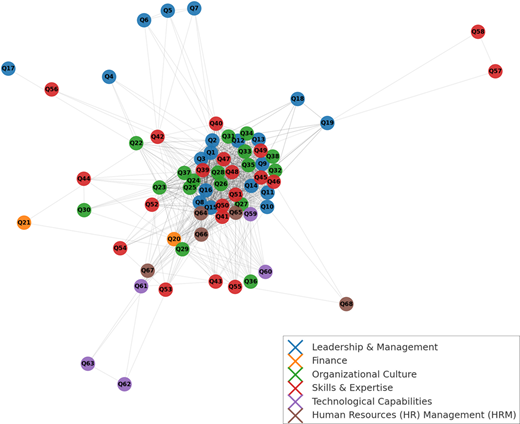
Even though the thorough analysis of QM capabilities can support decision-makers in the evolution of sustainable practices, the integration of I4.0 technologies into the status quo is particularly important, as it enables organizations to leverage advanced technologies to achieve their sustainability and further decarbonization goals. Consequently, a foremost concern is toward the assessment of how I4.0 capabilities are organized toward these common goals.
3.2 Industry 4.0 capabilities
Table 4 shows the 49 organizational capabilities for I4.0, classified within six categories. The data set indicates that the transition toward ID is strongly shaped by I4.0 capabilities. An initial analysis pointed to the most significant categories (Table 5), including Information and technology, which could be expanded to data literacy. Digital literacy and technical skills (I29), including computer programming (I30), are essential in managing modern industrial digital ecosystems. Caiado et al. (2024) used logic statistics to refine 34 I4.0 enablers and shortlist 10 main capabilities. They concluded that a balance between technology-driven interventions (intricately related to I29) and people-centered management is necessary for a successful transition to Industry 5.0. Organizations must adapt their strategies based on size, technological maturity and leadership commitment. Scholars (Tortorella et al., 2021) indicated that I30 has a significant correlation with lean/QM through the use of solidified tools such as PDCA (Plan, Do, Check, Act) and statistical analysis. Capabilities such as data awareness and security/prediction/integration (I19, I27 and I31) enable smart factories in which real-time data supports predictive maintenance and energy optimization. Survey evidence from Díaz Bermúdez and Flores Juárez (2017) emphasized that I4.0 adoption requires data analysis upskilling among operations leaders. Using a Delphi approach, Ostadi et al. (2024) concluded that data awareness and security/prediction feature in four of their 28 capabilities and are critical for ensuring the integrity of digital transformation; I4.0’s big data analytics, system integration and digital decision-making are key for sustainability (optimizing resources) and ensuring long-term competitive advantage. Finally, the creation of digital twins (I25) and ensuring transparency along the digitized system (I26), illustrate the potential of I4.0 technologies to monitor and reduce carbon footprints, while robust cyber security measures (I28) safeguard the integrity of these digital systems, ensuring that sustainability data remains accurate and reliable (Caiado et al., 2024; Ostadi et al., 2024).
I4.0 Capabilities toward sustainable performance
| Category | Index | Capability | Reference |
|---|---|---|---|
| Leading and deciding | I1 | Strategic management commitment | (Caiado et al., 2024; Chaka, 2020; Hecklau et al., 2016; Pinzone et al., 2023) |
| I2 | Leadership and autonomy | (Pinzone et al., 2023) | |
| I3 | Ability to adopt new models of work and organization with dynamic performance | (Díaz Bermúdez and Flores Juárez, 2017; Ostadi et al., 2024) | |
| I4 | Practice self-development as well as professional and personal continuous evolution | (Tortorella et al., 2021) | |
| I5 | Encourage participation in decision-making | (Díaz Bermúdez and Flores Juárez, 2017) | |
| I6 | Put the group’s interests above the individual ones | (Tortorella et al., 2021) | |
| Demonstrating inter/multi/transdisciplinary skills and mastering and displaying language-specific skills | I7 | Social (emotional) intelligent workforce competency: self-aware and empathetic | (Chaka, 2020; Flores et al., 2020) |
| I8 | Hard workforce competency: professional and dexterous | (Flores et al., 2020) | |
| I9 | Cognitive/ problem-solving/analytical skills | (Chaka, 2020; Flores et al., 2020) | |
| I10 | Flexibility and adaptability | (Chaka, 2020) | |
| I11 | Self-management and planning, manage complexity | (Chaka, 2020) | |
| I12 | Entrepreneurship competencies | (Chaka, 2020) | |
| I13 | Language and communication skills | (Caiado et al., 2024; Chaka, 2020) | |
| I14 | Collaboration and intercultural networking | (Caiado et al., 2024; Chaka, 2020; Hecklau et al., 2016) | |
| I15 | Ability to work under pressure | (Hecklau et al., 2016) | |
| I16 | Identify and provide value-added information clearly and objectively | (Tortorella et al., 2021) | |
| Information and technology | I17 | I4.0 infrastructure system | (Pinzone et al., 2023) |
| I18 | Knowledge of big data, cloud computing and emerging technologies | (Díaz Bermúdez and Flores Juárez, 2017) | |
| I19 | Data analysis ability and the use of tools for understanding the business and a smart factory | (Díaz Bermúdez and Flores Juárez, 2017; Ostadi et al., 2024) | |
| I20 | Knowledge and management of software and interfaces that support operations management | (Díaz Bermúdez and Flores Juárez, 2017; Ostadi et al., 2024) | |
| I21 | Virtual collaboration (participation in virtual forums) | (Díaz Bermúdez and Flores Juárez, 2017) | |
| I22 | Interoperability | (Ostadi et al., 2024) | |
| I23 | Understanding the strategies required for digitization | (Ostadi et al., 2024) | |
| I24 | Smart product development management (connecting the product development process to the value chain) | (Ostadi et al., 2024) | |
| I25 | Creating digital twins for simulation and virtualization | (Ostadi et al., 2024) | |
| I26 | Ensuring transparency of information along the digitized system | (Ostadi et al., 2024) | |
| I27 | Consistent data flow | (Caiado et al., 2024) | |
| I28 | Cyber security | (Caiado et al., 2024; Ostadi et al., 2024) | |
| I29 | Digital literacy and technical skills | (Chaka, 2020; Flores et al., 2020; Hecklau et al., 2016) | |
| I30 | Develop computer programming/coding | (Tortorella et al., 2021) | |
| I31 | Better resource management through Industry 4.0’s big data analysis and integrated systems | (Ostadi et al., 2024) | |
| I32 | Using Industry 4.0 technologies to integrate research and development departments | (Ostadi et al., 2024) | |
| Supply chain organization and processes | I33 | Supply chain and production systems | (Pinzone et al., 2023) |
| I34 | Product-service | (Pinzone et al., 2023) | |
| I35 | Data service | (Pinzone et al., 2023) | |
| I36 | Develop data processing and analytics | (Tortorella et al., 2021) | |
| I37 | Use continuous improvement practices and principles (PDCA, statistical process control) | (Tortorella et al., 2021) | |
| I38 | Manage with emphasis on value chain flow rather than on isolated operations | (Ostadi et al., 2024; Tortorella et al., 2021) | |
| I39 | Creating integration among dimensions (horizontal, vertical and end-to-end) and different departments | (Ostadi et al., 2024) | |
| Innovation | I40 | Creative and innovative practices | (Caiado et al., 2024; Chaka, 2020; Díaz Bermúdez and Flores Juárez, 2017; Ostadi et al., 2024; Tortorella et al., 2021) |
| I41 | Innovative business models | (Caiado et al., 2024) | |
| I42 | Develop research with external relations (public or private institutions) | (Díaz Bermúdez and Flores Juárez, 2017) | |
| I43 | Transdisciplinarity | (Díaz Bermúdez and Flores Juárez, 2017) | |
| I44 | Motivation to learn | (Hecklau et al., 2016) | |
| Circular and sustainability | I45 | Sustainable culture | (Caiado et al., 2024; Hecklau et al., 2016) |
| I46 | Focus on renewable natural resources | (Caiado et al., 2024) | |
| I47 | Compliance | (Hecklau et al., 2016) | |
| I48 | Achieving sustainability and developing it in different sectors in three (social, economic and environmental) dimensions | (Ostadi et al., 2024; Tortorella et al., 2021) | |
| I49 | Energy management through Industry 4.0 technologies | (Ostadi et al., 2024) |
I4.0 capabilities categories per number of capabilities
| I4.0 Categories | No. of capabilities (%) |
|---|---|
| Information and technology | 16 (33) |
| Demonstrating inter/multi/transdisciplinary skills and mastering and displaying language-specific skills | 10 (20) |
| Supply chain organization and processes | 7 (14) |
| Leading and deciding | 6 (12) |
| Innovation | 5 (10) |
| Circular and sustainability | 5 (10) |
| Total | 49 (100) |
Moving further, the Demonstrating inter/multi/transdisciplinary skills and mastering and displaying language-specific skills category is the second most significant, with 10 capabilities. Sustainability transformations require more than just strategic oversight; they demand a workforce that is both versatile and collaborative, because the competencies under this category are vital for driving innovative solutions in complex environments. Chaka’s (2020) classification of I4.0 skills, competencies and literacies into 28 subject disciplines developed an expanded competency framework (Big 11), identifying core digital, analytical and soft skills that are crucial for digital transition. Problem-solving and cognitive skills (I9) are the most frequently cited competencies in the author’s reviewed data, deemed as an essential 21st-century skill, often linked to critical thinking, creativity and innovation. Similarly, Flores et al. (2020) introduced a five-dimensional competency model to define Human Capital 4.0, where a cognitive workforce (intelligent and analytical) is presented as a key factor for successful organizations, constituted of verbal aptitude (i.e. vocabulary, orthography and reading comprehension), numerical aptitude (i.e. mathematics and arithmetic) and spatial aptitude (i.e. coordination, memory, decision-making, problem-solving, abstract reasoning and analytical thinking).
Flexibility and adaptability (I10) are crucial in an era of rapid technological advancements. Chaka (2020) states adaptability as both a personal and a professional requirement in response to automation, artificial intelligence (AI) and cyber-physical systems. In addition, entrepreneurship competencies (I12) in I4.0 (creativity, innovation and leadership) allow professionals to develop and implement disruptive solutions. Consistently, collaboration and intercultural networking (I14) enable cross-sector synergies to address global sustainability challenges. Hecklau et al. (2016) presented a competence-based framework for human resource management in I4.0, classifying them as technical, methodological, social and personal. Specifically, the social pillar emphasizes teamwork, networking and communication for culturally aware and internationally aligned operations. Finally, skills such as self-management (I11) and effective communication (I13) support efficient work in decentralized, dynamic settings, underpinning resource optimization and sustainable growth (Caiado et al., 2024; Chaka, 2020).
Although smaller than the main categories, the remaining groups still contribute to I4.0 and sustainability. Supply chain organization and processes category, including value chain management (I38) and integration across dimensions (I39), links lean and agile supply chains with digital technologies to reduce waste and improve resource efficiency. Also, continuous-improvement methodologies (I37) synergize with digitization to embed sustainability metrics and drive systematic reductions in energy use and emissions (Ostadi et al., 2024; Tortorella et al., 2021). Leading and deciding highlights strategic management commitment (I1), which keeps decarbonization programs on the organizational agenda (Pinzone et al., 2023). Adopting new work models (I3) shows organizational resilience to change, indicating that firms with agile and innovative structures are better equipped to implement sustainable practices into their core activities (Díaz Bermúdez and Flores Juárez, 2017; Ostadi et al., 2024). Participatory decision-making (I5) democratizes leadership, incorporating diverse perspectives to tackle complex sustainability challenges (Díaz Bermúdez and Flores Juárez, 2017). Innovation is central to the Fourth Industrial Revolution, with creative problem-solving (I40) and innovative business models (I41) demonstrating the role of innovation in sustainable transformation (Caiado et al., 2024). Research with external institutions (I42) and transdisciplinarity (I43) highlights the importance of collaborative innovation for addressing sustainability issues, while motivation to learn (I44) ensures organizations remain adaptive to evolving environmental regulations and green manufacturing technologies (Díaz Bermúdez and Flores Juárez, 2017; Hecklau et al., 2016). Finally, Circular and sustainability are directly aligned with decarbonization objectives. Sustainable culture (I45), renewable resource focus (I46) and compliance (I47) ensure adherence to environmental standards. Energy management through I4.0 technologies (I49) connects digital transformation with sustainability by leveraging smart grids, Internet of Things (IoT)-based energy monitoring and AI-driven energy optimization. Achieving sustainability across social, economic and environmental dimensions (I48) suggests a systemic approach, although explicit integration with digital strategies is often under-specified. Figure 6 presents the most frequent words observed in the list of I4.0 capabilities.
 The word cloud displays terms extracted from analysed literature related to cluster development and industrial management topics. Prominent terms include management, data, cluster, industry, product, value, development, technologies, skills, ability, information, chain, business, research, analysis, systems, knowledge, operations, collaboration, sustainability, service, participation, competency, models, dimensions, organization, supply, innovative practices, and digital aspects. Larger words represent higher frequency within the analysed dataset.
Word cloud of most frequent terms from I4.0 capabilities
Source: Authors’ own work
The word cloud displays terms extracted from analysed literature related to cluster development and industrial management topics. Prominent terms include management, data, cluster, industry, product, value, development, technologies, skills, ability, information, chain, business, research, analysis, systems, knowledge, operations, collaboration, sustainability, service, participation, competency, models, dimensions, organization, supply, innovative practices, and digital aspects. Larger words represent higher frequency within the analysed dataset.Word cloud of most frequent terms from I4.0 capabilities
Source: Authors’ own work
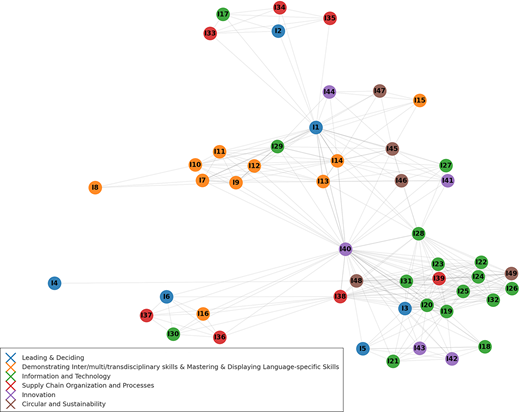
Similarly to section 3.1, the co-occurrence network from Figure 7 indicates reference relationships between I4.0 capabilities, as observed in I39, from Supply chain organization and processes category, relating strongly to I23 (Ostadi et al., 2024).
3.3 Industrial decarbonization capabilities
After the process of analysis, exclusion and clusterization, as described in Section 2, a list containing 9 categories and 30 capabilities was generated. Table 6 depicts the arrangement, with Figure 8 reflecting the 50 most-frequent terms within the ID capabilities list.
Industrial decarbonization capabilities
| Category | Index | Capability | Reference |
|---|---|---|---|
| Energy efficiency, renewables and low-carbon tech | D1 | Energy efficiency improvement | (Agrawal et al., 2023; Gavahian, 2024; Pan and Pan, 2021) |
| D2 | Renewable energy adoption | (Lu and Qiao, 2024; Orsini and Marrone, 2019; Pan and Pan, 2021) | |
| D3 | Low-carbon technology integration (i.e. carbon capture and storage) | (Bui et al., 2024; Cormos, 2025; Koilo, 2024; Pan and Pan, 2021; Yadav et al., 2024) | |
| D4 | Energy market development | (Miklautsch and Woschank, 2022) | |
| Carbon management and policy | D5 | Carbon pricing and trading (i.e. emission trading scheme, carbon market) | (Ambekar et al., 2019; Chaturvedi et al., 2024; Liu and Zhu, 2024) |
| D6 | Carbon information management and disclosure | (Ambekar et al., 2019) | |
| D7 | Greenhouse gas (GHG) measuring and reporting | (Lu and Qiao, 2024; Miklautsch and Woschank, 2022) | |
| D8 | GHG regulation and climate institutions | (Chaturvedi et al., 2024; Gavahian, 2024; Pan and Pan, 2021; Virmani et al., 2022) | |
| CE and resource management | D9 | Application of sustainable materials, waste management and recycling | (Ambekar et al., 2019; Gavahian, 2024; Orsini and Marrone, 2019; Yadav et al., 2024) |
| D10 | CE awareness from top management and consumers, knowledge and stakeholder engagement | (Yadav et al., 2023) | |
| D11 | Presence of economic and technical incentives and enablers for CE | (Agrawal et al., 2023; Kumar et al., 2023) | |
| Organizational culture, strategy and governance | D12 | Top management support and commitment | (Agrawal et al., 2023; Bui et al., 2024; Jabbour et al., 2015; Lopes de Sousa Jabbour et al., 2020; Miklautsch and Woschank, 2022; Virmani et al., 2022) |
| D13 | Behavior change and employee engagement | (Govindan, 2023; Jabbour et al., 2015; Ohene et al., 2023; Pan and Pan, 2021) | |
| D14 | Adoption of a green brand and low-carbon business opportunities | (Kumar et al., 2023; Lopes de Sousa Jabbour et al., 2020) | |
| D15 | Organizational structure and decision-making | (Agrawal et al., 2023; Peel et al., 2020; Virmani et al., 2022) | |
| D16 | Strong organizational culture, governance, corporate social responsibility and policy | (Kozlowska et al., 2024; Miklautsch and Woschank, 2022; Pan and Pan, 2021; Pan and Xiao, 2025; Virmani et al., 2022) | |
| Technology, R&D and digital transformation | D17 | Digitalization and presence of data analytics (i.e. business intelligence, digital self-service technology) | (Agrawal et al., 2023; Govindan, 2023) |
| D18 | Automation and advanced manufacturing (i.e. high computing power, information and communication technologies) | (Agrawal et al., 2023; Virmani et al., 2022) | |
| D19 | R&D, technology and infrastructure development | (Gavahian, 2024; Govindan, 2023; Kumar et al., 2023; Matviychuk et al., 2024; Miklautsch and Woschank, 2022; Pan and Xiao, 2025; Popp et al., 2024; Virmani et al., 2022) | |
| D20 | Real-time sensing and monitoring | (Agrawal et al., 2023) | |
| Stakeholder engagement and collaboration | D21 | Stakeholder collaboration and negotiation | (Lopes de Sousa Jabbour et al., 2020; Matviychuk et al., 2024; Virmani et al., 2022) |
| D22 | Procurement and interorganizational cooperation | (Miklautsch and Woschank, 2022; Ohene et al., 2023) | |
| D23 | Awareness of users and supply chain (stakeholders’ sustainability awareness) | (Koilo, 2024; Virmani et al., 2022) | |
| Skills, knowledge and education | D24 | Employee training and development in sustainability | (Gavahian, 2024; Jabbour et al., 2015; Miklautsch and Woschank, 2022; Pan and Pan, 2021; Popp et al., 2024; Virmani et al., 2022; Zhao et al., 2018) |
| D25 | Workforce existing expertise and skill management | (Dohale et al., 2024; Virmani et al., 2022; Wehden et al., 2025) | |
| Financial and economic tools | D26 | Cost management and availability of financial resources (i.e. life cycle cost management, strategic investments) | (Agrawal et al., 2023; Ambekar et al., 2019; Dohale et al., 2024; Miklautsch and Woschank, 2022; Virmani et al., 2022) |
| D27 | Financial and economic capabilities (i.e. financing instruments, incentive schemes) | (Chaturvedi et al., 2024; Dohale et al., 2024; Kozlowska et al., 2024; Matviychuk et al., 2024) | |
| Operations and efficiency | D28 | Operational efficiency and service (i.e. improvement of time to market) | (Agrawal et al., 2023; Koilo, 2024; Miklautsch and Woschank, 2022) |
| D29 | Process resilience and product quality (i.e. adoption of higher product safety, increased customization) | (Agrawal et al., 2023) | |
| D30 | Flexible and robust manufacturing | (Agrawal et al., 2023; Miklautsch and Woschank, 2022) |
 The word cloud presents terms extracted from literature related to carbon management, technology adoption, and organisational transformation. Prominent terms include technology, carbon, management, energy, adoption, development, organizational, awareness, market, financial, sustainability, business, information, employee, efficiency, product, manufacturing, stakeholder, computing, automation, analytics, service, collaboration, climate, cost, improvement, and change. Larger terms represent higher frequency within the analysed dataset.
Word cloud of ID capabilities
Source: Authors’ own work
The word cloud presents terms extracted from literature related to carbon management, technology adoption, and organisational transformation. Prominent terms include technology, carbon, management, energy, adoption, development, organizational, awareness, market, financial, sustainability, business, information, employee, efficiency, product, manufacturing, stakeholder, computing, automation, analytics, service, collaboration, climate, cost, improvement, and change. Larger terms represent higher frequency within the analysed dataset.Word cloud of ID capabilities
Source: Authors’ own work
The category of Organizational culture, strategy and governance is crucial, comprising five skills that span diverse behavioral and structural dimensions. Top management support (D12) endorses sustainability activities and ensures the provision of resources for decarbonization goals (Bui et al., 2024). This effect is also influential to lower spheres of the corporate hierarchy, as evidenced by Ohene et al. (2023), who understood behavior change and employee engagement (D13) as key capabilities toward ID. Agrawal et al. (2023) validated those, also indicating their influence in the adoption of emerging digital technologies advocated by I4.0. The pursuit of a green brand and low-carbon opportunities (D14) redefines strategic objectives for sustained resilience (Kumar et al., 2023), whereas the organizational structure and decision-making processes (D15) significantly affect the integration of sustainability into daily operations (Peel et al., 2020; Virmani et al., 2022). Therefore, the existence of a strong organizational culture and social awareness (D16) facilitates quality and environmental stewardship (Pan and Pan, 2021; Pan and Xiao, 2025). This was observed by Kozlowska et al. (2024) in an assessment with 40 experts from different domains, indicating that social responsibility actions (i.e. financing instruments, social innovation and innovative governance) stimulate decarbonization through energy efficiency, renewable energy, energy flexibility and sustainable mobility.
The Energy efficiency, renewables and low-carbon tech category, as displayed in Table 7, is one of the top clusters from ID. Energy efficiency improvement (D1) is critical for decreasing operational costs and emissions, drawing upon improved processes and technological updates (Gavahian, 2024). Renewable energy adoption (D2) extends these gains by substituting fossil fuels with cleaner energy sources (Lu and Qiao, 2024; Orsini and Marrone, 2019), thereby confirming an organization’s commitment to green transitions. On the other hand, low-carbon technology integration (D3), including the adoption of carbon capture and storage, offers a focused mechanism to curb GHG outputs, especially in high-emission industries (Cormos, 2025; Koilo, 2024). Finally, energy market development (D4) helps firms to unravel new trade opportunities and pricing regimes that reward efficiency, motivating a quick move to low-carbon operations. Miklautsch and Woschank (2022), in an investigation with experts from five segments (automotive, metal, food, materials and education), exposed the complexity of decarbonization of industrial logistics, pointing to the energy market development as a key enabler to shape a low-carbon industrial transition.
ID capabilities categories per number of capabilities
| ID categories | No. of capabilities (%) |
|---|---|
| Organizational culture, strategy and governance | 5 (17) |
| Energy efficiency, renewables and low-carbon tech | 4 (13) |
| Carbon management and policy | 4 (13) |
| Technology, R&D and digital transformation | 4 (13) |
| CE and resource management | 3 (10) |
| Stakeholder engagement and collaboration | 3 (10) |
| Operations and efficiency | 3 (10) |
| Skills, knowledge and education | 2 (7) |
| Financial and economic tools | 2 (7) |
| Total | 30 (100) |
The category centered around Carbon management and policy highlights emission trading schemes and carbon markets (D5) as creators of financial incentives for reducing emissions and the importance of proactive policy compliance (Liu and Zhu, 2024). Concurrently, carbon information management and disclosure (D6) ensures transparency in carbon footprints and cultivates stakeholder trust with clear reporting (Ambekar et al., 2019). Accurate GHG measurement and reporting (D7) are crucial for setting achievable emissions objectives and verifying performance improvements (Miklautsch and Woschank, 2022). Previous research in the Chinese dairy industry (Lu and Qiao, 2024) found a positive correlation between perception of climate change (evidenced by accurate carbon measuring) and proactivity to engage in carbon reduction strategies. Ultimately, GHG regulation and climate institutions (D8) create the institutional governance and regulatory frameworks that guide industries toward sustainable practices (Chaturvedi et al., 2024).
The category of Technology, research and development and digital transformation highlights the technological necessities for decarbonization. The employment of digital tools (D17) facilitates the monitoring of performance measures, the improvement of processes and the optimization of decision-making via data-driven insights (Agrawal et al., 2023; Govindan, 2023). Furthermore, automation and advanced manufacturing (D18) and real-time sensing and monitoring (D20) use sophisticated methods to enhance resource efficiency and product quality (Agrawal et al., 2023). This ensures immediate input on energy use and emissions, as corroborated by a study focused on the automotive industry in emerging economies. In their evaluation of 15-year-experience specialists, Virmani et al. (2022), the “adoption of advanced manufacturing technologies” is a critical success factor for decarbonization implementation. Similarly, research and development coupled with robust infrastructural support (D19) promote the continuous progression of innovative decarbonization technologies, enabling enterprises to sustain a competitive advantage in a sustainability-focused market (Matviychuk et al., 2024). These technological competencies collectively promote quality improvement and the attainment of carbon-neutral outcomes.
Finally, the other categories also pose as key enablers of ID. The CE and resource management category focuses on efficient resource management by implementing sustainable materials and recycling processes (D9) (Ambekar et al., 2019). Awareness among top management, consumers and stakeholders (D10) aligns sustainability principles with corporate culture (Yadav et al., 2023). Complementarily, economic and technical incentives (D11) accelerate CE adoption (Kumar et al., 2023), enabling resource optimization and stronger quality outcomes. Stakeholder engagement and collaboration highlights the importance of multi-party alignment for achieving sustainability. They involve negotiation (D21) (Lopes de Sousa Jabbour et al., 2020; Matviychuk et al., 2024; Virmani et al., 2022), procurement and interorganizational cooperation (D22) (Ohene et al., 2023). Finally, a broader awareness among end users and along the supply chain (D23) ensures that sustainability responsibilities are collectively recognized and acted upon (Koilo, 2024; Virmani et al., 2022). The category of Operations and efficiency highlights that achieving operational efficiency (D28) reduces waste and environmental impacts, thereby directly supporting ID while enhancing service quality. Process resilience (D29) ensures product excellence amidst market disruptions and strict environmental standards, while flexible manufacturing systems (D30) enable quick adaptation to green regulations and customer preferences (Agrawal et al., 2023; Miklautsch and Woschank, 2022). Skills, knowledge and education represent structured enablers of organizational learning in sustainability contexts. Thus, targeted training programs (D24) cultivate environmental and quality-focused competences across different hierarchical levels, leading to more informed decision-making and resilient operational practices (Popp et al., 2024). Also, effective management of existing skill sets (D25) ensures that organizations leverage their most valuable human resources to drive innovation and continuous improvement (Dohale et al., 2024; Virmani et al., 2022; Wehden et al., 2025). Ultimately, Financial and economic tools is the final category, which frames the economic rationale behind decarbonization. Organizations adept at comprehensive cost management (D26), including life cycle costing and strategic investments, gain a competitive edge and are better positioned to finance low-carbon transitions. Financial instruments and incentives (D27) have a similar importance level, creating economic structures that lower barriers to green initiatives (Dohale et al., 2024). By weaving economic feasibility into their strategic fabric, organizations can more reliably align QM endeavors with ambitious decarbonization targets. Figure 8 offers the most recurring words within the ID capabilities.
In addition, the co-occurrence network from Figure 9 can support the analysis of relationships between ID capabilities and categories, in terms of bibliographical sources. Upon further exploration, it shows how intertwined the ID capabilities are, excluding the capability D10 (outlier).
 The network diagram displays nodes labelled D 1 to D 30 connected through links representing relationships among capability elements within decarbonization and sustainability research. The nodes are grouped into clusters including energy efficiency renewables and low carbon technology, carbon management and policy, circular economy and resource management, organizational culture strategy and governance, technology research and development and digital transformation, stakeholder engagement and collaboration, skills knowledge and education, financial and economic tools, and operations and efficiency. The connections illustrate interactions among capability elements across these thematic clusters.
Co-occurrence network – ID capabilities
Source: Authors’ own work
The network diagram displays nodes labelled D 1 to D 30 connected through links representing relationships among capability elements within decarbonization and sustainability research. The nodes are grouped into clusters including energy efficiency renewables and low carbon technology, carbon management and policy, circular economy and resource management, organizational culture strategy and governance, technology research and development and digital transformation, stakeholder engagement and collaboration, skills knowledge and education, financial and economic tools, and operations and efficiency. The connections illustrate interactions among capability elements across these thematic clusters.Co-occurrence network – ID capabilities
Source: Authors’ own work
3.4 Unified taxonomy
The following discussion elaborates on the main categories derived from Table 8, which collates the individual capabilities (discussed in subsections 3.1, 3.2 and 3.3) into unified capabilities. It also organizes a framework that matches the capabilities to the three main pillars under investigation (QM, I4.0 and ID), acknowledging their potential intersectionality. These capabilities are strategically grouped under distinct categories, such as those more organization-focused, like Organizational culture, Sustainability and CE, Leadership and strategy and other relevant human-technical domains, including Human resources and Technological capabilities and even though the list is extensive, the discussion will focus on the most relevant categories and capabilities, with the aim of establishing a relationship where I4.0 technologies and capabilities act as a catalyzer of QM practices toward decarbonization.
Unified matrix of organizational capabilities
| Category | Individual capabilities indexes | Unified index | Unified capability | QM | I4.0 | ID |
|---|---|---|---|---|---|---|
| Leadership and strategy | Q1, Q7, Q15, D12, I1 | LS1 | Leadership and top management commitment | ✓ | ✓ | ✓ |
| Q2, Q8, Q14, Q17, Q18, Q19 | LS2 | Strategic direction, alignment and planning | ✓ | |||
| Q11, Q16 | LS3 | Change management and empowerment | ✓ | |||
| Q3, Q4, Q9 | LS4 | Benchmarking and business outcomes | ✓ | |||
| Q13 | LS5 | Connecting with government and science | ✓ | |||
| I2, I3, I4, I5, I6, D15 | LS6 | Leading and deciding approach (autonomy, new models, group orientation) | ✓ | ✓ | ||
| Organizational culture | Q22, Q23 | OC1 | Quality and continuous improvement culture | ✓ | ||
| Q26, Q27, Q29, D13 | OC2 | Employee involvement, cultural change and beliefs | ✓ | ✓ | ||
| Q30, Q31, Q32 | OC3 | Innovation and systemic thinking (stakeholder enrichment) | ✓ | |||
| Q33, Q34, Q36 | OC4 | Accountability, metrics and lessons learned | ✓ | |||
| Q35, Q28 | OC5 | Personnel satisfaction and reward system | ✓ | |||
| Q38, Q37 | OC6 | Strategic role of quality department and standardized procedures | ✓ | |||
| Q24, Q25 | OC7 | Focus on customers and suppliers | ✓ | |||
| D14 | OC8 | Green brand and low-carbon business opportunities | ✓ | |||
| D16 | OC9 | Strong governance, CSR and policy | ✓ | |||
| HR management | Q64, Q66 | HR1 | Human resources management and employee development | ✓ | ||
| Q12, Q68 | HR2 | Team emphasis and dedicated workforce | ✓ | |||
| Q65, Q67 | HR3 | Linking LSS/I4.0 with human resources (policies and rewards) | ✓ | |||
| Finance and resource management | Q10, Q20, D26 | FR1 | Resource availability and usage (financial and non-financial) | ✓ | ✓ | |
| Q21, D27 | FR2 | Financial position and economic capabilities (i.e. financing instruments, incentive schemes) | ✓ | ✓ | ||
| Skills and expertise | Q39, Q43, Q50, Q51, Q53, Q55, Q57, I7, I8, I12 | SE1 | Technical and methodological expertise (process, project, lean, Six sigma) | ✓ | ✓ | |
| Q40, Q46, Q47, Q52, D24, D25, I9, I10, I11 | SE2 | Data-driven decision making and analytics skills | ✓ | ✓ | ✓ | |
| Q41, I13, I14 | SE3 | Communication, collaboration and intercultural networking | ✓ | ✓ | ||
| I15, I16 | SE4 | Adaptability, working under pressure and clear information | ✓ | |||
| Q42, Q45, Q48, Q49, Q56, Q58 | SE5 | Domain technical and consumer expertise and sustainability (supply chain coordination, product/market knowledge) | ✓ | |||
| Technological capabilities | Q59, Q60, I17, I23, D17 | T1 | IT infrastructure and organizational infrastructure for Industry 4.0 | ✓ | ✓ | ✓ |
| Q62, Q63, I31, D18 | T2 | Automation, remote working and advanced manufacturing (i.e. high computing power, information and communication technologies) | ✓ | ✓ | ✓ | |
| Q61, I18, I19, I20, I21, I22, I24, I25, I26, I27, I28, I29, I30, I32, D19, D20 | T3 | Tech adaptation (knowledge of big data, cloud computing and emerging technologies), data analysis ability, integration and interoperability (data, cyber, R&D) | ✓ | ✓ | ✓ | |
| Supply chain | Q5, I33, I34, I35 | SC1 | Supply chain and production systems (incl. product-service, data) | ✓ | ✓ | |
| I36, I37 | SC2 | Data analytics and using continuous improvement in the supply chain | ✓ | |||
| I38, I39 | SC3 | Integration and value flow in the supply chain | ✓ | |||
| Q44, Q54 | SC4 | Supply chain coordination and green supply chain performance | ✓ | |||
| Innovation | I40 | IN1 | Creative and innovative practices | ✓ | ||
| I41, I43 | IN2 | Innovative business models and transdisciplinarity | ✓ | |||
| I42, I44 | IN3 | External research collaboration and continuous learning | ✓ | |||
| Sustainability, energy efficiency and CE | I45, I47 | SU1 | Sustainable culture and compliance | ✓ | ||
| I46, I48 | SU2 | Focus on renewable resources and achieving triple bottom line sustainability | ✓ | ✓ | ||
| Q6, D10 | SU3 | Presence of the environmental manager and CE awareness | ✓ | ✓ | ||
| D9 | SU4 | Waste management, recycling and usage of sustainable materials | ✓ | |||
| D11 | SU5 | Economic and technical enablers for CE | ✓ | |||
| D1, D2 | SU6 | Energy efficiency and renewable energy adoption | ✓ | |||
| D3, D4 | SU7 | Low-carbon technologies (i.e. carbon capture and storage) and energy market development | ✓ | |||
| D5, D6 | SU8 | Carbon pricing, trading (i.e. emission trading scheme, carbon market) and disclosure (i.e. carbon disclosure protocol) | ✓ | |||
| D7, D8 | SU9 | Greenhouse gas measurement, regulation and climate institutions | ✓ | |||
| Stakeholder engagement | D21, D22 | ST1 | Stakeholder collaboration, negotiation and procurement / interorganizational cooperation | ✓ | ||
| D23 | ST2 | Stakeholder’s sustainability awareness | ✓ | |||
| Operations and efficiency | D28 | OE1 | Operational efficiency and service improvement | ✓ | ||
| D29 | OE2 | Process resilience and product quality | ✓ | |||
| D30 | OE3 | Flexible and robust manufacturing | ✓ |
The Organizational culture category appears as the most relevant (tied with Sustainability, energy efficiency and CE), with a total of nine unified capabilities, stemming from the compilation of 20 individual ones. A capability worth highlighting within this cluster is the quality and continuous improvement culture (OC1), which fosters a predominant quality mindset that accelerates error mitigation and process standardization (Chen, 2024). This characteristic, even being predominantly associated to quality, as indicated in Table 8, also yields significant decarbonization opportunities when fostered by I4.0 technologies. This was observed in an empirical investigation of enterprise resource planning systems, where Yurtay (2025) found out that IoT devices enable continuous tracking of production processes, allowing for immediate adjustments to minimize waste and energy consumption. Similarly, employee involvement, cultural change and beliefs (OC2) prove fundamental in embedding lean and sustainability values in the company’s human workforce. When employees actively participate in shaping organizational routines, they reinforce collective responsibility for quality and green performance (Alkhoraif et al., 2019). All of those capabilities can be supported by standardized procedures plus the valuation of the strategic role of the quality department (OC6), in which Q38 and Q37 highlight how standardized procedures foster clarity in operational responsibilities and reduce variability (Sodhi et al., 2019).
Within Sustainability, energy efficiency and CE category (also the most relevant, with nine unified capabilities), the emphasis on renewable resources and achieving triple bottom line (SU2) emerges as a high-priority (Caiado et al., 2024; Hecklau et al., 2016), because prioritizing renewable energy and balanced economic-ecological outcomes promotes superior long-term resilience. However, similarly to the paradigm shift observed in the previous paragraph for the pair quality-continuous improvement, the use of renewable resources is not exclusively associated with sustainability. Scholars (Ah King and Rajkumarsingh, 2025) investigated I4.0 technologies as enablers of renewable energy in Africa, where a Kenyan AI-powered pay-as-you-go solar system confirmed the nexus of digital technologies to sustainable initiatives focused on low-carbon industrial transition, with cascading socioeconomic benefits. The capability of greenhouse gas measurement, regulation and climate institutions (SU9) underscores how quantitative frameworks for monitoring emissions support evidence-based decision-making and regulatory compliance (Gavahian, 2024) and by operationalizing it, organizations integrate climate considerations into strategic planning, thereby strengthening their competitive edge in emerging low-carbon markets.
Apart from the two main categories present in Table 8 and discussed above, the evaluation of the data presented in Table 9 displays an interesting perspective on the three main subject areas of this research. QM figures as the most covered topic of the three, confirming a concept that is solidified in global manufacturing for more than 50 years. On the other hand, a relatively recent topic, I4.0, is reflected by the lower number of organizational capabilities covered, highlighting the opportunity for further research in that direction. In addition, ID poses as a subtopic within sustainable production with a diverse applicability, as shown by the 48% of the unified capabilities covering it.
Unified capabilities coverage of the subject areas
| Subject areas | No. of capabilities (%) |
|---|---|
| Quality management | 27 (55) |
| Industry 4.0 | 17 (34) |
| Industrial decarbonization | 24 (48) |
| QM, I4.0, ID simultaneously | 5 (10) |
Finally, research has investigated the effect of the three subject areas in an intersectional approach. In this sense, five unified capabilities deserve special attention due to their holistic characteristic, simultaneously covering QM, I4.0 and ID. First, leadership and top management commitment (LS1) ensures that top leaders champion quality systems (Swarnakar et al., 2020), invest in digital transformation (Pinzone et al., 2023) and commit to emissions reduction targets (Bui et al., 2024). This is corroborated by Nasir et al. (2022), who established a correlation between transformational leadership and organizational sustainability using statistical techniques, also affirming the beneficial impact of I4.0 technologies as a catalyst of that relation. Confirming these findings, the second of those threefold capabilities is data-driven decision-making and analytics skills (SE2). Its concept underscores how big data proficiency serves as a linchpin for continuous improvement, real-time production control and energy optimization. The third and fourth of those holistic capabilities are IT infrastructure and organizational infrastructure for I4.0 (T1) and automation, remote working and advanced manufacturing (T2). Jointly, both represent the technology backbone required for operational excellence and lower carbon footprints. Bhosale et al. (2024) validated this I4.0–QM–ID nexus by proposing a model with industrial automation and predictive data analysis to support quality control, resulting in lowered reaction times, enhanced decision-making agility and reduction of waste. Ultimately, tech adaptation, data analysis capability and interoperability (T3) facilitate smart technologies to exchange data at different levels. It helps unify these elements through sophisticated digital tools and integrative platforms that facilitate lean practices, diminish energy usage and foster sustainable manufacturing. Researchers (Da Rocha et al., 2020) have examined semantic interoperability, defined as the sharing of information with unambiguous and clear meaning among I4.0 systems and agents. After assessing the reference models proposed for I4.0 within the Institute of Electrical and Electronics Engineers (IEEE) 451 family of standards, they concluded that this characteristic is essential for maintaining high-quality standards in manufacturing processes. As an additional contribution, Aranda et al. (2020) pointed out that both interoperability and tech adaptation provide many benefits from a sustainability perspective, with the optimization of material usage.
However, some balancing tensions and alternative explanations merit consideration in the current research. First, capability co-occurrence may reflect structural factors, such as firm size, capital intensity and regulatory exposure, rather than causal complementarity between QM, I4.0 and ID (Wankhede and Agrawal, 2025). Second, the environmental effects of QM and automation are mixed: rebound risks (e.g. higher energy demand from increased throughput or sensing/compute loads) and burden-shifting to upstream suppliers can offset expected gains, adding up to the undesirable effects of the technological evolution (Gaikwad and Wankhede, 2025). Third, the taxonomy construction from the systematic review process introduces interpretive subjectivity (search strings, inclusion/exclusion decisions, capability consolidation), and the evidence base is skewed toward English language/Organisation for Economic Co-operation and Development (OECD) contexts, limiting generalizability to the demanding reality of developing economies (Joshi et al., 2024). Finally, the unified matrix is conceptual and unweighted. Thus, the salience of specific capabilities depends on sector and carbon pricing factors (Mengesha and Roy, 2025). To mitigate these threats, future research should triangulate case studies and surveys reporting intercoder reliability (Lemke et al., 2025), run sensitivity analyses to alternative screening and merging rules and statistically test rebound conditions under carbon pricing scenarios. These strategies encourage cautious reading and delimit where the proposed framework is most reliable in practice.
As observed, current research has attempted to address the highlighted needs by proposing frameworks that frequently overlook the organizational capabilities perspective and its implications and are not comprehensive within the QM–I4.0–ID spectrum. Kabzhassarova et al. (2021) presented a Lean 4.0 matrix addressing the effects on sustainable performance, yet without addressing the capabilities that permeate Lean practices and I4.0 technologies. More recently, other authors (Eriksson et al., 2024), have proposed a framework toward human-centric Industry 5.0, meeting the demand for socially sustainable manufacturing. However, the approach was limited to social sustainability without considering the specific decarbonization constraints. Also, the investigation lacks further expansion into a holistic QM approach, limiting itself to Lean manufacturing practices. This research, opposed to the existing studies in the field, covers the paradigm of quality toward decarbonization in a comprehensive way, intertwining it with the effect of digital technologies by reflecting the findings in a novel model (Table 8). For example, the SU2 capability (Focus on renewable resources and achieving triple bottom line sustainability) can bridge this gap, guiding decision-makers in strategies toward investments in alternative power sources (e.g. solar, wind) with economic, social and environmental sustainability, alongside the possible interactions with QM strategies that would promote resource optimization (e.g. 5S, Just In Time).
Beyond the theoretical contributions, this research offers practical potential implications for practitioners and experts. For instance, in response to carbon pricing pressures, such as the European Union’s (EU) Carbon Border Adjustment Mechanism (Eicke et al., 2021), the proposed framework for QM and I4.0 toward ID could guide decision-makers into diagnosing, prioritizing, implementing and scaling up strategies:
Diagnose: Apply the 49-capability instrument to establish a baseline of organizational maturity and product-level emissions, mapping cost exposure per tCO2eq across processes and suppliers.
Prioritize: rank capability gaps by marginal abatement cost and operational benefit, targeting cross-domain enablers (QM–I4.0–ID) that reduce compliance risk and carbon costs.
Implement: run focused pilots with applied technologies and practices (e.g. SPC enhanced by IoT sensing; energy-analytics for process optimization) to assess capability adoption and eventual maturity increase.
Scale up: use QM strategies (e.g. DMAIC or PDCA) to track emission intensity, quality and throughput, then scale up to the upstream supply chain.
In practice, this sequence supports investment decisions with clear economic and commercial impacts, providing a case-based pathway and operationalizing capability requirements. This may benefit and eventually mitigate challenges stemming from rigorous policies implied by carbon pricing and border adjustments (Erdogdu, 2025). These implications align with the findings that cross-domain capabilities are critical enablers of operational performance and decarbonization.
4. Conclusions and further research
In this study, an investigation is done around how QM, I4.0 and ID capabilities synergize to support sustainable operations in manufacturing, especially concerning carbon reduction, a crucial element for the advancement of developing countries. To achieve this, a comprehensive literature review was executed, scavenging 166 papers that established the foundational framework for subsequent data collection and analysis. Building on this theoretical groundwork, a newly developed taxonomy was introduced to categorize and evaluate the interplay between QM, I4.0 and ID capabilities, connected to environmental performance outcomes. A unified framework is then created containing 49 key capabilities. This matrix underscores the critical enablers driving improvements in operational performance and carbon reduction strategies. Taken together, these steps culminate in a cohesive approach to examining and understanding the integration of QM and I4.0 toward ID, thus providing a necessary basis for practical decision-making models in sustainable operations management.
The findings presented in this work span across multiple-perspective threefold benefits. First, there is a significant potential in using I4.0 technologies, such as big data and cloud computing, to catalyze QM practices (i.e. Lean, continuous improvement) to attain significant benefits in sustainable operational performance and decarbonization, such as waste optimization and energy efficiency. Secondly, models like the framework presented in Table 8 can support managerial bodies to identify existing organizational capabilities in their companies that could bring extra benefits, on top of the most obvious ones. For instance, C7 (quality and continuous improvement culture) could not only bring operational benefits but also support the implementation of key SDGs that yield significant decarbonization impacts when coupled with some I4.0 capabilities. Third, the matrices and assessments presented could support the organizations to evolve in the deployment and adoption of new capabilities, accelerating their development toward higher stages of efficiency.
Even though it is very promising in bridging the nexus of the three main subject areas, this research may present some limitations that could be a positive opportunity for future research avenues. Even though academic production is solid in offering comprehensive views of QM and I4.0, the current propositions are built upon a concept of ID, which is significantly unexplored and incipient in research, which may raise some uncertainties in the effectiveness of the proposed findings. The suggested approach, as a theoretical and framework-oriented literature review, relies on search strings, screening choices and decisions about the manipulation of capabilities, which involve subjectivity and potential biases related to publication and language. Alternative interpretations are also feasible: observed co-occurrences may vary according to business size, sectoral energy intensity or regulatory exposure; additionally, certain I4.0 implementations may result in rebound effects (increased energy consumption) in the absence of governance and ongoing enhancement. This study also presents a theoretical framework on the subject, which might be further substantiated by case-study validation involving industry decision-makers and specialists. This would improve the model’s overall applicability while mitigating potential inaccuracies. To improve practical relevance, we elucidate stakeholder-specific implications: for academics, the 49 capabilities represent operationalizable constructs and testable propositions; for practitioners, a four-step process (diagnose–prioritize–implement–scale up) connects capability deficiencies to marginal abatement and operational Key Process Indicators; for policymakers, the framework delineates where capability-building incentives and policy mandates (e.g. border-adjustment schemes) should be directed; and for society, the pathway highlights avenues for emissions reduction with potential productivity and job quality benefits.
Finally, future research in this field could validate the theoretical proposals in the study via empirical research with actors in manufacturing industries. Further, it could explore the potential of companies in diagnosing their existing capabilities to assess their stage of maturity in QM, I4.0 and ID uptake. This would be accomplished by a precise specification of the benchmarks for maturity levels, accompanied by explicit criteria for progression. Those would be crucial for supporting the organizations and decision-makers in the creation of pathways for evolution to upgraded stages of maturity. This evolution could be achieved considering the three dimensions (QM, I4.0 and ID) as levelers, as the pathways could be executed one-, two- or three-dimensionally.

