This article responds to growing calls for enterprise education to address concerns of environmental degradation and damage wrought to ecosystems and communities associated with extractive economic models. Framed by the philosophy of personalism we examine how place can serve as a signature pedagogy for regeneration enterprise education and explore how learning situated in place can influence enterprise capabilities shaped by regenerative principles.
This research utilises a qualitative, illustrative case approach and is informed by action learning principles where cycles of reflection and engagement/action create situated learning. The study is theoretically underpinned by place as a relational context-specific construct and signature pedagogy as a framework for understanding how teaching can shape enterprise capabilities in line with regenerative principles.
The results show that place-based practice utilised in our signature pedagogy framework encouraged and empowered students to explore real-world construction from the perspectives of place and human development through lenses of economic opportunities and socio-ecological impact. The research is supportive of employing action-based learning and reflective inquiry with student engagement, frequency and depth of reflection supportive of the pedagogical value of the framework.
Answering recent calls for greater research into innovative approaches to enterprise curriculum development and pedagogy our proposed framework contributes to an evolving stream of research into the nature and role of signature pedagogies in enterprise education. Specifically, the framework breaks new ground in articulating how place can serve as regenerative signature pedagogy, specifically in entrepreneurship education. While the case study is located in the specific context of the construction industry, the richness of context possible from action learning suggests applicability of the framework into similar industries, and indeed into the general enterprise classroom.
For educators, our framework offers opportunities to engage their existing pedagogic practices with a theory-driven pathway supporting innovation of practices. The framework will support business faculty management curricula innovation. For policymakers and wider society, the framework positions regenerative enterprise pedagogy as offering enterprises opportunities to engage in regeneration and a navigational map of how interventions can succeed both for humans and wider ecological systems.
The research advances the literature by conceptualising place as a signature pedagogy in regenerative enterprise education. In doing this, the research answers calls to develop and embed regenerative enterprise as a credible alternative to extractive economic models.
Introduction
Contemporary approaches to enterprise, both in in practice, theory and pedagogy, increasingly advocate and engage with regenerative approaches (Kopnina et al., 2024; Sagendorf and Jackson, 2019; Turner and Gianiodis, 2018). Regenerative approaches to enterprise have emerged in response to demands for more sustainable approaches to business, stimulated by wider societal and political forces (Armon, 2021; Caldera et al., 2022; Caniglia, 2018; Wahl, 2019). Such sustainable approaches to enterprise have both engaged with wider sustainability initiatives but also responded to critics who have considered sustainability-induced responses inadequate and lacking in deeper engagement with the challenges at hand (Dodd et al., 2021, 2023; Hahn and Tampe, 2021). Specifically, such deeper concerns are noted as requiring greater engagement with human development. Philosophically, one means of engagement is provided by the personalist philosophy of Emmanuel Mounier and Jacques Maritain (Modarelli et al., 2025). In this personalist approach to regeneration, humans are situated as persons of inviolable dignity yet naturally embedded in human, societal and even wider natural relationships with the planet. Logically, this is most readily enacted at local levels where enterprises are embedded in specific place-related contexts (Hahn and Tampe, 2021). Recently, in an editorial to the Journal Corporate Governance and Control, Modarelli (2024: 1) articulates how “the profound transformation occurring over recent years, alongside the prevailing economic landscape, underscores the inadequacy of established management paradigms”. Regenerative enterprise then, is framed as a deeper response, addressing contemporary concerns and wicked challenges such as those posed by the UN Sustainable Development Goals (SDG)s. Based on Hahn and Tampe (2021) we define regenerative enterprise as enterprise oriented towards net positive impact based on symbiotic embeddedness in place, where the strategic focus aims to mutually support the co-evolution of ecosystems and enterprise through a long-term and cyclical approach. Alongside the emergence of regenerative approaches to enterprise, higher education institutions (HEIs) are argued to be on the cusp of a new era, requiring the integration of sustainability across university systems and disciplines (Christou et al., 2024). At the level of enterprise, such integration opens research opportunities into how pedagogy might be transformed to meet the challenges and opportunities.
Our article is positioned in the literature addressing how novel pedagogic approaches are required in the context of regenerative enterprise (Dodd et al., 2023; Gibbons, 2020; Konietzko et al., 2023; Kopnina et al., 2024; Wahl, 2019). In this context, we build on previous work arguing the role of place-based pedagogies in supporting pedagogic engagement with regenerative enterprise challenges and opportunities (Anderson et al., 2012; Boukis et al., 2020; Butler and Sinclair, 2020; Deringer, 2017; Kearney et al., 2025; Redhead and Bika, 2022). The study is focused by the question: How can place serve as a regenerative enterprise signature pedagogy? We build on advances that support the development of unique enterprise signature pedagogy (Hägg et al., 2024; Jones, 2019; Peschl et al., 2021; Ramsgaard and Blenker, 2022) and our unique contribution is to develop a conceptual framework of how place can act as a regenerative enterprise signature pedagogy. Empirical support for the framework is provided through action learning insights (Pedler et al., 2005; Zuber-Skerritt, 2002). These insights are drawn from a case study on teaching regenerative enterprise in construction management and quantity surveying at an emerging regional university. Theoretically, our contribution is framed by the personalist philosophy. This approach allows us to respond to the research question through both accepting the need for human development, which is economically natural to enterprise, while simultaneously being open to the needs of wider society and the natural environment.
The framework offers enterprise educators a theory-driven pathway supportive of improvement and innovation of their pedagogic practices and resonates with an action-oriented classroom generating outcomes in terms of regenerative enterprise skills at the level of “mind, hand and heart” (Shulman, 2005). Given the integration of a personalist philosophical approach into the article, the framework helps bring together contemporary aspirations for human development, wider society and the natural environment (Modarelli et al., 2025; Persico and Bucciarelli, 2025). This integration allows the study to speak to public policy makers who seek to develop novel pedagogies that respond to new and non-traditional forms of enterprise (Dodd et al., 2021). Finally, the framework offers a navigational tool for faculty management and administrative support in guiding how they may integrate regeneration into curriculum development.
The following section reviews key literature on regenerative enterprise, regenerative pedagogies, place and signature pedagogies. This is followed by a description of the case study context and methodological approach. The findings and proposed framework for teaching regenerative enterprise through a place-based lens are outlined, followed by a critical discussion and conclusion.
Background
Broadly, regeneration may be considered the process of renewal, restoration and growth that allows ecosystems to be resilient against challenging or damaging events or fluctuations (natural and human-made) (Carnevali, 2006). A central premise in regeneration is not merely to do less damage to the environment, but rather in learning how to positively participate with the environment (Reed, 2007). Building on this, Lazurko et al. (2024) posit that regeneration's importance emerges through its efforts to maintain the integrity of delicate systems (environmental, social and economic). Early work in the area focused on the requirements for a strategic shift from minimising harm to actively generating net-positive impacts on people and place (Mang and Reed, 2012; Reed, 2007). Such active engagement requires embracing new approaches to enterprise, and to reconsider the role of humanity, supporting a shift from a strongly individualist approach to the entrepreneur. This shift moves towards enterprise rooted in a personalist philosophy of the human, as worthy of inviolable dignity and thriving in an enterprise system, which recognises such dignity, and which promotes human development through relational engagement with community and place (Ongaro et al., 2025). There remains, however, debate over an accepted definition of regenerative development, yet many practitioners and scholars agree that regenerative development has three fundamental goals: increased prosperity and health of human and natural environments; creation of mutually beneficial relationships and inclusive resilience between human and natural environments and resources; respect for local places (economic, cultural and ecological) (Caniglia, 2018). These values correspond to the UN Sustainable Development Goals (SDGs) but crucially go beyond them in cementing the symbiotic nature of people and planet (Reed, 2007). One important differentiator between regenerative principles and the UN SDGs is the regenerative space's commitment to the idea of “net-positive” (Mang and Reed, 2015). These authors argue that “net-positive” is centred on actively adding value to ecological systems and in this way contributes to ecological sustainability “in terms of benefits to the systemic capability to generate, sustain and evolve the life of a particular place” (Mang and Reed, 2015). Drawing on these perspectives of regenerative development as an active, place-based engagement with environments, the following section explores how these principles inform regenerative enterprise.
Regenerative enterprise
Sanhokwe (2022) argues that collectively we are at an existential crossroads, where we either continue unabated towards an uncertain future with precarious climatic events as a growing threat, or we adapt to the equally enormous challenges of halting accelerating resource depletion and environmental degradation. Vlasov (2021) argues that regenerative business is slower, it is emotionally charged and value laden and impacts the types of ventures entrepreneurs choose to pursue and how they negotiate their struggles and successes. However, Wahl (2019) argues that difficulties associated with sustainability are dwarfed by the consequences of the alternative “do nothing” scenario.
In an enterprise context, this idea of protection of the global ecosystem is a mutual partnership. Hahn and Tampe (2021) argue that regenerative enterprise models are reciprocal and benefit and benefit from a healthy social-ecological system (Mehmood et al., 2020). However, effective adoption requires strategic support, including innovating curriculum development from our Higher Education Institutions (HEIs). Increasingly, scholars are calling for university programmes to focus on regenerative development, which acknowledges justice issues for people and the environment and finds new ways to prosper economically (Kopnina et al., 2024; Sagendorf and Jackson, 2019). Positioning regenerative enterprise as one element in a wider political, societal and economic paradigm shift, Modarelli (2025) delineates both the opportunities for regenerative enterprise, but also the need for enterprise owners, managers and educators to contemplate the need for new models of enterprise and new modes of value creation. It is in the context of this shift that this article argues the need to move past existing modes of pedagogic innovation, and to engage such innovation with deep-rooted signature pedagogies and to ground such an approach in the notion of place, as foundational to all humanity. Our approach here resonates with historical learning activism such as that of Dewey and Freire (Holdo, 2023). Learning activism challenges traditional pedagogy as overly focused on cognitive aspects of learning and as apolitical. In contrast, learning activism roots learning in embodied action, with learners engaged with the affective and experiential dimensions of individual and societal change (Ollis, 2012).
Given the world-shaping challenges which organisations and economies are confronting, enterprise graduates face new requirements for enhanced agility, opportunity-spotting and flexibility (Alexey, 2024). It behoves HEIs to heed this call and actively contribute to curriculum development and continuous innovation in enterprise pedagogy with regenerative models of core importance in this context (Konietzko et al., 2023). Regenerative enterprise pedagogies are rooted in a broad framework of sustainability. However, regenerative models move beyond the traditional sustainability paradigm that focuses on minimising harm (Wahl, 2019). Instead, regenerative approaches aim to create systems that are self-renewing and resilient, actively contributing to the health of ecological and social systems (Dasgupta, 2024; Wahl, 2019). Yet, despite widespread knowledge of ecological degradation, many businesses, both large and small, that profess to adopt sustainable practices in reality ignore ecological damage or pay lip service to it (Büchling and Maroun, 2021; Sahan et al., 2022).
Regenerative enterprise pedagogies
Regenerative enterprise pedagogies represent a transformative approach to business education, aligning progressive economic activities with the imperative of ecological restoration and social equity. Sagendorf and Jackson (2019) discuss how regeneration as a response to ecological, environmental and economic wicked problems must be integrated into all disciplines, not just enterprise, including agriculture, architecture, science and community, and more broadly across all disciplines. Through embedding regenerative principles broadly into diverse programmes Kopnina et al. (2024) argue that we are cultivating a new generation of leaders equipped with the skills to tackle critical environmental challenges. Focusing on developing future leaders of regenerative enterprise resonates with arguments that the lens of personalism supports bridging ecological regeneration and human development (Ongaro et al., 2025; Persico and Bucciarelli, 2025). HEIs are increasingly recognising the value and requirement for enterprise to address social and environment problems along with economic growth (Armon, 2021). Central to regenerative enterprise pedagogy must be a recognition that business profit must be upheld – profit is not an unsustainable or dirty word or the sole cause of ecological degradation (Bobulescu, 2022). Moreover, linking enterprise education and biodiversity actively positions economic growth as part of the solution to environmental damage and not the problem (Kopnina et al., 2024).
Kopnina et al. (2024) argues that current economic models prioritise profit over the fundamental need to alter business models to also protect the planet and cites Baudoin et al. (2023) “Business courses are “unable to adequately prepare future managers and decision-makers to solve grand challenges” as they lack “technical and scientific expertise, including … tensions between biodiversity and CO2 reduction, and land-use externalities”. Such a deficit requires addressing through a redevelopment of education for sustainable development (ESD) to ensure that future leaders understand the importance of just socio-economic growth (Sagendorf and Jackson, 2019). Adelman (2018) counters that ESD champions economic growth as a solution to sustainable development without adequate recognition of its position as a root cause through such integrative models as circular economy (CE) (Ogunmakinde et al., 2022).
Despite accelerated interest, the regenerative-enterprise pedagogy research stream is in an early stage and a peripheral concept for HEI business programmes and for curriculum development. Nonetheless, current research is supportive of integrating regenerative pedagogy into enterprise programmes with evidence that the approach equips students with a deep and rounded understanding of humanity's fragile relationship with socio-ecosystems (Konietzko et al., 2023). This understanding helps students to appreciate and internalise the long-term benefits of integrating regenerative models into businesses (Vlasov, 2021). However, it requires a culture that values the symbiotic relationship between enterprises and the ecosystems they inhabit (Sahan et al., 2022). This may require holistic interdisciplinary approaches that blend ecological literacy with business skills–interconnectedness of economic, social, and environmental systems and which demonstrate the value of an ethos of environmental stewardship (Kopnina et al., 2024). Despite the potential benefits, some factors hinder the widespread adoption of regenerative enterprise pedagogies. One barrier is the entrenched nature of traditional business education models that prioritise profit over ecological and social considerations (McBride et al., 2023). Additionally, failure to innovate new or adapt existing frameworks for integrating regenerative principles into business programmes/curriculum development and accelerated change in business models, technology and disruptive innovational all pose challenges for educators meaning that transformative change is needed (Konietzko et al., 2023).
Theoretical anchoring
Our research is centred on examining how place can serve as a signature pedagogy for regenerative enterprise. In this section, we consider place as a relational and context-specific concept, and signature pedagogy is used as a framework for understanding how forms of teaching can shape enterprise capabilities in a regenerative enterprise context.
Place
Place appears as a common premise uniting regenerative and enterprise actors such as socio-ecosystems, local environments, socio-ecosystems, environments and economies (Peng et al., 2020). This underscores the interconnectedness of enterprise and socio-ecological systems, highlighting the necessity of considering place as a central factor in both regenerative and enterprise practices and pedagogies. Recently, the philosophical approach of personalism has been argued to act as a new foundation for pedagogy in an age where the dynamics wrought by societal crises, induced by, amongst other factors, concerns around regenerative capacity, require a relational view of education (Adamson, 2025), and a relational one that can be founded in place.
Despite technological innovation leading to a hyper-connected and globalised economic eco-system, place endures as fundamental in human-environment relations (Lewicka, 2011). Place is broad and deep, it is static and evolving, it is physical and virtual, it is new and ancient (Henke and Gieryn, 2008). Cresswell (2014) posits that place is an entanglement of geography and philosophy, a maelstrom of people, nature and environment which results in uniqueness. Place represents identity and belonging, driving societal development and change (Lewicka, 2011). Given that place has always been, its definitions are many and varied, informed by philosophy, geography, history, sociology, ecology, anthropology, psychology and economics among others. Each discipline offers unique insights into the relationship between people, nature and place with place emerging as a multi-dimensional and multi-disciplinary construct. Moreover, Gruenewald (2003) argues for place to be understood as fundamentally pedagogical, proposing that critical pedagogy and place-based education are symbiotic traditions that together form a critical pedagogy of place. Clearly, place shapes social structures and cultures; it is the support system of all living systems in diverse environments (Fauchald, 2025; Gruenewald, 2003). However, in an industrialised, global reality, it is also a resource, a source of economy and market dynamics, which is increasingly facing depletion and degradation in the name of economic prosperity (Dodd et al., 2023).
For the purposes of our work in regenerative enterprise pedagogies, we draw on Agnew (1987) in understanding place as contextualised across three dimensions: geographical, a locale shaped by human and natural influences and a cultural milieu. Building on this and our work in regenerative enterprise pedagogy, we consider place to be a dynamic, multi-dimensional and fragile construct (Lewicka, 2011). Place encompasses the physical environment, the social and the economic ecosystem in which it is embedded (Gruenewald, 2003; Redhead and Bika, 2022). Specifically, place is a living entity that shapes and is itself constantly shaped by human and ecological interactions (Armon, 2021). Ultimately, we argue that taking a personalist approach (Mounier and Maritain in Modarelli, 2025) to the human side of enterprise, opens opportunities to move past dualist approaches to enterprise and place, towards an approach where human dignity is embedded in human relationships (Ongaro et al., 2025), scaffolded by historic, geographical and natural interpretations of place.
From an enterprise perspective, place and its role in entrepreneurship and its associated embeddedness and stickiness is increasingly recognised as important in shaping entrepreneurs (McKeever et al., 2015). Much of the earlier research into place and entrepreneurship focused on using place as a means towards wealth creation at a macro level (Dodd et al., 2021). However, more recent research considers place and entrepreneurship at more micro or individual levels, exploring tangible benefits of connection with place (Redhead and Bika, 2022). Enduring connections to place lead to people becoming spatially embedded and understanding more about local opportunities and resources and by extension can play an important role in shaping entrepreneurial development in line with local opportunities (Redhead and Bika, 2022). Local connection and embeddedness are recognised as valuable in creating opportunities for entrepreneurs and improving performance through knowledge and network development (Anderson et al., 2012; Redhead and Bika, 2022). Moreover, entrepreneurs with stronger place affinity are more supportive of exploring sustainable or regenerative practices (Slawinski et al., 2021; Hes et al., 2020). In an educational context, developing an understanding of the necessity and potential of regenerative enterprise can be supported by recognising its value and embedding place as an important interpretive lens and signature pedagogy (Sterling, 2011). Building on this, we see connection with place which recognises its value beyond wealth creation and encourages/drives/compels entrepreneurs to enter a symbiotic relationship/contract with place which supports enterprise, supports communities and supports ecosystems (Wahl, 2019). It is apparent that the diverse understandings of place and its ubiquity highlight its almost gravitational pull; place emerges as the critical and logical link that unites the multi-layered complexities of enterprise, pedagogy and regenerative practice broadly and deeply representing a holistic approach to regenerative enterprise pedagogy and practice (Butler and Sinclair, 2020; Deringer, 2017; Slawinski et al., 2021).
Signature pedagogies: Shulman to the enterprise context
According to the seminal work of Shulman (2005) signature pedagogies form future professionals through shaping their habits of “mind, heart and hand” (Shulman, 2005), and comprise three dimensions, indicated in Table 1. The pervasive nature of the signature pedagogy is articulated in the breadth of the dimensions, and in both the visible and invisible nature and potential impacts.
One benefit of signature pedagogies in a disciplinary context is to provide boundaries on pedagogical interventions, supporting the development of pedagogic routines and even capabilities (Smith et al., 2022). Such routines and capabilities form the basis of the storage and sharing of pedagogic capacity within and across universities, and a basis for critical evaluation and innovation of existing approaches (Hägg et al., 2024). Further the very integration of practice and theory in the signature pedagogy, enhances the credibility of the pedagogy with external stakeholders and students [1]. Finally, signature pedagogies “blueprint” professional curricula (Maykut et al., 2024). While signature pedagogies are to an extent institutional in nature, Shulman (2005) cautions against risks of internalised rigidity of pedagogic practice, and adduces the need to recognise that disruptive change, often digital in nature, can inform the fundamental reconfiguring of existing signature pedagogies, and even the need for new ones.
More recent work in the domain of enterprise articulates the benefits and opportunities from engaging with and even contemplating the application of signature pedagogies in the domain, and even towards developing a unique enterprise signature pedagogy (Hägg et al., 2024; Jones, 2019). Table 2 provides an overview of the major papers in the enterprise domain informed by a signature pedagogy approach.
Jones (2019) articulates how entrepreneurship education aims towards developing specific human agency, rather than purely disciplinary knowledge, and requires students' critical reflection on their assumptions and contexts. Specifically, Jones articulates the limits of pedagogy as requiring too much from teachers; andragogy, where problems occur if the students are not motivated and heutagogy. In the latter case, there is excess reliance on student motivation, and a limited role for the teacher. Based on these limitations a signature pedagogy of entrepreneurship education is proposed where andragogical experience, heutagogical direction and pedagogic approaches supporting the capacity to feel, think and act are proposed to support a signature pedagogy manifest as habits of mind, heart and hands. Thomassen et al. (2020) depict signature pedagogies in enterprise education as emerging historically. Initially the signature pedagogies emerge from a decontextualised MK0, characterised by distance from professional practice and other disciplines. At a more developed level, that of MK1 they consider how enterprise can benefit from education characteristics of other professions, At MK2, which builds on the Jones (2019), they assume that enterprise is a profession, with the individual learner as the focal point, in a context where enterprise is increasingly heterogenous. Finally, MK3 seeks to integrate entrepreneurship theory-based learning with the personal development of students and contextualised to a discipline. Contemplating signature pedagogies in the context of enterprise education (Peschl et al., 2021), consider how they are “pedagogies of uncertainty” creating “a classroom that is unpredictable and surprising”. This aligns with the work of Stoten (2023) in the wider business school, who suggests that while existing pedagogic approaches are so diverse as to exclude contemplation of a single signature pedagogy, the potential of such an approach into the future may emerge from the very diversity and openness to novel pedagogic approaches. Contemplating such potential Hägg et al. (2024) note the importance of a codification of the content domain in enterprise as an enabler of the development of an enterprise signature pedagogy, and analysis of the impact of different types of lecturers, particularly in order to articulate what each type brings to the interaction with students. In effect, Hägg et al. (2024) posit that enterprise signature pedagogies can emerge over time, can capitalise on accumulated learning, which can be both critiqued and built on, taking the form of a continuously developing capability. In this sense, an enterprise signature pedagogy is not a knowledge and guidance base set in stone. Instead, it is more of an emerging capability continually serving to foster discussions on how to elevate the existing knowledge frontiers.
From the above literature review, we structure a gap analysis highlighting the future trajectories relevant to the argument of the present article. The table builds a brief commentary, synthesises key sources reviewed above, and articulates gaps from the review in the domains of academic research, enterprise education practice and wider societal impacts.
Hence, we pose the following research question:
Research question: how can place serve as a regenerative enterprise signature pedagogy?
Emerging research demonstrates how place, and place embeddedness are increasingly recognised as being important for the development of stronger and more empathetic relationships between enterprise and socio-ecosystems (Caldera et al., 2022; Hes et al., 2020). This is reflected in how place emerges as a recurrent and central theme in many sustainability models (see Table 2) used by HEIs (Gruenewald, 2003; Sterling, 2013). These models inform teaching of sustainability and regenerative enterprise, where place is a vital and fundamental connector across the core actions in regenerative enterprise: communities, ecosystems and economies (Kopnina et al., 2024). Drawing on work by Wahl (2019), Dodd et al. (2021) and Redhead and Bika (2022), among others, there is compelling evidence of the essential role of place as a cornerstone in regenerative enterprise. Moreover, the argument for the inclusion of place within regenerative enterprise as an SP is increasingly becoming an imperative that cannot be overlooked. Resource depletion, vast socio-ecological damage wrought by climate change, a growing human population and geopolitical instability are converging to create a perfect storm of irreversible harm to the planet (Dodd et al., 2021; Wahl, 2019). This growing ecological imperative emphasises the importance of enhanced student engagement with place as a context through which students can critically explore, through reflection, the regenerative responses that protect and support environments while providing sustainable, economically sound futures for communities. This aligns with the action learning principles discussed by Zuber-Skerritt (2002), where cycles of reflection and engagement/action create situated (place-informed) learning. Furthermore, the reflective observations illustrate the surface structure of place as an SP, whereby place-based activities support student engagement with real-world regenerative enterprise contexts (see Table 3).
However, the literature on SPs advocates strongly for adoption only after rigorous assessment, a stance which is fundamentally sound (Gurung et al., 2023). In answer to this, the argument for place as an SP in regenerative enterprise is undoubtedly robust. Firstly, place is inseparable from the core dimensions of regenerative enterprise (community, economy, ecosystems) (Armon, 2021; Kopnina et al., 2024; Saha, 2022). Secondly, a characteristic of enterprise education is its recognition of the importance of the phenomenon encapsulated by disruption and innovation (Bauman and Lucy, 2021; Fauchald, 2025; Hägg et al., 2024; Turner and Gianiodis, 2018). Given that enterprise education must reflect the reality of a vibrant, everchanging business context influenced and shaped by technology, geopolitical issues, climate change etc, a process whereby EE is decolonised and open to new and relevant SPs is important in its ability to educate future enterprise leaders. Certainly, adopting regenerative enterprise as an SP may involve an unlearning of some inherent ideologies reflecting how SPs can become obsolete over time (Rousseau, 2024). A third important consequence of adopting place as an SP is that it facilitates a deeper learning about the broad issue of climate change and articulates opportunities and challenges for communities, ecosystems and business success. Finally, it would provide a mechanism and theoretical base (supportive of economic realities) to restore connections between humans and the environment and allow students to imagine other new futures where enterprises benefit and benefit from interplay with socio-ecological communities.
Based on Shulman's (2005) three levels of structure, Table 4 articulates how place can emerge as a regenerative enterprise signature pedagogy and support the necessary alignment between pedagogy and place in a changing and regenerative world.
Place-based pedagogic practices
Deploying the signature pedagogy in the classroom involved the emergence and development of specific pedagogic practices. Pedagogic practices are essentially honed actions taken by teachers to make sense of student learning needs and to support the engagement of students and develop their learning potential (Kearney et al., 2025). Change and disruption to the pedagogic environment promote and support the innovation of existing pedagogic practices (Santos et al., 2015), and this provided the rationale for choosing pedagogic practices to conceptualise place as a signature pedagogy. Explicitly, pedagogic practices serve as the locus of engagement between broader pedagogic theory and classroom implementation, with opportunities for deeper engagement of student feedback facilitating continual improvement (Wyatt-Smith and Adie, 2021).
Key pedagogical elements in embedding place as an SP encompass six place-based pedagogic practices as developed by Kearney et al. (2025). Each of the pedagogic practices engaged students with context-relevant aspects of place to support engagement with the development of regenerative enterprise skills. The construction context supported student activation of their own place embeddedness, and the place-embedded nature of regenerative enterprise skills. The six practices are outlined in Table 5.
From a practical pedagogy perspective, each practice embeds both the teaching and assessment into place (Sterling, 2011). Examples are apparent in a case study focused evaluation of the enterprise opportunities in the local emplacement; challenge-based learning leading students through the practice of transforming and deep dialogue around the moral purpose of enterprise articulated in contemplation of reflective student work around how place is embraced into the day-to-day work of enterprise.
Methodology
The present study is based on the action learning of an enterprise lecturer in the context of teaching regenerative enterprise to 35 construction students in their third year of study (Bachelor of Science (Hons) in Construction Management and Engineering). The study was conducted over the 12-week semester (semester 1). Participants had limited experience with regenerative enterprise. The construction context was chosen as the basis for the research, both for the opportunities offered to leverage novel approaches to pedagogy and to leverage the importance of place. Supporting these two aspects of context, the lecturer's experiences indicate that students enter the programme strongly motivated and oriented towards developing regenerative enterprise skills, and that place is a central resource in existing teaching. For example, a place supports discussions and creative idea generation around the challenges and opportunities for regenerative enterprise.
Data for reflection was gathered through student feedback and personal reflections throughout the semester. The study is underpinned by action learning principles and draws on Rae (2006), whose work supports the argument that contextual, experiential and reflective learning are central to teaching enterprise. Action learning is informed by real-world contexts and emphasises learning through iteration with action while also facilitating greater engagement with human development and impact (Modarelli et al., 2025; Ongaro et al., 2025) followed by reflection (Zuber-Skerritt, 2002; Pedler, 2011). Reflection is central to this method. It is an important part of professional learning and allows students to generate context-specific knowledge and insights – in this instance, for the construction sector. Learning emerges through an iterative series of engagement, consideration and adapting (Raelin, 2008). In this study, the data comprised lecturer reflections and student work and reflections. Raelin (2008) positions reflection as an important link between knowledge and action. Although the study focuses on one student cohort and student and teacher reflection, reflective inquiry is recognised as a legitimate approach to generate knowledge, given it is underpinned by iterative cycles and action and reflection (Raelin, 2008; Zuber-Skerrit, 2002).
Following Pedler et al. (2005), action learning involves the pedagogic reflection on concrete experiences through ongoing deep reflection and discussion with colleagues. Such an approach is helpful where empowerment of both students and teachers is central (Zuber-Skerritt, 2002) and resonates with the motivation to unpack the power of place as an enterprise signature pedagogy. Moreover, combining a case study approach with action learning supports in-depth exploration of real-world challenges supported by a theoretical underpinning, providing context-rich insights for practice and experience (Yin, 2018).
Results
Our early-stage findings were drawn primarily from reflective data sources from lecturer and students and gathered over the 12 weeks semester. The findings indicate that the place-based practice underpinning our signature pedagogy framework of six place-based pedagogic practices was successful in encouraging students to explore construction from the viewpoint of place and also human development from the perspective of socio-ecological impact and economic opportunity. Student reflective insights emerged through a process of teaching, engagement and action followed by reflection. Student reflections demonstrated increasing engagement with the concept of regenerative enterprise examined through the lens of place. These patterns appeared in student reflections consistently in individual and team-based work. On reflection, the lecturer's orientation, being informed by personalist philosophy, supported student development. Specifically, the philosophy supported guiding students in their engagement with regenerative enterprise, with the guiding process strongly informed by a focus on the student's human development.
Place-based practice encouraged and empowered students to explore real-world construction from the dual perspectives of place and human development. This helped students to develop a contextually grounded understanding of regenerative enterprise and, more broadly, opportunities and impacts. These experiential activities, along with reflective inquiry, helped to shape place as a signature pedagogy for regenerative enterprise.
Students frequently referenced local construction projects in their reflections; place-based examples were used by the students to explore regenerative opportunities and challenges. This work also enabled students to identify real-world practices on sites that aligned with regenerative principles. Students linked insights from their reflections and real-world experiences in their final projects, where they analysed initiatives through a regenerative and place-informed lens.
Shorter activities, such as reflective walks around and off campus, prompted students to consider how built environments impact places but also shape human experiences and development and enterprise practice. Students also reflected on the juxtaposition of regenerative and non-regenerative initiatives and how they impact places. Overall, the results indicate that action-based learning and reflective inquiry grounded in place is associated with strong student engagement and understanding of regenerative enterprise and regenerative principles. In this way, the results support the proposition of place as a signature pedagogy in regenerative enterprise education.
Proposing a framework of how place can serve as a regenerative enterprise signature pedagogy
Premised on an action learning reflection in the construction context and focused on the six place-based pedagogic practices, we propose a framework of how place can serve as a regenerative enterprise signature pedagogy. Central to our argument is that the role of place in enterprise education makes it suitable to function as a signature pedagogy. Such an argument rests on how place allows teachers to engage, challenge and embrace students as co-creators of future regenerative enterprise (McKeever et al., 2015). Such positive actions can emerge from articulating the role of place in shaping identity (Lewicka, 2011), evaluating philosophical assumptions (Cresswell, 2014), dialoguing with culture and social structures (Fauchald, 2025) and supporting students' complex journey towards embracing and implementing regenerative principles in enterprise (Henke and Gieryn, 2008).
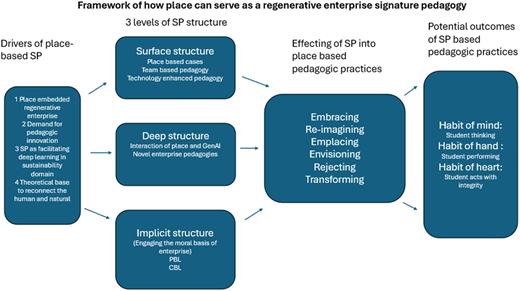
Building a narrative from the left side of Figure 1 below, drivers of place-based signature pedagogy are apparent in the place-embedded nature of the construction industry; demands at both the level of curriculum development and students for pedagogic innovation; demands for deeper and more tangible regenerative enterprise education for sustainability and aspirations to bridge the theory-practice gap between the human and natural spheres. To integrate the human, social and natural environments, the philosophy of personalism is positioned as framing the pedagogic approach of the lecturer. The framework then presents the three levels of signature pedagogy structure as emerging from contemporary drivers of demand for place as a signature pedagogy. In line with Shulman (2005), the surface structure comprised visible pedagogic artefacts such as case-based pedagogy, team-based pedagogy and technologically enhanced pedagogy (for instance, gamifications in simulation) can each be contextualised into a place-based enterprise. At the level of deeper structure, there were cycles for reflection which helped us to envision the opportunity for pedagogic innovation supporting place as an emerging signature pedagogy, but also one with innovative characteristics necessary to face contemporary construction enterprise challenges. For instance, contemporary technological change and even the questioning of the fundamental nature of enterprise education, support the validity of place as an emerging SP. Hence, there is potential for the use of GenAI in creating new business models/new products and services, with a fundamental shifting in pedagogy where the teacher becomes a proximal challenging guide, as opposed to a distant authority-based figure. Pedagogic artefacts emerging at the level of implicit structure are problem-based learning (PBL) and challenge-based learning (CBL), as well as enhanced awareness of human development (Modarelli et al., 2025; Ongaro et al., 2025) and responsibility towards community and environment. While both have a visible/surface aspect, they are included in the implicit level due to their engagement with tacit and deeper aspects of place-based pedagogy, with the potential to engage moral perspectives of students. This alignment with place, reflection and action primarily informed by tenets of CBL and Shulman (2005) underpins the framework's pedagogical logic. Each of the three levels of structure is then affected by six place-based pedagogic practices, with a measure of lecturer choice as to which practices are deployed in response to the specific level.
The six place-based pedagogic practices are then deployed by the teacher in order to support students in the development of regenerative enterprise. As with the theory of Shulman (2005), the student level outcomes of place as a signature pedagogy are manifest in terms of regenerative enterprise at three levels, those of mind, hand and heart. At the level of habits of mind, we see regenerative enterprise outcomes taking a number of forms. The pedagogic practice of transforming place, for example engages students with real-world enterprise planning embedded in their own place, hence requiring students to progress their own regenerative enterprise skills such as agility and opportunity spotting (Alexey, 2024). The practice of envisioning again takes the embedded notion of place and has students grapple with real-world possibilities for embedding sustainability into regenerative enterprise (Wahl, 2019). Habits of hand are taken in the present regenerative enterprise context to imply opportunities for students to directly engage with real-world problems. Specifically, habits of hand are engendered where the pedagogic practices, such as emplacing and embracing place, are used in work where students collaborate with real-world enterprise in articulating new regenerative-based solutions.
This reflects opportunities articulated by Anderson et al. (2012) for the development of improved networking capabilities within the enterprise community. Further, and following Dodd et al. (2023), opportunities for regenerative enterprise to emerge as emplacing and embracing support student interaction, which allows them to challenge existing enterprise models and actually gain hands-on experience of participating in the change. At the level of the heart and following Dasgupta (2024) reimagining as a pedagogic practice supports students in contemplating how their own place embeddedness can scaffold regenerative enterprise through innovating existing and building new business models. Place-based pedagogic practices can then innovate existing approaches based on challenge-based and problem-based learning. Finally, each of the pedagogic practices can be used to challenge students towards reflection on the need for and the potential to actuate new moral dimensions which are considered to be the bedrock of future regenerative enterprise. The moral dimension resonates with the personalist approach whereby advancing human dignity through relationality (Ongaro et al., 2025) is seen as an ongoing purpose and output of regenerative enterprise education. Given the resistance and challenges posed by the depth of change required, habits of heart are found to take time to develop, and experience with the students indicates the importance of longer-term reflective journals, aligned with appropriate tutor mentorship as a means of nurturing and developing novel moral perspectives. However, as the students engaged with the place-based practices, this allowed them to identify the value of regenerative opportunities in their local community. The place embedded nature of the pedagogic practices is again fundamental here, in enabling students to work on that which is familiar and yet through such familiarity contain the potential to allow deep critical reflection on that which is held dearest. In this sense, the place contains a gateway, where pedagogic support is appropriate, to the often sea-change of sense of integrity required.
Critical discussion
In recent times, the literature on enterprise pedagogy has progressed in highlighting the benefits of developing an enterprise signature pedagogy (Hägg et al., 2024). Notably, the benefits include supporting pedagogic practitioners with a more coherent foundation of pedagogy. This foundation can support genuine pedagogic collaboration, research into enterprise pedagogy and instil a level of professional credibility in the discipline (Peschl et al., 2021). The latter point being central to advance the work of the discipline in the eyes of key stakeholders at policy and societal levels (Ramsgaard and Blanker, 2022). Our study is contextualised in the context of regenerative enterprise, offering insight into a growing field of research and practice in the enterprise domain (Kopnina, 2018; Sagendorf and Jackson, 2019). Results demonstrate how students build engagement through place-based teaching (Kearney et al., 2025) over a semester, as the students embrace the construction module's orientation towards the local, practical and real-world approach. While our approach follows that of Deringer (2017) and Anderson et al. (2012) in supporting student development of habits of mind, hand and heart, critically, the short nature of the semester and the institutional context of construction may limit this development. Notably, construction has institutionalised a profit-driven and efficiency mindset in students, often at variance with the long-term perspective of regenerative enterprise (Hahn and Tampe, 2021). The short nature of the semester also impacts the effectiveness of the deployment of the six pedagogic practices in the construction context. While Kearney et al. (2025) evidence the effectiveness of deploying their six practices, looking critically, the combination of the short semester and the construction contexts' institutional mindset constrains fuller development of the proposed regenerative enterprise signature pedagogies. Personalist philosophy, as articulated by Modarelli et al. (2025), informs the motivation and orientation of the lecturer and guides the three levels of structure of the emerging signature pedagogy. Positively, the philosophy provides a holistic approach and focus to this initiative, which seeks to develop place as a regenerative signature pedagogy. Critically, the early-stage nature of the initiative suggests that much depends on the energy and resilience of the lecturer, and that the development of the signature pedagogy suffers the limitations of the short semester. While acknowledging that limitation, one can tentatively suggest that over time learning impacts will support the lecturer in advancing their capability to progress the signature pedagogy from the motivation and orientation of the personalist philosophy. Finally, we acknowledge the potential for tension between the undergraduate construction context and the approach of the lecturer who is a bearer of advanced contemporary approaches to regenerative enterprise. A notable influence here is the work of Dodd et al. (2021), where the fundamentals of business and enterprise are rejected in the interest of the regenerative paradigm. Revisiting the work of Shulman (2005) suggests that while the proposed framework presents a navigational map of how place can serve as a regenerative pedagogy, much hidden work by the lecturer is necessary to negotiate through tensions as experienced by students, academic colleagues in construction and at the level of the lecturer.
Conclusion
Our study emerges in the context of the teaching of enterprise in the construction management discipline. Inherent in this context is the embedded notion of place, where place is both assumed as a natural location for construction work, and yet subject to change from demands for a sustainable and regenerative approach to enterprise (Dodd et al., 2021; Redhead and Bika, 2022; Slawinski et al., 2021). It is in place that relational experiences shape professional identity and wider human development (Akrivou et al., 2022; Rae, 2006; Scruton, 2018). Teaching enterprise in this context benefits from supporting students to take a more integrative approach in building on the disciplinary learning of construction management and yet invites students to take more entrepreneurial approaches driven by demands for regeneration (Kearney et al., 2025).
The theoretical foundation of our study relies on the personalist philosophy of Mounier and Maritain (Modarelli et al., 2025), which proposes that humans are both persons of inviolable dignity, and yet embedded in wider relationships with other humans, society and the natural environment. Hence, it is possible for us to create a bridge between human development and demands for ecological regeneration (Ongaro et al., 2025; Persico and Bucciarelli, 2025).
Our motivations in the study are to innovate our pedagogies in response to supporting student engagement with the opportunities and challenges in developing vital regenerative enterprise skills and to address an important call for more research and action by HEIs in response to environmental degradation wrought by unsustainable economic models (Armon, 2021; Dodd et al., 2023; Konietzko et al., 2023). Specifically, we seek to position place as a regenerative signature pedagogy in order that our pedagogic innovations have greater breadth and depth of impact.
In taking an action learning approach to the study we are enabled to critically reflect on our contextual experiences in adopting place as a regenerative enterprise signature pedagogy in an authentic manner through our own social and temporal proximity to the module.
In responding to the research question: How can place serve as a regenerative enterprise signature pedagogy?, our theoretical framing in personalist philosophy supports the use of place as a regenerative enterprise signature pedagogy, where place supports a signature pedagogy engaging with enterprise ambitions of individual students while simultaneously embracing regeneration at societal and natural levels. Here we advance calls for research into the development of enterprise signature pedagogies (Hägg et al., 2024; Jones, 2019; Peschl et al., 2021; Ramsgaard and Blenker, 2022). Through an action learning approach, we develop an empirically informed framework, which emerges from authentic experiences of pedagogy in context.
Critically, the action learning approach reflects our ongoing exploration of the research question. In this light, our work is limited to a unique contextual opportunities and challenges. Methodologically, action learning suffers from heavy reliance on the perspectives of two lecturers strongly embedded in context. However, in acknowledging these limitations, we position our contributions as transferable to similar contexts, and here rely on the seminal work of Guba and Lincoln (1985) as applied in the enterprise context Mtisi (2022).
Future research is necessary to advance past these limitations. Contextually, we suggest the benefits of research in other contexts, perhaps where traditional forms of enterprise education are heavily embedded. To improve on the methodological limitations of action learning, we suggest three opportunities. A case study approach would allow a greater breadth of stakeholder perspectives on the emergence of place as a regenerative signature pedagogy. Empirical research focused at the level of students, for instance interview or survey-based research would allow a fuller articulation of student perspectives. Finally, our use of place is entirely based on assumptions around physical place, and given the contemporary trends in online education, future research can profit from contemplation of how online place might work as a signature pedagogy.
For enterprise educators, our framework offers opportunities to engage their existing pedagogic practices with a theory-driven pathway supporting necessary modification and innovation of practices. Ultimately, this engagement will result in the three-level outcomes of “mind, hand and heart”, thus resonating with demands of enterprise education for a converging of the theoretical, the practical and the moral. Given the framing of the study in the personalist philosophy, we suggest that a profoundly human-centric approach provides a novel and fruitful pathway to such convergence. We also consider that the framework will support business faculty management and administrators in their efforts to innovate curricula, both now and into the future as they seek to integrate enterprise education into wider societal and policy discourses in the space of the sustainable, responsible and regenerative. For external stakeholders such as enterprise policy makers and wider society, the framework positions regenerative enterprise pedagogy as offering those enterprises often excluded from enterprise education (Dodd et al., 2021) opportunities to engage in regeneration. For policy makers resourcing future training and development, we provide a navigational map of how such interventions can succeed both from humans and wider ecological systems. This aligns with the argument suggesting interactions between policy and enterprise can benefit from the personalist approach (Ongaro et al., 2025).
We accept that our work is entirely conceptual and at an early stage of development. We also acknowledge that the findings are context-specific and focus on one student group, and at this point cannot be made generalisable for those in the positivist paradigm. Accordingly, future research taking an empirical approach will support the development and refinement of our conceptual model. Our view is that this model is not static and must remain responsive to reflect a rapidly evolving reality in enterprise education and regenerative development. Central to our model is that place as a pedagogical cornerstone offers important opportunities to ground enterprise education in lived and contextualised experience, where real effects of environmental and economic damage are felt. This is reflected in the growing research streams on place (Redhead and Bika, 2022; Rietveld, 2022), regenerative enterprise (Caldera et al., 2022; Hahn and Tampe, 2021; Wahl, 2019) and enterprise education (Dodd et al., 2023; Ramsgaard and Blenker, 2022) and answers a call for deeper exploration through research to inform (and possibly disrupt) enterprise education and practice.
Note
As Shulman (2005: 53) notes, signature pedagogies must “measure up to the standards of not just the academy, but also to the particular professions. It is a preparation for good work”.