The growth of last-mile delivery presents challenges like environmental impact, operational inefficiencies and risks of theft or damage. This study explores parcel locker adoption as a potential solution, focusing on the roles of information framing and consumer characteristics in influencing consumer adoption. It offers insights into prioritizing benefits (environmental, security, convenience) in information framing and which consumer traits, such as regulatory focus and gender, to consider in designing and promoting parcel locker networks.
We test our hypotheses with three scenario-based experiments. The first focuses on the key parcel locker benefit of environmental sustainability framing, the second on security framing and the third on convenience framing.
Our results show that consumers are more likely to use parcel locker delivery when exposed to loss-framed environmental or security information, particularly when they are male. Additionally, promotion-focused individuals, particularly males, are the most likely users when presented with loss-framed messages emphasizing the inconvenience and insecurity of home delivery.
Our findings produce a middle range theory of gender and regulatory focus in the context of consumer participation in parcel locker delivery. Specifically, we find that gender and regulatory focus influence consumer reactions to information disclosure, with loss-framed information more strongly influencing consumer intent for promotion-focused individuals.
Managers seeking to introduce parcel lockers or expand existing parcel locker networks should incorporate security and convenience into their locker network decisions. Initial locker bays should be located in or near sites that experience high consumer traffic from promotion-focused males. Additionally, information disclosed should highlight these security and convenience benefits compared to the relative inconvenience and risk associated with home delivery.
While information disclosures often emphasize the environmental benefits associated with parcel locker use, likely users find other benefits more convincing. Highlighting these alternative factors and incorporating them into parcel locker network design will still allow for environmental benefits, including carrier CO2 reduction, to emerge from increased parcel locker use. As locker networks become more established, expanding the network to cater to additional consumers may allow service providers to focus information on environmental benefits.
Prior research assumes an existing parcel locker network or consumer base when studying network design and adoption. This study highlights the importance of tailoring information to consumer characteristics, emphasizing network features that best align with potential parcel locker users. Specifically, we found gender and regulatory focus to influence consumer reaction to information disclosure, where loss-framed information is the most influential particularly for promotion-focus individuals.
1. Introduction
The global last-mile delivery market is poised for substantial growth (Prescient and Strategic Intelligence, 2022). This growth, accompanied by escalating customer expectations for swifter and more convenient delivery services, drives businesses to seek innovative and economically efficient last-mile delivery solutions, such as parcel lockers (Seghezzi et al., 2022). To steer consumers toward these alternative delivery options, industry experts call for a shift to “psychologistics” (Sutherland et al., 2020), incorporating end-consumer perspectives into both the formulation and execution of logistics and supply chain strategies (Esper and Peinkofer, 2017). Aligning last-mile delivery systems with consumer preferences and raising awareness of their benefits enhances the adoption of alternative delivery methods. Parcel lockers, in particular, streamline logistics by consolidating deliveries at a single location, reducing miles traveled per route and optimizing asset utilization (Roberts, 2022). By improving efficiency and supporting sustainable practices, they address critical urban logistics challenges, including rising delivery volumes and environmental concerns (Różycki and Gral, 2022).
Recent research finds consumers willing to change their delivery selection when firms disclose information regarding fulfillment options (Thomas et al., 2022). Furthermore, responses to information disclosure depend on message content and framing (Cesario et al., 2013). For example, attempts to increase consumer adoption may emphasize the benefits of taking action, called gain-framing, or the consequences associated with failure to act, or loss-framing (Meyers-Levy and Maheswaran, 2004). Applying information disclosure considerations to one potential delivery alternative, parcel lockers, we pose our first research question:
How does information framing and content influence consumer intentions to use parcel lockers?
Firms introducing alternative delivery options often take an evolutionary approach. Parcel locker networks begin with a small number of pilot locations and expand over time (Pinchasik et al., 2023). As a result, firms seeking to introduce and expand parcel locker networks should recognize and target the most likely early adopters. Several individual characteristics can affect the way consumers perceive information disclosures. One such characteristic is gender, which has gained prevalence in supply chain management research (Darby et al., 2024; Scott and Davis-Sramek, 2023). This, together with other characteristics, including self-regulatory focus, can be linked to a higher or lower propensity to act (Cesario et al., 2013; McKay-Nesbitt et al., 2013). Furthermore, prior research shows a connection between these characteristics, information processing and responses to information disclosure (Chang, 2007; Scott et al., 2024). Identifying potential early adopters, designing parcel locker networks to best match their preferences and informing them about parcel locker benefits relative to home delivery, improves the likelihood of parcel locker adoption and thus allows for further expansion. This leads to our second research question:
How do consumer characteristics, such a as gender and regulatory focus, influence the relationship between information disclosure and consumer intentions to use parcel lockers?
To address these questions, we conducted three scenario-based experiments to assess the impact of information disclosure on consumers’ intent to use parcel locker delivery. Specifically, in each experiment, we include a statement with content describing one specific parcel locker benefit (namely environmental, security and convenience) (CEP Research, 2021; DHL.com, 2023; Pitney Bowes, 2021) using either gain- or loss-framing. Experiment 1 investigates an environmental scenario operationalized through CO2 emission reduction, while Experiment 2 explores a security scenario focused on safety improvements; finally, Experiment 3 studies a convenience scenario that connects parcel lockers to improved traffic and parking availability.
To explore consumer intent to use parcel lockers, this study employs regulatory focus theory, which suggests that the absence of losses and presence of gains represent two desired, but separate, end states corresponding with a prevention or promotion regulatory focus (Higgins, 1997; Johnson et al., 2015). Under regulatory focus theory, individual characteristics, including gender, further influence preferences for consistency or change (Croson and Gneezy, 2009), such that females and males perceive gain- and loss-framed information, associated with specific actions, differently. Taken together, the research provides insights into how information disclosure (content and framing), regulatory focus (promotion versus prevention) and gender impact consumer intent to use parcel lockers. Accordingly, this study responds to recent calls for research examining more nuanced factors impacting consumer decisions in supply chain management (Duan et al., 2022; Senyo and Osabutey, 2023).
This study offers significant contributions to the last-mile logistics field. First, it examines consumer responses to information disclosures regarding alternative last-mile delivery options, viewing consumers as both stakeholders and active participants. Although extant literature highlights the impact of supply chain information disclosure on consumer perceptions (Thomas et al., 2022), this research enhances understanding of how specific information content and framing combine with personal characteristics to influence parcel locker adoption. Second, the research highlights the influence of gender on consumer participation, finding males more likely to use parcel lockers than females. Third, our study contributes to a middle-range regulatory focus theory for consumer participation in the context of last-mile logistics services. This middle-range theory posits that when presented with loss-framed information, promotion-focused males showed a higher intent to use parcel lockers than females; thus, firms seeking to develop or expand a parcel locker network should start with parcel locker locations that appeal most to highly promotion-focused males and extend the network to serve wider populations over time.
The remainder of the paper is organized as follows: the next section provides the theoretical foundation in the context of last-mile logistics, gender, regulatory focus and information disclosure and includes our research hypotheses. Next, we detail our empirical research methodology and present our findings. Finally, we discuss theoretical and managerial implications before concluding with limitations and future research opportunities.
2. Literature review and hypothesis development
2.1 Parcel lockers: consolidating consumer deliveries in last-mile logistics
By offering logistics service providers a single delivery point, parcel lockers provide benefits to service providers by reducing miles traveled per route while enhancing asset utilization (Olsson and Woxenius, 2014). They also serve as a consumer facing consolidation point, allowing multiple deliveries to a single location (Peppel and Spinler, 2022) with consumers handling the last-mile delivery (Deutsch and Golany, 2018). Additionally, when placed in areas safer than nearby neighborhoods, parcel lockers reduce the risk of porch piracy (Risher et al., 2020), enhance consumer safety and security (McGrath and McManus, 2020) and keep employees away from dangerous delivery areas (Iacobucci et al., 2022). Finally, parcel lockers replace door-to-door deliveries, reducing neighborhood traffic (Deutsch and Golany, 2018) and related carbon emissions (Peppel and Spinler, 2022).
Table 1 provides a sample of recent parcel locker literature. To date, the literature focuses on two complementary areas. One literature stream focuses on the consumer perspective, seeking to understand what benefits and characteristics influence consumer satisfaction and intent to use pickup points including parcel lockers (Wang et al., 2019; Weltevreden, 2008). These papers often ask consumers about their own personal experience with parcel lockers (Yuen et al., 2019) or provide some information about parcel lockers in general to determine the operational factors that drive locker adoption, including delivery lead times, cost and time windows (Merkert et al., 2022; Oliveira et al., 2017). The consumer-facing parcel locker literature provides limited detail to survey respondents about the locker network, focusing more on a single collection experience.
The second stream of the parcel locker literature focuses heavily on the locker network and delivery operations (Edwards et al., 2010; Peppel et al., 2024). The network design and routing papers examine transportation provider costs and benefits (Ji et al., 2019; Veenstra et al., 2018) or external factors including carbon emissions (Edwards et al., 2010). These analytical studies often incorporate consumers by randomly generating demand (Seghezzi et al., 2022) or setting demand based on an area’s population (Deutsch and Golany, 2018) and factors including travel distance to a locker (Schwerdfeger and Boysen, 2020), travel time to a locker (Ulmer and Streng, 2019) or likelihood of home delivery failure (Mohri et al., 2024). A small subset of parcel locker literature presents both a consumer study and a network study (Deutsch and Golany, 2018; Edwards et al., 2010; Peppel et al., 2024), starting with surveys and experiments to understand consumer preferences (Deutsch and Golany, 2018) and then incorporating the data into a locker network problem (Peppel and Spinler, 2022). These studies still find travel distance and home availability as the driving factors for consumer adoption of parcel lockers (Peppel and Spinler, 2022).
The recent parcel lockers literature focuses on either generating and maintaining locker demand or designing an efficient parcel locker network. Yet, it largely overlooks the complementarity between these two aspects as consumer demand influences locker network performance and network characteristics influence consumer demand. For firms designing parcel locker networks, understanding which information framing and content would be better to drive the consumer toward the choice of parcel lockers requires further investigation. In particular, improving and informing consumers about parcel locker costs, environmental impacts (Peppel and Spinler, 2022), convenience and security (Tsai and Tiwasing, 2021) may all improve locker network performance and increase consumer adoption, but to varying degrees. Understanding how to match locker network objectives and consumer preferences, along with how to inform consumers, will allow firms to enhance their last-mile delivery operations by incorporating consumers into their strategy.
2.2 Consumer response to information disclosure
Both academics and practitioners recognize consumers as vital stakeholders and active value co-creators in the realm of supply chain strategy (Ta et al., 2015). Recent research argues for a consumer-centric supply chain strategy (Esper et al., 2020; Mollenkopf et al., 2022), emphasizing a growing need to gain deeper insights into consumer decision-making and its impact on supply chain performance (Duan et al., 2021; Stolze et al., 2016). Consumer-centric research provides insights that will allow firms to align their last-mile logistics operations with specific consumer preferences and values (Frankel et al., 2008; Sanders et al., 2013).
Recent literature supports this effort by exploring consumer responses to logistics information in an online retail context (Duan et al., 2022; Kumar et al., 2023; Ta et al., 2018). For example, consumers use supply chain information disclosures related to stockouts (Kumar et al., 2023), fulfilment service (Peinkofer and Jin, 2023) and sustainability (e.g. Duan et al., 2021; Mollenkopf et al., 2022; Nichols et al., 2019) in their decision-making process. The focus on disclosing information to consumers highlights the growing importance of the end-consumer in crafting logistics and supply chain strategy (Esper et al., 2020; Esper and Peinkofer, 2017).
Information disclosures include both content and tone, or framing, to manage demand (Balaji et al., 2021). Specifically, gain-framed information highlights strengths and benefits to instill eagerness about a firm’s offering (Jacks and Lancaster, 2015), while loss-framed information emphasizes shortcomings and failures of alternatives to prime an avoidance reaction in consumers (Rothman et al., 2006). Firms that match information disclosure framing with situational factors increase purchase likelihood (White et al., 2011). Such situational factors can include product characteristics, for example hedonic products that satisfy emotional wants and utilitarian products that fulfill needs (Sela et al., 2009). Services also reflect this dichotomy, with utilitarian services providing practical solutions to functional problems and experiential services focusing on hedonic, pleasure-related outcomes (Aaker and Lee, 2001; Dixon et al., 2017).
Applied to our context, last-mile delivery operations can qualify as a practical, utilitarian service as consumers evaluate options through cognitive reasoning over emotional indulgence (Bazerman et al., 1998). In fact, consumers experience greater emotion over delivery failures than success (Van Vaerenbergh et al., 2014). Prior research posits a match between loss-framing and utilitarian products (Dodoo and Padovano, 2020; Micu and Chowdhury, 2010). Thus, information emphasizing the shortcomings of existing delivery options (i.e. loss-framed) will likely enhance consumer intent to use parcel lockers over gain-framed information.
2.3 Gender and information disclosure
Several individual characteristics influence how consumers perceive loss-vs. gain-framed information disclosures. Gender presents one such characteristic gaining prevalence in supply chain management research (Darby et al., 2024; Scott and Davis-Sramek, 2023). Males, as selective processors, use simple rules and heuristics focused on specific information, allowing faster decisions based on limited data (Chang, 2007). Females, on the other hand, process information holistically, deliberating and learning as much as possible before making a choice (McRae et al., 2008). While not all males and females reflect these characteristics, research shows that certain characteristics, including emphasis on gains or losses, generally differ between men and women (Scott et al., 2024).
In practice, the distinction between selective and deliberate information processing further aligns with findings characterizing females as more passive than males when making decisions (Wood and Eagly, 2012). Generally, females prioritize caution while males are more likely to act (Armstrong et al., 2019), Early e-commerce research found males more likely to shop online, reflecting a predisposition toward action (Rodgers and Harris, 2003). Subsequently, we would expect gender to moderate the connection between information framing and intent to act (Chang, 2007). For parcel lockers, a novel but utilitarian service offering, loss-framing complements male propensity for action and thus, is expected to amplify intent to use parcel lockers in comparison to females. Therefore, we hypothesize:
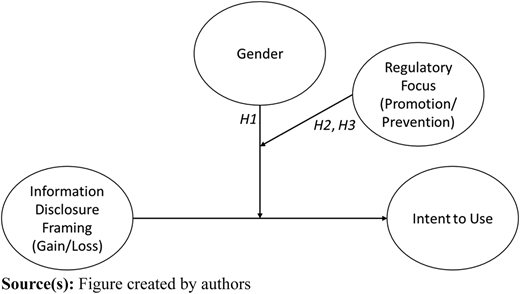
When information disclosure is loss-framed, male consumers (compared to female) have a higher intent to use parcel lockers.
2.4 Regulatory focus
Beyond the direct connection between gender and action preference, prior research also finds significant interaction effects with other individual factors (Auger et al., 2008). With a focus on changing from a familiar to a novel delivery option, an understanding of consumer preferences regarding action and outcomes becomes necessary. In this sense, regulatory focus theory (Higgins, 1997) examines an individual’s perceptions and decisions toward desired end states, with promotion- and prevention-focused individuals seeking to achieve gains or avoid losses, respectively (Johnson et al., 2015). Thus, it can provide insights into the factors that influence a preference for action or consistency that sheds light on consumer likelihood to either continue choosing home delivery or adopt parcel lockers.
Regulatory focus influences an individual’s understanding of stability, or lack of change (Liberman et al., 1999). A consumer with a high promotion focus seeks to avoid errors of omission, equating inaction with non-gains and, thus, failure (Wallace and Chen, 2006). Therefore, a highly promotion-focused consumer exhibits eagerness and an enhanced drive toward action (De Bock and Van Kenhove, 2010). Research on gender and behavior argues that males focus on gains over potential losses when assessing choices (Scott et al., 2024), aligning with regulatory focus literature finding males more promotion-focused (Gutermuth and Hamstra, 2024). Building on our argument from H1, that males are more likely to act, we expect a high promotion focus to strengthen the likelihood that males will use parcel lockers. Specifically, we would expect that highly promotion focused males to show a higher intention to use parcel locker delivery than highly promotion focused females when exposed to loss-framed information. We formally hypothesize:
When information disclosure is loss-framed, male consumers (compared to female) have higher intent to use parcel lockers, and this gender difference will increase among promotion-focused individuals.
While a highly promotion-focused individual seeks constant improvement, a highly prevention-focused consumer classifies non-loss as success, seeking consistency (De Bock and Van Kenhove, 2010). Hence, a high prevention focus instills a cautious mindset, with decisions based on avoiding errors of commission, or making the wrong choice (Bilgili et al., 2020). Building on H1, we would hence expect that a high prevention focus will dampen the interaction between information disclosure and gender since highly prevention-focused individuals are less likely to act (Higgins, 2002). Furthermore, as females more often exhibit a prevention focus than males (Gutermuth and Hamstra, 2024), regulatory focus exacerbates the connection between females and caution. In other words, we expect that the lower likelihood to act associated with a prevention focus will attenuate the initial match between information disclosure (i.e. loss framed information) and gender (male). Thus, we hypothesize:
When information disclosure is loss-framed, male consumers (compared to female) will have a higher intent to use parcel lockers, but this gender difference will decrease among prevention-focused individuals.
Figure 1 summarizes our conceptual model and related hypotheses.
3. Methodology
We utilized a scenario-based experimental approach to address our research questions, consistent with prior consumer-centric logistics and supply chain management studies (Confente et al., 2021; Hartmann et al., 2022; Mollenkopf et al., 2022). This approach involved three distinct scenario-based experiments, each featuring different information disclosures. The connection between information disclosure and the intent to use parcel lockers depends on information framing and content. This choice was guided by the need to examine the individual impact of key parcel locker benefits on consumers, and their potential influence on parcel locker network design (He, 2020). Each of our experiments specifically concentrated on one of the three key parcel locker benefits: environmental, security and convenience (DHL.com, 2023).
3.1 Development of experimental scenarios
To develop the scenarios, we followed the guidelines established by Rungtusanatham et al. (2011). The pre-design stage included a qualitative assessment of multiple professional reports to identify various benefits of parcel locker delivery (Fortune Business Insights, 2023; Różycki and Gral, 2022). Next, we assigned these benefits to one of the three perspectives: environmental (Deutsch and Golany, 2018; Peppel and Spinler, 2022), security (Lachapelle et al., 2018; Olsson et al., 2023) and convenience (Tsai and Tiwasing, 2021; Wang et al., 2019). To test our hypotheses within each dimension, we developed an environmental scenario, operationalized through CO2 emission reduction (Experiment 1: Environmental); a security scenario focused on safety improvements (Experiment 2: Security) and a convenience scenario that connected parcel lockers with enhanced driving and parking convenience (Experiment 3: Convenience). We then developed the common module which presented an online shopping scenario for a tablet and included a notification from the online retailer, ABC.com, announcing a new parcel locker delivery initiative. The experimental module included an additional statement either describing the consequences of not using parcel lockers (loss-framing) or the benefit of using (gain-framing) parcel locker delivery and two levels of product price (low: $79.99 vs. high: $949.99) to account for different product values. This step was repeated across all three experiments to examine the individual contexts. The Appendix summarizes the experimental stimuli for all three experiments [1].
3.2 Summary of experimental procedures for all experiments
Participants for all three experiments were recruited from the Qualtrics consumer panel. With the increase in problems associated with urban areas (e.g. traffic, pollution and safety), parcel lockers might be perceived as the most beneficial delivery option for these areas (Peppel and Spinler, 2022); thus, we limited our pool to participants that self-identified as urban residents [2] in the United States (US) that shop online at least once a year. Participants meeting the necessary qualifications were randomly assigned to one experimental condition and limited to participating in only one of the three experiments. Participants were compensated with a flat fee of $5. We included two attention check measures, one at the beginning of the experiments and one at the very end. Participants that failed the attention check measures were terminated from the experiments to ensure high data quality (Abbey and Meloy, 2017). We also included a two-item, 7-point Likert scale to assess whether participants perceived the experimental scenario as realistic. Table 2 provides a summary of the experimental procedures employed across the three experiments and the respective sample demographics.
3.3 Manipulations and manipulation checks
Experiments 1–3 each constitute a 2 (Information disclosure: gain-framed vs. loss-framed) x 2 (Price: low vs. high) between-subjects design. The information in Experiment 1 represents an environmental, in Experiment 2 a security and in Experiment 3 a convenience contextual setting.
Each experiment included two manipulation check measures to assess the validity of our manipulations (Perdue and Summers, 1986). We included a one-item, 7-point Likert scale asking participants to assess the advertised price for the tablet (1 = very low; 7 = very high) and a one-item, 7-point Likert scale to assess whether participants perceived the scenario as a threat (loss) or opportunity (gain) (1 = a threat; 7 = an opportunity) (Mittal and Ross, 1998). For each experiment we conducted two ANOVAs, with “Price” and “Information Disclosure” as our fixed factors and the two manipulation check measures as our dependent variables. In all three experiments, participants perceived the tablet’s price as significantly higher when the advertised price was $949.99 than $79.99 and perceived the gain-framed (loss-framed) information as constituting an opportunity (threat). No significant interactions were found. Hence, our manipulations worked as intended. Table 2 summarizes the manipulation checks.
3.4 Measures
Each experiment included the following measures. To assess participants' regulatory focus, we adopted the 11-item regulatory focus questionnaire (RFQ) developed by Higgins et al. (2001). This scale includes two subscales with six items to capture a person’s chronic promotion focus and five items to capture a person’s chronic prevention focus. A three-item semantic differential scale (e.g. Day and Stafford, 1997) measured intent to use parcel lockers. An additional measure captured the participant’s self-perception regarding the environmental, security or convenience perspectives associated with that experiment. Experiment 1 (Environmental) included a four-item, 7-point Likert scale assessing a participant’s environmental self-perception (“Green”) (Barbarossa and De Pelsmacker, 2016). Experiment 2 (Security) included a four-item, 7-point Likert scale to assess a participant’s risk self-perception (“Risk”) (Raju, 1980). Experiment 3 (Convenience) included a five-item, 7-point Likert scale capturing a participant’s convenience self-perception (“Convenience”) (Yuen et al., 2019). All scale items are summarized in Supplementary material for review A.
3.5 Confirmatory factor analyses (CFA)
For each experiment we ran a four-factor CFA model including the two RFQ subscales, intention to use locker delivery and the respective self-perception measure (Experiment 1, Environmental: “Green”; Experiment 2, Security: “Risk” and Experiment 3, Convenience: “Convenience”) [3]. In line with Hu and Bentler (1999), our fit statistics support the validity of all three experimental models. In each experiment, the average variance extracted (AVE) of each factor exceeds 0.5 (Fornell and Larcker, 1981), supporting convergent validity. Discriminant validity was achieved as, in each experiment, the AVE of each factor pair was larger than the phi-square correlation (Fornell and Larcker, 1981). Rather than averaging our scale items, we extracted the factor scores using MPlus, in line with best practices (e.g. Calantone et al., 2017; Mollenkopf et al., 2022) and used the factor scores as our observed measures in our analyses. Factor scores are perceived to be superior to simply averaging scale items for several reasons. First, when averaging items, each item is weighed equally but factor scores allow items to be weighted based on their importance (Edwards and Wirth, 2009). Additionally, factor scores are more evenly distributed (Calantone et al., 2017) which is especially beneficial when estimating interaction effects as in our case as more information can be extracted (Aiken and West, 1991). Supplementary material A summarizes the CFA results, and Supplementary material B provides the correlation matrices.
4. Analyses and results
To test our hypotheses, we employ PROCESS macros (Hayes, 2013). PROCESS is OLS regression-based and allows researchers to explore simple mediation and moderation models or more advanced models. Considering that we are using factor scores as our observed measures, OLS is an appropriate estimator. In addition, PROCESS provides additional benefits such as the Johnson-Neyman procedure for continuous moderators, which applies to our research, to establish a range of significance for our focal interaction effect (Hayes, 2017). PROCESS model 1 aligns with a two-way interaction as hypothesized in Hypothesis 1 and PROCESS model 3 aligns with a three-way interaction as proposed in Hypotheses 2 and 3.
To test H1, which predicts an interaction effect between “Information Disclosure” and “Gender,” we ran PROCESS Model 1 (Hayes, 2013) for each of our three experiments. The binary variable “Information Disclosure” (0 = gain-framed; 1 = loss-framed) was included as the focal predictor, the binary variable “Gender” (0 = female; 1 = male) as the moderator and intention to use parcel locker delivery as the dependent variable. Additionally, we included several control variables. First, we included “Price” (0 = $79.99; 1 = $949.99), which was an experimental factor. Also, because a person’s prior experience likely impacts future behavioral intentions (Voorhees and Brady, 2005), we included a binary variable capturing whether a participant has used parcel locker delivery in the past (0 = no; 1 = yes). Lastly, depending on the three contextual settings, we included that setting’s self-perception measure. Table 3 summarizes the regression results of PROCESS Model 1 for each of the three experiments.
For Experiment 1 (Environmental), we observe a significant positive interaction between “Information Disclosure” and “Gender” (β = 0.301, p = 0.048) (see Table 3), indicating the effect of “Information Disclosure” on intention to use is different for males vs. females. Conditional effects show that, when exposed to loss-framed information, males indicate a significantly higher intent to use parcel lockers than females (effect size = 0.248, p = 0.042). However, when exposed to gain-framed information no significant difference arises between males and females (effect size = −0.054, p = 0.564). For Experiment 2 (Security), we observe a partially significant positive interaction between “Information Disclosure” and “Gender” (β = 0.430, p = 0.093) (see Table 3), indicating the effect of “Information Disclosure” on intention to use differs between males and females. In line with the Environmental Experiment, we also observe a significant conditional effect when exposed to loss-framed information, as males indicate a significantly higher intent to use parcel locker delivery than females (effect size = 0.390, p = 0.035). However, no significant difference occurred between females and males presented with gain-framed information (effect size = −0.034, p = 0.826). For Experiment 3 (Convenience), the interaction between “Information Disclosure” and “Gender” was positive but not significant (β = 0.302, p = 0.246) (see Table 3). Hence, H1 is supported for the Environmental and Security Experiments.
H2 and H3 extend H1 and predict a three-way interaction effect between “Information Disclosure”, “Gender” and “Promotion Focus” (H2) or “Prevention Focus” (H3). Hence, we ran PROCESS Model 3 (Hayes, 2013) for each of our three experiments and the two RFQ subscales. Since the “Promotion Focus” and “Prevention Focus” subscales are orthogonal, running the analyses for each scale individually is appropriate (Haws et al., 2010). Table 4 summarizes the regression results of PROCESS Model 3 including promotion focus, and Table 5 summarizes the regression results of PROCESS Model 3 including prevention focus for the three experiments.
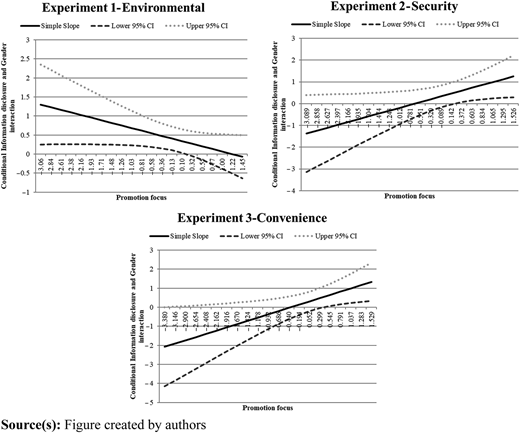
Regarding H2, in the Environmental scenario we observe a partially significant three-way interaction between “Information Disclosure”, “Gender” and “Promotion Focus” (β = −0.304, p = 0.071) (see Table 4). Contrary to our prediction, the three-way interaction is negative. The Johnson-Neyman plot in Figure 2 shows that the interaction between “Information Disclosure” and “Gender” is only significant for individuals with low to medium promotion focus (the interaction effect between information disclosure and gender takes on significance when promotion focus is at 0.187 or lower). In line with our predictions, we observe a positive three-way interaction between “Information Disclosure”, “Gender” and “Promotion Focus” in the Security Experiment (β = 0.569, p = 0.041) (see Table 4) and in the Convenience Experiment (β = 0.694, p = 0.020) (see Table 4).
In the Security Experiment the Johnson-Neyman plot in Figure 2 shows that the interaction effect between information disclosure and gender takes on significance when promotion focus is at 0.218 or higher. Similarly, in the Convenience Experiment the Johnson-Neyman plot in Figure 2 shows that the interaction effect between information disclosure and gender takes on significance when promotion focus is at 0.410 or higher. Hence, H2 is supported for the Security and Convenience Experiments.
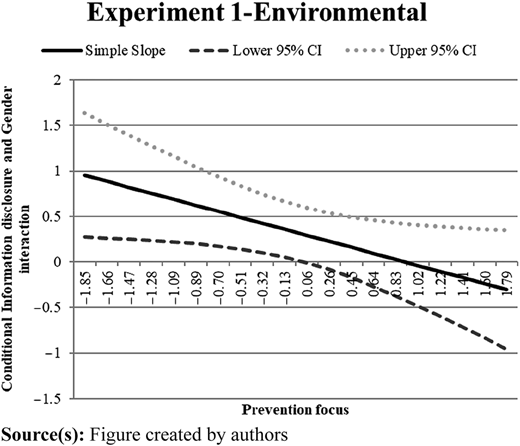
We observe a significant negative three-way interaction between “Information Disclosure”, “Gender” and “Prevention focus” (β = −0.345, p = 0.039) (see Table 5) for the Environmental Experiment, which is in line with our predictions. The Johnson-Neyman plot in Figure 3 shows that the interaction between “Information Disclosure” and “Gender” is only significant for individuals that range from low to medium but not for high prevention focus (the interaction effect between information disclosure and gender turns insignificant when prevention focus is at 0.041 or higher). Hence, only for low or medium prevention focus, males indicate a higher intention to use parcel lockers than females when exposed to loss-framed information. For the Security Experiment (β = −0.316, p = 0.250) and the Convenience Experiment (β = −0.381, p = 0.179) (see Table 5), the three-way interaction is not significant. Taken together, H3 is only supported for the Environmental Experiment. Table 6 provides an overview of our results across the three contexts.
5. Discussion
5.1 Theoretical implications
This research examines the nuanced role of information disclosure in shaping consumer intentions to adopt parcel locker delivery services, offering both theoretical and practical insights. By examining three key benefits of parcel lockers—environmental sustainability, security and convenience—our findings highlight that consumer perceptions and priorities are not uniform but vary depending on the disclosed framing of information (gain versus loss) and content.
First this research provides critical new insights into consumer-driven logistics strategy, extending the emerging concept of “psychologistics” which emphasizes the integration of consumer perspectives into supply chain decisions. Firms increasingly rely on information disclosure to educate and attract consumers to alternative last-mile delivery solutions (de Vries et al., 2017). However, this research highlights that the effectiveness of these disclosures depends on situational factors, including the utilitarian nature of last-mile delivery services, which prioritize cognitive reasoning over emotional engagement (Bazerman et al., 1998). Consumer psychology literature has long highlighted differences in male and female information processing (Chang, 2007; McRae et al., 2008). Notably, this research also underscores the unique interplay between gender and specific parcel locker information contents (benefits) and framing (gain vs. loss). In detail, male consumers exhibited a higher intention to adopt parcel locker delivery when exposed to loss-framed environmental or security information, supporting prior assertions that loss-framed messaging aligns with the functional nature of utilitarian services (Dodoo and Padovano, 2020). Conversely, no gender-based differences emerged for convenience information. However, by focusing on these dynamics, this study challenges the prevailing assumption that convenience is the primary driver of parcel locker adoption (Peppel et al., 2024). It contributes to theoretical knowledge by demonstrating how consumer characteristics interact with information framing to shape decision-making in last-mile logistics and emphasizes the need for messaging strategies tailored to specific consumer profiles.
The second contribution of this research is the development of a middle range theory (Craighead et al., 2016, 2024; Stank et al., 2017) of regulatory focus for consumer participation in utilitarian service delivery, operationalized through consumer intent to use parcel lockers. Our results challenge existing regulatory focus concepts, specifically regulatory fit (Avnet and Higgins, 2006), which argues that promotion-focused individuals respond more readily to gain-framed messaging. We find that, in some instances, consumers assessing utilitarian services reflect greater purchase intent when presented with a loss-framed message, in line with research showing the same consumer response with utilitarian products (Dodoo and Padovano, 2020). Specifically, this MRT illustrates that promotion-focused males respond more positively to loss-framed security and convenience information than do promotion-focused females. However, for loss-framed environmental information, only individuals with low to medium promotion focus exhibited a higher intention to use parcel lockers, suggesting that the framing and content of disclosed benefits interact uniquely in utilitarian contexts. Taken together, while our findings fail to completely reverse regulatory fit (Chernev, 2004), the research illustrates the influence of factors such as gender and stated benefits on regulatory focus theory. Last mile delivery, as a utilitarian service, prioritizes cognitive decision-making, meaning consumers evaluate losses and gains differently than in other contexts (Bazerman et al., 1998). Under these circumstances, in fact, promotion-focused individuals, particularly males, are more inclined to adopt parcel lockers when presented with loss-framed information regarding security or convenience related content.
The final contribution of this research is its extension of the growing consumer-centric logistics and supply chain management literature (Esper et al., 2020; Paluzzi et al., 2024; Baldi et al., 2024). Specifically, this research offers a more comprehensive perspective on the consumer’s role in last-mile logistics through parcel locker use. Specifically, our findings highlight that different consumers interpret delivery information differently, depending on individual characteristics such as gender and regulatory focus and that these differences influence their willingness to adopt sustainable delivery alternatives. This contribution directly connects with calls in the literature for more research on consumer-centric supply chain design, particularly Baldi et al.’s (2024) question of which factors, such as information framing drive consumer choices for sustainable delivery options, such as parcel lockers. Our research emphasizes the need to consider how consumers process and respond to different types of logistical information, including environmental, security and convenience benefits, in ways that vary across segments. This nuanced understanding of consumer decision-making underscores the importance of aligning supply chain strategy with consumer psychology to improve service adoption and satisfaction.
In doing so, this contribution furthers the academic dialogue on integrating consumer insights into supply chain decision-making (Duan et al., 2022; Esper and Peinkofer, 2017), while also offering practical guidance for firms looking to expand last-mile delivery solutions that resonate more effectively with their target audiences.
5.2 Managerial implications
Well-placed parcel lockers, along with communication around locker benefits for consumers, result in improvements for firms and consumers alike, but prior research also highlights the benefits of parcel locker incorporation for stakeholders beyond service providers and consumers. Parcel lockers make an environmental impact by enabling delivery consolidation, reducing the number of vehicles on the road and curbing traffic congestion and carbon emissions [4] (Roberts, 2022; Różycki and Gral, 2022). Furthermore, parcel lockers offer individual consumers a convenient and safe delivery option (DHL.com, 2023; Yuen et al., 2019), reducing theft along with delivery traffic in neighborhoods. As a result, parcel locker networks present social and environmental benefits when properly implemented. This research provides guidance for firms on how to plan and implement parcel locker operations as well as how best to communicate those benefits to potential users and society in general.
Given the emerging conversation in the industry around “psychologistics” (Sutherland et al., 2020), which calls for integrating consumer characteristics into last-mile delivery design, we provide some valuable implications for managers. A core managerial takeaway is that service providers with more specific information regarding potential parcel locker adopters should avoid generic assumptions about consumer characteristics. In doing so, to better understand which consumers are more likely to adopt parcel lockers, firms can leverage a combination of behavioral data and psychographic profiling. Further, firms can incorporate such information into parcel locker service delivery to enhance the likelihood of consumer adoption. By placing lockers in safe, convenient locations and tailoring placement first to the traits of promotion-focused males as a pilot, then expanding the network to meet the needs of other consumers, firms can improve adoption rates and expand their network effectively.
While consumer psychology literature highlights the differences between male and female information processing (Chang, 2007; McRae et al., 2008), research on parcel locker network design incorporates consumer perceptions almost exclusively through convenience (Peppel et al., 2024), which, according to our results, had no direct impact differentiating between male and female consumers. This research introduces an opportunity to differentiate between consumer groups in last-mile logistics, allowing for more detailed and realistic network design models. Network design problems seek to optimize or improve one or more objective outcomes, which can include environmental sustainability and security (Eskandarpour et al., 2015). Changing the objective influences system design. While parcel locker network design literature focuses largely on convenience, assuming convenience will maximize consumer adoption (Peppel et al., 2024), our results show that a more nuanced view of preferences, differentiating between the most likely early adopters and more cautious potential users, will increase the likelihood of parcel locker adoption. While convenience is an important consideration, incorporating additional factors and objectives will guide parcel locker service providers as they introduce and grow their networks. As parcel locker networks often begin small and expand over time, network design problems should also incorporate this evolution, allowing not only for dynamic design based on set objectives, but also for dynamic objectives to match a growing potential consumer set.
In line with prior research, our findings underscore the significant impact of convenience on intent to utilize parcel lockers, specifically the convenience associated with reduced traffic and parking concerns when consolidating deliveries at a single location (Lemke et al., 2016; Nguyen et al., 2019). At the same time, maximizing convenience for an entire population may result in less efficient locker locations at the outset. Instead, to amplify the parking and traffic benefits for the most likely early adopters, parcel locker providers should focus on opportunities to locate near, or even co-locate with, organizations and businesses frequented by males and promotion-focused individuals such as do-it-yourself or home improvement stores (Foster, 2004) and luxury goods retailers (Mo et al., 2022). Locating in such places removes the need for additional vehicle travel and reduces traffic around potential users' homes (Guerrero-Lorente et al., 2020), providing dual benefits and increasing the likelihood of use among the most likely first-movers.
Along with convenience, managers should incorporate security constraints into models. While existing literature and firm statements argue for environmental objectives, including reduced carbon emissions (Peppel and Spinler, 2022), green factors were least influential among likely users. Instead, firms should incorporate security factors into their final location decisions (Risher et al., 2020). This does not mean firms should always place lockers at the safest location, but instead target areas in which the security gap between locker and home is greatest. Delivering to a location safer than a consumer’s porch provides a number of benefits to both provider and consumer.
First, parcel lockers will reduce “porch piracy,” which represents a major issue for many home delivery providers (Risher et al., 2020). By minimizing theft and product damage, lockers offer a dual advantage: consumers gain peace of mind, and providers face fewer claims and operational risks (McGrath and McManus, 2020). Second, delivering to safer locations allows drivers to avoid dangerous delivery areas. Finally, secure delivery locations can increase the appeal of online shopping overall; for instance, research indicates that 80% of consumers would shop online more often if they felt confident in the safety of their deliveries (Risher et al., 2020). To increase adoption, firms should strategically place lockers near locations frequented by promotion-focused individuals, such as do-it-yourself stores or luxury retailers, where these consumers are likely to encounter the service. These consumers are more willing to try new solutions when convenience or security is emphasized. Conversely, prevention-focused consumers, who prioritize reliability and risk reduction, are more inclined to adopt lockers in areas offering notable safety advantages over home delivery.
Finally, when communicating these benefits to potential users, firms should shift their information disclosure away from the convenience and security benefits of parcel lockers and instead highlight the relative inconvenience and insecurity of other potential channels. In general, loss-framed information is more persuasive than gain-framed information, with utilitarian services amplifying this existing effect (Dodoo and Padovano, 2020). Even promotion-focused individuals are more likely to purchase products and services when the information highlights the negative impacts of inaction (Bullard and Penner, 2017). As a result, firms that design parcel locker networks around convenience and security and convince potential users that home deliveries are worse are the most likely to increase usage.
5.3 Limitations and future research
While this study makes a valuable contribution to both research and practical applications, it is important to acknowledge the presence of certain limitations. First, the vignettes examine parcel locker delivery, a utilitarian service offering. Prior research outlines differences between hedonic and utilitarian products regarding regulatory focus and information disclosure, with loss-framed information impacting intent to purchase utilitarian products over gain-framed messaging (Dodoo and Padovano, 2020). Our results expand the discussion to services instead of products but focus on utilitarian services alone. Future research should examine the influence of regulatory focus and information framing on intent to use experiential services, including those associated with the tourism and hospitality industry (Mattila, 2000). Second, the scenarios presented delivery of a common product, a tablet at a high and low price point. Product characteristics, such as whether it is a hedonic or utilitarian product, might influence the propensity to act too. As parcel lockers reduce theft and damage (Risher et al., 2020), future research could examine intent to use with various product types (hedonic vs utilitarian). Finally, while experimental methods, as employed in this research, achieve high internal validity, external validity constitutes a limitation. Thus, it would be interesting to partner with an online retailer and conduct a field experiment to explore and capture the magnitude of the effects that information disclosure regarding environmental, safety and convenience has on consumer parcel locker adoption.
This study was carried out within the Interconnected Nord-Est Innovation Ecosystem (iNEST) and received funding from the European Union Next-GenerationEU (PIANO NAZIONALE DI RIPRESA E RESILIENZA (PNRR) – MISSIONE 4 COMPONENTE 2, INVESTIMENTO 1.5 – D.D. 1058 23/06/2022, ECS00000043). This manuscript reflects only the authors’ views and opinions. Neither the European Union nor the European Commission can be considered responsible for them.
Notes
We conducted a pretest to establish that consumers perceived our respective information disclosure manipulations as either a loss or a gain.
At the beginning of the experiments, we asked participants to provide an answer to the following statement: “Please indicate in what area you live:” Answer options: (1) rural area, (2) urban area (e.g. towns, cities, suburbs). Only participants indicating that they live in an urban setting were able to participate in our experiments.
The following items were removed due to standardized loadings falling below 0.3: Promo6 (R) (Experiments 1–3), Risk4 (R) (Experiment 2) and Conv2 (Experiment 3).
We would like to note that the positive environmental impact often associated with parcel locker delivery is more nuanced and often one sided. Often the fact that consumers will need to drive their cars to pick up their parcel is largely ignored (Bozhilov, 2022).
References
The supplementary material for this article can be found online.