With the introduction of autonomous trucks, loading and unloading (L/UL) can no longer be performed by the driver and new requirements on automated L/UL are imposed. Compared with many other applications of automation, automated L/UL entails multiple actors, including senders, recipients, and transport providers, and thus several requirements, as explored in this paper.
A multiple-case study method is applied consisting of three cases to explore requirements for automated L/UL across four layers of interoperability: organisational, legal, semantic, and technical.
Key requirements identified include organisational adjustments to automate or eliminate drivers’ tasks, legal aspects on load securing and liabilities, semantic alignment for common understanding among the actors, and technical infrastructure needed for automated L/UL.
This paper emphasises the importance of automated L/UL for fully realising the benefits of autonomous trucks and considering organisational, legal, and semantic aspects beyond technical ones. The study is set in a context of stable transport systems as regards transport network and standardised unit loads.
Delving beyond technical aspects, it highlights crucial organisational challenges in automating L/UL and shifts in legal responsibilities among the actors of the supply chain. The paper also provides insights into actual industrial settings of automated L/UL. The development of a conceptual framework for identifying requirements and insights into interoperability provide guidance for engineers, managers, and researchers in designing automated L/UL.
1. Introduction
The loading and unloading (L/UL) of goods from trucks and trailers is integral in any freight flow. Normally performed manually, there are several technical solutions for automating the L/UL, though automation in L/UL has not been widely adopted (Kembro and Norrman, 2022; Tadumadze et al., 2019). The narrow scope of automation at present focuses on the physical transfer of goods to and from trucks or trailers, which continues to require various manual inputs. In traditional setups, L/UL activities are often performed by the drivers (Engholm et al., 2021). However, interest in fully automated solutions has increased due to the introduction of autonomous trucks. To be utilised together with autonomous trucks, L/UL processes should completely remove all human intervention, which impacts the technology, processes, and liabilities, and thereby extend the scope of L/UL beyond a narrow focus on the physical transfer of goods.
Autonomous trucks have received significant attention in both research and industry (Sindi and Woodman, 2021) suggesting many benefits in reducing labour costs, operating around the clock, saving energy, and decreasing congestion in urban areas (Fritschy and Spinler, 2019). By using autonomous trucks, the growing shortage of truck drivers (Scott and Davis-Sramek, 2023) can be mitigated as well (LeMay and Keller, 2019). Although transport with autonomous trucks remains rare, it has received considerable attention from developers, users, and policymakers. Official figures on the worldwide number of active autonomous trucks are unavailable, but numerous pilot use cases have been announced by companies, and authorities are working on legislation to regulate the vehicles. The market for autonomous trucks is estimated to grow from USD 25.3 billion in 2023 to USD 57.7 billion in 2031 (VMR, 2024). However, to fully utilise their potential benefits, it is necessary to consider automation of all manual activities, including the automation of L/UL (Ghandriz et al., 2020), which can reduce the cost of transport using autonomous trucks (Engholm et al., 2020). Automated L/UL would allow pick-ups and deliveries in the absence of staff at the sending or receiving facilities (e.g. at night to avoid road congestion) and remove the need for scheduling workers because the process would be automated. Furthermore, physically demanding and less desirable shifts (e.g. night shifts) are often unappealing to workers (Kaliterna et al., 2004), and associated with increased risk of accidents (Wagstaff and Sigstad Lie, 2011) and reduced productivity (de Cordova et al., 2016).
Automation is often applied within a single organisation, like in a factory. Automated L/UL, by contrast, typically involves several organisations, including a sender, transport provider, and recipient, which poses additional challenges for interoperability because several organisations need to align their operations. The concept of interoperability, defined as the ability of systems to understand and use the functionality of other systems (Chen et al., 2008), plays an important role in the alignment of operations between actors (Espadinha-Cruz and Grilo, 2019), in improving cooperation in supply chains (Pazos Corella et al., 2013), and in supporting automation in logistics systems (Pan et al., 2021). Interoperability is important in the Physical Internet concept (Münch et al., 2024; Sternberg and Norrman, 2017), in which automated hubs involving automated L/UL manage inbound and outbound goods (Sternberg and Denizel, 2021).
L/UL has not been subject to the same research attention or intense automation as many other activities in production and warehousing (Winkelhaus and Grosse, 2020), and real-world implementations of automation are rare. Existing implementations primarily involve installations inside trucks, meaning that trucks are dedicated to a specific flow. Such installations, including conveyors in the trucks that are matched to conveyors in the L/UL areas (Xu et al., 2021), are used to transfer the entire truckload in a single move. By contrast, automated guided vehicles (AGVs) may transfer goods automatically without installations in the trucks (e.g. Cao and Dou, 2021; Ghandriz et al., 2020). Whereas the mentioned solutions automate the physical transfer of goods, L/UL involves many other activities as well. Reiman et al. (2018) and Sanchez-Diaz et al. (2020) have identified a multitude of activities performed by truck drivers in L/UL, including opening gates, securing goods, and managing documentation. Current L/UL solutions do not automate all those activities, and several requirements need to be met for automated L/UL. In this paper, the term automated L/UL denotes that all activities are automated, not only the transfer of materials. The necessary interoperability between actors underlines the variety of requirements to fulfil. Therefore, this paper explores requirements for the automation of L/UL by addressing the following research question: which are the requirements for automated L/UL of autonomous trucks?
The scope of the paper is L/UL, including all activities necessary to perform the transfer of goods onto and off trucks (e.g. docking to the warehouse). The paper focuses on business-to-business transport between fixed locations, where the unit loads (e.g. pallets) are standardised and known. That setting is common in the manufacturing industry, providing stable requirements compared with many other settings and already involves some automation of L/UL activities. The paper was motivated by the increasing use of autonomous trucks, although the autonomous trucks themselves are not the focus of the study.
Based on a multiple-case study, this paper applies a perspective of interoperability when identifying requirements for automated L/UL. This lends a novel system-wide approach to the analysis of the management of flows and processes. In identifying requirements for automating the critical processes of L/UL, the paper has practical implications for any company planning to introduce autonomous trucks into its operations.
The paper is organised as follows. Section 2 presents a literature review, after which Section 3 describes the method applied in the study. Next, Section 4 presents the within-case analysis, and Section 5 presents the cross-case analysis. Finally, Section 6 presents the concluding discussion of the paper.
2. Literature review
This section presents a review of literature relevant to the paper’s focus. Section 2.1 presents a literature review on supply chain automation, while Section 2.2 focuses on literature dealing with the narrower area of automation of L/UL. Based on the literature reviewed, Section 2.3 highlights the gaps in the literature pertaining to the automation of L/UL.
2.1 Supply chain automation
This section, addressing the automation of activities in supply chains, presents a review of literature focused on automation activities related to this paper’s focus on L/UL. It provides insights into which areas and topics have been addressed in previous research and thus supports the positioning of the paper.
Autonomous trucks are receiving increasing attention in freight transport. Based on a Delphi study, Fritschy and Spinler (2019) anticipated the future impact of autonomous trucks on business models in the automotive and logistics industries, namely by identifying potential benefits in terms of customer satisfaction due to improved delivery predictability as well as improved possibilities for around-the-clock deliveries. In a similar vein, based on interviews and a questionnaire answered by representatives from the road freight sector and the logistics industry in the United Kingdom, Sindi and Woodman (2021) identified several potential gains that can be realised from automating truck transport. They also highlight several challenges related to tasks in L/UL traditionally performed by the driver, such as load securing.
In warehousing, literature review papers show that automation has been studied in relation to several aspects of storage and retrieval (Gagliardi et al., 2012; Li and Li, 2022; Roodbergen and Vis, 2009) as well as order picking (Jacob et al., 2023; Jaghbeer et al., 2020; Vijayakumar and Sgarbossa, 2021). Kembro and Norrman (2020) studied omni-channel retailing and based on a multiple-case study, they found that the use of automation in warehouse operations is increasing, particularly in storage, picking, sorting, and packing, while receiving often remains manual. They highlighted requirements for automation including the need for accurate data and IT system integration between actors in the supply chain. For receiving operations, collaboration with suppliers was emphasised. Automation also requires new competencies for workers. Kembro and Norrman (2021) investigated how contextual factors in omni-channel retailing influence warehouse configurations. Their results show that goods size, number of orders, sales turnover, and labour costs are perceived by retailers to strongly influence automation in warehouse configurations, while standardisation of packaging and demand variations are perceived to have less influence. Natarajan and Bookbinder (2024) addressed automation in cross-docking operations and conducted a discrete event simulation study focusing on the application of AGVs. However, in the simulation model, the L/UL of the trucks was performed by manually operated forklifts. Kembro and Norrman (2022) found, through a survey to retailers, that automation in the handling of incoming goods and in managing returns is limited but increasing. They also highlighted that coordination with suppliers, standardisation, and balancing material flows are required for increasing automation.
2.2 Automation of L/UL
This section presents a review of the literature addressing aspects of automation in L/UL. The section is structured based on the types of goods addressed in the reviewed publications, for that aspect is critical to how automation can be designed and managed in L/UL (Echelmeyer et al., 2008; Shen et al., 2019). Based on the types of goods handled, the requirements for the handling equipment and L/UL can differ. The type of goods, in turn, relates partly to the industry in which the L/UL solution is applied.
Solutions have been proposed for automating certain activities in the L/UL of pallets, including the visual detection of pallets. Bostelman et al. (2006) described a solution for visualising pallets to guide forklift AGVs in automated truck loading. The solution enables the AGVs to locate and pick up the pallets and supports the navigation of the AGVs. Similarly, Seelinger and Yoder (2005) presented a camera-based solution for the vision-guided control of AGVs that they suggested could be applied to help AGVs to unload pallets from trailers. In more recent work, Iinuma et al. (2021) presented an automated forklift for handling pallets outdoors, including in L/UL, that can visually detect a pallet and adapt the tilt angle of the forks to compensate for the potential unevenness of the ground, thereby making it operable in more unpredictable environments than what is common indoors. Cao and Dou (2021) examined the use of AGVs for the L/UL of pallets in containers and identified problems including positioning accuracy and the slow speed of operation. Agrawal et al. (2023) identified challenges in automated L/UL from a single case study where automated L/UL of pallets by means of AGVs had been conceptually evaluated but not yet implemented.
There are also automated L/UL solutions that focus on other types of goods than pallets. Stoyanov et al. (2016) presented two robot-based solutions for unloading containers: one for unloading sacks of coffee beans, the other for unloading various loose goods. One success factor was found to be the interactions between the system for perception and the system for grasping and manipulation. Even so, the authors found it was challenging to handle heterogeneous goods and identified motion planning as one challenge in particular. Echelmeyer et al. (2014) presented a robot for unloading parcels from containers and identified the position and the orientation of goods in a container as challenges that need to be addressed. Kharitonov et al. (2021) addressed automation in the unloading of parcels from shipping containers, highlighting difficulties with achieving reliability and, in response, presented a solution utilising laser scanner data and machine learning for the automated detection of faulty grasping processes.
Some solutions for automation in L/UL are flexible with regard to which types of unit loads can be handled. Xu et al. (2021) suggested an L/UL solution that utilises conveyors in the receiving and sending facility, as well as in the trailers, and is capable of moving a variety of unit loads. Tadumadze et al. (2019) described a L/UL solution involving a platform installed in the loading bay for loading or unloading a complete truckload in one move. Such solutions, however, require a separate process for loading the platform.
2.3 Addressing the gaps in existing literature
Although several aspects of supply chain automation have been addressed in previous research, including autonomous transport, warehousing, and cross-docking, the interfaces between the trucks and facilities involving L/UL have not received much attention. As shown in the literature review, previous research has largely focused on developing and describing technical solutions for L/UL, primarily to automate the physical flow (i.e. the movement of goods onto and off a trailer or container). However, in a traditional setup, the truck driver usually performs several additional tasks and makes numerous decisions associated with L/UL (Reiman et al., 2018; Sindi and Woodman, 2021), none of which are automated. Thus, though automated L/UL needs to encompass not only the physical movement of goods but also activities in the flow of information and in decision-making, previous research has yet to address that broader scope of activities. Moreover, except for Agrawal et al.’s (2023) study of a case in which automated L/UL was not yet in place, previous research has not considered the industrial settings of L/UL other than in terms of the unit loads handled.
This paper contrasts earlier publications on automation in L/UL by studying real-world cases of automated solutions actually operating L/UL while providing insights into the industrial settings of such solutions and the requirements for successful automation. In so doing, the paper contributes to the literature as well as offers support to companies that are considering automating their L/UL. By utilising the new knowledge provided herein, companies contemplating or pursuing the automation of their L/UL can gain valuable support in identifying a suitable course of action without overlooking potentially crucial requirements. The paper’s contribution is enhanced by being based on a multiple-case study, through which in-depth insights are provided into various industrial settings involving L/UL in which automation is applied.
3. Method
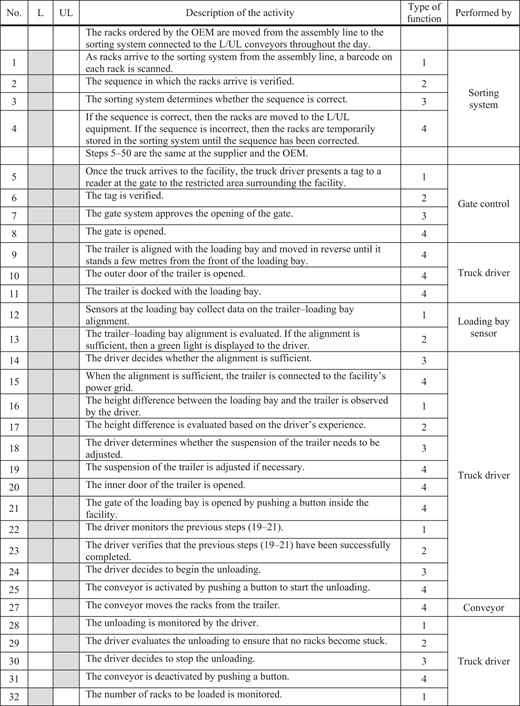
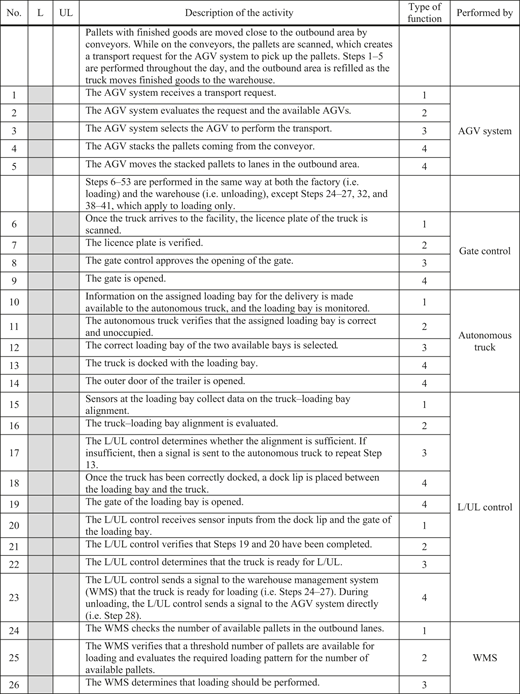
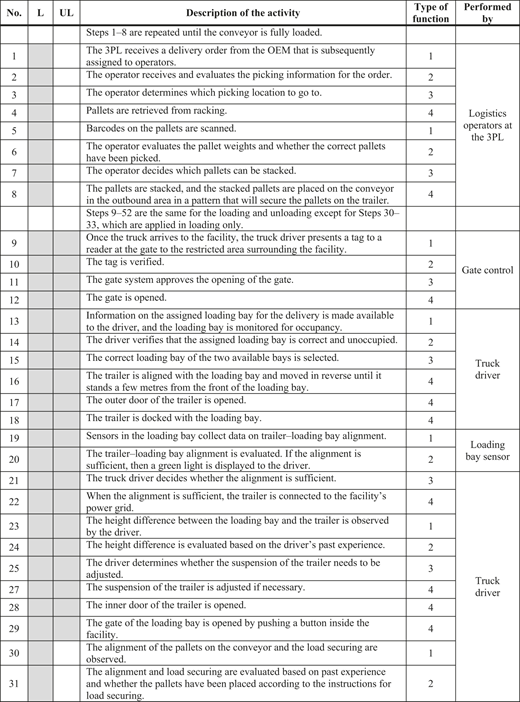
A multiple-case study comprising three cases was conducted to cover various contexts, to improve the validity of the results, and to reduce the risk of observer bias (Voss et al., 2002). Case studies are in-depth studies of individual units of analysis focused on achieving depth and context (Flyvbjerg, 2011). In a case study, the unit of analysis and its boundaries are pivotal (Harrison et al., 2017). For this paper, the unit of analysis was the L/UL, defined as the physical movements, information flows, and decision-making involved in loading and unloading of unit loads from road trucks, including the necessary preparatory activities within the sending and receiving organisations, as detailed in Tables 5, A1 and A2.

Case studies are suitable for exploratory studies (Meredith, 1998) which aligns with the current study, and when studying phenomena in real-world contexts (Yin, 2014). Multiple-case studies comprise several cases, although there is no fixed number that should be met (Eisenhardt, 2021). Multiple-case studies allow researchers to understand the differences and similarities between cases and analyse data both within each case and across cases (Gustafsson, 2017). They also provide a stronger base for theory (Yin, 2014) because the propositions are more deeply grounded in varied empirical evidence (Eisenhardt and Graebner, 2007). A multiple-case study implies that multiple settings are investigated to improve the generalisability of the results (Meredith, 1998; Stake, 2006).
3.1 Case selection
A strategic information-oriented selection of cases is important for a case study (Eisenhardt, 1989; Flyvbjerg, 2011). The cases in the study for this paper were deliberately selected to demonstrate both similarities and differences, which provided a basis for identifying requirements for automated L/UL. To increase its validity, the study involved using both a paradigmatic and varied selection of cases with the aim of having representative cases of the phenomenon that differ in key aspects (Flyvbjerg, 2011). The cases were selected due to showing automation in their L/UL, while also providing contrast in that two of the systems have been used for several years, whereas the third system is an experimental system using autonomous trucks. The business models of the systems differ in the responsibilities and number of stakeholders involved, which provided a rich environment suitable for a multiple-case study and triangulation of the results. The three cases are located in Sweden and represent large manufacturing industries with significant material flows in which transport takes place by truck between local warehouses and production facilities. In all cases, the L/UL equipment automates the physical movement of goods onto and off trucks and trailers. Cases 1 and 2 use similar L/UL solutions involving dedicated trucks along with conveyors installed in the trailers and in the sending and receiving facilities. The trucks in Cases 1 and 2 are operated by truck drivers, whereas Case 3 involves an autonomous truck and AGVs used for L/UL. Two different L/UL solutions are thus represented in the cases, which may involve different requirements for automation. The L/UL solution in Case 3 is not fully operational; however, tests in a pilot project have been conducted wherein specifications were defined, and those specifications are used in this paper.
Whereas the sending and receiving facilities in Case 3 belong to the same company, the facilities in in Cases 1 and 2 belong to different companies, which could affect requirements regarding legal responsibilities and alignment of processes between the companies. The recipient company is the same in Cases 1 and 2. In all three cases, transport providers are responsible for the transport between the sender and recipient, while the cases differ in terms of the operational setup. In Case 2, goods have to be delivered in an agreed-upon sequence, and the case involves a return flow of empty unit loads. Last, whereas Cases 1 and 3 involve palletised goods, racks are used in Case 2. Table 1 provides an overview of the three studied cases.
Overview of the studied cases
| Characteristic | Case 1 pallet conveyor | Case 2 rack conveyor | Case 3 pallet AGV |
|---|---|---|---|
| Industry | Manufacturing | Manufacturing | Manufacturing |
| L/UL solution | Conveyor | Conveyor | AGVs |
| Material flow | From a third party logistics provider to an automotive manufacturer | From a supplier of subassemblies to an automotive manufacturer | From a production facility to a finished goods storage within a company |
| Both loading and unloading performed at each destinations? | No | Yes | No |
| Type(s) of unit loads | EUR-pallets (800 × 1,200 mm), half-pallets (800 × 600 mm) | Specialised racks | EUR-pallets (800 × 1,200 mm), half-pallets (800 × 600 mm) |
| Number of transports per day | Deliveries according to fixed schedule. One delivery every 30 min. In total 27 transports each day | Delivery according to fixed, takt driven schedule. One delivery every 30 min. In total 27 transports each day | Maximum 10 transports Average 8 transports |
| Number of unit loads per delivery1 | Maximum 90 pallets Average 75 pallets | 30 racks | Maximum 72 pallets Average 48 pallets |
| Variation in truck arrival times | Low variation, having no effect on the production at the automotive manufacturer | Low variation, no effect on the production at the automotive manufacturer | Variations in truck arrival times since the deliveries are not performed according to a fixed schedule, but variations having no effect on the operations in production and warehouse |
| Number of trucks in the material flow | 2 | 3 | 1 |
| Truck drivers involved per day | 6 | 9 | 2 remote drivers shared with other transport flows supervising the autonomous truck |
| Load transferring time | 300 s for transferring a full truckload. Limited variations | 420 s for transferring a full truckload, including both loading and unloading. Limited variations | 130 s for transferring a single pallet2 |
| Number of shifts | 3 | 3 | 2 |
| Distance between sender and recipient (km) | 3.0 | 1.9 | 1.6 |
Note(s): 1In the cases the pallets are stacked. Case 1 involve triple stacking pallets occasionally. The variation in number of pallets in the cases is caused by what is produced at the assembly line
2The time it takes to load/unload one pallet for the AGV depend on how many pallets have been loaded/unloaded previously
Source(s): Table by authors
3.2 Data collection
Table 2 provides an overview of the data collection in the multiple-case study. The scope of data collection included all activities except the transport between the sender and recipient, and data were collected regarding the information flow, decisions made, and physical activities, from when loading is initiated at the sender’s facility until the goods are moved from the loading bay to the next activity at the recipient’s facility.
Observations and interviews performed
| Case | Duration (min) | Roles interviewed/observed | Description |
|---|---|---|---|
| Case 1 | 50 | Supply Chain Engineer 1 (recipient), Supply Chain Engineer 2 (recipient), Truck Driver 1 (transport provider) | Visit to the recipient: Supply Chain Engineers 1 and 2 explained the L/UL, L/UL equipment, and the setup between the sender, transport provider, and receiver. The activities performed by Truck Driver 1 were observed, during which the driver explained each activity |
| 75 | Team Leader 1 (recipient), Logistics Operator 1 (recipient), Logistics Operator 2 (recipient) | Visit to the recipient: Logistics Operators 1 and 2 in the inbound process were observed while they explained the activities being performed. Team Leader 1 in the inbound process was interviewed and explained the processes being performed | |
| 105 | Team Leader 2 (sender), Logistics Operator 3 (sender), Truck Driver 2 (transport provider) | Visit to the sender: The activities performed by Truck Driver 2 were observed, during which the driver explained each activity. Logistics Operator 3 was observed while performing the activities preceding loading and explained the activities. Team Leader 2 in the outbound process was interviewed and explained the activities being performed | |
| 551 | Supply Chain Engineer 3 (recipient) | Online meeting to present the findings of the paper and discuss them with Supply Chain Engineer 3 | |
| Case 2 | 70 | Supply Chain Engineer 1 (recipient), Supply Chain Engineer 2 (recipient), Logistics Operator 4 (recipient), Truck Driver 3 (transport provider) | Visit to the recipient: Supply Chain Engineers 1 and 2 were the same individuals as in Case 1 and explained the L/UL, the L/UL equipment, and the setup between sender, transport provider, and recipient. The activities performed by Truck Driver 3 were observed, during which the driver explained each activity. Logistics Operator 4 was interviewed while the activities were observed |
| 110 | Production Manager (sender), Maintenance Employee (sender), Truck Driver 4 (transport provider) | Visit to the sender: The Production Manager explained the L/UL, the L/UL equipment, and the setup between sender, transport provider, and recipient. The activities performed by Truck Driver 4 were observed, during which the driver explained each activity. The Maintenance Employee provided details on potential malfunctions with the L/UL equipment and how to proceed when such malfunctions arise | |
| 551 | Supply Chain Engineer 3 (recipient) | Online meeting to present the findings of the paper and discuss them with Supply Chain Engineer 3 | |
| Case 3 | 110 | General Manager in Logistics (sender/recipient), Logistics Engineer, (sender/recipient), Process Engineer (sender/recipient) | Visit to the sender and recipient: The process of the automated L/UL was explained by the General Manager in Logistics and the Logistics Engineer. The manually performed L/UL activities were observed, and activities that need to be performed automatically were identified. The General Manager in Logistics explained the setup between the factory and the warehouse. The Logistics Engineer and the Process Engineer explained how the AGVs are to be used in L/UL |
| 480 | Logistics Engineer (sender/recipient), Process Engineer (sender/recipient) AGV Supplier, Transport Provider Representative, Operator | The planned operations in the L/UL were observed while being performed manually by the Operator, who highlighted activities regarding information and physical flows, as well as decisions in the L/UL. The AGV Supplier was interviewed regarding the AGVs and how they will be used in L/UL. The Transport Provider Representative was interviewed about the autonomous truck. The Logistics Engineer and Process Engineer were providing information on the IT systems and the technical challenges involved | |
| 50 | General Manager in Logistics (sender/recipient), Process Engineer (sender/recipient) | Online meeting to present the findings of paper and discuss them with the General Manager in Logistics and the Process Engineer |
Note(s): 1This was the same meeting
Source(s): Table by authors
In case studies, researchers advocate the use of multiple data collection methods to provide a comprehensive view of the unit of analysis and increase the validity of the results (Eisenhardt, 1989; Flyvbjerg, 2011; Harrison et al., 2017). Triangulation through different methods and data sources strengthen validity (Yin, 2013) as well as reliability (Voss et al., 2002). The multiple-case study conducted for this paper involved semi-structured interviews, observations, and video-recordings. Data collection involved observations and interviews conducted during visits to each case site. Visits were made to both the senders and the recipients, and all activities were video-recorded except loading at the sender in Case 2, where video-recording was prohibited. The video-recordings aided in making comprehensive mappings of the material flows and increased reliability (Riege, 2003). Each material flow was followed, and all activities involved were mapped. The activities of the truck drivers were observed during L/UL, and the drivers explained each activity that they performed from their arrival to their departure. They also explained the procedures to be followed if irregularities occur in L/UL. Furthermore, the activities performed by operators and team leaders working in the outbound and inbound processes were observed. Last, engineers and managers were interviewed, providing data regarding the design of the L/UL solutions as well as the arrangement of the collaboration between the sender, transport provider, and recipient. During each visit, at least two authors participated, and notes from the observations and interviews were compared and discussed to ensure a common understanding. Using multiple investigators allowed each case to be viewed from different perspectives, thereby increasing the richness of the data (Eisenhardt, 1989; Riege, 2003). Case descriptions were compiled and shared with the case companies for validation, which further increased validity (Riege, 2003). The conclusions of the study were presented and discussed with the case companies in order to get their perspectives on the results.
3.3 Analysis
Eisenhardt (1989) states that a multiple-case study includes both within-case and cross-case analysis, and suggests dividing the cases into dimensions for the analyses. Barratt et al. (2011) suggested that researchers should select constructs based on the existing literature and address those in the cross-case analysis. This section outlines the analysis conducted for the paper, and in line with Eisenhardt (1989) and Barratt et al. (2011), it also describes the conceptual framework developed to structure the cross-case analysis. The within-case analysis, meanwhile, consisted of mapping the activities of the L/UL process for each case as well as noting the IT systems involved, how data and information are transferred, and the legal terms between the sender, transport provider, and recipient. The cross-case analysis then involved applying the developed conceptual framework to categorise the information from the cases and provide an understanding of it. The conceptual framework assisted in identifying requirements and comparing the cases, as is presented in Section 5. The framework of the paper consists of two dimensions: Parasuraman et al.’s (2000) types of function in which automation can be applied and layers of interoperability, both of which are explained in the following paragraphs.
The paper considers L/UL from a wider perspective that encompasses more than the mere physical transfer of goods onto and off trucks. Thus, to support the analysis, the conceptual framework needed to consider a broad set of activities. Previous research on automation, albeit not specifically addressing L/UL, has considered specific functions that could be automated. Engsley et al. (1997) suggested that automation can be applied in the four functions of monitoring, generating, selecting, and implementing, while Proud et al. (2003) have proposed the functions of observing, orienting, deciding, and acting. Similarly, Parasuraman et al. (2000) distinguished between the four functions of (1) information acquisition, meaning the sensing and registering of data; (2) information analysis, meaning the analysis of acquired data by combining several data sources to make predictions, among other activities; (3) decision and action selection, meaning the selection of actions to perform; and (4) action implementation, meaning performing each chosen action. All three models (Engsley et al., 1997; Parasuraman et al., 2000; Proud et al., 2003) are similar and highlight the information flows, decision-making processes, and actions in which automation can be applied. Those types of functions also apply to the automation of L/UL. The model suggested by Parasuraman et al. (2000) is well-established and provides a clear structure for the functions for which automation can be applied. Therefore, that model is used as part of this paper’s conceptual framework to identify activities in L/UL that would need to be automated.
Interoperability is vital to aligning operations within a supply chain (Espadinha-Cruz and Grilo, 2019) and, in the case of L/UL, aligning operations between sender, transport provider, and recipient. Many frameworks and models for interoperability have been developed, including the European interoperability framework (EIF), the advanced technologies for interoperability of heterogeneous enterprise networks and their applications framework (ATHENA), the levels of information systems interoperability framework (LISI), and the interoperability development of enterprise applications and software framework (IDEAS), as presented in Chen et al. (2008), Espadinha-Cruz and Grilo (2019), Rezaei et al. (2014), and Vernadat (2010). Among them, the EIF is a generic framework consisting of four layers of interoperability: the organisational, legal, semantic, and technical (European Commission, 2017). Although originally developed for information exchange between the public administrations of countries in the European Union, the EIF has also been applied in previous research on automation in manufacturing and supply chain management (Vernadat, 2010, 2023).
In the organisational layer, business processes need to be aligned to achieve common goals between the organisations involved. For L/UL, both physical and informational processes (e.g. confirming deliveries and performing physical tasks) between the organisations need to be aligned. In the legal layer, various legal agreements need to be made, and the actors have to be able to work together when operating under different legal frameworks. In relation to L/UL, legal aspects could concern, for example, responsibilities and liabilities for cargo (Stojanović and Ivetić, 2020) and securing loads (Vlkovský et al., 2021). In the semantic layer, the meaning and formatting of data and information need to be aligned to ensure mutual understanding between the actors; in L/UL, such aspects relate to delivery confirmations, among other things. Last, in the technical layer, infrastructure and applications that connect systems need to be aligned, and additions to the technical layer may be needed to support automated L/UL.
Vernadat (2023) applied the EIF when studying standards for automation. Similarly, Weichhart et al. (2021) applied the EIF to study interoperability in cyber-physical manufacturing, including automation, and focused on organisational, semantic, and technical interoperability in particular. In their paper, they highlighted the need for interoperability between organisations, including in supply chains. The EIF provides a structure for identifying requirements to align operations between the sender, transport provider, and recipient in the context of automated L/UL.
Table 3 shows the conceptual framework applied in this paper, based on Parasuraman et al. (2000) and the EIF (European Commission, 2017). By combining the two dimensions of interoperability and the type of function in which automation can be applied, the framework allowed a multifaceted understanding of the requirements for automation, in line with the focus of the paper. Many activities are performed in L/UL in addition to physically moving goods. The types of functions in Parasuraman et al. (2000) allowed the categorisation of the functions that can be automated. Altogether, a 4 × 4 matrix was derived from the types of functions and the layers of interoperability, in which each cell represents an area wherein requirements may be identified, and each area is studied to identify requirements for automated L/UL.
Conceptual framework developed to support the analysis
| Type of function | |||||
|---|---|---|---|---|---|
| Information acquisition | Information analysis | Decision and action selection | Action implementation | ||
| Layer of interoperability | Organisational | Business processes related to gathering data and information | Business processes related to analysing and combining data | Business processes related to making decisions | Business processes related to performing actions |
| Legal | Legal considerations related to gathering data and information | Legal considerations related to analysing and combining data | Legal considerations related to making decisions | Legal considerations related to performing actions | |
| Semantic | Formatting and meaning related to gathering data and information | Formatting and meaning related to analysing and combining data | Formatting and meaning related to making decisions | Formatting and meaning related to performing actions | |
| Technical | Technical infrastructure and applications related to gathering data | Technical infrastructure and applications related to analysing and combining data | Technical infrastructure and applications related to making decisions | Technical infrastructure and applications related to performing actions | |
Source(s): Table by authors
4. Within-case analysis
4.1 Case 1
Case 1 comprises a material flow of palletised goods from a warehouse of a third-party logistics provider (3PL) to an assembly plant of an original equipment manufacturer (OEM) in the automotive industry, located 3 km away. The OEM and 3PL have collaborated closely for a long time. The transport provider owns the trailers used in transport. The L/UL solution involves conveyors in the trailers that are matched to conveyors in the facilities of the 3PL and the OEM (Figure 1). There are two L/UL loading bays at both the OEM and the 3PL, and after unloading, the truck returns empty to the 3PL. The conveyor in the trailer requires the truck to be connected to the facility’s power grid.
 Three photos are arranged in two rows, labeled (a) and (b) in the top row, and (c) in the bottom row. In the first photo (a) labeled “The empty conveyor for L over U L,” there is an empty conveyor located in the center of the photo. The conveyor is rectangular and runs horizontally across the floor, with several parallel lines visible, indicating the belts on the conveyor. The yellow conveyor frame stands out, and the surrounding space appears to be an industrial area with high ceilings and large windows. On the left side of the photo, a forklift is positioned next to the conveyor, visible behind some boxes or pallets. The second photo (b), labeled “The conveyor loaded with pallets,” shows the same conveyor now loaded with several pallets. The pallets are stacked in a row along the conveyor, occupying most of its length. The pallets are rectangular and made of dark-colored material. The conveyor belt appears to be slightly inclined and is holding the pallets in a steady position, ready for further transportation. The warehouse setting remains consistent, with visible structural elements, such as ceiling fans and bright industrial lights. The third photo (c), labeled “The pallets loaded onto the trailer. Matching conveyors are installed in the trailer,” shows a close-up of a trailer's rear door. The trailer's interior is visible, with pallets loaded inside and resting against the back wall. The pallets are aligned with matching conveyors, which are installed inside the trailer to facilitate the movement of goods from the loading area to the truck. The trailer's entrance is large, with yellow and black striped safety markings at the edges.
Images showing the L/UL solution in Case 1
Three photos are arranged in two rows, labeled (a) and (b) in the top row, and (c) in the bottom row. In the first photo (a) labeled “The empty conveyor for L over U L,” there is an empty conveyor located in the center of the photo. The conveyor is rectangular and runs horizontally across the floor, with several parallel lines visible, indicating the belts on the conveyor. The yellow conveyor frame stands out, and the surrounding space appears to be an industrial area with high ceilings and large windows. On the left side of the photo, a forklift is positioned next to the conveyor, visible behind some boxes or pallets. The second photo (b), labeled “The conveyor loaded with pallets,” shows the same conveyor now loaded with several pallets. The pallets are stacked in a row along the conveyor, occupying most of its length. The pallets are rectangular and made of dark-colored material. The conveyor belt appears to be slightly inclined and is holding the pallets in a steady position, ready for further transportation. The warehouse setting remains consistent, with visible structural elements, such as ceiling fans and bright industrial lights. The third photo (c), labeled “The pallets loaded onto the trailer. Matching conveyors are installed in the trailer,” shows a close-up of a trailer's rear door. The trailer's interior is visible, with pallets loaded inside and resting against the back wall. The pallets are aligned with matching conveyors, which are installed inside the trailer to facilitate the movement of goods from the loading area to the truck. The trailer's entrance is large, with yellow and black striped safety markings at the edges.Images showing the L/UL solution in Case 1
The entire truckload is transferred to or from the trailer when the conveyors are activated. Guide rails have been installed at the loading bays to align the trailer. The OEM and 3PL are responsible for maintaining the L/UL equipment at their facilities, and the transport provider is responsible for maintaining the trailers. Table 4 presents an overview of the L/UL activities, which are further detailed in Table 5.
Overview of the main activities in L/UL in Case 1
| Stage | Activities |
|---|---|
| Before loading (sender) |
|
| Truck arrival |
|
| Loading activities (sender) |
|
| Truck departure |
|
| Transport |
|
| Truck arrival |
|
| Unloading activities (recipient) |
|
| Post-unloading activities |
|
Source(s): Table by authors
Six truck drivers operate over three shifts. All transport runs according to a fixed schedule with trucks arriving to the OEM every 30 min. If problems occur with the L/UL equipment, the truck driver contacts maintenance personnel. The order information is transferred electronically between the OEM and the 3PL according to a predefined standard. The 3PL or the transport provider is responsible for any damage to goods, depending on who is at fault, until the goods are inside the OEM facility. When loading the conveyor at the 3PL, logistics operators ensure that the loads are secured by placing the pallets according to a predetermined pattern.
4.2 Case 2
Case 2 comprises a material flow of subassemblies delivered in sequence on racks from a supplier to the same automotive OEM as in Case 1, at a distance of 1.9 km. A transport provider is responsible for the transport. The OEM and the supplier have matching conveyors in their facilities (Figure 2), and dedicated trailers with conveyors are used. The conveyors transfer an entire truckload at once. High-precision trailer alignment is needed, and there are guide rails for the truck at the loading bays. All racks have the same dimensions. The subassemblies need to be delivered in a predetermined sequence to the OEM, and a sorting system connected to the L/UL equipment can automatically re-sequence the subassemblies if needed. The trailer needs to be connected to the facilities’ power grid for the conveyors to function. The OEM has a loading bay dedicated to that flow, as does the supplier. An overview of the activities in the material flow are presented in Table 6. Both loading and unloading occur at the supplier and the OEM because empty racks are returned to the supplier using the same trailers and L/UL equipment. Once L/UL has been performed, the truck driver signs a document confirming its error-free completion. A detailed description of the activities appears in Table A1.
 The photo shows an elevated view of a production area in a factory featuring multiple parallel rows of metallic racks and yellow safety rails. Fencing and access gates border the workspace, and a section of the back wall has the label “Loading bay door.” Bright red arrows are overlaid atop several rack rows, visually guiding the route that parts or finished subassemblies take as they move from the foreground production area toward the back of the workspace, where the loading bay door is located. The arrows trace a path first across, then parallel, and finally back across the racks, indicating a looped or zigzag flow. On the right side of the photo, descriptive text explains the process: “The red arrows show how the finished subassemblies are moved from the production line to the loading bay door where empty racks returning from the O E M are first unloaded, before the racks with subassemblies are loaded onto the trailer. The completed subassemblies are attached to the racks in the production.”
Image showing the L/UL solution in Case 2
The photo shows an elevated view of a production area in a factory featuring multiple parallel rows of metallic racks and yellow safety rails. Fencing and access gates border the workspace, and a section of the back wall has the label “Loading bay door.” Bright red arrows are overlaid atop several rack rows, visually guiding the route that parts or finished subassemblies take as they move from the foreground production area toward the back of the workspace, where the loading bay door is located. The arrows trace a path first across, then parallel, and finally back across the racks, indicating a looped or zigzag flow. On the right side of the photo, descriptive text explains the process: “The red arrows show how the finished subassemblies are moved from the production line to the loading bay door where empty racks returning from the O E M are first unloaded, before the racks with subassemblies are loaded onto the trailer. The completed subassemblies are attached to the racks in the production.”Image showing the L/UL solution in Case 2
Overview of the main activities in L/UL in Case 2
| Stage | Activities |
|---|---|
| Before loading (sender) |
|
| Truck arrival |
|
| Unloading activities (sender) |
|
| Loading activities (sender) |
|
| Truck departure |
|
| Transport |
|
| Truck arrival |
|
| Unloading activities (recipient) |
|
| Loading activities (recipient) |
|
| Post-unloading (recipient) |
|
Source(s): Table by authors
The supplier, transport provider, and OEM are each responsible for maintaining their respective parts of the L/UL equipment. The truck driver contacts maintenance employees when the L/UL equipment malfunctions. The transport provider is responsible for performing transport and owns the three trailers dedicated to the flow. Nine drivers are employed, operations run in three shifts, and a truck arrives every 30 min. Order information is transferred electronically between the IT systems of the OEM and the supplier according to a predefined standard. If the goods are damaged before reaching the OEM, the transport provider or supplier must compensate the OEM depending on who is at fault. The trailer is always fully loaded with the same number of racks, and there is no need for further load securing.
4.3 Case 3
Case 3 involves a material flow of palletised goods between a factory and a finished goods warehouse in the same company, located 1.6 km apart. The warehouse has two loading bays for the flow, whereas the factory has one. In L/UL, the pallets are moved by AGVs in stacks of two (Figure 3). No fixed installations in the truck are necessary. There is a remote driver who supervises several autonomous trucks and can operate the truck remotely if needed. The remote driver is employed by the transport provider, who also owns the truck. On average, eight transports are performed per day by a single truck, performed when needed and not according to a fixed schedule. In loading, the remote driver verifies that the cargo is secured before departing for the warehouse.
 Two photos display consecutive stages in a warehouse loading area. The first photo (a), on the left and labeled “The A G V picking up a pallet for loading,” shows an orange and black automated guided vehicle (A G V) adjacent to a row of stacked wooden pallets. The A G V is positioned with its forks near or under the pallet, standing on a smooth concrete floor. In the background, there is a row of tall warehouse doors, wall-mounted equipment, and overhead lights aligned along the length of the building. The environment includes visible vertical steel supports and safety features, such as warning stripes at the dock edge. The second photo (b), on the right and labeled “A G V entering the truck during loading,” shows the same A G V maneuvering forward into the open cargo space of a truck trailer, carrying a pallet on its forks. The truck’s interior is visible with a wide, open floor space, and the dock area shows metal door tracks, electrical panels, yellow safety tape, and metal door edges.
Images showing the L/UL solution in Case 3
Two photos display consecutive stages in a warehouse loading area. The first photo (a), on the left and labeled “The A G V picking up a pallet for loading,” shows an orange and black automated guided vehicle (A G V) adjacent to a row of stacked wooden pallets. The A G V is positioned with its forks near or under the pallet, standing on a smooth concrete floor. In the background, there is a row of tall warehouse doors, wall-mounted equipment, and overhead lights aligned along the length of the building. The environment includes visible vertical steel supports and safety features, such as warning stripes at the dock edge. The second photo (b), on the right and labeled “A G V entering the truck during loading,” shows the same A G V maneuvering forward into the open cargo space of a truck trailer, carrying a pallet on its forks. The truck’s interior is visible with a wide, open floor space, and the dock area shows metal door tracks, electrical panels, yellow safety tape, and metal door edges.Images showing the L/UL solution in Case 3
The AGVs load the truck according to a predetermined pattern, which depends on the number of pallets to be loaded. By following the pattern, the cargo is secured on the truck. There is no return flow from the warehouse to the factory. An overview of the activities performed appears in Table 7 and a detailed description of the activities appears in Table A2.
Overview of the main activities in L/UL in Case 3
| Stage | Activities |
|---|---|
| Before loading (sender) |
|
| Truck arrival |
|
| Loading activities (sender) |
|
| Truck departure |
|
| Transport |
|
| Truck arrival |
|
| Unloading activities |
|
| Post-unloading (recipient) |
|
Source(s): Table by authors
The AGVs scan barcodes on the pallets that they pick up, which requires the barcodes to be located in the same place on each pallet. If the barcodes cannot be scanned, the AGVs require manual assistance. The AGV system has its own control system, connected to the company’s IT systems. AGV errors are reported to the AGV system supplier, who also performs maintenance on the AGVs. The factory and the warehouse use separate IT systems, requiring the barcodes to be scanned on the pallets when transferring them between systems.
5. Cross-case analysis of the requirements for automated L/UL
In line with the conceptual framework presented in Table 3, the cases were analysed and compared with each other in terms of the four layers of interoperability (i.e. organisational, legal, semantic, and technical) and considering the four types of functions (i.e. information acquisition, information analysis, decision and action selection, and action implementation). A cross-case comparison is shown in Table 8 using the stages identified in Tables 4–7 and the actors identified in Tables 5, A1, and A2.
Cross-case comparison of the activities performed during the L/UL stages
| Stage | Performed by | Case 1 pallet conveyor | Case 2 rack conveyor | Case 3 pallet AGV |
|---|---|---|---|---|
| Before loading | Logistics operators at the 3PL/shipper, Sorting system, AGV system | Logistics operator picks orders and stacks pallets to be loaded in a pattern so that the load will be secured on the trailer | Mechanical sorting system sequence racks to be loaded | AGV stacks pallets to be loaded |
| Truck arrival | Gate control, Truck driver/Remote driver/Autonomous truck, Loading bay sensor, L/UL control | Driver gets access through external gate. Driver docks trailer and loading bay sensors confirm alignment | Driver gets access through external gate. Driver docks trailer and loading bay sensors confirm alignment | Autonomous truck gets access through external gate and docks independently. Sensors confirms alignment |
| Loading/unloading activities | Truck driver, L/UL control, WMS, Conveyor, AGV system | Truck driver starts, stops and monitors L/UL. Calls maintenance if necessary. Conveyor performs loading/unloading. Loadin/unloading requires supervision as pallets tend to get stuck | Truck driver starts, stops and monitors L/UL. Calls maintenance if necessary. Conveyor performs loading/unloading, scanning of barcodes and load securing | L/UL control initiates unloading/loading. WMS instructs AGV to performs loading/unloading and load securing |
| Truck departure | Truck driver/Remote driver/Autonomous truck, L/UL control | Truck driver initiates departure and disconnects the trailer from the power grid | Truck driver initiates departure and disconnects the trailer from the power grid | L/UL control verifies truck ready for departure. Remote driver initiates departure of autonomous truck and verifies load securing |
| Post-unloading | Logistics operators at OEM/warehouse | Operators scans barcodes and transfers to internal logistics systems | Operator transfers to internal logistics systems | Operators scans barcodes and transfers to internal logistics systems |
Source(s): Table by authors
5.1 Organisational layer
Without a truck driver, the activities and responsibilities of the driver need to be transferred to automated solutions or humans outside the L/UL system. Comparing the cases clarifies that information-related activities such as checking trailer–loading bay alignment, monitoring the sequence of goods, confirming completed deliveries, verifying load securing, scanning unit load barcodes, and monitoring L/UL relate to information acquisition and information analysis. Those activities would need to be automated or eliminated when using autonomous trucks. The change in the organisational layer for automated L/UL, that is, the removal of the truck driver, means that there are requirements in the technical layer to perform activities that have previously been conducted by the truck driver, and those requirements are detailed in Section 5.4. Without human involvement, additional sensors are required to gather data, which involves its own requirements in the semantic and the technical layers (see Sections 5.3 and 5.4). Additionally, there is a clear sequence of activities in L/UL, and without a truck driver to ensure that the activities are performed in the correct sequence, there are requirements in the technical layer to verify that the activities are performed correctly relating to the decision and action selection function. Furthermore, activities extending beyond the core actors of the L/UL system may also need to be triggered. The maintenance of the L/UL equipment in Cases 1 and 2 is triggered by truck drivers or logistics operators by calling maintenance personnel when they notice a malfunction. Because maintenance itself likely cannot be automated, it is necessary to monitor the equipment, to decide when maintenance is needed, and, if so, to contact maintenance personnel automatically. A similar setup is required by the AGV in Case 3 if there are issues during L/UL.
In information acquisition, the processes preceding the physical L/UL can be important. To enable the AGVs in Case 3 to scan pallets, the barcode labels need to be in the same place on every pallet, and this process needs to be considered for automated L/UL. Placing barcodes on the pallets occurs earlier in the material flow, meaning that there are requirements for automated L/UL at earlier stages, not only during the L/UL activities. In Case 2, by comparison, the location of the barcodes is fixed, which simplifies the scanning of the racks in L/UL.
Table 5, A1, and A2 present aspects of decision and action selection in L/UL by truck drivers and operators that need to be automated in all three cases, including deciding departure time, deciding when to start and stop L/UL, confirming that L/UL proceeds without errors, selecting the loading bay, and confirming trailer–loading bay alignment. Making those decisions requires input data from monitoring various parts of the L/UL. In Cases 1 and 3, a decision needs to be made about what loading bay to dock to, whereas that decision is not required in Case 2. Several physical actions are also required for L/UL, including opening and closing gates, stacking and unstacking pallets (i.e. in Cases 1 and 3), aligning a dock lip (i.e. in Case 3), aligning the truck and loading bay, activating and deactivating the L/UL, and connecting the trailer to the facility power grid (i.e. in Cases 1 and 2). There are also differences between the cases regarding the action implementation, including the requirement to connect the conveyors to the power grid, which is not required for L/UL with AGVs. Those actions need to be automated or else eliminated for automation to be achieved, which requires that the equipment, including gates, trucks, and connectors, can send and receive signals and perform the necessary actions (see Sections 5.3 and 5.4).
Some activities are better eliminated than automated. For example, concerning action implementation in Case 1, pallets are stacked manually before loading and then unstacked manually when unloaded. The conveyor-based solution in Case 1 lacks stacking capabilities, whereas the L/UL equipment based on AGVs in Case 3 can manage the stacking automatically. In Case 1, logistics operators pick the pallets from racking before loading and, after unloading, transfer pallets to a tugger train. The truck drivers in Case 1 also need to manually align the pallets on the conveyor with a metal bar to prevent them from becoming stuck during automated loading. Although they could be automated, the preferred strategy is to eliminate them, sometimes by adapting packaging to avoid the need for stacking and by ensuring alignment to remove the need for human correction.
5.2 Legal layer
Removing the driver has legal implications, most significantly regarding liabilities and compliance, as identified in all cases. The overall distribution of responsibilities between the sender, transport provider, and recipient remains the same, however, the lack of human presence places demand on the technical ability to verify, for instance, whether the door was locked when the truck departed and whether the correct goods are delivered. Such confirmation concerns information acquisition and analysis as well as decision and action selection. The transfer of responsibility for the goods between organisations is important because damage to goods may require compensation to other organisations (i.e. in Cases 1 and 2). Although the transfer of responsibility is less important in Case 3, wherein the sender and recipient are the same company, the responsibility of the external transport provider remains important to consider. In all cases, the contractual consequences of failed deliveries are severe. Failed deliveries can halt production and justify demands for significant economic compensation. Documenting performance and liability issues is therefore important. In Case 2, the physical document signed by the driver at each unloading would have to be replaced by logs based on sensor data to determine who is responsible.
Another legal requirement relates to load securing. There needs to be a clear responsibility for the load securing, regarding both compliance with laws and regulations and avoiding damages to goods. In Case 1, loads are secured by logistics operators because the L/UL equipment cannot secure the cargo automatically. Securing loads is less challenging in Case 2, because the trailers are always fully loaded, which prevents the racks from sliding inside the trailer, and in Case 3, where an AGV secures the goods by following a predetermined loading pattern. In Cases 1 and 2, the driver is responsible and confirms that the load is secure and, in Case 2, also signs a document confirming that loading has been successfully performed. In Case 3, by contrast, the remote driver of the autonomous truck needs to confirm that the load is secured. That activity relates to decision and action selection and is critical when the transport is conducted by an autonomous truck, as in Case 3.
5.3 Semantic layer
The semantics in an automated system cannot be ambiguous. In L/UL, semantics refers to how the meaning of data in the IT systems is interpreted. Data from several sensors might have to be combined to convey information, as indicated in Section 5.1. The trucks have to be able to communicate with the IT systems in the facilities (e.g. receive signals to depart or open trailer doors), and all subprocesses in L/UL need to be able to send and receive understandable and actionable signals without a truck driver present, which pertains to the information acquisition and information analysis functions (see Section 5.4). Those semantic requirements are present in all three cases. It is important to clearly define what data are needed to make decisions and what actions should be performed, and that understanding also has to be shared between the sender, transport provider, and recipient. The parties additionally need to agree on what input is needed to confirm that a door is closed or what is required for unloading to be considered complete, among other things. Such agreement is important when liability issues arise, as stated in Section 5.2, which shows that there are requirements in the semantic layer related to decision and action selection as well as action implementation. When the sender and receiver are the same company, as in Case 3, semantics could be easier to manage.
5.4 Technical layer
Without humans in the L/UL process, new technical infrastructure is needed, as presented in Section 5.1. In Cases 1 and 2, sensors are already used to visually assist the truck driver in aligning the trailer; however, additional sensors would be needed, along with infrastructure, to manage the extended communication, as presented in Section 5.3. Sensors would be needed to collect data on the activities to ensure that the next activity can be performed. In addition to sensors for the truck–loading bay alignment, sensors would be needed to confirm that the loading bay gate is opened, the truck suspension is appropriately adjusted (i.e. in Cases 1 and 2), the truck is connected to the power grid (i.e. in Cases 1 and 2), the trailer door is opened, and the dock lip is in place (i.e. in Case 3), all of which are needed for loading to begin. Additionally, sensors need to monitor the loading for the conveyor solutions in Cases 1 and 2 to ensure that it proceeds without errors and that all goods are loaded. In unloading, sensors would need to confirm that the truck can depart, for instance, that the dock lip is disengaged and that the trailer door is closed. A technical solution, a L/UL control, is also needed that can receive and analyse signals from sensors (i.e. information acquisition and analysis), make decisions (i.e. decision and action selection), and send signals to the next activity (i.e. action implementation). The L/UL control needs to determine, for example, whether the trailer–loading bay alignment is satisfactory; if so, the next step can be performed, and if not, a signal needs to be sent to the truck to realign. The L/UL control additionally needs to be able to collect the data, manage, and relay the data to the right processes, in the right format, and at the right time.
Additions in the technical layer of interoperability outside IT systems are needed as well. Trailer–loading bay alignment can be managed by physical guide rails (i.e. in Cases 1 and 2). Furthermore, the truck needs to connect to the facility’s power grid automatically for the conveyor to work (i.e. in Cases 1 and 2). Similarly, the truck’s suspension needs to be automatically adjusted to the height of the loading bay. In Case 3, the AGVs require a dock lip to be vertically aligned to the truck, and the trailer door and the facility gates need to be opened as a truck arrives and closed when the truck departs. In Cases 1 and 2, all those activities are performed manually by the truck driver; however, as highlighted in Case 3, those activities would need to be connected to the L/UL control for automated L/UL. For example, the loading bay gate is not connected to any IT system in Cases 1 and 2 but is opened by pushing a button. The loading bay gate would need to be connected to the L/UL control to receive and send signals to open and close the gate, as required when there are no truck drivers to push the buttons. Those requirements are connected to the action implementation function.
5.5 Requirements for automated L/UL
The cross-case analysis shows that the requirements for automated L/UL are mostly similar in the cases. Differences largely relate to technical and practical issues linked to the operation of the L/UL equipment. Those aspects are situation-dependent and impacted by the type of unit loads and physical characteristics at the site, which highlights the need for practical site-specific adaptions of the technical solution. Automated L/UL might also require or benefit from adaptations in processes that precede or follow the L/UL, highlighting the importance of comprehensively mapping the activities and subprocesses involved not only in the L/UL but also throughout the supply chain. This was seen in Case 3 where the placement of barcodes on the unit loads is vital for the L/UL to function but performed earlier in the material flow. Case 3 stands out also regarding organisational aspects as being the only case internal to one organisation, which simplifies requirements in the legal layers. However, even within Case 3, there are different IT systems used in the factory and warehouse, which implies requirements in the technical and semantic layers, as seen in the case. Following the conceptual framework presented in Section 3.3, Table 9 presents the identified requirements in the 4 × 4 matrix formed by the layers of interoperability and types of functions.
Requirements for automated L/UL identified in the three cases
| Type of function | |||||
|---|---|---|---|---|---|
| Information acquisition | Information analysis | Decision and action selection | Action implementation | ||
| Layer of interoperability | Organisational | It is necessary to acquire data about the unit loads being moved, potential complications in the execution of L/UL, trailer–loading bay alignment, confirmations when deliveries are completed, the sequence of goods, and the need for maintenance | It is necessary to combine and analyse data to ensure that L/UL is not obstructed (e.g. by poorly placed unit loads), to verify the correct sequence of goods in the L/UL process, to analyse trailer–loading bay alignment, to assess the need for maintenance, and to compare unit loads received with the unit loads ordered | It is necessary to make decisions about whether the sequence is correct, whether trailer–loading bay alignment is sufficient, when is it time to depart, whether maintenance is needed, whether all required activities have been performed so that next activity can be performed, and whether the loading or unloading process is complete. It may also be necessary to select the correct loading bay | It is necessary to perform actions for managing goods that are out of sequence, opening and closing gates, stacking and unstacking unit loads, activating and deactivating L/UL, signalling when maintenance is needed, and sending signals between different systems. For the conveyor equipment, the trailer needs to be connected to the power grid, and its suspension needs to be adjusted. For AGVs, a dock lip between the loading bay and truck may need to be put in place |
| Legal | It is necessary to acquire data about legal compliance and potential liability issues as well as for performance follow-up. Data also need to be collected about what goods are delivered in what sequence, damaged goods, the timeliness of deliveries, and the load securing in order to verify the events that happened | It is necessary to combine and analyse data to detect potential liability issues and for follow-up on performance to compare the delivered goods with the ordered goods, confirm the sequence, gauge the timeliness of deliveries, and ensure the load securing | It is necessary to make decisions about potential liability issues and the level of performance, that is, whether there is a liability issue, whether performance is subpar, which party is responsible, what the consequences are, and how the responsible party should compensate the others. It is also necessary to determine responsibility for securing loads | It is necessary to perform actions to secure loads. The cargo needs to be secured on the truck or trailer | |
| Semantic | It is necessary to acquire data that are understandable and that have a clear meaning for all parties. It is also necessary that the subprocesses in L/UL can be understood and performed considering incoming signals. Signals need to be transferrable and understandable between the IT systems used by the sender, transport provider, and recipient | It is necessary to combine and analyse data from different sensors in L/UL in order to allow combining and understanding sensor data from different subprocesses in the L/UL process as a means to ensure that the activities in L/UL can be performed | It is necessary to make decisions based on an understanding and agreement between all parties involved about what decisions in L/UL should be made in different situations and what data the system requires in order to make certain decisions regarding, for instance, the criteria for determining whether a delivery has been confirmed | It is necessary to have an understanding and agreement about the actions performed in the L/UL process between the sender, transport provider, and recipient. The signals between subprocesses in the L/UL process need to be actionable, including the L/UL equipment, the gates of the loading bays, the truck, the power grid’s connectivity, the dock lip, and the trailer’s suspension | |
| Technical | It is necessary to have sensors to acquire data for monitoring the activities in L/UL | It is necessary to be able to combine and analyse data from the different sensors in the L/UL system in order to ensure that the activities in L/UL can be performed (e.g. combining signals from the gates of the loading bays and trailer–loading bay alignment). Connectivity is needed between the subprocesses involved in the L/UL to enable sending and receiving signals | It is necessary to make decisions based on the sensor data analysed in order to determine whether the next activity in the process can be performed. A L/UL control system is needed to make decisions about the incoming sensor data | It is necessary for different subprocesses in L/UL to be connected, including the L/UL equipment, the gates of the loading bays, the power grid connection, and the truck’s suspension, so that those processes can be performed without human involvement. It is also necessary for the truck to be connected and able to perform actions (e.g. opening the trailer door) | |
Source(s): Table by authors
When the results were presented and discussed with the case companies, the companies agreed with the descriptions and the main requirements identified. The companies perceived the conceptual framework developed in the paper to be appropriate and relevant to capture a wider range of aspects of the automation. In particular semantics was identified as being challenging by Supply Chain Engineer 3 in Cases 1 and 2, since conflicts can arise when the involved companies do not fully understand the responsibilities and activities performed by the other actors. Load securing was perceived as being a requirement that could be difficult to fulfil from a technical perspective without human involvement in the L/UL, while the interoperability between ERP and WMS is perceived to be easier to manage according to the General Manager in Logistics and the Process Engineer in Case 3. They also suggest that continuous improvements need to be considered and that data on performance should be collected once an automated L/UL system has been implemented, which could be used as the basis for improvements. Additionally, the L/UL solution needs to meet the demands of the material flow, that is, it needs to be able to move goods as fast as goods arrive from the production. The Supply Chain Engineer 3 in Cases 1 and 2 also underlined that all automated solutions will have some degree of failure, and how the failures are managed is of key importance for automated L/UL. Due to the large number of shipments handled, even if only a fraction of a percent of pallets are, for example, misaligned, this would cause challenges in a fully automated system.
The General Manager in Logistics in Case 3 reflected upon the business case for automated L/UL. The potential time savings from automated L/UL needs to justify the investment by reducing labour costs to ensure payback within a reasonable time. Additionally, there are limited engineering resources available for designing and implementing the solution. The Supply Chain Engineer 3 in Cases 1 and 2 further highlighted the balance between automation and flexibility, stating that the physical infrastructure required by the L/UL equipment was inflexible and difficult to move to other docking bays as production processes changed. Although automated L/UL was perceived to be more efficient than manual processes, the company was reluctant to expand the use of L/UL automation as they did not want to reduce flexibility. In situations when the company is certain that a material flow will remain stable for the foreseeable future, investing in dedicated automated solutions, such as automation in L/UL, is a lucrative option according to the Supply Chain Engineer 3.
6. Concluding discussion
This section discusses the findings in three sections addressing theoretical contributions, managerial contributions, and limitations along with suggestions for future research.
6.1 Theoretical contributions
Previous research has addressed automation of certain transport and handling activities in supply chains. Automation in warehousing has been researched relatively extensively (e.g. Jaghbeer et al., 2020), and the use of autonomous trucks for freight transport has received increasing attention (e.g. Fritschy and Spinler, 2019). However, when it comes to the L/UL, which in practice comprises the link between truck transports and pick-up/drop-off locations, limited attention has been paid to the possibilities for automation. Combining autonomous trucks with automated L/UL would allow trucks to depart and arrive at any time of day, thereby making it possible for transport to occur at night when there is less traffic, which reduces congestion and may improve environmental performance. By adding understanding regarding the requirements for automated L/UL of autonomous trucks, the current paper contributes to the literature on supply chain automation.
Existing literature on automated L/UL has been scarce, and existing literature on the topic focuses mostly on technical solutions (e.g. Cao and Dou, 2021; Echelmeyer et al., 2008; Stoyanov et al., 2016; Xu et al., 2021). This paper, by contrast, contributes by creating an understanding of the interface between transport logistics and internal logistics by identifying requirements for automated L/UL. Automating L/UL is not only a technical undertaking but requires a wider supply chain perspective that considers interoperability. Compared with previous research, the paper takes a broader perspective on L/UL that considers activities beyond the physical movement of goods onto and off the truck, as well as provides insights into empirical settings in which automation in L/UL is applied. The paper contributes with insights into the organisational challenges of automating L/UL, largely relating to the automation of human decisions. Those challenges are particularly prominent in L/UL because, unlike many other automation-related areas, the L/UL process involves several companies in a supply chain. Implementing automated L/UL might imply that responsibilities are shifted between organisations, including that checks performed visually by the driver employed by the transport company might be replaced by sensors at the loading bay operated by the receiving company. Not only is that shift of responsibility a matter of negotiation and potential economic compensation, but it also impacts legal responsibilities. If a gate in a manned system is not properly closed, it would most likely be attributed to the driver; however, in an automated system, the responsibility might fall to the operator of the technical infrastructure at the site. Such dynamics highlight the need for clear, agreed-upon semantics between the parties.
In the context of automation of warehouse operations, Kembro and Norrman (2020) highlighted the need for accurate data on the goods that are handled as well as the need for the actors in the supply chain to integrate their IT systems. Kembro and Norrman (2022) highlighted that collaboration with suppliers is important for automated handling of incoming goods and returns management. This paper supplements the findings of Kembro and Norrman (2020, 2022) in that it shows requirements for automated L/UL along the four interoperability layers where the actors of the supply chain need to collaborate and interoperate. Legal considerations concerning liabilities and load securing, the need to integrate different IT systems, and having the correct semantics were highlighted. The paper contributes by providing further details regarding the requirements for automated L/UL.
The conceptual framework developed for the paper facilitated the identification of requirements for automating L/UL. The paper has shown that the concept of interoperability can provide a valuable perspective on the alignment of processes and actors in a transport setup, particularly when several organisations are involved. The layers of interoperability (European Commission, 2017), together with the types of functions (Parasuraman et al., 2000), provided a well-functioning structure for collecting data in the cases and for guiding the analysis in identifying requirements. The same framework can be useful to assist in pinpointing requirements for introducing supply chain automation. For example, the automation of L/UL relates to the concept of the Physical Internet, in which automated hubs are important in managing inbound and outbound goods, and automated L/UL can enable new supply chain network designs with reduced risks and wastes (Sternberg and Denizel, 2021). Applying an approach inspired by the conceptual framework in this paper to the wider logistics network could assist in identifying requirements or barriers for creating the interconnected logistics systems envisioned in the Physical Internet.
6.2 Managerial contributions
The paper also contributes to practice. Because the use of automation in L/UL has been limited thus far (Kembro and Norrman, 2022; Tadumadze et al., 2019), the findings in this paper can help managers and engineers to understand the requirements involved in automating L/UL. Kembro and Norrman (2022) showed that there is an increasing trend towards automation for incoming goods, indicating that the results of this paper are timely and can support managers in their pursuit to apply automation in L/UL. At an initial stage of assessment, the requirements facilitate decision-making about whether automated L/UL is worth pursuing and whether it will be possible to meet the requirements identified in this paper together with the other actors involved. The identified requirements can be of value in determining whether there is a potential business case for automated L/UL. If automated L/UL is found to be feasible, the identified requirements are also useful input to the design process of an automated L/UL solution. The findings of the paper were presented to the case companies to get their input, as detailed in Section 5.5. The case companies expressed that the identified requirements were relevant and comprehensive, as well as valuable to them for future automation projects related to L/UL, indicating the managerial contributions of the paper.
In the presentation of the findings to the case companies, the conceptual framework was discussed. The case companies found the framework to be useful, covering relevant layers of interoperability as well as types of functions. In this study, the developed conceptual framework was applied for identifying requirements for automated L/UL, but it could also be relevant for other projects or collaborations that involve several actors of the supply chain. The framework can provide a structure for planning how the actors should interoperate and for the information, decisions, and actions in the collaboration.
Kembro and Norrman (2020) showed that new competences are required of the warehouse employees when automation is applied. This paper similarly shows that the introduction of automated L/UL may shift the required competencies of employees. Skills in manual loading or unloading goods would become less relevant, while technical expertise to manage automated L/UL systems would be crucial. As observed in the cases, operational errors with the L/UL equipment occur occasionally, necessitating employees capable of resolving these issues. Even when fully automated L/UL solutions are used, it is unlikely that the L/UL equipment can repair itself. Furthermore, competence in managing communication between IT systems, sensors, gate control, the L/UL equipment, etc. is essential as there are several systems and pieces of equipment that need to communicate with each other. The competence requirements have implications for the recruitment of new employees and/or for the internal education of employees for the actors of the supply chain in the future.
Even with automated L/UL, interactions with humans in the interface to outside systems may occur, for example, when the goods are picked up from the unloading area and moved into subsequent processes, or in contact with maintenance staff. Moreover, automated L/UL may introduce business models that impact processes, goals, and responsibilities among organisations and personnel involved. Autonomous trucks may also introduce changes to organisational interoperability requirements outside the L/UL operations, which could influence production planning, stock levels, and delivery flexibility, for example, by enabling deliveries to be made at any time during the day. Improved interoperability in L/UL operations can thus impact overall supply chain operations as well.
6.3 Limitations and future research
The cases studied in this paper represent logistics setups typical of large manufacturing industries globally. The findings from the three cases all point in the same direction, suggesting that the results could be analytically generalised (Yin, 2014) to similar setups. Stake (2006) advises researchers conducting multiple-case studies to present apparent generalisations in tentative ways, along with as much contextual detail as possible. This allows readers to draw on their own experience and knowledge to assess whether the generalisations are applicable to their specific situations. The contexts of the cases are thoroughly described in Section 4 and the activities performed in the L/UL are described in detail in Tables 5, A1, and A2, which enable comparison to other contexts.
In this study, the studied settings involve closely collaborating companies that utilise dedicated loading bays, handle standardised unit loads, operate full truckloads, and transport predictable volumes. Such settings provide a solid foundation for adopting automated L/UL due to the predictability of the material flows, which for example enables targeted investments in trailers with conveyors installed that are dedicated to a particular material flow, as in Cases 1 and 2. Future research on automated L/UL could focus on alternative settings where some of the above characteristics differ, forming more complex logistics contexts with greater variability. For instance, Kembro and Norrman (2020, 2022) focus on warehousing in omni-channel retailing where incoming material flows include multiple types of unit loads from various suppliers, leading to increased diversity and complexity. Such settings are likely to impose additional demands on business models for automated L/UL and involve actors that do not regularly cooperate.
As discussed in Section 6.1, the interoperability perspective and conceptual framework developed in this paper can help address the requirements for automated L/UL in these more complex settings. Also, given the complex relations between actors, resources and activities, the industrial network approach (Håkansson and Snehota, 1995) may prove useful in mapping and understanding the interactions. In more complex logistics settings, the industrial network approach can facilitate the mapping of the actors involved and how they interact. With a larger number of actors, the actors might have to adapt their resources, for example their unit loads, to make use of automated L/UL, which could impose additional requirements. As shown in this paper, L/UL involves a large number of activities. When more actors are involved, determining responsibilities for these activities among the actors may create additional requirements. Eriksson et al. (2022) draws upon the industrial network approach to understand transport activities in supply chains involving several actors from sender to recipient. Another potential approach is design science through the CIMO-design logic (Russo et al., 2024), as the CIMO-design logic facilitates the specification of the problem context, the design intervention, the mechanisms of the intervention, and the expected outcomes.
One layer of the EIF concerns legal interoperability, and as identified in this paper, it has implications for automated L/UL. Because the cases in this paper are all in the same country, the sender, recipient, and transport provider all operate under the same legal framework. In international transports, differences in the legal frameworks may influence, among other things, regulations for the load securing and the responsibilities of the truck driver, sender, transport provider, and recipient (Stojanović and Ivetić, 2020) which, in turn, could affect the requirements for automated L/UL. Institutional theory (DiMaggio and Powell, 1983), which examines how organisational behaviour is influenced by its environment—including formal institutions such as laws and regulations, and informal institutions such as norms and values—could provide valuable insights into these dynamics. Furthermore, current global developments, including increasing protectionism with the introduction of additional tariffs and increased border restrictions, as well as escalating political tensions and conflicts, are complicating international transport logistics. These developments could make it more challenging to introduce automated L/UL and autonomous trucks since uncertainty is increasing. Future research could address the challenges for automated L/UL in international transports considering differences in legal frameworks as well as the current global developments.
This work was supported by Swedish Energy Agency under Grant No. 2021-012503.