This research aims to design a customized internal training process integrating theoretical and practical components to foster cultural transformation and organizational commitment to operational excellence while evaluating its impact on the model’s key success factors.
This study employed action research, integrating hermeneutic phenomenology and quantitative analysis to examine organizational change, with emphasis on culture and managerial commitment through training. Data from meetings, observations and questionnaires assessed the Degree of Leanness (DOL) using SAE J4000. The researcher’s active involvement enabled a detailed, longitudinal evaluation of the company’s lean transformation process.
Implementing project-specific, practice-oriented corporate training enhances resource development and fosters a culture of change and continuous improvement. Empirical results reveal significant evolution, especially among management, who overcame cultural barriers while technical and middle management improved operational standards through increased knowledge and tools, reinforcing the project’s organizational impact.
This research proposes ad-hoc training tailored to organisational levels to overcome cultural barriers in operational transformations, defining specific competencies and integrating theory and practice to apply knowledge and develop effective strategic skills.
1. Introducción
Globalisation and technological advancement have significantly reshaped industrial sectors, leading to heightened global competition (Habib et al., 2022; Kormakova et al., 2023; Seth et al., 2020). This context presents both challenges and opportunities for companies seeking to enhance competitiveness through efficiency, operational excellence, and customer-focused innovation. Lean Manufacturing (LM) has emerged as a widely adopted strategy due to its emphasis on customer orientation and value chain alignment (Jastia and Kodali, 2015; Krafcik, 1988; Womack and Jones, 2003). Concurrently, Lean Logistics (LL) has gained prominence for its role in synchronising material flows and fostering collaboration across supply chains to boost overall performance (Mehrsai et al., 2014; Moyano-Fuentes and Sacristán-Díaz, 2012). Such approaches have been notably embraced in the automotive industry (Boppert et al., 2007, p. 349).
Despite extensive literature on LM outcomes (Jastia and Kodali, 2015), empirical evidence of sustained LL implementations remains scarce (Danese et al., 2012; Srisuk and Tippayawong, 2020). A central challenge lies in cultivating a Lean culture, necessitating the development of new competencies and routines within LL (Pacher et al., 2022). This study proposes a training process to implement a flow-oriented logistics model rooted in LL, applied in a Basque Country industrial firm, aiming to foster a culture of operational excellence.
2. Theoretical framework
LM originated in post-WWII Japan due to limited industrial resources, evolving from the Toyota Production System (TPS) developed by Ohno and Shingo (Ohno, 1988; Shingo, 1981). Researchers at MIT coined the term LM, later popularised by The Machine That Changed the World (Womack et al., 1992). TPS, also known as Just-in-Time (JIT), promotes employee engagement and waste elimination (Sugimori et al., 1977), aiming to systematically reduce non-value-adding activities (Afum et al., 2024; Arunagiri and Gnanavelbabu, 2014; Liker, 2008; Psomas and Antony, 2019; Salas-Navarro et al., 2024).
Interorganizational collaboration is pivotal for generating value and enhancing competitiveness, contributing to improved environmental, business, and social outcomes. Within this framework, supply chains (SC) have assumed increasing significance (Afum et al., 2024; Salas-Navarro et al., 2024). The Lean approach to supply chain management (SCM) must transcend short-term, profit-driven commercial paradigms reliant on market volatility and adversarial supplier negotiations. Instead, it should prioritise sustainable, long-term supply strategies (Alejandro-Chable et al., 2022). Thus, LL emerges as essential for fostering sustainable competitive advantage in SCs (Salas-Navarro et al., 2024).
LL is a working philosophy focused on identifying and eliminating waste throughout the SC, encompassing all stages of planning, implementation, and control of each process, from the supplier to the final customer (Alejandro-Chable et al., 2022; Braglia et al., 2024; Rojas-García et al., 2024; Salas-Navarro et al., 2024; Szabo et al., 2021). Llanos-Solorzano et al. (2025) identify the primary objective of LL as the systematic elimination of unnecessary losses, while promoting sustained improvement in product competitiveness through cost reduction and quality enhancement. Within this context, the approach incorporates a fundamental cultural component in the logistics field: the internalisation of the total cost concept as the central framework for operational efficiency.
LL integrates core lean principles into logistics to develop high-performance systems that satisfy manufacturing productivity demands, reduce production times, and enhance operational flexibility. It strategically coordinates customer-focused, value-added processes within LM environments, thereby generating competitive advantages (Braglia et al., 2024; Klug, 2018, p. 288; Macedo et al., 2025; Strukova et al., 2024).
2.1 Lean logistics tools and methods
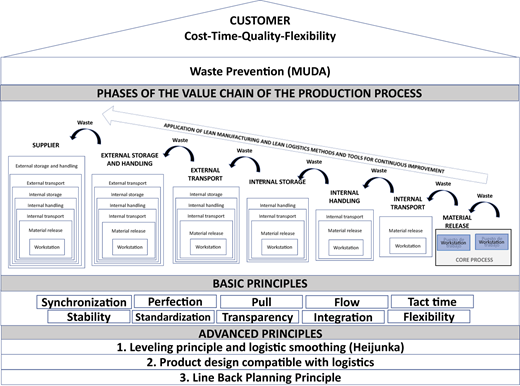
An efficient high-performance logistics system comprises methodological and conceptual principles for designing and optimising logistics processes (Höltz, 1981; Llanos-Solorzano et al., 2025; Rojas-García et al., 2024). While no universally accepted holistic concept exists, key elements have been defined, functionally describing core principles and methods (Höltz, 1981) (Figure 1).
2.1.1 Basic principles of LL for the design of an efficient logistics system
Figure 1 illustrates the fundamental principles of lean logistics essential for an efficient system: synchronisation, perfection, takt time, flow, pull, stability, standardisation, transparency, integration, and flexibility. Beyond these, advanced methods such as logistics levelling, logistics-compatible product design, and the Line Back logistics planning principle are also vital. Thus, logistics planning must holistically incorporate both basic and advanced principles (Boppert, 2008; Boppert et al., 2013; Höltz, 1981; Klug, 2018). Each of these is briefly described below.
Synchronisation
Coordinating capacities to optimise resources, ensure flow, minimise inventory.
Perfection
Ideal logistics demand error elimination, provisional optimisation, ongoing perfection pursuit.
Takt time
Takt time aligns production to demand, guiding flow and capacity.
Flow
LL seeks one-piece flow via layout enabling swift supply.
Pull
Pull logistics aligns flow to demand, cutting inventory and costs.
Stability
Stable logistics enhance planning, reduce errors, boost efficiency, maintain flexibility.
Standardisation
Standardised logistics processes enable continuous improvement, efficiency, and adaptation (Lu and Yang, 2015).
Transparency
Reducing complexity increases transparency, enabling efficient logistics optimisation.
Integration
Internal and inter-company interfaces are crucial; their minimisation and consolidation reduce delays, resource use, losses, and non-value activities.
Flexibility
Agile logistics aims to maintain stable, resilient processes and respond to demand changes by utilising transport, handling, storage, and human resources effectively.
2.1.2 Advanced approaches and principles
Logistics levelling (Heijunka)
By applying Heijunka to logistics, customer demand is decoupled and adapted, making the supply chain more predictable, although flexibility reserves will still be required for any possible disruptions. Flexibility is mainly achieved through the flexible use of employees.
Logistics-oriented product design
The objective should be to consider all internal chain logistics processes in the development and design of products, anticipating the interactions necessary to optimise their integration.
Line-back planning principle
The model’s conceptual foundation and guiding principle involve value creation through analysing and backward planning of the material SC, from supplier to final installation. It covers all material and information flows, sourcing principles, required containers, and interfaces across internal and external processes, including pre-assembly.
All LL approaches aim to significantly enhance organisational performance, reflecting the organisation’s understanding of customer needs and its ability to create sustainable value (Shahul Hameed et al., 2022). Shahul Hameed et al. (2022) and Alejandro-Chable et al. (2022) highlight that intense global competition forces operational transformation, often hindered by strong resistance to change within organisations.
Several authors highlight factors in LL adoption, including methodology understanding, organisational culture, and resource availability, crucial for success (Alejandro-Chable et al., 2022).
The proposed transformation model, based on (Wu and Chen, 2006; Unzueta et al., 2020), aims to foster an organisational culture for lean adoption, centred on values like customer satisfaction, management commitment, and collaboration. Lean requires a strategic, systemic approach, integrating IoT aligned with Industry 4.0 (Bamford et al., 2015; Bittencourt et al., 2021; Shahul Hameed et al., 2022; Shou et al., 2017).
2.2 Deploying the LL model
The proposed lean transformation model includes the following key factors: F1. Customer, F2. Strategy, F3. Management commitment, F4. Culture, F5. Resources, F6. Information Systems and F7. Training.
2.2.1 F1. Customer
Customer orientation drives global performance through value processes, continuous improvement, strategic planning, collaboration, and leadership (Afum et al., 2024; Alves and Alves, 2015; Kou et al., 2015; Macedo et al., 2025; Patel and Patel, 2020; Prasad et al., 2020; Srisuk and Tippayawong, 2020; Strukova et al., 2024; Tomelero et al., 2017).
2.2.2 F2. Strategy
Globalisation demands flexible production and continuous innovation; LL improves performance if aligned with business strategy (Bultó et al., 2015; Negrão et al., 2017; Shahul Hameed et al., 2022).
2.2.3 F3. Management commitment
LL failures stem from weak management support and resources; success requires communication, training, culture, and technology adoption (Alejandro-Chable et al., 2022; Alnadi and McLaughlin, 2021; Bai et al., 2019; Shahul Hameed et al., 2022; Tortorella and Fettermann, 2018).
2.2.4 F4. Culture
Organisational culture is a set of learned basic assumptions for solving problems, communicated to new members. In a lean culture, employees are committed to waste reduction and learning (Dorval et al., 2019; Hardcopf et al., 2021).
2.2.5 F5. Resources
Resource allocation is vital for lean success, enabling profitable firms to overcome barriers and boost long-term competitiveness (Almeida Marodin and Saurin, 2015; Kurpjuweit et al., 2019).
2.2.6 F6. Information systems (ITs)
Industry 4.0 enhances Lean efficiency through integrating ERP systems with Lean practices, supported by IoT investment and training, which improves organisational performance (Erkayman, 2019; Powell, 2013); continuous training and comprehension are essential (Busert and Fay, 2020).
2.2.7 F7. Training
The effective implementation of LM depends on organisational learning and ongoing training. Employees skilled in visual management and lean projects are vital for creating tools that enhance operational performance and reduce barriers like staff turnover (Almeida Marodin and Saurin, 2015; Jaeger, 2018; Netland et al., 2021; Rojas-García et al., 2024). Proper training also improves performance and clarifies roles, boosting production efficiency (Bai et al., 2019; Binti Aminuddin et al., 2016; Szabo et al., 2021).
2.3 Proposed model for lean transformation based on the line back principle
One of the foremost challenges in contemporary organisational management is sustaining continuous improvement over time (Lleo et al., 2021; Marin-Garcia and Bonavia, 2015). While the importance of such improvement is well established within lean methodology literature, its systematic and enduring implementation remains problematic. A considerable body of research identifies the active engagement of frontline staff as a critical factor for maintaining these processes in the long term (van Assen, 2021; Fraile et al., 2023; Gualtieri et al., 2024; Lleo et al., 2021; Roberts et al., 2014). However, for such engagement to be both effective and sustained, specific organisational conditions must be met (Jeffrey and Wilson, 2008; Monaci, 2020; Patki et al., 2021).
The literature identifies two primary antecedent categories influencing continuous improvement sustainability. Strategic and structural factors include alignment with organisational strategy, resource allocation, reward systems, formal communication, performance evaluation, standardised methodologies, and training programmes, reflecting senior management’s commitment and fostering a supportive environment (Lleo et al., 2021).
The second set of factors pertains to the leadership of middle managers. Although senior leadership commitment is crucial, recent studies stress the pivotal role of middle management in maintaining employee engagement (Jeffrey and Wilson, 2008; Lleo et al., 2021). As intermediaries between strategic and operational tiers, they are often perceived as the organisation’s direct representatives and are instrumental in shaping a climate conducive to sustained participation.
Accordingly, sustainable continuous improvement depends on coherent integration between senior leadership, structured training, and strategic-operational alignment—foundational elements for embedding a lasting culture of operational excellence.
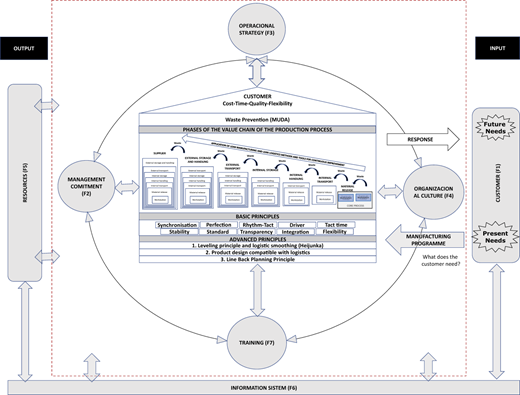
Consequently, and considering the above-mentioned factors, which have been identified as critical, the proposed model is the one presented in Figure 2.
As illustrated in Figure 2, customers (F1) have both long-term needs, shaping strategic planning, and short-term needs, requiring agile responses. Strategic planning, driven by these demands, informs the operational strategy (F3), supported by management commitment (F2) and a continuous improvement culture (F4). This strategy is grounded in the LL model, focused on waste elimination across the value chain. Optimisation begins in the Core Process through line back planning. Addressing future and current needs requires training (F7), supported by resources (F5) and efficient flow management, where information systems and technologies (F6) are crucial.
2.4 Development and theoretical grounding of the hypotheses
From a strategic standpoint, employee training is essential for fostering active engagement and continuous organisational improvement (van Assen, 2021). Netland (2016) highlights training, commitment, and empowerment as key to successful LM implementation.
Beyond its functional role, van Assen (2021) views training as a tool for enhancing self-efficacy and commitment to organisational change, transforming employees into proactive agents of change who promote a culture of learning and adaptability. Anjum et al. (2025) emphasise the efficacy of practice-based learning, noting that aligning individual competencies with organisational strategies through integrated practical training is crucial. Accordingly, we propose the following hypothesis:
The systematic incorporation of training methodologies based on learning by doing positively moderates the relationship between senior management commitment, operational leadership, and the sustainability of continuous improvement dynamics in lean transformation environments.
Based on this hypothesis, the following secondary hypotheses arise:
Practical training focused on learning by doing significantly increases employees’ perceived self-efficacy, which in turn enhances their active participation in continuous improvement processes.
The implementation of training strategies based on learning by doing, aligned with the organisation’s strategic objectives, strengthens the coherence between managerial and operational levels, thereby facilitating the institutionalisation of a sustainable lean culture.
Specialised literature identifies several factors discouraging companies from implementing employee training programmes, notably costs and the required working time. Given the investment in training, accurately assessing each employee’s competencies is crucial for designing effective skill acquisition strategies (Fraile et al., 2023). Shahul Hameed et al. (2022) highlight that managerial commitment, organisational readiness for change, and personnel management significantly affect organisational performance, which is measured by financial and non-financial indicators reflecting the achievement of institutional objectives. The impact of intellectual capital depends on the organisation’s capacity to measure and report these indicators.
The evaluation of the results of the LL transformation process has attracted the interest of both researchers and practitioners, who have proposed various qualitative and quantitative methodologies to measure the degree of leanness achieved (Narayanamurthy and Gurumurthy, 2016; Navarro et al., 2024). According to Lucato et al. (2012), evaluating organisational performance requires considering eight key factors: design, modularity, pricing, kaizen, lean manufacturing, proximity, management, and finance. Moreover, an effective model for measuring performance must be based on comparisons with a competitive standard (Lucato et al., 2014). In this regard, the SAE J4000 standard is proposed as a valid model (Lucato et al., 2012, 2014; Navarro et al., 2024). Therefore, the hypothesis to be tested is:
The implementation of learning-by-doing programmes, based on the identification of individual competencies, has a positive effect on the competitive factors outlined in the SAE J4000 standard for LM.
Evaluating cultural progression in learning-by-doing programmes requires moving beyond quantitative metrics and employing qualitative approaches that capture the complexity of perceptions, emotions, and meanings constructed during the learning process. Hermeneutic phenomenology is a qualitative method that deeply interprets the meanings of lived experience from the subject’s perspective, going beyond mere description (Gorichanaz, 2017; Langdridge, 2007). Through this perspective, we can access the subjective and transformative dimension of experiential learning, providing a richer and more contextualised evaluation of its impact. Therefore, the resulting hypothesis is:
Hermeneutic phenomenology enables a deep and contextualised understanding of practical learning, capturing cultural transformation in individuals more effectively than other, more quantitative or descriptive methodologies.
3. Methodology
In this study, a longitudinal analysis was conducted using a single case study comprising four units of analysis, each representing a distinct business unit within the same company. The research employed the Action Research (AR) methodology, which positions the researcher as an active participant in the change process rather than an external observer (Coughlan and Coghlan, 2002). This participatory framework enabled the researcher to be directly involved in the model’s development, training, and implementation phases. Data were gathered and triangulated from multiple sources, including direct observation and questionnaires administered in each unit.
To meet the research objectives and account for contextual complexity, a methodological combination of hermeneutic phenomenology and quantitative analysis was adopted. Although questionnaire data may be susceptible to subjective bias (Phan et al., 2019), the integration of hermeneutic phenomenology allowed for a more interpretative and nuanced understanding of the organisational transformation. This methodological approach is well-suited for longitudinal case study research within AR frameworks (Martínez-Costa and Jiménez-Jiménez, 2008), especially when exploring cultural change through training and supported implementation. Context-sensitive qualitative methods, particularly those incorporating temporal dimensions, are considered appropriate for single-case studies (Martinez-costa and Jimenez-Jimenez, 2009; Noronha, 2003) Hermeneutic phenomenology, with its focus on in situ interpretation, was thus essential in capturing participants’ lived experiences (Gorichanaz, 2017).
The quantitative analysis was based on questionnaires completed by managers and middle managers across several manufacturing and assembly lines within the organization under study in order to measure the degree of leanness (DOL). The SAE J4000 standard proposed as a valid model for measuring the DOL or competitiveness of companies (Lucato et al., 2014; Navarro et al., 2024). The J4000 standard specifies six critical measurement elements needed to measure LM implementation: Element 4 (management/trust), Element 5 (people), Element 6 (information), Element 7 (supplier/organization/customer chain), Element 8 (product), and Element 9 (process flow). To assess the extent to which these elements are implemented, the standard specifies 52 components, which are statements designed to characterize pertinent aspects of the principles of LM. These components are divided among the elements, so that the most important elements have more components. These metrics have been used to measure the implementation and development of the 7 key factors identified in the proposed lean transformation model. Table 1 shows the relationship between the key factors (F1 to F7) of the proposed lean transformation model and the SAE J4000 measurement elements (E4 to E9) evaluated to analyse the organization’s evolution.
According to the J4000 standard, implementation levels for each component are categorized into four distinct levels: Level 0 (L0) indicates the component is either absent or has significant inconsistencies in its implementation; Level 1 (L1) signifies the component is present but with minor inconsistencies; Level 2 (L2) denotes the component is fully implemented and effective; and Level 3 (L3) means the component is fully implemented, effective, and has demonstrated improvement over the past 12 months.
Based on this score, the Degree of Leanness (DOL) of each element (ge) is calculated, equation (1).
Lek = Points obtained by each one of the “k” components of Element “e” n = Number of Components of Element “e”.
The DOL of the company is calculated by extracting the arithmetic mean of the DOL of each element (Lucato et al., 2014; Navarro et al., 2024).
To evaluate temporal and structural differences in perception, a two-way Analysis of Variance (ANOVA) was performed, incorporating factors related to both organizational level and time (pre- and post-implementation). The analysis was conducted at a 95% confidence level (α = 0.05). The ANOVA model was used to determine whether there were statistically significant differences in mean scores across the organizational strata, and to assess the interaction effect between the time of measurement and the organizational level. Particular focus was given to the elements E4 through E9, which are core components of the model under investigation. Assumptions of normality and homogeneity of variances were tested using the Shapiro–Wilk and Levene’s tests, respectively. In addition to inferential statistics, multi-vari charts were constructed to visually inspect the distribution and trends of responses across the different organizational levels and time periods. These graphical tools provided complementary insights into the behavioural patterns of the measured elements, aiding in the interpretation of statistical outcomes. Statistical significance was established for any comparison yielding a p-value less than 0.05. All analyses were conducted using [Minitab21], ensuring robustness and reproducibility of results.
The perceived changes identified through the quantitative assessment were further corroborated, reinforced, and validated through a qualitative analysis grounded in a phenomenological approach. To collect qualitative data, the researcher maintained a field journal in which observations were systematically recorded. This included notes on conversations, actions, behaviours, and interactions that occurred during regular meetings with the implementation team, as well as during training sessions conducted throughout the implementation process.
4. Case study
This study is conducted within a multinational corporation specialising in the design and manufacture of equipment for the catering, laundry, and refrigeration sectors, operating seven production plants and employing over 2,300 staff. The analysis focuses on the plant located in Oñate (Basque Country, Spain), which specialises in cooking equipment, ovens, dishwashers, and laundry machinery, and employs approximately 600 workers.
Over the past five years, this plant has undergone an operational transformation based on LL and LM principles. To structure this transformation, a model with seven key dimensions was adopted (Figure 2). This study focuses on four of these—managerial commitment, resource availability, training, and organisational culture—selected for their behavioural nature and the complexity associated with their implementation (Dorval et al., 2019; Hardcopf et al., 2021; Lleo et al., 2021; Netland et al., 2021).
4.1 Development of the training framework for resources
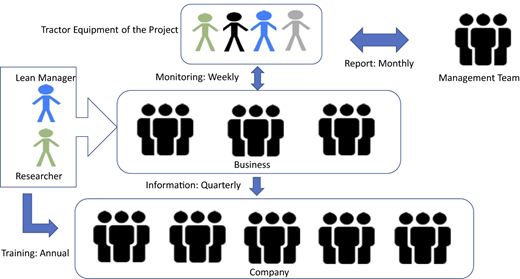
Training at the various organisational levels has been aligned with the organisational structure defined for the Lean transformation project (Figure 3). The team responsible for leading the initiative—comprising the Industrial Director, the Laundry Business Director, the process technician for that business, and the researcher—played a central role in its implementation. The researcher actively participated in all phases of the project, providing continuous guidance throughout the process.
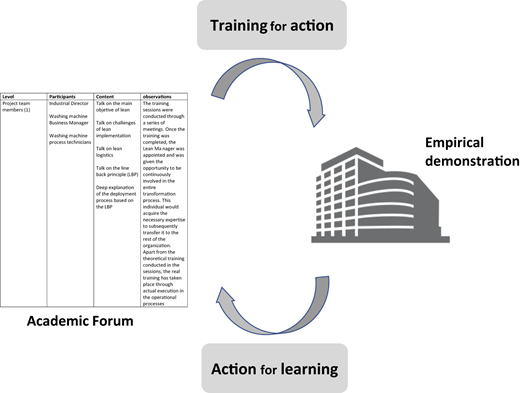
The project’s initial phase involved training the core team in LM and LL, emphasising Line Back logistical planning as the foundational principle. Following Lista et al. (2022), traditional teaching was integrated with active learning to optimise training efficacy (Figure 4). Competencies were defined per engineering profiles specialised in LM and LL (Pacher et al., 2022, 2024; Zighan and EL-Qasem, 2021) (Table 2).
Once the competencies were defined, a programme was designed (Table 3) to enable the core team to acquire them, with a particular focus on those who would assume greater responsibilities, such as the Industrial Director and the Process Technician, appointed Lean Manager and Lean Technician, respectively.
After the theoretical phase, practical work began to analyse and redesign the assembly lines into a multiproduct line. This applied the “training for action and action for learning” approach (Figure 4), involving the Lean Technician and researchers together.
4.2 Deployment of training across other business units
After assessing initial benefits, training was rolled out to other business units (Table 4).
Each team required the same competencies as the lead team. The Lean Manager and researchers handled training and coordination (Figure 3).
Once continuous improvement was established via weekly meetings between the Lean Manager, teams, and researchers to prioritise actions and assess outcomes, evaluating lean integration became necessary. Using the SAE J4000 standard, a cross-sectional survey revealed limited staff involvement and low managerial commitment, attributed to an unsupportive organisational environment hindering active participation.
As a result, the core team and the CEO implemented two measures: monthly follow-up meetings and executive training to promote engagement and resource allocation (Tables 5 and 6).
As a result of the training, directors assigned participants for future actions (Tables 7 and 8). Organisational training sessions and regular progress updates were planned, increasing staff engagement.
One month after completing all training sessions, the SAE J4000 survey was conducted again to assess the organisation’s level of leanness. Notably, two years had passed between the initial and final measurements.
5. Results
Based on the results of the initial SAE J4000 survey, training actions were designed and implemented over the following two years. These initiatives aimed to strengthen senior management commitment and encourage active staff participation, with the goal of consolidating a change-oriented organisational culture. At the end of the training process, a new evaluation was conducted, complemented by a qualitative analysis grounded in a hermeneutic-phenomenological approach.
5.1 Quantitative assessment
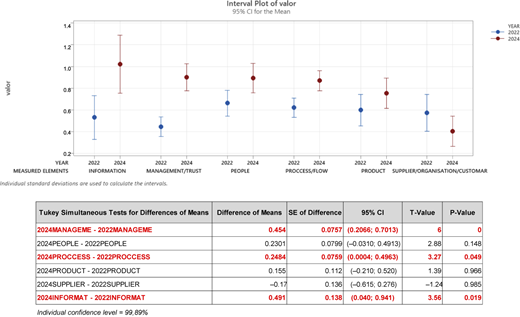
As shown in Figure 5, the comparison between the initial measurement (2022) and the most recent one (2024) reveals an overall positive trend. With the sole exception of element E7—specifically related to new product launch processes—there is an improvement in staff perception regarding key factor (KF) F4.
The analysis of the results shows significant improvements in three key elements: E4, E6, and E9, reflecting substantial progress in management and organisational culture.
E6 shows a notable improvement in the organisation’s ability to share relevant information and distribute decision-making responsibility among process members. This change reflects a more transparent environment, with equitable access to data and a more participative approach to decision-making.
The most significant improvement is seen in E4, linked to KF F4, which assesses knowledge deployment and the implementation of lean practices. Management commitment has strengthened, shifting from quarterly to monthly meetings, enabling faster resource allocation and overcoming cultural barriers. This increased managerial presence has accelerated initiative execution and improved internal perception.
Regarding E9, the improvement is linked to KF F7, which focuses on learning through action. There is clear evidence of increased adoption of lean tools such as 5S, preventive maintenance, and problem-solving methodologies. This progress reflects a consolidation of practical learning and growing operational competence among staff.
Elements E5 and E8 show some progress, but it is limited. E5 was constrained by the cooperative model, which prevents removing partner-held positions, and by a lack of timely communication about organisational restructuring. The improvement in E8 reflects greater awareness of product and process costs, but issues remain, such as poor consideration of lead time in design and insufficient early involvement of process technicians.
These limitations are linked to the decline in element E7, which relates to the integration of customers and suppliers in product design, prompting a partial redesign of the process.
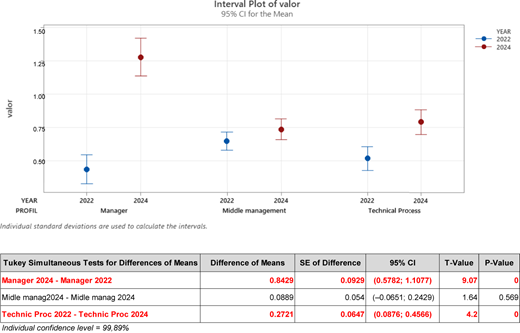
Finally, the profile analysis (Figure 6), shows that senior management is the group perceiving the greatest improvement since 2022. The technical profile also improves significantly, though it remains critical, while middle management shows positive progress, albeit less pronounced than expected.
The findings demonstrate that significant improvements in E4, E6, and E9 result from an integrated training approach based on experiential learning and continuous support, rather than isolated measures. This learner-centred pedagogy, emphasising active engagement, has been crucial in transforming organisational practices by enabling practical application of lean tools and techniques within real work settings, thereby enhancing technical autonomy and confidence.
Continuous oversight by the core team has been instrumental in catalysing change, notably by reinforcing active leadership (E4) through proactive management presence. Improvements in knowledge sharing and collective decision-making (E6) signify a shift towards a collaborative organizational culture committed to ongoing enhancement.
Differential impacts across professional tiers reveal heightened senior management engagement, increased technical proficiency, and a need for greater middle management alignment, collectively validating the approach’s efficacy in embedding a sustainable lean culture.
5.2 Qualitative assessment
As noted, a key aspect of the results analysis was the use of the hermeneutic-phenomenological approach. This method is particularly valuable in studies of cultural transformation, as it enables a deep understanding of participants’ lived experiences and constructed meanings. Unlike quantitative analysis, which may be affected by personal biases or structural limitations in questionnaires (Phan et al., 2019), hermeneutic phenomenology allows for a richer, more contextualised and dynamic interpretation.
In this sense, the combination of both approaches—hermeneutic-phenomenological and quantitative—was essential for reaching meaningful conclusions. While the questionnaires provided structured data, phenomenological observation and interpretation not only confirmed and reinforced findings but also revealed each participant’s individual progression in terms of ideas, values, and cultural elements throughout the project. Thus, the hermeneutic approach not only complemented the quantitative data but significantly deepened the understanding of the ongoing cultural change, offering a more comprehensive view of the phenomenon under study.
Table 9 presents a compilation of comments gathered throughout the transformation process, organised according to each of the measurement elements defined by the SAE J4000 standard.
6. Discussion and conclusions
The findings robustly validate the proposed hypotheses, evidencing that a formative, experiential learning approach significantly fosters organisational transformation and the sustainability of lean practices. Concerning H1, the structured incorporation of active training methodologies is shown to positively moderate the link between managerial commitment, operational leadership, and continuous improvement sustainability. This is reflected in the reinforcement of key elements—visible leadership (E4), knowledge dissemination (E6), and lean practice adoption (E9)—as well as tangible outcomes such as increased management meetings, expedited resource allocation, and enhanced collaboration.
Hypothesis H1a is empirically confirmed, demonstrating that a learning-by-doing programme significantly enhances employees’ perceived self-efficacy, leading to increased technical autonomy, proficient use of lean tools, and proactive participation in transformation processes. Similarly, H1b is validated through the alignment of strategic objectives with training content, wherein the core implementation team’s mediating role fosters hierarchical coherence and facilitates the operationalisation of the strategic visión
With respect to H2, the application of the SAE J4000 standard objectively confirmed significant improvements in key areas such as E4, E6, and E9, indicating overall progress in leadership, decision-making, and organisational learning. Despite ongoing challenges in E5 and E7, the advancements in F4 and F7 validate the relevance of the competence-based approach.
Finally, H3 is confirmed through phenomenological-hermeneutic analysis, which revealed how participants reinterpreted the project, highlighting the attitudinal shift of senior management as a decisive factor in overcoming cultural barriers.
6.1 Theoretical implications
This study reveals that experiential learning effectively promotes sustainable organizational change by enhancing technical skills, driving cultural transformation, and fostering cross-hierarchical collaboration through targeted training interventions.
It is confirmed that active methodologies have a positive influence on the relationship between senior management, operational leadership, and the continuity of lean practices. Training employees within their work environment and using real-world problems supports the consolidation of organisational change.
Moreover, when training is aligned with strategic objectives, it strengthens the connection between managers and shop-floor operators. In this process, the core team played a key role by translating strategic goals into concrete actions, demonstrating that leadership also involves guiding learning.
The use of the SAE J4000 standard enabled a structured evaluation of the impact of competency-based training, revealing progress in leadership, decision-making, and organisational learning. This reinforces the notion that competencies should be understood as collective capabilities, extending beyond the individual level.
Finally, the qualitative approach of the study facilitated an understanding of how participants experienced the change process, revealing an evolution in the perception of the project, even among senior management.
Taken together, Taken together, the findings support a view of learning as a transformative process that strengthens organisational culture and fosters sustainable improvements.
6.2 Implications for management
The findings of this study offer valuable implications for organisational management, particularly in contexts focused on the adoption and sustainability of lean practices through innovative training approaches. Firstly, the evidence highlights the importance of integrating active learning methodologies, such as learning by doing, into corporate strategies. This approach not only enhances the acquisition of technical competencies but also serves as a facilitating mechanism for cultural and organisational change, promoting a profound and sustainable transformation within the dynamics of continuous improvement.
For companies, it is crucial to recognise that senior management commitment and the strengthening of operational leadership are fundamental pillars for the institutionalisation of these dynamics. The systematisation of managerial meetings and the improvement of communication across levels, arising from a coherent and contextualised training programme, enable the acceleration of resource allocation and promote a collaborative environment conducive to innovation and efficiency.
Similarly, enhancing employees’ perceived self-efficacy through practical training fosters greater autonomy and proactivity in task execution, facilitating the internalisation of lean principles. This results in a deeper commitment from staff to transformation processes, which is a crucial factor for the sustainability of change.
From a strategic perspective, alignment between organisational objectives and training content facilitates operational coherence and effective coordination between senior management and middle management. The role of a driving team to methodologically support this process emerges as a key factor in translating strategic guidelines into concrete actions, thereby strengthening organisational culture and resilience against internal resistance.
Finally, the implementation of programmes based on the identification and development of individual competencies, assessed through recognised standards such as the SAE J4000, contributes to enhancing critical factors of organisational competitiveness. However, continuous attention must be given to persistent challenges in certain organisational elements to ensure comprehensive and sustained improvement.
In conclusion, companies that adopt a learning-by-doing approach, integrated into a comprehensive pedagogical strategy and tailored to their context, will be better positioned to achieve a robust cultural transformation, strategic alignment, and the consolidation of a culture of continuous improvement that addresses the contemporary challenges of lean manufacturing and global competitiveness.
6.3 Future research directions
According to Upton and Kim (1998), evidence does not conclusively support workplace learning as superior to off-site training, challenging the notion of a singular optimal learning approach. They argue that the choice of learning method should consider how operators have previously acquired knowledge through experience. This perspective motivates investigation into workplace-based training models and their effectiveness compared to traditional methods. Single case study methodology offers detailed, context-specific insights into such training processes but limits generalizability (Coughlan and Coghlan, 2002). Understanding these findings is crucial for adapting and replicating models in other organizations (David Ford et al., 2000).
Future research should focus on replicating and evaluating these models across diverse settings to generate robust evidence addressing Upton and Kim’s question. Comparative analysis across contexts can elucidate conditions where workplace training outperforms or complements off-site training, informing the development of more effective, context-sensitive learning strategies.