Communication and job satisfaction are two key factors for the success of public organisations. The study aims, firstly, to examine the effects of training activities and internal meetings on the perceived quality of communication processes; secondly, to explore the nuanced relationship between communication and job satisfaction.
This is a cross-sectional study based on results from organisational climate surveys conducted between 2019 and 2020 in six Italian Regional Healthcare Systems, involving a total of 58,888 employees. Linear regression models were performed.
Results highlight that employee satisfaction is positively influenced by high-quality internal communication. The organisation of frequent internal meetings and the offer of ad hoc training sessions on communication were found to be antecedents of good communication.
The study offers practical implications for healthcare organisations, highlighting specific strategies that can be employed to enhance internal communication and, subsequently, job satisfaction. The emphasis on training programmes and internal meetings provides actionable insights for organisational improvement.
The originality and value of this study lie in its unique large datasets, which significantly strengthen the reliability of the findings and make them more applicable to a wider range of contexts. Also, the exploration of the relationship between internal communication processes and job satisfaction within public healthcare organisations contributes to the growing body of knowledge in organisational studies.
Introduction
In public organisations, ensuring efficient operations and high-quality service delivery is paramount. Effective communication has long been recognized as a fundamental component that supports both individual and organisational success (Coiera, 2006). Internal communication is defined as all formal and informal communication that takes place internal at all levels of an organisation (Foronda et al., 2016; Kalla, 2005).
In particular, communication quality significantly affects the internal dynamics of organisations, influencing everything from information exchange to employee engagement (De Matteis et al., 2023). One of the key competencies that a proficient manager must possess is the ability to communicate effectively with their employees (Vainieri et al., 2019). Indeed, the management’s ability to communicate the organisation’s strategic vision to employees enables them to reach the organisational objectives (Vainieri et al., 2019).
Within the Italian National Healthcare System (NHS), the importance of communication has been codified through regulations (legislative decree 502/92 and presidential decree 484/97) mandating that healthcare managers undergo a management training programme aimed at acquiring interpersonal skills, including effective communication (Giacomelli et al., 2019).
Organizations are equipped with a repertoire of managerial tools that could be essential for the effective governance of communication processes, such as tailored managerial training courses (Giacomelli et al., 2019; Omura et al., 2017). However, healthcare organisations often neglect training evaluation due to doubts about its impact on performance (Giacomelli et al., 2019). Evaluating training involves systematically collecting and analysing data on training programs to inform planning, decision-making, and assess their effectiveness (Phillips and Phillips, 2016). Measuring the impact of training on organisational or individual behaviour is crucial to determine the return on investment and the value of the interventions, thereby enhancing accountability (Giacomelli et al., 2019).
We also have to consider that for public healthcare organisations, where the stakes of communication breakdowns are high, miscommunication can negatively impact employee morale (Nuti et al., 2019; Vainieri et al., 2019). Public healthcare organisations, due to their hierarchical, multi-stakeholder, and politically driven structures, operate in complex adaptive systems where communication is not merely a management tool but a survival mechanism. As such, understanding how communication serves as a resource, rather than merely a process, could provide new insights into the relationship between internal communication quality and job satisfaction.
In this context, and more broadly across all public organisations, the sharing of information, regarding expected objectives and achieved results, is essential both from a performance than from a satisfaction perspective (Fischer and Döring, 2022).
Job satisfaction is referred to as an individual’s perception of his or her job and the various aspects of it, whether positive or negative feelings (Rainey, 2009), and it’s crucial for maintaining high levels of motivation and performance (Asgarian et al., 2022; Giri and Pavan Kumar, 2010). Several studies have shown that higher levels of job satisfaction are associated with lower turnover, better employee performance, and greater organisational commitment (Ghanbary Vanani et al., 2024; Judge et al., 2001; Platis et al., 2015).
Together, communication and job satisfaction are crucial to ensure that public organisations can operate efficiently and effectively for the benefit of society (Giacomelli et al., 2019; Nuti et al., 2019).
Unlike private organisations that might have more flexibility in managing human and financial resources, public sector organisations often operate under tight budgets (Men, 2014; Mishra et al., 2014). Communication becomes a critical way to manage expectations and ensure that employees remain satisfied despite constraints (Suh and Battaglio, 2022).
Yet, while there is a growing interest in the links between communication, job satisfaction, and performance in public management research, the literature lacks a comprehensive understanding of how internal communication affects job satisfaction at the micro-level, especially in large public healthcare systems like the Italian NHS.
Theoretical framework and previous research
While our study focuses on public healthcare organisations, the relationship between internal communication and job satisfaction is relevant to many other public sector contexts, such as education, law enforcement, or public administration (Cantarelli et al., 2016; Gregson, 1991; Lekić et al., 2019).
According to Public Value Theory, communication in the public sector is not only about meeting organisational goals but also about creating public value. This ties directly into job satisfaction, as healthcare employees may derive satisfaction from understanding how their work contributes to broader societal benefits (Meynhardt et al., 2024).
In recent years, there has been a growing body of research that has explored the relationship between communication, job satisfaction and organisational performance in different context (Aguerrebere, 2015; Fischer and Döring, 2022; Suh and Battaglio, 2022; Vainieri et al., 2019; Wang et al., 2022). These studies have consistently found that the quality of perceived communication is positively associated with job satisfaction among employees (Cantarelli et al., 2016), and that both have a strong influence on organisational performance (Giacomelli et al., 2019; Vainieri et al., 2019).
For instance, Vainieri et al. (2019) explored how top management skills and information sharing affect organisational performance in the public healthcare system of Tuscany, finding that systematic information sharing is crucial for clinician engagement and better organisational outcomes.
Additionally, Giacomelli (2019) showed that clinical directors’ participation in managerial training programmes increases their knowledge and use of performance information. By surveying over 3,000 clinical directors in Italy, the study revealed that the knowledge and use of performance information mediate the link between training and involvement in top management decisions. This indicates that investing in managerial training helps professionals communicate more effectively and influence strategic decisions, thus improving organisational communication. Both studies (Giacomelli et al., 2019; Vainieri et al., 2019) relied on organisational performance outcomes and on healthcare managers as study population. In our research we focused on how communication quality affects job satisfaction in all public healthcare employees. We choose job satisfaction as a proxy of organisational performance because by doing so we were able to retain the micro-level perspective, thus valorising our large sample size and their perceptions, which are a key strength of our research. While there are many soft variables that could affect organisational performance, job satisfaction captures individual perceptions of their work environment, which can be directly tied to performance outcomes (Judge et al., 2001). A robust body of literature exists supporting the link between job satisfaction and higher productivity, lower turnover rates and a better employee engagement, all characteristics of success in public organisations (Cantarelli et al., 2016; Iaffaldano and Muchinsky, 1985; Platis et al., 2015).
Thus, despite the growing recognition of the importance of communication in public sector performance, gaps remain in understanding how communication quality directly influences employee satisfaction at the micro level, particularly in complex and adaptive systems such as public healthcare organisations. Addressing these gaps is crucial as public healthcare managers strive to navigate the challenges of workforce motivation, staff shortages, and patient care quality in the face of increasing demands on the system.
The antecedents of better perceived internal communication
The highly technical nature of the work, the fast-paced and stressful environment, and the diverse backgrounds and perspectives of the healthcare team, can make communication processes very challenging (Vainieri et al., 2019). Proficient communication is a time-intensive process, and an elevated workload can precipitate communication lapses, resulting in inaccuracies, inadequately conveyed messages, or misunderstandings (Vermeir et al., 2015; Zota et al., 2023).
The quality of perceived communication is a multi-dimensional construct that encompasses various aspects of communication, such as the clarity, accuracy, and timeliness of information exchange, as well as the level of trust, respect, and understanding among team members (Verhaegh et al., 2017). Moreover, organisational characteristics, such as the structure and culture of the organisation, can also affect the communication process and the perceived quality (Hargie, 2016). Several studies have explored how organisational aspects, such as the preferred type of communication channel (Tkalac Verčič and Špoljarić, 2020) or the offer of communication training programs (Omura et al., 2017), have a positive impact on the perceived quality of communication and ultimately on organisational performance (Vainieri et al., 2019). For instance, Vainieri et al. (2019) examined the impact of top management competencies and information sharing on organisational performance in Tuscany’s public healthcare system, demonstrating how systematic information sharing is essential for clinician engagement and improved organisational outcomes.
In this paper, we refer to internal meetings as the proper space and moment for information sharing, therefore hypothesizing that frequent internal meetings can lead to improve employees’ perception of the internal communication processes.
Furthermore, Giacomelli (2019) demonstrated that participation in managerial training programs for clinical directors enhances their knowledge and use of performance information. The research uses mediation analysis to show that knowledge and use of performance information mediate the relationship between training and involvement in top management decisions. This suggests that investing in managerial training supports professionals in communicating effectively and influencing strategic decisions, thereby contributing to better organisational communication.
Building on these findings, our study seeks to delve deeper into the connection between participating in communication training activities, organising frequent internal meetings, and the perceived quality of internal communication processes.
Although this paper focuses on public healthcare organisations, the managerial tools mentioned above, such as communication training and regular internal meetings are not healthcare specific. For instance, fostering a communicative culture through training could benefit public schools or government agencies that also require effective communication for collaboration and performance (Suh and Battaglio, 2022).
Internal communication as antecedent of job satisfaction
Delving into the relationship between communication and job satisfaction, it becomes evident that effective communication significantly contributes to professional well-being (Cantarelli et al., 2016; Kumari and Pandey, 2011).
The effect of communication processes is usually studied in relation to performance outcomes. In this study, we decided to focus on the effect of communication quality on job satisfaction for two main reasons. Firstly, both variables are widely studied in relation to organisational performance, with the literature reporting varied examples of a positive relationship (Cantarelli et al., 2023; Suh and Battaglio, 2022; Vainieri et al., 2019). Secondly, by excluding organisational performance outcomes we wanted to maintain the micro-individual level of the observations, thus also preserving the large numerosity of the study population, which is one of the major strengths of this study.
While this study focuses on the effect of communication quality on job satisfaction, it is important to recognize that job satisfaction is a multidimensional construct influenced by a variety of factors, such as compensation, leadership, work-life balance, and professional development opportunities (Cantarelli et al., 2023; Kumari and Pandey, 2011; Walden, 2021). Communication, however, plays a central role as a resource that can significantly impact employees’ well-being, as suggested by the Job Demands-Resources (JD-R) theory (Bakker et al., 2023; Demerouti and Bakker, 2023). A work environment where communication is transparent, respectful, and inclusive can act as a positive resource, enhancing job satisfaction (Barello et al., 2021; Kim and Lee, 2021). Conversely, deficient communication or an excessive communicative burden could be perceived as additional job demands, potentially contributing to increased fatigue and dissatisfaction.
Some studies have explored communication competences of healthcare workers reporting that these contribute directly to greater job satisfaction among them (McKinley and Perino, 2013). Others, highlight how the frequent organisation of internal meetings, having routine channels of communication or having structured communication checklists enhance not only the quality of perceived communication but also job satisfaction (O’Daniel and Rosenstein, 2008; Rogelberg et al., 2010; Vermeir et al., 2017).
This study narrows its focus to communication for analytical clarity and to maintain the micro-individual level of observation, but we acknowledge that other organisational dynamics also play a key role in shaping job satisfaction (Cantarelli et al., 2016). For instance, in his study Fischer and Döring (2022) suggests that “job satisfaction is only partly affected by knowledge sharing itself, but particularly through the availability of job-related information enabling the information receiver to work effectively”.
The subject of communication represents an element of organisational importance (Vainieri et al., 2019), and the relations between individuals and the organisation based on open and structured communication processes tend to correspond to positive conditions of internal climate, and consequently higher job satisfaction (Castañer and Oliveira, 2020; Kozlowski and Ilgen, 2006; Thiede, 2005).
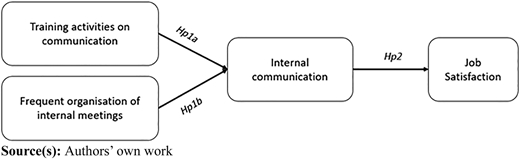
Therefore, in response to the presented gap, this study aims to examine how managerial tools, such as communication training and internal meetings, contribute to the perceived quality of internal communication processes and, subsequently, how communication quality impacts job satisfaction among public healthcare professionals (see Figure 1).
The participation in training activities on communication is associated with a better perceived quality of internal communication processes.
The frequent organisation of internal meeting is associated with a better perceived quality of internal communication processes.
A better perceived quality of communication is positively associated with job satisfaction.
Methodology
Study design and setting
This is a cross-sectional survey study exploring the relationship between training activities on communication and the frequent organisation of internal meetings with the quality of communication as perceived by employees. Moreover, this study investigates the effects of the perceived quality of internal communication processes on job satisfaction.
The study was carried out in six Italian Regional Health Systems. The Italian National Health System (NHS) encompasses nineteen regions and two autonomous provinces and is structured and administered across three tiers: national, regional, and local (Pirrotta et al., 2022). Regions are divided into Health Authorities, which oversee delivering healthcare locally. The Local Health Authorities (LHAs) ensures the provision of primary, secondary, and tertiary healthcare services, in addition to preventive and health promotion services (Tediosi et al., 2009).
In our study we grouped Health Authorities according to their different nature. First, we divided LHAs, which are responsible for medical and diagnostic care both in hospital and territorial settings, from Teaching Hospitals and Institutes for Scientific Research and Care, which are responsible for hospital care only (Ricciardi and Tarricone, 2021). Secondly, LHAs were divided into three different categories according to their catchment area. Data on the resident population for LHAs were extracted from the Ministry of Health website (Ministero della Salute, 2022). A total of 38 Health Authorities were included in the sample, with more information reported in Table A1 (Appendix).
Data source
We used data from the organisational climate survey. The organisational climate survey is a widely structured and established tool. In the Italian NHS context, the Management and Healthcare Laboratory of the Scuola Superiore Sant’Anna has been in charge since 2004 of submitting the organisational climate questionnaire for LHAs at recurring intervals, usually every three years. The questionnaire is a widely structured and established tool and is inspired by the main international examples used in public administration, such as the Federal Viewpoint Survey Employees, or the English NHS Staff Survey. Data from these questionnaires have been repeatedly used to conduct scientific studies on organisational climate (Cantarelli et al., 2023; Fischer and Döring, 2022; Nuti et al., 2019; Resh et al., 2021; Seghieri et al., 2015; Waters, 2022).
The survey is divided into different sections representative of the complex construct of the organisational climate. In particular, the employees express an opinion on topics such as working conditions, relationship with the supervisor and colleagues, training, communication and information processes, and the company’s vision. The questionnaire items are collected in dimensions following the validation of the tool in use by the MeS Laboratory in 2004, subsequently revised (Pizzini and Furlan, 2012).
For this study, the Management and Healthcare Laboratory oversaw administering the questionnaire to six Regional Health Systems between 2019 and 2020. The survey is a census, involving therefore all employees. From a methodological point of view, the survey was carried out online by means of specific software, based on CAWI (Computer Assisted Web Interviewing). All questions had a 5-point Likert scale format, from 1 (Strongly disagree) to 5 (Strongly agree).
Participants and outcomes
Each respondent was characterized by individual characteristics (age, sex, working age, professional family), and contextual characteristics (the type of Health Authorities where he or she worked).
The main dimension considered in this study was the internal communication index, which was obtained by summing all the items belonging to the communication section of our survey. We applied Principal Components Factor Analysis, with varimax rotation of the orthogonal axes, setting an inclusion cut-off of 0.3 loading. All details are shown in Table 1.
The percentage of explained variance was about 80%. We also assessed the internal consistency of the scale using Cronbach’s alpha, testing the average interitem covariance among the items, with the scale demonstrating good reliability (Cronbach’s alpha = 0.812).
This variable was taken as the outcome variable to answer the first research questions, and as the main in independent variable to reach the second study objective, as also described below.
The second main dimension was the score for job satisfaction. This score was measured by a single item which describes the level of satisfaction of working in that structure or unit. This variable was considered only to answer the second research question and used as the outcome variable.
Statistical analysis
We reported the baseline characteristics of our study sample reporting continuous variables as mean (and standard deviation) and categorial variables as counts (and percentages). Such characteristics were divided according to the Health Authority each respondent worked in.
To explore the main determinants of internal communication (first aim), we performed linear regression models by using the internal communication index as our outcome variable. We built two models: Model 1 included as control variables just individual and contextual attributes of respondents, while Model 2 also included the other items related to the organisational climate available from our survey. To make the results of the analysis easier to read, we labelled the items of the questionnaire based on keywords. The extended description of the survey items is available in the Supplementary Material (Table A1). To assess whether internal communication influenced job satisfaction (second aim), we ran linear regression models by taking the job satisfaction score as our outcome variable, and the communication index as our main independent variable.
Data management and statistical analyses were performed by using the Stata Software version 17.1 (Stata-Corp, LLC, College Station, Texas, USA). Results of regression models were reported as coefficients with 95% confidence intervals. Statistical significance was set at a p-value below 0.05.
Results
Descriptive statistics
We obtained 58,888 respondents. Their sociodemographic and work-related features are shown in Table 2. Nurses were the most represented professional family, followed by doctors and the health staff. The female gender made up 73.23% of the sample, while 26.77% were men. The mean average age of participants was around 51 years, while the working age was around 18 years.
The main determinants of perceived communication quality
Both Model 1 and Model 2 results are presented in Table 3 to show how different control variables affect the outcomes. Model 1 includes sociodemographic characteristics of the respondents as control variables, while Model 2 also incorporates additional aspects of organisational climate. Model 2 explained more variability in the data (R-sq. > 0.40), but both models provide important insights.
In Model 1, internal communication was significantly influenced by participating in training activities aimed at improving communication (Coeff. 0.27, p < 0.001) and frequent internal meetings (Coeff. 0.36, p < 0.001). Model 2 showed that these effects remained significant, although reduced, with coefficients of 0.13 for training (p < 0.001) and 0.22 for internal meetings (p < 0.001), suggesting the importance also of other organisational climate factors.
Additionally, respondents who worked at a sustainable rhythm had higher internal communication scores (Coeff. 0.08, p < 0.001 in Model 2). Awareness of training opportunities within the organisation was also a key factor (Coeff. 0.32, p < 0.001). Regarding respondent characteristics, Model 2 revealed a gender difference, with men reporting higher internal communication scores (p = 0.006). The internal communication index was lower among nurses and other healthcare staff compared to doctors, while higher in administrative, technical, and social work departments (p < 0.001). Age negatively affected communication quality, while working age had no significant effect. Finally, internal communication was found to be better in small (p < 0.001) and medium-sized (p = 0.005) Local Health Authorities (LHAs) compared to Teaching Hospitals, but lower in large LHAs (p = 0.004). Full results are reported in Table A3 ( Appendix).
Internal communication and job satisfaction
As shown in Table 4, job satisfaction was significantly and positively influenced by higher internal communication scores in both models (p < 0.001). The coefficient for internal communication was higher in Model 1 (Coeff. 0.25) than in Model 2 (Coeff. 0.17), although it remained the third highest determinant in Model 2. Similarly, working with sustainable rhythms (Coeff. 0.20, p < 0.001) and participating in communication-related training (Coeff. 0.09, p < 0.001) also positively influenced job satisfaction. Frequent internal meetings organised by the Health Authority contributed to greater job satisfaction (p < 0.001, Coeff. 0.12), as did being informed about training activities (Coeff. 0.01, p < 0.001).
Once again, full results are provided in Table A4 ( Appendix). Regarding respondent characteristics, there were no significant gender differences in job satisfaction. However, job satisfaction was higher among nurses, administrative and technical staff, non-medical managers, and social workers compared to medical doctors (p < 0.001). Both age and working age were nonsignificant. Finally, job satisfaction was found to be higher in large LHAs compared to Teaching Hospitals (p = 0.008).
Discussion
Considering the importance of communication for the proper functioning of public healthcare organisations, this study aims to investigate the relationship between the perceived quality of internal communication and job satisfaction, and the effects of managerial tools in enhancing the first. This study’s findings align closely with its dual objectives. Hypotheses 1a and 1b address the antecedents of internal communication quality, highlighting the positive roles of communication training and regular internal meetings. These managerial tools directly contribute to achieving the first objective: identifying strategies to improve communication processes. Similarly, Hypothesis 2a confirms the second objective by demonstrating that improved communication quality significantly enhances job satisfaction. Together, these findings provide a comprehensive framework that connects actionable managerial interventions with improved organisational outcomes, thereby advancing the understanding of internal communication dynamics in public healthcare.
The findings strongly support Hypothesis 1a, which aligns with the study’s first objective: to examine the role of training activities in shaping the perceived quality of communication. Specifically, participation in these activities showed a significant positive association with the internal communication index (Coeff. 0.13, p < 0.001). This result confirms that training equips employees with skills to improve information sharing and understanding within organisations. By emphasizing this connection, the study provides actionable insights for the design of managerial tools aimed at enhancing communication processes in public healthcare systems. Training Programs in public healthcare must align with regulatory requirements and must often tackle broader issues like patient safety, bureaucratic compliance, and multi-disciplinary collaboration. These programs are thus not merely about communication efficiency but about meeting legal, ethical, and organisational mandates. Public organisations should prioritize training programs that enhance interpersonal and communication skills among their workforces, as one of the aims of internal communication is to guide people in their job, promoting internal dialogue and teamwork (Aguerrebere, 2015). Considering that trained employees positively influence the perception of communication quality, and that communication is considered an unfailing competence for public managers (Fanelli et al., 2020; Giacomelli et al., 2019; Robert Hernandez et al., 2018), Health Authorities should promote specific training opportunities. By doing so, they can foster a communicative culture that supports collaboration and information sharing (Giacomelli et al., 2019). With respect to this point, the peculiarity of this study lies in its attempt to give a return about the effectiveness of training activities, which are often, as Giacomelli and colleagues attend (2019), not carefully monitored over time. Here we provide evidence, valuing the perceptions of nearly 60 thousand public employees, on the effectiveness of such training initiatives on internal communication processes.
Moreover, if information sharing is demonstrated having a strong influence on communication processes and overall performance (Giacomelli et al., 2019), what better venue is there than internal meetings within one’s business unit to discuss expected goals or achievements?
Frequent internal meetings also play a pivotal role in shaping the quality of internal communication. Organizations that actively organise and encourage regular internal meetings provide platforms for employees to exchange information, discuss concerns, and align on common goals (Tkalac Verčič and Špoljarić, 2020). This aligns with previous research emphasizing the role of meetings in facilitating communication and promoting a shared understanding of organisational objectives (O’Daniel and Rosenstein, 2008; Vainieri et al., 2019).
Internal meetings often involve cross-functional teams, which differ from the typically more siloed structures in private companies (Men, 2014). Public healthcare systems, and public organisations in general, have a wide range of stakeholders (from policymakers to frontline workers), so meetings are spaces where conflicting priorities must be negotiated and aligned. Healthcare institutions should therefore recognize the strategic value of internal meetings in enhancing communication and consider them as integral components of their organisational communication strategies. Public sector managers in diverse fields adopt similar practices to improve communication quality, since public organisations often face similar challenges in aligning goals and ensuring information flows. This makes these strategies broadly applicable.
Furthermore, having time to participate in training activities and organise internal meetings is facilitated by sustainable work rhythms. The positive association between manageable workloads and effective internal communication aligns with the idea that a balanced workload can contribute to better communication processes (Coiera, 2006; Zota et al., 2023). Healthcare professionals working at sustainable paces may experience fewer communication lapses, ensuring timely and accurate information exchange (Vermeir et al., 2015). This result underscores the importance of organisational efforts to address work-related stressors and promote conducive work environments, ultimately fostering better internal communication. Stress and burnout are common factors in public services, and promoting manageable workloads and communication channels could lead to enhanced employee satisfaction in these settings as well.
Hypothesis 2a, which posits that better perceived communication quality is positively associated with job satisfaction, directly addresses the study’s second objective: exploring the nuanced relationship between communication and job satisfaction. The regression analysis reveals that the communication index is one of the strongest predictors of job satisfaction (Model 2, Coeff. 0.176, p < 0.001), supporting the argument that effective communication fosters a sense of belonging and clarity among employees. These findings underscore the central role of internal communication as a resource for enhancing job satisfaction, particularly in complex adaptive systems like public healthcare organisations (Cantarelli et al., 2016; Karaferis et al., 2022; Walden, 2021). Other studies have shown that effective internal communication is linked to improved employee morale, and reduced turnover (Asgarian et al., 2022; Giri and Pavan Kumar, 2010; Vermeir et al., 2017).
Compared to the private sector, public organisations often have more stringent rules and slower decision-making processes. Communication within such structures must account for delays and frustrations stemming, for instance, from bureaucratic procedures. The ability to communicate clearly in such environments can significantly boost job satisfaction by reducing the feeling of alienation or helplessness. Also, employees in public sector organisations may experience more frequent shifts in leadership or changes in policy and effective communication is essential for maintaining consistency in organisational vision, despite political shifts, contributing to employee stability and satisfaction. Factors like profit motives, customer orientation, and hierarchical fluidity in the private sector could lead to different dynamics between communication quality and job satisfaction. In private organisations, communication may be more closely tied to efficiency and bottom-line performance, while in the public sector, it serves to maintain the workforce’s engagement and commitment in a more complex, mission-driven context.
Therefore, public organisations aiming to enhance the quality of internal communication processes should involve continuous efforts to improve information dissemination, streamline communication channels, and create a supportive communication climate.
The use of a well-established tool such as the organisational climate survey, which has been utilized in several international studies to assess the internal climate of health authorities and public administration (Resh et al., 2021; Somers, 2018; Waters, 2022), represents above all a methodological strength of this study, as well as the main recommendation for public managers. The organisational climate survey stands as a crucial managerial tool for closely monitoring employee perceptions within an organisation. By capturing valuable insights into the workplace context, this practice enables managers to pinpoint strengths, challenges, and areas for improvement.
Additionally, the large size of the datasets used throughout this study is a major strength. To the authors knowledge few other studies have access to such extensive data, which significantly strengthens the reliability of the findings and makes them more applicable to a wider range of contexts. Employee perceptions serve as a vital indicator of internal dynamics, facilitating the implementation of targeted strategies to foster a positive work environment and support organisational well-being.
Limitations and future research
Despite the robustness of this results, there are also some limitations to the study’s methodology. First, given the type of data available and the desire to avoid overestimating our work, we’ve narrowed the conceptual scope to the public healthcare sector.
Secondly, a key limitation of our study lies in the fact that the questionnaire used, while based on validated constructs from similar surveys, has not itself been subject to a formal validation process. This means that we cannot entirely rule out measurement errors or biases in how the items capture the underlying constructs of internal communication and job satisfaction. Additionally, the study’s cross-sectional nature only allows researchers to establish associations between variables and not causality. Nonetheless, cross-sectional studies can still be useful for identifying potential associations and generating hypotheses for further investigation or confirming, as in this case, previous literature. Finally, the study relies on self-reported data, which may be subject to bias and inaccuracies and does not consider other possible factors that may influence the relationship between internal communication and job satisfaction, like personal attitudes.
A mixed-method approach emphasizing more qualitative analysis to investigate deeper the relationship between communication and job satisfaction would be useful. So would a longitudinal study, which considering the recurring nature of the questionnaire would allow the effectiveness of interventions in the direction suggested by this study to be evaluated.
Conclusions
To develop a critical reflection on the relationship between internal communication and job satisfaction, a first key point is to recognize the role of communication as a strategic tool for operational efficiency in public organisations, especially health care organisations. In the management of complex services effective internal communication is not only desirable but necessary for the smooth functioning of the organisation.
A second reason is that employee satisfaction directly affects the performance and outcomes of organisations. The literature emphasizes how clear and open communication can reduce work stress and ambiguity, fostering a more collaborative corporate culture and thus increasing satisfaction. This is particularly relevant for public organisations, where budgetary constraints and external pressures make it more difficult to maintain high levels of motivation and commitment among employees.
Investing in internal communication offers public managers a real opportunity to improve the organisational climate, reduce turnover and increase the quality of services delivered.
This research is an integral component of collaborative projects conducted in partnership with the following Italian regional governments: Regione Toscana, Veneto, Friuli Venezia Giulia, Puglia and the Autonomous Provinces of Trento and Bolzano. We extend to those governments, and to all the Management and Healthcare Laboratory of the Sant’Anna School of Advanced Studies, our sincere gratitude for their support and collaboration.
Declaration of Conflicting Interests: The author(s) declared no potential conflicts of interest with respect to the research, authorship, and/or publication of this article.
Funding: The author(s) received no financial support for the research, authorship, and/or publication of this article.