Negative travel posts are increasingly common, yet we know little about how their tone shapes the parasocial route from influencer relatability to destination-related intentions, especially among Gen Z. This study aims to conceptualize relatability as a dual path: perceived similarity (cognitive) and perceived emotional closeness (affective) and test a moderated mediation model in a between-subjects experiment.
In total, 347 Chinese Gen Z’ers participated in a between-subjects experiment. After exposure to a standardized post, participants reported similarity, closeness, parasocial interaction (PSI) and destination-related consumption intention.
Structural analyses show that both similarity and closeness significantly increase PSI, which in turn robustly predicts destination intentions; smaller but meaningful direct effects from similarity and closeness to intentions remain, indicating partial mediation. Critically, tone qualifies only the first stage: humorous posts strengthen the association between perceived similarity and PSI, whereas the association between perceived closeness and PSI is robust to tone. Conditional indirect effects via PSI are significant, and the model explains substantial variance in PSI and intentions.
Managerially, when targeting audiences for whom “being like me” is the lever, humorous negative posts are more effective; where closeness is already high or cultivated, tone is less pivotal for sustaining PSI and downstream intention.
The authors add to the limited research examining how humorous and vulnerable negative posts differentially activate similarity and closeness. Theoretically, the authors disentangle the cognitive and affective routes of relatability and demonstrate that content tone primarily leverages the similarity pathway rather than closeness.
1. Introduction
Social media influencers have become central to how Generation Z discovers and evaluates destinations because they feel accessible and authentic, which strengthens persuasion through parasocial processes (Sokolova and Kefi, 2020). One visible expression of “being real” is negative self-disclosure. Creators increasingly rely on two recognizable styles: humorous self-deprecation and vulnerable disclosure. Evidence shows that self-disclosure and two-sided messages (acknowledging drawbacks alongside positives) raise perceived authenticity and credibility, improving attitudes and intentions (Lee and Johnson, 2022b; Nah, 2022). In travel persuasion, humor can also increase visit intention through trust transfer from influencer to destination and tends to boost enjoyment and perceived opinion leadership on short-video platforms (Li and Zhou, 2024; Barta et al., 2023). At the same time, work on authenticity management cautions that disclosure must be transparent and proportionate to sustain credibility over time (Audrezet et al., 2020). Together, these findings suggest that “negative” content, when calibrated, can signal honesty and invite identification rather than riskiness.
Our study aims to add to the exploration of the effect of negative content building on three interlinked ideas. First, we argue relatability is not a single thing: it has a cognitive facet – perceived similarity (“like me” judgments about values or lifestyle), and an affective facet – perceived closeness (friend-like warmth). Both have been connected to parasocial processes in social media, but their relative strength and distinct roles are rarely tested side-by-side (Zhang et al., 2021; Sokolova and Kefi, 2020). Second, parasocial interaction (PSI) captures a one-sided but friend-like experience that helps move audiences from liking content to acting on it (Labrecque, 2014). Third, we build on the notion that in tourism specifically stronger parasocial bonds are associated with destination attitudes and visit intentions, indicating that relationship feelings matter for conative outcomes (Zheng et al., 2022; Yılmazdoğan et al., 2021; Magrizos et al., 2021).
Despite rapid growth in influencer research, three gaps motivate our work. Conceptually, studies often operationalize relatability as a single factor; few models separate similarity and closeness in the same design to see which pathway more strongly drives PSI and downstream intentions. Substantively, most models analyze neutral or positive posts; fewer examine humorous and vulnerable negative posts and how tone may differentially activate similarity and closeness before PSI (Li and Zhou, 2024; Barta et al., 2023). Contextually, rigorous, theory-driven tests on Xiaohongshu for Chinese Gen Z travel remain limited even though platform studies show strong UGC effects on travel decision-making (Wang et al., 2022). Xiaohongshu (RED) concentrates a unique dynamic: travel posts combine practical tips with lived narratives, and user-generated information reduces uncertainty and supports intention formation during trip planning (Wang et al., 2022). This platform context foregrounds relatable storytelling as a persuasive cue in tourism.
Guided by these gaps, we aim to answer three research questions (RQs):
How does perceived similarity with a travel influencer affect PSI and, in turn, destination-related consumption intention?
How does perceived emotional closeness affect PSI and intention?
Does content tone (specifically humorous and vulnerable negative self-disclosure) moderate the link from similarity/closeness to PSI?
In doing so, we contribute to the relevant literature in three ways. First, we conceptually disentangle relatability into two distinct concepts: perceived similarity (a cognitive evaluation) and perceived emotions closeness (an affective state). We then show how each of these affects parasocial relationship. Second, we identify a new variable, content tone, as a boundary condition on this relationship. Third, we extend PSI research into a different context, the underexamined negative content by travel influencers, further offering insights specific to Chinese Gen Z travelers on Xiaohongshu.
Our objective is to build and test a dual-path model on Xiaohongshu that separates the two facets of relatability, positions PSI as the mechanism to intention and treats tone as a boundary condition. In doing so, we clarify how similarity and closeness jointly but not identically shape parasocial engagement and, ultimately, travel intentions on a platform where authenticity cues carry unusual weight.
2. Literature review
2.1 Negative influencer content
Influencers increasingly deploy negative self-disclosure – admitting setbacks, insecurities or everyday failures – to project authenticity and reduce psychological distance from followers. Two common forms are self-deprecating humor (e.g. joking about one’s mistakes) and vulnerability-framed narratives (e.g. candid accounts of struggle). Both can enhance effectiveness, but they work through different psychological routes and under meaningful boundary conditions (Audrezet et al., 2020; Lou and Zhou, 2024).
Humorous negativity tends to signal humility, approachability and shared fallibility. In short-form social media, humor elevates hedonic experience and perceived opinion leadership, which in turn raises intentions to follow an influencer’s advice; large-sample evidence on TikTok shows that humorous account characteristics boost enjoyment and compliance via perceived entertainment and opinion leadership (Barta et al., 2023). In tourism, humor used by travel influencers has been linked to higher visit intentions, with trust transfer mediating the path from humorous content to destination-related outcomes (Li and Zhou, 2024). These findings imply that humor opens a cognitive–affective corridor to persuasion by making influencers seem less distant and more socially attractive – conditions that facilitate PSI and drive downstream behavioral intentions (Sokolova and Kefi, 2020).
At the same time, humor’s effectiveness is context-sensitive. Research in services and communication shows that humor helps when it is congruent with the situation and interpreted as benign; when incongruent or ill-timed, it can backfire (Kobel and Groeppel-Klein, 2021). For example, in service-failure settings, self-deprecating humor defuses anger and prompts forgiveness only when the violation is minor and the humor is perceived as appropriate; otherwise, it risks amplifying dissatisfaction (Kobel and Groeppel-Klein, 2021). These contingencies mirror social-media dynamics: humor that appears flippant in serious topics (e.g. safety, health or crisis) may violate expectations and erode credibility. Thus, humorous negativity is best positioned where the topic permits levity and where audience norms favor playfulness (Barta et al., 2023).
Vulnerability-framed disclosures primarily operate through authenticity and felt intimacy (perceived closeness). Qualitative research shows that creators actively manage authenticity under commercial pressure, adopting “transparent” or “passionate” authenticity strategies to preserve credibility and intimacy with followers (Audrezet et al., 2020). When disclosures are moderate, specific and relevant, they strengthen parasocial bonds and perceived sincerity. Experimental work further indicates that self-disclosure can increase message acceptance via heightened perceived authenticity and liking – a serial pathway that maps cleanly onto the closeness route to PSI (Nah, 2022). Complementary evidence in sponsored-post contexts shows that two-sided messaging (acknowledging negatives alongside positives) and judicious self-disclosure enhance perceived authenticity and credibility, improving attitudes and intentions (Lee and Johnson, 2022a).
Crucially, more disclosure is not always better. When intimacy is too deep or too frequent, audiences can experience appropriateness violations, leading to skepticism and lower perceived source credibility (Leite and Baptista, 2022). In other words, the same “authentic” tactic can undermine influence if it feels performative or self-indulgent (Leite et al., 2022). The risk is particularly acute on platforms with strong peer-policing norms, where followers call out “over-sharing” or contrived confessionals; maintaining diagnosis and dosage – what to reveal, to whom and how much – is therefore pivotal (Lou and Zhou, 2024). Practically, disclosures that feel earned (e.g. a concrete setback overcome) tend to strengthen closeness without compromising competence, whereas generic “trauma dumping” may do the opposite (Audrezet et al., 2020).
Putting both forms together, humorous negativity and vulnerability offer distinct but complementary routes into relatability and PSI. Humor chiefly reduces distance and highlights a shared mindset, supporting a cognitive similarity route (“they see the world like I do”) (Barta et al., 2023; Sokolova and Kefi, 2020). Vulnerability chiefly raises perceived sincerity and intimacy – supporting an affective closeness route (“I feel for them as if they were a friend”) (Audrezet et al., 2020; Nah, 2022). These routes often converge in PSI, which, across platforms, predicts brand attitudes, eWOM, and purchase intentions and – within tourism – destination attitudes and visit intentions (Sokolova and Kefi, 2020; Li and Zhou, 2024b). Accordingly, negative content can humanize influencers without sacrificing professional competence, provided the tactic is fitted to topic and audience expectations: humor requires congruity and benign interpretation; vulnerability requires appropriateness and self-relevance (Kobel and Groeppel-Klein, 2021; Leite and Baptista, 2022).
Platform and identity dynamics further shape outcomes. Comparative work on virtual vs human influencers underscores the centrality of perceived authenticity and lived-experience disclosure in building PSI – clarifying why human influencers often hold an advantage when sharing grounded, non-manufactured vulnerability (Dondapati and Dehury, 2024). Recent reviews likewise identify strategic sharing of privacy as a core principle: successful creators calibrate what to reveal (and what to hold back) to sustain trust while maintaining engagement (Lou and Zhou, 2024). In practice, negative content that is calibrated to community norms and audience expectations – neither sanitized perfection nor gratuitous confession – most reliably advances relational goals.
Implications for the present study. We therefore treat negative influencer content as a message-level antecedent that can strengthen relatability via two routes: self-deprecating humor boosts perceived commonality/approachability (similarity), whereas vulnerability boosts perceived authenticity and intimacy (closeness). Both routes are expected to raise PSI and, through PSI, to enhance downstream intentions (including destination-related intentions). Accordingly, we manipulate humor vs vulnerability at the stimulus level, measure relatability using two pathways (similarity vs closeness) and model PSI as the mediator to intention, while explicitly testing boundary conditions (appropriateness for vulnerability; congruity for humor) (Lee and Johnson, 2022a; Leite et al., 2022; Kobel and Groeppel-Klein, 2021).
2.2 Relatability
Relatability – followers’ sense that an influencer is “like me” or otherwise easy to connect with – has emerged as a central lever of influencer effectiveness, complementing message value and source credibility in shaping trust and persuasion. In influencer contexts, message value and credibility build trust directly, while relatability often works through relationship mechanisms such as PSI/parasocial relationship (PSI/PSR) to influence attitudes and intentions (Lou and Yuan, 2019; Lee and Watkins, 2016; Ismagilova et al., 2020). Building on source-attractiveness and homophily traditions as well as contemporary PSI/PSR research in social media, we conceptualize relatability as two complementary pathways: a cognitive route of perceived similarity (homophily) and an affective route of perceived closeness (felt intimacy/companionship). This integrative framing aligns with evidence that social media exchanges can cultivate quasi-interpersonal bonds that drive relationship quality and downstream outcomes (Chung and Cho, 2017).
Perceived similarity as a cognitive route. The similarity pathway captures followers’ judgments of commonality – shared interests, values or lifestyles – with the influencer. Homophily reliably predicts stronger PSI and more favorable downstream outcomes. In a widely cited vlogger study, attitude homophily (along with attractiveness) increased PSI, which in turn enhanced brand perceptions and purchase intentions(Lee and Watkins, 2016). More recent evidence shows that homophily functions as a bridge from celebrity/influencer attributes to PSI and brand attitude (Zhang et al., 2021). At a broader level, a meta-analysis confirms that homophily – together with expertise and trustworthiness – significantly shapes eWOM usefulness/credibility and intentions, underscoring its robust role in persuasion processes (Ismagilova et al., 2020). Importantly, homophily is one driver among others; the literature does not support the claim that similarity universally dominates expertise or prestige, so comparative statements should be avoided. Studies that do compare antecedents typically find multiple, converging routes to influence rather than a single “winner” (Sokolova and Kefi, 2020; Ismagilova et al., 2020).
Perceived closeness as an affective route. The closeness pathway reflects a felt bond or “friend-like” intimacy cultivated by authentic, self-disclosing communication. Social media affordances (direct address, behind-the-scenes content, narrative self-disclosure) reliably foster PSI/PSR and strengthen endorsement effects (Chung and Cho, 2017; Labrecque, 2014). Experimental work shows that practices undermining perceived authenticity – such as “ghost-tweeting” – increase psychological distance and reduce PSI, clarifying authenticity as a necessary condition for closeness (Cohen and Tyler, 2016). Qualitative and conceptual research further illuminates how influencers manage authenticity under commercial pressure, noting that “transparent” and “passionate” authenticity strategies can preserve intimacy even in sponsored contexts (Audrezet et al., 2020). Together, these findings position authenticity and self-disclosure as practical levers for the closeness pathway of relatability.
From dual pathways to outcomes via PSI/PSR. Both similarity and closeness typically operate through PSI/PSR to shape attitudes and intentions. In influencer settings beyond traditional celebrity endorsement, PSI/PSR consistently predicts purchase and eWOM intentions (Hwang and Zhang, 2018). In tourism, PSR with endorsers improves destination attitudes and visit intentions and can mediate source-credibility effects on travel intention (Zheng et al., 2022; Yılmazdoğan et al., 2021). These effects generalize across platforms: an Instagram/TikTok study shows that PSI and (perceived) influencer credibility jointly shape purchase intentions, again illustrating that relational and informational routes co-produce persuasion (Sokolova and Kefi, 2020).
Boundary conditions and nuances. First, the strength of closeness can change how similarity translates into outcomes. Evidence from human–brand work on influencers indicates that perceived closeness moderates the links among attractiveness, likeability, similarity and downstream outcomes; closeness can amplify or dampen these effects depending on the combination, suggesting that similarity alone is not always sufficient or uniformly beneficial (Taillon et al., 2020). Second, relatability interacts with aspirational distance. Recent research on self-discrepancies shows that exposure to highly polished “star” influencers can evoke both negative and positive affect; perceived homophily attenuates harmful discrepancy effects and supports more constructive inspiration, while perceived authenticity channels positive affect into eWOM and purchase (Jaiswal et al., 2024). This implies that relatability should be calibrated – too much distance erodes identification; too little can dilute aspiration. Third, it is important to avoid conceptual slippage between PSI and PSR and to use validated measures. Classic scales (Rubin et al., 1985) remain influential, but recent reviews caution against conflating “in-moment interaction” with longer-term relational bonds; careful operationalization improves construct validity (Schramm et al., 2024).
Positioning and implications for the present study. We therefore operationalize relatability as a dual-path construct: a cognitive similarity route rooted in homophily (shared interests/values) that reduces uncertainty and facilitates PSI and an affective closeness route rooted in authenticity and self-disclosure that nurtures intimacy and companionship. This is not a claim that the field has canonically defined “relatability” as two fixed dimensions; rather, our framing integrates convergent evidence from homophily-PSI links and authenticity-driven closeness under a single, testable umbrella (Zhang et al., 2021; Lee and Watkins, 2016). In modeling influence effectiveness, we expect both routes to raise PSI/PSR and, via PSI/PSR, to improve brand (and destination) attitudes, purchase and eWOM intentions. We also consider moderation by closeness (Taillon et al., 2020) and the role of self-discrepancies (Jaiswal et al., 2024) to capture conditions under which relatability helps or hinders persuasion.
Collectively, this approach aligns with the current evidence base: influencer effects seldom hinge on any single factor. Instead, relatability acts in concert with message value and source credibility, with similarity and closeness providing two theoretically coherent, empirically supported pathways into the PSI/PSR mechanism that ultimately shapes consumer judgments and behaviors (Lou and Yuan, 2019; Sokolova and Kefi, 2020; Zhang et al., 2021; Zheng et al., 2022).
To avoid conceptual overlap, we clarify that perceived similarity reflects a cognitive assessment of shared values, interests or worldviews; perceived emotional closeness reflects an affective sense of warmth and friendship-like connection; and PSI captures the illusion of mutual interaction during exposure. Closeness is therefore an antecedent of PSI rather than a component of it. This distinction aligns with the view that PSI is situational and interaction-like, whereas closeness is a more generalized emotional bond. Table 1 summarizes these conceptual distinctions.
2.3 Parasocial interaction
PSI offers a powerful lens for understanding how audiences relate to influencers. In their foundational paper, Horton and Richard Wohl (1956) defined PSI as an illusion of reciprocal exchange during media exposure – viewers feel as if a performer addresses them directly, despite the non-reciprocal situation. In social media contexts, this momentary interaction experience can, with repeated exposure, consolidate into a longer-term PSR – a durable sense of connectedness and loyalty (Labrecque, 2014). Contemporary syntheses emphasize keeping PSI (an episode-level experience) conceptually distinct from PSR (an enduring bond), while recognizing their developmental linkage.
PSI/PSR typically feature perceived familiarity, imagined conversation and emotional investment in the persona’s life – responses that map onto social-cognitive and affective processes of mediated relating (Hartmann, 2016; Hartmann and Goldhoorn, 2011). In practice, followers may await an influencer’s new vlog, feel happy for their successes or worry about their setbacks, mirroring close-friend reactions despite no offline contact. Clarifying the distinction, Hartmann and Goldhoorn (2011) introduced the experience of PSI (EPSI) scale to capture in-moment parasocial experiences triggered by direct verbal/bodily address; PSR is then theorized as the cumulative, longer-term bond forged through repeated PSI episodes.
In influencer marketing, PSI/PSR frequently operate as relationship mechanisms that translate influencer attributes and content cues into consumer responses. Experimental and survey evidence shows PSI/PSR predict brand attitudes, eWOM and purchase intentions in influencer settings (Hwang and Zhang, 2018; Sokolova and Kefi, 2020). Related work on Instagram documents that social presence to PSI to purchase holds in controlled designs, underscoring PSI’s mediating role between interactive cues and intentions (Kim and Kim, 2022). Meta-analytic and review evidence likewise highlights PSR as a consistent pathway by which influencer characteristics (e.g. fit, self-disclosure, interaction strategies) shape attitudes and behaviors (Schramm et al., 2024).
The relevance of PSI/PSR is amplified in tourism, where decisions are experiential and self-projective. Here, influencers can function as perceived “travel companions,” reducing uncertainty and shaping destination evaluations. Empirically, PSR with endorsers increases destination attitudes and visit intentions (Zheng et al., 2022), and PSI mediates the impact of source-credibility cues on travel intention in Instagram settings (Yılmazdoğan et al., 2021). These findings align with broader digital-endorsement evidence that PSR/PSI connect relational cues to downstream conative outcomes.
PSI/PSR do not emerge automatically; several antecedents facilitate their development. First, interactivity and social presence matter. When influencers use direct address, inclusive language (“we”) or respond to comments, audiences feel more “acknowledged,” elevating social presence and triggering PSI; experiments on Instagram confirm that social presence increases intentions via PSI (Kim, 2022; Labrecque, 2014). Second, authenticity and self-disclosure foster closeness: judicious disclosure and two-sided messaging enhance perceived authenticity and credibility and, via those appraisals, strengthen acceptance and engagement (Lee and Johnson, 2022a). Third, relatability – our dual-path construct introduced earlier – feeds into PSI through perceived similarity (homophily) and perceived closeness (felt intimacy). Homophily has been repeatedly linked to stronger PSI/PSR and favorable outcomes (Lee and Watkins, 2016; Zhang et al., 2021), while authenticity-driven closeness deepens the relational bond that PSI/PSR capture.
While PSI is often modeled as a mediator, its operation is context-dependent. A large recent review of 281 studies (2016–2020) notes variation in directionality assumptions across the literature: many models treat PSI/PSR as antecedent to trust and attitudes, but others also consider reciprocal or alternative orderings (e.g. trust reinforcing PSR), urging careful theorization and measurement (Schramm et al., 2024). Moreover, PSR strength and effects are contingent on persona consistency. Work on media-figure scandals shows that norm violations can weaken PSR, trigger parasocial break-up responses and blunt persuasion – highlighting that relationship benefits depend on maintaining an image consistent with audience expectations. These insights directly inform negative-content strategies: “authentic” vulnerability strengthens bonds when appropriate and sincere, but contrived confessionals or value-incongruent disclosures can attenuate or even reverse PSI benefits.
Integrating these threads, we position PSI/PSR as the connective tissue linking relatability and content tone to consumer outcomes. Specifically, we argue that humorous negativity primarily increases perceived similarity (a cognitive route) – reducing distance and highlighting shared worldview – while vulnerability-framed disclosures primarily increase perceived closeness (an affective route) through authenticity and intimacy signals. Both routes are expected to raise PSI, and through PSI (and evolving PSR), to improve brand/destination attitudes, eWOM and visit or purchase intentions (Sokolova and Kefi, 2020; Zheng et al., 2022). This approach respects conceptual distinctions (PSI vs PSR), uses validated measurement where possible (e.g. EPSI for episode-level PSI) and recognizes boundary conditions identified in recent reviews (e.g. persona consistency, context fit).
Implications for the present study. Consistent with this evidence base, our model treats PSI as the principal mediating mechanism through which dual-path relatability – similarity driven by humor and closeness driven by vulnerability – translates into destination-related intentions. We operationalize relatability as two pathways, manipulate content tone (humorous vs vulnerable negativity) at the stimulus level and model PSI as the mediator from these pathways to intentions, while testing boundary conditions emphasized in the literature (e.g. appropriateness for vulnerability; topic/platform congruity for humor; persona consistency over time). This positioning heeds calls for more nuanced, condition-sensitive PSI models in influencer research (Kim, 2022; Schramm et al., 2024).
2.4 Destination-related consumption intention
Destination-related consumption intention (DRCI) – commonly operationalized as destination visit intention or tourism purchase intention – captures an individual’s stated likelihood of visiting a focal destination or undertaking destination-linked consumption in the near term. In the theory of planned behavior (TPB), intention is the most proximal antecedent of behavior, formed by attitude, subjective norm and perceived behavioral control (Ajzen, 1991). In tourism – an archetypal high-involvement, uncertainty-laden domain – intention formation depends not only on instrumental appraisals (destination attributes, value for money) but also on the credibility and affective resonance of information sources that help travelers evaluate quality and risk (Chen and Tsai, 2007). Classic tourism research links DRCI to perceived quality/value, destination image and satisfaction, typically within quality–satisfaction–behavioral-intentions frameworks (Baker and Crompton, 2000; Chi and Qu, 2008).
A large empirical stream shows DRCI rising with favorable destination image and perceived value, consistent with TPB pathways to intention (Lam and Hsu, 2006; Chen and Tsai, 2007). As social platforms became primary travel information channels, source-side factors – especially message value, credibility and authenticity – moved center stage (Kostopoulos et al., 2025). In influencer settings, higher message value and credibility increase trust in branded or destination-related content, which in turn elevates behavioral intentions (Lou and Yuan, 2019). Related work shows digital influencers’ perceived impact on engagement, expected value and purchase intention (Sánchez-Fernández and Jiménez-Castillo, 2021; Magrizos et al., 2025), and that emotional attachment to influencers plus information value predicts WOM and purchase intention (Sánchez-Fernández and Jiménez-Castillo, 2021). In travel contexts, high-quality social media information enhances trust and self-congruity, which mediate travel intention – evidence that online creator content reduces uncertainty and nudges intentions toward action. Complementarily, UGC has direct and indirect effects on intention to select a travel destination via image and affective desire (Le et al., 2025; Nguyen and Tong, 2022).
Within this social media paradigm, parasocial processes furnish a robust mechanism connecting influencer content to DRCI. Across platforms, stronger PSI/PSR correlates with brand attitudes, eWOM and purchase intentions (Sokolova and Kefi, 2020) and with purchase/eWOM in broader digital-celebrity contexts (Hwang and Zhang, 2018). In tourism specifically, PSR with endorsers increases destination attitudes and visit intentions (Zheng et al., 2022), while PSI mediates the impact of influencer source credibility on travel intention (Yılmazdoğan et al., 2021). Moreover, on tourism brands’ own social pages, perceived similarity and value congruence stimulate PSI, which fosters brand identification and pro-brand behaviors – clarifying how relational cues carry over to conative outcomes in tourism (Ye et al., 2021).
Two complementary processes explain these effects. First, trust-transfer: PSI humanizes the source (advice from a “friend”), reducing perceived risk and increasing compliance – consistent with social persuasion accounts and influencer trust paths (Lou and Yuan, 2019; Wang et al., 2022). Second, affective simulation: parasocial bonds enrich destination imagery and self-projection (imagining “being there”), strengthening approach motivation that registers as DRCI (Zheng et al., 2022).
Although PSI’s association with intentions is well-established, two omissions persist. Relatability is rarely decomposed. Many studies treat “relatability/homophily” as unidimensional. Yet, perceived similarity (cognitive commonality) and felt closeness (affective intimacy) are theoretically distinct antecedents that may differentially feed into PSI and, downstream, DRCI. Evidence shows homophily/similarity predicts stronger PSI/PSR and favorable outcomes (Lee and Watkins, 2016; Zhang et al., 2021), while closeness operates as a potent relational moderator shaping responses to influencers (Taillon et al., 2020). Parsing these facets clarifies whether DRCI is sparked primarily by applicability heuristics (“people like me enjoyed it”) or by bond-based persuasion (“a friend recommends it”). Emotional tone is under-theorized. Much PSI – intention research uses neutral/positive content; few studies compare negative-tone formats – e.g. humorous self-deprecation vs earnest vulnerability – even though tone likely conditions how relatability converts to PSI. Recent evidence shows humor on TikTok elevates hedonic experience and opinion leadership, increasing advice-following intentions (Barta et al., 2023). In travel, humorous influencer posts raise visit intention via trust transfer to the influencer and destination (Li and Zhou, 2024). By contrast, self-disclosure and two-sided messaging enhance perceived authenticity/credibility, boosting attitudes and intentions – mechanisms consistent with vulnerability-driven closeness (Lee and Johnson, 2022a). Together, these findings support a dual-route prediction: humorous negativity preferentially activates similarity-based identification, whereas vulnerable negativity preferentially activates closeness-based empathy; both routes culminate in PSI but may differ in strength by tone.
Building on this literature, we conceptualize DRCI as the terminal outcome in a moderated-mediation structure: perceived similarity and closeness (dual facets of relatability) – PSI – DRCI, with post tone (humor vs vulnerability) moderating the relatability to PSI stage. This specification aligns with TPB by placing intention as the immediate precursor to behavior (Ajzen, 1991); nests well-established tourism antecedents – trust, image, value – as subsumed mechanisms of PSI (trust-transfer, affective simulation); and addresses the dual gaps of relatability dimensionality and content-tone contingencies. Practically, DRCI is not merely an endpoint but a proving ground for how authenticity tactics (tone) and relationship architecture (similarity vs closeness) translate into actionable intentions in high-stakes travel decisions.
3. Research model development
Building on the preceding review, we integrate three constructs – content tone (humorous vs vulnerable negative self-disclosure), relatability (perceived similarity and perceived emotional closeness) and PSI – to explain how influencer-generated posts on Xiaohongshu shape Chinese Gen Z’s DRCIs. Drawing on PSI theory and influencer research, we conceptualize relatability as two complementary pathways: a cognitive route (similarity/homophily) and an affective route (felt closeness/intimacy). Both are theorized to foster PSI, a relationship mechanism that translates creator attributes and message cues into conative outcomes (Horton and Richard Wohl, 1956; Labrecque, 2014; Sokolova and Kefi, 2020). In turn, PSI/PSR consistently predict destination attitudes and visit intentions in tourism (Zheng et al., 2022; Yılmazdoğan et al., 2021).
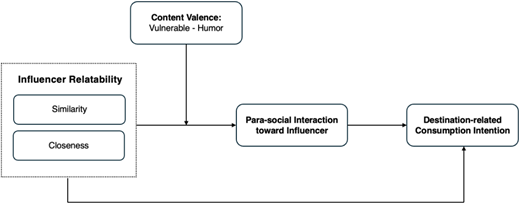
We further posit a first-stage moderation by content tone: the humorous vs vulnerable framing of negative self-disclosure conditions how strongly each relatability pathway predicts PSI. Extant evidence shows that humor heightens hedonic experience and perceived opinion leadership on short-video platforms, thereby increasing intentions to follow advice (Barta et al., 2023), and in travel contexts, raises visit intention via trust transfer from influencer to destination (Li and Zhou, 2024). By contrast, self-disclosure and two-sided messaging (acknowledging negatives with positives) enhance perceived authenticity/credibility and improve downstream attitudes and intentions – consistent with a closeness-based route (Lee and Johnson, 2022b; Nah, 2022). Taken together, we expect humorous negativity to preferentially activate similarity (shared mindset/“they’re like me”), whereas vulnerable negativity preferentially activates closeness (felt intimacy/“I feel for them”). We formalize this as a moderated-mediation model (Hayes, 2017). Figure 1 presents our moderated-mediation model, linking relatability (similarity, closeness), PSI and DRCI.
3.1 Hypotheses development
Perceived similarity reflects followers’ cognitive assessment that the influencer is “like me” in interests, values or lifestyle. Homophily reliably predicts stronger PSI/PSR and favorable outcomes in influencer/endorser settings (Lee and Watkins, 2016; Zhang et al., 2021; Sokolova and Kefi, 2020). Perceived closeness reflects an affective bond akin to friendship or intimacy, nourished by authentic, self-disclosing communication; it is central to parasocial bonds on social media (Labrecque, 2014). Accordingly:
Greater perceived similarity to the influencer is associated with higher levels of parasocial interaction (PSI).
Perceived emotional closeness to the influencer positively predicts PSI.
Humorous self-disclosures signal resilience and a shared worldview; on TikTok-like contexts, humor elevates enjoyment and perceived opinion leadership, which increase compliance/advice-following (Barta et al., 2023). In tourism, humorous influencer posts raise visit intention via trust transfer (Li and Zhou, 2024). Vulnerable disclosures invite empathy and intimacy; judicious self-disclosure and two-sided messaging enhance perceived authenticity/credibility and improve persuasion (Lee and Johnson, 2022a; Nah, 2022). Thus, tone should condition how relatability converts to PSI:
The positive association between perceived similarity and PSI is stronger when posts adopt a humorous tone than when they adopt a vulnerable tone.
The positive association between perceived emotional closeness and PSI is stronger when posts adopt a vulnerable tone than when they adopt a humorous tone.
PSI is a key psychological process translating creator attributes into conative outcomes in influencer contexts (Sokolova and Kefi, 2020). In tourism, PSR/PSI predict destination attitudes and visit intentions (Zheng et al., 2022; Yılmazdoğan et al., 2021). Therefore:
PSI mediates the relationship between perceived similarity and destination-related consumption intention.
PSI mediates the relationship between perceived closeness and destination-related consumption intention.
Beyond continuous interactions, we probe simple-effects patterns using high vs low relatability groups for interpretability (Aiken et al., 1991; Hayes, 2017):
The simple effect of post tone on PSI differs between followers with high perceived similarity and followers with low perceived similarity.
The simple effect of post tone on PSI differs between followers with high perceived emotional closeness and followers with low perceived emotional closeness.
These tests visualize whether humorous posts yield disproportionately higher PSI among high-similarity followers (vs low-similarity), whereas vulnerable posts yield higher PSI among high-closeness followers – patterns consistent with H2.
4. Methodology
4.1 Research paradigm
This study is grounded in the positivist research paradigm, which assumes that reality exists independently of human perception and can be objectively observed and measured. In business research, positivism supports the use of empirical observation and statistical analysis to identify cause–effect relationships between variables (Bryman, 2016; Saunders et al., 2023). This paradigm aligns with the hypothetico-deductive model of science, where research begins with established theories, formulates hypotheses and tests them against empirical evidence (Popper, 2005).
Following a deductive reasoning approach, this study derives hypotheses (H1–H4) from existing theories in marketing and consumer behavior, ensuring that the conceptual model is theoretically justified before empirical testing (Whetten, 1989). Consistent with the positivist emphasis on objectivity and replicability, data collection is conducted using structured, standardized instruments to minimize researcher bias and enhance measurement reliability. The quantitative research design further enables the study to test theory-driven predictions with statistical rigor, allowing for generalizable conclusions within the target population (Creswell and Creswell, 2017).
By adopting this positivist, deductive and quantitative stance, the research ensures philosophical coherence, methodological rigor and alignment with best practices in business and management research.
4.2 Research design
The study used a one by two between-subjects manipulation of post tone (vulnerability vs humor), and two measured antecedents – perceived similarity and perceived closeness (CLO) that serve as predictors of PSI. This hybrid design isolates the causal effect of tone while capturing naturally varying relatability perceptions that condition the link between tone and PSI.
This hybrid quantitative approach enables the examination of causal effects of post tone while simultaneously assessing how naturally varying perceptions of relatability moderate these effects. As Creswell and Creswell (2017) note, combining experimental control with measured variables allows researchers to capture both controlled variance (from the manipulation) and naturally occurring individual differences (from measured constructs), thereby enhancing explanatory power.
From an experimental design perspective, the between-subjects manipulation of post tone maximizes internal validity by reducing carryover and demand effects (Shadish et al., 2002). At the same time, the inclusion of continuous moderators follows the recommendations of Aiken and West Aiken et al. (1991) and Hayes (2017) for testing interaction effects in regression and moderation models, which are widely used in business and marketing research. Similar hybrid designs, combining experimental manipulations with measured latent moderators, have been successfully applied in marketing and consumer behavior research (Le et al., 2025).
Because the focal constructs (SIM, CLO, PSI and DRCI) are latent variables, their measurement follows the SEM tradition (Bagozzi and Yi, 1988). This requires establishing construct reliability and convergent and discriminant validity prior to hypothesis testing, to ensure that observed effects are not artifacts of measurement error. Furthermore, steps are taken to ensure that the moderators are not confounded with the experimental conditions, thus maintaining the interpretability of the interaction effects and protecting internal validity (Podsakoff et al., 2003).
By integrating manipulation with measurement in a single design, this study aligns with best practices in behavioral and business research, allowing for nuanced testing of theory-driven hypotheses while maintaining methodological rigor and replicability.
4.3 Experimental manipulation and measured variables
Participants were randomly assigned to one of two post tone conditions (vulnerability vs humor). Random assignment is widely recognized as the most effective way to maximize internal validity because it balances participant characteristics across groups and minimizes selection bias (Shadish et al., 2002). In this study, both conditions were of primary interest, so a separate control group was unnecessary.
To further control for potential confounding influences, we recorded covariates such as age and platform use. All participants completed the study via the online survey platform Qualtrics, which ensured that instructions, presentation format and task environment were identical for everyone.
The design also included two measured antecedents – perceived similarity and perceived closeness – as predictors of PSI; post tone served as the experimental moderator. These variables capture naturally occurring differences in how participants relate to the influencer, which can shape the strength of the experimental effect (Aiken et al., 1991).
In addition, a mediator – PSI – was measured to examine whether influencer effects operate indirectly through this psychological process. The inclusion of both moderators and a mediator allowed us to test not only direct and indirect effects but also a conditional indirect effect (moderated mediation), following established analytical frameworks in behavioral research (Hayes, 2017).
Consistent with best practices for experiments combining manipulations with measured predictors, the antecedent variables (perceived similarity and closeness) were measured after stimulus exposure; the experimental moderator (post tone) was manipulated via random assignment. We confirmed to participants that the stimuli was fictional but the post was designed to mimic common Xiaohongshu conventions (length, voice, emoji use, etc.). Measuring them post-exposure avoids priming participants about their relatability perceptions in advance, which could bias their reactions (Podsakoff et al., 2003). It also ensures that their responses reflect perceptions formed in the specific context of the influencer post they saw.
Before the actual experiment, both stimuli were pretested with a separate sample (n = 20) to ensure that they differed not only in perceived humor and vulnerability but also in perceived authenticity and appropriateness. Results confirmed clear differences across these dimensions, supporting the validity of the manipulation.
4.4 Participants and procedure
The study targeted Chinese Gen Z social media users (aged 18–30), a demographic highly active on social media and particularly engaged with influencer content. Participants (n = 347) were recruited via the online survey platform Qualtrics. Screening criteria required Chinese nationality or long-term residence in China to ensure cultural context consistency, active use of at least one social media platform on a weekly basis and following at least one social media influencer so that stimulus materials would be meaningful and relevant. Data collection took place in July 2024, and each participant received no monetary incentive for completing the study.
Upon accessing the Qualtrics survey, participants provided informed consent and were then randomly assigned by the platform’s randomization function to one of two experimental conditions: a vulnerability post or a humor post. Both stimuli depicted an influencer’s travel-related social media post paired with an identical destination image. The only difference was the caption text – one written in a vulnerable, self-disclosive tone describing personal travel-related challenges, the other in a humorous, lighthearted tone. This controlled design ensured that any observed effects could be attributed to post tone rather than differences in visual content (Shadish et al., 2002).
Following stimulus exposure, participants completed an attention check to verify engagement. Additional data quality safeguards were implemented, including response time thresholds and detection of straightlining patterns, which are recommended best practices for online survey research (Meade and Craig, 2012). Participants failing these checks were excluded. The final valid sample was balanced in gender (51.01% female, 48.99% male; mean age = 22.4, SD = 2.9) and reported high engagement with social media, with a majority using Weibo or Xiaohongshu as their primary platforms for following travel or lifestyle influencers.
The questionnaire sequence included manipulation checks, measures of perceived similarity, closeness, PSI and destination consumption intention, as well as control variables (age, travel frequency, usage frequency). The procedure was reviewed and approved by the institutional ethics committee of the first author and adhered to established guidelines for online human subjects research (Creswell and Creswell, 2017). The randomization function in Qualtrics ensured equal allocation across both tone conditions. Although demographic quotas were not imposed, the final sample was naturally balanced in gender, region and level of education, reducing risk of demographic bias between conditions.
4.5 Measures
4.5.1 Measurement instruments.
All variables, except the experimentally manipulated one, were measured using established multi-item Likert scales. Where possible, validated instruments from prior research in influencer marketing, PSI and tourism intention were adopted or adapted to ensure content validity. The survey was designed in English and translated into Chinese using the back-translation method.
Perceived similarity refers to the perceived commonality between the participant and the influencer in terms of values, interests or lifestyle. A five-item scale was adapted from prior influencer-audience homophily research (Taillon et al., 2020; Yılmazdoğan et al., 2021) and refined following language and identity similarity measures in Kim and Kim (2022). Items captured shared interests and perspectives (e.g. “I have a lot in common with this influencer”; “This influencer shares similar values with me”), rated on a seven-point Likert scale (1 = strongly disagree, 7 = strongly agree). Cronbach’s α = 0.926, indicating good internal reliability.
Perceived closeness captures the emotional bond or friendship-like connection between a follower and an influencer. This construct was measured with five items adapted from interpersonal closeness and influencer attachment literature (Taillon et al., 2020; Leite and Baptista, 2022). Items reflected felt connectedness and trust (e.g. “I feel personally close to this influencer, as if we were friends”; “I trust this influencer”), using a seven-point agreement format. Cronbach’s α = 0.921.
PSI was defined as the one-sided psychological closeness a participant feels toward an influencer after viewing a post, akin to understanding and companionship. The scale was adapted from Rubin et al. (1985)PSI scale and recent social media adaptations (Lin et al., 2021; Sokolova and Kefi, 2020), drawing conceptually from the Horton and Richard Wohl (1956) original PSI theory. Five items assessed cognitive and affective PSI (e.g. “I understand this influencer’s personality as if they were a friend”; “I feel like I know this influencer personally”), rated on a seven-point Likert scale (1 = strongly disagree, 7 = strongly agree). Internal consistency was high (α = 0.911).
Destination consumption intention reflects the participant’s willingness to visit or engage with the destination shown in the influencer’s post. A five-item scale was adapted from established tourism intention measures (Zheng et al., 2022; Lam and Hsu, 2006; Chen and Tsai, 2007). Items assessed visit intention and related engagement (e.g. “I intend to visit the destination shown in the post”; “I will search for more travel information about this destination”), rated on a seven-point likelihood scale (1 = very unlikely, 7 = very likely). Cronbach’s α = 0.935.
Age (continuous, verified from panel data) and platform use (primary platform and daily usage hours) were measured as covariates to account for demographic and familiarity effects. Platform use frequency was treated as a numeric covariate, and primary platform was dummy-coded if required. To reduce order bias, all multi-item scales were presented in randomized order. Likert anchors followed standard practice (e.g. 1 = strongly disagree, 7 = strongly agree; or 1 = very unlikely, 7 = very likely).
Our study used a single‐factor, between‐subjects manipulation of the post tone of the influencer’s post with two conditions: vulnerability vs humor. Both (approximately 150 words) described the same travel episode and followed an identical three-part structure: location introduction, personal experience and a closing engagement cue. This reflects high self-disclosure, which can enhance authenticity and trust (Taillon et al., 2020; Horton and Richard Wohl, 1956). The vulnerability version used self-disclosure cues (personal struggle, growth framing), whereas the humor version used lighthearted, playful and self-deprecating language without revealing personal struggles. All stimuli were written in Chinese and styled as Xiaohongshu posts. Participants were randomly assigned to one of the two conditions (1 = vulnerability; 2 = humor; n1 = 181, n2 = 166).
Immediately after reading the vignette, participants completed two three-item, seven-point indices: perceived vulnerability (MP_VUL1–3, averaged) and perceived humor (MP_HUM1–3, averaged). Independent-samples t-tests confirmed clear separation between conditions: vulnerability ratings were higher in the vulnerability condition than in the humor condition [M1 = 4.77, SD = 1.66 vs M2 = 2.58, SD = 1.75; t(338.33) = 11.90, p < 0.001, d = 1.28], whereas humor ratings showed the opposite pattern [M1 = 3.29, SD = 1.75 vs M2 = 5.00, SD = 1.54; t(344.41) = −9.66, p < 0.001, d = 1.03]. Post tone (Type_V1H2; vulnerability vs humor) was modeled as a dichotomous moderator. Interaction terms with perceived similarity and perceived closeness were estimated in regression analyses aligned with the SEM paths. For robustness and visualization, we also reported groupwise summaries and simple-slope plots; median splits of continuous predictors were used for display only, not for inference complete results for the manipulation checks – including group means (M), standard deviations (SD), Welch’s t with df, two-tailed p-values and Cohen’s d – are summarized in Table 2.
4.6 Data analysis
All analyses were conducted in R (v4.2.2). After excluding incomplete responses, the final analytic sample was n = 347. Scale items were scored so that higher values indicate more of the underlying construct. For descriptive purposes, composite means were computed for each construct by averaging their items; hypotheses were tested primarily with composite-indicator structural models (regressions/SEM estimated on scale means). In parallel, we estimated an item-level latent SEM as a robustness check. Because responses were collected on fixed Likert-type scales, univariate out-of-range values were not expected. Internal consistency was high (Cronbach’s α: SIM = 0.926, CLO = 0.921, PIN = 0.911, DECI = 0.935), and convergent validity in CFA was supported (CR = 0.914–0.936; AVE = 0.682–0.747). Variance inflation factors in the regression models were low (≤ 1.303), indicating no multicollinearity concerns between similarity and closeness. Descriptive statistics, bivariate correlations and full measurement diagnostics are reported in the measurement model section, and a single-factor probe for common method variance indicated 37.6% explained variance, suggesting CMV was not a serious concern.
A confirmatory factor analysis (CFA) was conducted in lavaan (Rosseel, 2012) to validate four latent constructs: perceived similarity (five items), perceived closeness (five items), PSI (five items) and destination‐related consumption intention (five items). Model fit was assessed using χ2/df, CFI, TLI, RMSEA and SRMR, with commonly used benchmarks (e.g. CFI/TLI ≥ 0.90; RMSEA/SRMR ≤ 0.08). Modification indices were consulted only for theoretically justifiable correlated residuals.
Internal consistency was evaluated using Cronbach’s α (α ≥ 0.80) and composite reliability (CR ≥ 0.70). Convergent validity was assessed via average variance extracted (AVE ≥ 0.50) (Fornell and Larcker, 1981). Discriminant validity was examined using both the Fornell–Larcker criterion (√AVE on the diagonal exceeding inter‐construct correlations) and the HTMT ratio with a conservative cutoff of < 0.90 (Henseler et al., 2015). Despite the strain item-level CFA fit, reliability and discriminant validity were adequate (CR ≈ 0.91–0.94; HTMT < 0.90). Accordingly, we use composite-indicator models as the primary analysis, and treat the item-level latent SEM as a robustness/sensitivity check.
Item-level CFAs were estimated with maximum likelihood (ML), treating Likert responses as approximately continuous. We then averaged items within each construct to form composites and estimated the primary structural paths on these composites using ML with 5,000 bootstrapped confidence intervals for indirect effects. Moderation was tested via interaction regressions using the composites and the tone dummy (Type_V1H2: 1 = vulnerability, 2 = humor; vulnerability as the reference), supported by simple-slope plots and groupwise summaries. The same path specification was re-estimated as an item-level latent SEM as a robustness check.
This study received approval from the University of Glasgow College of Social Sciences Ethics Committee. Procedures followed university guidelines and the Declaration of Helsinki. Participants received an information sheet detailing the study’s purpose, voluntary participation, anonymity and withdrawal rights before providing informed consent via the online survey (Qualtrics). No personal identifiers were collected and all responses were anonymized and stored securely on encrypted devices.
5. Data analysis results
5.1 Measurement model evaluation
Before estimating the structural paths, we validated the measurement model for the four latent constructs – perceived similarity, perceived closeness (CLO), PSI and DRCIs. A CFA indicated poor global fit [χ2(164) = 856.08; CFI = 0.888; TLI = 0.870; RMSEA = 0.110; SRMR ≈ 0.043]. Although item-level CFA fit indicated strain, all loadings were high and significant; we therefore retained items and proceed with composite-indicator structural models as the primary analysis, complemented by an item-level latent SEM as a robustness check.
Reliability and convergent validity were satisfactory. Model fit is reported in Table 4, and the correlation/√AVE matrix is shown in Table 3. Standardized loadings spanned 0.72–0.91 for SIM, 0.75–0.92 for CLO, 0.70–0.88 for PSI, and 0.82–0.89 for DRCI. CR values ranged from 0.914–0.936 and Cronbach’s α from 0.911 to 0.935, exceeding the 0.70 benchmark. Average variance extracted (AVE) was also above the 0.50 criterion for every construct (SIM = 0.714, CLO = 0.710, PSI = 0.682, DRCI = 0.747), indicating that each construct captured a substantial share of its indicators’ variance.
Discriminant validity was supported by multiple diagnostics. Under the Fornell–Larcker criterion, each construct’s square root of AVE exceeded its correlations with other constructs – for example, √AVE_SIM ≈ 0.845 was greater than SIM’s correlations with CLO (r ≈ 0.28), PSI (r ≈ 0.36) and DRCI (r ≈ 0.52). Likewise, √AVE_CLO ≈ 0.843 exceeded CLO’s correlations with PSI (r ≈ 0.40) and DRCI (r ≈ 0.34). HTMT ratios were all below 0.90 (e.g. SIM–CLO ≈ 0.30; SIM–PSI ≈ 0.38; CLO–PSI ≈ 0.42), reinforcing that the constructs are empirically distinct. Conceptually related dimensions of relatability (SIM and CLO) were correlated but non-collinear (r ≈ 0.28), and PSI remained distinguishable from DRCI despite a moderate association (PSI–DRCI r ≈ 0.42).
Because the data were collected via self-report, we assessed common method bias. An unrotated Harman single-factor test showed that the largest factor explained approximately 37.6% of the variance (well below the 50% heuristic). A CFA marker-variable approach further indicated no meaningful inflation of substantive loadings, suggesting that common rater effects were unlikely to threaten the inferences. Taken together, these results indicate strong internal consistency, satisfactory convergent and discriminant validity and minimal concern about common method bias. The measurement model is therefore adequate for testing the structural hypotheses.
5.2 Hypothesis testing: main effects, moderation and mediation
We estimated the hypothesized relations using composite-indicator structural models (ML) as the primary analysis, complemented by an item-level latent SEM as a robustness check in lavaan. The structural specification was identical across approaches: perceived similarity and perceived closeness (CLO) predicted PSI; PSI predicted DRCI; and direct paths from SIM and CLO to DRCI were included to assess partial mediation. The post-tone manipulation was coded Type_V1H2 (1 = vulnerability, 2 = humor; vulnerability as the reference) and entered as a categorical moderator; moderation was examined via interaction regressions aligned with the SEM specification and corroborated with tone-based multi-group checks. For composites, standard errors were heteroskedasticity-robust and indirect effects were evaluated with 5,000 bias-corrected bootstrap resamples. The latent SEM achieved adequate global fit [χ2(160) = 468.21, CFI = 0.950, TLI = 0.941, RMSEA = 0.075, SRMR = 0.044; p < 0.001], and both modeling choices yielded convergent conclusions.
Results supported the predicted main effects of the two facets of relatability on PSI. The standardized path from perceived similarity to PSI was β = 0.25 (z = 4.48, p < 0.001), and the standardized path from perceived closeness to PSI was β = 0.35 (z = 5.95, p < 0.001). Both coefficients are positive and statistically significant, showing that respondents who perceived the influencer as more similar to themselves, and those who felt more emotionally close to the influencer, reported stronger parasocial engagement. These effects are independent, meaning that each form of relatability explains unique variance in PSI net of the other. In combination, the two predictors account for a meaningful portion of the variance in PSI and establish the foundation for the subsequent moderation and mediation tests. Accordingly, H1a and H1b are supported.
To verify the robustness of these main effects using a different analytical lens, we ran a linear regression with PSI as the dependent variable and entered similarity and closeness simultaneously as predictors. This corroborated the SEM findings: the model yielded R2 = 0.211 (adjusted R2 =0.206, F-stat p < 0.001), with similarity (b ≈ 0.26, p < 0.001) and closeness (b ≈ 0.30, p < 0.001) both significant. Although the composite-indicator models are our primary inferential framework given its capacity to evaluate the full path structure, the convergence across approaches increases confidence that the relation between relatability and PSI is not an artifact of model specification, and that the pattern generalizes across standard estimation methods. Full standardized coefficients, robust SEs and model statistics for these main effects are reported in Table 5.
We next assessed whether the tone of the influencer’s negative content moderated the links from the two facets of relatability to PSI. Moderation was probed using interaction regressions with the raw composite predictors, a dummy code for post tone (1 = vulnerability; 2 = humor) and the corresponding interaction terms. These regressions were treated as complementary to the latent-variable SEM and were paired with multi-group checks to ensure that any interaction pattern was not driven by scale imbalances or distributional peculiarities. This step respects the experimental nature of the moderator and allows a straightforward test of slope differences across the two content conditions while retaining the parsimony of a single-degree-of-freedom contrast.
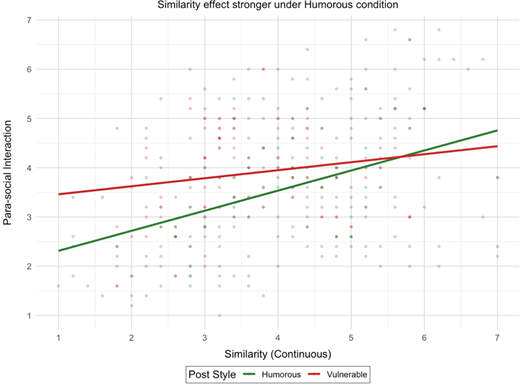
The interaction between perceived similarity and post style was statistically significant (β = 0.245, t = 2.66, p = 0.008), indicating that the slope of PSI on similarity differed by content tone. Specifically, the similarity – PSI association was stronger in the humor condition than in the vulnerability condition (interaction β = 0.245, SE = 0.092, t = 2.66, p = 0.008). As perceived similarity increased, PSI rose more steeply under humor; at low similarity, humor yielded lower PSI than vulnerability, whereas at high similarity the two converged. Inspection of the interaction plot in Figure 2 indicates that when perceived similarity is low, humorous self-deprecating posts elicit noticeably lower PSI than vulnerability-framed posts. As similarity increases, PSI rises in both conditions, but the slope is steeper under humor, illustrating that humorous negativity particularly strengthens the similarity–PSI link. At high similarity, PSI converges across tone conditions.
By contrast, the interaction between perceived closeness and post style did not reach conventional significance (β = −0.170, t = −1.83, p = 0.068). Perceived closeness remained a strong and positive predictor of PSI in both content conditions, and the slopes were comparable across humor and vulnerability. In other words, the affective route to parasocial engagement appears stable regardless of whether negative content is framed humorously or vulnerably. This pattern suggests that the sense of friendship-like connection captured by closeness is resilient across stylistic shifts in content tone. Accordingly, H2b is not supported.
Taken together, the moderation tests indicate a selective contingency: post style moderates the similarity to PSI path but does not meaningfully alter the closeness to PSI path. Cognitive relatability is more condition-dependent, whereas affective closeness exerts a relatively stable influence on parasocial engagement across different presentations of negative content. This selective moderation provides a coherent bridge to the mediation analysis, where PSI is positioned as a pathway from relatability to downstream behavioral intentions. Table 6 reports the moderation regression.
We then tested whether PSI mediates the effects of perceived similarity and perceived closeness on DRCIs. As shown in Table 7, both similarity and closeness significantly load onto PSI, and when PSI enters the model, PSI, similarity and closeness all show positive direct effects on intention, consistent with partial mediation.
Mediation was examined within the SEM by estimating the direct and indirect effects and by computing nonparametric bootstrap confidence intervals for the indirect paths. For perceived similarity, the direct effect on intention remained statistically significant in the presence of PSI (unstandardized β = 0.463, p < 0.001; standardized β ≈ 0.38). In addition, the indirect effect through PSI was significant, see Table 8 (indirect = 0.053, SE = 0.016, 95% CI [0.021, 0.085], z = 3.24, p = 0.001). This combination – retention of a direct path together with a nonzero indirect path – indicates partial mediation and supports H3a. For perceived closeness, the direct effect on intention was smaller but still significant (unstandardized β = 0.164, p = 0.016; standardized β ≈ 0.14), and the indirect effect via PSI was also significant (indirect = 0.060, SE = 0.018, 95% CI [0.025, 0.096], z = 3.38, p = 0.001), supporting H3b. Collectively, these estimates show that PSI functions as a consistent mediating mechanism for both forms of relatability, while similarity also retains a notable direct route to intention beyond PSI.
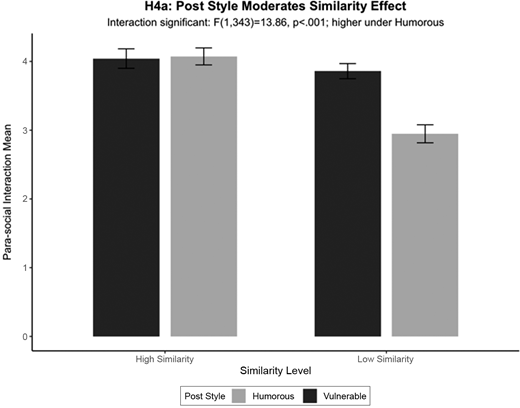
To provide an intuitive visualization of the moderation patterns and to assess the robustness of the findings using a categorical grouping approach, we conducted two-way ANOVAs on PSI after splitting participants into high vs low groups based on the median of the similarity and closeness scales. For the similarity analysis, the interaction between similarity group and post style was significant [F(1,343) = 13.86, p < 0.001]. The pattern was consistent with the interaction regression: low-similarity participants exhibited markedly lower PSI under humor than under vulnerability, whereas high-similarity participants reported uniformly high PSI in both conditions (Figure 3). This result converges with H2a and provides a clear illustration that when similarity is low, vulnerable content is more effective than humorous content at eliciting parasocial engagement; when similarity is high, PSI remains strong regardless of tone.
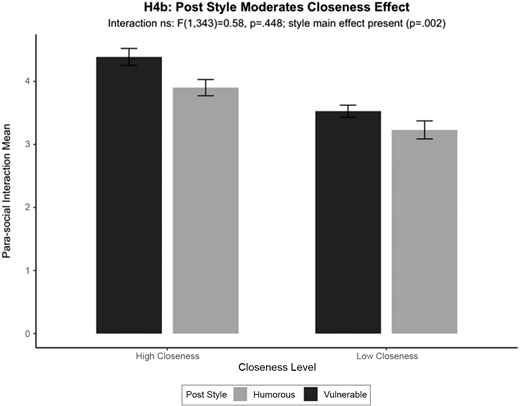
For the closeness analysis, the interaction with post style was not significant [F(1, 343) = 0.58, p = 0.448]. Participants high in closeness reported substantially greater PSI than those low in closeness, and this gap was evident under both humor and vulnerability, with no reliable difference in the size of the gap across conditions (Figure 4). This outcome mirrors the null interaction observed in H2b and further supports the conclusion that the effect of perceived closeness on PSI is relatively insensitive to whether negative content is framed humorously or vulnerably. While the ANOVAs are secondary to the latent-variable modeling, they help visualize the directional pattern and demonstrate that the findings are not an artifact of the estimation technique or distributional assumptions inherent to SEM.
5.3 Overall conclusion of hypothesis tests
Across analyses, H1a and H1b are supported: both perceived similarity and perceived closeness positively predict PSI. H2 receives partial support: post style strengthens the similarity – PSI association but does not materially alter the closeness – PSI association. H3a and H3b are supported: PSI significantly mediates the effects of both similarity and closeness on DRCIs; for similarity, the mediation is partial because a direct path remains, whereas for closeness, the effect relies more on the mediated route through PSI. The supplementary H4 group-based results align with these patterns, reinforcing the selective moderation on the similarity pathway and the stability of the closeness pathway. Together, the findings present a coherent picture in which cognitive and affective facets of relatability both elevate parasocial engagement, but only the cognitive facet is meaningfully conditioned by the tone of negative content, and PSI serves as the conduit translating these relational perceptions into destination-related behavioral intentions.
6. Discussion
Taken together, the evidence portrays influencer relatability as a dual-path architecture that channels into behavioral intention largely through PSI. Perceived similarity and perceived emotional closeness both heighten PSI, and PSI functions as the principal conduit to destination-related intentions; at the same time, each facet of relatability retains some direct association with intention, consistent with partial mediation (Sokolova and Kefi, 2020; Lou and Zhou, 2024). This pattern aligns with syntheses positioning PSI/PSR as a core mechanism in influencer persuasion (Han and Balabanis, 2024) and with experimental and field evidence documenting PSI’s mediating role between influencer cues (e.g. homophily/similarity, authenticity) and purchase-related outcomes (Stein et al., 2024).
The two facets are not functionally equivalent. Similarity tends to operate as a diagnostic-fit route – signals that “this applies to me” – and can translate cognitive alignment into both relationship formation and action (Bu et al., 2022; Naderer et al., 2021). Closeness, by contrast, reflects affective bonding that exerts its influence primarily through PSI and is often sustained by perceptions of authenticity and relational warmth (Chung and Cho, 2017). This differentiation helps explain why similarity may produce residual effects beyond PSI, whereas closeness more commonly expresses its impact via the relationship itself.
Content tone qualifies the first stage selectively. Humorous framing can amplify the link between similarity and PSI by normalizing minor setbacks and foregrounding a shared interpretive lens, consistent with evidence that humor strengthens persuasion when it complements message structure (Eisend, 2022; Ning et al., 2022). Vulnerability, as self-disclosure, is effective for initiating PSI by reducing social distance, but its success hinges on appropriateness and authenticity management; transparent and proportionate disclosure sustains credibility, whereas incongruent or excessive disclosure can backfire (Audrezet et al., 2020; Andonopoulos et al., 2023). This asymmetry clarifies why tone tends to matter more for the similarity route (initiation and amplification) than for the closeness route (maintenance once warmth is established). Finally, we need to note that these effects are not unconditional. Tone matters less for well-established close relationships, or in topics where humor is culturally inappropriate. Conversely, humorous self-deprecations is more effective when influencers aim to reduce psychological distance or when addressed audiences who perceive to be similar to the influencer.
6.1 Theoretical implications
Prior influencer and PSI work often treats “relatability/homophily” as unitary. By separating SIM (cognitive commonality) from CLO (affective intimacy), we show that both facets uniquely predict PSI and are not redundant. That CLO’s coefficient is marginally larger clarifies why warmth-laden cues (authentic self-disclosure, friend-like address) are potent in building parasocial bonds (Labrecque, 2014), whereas SIM’s residual direct effect on DRCI indicates a fit/applicability route beyond relationship feelings. The “two-routes-to-PSI” view reconciles evidence emphasizing homophily (Lee and Watkins, 2016; Zhang et al., 2021), with evidence emphasizing intimacy/companionate feelings in PSR. The theoretical upshot is a structured account of relatability: cognition-first (Aaker et al.) versus affect-first (bond) routes that converge on PSI yet retain distinct behavioral footprints.
Consistent with established models, PSI is the proximal conduit from creator attributes to conative outcomes (Sokolova and Kefi, 2020). Our pattern – partial mediation for SIM and fuller mediation for CLO – sharpens that mechanism: similarity appears to carry an additional, non-relational influence on intention (e.g. perceived applicability, social norm congruence), whereas closeness works almost entirely through PSI (relationship leverage). This helps explain mixed reports of direct influencer effects on intentions: whether direct paths surface depends on which facet of relatability predominates in a study’s stimuli and audience.
Tone matters at the first stage: vulnerability strengthens the effect of perceived similarity on PSI, whereas the effect of perceived closeness on PSI does not vary by tone. This extends content-cue perspectives (Lee and Johnson, 2022a) by showing that negative-tone subtypes shape how cognitive versus affective relatability translate into parasocial engagement. Theoretically, vulnerability heightens diagnostic salience of shared identity (“that could be me”), amplifying SIM’s impact; humor primarily adds hedonic value/opinion leadership, which is helpful but less bonding in the SIM – PSI step (Barta et al., 2023; Li and Zhou, 2024). The so-what: PSI theory gains a contextual moderator – message tone can magnify or mute the power of homophily to produce parasocial bonds.
6.2 Contextualizing parasocial interaction on Xiaohongshu with Gen Z
In a high-involvement category (travel) and a high-policing platform (comment cultures that scrutinize “try-hard authenticity”), stable, self-diagnostic cues (consistent vulnerability, balanced two-sided narratives) seem more predictive of CLO and PSI persistence, whereas one-off humor varies more with taste alignment. This situates PSI/PSR theory within Chinese Gen Z and Xiaohongshu: relational processes remain universal, but cue diagnosability and norm expectations sharpen tone effects in this milieu. For theory, the boundary is not “humor vs vulnerability” per se; it is how a tone renders similarity diagnostic and how authenticity consolidates closeness on a platform that rewards credible self-presentation (Lee and Johnson, 2022a; Li and Zhou, 2024; Sokolova and Kefi, 2020; Zheng et al., 2022).
6.3 Practical implications
If the goal is initiation (building PSI among look-alike prospects), prioritize vulnerability-framed negative self-disclosures that make similarity feel consequential (specific, proportionate, two-sided). Where the goal is maintenance (already high CLO), tone calibration is less critical audiences with strong closeness sustain PSI across lighthearted and somber posts. For mixed audiences, sequence content: open with vulnerability to activate SIM broadly, then use humor to maintain engagement and reinforce shared worldview (Barta et al., 2023; Aaker et al., 2010; Li and Zhou, 2024).
For destinations targeting niche, identity-defined segments, select creators with high baseline SIM to the segment and design vulnerable storytelling to maximize the SIM−PSI lift. For broader markets where CLO is the lever, partner with creators who have proven authenticity footprints (consistent, proportionate disclosures; balanced reviews) and build serial narratives that accrue closeness over time—more effective than episodic gags for PSR (Audrezet et al., 2020; Liu and Zheng, 2024; Han and Balabanis, 2024).
Engineer parasocial touchpoints around posts: timely replies, “we/you” inclusive address, Q&A stickers, behind-the-scenes “fail-then-learn” reels. Tie these to clear travel calls-to-action (savable itineraries, shoppable links, “how I booked” walk-throughs). Because SIM retains a direct path to intention, surface applicability cues (budget tier, travel style, constraints), so look-alike followers can map advice to self even before deep bonding (Audrezet et al., 2020; Tao et al., 2024).
6.4 Limitations and future research
The study focuses on Chinese Gen Z on Xiaohongshu with a controlled negative-tone manipulation and self-reported intentions. Platform culture and age cohort may limit external validity. Future work should test multi-platform (e.g. Douyin, Bilibili) and cross-cultural samples and complement surveys with behavioral traces (click-throughs, saves, bookings).
We compared humorous and vulnerable negative self-disclosures at a given depth. Real-world posts vary in intensity, specificity and frequency. Future experiments can orthogonally vary depth (moderate vs intimate) and narrative arc (open-ended vs resolved) to chart non-linear effects and identify the tipping point where vulnerability shifts from authentic to performative(Leite et al., 2024; Eisend, 2022).
We modeled PSI as the mediator and interpreted patterns via trust-transfer (fit) and empathic bonding. Alternative or complementary processes – perceived diagnosticity, inspiration, social presence, perceived risk – could be added to a multiple-mediator design to parse micro-mechanisms. Longitudinal designs can test whether CLO-driven PSI indeed shows greater temporal inertia than SIM-driven PSI (Han and Balabanis, 2024; Tao et al., 2024).
Although we took steps to reduce common-method bias, SIM, CLO, PSI and intention were self-reports within a single session. Future research can combine validated episode-level PSI scales with trace-based engagement, and use instrumental variables or two-wave designs to better separate mediator timing from outcomes. Boundary conditions and heterogeneity (Bizjak Zabukovec and Faganel, 2024). Tone effects may vary by trip type (adventure vs relaxation), destination familiarity and risk level. Segmenting by identity centrality or humor style preference could reveal for whom humor functions as a bonding cue versus a mere entertainment cue (Xue et al., 2022).
7. Conclusion
This study advances a contingent, dual-path account of how influencer content moves travel intentions: similarity and closeness each foster PSI, but their behavioral footprints differ, and message tone can amplify (or leave untouched) the first-stage link. By positioning PSI as the connective tissue from relatability to DRCI, and by showing when vulnerability versus humor enhances that connection on Xiaohongshu, we refine parasocial theory for social-media travel persuasion and equip practitioners with concrete levers for content, selection and conversion. In high-stakes travel decisions, authenticity that is diagnostic (for similarity) and sustained (for closeness) is most likely to translate social bonds into action.