This study examines how university students' conceptions of learning shape their motivation, self-regulation and information processing throughout different academic stages, showing how these factors interact and transform as a function of academic progression. The objective, therefore, is to provide evidence on the mechanisms that sustain self-regulated learning and its impact on retention and academic success during higher education.
A formative structural model was developed and validated using Partial Least Squares Path Modeling (PLS-PM), with 5,000 bootstrap resamples from a large and diverse sample of 1,630 Colombian university students. This methodology helped to capture the complex dynamics among conceptions, motivation, self-regulation and information processing as well as to analyze variations across three cohorts at different stages of academic progression.
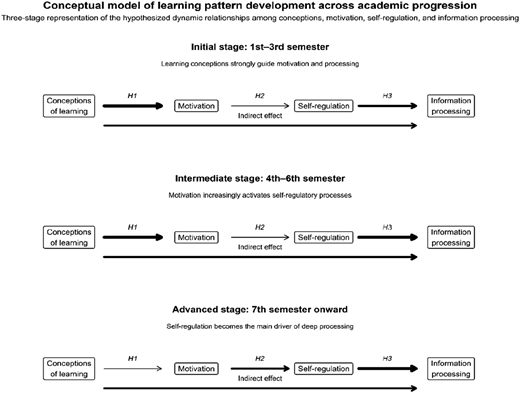
The results indicate that in the early semesters, learning conceptions drive motivation and indirectly influence information processing. In the intermediate stages, self-regulation emerges as a key mediator. By the later semesters, metacognitive self-regulation becomes the primary determinant of deep processing, overshadowing the direct influence of conceptions. These findings confirm the dynamic and evolving nature of learning patterns throughout university education and highlight the development of self-directed and deep learning.
This study has some limitations that should be acknowledged. First, the cross-sectional design limits the possibility of establishing causal relationships between the variables, since the observed associations reflect patterns at a single point. Future research should adopt longitudinal designs that better capture the evolution of learning processes throughout academic progression. Second, the use of non-probability convenience sampling may limit the generalizability of the findings. Although the sample was large and diverse, it is recommended that future studies replicate the model in different institutional and cultural contexts. Finally, the use of self-report measures may introduce potential response biases.
The findings provide explicit guidelines for curriculum design and university policies aimed at promoting constructivist principles and intrinsic motivation through active methodologies in the early stages of education. In more advanced stages, it is essential to enhance metacognitive regulation, autonomy and reflective practices. The implementation of these strategies can result in enhanced academic performance, increased student retention rates and the development of self-reliant graduates equipped for lifelong learning.
This study provides a novel contribution by proposing a dynamic and developmental model of learning patterns, demonstrating how the relationships among conceptions, motivation, self-regulation and information processing reorganize across academic progression.
Introduction
Conceptions of learning, understood as the beliefs and meanings that students attribute to their information and knowledge acquisition processes, decisively shape how they engage with academic tasks and the strategies they use to address them (Martínez-Fernández and García-Ravidá, 2012; Martínez-Fernández et al., 2018). These conceptions operate as frames of reference that influence motivation, self-regulation, and the depth of information processing, all of which are critical factors for academic success in higher education. According to Vermunt and Donche (2017), conceptions of learning act as guiding structures that direct the selection of strategies and the level of engagement in university contexts, which makes them a privileged entry point for understanding the dynamics that sustain or limit self-regulated learning.
Classic literature has consistently shown that constructivist conceptions are associated with higher levels of intrinsic motivation and sophisticated self-regulatory strategies, in contrast to reproductive conceptions, which are generally linked to rote and superficial approaches (Pintrich, 2000; Schunk and Zimmerman, 2011; Panadero and Alonso-Tapia, 2014). Recent research reinforces this perspective, pointing out that the capacity for self-regulation becomes essential in higher education environments characterized by heterogeneity, continuous assessment, and hybrid teaching and learning modalities (Boshoff-Knoetze and Du Toit, 2023), suggesting that the link between conceptions of learning and self-regulation is not static but evolves depending on the academic demands and contextual changes that a student goes through in their university training process.
Vermunt and Donche (2017) emphasize that self-regulatory strategies tend to strengthen progressively as students advance through their university careers. In the initial semesters, students often depend more on extrinsic motivations and external support. However, in later stages, they develop more constructivist conceptions, which promote more profound understanding, knowledge integration, and autonomous learning. This gradual development indicates that self-regulation is a competency built over time and is an integral part of the academic experience, highlighting the importance of examining it throughout the entire university journey.
The premise connects directly with the learning patterns model proposed by Vermunt and Donche (2017), which integrates conceptions, motivation, self-regulation, and information processing into a comprehensive framework for identifying adaptive behaviors and risk trajectories. However, contemporary university environments, characterized by digitalization, the increasing incorporation of emerging technologies, and the pedagogical challenges stemming from the post-pandemic era, necessitate an empirical update of these frameworks. In this context, recent studies have made clear the value of revisiting cognitive and metacognitive learning processes from modern perspectives. For instance, Junaštíková (2024) illustrated how digital environments demand new forms of self-regulation, while Do and Lai (2024) highlighted the mediating role of self-efficacy in the relationship between learning conceptions and academic performance. These findings, along with research focused on blended learning and self-regulation (García-Peñalvo and Corell, 2020), strengthen the notion that learning can be reinterpreted considering current dynamics to better address the evolving conditions of contemporary higher education.
The study explores how learning conceptions affect motivation, self-regulation, and information processing at various stages of university education. Building on previous studies (Vermunt and Donche, 2017; Panadero and Alonso-Tapia, 2014), this study hypothesizes that learning conceptions influence motivation during the early semesters. Furthermore, during intermediate stages, motivation positively predicts self-regulation. At advanced levels, self-regulation emerges as the primary predictor of deep learning processing. Additionally, it is expected that the direct effect of learning conceptions on information processing decreases in the later semesters, primarily functioning through the mediation of self-regulation.
This study aims to explain how learning patterns evolve throughout academic progression by proposing and validating a structural model based on the learning pattern framework. Specifically, it examines the relationships among conceptions of learning, motivation, self-regulation, and information processing while considering their dynamic interactions across different stages of higher education.
This study differs from previous research, which has mainly concentrated on static or correlational approaches, by adopting a predictive and systemic perspective. It models learning as an evolving configuration of interdependent processes. In doing so, the study aims to provide a more comprehensive understanding of how learning mechanisms reorganize as students advance through their academic trajectories.
For the purposes of this study, the main constructs are understood as follows: conceptions of learning refer to the meanings and beliefs that students attribute to the learning process; motivation refers to the processes that activate and sustain academic behavior; self-regulation involves the ability to plan, monitor, and control one's own learning; and information processing refers to the cognitive strategies used to understand, organize, and apply knowledge.
Taken together, these variables form an interdependent system in which conceptions of learning guide motivation, which activates self-regulatory processes, and these, in turn, determine the depth of information processing.
Therefore, the proposed model assumes a dynamic sequence in which conceptions of learning guide motivation, motivation activates self-regulation, and self-regulation determines the depth of information processing
The study's objectives pose the following research questions:
How do conceptions of learning influence student motivation throughout the different stages of academic progression?
To what extent does motivation predict self-regulation in university students?
How does self-regulation affect information processing throughout academic development?
Does self-regulation act as a mediating variable between motivation and information processing?
How do these relationships vary according to the level of academic progression?
These research questions are operationalized through the hypotheses presented in the following section. The following section also presents the proposed model and its associated hypotheses.
Theoretical framework and hypothesis
This study is based on Vermunt's learning patterns perspective, which views learning as a dynamic system in which conceptions of learning, motivation, self-regulation, and information processing are articulated. From this perspective, these components do not operate as isolated traits, but rather as interdependent dimensions that are configured and transformed throughout the academic trajectory (Vermunt and Donche, 2017). Recent research has reaffirmed that conceptions of learning vary according to context and educational stage, supporting their evolutionary nature within higher education (Ilie et al., 2025).
From a socio-cognitive perspective, learning is understood as an active process of meaning-making in which students regulate their cognitive, motivational, and behavioral processes according to the demands of the context. In this context, motivation is crucial for initiating and maintaining academic behavior, whereas self-regulation facilitates the planning, monitoring, and regulation of learning (Zimmerman, 2002; Panadero, 2017). This approach remains consistent with recent evidence highlighting the relevance of self-regulation in contemporary university contexts, especially in hybrid and technology-mediated environments (Lobos et al., 2024; Luo and Zhou, 2024).
Within this framework, conceptions of learning can be understood as cognitive filters that guide students' goals and expectations, influencing their motivational orientations and, indirectly, their ability to self-regulate their learning. Motivation influences the willingness to participate in academic activities, whereas self-regulation directs this participation toward the application of advanced information processing strategies. This relationship has been confirmed in recent studies showing how motivation and self-regulation predict the effective use of learning resources in digital higher education environments (Bühler et al., 2025).
From a dynamic perspective, conceptions of learning shape how students interpret academic tasks and influence their motivational orientations. Motivation subsequently activates self-regulatory processes by promoting planning, monitoring, and strategic engagement. Through these mechanisms, self-regulation organizes cognitive activity and facilitates deeper levels of information processing. Therefore, the proposed model assumes a sequential and interdependent relationship in which conceptions influence motivation, motivation activates self-regulation, and self-regulation determines the depth of information processing.
Based on this theoretical framework, the study proposes a structural model in which conceptions of learning influence motivation, motivation predicts self-regulation, and self-regulation determines the depth of information processing. Furthermore, it posits that the strength of these relationships varies according to the level of academic advancement, consistent with evidence indicating changes in learning patterns throughout university education (Vermunt and Donche, 2017; Ilie et al., 2025).
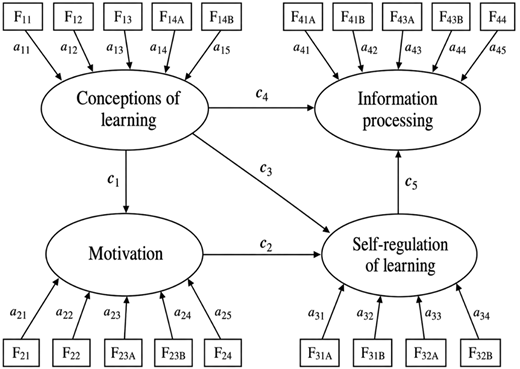
The proposed theoretical model is illustrated below in Figure 1.
Although Figure 1 presents the general structure of the proposed model, the relationships were also examined across three academic stages (initial, intermediate, and advanced) using multigroup analysis. This approach allowed the identification of structural variations in the strength and significance of the relationships among conceptions of learning, motivation, self-regulation, and information processing throughout academic progression.
In this regard, the use of structural equation modeling with partial least squares (PLS-PM) is particularly relevant when analyzing complex relationships between learning constructs and when the focus is on prediction (Sanchez, 2013). This approach allows constructs to be modeled as emergent composites and is particularly suitable in educational contexts where learning processes are multidimensional and dynamic. Furthermore, recent reviews show an increasing use of PLS-PM in educational research, although they although they emphasize the need for greater methodological rigor in the evaluation of measurement models and predictive validation (Demir and Uşak, 2025).
Figure 2 presents the formative structural model proposed in this study, while Table 1 describes the formative indicators and structural relationships associated with each construct represented in the model.
Based on the proposed model, the following hypotheses are formulated:
Conceptions of learning positively predict student motivation.
Motivation positively predicts self-regulated learning.
Self-regulated learning positively predicts deep information processing.
Self-regulation mediates the relationship between motivation and information processing.
The strength of the relationships between conceptions, motivation, self-regulation, and information processing varies according to the level of academic progression.
Method
Design
This study employed a cross-sectional quantitative design to examine the relationships between conceptions of learning, motivation, self-regulation, and information processing in university students within the framework of Vermunt and Vermetten (2004) learning patterns model.
The study was based on a theoretically grounded structural model that conceptualizes learning as a dynamic system of interrelated cognitive, motivational, and regulatory processes that evolve throughout an academic career. In accordance with this perspective, all constructs were specified as formative composites, since they represent multidimensional configurations of learning processes rather than reflective manifestations of a single latent trait.
Consequently, the path-modeling partial least squares structural equation model (PLS-PM) was used to estimate the model, given its suitability for analyzing complex predictive relationships involving formative specifications and its robustness to non-normal data distributions (Sanchez, 2013). The model was estimated using 5,000 bootstrap resamples to assess the stability and significance of the model parameters.
Participants
The sample consisted of 1,630 undergraduate students enrolled in various academic programs at several universities in Colombia. Participants were selected using non-probability convenience sampling, based on voluntary participation and institutional access.
The participants' ages ranged from 16 to 24 years (M = 20.5; SD = 2.31), with a gender distribution of 73.5% women and 26.2% men.
For analytical purposes, students were classified into three groups according to their level of academic progression: (1) initial stage (1st to 3rd semester; n = 948), (2) intermediate stage (4th to 6th semester; n = 344), and (3) advanced stage (7th semester onward; n = 338). This classification was theoretically based on the progressive evolution of learning patterns suggested in the literature and facilitated the analysis of structural disparities among the different stages of university education.
Instruments
The measurement model consisted of 19 observed indicators grouped into four constructs: conceptions of learning, motivation, self-regulation, and information processing. The indicators were adapted from instruments widely used in the framework of learning styles, particularly the Inventory of Learning Styles (ILS) developed by Vermunt (1998) and Vermunt and Vermetten (2004) and subsequently refined by Vermunt and Donche (2017). Empirical adaptations used in higher education contexts in Latin America (Martínez-Fernández et al., 2019) were also considered.
The instrument used in this study is grounded in the learning patterns model proposed by Vermunt and Vermetten (2004) and has been previously adapted and applied in Spanish-speaking contexts, particularly in Latin American higher education (Martínez-Fernández et al., 2019). These prior adaptations support the cultural and theoretical relevance of the model beyond its original context.
Building on this foundation, the present study involved a contextual adaptation process to ensure the clarity and appropriateness of the items for Colombian university students. The indicators were reviewed in terms of semantic clarity, linguistic adequacy, and contextual relevance to the local academic environment.
This adaptation process was carried out in three stages: (1) initial review and contextual adjustment of the indicators, (2) expert evaluation to assess content validity and theoretical coherence, and (3) refinement of item wording to ensure clarity, semantic precision, and cultural relevance for Colombian higher education students.
Additionally, expert judgment was employed to assess the coherence between the indicators and the theoretical constructs, ensuring that each item adequately represented its corresponding dimension. Minor wording adjustments were introduced, when necessary, without altering the original conceptual meaning of the indicators.
This process ensured the content validity and cultural adequacy of the measurement model within the context of Colombian higher education.
Conceptions of learning were operationalized using indicators that reflect constructivist and reproductive orientations toward knowledge acquisition, consistent with Vermunt's model. Motivation was measured using components associated with goal orientation and task value, following Pintrich's (2000) motivational model. Self-regulation was assessed using indicators related to planning, monitoring, and control processes of learning, according to Zimmerman's (2002) socio-cognitive model. Finally, information processing was operationalized using indicators associated with deep and surface learning strategies, based on the literature on learning approaches (Marton and Säljö, 1976).
All items were measured using a five-point Likert scale (1 = strongly disagree; 5 = strongly agree). Given the formative nature of the constructs, internal consistency was not assessed as a reliability criterion. Instead, the contribution of the indicators to each construct and potential collinearity issues were analyzed, ensuring the appropriate specification of the formative components.
By way of illustration, some representative items used in the study include: for conceptions of learning, “Learning involves deeply understanding the content beyond memorizing it”; for motivation, “I put effort into my studies because I consider them important for my personal development”; for self-regulation, “I plan my study activities before starting an academic task”; and for information processing, “I relate new content to prior knowledge to understand it better.”
Table 2 presents the operationalization of the variables included in the formative structural model.
Procedure
Data collection took place during the second academic semester of 2024 at participating institutions. Access to students was facilitated through coordination with course instructors, allowing the instrument to be administered during scheduled class sessions. Participants were selected using non-probability convenience sampling based on voluntary participation. The proper handling and anonymization of personal data were guaranteed.
The questionnaire was administered in paper-and-pencil format under standardized conditions, with an average response time of approximately 25 min. Before participating, students were informed about the study's objectives, the voluntary nature of their participation, and the confidentiality of their responses. Written informed consent was obtained from all participants.
The application process was supervised by trained researchers to ensure consistency in instructions, minimize potential bias, and address participants' concerns. Once the application was complete, all questionnaires were anonymized, coded, and entered into a secure database for subsequent statistical analysis.
The study was developed following ethical principles for research with human beings approved by the ethics committee of the University of Research and Development UDI through act No. CEI0317092025 in the ordinary session of September 17, 2025.
Voluntary participation, informed consent, and confidentiality of information were guaranteed. Likewise, measures were taken to minimize any potential risk to participants, ensuring the exclusive use of data for academic and research purposes.
Data analysis
The structural model was estimated using the partial least squares structural equation model (PLS-PM) using the plspm package of R project 4.0.3, following the methodological approach proposed by Sanchez (2013).
The analysis, given the formative specification of the constructs and the predictive orientation of the study, focused on evaluating both the measurement model and the structural model. In the measurement model, the examination included the weights of the indicators, the contribution of each indicator to the construct, and the collinearity diagnostics to ensure the adequacy of the formative composites.
Regarding the structural model, the evaluation included path coefficients (β) and coefficients of determination (R2). The model was estimated using bootstrapping with 5,000 resamples, employing bias-corrected confidence intervals (BCBCI).
To examine differences according to the stages of academic progression, a multi-group analysis (MGA) was conducted, which allowed for a comparison of the structural relationships between student groups at the initial, intermediate, and advanced stages. This approach made it possible to identify variations in the magnitude and significance of the modeled relationships across the different stages of university education.
In order to execute the process, the following steps were established in the work method:
Step 1. Information cleansing, cleaning, and validation: the information was collected in a file forming a database in EXCEL, and the traceability of the information was carried out.
Step 2. Recoding, univariate, and multivariate extreme data analysis: The process of cleaning outliers, imputing data, and recoding was carried out so that the database was readable in statistical software (R project).
Step 3. Database exploration and model formulation: univariate and multivariate exploration according to qualitative and quantitative variables. Identification of factors and grouping of variables in the model.
Step 4. Structural model estimation and validation by bootstrapping: Path coefficients, direct and indirect effects, and their significance were calculated using confidence intervals.
Results
The structural model, estimated using data from 1,630 university students, showed high explanatory power, especially in information processing (R2 = 0.75). It also explained 44% of the variance in motivation and 29% in self-regulation, supporting the proposed structural relationships.
The parameter estimates were stable and statistically significant according to the bootstrapping analysis with 5,000 resamples, which reinforces the robustness of the results obtained.
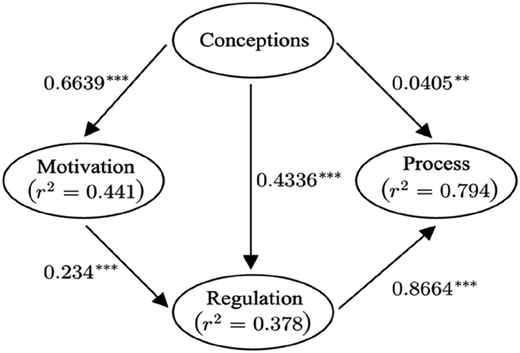
Figure 3 displays the PLS-PM structural model, highlighting the standardized path coefficients (β) and the explained variance (R2) for each endogenous construct. The model demonstrates sequential relationships among conceptions of learning, motivation, self-regulation, and information processing within the total sample.
The overall model indicated that learning conceptions significantly influenced motivation (β = 0.664, p < 0.001). Additionally, motivation was found to moderately predict self-regulation (β = 0.234, p < 0.001), while self-regulation had a substantial impact on information processing (β = 0.866, p < 0.001). This pattern illustrates that students' beliefs are the main predictors of motivation, with self-regulation acting as the central mechanism that explains the depth of learning in later stages.
The results of the general model are illustrated in Table 3 below.
To examine differences based on academic progress, multigroup analyses were conducted, dividing the sample into three cohorts: early semester students (1st–3rd, n = 948), intermediate semester students (4th–6th, n = 344), and advanced semester students (7th and above, n = 338).
Detailed results of the models by cohort are presented in Tables 4–6.
As observed, during the initial semesters, conceptions had a strong impact on motivation (β = 0.675) and a moderate indirect effect on processing via self-regulation (β = 0.542), while the connection between motivation and self-regulation was weak (β = 0.190). In the middle semesters, conceptions continued to affect motivation (β = 0.632), and motivation enhanced its influence on self-regulation (β = 0.279); the direct effect of conceptions on processing was substantially weaker (β = 0.061). Nevertheless, the overall effect remained significant (β = 0.550) due to the mediation of self-regulation. Lastly, in the later semesters, motivation had its strongest effect on self-regulation (β = 0.304), which emerged as the primary predictor of information processing (β = 0.909).
Overall, the findings reflect the theoretical progression proposed by the learning patterns model (Vermunt and Donche, 2017). In the early semesters, conceptions are the main driver of motivation and processing; in intermediate stages, self-regulation emerges as a key mediator; and in advanced semesters, self-regulation becomes the fundamental determinant of deep processing, while the direct influence of conceptions is attenuated.
These differences across academic stages are consistent with the multigroup analysis results, which revealed significant variations in the strength and significance of the relationships among conceptions of learning, motivation, self-regulation, and information processing.
Discussion
The findings of this study provide empirical support for the proposed theoretical model and confirm the dynamic nature of learning patterns throughout academic progression. Overall, the results are consistent with the hypotheses and reinforce the idea that learning should be understood as an evolving system of interrelated cognitive, motivational, and regulatory processes.
Regarding H1, the strong effect of learning conceptions on motivation confirms that students' beliefs function as cognitive filters that shape their engagement in academic tasks. This finding is consistent with previous research highlighting the role of epistemological beliefs in orienting motivation (Pintrich, 2000; Jiang et al., 2021), as well as with recent studies showing how learning conceptions directly influence the activation of motivational processes in contemporary university contexts (Do and Lai, 2024).
Regarding H2, the positive relationship between motivation and self-regulation supports the idea that motivational processes activate and sustain regulatory strategies. This result aligns with classic socio-cognitive perspectives (Zimmerman, 2002) and with recent evidence highlighting the role of motivation as a necessary condition for the deployment of self-regulatory strategies in complex learning environments (Boshoff-Knoetze and Du Toit, 2023).
This relationship reflects a transition from intention to action. Motivation provides the initial activation required for engagement, but it is through self-regulation that this activation is transformed into structured learning behavior. The strengthening of this relationship across academic stages suggests that students progressively develop the capacity to convert motivational states into organized regulatory strategies.
Regarding H3, the strong influence of self-regulation on information processing highlights its central role in promoting deep learning strategies. This finding is consistent with research that positions metacognitive regulation as a key determinant of meaningful learning (Schraw et al., 2006), as well as with current studies that demonstrate its impact on learning in digital and autonomous contexts (Junaštíková, 2024).
This finding can be interpreted as evidence that self-regulation operates as the central mechanism that organizes cognitive processing. While early learning may depend on external guidance, advanced students rely on metacognitive control to structure their understanding. This explains why self-regulation becomes the dominant predictor of deep processing in later stages.
In line with H4, the mediating role of self-regulation suggests that the effect of motivation on learning outcomes operates primarily through regulatory mechanisms rather than direct ones. This finding supports integrative models of self-regulated learning (Panadero and Alonso-Tapia, 2014) and aligns with recent research highlighting the mediation of regulatory variables in the relationship between motivation and academic performance (Do and Lai, 2024).
The mediating effect indicates that motivation alone is insufficient to produce deep learning outcomes. Instead, its impact is realized through regulatory mechanisms that structure cognitive engagement. This highlights the importance of self-regulation as the process through which motivational energy is transformed into effective learning strategies.
The lack of a significant direct relationship between conceptions of learning and information processing in advanced stages can be explained by the predominant role that self-regulation mechanisms acquire as students progress academically. At these levels, beliefs cease to influence cognitive strategies directly, and their effect is channeled primarily through metacognitive processes that regulate learning activity.
This finding suggests that, as students develop greater autonomy, self-regulation becomes the primary explanatory mechanism for deep learning, displacing the direct influence of conceptions. This dynamic has been reported in previous research demonstrating how, in more advanced students, metacognitive regulation mediates the relationship between motivational and cognitive variables (Vermunt and Donche, 2017; Panadero and Alonso-Tapia, 2014), reducing the direct impact of beliefs on information processing.
Finally, H5 is supported by the differences observed between the stages of academic progression, indicating that the relationships between the components of learning are not static but rather evolve as students advance along their academic paths. This finding expands upon the arguments of Vermunt and Donche (2017) by providing empirical evidence on the progressive reorganization of learning patterns and aligns with recent research highlighting the dynamic nature of learning in contemporary higher education (Maré, 2025).
From a theoretical perspective, this study expands the framework of learning patterns by demonstrating that the relative influence of conceptions of learning, motivation, and self-regulation is not static but rather systematically reorganizes itself throughout academic progression. Unlike traditional approaches that treat these components as stable and independent dimensions, the findings of this study support a dynamic and evolutionary interpretation of learning, in which regulatory processes progressively become the dominant mechanism underpinning deep information processing.
This shift represents a conceptual advance by positioning self-regulation not simply as another component but as the central organizing process that integrates motivational and cognitive dimensions throughout students' academic journeys. In this sense, learning is better understood as an evolving system rather than a set of fixed characteristics.
Additionally, the use of a structural formative model contributes methodologically to the field by allowing learning to be captured as an emergent configuration of interrelated processes. This approach transcends traditional factorial models and enables a more accurate representation of the complexity of learning in higher education contexts, especially in large and diverse student populations.
From a practical perspective, the findings suggest that educational interventions should be aligned with the academic progression of students, rather than assumed uniform learning processes throughout university education.
These pedagogical strategies reinforce the importance of aligning teaching practices with the developmental characteristics of each academic stage.
In the initial stages, where conceptions of learning strongly influence motivation, pedagogical strategies should focus on promoting constructivist approaches to learning and intrinsic motivation. In this sense, approaches such as problem-based learning, guided reflection, and collaborative tasks can contribute to establishing the cognitive and motivational foundations necessary for the development of self-regulation.
In the intermediate stages, where motivation begins to support the development of self-regulatory processes, educational practices should emphasize the progressive transfer of control to the student. Strategies such as structured self-assessment, formative feedback, and scaffolded learning activities are especially effective in strengthening regulatory skills.
In advanced stages, where self-regulation becomes the primary driver of deep information processing, pedagogical efforts should prioritize metacognitive development and autonomous learning. Practices such as reflective learning, independent project work, and adaptive learning environments are critical to promoting deep and sustained engagement.
At the institutional level, these findings support the implementation of differentiated curricular and support strategies that respond to the evolving nature of learning processes. This perspective allows universities to design more effective interventions aimed at improving academic performance, student retention, and the development of lifelong learning skills. Additionally, the proposed model can be used as a diagnostic framework to identify the predominant learning factors at different stages of academic progression. Furthermore, future research should analyze the validity of this model in diverse institutional contexts and employ longitudinal designs to more accurately understand the evolution of learning patterns over time.
Taken together, these findings indicate that learning in higher education is not governed by fixed structures but rather by processes of progressive reorganization. In this context, students transition from belief-guided learning to increasingly autonomous forms of self-regulation.
Limitations of the study
This study has some limitations that should be acknowledged. First, the cross-sectional design limits the possibility of establishing causal relationships between the variables, since the observed associations reflect patterns at a single point. Future research should adopt longitudinal designs that better capture the evolution of learning processes throughout academic progression.
Second, the use of non-probability convenience sampling may limit the generalizability of the findings. Although the sample was large and diverse, it is recommended that future studies replicate the model in different institutional and cultural contexts.
Finally, the use of self-report measures may introduce potential response biases. Future research could incorporate mixed methods or behavioral data to complement self-reported information.
These limitations may have influenced the observed strength of the relationships, particularly the mediating role of self-regulation, which should be interpreted with caution in non-longitudinal designs.
Conclusion
The findings of this study indicate that learning patterns in higher education are dynamic rather than static, evolving systematically throughout students' academic trajectories. In the initial semesters, conceptions of learning are critical to developing motivation and guiding students' engagement in academic tasks. As students advance, the direct influence of these conceptions gradually diminishes, while self-regulation becomes increasingly relevant in response to rising academic demands. In later stages, metacognitive regulation emerges as the primary factor influencing deep information processing, facilitating more autonomous and strategic learning approaches.
These practical implications are directly derived from the observed differences across academic stages, where the role of each learning component varies systematically.
From a practical perspective, these findings underscore the necessity of implementing differentiated pedagogical strategies that align with students' levels of academic development. In the early phases, educational practices ought to prioritize the advancement of constructivist methodologies and intrinsic motivation via active techniques, such as problem-based learning, collaborative endeavors, and facilitated reflection. As students progress, educational efforts should shift to enhancing metacognitive regulation and fostering autonomous learning through strategies such as self-assessment, formative feedback, and reflective learning activities.
The study highlights potential directions for future research focused on assessing the generalizability of these findings across various institutional and socio-educational contexts. Employing longitudinal designs may yield a more comprehensive understanding of how learning patterns develop, particularly within the evolving landscape of digital and flexible higher education environments.