Information technology (IT) suppliers play a crucial role in shaping digitally-enabled services in small and medium-sized enterprises (SMEs) in the manufacturing sector, addressing limitations such as limited resources, a lack of digital expertise and financial constraints. This study investigates how manufacturing SMEs involve IT suppliers in digitally-enabled service offerings.
This paper investigates six manufacturing SMEs involving suppliers in digitally-enabled services. Data were collected via 20 in-depth interviews.
This study identifies SMEs’ sensing capabilities influencing their digitally-enabled services, including responding to industry and market demands, assessing customer readiness, developing responses to crises, and understanding IT suppliers’ offerings and capabilities. Three clusters of SMEs are introduced: operational efficiency seekers, service growth seekers and service-centric SMEs, based on their seizing capability through analyzing how different SMEs position services within the business strategy, allocate and manage service resources and build and leverage digital capabilities and readiness. These differ in how they involve IT suppliers: operational involvement, innovation collaboration and strategic partnership.
This research illuminates how digitally-enabled services and IT supplier involvement differ in SME environments. Analysis of SMEs’ digitally-enabled services and capabilities prompts a novel three-cluster framework. The findings unveil how manufacturing SMEs involve IT suppliers in digital servitization as it relates to the SMEs’ dynamic capabilities.
Quick value overview
Interesting because - IT suppliers play a crucial role in shaping digitally-enabled services in manufacturing SMEs, addressing limitations such as limited resources, a lack of digital expertise, and financial constraints. Previous studies have focused on large manufacturers and their conventional supply chains and have primarily emphasized the similarities among SMEs in terms of challenges and opportunities in offering digitally-enabled services, neglecting the inherent variations among SMEs. While research highlights the importance of SME–IT supplier collaboration to digitally-enabled services, little is known about how SMEs involve IT suppliers in digitally-enabled services. This study provides a three-cluster framework reflecting manufacturing SMEs’ internal resources and capabilities and unveils how these SMEs utilize their IT suppliers’ expertise despite their inherent limitations, such as scarcity of resources and digital expertise.
Theoretical value - The study found how manufacturing SMEs involve IT suppliers in digital servitization as it relates to the SMEs’ dynamic capabilities. Accordingly, the study identifies distinct ways SMEs involve IT suppliers in digitally-enabled services, each with different outcomes.
Practical value - SME managers should understand how the business environment drives digital servitization to position their companies effectively. Identifying the firm as an efficiency seeker, service growth seeker, or service-centric helps align resources and capabilities with strategic goals. Selecting the appropriate level of IT supplier involvement—whether focusing on process optimization or forming strategic partnerships—supports innovation, growth, and long-term success in digital transformation.
1. Introduction
Manufacturers’ shift from product-centric business models to those emphasizing value-added services is reshaping the traditional boundaries of manufacturers. The ongoing digital servitization trend enables manufacturers to offer more value-added services through technologies such as the Internet of Things (IoT), intelligent automation, and digital platforms (Agarwal et al., 2022), and we refer to these as digitally-enabled services (Schroeder et al., 2020). Digital servitization requires manufacturers to develop new capabilities (Coreynen et al., 2017) and reconfigure resources, organizational structures, work practices, and cultures, which necessitates collaboration with external actors and changes to the manufacturers’ ecosystem (Sklyar et al., 2019). Such collaboration in digital servitization offers benefits, such as enhanced value creation (Lin et al., 2024), but also presents challenges related to data management, customer needs (Lin et al., 2024), and organizational shifts (Peillon and Dubruc, 2019). The impact of collaboration on the digital servitization process is evident in the development of operational capabilities (Momeni et al., 2023) and service innovation (Sjödin et al., 2020). However, manufacturers do not adopt a single collaboration approach with external actors to implement digitally-enabled services (Dalenogare et al., 2023).
Previous digital servitization studies focused on large firms (Trabert et al., 2024); however, offering services is even more crucial for SMEs that rely on the continuity of customer relationships to maintain competitiveness (Gebauer et al., 2010). Resource limitations often force SMEs to compromise service quality and cost efficiency (Kowalkowski et al., 2013), particularly when they act within large supply chains, leading to uncertainties regarding aftermarket services (Åkesson et al., 2022). This study focuses on manufacturing SMEs’ service offerings enabled by digital technologies.
Digital technologies play a pivotal role in service delivery, facilitating scalability and expansion and mitigating supply-chain-related challenges, such as through establishing online marketplaces or remote support services (Romagnoli et al., 2023; Zheng et al., 2020). SMEs’ resource limitations make offering digitally-enabled services challenging, as do bargaining power disparities and altered business models (Müller, 2019). Consequently, manufacturing SMEs can be reluctant to adopt new capabilities (Mennens et al., 2018; Michalik et al., 2019).
The digital transformation of manufacturing SMEs changes the traditional supply chain by introducing new ties and highlighting co-creation and co-evolution (Schmidt et al., 2023). This transformation relies on the contribution of information technology (IT) suppliers, which provide infrastructure and impact IoT technology strategy (Ferreira and Lind, 2023). The role of IT suppliers in digital transformation has typically been explored in terms of improving or creating data-enabled business processes, platforms, and skills in SMEs, such as marketing, purchasing, or inventory management (Battistoni et al., 2023). However, their role in developing SMEs’ service businesses is distinct, considering that their expertise and efforts are featured in their service offerings to customers (Momeni et al., 2023).
This study applies the concept of supplier involvement, which has attracted attention in manufacturing product and service development fields (Ayala et al., 2021). For manufacturing SMEs, involving suppliers refers to collaborating with suppliers in the product development, production, and service provision processes (Flankegård et al., 2021). Here, we interpret supplier involvement in terms of the extent of supplier involvement and supplier responsibility in the project (Kędzia, 2024). Involving IT suppliers, such as software developers and cloud platform providers, enhances SMEs’ operational efficiency and encourages innovation and adaptability (Cenamor et al., 2019). It also offers SMEs access to digital technologies and expertise, which they might otherwise lack (Brodeur et al., 2022). That access narrows the disadvantageous digital gap to large manufacturers (Paiola et al., 2022a). Such collaboration also helps SMEs customize digital technologies to fit their needs, ensuring that these technologies are not just accessible but also relevant and effective in driving growth and competitiveness (Paiola et al., 2022b).
The current research addresses three main gaps in digital servitization literature. First, despite the highlighted contributions, the literature on digital servitization has focused on large manufacturers (Paiola et al., 2022a) and it has paid less attention to the involvement of IT suppliers, particularly in the SME context (Rapaccini et al., 2023). Second, while research highlights the importance of SME–IT supplier collaboration to digitally-enabled services (Cenamor et al., 2019; Rapaccini et al., 2023), little is known about how SMEs involve IT suppliers in digitally-enabled services. Third, previous studies have primarily emphasized the similarities among SMEs in terms of offering services and the need for involving IT suppliers, neglecting the inherent variations among SMEs (Johnson, 2002; Sparrow, 2005; Zheng et al., 2020).
Accordingly, this paper aims to provide a comprehensive understanding of how SMEs involve IT suppliers in offering different types of digitally-enabled services and addresses the following research question: How do manufacturing SMEs involve IT suppliers in offering digitally-enabled services?
The study applies a dynamic capabilities lens, which helped unveil supplier involvement (Vanpoucke et al., 2014; Wagner and Zanger, 2023). The framework emphasizes a firm’s ability to integrate, build, and reconfigure internal and external resources to address rapidly changing environments (Teece, 2007). Here, IT suppliers are seen as an external resource SMEs leverage to navigate digital transformation. The interplay between the dynamic capabilities and supplier involvement perspectives helps differentiate how SMEs involve IT suppliers.
2. Literature review
2.1 Adding digitally-enabled services to manufacturing SME offerings
The often-cited characteristics of SMEs include creativity, a local foothold, and diverse managerial skills, ranging from low-technology locally oriented businesses to high-technology manufacturing entities (Rodríguez-Gutiérrez et al., 2015). Globalization and increasing competition have forced SMEs to seek new ways to gain competitive advantage and participate in global firms’ supply chains (Turekulova et al., 2022). Service innovation can significantly affect SMEs’ performance, indicating the importance of service business (de Oliveira Sousa et al., 2020). Adding services to SMEs’ offerings can have financial and non-financial benefits, such as enhancing customer relationships and loyalty (Kowalkowski et al., 2013), signaling firms are reliable and innovative partners (Grandinetti et al., 2020) and improving revenue stability via ongoing service contracts or subscription-based models (Gebauer et al., 2010). Typically, SMEs have a shorter-term horizon and a more reactive business approach than large manufacturing firms, making adding digitally-enabled services challenging (Rakic et al., 2020).
Incorporating digitally-enabled services in manufacturing involves using digital technologies to enhance traditional service offerings to provide value beyond that available from the physical product (Schroeder et al., 2020). Digitally-enabled services encompass obligatory ICT (information and communication technology)-based services, ICT-based solutions, pure digital services, and digitalized product-service systems, reflecting the contribution of digital components and the complexity of each offering (Lerch and Gotsch, 2015). Obligatory ICT-based services are essential support functions like remote support. ICT-based solutions integrate digital systems, such as remote monitoring and teleservice, to optimize processes (Ardolino et al., 2018). Pure digital services extend the manufacturer’s service offerings and enhance the performance of products and services (Lerch and Gotsch, 2015), such as SaaS (software-as-a-service) platforms or cloud-based analytics. Digitalized product-service systems combine physical products with digital services, creating intelligent, autonomous systems (Frandsen et al., 2022).
Digitally-enabled services help SMEs enhance service delivery, streamline operations, and elevate the customer experience (Coreynen et al., 2017). Previous studies underscore the significance of SMEs developing and evaluating digitally-enabled services (Lamperti et al., 2023). Additionally, studies highlight the importance of SMEs’ strategic management and exploration orientation in achieving sustainable competitive advantage via digitally-enabled services (Cenamor et al., 2019). Manufacturing SMEs often manage digital servitization through small, consistent organizational changes (Brodeur et al., 2023). The literature emphasizes the need for a structured approach, including roadmaps, maturity assessments, and ecosystem involvement (Kolagar et al., 2021).
While digital technology can transform service delivery, manufacturing SMEs are often reluctant to adopt digitalization (Cimini et al., 2020). Common barriers include limited resources, capabilities, and expertise in digital technologies; financial pressures; and resistance to change (Grandinetti et al., 2020; Paiola et al., 2022b; Peillon and Dubruc, 2019; Wang et al., 2007). Considering the limited resources and capabilities of manufacturing SMEs, external service suppliers play a key role in shaping their service business (Brodeur et al., 2022) and digitalization (Ghobakhloo and Iranmanesh, 2021). Consequently, adding digitally-enabled services often requires SMEs to rethink their value chain position (Gebauer et al., 2010) and demands support across distribution channels and customer bases (Peillon and Dubruc, 2019).
2.2 Involving IT suppliers in manufacturing SMEs’ service offerings
Digital transformation in SMEs is characterized by the strategic integration of digital technologies into all business areas, which changes how SMEs operate and deliver customer value (de Mattos et al., 2023). The transformative journey often leads SMEs to collaborate with IT suppliers to integrate solutions into business processes (Brodeur et al., 2022). An IT supplier might provide the necessary digital tools and platforms, offer expertise in digital strategy formulation, and assist in implementing digital initiatives (Cenamor et al., 2019; de Mattos et al., 2023). The literature highlights the key characteristics of involving IT suppliers in manufacturers’ digital transformation (see Table 1). The literature emphasizes strategic alignment and dynamic capabilities, revealing that significant involvement and regular communication enhance the attractiveness and long-term success of IT supplier relationships (Beulen and Ribbers, 2002; Brito and Nogueira, 2009; Karimi-Alaghehband and Rivard, 2020; Poleto et al., 2022). Manufacturers need strong digital capabilities, such as advanced IT infrastructure and skilled personnel, strategic IT planning, and market awareness (Brodeur et al., 2023; Karimi-Alaghehband and Rivard, 2020; Ma et al., 2023; Obwegeser et al., 2020) and IT suppliers need advanced technological skills, industry-specific knowledge, and adaptability to provide customized solutions (Brito and Nogueira, 2009; Brodeur et al., 2023).
Table 2 lists the empirical studies of digital servitization in SMEs. Digital servitization drives business model innovation toward more service-oriented and data-driven approaches, often involving collaboration with IT suppliers for efficient and tailored services (Reim et al., 2022). Collaboration with IT suppliers and other partners is necessary for providing technological capabilities and facilitating joint innovation, with ecosystems supporting complex digital transformations and value co-creation (Chuang and Lee, 2023; Gao et al., 2023; Kolagar et al., 2021; Lamperti et al., 2023). IT suppliers help SMEs anticipate potential issues, avoid common pitfalls, and achieve the integration of digital tools into their existing systems (Rapaccini et al., 2023). Furthermore, suppliers are often at the forefront of technological innovation, offering manufacturers access to the latest developments in digital technology (Dalenogare et al., 2023; Momeni et al., 2023).
Previous studies of large manufacturers discussed mechanisms combining utilizing internal resources and existing customer relationships with acquiring external IT suppliers and knowledge providers to offer digitally-enabled services (Ciasullo et al., 2021; Coreynen et al., 2017; Momeni et al., 2023). However, the applicability of the mainstream digital servitization literature to small manufacturers with limited resources remains questionable. While digitally-enabled services are important for manufacturers of all sizes, the nature of those services and the involvement of IT suppliers differ substantially. Despite a growing understanding of the importance of network capability and ecosystem involvement in the context of digital servitization in SMEs, there remains a need for more detailed research in this area (Cenamor et al., 2019; Kolagar et al., 2021; Rapaccini et al., 2023). Another critical issue requiring deeper exploration is how SMEs involve their suppliers. It is essential to recognize that SMEs are not a homogeneous group (Johnson, 2002; Sparrow, 2005); they vary in terms of size, sector, market focus, and resource availability. That diversity affects the nature and extent of supplier involvement.
2.3 Dynamic capabilities as a lens on IT supplier involvement in digitally-enabled services
Dynamic capabilities refer to a firm’s ability to integrate, build, and reconfigure internal and external competencies to address rapidly changing environments (Teece, 2007). This perspective is particularly relevant to the context of digitally-enabled services in manufacturing SMEs, in which the ability to adapt and evolve is crucial for survival and success (Coreynen et al., 2017; Kohtamäki et al., 2021). Applying the dynamic capabilities lens sheds light on how manufacturing SMEs involve suppliers in digitally-enabled services. Research can then move beyond a simplistic view of digital adoption toward a more comprehensive understanding of how SMEs involve IT suppliers. Developing dynamic capabilities can manifest in several ways among SMEs:
Sensing: Manufacturers must assess opportunities presented by digital technologies (Karimi-Alaghehband and Rivard, 2020). They must, therefore, understand the technology and its operational implications (Kolagar et al., 2021).
Seizing: Manufacturers must be able to seize the opportunities identified. That could involve commissioning new digital tools or platforms or digitally-enabled services (Cenamor et al., 2019).
Reconfiguring: Finally, manufacturers must be able to reconfigure their operations and processes (Coreynen et al., 2020). That may involve reconfiguring supply chains, changing production processes, or rethinking business models (Hasselblatt et al., 2018). Key stakeholders, like suppliers, must be actively involved in these processes (Dalenogare et al., 2023; Rapaccini et al., 2023).
Building on the concept of reconfiguring capabilities, we explore involving IT suppliers in SMEs’ digitally-enabled services through the lens of supplier involvement (Ayala et al., 2021). Supplier involvement in manufacturing is intended to enhance innovation, improve product quality, and optimize supply chain efficiency (Wynstra and Ten Pierick, 2000). The bulk of research in this area focuses on the role of suppliers in new product development and innovation in large manufacturers, highlighting the benefits of supplier contributions to product innovation, reduced time-to-market, and enhanced product quality (Danese and Filippini, 2010; Luzzini et al., 2015).
The limited studies on service supplier involvement have acknowledged that the service business of manufacturers has expanded beyond the conventional view of a dyadic interaction between manufacturers and customers by acknowledging the key role intermediaries play in this process (Ayala et al., 2021). Manufacturers increasingly use the expertise and capabilities of external service suppliers, elevating the importance of service suppliers as a critical enabler of this transformation (Saccani et al., 2014).
Previous research often discusses three types of supplier involvement:
Operational involvement: third parties’ contribution to day-to-day operations, such as product or service delivery (Huttu and Martinsuo, 2015; Momeni and Martinsuo, 2019; Vaittinen et al., 2019).
Innovation collaboration: joint efforts in developing certain new products or services, often leveraging the supplier’s unique expertise or resources (Yeniyurt et al., 2014).
Strategic partnership: Long-term agreements in which product suppliers work closely with manufacturers in research and development and new product design (Luzzini et al., 2015).
This research adopts the dynamic capabilities and supplier involvement concepts to investigate how manufacturing SMEs involve IT suppliers in digitally-enabled services.
3. Research methodology
3.1 Research design and cases
The research adopts a qualitative multiple-case study approach. Case studies suit investigating phenomena in real-life contexts, aligning with our study’s how research question (Yin, 2009). Specifically, this approach seeks insights into how manufacturing SMEs involve their suppliers in digitally-enabled services. The research questions outlined guided the research design and data collection. Multiple-case studies allow researchers to compare, replicate, and, when necessary, challenge findings related to a phenomenon across contexts. Additionally, they provide an opportunity to explore how different contexts impact the studied phenomenon (Yin, 2009).
This study focuses on the service businesses of manufacturing SMEs. This research analyzes multiple cases to provide valuable insights and practical knowledge to inform theory on SME service business development and advance practice (Siggelkow, 2007). We targeted business-to-business (B2B) manufacturing SMEs in a region of Finland accessible to our research team. Our search began by compiling a list of active technology-based SMEs in the region, ensuring they met the SME criteria related to sales revenue and personnel count. We utilized a technology association company listing for this purpose. Subsequently, we explored the websites of these firms to understand their businesses and identify any relevant industrial services they offered. Our key criteria for case selection included (1) well-established manufacturing SMEs that are (2) involved in developing and delivering services alongside their products and (3) that cover a variety of industry sectors. This process yielded a preliminary list of approximately 30 potential firms. We contacted these companies via email and telephone to gauge their interest in participating in our study. Ultimately, initial discussions with six SMEs led to their participation, providing a sufficient number of interviews per firm, aligned with the recommended range of four to ten cases for case-study research (Eisenhardt, 1989). Table 3 introduces background information on the companies and details the data collection. Pseudonyms are used to maintain the anonymity of the companies.
Each company in our study manufactures a product independently or in collaboration with a partner. Their products are primarily sold in the B2B market internationally. All the selected companies offer services to their industrial customers, including installation and training, maintenance and repair, modernization and upgrades, and digitally-enabled services. Each of the selected SMEs has a distinct core business. Although two companies, ElectricCool and MarineMotive, operate in the marine sector, they offer different solutions. Similarly, while PaperTech and PrecisionFlow both serve customers in the process industry, their products and customer bases differ.
3.2 Data collection
Semi-structured interviews served as the primary data collection method. We developed a semi-structured interview outline to allow interviewees’ personal stories and experiences to emerge while systematically covering key themes across all interviews. The interview outline included questions related to the company’s background, service offerings, service delivery, utilization of digitalization in services, and involvement of various actors (such as suppliers) in service development and delivery ( Appendix). Additionally, we explored changes in the service process, strategy, supply chain, and plans concerning service business development.
The key contact person, typically the chief executive officer or managing director, provided broad background information on the SME, its services, and its overall strategy. To complement this director-level knowledge, the contact person shared the contact information for additional informants directly involved in the firm’s service development, delivery, digitalization efforts, and supplier cooperation. The pool of such individuals in manufacturing SMEs was limited, so we selected two to four persons per firm to cover most of those directly engaged with services.
We conducted a total of 20 interviews, with each interview lasting between 25 and 84 minutes. All interviews were recorded and transcribed for subsequent analysis. Additionally, we supplemented the interview data with secondary sources, such as company websites and marketing materials. These sources were valuable in providing background information about the SMEs and confirming the data on digitally-enabled services obtained in the interviews.
3.3 Data analysis
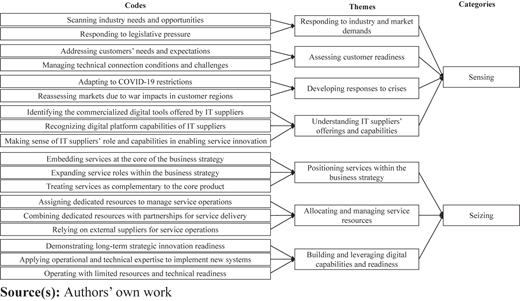
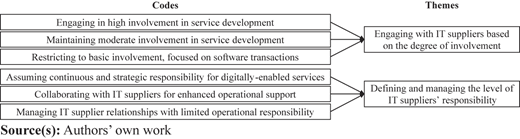
We employed a thematic analysis method, which suits identifying patterns in data and remains flexible enough to establish diverse theoretical connections (Braun and Clarke, 2022). Given the absence of pre-existing frameworks regarding how SMEs involve IT suppliers, we adopted an abductive approach by comparing empirical observations with the existing literature to uncover thematic patterns (Dubois and Gadde, 2014). The data analysis focused on SMEs and how they interpret involving IT suppliers in their digitally-enabled services. Figures 1 and 2 illustrate the analysis categorizations, and the supplementary material provides representative interview excerpts.
Initially, one researcher reviewed all interview notes, focusing on sections relevant to our study. This process allowed for a preliminary understanding of the nature of each SME’s business. We noted how SMEs involve IT suppliers as key stakeholders influencing their digitally-enabled services for industrial customers. We conducted rough initial coding to identify digitally-enabled services and the various ways SMEs involve IT suppliers, and the factors differentiating those ways were examined.
In the second step, another researcher followed the initial exploration and reviewed alternative themes, ensuring the validation and peer verification of the data analysis process. This iterative process involved cross-referencing observations from the interviews with the relevant literature. Ultimately, we refined and structured the identified themes into two distinct domains: sensing and seizing. In explaining the development of service business and digitally-enabled services, the interviewees emphasized “sensing” the business environment influencing digitally-enabled services within SMEs (Figure 1). The themes encompassed responding to industry and market demands, assessing customer readiness, developing responses to crises, and understanding IT suppliers’ offerings and capabilities. Next, we delved into how each SME considers its specific internal conditions and “seizes” the opportunities by developing digitally-enabled services. The themes include positioning services within the business strategy, allocating and managing service resources, and building and leveraging digital capabilities and readiness (Figure 1).
Third, having compared our empirical observations with the literature on digitally-enabled services (Lerch and Gotsch, 2015), we categorized the digitally-enabled services offered by SMEs into obligatory ICT-based services, ICT-based solutions, pure digital services, and digitalized product-service systems (Table 4). Our coding process considered criteria such as the contribution of digital components and the complexity of each offering. Notably, none of the SMEs in our study provided digitalized product-service systems, as these more advanced and integrated offerings, which combine physical products with autonomous digital services, were beyond the scope of their current capabilities. Our analysis revealed both similarities and differences in the development of the service aspects of the business for each case company. We thus clustered SMEs into three main categories: operational efficiency seekers, service growth seekers, and service-centric SMEs (Table 5).
The fourth step analyzed how different clusters of SMEs reconfigure their resources by involving IT suppliers in digitally-enabled services. To differentiate ways of involving IT suppliers, we defined the key themes according to the literature, including engaging with IT suppliers based on the degree of involvement and defining and managing the level of IT “suppliers” responsibility (Kędzia, 2024) (Figure 2). While the degree of IT supplier involvement refers to the extent and depth of participation and engagement of the IT supplier, the level of responsibility refers to the supplier’s role in contributing to ongoing improvement, optimization, and management of the digitally-enabled services. Each of these key themes was perceived in three different ways among the interviewees. Consequently, when the three combinations of these codes were examined at the firm level, the overall patterns matched the categorization framework introduced in the literature review, which defines three distinct ways of involving suppliers: operational involvement, innovation collaboration, and strategic partnership. For example, when the degree of supplier involvement was moderate and the level of responsibility was enhanced operational, the pattern suggested was innovation collaboration.
Finally, analyzing patterns in the data facilitated generalizing our findings through cross-cluster analysis to isolate the differences among SMEs and their ways of involving IT suppliers (see Table 6).
4. Findings
4.1 Sensing the business environment regarding digitally-enabled services
An SME’s business environment may encourage or hinder digital servitization. The direction is often shaped by its response to industry and market demands, particularly in traditional sectors such as machine manufacturing. Product-centric strategies dominate such industries, reducing the attraction of offering digitally-enabled services. Nevertheless, some SMEs operating in advanced industries, such as aviation and maritime, have developed advanced digital services in response to industry-specific opportunities or needs. For example, GripMeter responded to changes in aviation industry regulations by developing a runway reporting system. Similarly, MarineMotive entered the condition-monitoring software market in response to the existing market appreciation for such services.
However, offering digitally-enabled services also hinges on assessing customer readiness (supporting Vaittinen and Martinsuo, 2019). Some interviewees explained that some customers resist adopting complex digital offerings despite having the necessary infrastructure in place. ElectricCool acknowledges challenges in certain customer segments, particularly regarding network connectivity and integration with larger technical systems.
Responses to crises can prompt companies to mitigate adverse impacts and seize emerging opportunities (Rapaccini et al., 2020). The COVID-19 pandemic, for example, forced businesses, including ElectricCool, GripMeter, and PrecisionFlow, to pivot toward remote services and digitalization. Similarly, PrecisionFlow faced market disruption caused by war, compelling a strategic departure from supplying to hostile regions. The firm had to explore alternative markets and solutions to mitigate financial losses and sustain business operations.
The interviewees also emphasized understanding IT suppliers’ offerings and capabilities (Karimi-Alaghehband and Rivard, 2020), which could reduce the burden on their internal resources. Both ElectricCool and PrecisionFlow demonstrated an awareness of what their IT suppliers could offer, recognizing their platforms and capabilities as key to developing tailored solutions to meet customer needs while integrating seamlessly with existing systems.
4.2 Developing digitally-enabled services and differences among SMEs’ resources and capabilities
This section explores three clusters of SMEs: operational efficiency seekers, service growth seekers, and service-centric SMEs (Table 5). Categorizations are based on strategic focus, resource allocation, and digital capabilities and readiness. Each cluster demonstrates varying levels of seizing capability regarding service integration within their business strategies, resource dedication to service development and delivery, and readiness to leverage digital technologies to support service offerings.
Operational efficiency seekers. The first cluster of case companies includes HeavyLift and PaperTech. Within this cluster, firms focus on obligatory ICT-based services, which enhance internal service processes rather than providing advanced digital offerings for customers. An illustrative example is PaperTech’s innovative 3D installation tool. The installation manager at PaperTech stated, “The tool provides engineers with all the necessary instructions in one place to make the installation easier; also, the tool helps with communicating the service task to the customer.” A common service among SMEs in this cluster is remote customer support, predominantly facilitated through standard video-conferencing tools.
For these SMEs, positioning services within the business strategy is secondary. This implies that services are not a primary focus of the business model. Product-oriented SMEs in this cluster focus on aftersales services and tend to involve conventional suppliers to leverage their competencies and enhance sales and aftersales. For example, HeavyLift, primarily a product-centric firm, channels its sales and aftersales through a global network of dealers.
Both SMEs acknowledged their limitations in building digital capabilities and readiness. HeavyLift interviewees, for example, had negative experiences with early experiments with digital technologies, which made them cautious and highlighted their lack of intrinsic motives, capabilities, and resources (Cimini et al., 2020). PaperTech interviewees also indicated that digitalization was not a core competency.
Service growth seekers. This cluster includes ElectricCool and PrecisionFlow, which have shifted toward positioning services centrally in the business strategy. Such firms adopt ICT solutions to improve existing service offerings. ElectricCool and PrecisionFlow offer digitally-enabled services, such as remote commissioning and pre-sales support configurators. Remote commissioning allows SMEs to install, configure, and test industrial equipment while assisting customers remotely. Configurator tools are attractive to certain customers. The technical production manager at PrecisionFlow explained, “Our configurator tool makes it possible for customers to discover solutions. Some engineering-minded people prefer to explore and experiment with the configurator themselves instead of listening to salesmen.” ElectricCool’s managing director added, “The configurator saves time in sales and consultancy situations, as the customers have already familiarized themselves with configurations that might suit their needs.”
In these SMEs, allocating and managing service resources are becoming more structured. Services are emerging as a key growth driver and attracting resources. For example, ElectricCool is gradually increasing its focus on aftersales services, recognizing the importance of long-term customer relationships while relying on suppliers and partners for some services. ElectricCool interviewees reported that service development, delivery, and customer support services were primarily in-house, but third-party companies contributed to some projects.
Regarding digital capabilities and readiness, these SMEs demonstrate some operational and technical expertise, with experts focusing on efficiency and automation. Skilled personnel who understand customer processes and new technology play a key role. ElectricCool, for example, had a small group of experts addressing efficiency and automation by leveraging digital technologies. PrecisionFlow had some advanced technicians presenting digital solution ideas.
Service-centric SMEs. This cluster comprises GripMeter and MarineMotive. These SMEs have developed pure digital services to support customer operations, leveraging advanced digital solutions such as SaaS models and condition-monitoring software. GripMeter, for example, has developed automated reporting software in response to changes in industry regulations, aiding customers in compliance and simplifying the reporting process. The CEO at GripMeter stated, “The automated reporting software was developed to help our customers when regulations on reporting traction levels changed. We made it easy for the customers to keep up with the new standards.” Similarly, MarineMotive’s SaaS solution for monitoring propulsion systems and alerting customers to maintenance needs illustrates the SMEs’ proactive approach to maintaining efficient customer service.
Positioning services within the business strategy is a central priority in these SMEs. Services are not merely an add-on but are at the forefront of the value proposition and growth strategy. For example, GripMeter’s emphasis on standardized maintenance processes and its service contracts reflect its commitment to providing consistent, high-quality aftersales service at airports, which is the most important thing for the customer. These SMEs also dedicate resources to support and enhance their service offerings. Such resources include specialist personnel tasked with service development, delivery, and customer support.
The interviewees in this cluster highlighted future preparedness and operational and technical expertise when explaining their capabilities and readiness. The findings parallel those of Cenamor et al. (2019) on the importance of SMEs’ strategic management and exploration orientation in developing digital servitization. The MarineMotive interviewees explained that the foundations for its digitally-enabled services were laid a decade previously to add value for the customer and manufacturer. These SMEs ran goal-oriented development projects (Obwegeser et al., 2020) and were willing to customize services for strategic customers.
4.3 Involving IT suppliers in the SMEs’ digitally-enabled services
The involvement of IT suppliers in SMEs’ digitally-enabled services ranges from basic operational support to complex, co-owned digital platforms. This reflects how SMEs engage with IT suppliers based on the degree of involvement and define and manage the level of IT supplier responsibility. Our analysis categorizes the involvement of IT suppliers into three types based on the two dimensions: operational involvement, innovation collaboration, and strategic partnership (see Table 6 below).
Operational involvement was observed in efficiency seekers. The SMEs often opt for known software brands for the solutions were commercially available or required only minor customization. The degree of the supplier’s involvement is basic, focusing only on software transactions, where the supplier sells a software package or license to the SME. The IT suppliers’ responsibility is limited to managing software sales, operational customer support, and updates (Momeni and Martinsuo, 2019).
Innovation collaboration was more evident in the service growth seekers, ElectricCool and PrecisionFlow, that tailored digitally-enabled services to address specific needs. For example, PrecisionFlow collaborated with IT suppliers to transform simple configuration tools into more advanced, self-service online versions for customer use. The IT supplier’s involvement was moderate. The supplier provided the platform and development resources, while the SME defined the scope, requirements, and content and handled problem-solving during testing. These findings on the service growth seekers confirm the importance of the SMEs’ digital capabilities and skilled personnel in effectively collaborating with IT suppliers (Ma et al., 2023). Supplier responsibility is enhanced operationally as the supplier commits to supporting the development of the solution and managing changes in cooperation, and also sales, operative support, and updates.
Strategic partnership was observed in service-centric SMEs, such as GripMeter and MarineMotive, where digitally-enabled services were central to SME operations. The IT suppliers were deeply embedded in the development process, working closely with the SME on co-developing and tailoring solutions for strategic customers (Brodeur et al., 2023). The level of involvement extended beyond operational support; the supplier assumed strategic responsibility for digitally-enabled services over the solution lifecycle to meet customer needs and maintain the partnership. Revenue-sharing models, such as subscription-based or use-based earning logics, were common in this category, with clearly defined contracts specifying the distribution of earnings between the IT supplier and the SME.
5. Discussion and conclusions
5.1 Theoretical contributions
This study investigated how manufacturing SMEs involve IT suppliers in offering digitally-enabled services. It explored small manufacturers with limited resources, which require external support for digital servitization (Ghobakhloo and Iranmanesh, 2021), thus extending knowledge of digitally-enabled services beyond the context of well-resourced manufacturers (Paiola et al., 2022b). The selected manufacturing SMEs possess distinct patterns of dynamic capability—sensing, seizing, reconfiguring—concerning their digitally-enabled services. They adapt and evolve to implement digital servitization (Cenamor et al., 2019; Coreynen et al., 2020) in line with specific conditions and capability patterns in their business. The research makes three key contributions.
First, it illuminates how digitally-enabled services and means of involving IT suppliers differ in SME environments. Our findings show that SMEs may adopt incremental, flexible approaches to digital transformation, focusing on immediate and practical digital solutions that support their routine operations (Brodeur et al., 2023). This approach allows them to align digital growth with capabilities, avoiding the pitfalls of overinvestment or underutilization. Given SMEs’ resource constraints, involving IT suppliers must be strategic and focus on areas where supplier contributions are most impactful (Ferreira and Silva, 2022). Examples include innovation, where suppliers’ specialized knowledge and skills can be leveraged, or operational efficiency, where suppliers can help optimize processes and reduce costs. The findings reveal that IT suppliers often develop scalable solutions tailored to the specific needs of SMEs and support their adoption and expansion. The client SMEs rely on these services to counter challenges and constraints that are less relevant to larger firms (Kowalkowski et al., 2013).
Second, this article draws on dynamic capabilities to explicate involving suppliers beyond the dominant relationship-management perspective (Beulen and Ribbers, 2002; Brito and Nogueira, 2009; Poleto et al., 2022). This study extends previous research acknowledging the importance of dynamic capabilities in IT outsourcing (Karimi-Alaghehband and Rivard, 2020) by characterizing the sensing, seizing, and reconfiguring of the digital servitization of SMEs. It extends previous research by demonstrating that SME decision-making is not merely reactive (Wang et al., 2007) but driven by analysis of business environments and IT suppliers’ capabilities. Our findings illuminate the processes involving IT suppliers beyond identifying the importance of network capability and ecosystem involvement (Le-Dain et al., 2023; Reim et al., 2022). The findings identify key factors in the context of digital servitization in SMEs, including responding to industry and market demands, assessing customer readiness, developing responses to crises, understanding IT suppliers’ offerings and capabilities, positioning services within the business strategy, allocating and managing service resources, and building and leveraging digital capabilities.
Third, this study introduces a novel three-cluster framework reflecting manufacturing SMEs’ internal resources and capabilities. The clusters are efficiency seekers, service growth seekers, and service-centric SMEs. The approach reveals the factors shaping SMEs’ digital servitization strategies and extends prior literature, which often treats SMEs as a homogeneous group (Johnson, 2002; Sparrow, 2005). Accordingly, the study identifies distinct ways SMEs involve IT suppliers in digitally-enabled services, each with different outcomes. The three ways of involving IT suppliers—operational involvement, innovation collaboration, and strategic partnership—are manifestations of the reconfiguration process in SMEs. These findings complement previous studies identifying the need for IT supplier collaboration in SMEs (Cenamor et al., 2019; Kolagar et al., 2021; Rapaccini et al., 2023) by clarifying the degree and level of IT suppliers’ responsibilities. The types of involvement match the internal capabilities that enable SMEs to effectively utilize their IT suppliers’ expertise despite their inherent limitations, such as scarcity of resources and digital expertise.
5.2 Managerial implications
The study’s findings will provide SME managers with insights into the involvement of IT suppliers in digitally-enabled services. Managers should be aware of the role of the business environment in driving digital servitization, which will aid in positioning their companies in the market. Furthermore, this study highlights the importance of SME resources and capabilities in shaping digital servitization strategies. Managers who diagnose their own SME as an efficiency seeker, service growth seeker, or service-centric firm will better understand strategic focus and resource allocation. Lastly, the study provides insights into different ways of involving IT suppliers, allowing managers to choose the way best aligned with their company’s needs and goals. The choice might range from operational involvement for process optimization to a strategic partnership for long-term growth and innovation. These implications can guide SMEs in their journey toward successful digital servitization.
5.3 Limitations and suggestions for future research
This study has some limitations that suggest opportunities for future research. Firstly, the focus on SMEs within the manufacturing sector and the selection of companies from a specific region may limit the generalizability of the findings. Different businesses or regions might affect digital servitization and IT supplier involvement. Secondly, the data collection approach could have influenced the insights elicited, including the formulation of questions and the respondents contacted. Future research could explore the dynamics of manufacturer-supplier relationships in a dyadic setting by including IT suppliers’ perspectives. That could unveil the multiple forms and collaboration models for various actors and services. Moreover, investigating the customer viewpoint on manufacturing SMEs’ digitally-enabled services could elicit customer expectations, their perceived value, and the challenges of developing and delivering them in a triadic setting.
Furthermore, scholars could scrutinize the economic aspects of such collaborations. Understanding the business logic and financial outcomes for manufacturers and IT suppliers would be useful. Another intriguing aspect is the dynamics of these relationships, which might include trust, communication, and power dynamics. Given the rapidly evolving digital landscape, longitudinal studies could be beneficial. These could track the digital servitization journey of SMEs over time, providing insights into how strategies and supplier relationships evolve in response to technological advancements and market trends.
The authors would like to thank the anonymous reviewers who provided many insightful comments.
to help improve this paper. The authors would also like to thank Tampere University research group CROPS (Center for Research on Project and Service Business) for their collegial support and inspiring atmosphere during the data collection phase of this research. Part of this research was conducted through the “Development of adaptable integration mechanisms for data-enabled service operations in industrial networks” research project. The financial support of the Academy of Finland is gratefully acknowledged.
References
Appendix 1 Semi-structured interview guide (short version)
General questions about the interviewee and the company
Service business
What services do you offer your customers?
How is your service business positioned in light of your firm’s strategy? Is it included in the strategy?
Service delivery
How is service delivery organized in the company?
What third parties are involved in service delivery, and how?
What challenges have you encountered in service delivery? How have you overcome them?
Digitalization
How do you utilize digitalization in service delivery? For which services?
How have you developed digitally-enabled services?
What were the main drivers?
What digital features or digitally-enabled services do customers appreciate the most?
What challenges have your company faced in developing, organizing, and delivering this service?
How do you see the systems developing in the future?
Involving suppliers
In the delivery of digital services, do you involve system integrators or other IT or software companies? How?
How did the collaboration begin?
What were the main actions and challenges involved?