


This study aims to develop a systematic method called servitization maturity model to support companies in developing distinctive capabilities for successful servitization.
The concept of maturity models is adopted to support companies in developing distinctive capabilities for servitization. A systematic literature review and case study approach are employed to develop the maturity model.
The findings highlight 46 capabilities classified into seven categories: strategy and leadership, performance, offerings, customers, organization, network and digital technology. Furthermore, the evolutionary path is defined by combining two types of levels, i.e. capability and maturity levels, to develop these capabilities.
The evolutionary path was partially validated through the application, while further investigation is required to validate the evolutionary path. Therefore, future research should investigate the further validation of the evolutionary path by conducting multiple case studies.
The proposed maturity model enables companies to not only capture the bigger picture of the required capabilities without oversight, but also determine a process for improving the requisite capabilities with feasible efforts.
Existing maturity models focused on the transition from less to more advanced services. However, recent studies emphasized that companies need to determine strategies that reflect their capabilities rather than simply move toward more advanced services. Based on this assumption, this study provides successive stages that enable companies to improve their capabilities through feasible efforts.
1. Introduction
Manufacturing companies are increasingly extending their product offerings with services (Davies, 2004; Kowalkowski et al., 2009; Oliva and Kallenberg, 2003; Gebauer et al., 2005; Mathieu, 2001), a phenomenon often described as servitization (Vandermerwe and Rada, 1988; Baines et al., 2017). Quantitative studies have found that providing services enables manufacturing companies to obtain financial benefits (Wise and Baumgartner, 1999; Neely, 2009; Eggert et al., 2014). Despite high expectations, many researchers have provided evidence that investment in extending a service business does not necessarily generate the expected higher returns (Gebauer et al., 2005; Fang et al., 2008; Neely, 2009; Calabrese et al., 2019). As a reason for the failure to achieve the expected benefits, many researchers have pointed out that offering products with services requires distinctive capabilities that differ from those required to develop, sell and manage a product alone. Therefore, many studies have been conducted to identify the distinctive capabilities for successful servitization, such as service development (Gebauer et al., 2008), sales (Ulaga and Reinartz, 2011), alliances (Kohtamäki et al., 2018) and digitalization (Lenka et al., 2017). However, the knowledge is fragmented in the literature. Furthermore, limited studies have discussed successive stages that enable companies to improve their capabilities through feasible efforts.
To address this problem, this study develops a systematic method to support companies in developing distinctive capabilities for successful servitization. In particular, we propose servitization maturity model based on existing maturity models (CMMI Product Team, 2010). The proposed model not only provides a comprehensive framework of distinctive capabilities for servitization, but also presents an evolutionary path toward continuous improvement. To evaluate the proposed model, it is applied to a company that aims to initiate a service business.
The remainder of this paper is organized as follows. Section 2 provides the motivation for this research based on a review of the extant literature. Section 3 introduces the research methodology adopted in this study. Section 4 proposes the maturity model and Section 5 presents the results of its application. Section 6 presents the discussion of the results.
2. Research motivation based on literature review
2.1 Maturity models for service business in manufacturing companies
A maturity model is a conceptual framework that assesses an organization's ability to ensure continuous improvement in a particular discipline, such as capabilities and practices (Chrissis et al., 2007). Maturity models were originally developed in the software industry so that software organizations could increase their software process capability, while currently maturity models are applied in various areas such as ecodesign (Pigosso et al., 2013), service management (Forrester et al., 2011) and project management (Committee, 2003). In the field of service research, some researchers have developed maturity models that focused on service businesses in manufacturing companies (Table 1). For example, Alvarez et al. (2015) proposed a servitization maturity model for consumer durables companies. They identified 31 critical requirements that were associated with four maturity levels: prospecting, initiation, consolidation and specialization. Wikström et al. (2009) analyzed the complexity of the project delivery and the firm's degree of maturity in delivering services that consist of goods-dominant, customer-centric and business-dominant logic. Li et al. (2014) defined maturity levels for implementing manufacturing services that were classified into four categories: basic services, initial stage, growth stage and maturity stage for value-added services. Neff et al. (2014) proposed a maturity model for assessing the information systems support of service systems in the heavy equipment manufacturing industry. The model consisted of five levels ranging from rudimentary spare parts service (level 1) to managing the customer's operations (level 5). Other studies proposed maturity models focusing on specific areas. For example, Adrodegari and Saccani (2020) identified 85 critical requirements that were used to evaluate servitized business models in product-centric companies. Rapaccini et al. (2013) and Jin et al. (2014) focused on the maturity assessment of new service development (NSD) processes. Pigosso and McAloone (2016) identified 30 best practices for developing Product-Service Systems (PSS), which create value by integrating physical products and services (Tukker, 2004). These best practices were classified into five evolution levels (Pigosso et al., 2013) for the development of environmentally sustainable PSS. Paschou et al. (2020) developed a maturity model for digital servitization.
Review of Maturity Models for servitization
| Author | Topic | Dimensions of capabilities | Maturity levels | Dimensions of the maturity measurement |
|---|---|---|---|---|
| Alvarez et al. (2015) | Servitization process | Market, Network, Customer, Internal | Prospecting, Initiation, Consolidation, Specialization | Maturity model processes (performing activities in a systematic manner, achieving quality, timeline and cost goals consistently and efficiently, performing activities with systematized processes and documented methods, collecting data for analyzing, controlling, predicting and planning performance systematically), Product support evolution (preventive maintenance, maintenance with included costs and maintenance based on performance) |
| Wikström et al. (2009) | Service provision | Goal, Value creation route, Mental process, Organizational concept, Most important process, Measures, Culture, Most important customer, Priority-setting bases, Main offering, Approach to personnel, Sales bias | Goods-dominant, Customer-centric, Business-dominant | Development of the firm's core project deliveries |
| Li et al. (2014) | Product life cycle services | Sale profit source, Service business composition, Service process quality, Service infrastructure | Basic services, Initial stage for value-added services, Growth stage for value-added services, Maturity stage for value-added services | Quality of the services, Service operational ability |
| Neff et al. (2014) | Information systems of service systems | Strategy (Performance measurement of industrial services), Environment and Organization (Installed base management), IT Artefact (Mobile support for the service workforce, Integration of service and product data, Data quality assurance) | Rudimentary spare parts service, Reactive maintenance service, Predictive maintenance service, Performance contracting service, Managing the customer's operations | Integration of service offering into the business model |
| Adrodegari and Saccani (2020) | Servitized business model | Organization, Process management, Performance management, Capabilities, Tools | Five maturity level for each dimension, ranging from 1 (no service orientation) to 5 (highest servitization maturity) | Service orientation of each requirement |
| Rapaccini et al. (2013) | New service development | Organizational approach, Resources, Customers, suppliers and other stakeholders, Performance management | Initial stage, Repeatable, Defined, Managed, Optimized | Management of processes and projects, Use of specific resources, skills and tools, Involvement of customers, suppliers and other stakeholders, Adoption of performance management systems |
| Jin et al. (2014) | New service development | Strategy management, process formalization, knowledge management, customer involvement | Five maturity level for each dimension | Evolutionary path of practices or characteristics pertaining to the process area |
| Pigosso and McAloone (2016) | Development of Product-Service Systems | Ecodesign management practices for PSS development | Limited, Start-up, Experienced, Expansion, Incorporation | Integration of environmental issues into PSS development |
| Paschou et al. (2020) | Digital servitization | Strategy (Strategic orientation, Business model, Digital service offering, Digital service ecosystem), Customer experience (Customer centricity, Customer trust), Business Processes (Production, Marketing, Human resources), Organization and Culture (Digital service mindset and culture, Governance and leadership, Organization design and talent management, Competences) | Beginner, Experienced, Leader | Service Strategies (base services, intermediate services, advanced services) |
Source(s): Extended from Adrodegari and Saccani (2020)
2.2 Research gap for developing distinctive capabilities for servitization
The concept of maturity models can help companies develop distinctive capabilities for servitization. Many maturity models measured the maturity based on the service orientation of strategies and offerings (Wikström et al., 2009; Li et al., 2014; Neff et al., 2014), since they assumed that a servitization proceeds linearly through along a product-service continuum from less to more advanced services (Oliva and Kallenberg, 2003). However, recent studies have revealed contrasting evidence (Lütjen et al., 2017). Raddats and Kowalkowski (2014) stated that companies need to determine strategies that reflect their capabilities and markets, rather than simply move toward more advanced services. Actually, some companies are starting to withdraw from new service offerings rather than extending their service initiatives, i.e. deservitization (Kowalkowski et al., 2017). Furthermore, pursuing more advanced services needs to consider transformation efforts, since overambitious objectives often lead to negative results (Oliva and Kallenberg, 2003; Gebauer and Fleisch, 2007). However, existing maturity models emphasized the transition toward more advanced services. Some maturity models aimed at improving capabilities gradually rather than pursing more advanced services, while these models are limited to specific capabilities, such as development (Pigosso and McAloone, 2016; Rapaccini et al., 2013; Jin et al., 2014), business model (Adrodegari and Saccani, 2020), information systems (Neff et al., 2014) and digitalization (Paschou et al., 2020). Alvarez's model (Alvarez et al., 2015) included relatively a broad range of capabilities but some critical capabilities were missing, such as digital capabilities (Lenka et al., 2017). Therefore, existing maturity models fail to support companies to improve their capabilities through feasible efforts.
3. Research methodology
This study employed the hypothetical-deductive approach to develop the maturity model. This involves the development of a conceptual and theoretical structure before empirical testing (Gill and Johnson, 2002). As shown in Figure 1, the proposed maturity model was developed through three phases: (1) theoretical development, (2) empirical development and (3) theory testing.
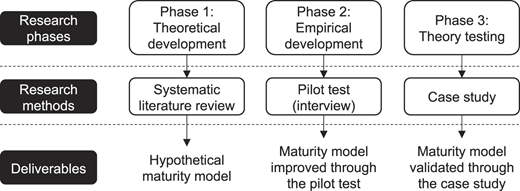
As review in section 2.1, many studies have been investigated for identifying the distinctive capabilities for servitization, but the knowledge is fragmented. Therefore, in the theoretical development phase (phase 1), a systematic literature review (Tranfield et al., 2003) was conducted for developing an initial maturity model. In the review, relevant papers were collected based on the following keywords: “servitization,” “product-service system*,” “advanced service,” “service transition,” and “service infusion.” Papers identified with the keywords of “product service system*” and “advanced service” were narrowed with two additional keywords: “implementation” and “transition.” The database selected for this review was the ISI Web of Science because of its comprehensiveness in the researched knowledge area. Before searching articles, we set a criterion of including only articles that investigated “capabilities” requisite for servitization. The initial search produced 262 results in September 2017. From an abstract review, we excluded articles that did not explicitly contribute to capabilities for servitization. If an article's focus remained unclear, the article was included in the full paper review. As a result of the full paper review, we selected 110 articles. From a total of 110 articles, 65 were excluded because they referred capabilities that were already presented in other articles. After cross referencing with the bibliography of these articles, another 14 articles were added that were not part of the initial search but contributed to synthesize the distinctive capabilities for servitization. Furthermore, an additional review was conducted in September 2021. We collected relevant articles that were published after the first review based on the following keywords: “servitization” and “capabilit*.” The initial search produced 287 results from Web of Science. In the same manner as the first review, the abstract and full paper review were conducted, and then, another 16 articles were added. There was no review paper specific to capabilities, while some papers included this topic as a part of the review (Ruiz-Martín et al., 2021; Kohtamäki et al., 2019a). Especially, Raddats et al. (2019) and Khanra et al. (2021) published review papers that introduced sections dedicated to these capabilities. Our full paper review included all articles introduced in these sections as well as 120 articles different from them. The final data sample thus included 75 articles that originally presented the distinctive capabilities for servitization. The selected articles were analyzed and synthesized into 46 items. Furthermore, an evolutionary path for improving these capabilities was developed based on these articles and existing maturity models, such as (CMMI Product Team, 2010; Pigosso et al., 2013).
In the empirical development phase (phase 2), a pilot case study was conducted to test the initial maturity model. The company selected in the pilot case study was a multinational that provides infrastructure systems, digital products, electronic devices, and a broad range of services for these products. The method applied in this phase was qualitative due to its exploratory character. As shown in Table 2, multiple interviews were conducted to evaluate the initial model. The interviews were conducted in the single company, while individuals interviewed have been selected from different business functions, such as engineering, sales and design, who have actively participated in several service businesses. We asked interviewees to provide examples of specific initiatives corresponding to each capability in the initial maturity model. The interview was structured according to a semi-structure outline, designed in a form of protocol that represented the list of the capabilities. The interviewees declined requests to record interviews because of confidentiality reasons. Therefore, we took detailed notes during the interviews. Based on the results of interviews, we improved the framework and definitions of capabilities using three key criteria in the same manner as Tuli et al. (2007) and Ulaga and Reinartz (2011): (1) Is the capability applicable beyond a very specific context? (2) Did multiple participants mention the capability? and (3) Does the capability go beyond the obvious to provide interesting and useful conclusions? The results are presented in Sections 4.1 and 4.2, respectively.
Profile of the pilot case study participants
| Business unit/department | Position | Length of the interview (Minutes) | Number of interviews |
|---|---|---|---|
| Energy business | Project manager | 60–120 | 3 |
| Digital business | Senior manager in industrial solution | 60 | 4 |
| Design department | Designer | 60–120 | 2 |
| Digital business | General manager in sales | 60 | 1 |
| Digital business | Senior manager in engineering | 60 | 1 |
| Digital business | Senior manager in sales | 60 | 1 |
In the theory testing phase (phase 3), the final version of the maturity model was validated by applying it to a real case of an energy management service. The case has been selected according to three criteria: (1) companies manufacturing products as well as offering services; (2) intention to improve their capabilities to offer more advanced services; (3) willingness to collaborate with the research. The objectives of this application were to assess the gaps between current and target capability levels and then collect data on the continuous improvement of these capabilities. Since organizational capabilities develop over time, a longitudinal case research design was chosen to validate the evolutionary path proposed in the maturity model. Furthermore, a single case study approach enables the collection of rich longitudinal data in a real context (Yin Robert, 1994). Interviews were conducted with the manager and the designer involved in the project who had the responsibility for designing services as well as interacting with customers and partners. Semi-structured interviews were conducted in the same manner as phase 2. The first interview was conducted in January 2019, aiming at assessing the gaps between current and target capability levels. For collecting data on the improvement of the capabilities on a long-term basis, the second and third interviews were conducted in March 2020 and September 2021 respectively. These interviews lasted an average of 90 min (ranging from 60 to 120 min). We took detailed notes during the interviews instead of recording due to confidentiality reasons. The results of the application are described in Section 5.
4. Servitization maturity model
4.1 Distinctive capabilities for servitization
Based on the results of the review, the identified capabilities are classified into seven categories: strategy and leadership, performance, offerings, customers, organization, network and digital technology. The details are as follows.
4.1.1 Strategy and leadership
Table 3 shows capabilities required for strategy and leadership. Product-service offerings require companies to collaborate with customers as well as partners such as distribution and logistics service providers. Therefore, first, the company should define a clear vision that allows customers and partners to converge their expectations and strategic direction (Ceschin, 2013). Based on this vision, new opportunities for providing services can be exploited by benchmarking competitors' services (Fischer et al., 2010). Analyzing the external environment is also important for exploitation, as changes in industry growth, technology and regulation increase the awareness of and need for services (Kindström et al., 2013; Turunen and Finne, 2014; Lertsakthanakun et al., 2012). The design and delivery of services require the commitment of service organizations as well as top management and product organization. This commitment can be ensured by estimating the potential of the service business in terms of revenue, profit, customer loyalty and so on (Gebauer et al., 2005; Oliva and Kallenberg, 2003; Gebauer et al., 2010). Since requirements for services vary greatly, the company needs to develop a coherent and extensive service portfolio to fulfill different customer needs while mitigating the risks of service businesses (Kindstrom and Kowalkowski, 2014; Kindström and Kindstrom, 2010).
Distinctive capabilities required for strategy and leadership
| Codes | Capabilities | References |
|---|---|---|
| 101 | Determining a vision that clearly shows the direction of the service strategy, not only for the company, but also for clients and partners | Ceschin (2013) |
| 102 | Benchmarking competitors' services to search for new opportunities for a service business | Fischer et al. (2010) |
| 103 | Analyzing the effects of the external environment on the service business, such as changes in technologies and regulations | Kindström et al. (2013), Turunen and Finne (2014), Lertsakthanakun et al. (2012), Kowalkowski et al. (2012) |
| 104 | Estimating how the service business might affect the company, such as obtaining economic benefits and strengthening the relationship with customers | Gebauer et al. (2005), Oliva and Kallenberg (2003), Gebauer et al. (2010), Brax et al. (2021) |
| 105 | Constructing a comprehensive and consistent service portfolio to reduce the risks of the service business | Kindstrom and Kowalkowski (2014), Kindström and Kindstrom (2010), Brax et al. (2021) |
| 106 | Specifying the customer segments and markets for the service business that can guarantee making a profit | Alghisi and Saccani (2015), Kindstrom and Kowalkowski (2014), Kindström and Kindstrom (2010) |
| 107 | Defining the competitive advantage of competitors and other service providers from the viewpoint of services instead of products | Eloranta and Turunen (2015), Gebauer et al. (2005) |
| 108 | Setting a service price at which price competitiveness and internal profit are compatible | Kindstrom and Kowalkowski (2014), Parida et al. (2014), Rapaccini (2015), Auguste et al. (2006), Ulaga and Reinartz (2011), Kanninen et al. (2017) |
| 109 | Supporting top management's decisions on investment in the service business | Alghisi and Saccani (2015), Oliva et al. (2012) |
| 110 | Obtaining the cooperation of key individuals and related departments within the company that are necessary for the service business | Gebauer et al. (2005), Kindstrom and Kowalkowski (2014), Karlsson et al. (2017) |
For strategy formulation, first, the definition of the target customer segments is crucial to ensure a critical mass of service sales to be profitable (Alghisi and Saccani, 2015; Kindstrom and Kowalkowski, 2014). Based on such targeting, competitive advantages should be defined from the viewpoint of services such as complex product-service offerings and customer/supplier relationships to differentiate the offerings of the competitors of manufacturing companies as well as pure service providers (Gebauer et al., 2005; Eloranta and Turunen, 2015). Since value propositions focus on the availability or outcomes of product use, the company needs to adopt new pricing mechanisms based on value rather than costs (Kindstrom and Kowalkowski, 2014; Parida et al., 2014; Rapaccini, 2015). These pricing mechanisms increase the requirement to set a service price that balances competitiveness and internal profit targets (Ulaga and Reinartz, 2011; Kindstrom and Kowalkowski, 2014; Parida et al., 2014). Furthermore, to address these changes in value propositions and pricing mechanisms, the commitment and leadership of the top management are crucial to decide on additional investments in human resources and facilities (Alghisi and Saccani, 2015; Oliva et al., 2012) as well as attract and retain key individuals working in the service business (Gebauer et al., 2005; Kindstrom and Kowalkowski, 2014; Lenka et al., 2018).
4.1.2 Performance
Table 4 shows capabilities required for the performance assessment. Since service contracts are usually long term, changes in the timescale of financial flows should be considered when evaluating the return on investment of the service business (Barquet et al., 2013; Gremyr et al., 2010; Neely, 2009). Furthermore, it is important to evaluate the proportion of service businesses' revenue or profit to the total revenue or profit of the company, since a critical mass of service sales is needed to increase internal and external awareness about service businesses (Alghisi and Saccani, 2015; Gebauer et al., 2005). The company also needs to evaluate the various environmental aspects of the service such as resource utilization and rebound effects (Reim et al., 2015). With regard to customer aspects, performance should be measured based on the outcomes of product use (Baines and Lightfoot, 2014; Reinartz and Ulaga, 2008). Finally, service-oriented measurement and rewards systems are crucial for services to encourage and sustain the behavioral change of employees (Baines et al., 2013; Huikkola et al., 2016; Kindstrom et al., 2015). Balancing assets related to product and service innovation is also important to secure the interests of both business units (Baines et al., 2013; Kindstrom and Kowalkowski, 2014; Kindstrom et al., 2015).
Distinctive capabilities required for performance assessment
| Codes | Capabilities | References |
|---|---|---|
| 201 | Evaluating the return on investment of the service business considering its characteristics such as changes in the payback period | Barquet et al. (2013), Gremyr et al. (2010), Neely (2009) |
| 202 | Evaluating the proportion of the service business' revenue or profits to the total revenue or profit of the company | Alghisi and Saccani (2015), Gebauer et al. (2005) |
| 203 | Evaluating the environmental effects of the service business such as resource efficiency and rebound effects | Reim et al. (2015) |
| 204 | Establishing key performance indicators appropriate for service operations such as the product use outcomes of individual customers | Baines and Lightfoot (2014), Reinartz and Ulaga (2008) |
| 205 | Adopting measurement and rewards systems encouraging employees' behaviors appropriate for service operations | Baines et al. (2013), Huikkola et al. (2016), Kindstrom et al. (2015), Oliva and Kallenberg (2003), Story et al. (2017), Auguste et al. (2006), Gebauer et al. (2010), Kanninen et al. (2017), Yan et al. (2019) |
| 206 | Balancing resources and assets to accelerate innovation in both product organizations and service organizations | Baines et al. (2013), Kindstrom and Kowalkowski (2014), Kindstrom et al. (2015), Kindström et al. (2013), Story et al. (2017) |
4.1.3 Offerings
Table 5 shows capabilities required for developing offerings. To implement a successful strategy, designing standardized processes is necessary for delivering services effectively at low cost (Alghisi and Saccani, 2015; Kindstrom and Kowalkowski, 2014; Oliva and Kallenberg, 2003). To customize offerings to individual customers, modularized product and service components should be designed to ensure the transferability of offerings across markets (Adrodegari and Saccani, 2017; Alghisi and Saccani, 2015; Gremyr et al., 2010). Product characteristics should also be aligned with services to integrate both components synergistically, e.g. maintainability and serviceability, which could help differentiate the company's services from those of pure service suppliers (Adrodegari and Saccani, 2017; Baines et al., 2009b; Kindstrom and Kowalkowski, 2014). The customer fit of the service can be ensured through the involvement in the development process of customers (Baines et al., 2009a, b; Coreynen et al., 2017; Kindstrom and Kowalkowski, 2014), local organizations (Parida et al., 2015; Huikkola and Kohtamaki, 2017) and partners (Alghisi and Saccani, 2015; Kindström et al., 2013; Chen et al., 2021). Involving service network partners in the development process can also increase their commitment to the service (Alghisi and Saccani, 2015; Lofberg et al., 2010; Raddats et al., 2017). As mentioned above, many services adopt new pricing mechanisms based on value rather than cost. To maintain internal profit targets, it is thus crucial to assess and mitigate the risks of service operations and product failures to achieve contractually agreed outcomes (Alghisi and Saccani, 2015; Paiola et al., 2013; Rapaccini, 2015). The promotion and diffusion of services often increase demand for relaxing existing regulations or introducing new one. Therefore, it is important to detect regulatory barriers and develop adequate countermeasures in the development process (Ceschin, 2013).
Distinctive capabilities required for developing offerings
4.1.4 Customers
Table 6 shows capabilities related to customers of service businesses. Building in-depth knowledge on customers' needs and operating processes is crucial for designing and selling new services (Alghisi and Saccani, 2015; Gebauer et al., 2005; Kindstrom and Kowalkowski, 2014). The key decision-makers when purchasing services could differ from those when purchasing products. Therefore, selling services requires access the right decision-makers in the customer's organization (Ulaga and Reinartz, 2011; Coreynen et al., 2017). The intangible value of services can then be visualized to help customers understand the benefits (Reinartz and Ulaga, 2008; Kindström and Kindstrom, 2010; Ulaga and Reinartz, 2011). Since many services include co-production and/or co-creation activities with customers, the company needs to provide appropriate information or education to customers to enhance their willingness and ability to participate in these activities (Rönnberg-Sjödin, 2013; Kindstrom and Kowalkowski, 2014; Raddats et al., 2017). Furthermore, adequate operational links and information exchange with customers build closer relationships with them (Grönroos and Helle, 2010; Bastl et al., 2012; Barquet et al., 2013).
Distinctive capabilities related to customers of service businesses
4.1.5 Organization
Table 7 shows capabilities related to the organization of the company. For designing, selling and delivering services as well as building relationships with customers, the company needs to recruit different staff members for services than those for products. In particular, a dedicated service salesforce should be recruited and/or trained to acquire new competencies to be able to access the key decision-makers in the customer's organization and communicate the service value (Baines et al., 2009a, b; Gebauer et al., 2005; Huikkola et al., 2016). Service technicians and frontline employees should also be recruited and/or trained, since they need to have technical skills related to products as well as the competencies to interact with customers (Baines and Lightfoot, 2014; Baines et al., 2013; Gebauer et al., 2013). Facilities located physically close to a customer's operations are considered as crucial for ongoing product and service improvements, since the company can respond quickly (Baines et al., 2012; Baines and Lightfoot, 2014; Baines et al., 2009a, b). The decentralization of service initiatives to the local organization is also important, since service development often takes place locally through interactions with key customers (Alghisi and Saccani, 2015; Kindstrom and Kowalkowski, 2014; Kindström et al., 2013). Finally, it is necessary to define the organizational distinctiveness between the product and service businesses in order to make these decisions quickly and protect the emerging service culture (Gremyr et al., 2010; Huikkola et al., 2016; Oliva and Kallenberg, 2003). The service organization must also share the requisite resources with the product organization, since cross-functional integration is essential for selling, developing and delivering services (Adrodegari and Saccani, 2017; Baines et al., 2009b; Coreynen et al., 2017).
Distinctive capabilities related to the organization of the company
4.1.6 Network
Table 8 shows capabilities related to the network of partners for product-service offerings. Collaborating with third-party suppliers allows the company to overcome the lack of required competencies in-house and share the risks and responsibilities of the offerings (Huikkola and Kohtamaki, 2017). To collaborate with suppliers, first, the company needs to understand their goals, competencies and directions for growth (Kindstrom and Kowalkowski, 2014; Kindström et al., 2013; Oliva and Kallenberg, 2003). This knowledge enables it to determine the processes that should be strategically assumed in house and those to be outsourced to partners (Alghisi and Saccani, 2015; Huikkola et al., 2016; Kindstrom and Kowalkowski, 2014), as well as identify partners able to compensate for the lack of internal competencies and resources (Barquet et al., 2013; Parida et al., 2014; Reim et al., 2015). When a supplier has already offered the service independently, it is necessary to leverage on the long-term benefits of becoming a partner to avoid supplier competition (Alghisi and Saccani, 2015; Kindstrom and Kowalkowski, 2014; Parida et al., 2014). Since the network consists of various partners, they should be trained to maintain consistent service quality across markets (Alghisi and Saccani, 2015; Kucza and Gebauer, 2011; Oliva and Kallenberg, 2003). Furthermore, mutual learning with partners enables knowledge to be shared and durable relationships created (Chen et al., 2016; Huikkola et al., 2016; Paiola et al., 2013).
Distinctive capabilities related to the network of partners for product-service offerings
4.1.7 Digital technology
Table 9 shows capabilities related to the digital technologies used in product-service offerings. Digital technologies have been attracting attention for supporting servitization processes, that is, digital servitization (Sklyar et al., 2019; Kohtamäki et al., 2019b). Before using digital technologies, first, the company must define data protection and use agreements for sharing product and service data with customers and partners (Schroeder and Kotlarsky, 2015; Sjödin et al., 2021). The integration of sensors and digital technology into products enables the company to measure the operational performance and condition of the products with low human intervention (Alghisi and Saccani, 2015; Lenka et al., 2017; Lightfoot et al., 2011). These collected product and service data can be used to not only improve service operations (Adrodegari and Saccani, 2017; Barquet et al., 2013; Belvedere et al., 2013) and product design (Baines and Lightfoot, 2014; Parida et al., 2014; Hallstedt et al., 2020), but also maintain continuous contact with customers (Baines et al., 2009a, b; Gebauer et al., 2005) and identify new business opportunities (Alghisi and Saccani, 2015; Lenka et al., 2017; Ulaga and Reinartz, 2011).
Distinctive capabilities related to the digital technologies used in product-service offerings
| Codes | Capabilities | References |
|---|---|---|
| 3D1 | Building consensus with customers and partners on the usage and protection of product- and service-related data | Schroeder and Kotlarsky (2015), Sjödin et al. (2021) |
| 3D2 | Integrating digital technologies and sensors into products to acquire the data necessary for service operations | Alghisi and Saccani (2015), Lenka et al. (2017), Lightfoot et al. (2011), Naik et al. (2017), Fischer et al. (2010) |
| 3D3 | Using the collected data on products and services to efficiently and effectively carry out service operations | Adrodegari and Saccani (2017), Barquet et al. (2013), Belvedere et al. (2013), Gebauer et al. (2013), Kowalkowski et al. (2013), Lenka et al. (2017), Lightfoot et al. (2011), Schroeder and Kotlarsky (2015), Huikkola and Kohtamaki (2017), Sjödin et al. (2021), Kanninen et al. (2017) |
| 3D4 | Using the collected data on products and services to improve product design | Baines and Lightfoot (2014), Parida et al. (2014), Hallstedt et al. (2020) |
| 3D5 | Using the collected data on products and services to construct long-term relationships with clients | Baines et al. (2009), Gebauer et al. (2005) |
| 3D6 | Using the collected data on products and services to search for new opportunities for the service business | Alghisi and Saccani (2015), Lenka et al. (2017), Ulaga and Reinartz (2011), Naik et al. (2017), Schroeder and Kotlarsky (2015), Sjödin et al. (2021), Hasselblatt et al. (2018), Chen et al. (2020) |
4.2 Evolutionary path for capability development
4.2.1 Overview
In the same manner as existing maturity models (CMMI Product Team, 2010), the proposed model adopts the concept of levels that describe an evolutionary path for developing capabilities. The evolutionary path is defined by combining two types of levels: capability and maturity levels. Capability levels are applied to an individual's capability, representing the extent to which the capability is improved. On the contrary, maturity levels represent successive stages ranging from initiating a single project to optimizing multiple service businesses. Each maturity level defines the scope of capabilities that should be improved to take the company to the next stage.
4.2.2 Capability levels
Capability levels are defined based on existing maturity models (CMMI Product Team, 2010) that evaluate each capability from the viewpoint of the formalization of processes required to exert the capability. As shown in Table 10, the model defines four capability levels, which are numbered from 0 to 3.
Definition of capability levels
| Capability levels | Descriptions | |
|---|---|---|
| Level 0 | Incomplete | Process is not performed or is performed incompletely |
| Level 1 | Performed in an ad hoc way | Process is performed by some individuals in an ad hoc way |
| Level 2 | Managed in isolated projects | Process is planned and executed with policy in isolated projects |
| Level 3 | Defined as organizational standards | Process is tailored from the organization's set of standard processes |
Source(s): Extended from CMMI Product Team (2010)
Capability level 0 corresponds to the situation in which the process is not performed. Capability level 1 is characterized as a process performed by some individuals in an ad hoc manner, while not yet formalized and systematized. This situation is unstable and has poor continuity if the process is not institutionalized at levels 2 and 3. At capability level 2, the process is managed in isolated projects, where the performed process is planned and executed in accordance with policy. At capability level 3, the process is defined as an organizational standard; therefore, each project manages a process tailored from the organization's set of standard processes. Therefore, processes at capability level 3 are more consistent across the organization than those at level 2. Capability levels are used not only to assess the organization's current situation, which is called the current profile, but also to define their target state, which is called the target profile.
4.2.3 Maturity levels
Maturity levels define the successive stages of target capability levels, enabling a focus on the company's capability development efforts for a manageable number of capabilities at a time. Based on the literature review and the pilot case study, maturity levels are defined by three dimensions based on the degree of stakeholder involvement (Oliva and Kallenberg, 2003; Ceschin, 2013; Story et al., 2017), product and service business integration (Kindström and Kindstrom, 2010; Huikkola et al., 2016; Kindström et al., 2013; Story et al., 2017), and knowledge and data acquisition and use (Ceschin, 2013; Coreynen et al., 2017). As shown in Table 11, these dimensions define five stages of the proposed maturity levels: initial, managed, defined, quantitatively managed and optimizing. Each maturity level is associated with the capabilities that should be developed in each stage. The details of each stage are as follows.
Maturity level 1 – Initial: Companies with little experience in service businesses should begin by increasing awareness about their service businesses within the company. For this purpose, maturity level 1 requires the development of capabilities to estimate the potential economic benefits of service businesses (104) by benchmarking competitors' services (102) and analyzing the external environment such as technology trends, deregulation, strengthening and other service businesses (103).
Maturity level 2 – Managed: The first step in initiating a service business is to launch pilot projects to confirm the potential benefits. Therefore, this stage needs to improve the processes to be performed by project teams, including those that define the competitive advantage of services (107) and target customer segments (106). Furthermore, it is also necessary to define the appropriate key performance indicators to evaluate pilot projects (204). These indicators can be used to improve processes that not only develop offerings such as standardizing service operations (3P1) and modularizing service content (3P2), but also understand the legal barriers to promoting and diffusing the offerings (3P7). Pilot projects enable companies to determine the processes to be outsourced to external partners (3N2) and identify suitable customers (3C2) and partners (3N3) based on their knowledge (3C1 and 3N1) accumulated through projects.
Maturity level 3 – Defined: The knowledge and data obtained from pilot projects enable the company to manage service projects proactively; hence, organizational processes and structures can be aligned with those of the service business to achieve the expected benefits. The scope of this alignment includes not only the processes and structure of the company but also those of customers and partners. Therefore, maturity level 3 focuses on the process improvement of the whole organization, customers and partners, while maturity level 2 focuses on the process improvement of individual projects. For this purpose, it is necessary to obtain the commitment of top management (109) and key individuals (110) to improve the processes of product-service alignment (3P3), human resource development (3O1 and 3O2) and facility deployment (3O3). It is also necessary to improve the processes for enhancing customer and partner commitment through their involvement in service development (3P4 and 3P5), education and training (3C4 and 3N5) and optimum incentives (3N4). For these process improvements, the company needs to determine a vision that clearly shows the direction of the service strategy not only for itself but also for customers and partners (101).
Maturity level 4 – Quantitatively managed: This stage aims to develop capabilities that enable the company to manage the service business based on quantitative data. For this purpose, the company needs to build consensus on data use and protection (3D1) and then integrate digital technologies into the product (3D2) to monitor product conditions and operational performance. This enables the company to determine a service price (108), reduce the risks of product failure and service operations (3P6) and visualize the service value for customers (3C3). The data are also effective for evaluating the economic and environmental benefits of service businesses (201 and 203), thereby improving existing offerings (3D3 and 3D4).
Maturity level 5 – Optimizing: To optimize the financial benefits of service businesses within the company, this stage aims to improve processes across multiple service businesses as well as product and service businesses. For this purpose, it is crucial to not only activate the collaboration between the product and service organizations (3O6), but also optimize the organizational design through organizational distinctiveness (3O5) and the decentralization of service initiatives (3O4). It is also important to manage a service portfolio (105) and balance resources and assets in both the product and the service organizations (206) to reduce the risks of the service business and accelerate both product and service innovation. Furthermore, adopting service-oriented measurement can increase the internal and external awareness of service businesses (202 and 205). Data and knowledge can be used not only to build long-term relationships with customers (3C5 and 3D5) and partners (3N6), but also to identify new business opportunities (3D6).
Maturity levels for improving the distinctive capabilities of service businesses
| Maturity level 1 Initial | Maturity level 2: Managed | Maturity level 3: Defined | Maturity level 4: Quantitatively managed | Maturity level 5: Optimizing | ||
|---|---|---|---|---|---|---|
| Dimensions of maturity levels | Stakeholder involvement | Stakeholders related to project teams | All relevant stakeholders within the company, customers and partners | |||
| Product and service business integration | Isolated service businesses | Multiple product and service businesses | ||||
| Knowledge and data acquisition and use | Reactive | Proactive | Predictive | |||
| Categories of capabilities | Strategy and Leadership | Service benchmarking (102) | Service customer segmentation (106) | Service vision determination (101) | Service price determination (108) | Service portfolio management (105) |
| External environmental analysis (103) | Service competitiveness definition (107) | Top management decision support (109) | ||||
| Service potential estimation (104) | Key individual cooperation (110) | |||||
| Performance | Service indicator definition (204) | Service investment evaluation (201) | Service ratio evaluation (202) | |||
| Service-oriented measurement (205) | ||||||
| Environmental effect evaluation (203) | ||||||
| Product-service innovation (206) | ||||||
| Offerings | Service operation standardization (3P1) | Product-service alignment (3P3) | Service risk assessment (3P6) | |||
| Service content modularization (3P2) | Customer involvement (3P4) | |||||
| Legal barrier understanding (3P7) | Partner involvement (3P5) | |||||
| Customers | Customer knowledge accumulation (3C1) | Customer education (3C4) | Service value visualization (3C3) | Customer relationship building (3C5) | ||
| Customer access (3C2) | ||||||
| Organization | Service salesforce development (3O1) | Decision-making decentralization (3O4) | ||||
| Service technician development (3O2) | Organizational distinctiveness definition (3O5) | |||||
| Service facility deployment (3O3) | Organizational resource sharing (3O6) | |||||
| Network | Partner knowledge accumulation (3N1) | Partner incentive determination (3N4) | Partner relationship building (3N6) | |||
| Outsourcing determination (3N2) | ||||||
| Partner training (3N5) | ||||||
| Partner identification (3N3) | ||||||
| Digital technology | Data use agreement (3D1) | Data use for customer relationships (3D5) | ||||
| Digital technology integration (3D2) | ||||||
| Data use for service operations (3D3) | Data use for new business (3D6) | |||||
| Data use for product design (3D4) | ||||||
Each of these stages defines the target capability level, as shown in Table 12. For example, to achieve maturity level 1, all the capabilities assigned to this maturity level should achieve capability level 2. To achieve maturity level 2, all the capabilities at this maturity level should achieve capability level 2 and those at maturity level 1 should achieve capability level 3. As the maturity level increases, higher capability levels must be achieved. Eventually, all the capabilities must achieve capability level 3 for maturity level 5.
Target capability levels at each maturity level
| Capabilities associated with each maturity level | Capability level to be achieved at each maturity level | |||||
|---|---|---|---|---|---|---|
| Maturity Level 1 | Maturity Level 2 | Maturity Level 3 | Maturity Level 4 | Maturity Level 5 | ||
Maturity Level 1 | Strategy and Leadership . Service benchmarking (102), External environmental analysis (103), Service potential estimation (104) | Capability level 2 | Capability level 3 | Capability level 3 | Capability level 3 | Capability level 3 |
Maturity Level 2 | Strategy and Leadership . Service customer segmentation (106), Service competitiveness definition (107) Performance. Service indicator definition (204) Offerings. Service operation standardization (3P1), Service content modularization (3P2), Legal barrier understanding (3P7) Customers. Customer knowledge accumulation (3C1), Customer access (3C2) Network. Partner knowledge accumulation (3N1), Outsourcing determination (3N2), Partner identification (3N3) | Capability level 2 | Capability level 3 | Capability level 3 | Capability level 3 | |
Maturity Level 3 | Strategy and Leadership . Service vision determination (101), Top management decision support (109), Key individual cooperation (110) Offerings. Product-service alignment (3P3), Customer involvement (3P4), Partner involvement (3P5) Customers. Customer education (3C4) Organization. Service salesforce development (301), Service technician development (302), Service facility deployment (303) Network. Partner incentive determination (3N4), Partner training (3N5) | Capability level 2 | Capability level 3 | Capability level 3 | ||
Maturity Level 4 | Strategy and Leadership . Service price determination (108) Performance. Service investment evaluation (201), Environmental effect evaluation (203) Offerings. Service risk assessment (3P6) Customers. Service value visualization (3C3) Digital technology . Data use agreement (3D1), Digital technology integration (3D2), Data use for service operations (3D3), Data use for product design (3D4) | Capability level 2 | Capability level 3 | |||
Maturity Level 5 | Strategy and Leadership: Service portfolio management (105) Performance. Service ratio evaluation (202), Service-oriented measurement (205), Product-service innovation (206) Customers. Customer relationship building (3C5) Organization. Decision-making decentralization (304), Organizational distinctiveness definition (305), Organizational resource sharing (306) Network. Partner relationship building (3N6) Digital technology. Data use for customer relationships (3D5), Data use for new business (3D6) | Capability level 3 | ||||
5. Application of servitization maturity model
5.1 Case description
The case company is a multinational that provides infrastructure systems, digital products, electronic devices and a broad range of services for these products. Currently, services are crucial for its business. For example, it has invested in cyber-physical systems to collect data from physical products, recognize and analyze them with digital technologies and provide feedback to the physical world. Cyber-physical systems aim to not only improve products but also solve customers' problems across many business domains. For this purpose, they need to improve their capabilities to offer more advanced services such as performance-based contracting.
In this application, we focused on an advanced service project in the company, namely, a management system for zero-emission fuel in the energy business domain. The system includes not only a product that uses renewable energy to produce and store zero-emission fuel, but also a service that monitors the consumption and storage of electricity for running a zero-emission fuel in the optimal range to reduce the cost of electricity while cutting CO2 emissions. The objectives of this application were to assess the gaps between the current and target capability levels and then develop projects to fill these gaps. The details of the results are as follows.
5.2 Results of the application
5.2.1 Gaps between the current and target capability levels
We asked interviewees to provide examples of specific initiatives corresponding to each capability in the maturity model and then investigated the formalization of processes for these initiatives. Capabilities that no initiatives existed were judged as capability level 0, while those that the processes for the initiatives were performed in an ad hoc manner were judged as capability level 1. For the determination of whether a capability was judged as capability level 2, this application focused on the project of the management system for zero-emission fuel. Namely, capabilities that formalized processes existed in the project were judged as capability level 2. Furthermore, if the process was standardized and consistent across multiple projects in the energy business unit, its relevant capability was judged as capability level 3. Based on the criteria, data on the current situation of each capability were basically collected from the interview with the project manager, since he took responsibility for managing all processes of the project and had enough information on the entire situation. Furthermore, some capabilities were performed by the design department that was a cross-functional team across multiple business units. Therefore, we also conducted the interview with the designer who was involved in the project. Based on the results of the interviews, the current capability levels, i.e. current profile, were judged by two servitization experts to ensure coherence and consistency. After the judgment, we provided the project manager with a summary report that included the current capability levels and examples of initiatives, thereby confirming the result of the company's current profile. In the same manner as Pigosso et al. (2013), the company's current profile was outlined using a maturity radar, as shown in Figure 2. The codes in the radar represent the capabilities and the scale of the axis corresponds to the capability levels. As a result, 14 capabilities were judged as capability level 2, that is, managed in isolated projects. For example, “customer knowledge accumulation (3C1)” was evaluated at capability level 2, as the design team managed a process based on user-centered design (Abras et al., 2004) to exert this capability. On the contrary, 17 capabilities were judged as capability level 1 (performed in an ad hoc manner) and the others were level 0 (incomplete). No capabilities at capability level 3 were found in the interviews, since the company was still in the early stages of servitization.
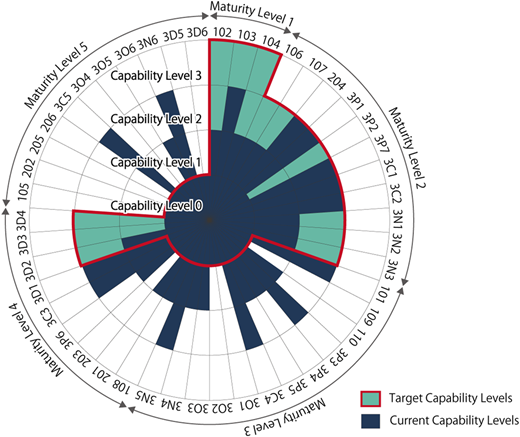
Subsequently, the target profile was defined based on the current profile. The target profile can be defined based on the maturity levels and strategic direction of the company. The company had started to launch pilot projects to validate its potential benefits, thereby some capabilities associated with maturity level 2 were already performed with policies in the project, i.e. capability level 2. Based on this situation, the target maturity level was determined to be level 2. Therefore, the target level of the capabilities associated with maturity level 2 was defined as capability level 2. On the contrary, the capabilities associated with maturity level 1 should achieve capability level 3. Furthermore, the target profile was customized based on the orientation of the company's service strategies. Since the company has invested in cyber-physical systems to improve products and services based on the collected data, the priority was to improve capabilities related to digital technologies such as digital technology integration (3D2) and data use for service operations (3D3). Finally, the target profile was outlined in a maturity radar, as shown in Figure 2.
5.2.2 Capability improvement on a long-term basis
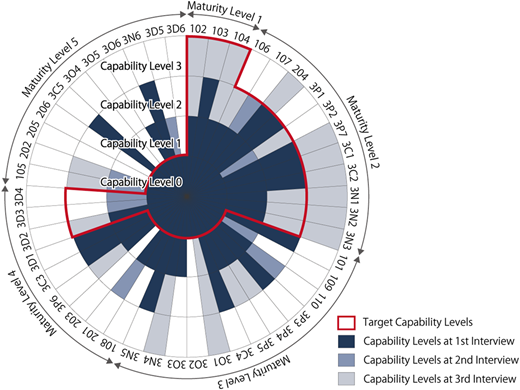
For collecting data on the improvement of the capabilities on a long-term basis, we conducted the second and third interviews with the same manager. In the same manner as the first one, capability levels were judged and outlined as shown in Figure 3. At the first interview, the target maturity level was defined as level 2. As a result of continuous improvement efforts, the energy business unit had achieved the target maturity level. In the maturity model, we assumed that the capabilities at maturity level 2 could be improved at a relatively early stage by stakeholders involved in pilot projects. This assumption was empirically supported by this application. After the first interview, the company had initiated regular meetings to share knowledge on several projects related to zero-emission fuel in the energy business domain. This enabled them to formalize processes to exert the capabilities at maturity level 2. Furthermore, the company also improved some capabilities at maturity level 3 that should involve all relevant stakeholders within the company, such as service salesforce development (3O1). This led to further improvement in capabilities at maturity level 2. For example, they formalized a process to recruit and train salesforce for service business in the energy business unit (3O1). This enabled them to improve processes to accumulate knowledge on customers (3C1) and access to key individuals in customer's organization (3C2). This result also supports the assumption on evolutionary path in the maturity model.
6. Discussion on the application results
6.1 Theoretical implications
The major theoretical contribution of this research lies in the following two aspects. First, the proposed maturity model provides a comprehensive framework of distinctive capabilities for servitization based on the systematic literature review. A few models focused on the entire capabilities for servitization, such as (Alvarez et al., 2015; Adrodegari and Saccani, 2020), while some important capabilities were missing in these existing models.
Second, the proposed model defined an evolutionary path for improving capabilities where maturity levels were defined as the successive stages of target capability levels. This assumption was partially supported by the empirical application. For example, capabilities at maturity level 2 were improved at a relatively early stage, such as customer knowledge accumulation (3C1). Furthermore, improving capabilities at higher maturity level led to further improvement in those at lower level. For example, improving capabilities at maturity level 3, such as service salesforce development (3O1), enabled further improvements in those at maturity level 2, such as customer knowledge accumulation (3C1). This enables companies to improve capabilities through feasible efforts. This could be difficult for existing methods, since they defined maturity levels based on the transition from less to more advanced services.
6.2 Practical implications
Through the application to the real-world case, we found the effectiveness of the proposed maturity model in the following ways. First, the model enables companies to capture the bigger picture of the required capabilities without oversight. For example, in the case company, the awareness of improving “service competitiveness definition (107)” was limited before the application, since it had been defining the comparative advantage from a product perspective, e.g. technological superiority. However, many studies have emphasized the importance of defining competitive advantage from the viewpoint of services to allow a company to differentiate its offerings from competitors among both manufacturing companies and pure service providers (Gebauer et al., 2005; Eloranta and Turunen, 2015). The results of assessing the company's current maturity profile enabled the manager to recognize the importance of improving this capability.
Second, the model can determine a process for improving the requisite capabilities through feasible efforts. For example, in the application, 32 capabilities were judged as capability level 0 or 1. It was difficult for the company to improve all these capabilities simultaneously. Based on the results of analyzing the gap between the current and target maturity profiles, it was suggested to improve the capabilities associated with maturity levels 1 and 2. This enabled the design team to find the relevant capabilities to be prioritized for improvement, such as top management decision support (109) and key individual cooperation (110).
6.3 Limitations and further research directions
In the application, some limitations of the proposed maturity model were noted. Through the application, it was found that guidance was required to understand the capabilities correctly before applying the maturity model. Additional support is also necessary to determine the target profile, enabling companies to select capabilities to be improved based on their strategies. Furthermore, the evolutionary path was partially validated through the application, while further investigation is required to validate the evolutionary path. Therefore, future research should investigate the further validation of the evolutionary path by conducting multiple case studies.
This work was supported by JSPS KAKENHI Grant Number 20K12082.

