


The authors systematically review empirical dyadic service encounter research published in top-tier journals between 1972 and 2022.
The authors employed bibliometric techniques, co-citation analysis and bibliographic coupling analysis to map schools of thought and research frontiers within the dyadic service encounter literature. In total, the authors analyzed 155 articles. To ensure inclusion of high-quality research, the authors screened articles from 139 journals with “4” or “4*” ratings on the 2021 Chartered Association of Business Schools (ABS) journal list, in addition to articles published in three service sector-specific journals: Journal of Service Management, Journal of Services Marketing and Journal of Service Theory and Practice.
The authors' co-citation analysis identified four distinct clusters within the dyadic service encounter literature: (1) shaping and explaining service encounters; (2) emotions in service work; (3) modeling, manipulating and measuring encounter service quality and (4) emotional labor and regulation in dyadic service encounters. Furthermore, the authors' bibliographic coupling analysis generated three research clusters: (1) service encounter characteristics; (2) emotions and emotional labor and (3) service encounter interaction content.
The authors' comprehensive review synthesizes knowledge, summarizing similarities among research clusters within the service encounter realm. Noteworthy are research clusters that clarify the emotion-based underpinnings and reciprocal nature of behaviors and emotions within dyadic encounters. By conducting complementary bibliometric analyses, the authors trace the evolution of the service encounter literature, providing an overview of the present state of dyadic service encounter research. These analyses offer valuable insights into the current landscape of the field, identifying future dyadic service encounter research opportunities.
Management scholars across disciplinary fields including human resource management, industrial/organizational psychology, marketing, organizational behavior, operations management and service management have explored the concept of service encounters, recognizing their significance to national economies. We define a service encounter as a dyadic interaction between frontline employees and organizational outsiders (e.g. customers, clients, passengers), hereinafter customers, wherein the customer actively participates in the co-production of service alongside a service employee (e.g. Bitner, 1990; Surprenant and Solomon, 1987). These encounters can range from routine interactions (e.g. ordering) at a chain restaurant to complex expert services (Azzari et al., 2021) involving legal or financial discussions. Notably, in contexts such as travel, retail, banking and contact centers, a “moment of truth” arises in each encounter with the potential to form and build the relationship between the customer and the organization (Bitner et al., 1994) by shaping perceptions of the organization's service and strengthening or weakening customer loyalty.
Multidisciplinary service encounter research reveals three key characteristics that are commonly observed. First, service encounters are inherently dyadic, involving an interrelated and reciprocal interaction between two parties, often investigated as interactions between a single customer and a single employee (e.g. Rupp and Spencer, 2006). The dyadic nature of service encounters, however, extends beyond the typical single customer/single employee exchange and encompasses a broad ecosystem of interactions (Subramony and Groth, 2021). Dyads of “parties” in service encounters could involve one employee interacting with a group of customers (Smith et al., 1999), or a group of employees delivering service to one (Yamauchi and Hiramoto, 2016) or more customers (Mossberg, 1995). Second, individual (or groups of) customers coproduce service encounters by providing input such as effort, knowledge and resources, to encounters (Bendapudi and Leone, 2003). Third, service encounters are bidirectional (e.g. Subramony et al., 2021); customers and employees influence each other's performance and thus the dyadic experience of the encounter and related outcomes. Moreover, each party could simultaneously change the other party's psychological (e.g. emotions; Pugh, 2001), behavioral (e.g. rule following; Habel et al., 2017), or even monetary (e.g. tipping; Chi et al., 2011) outcomes related to the encounter.
The customer and employee relationship in service encounters can vary in nature, complexity and whether it existed prior to the encounter, adding a further challenge to studying service encounter characteristics (Bowen, 1990). For example, a service encounter can be an initial meeting between participants (e.g. a retail encounter), or part of a long-standing relationship, such as those with a hairdresser (Chi et al., 2013) or a financial advisor (Giardini and Frese, 2008), where the employee possesses extensive customer knowledge. An existing relationship can influence a customer's ability to coproduce, evoke authentic emotions, or facilitate unscripted encounters that enhance service quality (Price et al., 1995).
Furthermore, it is essential to distinguish between individual “encounters” (Pugh, 2001) or “events” (Walker et al., 2014) and aggregated encounter research. At the encounter level, an established relationship between the customer and the employee can act as a “transaction-defining cue” influencing both parties' displayed emotions (Rafaeli and Sutton, 1989). Consequently, studying service encounters requires methods that capture both customer and employee perspectives, as well as data relevant to specific encounters.
State of the science on dyadic service encounters
The study of service encounters, with their dyadic, coproduced and reciprocal characteristics, has emerged from multiple fields, resulting in a diverse and fragmented knowledge base. Published dyadic service encounter research appears from disciplines such as marketing (e.g. Hennig-Thurau et al., 2006), organizational behavior (e.g. Giardini and Frese, 2008), tourism (Mossberg, 1995) and industrial/organizational psychology (Walker et al., 2014). This research draws upon a range of theoretical foundations including affective events theory (Weiss and Cropanzano, 1996), emotional labor (Hochschild, 1983), emotional contagion (Hatfield et al., 1994) and conservation of resources theory (Hobfoll, 1989) to explain customer and employee actions and outcomes in service encounters. This breadth of research raises two key questions. First, what are the intellectual foundations of dyadic service encounter research and are there theoretical perspectives that connect disciplines? Second, what is the research front of dyadic service encounter research?
Existing reviews have examined service, customer experience and dyadic research, yet, to date, none explicitly focuses on dyadic service encounters, despite their significance in service delivery (see Supplementary Material A). On the one hand, Subramony et al. (2021) initiated discourse on service encounters as an important research theme, while Groth et al. (2019) advocated for increased dyadic service research. Although these reviews offer valuable insights, they lack explicit guidance regarding the theoretical perspectives and research front of the dyadic service encounter literature. On the other hand, reviews on customer experience (e.g. Gallardo-Garcia et al., 2023), acknowledge the importance of moments of truth, but go beyond the scope of dyadic service encounters. Similarly, Liden et al. (2016), explained the importance of dyadic relationship research, but overlooked dyadic research within the service encounter literature. Comprehensive insight into the state of the literature on dyadic service encounters is missing from the broad focus of published reviews on service employment and customer experience.
We address this oversight by systematically reviewing the dyadic service encounter literature. Our two bibliometric analyses: (1) co-citation analysis; and (2) bibliographic coupling analysis reveal research clusters or “schools of thought” (Lievrouw, 1989), as well as the research front (Donthu et al., 2021) of dyadic service encounter research. A co-citation analysis (e.g. McCain, 1990) identifies the frequency with which two documents (e.g. papers, books) are cited together in the reference list of a third document in a corpus of literature representing a research field. Co-citation analysis, assuming similar content for documents cited together, can facilitate interpretation of the theoretical foundation(s) of a field represented by a group of documents (Pasadeos et al., 1998). Alternatively, bibliographic coupling analysis (e.g. Kessler, 1963) identifies topics attracting research attention by analyzing shared references in a collection of documents. Documents sharing more references are more likely to reflect similar theoretical, conceptual, or methodological foundations (Boyack and Klavans, 2010). This approach captures both the historical development of the field, uncovering recent research representing the dyadic service encounter research front that co-citation analysis could overlook (Glänzel and Czerwon, 1996). We combine these approaches to develop a comprehensive understanding of the field's foundations and its current research directions (Boyack and Klavans, 2010).
Our analysis initially included service encounter papers published in top-tier and service-specific journals between 1972 and 2022. We ensured that each paper reported encounter-level research from a dyadic perspective using manual screening, thus creating a reduced sample. This systematic and inclusive approach is necessary due to the fragmented nature of the literature. Furthermore, systematically reviewing the dyadic service encounter literature reveals neglected interdisciplinary aspects of this field, while also providing valuable insights for scholars. Our review has the potential to guide researchers in identifying crucial research questions to enhance customer satisfaction, employee well-being and organizational outcomes paving the way for future service encounter research.
Method
We employed a rigorous approach to review the dyadic service encounter literature that considers experiences and outcomes for both customers and employees. First, we conducted search term queries of titles, abstracts and keywords in the Scopus database, using combinations of phrases from existing reviews, our knowledge of dyadic service encounter research and terms derived from “moment of truth” studies. Figure 1 describes our search process and the specific research terms used. This initial search yielded a total of k = 2,854 articles published between 1972 and February 2022, sourced from the 2021 Chartered Association of Business Schools (ABS) journal list (Castro et al., 2020).
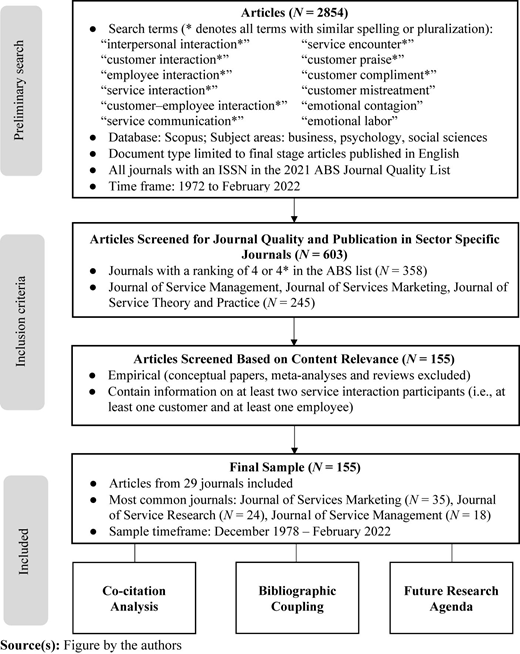
Second, we narrowed our primary document selection to articles published in “4” or “4*” ABS journals, ensuring inclusion of high-quality research. This journal quality criterion reduced our sample to 358 articles from disciplines including management, economics, information systems, marketing, organizational studies, social sciences and service research published in Journal of Service Research. Third, we included articles meeting our keyword requirements from Journal of Service Management, Journal of Services Marketing and Journal of Service Theory and Practice to expand our search to publications focused on the service sector. Fourth, we manually screened the title, abstract and methods sections of each article evaluating its relevance to our review. This screening process removed 448 articles to ensure inclusion of empirical articles that served as the primary source (excluding, for example, meta-analyses) and contained data on dyadic elements (e.g. customer and employee data) within an encounter.
In total, our primary document sample included 155 articles, published from December 1978 to February 2022. In Supplementary Material B, we report annual and total cumulative publications for this sample ( Figure B1) and provide an overview of the most influential papers in the document sample by citations and citations per year ( Table B1). In addition, we include Table B2 reporting number of publications and citations for the most influential journals publishing dyadic service encounter research, as well as Table B3 outlining the ABS field, journals, number of articles and the most common search keywords. All references for our primary documents are in Supplementary Material C.
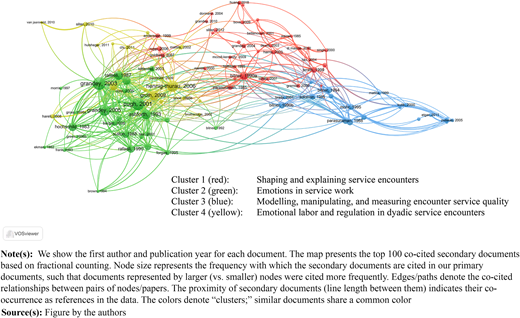
Next, we conducted computer-assisted (1) co-citation analysis and (2) bibliographic coupling analysis. These analyses facilitated mapping relationships between primary documents, either through their shared references or shared inclusion as references in other documents. The graphical network representations visually illustrate interconnectedness among sample documents. These maps help identify clusters, which can be interpreted as “schools of thought” (Lievrouw, 1989) or as the research front underlying a cluster. Examining the document's spatial proximity in the network visualization shows their relatedness, with closer proximity indicating increased similarity of theoretical perspectives, research topics and clusters (Small, 1999). Further, label size and the circle on the maps visually represent the weight, or relative importance, of each document. For example, in Figure 2, the document “Grandey, 2003” is connected to multiple primary documents.
Co-citation analysis: the knowledge structure of dyadic service encounter research
In phase one of our bibliometric analysis, we employed the Visualization of Similarities Viewer (VOSviewer) 1.6.18 software to conduct a co-citation analysis. This analysis identified secondary documents (journal articles, book chapters, edited volumes, books) referenced in our 155 primary documents. We focused on the 100 most-cited secondary documents derived from reference lists in the primary documents indicating the knowledge structure of these documents. Consequently, before identifying top documents, we removed 23 references (e.g. methodological papers, texts and software user manuals). We scrutinized the remaining 100 secondary documents assessing their relevance to the knowledge structure underpinning the primary documents. The VOSviewer software facilitated the ranking of secondary documents based on their co-citation link strength. This link strength indicates how frequently primary documents reference secondary documents (van Eck and Waltman, 2014). Utilizing fractional counting (Perianes-Rodriguez et al., 2016), we identified four distinct co-citation clusters as shown in Figure 2. In Table 1, we report the five most important articles in each co-citation cluster, based on their total link strength. References for all 100 secondary documents in our co-citation analysis are in Supplementary Material D.
Top 5 documents for each cluster in the co-citation analysis
| Cluster | Cluster description | Examples | Weight (total link strength) | Documents |
|---|---|---|---|---|
| Cluster 1: shaping and explaining service encounters (red) | Research investigating factors that shape service outcomes around three themes: theoretical foundations, service failure/recovery and customer mistreatment | Bitner et al. (1990) | 16 | 35 |
| Smith et al. (1999) | 10 | |||
| Parasuraman et al. (1985) | 8 | |||
| Rupp and Spencer (2006) | 8 | |||
| Andersson and Pearson (1999) | 7 | |||
| Goldberg and Grandey (2007) | 7 | |||
| Grandey et al. (2004) | 7 | |||
| Harris and Reynolds (2003) | 7 | |||
| Weiner (2000) | 7 | |||
| Cluster 2: emotions in service work (green) | Research on emotions in service encounters, including discrete emotions, emotional labor, emotional authenticity, expressed emotions and emotional contagion | Grandey (2003) | 30 | 26 |
| Pugh (2001) | 29 | |||
| Grandey et al. (2005) | 25 | |||
| Ashforth and Humphrey (1993) | 20 | |||
| Rafaeli and Sutton (1987) | 18 | |||
| Cluster 3: modeling, manipulating and measuring service quality (blue) | Research on measuring service quality (e.g. SERVQUAL) and customer satisfaction, models of customer service and factors affecting customer evaluations of encounters (e.g. cultural differences, servicescapes and customer behavior) | Bitner et al. (1990) | 12 | 21 |
| Parasuraman et al. (1988) | 12 | |||
| Bitner et al. (1994) | 11 | |||
| Zeithaml et al. (1996) | 11 | |||
| Mohr and Bitner (1995) | 10 | |||
| Cluster 4: emotional labor and regulation in dyadic service encounters (yellow) | Research on how service encounter emotions, including emotional regulation, emotional labor and emotional displays, impact both customers and employees | Hennig-Thurau et al. (2006) | 26 | 18 |
| Groth et al. (2009) | 21 | |||
| Dallimore et al. (2007) | 15 | |||
| Mattila and Enz (2002) | 7 | |||
| Sliter et al. (2010) | 7 |
Source(s): Table by the authors
Co-citation cluster 1 (red): shaping and explaining service encounters – theoretical guidance, service failure and customer behavior
The first and largest cluster we identified in our co-citation analysis includes 35 secondary documents, with 28 of them being predominantly empirical in nature as opposed to theoretical or model development. These documents delve into encounter outcomes, encompassing service failure (Bitner et al., 1990) and customer actions (e.g. Rupp and Spencer, 2006), participant relationships during encounters (e.g. Gremler and Gwinner, 2000) as well as the involvement of artificial intelligence (Huang and Rust, 2018) and service robots in encounters (Wirtz et al., 2018). This cluster represents three main research fields – marketing (13 documents), service research (10 documents) and applied psychology (7 documents). Theoretical perspectives in Cluster 1 include emotions (McColl-Kennedy et al., 2009), workplace mistreatment (Andersson and Pearson, 1999) and service quality (Parasuraman et al., 1985). We categorize the documents in Cluster 1 into three themes: (1) conceptual guidance for understanding service encounters, (2) service encounter evaluations and (3) negative customer behaviors in service encounters.
In the first theme, seven documents provide conceptual guidance for understanding service encounters. These include a model of service quality (Parasuraman et al., 1985), an overview of dysfunctional customer behavior (Harris and Reynolds, 2003), an explanation of reciprocal incivility (Andersson and Pearson, 1999) and more recent research like an overview of transformative service research (Anderson and Ostrom, 2015). Notably, the three most recently published conceptual papers in this cluster focus on the role of emerging technology in service encounter research, such as the impact of artificial intelligence on employee task performance (Huang and Rust, 2018; Marinova et al., 2017; Wirtz et al., 2018). For example, Huang and Rust (2018) presented a model explaining how artificial intelligence might replace analytical employee task performance in service encounters such that “softer” tasks become a key part of employee service encounter task performance. Alternatively, Wirtz et al. (2018) defined service robots, compared them with frontline employees, and offered insights on the optimal utilization of humans, service robots, or a combination of both in service encounter scenarios.
The second theme consists of research on service encounter quality from the customer perspective and importantly, how participants (typically, employees) influence the attitudes and behaviors of other participants (typically, customers) in service encounters. At least six documents investigated service failure or service recovery. For example, Bitner et al. (1990), in the most highly linked document in this cluster, analyzed over 700 actual service incidents across industries to identify employee behaviors differentiating between satisfactory and unsatisfactory encounters. In the second-most highly linked paper, Smith et al. (1999) drew upon social exchange, equity (Walster et al., 1973) and organizational justice theories (e.g. Colquitt, 2001), utilizing lab and field research, to explain customer preferences for recovery resources that match the type and magnitude of service failures.
The third theme emerging from Cluster 1 considers negative customer behaviors in service encounters, including dysfunctional customer behavior (Harris and Reynolds, 2003), customer interpersonal injustice (Rupp and Spencer, 2006), customer aggression (Grandey et al., 2004), customer rage (McColl-Kennedy et al., 2009) and customer incivility (Sliter et al., 2010). This theme primarily explores the impact of customer mistreatment towards employees on employee performance and service delivery (e.g. task performance, Goldberg and Grandey, 2007). Considering the prevalence of customer mistreatment within the realm of service failure and attempted service recovery, it is unsurprising to find documents addressing these topics alongside those examining negative customer behaviors in Cluster 1. For example, McColl-Kennedy et al. (2009) specifically studied verbal and physical rage expressed by customers after service failures.
Co-citation cluster 2 (green): emotions in service work – authenticity, contagion, expressivity and suppression
Cluster 2 encompasses 26 secondary documents, published primarily in management (12 documents) and psychology (7 documents) journals. The underlying emotions content in Cluster 2 (e.g. Ekman and Friesen, 1982; Hochschild, 1983) includes some of the earliest published documents among our four co-citation clusters. Cluster 2 has a median publication age pre-dating the other clusters by three years (Cluster ages: MdnCluster 1 = 2004, MdnCluster 2 = 1996, MdnCluster 3 = 1999, MdnCluster 4 = 2009). The most recent document in Cluster 2 was published in 2006, in contrast to the most recent publications in other clusters: 2018 (Cluster 1), 2012 (Cluster 3) and 2015 (Cluster 4). The major theoretical perspectives underlying Cluster 2 include emotional labor (Hochschild, 1983), emotional contagion (Hatfield et al., 1994) and expressed emotions (Sutton and Rafaeli, 1988). The key theoretical contributions of documents within this cluster consider that employees, as part of their jobs, might be required to display emotions that can differ from their true emotion experiences.
The most influential documents in this cluster have significantly contributed to advancing the concept of emotional labor in management research and emphasize the importance of emotional display authenticity (Grandey, 2000, 2003; Grandey et al., 2005; Pugh, 2001). Several documents establish the theoretical groundwork of emotional labor and emotion expression, often cited by researchers exploring dyadic service encounters. Hochschild (1983), for example, wrote a ground-breaking book, introducing surface acting and deep acting as forms of emotional labor, explaining how frontline employees implement them to adhere to organizational or occupational display rules (Ashforth and Humphrey, 1993). These expectations are accompanied by “feeling rules or norms that specify the range, intensity, duration, and object of emotions that should be experienced” by employees (Ashforth and Humphrey, 1993, p. 89).
Cluster 2 also provides a second perspective on emotional displays and emotional contagion. Emotional contagion helps illuminate the boundary spanning nature of customer service work, as both customers and service employees collaborate in the co-production of service, enabling emotions to traverse the organizational boundary between encounter participants (Hatfield et al., 1994). By recognizing the influence of service encounter participants on each other's emotions, a clear connection emerges between emotional labor and emotional contagion. Managers who can influence the emotion displays of frontline employees have the potential to impact customer emotions in those very encounters through contagion processes.
Another seminal document in Cluster 2, Rafaeli and Sutton's (1987) theoretical paper, underscores the significance of emotions displayed by individuals in the workplace for meeting role expectations, an aspect of service work largely neglected by role theory until this paper. These authors show that while individuals display emotions to promote their own interests, they also display emotions to serve the interests of co-workers and customers, with employee emotion displays contingent upon the organizational context.
Among the empirical papers most interconnected with other documents in Cluster 2, Sutton and Rafaeli (1988) analyzed the relationship between store sales, store pace and employee expressed emotions. Similarly, Rafaeli and Sutton (1990) used independent observations of customer and employee supermarket encounters in Israel to dissect the “mechanics of displayed positive emotion” (p. 630) assessing greeting, eye contact, smiling and expressions of gratitude. Both the theoretical and empirical papers in Cluster 2 establish the foundation for research seeking to understand emotions in service work, as well as emphasizing the dyadic aspects of service encounter research.
Co-citation cluster 3 (green): modeling, manipulating and measuring encounter service quality
Cluster 3 consists of 21 secondary documents published predominantly in marketing journals (13 documents), confirming the significance of the service encounter customer-employee dyad and the research intersection of the marketing and management fields. Among the top 10 documents in this cluster, seven highly ranked articles are from marketing journals. Many cluster documents consider customer evaluations of service encounter quality and, importantly, how encounter participants (typically, employees) influence the attitudes and behaviors of other participants (typically, customers). The theoretical perspectives in these documents encompass social identity and role theory, script theory, attachment theory and the intercultural service encounter framework (e.g. Sharma et al., 2012).
In the first theme, at least seven documents investigate concepts related to service quality (SERVQUAL, Parasuraman et al., 1988), customer satisfaction (Oliver, 1997) and service encounter evaluation (Bitner, 1990). For example, Bitner (1990) suggested that factors beyond interpersonal interaction, such as physical surroundings that signal “competence, efficiency, care, and other positive attributes” (p. 73), can influence customer and employee dynamics. Bitner (1990) underscores the value of “managing and controlling every individual service encounter to enhance overall perceptions of service quality” (p. 79).
Cluster 3 research also indicates that a customer's own behavior, in the forms of drunkenness, abuse, violating company policies and being uncooperative can reduce encounter satisfaction (Bitner et al., 1994). Furthermore, three authors (with varying authorship order) describe the development of a well-known measure of service quality (Parasuraman et al., 1988), a conceptual model of customer considerations regarding desired service, adequate service and predicted service in their service expectations (Zeithaml et al., 1993) and a conceptual paper outlining the effects of service quality on customer behaviors, particularly customer loyalty intentions (Zeithaml et al., 1996).
In the second theme, eight documents explore concepts related to intercultural service encounters (Sharma et al., 2012) and cultural differences (Etgar and Fuchs, 2011) in service encounters, including their impact on service evaluation (Mattila, 1999). From this perspective, intercultural aspects of service encounters emerge as significant factors influencing service encounter outcomes. Etgar and Fuchs (2011), for example, found that service recipients' perceptions of similarity with service providers are associated with perceptions of higher service quality within a majority social group (e.g. Israeli Jews), but not within a minority social group (e.g. Israeli Arabs). In short, intercultural differences help shape service quality evaluations. Furthermore, Ueltschy et al. (2007) found that measures of customer satisfaction and service quality are influenced by the culture and nationality of the respondents completing these measures. Collectively, research on intercultural service encounters is encompassed in this cluster due to the significant role of culture in altering perceptions of customer satisfaction and service quality in service encounters.
Co-citation cluster 4 (blue): emotional labor and regulation in dyadic service encounters
Co-citation Cluster 4 consists of 18 papers, with 15 of them being empirical studies. The central themes within this cluster are service encounter affect display, service quality and the outcomes of emotion in service encounters. Papers in Cluster 4 build upon the major theoretical perspectives from Cluster 2, including emotional labor (Hochschild, 1983), emotional contagion (Hatfield et al., 1994) and expressed emotions (Sutton and Rafaeli, 1988). Many papers in Cluster 4 expand upon the research in Cluster 2 and investigate both customer and employee outcomes related to emotion displays in service encounters, such as customer satisfaction (Hennig-Thurau et al., 2006), employee affective state (Dallimore et al., 2007) and employee performance (Chi et al., 2011). Thus, Cluster 4 bridges the service encounter focus of Cluster 1 and the emotion focus of Cluster 2. Moreover, the publications in Cluster 4 are more recent than those in Cluster 2.
Two articles play a fundamental role within Cluster 4 shedding light on how emotional labor influences customer outcomes. The most influential article in terms of link strength, Hennig-Thurau et al. (2006), developed a conceptual model utilizing emotional contagion and emotional labor to explain how employees' emotional displays influence customer emotions, subsequently impacting customer satisfaction and loyalty intentions. They showed that customers are more likely to adopt the emotions of employees who display more authentic emotions (deep acting). Moreover, the authenticity of employees' emotional labor influences customers' emotions, whereas the extent of employee smiling does not. Second, Groth et al. (2009) demonstrated that accurately detecting employees' surface and deep acting can intensify the impact of emotional labor on customers' evaluations.
Articles in Cluster 4 also report important emotional labor outcomes for employees. For example, research in this cluster indicates that deep acting is generally an effective strategy that leads to better emotional performance and larger tips than surface acting (Chi et al., 2011). Moreover, Sliter et al. (2010) find that feigning positive emotions in response to customer mistreatment increases employee emotional exhaustion and decreases customer service scores. Finally, in the most recent article in this cluster, Gabriel and Diefendorff (2015) found that surface and deep acting are not mutually exclusive strategies, but are employed dynamically during service encounters. Findings from a laboratory study involving respondents role playing call center employees, demonstrate that interacting with an uncivil customer influences within-encounter changes in felt emotions and emotional labor, with these dynamics captured at intervals of 200 milliseconds. Clearly, based on this cluster, (1) emotion-based research provides a substantial foundation for dyadic service encounter research and (2) emotions predict outcomes for customers and employees in dyadic service encounters.
Bibliographic coupling analysis: identifying the dyadic service encounter literature research front
In phase two of our bibliometric review, we used VOSviewer 1.6.18 to conduct a bibliographic coupling analysis which enabled us to: (1) identify how often primary documents in a document sample cite the same secondary documents (e.g. papers, books; Kessler, 1963) and (2) calculate a coupling strength value for each primary document. A higher bibliographic coupling link strength indicates that a document shares more citations with other primary documents (Glänzel and Czerwon, 1996).
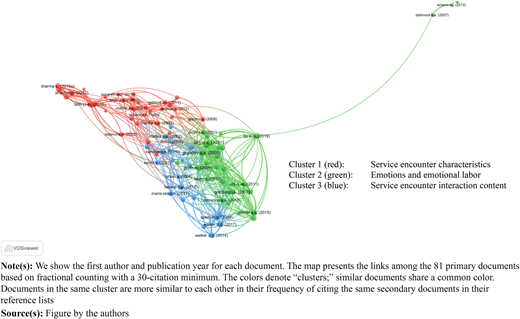
We conducted our bibliographic coupling analysis using fractional counting (Perianes-Rodriguez et al., 2016) and set inclusion criteria for the analysis requiring primary documents to have a minimum of 30 citations to be included (Wu et al., 2021). These analytical decisions reduced our sample to 84 documents from the initial 155 documents. Additionally, to be considered a document cluster, the clusters needed to include a minimum of 21 papers, which corresponds to 25% of the reduced primary document sample (Jarneving, 2005). Following the removal of three papers that were not linked to other documents, the analysis yielded three clusters encompassing 81 papers, as depicted in Figure 3. We present the five most significant primary documents for each bibliographic coupling cluster in Table 2. In Supplementary Material B, we summarize the most influential documents (papers and books) cited by papers in our bibliographic coupling clusters ( Table B4). References for these 81 papers, by cluster, can be found in Supplementary Material E.
Bibliographic coupling analysis: cluster map of dyadic service encounter research
Bibliographic coupling analysis: cluster map of dyadic service encounter research
Top 5 documents for each cluster based on bibliographic coupling
| Cluster | Cluster description | Examples | Weight (total link strength) | Papers |
|---|---|---|---|---|
| Cluster 1: service encounter characteristics (red) | Research investigating encounter features that affect customer satisfaction around two general themes: service failure and culture | Tam et al. (2014) | 60 | 33 |
| Tam et al. (2016) | 60 | |||
| Sharma et al. (2012) | 59 | |||
| Sharma et al. (2015) | 54 | |||
| Sharma et al. (2016) | 48 | |||
| Cluster 2: emotions and emotional labor (green) | Research investigating the role of emotions in service encounters, including emotional labor, contagion, authenticity and display | Lin and Lin (2011) | 74 | 27 |
| Grandey et al. (2005) | 62 | |||
| Groth et al. (2009) | 50 | |||
| Gabriel and Diefendorff (2015) | 49 | |||
| Chi et al. (2011) | 48 | |||
| Cluster 3: service encounter interaction content (blue) | Research investigating interaction content, including customer behavior (e.g. mistreatment, incivility) and employee behavior (e.g. scripts, rapport, innovation and mimicry) | Spencer and Rupp (2009) | 53 | 21 |
| Walker et al. (2017) | 50 | |||
| Lin and Lin (2017) | 48 | |||
| Henkel et al. (2017) | 46 | |||
| Rupp and Spencer (2006) | 40 |
Source(s): Table by the authors
Coupling cluster 1 (red): service encounter characteristics
Cluster 1, consisting of 31 primary documents, focusses on service encounter characteristics affecting customers' evaluations of service encounter quality, satisfaction and loyalty. Two main themes emerged: the role of service failure (11 papers) and the role of cultural differences and individual attributes (14 papers) in shaping customers' assessments of service encounters. Considering the critical importance of service failures to organizations and strong customer reactions to service failures, several papers in the first theme examine incidents of service failure and recovery (e.g. Boshoff, 2012; Gabbott et al., 2011; Mattila, 2001) as well as strategies (e.g. listening) used to manage interactions and alter service outcomes (de Ruyter and Wetzels, 2000). Smith et al. (1999) found that customers prefer to receive recovery resources that match the failure type in amounts that are commensurate with the magnitude of the failure. In addition, service employees' effort, apologies and supportive responses also can assuage customers' anger (Sarel and Marmorstein, 1998) and anxiety (Menon and Dubé, 2004) in service failure and recovery encounters.
Consistent with increasing globalization, international travel and offshoring of service within our review timeframe, research on intercultural service encounters involving customers and employees from different cultural backgrounds is prevalent. Reflecting this trend, some of the most highly linked papers in the second theme focus on cultural differences and individual attributes that affect customer service evaluations. One study of customers in Hong Kong found that perceived cultural distance between a respondent and the service provider was positively related to customer satisfaction (Tam et al., 2014). In contrast, other studies conducted by the same authors in the same geographic location (Sharma et al., 2012, 2015), found a negative relationship between perceived cultural distance and interaction comfort, satisfaction and perceived service quality. Research in this theme also revealed that the negative effects of cultural distance and service failure on customer satisfaction depends on customers' personal cultural orientations (Sharma et al., 2016; Tam et al., 2016).
Coupling cluster 2 (green): emotions and emotional labor
Cluster 2, the second-largest bibliographic coupling cluster, comprises 26 articles focused on emotions and emotional labor. Key documents in this cluster report on employee emotional labor strategies, as well as antecedents and outcomes of employee emotional labor. Organizations striving to deliver “service with a smile” reflect the strong industry norms requiring employee positive emotional displays and warmth in customer interactions (Ashforth and Humphrey, 1993). Positive emotional displays are a recurring research theme as these service employee displays favorably impact customer mood and service evaluations (Grandey, 2003). Delivery of positive affect in service encounters involves a combination of employee spoken words, facial expressions and vocal tone conveying friendliness (Tsai, 2001) and is driven by employees' inner emotions, work group mood and the service environment (Lin and Lin, 2011).
In this cluster, scholars focused on employees' (in)authentic emotional expressions (14 papers) and investigated differential outcomes of surface and deep acting (8 papers). Collectively, studies in this cluster demonstrate that authenticity and intensity are crucial dimensions of employees' positive emotional displays that influence customer service outcomes (Cheshin et al., 2018). For example, Grandey et al. (2005) studied the impact of authentic (Duchenne) smiles which activate muscle groups around the eyes (Ekman and Friesen, 1982) on customers' impression formation. Authentic emotional displays are associated with customer perceptions of friendliness and warmth, leading to increased customer evaluations and satisfaction (Grandey et al., 2005).
Research in this cluster indicates that deep acting, an emotional labor strategy whereby inner feelings are modified to support authentic positive expressions (Grandey, 2003), is generally effective, leading to better emotional and financial outcomes (e.g. tips) (Chi et al., 2011). Conversely, surface acting involves the superficial modification of emotion expressions, resulting in inauthentic positive emotion displays (Grandey, 2003). Unlike deep acting, the effectiveness of surface acting in terms of performance and financial gains depends on employee extraversion (Chi et al., 2011). Similarly, Groth et al. (2009) found that while surface acting does not significantly impact customer evaluations, deep acting is positively related to perceived customer orientation and service quality. Furthermore, these authors demonstrated that accurately detecting employee surface (deep) acting strengthens its negative (positive) effects on customer evaluations. Overall, findings in this cluster clearly demonstrate that customers consider (in)authentic emotional expressions associated with surface acting and deep acting when evaluating service encounters.
Coupling cluster 3 (blue): service encounter interaction content
Cluster 3 comprises 23 articles focusing on the behaviors participants exhibit in service encounters, which contribute to the overall interaction. Interactions between customers and employees are guided by norms of typical human interactions as well as the expectations associated with their respective roles as service recipients and providers (Solomon et al., 1985). Generally, as service co-producers, employees and customers engage in behaviors that are neither extremely positive nor extremely negative. However, instances can arise when customer and/or employee behaviors deviate from encounter norms. The common thread connecting papers in this cluster is their exploration of the impact of negative or positive behaviors on the other participant in the service encounter.
Seven articles within this cluster specifically documented negative customer behaviors, including aggression and mistreatment directed towards service employees (e.g. Huang et al., 2019; Rupp and Spencer, 2006; Walker et al., 2014). By analyzing transcripts and computerized text analysis (CATA) of customer service events, for example, Walker et al. (2017) identified combinations of customers' aggressive words, second-person pronouns (e.g. you, your) and interruptions as linguistic manifestations of incivility toward employees. When employees encounter or witness interactions with interactionally unfair customers, they often experience higher levels of emotional labor in managing their anger encountering difficulties complying with display rules (Rupp and Spencer, 2006; Spencer and Rupp, 2009). More recent studies have examined customer reactions to observing another customer mistreating an employee. Customers who witness mistreatment in settings like clothing stores, fast food restaurants and coffee shops, tend to show increased warmth towards the mistreated employee, offering emotional support and providing more positive evaluations of the target employee (Henkel et al., 2017).
Shifting focus away from negative customer behavior, researchers have investigated employee behaviors that favorably influence customer evaluations of service quality. For example, Lin and Lin (2017) examined the impact of affective delivery (e.g. smiling, eye contact, rhythmic vocal tone) and nonverbal behavioral mimicry (e.g. mimicking customer body position, hand gestures) as service employee nonverbal communication. The study revealed that employee nonverbal communication had a positive effect on customer emotions and rapport during the service encounter. Furthermore, customer-oriented behaviors displayed by employees, such as anticipating customer requests; providing explanations; educating customers; offering emotional support; and providing personalized information (Rafaeli et al., 2008) as well as employee creativity (Dong et al., 2015) and innovative service behavior (Stock et al., 2017) enhance service quality. In summary, research within this cluster primarily focuses on negative customer behaviors and positive employee behaviors. This discrepancy in focus likely arises from the differing behavioral expectations of service providers and recipients, as well as power dynamics in employee–customer dyads.
Summary of findings from bibliographic co-citation and bibliographic coupling analyses
As shown in Table 3, a review of findings from our bibliometric analyses reveals two meta-clusters of documents across the co-citation and bibliographic coupling clusters (emotions, service encounter evaluations) and a cluster unique to the bibliographic coupling analysis (service encounter interaction content).
Summary of bibliometric analyses: meta-clusters
| Meta-cluster | Co-citation analysis | Bibliographic coupling analysis |
|---|---|---|
| 1: Emotions | Cluster 2: Emotions in service work | Cluster 2: Emotions and emotional labor |
| Cluster 4: Emotional labor and regulation in dyadic service encounters | ||
| 2: Service encounter evaluations | Cluster 1: Shaping and explaining service encounters | Cluster 1: Service encounter characteristics |
| Cluster 3: Modeling, manipulating and measuring encounter service quality | ||
| 3: Encounter content | Cluster 3: Service encounter interaction content |
Emotions play a prominent role in the dyadic service encounter literature, as evidenced by the emotions meta-cluster that surfaced in both analyses. Co-citation Cluster 2 comprises foundational documents exploring concepts such as emotional labor, expressivity, suppression, authenticity and contagion in service work. Building on foundational studies in Cluster 2, co-citation Cluster 4 includes studies on outcomes of emotional displays for customers and employees. Bibliographic coupling Cluster 2 includes research reporting antecedents of emotional labor and outcomes of emotional labor strategies.
Another meta-cluster relates to service encounter evaluation. Co-citation Clusters 1 and 3, along with bibliographic coupling Cluster 1, examine customer evaluations of service encounters, encompassing aspects such as service quality, customer satisfaction, customer loyalty and the factors influencing these evaluations. These factors include service failure and recovery, environmental cues, customer actions, cultural differences and individual attributes. Service encounter interaction content is a third meta-cluster unique to bibliographic coupling Cluster 3. This content demonstrates the evolution of dyadic service encounter research to consider the reciprocal nature of dyadic employee–customer exchanges.
Future research agenda
We had two key objectives for this review. The primary objective was to identify the underlying “schools of thought” (Lievrouw, 1989) within the vast dyadic service encounter literature. Our findings reveal this literature's considerable progress toward explaining the role of emotions, such as emotional labor and emotional contagion, in service encounters, as well as the impact of customer actions on service employees and employee behaviors on encounter outcomes. The secondary objective was to provide guidance on unanswered research questions and pave the way for new frontiers in dyadic service encounter research.
Research direction 1: moving beyond affect in dyadic service encounter research
Both the co-citation and bibliographic coupling analyses emphasized affect-based processes in dyadic service encounter research. Concepts beyond affect remain relatively underrepresented in this literature. During encounters, customers and employees activate cognitive and affective systems to simultaneously process information and regulate interpersonal behavior towards others, including customers (Lord et al., 2010). Our bibliometric analysis revealed strong emphasis on affect in service encounters. While it is essential to study affect management, whether through expressed emotion or understanding underlying emotion-based processes in encounters, surprisingly, research focuses predominantly on affect alone, considering its insufficiency for delivering quality customer service or resolving customer problems. We need to develop a better understanding of how cognitive processes (e.g. creativity, sensemaking and executive function) influence service encounters.
One aspect of executive function is employee inhibitory control, involving individual control over behavior, attention and thought (Diamond, 2013). Executive function, including working memory and cognitive flexibility, supports employees' task focus and the ability to enact brand behaviors in service encounters. These functions enable employees to recall service procedures or find creative solutions to customer problems and adapt perspectives and approaches to problem-solving. Investigating the interplay between emotion and cognitive mechanisms (e.g. Spencer and Rupp, 2009) is important to advance the dyadic service encounter literature.
From a practical standpoint, many organizations such as Amazon and Cisco Consumer Products, view customers' effort in service interactions such as channel switching (e.g. moving from chat to voice) and problem reexplanation, as important indicators of service performance. Industry practitioners advocate for transitioning from delighting customers (i.e. emphasizing customer emotions) to prioritizing reduced customer effort in encounters (Dixon et al., 2010). Our review suggests that examining customer effort, which can potentially reflect the cognitive workload associated with co-producing service encounters, is a topic with the potential to become a research front beyond affect-based “schools of thought.”
Research direction 2: broadening the literature supporting dyadic service encounters research
Our bibliometric review revealed that dyadic service encounters research spans numerous fields and methods. However, we found less diversity in the content and types of service encounters in our sample. The typical service encounter in dyadic research involves a short interaction (under 10 min) with two participants (one customer, one employee) who are unknown to each other (e.g. a call center or retail exchange). These transactional encounters are relatively simple interactions, such as quick service restaurant orders. Yet, service encounters encompass a wide-range of economic activity, including increasingly complex and technologically-mediated transactions. Moreover, dyadic service encounters involve numerous customer segments, ranging from transactional encounters to those involving representatives from small and large businesses. The current literature only scratches the surface of the variety of dyadic service encounters and the customer segments participating in them.
To advance dyadic encounter research, we propose three avenues for future research with potential to become fronts of dyadic service encounter research. First, we recommend studying dyadic service encounters involving multiple customers and/or employees. By examining encounters with multiple participants, we can gain insights into the dynamics and complexities arising from interactions among different individuals. Second, we propose studying encounters involving more complex relationships between dyadic elements. An investigation of complex interactions can shed light on employee performance and the changing dynamics of service encounters (Huang and Rust, 2018). Third, we call for research on increasingly complex services. As technology and automation replace relatively simple tasks (Bankins et al., 2023), it becomes essential to explore encounters that involve intricate relationships among customers, employees and technology. Extending dyadic service encounter research in these three directions reflects the changing front of service employment and also, could improve generalizability of extant findings.
Research direction 3: moving inside dyadic service encounters
The dyadic service encounter research front clearly encounters resistance when moving beyond investigating dynamics of service encounters in a general sense. For example, in scenario- or simulation-based lab experiments, researchers often manipulate customer mistreatment (e.g. Rupp and Spencer, 2006; Spencer and Rupp, 2009), but customers frequently transition between civility and incivility within an encounter. Furthermore, employee emotional labor can vary during the encounter (Gabriel and Diefendorff, 2015). Beal and Weiss (2003, p. 442) underscored the importance of moving beyond examining “relationships at the aggregate level” which “are really summaries of processes that play out at a momentary level within defined time frames.” Service encounters are dynamic. Within an encounter, customers and employees can transition between civility and incivility; employees express emotions during key encounter turns and customers co-produce service effectively during certain moments, but not in others because they are unprepared, or deliberately disrupt the encounter through aggression or hostility.
In developing our future research guidance, we acknowledge that service encounters involve different segments, or turns. For example, a transactional customer service encounter could involve initial small talk, the exchange of transaction information (e.g. name, account number), a customer complaint, an employee's attempt at service recovery and the conclusion of the interaction (Gutek et al., 1999). Despite service encounter complexity, researchers typically focus on the entire encounter, thereby overlooking the rich theoretical, empirical and practical insights that could be derived by analyzing dynamics within encounters.
Building on Groth et al.’s (2019) recommendation to increase research on the dynamic aspects of service delivery across levels of analysis, we provide two suggestions for advancing the dyadic service encounter research front. First, scholars should focus on how variance in the experiences of customers and employees relates to overall perceptions of service quality, employee performance, or employee well-being. Second, the dynamic nature of participants' behavior in service encounters means that encounters often finish differently from the way they started. Current dyadic service encounter research neglects when in encounters customer or employee behaviors change, what actions occur in specific turns to drive employee performance or service quality and whether the pattern of turns in encounters drive encounter outcomes.
The importance of finishing strong and continuously improving performance throughout a service encounter is a crucial aspect of service design (Chase and Dasu, 2001). However, this aspect is often overlooked in whole encounter research and theory. To address this gap, within-encounter dyadic service research can play a vital role in identifying the key components of encounter design that are often missed. By focusing on intricacies within an encounter, we can uncover valuable insights that contribute to enhancing the overall service experience. In addition, integrating time into service encounter research is essential for improving our understanding of how the dynamics during an encounter influence customer and employee outcomes (Mitchell and James, 2001). By considering the temporal dimension, we can examine the sequence of events, transitions and fluctuations that occur within an encounter.
Research direction 4: extending research on technology-mediated dyadic service encounters
Our review of the dyadic service encounter literature revealed a predominant focus on face-to-face and telephone-based encounters, while technology-mediated encounters remain under-investigated. With evolving technologies, companies increasingly offer customer service through email, social media, live chat and service bots (Bacile, 2020; Ishii and Markman, 2016). These channels provide flexibility and convenience for customers, such as 24/7 availability, but sacrifice information richness, including limited synchronization and cue availability (Baltes et al., 2002). Despite the limitations in information richness, text-based interactions offer organizations the opportunity for enhanced performance monitoring, such as sentiment analysis of each service encounter. However, it is crucial to understand how advancing technologies influence dyadic service encounters, including the role of affect-based processes, increased electronic performance monitoring and encounter features that impact customer satisfaction and employee performance.
In contrast to face-to-face or telephone encounters, affect-based processes identified in the existing literature could be less relevant in online service encounters, where many newer technologies restrict the access to affect-related cues. This change, such as reduced emotional channel leakiness (Rosenthal and DePaulo, 1979), opens up new research directions. For instance, investigating employee strategies for managing emotions in online encounters, factors influencing customer evaluations of online service encounters (e.g. information quality and ease of use) and customer expectations of emotional engagement or anthropomorphic cues from chatbots (Araujo, 2018).
Research direction 5: making dyadic service encounter research more diverse
Surface-level diversity (e.g. gender, race, perceived cultural distance) in intercultural service encounters has received considerable attention (Boshoff, 2012; Sharma et al., 2012, 2015). Our review revealed research opportunities to explore different forms diversity in service encounters. Few scholars have considered other forms of diversity (e.g. age, neurodiversity, disability, socio-economic status, or sexual orientation). As populations age and organizations become more aware of customer cognitive abilities, the dyadic service encounter research front needs to better reflect encounter participant diversity. Finally, our review identified a gap in research samples representing populations from large parts of the world, such as South America and Africa. Most of the primary documents we examined focused on samples from North America, specifically the United States. While our inclusion criteria could have contributed to this limitation, it is crucial for dyadic service encounter research to extend its scope to include encounters from diverse geographic regions and populations to enhance the generalizability and applicability dyadic service encounter research findings.
Conclusion
Our comprehensive review of dyadic service encounter research has highlighted the interdisciplinary and multimethod nature of this literature. By conducting co-citation and bibliographic coupling analyses, we revealed the different schools of thought shaping this literature. One school revolves around emotion-based research, encompassing concepts such as emotions, emotional expressivity, emotional labor and emotional contagion. The second school focuses on investigating service encounter features and outcomes, including customer satisfaction, service failure and employee performance. Building upon our analyses, we strongly advocate for future research that delves deeper into the individual processes unfolding during service encounters and their significant influence on customer and employee encounter outcomes. By broadening the scope of investigation, we can gain a more comprehensive understanding of the complexities inherent in dyadic service encounters. Furthermore, we emphasize the need for future research to encompass a wider range of dyadic service encounters, incorporating their inherent complexity and reflecting the diverse nature of these interactions. It is essential to expand the diversity represented in service encounter research, taking into account factors such as participant characteristics, cultural backgrounds and the evolving technological landscape. In conclusion, our review is a call to action for researchers in the field of dyadic service encounters.
The paper draws on research supported by the Social Science and Humanities Research Council of Canada.
References
Further reading
Appendix
The supplementary material for this article can be found online.

