Social networks have become important firm-customer touchpoints, challenging service firms to manage consumer feedback and develop effective communication strategies. This study aims to examine how corporate response strategies (replying to only negative vs some positive and negative comments), response types (defensive vs accommodative) and account types (standard vs humanized) affect the reactions of complaining social network users.
The authors provide insights into common marketing practices and then present a quantitative preliminary study and focus groups to build the foundation for a new theoretical framework. The authors also draw on accessibility-diagnosticity theory, apply it to the research context and test its application empirically. The authors subsequently test the combined effects of response strategies, response types and account types in the quantitative main study.
The response type influences complainants’ attitudes toward the firm through complaint satisfaction, response perception and perceived customer orientation. The response strategy affects attitudes only through perceived customer orientation. There is an interaction between response type and account type. The findings suggest that social media managers using a selective response strategy should address all negative comments, use humanized accounts and provide accommodative responses. If defensive responses are necessary, humanized accounts may help mitigate negative effects.
The mixed-methods approach offers comprehensive insights into communication strategies on social networks. The authors validate a new theoretical framework by applying accessibility-diagnosticity theory to the context and reveal the benefits and novelty of humanized communication on social networks, which increases flexibility and strategic advantages by mitigating negative effects of defensive replies but remains uncommon among service firms.
Introduction
Social networks have become key touchpoints between service firms and consumers, shaping consumer behavior (e.g. Einwiller and Steilen, 2015; Tsao and Su, 2021; Van Mulken and Heslenfeld, 2025) and customer relationships (Oncioiu et al., 2021). Yet many service firms struggle to strategically manage the growing volume of user comments in line with customer expectations (Cheng et al., 2024). While advanced artificial intelligence (AI) tools are increasingly integrated into customer service, the contextual and communicative complexities of social networks, such as sarcasm and irony, limit their effectiveness (Sykora et al., 2020). Social networks require authentic interaction, while communication failures are visible and damage the firm’s reputation. Therefore, our overarching aim is to examine how service firms can enhance the effectiveness of their social media strategies through different communication elements. Specifically, we investigate three interrelated service firm strategies that shape consumers’ overall impressions of the service firm:
the response strategy (i.e. which comments to address);
the response type (i.e. how to reply); and
the account type (i.e. how the reply is delivered) (Lopes et al., 2023).
We focus on complaining users because online complaints are highly influential and quickly shape user perceptions of a firm, making effective communication crucial to increasing customer satisfaction (Agnihotri et al., 2024; Einwiller and Steilen, 2015; Weitzl et al., 2018) and improving attitudes (Stauss and Seidel, 2019). Accordingly, our research examines key service recovery outcomes, namely, complaint satisfaction and attitudes toward the firm, as well as users’ perceptions of customer orientation, which reflect the extent to which a service firm is seen as genuinely attentive and shape the evaluation of its service recovery efforts on social networks. Additionally, we include perceptions of the service firm’s response as a variable capturing how users assess the firm’s reply to their online complaint.
First strategic decision: Response strategy. Replying to all comments is most customer-oriented but many firms lack the resources to do so (Guha et al., 2018). Selective strategies include responding only to positive, only to negative or to some positive and negative comments. As it is important to address complaints (Istanbulluoglu and Sakman, 2024), replying to only positive comments appears inadequate. Yet it remains unclear whether and how firms should balance replies to positive and negative comments. Focusing on negative comments risks framing the social network as a complaint channel by encouraging more complaints (Cheng et al., 2024; Golmohammadi et al., 2021; Ma et al., 2015), whereas addressing positive feedback may reinforce favorable comments and audience perceptions (Schamari and Schäfers, 2015). Replying to some but not all comments leaves potentially problematic comments unaddressed. Considering this dilemma and the lack of systematic research, our first research objective is to compare user reactions to firms’ replies to only negative vs some positive and negative comments.
Second strategic decision: Response type. Well-crafted responses can signal customer orientation and be perceived as useful (Demmers et al., 2018), helpful (Jin et al., 2023), credible (Verčič et al., 2019) and emotional (Herhausen et al., 2023). Accommodative responses can have positive effects (e.g. Einwiller and Steilen, 2015; Weitzl et al., 2018; Van Mulken and Heslenfeld, 2025), but defensive responses may also be suitable in some contexts (e.g. Weitzl, 2019; Weitzl and Einwiller, 2020). Responding to the call for research on the effectiveness of accommodative vs defensive responses (Lopes et al., 2023), our second research objective is to examine how defensive vs accommodative responses affect user reactions.
Third strategic decision: Account type. Consumers generally prefer human service (Huang et al., 2024), but firm-customer interactions on social networks often feel impersonal, leaving users uncertain whether they are communicating with human employees or chatbots (Cheng and Pan, 2021). Accordingly, our third research objective is to investigate the moderating effects of standard vs humanized account types that service firms can use on social networks.
Recent practice shows that leading service firms predominantly use selective response strategies, accommodative responses, standard accounts and rarely implement humanized communication (see Table 1). These patterns, along with the limited research in this area, underscore the need to critically evaluate common practice and systematically examine its implications.
Drawing on the practical insights in Table 1, a preliminary study on the effects of selective response strategies on complaining users’ perceptions of customer orientation and attitudes toward the service firm, and in-depth focus group discussions exploring complaint satisfaction, attitudes, perceived customer orientation and response perceptions, we develop our conceptual framework for the main quantitative study. We additionally draw on accessibility-diagnosticity theory (ADT), which explains how different response approaches affect users’ ability to retrieve relevant information (accessibility) and to evaluate its importance (diagnosticity), making it well-suited to public, dynamic and information-rich social network interactions.
With this research, we make several key contributions. We advance service marketing theory by applying ADT to effective complaint management on social networks. We develop a novel framework by linking ADT to core service marketing concepts and providing empirical measures of accessibility and diagnosticity on online networks. Furthermore, our study extends social media and webcare, service recovery and strategic communication research, highlighting the theoretical relevance of humanized account types and perceived customer orientation as key factors in social network settings. These contributions extend the theoretical understanding of how consumers process service firm responses to complaints and offer a methodological foundation for more effective digital service communication strategies.
Moreover, our findings offer clear practical guidelines. Although marketing practice is often complex, our findings suggest that service firms using a selective response strategy should at least reply to all negative comments. Social media managers should use humanized accounts and provide accommodative responses to complaints. Since marketing practice requires flexibility and defensive responses may occasionally be unavoidable, responding from humanized accounts provides novel benefits by mitigating negative effects and differentiating firms through a highly personal communication style that remains rare in practice. By providing helpful, emotional and credible responses and signaling strong customer orientation, service firms can foster complainants’ understanding and may even trigger positive reactions.
Analysis of service firms’ response strategies on Instagram
To gain insights into marketing practices, we examined real firm-consumer interactions on Instagram. Instagram is one of the most popular and fastest-growing social networks (Bastero, 2025), with many users following and engaging with firms (Meta, 2019).
In February 2023, we searched for international service firms that ranked among the top ten in their industries, maintained Instagram accounts and had over 50,000 followers. This minimum number of followers ensured a realistic level of social media activity and adequate insight into firm-consumer engagement. We examined service firms from eight different industries (hotels, restaurants, food delivery, airlines, logistics, communication, retail and e-commerce) to gain broad insights. Given that qualitative research emphasizes information depth over quantity (Barbour, 2007), we selected 3 firms per industry, resulting in a sample of 24 service firms. Three firms (American Airlines, Alibaba and Dunkin’) fulfilled the selection criteria but were excluded from the analysis as they did not respond to consumer comments during the period under research. An overview of the remaining firms’ response strategies, types and accounts for November 2022 is presented in Table 1.
The observation that most service firms in our sample adopt a selective strategy by responding to some positive and negative comments suggests that they aim to acknowledge different feedback to interact with diverse consumers without spending the effort to address all comments. The prevalence of accommodative responses across industries, with replies to positive comments expressing appreciation and replies to negative comments including apologies and efforts to correct service failures, appears to reflect a common trend in social media marketing communication. Additionally, the widespread use of standard company accounts to reply to consumer comments, with some firms including the first names of responding employees, suggests that many service firms do not seem to use humanized communication.
In light of these observations, it seems essential to examine the strategy of selectively replying to some positive and negative comments, a common practice among service firms, from a scientific perspective. Systematically analyzing the effects of accommodative vs defensive responses may help service firms determine whether accommodative responses are overall more effective or whether defensive approaches can also be used. Investigating potential benefits of humanized communication generates novel insights and practical guidance for improving firm–consumer interactions on social networks.
Literature review
We discuss previous research on firm-customer communication and complaint handling of service firms on social networks from our perspective on complaining commenters.
Research on response strategies
Due to limited research on which consumer comments service firms should address on social networks, we also consider studies on firms’ responses on review platforms. Service firms aim to elicit positive consumer reactions in both contexts and must decide which comments to address. However, consumers mainly visit review platforms to exchange experiences with other consumers and do not necessarily appreciate firm interventions (Anderson and Han, 2016). Social network users, in contrast, primarily visit corporate social network sites to engage with firms (Tsai and Men, 2013; Varnali and Cesmeci, 2022). As social network interactivity further intensifies the need for reciprocal communication, firms’ response strategies are likely to have a different impact on social networks where consumers actively seek direct engagement and are more attentive to receiving a firm’s reply.
Prior research shows that replying to negative reviews can positively affect complainants’ company ratings (Hernández-Maestro, 2020; Liang and Li, 2019; Rezvani and Rojas, 2022; Sheng et al., 2019; Sheng et al., 2021; Wang and Chaudhry, 2018) and brand evaluations (Sparks and Bradley, 2017) in service recovery settings. Nevertheless, previous research on review platforms does not align on whether such corporate replies decrease (Liang and Li, 2019; Proserpio and Zervas, 2017; Proserpio et al., 2021) or increase (Chevalier et al., 2018) complainants’ unfavorable engagement. Research on social networks shows similarly mixed patterns. Replying (vs not replying) to negative comments can trigger further complaints, i.e. unfavorable engagement (Cheng et al., 2024; Golmohammadi et al., 2021; Ma et al., 2015), especially if complainants notice that firms respond to others but not to them (Gu and Ye, 2014). However, replying to negative comments might increase favorable engagement of complainants who receive a reply (Gu and Ye, 2014). Further research emphasizes that responding to negative comments on social networks improves the relationship between the firm and the complainant (Ma et al., 2015) and increases complainants’ repurchase intentions through increased trust (Istanbulluoglu and Sakman, 2024).
Although these findings point to more positive effects if firms reply to negative comments, drawing conclusions for our research context is difficult, as no study systematically compared the strategies of replying to some positive and negative comments and replying to only negative comments, and only a few studies examined social networks (e.g. Cheng et al., 2024; Golmohammadi et al., 2021; Gu and Ye, 2014; Istanbulluoglu and Sakman, 2024; Ma et al., 2015).
Research on response types
Despite the broad body of literature on different types of responses to complaints on social media, most studies related to social networks examine passive network users who only observe firm-customer interactions and do not participate in the conversation (e.g. Johnen and Schnittka, 2019; Weitzl and Hutzinger, 2017). Given our focus on active users and the limited research on the effects of response types (defensive vs accommodative) on complaining commenters on social networks, we again include studies on review platforms.
With accommodative responses, which typically include apologies, corrective actions and compensation (Lee and Song, 2010), firms acknowledge customer concerns, assume responsibility and provide constructive solutions (Casado-Díaz et al., 2020). With defensive responses, firms deny responsibility, blame external factors and avoid acknowledging fault (Casado-Díaz et al., 2020; Li et al., 2018). Accommodative responses in online service recovery can enhance corporate image (Tsao and Su, 2021), purchase intentions (Tsao and Su, 2021; Van Mulken and Heslenfeld, 2025) and complaint satisfaction (Einwiller and Steilen, 2015). While accommodative responses typically reduce negative attributions for complainants with few prior failures, defensive responses can have similar effects for those with multiple prior failures (Weitzl et al., 2018). Likewise, if complainants experienced multiple failures but have a strong relationship with the firm, defensive responses lead to lower revenge intentions (Hutzinger and Weitzl, 2023). Additionally, accommodative responses benefit constructive complainants but may have little effect on vindictive ones (Weitzl, 2019; Weitzl and Einwiller, 2020). Prior research has focused on external factors and left a gap in understanding the role of communication elements within a service firm’s control. Therefore, exploring how specific communication strategies shape the impact of different response types on complaining commenters is an important step toward examining the contingent effectiveness of accommodative vs defensive responses.
Research on humanized marketing communication
Humanized marketing communication means that a real person is (at least digitally) present and actively engaged in an interaction. Research on service recovery suggests that customers prefer interactions with human representatives over automated systems, as they are perceived as more empathic and trustworthy (Huang et al., 2024). Providing visual and personal information about the response sender (e.g. photo, name, role, contact details) can enhance perceptions of accessibility, customer orientation and service quality on service websites (Herhausen et al., 2020). This finding highlights the relevance of investigating complainants’ customer orientation perceptions in the context of humanized marketing communication on social networks. Although one study finds no significant differences between standard and humanized accounts in terms of complainants’ satisfaction and brand attitudes on review platforms (Esmark Jones et al., 2018), other studies show that providing detailed sender information can increase complainants’ willingness to forgive the firm if combined with mixed accommodative and defensive replies (Tathagata and Amar, 2018) and lead to fewer complaints (Cheng and Pan, 2021).
Most studies focus on the effects of humanized communication on observing social media users (e.g. Barcelos et al., 2018; Huang and Ki, 2023; Lopes et al., 2024; Schamari and Schäfers, 2015; Park and Jiang, 2021; Olson and Ro, 2020), with only one study (Cheng and Pan, 2021) examining the effects of humanized communication on complainants on social networks. Thus, prior research offers only limited insights into the impact of humanized communication on complaining commenters and the combined effectiveness of response accounts, strategies and types in service recovery settings.
Given the limitations of previous research, we conducted a preliminary study (see Table A1) to develop an initial understanding of how replying to only negative vs some positive and some negative comments affects complainants’ perceptions of service firms’ customer orientation and their attitudes toward the firm. The results of the preliminary study interestingly show that perceived customer orientation was higher with the “response to only negative comments” strategy, suggesting that this strategy might have more positive effects than replying to some positive and negative comments, which is common in marketing practice. Next, we present insights from focus groups based on the preliminary study’s initial findings.
Focus groups
Objective, sample and procedure
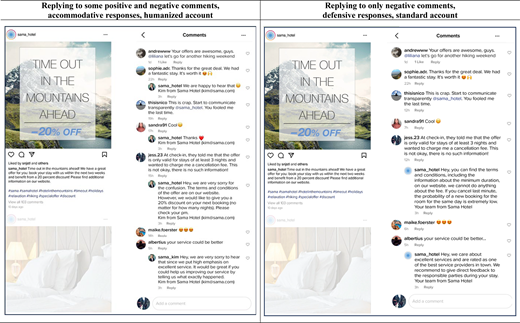
With the dynamic focus group discussions, we aimed to develop a deeper understanding of our field of research, get a multifaceted picture of complainants’ reactions to various forms of social media marketing communication, and lay the foundation for our theoretical framework. We conducted two semistructured focus groups with participants recruited via Instagram (January, 2024; each lasting 40 min; eight participants in total; equal gender distribution; ages ranging from 24 to 32 years). The focus groups discussed defensive vs accommodative service firms’ replies to only negative consumer comments separately for each account type. We focused on the strategy of replying to negative comments, as the preliminary study indicated that this strategy elicited more favorable commenter perceptions (see Table A1). The stimulus material was developed based on our analysis of service firms’ response behavior on social networks and was pretested for clarity and realism (see Figure A1).
We selected participants who used social networks at least several times per week, were over 18 years old and had prior experience complaining on a service firm’s social network site. Potential participants completed a brief prescreening survey verifying these criteria before being invited to participate. With this selection procedure, we ensured that participants had first-hand experience with digital complaint situations and generated meaningful insights.
The participants consented to record the meetings and were briefed on the study context and the scenario (see Table A1). They watched two simulated social network threads (one for each account type, with the order counterbalanced). Each thread displayed the service firm’s post, consumer comments (including the comment from the alias they were asked to identify with) and the service firm’s replies to negative comments (see Figure A1). The participants shared their impressions of the firm’s response, complaint satisfaction, attitudes toward the firm and their perceptions of customer orientation.
To ensure the rigor and reliability of the focus group analysis, we audio-recorded and transcribed all discussions. Following the coding process outlined by Bingham (2023) and Bingham and Witkowsky (2022), we used an inductive approach, allowing the coding scheme to emerge directly from the data. We then organized the codes into overarching themes through iterative analysis to capture recurring topics and patterns across participants and reflect shared perspectives.
Focus group insights
The overarching themes and the participants’ statements are summarized in Table 2.
The focus group discussions suggest that replying to only negative comments may enhance user reactions when service firms provide an accommodative response, which increases perceptions of firms’ sincerity and trustworthiness. The participants perceived the account type as less important in the context of the response strategy. However, the more tangible and credible response sender using a humanized account seems to mitigate the negative effects of defensive responses. Overall, the participants emphasized that firms should provide useful, helpful, credible and emotional replies to complaints on social networks. The focus groups confirm and contextualize principles of complaint management, such as the importance of helpfulness and credibility for the specific setting of social media interactions. They illustrate how accommodative responses to negative comments and the use of humanized accounts can positively influence user perceptions.
Theoretical background and hypotheses
We synthesize arguments from previous research and the insights from the preliminary study and the focus groups to develop our theoretical framework. We position our research in three major streams of the service literature:
Social media and webcare research, which examines how firms’ online responses shape user perceptions and relational outcomes (e.g. Hogreve et al., 2019; Istanbulluoglu and Sakman, 2024; Sparks et al., 2016; Weitzl and Einwiller, 2020).
Service recovery literature, which provides established mechanisms explaining how recovery efforts influence satisfaction and attitudes (e.g. Gelbrich and Roschk, 2011; Maxham and Netemeyer, 2002; Orsingher et al., 2010; Smith et al., 1999; Tax et al., 1998).
Strategic communication research, which emphasizes how overarching principles like message consistency, transparency and credibility affect consumer evaluations and trust (e.g. Coombs, 2007; Frandsen and Johansen, 2017; Holland et al., 2021; Sharma and Patterson, 1999).
We additionally apply ADT to our research context, as accessible and diagnostic communication is essential in firm-customer interactions on social networks.
Effects of response strategy and response type
According to ADT, information accessibility and diagnosticity affect individuals’ evaluations and choices (Feldman and Lynch, 1988). Information accessibility refers to the ease with which information can be accessed and made available for cognitive processing. Information is considered accessible when consumers can retrieve it effortlessly and conveniently (Herr et al., 1991). Information diagnosticity refers to how consumers assess the usefulness of information (Jiang and Benbasat, 2004). High diagnosticity is given when information assists the consumers’ decision-making (Chen et al., 2024). The more accessible and diagnostic the information, the more consumers can rely on it (Herr et al., 1991), form positive brand perceptions and exhibit favorable reactions. ADT has been applied to various marketing contexts, including advertising (e.g. Huang et al., 2021), pricing (e.g. Vaidyanathan, 2000) and electronic word of mouth (e.g. Chen et al., 2024).
We apply ADT to our research context to explain how complainants process service firms’ recovery attempts on social networks. Social networks expose consumers to a continuous stream of firm- and user-generated content that varies in accessibility (i.e. how easily it can be retrieved or noticed) and diagnosticity (i.e. how useful and credible it is for forming judgments). Consumers rely most on information that is highly accessible and diagnostic (Herr et al., 1991). We argue that a firm’s response strategy (i.e. the types of comments service firms address: only negative or some positive and negative comments) determines the visibility and salience of the firm’s engagement, and thus conveys accessibility. The response type (defensive vs accommodative) and the account type (standard vs humanized) mirror the helpfulness and credibility of the responses and thus convey diagnosticity. This dual perspective helps to ground the multifaceted effects of social media marketing communication theoretically and provides a novel framework for capturing user reactions to firm-customer interactions on social networks. Based on the application of ADT to our research context, we describe the accessibility and diagnosticity paths as follows.
Accessibility path: This path runs from the response strategy through customer orientation perceptions to attitudes toward the firm. Since we examine which comments service firms address, we do not expect response strategies to influence complaint satisfaction or response perceptions, as these aspects primarily depend on the content of the reply. The information firms make accessible by replying to consumer comments helps complainants evaluate the firms’ customer orientation. Replying to some positive and negative comments may demonstrate the firm’s accessibility and commitment to a broad range of (potential) customers. Consequently, this strategy may be a well-integrated approach to complaint handling and relationship management, reinforcing the firm’s customer orientation. However, replying to negative comments likely provides more accessibility than replying to some positive and negative comments, as replying to only negative comments leaves clear and easily recognizable patterns in social network threads, while replies to positive and negative comments may appear less systematic, and users may not recognize the criteria behind the reply patterns.
Given that accessible information guides attitude formation (Glasman and Albarracín, 2006), complaining commenters are likely to draw on salient firm-related cues when forming attitudes in response to a service failure. The publicly visible response strategy conveys information that may influence complainants’ attitudes toward the firm (Liu et al., 2019; Stauss and Seidel, 2019). In social media and webcare research, the response strategy signals a firm’s willingness to acknowledge, address and remediate customer problems (Einwiller and Steilen, 2015). Webcare in the form of responding to complaints on social networks enhances perceptions of service quality and trust (Hogreve et al., 2019), strengthens favorable firm evaluations and behavioral intentions (Istanbulluoglu and Sakman, 2024; Van Noort and Willemsen, 2012), as well as firm-customer relationships (Ma et al., 2015).
By replying to all negative comments, service firms systematically manage complaints, demonstrating effective customer care (Colliander et al., 2015). As service recovery literature emphasizes the importance of complainants’ fairness perceptions (Gelbrich and Roschk, 2011; Maxham and Netemeyer, 2002; Tax et al., 1998) and as addressing all complaints can increase such perceptions (Orsingher et al., 2010), this strategy is likely more effective in fostering positive attitudes than replying to some positive and negative comments, which leaves some complaints unaddressed. This assumption aligns with previous research, which shows that complaining commenters react negatively when a firm responds to others but not to their own complaint (Gu and Ye, 2014). From a strategic communication perspective, maintaining consistency is essential (Coombs, 2007; Frandsen and Johansen, 2017; Sharma and Patterson, 1999). In this regard, consistent and systematic replies to complaints signal trustworthiness and concern (Sparks et al., 2016) as well as effort and empathy (Abney et al., 2017), reflecting a customer-oriented approach. Our focus group insights and the results of our preliminary study further suggest that service firms’ replies to negative comments signal a willingness to resolve customer issues and positively affect perceptions of customer orientation in service recovery settings. These arguments lead to:
For complaining commenters, service firm replies to only negative comments trigger perceptions of stronger customer orientation than replies to some positive and negative comments.
From a social media and webcare perspective, visible responsiveness to complaints signals attentiveness and reliability, which shapes customers’ evaluations of the firm and its services (Hogreve et al., 2019; Sparks et al., 2016; Van Noort and Willemsen, 2012). A firm’s perceived effort and care in firm-customer interactions can, in turn, enhance brand attitudes (Colliander et al., 2015). Service recovery literature further indicates that a firm’s commitment to addressing customer issues enhances perceived service quality (Black et al., 2014; Tax et al., 1998). From a strategic communication perspective, transparent and credible messaging can positively influence customer attitudes toward the firm (Holland et al., 2021), as it might be seen as customer-oriented. Building on these insights, we position customer orientation as a key concept for complaining customers, for whom the way their complaints are handled on social networks influences service recovery outcomes. This assumption is supported by our focus group insights, which indicate that stronger perceptions of customer orientation are likely to lead to more favorable attitudes toward the firm, as consumers value firms that prioritize customer care and demonstrate a serious commitment. We therefore assume:
Perceptions of a stronger customer orientation result in more positive attitudes toward the firm.
Diagnosticity paths: Service firms can respond to negative comments defensively or accommodatively, which may lead to different levels of perceived response diagnosticity. These paths run from the response type through (a) perceptions of the firm’s response and (b) complaint satisfaction to perceived customer orientation and finally to attitudes toward the firm.
Diagnosticity path (a): Service firms’ replies on social networks and in the context of webcare reveal information that enables users to assess the responses and related benefits (Johnen and Schnittka, 2019; Weitzl et al., 2018). Service recovery research suggests that complainants appreciate compensation, followed by an explanation and apology from the firm (Gelbrich and Roschk, 2011; Smith et al., 1999; Tax et al., 1998), when the failure occurs at the beginning of the relationship (Cambra-Fierro et al., 2015). Since only accommodative responses provide monetary benefits (i.e. compensation) and social benefits (i.e. apology) (Weitzl and Einwiller, 2020) that compensate for the service failure and the effort required to complain, the diagnostic cues of accommodative responses are salient. This aligns with social media research showing that accommodative responses are particularly beneficial as the provision of specific benefits helps restore balance in the firm-customer relationship (Weitzl et al., 2018). Previous research in this domain suggests that defensive responses can be effective when complainants have experienced multiple prior failures (Weitzl et al., 2018) or exhibit vindictive behavior (Weitzl, 2019; Weitzl and Einwiller, 2020), but neither condition applies to our research context.
Principles of strategic communication outline the importance of credible, transparent and emotional messaging (Frandsen and Johansen, 2017) as well as of perceived usefulness (Demmers et al., 2018) and helpfulness (Jin et al., 2023) of replies. Research on social networks shows that accommodative responses are perceived as more credible than defensive responses (Weitzl and Hutzinger, 2017). This aligns with our focus group insights, indicating that effective responses should be emotional, helpful, useful and credible – characteristics that the participants associated with accommodative but not with defensive responses. We thus argue that complainants who recognize that service firms respond accommodatively by showing emotions (e.g. through a sincere apology), providing helpful and useful information (e.g. clarifying the service recovery process, providing compensation) and acting credibly (e.g. giving transparent explanations) are more likely to perceive the response as diagnostic. Hence, we assume:
For complaining commenters, accommodative responses generate more positive perceptions of the service firm’s response (as useful, helpful, emotional and credible) than defensive responses.
Consumers experiencing service failures are typically in high-arousal emotional states. When firms listen to what customers say and show empathy in social media and webcare contexts, complainants are more likely to feel acknowledged and be grateful (Herhausen et al., 2023). Online responses that convey customer care cues, such as active listening (Herhausen et al., 2023) or effort (Colliander et al., 2015), signal that the firm takes the customer seriously, thereby fostering perceptions of strong customer orientation. These positive perceptions of the firm’s response likely enhance complainants’ service recovery attitudes (Colliander et al., 2015; Weitzl and Hutzinger, 2017). Service firms should consequently integrate clear and compelling message signals to improve outcomes, aligning with strategic communication insights (Holland et al., 2021) and service recovery research emphasizing the importance of fair and just complaint handling (e.g. Gelbrich and Roschk, 2011; Tax et al., 1998). In this regard, the focus group insights suggest that responses perceived as useful, helpful, emotional and credible are likely to reinforce the impression that the firm values its customers and takes their concerns seriously, thereby demonstrating strong customer orientation and resulting in more favorable attitudes toward the firm. These arguments result in:
More positive perceptions of the service firm’s response (as useful, helpful, emotional and credible) enhance perceived customer orientation and attitudes toward the firm.
Diagnosticity path (b): The response type reveals how service firms acknowledge customer concerns. Literature on social media and webcare shows that firms can increase complaint satisfaction by demonstrating attentiveness and willingness to solve problems (Einwiller and Steilen, 2015; Weitzl, 2019). In this regard, perceptions of higher response diagnosticity enhance service perception and complaint satisfaction (Huang and Ha, 2020). Service recovery research outlines that perceptions of justice (i.e. distributive justice: compensation; interactional justice: empathy, politeness and visible effort) enhance service recovery outcomes (Gelbrich and Roschk, 2011; Maxham and Netemeyer, 2002; Orsingher et al., 2010; Smith et al., 1999; Tax et al., 1998). Research on strategic communication demonstrates the positive effects of effective communication on firm-customer relationships (Sharma and Patterson, 1999).
Accommodative responses signal the firm’s effort to resolve customer concerns and fair customer treatment by offering solutions, apologies and compensation (Einwiller and Steilen, 2015; Lee and Song, 2010). Accommodative responses may thus be highly effective and diagnostic because they provide customers with valuable information to evaluate the service firm’s commitment to resolving issues. Defensive responses, in turn, do not necessarily provide explanations or information about the complaint-handling process and are thus less diagnostic. Defensive responses are also perceived as less justice-restoring and fair, as lost time, high costs and inconvenience caused by the failure remain unacknowledged (Weitzl and Einwiller, 2020). Supported by our focus group insights, we thus derive:
For complaining commenters, accommodative responses generate higher complaint satisfaction than defensive responses.
When complainants are satisfied with how their complaint is publicly handled, they tend to make positive inferences about the firm’s concern for customers (Sparks et al., 2016). This aligns with service recovery literature showing that complainants who are satisfied with the complaint handling perceive increased firm credibility (Triadi et al., 2024). Moreover, complaint satisfaction enhances customer trust and commitment (Tax et al., 1998), as well as behavioral intentions (Gelbrich and Roschk, 2011; Orsingher et al., 2010). Consequently, complaint handling satisfaction reflects the firm’s commitment to valuing customers’ needs and actively addressing issues, a point that also emerged from our focus group discussions. Thus, complaint handling satisfaction can improve further customer reactions, leading to:
Higher complaint satisfaction enhances perceived customer orientation and attitudes toward the firm.
Moderator effects of account type
Perceived information diagnosticity increases with more cues that help consumers evaluate a firm (Chen et al., 2024). This makes strategic communication insights particularly relevant, emphasizing the influential role of credible, empathetic and emotional communicative signals (Frandsen and Johansen, 2017; Sharma and Patterson, 1999). Humanized accounts, featuring diagnostic cues such as names, photos and contact details, contribute to more humanized marketing communication and increased accessibility in online contexts (Herhausen et al., 2020).
Standard accounts often convey an impression of an automated or impersonal response process, making it challenging for consumers to assess the firm’s credibility and reducing the diagnostic value of its responses. The absence of specific sender information additionally decreases accessibility as the communication appears more abstract. We argue that account type and response strategy do not interact, as complaining commenters likely focus on receiving a reply rather than the account from which it comes. The focus group insights support this argument by indicating that the account type is less relevant in the context of the response strategy. However, the focus group insights, as well as previous research, suggest potential interaction effects between the account type and the response type in online complaint handling, given their combined influence on consumer forgiveness (Tathagata and Amar, 2018). This interaction is likely because both factors relate to the reply content and may jointly shape perceptions of accessibility and diagnosticity. In the following, we develop the arguments related to the interaction between account type and response type.
Standard account: Standard accounts seem less accessible and diagnostic. Accommodative responses from a standard account are perceived as helpful and diagnostic, provide valuable insights into the firm’s commitment to addressing customer concerns and are likely to offer a more satisfying complaint experience than defensive responses from a standard account. This argument is supported by our focus group insights, which indicate that accommodative responses enhance trustworthiness. Thus, even when delivered from standard accounts, accommodative responses can make complainants feel acknowledged and enhance their perceptions of the firm, as the diagnostic value may help offset the account’s lack of accessibility and diagnosticity. In contrast, service firms that provide defensive responses tend to avoid constructive dialogue with customers and offer replies with limited diagnostic value. The limited diagnostic value of a standard account further intensifies this lack of diagnosticity. This combination is likely to result in negative reactions from complainants. These arguments lead to:
If service firms address complaints from standard accounts, accommodative responses generate more positive perceptions of the firms’ responses (as useful, helpful, emotional and credible) and higher complaint satisfaction than defensive responses.
Humanized account: Social presence cues have positive effects on perceived diagnosticity of product information in social media contexts (Poirier et al., 2024), and humanized marketing communication (e.g. through providing the employee’s photo and contact details) positively affects service quality perceptions in online contexts (Herhausen et al., 2020). Accommodative responses to complaints elicit favorable consumer reactions regardless of social presence (Olson and Ro, 2020), likely because they provide clear and informative cues. Humanized accounts do not further increase the diagnosticity of accommodative responses. This assumption aligns with our focus group insight, indicating that participants had no preferred account type when an accommodative response was given. Building on ADT and our focus group insights that tangible communication partners may enhance consumer reactions and signal openness, we argue that humanized accounts can attenuate the defensive tone of defensive responses and make responses seem more genuine. This may foster greater consumer forgiveness (Tathagata and Amar, 2018) and mitigate the lower diagnostic value of defensive replies. We therefore assume:
If service firms address complaints from humanized accounts, accommodative responses no longer generate more positive perceptions of the firms’ responses (as useful, helpful, emotional and credible) and higher complaint satisfaction than defensive responses.
Accessibility-diagnosticity theory application study
With the ADT application study, we linked and empirically tested our arguments derived from ADT to the factors response strategy, response type and account type that we then examined in the main study. We chose this two-step approach of conducting a separate application study to keep the main study concise and focused on the effects of the approaches to social media marketing communication (i.e. response strategy, type and account). Detailed information on the study setup, the arguments’ links with the response strategy, type and account, as well as direct measures of accessibility and diagnosticity, are listed in Table 3.
The results in Table 3 indicate that replying to only negative comments leaves clear and recognizable patterns, is perceived as a systematic and consistent approach to addressing customer feedback, demonstrates customer orientation and is evaluated as more accessible than replying to some positive and negative comments. Accommodative responses appear to offer useful and helpful information for complainants, provide value, compensate for the effort of complaining, demonstrate the firm’s customer orientation and are more diagnostic than defensive responses. Humanized accounts are perceived as more human and tangible, increase the firm’s authenticity, demonstrate the firm’s customer orientation and appear more accessible and diagnostic than standard accounts. Overall, these findings support our ADT-based arguments and provide an appropriate theoretical rationale for the hypothesized effects. In the main study presented next, we test the hypothesized relationships.
Main study
Method
As we were interested in the effects of three factors with two levels each (i.e. two alternative response strategies, two response types and two account types), the main study was based on a 2 (response strategy: reply to negative only vs some positive and negative) × 2 (response type: defensive vs accommodative) × 2 (account type: standard vs humanized) between-subjects design. When the “reply to only negative comments” strategy was used, the firm responded to all negative comments but not to any positive ones. In the case of the “reply to some positive and negative” strategy, the firm responded to two positive and two negative comments to demonstrate a selective yet fair approach that considers both favorable and unfavorable feedback and is easy for firms to implement (see details in Table A1). While service firms may adjust the content of their social network posts to specific social networks (Shen, 2023), firms typically maintain consistent communication strategies across platforms to preserve brand coherence (Rashkova et al., 2024; Tao and Wilson, 2015), thereby minimizing the likelihood of platform-related biases. Thus, service firms likely select a specific response strategy and use this strategy across platforms.
In early 2024, we collected our data through an online questionnaire shared on social networks and the international data collection platform Prolific.com that connects researchers with comprehensively screened study participants for academic and scientific studies (final sample: 419 active social network users who passed the manipulation checks; 59% female, 39% male, 2% diverse; average age: 32 years; 53% European, 47% American). The participants needed to be at least 18 years old and have prior experience with complaints on social networks. Those who did not meet these criteria were redirected and informed that they did not qualify to participate and thus did not proceed with the survey. 75% of the participants used social networks (e.g. Facebook, Instagram, X) several times a day, while the others used them once a day or several times a week.
With the international sample, we aimed to achieve greater representativeness. Given the global reach of social networks, service firms need to develop social media communication strategies that effectively engage an international audience. Europe and America are among the geographical regions with the highest numbers of social network users worldwide (Dixon, 2025). Potential bias due to cultural differences should be a minor concern here, as both regions are considered individualistic, which leads to comparably positive attitudes toward social networks (Alsaleh et al., 2019) and high service quality expectations (Donthu and Yoo, 1998).
The participants were asked to imagine that they had booked a hotel’s special offer from a social network and learnt at check-in that the promotion’s conditions did not apply. Unable to cancel, they decided to stay. They then had to imagine sharing their negative experience under the hotel’s post using an alias. With these instructions, we ensured that the respondents adopted the perspective of the complaining commenter. The participants saw the hotel’s post about the special offer, consumer comments, including their alias’ comment and the firm’s replies in a video.
After seeing the introductory scenario and the video simulation of the social network thread (please refer to the descriptions of the stimulus material in Table A1), the respondents rated their attitudes toward the firm, complaint satisfaction and perceptions of the firm’s response and customer orientation (see Table 4).
Next, they indicated whether the hotel replied to only negative or some positive and negative comments, in a defensive or accommodative way and from a standard or humanized account (one option to select for each manipulation check). Approximately 80% of the respondents (initial sample) correctly recognized all manipulations. This percentage is sufficiently high for the study context, as not all social network users pay much attention to such threads in real situations. Finally, the respondents completed scenario realism checks, assessed their social media usage behavior (see Table A1) and provided demographics.
The fit indices (Table 4) for the measurement model are appropriate. All factor loadings (reflective indicators) are significant and exceed 0.70, confirming convergent validity (Bagozzi et al., 1991). All composite reliabilities surpass 0.70 (Fornell and Larcker, 1981). All Cronbach’s alpha values exceed 0.70 (Ponterotto and Ruckdeschel, 2007). The average variance extracted values surpass all squared correlations between the respective pairs of latent variables (r2CS_CO = 0.54; r2CS_AF = 0.54; r2CO_AF = 0.50), proving discriminant validity (Fornell and Larcker, 1981).
Results
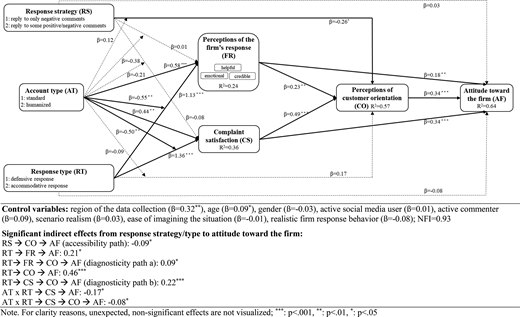
A contingency analysis shows that response strategy and response type are independent (coefficient of contingency: 0.001). We examined all hypothesized effects (see Figure 1) simultaneously using SmartPLS 4 (Ringle et al., 2022). Although partial least squares structural equation modeling does not make any assumptions about variable distributions (Hair et al., 2011), we assessed the construct scores, composed of single items, for skewness and kurtosis, as recommended by Hair et al. (2022). All skewness values lie between −1 and 1 (complaint satisfaction (CS): 0.472, perceptions of customer orientation (CO): −0.067, attitude toward the firm (AF): 0.596) and the kurtosis values lie between −2 and 2 (CS: −1.027, CO: −0.957, AF: −0.118). According to Hair et al. (2022), values falling into these intervals can be interpreted as not too far from normal. Thus, the variable distributions seem to be adequate for the planned analysis.
Response strategy’s effects: As Figure 1 illustrates, the response strategy does not affect perceptions of the firm’s response (ß = 0.01, p > 0.10) and complaint satisfaction (β = −0.08, p > 0.10). Instead, it affects perceived customer orientation directly (ß = −0.26, p < 0.05) and attitudes toward the firm indirectly (response strategy → perceptions of customer orientation → attitudes toward the firm: −0.09, p < 0.05). Thus, complaining commenters consider the corporate response strategy when evaluating a firm’s customer orientation. The negative sign of the coefficient representing the effect of the response strategy on perceived customer orientation indicates that replying to all negative consumer comments triggers perceptions of stronger customer orientation than replying to some positive and negative comments. Stronger customer orientation perceptions, in turn, result in more positive attitudes toward the firm. This result aligns with the preliminary and the ADT application study findings. It suggests that replying only to negative comments is a more recognizable, consistent and systematic approach to complaint management and, thus, more accessible and diagnostic. These results support H1 and H2, confirming the hypothesized accessibility path. The account type does not moderate the response strategy’s effects.
Response type’s effects and interaction with the account type: The response type does not directly affect customer orientation perceptions (β = 0.17, p > 0.10) but has indirect effects through perceptions of the firm’s response (response type → perceptions of the firm’s response → perceptions of customer orientation → attitudes toward the firm: 0.09, p < 0.05) and complaint satisfaction (response type → complaint satisfaction → perceptions of customer orientation → attitudes toward the firm: 0.22, p < 0.001). The positive path coefficient in Figure 1 (β = 1.13, p < 0.001) indicates that accommodative responses (coded as 2) lead to perceiving the firm’s response as more helpful, emotional and credible and to higher complaint satisfaction than defensive responses (coded as 1). These results support H3 and H5 and align with our ADT application study, which indicated that accommodative responses offer customers greater insight and diagnostic value. Furthermore, more positive perceptions of the firm’s response and higher complaint satisfaction lead to perceiving a stronger customer orientation and more positive attitudes toward the firm, confirming the hypothesized diagnosticity paths (support for H4 and H6). Moreover, there are significant interaction effects of response type and account type on response perceptions (β = −0.55, p < 0.01) and complaint satisfaction (β = 1.36, p < 0.001). Table 5 contains the mean values illustrating these interaction effects identified in the path analysis.
The results in Table 5 confirm that accommodative responses more positively affect perceptions of the firm’s response and complaint satisfaction than defensive responses. Thus, H7a regarding standard accounts is supported. H7b regarding humanized accounts is not supported, as humanized accounts reduce but do not entirely offset the superiority of accommodative over defensive responses. Linking this finding to our ADT application study suggests that humanized accounts increase accessibility and diagnosticity but cannot entirely eliminate the negative effects of defensive service firm responses.
Conclusion
Discussion
Going beyond previous studies that analyzed observing consumers (e.g. Huang and Ki, 2023; Johnen and Schnittka, 2019; Lopes et al., 2024; Park and Jiang, 2021; Weitzl and Hutzinger, 2017) and single aspects of corporate communication (e.g. Chevalier et al., 2018; Einwiller and Steilen, 2015; Huang et al., 2024; Van Mulken and Heslenfeld, 2025), we investigated the combined effects of strategic communication elements on complaining commenters in a service recovery context. While previous studies primarily examined the impact of corporate response approaches on review platforms (e.g. Esmark Jones et al., 2018; Rezvani and Rojas, 2022; Tathagata and Amar, 2018), we focused on social networks. We thereby contribute to the existing literature on social media and service recovery and strategic communication.
The first insight from our studies is that, from the perspective of complaining commenters, service firms’ replies to only negative comments are more effective than replies to some positive and negative comments. This finding not only aligns with service recovery literature emphasizing the importance of fair complaint handling (Gelbrich and Roschk, 2011; Maxham and Netemeyer, 2002; Tax et al., 1998) but also reflects strategic communication principles highlighting the value of consistent organizational communication (Coombs, 2007; Frandsen and Johansen, 2017; Sharma and Patterson, 1999). We advance both research fields by translating fair and consistent communication into a social media-based complaint-handling approach. This finding can also be linked to social media and webcare research indicating that ignoring complaints can trigger negative reactions of complainants (Gu and Ye, 2014), while addressing them strengthens firm-customer relationships (Ma et al., 2015) and improves repurchase intentions (Istanbulluoglu and Sakman, 2024), brand evaluations (Sparks and Bradley, 2017) and (favorable) engagement intentions (Gu and Ye, 2014; Liu et al., 2019; Proserpio and Zervas, 2017). However, as these studies only consider responses to complaints (reply vs no reply), our findings on replies to some positive and negative comments go beyond these previous insights. Moreover, by comparing the effects of different response strategies and focusing on active complainants, we extend Van Noort and Willemsen’s (2012) research, showing that observing users evaluate a firm more favorably when it provides proactive complaint handling by responding to negative comments. Thus, our research adds novel insights by revealing that responses to complaints can lead to better outcomes than broader response strategies on social networks. In terms of user perceptions of firm responses, we advance the finding that perceived effort and care, signaled through a company’s interactivity on social media, positively influence brand attitudes (Colliander et al., 2015) by examining the impact of specific response strategies and shifting the focus from passive observers to actively complaining customers. Additionally, we extend the findings of Sparks et al. (2016), who investigated how responses to reviews shape observers’ perceptions of a firm’s trustworthiness and customer concern, by focusing on social network interactions and the perceptions of the complainants. Moreover, while customer orientation is well established in offline service contexts, our study is among the first to examine this important construct within social media interactions and to show that the mechanism underlying this effect is the increased accessibility of replies to negative comments.
The second insight from our research is that, on social networks, accommodative responses from service firms lead to more favorable complainant reactions than defensive responses. We thereby confirm previous research outlining the positive effects of accommodative responses on complainants in social media and webcare contexts (Einwiller and Steilen, 2015; Tsao and Su, 2021; Van Mulken and Heslenfeld, 2025), as well as service recovery (Gelbrich and Roschk, 2011; Smith et al., 1999; Tax et al., 1998). We show that service firms’ defensive responses to complaints are inappropriate, which challenges previous studies suggesting that defensive responses can be equally or more effective in some situations (Hutzinger and Weitzl, 2023; Weitzl, 2019; Weitzl et al., 2018; Weitzl and Einwiller, 2020). We further extend prior research on strategic communication by showing that accommodative responses are perceived as more helpful, emotional and credible, and by shedding light on these perceptions and complaint satisfaction as key drivers of perceived customer orientation and attitudes toward the firm. Beyond that, we identify information diagnosticity as the mechanism underlying the effect of the response type on user perceptions.
Our third insight is that using humanized accounts can help mitigate the negative impact of defensive responses in service recovery settings. This result offers novel insights into how firms can enhance the effectiveness of their defensive responses. We advance the findings of Herhausen et al. (2020), who showed that employees’ digital presence enhances perceived customer orientation in a website context, by demonstrating that this effect also holds on social networks. Moreover, our findings extend previous research suggesting that specific sender information on social media can improve observing consumers’ reactions (Barcelos et al., 2018; Huang and Ki, 2023; Lopes et al., 2024) by providing insights into the effects on actively complaining commenters. As only one study examined the interaction between response type (accommodative vs mixed accommodative-defensive) and response sender on complainants in a review context (Tathagata and Amar, 2018), we advance this line of research by clearly differentiating accommodative and defensive responses, focusing on social networks and examining combined effects of response and account type on response perceptions, perceived customer orientation and attitudes toward the firm. Our findings diverge from those of Esmark Jones et al. (2018), who found no significant difference between account types. An explanation could be that they only presented the employee’s name, whereas our humanized account additionally included a photo and contact information, which may enhance perceptions of accessibility and diagnosticity. Thus, we contribute novel evidence by outlining the importance of humanized communication, particularly in complaint management, and its role in increasing both accessibility and diagnosticity in firm-consumer interactions on social networks.
Theoretical contributions
We extend the scope of ADT by applying it to social network interactions between service firms and complaining customers, a field of research where ADT application has remained limited. Prior studies in online contexts have applied ADT to areas such as review helpfulness on review platforms (Chen et al., 2024), observer reactions to recovery strategies on online platforms (Huang and Ha, 2020) and decision-making based on AI recommendations (Stergiou and Nella, 2024). We provide a unique contribution by empirically demonstrating the role of accessibility and diagnosticity of different communication elements (response strategy, response type and account type) for complaining commenters in social media marketing communication. In service recovery settings on social networks, accessibility and diagnosticity emerge as critical factors for firms seeking to influence their customers’ perceptions positively. Our measures, empirically tested in the ADT application study, extend previous applications of ADT and can be used in future studies.
Beyond extending ADT, our study contributes to the social media, webcare, service recovery and strategic communication literature by presenting a novel response strategy framework to explain how customers react to complaint handling strategies in interactive social network settings, drawing on key constructs such as complaint satisfaction, perceived customer orientation and attitudes. Our findings demonstrate that firms’ responses are not only operational recovery actions but also send strategic communication signals. By showing that different combinations of response strategies, types and accounts trigger distinct processing paths, we enrich the theoretical understanding of consumer reactions to digital complaint handling. Importantly, we reveal the benefits of humanized account types on social networks. While service research in online contexts has largely focused on automated digital interactions and customers’ perceptions of human touch in AI-driven service encounters (e.g. Khan et al., 2025; Wang et al., 2025: Zhao et al., 2022), our study shifts attention to the importance of genuine human contact in social network environments. Although providing empathetic and tangible support to customers is recognized as a core dimension of service quality (e.g. Parasuraman et al., 1988; Zygiaris et al., 2022), its implications for social media-based service recovery remain underexplored. We address this lack of research by highlighting the importance of humanized communication on social networks to strengthen relational and emotional elements that contribute to successful service recovery. We furthermore identify perceived customer orientation as a central mechanism that links service recovery communication to complaining customers’ attitudinal responses on social networks. While prior research has extensively examined perceived customer orientation in face-to-face service interactions (e.g. Kim et al., 2012; Sommovigo et al., 2019; Yoo et al., 2015), this construct has received limited attention in social network contexts. We additionally enrich service recovery literature, often centered on fairness perceptions (e.g. Gelbrich and Roschk, 2011; Maxham and Netemeyer, 2002; Tax et al., 1998), by introducing perceptions of customer orientation as an important, explanatory dimension.
Practical contributions
Our initial analysis of real service firms’ response behavior outlines that selective response strategies, accommodative replies and standard accounts are widespread marketing practices on social networks. Our findings challenge these common approaches and offer recommendations for more effective communication. The insights from our studies provide the following set of practical guidelines for service firms seeking to leverage their social media marketing communication, even if responding to every comment is not feasible.
Prioritize responses to negative comments: Service firms may often find it complex to identify the user comments they should reply to, and one strategy might not work for all firms or contexts. Nevertheless, we recommend that service firms facing limited resources, frequent complaints, high customer churn or low complaint satisfaction respond consistently to all negative comments on their corporate social network site. Visible and professional complaint handling signals customer care, thereby enhancing consumers’ attitudes toward the firm. Once all negative comments have been addressed, remaining capacities can be allocated to replying to positive ones.
Favor accommodative over defensive responses: Social media managers should use accommodative responses whenever possible, as they lead to higher complaint satisfaction, more favorable perceptions of the firm’s response and customer orientation, and more positive consumer attitudes. At the same time, we recognize that marketing practice requires flexibility and defensive replies may sometimes be necessary. In such cases, a humanized communication approach can mitigate the negative effects of defensive responses while maintaining professionalism and credibility.
Implement humanized account types: Our findings suggest that human agents, rather than impersonal AI systems, should reply. Displaying the replying employee’s name, photo and contact details requires minimal effort, does not affect labor costs, aligns with the personal and reciprocal nature of social networks, enhances customer perceptions and helps firms stand out from competitors. This novel finding can also be applied to other online customer service contexts, where implementing humanized communication strategies may benefit firms.
Signal strong customer orientation: Social media managers should proactively demonstrate the firm’s customer focus in their responses. Highlighting attentiveness, willingness to help and understanding of the complainant’s situation not only reassures social network users that the service firm values its customers. Using a humanized account enhances perceptions of customer orientation by making the service representative more concrete and tangible.
Ensure that responses are helpful, emotional and credible: Service firms’ social media managers should provide responses that are helpful, emotional and credible from both the firm’s and the complainant’s perspectives. Purposeful and well-structured responses, rather than offhand replies, help complaining users and likely even observers to better understand the situation and form positive impressions of the firm. While empathetic responses are well-established in traditional complaint management, our findings offer clear guidance for complaint handling on social networks, highlighting the positive impact of humanized communication on perceptions of firm responses in these public yet personal online environments. In light of the critical role of customer relationship management in the service sector, implementing these recommendations can help retain complaining customers.
Limitations and perspectives for future research
Our studies focused on complaining social network users. Future studies could investigate the combined effects of response strategy, type and account on perceptions of other visitors of the corporate social network site, e.g. observing or favorably engaging consumers. Furthermore, since our research used a specific scenario, the findings may not be directly applicable to other contexts. Future research should therefore examine our research questions for other types of service providers and complaints, as well as other comment volumes. Moreover, we only simulated the experience of scrolling through a social media thread. Future research could replicate our findings using real social network sites to make the study even more realistic and enhance validity. We also purposely examined two selective response strategies that service firms with limited social media marketing budgets can use. Future studies could include the “reply to all comments” strategy to examine whether and under which conditions it justifies additional budget allocation and outperforms the two strategies examined here. Moreover, we examined replies to two positive and two negative comments for the “reply to some positive and negative comments” strategy. Future research should systematically vary the number of positive and negative comments being addressed. When selective response strategies are used, the influence of justice perceptions should also be evaluated, as some consumers may not receive replies, which could impact their justice perceptions and subsequent reactions. Additionally, we assumed that firms consistently provide accommodative or defensive responses. For future studies, examining consumer reactions to responses that combine accommodative and defensive elements would be an interesting topic. Moreover, as service firms may have valid reasons for replying in different ways depending on the context, we suggest that future studies examine which (combinations of) strategies are most effective for different interactions between service firms and customers on social networks. Finally, future studies may consider boundary conditions such as platform type, complaint severity, industry context or cultural differences.
Acknowledgements
The questionnaire used for the main study was approved by the Institutional Review Board of the authors’ university.
Funding
This research did not receive any specific grant from funding agencies in the public, commercial, or not-for-profit sectors.