A notable research gap exists in the literature regarding the intervening role of workplace happiness (WPH) between perceived organisational support (POS) and extra-role customer service behaviour (ECSB). Thus, this study, drawing on social exchange theory and organisational support theory, examines how POS affects ECSB of bankers both directly and indirectly, with WPH acting as a mediator.
A quantitative survey, using a self-administered questionnaire covering the study variables, targeted front-line bankers working in private banks in Bangladesh. PLS-SEM was applied to the data from 203 bankers, with a response rate of 40.6%, to explore associations between the variables.
The study revealed that POS positively and significantly promotes WPH and ECSB. Moreover, WPH significantly enhances ECSB. Furthermore, it was found that POS indirectly influences ECSB through flourishing WPH. The study also observed that POS and WPH accounted for 58.6% of the variance in ECSB, while POS alone accounted for 42.1% of the variance in WPH.
Banking firms can apply the findings of this study to cultivate a supportive work environment and improve workplace happiness, helping employees feel motivated to take responsibility for delivering exceptional customer service.
This paper makes a novel contribution by examining WPH as an intervening variable in the relationship between POS and ECSB. Moreover, this study provides insights into the factors influencing bankers’ ECSB.
1. Introduction
Banks are service-driven organisations and serve as the primary source of financial support for all other economic activities of any country (Zahra et al., 2022). However, banking firms are increasingly facing survival challenges due to the rapid growth of banks and other financial institutions (e.g. leasing companies), which have significantly altered customer expectations for service delivery (Kandeepan et al., 2019). Being the lifeblood of the economy, Bangladesh’s banking sector features 62 scheduled banks and 5 non-scheduled banks, while the scheduled banks comprise 43 private commercial banks, 6 state-owned commercial banks, 3 specialized banks, 1 digital commercial bank, and 9 foreign commercial banks (Bangladesh Bank, 2024). This sector has been experiencing increasing hurdles owing to fierce competition, a high volume of non-performing loans, serious liquidity shortages, inflationary pressure, nepotism, corruption, poor service quality, and declining customer trust (Karim et al., 2024). In particular, substandard customer service may play a key role in weakening this sector. This issue was demonstrated in a study by Al Karim and Habiba (2020), where 41.7% of those surveyed stated that the banking services they experienced did not meet their expectations. Another study by the Bangladesh Institute of Bank Management (BIBM) indicated that poor customer service contributed to the closure of over 1.6 million accounts, amounting to 12.5% of all account holders in 2017 (The Financial Express, 2018). Thus, providing quality service to both existing and potential customers has become a key concern for gaining customer loyalty and improving customer satisfaction (Fida et al., 2020). Indeed, banking firms require consistent efforts to develop, refine, and establish strategies to identify factors affecting service quality. These efforts should aim to surpass customer needs and expectations, grow their customer base, improve value for shareholders, and remain competitive in the market (Pakurár et al., 2019). To deliver exceptional service to the customers, it is widely agreed that bankers must go beyond their basic responsibilities and participate in extra-role behaviours (Karim et al., 2024). In particular, employees’ extra-role customer service behaviour (ECSB) is crucial for enhancing customer satisfaction, happiness, and loyalty, thereby improving organisational performance (Alshamsi et al., 2023). Since frontline bankers are the primary contact with customers, their extra-role behaviour enhances customers’ perception of service quality, boosts customer satisfaction, enhances customer value, and strengthens competitive advantage (Alnaimi and Rjoub, 2021; Phuong and Ahn, 2021). Thus, examining ECSB and its influencing factors, as well as finding ways to enhance it, is vital for improving service quality and boosting organisational performance.
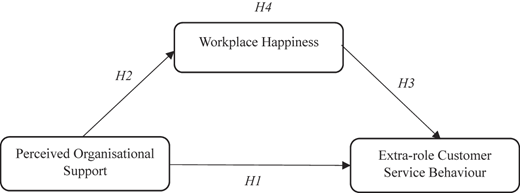
Employees are more likely to display positive workplace behaviours when they perceive strong support from their organization. This support, referred to as perceived organizational support (POS), involves recognizing their contributions and well-being (Eisenberger et al., 2020). Higher POS is linked to lower workplace withdrawal, employee absenteeism, turnover intention, and improved organisational outcomes such as increased extra-role behaviour (Alnaimi and Rjoub, 2021). In particular, the existing literature successfully identified the strong association between POS and extra-role behaviour (e.g. Alshaabani et al., 2021; Alnaimi and Rjoub, 2021; Alparslan and Kılınç, 2015; Kao et al., 2023). Thus, the study aims to assess the effect of POS on ECSB, a type of extra-role behaviour. Moreover, it seems to have a linking mechanism between POS and extra-role behaviour which has been addressed in the current literature with several variables like energy at work (Alparslan and Kılınç, 2015), job satisfaction (Andriyanti and Supartha, 2021), organisational commitment (Alshaabani et al., 2021; Singh et al., 2024a; Sumardjo and Supriadi, 2023; Widzayanto et al., 2024); employee happiness (Singh et al., 2024b); work engagement (Bizri and Hamieh, 2020; McManus et al., 2025; Park and Kim, 2024; Shams et al., 2020). These studies focused on service sectors such as hospitality, tourism, education and banking industries, and identified various individual attitudes (e.g. affective commitment or work engagement) as mediators between POP and extra-role behaviour, as shown in Table 1. However, these research efforts highlight three key research gaps: (1) They have primarily focused on extra-role behaviour broadly, overlooking customer-oriented extra-role service behaviour, which is crucial for the success of any service firm. (2) No study has considered workplace happiness (WPH) as a mediating mechanism between POS and ECSB, except for a single study in the retail industry (Singh et al., 2024b), which focused on OCB as the dependent variable rather than ECSB specifically. (3) There is a lack of prior studies linking POS, employee attitudes, and extra-role behaviour in the context of the South Asian banking sector, except for a single study by Shams et al. (2020). To fill up the gaps, the study aims to study WPH as a linking variable between POS and ECSB pertaining to banking industry of Bangladesh. Positioning WHP as a mediator between POS and ECSB appears to be a groundbreaking study, not only within the banking sector but also across other industries. WPH refers to the degree of happiness in the workplace. Employees who experience workplace happiness tend to be more enthusiastic about their roles, find meaning in their work, enjoy good workplace relationships, and are strongly committed to their jobs (Kun and Gadanecz, 2022). The current study assumes that if employees perceive greater support from their banks, they will experience higher levels of workplace happiness, which will, in turn, encourage them to engage more in extra-role behaviour toward their customers. Thus, this research, based on social exchange theory (SET) and organisational support theory (OST), aims to study the direct effect of POS on ECSB, as well as the mediating effect of WPH in this relationship, particularly among bankers in the private sector of Bangladesh. The research model is shown in Figure 1.
2. Literature review
2.1 Association of POS and ECSB
Eisenberger et al. (1986, p. 501) outlines POS as “beliefs developed by employees concerning the extent to which the organization values their contributions and cares about their well-being”. Organisational support reflects employees’ perceptions and beliefs that the organisation genuinely cares about their overall well-being and provides them with instrumental, emotional, and social support (Rasool et al., 2021). According to the OST (Rhoades and Eisenberger, 2002), employees’ perception of strong organisational support grows when they experience positive treatment in areas such as managerial support, fairness, procedural justice, incentives, and working conditions (Zeng et al., 2020). The higher POS is anticipated to boost employees’ confidence that the organisation will genuinely care about them, value their contributions, and reward their efforts in achieving its goals, thereby fostering positive emotions, attitudes, and behaviours (Jeong and Kim, 2022). On the other hand, when employees voluntarily perform tasks beyond their prescribed roles, it is referred to as organisational citizenship behaviour (OCB) or extra-role behaviour (Orlowski et al., 2021). Employees’ extra-role behaviour may be directed towards co-workers, the organisation, or customers. When it is service-oriented and exhibited by front-line employees towards customers, it represents ECSB and is defined as “discretionary behaviours of contact employees in serving customers that extend beyond formal role requirements” (Bettencourt and Brown, 1997, p. 41). ECSB involves providing memorable service experiences that exceed customer expectations, greatly influencing customers’ perceptions of service quality, overall satisfaction, loyalty, and organisational performance (Karim et al., 2024).
Since POS involves caring for employees’ well-being and appreciating their efforts, it can fulfil several employee needs, including recognition, acceptance, psychological backing, and approval, which shape their attitude and behaviour (Baset and Karim, 2020). The OST (Eisenberger et al., 1986) suggests that employees’ effort at work depends on how much their organisation is attentive to their well-being and comfort (Maan et al., 2020). According to the SET, when employees perceive a high level of organisational support, they will feel more accountable and responsible to the organisation, which subsequently encourages positive and attitudes and behaviours (Baset and Karim, 2020), such as extra-role service behaviour. According to Maan et al. (2020), employees’ POS enhances their sense of obligation to the organisation, motivating them to reciprocate positively through exhibiting both in-role and extra-role behaviours. Relying on the Job Demands-Resources (JD-R) model (Demerouti et al., 2001), Zeng et al. (2020) argues that POS is a key psychological job resource that fosters employees’ belief that the organisation values their dedication and well-being, thereby encouraging them to engage in desired behaviours such as ECSB. In the context of banking sector, several studies confirmed that POS has a positive influence on extra-role behaviour of bankers (Alnaimi and Rjoub, 2021; Bizri and Hamieh, 2020). The positive link between POS and bankers’ extra-role behaviours has also been explored within the sphere of South Asian banking operations (Bhatti et al., 2022; Shams et al., 2020). Thus, this study assumes the following:
POS significantly promotes ECSB.
2.2 Association of POS and WPH
WPH refers to the state of employees who feel energized and excited about their work, derive a sense of meaning and purpose from it, enjoy positive relationships with colleagues, and are dedicated to their job (Kun and Gadanecz, 2022). According to Misra and Srivastava (2023), happiness at work describes a scenario where employees feel content in their roles, are productive, and successfully meet both individual and organisational goals. As noted by Fisher (2010), WPH encompasses three interconnected yet distinct dimensions: job satisfaction, affective organizational commitment, and work engagement. Recognizing happiness as a top priority in human life, organisations are increasingly investing in their employees’ happiness to promote positive attitudes and behaviours that benefit organisational outcomes (Salas-Vallina and Alegre, 2021). Compared to unhappy employees, those who are happy are often more energized, enthusiastic, work-driven, supportive of colleagues, and better at handling difficulties (Jaswal et al., 2024). Statistical evidence shows that WPH increases employee productivity by 12% (Misra and Srivastava, 2023).
WPH tends to be shaped by multiple factors, which can be grouped into four main categories: personal factors, family environment factors, social factors, and organizational factors (Singh et al., 2024b). Organisational factors such as leadership (Kebede et al., 2024), organizational justice, workplace inclusion (Jha et al., 2024), high performance work practices (Guerci et al., 2022), and meaningful work (Charles-Leija et al., 2023) are found to be the determinants of WPH. Similarly, POS might be a key antecedent of WPH (Singh et al., 2024b). When employees feel supported in their workplace, they experience greater job satisfaction, motivation, and organisational commitment, which increases their enjoyment of work and overall happiness (Akgunduz et al., 2023). Additionally, POS fulfils various socioemotional needs, such as esteem, emotional support, and affiliation, promotes positive attitudes, and reduces psychological stress, ultimately enhancing employees’ well-being and happiness (Singh et al., 2024b). According to Hamid and Kundi (2024), when employees perceive their organisation as supportive, valuing their contributions, and caring about their well-being (higher POS), they will feel happier about their job, its aspects, and the organisation as a whole (WPH). Therefore, the following hypothesis is suggested:
POS significantly promotes WPH.
2.3 Association of WPH and ECSB
Although numerous studies have examined extra-role behaviour and its antecedents, research on the impact of WPH on extra-role behaviour, either directly or indirectly through other variables, remains limited (Al-Shami et al., 2023). However, it appears that WPH might be a strong predictor of employees’ extra-role behaviour. Since WPH reflects a sense of fulfilment with the job, the nature of the work, and the organisation, and fosters a positive mindset at work, happy employees are more inclined to exhibit extra-role behaviour (Rahmaningtyas et al., 2022). According to the attitudinal theory, attitudinal constructs are better predictors of behavioural constructs; therefore, WPH, as a broader positive attitudinal construct representing job satisfaction, affective organisational commitment, and work engagement, may lead to extra-role behaviour (Goel and Singh, 2024). Happy employees are more loyal, productive, and engaged, with lower absenteeism and tardiness, while fun activities boost morale, improve teamwork through social interaction, and enhance both in-role and extra-role performance (Soundarapandiyan et al., 2018). Several studies have also demonstrated that WPH promotes employees’ extra-role behaviour (e.g. Al-Shami et al., 2023; Goel and Singh, 2024; Singh and Banerji, 2022).
WPH significantly promotes ECSB.
2.4 Mediating role of WPH
The SET and JD-R models could be helpful in explaining the connection between POS, WPH, and ECSB. The SET (Blau, 1964), rooted in the norm of reciprocity (Gouldner, 1960), holds that individuals feel compelled to return favours to those who have helped them. As a result, they are inclined to respond the treatment—good or bad—that they get from an organisation (Karim, 2021). Accordingly, when employees feel that their organisation cares about them (i.e. higher POS), they will feel happy (i.e. higher WPH) and develop a sense of positive reciprocity towards their organisation. Thus, they are more likely to display favourable behaviour in return, such as extra-role behaviour (Singh and Banerji, 2022). The JD-R theory (Demerouti et al., 2001) suggests that workplace resources (i.e. favourable and supportive aspects of a job) promote positive attitudes, such as passion and commitment to work, which ultimately result in extra-role behaviour (Goel and Singh, 2024; Karim, 2023). Thus, POS as an organisational resource (Ramaci et al., 2024) is likely to uplift positive attitudes (e.g. WPH), which will lead to ECSB of bankers.
WPH mediates the association between POS and ECSB.
3. Methodology
3.1 Sample and data collection
This study focused on managerial employees, excluding non-managerial roles, from various branches of private commercial banks located in Dhaka City, Bangladesh. Based on professional and personal relationships, many bankers were contacted and a total of 500 structured questionnaires were conveniently distributed to the target respondents with the help of five research assistants. In addition to demographic questions and measurement items, each survey questionnaire included a forwarded message outlining the study’s overall objective, providing necessary instructions, and requesting participation, with a return deadline of one month. Participants were selected using convenience sampling due to the lack of a sampling frame, time constraints, and limited access. In Bangladesh, it is easier to connect with people through friends, acquaintances, and relatives rather than approaching unfamiliar individuals. In fact, obtaining responses from strangers is nearly impossible. Due to the relatively small sample size, PLS-SEM is used for data analysis in the study. PLS-SEM data analysis is generally well-suited for sample sizes ranging from 100 to 200 (Strzelecki, 2024). Even with sample sizes between 69 and 100, PLS-SEM can provide consistent and robust outcomes (Hair and Alamer, 2022). Thus, the sample size of 203 in the current study seems sufficient to generalize the findings to the target population. During the survey period from February to April 2024, we received 217 questionnaires, of which 203 (40.6%) were completed and valid, while those with incomplete or missing data were excluded from the analysis. Table 2 presents the demographic information of the respondents.
3.2 Measures
POS is assessed using eight items from the research by Cho et al. (2009). An example item is “This bank cares about my opinions”, with a composite reliability of 0.92. The authors assessed WPH using a six-item scale adapted from Mousa (2021), who obtained it from Fisher’s (2010) study, with Mousa’s scale showing an α value of 0.89. The scale includes an item “I have positive emotions towards my bank and accordingly I continue my organisational membership”. A four-item scale from Orlowski et al. (2021) was used to measure ECSB, with a reported reliability score of 0.97. “I willingly go out of my way to make a customer satisfied” is a sample item from ECSB scale. The questionnaire was provided in English.
4. Results
The study employed SPSS (version 22) for description analysis. The statistical tool called PLS-SEM was chosen to test the proposed model, as it is widely regarded as a robust method in management research for estimating empirical models of causal and complex variable relationships. Presented in Table 3 are the descriptive statistics and the correlations of the variables. POS is positively correlated with WPH (r = 0.64, p < 0.01) and with ECSB (r = 0.62, p < 0.01), while WPH is positively correlated with ECSB (r = 0.74, p < 0.01).
Furthermore, we examined the common method bias (CMB) in the data, typically resulting from self-reported bias, which can potentially inflate the relationships between variables. Harman’s single-factor test was applied to assess the potential presence of CMB, revealing that a single factor accounted for a maximum of 47.782% of the variance—below the 50% threshold—confirming that CMV is not a significant issue in this study. As shown in Table 4, the highest VIF value was 1.73, remaining below the 3.3 threshold (Knock, 2015), further suggesting that CMV is not present in the data. Additionally, an ex-ante approach was implemented to ensure respondents’ anonymity and confidentiality, promoting truthful responses and minimizing the risk of CMV (Fu et al., 2022).
4.1 Measurement model
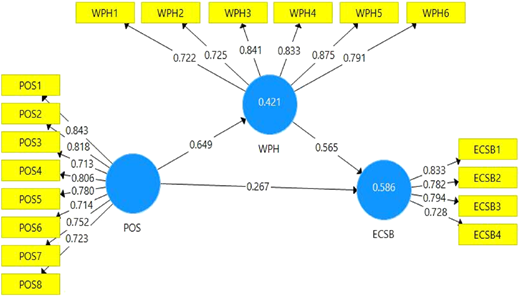
PLS-SEM requires measuring measurement and structural models, wherein measurement model checks the reliability and validity of the items and constructs of the research model, as presented in Table 5 and Figure 2. The factor loadings, composite reliability (CR), and average variance extracted (AVE) shown in Table 5 exceed the cut-off values of 0.70, 0.70, and 0.50 respectively, confirming the indicator reliability, internal consistency reliability, and convergent validity of the constructs (Ali et al., 2018). The alpha values (α) and rho_A values shown in Table 5 are greater than 0.70, also ensuring the reliability of the constructs through internal consistency. As indicated in Table 6, all values of HTMT are below 0.85, confirming that there is no concern regarding discriminant validity. The discriminant validity was further verified using the Fornell–Larcker criterion, where the diagonal values (i.e. square roots of AVEs) are greater than the non-diagonal values (Fornell and Larcker, 1981), as shown in Table 7.
4.2 Structural model
In structural model evaluation, factors such as collinearity, the relevance and significance of path coefficients, effect size (f2), R2 for determination, and Q2 for predictive relevance of exogenous constructs are evaluated. The analysis of the structural model starts by assessing the potential presence of multicollinearity through the examination of the VIF. The results, displayed in Table 3, reveal that the values range from 1 to 1.73, which are below 3, implying no collinearity in the structural model (Hair and Alamer, 2022). A subsequent bootstrapping procedure with 10,000 resamples was conducted to calculate t-values, path coefficients, and bias-corrected confidence intervals. As presented in Table 8, the findings indicate that POS has a positive and significant impact on WPH (β = 0.649, t = 14.272, p = 0.000). In turn, WPH positively and significantly affects ECSB (β = 0.565, t = 11.955, p = 0.000). Likewise, POS directly and significantly enhances ECSB (β = 0.267, t = 4.533, p = 0.000). Alternatively, ECSB is significantly shaped by both POS and WPH. Additionally, the study highlights the importance of indirect effects, assessed through bootstrapping. The indirect or mediation effect of WPH on the relationship between POS and ECSB is positive and significant (β = 0.367, t = 8.647, p = 0.000). This mediation result indicates that WPH intervenes between POS and ECSB. More precisely, POS enhances WPH, which in turn promotes ECSB. Alternatively, inadequate organizational support may hinder workplace happiness, which in turn could diminish ECSB. As described by Nitzl et al. (2016), partial mediation occurs when both direct and indirect effects are significant. In contrast, full mediation is indicated when the direct effect is not significant, but the indirect effect is positive and significant. Accordingly, the findings indicate that partial mediation of WPH between POS and ECSB occurred in this study. This confirms WHP’s role in bridging the relationship between POS and ECSB. Consequently, if employees perceive greater support from their organization, they are likely to experience greater happiness in the workplace, which, in turn, motivates them to actively serve customers in an extraordinary way.
The R2 values were employed to assess the extent of explained variance in the endogenous construct. Our analysis, as shown in Table 8, revealed that POS and WPH explained 58.6% of the variance in ECSB (R2 = 0.586), while POS explained 42.1% variance in WPH (R2 = 0.421), signifying a strong and moderate effects, respectively (Hair and Alamer, 2022). The research further examined the effect sizes (f2) to evaluate the relative contribution of the predictor constructs to the R2 (Ali et al., 2018). This metric assesses the impact magnitude of an independent variable on a dependable variable (Halis and Halis, 2022). According to Cohen’s (1988) guidelines (0.02 = small, 0.15 = moderate, 0.35 = strong effect), the results showed that POS had a small effect on ECSB (f2 = 0.10) and a strong effect on WPH (f2 = 0.73); while WPH had a strong effect on ECSB (f2 = 0.45). Finally, the model’s out-of-sample predictive relevance was assessed using the Stone-Geisser Q2 value through the blindfolding procedure. The Q2 value of the study is 0.425, indicating that Q2 > 0 demonstrates the presence of predictive relevance.
5. Discussion and conclusion
Our study reveals that POS significantly enhances WPH, which in turn stimulates bankers to perform extra-role service behaviour towards their clients. The finding of a positive association between POS and WPH aligns with the results of several previous studies (Akgunduz et al., 2023; Pradhan et al., 2024; Singh et al., 2024b). Similarly, the observed positive link between WPH and ECSB supports existing research (e.g. Al-Shami et al., 2023; Goel and Singh, 2024; Singh and Banerji, 2022) by highlighting the value of workplace happiness in inspiring employees’ extra-role behaviour in the workplace. Moreover, POS directly contributes to ECSB of bankers. This finding aligns with prior research, confirming that POS is a key factor influencing extra-role behaviour in both banking (Alnaimi and Rjoub, 2021) as well as non-banking service sectors (Alshaabani et al., 2021; Alparslan and Kılınç, 2015; Kao et al., 2023). The findings of the study indicate that POS cultivates positive emotions among employees and builds a social exchange relationship, creating a sense of obligation for employees to contribute to the organisation. This, in turn, leads to beneficial outcomes for both the individual and the organisation. POS fosters trust and confidence in individuals, assuring them that their contributions are acknowledged and rewarded by the organisation (Maan et al., 2020). This results in higher job satisfaction, happiness, and reciprocal actions from employees, such as desirable behaviours like ECSB.
5.1 Theoretical implications
The results of this study offer significant contributions to the literature on bank management and extra-role service behaviour in several ways. Firstly, the proposed research model offers insights into the concept of service behaviour within the Bangladesh’s banking industry. Secondly, this research introduced a new framework by integrating workplace happiness of the bankers as a linking mechanism between POS and ECSB. This approach addresses and resolves some of the limitations found in POS-ECSB literature. The existing literature has separately examined employee attitudes, such as organisational commitment and work engagement, as mediating variables between POS and ECSB, but has overlooked employees’ happiness as a linking mechanism in this relationship. This study uniquely connects POS with ECSB through workplace happiness, which integrates three different attitudes: job satisfaction, work engagement, and organisational commitment. Finally, this study expands the literature on attitude-behaviour linkage by highlighting the positive behavioural effects associated with having happy coworkers. The presence of happy coworkers, as our research reveals, serves as a significant factor that boosts desired behaviour of employees.
5.2 Practical implications
To achieve sustainable competitive advantage, providing customer service beyond the expectations is crucial in the banking industry. Therefore, our findings carry significant implications for bank administrators. The banking firms should consistently strive to create a supportive work environment as a means to stimulate exceptional customer service among bankers, thereby gaining competitive advantages and achieving success. Thus, managers should understand the conditions that drive employees to perceive greater organisational support. Bank managers should focus on creating a positive and employee-friendly workplace with suitable policies and practices that support employee welfare, happiness and satisfaction. The banking firms should encourage senior managers to support the front-line bankers by clarifying their job roles, holding regular meetings, resolving conflicts and offering emotional and material resources as needed (Imran et al., 2020). Another implication for managers is to implement processes that promote justice, minimize stress, and offer targeted training and development, and unbiased resource allocation (Srivastava and Agrawal, 2020). Moreover, banks should take initiatives like fairness practices, open information sharing, offering feedback, fostering a respectful climate, and granting decision-making autonomy can enhance vitality and foster a sense of POS among employees (Imran et al., 2020). Additionally, banks should pay attention to promoting favourable human resource practices (e.g. attractive rewards and benefits, objective performance appraisal, and development-oriented training), ensuring fair treatment from their managers, providing favourable job characteristics (e.g. job enrichment), and reducing abusive supervision and role stressors—such as role ambiguity, role conflict, and work overload (Eisenberger et al., 2020). WPH encourages employees to stay loyal, adapt to work schedules, and support their colleagues and outperform for the customers (Singh and Banerji, 2022). By focusing on strategies that increase workplace happiness, bank HR departments should cultivate a supportive environment that benefits both employee well-being and organisational goals.
In practice, banking firms in Bangladesh could be more supportive towards their employees in various ways. First, banks in Bangladesh are frequently criticized for nepotism and discrimination in performance appraisals, promotions, transfers, and work assignments. Regarding these issues, banks should follow rules and regulations objectively rather than relying on subjective decisions and nepotism, thereby promoting justice and fairness. Second, banks are often accused of setting extremely unrealistic performance targets for their bankers, leading to immense mental pressure and job-related stress. Instead of performing their duties at their desks, they are forced to move door-to-door for deposit collection, loan disbursement, and credit card sales. If they fail to achieve their targets, they receive oral reprimands, threats, and punishments including termination. Sometimes, poor loan decisions are made due to undue pressure from the head office. However, the responsibility for recovery lies with the branch-level bankers. Branch managers receive threats from the head office, and in turn, they apply pressure on other branch-level bankers. Therefore, banks should set challenging yet achievable performance targets and prevent undue influence in loan approvals. Third, banks offer housing loans at reduced interest rates only to upper-level bankers (e.g. Assistant Vice Presidents and above), ignoring lower-level bankers. Therefore, housing loans should be made available to all bank officers. Fourth, unfortunately, bankers have a specific entry time but no fixed departure time, which poses a serious threat to work-life balance. Banks should establish a specific departure time. Fifth, banks can improve the lives of bankers by providing transportation services (e.g. bus services) and in-house dining facilities. Sixth, banks should offer better job security, which has become a major concern recently. In conclusion, fair practices, good governance, and high-commitment HRM practices (such as teamwork, fair performance appraisals, job security, and work-life balance initiatives) can enhance perceived organizational support and happiness.
However, banks tend to encounter several challenges in implementing these strategies in resource-constrained environments. The first challenge comes from severe and unhealthy competition, which forces banks to put undue pressure on their employees to meet unattainable deposit and loan targets. In this regard, the central bank of the country may take initiatives to merge banks, which could reduce unhealthy competition and undue pressure. Another challenge arises from the high non-performing loans and liquidity crisis, which force banks to adopt a cost-cutting approach and curtail employee benefits. Moreover, many banks face challenges in upgrading their technology and R&D due to a lack of necessary investment, which requires employees to work manually. As a result, employees are required to work longer hours, leading to an imbalance in work-life. Finally, unfair practices are deeply rooted in the country’s culture. Thus, promoting fair practices for employees will be a significant challenge, but it can be addressed by developing core organizational values that prioritize justice, fairness, and ethics.
If banks can overcome these challenges and become supportive of their employees, they will feel happy, energized, and motivated to excel not only in their regular duties but also in delivering extra-role services to clients. This, in turn, enhances customer satisfaction, loyalty, and overall organizational performance. The study findings might be applied to other customer-centric service sectors such as hospitality and tourism, healthcare, education, the retail sector (e.g. e-commerce platforms and supermarkets), and the financial services sector (e.g. insurance companies and investment firms). For example, Firmansyah et al. (2022) discovered that when nurses perceive greater support from their hospitals, they feel happier, more committed to their organizations, and more actively engage in extra-role care services for their patients.
5.3 Limitations and avenues for future research
This study has certain limitations. It centres exclusively on the banking sector, specifically private sector banks, limiting the ability to generalize findings to other industries. Future researchers might examine different industries, or similar studies could be conducted in various countries or among employees of global companies to enhance the generalizability of the results. Other limitations of this research include the reliance on convenience sampling, cross-sectional and self-reported data, and a small sample size drawn exclusively from mid-level and first-line managers working in bank branches within Dhaka city. Thus, future studies could adopt longitudinal designs, probabilistic sampling with larger sample size, and triangulation methods by utilizing multiple data sources and approaches, including mixed or qualitative methods, to validate and strengthen the findings. For the purpose of using a probabilistic sampling technique such as simple random sampling, future researchers must prepare a sampling frame listing all the members of the target population. Then, the target number of samples should be chosen following random number table or computer-generated random numbers. Future research could expand the study’s scope beyond Dhaka city following the multi-stage sampling method. Banks in Bangladesh have branches extending up to the upazila (sub-district) level. Thus, researchers may first randomly select a district from each of the eight divisions in Bangladesh, followed by an upazila. Next, they should choose bank branches from the selected upazilas and, finally, randomly select samples from each chosen branch. Additional variables, such as leadership style or strong organizational culture, could be examined as antecedents in the current model to enhance its robustness. Moreover, other variables, such as autonomous work motivation, leadership support, and coworker support, could be explored as potential mediators, while different personality types, job complexity, and employee resilience could serve as moderators in future research. In addition, future studies can explore the dimensional measures of POS (financial, career, and adjustment) (Kraimer and Wayne, 2004) in place of its unidimensional measure. Finally, the model should be tested across diverse geographic locations, particularly in developing countries. It should also be applied to service sectors such as hospitality, tourism, education, and healthcare, using a large sample size, probabilistic sampling, and a longitudinal study.