Skip to Main Content
Purpose

The purpose of this research is first to examine the extent to which renewable energy providers (supply side) add value to their consumers (demand side) and how these perceive value-adding when acquiring these solutions. Second, the key challenges in supplying renewable energy solutions and how value-adding is manifested for the demand side are investigated. Third, the study ascertains the key resources needed to provide value (supply side) and how the consumption experience could be enhanced (demand side).

Design/methodology/approach

Semi-structured interviews were conducted with representatives from the supply and demand sides of renewable energy in Vietnam; the data were analysed through qualitative content analysis and data structure.

Findings

The analysis underlines commonalities and differences between the two participating groups. For instance, whereas members of the supply side perceive committing to higher levels of service or providing expert advice as fundamental opportunities to add value, those on the demand side value add-ons, including detailed instructions and consultations, together with the possibility to purchase quality products.

Originality/value

In embracing the underpinnings of the diffusion of innovations theory, this study makes various contributions to the business and renewable energy literature in emerging markets. Importantly, a conceptual framework with implications for practitioners and researchers was developed. This framework is founded on 21 conceptual dimensions revealed in the analysis, including the action-oriented and service-oriented, which help discern tangible and intangible ways to add value from the supply side. Relationships between the analysis and the theory's principles were also uncovered.

Throughout the last decades, renewable energy development has been a crucial issue with key implications for governments and allied stakeholders, including in agenda-planning, delegating and collaborating (e.g. Dögl et al., 2012; Hussain et al., 2022; Le, 2022; Müller et al., 2020). Renewable sources that include wind, solar, biomass or hydroelectric typically rely on nonperishable resources and help address a nation's sustainable development needs (Elmassah, 2024). Nevertheless, despite the promising potential of renewable energy sources, worldwide, the energy sector is experiencing manifold and significant transformation (e.g. Esmaeilpour Moghadam and Karami, 2024). Indeed, energy usage has grown and is expected to continue growing substantially to advance development, particularly in much of the developing world (Irfan and Ojha, 2023; Roy et al., 2022). Furthermore, rapid industrialisation has inevitably brought negative environmental and natural resource impacts (Minh and Van, 2023).

The case of Vietnam epitomises some of the above trade-offs, opportunities, and challenges, with implications for the broader community and society. As a country nearing 100 million inhabitants (Statista, 2024), shifting from a centrally planned to a market-oriented economy (Minh and Van, 2023) has brought significant changes. For instance, there has been a noticeable growth of small and medium enterprises and the middle class with associated needs for renewable energy products (Lan et al., 2023). Being a fast-growing economy that has accomplished remarkable developments in recent years and with a continuous aspiration to achieve modernity and higher income levels, Vietnam is expected to maintain its course and, by extension, its energy demands (Nguyen and Le, 2022, 2024). By considerably making use of its water resources, forests, and agricultural land (Minh and Van, 2023), Vietnam's traditional energy sources are expected to be drastically reduced in the next decades (Lan et al., 2023).

In turn, renewable energy promotion and related solutions are increasingly considered a pressing replacement and a long-term alternative to conventional energy sources (Do et al., 2021; Nong et al., 2020a; Yu et al., 2022). Indeed, the installation of solar photovoltaic energy skyrocketed in 2019 (Do et al., 2020), suggesting the promising potential for renewable energy in Vietnam (e.g. Vu et al., 2024). Furthermore, being an agro-industrial nation, Vietnam holds vast quantities of biomass resources that, as in the case of agricultural waste, can help in the generation of renewable energy (Cuong et al., 2021), with socioeconomic benefits. The additional data presented in Table 1 show that Vietnam's renewable energy capacity has more than tripled since 2011 (Statista, 2025a). Additionally, the capacity of power generation using various energy sources in the ASEAN region has steadily increased (Statista, 2025b). Similarly, selecting the cases of five of the region's nations (Energy Institute, 2025), it is revealed that the total energy supply from renewable energy has grown over the last decade, including in Vietnam.

While scholarly renewable energy research focussing on Vietnam has increased substantially over the last decades, there is merit in delving deeper into areas that have remained under-researched. For example, there is an absence of studies comparing the experiences of members of the renewable energy industry's supply and demand sides, particularly (1) regarding value-adding through renewable energy solutions and (2) from the perspectives of companies operating in an emerging economy. Indeed, research investigating how renewable energy adds value to those providing and consuming it is scant. Definitions of value-adding abound. For instance, in the field of logistics, Rutner and Langley (2000) posit that value-adding stresses the creation of business experiences that exceed customers' expectations and requirements, enabling the recurrence of such experiences and sharing them across the business community. Value-adding is also perceived through such hands-on activities as cycle time or inventory reductions, sales boosts, customer service or cash flow improvements, and new distribution or marketing channels (Wigand, 1997). Hence, value-adding can lead to supply chain cost-cutting, revenue gains and overall enhancements of a firm's competitiveness in the marketplace (Rutner and Langley, 2000; Wigand, 1997).

Delving into the expectations, concerns, experiences and future perceptions of members of the supply and demand sides of Vietnam's renewable energy industry could be invaluable. New and accumulated information would provide robust empirical guidance to key renewable energy stakeholders while guiding and improving conceptual understanding among scholars. Against this backdrop, the present study will make two key contributions. First, it will create new knowledge associated with renewable energy, considering two key stakeholders: the supply and the demand side of renewable energy implementation. To fulfil this objective, the following research questions (RQs) will be addressed (Table 2):

Second, the study will develop conceptual understanding further. Moreover, embracing an inductive approach supported by conventional qualitative content analysis and data structure, a theoretical framework stemming from the analysis of the above questions will be proposed. In line with previous research (e.g. Franceschinis et al., 2017; Silk et al., 2014; Simpson and Clifton, 2017), the conceptual foundation of the diffusion of innovations theory (e.g. Rogers, 2003) will be considered. The following section presents the rationale behind this choice and the key notions of this framework.

Rogers' (2003) framework discussing the diffusion of innovations is one of the best-known (Ozaki, 2011). Diffusion is conceptualised as a process facilitating the spread of innovation through communication avenues connecting members that belong to a social system, which is “a set of interrelated units that are engaged in joint problem solving to accomplish a common goal” (Rogers, 2003, p. 23). Organisations, individuals, or informal groups may acquire membership in a social system (Rogers, 2003); as a result, innovation can be diffused through specific community channels among members (Ozaki, 2011). Thus, in the case of renewable energy adoption, suppliers and consumers demonstrate such membership by identifying needs and wants and making product and service decisions to solve energy-related problems, thereby contributing to innovation diffusion.

Innovation has been conceptualised manyfold. Rogers (1986), for instance, underlines its attribute as a new idea, while Zanello et al. (2016) acknowledge that innovation can be imitative and ground-breaking/novel. Importantly, innovation in its varied forms can contribute to significant value-adding (Jebli et al., 2020; Zanello et al., 2016), including in services (Anton and Nucu, 2020) and job creation (Heinbach et al., 2014). Several conditions need to be met before consumers are brought into the innovation-decision process, including existing needs/problems, previous experiences, or a need for innovativeness (Ozaki, 2011).

Rogers' (2003) wide range of developed conceptual underpinnings illuminates the understanding of the diffusion of innovations theory (DOIT). First, Rogers (2003) underlines five successive stages in the innovation-adoption decision process:

  1. Knowledge can be mediated by factors such as age, education, socioeconomic features (Franceschinis et al., 2017), or social networks (Ozaki, 2011; Rogers, 2003). At this stage, individuals acquire knowledge of an innovation's existence, for instance, deepening their understanding of its functionality (Ozaki, 2011; Rogers, 2003) and potential for value-adding. In the context of renewable energy (solar photovoltaic adoption), the benefits of focussing on the development of in-house knowledge, expertise or skills are recognised in contemporary research (e.g. Shakeel et al., 2024).

  2. Persuasion occurs when individuals form their own opinions or attitudes toward innovation, whether favourable or unfavourable (Rogers, 2003), potentially affecting their innovation-purchasing intentions (Franceschinis et al., 2017). Furthermore, social networks can influence persuasion or the adoption of an innovation, particularly through peer groups, opinion leaders or change agents (Ozaki, 2011; Rogers, 2003).

  3. Decision: At this stage, the individual is already engaging in activities that are conducive to either adopting or rejecting the innovation (Rogers, 2003).

  4. Implementation: The innovation can be implemented once the decision is made (Rogers, 2003). Nevertheless, Kertcher et al. (2020) highlight the importance of adaptation among actors associated with innovation processes, even before the involvement of early adopters as Rogers (2003) suggested. Adaptation could facilitate broader innovation consumption, particularly among those who were not involved in initial developments (Kertcher et al., 2020).

  5. Confirmation entails reinforcing an already-made innovation decision; however, such a decision might be revisited if messages regarding the innovation are conflicting (Rogers, 2003).

These stages can be applicable to understanding the process of adopting (demand side) and providing innovative solutions (supply side). Indeed, as Ozaki (2011) observes, various conditions affect innovation-related decisions, including past experiences, current problems or needs. Given the existing business environment, where the pressures of efficiency and financial gains are augmented by future energy source consumption, these notions have implications for Vietnamese firm managers in making informed renewable energy-related decisions. For example, an argument can be made regarding the significance of the post-sales (supply side) and post-purchase (demand side) domains, where service plays a key role. Vargo (2009) defines service as a process that uses one party's competencies, such as skills or knowledge, for another party's benefit. In this context, service represents the foundation of a service-dominant logic, which predicates “that service is the fundamental basis of exchange” (Vargo, 2009, p. 374). In the field of sustainability science, Saviano et al. (2025) argue for the consideration of service-dominant logic, which provides a systems thinking perspective. Moreover, the service-dominant logic framework stresses that the goal of achieving sustainability demands constant adaptability among various actors, their behaviour and strategies; this adaptability is contingent upon feedback gathered from one another and within the system (Saviano et al., 2025).

Rogers' (2003) work further stresses the following five characteristics of innovation processes:

  1. Relative advantage concerns favourable perceptions of innovation determined by factors such as economic, convenience, satisfaction, or social (Rogers, 2003) vis-à-vis existing alternatives (Silk et al., 2014). Thus, realising innovation-related advantages is paramount in the speed at which innovation is adopted (Rogers, 2003). This aspect is also crucial concerning renewable energy adoption; here, the role of the providers (supply chain) is fundamental in sharing knowledge of renewable energy's advantages and potential benefits. Relative advantage can also be perceived in the form of value co-creation, for instance, at the grassroots level of renewable energy. Indeed, research focussing on renewable energy communities (Mihailova et al., 2022) emphasises the important role to be played by citizens as initiators of renewable energy activities, as potential financers, engaging in crowdfunding of emerging technologies, and as “prosumers,” those individuals who produce and consume energy (Parag and Sovacool, 2016).

  2. Compatibility emphasises consistency with the needs, past experiences, or existing values of those considering innovation adoption (Rogers, 2003). Therefore, the compatibility, or lack thereof, between innovative ideas and an organisation's norms or values may dictate the urgency of innovation adoption (Rogers, 2003). Silk et al. (2014) illustrate this characteristic in the farming environment, where a lack of compatibility between technology and farming practices might render innovation adoption challenging. Here again, depending on companies' philosophy or narrative towards sustainable production or corporate social responsibility activities and principles, there are linkages with renewable energy involvement and resulting value-adding outcomes.

  3. Complexity underlines an innovation's perceived level of difficulty (Rogers, 2003) or its perceived ease of use and understanding (Silk et al., 2014). Moreover, while some members comprehend an innovation promptly, others require more time to understand it, which has implications for their readiness to adopt it (Rogers, 2003). Within renewable energy solutions, the supply chain can once again drive educational processes, guiding potential users in understanding and operating equipment and technologies, thus reducing complexity.

  4. Trialability denotes the extent to which an innovation is experimented with before its permanent adoption (Silk et al., 2014). Some innovations that lend themselves to being trialled in apportionments can also be potentially adopted more quickly than others (Rogers, 2003). In the case of renewable energy adoption, users trialling wind or solar energy solutions can ascertain the benefits and potential for value-adding. This trialling step can be triggered by industry stakeholders; for instance, Shakeel et al. (2024) highlight the role of companies in creating and delivering value offerings that, because of their potentially beneficial impacts, may trigger consumers' adoption.

  5. Observability refers to the degree of observation of an innovation before adoption (Silk et al., 2014). Furthermore, the ease of observing an innovation's results can dictate its level of adoption among others (Rogers, 2003). In the renewable energy domain, manufacturers and suppliers are responsible for trialling equipment and technologies and enabling visibility to those on the demand side searching for energy solutions.

In the last decade, researchers embraced the DOIT to understand the juxtaposition between innovation and renewable energy in the consumer, household, or rural domains more deeply (e.g. Ahmad et al., 2023; Wang et al., 2022). Despite its insightfulness, to the knowledge of the author(s), studies examining the supply and demand sides of the renewable energy industry embracing the DOIT tenets, particularly in emerging economies, are nonexistent. Among the very few contemporary contributions focussing on the DOI to examine renewable energy themes in Asia, Zhang et al. (2018) presented a model of photovoltaic energy diffusion for Singapore's residential areas. More specifically, the focus of Zhang et al.’s (2018) model was associated with the impacts of project uncertainty and interpersonal communication on those adopting it. The authors conclude that, despite the relevance of these factors, numerous others that could equally affect adoption decisions merit investigation in the future. The present study partly adheres to this objective, embracing the DOIT to explore, among other themes, value-adding in the context of renewable energy (e.g. Table 2).

Examining the supply and demand sides could also contribute to a deeper empirical and conceptual understanding. Empirically, ascertaining how the two groups perceive value in the context of renewable energy can provide practical insights for the industry, including in terms of coordination. In fact, as Dranka et al. (2021) revealed, an increasing body of research acknowledges the merit of integrating both the supply and demand sides in studies focussing on long-term power systems.

Expanding from these premises, there is also conceptual value in embracing these two stakeholder groups. For instance, new knowledge arising from contrasting the study's analysis and the DOIT's tenets in the context of these two groups could guide future endeavours. These endeavours include conceptually understanding value-adding in the field of renewable energy and extending the DOIT in this domain.”

Consequently, the present study will also address the following RQ:

RQ4.

To what extent can the DOIT facilitate a deeper understanding of renewable energy involvement, namely regarding:

  1. value-adding through renewable energy solutions (supply side) and

  2. perceptions of receiving or consuming added value (demand side)?

The study's focus on a new and under-researched perspective, that is, the examination of the supply and demand sides of renewable energy regarding perceptions of value-adding, called for an exploratory direction. This approach is in line with Murthy and Bhojanna (2008) in that it can help researchers become familiar with an issue or problem. Exploratory research also aligns with Hair et al.’s (2020) notions that (1) exploratory research helps discover new themes, relationships, or ideas, and (2) various types of data gathering can be implemented, including qualitative techniques such as in-depth interviews and document observation. Exploratory research is also associated with an inductive paradigm, whose main purposes are condensing textual data, creating links between the research's objectives and the findings from the data, and developing a framework capturing the processes or experiences revealed in the data (Thomas, 2006).

The need to gather data from knowledgeable and experienced individuals suggested the value of purposive sampling, which highlights the importance of information-rich cases for in-depth inquiry (Patton, 1999). The views of experienced individuals from both the supply and demand sides of renewable energy usage were perceived to help illuminate the answers to the research's central questions (Patton, 1999).

At the end of 2021, groundwork was conducted to learn about companies that supplied and acquired renewable energy equipment/solutions; this process helped identify five from the first and three from the second group. After securing university ethics approval in March 2022, the eight companies' management was approached by email correspondence, where the research was introduced, and managers were formally invited to an interview. Seven managers (supply side: four; demand side: three) agreed to partake in the study and were interviewed. These interviews were carried out during May 2022; in all cases, participants were informed that their agreement to partake in the interview was understood as their consent. The interview protocol was divided into two parts. In the first, participants were asked questions about their career, role, and company demographic details, while in the second, they were presented with the following questions (Table 3):

These questions were developed after considering extant literature on various themes that included renewable energy usage/implementation (Cuong et al., 2021; Hussain et al., 2022; Lan et al., 2023; Le, 2022; Minh and Van, 2023; Müller et al., 2020; Nguyen and Le, 2022; Nong et al., 2020b) and value-adding (e.g. Anton and Nucu, 2020; Jebli et al., 2020; Zanello et al., 2016). At the end of each of the seven interviews, participants were asked to recommend other individuals who might also contribute to the research. This snowballing technique (e.g. Noy, 2008) helped recruit an additional 17 participants nationwide; together, two balanced cohorts of 12 participants each were interviewed. The 24 semi-structured interviews lasted an average of 90 min. Six interviews were conducted at the participants' premises, allowing for reviewing company information, observing and note-taking. Together with other printed materials showcasing government and industry legal and regulatory codes and prescriptions, method triangulation (Carter et al., 2014) facilitated a deeper understanding of some of the answers participants provided. One demonstration of this type of triangulation was in the form of company, supplier, or government printed documents and materials. As illustrated in Figure 1, some of these documents entailed product warranties, instructions and pricing.

The other semi-structured interviews were conducted online due to the challenges of the geographic distance between the research team and the interviewees. As illustrated in the analysis (Figures 1–3), the interviews contributed to a recurrence of themes, a sign of data saturation (Fusch and Ness, 2015). This recurrence was noticed after the 10th interview in both cases (supply and demand side groups), which led to discontinuing the interview process after the 12th interview.

The majority of the interviews (14) were conducted in Vietnamese, and 10 in English. The questionnaire composition followed protocols of iterative translation (Douglas and Craig, 2007), while the translation process followed protocols regarding the collaboration between the researchers and a professional translator (van Nes et al., 2010).

The gathered data were analysed using reliable methods, including conventional qualitative content analysis and a data structure. Conventional qualitative content analysis entails coding categories flowing directly from the gathered data (Hsieh and Shannon, 2005). By using this approach, researchers can obtain direct information from their participants without imposing predetermined theoretical views or categories (Hsieh and Shannon, 2005). The data structure method (Gioia et al., 2013) focuses on a systematic presentation of first-order (informant-centric codes/terms) and second-order analysis (researcher-centric dimensions, themes, or concepts). Table 4 shows the various steps followed while embracing this method in the present research. Importantly, and as with inductive research, the data structure method can contribute to the development of a theoretical model (Gioia et al., 2013). Figures 1–4 provide more in-depth demonstrations of both qualitative content analysis and data structure methods.

Several researchers emphasise the significance of transparency and rigour in qualitative research. The present research strongly subscribes to Shenton's (2004) protocols that are based on the interpretation of the seminal works by Guba (1981), Guba and Lincoln (1981), and Lincoln and Guba (1985), highlighting various criteria:

  1. Credibility stresses researchers' duty “to establish confidence in the truth of the data” (Polit and Beck, 2014, p. 492) within the context of the research. Ways to demonstrate credibility include implementing well-established research methods and triangulation (Shenton, 2004), both of which are illustrated in the present study.

  2. Dependability refers to the potential to replicate a study's findings using the same or similar context and participants (Polit and Beck, 2014). In line with Shenton (2004), dependability was addressed by reporting the study's processes in detail, thus enabling researchers to replicate the work should the study be reconducted in the future.

  3. Confirmability emphasises that the data gathered are accurate, relevant, and meaningful; more importantly, that these characteristics represent the participants' thoughts and not the researcher's interpretations or imagination (Polit and Beck, 2014). The interviews and the resulting verbatim comments presented in the next section, together with triangulation (Shenton, 2004), demonstrate confirmability in the present research. Moreover, in line with Carter et al. (2014), the study also employed investigator triangulation, involving the participation of various researchers to provide a variety of observations during the data analysis process, including the coding of the interview transcripts.

Additionally, the principles of consensual qualitative research, which are suggested to contribute to trustworthiness and consistency of both analysis and coding (e.g. Van den Berg and Struwig, 2017), were adhered to. Consensual qualitative research is based on the notion that multiple levels of awareness and perspectives are required to address complex issues (Hill et al., 1997); thus, it entails consensus among team members (Depner et al., 2017). Correspondingly, at least three team members are recommended, first, to analyse the data independently and, subsequently, to present and discuss the emerging points as a team, eventually reaching a unified version that best represents the data (Hill et al., 1997). Aligning with this method, in this study, three team members were first involved in coding independently; this process was followed by meetings to discuss their independent analyses and reach consensus. Members of the research team also compiled an audit trail (Shenton, 2004) during the interview process; the notes containing procedures and decisions made during the data collection process were also compared between the researchers.

  1. Transferability, which is comparable to generalisability (Polit and Beck, 2014), indicates the applicability of a study's findings and conclusions to other populations or circumstances (Shenton, 2004). However, as is the case with the present research, the modest numbers of individuals and environments in qualitative inquiry may render transferability unachievable (Shenton, 2004).

Table 5 indicates that most participants were directors/managers and male, and their companies were engaged in international business activities. The majority of their companies employ fewer than 250 full-time employees, and half of them operate in Hanoi. In terms of work experience, 20 participants have been in their industry/company for six or more years, thus reinforcing their significance as “information-rich cases” (Patton, 1999). The demand side perspective is represented by a variety of industries. In the following results section, participants' comments will be deidentified (e.g. supply side = S1, S2, etc.; demand side (consumers) = C1, C2, etc.).

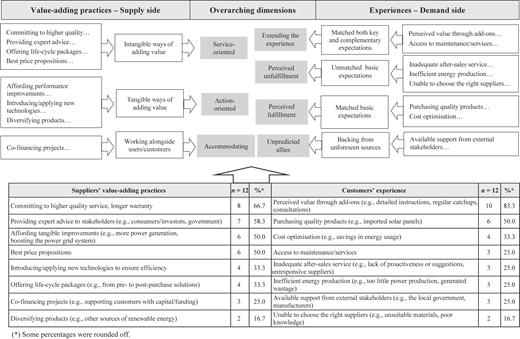
The first part of the analysis reveals that providers (supply side) add value in predominantly six forms; among these, four were indicated by at least six representatives (50%) of the provider group (Figure 1). These forms included quality service, such as offering post-installation service and extended warranties (66.7%), alongside providing expert advice (58.3%), maximising energy production (50%), and offering competitive prices (50%). The following verbatim comments lend support to the findings:

S2: We are diversifying what we sell to our customers, specifically bioenergy, to produce heat.

S3: We use a simulation program to forecast the [renewable energy] product, ensuring that our system will produce the estimated- and promised- quantities to our clients.

Other providers intended to add value through power generation (S1): “We are willing to invest in the power transmission line system to connect to the national power grid.” This aspect is crucial as “most businesses in Vietnam do not have enough financial capacity to invest in renewable energy power systems” (S5). Investments, however, are crucial if countries are to successfully switch to renewable energy sources as opposed to perpetuating the usage of conventional ones (Karamoozian et al., 2023).

The demand side group's viewpoints regarding added value are, to some extent, in line with providers' intent to deliver similar outcomes (Figure 1). Indeed, the demand side group's perceptions were mainly reflected by such add-ons as detailed equipment instructions and regular consultations (83.3%), together with the availability of quality products (50%), and were distantly followed by cost optimisation through products (33.3%). Here, again, several insightful comments emerged:

C2: If the investment has a clear roadmap, it can certainly create financial benefits for businesses.

C5: For us, investing in renewable energy is worthwhile, especially given its very lengthy useful life (at least 10 years), where numerous benefits (saving on electricity usage every day, creating a highlight for the business’s marketing and operation activities) can be achieved …

Nevertheless, concerns regarding the applicability of the experience with value-added products/services were also raised. C3 expressed reservations about poor after-sales service due to the supplier's lack of initiative in providing further instructions for the installed equipment or responding to queries when contacted. C1 also echoed these views:

The quality of the solar panels we are using is quite high (no damage or maintenance required during use). However, the provider’s after-sales service is very poor. There is a lack of initiative in monitoring customers' use to advise and suggest cleaning and maintenance …

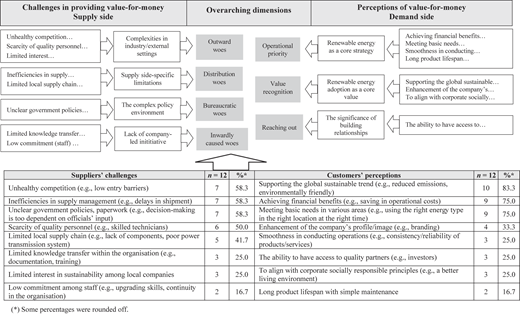
When the interviewees were asked about the barriers to delivering value-for-money, these challenges primarily originate at the industry level, and they are mainly reflected in three ways (Figure 2). In fact, seven suppliers (58.3%) perceived unfair competition from current or new competitors entering the industry, unstable state policies for renewable energy business activities, respectively, while six (50%) pinpointed gaps concerning human resources. Regarding renewable energy policies, a recent critical analysis (Ngoc et al., 2025) identifies that regulatory uncertainties, such as land acquisition or power purchase agreements, have adversely affected investors' confidence. Moreover, as a direct result of these uncertainties, foreign direct investment has fallen by as much as 30% between 2022 and 2024 (Ngoc et al., 2025). Similarly, due to the unpredictability in renewable energy policy changes, there has been a stagnation of rooftop solar panel investments (Tham et al., 2025). Complementing these points, Quang et al. (2025) argue that Vietnam has yet to enact dedicated renewable energy policies. For instance, hydropower projects are affected by fragmented regulations from different legal documents; furthermore, hydropower-related laws exhibit technocratic and state-led frameworks dominated by licencing procedures and technical permits (Quang et al., 2025). The following views provide additional context to these findings:

S5: Competition in the field is becoming increasingly fierce as demand for development resources (people, components, and suppliers) remains constant and limited.

S6: Finding people with industry knowledge or the mindset and thinking of a foreign investor in planning, initiative, or leadership is extremely tough.

S10: If the government’s policy mechanisms are not long-term and change too often, companies cannot adapt because changes consume many resources …

Understanding what customers expect from renewable energy products/services is also challenging. The revealed themes (Figure 2), representing customers' investment evaluation, can be interpreted from both external and internal angles. On the outward side, 10 demand side interviewees (83.3%) noted that their investment value mirrored the trend of sustainable development worldwide, while nine (75%) sought financial gains and meeting basic needs in different areas, respectively. Some of their selected comments follow:

C7: Certainly, renewable energy is positive in creating trends … However, measuring the effective value of an investment is unachievable, for instance, in North Vietnam, where the amount of sunlight during the year is limited or unstable … currently, the system does not contribute highly to our electricity demands …

C11: I wanted to do something for Vietnam and for the world and for my investment to be profitable. Unfortunately, because of the increasing price of the materials and the lack of clear government regulations, investing in a renewable energy project at the present time is unviable.

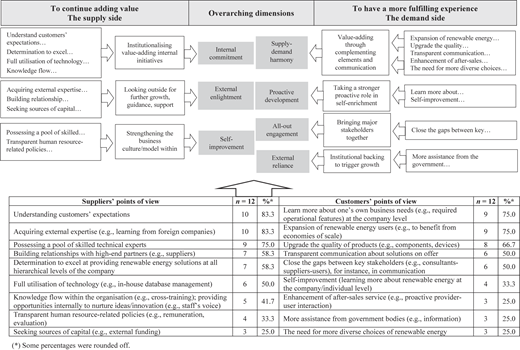
Exploring the main resources needed to continue value-adding by providing renewable energy products/services (supply side), the analysis predominantly highlights nine proactive measures and initiatives (Figure 3). At the centre of these are service-related elements, such as a) understanding customers' expectations and b) gaining external expertise, including learning from model international companies, both of which were indicated by 10 (83.3%) interviewees. Also crucial is the availability of skilled technical experts within the firm (9 or 75%). These perceptions are associated with enhancing internal knowledge that, in turn, could help build relationships and change the internal mindset to understand that finding renewable energy solutions is part of a common company philosophy as opposed to isolated individual efforts. The full implementation of technology and knowledge flow improvements, together with designing transparent internal policies and pursuing external funding, were also perceived as crucial in extending value-adding principles. Several viewpoints illuminate the understanding of some of these areas:

S4: We cooperate with a German company with more than 18 years of experience in operations and maintenance manuals … it has an artificial intelligence solution that analyses all of the power plant’s data and then provides us with the appropriate operational and maintenance instructions …

S9: Because this field has unique characteristics … having relationships with local management agencies where the energy farm is located is critical in resolving compensation and clearance issues for people, handling waste problems, and determining the impact of production on the local environment.

Concerning ways in which their renewable energy experience could be more fulfilling, nine representatives of the demand side group (75%) underscored the significance of understanding the company's internal needs more. The same number of responses highlighted the importance of increasing renewable energy user numbers to develop economies of scale, where consumers could benefit more. Providers' responsibility to maintain the consistency through the upgrade of products' quality (8 or 66.7%), nurturing communication transparency (6 or 50%), as well as mitigating communication gaps between renewable energy consultants, suppliers or users, were additional valuable ways to create fulfilling experiences. Selected observations further support these views:

C2: The difference here is the after-sales services they provide (maintenance, post-installation maintenance) and their expertise in offering the most optimal investment options with each business’s unique characteristics (the fastest way to pay back capital).

C3: It is very difficult to rely on service providers, but it must come from the customers themselves … they must carefully assess the specifics of their business and find service/solution providers that are suitable for their needs.

Finally, Table 6 presents comparisons within each group of participants and reveals some differences. For instance, more supply side participants with over a decade of experience perceived the challenge of unhealthy competition than their counterparts with less than a decade of experience. In turn, more participants of the less experienced group viewed the scarcity of quality personnel as a challenge.

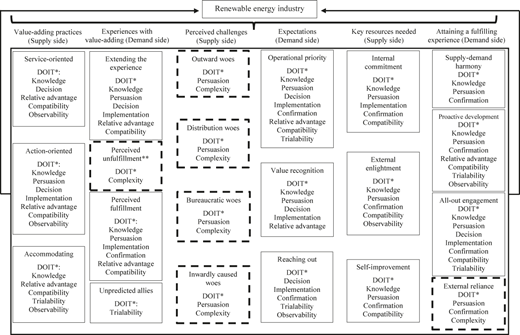
The study makes various contributions to the entrepreneurship literature, specifically regarding renewable energy supply and demand, from the perspective of industry practitioners operating in an emerging economy. The study's primary contribution lies in the 21 dimensions that emerged in the analysis, together with the resulting theoretical framework (Figure 4), which provides a) a model highlighting the analysis and b) the juxtaposition between these dimensions and the DOIT. In Figure 1, for instance, the service- and action-oriented, together with the accommodating dimension, help explain suppliers' value-adding practices. While affording tangible and intangible value, suppliers also engage in working alongside the demand side stakeholders to enhance their potential to use and benefit from renewable energy solutions. Among the three, the action-oriented dimension exhibits as many as seven associations with the DOIT's stages in the innovation-adoption decision process and with the characteristics of innovation processes (Figure 4), including persuasion, decision, compatibility and observability.

Examining the stakeholders' perspectives, the ‘extending the experience’ dimension reveals two fundamental ways that match central and harmonising aspects, where communication and other forms of service support are crucial. This dimension also reveals several associations with the DOIT, namely, concerning knowledge, implementation and relative advantage. The perceived fulfilment dimension underlines users' level of satisfaction with “hard” aspects of renewable energy involvement, including quality products and cost optimisation, whereas the “unpredicted allies” dimension stresses the significance of external stakeholders to boost the future implementation of renewable energy solutions. Nevertheless, the “perceived unfulfillment” dimension points to various limitations in product/service performance, thus denoting existing gaps.

Figure 2 illustrates that suppliers' perceived challenges can be understood through the outward, distribution, bureaucratic, and inwardly caused woes. This conceptual foundation is based on various premises ranging from existing limitations (human resources) or threats (competition), together with challenges at a broader supply chain level, policy barriers or even the company's limited initiative in engaging in value-adding activities. The analysis of consuming companies' experiences in this domain, however, identifies areas that underline the urgency for suppliers to pay attention to. The operational priority and the value recognition dimensions emphasise companies' needs/wants in areas where the supply side encounters barriers (e.g. distribution, bureaucratic, inwardly caused woes). In turn, such weaknesses could also have direct and negative impacts on building relationships with the demand side, whose members perceive these relationships as vital (reaching out dimension). Importantly, the operational priority dimension illustrates eight links to the DOIT, five related to the stages in the innovation-adoption process (e.g. knowledge and persuasion) and three to the characteristics of innovation processes (e.g. compatibility and trialability).

Figure 3 identifies organisational resources that can help towards competitiveness (supply side) by understanding the demand side's needs to achieve more fulfilling experiences through their involvement in renewable energy solutions. The internal commitment dimension underscores the strategic relevance of “institutionalising” various internal activities that could drive companies' performance and competitiveness. Equally important are the external enlightenment and self-improvement dimensions, which underscore the role of continuous learning while building relationships, procuring capital, acquiring talent, and demonstrating transparency within internal human resource processes. Learning through renewable energy technology understanding and evaluation can lead to consumers' confidence (Irfan et al., 2021).

Conversely, the supply-demand harmony dimension (Figure 3) identifies consuming companies' expectations of enhanced harmony with their providers. The proactive development and all-out engagement dimensions ascertain company leaders' intention to engage, acquire more knowledge and be more proactive to benefit from renewable energy solutions. The proactive development dimension also underscores the significance of self-education as a catalyst for the future adoption of renewable energy solutions (Simpson and Clifton, 2017). Thus, relationships emerge between this dimension and the DOIT, such as regarding knowledge and persuasion (stages in the innovation-adoption decision process) and trialability and observability (characteristics of innovation processes). Additionally, the external reliance dimension aligns with extant research (e.g. Smirnova et al., 2021) that underscores the role of government bodies in supporting the further development of renewable energy implementation, including through financial incentives.

By encapsulating the study's key findings and dimensions, Figure 4 contributes to a more rigorous conceptual understanding of renewable energy from the perspectives of business leaders operating on the delivery and consumption sides. At the same time, one fundamental theoretical implication emanates from the value of contrasting the two participant groups. For instance, Figure 1's analysis identifies both alignments and mismatches, notably in what the supply side participants perceive and what the experiences of the demand side are. More specifically, the perceived unfulfillment dimension helps understand existing gaps voiced by the demand side vis-à-vis how the supply side perceives its performance in value-adding. Illuminating the extant gaps helps provide a preliminary foundation to understand the predicaments in adding value and, importantly, what value is expected to exploit the potential of renewable energy in the context of an emerging economy.

Through seven dimensions, Figure 2 also presents conceptual elements associated with the study's themes and suggests the significance of considering these at the individual level and as part of the holistic model (Figure 4). In fact, when set against consumers' expectations, the operational priority, value recognition, and reaching out dimensions represent tools that can counterbalance the four identified types of woes (supply side), thus affording new and deeper conceptual avenues.

Figure 3 illustrates a juxtaposition between perceived resources for enhancing value-adding (supply side) and for experiencing it (demand side). The internal commitment, external, enlightenment, and self-improvement dimensions have clear conceptual implications. Indeed, a model could emerge in which linkages can be established, first, associated with the supply-demand harmony dimension and additionally with the proactive development and all-out engagement dimensions. The identified juxtapositions also suggest their conceptual significance, guiding researchers and practitioners in their quest for developing robust models to improve processes related to renewable energy implementation, future adoption, and the industry's long-term sustainability.

Theoretical implications also emerge in the context of the study's developed dimensions and their relationship with the DOIT (RQ3). The usefulness of the DOIT is ascertained in illuminating additional elements pertaining to the renewable energy journey undertaken by both members of the supply and demand sites. For instance, when contrasting the three dimensions (supply side) and the four (demand side), in line with Rogers (2003), there is potential for suppliers to play a crucial role in disseminating knowledge. This knowledge can help narrow some of the recognised gaps on the demand side, including enhancing the understanding of functionality, as discussed in earlier research (e.g. Ozaki, 2011). Knowledge can persuade suppliers to embrace and implement innovations (Franceschinis et al., 2017), such as renewable energy solutions. In addition, observability and trialability (Silk et al., 2014) could address issues of complexity in understanding technologies while helping companies gain more favourable views of innovation (Rogers, 2003), potentially embracing renewable energy as a valuable resource. Overall, while the relationships between the study's analysis and the DOIT afford valuable insights, considering other models (e.g. dynamic capabilities) could complement and further increase the conceptual understanding of renewable energy implementation in an emerging economy.

By contrasting the supply and demand sides of renewable energy, the analysis sheds light on the differing or complementary views of each group concerning the investigated areas and signals important implications for practitioners. First, whereas the service-oriented, action-oriented and accommodating dimensions (Figure 1) highlight providers' perceived strengths in adding value, the perceived unfulfillment suggests the need for further attention and efforts in persuading the demand side of embracing renewable energy solutions. Reinforcing this point, the analysis suggests that product/service inconsistencies perceived by the demand side might result in poor word-of-mouth promotion and feedback, thus, discouraging other businesses from considering or adopting those solutions.

To minimise these issues, businesses, industries, and public entities need to develop steps and initiatives to build and maintain a culture that nurtures trust and confidence in products and services. Despite empirical evidence revealing the weak nature of collaborative relationships among renewable energy firms (e.g. Christensen et al., 2019), working together on improving consistency or educating potential users could strengthen the service culture and have implications for equipment sales, energy production, and minimisation of environmental impacts.

The supply side operators' recognised woes (Figure 2) have key implications for several stakeholders, including educational institutions, to play a fundamental role, particularly in offering courses and degrees that could alleviate the industry's difficulties in finding quality and qualified personnel. Indeed, future industry professionals could be introduced to different types of renewable energy options available or with potential to be developed. These courses and degrees could be technical to illuminate scientific demands and knowledge, as well as uncover legal aspects that are crucial to the progression of the renewable energy sector, as this study identified. Similarly, universities could provide practical knowledge, by exposing students to real-life company cases, industry scenarios, by providing access to internship or part-time job opportunities, or by organising training and workshops at their own or at the companies' premises, including scientific, legal or practical aspects. These initiatives could contribute to enhancing companies' knowledge transfer and employee morale, potentially triggering their interest and commitment to learning and maximising their newly acquired knowledge and skills. Government institutions and representatives could meet with company leaders to learn more deeply about their predicaments in fulfilling the potential of renewable energy. Complementing these implications, the identified dimensions from the demand side participants (Figure 2) underline priorities and their perceived significance moving forward, with implications from addressing suppliers' perceived challenges to further develop the renewable energy industry in Vietnam.

These implications extend to the analysis of Figure 3. In fact, to render the renewable energy industry more competitive, respond to challenges (supply side) and be more useful (demand side), company employees and leaders must commit to continuing their journey of building knowledge, expertise, and adaptive skills associated with this industry.

Finally, there are policy implications, such as the need for renewable energy stakeholders to share concerns and insights as ways to move forward. While this study emphasised the value of juxtaposing supply and demand stakeholders, the evidence from participants' experiences, and recent academic research (e.g. Ngoc et al., 2025; Tham et al., 2025) highlights significant burdens in current renewable energy policies. To mitigate these, much more dialogue and discussions are needed between policy-making bodies and all other affected stakeholders, including industry representatives (suppliers, manufacturers, firms buying/selling) and consumers (businesses, individual households, consumer groups). These conversations are vital for government representatives to understand the challenges faced by industry and consumer groups, and for these to facilitate or even trigger swifter policies that are also more transparent, and more conducive to building trust, predictability and certainty.

This study made two distinctive contributions. First, it empirically investigated various key themes associated with renewable energy implementation based on the experiences of 24 leaders involved in the supply and demand sides of this industry. This research angle is rarely examined in contemporary research, particularly in the context of companies operating in emerging economies. Moreover, the study focuses on companies operating in the emerging economy of Vietnam, whose economic growth is exerting significant pressure on its energy supplies (Minh and Van, 2023). Given the gradual depletion of its energy sources (Lan et al., 2023), alternative forms are under consideration and trial (e.g. Nong et al., 2020a; Yu et al., 2022). From the supply side, the importance of adding value to renewable energy products and services on the following themes, challenges in doing so, and key resources needed by companies to continue their value-adding journey were examined. From the demand side, the study enquired how users experience added value, how they perceive value-for-money, and how they experience added value, and how their companies' renewable energy experience could be more fulfilling. The study considered the conceptual underpinnings of the DOIT (e.g. Ozaki, 2011; Rogers, 2003; Silk et al., 2014).

The data analysis based on semi-structured interviews uncovered 21 dimensions across the study's various themes and resulted in a theoretical framework (Figure 4). Similarly, the dimensions led to crucial theoretical and practical implications and were enriched through their juxtaposing. For instance, Figure 2 ascertained suppliers' challenges in delivering added value; however, part of their challenges represent areas of significance and need to be expected by the demand side. Thus, the study's implications are multifaceted and include the coordination between renewable energy stakeholders beyond suppliers and consumers to include educational institutions or government bodies. Conceptually, the 21 dimensions contributed to the proposal of a theoretical framework (Figure 4).

Despite its novelty and value, the study presents several limitations. First, the study only focuses on Vietnamese companies and the findings, therefore, may not apply to other socioeconomic or cultural settings. Future research could include companies in other nations to afford comparative analysis, with implications for the further understanding of this study's foci and theory development. Second, the study was conducted in 2022 and only once; thus, it lacks a longitudinal approach, which could identify or illuminate developments at a company or industry level. Future studies could fill this gap by establishing relationships with the subjects and engaging in yearly dialogue to ascertain the extent of any developments from suppliers and consumers.

Third, the study is limited to only 24 companies, 12 from the supply and 12 from the demand side. This limitation prevented conducting more in-depth analyses, including statistical analyses to compare or identify differences in the responses of participants. Future studies could, therefore, broaden the participant pool and seek more responses. Finally, the discussed dimensions and proposed framework were developed in this research based on the findings and analysis; hence, they lack rigorous assessment from subsequent research.

Oanh Thi Kim Vu. Research interests include entrepreneurship, international business, SMEs, tourism, and hospitality.

Abel Duarte Alonso (Corresponding author). Research interests include international business, hospitality, tourism, micro, small and medium enterprises, family enterprises, innovation, and wine entrepreneurship.

Trung Quang Nguyen. Research interests include international business, economics of sustainable development, and smart transformation management.

Thanh Duc Tran. Research interests include tourism, hospitality, community-based tourism, female entrepreneurship, and local entrepreneurship.

Chuyen Nguyen. Research interests include international business, cross-cultural management, and strategy-as-practice.

Nhan H. Nguyen. Research interests include plastic pollution, zero waste, circular economy, sustainability, small businesses, and community development.

Luong Ngoc Tran. Research interests include travel, hospitality, gastronomy, community-based tourism, culture, and local entrepreneurship.

Nhu T.H. Do. Research interests include entrepreneurship, innovation management, digital transformation, education, education management, and SDGs.

Gavin John Nicholson. Research interests include organisational behaviour, family business, Industry 4.0 and digitalisation.

Seamus O'Brien. Research interests include SMEs in the economy, the economic impact of small businesses, and adaptation and resilience of micro, small and medium-sized enterprises.

The construtive feedback of the reviewers is much appreciated.
Ahmad
,
M.
,
Khan
,
I.
,
Khan
,
M.Q.S.
,
Jabeen
,
G.
,
Jabeen
,
H.S.
and
Işık
,
C.
(
2023
), “
Households' perception-based factors influencing biogas adoption: innovation diffusion framework
”,
Energy
, Vol. 
263
, 126155, doi: .
Anton
,
S.G.
and
Nucu
,
A.E.A.
(
2020
), “
The effect of financial development on renewable energy consumption. a panel data approach
”,
Renewable Energy
, Vol. 
147
, pp. 
330
-
338
, doi: .
Carter
,
N.
,
Bryant-Lukosius
,
D.
,
DiCenso
,
A.
,
Blythe
,
J.
and
Neville
,
A.J.
(
2014
), “
The use of triangulation in qualitative research
”,
Oncology Nursing Forum
, Vol. 
41
No. 
5
, pp. 
545
-
547
, doi: .
Christensen
,
J.L.
,
Hain
,
D.S.
and
Nogueira
,
L.A.
(
2019
), “
Joining forces: collaboration patterns and performance of renewable energy innovators
”,
Small Business Economics
, Vol. 
52
No. 
4
, pp. 
793
-
814
, doi: .
Cuong
,
T.T.
,
Le
,
H.A.
,
Khai
,
N.M.
,
Hung
,
P.A.
,
Linh
,
L.T.
,
Thanh
,
N.V.
,
Tri
,
N.D.
and
Huan
,
N.X.
(
2021
), “
Renewable energy from biomass surplus resource: potential of power generation from rice straw in Vietnam
”,
Scientific Reports
, Vol. 
11
No. 
1
, pp.
792
-
801
, doi: .
Depner
,
R.M.
,
Grant
,
P.C.
,
Byrwa
,
D.J.
,
Breier
,
J.M.
,
Lodi-Smith
,
J.
,
Kerr
,
C.W.
and
Luczkiewicz
,
D.L.
(
2017
), “
A consensual qualitative research analysis of the experience of inmate hospice caregivers: posttraumatic growth while incarcerated
”,
Death Studies
, Vol. 
41
No. 
4
, pp. 
199
-
210
, doi: .
Do
,
T.N.
,
Burke
,
P.J.
,
Baldwin
,
K.G.
and
Nguyen
,
C.T.
(
2020
), “
Underlying drivers and barriers for solar photovoltaics diffusion: the case of Vietnam
”,
Energy Policy
, Vol. 
144
, 111561, doi: .
Do
,
T.N.
,
Burke
,
P.J.
,
Nguyen
,
H.N.
,
Overland
,
I.
,
Suryadi
,
B.
,
Swandaru
,
A.
and
Yurnaidi
,
Z.
(
2021
), “
Vietnam's solar and wind power success: policy implications for the other ASEAN countries
”,
Energy for Sustainable Development
, Vol. 
65
, pp. 
1
-
11
, doi: .
Dögl
,
C.
,
Holtbrügge
,
D.
and
Schuster
,
T.
(
2012
), “
Competitive advantage of German renewable energy firms in India and China: an empirical study based on Porter's diamond
”,
International Journal of Emerging Markets
, Vol. 
7
No. 
2
, pp. 
191
-
214
, doi: .
Douglas
,
S.P.
and
Craig
,
C.S.
(
2007
), “
Collaborative and iterative translation: an alternative approach to back translation
”,
Journal of International Marketing
, Vol. 
15
No. 
1
, pp. 
30
-
43
, doi: .
Dranka
,
G.G.
,
Ferreira
,
P.
and
Vaz
,
A.I.F.
(
2021
), “
Integrating supply and demand-side management in renewable-based energy systems
”,
Energy
, Vol. 
232
, 120978, doi: .
Elmassah
,
S.
(
2024
), “
Determinants of renewable energy production in emerging and developed countries
”,
International Journal of Energy Sector Management
, Vol. 
18
No. 
5
, pp. 
1014
-
1040
, doi: .
Energy Institute
(
2025
), “
Statistical review of world energy
”,
available at:
 https://www.energyinst.org/statistical-review
Esmaeilpour Moghadam
,
H.
and
Karami
,
A.
(
2024
), “
Green innovation: exploring the impact of environmental patents on the adoption and advancement of renewable energy
”,
Management of Environmental Quality: An International Journal
, Vol. 
35
No. 
8
, pp. 
1815
-
1835
, doi: .
Franceschinis
,
C.
,
Thiene
,
M.
,
Scarpa
,
R.
,
Rose
,
J.
,
Moretto
,
M.
and
Cavalli
,
R.
(
2017
), “
Adoption of renewable heating systems: an empirical test of the diffusion of innovation theory
”,
Energy
, Vol. 
125
, pp. 
313
-
326
, doi: .
Fusch
,
D.
and
Ness
,
L.R.
(
2015
), “
Are we there yet? Data saturation in qualitative research
”,
Qualitative Report
, Vol. 
9
No. 
20
, pp. 
1408
-
1416
.
Gioia
,
D.A.
,
Corley
,
K.G.
and
Hamilton
,
A.L.
(
2013
), “
Seeking qualitative rigor in inductive research: notes on the gioia methodology
”,
Organizational Research Methods
, Vol. 
16
No. 
1
, pp. 
15
-
31
, doi: .
Guba
,
E.G.
(
1981
), “
Criteria for assessing the trustworthiness of naturalistic inquiries
”,
Educational Communication and Technology Journal
, Vol. 
29
No. 
2
, pp. 
75
-
91
, doi: .
Guba
,
E.G.
and
Lincoln
,
Y.S.
(
1981
),
Effective Evaluation: Improving the Usefulness of Evaluation Results Through Responsive and Naturalistic Approaches
,
San Francisco, CA
:
Jossey-Bass
.
Hair
 Jr,
J.
,
Page
,
M.
and
Brunsveld
,
N.
(
2020
),
Essentials of Business Research Methods
, (4th ed.) ,
Abingdon, Oxon, UK
:
Routledge
.
Heinbach
,
K.
,
Aretz
,
A.
,
Hirschl
,
B.
,
Prahl
,
A.
and
Salecki
,
S.
(
2014
), “
Renewable energies and their impact on local value added and employment
”,
Energy Sustainability and Society
, Vol. 
4
, pp. 
1
-
10
, doi: .
Hill
,
C.E.
,
Thompson
,
B.J.
and
Williams
,
E.N.
(
1997
), “
A guide to conducting consensual qualitative research
”,
The Counseling Psychologist
, Vol. 
25
No. 
4
, pp. 
517
-
572
, doi: .
Hsieh
,
H.F.
and
Shannon
,
S.E.
(
2005
), “
Three approaches to qualitative content analysis
”,
Qualitative Health Research
, Vol. 
15
No. 
9
, pp. 
1277
-
1288
, doi: .
Hussain
,
S.
,
Xuetong
,
W.
,
Maqbool
,
R.
,
Hussain
,
M.
and
Shahnawaz
,
M.
(
2022
), “
The influence of government support, organizational innovativeness and community participation in renewable energy project success: a case of Pakistan
”,
Energy
, Vol. 
239
, 122172, doi: .
Irfan
,
M.
and
Ojha
,
R.K.
(
2023
), “
Foreign direct investment inflows and energy diversification in emerging seven economies: evidence from a panel data analysis
”,
International Journal of Emerging Markets
, Vol. 
18
No. 
12
, pp. 
5545
-
5564
, doi: .
Irfan
,
M.
,
Hao
,
Y.
,
Ikram
,
M.
,
Wu
,
H.
,
Akram
,
R.
and
Rauf
,
A.
(
2021
), “
Assessment of the public acceptance and utilization of renewable energy in Pakistan
”,
Sustainable Production and Consumption
, Vol. 
27
, pp. 
312
-
324
, doi: .
Jebli
,
M.B.
,
Farhani
,
S.
and
Guesmi
,
K.
(
2020
), “
Renewable energy, CO2 emissions and value added: empirical evidence from countries with different income levels
”,
Structural Change and Economic Dynamics
, Vol. 
53
No. 
402-410
.
Karamoozian
,
A.
,
Wu
,
D.
and
Luo
,
C.
(
2023
), “
Risk assessment of renewable energy projects using a novel hybrid fuzzy approach
”,
International Journal of Green Energy
, Vol. 
20
No. 
14
, pp. 
1597
-
1611
, doi: .
Kertcher
,
Z.
,
Venkatraman
,
R.
and
Coslor
,
E.
(
2020
), “
Pleasingly parallel: early cross-disciplinary work for innovation diffusion across boundaries in grid computing
”,
Journal of Business Research
, Vol. 
116
, pp. 
581
-
594
, doi: .
Lan
,
T.T.N.
,
Duc
,
L.D.M.
,
Tien
,
N.H.
,
Hai
,
D.H.
,
Nhung
,
N.V.
and
Thong
,
L.N.
(
2023
), “
Market development strategy of renewable energy industry in Vietnam
”,
International Journal of Business and Globalisation
.
Le
,
T.H.
(
2022
), “
Connectedness between nonrenewable and renewable energy consumption, economic growth and CO2 emission in Vietnam: new evidence from a wavelet analysis
”,
Renewable Energy
, Vol. 
195
, pp. 
442
-
454
, doi: .
Lincoln
,
Y.S.
and
Guba
,
E.G.
(
1985
),
Naturalistic Inquiry
,
Newbury Park, CA
:
SAGE Publications
.
Mihailova
,
D.
,
Schubert
,
I.
,
Burger
,
P.
and
Fritz
,
M.M.
(
2022
), “
Exploring modes of sustainable value co-creation in renewable energy communities
”,
Journal of Cleaner Production
, Vol. 
330
, 129917, doi: .
Minh
,
T.B.
and
Van
,
H.B.
(
2023
), “
Evaluating the relationship between renewable energy consumption and economic growth in Vietnam, 1995-2019
”,
Energy Reports
, Vol. 
9
, pp. 
609
-
617
, doi: .
Müller
,
F.
,
Claar
,
S.
,
Neumann
,
M.
and
Elsner
,
C.
(
2020
), “
Is green a Pan-African colour? Mapping African renewable energy policies and transitions in 34 countries
”,
Energy Research and Social Science
, Vol. 
68
, 101551, doi: .
Murthy
,
S.N.
and
Bhojanna
,
U.
(
2008
),
Business Research Methods
( (2nd ed.) ),
New Delhi
:
Excel Books
.
Ngoc
,
T.H.
,
Duc
,
H.C.
and
Hung
,
N.V.
(
2025
), “Vietnam's renewable energy transition: policy frameworks and implementation challenges”. In
S.K.
 
Gosh
,
M.T.
 
Nhuan
,
N.N.
 
Truc
,
N.V.
 
Khoi
and
B.T.T.
 
Huong
(eds.),
Green Transformation in the Context of Global Change
, pp. 
41
-
50
,
London, UK
:
CRC Press
.
Nguyen
,
V.C.T.
and
Le
,
H.Q.
(
2022
), “
Renewable energy consumption, nonrenewable energy consumption, CO2 emissions and economic growth in Vietnam
”,
Management of Environmental Quality: An International Journal
, Vol. 
33
No. 
2
, pp. 
419
-
434
, doi: .
Nguyen
,
V.C.T.
and
Le
,
H.Q.
(
2024
), “
The impact of ICT infrastructure, technological innovation, renewable energy consumption and financial development on carbon dioxide emission in emerging economies: new evidence from Vietnam
”,
Management of Environmental Quality: An International Journal
, Vol. 
35
No. 
6
, pp. 
1233
-
1253
, doi: .
Nong
,
D.
,
Nguyen
,
D.B.
,
Nguyen
,
T.H.
,
Wang
,
C.
and
Siriwardana
,
M.
(
2020a
), “
A stronger energy strategy for a new era of economic development in Vietnam: a quantitative assessment
”,
Energy Policy
, Vol. 
144
, 111645, doi: .
Nong
,
D.
,
Wang
,
C.
and
Al-Amin
,
A.Q.
(
2020b
), “
A critical review of energy resources, policies and scientific studies towards a cleaner and more sustainable economy in Vietnam
”,
Renewable and Sustainable Energy Reviews
, Vol. 
134
, 110117, doi: .
Noy
,
C.
(
2008
), “
Sampling knowledge: the hermeneutics of snowball sampling in qualitative research
”,
International Journal of Social Research Methodology
, Vol. 
11
No. 
4
, pp. 
327
-
344
, doi: .
Ozaki
,
R.
(
2011
), “
Adopting sustainable innovation: what makes consumers sign up to green electricity?
”,
Business Strategy and the Environment
, Vol. 
20
No. 
1
, pp. 
1
-
17
, doi: .
Parag
,
Y.
and
Sovacool
,
B.K.
(
2016
), “
Electricity market design for the prosumer era
”,
Nature Energy
, Vol. 
1
No. 
4
, pp. 
1
-
6
, doi: .
Patton
,
M.Q.
(
1999
), “
Enhancing the quality and credibility of qualitative analysis
”,
Health Services Research
, Vol. 
34
No. 
5
, pp. 
1189
-
1208
.
Polit
,
D.F.
and
Beck
,
C.T.
(
2014
),
Essentials of Nursing Research: Appraising Evidence for Nursing Practice
, (8th ed.) ,
Philadelphia, PA
:
Wolters Kluwer/Lippincott Williams & Wilkins
.
Quang
,
N.C.
,
Hoang
,
T.A.
,
Nguyen
,
H.T.D.
,
Huynh
,
H.T.T.
and
Nguyen
,
H.T.
(
2025
), “
Critically reviewing the legal framework for renewable energy in developing countries: the case of Vietnam hydropower
”,
Journal of Property, Planning and Environmental Law
, Vol. 
17
Nos 
2-3
, pp.
232
-
259
.
Rogers
,
E.M.
(
1986
), “Models of knowledge transfer: critical perspectives”, In
G.M.
 
Beal
,
W.
 
Dissanayake
and
S.
 
Konoshima
(eds.),
Knowledge Generation, Exchange, and Utilization
(pp. 
37
-
60
).
Boulder, CO
:
Westview Press
.
Rogers
,
E.M.
(
2003
),
Diffusion of Innovations
,
Free Press
,
New York
.
Roy
,
S.
,
Lam
,
Y.F.
,
Hossain
,
M.U.
and
Chan
,
J.C.L.
(
2022
), “
Comprehensive evaluation of electricity generation and emission reduction potential in the power sector using renewable alternatives in Vietnam
”,
Renewable and Sustainable Energy Reviews
, Vol. 
157
, 112009, doi: .
Rutner
,
S.M.
and
Langley
,
C.J.
(
2000
), “
Logistics value: definition, process and measurement
”,
International Journal of Logistics Management
, Vol. 
11
No. 
2
, pp. 
73
-
82
, doi: .
Saviano
,
M.
,
Barile
,
S.
,
Caputo
,
F.
and
La Sala
,
A.
(
2025
), “
Sustainability as a co-created service: integrating complex adaptive systems and service-dominant logic within the triple helix framework
”,
AMS Review
,
forthcoming
.
Shakeel
,
S.R.
,
Juntunen
,
J.K.
and
Rajala
,
A.
(
2024
), “
Business models for enhanced solar photovoltaic (PV) adoption: transforming customer interaction and engagement practices
”,
Solar Energy
, Vol. 
268
, 112324, doi: .
Shenton
,
A.K.
(
2004
), “
Strategies for ensuring trustworthiness in qualitative research projects
”,
Education for Information
, Vol. 
22
No. 
2
, pp. 
63
-
75
, doi: .
Silk
,
K.J.
,
Hurley
,
A.
,
Pace
,
K.
,
Maloney
,
E.K.
and
Lapinski
,
M.
(
2014
), “
A diffusion of innovations approach to understand stakeholder perceptions of renewable energy initiatives
”,
Science Communication
, Vol. 
36
No. 
5
, pp. 
646
-
669
, doi: .
Simpson
,
G.
and
Clifton
,
J.
(
2017
), “
Testing diffusion of innovations theory with data: financial incentives, early adopters, and distributed solar energy in Australia
”,
Energy Research and Social Science
, Vol. 
29
, pp. 
12
-
22
, doi: .
Smirnova
,
E.
,
Kot
,
S.
,
Kolpak
,
E.
and
Shestak
,
V.
(
2021
), “
Governmental support and renewable energy production: a cross-country review
”,
Energy
, Vol. 
230
, 120903, doi: .
Statista
(
2024
), “
Vietnam: total population from 2018 to 2028(in million inhabitants)
”,
available at:
 https://www.statista.com/statistics/444597/total-population-of-vietnam/
Statista
(
2025a
), “
Total renewable power generation capacity in Vietnam from 2011 to 2023 (in megawatts)
”,
available at:
 https://www-statista-com.ap1.proxy.openathens.net/statistics/872562/total-renewable-power-generation-capacity-in-vietnam/
Statista
(
2025b
), “
Installed capacity of renewable power generation in ASEAN from 2015 to 2024, by energy source (in gigawatts)
”,
available at:
 https://www-statista-com.ap1.proxy.openathens.net/statistics/1617687/sea-installed-renewable-power-capacity-by-source/
Tham
,
P.N.
,
Thuy
,
T.D.
,
Nam
,
P.K.
and
Papyrakis
,
E.
(
2025
), “
Policy uncertainty, public perception, and the preferences for rooftop solar power systems: a choice experiment study in Vietnam
”,
Renewable and Sustainable Energy Reviews
, Vol. 
208
, 115067, doi: .
Thomas
,
D.R.
(
2006
), “
A general inductive approach for analyzing qualitative evaluation data
”,
American Journal of Evaluation
, Vol. 
27
No. 
2
, pp. 
237
-
246
, doi: .
Van den Berg
,
A.
and
Struwig
,
M.
(
2017
), “
Guidelines for researchers using an adapted consensual qualitative research approach in management research
”,
Electronic Journal of Business Research Methods
, Vol. 
15
No. 
2
, pp. 
109
-
119
.
van Nes
,
F.
,
Abma
,
T.
,
Jonsson
,
H.
and
Deeg
,
D.
(
2010
), “
Language differences in qualitative research: is meaning lost in translation?
”,
European Journal of Ageing
, Vol. 
7
No. 
4
, pp. 
313
-
316
, doi: .
Vargo
,
S.L.
(
2009
), “
Toward a transcending conceptualization of relationship: a service‐dominant logic perspective
”,
Journal of Business and Industrial Marketing
, Vol. 
24
No. 
5/6
, pp. 
373
-
379
, doi: .
Vu
,
T.D.
,
Nguyen
,
T.M.N.
and
Vu
,
P.T.
(
2024
), “
Exploring young customers’ purchasing intention for solar appliances in an emerging market: evidence from structural equation modeling approach
”,
International Journal of Energy Sector Management
, Vol. 
19
No. 
4
, pp.
795
-
819
.
Wang
,
J.
,
Liu
,
F.
,
Li
,
L.
and
Zhang
,
J.
(
2022
), “
More than innovativeness: comparing residents' motivations for participating renewable energy communities in different innovation segments
”,
Renewable Energy
, Vol. 
197
, pp. 
552
-
563
, doi: .
Wigand
,
R.T.
(
1997
), “
Electronic commerce: definition, theory, and context
”,
The Information Society
, Vol. 
13
No. 
1
, pp. 
1
-
16
, doi: .
Yu
,
Y.
,
Yamaguchi
,
K.
,
Thuy
,
T.D.
and
Kittner
,
N.
(
2022
), “
Will the public in emerging economies support renewable energy? Evidence from Ho Chi Minh City, Vietnam
”,
Renewable and Sustainable Energy Reviews
, Vol. 
169
, 112942, doi: .
Zanello
,
G.
,
Fu
,
X.
,
Mohnen
,
P.
and
Ventresca
,
M.
(
2016
), “
The creation and diffusion of innovation in developing countries: a systematic literature review
”,
Journal of Economic Surveys
, Vol. 
30
No. 
5
, pp. 
884
-
912
, doi: .
Zhang
,
N.
,
Lu
,
Y.
and
Chen
,
J.
(
2018
), “
Development of an innovation diffusion model for renewable energy deployment
”,
Energy Procedia
, Vol. 
152
, pp. 
959
-
964
, doi: .
Published by Emerald Publishing Limited. This article is published under the Creative Commons Attribution (CC BY 4.0) licence. Anyone may reproduce, distribute, translate and create derivative works of this article (for both commercial and non-commercial purposes), subject to full attribution to the original publication and authors. The full terms of this licence may be seen at Link to the terms of the CC BY 4.0 licence.

Data & Figures

Figure 1
A figure links a table of value-adding practices to a flowchart connecting supply, demand, and overarching dimensions.The table shows 6 columns and 9 rows. Row 1 contains the column headers and is as follows. Column 1: Suppliers’ value-adding practices. Column 2: n equals 12. Column 3: Percentage asterisk. Column 4: Customers’ experience. Column 5: n equals 12. Column 6: Percentage asterisk. The row-wise data presented in the table is as follows: Row 2: Suppliers’ value-adding practices: Committing to higher quality service, longer warranty; n equals 12: 8; Percentage asterisk: 66.7; Customers’ experience: Perceived value through add-ons (For example, detailed instructions, regular catchups, consultations); n equals 12: 10; and Percentage asterisk: 83.3. Row 3: Suppliers’ value-adding practices: Providing expert advice to stakeholders (For example, consumers or investors, government); n equals 12: 7; Percentage asterisk: 58.3; Customers’ experience: Purchasing quality products (For example, imported solar panels); n equals 12: 6; and Percentage asterisk: 50.0. Row 4: Suppliers’ value-adding practices: Affording tangible improvements (For example, more power generation, boosting the power grid system); n equals 12: 6; Percentage asterisk: 50.0; Customers’ experience: Cost optimisation (For example, savings in energy usage); n equals 12: 4; and Percentage asterisk: 33.3. Row 5: Suppliers’ value-adding practices: Best price propositions; n equals 12: 6; Percentage asterisk: 50.0; Customers’ experience: Access to maintenance or services; n equals 12: 3; and Percentage asterisk: 25.0. Row 6: Suppliers’ value-adding practices: Introducing or applying new technologies to ensure efficiency; n equals 12: 4; Percentage asterisk: 33.3; Customers’ experience: Inadequate after-sales service (For example, lack of proactiveness or suggestions, unresponsive suppliers); n equals 12: 3; and Percentage asterisk: 25.0. Row 7: Suppliers’ value-adding practices: Offering life-cycle packages (For example, from pre to post-purchase solutions); n equals 12: 4; Percentage asterisk: 33.3; Customers’ experience: Inefficient energy production (For example, too little power production, generated wastage); n equals 12: 3; and Percentage asterisk: 25.0. Row 8: Suppliers’ value-adding practices: Co-financing projects (For example, supporting customers with capital or funding); n equals 12: 3; Percentage asterisk: 25.0; Customers’ experience: Available support from external stakeholders (For example, the local government, manufacturers); n equals 12: 3; and Percentage asterisk: 25.0. Row 9: Suppliers’ value-adding practices: Diversifying products (For example, other sources of renewable energy); n equals 12: 2; Percentage asterisk: 16.7; Customers’ experience: Unable to choose the right suppliers (For example, unsuitable materials, poor knowledge); n equals 12: 2; and Percentage asterisk: 16.7. A note below the table reads: Asterisk: Some percentages were rounded off. An upward arrow from this table points to a horizontally structured flowchart. The flowchart is organized into three vertical conceptual sections titled “Value-adding practices - Supply side”, “Overarching dimensions”, and “Experiences - Demand side”. The “Value-adding practices - Supply side” section contains three vertically stacked boxes. The first box is labeled “Committing to higher quality ellipsis”, “Providing expert advice ellipsis”, “Offering life-cycle packages ellipsis”, and “Best price propositions ellipsis”. A right-pointing arrow from this box points to a box labeled “Intangible ways of adding value”. From “Intangible ways of adding value”, a right-pointing arrow points to a box labeled “Service-oriented” in “Overarching dimensions”. The second box in “Value-adding practices - Supply side” is labeled “Affording performance improvements ellipsis”, “Introducing or applying new technologies ellipsis”, and “Diversifying products ellipsis”. A right-pointing arrow from this box points to a box labeled “Tangible ways of adding value”. From “Tangible ways of adding value”, a right-pointing arrow points to a box labeled “Action-oriented” in “Overarching dimensions”. The third box in “Value-adding practices - Supply side” is labeled “Co-financing projects ellipsis”. A right-pointing arrow from this box points to a box labeled “Working alongside users or customers”. From “Working alongside users or customers”, a right-pointing arrow points to a box labeled “Accommodating” in “Overarching dimensions”. In the “Experiences - Demand side” column, there are 4 vertically stacked boxes. The first box in “Experiences - Demand side” is labeled “Perceived value through add-ons ellipsis”, and “Access to maintenance or services ellipsis”. From this box, a left-pointing arrow points to a box labeled “Matched both key and complementary expectations”. A left-pointing arrow points to a box labeled “Extending the experience” in “Overarching dimensions”. The second box in “Experiences - Demand side” is labeled “Inadequate after-sales service ellipsis”, “Inefficient energy production ellipsis”, and “Unable to choose the right suppliers ellipsis”. From this box, a left-pointing arrow points to a box labeled “Unmatched basic expectations”. A left-pointing arrow points to a box labeled “Perceived unfulfillment” in “Overarching dimensions”. The third box in “Experiences - Demand side” is labeled “Purchasing quality products ellipsis”, and “Cost optimisation ellipsis”. From this box, a left-pointing arrow points to a box labeled “Matched basic expectations”. A left-pointing arrow points to a box labeled “Perceived fulfillment” in “Overarching dimensions”. The fourth box in “Experiences - Demand side” is labeled “Available support from external stakeholders ellipsis”. From this box, a left-pointing arrow points to a box labeled “Backing from unforeseen sources”. A left-pointing arrow points to a box labeled “Unpredicted allies” in “Overarching dimensions”.

Suppliers' value-adding practices and experiences from the demand side. (*) Some percentages were rounded off. Source: Authors' own work

Figure 1
A figure links a table of value-adding practices to a flowchart connecting supply, demand, and overarching dimensions.The table shows 6 columns and 9 rows. Row 1 contains the column headers and is as follows. Column 1: Suppliers’ value-adding practices. Column 2: n equals 12. Column 3: Percentage asterisk. Column 4: Customers’ experience. Column 5: n equals 12. Column 6: Percentage asterisk. The row-wise data presented in the table is as follows: Row 2: Suppliers’ value-adding practices: Committing to higher quality service, longer warranty; n equals 12: 8; Percentage asterisk: 66.7; Customers’ experience: Perceived value through add-ons (For example, detailed instructions, regular catchups, consultations); n equals 12: 10; and Percentage asterisk: 83.3. Row 3: Suppliers’ value-adding practices: Providing expert advice to stakeholders (For example, consumers or investors, government); n equals 12: 7; Percentage asterisk: 58.3; Customers’ experience: Purchasing quality products (For example, imported solar panels); n equals 12: 6; and Percentage asterisk: 50.0. Row 4: Suppliers’ value-adding practices: Affording tangible improvements (For example, more power generation, boosting the power grid system); n equals 12: 6; Percentage asterisk: 50.0; Customers’ experience: Cost optimisation (For example, savings in energy usage); n equals 12: 4; and Percentage asterisk: 33.3. Row 5: Suppliers’ value-adding practices: Best price propositions; n equals 12: 6; Percentage asterisk: 50.0; Customers’ experience: Access to maintenance or services; n equals 12: 3; and Percentage asterisk: 25.0. Row 6: Suppliers’ value-adding practices: Introducing or applying new technologies to ensure efficiency; n equals 12: 4; Percentage asterisk: 33.3; Customers’ experience: Inadequate after-sales service (For example, lack of proactiveness or suggestions, unresponsive suppliers); n equals 12: 3; and Percentage asterisk: 25.0. Row 7: Suppliers’ value-adding practices: Offering life-cycle packages (For example, from pre to post-purchase solutions); n equals 12: 4; Percentage asterisk: 33.3; Customers’ experience: Inefficient energy production (For example, too little power production, generated wastage); n equals 12: 3; and Percentage asterisk: 25.0. Row 8: Suppliers’ value-adding practices: Co-financing projects (For example, supporting customers with capital or funding); n equals 12: 3; Percentage asterisk: 25.0; Customers’ experience: Available support from external stakeholders (For example, the local government, manufacturers); n equals 12: 3; and Percentage asterisk: 25.0. Row 9: Suppliers’ value-adding practices: Diversifying products (For example, other sources of renewable energy); n equals 12: 2; Percentage asterisk: 16.7; Customers’ experience: Unable to choose the right suppliers (For example, unsuitable materials, poor knowledge); n equals 12: 2; and Percentage asterisk: 16.7. A note below the table reads: Asterisk: Some percentages were rounded off. An upward arrow from this table points to a horizontally structured flowchart. The flowchart is organized into three vertical conceptual sections titled “Value-adding practices - Supply side”, “Overarching dimensions”, and “Experiences - Demand side”. The “Value-adding practices - Supply side” section contains three vertically stacked boxes. The first box is labeled “Committing to higher quality ellipsis”, “Providing expert advice ellipsis”, “Offering life-cycle packages ellipsis”, and “Best price propositions ellipsis”. A right-pointing arrow from this box points to a box labeled “Intangible ways of adding value”. From “Intangible ways of adding value”, a right-pointing arrow points to a box labeled “Service-oriented” in “Overarching dimensions”. The second box in “Value-adding practices - Supply side” is labeled “Affording performance improvements ellipsis”, “Introducing or applying new technologies ellipsis”, and “Diversifying products ellipsis”. A right-pointing arrow from this box points to a box labeled “Tangible ways of adding value”. From “Tangible ways of adding value”, a right-pointing arrow points to a box labeled “Action-oriented” in “Overarching dimensions”. The third box in “Value-adding practices - Supply side” is labeled “Co-financing projects ellipsis”. A right-pointing arrow from this box points to a box labeled “Working alongside users or customers”. From “Working alongside users or customers”, a right-pointing arrow points to a box labeled “Accommodating” in “Overarching dimensions”. In the “Experiences - Demand side” column, there are 4 vertically stacked boxes. The first box in “Experiences - Demand side” is labeled “Perceived value through add-ons ellipsis”, and “Access to maintenance or services ellipsis”. From this box, a left-pointing arrow points to a box labeled “Matched both key and complementary expectations”. A left-pointing arrow points to a box labeled “Extending the experience” in “Overarching dimensions”. The second box in “Experiences - Demand side” is labeled “Inadequate after-sales service ellipsis”, “Inefficient energy production ellipsis”, and “Unable to choose the right suppliers ellipsis”. From this box, a left-pointing arrow points to a box labeled “Unmatched basic expectations”. A left-pointing arrow points to a box labeled “Perceived unfulfillment” in “Overarching dimensions”. The third box in “Experiences - Demand side” is labeled “Purchasing quality products ellipsis”, and “Cost optimisation ellipsis”. From this box, a left-pointing arrow points to a box labeled “Matched basic expectations”. A left-pointing arrow points to a box labeled “Perceived fulfillment” in “Overarching dimensions”. The fourth box in “Experiences - Demand side” is labeled “Available support from external stakeholders ellipsis”. From this box, a left-pointing arrow points to a box labeled “Backing from unforeseen sources”. A left-pointing arrow points to a box labeled “Unpredicted allies” in “Overarching dimensions”.

Suppliers' value-adding practices and experiences from the demand side. (*) Some percentages were rounded off. Source: Authors' own work

Close modal
Figure 2
A figure links supplier challenges to customer perceptions through overarching dimensions in a structured flowchart.The table shows 6 columns and 9 rows. Row 1 contains the column headers and is as follows. Column 1: Suppliers’ challenges. Column 2: n equals 12. Column 3: Percentage asterisk. Column 4: Customers’ perceptions. Column 5: n equals 12. Column 6: Percentage asterisk. The row-wise data presented in the table is as follows: Row 2: Suppliers’ challenges: Unhealthy competition (For example, low entry barriers); n equals 12: 7; Percentage asterisk: 58.3; Customers’ perceptions: Supporting the global sustainable trend (For example, reduced emissions, environmentally friendly); n equals 12: 10; and Percentage asterisk: 83.3. Row 3: Suppliers’ challenges: Inefficiencies in supply management (For example, delays in shipment); n equals 12: 7; Percentage asterisk: 58.3; Customers’ perceptions: Achieving financial benefits (For example, saving in operational costs); n equals 12: 9; and Percentage asterisk: 75.0. Row 4: Suppliers’ challenges: Unclear government policies, paperwork (For example, decision-making is too dependent on officials’ input); n equals 12: 7; Percentage asterisk: 58.3; Customers’ perceptions: Meeting basic needs in various areas (For example, using the right energy type in the right location at the right time); n equals 12: 9; and Percentage asterisk: 75.0. Row 5: Suppliers’ challenges: Scarcity of quality personnel (For example, skilled technicians); n equals 12: 6; Percentage asterisk: 50.0; Customers’ perceptions: Enhancement of the company’s profile or image (For example, branding); n equals 12: 4; and Percentage asterisk: 33.3. Row 6: Suppliers’ challenges: Limited local supply chain (For example, lack of components, poor power transmission system); n equals 12: 5; Percentage asterisk: 41.7; Customers’ perceptions: Smoothness in conducting operations (For example, consistency or reliability of products or services); n equals 12: 3; and Percentage asterisk: 25.0. Row 7: Suppliers’ challenges: Limited knowledge transfer within the organisation (For example, documentation, training); n equals 12: 3; Percentage asterisk: 25.0; Customers’ perceptions: The ability to have access to quality partners (For example, investors); n equals 12: 3; and Percentage asterisk: 25.0. Row 8: Suppliers’ challenges: Limited interest in sustainability among local companies; n equals 12: 3; Percentage asterisk: 25.0; Customers’ perceptions: To align with corporate socially responsible principles (For example, a better living environment); n equals 12: 3; and Percentage asterisk: 25.0. Row 9: Suppliers’ challenges: Low commitment among staff (For example, upgrading skills, continuity in the organisation); n equals 12: 2; Percentage asterisk: 16.7; Customers’ perceptions: Long product lifespan with simple maintenance; n equals 12: 2; and Percentage asterisk: 16.7. A note below the table reads: Asterisk: Some percentages were rounded off. An upward arrow from this table points to a horizontally structured flowchart. The flowchart is organised into three vertical conceptual sections titled “Challenges in providing value-for-money - Supply side”, “Overarching dimensions”, and “Perceptions of value-for-money - Demand side”. The “Challenges in providing value-for-money - Supply side” section contains four vertically stacked boxes. The first box is labeled “Unhealthy competition ellipsis”, “Scarcity of quality personnel ellipsis”, and “Limited interest ellipsis”. A right-pointing arrow from this box points to a box labeled “Complexities in industry or external settings”. From “Complexities in industry or external settings”, a right-pointing arrow points to a box labeled “Outward woes” in “Overarching dimensions”. The second box in “Challenges in providing value-for-money - Supply side” is labeled “Inefficiencies in supply ellipsis”, and “Limited local supply chain ellipsis”. A right-pointing arrow from this box points to a box labeled “Supply side-specific limitations”. From “Supply side-specific limitations”, a right-pointing arrow points to a box labeled “Distribution woes” in “Overarching dimensions”. The third box in “Challenges in providing value-for-money - Supply side” is labeled “Unclear government policies ellipsis”. A right-pointing arrow from this box points to a box labeled “The complex policy environment”. From “The complex policy environment”, a right-pointing arrow points to a box labeled “Bureaucratic woes” in “Overarching dimensions”. The fourth box in “Challenges in providing value-for-money - Supply side” is labeled “Limited knowledge transfer ellipsis”, and “Low commitment (staff) ellipsis”. A right-pointing arrow from this box points to a box labeled “Lack of company-led initiative”. From “Lack of company-led initiative”, a right-pointing arrow points to a box labeled “Inwardly caused woes” in “Overarching dimensions”. In the “Perceptions of value-for-money - Demand side” section, there are 3 vertically stacked boxes. The top box in “Perceptions of value-for-money - Demand side” is labeled “Achieving financial benefits ellipsis”, “Meeting basic needs ellipsis”, “Smoothness in conducting ellipsis”, and “Long product lifespan ellipsis”. From this box, a left-pointing arrow points to a box labeled “Renewable energy as a core strategy”. A left-pointing arrow points to a box labeled “Operational priority” in “Overarching dimensions”. The second box in “Perceptions of value-for-money - Demand side” is labeled “Supporting the global sustainable ellipsis”, “Enhancement of the company’s ellipsis”, and “To align with corporate socially ellipsis”. From this box, a left-pointing arrow points to a box labeled “Renewable energy adoption as a core value”. A left-pointing arrow points to a box labeled “Value recognition” in “Overarching dimensions”. The third box in “Perceptions of value-for-money - Demand side” is labeled “The ability to have access to ellipsis”. From this box, a left-pointing arrow points to a box labeled “The significance of building relationships”. A left-pointing arrow from this box points to a box labeled “Reaching out” in “Overarching dimensions”.

Suppliers' challenges in providing value-for-money and customers' perceptions on value-for-money. (*) Some percentages were rounded off. Source: Authors' own work

Figure 2
A figure links supplier challenges to customer perceptions through overarching dimensions in a structured flowchart.The table shows 6 columns and 9 rows. Row 1 contains the column headers and is as follows. Column 1: Suppliers’ challenges. Column 2: n equals 12. Column 3: Percentage asterisk. Column 4: Customers’ perceptions. Column 5: n equals 12. Column 6: Percentage asterisk. The row-wise data presented in the table is as follows: Row 2: Suppliers’ challenges: Unhealthy competition (For example, low entry barriers); n equals 12: 7; Percentage asterisk: 58.3; Customers’ perceptions: Supporting the global sustainable trend (For example, reduced emissions, environmentally friendly); n equals 12: 10; and Percentage asterisk: 83.3. Row 3: Suppliers’ challenges: Inefficiencies in supply management (For example, delays in shipment); n equals 12: 7; Percentage asterisk: 58.3; Customers’ perceptions: Achieving financial benefits (For example, saving in operational costs); n equals 12: 9; and Percentage asterisk: 75.0. Row 4: Suppliers’ challenges: Unclear government policies, paperwork (For example, decision-making is too dependent on officials’ input); n equals 12: 7; Percentage asterisk: 58.3; Customers’ perceptions: Meeting basic needs in various areas (For example, using the right energy type in the right location at the right time); n equals 12: 9; and Percentage asterisk: 75.0. Row 5: Suppliers’ challenges: Scarcity of quality personnel (For example, skilled technicians); n equals 12: 6; Percentage asterisk: 50.0; Customers’ perceptions: Enhancement of the company’s profile or image (For example, branding); n equals 12: 4; and Percentage asterisk: 33.3. Row 6: Suppliers’ challenges: Limited local supply chain (For example, lack of components, poor power transmission system); n equals 12: 5; Percentage asterisk: 41.7; Customers’ perceptions: Smoothness in conducting operations (For example, consistency or reliability of products or services); n equals 12: 3; and Percentage asterisk: 25.0. Row 7: Suppliers’ challenges: Limited knowledge transfer within the organisation (For example, documentation, training); n equals 12: 3; Percentage asterisk: 25.0; Customers’ perceptions: The ability to have access to quality partners (For example, investors); n equals 12: 3; and Percentage asterisk: 25.0. Row 8: Suppliers’ challenges: Limited interest in sustainability among local companies; n equals 12: 3; Percentage asterisk: 25.0; Customers’ perceptions: To align with corporate socially responsible principles (For example, a better living environment); n equals 12: 3; and Percentage asterisk: 25.0. Row 9: Suppliers’ challenges: Low commitment among staff (For example, upgrading skills, continuity in the organisation); n equals 12: 2; Percentage asterisk: 16.7; Customers’ perceptions: Long product lifespan with simple maintenance; n equals 12: 2; and Percentage asterisk: 16.7. A note below the table reads: Asterisk: Some percentages were rounded off. An upward arrow from this table points to a horizontally structured flowchart. The flowchart is organised into three vertical conceptual sections titled “Challenges in providing value-for-money - Supply side”, “Overarching dimensions”, and “Perceptions of value-for-money - Demand side”. The “Challenges in providing value-for-money - Supply side” section contains four vertically stacked boxes. The first box is labeled “Unhealthy competition ellipsis”, “Scarcity of quality personnel ellipsis”, and “Limited interest ellipsis”. A right-pointing arrow from this box points to a box labeled “Complexities in industry or external settings”. From “Complexities in industry or external settings”, a right-pointing arrow points to a box labeled “Outward woes” in “Overarching dimensions”. The second box in “Challenges in providing value-for-money - Supply side” is labeled “Inefficiencies in supply ellipsis”, and “Limited local supply chain ellipsis”. A right-pointing arrow from this box points to a box labeled “Supply side-specific limitations”. From “Supply side-specific limitations”, a right-pointing arrow points to a box labeled “Distribution woes” in “Overarching dimensions”. The third box in “Challenges in providing value-for-money - Supply side” is labeled “Unclear government policies ellipsis”. A right-pointing arrow from this box points to a box labeled “The complex policy environment”. From “The complex policy environment”, a right-pointing arrow points to a box labeled “Bureaucratic woes” in “Overarching dimensions”. The fourth box in “Challenges in providing value-for-money - Supply side” is labeled “Limited knowledge transfer ellipsis”, and “Low commitment (staff) ellipsis”. A right-pointing arrow from this box points to a box labeled “Lack of company-led initiative”. From “Lack of company-led initiative”, a right-pointing arrow points to a box labeled “Inwardly caused woes” in “Overarching dimensions”. In the “Perceptions of value-for-money - Demand side” section, there are 3 vertically stacked boxes. The top box in “Perceptions of value-for-money - Demand side” is labeled “Achieving financial benefits ellipsis”, “Meeting basic needs ellipsis”, “Smoothness in conducting ellipsis”, and “Long product lifespan ellipsis”. From this box, a left-pointing arrow points to a box labeled “Renewable energy as a core strategy”. A left-pointing arrow points to a box labeled “Operational priority” in “Overarching dimensions”. The second box in “Perceptions of value-for-money - Demand side” is labeled “Supporting the global sustainable ellipsis”, “Enhancement of the company’s ellipsis”, and “To align with corporate socially ellipsis”. From this box, a left-pointing arrow points to a box labeled “Renewable energy adoption as a core value”. A left-pointing arrow points to a box labeled “Value recognition” in “Overarching dimensions”. The third box in “Perceptions of value-for-money - Demand side” is labeled “The ability to have access to ellipsis”. From this box, a left-pointing arrow points to a box labeled “The significance of building relationships”. A left-pointing arrow from this box points to a box labeled “Reaching out” in “Overarching dimensions”.

Suppliers' challenges in providing value-for-money and customers' perceptions on value-for-money. (*) Some percentages were rounded off. Source: Authors' own work

Close modal
Figure 3
A figure links suppliers’ and customers’ viewpoints through internal, external, and overarching value dimensions.The table shows 6 columns and 10 rows. Row 1 contains the column headers and is as follows. Column 1: Suppliers’ points of view. Column 2: n equals 12. Column 3: Percentage asterisk. Column 4: Customers’ points of view. Column 5: n equals 12. Column 6: Percentage asterisk. The row-wise data presented in the table is as follows: Row 2: Suppliers’ points of view: Understanding customers’ expectations; n equals 12: 10; Percentage asterisk: 83.3; Customers’ points of view: Learn more about one’s own business needs (For example, required operational features) at the company level; n equals 12: 9; and Percentage asterisk: 75.0. Row 3: Suppliers’ points of view: Acquiring external expertise (For example, learning from foreign companies); n equals 12: 10; Percentage asterisk: 83.3; Customers’ points of view: Expansion of renewable energy users (For example, to benefit from economies of scale); n equals 12: 9; and Percentage asterisk: 75.0. Row 4: Suppliers’ points of view: Possessing a pool of skilled technical experts; n equals 12: 9; Percentage asterisk: 75.0; Customers’ points of view: Upgrade the quality of products (For example, components, devices); n equals 12: 8; and Percentage asterisk: 66.7. Row 5: Suppliers’ points of view: Building relationships with high-end partners (For example, suppliers); n equals 12: 7; Percentage asterisk: 58.3; Customers’ points of view: Transparent communication about solutions on offer; n equals 12: 6; and Percentage asterisk: 50.0. Row 6: Suppliers’ points of view: Determination to excel at providing renewable energy solutions at all hierarchical levels of the company; n equals 12: 7; Percentage asterisk: 58.3; Customers’ points of view: Close the gaps between key stakeholders (For example, consultants, suppliers, users) in communication; n equals 12: 6; and Percentage asterisk: 50.0. Row 7: Suppliers’ points of view: Full utilisation of technology (For example, in-house database management); n equals 12: 6; Percentage asterisk: 50.0; Customers’ points of view: Self-improvement (learning more about renewable energy at the company or individual level); n equals 12: 4; and Percentage asterisk: 33.3. Row 8: Suppliers’ points of view: Knowledge flow within the organisation (For example, cross-training, providing opportunities internally to nurture ideas or innovation such as staff’s voice); n equals 12: 5; Percentage asterisk: 41.7; Customers’ points of view: Enhancement of after-sales service (For example, proactive provider-user interaction); n equals 12: 3; and Percentage asterisk: 25.0. Row 9: Suppliers’ points of view: Transparent human resource-related policies (For example, remuneration, evaluation); n equals 12: 4; Percentage asterisk: 33.3; Customers’ points of view: More assistance from government bodies (For example, information); n equals 12: 3; and Percentage asterisk: 25.0. Row 10: Suppliers’ points of view: Seeking sources of capital (For example, external funding); n equals 12: 3; Percentage asterisk: 25.0; Customers’ points of view: The need for more diverse choices of renewable energy; n equals 12: 3; and Percentage asterisk: 25.0. A note below the table reads: Asterisk: Some percentages were rounded off. An upward arrow from this table points to a horizontally structured flowchart. The flowchart is organised into three vertical conceptual sections titled “To continue adding value - The supply side”, “Overarching dimensions”, and “To have a more fulfilling experience - The demand side”. The “To continue adding value - The supply side” section contains three vertically stacked boxes. The first box is labeled “Understand customers’ expectations ellipsis”, “Determination to excel ellipsis”, “Full utilisation of technology ellipsis”, and “Knowledge flow ellipsis”. A right-pointing arrow from this box points to a box labeled “Institutionalising value-adding internal initiatives”. From “Institutionalising value-adding internal initiatives”, a right-pointing arrow points to a box labeled “Internal commitment” in “Overarching dimensions”. The second box in “To continue adding value - The supply side” is labeled “Acquiring external expertise ellipsis”, “Building relationships ellipsis”, and “Seeking sources of capital ellipsis”. A right-pointing arrow from this box points to a box labeled “Looking outside for further growth, guidance, support”. From “Looking outside for further growth, guidance, support”, a right-pointing arrow points to a box labeled “External enlightenment” in “Overarching dimensions”. The third box in “To continue adding value - The supply side” is labeled “Possessing a pool of skilled ellipsis”, and “Transparent human resource-related policies ellipsis”. A right-pointing arrow from this box points to a box labeled “Strengthening the business culture or model within”. From “Strengthening the business culture or model within”, a right-pointing arrow points to a box labeled “Self-improvement” in “Overarching dimensions”. In the “To have a more fulfilling experience - The demand side” column, there are 4 vertically stacked boxes. The first box is labeled “Expansion of renewable energy ellipsis”, “Upgrade the quality ellipsis”, “Transparent communication ellipsis”, “Enhancement of after-sales ellipsis”, and “The need for more diverse choices ellipsis”. From this box, a left-pointing arrow points to a box labeled “Value-adding through complementing elements and communication ellipsis”. From “Value-adding through complementing elements and communication ellipsis”, a left-pointing arrow points to a box labeled “Supply-demand harmony” in “Overarching dimensions”. The second box in “To have a more fulfilling experience - The demand side” column is labeled “Learn more about ellipsis”, and “Self-improvement ellipsis”. From this box, a left-pointing arrow points to a box labeled “Taking a stronger proactive role in self-enrichment ellipsis”. From this box, a left-pointing arrow points to a box labeled “Proactive development” in “Overarching dimensions”. The third box in “To have a more fulfilling experience - The demand side” column is labeled “Close the gaps between key ellipsis”. From this box, a left-pointing arrow points to a box labeled “Bringing major stakeholders together ellipsis”. From “Bringing major stakeholders together ellipsis”, a left-pointing arrow points to a box labeled “All-out engagement” in “Overarching dimensions”. The fourth box in “To have a more fulfilling experience - The demand side” column is labeled “More assistance from the government ellipsis”. From this box, a left-pointing arrow points to a box labeled “Institutional backing to trigger growth”. A left-pointing arrow from this box points to a box labeled “External reliance” in “Overarching dimensions”.

Key resources needed to continue adding value (supply side) and perceptions of a more fulfilling experience (demand side). (*) Some percentages were rounded off. Source: Authors' own work

Figure 3
A figure links suppliers’ and customers’ viewpoints through internal, external, and overarching value dimensions.The table shows 6 columns and 10 rows. Row 1 contains the column headers and is as follows. Column 1: Suppliers’ points of view. Column 2: n equals 12. Column 3: Percentage asterisk. Column 4: Customers’ points of view. Column 5: n equals 12. Column 6: Percentage asterisk. The row-wise data presented in the table is as follows: Row 2: Suppliers’ points of view: Understanding customers’ expectations; n equals 12: 10; Percentage asterisk: 83.3; Customers’ points of view: Learn more about one’s own business needs (For example, required operational features) at the company level; n equals 12: 9; and Percentage asterisk: 75.0. Row 3: Suppliers’ points of view: Acquiring external expertise (For example, learning from foreign companies); n equals 12: 10; Percentage asterisk: 83.3; Customers’ points of view: Expansion of renewable energy users (For example, to benefit from economies of scale); n equals 12: 9; and Percentage asterisk: 75.0. Row 4: Suppliers’ points of view: Possessing a pool of skilled technical experts; n equals 12: 9; Percentage asterisk: 75.0; Customers’ points of view: Upgrade the quality of products (For example, components, devices); n equals 12: 8; and Percentage asterisk: 66.7. Row 5: Suppliers’ points of view: Building relationships with high-end partners (For example, suppliers); n equals 12: 7; Percentage asterisk: 58.3; Customers’ points of view: Transparent communication about solutions on offer; n equals 12: 6; and Percentage asterisk: 50.0. Row 6: Suppliers’ points of view: Determination to excel at providing renewable energy solutions at all hierarchical levels of the company; n equals 12: 7; Percentage asterisk: 58.3; Customers’ points of view: Close the gaps between key stakeholders (For example, consultants, suppliers, users) in communication; n equals 12: 6; and Percentage asterisk: 50.0. Row 7: Suppliers’ points of view: Full utilisation of technology (For example, in-house database management); n equals 12: 6; Percentage asterisk: 50.0; Customers’ points of view: Self-improvement (learning more about renewable energy at the company or individual level); n equals 12: 4; and Percentage asterisk: 33.3. Row 8: Suppliers’ points of view: Knowledge flow within the organisation (For example, cross-training, providing opportunities internally to nurture ideas or innovation such as staff’s voice); n equals 12: 5; Percentage asterisk: 41.7; Customers’ points of view: Enhancement of after-sales service (For example, proactive provider-user interaction); n equals 12: 3; and Percentage asterisk: 25.0. Row 9: Suppliers’ points of view: Transparent human resource-related policies (For example, remuneration, evaluation); n equals 12: 4; Percentage asterisk: 33.3; Customers’ points of view: More assistance from government bodies (For example, information); n equals 12: 3; and Percentage asterisk: 25.0. Row 10: Suppliers’ points of view: Seeking sources of capital (For example, external funding); n equals 12: 3; Percentage asterisk: 25.0; Customers’ points of view: The need for more diverse choices of renewable energy; n equals 12: 3; and Percentage asterisk: 25.0. A note below the table reads: Asterisk: Some percentages were rounded off. An upward arrow from this table points to a horizontally structured flowchart. The flowchart is organised into three vertical conceptual sections titled “To continue adding value - The supply side”, “Overarching dimensions”, and “To have a more fulfilling experience - The demand side”. The “To continue adding value - The supply side” section contains three vertically stacked boxes. The first box is labeled “Understand customers’ expectations ellipsis”, “Determination to excel ellipsis”, “Full utilisation of technology ellipsis”, and “Knowledge flow ellipsis”. A right-pointing arrow from this box points to a box labeled “Institutionalising value-adding internal initiatives”. From “Institutionalising value-adding internal initiatives”, a right-pointing arrow points to a box labeled “Internal commitment” in “Overarching dimensions”. The second box in “To continue adding value - The supply side” is labeled “Acquiring external expertise ellipsis”, “Building relationships ellipsis”, and “Seeking sources of capital ellipsis”. A right-pointing arrow from this box points to a box labeled “Looking outside for further growth, guidance, support”. From “Looking outside for further growth, guidance, support”, a right-pointing arrow points to a box labeled “External enlightenment” in “Overarching dimensions”. The third box in “To continue adding value - The supply side” is labeled “Possessing a pool of skilled ellipsis”, and “Transparent human resource-related policies ellipsis”. A right-pointing arrow from this box points to a box labeled “Strengthening the business culture or model within”. From “Strengthening the business culture or model within”, a right-pointing arrow points to a box labeled “Self-improvement” in “Overarching dimensions”. In the “To have a more fulfilling experience - The demand side” column, there are 4 vertically stacked boxes. The first box is labeled “Expansion of renewable energy ellipsis”, “Upgrade the quality ellipsis”, “Transparent communication ellipsis”, “Enhancement of after-sales ellipsis”, and “The need for more diverse choices ellipsis”. From this box, a left-pointing arrow points to a box labeled “Value-adding through complementing elements and communication ellipsis”. From “Value-adding through complementing elements and communication ellipsis”, a left-pointing arrow points to a box labeled “Supply-demand harmony” in “Overarching dimensions”. The second box in “To have a more fulfilling experience - The demand side” column is labeled “Learn more about ellipsis”, and “Self-improvement ellipsis”. From this box, a left-pointing arrow points to a box labeled “Taking a stronger proactive role in self-enrichment ellipsis”. From this box, a left-pointing arrow points to a box labeled “Proactive development” in “Overarching dimensions”. The third box in “To have a more fulfilling experience - The demand side” column is labeled “Close the gaps between key ellipsis”. From this box, a left-pointing arrow points to a box labeled “Bringing major stakeholders together ellipsis”. From “Bringing major stakeholders together ellipsis”, a left-pointing arrow points to a box labeled “All-out engagement” in “Overarching dimensions”. The fourth box in “To have a more fulfilling experience - The demand side” column is labeled “More assistance from the government ellipsis”. From this box, a left-pointing arrow points to a box labeled “Institutional backing to trigger growth”. A left-pointing arrow from this box points to a box labeled “External reliance” in “Overarching dimensions”.

Key resources needed to continue adding value (supply side) and perceptions of a more fulfilling experience (demand side). (*) Some percentages were rounded off. Source: Authors' own work

Close modal
Figure 4
A framework shows supply-side and demand-side linkages within the renewable energy industry.The top of the framework shows a text box labeled “Renewable energy industry”, and from “Renewable energy industry” a square arrow points downward to a table with 6 columns. The columns are labeled from left to right as follows: Column 1: “Value-adding practices (Supply side)”, Column 2: “Experiences with value-adding (Demand side)”, Column 3: “Perceived challenges (Supply side)”, Column 4: “Expectations (Demand side)”, Column 5: “Key resources needed (Supply side)”, and Column 6: “Attaining a fulfilling experience (Demand side)”. Below these headings, the diagram is arranged into a grid-like structure composed of rectangular boxes, some with solid outlines and others with dashed outlines, that display the progression from supply-side practices to demand-side fulfillment through intermediate stages. Under the “Value-adding practices (Supply side)” column, three vertically stacked solid rectangular boxes are presented. The first box is labeled “Service-oriented” followed by a list of “D O I T asterisk: Knowledge”, “Decision”, “Relative advantage”, “Compatibility”, and “Observability”. Beneath this, the second box reads “Action-oriented” and contains the “D O I T asterisk: Knowledge”, “Persuasion”, “Decision”, “Implementation”, “Relative advantage”, “Compatibility”, and “Observability”. Beneath this, the third box reads “Accommodating” and contains “D O I T asterisk: Knowledge”, “Relative advantage”, “Compatibility”, “Trialability”, and “Observability”. Under the “Experiences with value-adding (Demand side)” column, four vertically aligned boxes are present. The first box is labeled “Extending the experience” and contains “D O I T asterisk: Knowledge”, “Persuasion”, “Decision”, “Implementation”, “Relative advantage”, and “Compatibility”. The second box is dashed and contains the text “Perceived unfulfillment double asterisk” followed by “D O I T asterisk: Complexity”. The third box reads “Perceived fulfillment” and contains “D O I T asterisk: Knowledge”, “Persuasion”, “Implementation”, “Confirmation”, “Relative advantage”, and “Compatibility”. The fourth box is labeled “Unpredicted allies” and contains “D O I T asterisk: Trialability”. Under the “Perceived challenges (Supply side)” column, four vertically aligned dashed boxes are present. The first dashed box is labeled “Outward woes” and contains “D O I T asterisk: Persuasion”, and “Complexity”. The second dashed box below it is labeled “Distribution woes” and contains “D O I T asterisk: Persuasion”, and “Complexity”. The third dashed box reads “Bureaucratic woes” and contains “D O I T asterisk: Persuasion”, and “Complexity”. The fourth dashed box is labeled “Inwardly caused woes” and contains “D O I T asterisk: Persuasion”, and “Complexity”. Under the “Expectations (Demand side)” column, three vertically aligned boxes are present. The first box is labeled “Operational priority” and contains “D O I T asterisk: Knowledge”, “Persuasion”, “Decision”, “Implementation”, “Confirmation”, “Relative advantage”, “Compatibility”, and “Trialability”. Beneath this, the second box reads “Value recognition” and contains “D O I T asterisk: Knowledge”, “Persuasion”, “Decision”, “Implementation”, and “Relative advantage”. Beneath this, the third box reads “Reaching out” and contains “D O I T asterisk: Decision”, “Implementation”, “Confirmation”, “Trialability”, and “Observability”. Under the “Key resources needed (Supply side)” column, three vertically aligned boxes are present. The first box is labeled “Internal commitment” and contains “D O I T asterisk: Knowledge”, “Persuasion”, “Implementation”, “Confirmation”, and “Compatibility”. The second box below it reads “External enlightenment” and contains “D O I T asterisk: Knowledge”, “Persuasion”, “Confirmation”, “Compatibility”, and “Observability”. The third box reads “Self-improvement” and contains “D O I T asterisk: Knowledge”, “Persuasion”, “Confirmation”, and “Compatibility”. Under the “Attaining a fulfilling experience (Demand side)” column, four vertically aligned boxes are present. The first box is labeled “Supply-demand harmony” and contains “D O I T asterisk: Knowledge”, “Persuasion”, and “Confirmation”. The second box below it reads “Proactive development” and contains “D O I T asterisk: Knowledge”, “Persuasion”, “Confirmation”, “Relative advantage”, “Compatibility”, “Trialability”, and “Observability”. The third box reads “All-out engagement” and contains “D O I T asterisk: Knowledge”, “Persuasion”, “Decision”, “Implementation”, “Confirmation”, “Compatibility”, and “Trialability”. The fourth box at the bottom is a dashed box labeled “External reliance” and contains “D O I T asterisk: Persuasion”, “Confirmation”, and “Complexity”. From this table two arrows arise from the right and left sides of the table and point backward to “Renewable energy industry”.

Renewable energy value-adding framework: The supply and demand perspectives. * Denotes potential linkages between the emerging dimension and the diffusion of innovation theory (DOIT), including the five characteristics of innovation processes. ** Denotes a significant gap between supply-demand. Source: Authors' own work. The following sources were consulted: Franceschinis et al. (2017), Ozaki (2011), Rogers (2003), Silk et al. (2014) 

Figure 4
A framework shows supply-side and demand-side linkages within the renewable energy industry.The top of the framework shows a text box labeled “Renewable energy industry”, and from “Renewable energy industry” a square arrow points downward to a table with 6 columns. The columns are labeled from left to right as follows: Column 1: “Value-adding practices (Supply side)”, Column 2: “Experiences with value-adding (Demand side)”, Column 3: “Perceived challenges (Supply side)”, Column 4: “Expectations (Demand side)”, Column 5: “Key resources needed (Supply side)”, and Column 6: “Attaining a fulfilling experience (Demand side)”. Below these headings, the diagram is arranged into a grid-like structure composed of rectangular boxes, some with solid outlines and others with dashed outlines, that display the progression from supply-side practices to demand-side fulfillment through intermediate stages. Under the “Value-adding practices (Supply side)” column, three vertically stacked solid rectangular boxes are presented. The first box is labeled “Service-oriented” followed by a list of “D O I T asterisk: Knowledge”, “Decision”, “Relative advantage”, “Compatibility”, and “Observability”. Beneath this, the second box reads “Action-oriented” and contains the “D O I T asterisk: Knowledge”, “Persuasion”, “Decision”, “Implementation”, “Relative advantage”, “Compatibility”, and “Observability”. Beneath this, the third box reads “Accommodating” and contains “D O I T asterisk: Knowledge”, “Relative advantage”, “Compatibility”, “Trialability”, and “Observability”. Under the “Experiences with value-adding (Demand side)” column, four vertically aligned boxes are present. The first box is labeled “Extending the experience” and contains “D O I T asterisk: Knowledge”, “Persuasion”, “Decision”, “Implementation”, “Relative advantage”, and “Compatibility”. The second box is dashed and contains the text “Perceived unfulfillment double asterisk” followed by “D O I T asterisk: Complexity”. The third box reads “Perceived fulfillment” and contains “D O I T asterisk: Knowledge”, “Persuasion”, “Implementation”, “Confirmation”, “Relative advantage”, and “Compatibility”. The fourth box is labeled “Unpredicted allies” and contains “D O I T asterisk: Trialability”. Under the “Perceived challenges (Supply side)” column, four vertically aligned dashed boxes are present. The first dashed box is labeled “Outward woes” and contains “D O I T asterisk: Persuasion”, and “Complexity”. The second dashed box below it is labeled “Distribution woes” and contains “D O I T asterisk: Persuasion”, and “Complexity”. The third dashed box reads “Bureaucratic woes” and contains “D O I T asterisk: Persuasion”, and “Complexity”. The fourth dashed box is labeled “Inwardly caused woes” and contains “D O I T asterisk: Persuasion”, and “Complexity”. Under the “Expectations (Demand side)” column, three vertically aligned boxes are present. The first box is labeled “Operational priority” and contains “D O I T asterisk: Knowledge”, “Persuasion”, “Decision”, “Implementation”, “Confirmation”, “Relative advantage”, “Compatibility”, and “Trialability”. Beneath this, the second box reads “Value recognition” and contains “D O I T asterisk: Knowledge”, “Persuasion”, “Decision”, “Implementation”, and “Relative advantage”. Beneath this, the third box reads “Reaching out” and contains “D O I T asterisk: Decision”, “Implementation”, “Confirmation”, “Trialability”, and “Observability”. Under the “Key resources needed (Supply side)” column, three vertically aligned boxes are present. The first box is labeled “Internal commitment” and contains “D O I T asterisk: Knowledge”, “Persuasion”, “Implementation”, “Confirmation”, and “Compatibility”. The second box below it reads “External enlightenment” and contains “D O I T asterisk: Knowledge”, “Persuasion”, “Confirmation”, “Compatibility”, and “Observability”. The third box reads “Self-improvement” and contains “D O I T asterisk: Knowledge”, “Persuasion”, “Confirmation”, and “Compatibility”. Under the “Attaining a fulfilling experience (Demand side)” column, four vertically aligned boxes are present. The first box is labeled “Supply-demand harmony” and contains “D O I T asterisk: Knowledge”, “Persuasion”, and “Confirmation”. The second box below it reads “Proactive development” and contains “D O I T asterisk: Knowledge”, “Persuasion”, “Confirmation”, “Relative advantage”, “Compatibility”, “Trialability”, and “Observability”. The third box reads “All-out engagement” and contains “D O I T asterisk: Knowledge”, “Persuasion”, “Decision”, “Implementation”, “Confirmation”, “Compatibility”, and “Trialability”. The fourth box at the bottom is a dashed box labeled “External reliance” and contains “D O I T asterisk: Persuasion”, “Confirmation”, and “Complexity”. From this table two arrows arise from the right and left sides of the table and point backward to “Renewable energy industry”.

Renewable energy value-adding framework: The supply and demand perspectives. * Denotes potential linkages between the emerging dimension and the diffusion of innovation theory (DOIT), including the five characteristics of innovation processes. ** Denotes a significant gap between supply-demand. Source: Authors' own work. The following sources were consulted: Franceschinis et al. (2017), Ozaki (2011), Rogers (2003), Silk et al. (2014) 

Close modal
Table 1

Information on renewable energy in Southeast Asia

Total renewable power generation capacity in Vietnam from 2011 to 2023 in megawatts (MW)20112023
 10,24146,012
Installed capacity of renewable power generation in ASEAN from 2015 to 2024, by energy source (in gigawatts)20152024
Bioenergy7.0710.18
Hydropower42.4658.22
Solar Power1.9930.46
Wind power0.88.32
Total gigawatts55.88112.26
Comparisons between Vietnam and selected ASEAN nations–renewable power total energy supply, including hydropower (in exajoules, input-equivalent)20142024Growth
2014–2024
Indonesia0.421.059.6%
Malaysia0.060.1510.4%
Philippines0.410.451.0%
Thailand0.100.217.8%
Vietnam0.220.477.7%
Table 2

The study's research questions

Supply sideDemand side
RQ1: To what extent do renewable energy suppliers add value to their products/services?RQ1: How do renewable energy consumers experience added-value products/services?
RQ2: What are the key challenges renewable energy suppliers face in providing ‘value-for-money’ to their consumers?RQ2: How do renewable energy consumers perceive ‘value-for-money’ when investing in renewable energy solutions?
RQ3: What are the key resources needed to continue adding value when delivering renewable energy products/services?RQ3: How could those consumers acquiring renewable energy products/services experience more fulfilling outcomes?
Sources(s): Authors' own work
Table 3

The questions posed to the participants

Supply sideDemand side
RQ1: How is your company adding value to its products/services?RQ1: How does your company experience ‘added value’ products/services?
RQ2: What are the key challenges your company faces in providing ‘value-for-money’ to its consumers?RQ2: When investing in renewable energy solutions (e.g. products/services), how do you perceive ‘value-for-money’?
RQ3: What key resources are needed for your company to continue adding value when delivering renewable energy products/services?RQ3: How could your company have a more fulfilling experience when acquiring renewable energy products/services?
Sources(s): Authors' own work
Table 4

Illustrations of operationalising the data structure template

Interview data
Verbatim comment associated with the first-order codes (Figure 1, supply side)
Participant 12: With a long operating time and extensive experience in the field, as well as a lot of business know-how, we can very well assess the capacity of stakeholders (partners, manufacturers and suppliers), ensure the safety of the property of our investors, and ensure that our customers get the best solar energy systems. This evaluation is meticulously carried out and in detail through software systems. Most businesses in Vietnam do not have enough financial capacity to invest in renewable energy power systems. Our funds are a critical component for them to have both clean and cheap energy while also helping to protect the environment; they build a strong business profile for future development and a good public image at no cost. Investing in the development of renewable energy systems requires a significant amount of both physical and time resources. With our assistance, businesses in Vietnam can totally focus their resources on growing their core businesses while still having sustainable energy systems to use.
 
First-order codes (informant-centric) - Samples Second-order themes (researcher-centric) - Samples Overarching theoretical dimensions–Samples
Committing to higher quality service, longer warranty (Figure 1, supply side)
Providing expert advice to stakeholders (e.g. consumers/investors, government) (Figure 1, supply side)
Intangible ways of adding valueService oriented
Verbatim comments associated with the first-order codes (Figure 1, demand side)
Participant 2: The available renewable energy production system (solar panels) is straightforward, and its maintenance and cleaning are quite easy. Right now, we have no problem with the supplier and are satisfied with the service …
Participant 9: We usually meet annually with the supplier to discuss particulars about the performance of the products (we purchased). For example, with the biomass supplier, we have an annual performance review. And we try to improve work progress.
 
First-order codes (informant-centric) - Samples Second-order themes (researcher-centric) - Samples Overarching theoretical dimensions–Samples
Perceived value through add-ons (e.g. detailed instructions, regular catchups, consultations) (Figure 1, demand side)
Access to maintenance/services (demand side)
Matched both key and complementary expectationsExtending the experience
Sources(s): Authors' own work and Gioia et al. (2013).
Table 5

Background characteristics of the participants and their companies

Code ***Years of experienceRoleGenderFull-time employeesMain energy source providedLocation
S16ManagerFemale50Solar powerBac Lieu
S29ManagerMale15Solar powerHCMC***
S37Co-founderMale50SolarHCMC***
S413ChairmanMale200Solar, robotics for solar plants and rooftopsHCMC***
S54CEOMale15Solar power (rooftops)HCMC***
S69ManagerMale804Wind and solar powerManila
S724R&D DirectorMale3Wind powerHanoi
S814CEOMale100Thermal power plant, solar powerHCMC***
S922DirectorMale196Various (wind power, solar power, thermal power, bioelectricity)Hanoi
S1015DirectorMale9,000Wind power, solar power, thermal power, bioelectricityHanoi
S1118CEOMale15SolarHanoi
S123DirectorMale130SolarHanoi
Code *Years of experienceRoleGenderFull-time employeesMain industryLocation
D121DirectorMale700Real estateOther***
D25Co-founderMale28EngineeringHanoi
D36ManagerMale700Energy providerHanoi
D46FounderMale50ConstructionHanoi
D55DirectorFemale85HospitalityOther****
D623ManagerMale2,100Energy providerHanoi
D77ManagerMale500EducationHanoi
D811DirectorMale234Energy providerHanoi
D920ManagerFemale2,300Beer salesOther****
D108DirectorFemale25ExportingVinh Phuc
D1111ManagerMale2EquipmentHanoi
D1211DirectorMale5EquipmentOther****

Note(s): *S= Supplier; D = Demand side (consumers); ** Years of experience in the respective industry; ***HCMC: Ho Chi Minh City; ****Other provinces in Vietnam

Sources(s): Authors' own work
Table 6

Comparisons between the findings and selected characteristics of participants and their firms

Supply sideExperience (fewer than 10 years)Experience (10+ years)Solar power onlyOther sources,
Various
Size (<100)Size (100+)
F1: Committing to higher quality …354444
F1: Providing expert advice …343434
F1: Affording tangible improvements …423324
F1: Best price propositions …1*5*2424
F2: Unhealthy competition …2*5*3443
F2: Inefficiencies in supply …434343
F2: Unclear government …243333
F2: Scarcity of quality …5*1*4233
F3: Understanding customers …555555
F3: Acquiring external …464646
F3: Possessing a pool …545445
F3: Building relationships …5*2*4334
F3: Determination to excel …34435*2*
F3: Full utilisation …332424
Demand sideExperience (fewer than 10 years)Experience (10+ years)Size (<100)Size (100+)
F1: Perceived value through …6455
F1: Purchasing quality products …2442
F2: Supporting the global …5555
F2: Achieving financial …4554
F2: Meeting basic needs …453*6*
F3: Learn more about …5454
F3: Expansion of renewable …4553
F3: Upgrade the quality …4443
F3: Transparent communication …3342
F3: Close the gaps …4242

Note(s): Using the main frequencies (no less than six) from Figures 1–3. F1: Figure 1, F2: Figure 2; F3: Figure 3. * Differences of three frequencies or above

Source(s): Authors' own work

Supplements

References

Ahmad
,
M.
,
Khan
,
I.
,
Khan
,
M.Q.S.
,
Jabeen
,
G.
,
Jabeen
,
H.S.
and
Işık
,
C.
(
2023
), “
Households' perception-based factors influencing biogas adoption: innovation diffusion framework
”,
Energy
, Vol. 
263
, 126155, doi: .
Anton
,
S.G.
and
Nucu
,
A.E.A.
(
2020
), “
The effect of financial development on renewable energy consumption. a panel data approach
”,
Renewable Energy
, Vol. 
147
, pp. 
330
-
338
, doi: .
Carter
,
N.
,
Bryant-Lukosius
,
D.
,
DiCenso
,
A.
,
Blythe
,
J.
and
Neville
,
A.J.
(
2014
), “
The use of triangulation in qualitative research
”,
Oncology Nursing Forum
, Vol. 
41
No. 
5
, pp. 
545
-
547
, doi: .
Christensen
,
J.L.
,
Hain
,
D.S.
and
Nogueira
,
L.A.
(
2019
), “
Joining forces: collaboration patterns and performance of renewable energy innovators
”,
Small Business Economics
, Vol. 
52
No. 
4
, pp. 
793
-
814
, doi: .
Cuong
,
T.T.
,
Le
,
H.A.
,
Khai
,
N.M.
,
Hung
,
P.A.
,
Linh
,
L.T.
,
Thanh
,
N.V.
,
Tri
,
N.D.
and
Huan
,
N.X.
(
2021
), “
Renewable energy from biomass surplus resource: potential of power generation from rice straw in Vietnam
”,
Scientific Reports
, Vol. 
11
No. 
1
, pp.
792
-
801
, doi: .
Depner
,
R.M.
,
Grant
,
P.C.
,
Byrwa
,
D.J.
,
Breier
,
J.M.
,
Lodi-Smith
,
J.
,
Kerr
,
C.W.
and
Luczkiewicz
,
D.L.
(
2017
), “
A consensual qualitative research analysis of the experience of inmate hospice caregivers: posttraumatic growth while incarcerated
”,
Death Studies
, Vol. 
41
No. 
4
, pp. 
199
-
210
, doi: .
Do
,
T.N.
,
Burke
,
P.J.
,
Baldwin
,
K.G.
and
Nguyen
,
C.T.
(
2020
), “
Underlying drivers and barriers for solar photovoltaics diffusion: the case of Vietnam
”,
Energy Policy
, Vol. 
144
, 111561, doi: .
Do
,
T.N.
,
Burke
,
P.J.
,
Nguyen
,
H.N.
,
Overland
,
I.
,
Suryadi
,
B.
,
Swandaru
,
A.
and
Yurnaidi
,
Z.
(
2021
), “
Vietnam's solar and wind power success: policy implications for the other ASEAN countries
”,
Energy for Sustainable Development
, Vol. 
65
, pp. 
1
-
11
, doi: .
Dögl
,
C.
,
Holtbrügge
,
D.
and
Schuster
,
T.
(
2012
), “
Competitive advantage of German renewable energy firms in India and China: an empirical study based on Porter's diamond
”,
International Journal of Emerging Markets
, Vol. 
7
No. 
2
, pp. 
191
-
214
, doi: .
Douglas
,
S.P.
and
Craig
,
C.S.
(
2007
), “
Collaborative and iterative translation: an alternative approach to back translation
”,
Journal of International Marketing
, Vol. 
15
No. 
1
, pp. 
30
-
43
, doi: .
Dranka
,
G.G.
,
Ferreira
,
P.
and
Vaz
,
A.I.F.
(
2021
), “
Integrating supply and demand-side management in renewable-based energy systems
”,
Energy
, Vol. 
232
, 120978, doi: .
Elmassah
,
S.
(
2024
), “
Determinants of renewable energy production in emerging and developed countries
”,
International Journal of Energy Sector Management
, Vol. 
18
No. 
5
, pp. 
1014
-
1040
, doi: .
Energy Institute
(
2025
), “
Statistical review of world energy
”,
available at:
 https://www.energyinst.org/statistical-review
Esmaeilpour Moghadam
,
H.
and
Karami
,
A.
(
2024
), “
Green innovation: exploring the impact of environmental patents on the adoption and advancement of renewable energy
”,
Management of Environmental Quality: An International Journal
, Vol. 
35
No. 
8
, pp. 
1815
-
1835
, doi: .
Franceschinis
,
C.
,
Thiene
,
M.
,
Scarpa
,
R.
,
Rose
,
J.
,
Moretto
,
M.
and
Cavalli
,
R.
(
2017
), “
Adoption of renewable heating systems: an empirical test of the diffusion of innovation theory
”,
Energy
, Vol. 
125
, pp. 
313
-
326
, doi: .
Fusch
,
D.
and
Ness
,
L.R.
(
2015
), “
Are we there yet? Data saturation in qualitative research
”,
Qualitative Report
, Vol. 
9
No. 
20
, pp. 
1408
-
1416
.
Gioia
,
D.A.
,
Corley
,
K.G.
and
Hamilton
,
A.L.
(
2013
), “
Seeking qualitative rigor in inductive research: notes on the gioia methodology
”,
Organizational Research Methods
, Vol. 
16
No. 
1
, pp. 
15
-
31
, doi: .
Guba
,
E.G.
(
1981
), “
Criteria for assessing the trustworthiness of naturalistic inquiries
”,
Educational Communication and Technology Journal
, Vol. 
29
No. 
2
, pp. 
75
-
91
, doi: .
Guba
,
E.G.
and
Lincoln
,
Y.S.
(
1981
),
Effective Evaluation: Improving the Usefulness of Evaluation Results Through Responsive and Naturalistic Approaches
,
San Francisco, CA
:
Jossey-Bass
.
Hair
 Jr,
J.
,
Page
,
M.
and
Brunsveld
,
N.
(
2020
),
Essentials of Business Research Methods
, (4th ed.) ,
Abingdon, Oxon, UK
:
Routledge
.
Heinbach
,
K.
,
Aretz
,
A.
,
Hirschl
,
B.
,
Prahl
,
A.
and
Salecki
,
S.
(
2014
), “
Renewable energies and their impact on local value added and employment
”,
Energy Sustainability and Society
, Vol. 
4
, pp. 
1
-
10
, doi: .
Hill
,
C.E.
,
Thompson
,
B.J.
and
Williams
,
E.N.
(
1997
), “
A guide to conducting consensual qualitative research
”,
The Counseling Psychologist
, Vol. 
25
No. 
4
, pp. 
517
-
572
, doi: .
Hsieh
,
H.F.
and
Shannon
,
S.E.
(
2005
), “
Three approaches to qualitative content analysis
”,
Qualitative Health Research
, Vol. 
15
No. 
9
, pp. 
1277
-
1288
, doi: .
Hussain
,
S.
,
Xuetong
,
W.
,
Maqbool
,
R.
,
Hussain
,
M.
and
Shahnawaz
,
M.
(
2022
), “
The influence of government support, organizational innovativeness and community participation in renewable energy project success: a case of Pakistan
”,
Energy
, Vol. 
239
, 122172, doi: .
Irfan
,
M.
and
Ojha
,
R.K.
(
2023
), “
Foreign direct investment inflows and energy diversification in emerging seven economies: evidence from a panel data analysis
”,
International Journal of Emerging Markets
, Vol. 
18
No. 
12
, pp. 
5545
-
5564
, doi: .
Irfan
,
M.
,
Hao
,
Y.
,
Ikram
,
M.
,
Wu
,
H.
,
Akram
,
R.
and
Rauf
,
A.
(
2021
), “
Assessment of the public acceptance and utilization of renewable energy in Pakistan
”,
Sustainable Production and Consumption
, Vol. 
27
, pp. 
312
-
324
, doi: .
Jebli
,
M.B.
,
Farhani
,
S.
and
Guesmi
,
K.
(
2020
), “
Renewable energy, CO2 emissions and value added: empirical evidence from countries with different income levels
”,
Structural Change and Economic Dynamics
, Vol. 
53
No. 
402-410
.
Karamoozian
,
A.
,
Wu
,
D.
and
Luo
,
C.
(
2023
), “
Risk assessment of renewable energy projects using a novel hybrid fuzzy approach
”,
International Journal of Green Energy
, Vol. 
20
No. 
14
, pp. 
1597
-
1611
, doi: .
Kertcher
,
Z.
,
Venkatraman
,
R.
and
Coslor
,
E.
(
2020
), “
Pleasingly parallel: early cross-disciplinary work for innovation diffusion across boundaries in grid computing
”,
Journal of Business Research
, Vol. 
116
, pp. 
581
-
594
, doi: .
Lan
,
T.T.N.
,
Duc
,
L.D.M.
,
Tien
,
N.H.
,
Hai
,
D.H.
,
Nhung
,
N.V.
and
Thong
,
L.N.
(
2023
), “
Market development strategy of renewable energy industry in Vietnam
”,
International Journal of Business and Globalisation
.
Le
,
T.H.
(
2022
), “
Connectedness between nonrenewable and renewable energy consumption, economic growth and CO2 emission in Vietnam: new evidence from a wavelet analysis
”,
Renewable Energy
, Vol. 
195
, pp. 
442
-
454
, doi: .
Lincoln
,
Y.S.
and
Guba
,
E.G.
(
1985
),
Naturalistic Inquiry
,
Newbury Park, CA
:
SAGE Publications
.
Mihailova
,
D.
,
Schubert
,
I.
,
Burger
,
P.
and
Fritz
,
M.M.
(
2022
), “
Exploring modes of sustainable value co-creation in renewable energy communities
”,
Journal of Cleaner Production
, Vol. 
330
, 129917, doi: .
Minh
,
T.B.
and
Van
,
H.B.
(
2023
), “
Evaluating the relationship between renewable energy consumption and economic growth in Vietnam, 1995-2019
”,
Energy Reports
, Vol. 
9
, pp. 
609
-
617
, doi: .
Müller
,
F.
,
Claar
,
S.
,
Neumann
,
M.
and
Elsner
,
C.
(
2020
), “
Is green a Pan-African colour? Mapping African renewable energy policies and transitions in 34 countries
”,
Energy Research and Social Science
, Vol. 
68
, 101551, doi: .
Murthy
,
S.N.
and
Bhojanna
,
U.
(
2008
),
Business Research Methods
( (2nd ed.) ),
New Delhi
:
Excel Books
.
Ngoc
,
T.H.
,
Duc
,
H.C.
and
Hung
,
N.V.
(
2025
), “Vietnam's renewable energy transition: policy frameworks and implementation challenges”. In
S.K.
 
Gosh
,
M.T.
 
Nhuan
,
N.N.
 
Truc
,
N.V.
 
Khoi
and
B.T.T.
 
Huong
(eds.),
Green Transformation in the Context of Global Change
, pp. 
41
-
50
,
London, UK
:
CRC Press
.
Nguyen
,
V.C.T.
and
Le
,
H.Q.
(
2022
), “
Renewable energy consumption, nonrenewable energy consumption, CO2 emissions and economic growth in Vietnam
”,
Management of Environmental Quality: An International Journal
, Vol. 
33
No. 
2
, pp. 
419
-
434
, doi: .
Nguyen
,
V.C.T.
and
Le
,
H.Q.
(
2024
), “
The impact of ICT infrastructure, technological innovation, renewable energy consumption and financial development on carbon dioxide emission in emerging economies: new evidence from Vietnam
”,
Management of Environmental Quality: An International Journal
, Vol. 
35
No. 
6
, pp. 
1233
-
1253
, doi: .
Nong
,
D.
,
Nguyen
,
D.B.
,
Nguyen
,
T.H.
,
Wang
,
C.
and
Siriwardana
,
M.
(
2020a
), “
A stronger energy strategy for a new era of economic development in Vietnam: a quantitative assessment
”,
Energy Policy
, Vol. 
144
, 111645, doi: .
Nong
,
D.
,
Wang
,
C.
and
Al-Amin
,
A.Q.
(
2020b
), “
A critical review of energy resources, policies and scientific studies towards a cleaner and more sustainable economy in Vietnam
”,
Renewable and Sustainable Energy Reviews
, Vol. 
134
, 110117, doi: .
Noy
,
C.
(
2008
), “
Sampling knowledge: the hermeneutics of snowball sampling in qualitative research
”,
International Journal of Social Research Methodology
, Vol. 
11
No. 
4
, pp. 
327
-
344
, doi: .
Ozaki
,
R.
(
2011
), “
Adopting sustainable innovation: what makes consumers sign up to green electricity?
”,
Business Strategy and the Environment
, Vol. 
20
No. 
1
, pp. 
1
-
17
, doi: .
Parag
,
Y.
and
Sovacool
,
B.K.
(
2016
), “
Electricity market design for the prosumer era
”,
Nature Energy
, Vol. 
1
No. 
4
, pp. 
1
-
6
, doi: .
Patton
,
M.Q.
(
1999
), “
Enhancing the quality and credibility of qualitative analysis
”,
Health Services Research
, Vol. 
34
No. 
5
, pp. 
1189
-
1208
.
Polit
,
D.F.
and
Beck
,
C.T.
(
2014
),
Essentials of Nursing Research: Appraising Evidence for Nursing Practice
, (8th ed.) ,
Philadelphia, PA
:
Wolters Kluwer/Lippincott Williams & Wilkins
.
Quang
,
N.C.
,
Hoang
,
T.A.
,
Nguyen
,
H.T.D.
,
Huynh
,
H.T.T.
and
Nguyen
,
H.T.
(
2025
), “
Critically reviewing the legal framework for renewable energy in developing countries: the case of Vietnam hydropower
”,
Journal of Property, Planning and Environmental Law
, Vol. 
17
Nos 
2-3
, pp.
232
-
259
.
Rogers
,
E.M.
(
1986
), “Models of knowledge transfer: critical perspectives”, In
G.M.
 
Beal
,
W.
 
Dissanayake
and
S.
 
Konoshima
(eds.),
Knowledge Generation, Exchange, and Utilization
(pp. 
37
-
60
).
Boulder, CO
:
Westview Press
.
Rogers
,
E.M.
(
2003
),
Diffusion of Innovations
,
Free Press
,
New York
.
Roy
,
S.
,
Lam
,
Y.F.
,
Hossain
,
M.U.
and
Chan
,
J.C.L.
(
2022
), “
Comprehensive evaluation of electricity generation and emission reduction potential in the power sector using renewable alternatives in Vietnam
”,
Renewable and Sustainable Energy Reviews
, Vol. 
157
, 112009, doi: .
Rutner
,
S.M.
and
Langley
,
C.J.
(
2000
), “
Logistics value: definition, process and measurement
”,
International Journal of Logistics Management
, Vol. 
11
No. 
2
, pp. 
73
-
82
, doi: .
Saviano
,
M.
,
Barile
,
S.
,
Caputo
,
F.
and
La Sala
,
A.
(
2025
), “
Sustainability as a co-created service: integrating complex adaptive systems and service-dominant logic within the triple helix framework
”,
AMS Review
,
forthcoming
.
Shakeel
,
S.R.
,
Juntunen
,
J.K.
and
Rajala
,
A.
(
2024
), “
Business models for enhanced solar photovoltaic (PV) adoption: transforming customer interaction and engagement practices
”,
Solar Energy
, Vol. 
268
, 112324, doi: .
Shenton
,
A.K.
(
2004
), “
Strategies for ensuring trustworthiness in qualitative research projects
”,
Education for Information
, Vol. 
22
No. 
2
, pp. 
63
-
75
, doi: .
Silk
,
K.J.
,
Hurley
,
A.
,
Pace
,
K.
,
Maloney
,
E.K.
and
Lapinski
,
M.
(
2014
), “
A diffusion of innovations approach to understand stakeholder perceptions of renewable energy initiatives
”,
Science Communication
, Vol. 
36
No. 
5
, pp. 
646
-
669
, doi: .
Simpson
,
G.
and
Clifton
,
J.
(
2017
), “
Testing diffusion of innovations theory with data: financial incentives, early adopters, and distributed solar energy in Australia
”,
Energy Research and Social Science
, Vol. 
29
, pp. 
12
-
22
, doi: .
Smirnova
,
E.
,
Kot
,
S.
,
Kolpak
,
E.
and
Shestak
,
V.
(
2021
), “
Governmental support and renewable energy production: a cross-country review
”,
Energy
, Vol. 
230
, 120903, doi: .
Statista
(
2024
), “
Vietnam: total population from 2018 to 2028(in million inhabitants)
”,
available at:
 https://www.statista.com/statistics/444597/total-population-of-vietnam/
Statista
(
2025a
), “
Total renewable power generation capacity in Vietnam from 2011 to 2023 (in megawatts)
”,
available at:
 https://www-statista-com.ap1.proxy.openathens.net/statistics/872562/total-renewable-power-generation-capacity-in-vietnam/
Statista
(
2025b
), “
Installed capacity of renewable power generation in ASEAN from 2015 to 2024, by energy source (in gigawatts)
”,
available at:
 https://www-statista-com.ap1.proxy.openathens.net/statistics/1617687/sea-installed-renewable-power-capacity-by-source/
Tham
,
P.N.
,
Thuy
,
T.D.
,
Nam
,
P.K.
and
Papyrakis
,
E.
(
2025
), “
Policy uncertainty, public perception, and the preferences for rooftop solar power systems: a choice experiment study in Vietnam
”,
Renewable and Sustainable Energy Reviews
, Vol. 
208
, 115067, doi: .
Thomas
,
D.R.
(
2006
), “
A general inductive approach for analyzing qualitative evaluation data
”,
American Journal of Evaluation
, Vol. 
27
No. 
2
, pp. 
237
-
246
, doi: .
Van den Berg
,
A.
and
Struwig
,
M.
(
2017
), “
Guidelines for researchers using an adapted consensual qualitative research approach in management research
”,
Electronic Journal of Business Research Methods
, Vol. 
15
No. 
2
, pp. 
109
-
119
.
van Nes
,
F.
,
Abma
,
T.
,
Jonsson
,
H.
and
Deeg
,
D.
(
2010
), “
Language differences in qualitative research: is meaning lost in translation?
”,
European Journal of Ageing
, Vol. 
7
No. 
4
, pp. 
313
-
316
, doi: .
Vargo
,
S.L.
(
2009
), “
Toward a transcending conceptualization of relationship: a service‐dominant logic perspective
”,
Journal of Business and Industrial Marketing
, Vol. 
24
No. 
5/6
, pp. 
373
-
379
, doi: .
Vu
,
T.D.
,
Nguyen
,
T.M.N.
and
Vu
,
P.T.
(
2024
), “
Exploring young customers’ purchasing intention for solar appliances in an emerging market: evidence from structural equation modeling approach
”,
International Journal of Energy Sector Management
, Vol. 
19
No. 
4
, pp.
795
-
819
.
Wang
,
J.
,
Liu
,
F.
,
Li
,
L.
and
Zhang
,
J.
(
2022
), “
More than innovativeness: comparing residents' motivations for participating renewable energy communities in different innovation segments
”,
Renewable Energy
, Vol. 
197
, pp. 
552
-
563
, doi: .
Wigand
,
R.T.
(
1997
), “
Electronic commerce: definition, theory, and context
”,
The Information Society
, Vol. 
13
No. 
1
, pp. 
1
-
16
, doi: .
Yu
,
Y.
,
Yamaguchi
,
K.
,
Thuy
,
T.D.
and
Kittner
,
N.
(
2022
), “
Will the public in emerging economies support renewable energy? Evidence from Ho Chi Minh City, Vietnam
”,
Renewable and Sustainable Energy Reviews
, Vol. 
169
, 112942, doi: .
Zanello
,
G.
,
Fu
,
X.
,
Mohnen
,
P.
and
Ventresca
,
M.
(
2016
), “
The creation and diffusion of innovation in developing countries: a systematic literature review
”,
Journal of Economic Surveys
, Vol. 
30
No. 
5
, pp. 
884
-
912
, doi: .
Zhang
,
N.
,
Lu
,
Y.
and
Chen
,
J.
(
2018
), “
Development of an innovation diffusion model for renewable energy deployment
”,
Energy Procedia
, Vol. 
152
, pp. 
959
-
964
, doi: .

Languages

or Create an Account

Close Modal
Close Modal