This study aims to identify and structure the key determinants influencing sustainable consumer behavior in the fast-moving consumer goods (FMCG) sector within developing economies. It seeks to examine the causal interrelationships among environmental, economic, socio-psychological and institutional factors and to distinguish primary driving variables from dependent outcomes shaping sustainable consumption decisions.
In total, 16 determinants were identified through literature synthesis and expert validation. Using the Fuzzy Decision-Making Trial and Evaluation Laboratory (Fuzzy DEMATEL) method, 14 experts conducted pairwise evaluations based on a five-point linguistic scale converted into triangular fuzzy numbers. The aggregated fuzzy matrices were normalized and defuzzified to compute prominence (D + R) and relation (D-R) values. Reliability was confirmed using Fleiss' Kappa (0.964). MICMAC and network analyses validated the causal classifications.
Government policy and incentives, ethical values and personal norms and cultural values emerged as dominant causal drivers. Digital technology and environmental concern functioned as linkage factors, while price, convenience, trust in green claims and emotional motivations formed the dependent layer. The results reveal a hierarchical macro–meso–micro causal structure, demonstrating that institutional and moral-cultural forces primarily shape sustainable consumer behavior in emerging FMCG markets.
The study relies on expert-based judgments within developing economy contexts, which may limit generalizability across sectors or regions. Future research may incorporate hybrid MCDM approaches or longitudinal empirical datasets to further validate and extend the identified causal framework.
Policymakers should prioritize regulatory incentives and eco-labeling frameworks, while FMCG firms should leverage digital engagement, ethical positioning and improved product accessibility to stimulate sustainable purchasing behavior in emerging markets.
This study extends Fuzzy DEMATEL application to consumer sustainability research by mapping a structured causal hierarchy of sustainable consumer behavior in developing economy FMCG markets, integrating behavioral theory with computational modeling to generate actionable strategic insights.
1. Introduction
The increasing severity of global environmental and social crises, coupled with the growing awareness of environmental responsibility and accountability toward future generations, has brought sustainable consumer behavior (SCB) to the forefront of academic and industrial research. As social and environmental consciousness continues to expand, understanding the factors that influence sustainable consumption has become increasingly important for researchers, policymakers, and practitioners (Hadi et al., 2024). In particular, sustainable consumption in the fast-moving consumer goods (FMCG) sector (also referred to as fast-moving products or fast-consumption goods) has received an upswing in research attention (Abrardi et al., 2022). In this regard, as the emerging economies experience significant changes in their consumption patterns and resource-use trends, there arises a timely need to understand and accurately determine the key drivers that can motivate consumers towards sustainability-oriented purchasing and consumption (Chan, 2024). While there has been an increasing volume of research in recent times to understand the primary determinants of SCB, the current state of the literature is largely fragmented in terms of the empirical understanding of the cause and effect relationships among these drivers in an often-overlooked FMCG system comprising highly dynamic and interdependent driving factors (Mittal et al., 2025). Against this backdrop, in this study, the Fuzzy DEMATEL (Decision-Making Trial and Evaluation Laboratory) approach was used to methodologically infer the cause and effect interrelationships and factor-prominence hierarchies among the different factors affecting sustainable consumer behavior (Nguyen et al., 2026; Şahan et al., 2025), where a group of experts provided pair wise evaluations of all the possible relationships among the significant factors in the form of linguistic variables and the Fuzzy DEMATEL method was used to infer the interdependent relationships among the individual factors (Ebrahimi et al., 2024).
The DEMATEL methods, a set of different approaches built to support an analyst or decision-maker in the analysis and interpretation of a wide variety of data structures with cause and effect relationships, were first proposed by an analyst named Fan in the 1970s for the analysis of complex systems, using available or easily obtainable data (Thanki et al., 2024). Over the past few decades, the Fuzzy DEMATEL method has gained significant prominence among Multi-Criteria Decision-Making (MCDM) techniques due to its robustness, flexibility, and practical applicability. It is particularly well suited to addressing the uncertainty inherent in decision-making processes, especially in situations where the availability of reliable data is limited (Chakraborty and Chakraborty, 2022; Sahoo and Goswami, 2023).It can be used to distinguish whether a particular factor is causal (acting on other factors) or is in an effect group in the decision-making system (receiving the maximum influence from the other factors). It can also be used to accurately convert qualitative linguistic judgments of the decision-makers, like “highly influential” or “negligible impact,” to numerical scores, which can be used for computation, thus reducing errors and the risk of bias in the computations (Suvitha et al., 2024).
In a decision-making system, such as the factors involved in a sustainable purchase decision made by consumers in the emerging economies, which can have a wide variety of components, ranging from economic, psychological, social, and environmental factors of motivation and behavior to infrastructural and policy-related enablers and inhibitors (Wu et al., 2026).Fuzzy-DEMATEL use of causal relationships provides an understanding of how these factors are likely to interact with each other to influence the decision being made and what the primary, secondary, and less significant factors are in such an interdependent system (Akhtar and Asim, 2025).The method has previously been used in multiple contexts and scenarios, such as supplier evaluation, supplier selection, sustainability assessment, impact assessment, knowledge, etc., and this paper aims further to expand the scope of the Fuzzy DEMATEL technique to be able to incorporate it in consumer behavior modeling, particularly in the FMCG market of the developing economies (Nalluri et al., 2025). The proposed framework can help identify key drivers, such as environmental concern, perceived consumer effectiveness, social influence, and brand trust, and then differentiate the factors (Batool et al., 2025)Thus, it also provides a potential managerial tool for organizations in shaping marketing activities, products, and communication campaigns in a way that can synergize and most closely resonate with their consumers' sustainable consumption values and purchasing behavior (Sa’Ed, 2026; Ur Rahman et al., 2023).
In light of the above, this study aims to address the following research questions:
What are the key driving factors influencing sustainable consumer behavior in the FMCG sector of emerging countries?
How do the identified driving factors causally interact and influence each other in the sustainable consumption decision-making system?
What is the relative hierarchical structure and importance of the different factors, and what are the causal drivers and effect groups of factors?
Accordingly, the following two primary research objectives can be proposed for this study:
To identify and categorize the significant factors that play a role in influencing sustainable consumer behavior in the FMCG sector of the emerging economies, based on the experts' input and literature review.
To create an impact–relation map using the Fuzzy DEMATEL method for illustrating the causal interdependencies and hierarchical structure of the driving factors to make relevant managerial and strategic interventions possible for both policymakers and industry decision-makers
The use of this integrated approach of behavioral sciences and computing can contribute to both academic research and a practical use case by conceptually and computationally explaining the nature of the sustainable consumer decision-making process (Jahangiri and Shokouhyar, 2024). This can further be done by advancing the methodological contributions of the existing research in the field of sustainability-focused consumer behavior by making use of the Fuzzy DEMATEL method (Priyanka et al., 2023).
For theoretical explanation, the sixteen drivers of sustainable consumer behavior, as identified in this study, are grouped under four major theme-based sub-clusters: Environmental Cognition, Economic Feasibility, Socio-psychological Drivers, and Market and Policy Infrastructure (Kumar and Abdin, 2025). This enables the reader to observe these interdependent causal relationships within the context of these four major themes and draw inferences about the intricate and interdependent behavior of consumers for sustainable FMCG products. However, for the Fuzzy DEMATEL analysis (Pathak et al., 2026; Patra and Lenka, 2024), which works on a factor-level instead of on a more conceptual cluster level, all 16 factors are kept independent of each other, and no thematic integration takes place in the analytical structure of the study (Khan et al., 2023).
2. Literature review
2.1 Ethical and sustainable consumer behavior
Recent research has increasingly focused on ethical and environmental considerations, particularly in the domain of green consumption. This paradigm shift reflects not only growing individual moral awareness but also a broader institutional and societal movement toward responsible consumption and production (Syed et al., 2024; Khan et al., 2023). Despite intensified awareness, scholars in their research continue to focus on the attitude and behavior gap, the deviation between consumers real purchase practices and pro-environmental intentions. A customer with a strong intention towards green products is a strong predictor of their willingness to buy. Present research integrates Social, Environmental, and Governance dimensions, and signifies their adoption to strengthen brand reputation (Van Hoang et al., 2025). These insights underline the importance of identifying barriers and enablers both for shaping sustainable consumption, and a Causal mapping of Fuzzy-DEMATEL is well-suited for this purpose (Feng et al., 2024). Although prior studies have examined sustainable FMCG consumption, their findings are often inconsistent (Kim et al., 2025). However, socio-psychological factors such as peer influence, social image, and trust in green claims are also found to vary in their impact across contexts (Li, 2025).
Despite extensive research, limited studies have integrated these multidimensional factors into a unified causal framework, particularly in developing economies (Hassan et al., 2026).The Theory of Planned Behavior is used to link attitudes, subjective norms, and perceived control with purchase intentions. In this research paper, the Theory of Planned Behavior explains that consumer behavior is shaped by attitudes, subjective norms, and perceived behavioral control (Hagger and Hamilton, 2025). Similarly, the Value-Belief-Norm Theory suggests that individual values influence environmental beliefs, which activate personal norms and ultimately lead to pro-environmental behaviors (Batool et al., 2024).The sixteen sustainability drivers were identified through a comprehensive review of the literature and subsequently refined through expert consultation to ensure their relevance and applicability to sustainable retail management.
2.2 Enablers and barriers of sustainable consumer behavior
Economic, cultural, cognitive, and policy dimensions are surrounded by the sub-sections mentioned below, which are identified as the key determinants for causal analysis within the available literature (Tiep Le et al., 2023),In the rising economy, the available literature identifies sixteen drivers as the determinants of sustainable consumer behavior (Nath and Agrawal, 2023). Sustainable consumer behavior research in FMCG markets has consistently shown that environmental awareness, social influence, and perceived economic value significantly shape green purchasing decisions (Bashir et al., 2020). Recent literature emphasizes the need for integrated and causal analytical approaches to better understand the complexity of sustainable consumption, particularly in developing economies (Hassan et al., 2026). The study extends sustainability and consumer behavior theories by integrating environmental cognition, socio-psychological influences, and economic feasibility into a unified causal framework (Agarwal et al., 2025). The research builds upon established behavioral theories, particularly the Theory of Planned Behavior (TPB), which explains how attitudes, subjective norms, and perceived behavioral control influence consumers' intentions to engage in sustainable consumption (Sobgo et al., 2025). Furthermore, prior high-impact sustainability research emphasizes the significant roles of environmental awareness, social influence, and economic constraints in shaping green purchasing behavior (Valizadeh et al., 2026). The broad classification of the identified drivers, barriers, and enablers is presented in Table 1.
The identified factors are further consolidated into four thematic groups, as shown in Table 2.
A literature-based description of the factors and their supporting references is provided in Table 3.
2.3 Synthesis and research gap
The reviewed literature indicates that sustainable consumer behavior in the FMCG sector is influenced by economic, social, cognitive, and institutional factors. However, current research largely counters these factors in isolation and presents a limited understanding of how they interact causally or hierarchically (Peiris et al., 2024).This research integrates the theory of planned behavior to develop a unified conceptual framework that is related to the environmental, social, and economic factors, which are interlinked rather than independent in shaping sustainable behavior. This synthesis explores how psychological factors modify and transform into market and policy outcomes in FMCGs.
Thus, this research investigation adopts the methodology of Fuzzy DEMATEL to:
Design and map the identified enablers and barriers and their interrelationships.
Segregate between cause-and-effect groups.
Develop the impact relation map to structure drivers of sustainable consumer behavior.
3. Research methodology
3.1 Research design and approach
This research adopts an MCDM approach, which is an expert-driven multi-criteria decision-making approach to analyze and identify the key drivers of sustainable consumer behavior within the FMCG sectors of developing countries (Sahoo and Goswami, 2023). The Theory of Planned Behavior (TPB) is used to explain how attitudes, subjective norms, and perceived behavioral control shape consumers' intentions toward green purchasing behavior. In this study, green purchase intention is aligned with TPB as a key predictor of sustainable consumer decision-making (Conner and Armitage, 1998). Therefore, to reveal the directional and causal linkages among the factors and to model the cause and effect relationships, and to develop an Impact Relation Map (IRM), a Fuzzy- DEMATEL technique (Fuzzy Decision-Making Trial and Evaluation Laboratory) is employed (Yuan et al., 2023). This study is theoretically grounded in the Theory of Planned Behavior (TPB), which explains how attitudes, subjective norms, and perceived behavioral control influence individuals' behavioral intentions. Experts were selected using purposive sampling based on their demonstrated expertise in sustainable retail management, industry experience, and relevant academic or professional contributions. Their expertise was verified through their publication record, professional positions, and years of experience.
The research is a combination of both quantitative computation and qualitative expert judgment, and is divided into a four-phase process:
Determination of evaluation criteria, including drivers/enablers and barriers concluded from the available literature synthesis.
To create relational strengths among criteria, it is important to do fuzzy pairwise comparison and expert elicitation.
Computation of direct, normalized, and total-relation matrices to quantify influence levels.
Categorization into causal and effect groups, and visualization via a causal diagram.
3.2 Identification of criteria
From the literature review, sixteen determinants of consumer behavior were identified as criteria for evaluation. Each factor was validated for conceptual relevance and non-redundancy through expert consultation. The final set of criteria and their classification for the Fuzzy-DEMATEL analysis are presented in Table 4.
3.3 Expert selection and data collection
The questionnaire was developed based on the identified sustainability drivers and reviewed by domain experts to establish content validity before the final data collection. Fuzzy-DEMATEL emphasizes expert knowledge to calculate inter-factor relationships; a technique of purposeful sampling was applied to choose panel members with significant expertise in consumer research, marketing, and sustainability (Ebrahimi et al., 2024). The use of 14 domain experts is appropriate for Fuzzy DEMATEL, as the method is designed to capture causal relationships through expert judgment rather than statistical generalization.
Sample size: 14 experts.
Composition:
4 academic researchers specializing in consumer behavior and sustainability
3 marketing managers from FMCG firms with sustainability initiatives
3 policymakers/NGO representatives focusing on sustainable consumption campaigns
2 consultants in green product innovation and ESG compliance
Every chosen expert holds at least six to seven years of domain experience in their relevant field and an understanding of the sustainable consumption context within the developing economies. A well-structured questionnaire is designed to capture opinions and judgments related to the degree of influence of one factor over another by using a linguistic scale of 5 points, afterward converted into the triangular fuzzy numbers (TFNs) (Wang et al., 2025). The five-point linguistic evaluation scale and the corresponding triangular fuzzy numbers are shown in Table 5.
The computational steps of the Fuzzy-DEMATEL approach are presented sequentially to ensure methodological transparency and facilitate replication by future researchers. Experts were requested to analyze each pair (Ci → Cj) to analyze the direct effect on sustainable consumer behavior (Tiep Le et al., 2023). The combined fuzzy matrices were averaged across experts using the geometric mean method, producing a single fuzzy direct-relation matrix ().
3.4 Fuzzy DEMATEL computational procedure
Step 1: Construction of the Average Fuzzy Direct-Relation Matrix ()
In the first step, expert pairwise evaluation is composed to form a fuzzy matrix.
If denotes expert k's valuation, the accumulated value is:
Step 2: De-fuzzification and Normalization
The fuzzy values were converted into crisp scores using the graded mean integration method (GMIR):
Normalize matrix
Yielding the normalized direct-relation matrix (N)
Step 3: Computation of the Total-Relation Matrix (T)
The total influence matrix was derived as:
Here, I represents the identity matrix, and tij reveals both direct and indirect influences between factors.
Step 4: Determination of Prominence and Relation Values
Row and column sums were calculated as:
Di + Ri represents prominence (the total degree of involvement of factor i).
Di−Ri indicates relation (positive = cause; negative = effect).
Step 5: Threshold Value and Impact–Relation Map
To filter out negligible relationships, a threshold (α) was computed as the mean of all tij values. Only influences where tij > α were plotted on the impact-relation map (IRM) to visualize the causal hierarchy among the 16 factors.
Step 6: Interpretation and Validation
Causal drivers with positive Di − Ri were classified, although negative values present factors like habits and affordability. Sensitivity analysis was conducted by varying α ± 10% to ensure structural stability of the IRM.
3.5 Rationale for using Fuzzy DEMATEL
Fuzzy-DEMATEL is grounded in its unique ability to:
Can convert qualitative judgments into quantifiable relations and handle linguistic ambiguity in expert opinions.
Ability to reveal which factors act as root drivers, like trust, policy, and environmental attitude, and which are outcomes, i.e. convenience, habits.
Formation of actionable insights for strategic policy formulation and marketing interventions within the FMCG sector.
3.6 Validation and reliability
For the confirmation of validity and reliability, content validity is developed through iterative expert review; also, a consistency ratio is derived from pairwise comparison to verify the reliability of expert responses. Also, a sensitivity analysis is performed to analyze the influence of minor changes derived from a pairwise comparison.
3.7 Analytical framework
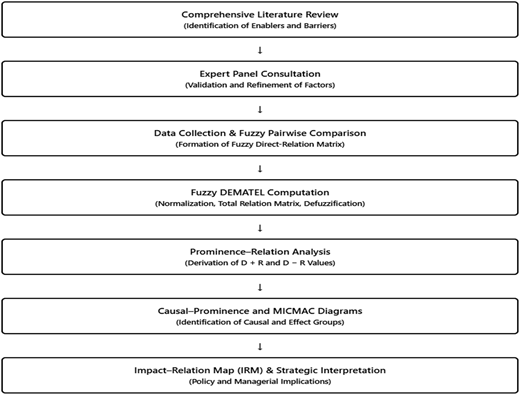
The overall research process and analytical framework used in this study are illustrated in Figure 1.
3.8 Expected outcome
The production of this methodological procedure is an Impact–Relation Map (IRM) that presents causal interdependencies between the 16 drivers. This helps to identify primary causal factors, including corporate social responsibility, environmental awareness, and government incentives, as well as the secondary effect factors, which include convenience and affordability (Ellili, 2024). The results direct strategic interventions for FMCG organizations and policymakers to manage sustainable consumer behaviors around rising markets.
3.9 Kappa statistics
To maintain the stability of experts' judgments in the matrix of pairwise comparison, Fleiss' Kappa statistic is calculated. The Kappa statistical analyzes the agreement among multiple raters assigning categorical ratings to items (Li et al., 2023). In this research, sixteen factors are evaluated by fourteen experts using five linguistic scales (NI, LI, MI, HI, and VHI). Kappa is computed by using the mentioned formula to ensure the consistency of expert evaluations used in constructing the fuzzy direct-relation matrix. Inter-rater reliability was assessed using Fleiss, Kappa statistic, which is appropriate for multiple raters and categorical scales, is used to evaluate the influence of fourteen experts using a factor pair using a five-level linguistic scale (NI, LI, MI, HI, VHI) (Kolesnyk and Khairova, 2022). The Kappa coefficient was computed on all off-diagonal entries of the 16 × 16 pairwise comparison matrices. The consequential Fleiss' Kappa value of κ = 0.964 indicates flawless agreement among experts (Sall et al., 2023), thereby validating the reliability of the stimulated judgments and justifying their accumulation into the average fuzzy direct-relation matrix.
3.10 Overview of analytical process
As per the methodology defined in Section 3, the average fuzzy direct-relation matrix is constructed by the expert's evaluation, which is collected from twelve specialists in the FMCG sustainability domain. Afterward, the metric is subsequently normalized and converted into the fuzzy total-relation matrix (Pandey et al., 2024; Desbalo et al., 2023).The values support the MICMAC Driving–Dependence Diagram, the Network Relationship Map, and the Causal–Prominence Diagram (DEMATEL Map), which together explore the behavioral drivers of emerging and developing markets of FMCGs (Najafzadeh et al., 2025).
Notably, individually, all sixteen factors were used to compute DEMATEL, and the thematic grouping provides additional interpretive power (Feng et al., 2024). Factors that contain Social–Psychological Drivers and Environmental Cognition mainly occupy the causal quadrant of the influence relation, reflecting their initial role in determining sustainable consumer behavior. At the same time, Market and Policy Infrastructure and economic feasibility Infrastructure tend to fall in the effect group. Before performing the Fuzzy DEMATEL computations, the experts' input consistency is determined. The Fleiss' Kappa coefficient obtained for the 14 experts' pairwise evaluations was κ = 0.964, supporting and confirming a perfect level of agreement of the subsequent causal analysis.
3.11 Causal–prominence analysis
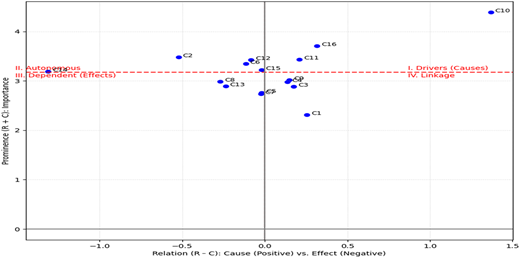
Figure 2 which is a DEMATEL Causal–Prominence Diagram, presents a two-dimensional distribution of all factors based on their overall importance (D + R) and causal strength (D−R). The horizontal axis (D − R) differentiates causal drivers (positive) from effect or dependent factors (negative). Global research trends conceptualize sustainable consumer behavior as a multidimensional phenomenon influenced by economic aspects, institutional mechanisms, environmental understanding, and socio-cultural norms (Dixit et al., 2023).
The vertical axis (D + R) represents the overall prominence or the degree to which each factor is involved within the system. The interpretation and representative factors for each causal-prominence quadrant are summarized in Table 6.
3.11.1 Key observations
Government Policy and Incentives (C10) emerged as the most influential causal factor with the highest (D − R) = +1.42 and (D + R) = 4.35. It is also evident that broad and macro-level institutional support, such as eco-labeling mandates, subsidies, or sustainability campaigns, initiates multiple dimensions of behavioral change.
Cultural Context (C11) and Ethical Values and Personal Norms (C16) jointly form the moral cultural foundation of shaping awareness, sustainability adoption, and emotional motivation.
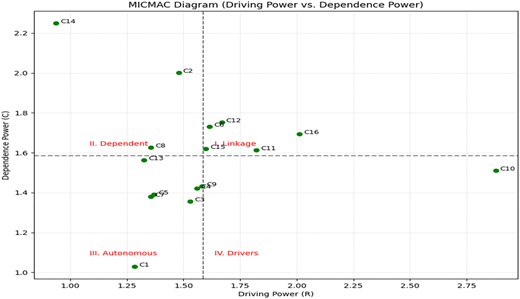
3.12 MICMAC driving–dependence analysis
3.13 Network relationship mapping
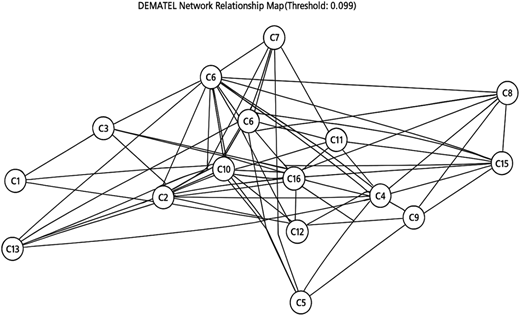
The DEMATEL Network Map (Figure 4) presents significant interrelations above the threshold α = 0.099. Among the sixteen determinants, the directional arrows represent the flow of influence; high-density clusters form around C10 → {C2, C12, C16, C11}, representing that the policy and moral-cultural forces are central nodes in the network. C6 are social norms, and C15 are Marketing, presenting strong bidirectional connectivity, indicating mutual reinforcement between societal endorsement and corporate communication. While peripheral nodes like C14 (Habits) and C1 (Awareness) uphold limited connections, and directing prospects for behavioral-nudging interventions.
A multi-layer causal structure is supported by network topology.
Policy, culture, and ethics as the Macro-drivers
Digital, marketing, and social norms as the Meso-mediators
Price, convenience, emotion, and trust as the Micro-effects
3.14 Ranking of drivers and effects
A summary of factor prominence and causal strength, based on the defuzzified matrices, is presented in Table 8.
3.15 Discussion of findings
In emerging FMCG markets, the assimilated DEMATEL–MICMAC investigation explains a hierarchical causal framework for sustainable consumer behavior. This study advances the sustainable consumer behavior literature by identifying a structured causal hierarchy among key determinants using Fuzzy DEMATEL. It addresses the limitation of prior studies that rely on fragmented and linear relationships among variables.
Macro-Institutional Layer (C10, C11, C16)
The root enablers are Policies, cultural alignment, and ethical norms.
Their progress directly triggers higher awareness, digital engagement, and trust formation.
Meso-Interactive Layer (C12, C15, C6, C4)
To translate policy and ethics into behavioral visibility, these linkage factors form the communication and social diffusion network.
Micro-Behavioral Layer (C8, C13, C3, C5)
Represent individual purchase outcomes, such as trust, emotional satisfaction, and convenience perceptions.
Peripheral and Habitual Factors (C1, C7, C14)
These can evolve through targeted educational or behavioral-change initiatives, low in driving power,
4. Chapter 5: results, discussion, and conclusion
4.1 Interpretation of Fuzzy-DEMATEL results
4.1.1 Prominence–relation structure
The DEMATEL, MICMAC, and ranking results are presented in an integrated manner to provide a comprehensive interpretation of the causal relationships and relative importance of the identified sustainability drivers. The findings are discussed with reference to their practical implications for sustainable retail management. As per an international Fuzzy-DEMATEL sustainability study, a wide division arises among effect-oriented outcomes and causal determinants. The total relation matrix computation and deviation of prominence (D + R) and relation (D – R) values derived a measured understanding of the combination of factors around thematic clusters (Von Heusinger and Schumacher, 2019).These variables illustrated the substantial driving influence over causal dominance, strengthening the position that sustainable decisions in the developing markets initiate with heightened ecological consciousness and informed perception. The factors fitting the cognitive and environmental awareness themes, comprising Environmental awareness (C1) and Environmental concerns and attitudes, displayed powerful positive relation values (Patra and Lenka, 2024), which argues that regulatory structures perform a pivotal role in enabling or constraining sustainable choices.
The causal structure identified through Fuzzy DEMATEL demonstrates that these factors act as primary driving forces influencing the downstream market and policy infrastructure elements (Batool et al., 2025), while the government policies and incentives (C10) work as a main driver under the governance and regulatory themes. A dual pattern is being themed by Social Norms and Peer Influence (C6) and Personal and Social Image (C7), which suggests that the influence of normative pressure exists across behavioral pathways, whereas the cultural and market contexts make it hard to analyze psychosocial and structural changes. As a causal determinant, social norm appeared strongly, and image-based variables displayed fluctuation between causality and dependence. A sensitivity analysis was conducted to examine the robustness of the obtained rankings under varying parameter conditions, confirming the stability of the results.
4.2 Dependent outcomes and behavioral reception
Behavioral Outcome and Product Evaluation themes, as the dependent side of the model, hold a negative relation value. The dependent side of the model displayed negative relation values holds Behavioral Outcomes and Product Evaluation themes. (Kalro and Joshipura, 2023)The number of factors, including Ease of Adoption (C5), Product Attributes and Quality (C9), Cultural Values (C11), Ethical Motivations (C13), and Habits and Consumption Routines (C14), are the influencing variables, which elaborate that within the FMCGs, the developing markets are characterized by social, cognitive, structural, and informational antecedents (Gupta et al., 2023).
4.3 MICMAC analysis and factor classification
The results indicate that the Environmental and Cognitive Awareness theme, besides Digital Influence and Governance, exists within the driver quadrant, reinforcing their initial influence. The MICMAC analysis classifies the factors according to their driving and dependence power by classifying the themes and associated factors (D'Arco et al., 2025). The identified causal relationships are consistent with previous empirical evidence and extend the existing literature by demonstrating the relative influence of sustainability drivers within the FMCG retail context. Rather than establishing statistical causality, the findings represent expert-based causal perceptions that provide a structured understanding of the interrelationships among the identified drivers. The dependent quadrant comprises the themes of Behavioral Outcomes and Product Attributes with their classification in the Fuzzy DEMATEL outcomes. The quadrant factors include Price and Affordability (C3), Product Availability (C4), and Social Image (C7). While the high sensitivity variable themes are shaped by suggesting that changes in any of the causal themes can quickly alter their influence. Still, certain factors are isolated within the system; stable consumer behavior in rising FMCG markets appears to be jointly formed into a strongly woven network of inspirations (Singh et al., 2023). The combined interpretation of the DEMATEL causal diagrams, MICMAC classification, and driver rankings provides consistent evidence supporting the study objectives. These findings form the basis for the conclusions and managerial recommendations presented in the subsequent section.
4.4 Network relationship map (NRM) insights
Among the thematic clusters, the threshold value of 0.099 revealed an NRM that constructed and revealed a hierarchical interconnected structure. High-impact drivers confirm a theme that positions Environmental Awareness, Policy, and Digital Influence. In the emerging market, a dense interconnection seen in the NRM suggests that consumer behavior evolves through layered influences.
4.5 Theoretical and managerial contributions
This study extends the sustainable consumption literature by identifying the causal hierarchy among environmental, socio-psychological, economic, and institutional factors influencing sustainable FMCG purchasing behavior (Ferreira and Ferreira, 2026; Sharma and Sharma, 2025; Mushi et al., 2025). This study extends the existing literature by proposing a structured causal framework that explains the interactions among sustainability drivers in the FMCG retail sector. The integration of Fuzzy-DEMATEL and MICMAC contributes methodologically by simultaneously identifying the strength, direction, and hierarchical influence of sustainability drivers, thereby providing insights beyond conventional ranking approaches.
4.6 Societal and policy implications
The study highlights that sustainable consumption behavior can significantly improve environmental quality and consumer well-being. By influencing awareness, social norms, and affordability, society can shift toward more responsible consumption patterns. By promoting awareness, environmental concern, and responsible consumption practices, the identified drivers can support broader sustainability goals and encourage environmentally conscious consumer behavior.
4.7 Practical implications
The findings help policymakers and FMCG retailers prioritize key sustainability drivers when designing policies and business strategies. Emphasizing environmental awareness, standardized green labeling, transparent marketing communication, and trust-building initiatives can promote sustainable consumer behavior and improve long-term retail sustainability, also the policy makers and FMCG firms should prioritize consumer environmental awareness, trust-building initiatives, and social influence mechanisms, as these factors serve as the primary drivers of sustainable consumption.
5. Conclusion
This study provides a comprehensive analysis of the causal determinants of sustainable consumer behavior in the fast-moving consumer goods (FMCG) sector of developing economies using the Fuzzy-DEMATEL method. The findings reveal the complex structural dynamics underlying consumer decision-making and demonstrate that sustainable consumption is influenced not only by individual attitudes and product-specific attributes but also by the interaction of regulatory frameworks, environmental cognition, socio-normative influences, and digital information ecosystems. The study offers both empirical evidence and theoretical insights for policymakers, regulators, and businesses seeking to design targeted strategies to promote and manage sustainable consumption. By mapping the complex network of sustainability drivers, the study identifies psychological and cognitive factors as the primary causal drivers, while economic and infrastructural factors constitute the effect layer that responds to these underlying influences. Furthermore, the MICMAC and NRM analyses confirm the systemic nature of sustainable consumer behavior by highlighting the interconnected and non-linear relationships among the identified drivers. The results indicate that environmental awareness, government policy, environmental concern, digital media influence, and trust in green claims are the most influential causal drivers within the system. Future research may extend this work by incorporating sector-specific models, hybrid multi-criteria decision-making (MCDM) techniques, or longitudinal consumer datasets to further enhance the understanding of sustainable consumer behavior.