Skip to Main Content
Purpose

Interest in decent work research has been increasing among scholars. However, existing reviews have focused on context specificities such as industries, methods, samples and locations. This study provides holistic and up-to-date insights into emerging decent work themes to advance theory and inform policy.

Design/methodology/approach

A systematic mixed studies review approach was employed following Preferred Reporting Items for Systematic reviews and Meta-Analyses (PRISMA) to comprehensively review 98 decent work studies published in 40 journals between 2006 and 2024 across 193 countries.

Findings

The analysis revealed eight core themes: conceptualization of decent work, decent work profiles, decent work antecedents, decent work outcomes, mediators of decent work, moderators of decent work, cross-context decent work conditions and decent work enhancement strategies.

Originality/value

Unlike existing reviews that have context-specific restrictions such as industries, methods, samples and locations, which may fail to capture the broader scope of the decent work literature, this review provides methodologically inclusive, contextually diverse and multi-level evidence syntheses of the decent work literature.

The importance of decent working conditions in the world of work and society generally has made it a subject of great interest among scholars and practitioners. Work takes up a significant part of the daily routine of humans and significantly affects our lives and determines the kind of effects individuals and society experience (Dodd et al., 2019; Ferreira et al., 2019; Ralph and Arora, 2024; Randev and Jha, 2023). Decent work represents the minimum conditions in the work environment that employees must be given (Blustein et al., 2023b). These conditions, including time and rest from work, social security, adequate compensation, values alignment, safe work, social dialogue, representation, work rights and accessible healthcare, enhance the well-being of employees (Duffy et al., 2019, 2021; Masdonati et al., 2019; Ribeiro et al., 2019). When work is decent, its effects are positive, which contributes a great deal to achieving social sustainability (Conigliaro, 2021). The reverse occurs when work is not decent.

In the last 25 years, there have been four major developments around the decent work phenomenon. First, the ILO (1999) promoted the decent work agenda covering rights at work, employment creation, social protection and social dialogue as its primary goal. Second, in the resolution adopted by the United Nations to transform the world through the 2030 Agenda for Sustainable Development, decent work was included as one of the 17 Sustainable Development Goals (United Nations, 2015). Third, Duffy et al. (2016), in their seminal work, the psychology of working theory (PWT), placed decent work as central to the PWT and individual employees at the forefront of decent work. Fourth and lastly, Duffy and his colleagues in 2017 validated a scale to measure decent work, and this measure has underpinned most cross-cultural empirical studies and advanced decent work practices, particularly at the individual worker level.

Following these developments, interest in decent work research has been high, and it keeps growing among international development organizations and scholars. Some reviews of the literature have consequently been conducted to explore the decent work concept and experiences. Existing reviews have largely focused on context specificities such as sectors/industries (see Wang and Cheung, 2024; Foláyan et al., 2024; Saragih et al., 2024), samples (see Baldry et al., 2024; Hult et al., 2024; López Peláez et al., 2023), methods (see Baldry et al., 2024; Nourafkan and Tanova, 2023; Pereira et al., 2019) and location (see Cooke et al., 2019). Yeh and Wang (2024), on their part, examined the evolution of decent work and how each phase related to empowerment. We note that these context-specific reviews can enhance our understanding of worker experiences of decent work across different organizations, industries/sectors and national cultures. However, they may offer a compartmentalized understanding of the subject.

The current study thus offers a holistic and integrated appreciation of the concept of decent work and provides a critical analysis of the literature to date. Guided by the theoretical question: What insights can be drawn from the decent work literature? We adopt a systematic mixed studies approach to examine decent work research spanning 18 years. Specifically, our review addresses the following research questions (1) How has decent work been theoretically conceptualized? (2) What profiles characterize workers' experiences of decent work? (3) Which antecedents, outcomes, mediators and moderators are associated with decent work? (4) How do decent work conditions compare across meso and macro contexts? and (5) What strategies can be employed to enhance decent work?

This paper thus makes several contributions to the decent work literature. First, unlike prior reviews that tend to be limited by methods, location, sample or industry (e.g., Baldry et al., 2024; Cooke et al., 2019; Foláyan et al., 2024; Hult et al., 2024; López Peláez et al., 2023; Nourafkan and Tanova, 2023; Pereira et al., 2019; Saragih et al., 2024; Wang and Cheung, 2024), our systematic mixed studies review provides a comprehensive and critical analysis of decent work by taking a methodologically inclusive, contextually diverse and multi-level evidence syntheses of the literature. Although the context-specific reviews can enhance our understanding of worker experiences of decent work across different organizations, industries/sectors and national cultures, they may offer a compartmentalized understanding of the subject. Consequently, the current review offers an integrated appreciation of the concept of decent work and provides a critical analysis of the literature to date.

Moreover, the existing reviews have relied largely on descriptive analytic frameworks, thereby limiting the depth of thematic synthesis and integration of findings across studies (see Baldry et al., 2024; Nourafkan and Tanova, 2023; Pereira et al., 2019). Our review is one of the first to thematically synthesize decent work at macro (national), meso (industry) and micro (individual) levels without context and methodological limitations. Accordingly, this review offers breadth and depth that update and extend existing reviews. Relatedly, our review contributes to the discourse of promoting decent work by providing a multi-level thematic map for scholars, practitioners and policymakers. Specifically, this review establishes what constitutes decent work, how it is experienced by workers, factors that impact it and result from it, as well as strategies that can improve decent working conditions. Lastly, our review discusses critical gaps in the decent work literature and advances potentially fruitful avenues for future research and policy directions for promoting decent work in practice.

In the remainder of this paper, we discuss the methods employed in the review, which cover the study design, data identification, eligibility criteria, data screening process and synthesis of selected data. Discussion of the findings and avenues for future research and policy follow the methods. The paper ends with a conclusion and limitations of the study.

Following PRISMA (Preferred Reporting Items for Systematic reviews and Meta-Analyses) guidelines to ensure transparency and reproducibility (Page et al., 2021), this paper employed a systematic mixed studies review through the convergent qualitative synthesis design. A systematic mixed studies review is a type of systematic literature review that uses a mixed methods approach. In such reviews, there is no restriction to study inclusion based on methods. Mixed methods, qualitative, conceptual/theoretical and quantitative studies are integrated in the same review (Bush et al., 2017; Heyvaert et al., 2017; Hong et al., 2017; Pluye and Hong, 2014). Using a convergent qualitative synthesis design meant that the studies that met the eligibility criteria, including the quantitative studies, were coded as texts and synthesized simultaneously (Hong et al., 2017; Pluye and Hong, 2014). This approach allows researchers to bring together diverse types of evidence in the literature regardless of the methods used and the type of results the studies evinced in the same review (Lizarondo et al., 2022). In doing so, we overcame the methodological limitations that characterize previous reviews (e.g., Baldry et al., 2024; Nourafkan and Tanova, 2023; Pereira et al., 2019). Thus, this systematic mixed studies review enables a methodologically inclusive approach to provide a comprehensive and critical analysis of the decent work literature. The systematic mixed studies review design also enabled us to update and extend prior reviews on decent work, as we were not bound by methodological and contextual restrictions.

The data identification process started off by consulting a research librarian, and the research team decided the appropriate databases, search phrases and search strategy (Covidence, 2024; Pluye and Hong, 2014). We settled on four databases (i.e., Business Source Ultimate, PsycINFO, Scopus and Web of Science) because they contain subject areas highly relevant to decent work. On September 20, 2024, we used the phrase “decent work” to search the TITLE-ABS-KEY of all the databases. In each database search, preliminary delimitations applied were peer-reviewed journal articles published in the English language. There were no restrictions by year of publication or location of study. A combined total of 2,426 articles were obtained through this search process.

The following criteria were used to determine the eligibility of studies for inclusion in the review. Only studies that met these criteria were included in our review.

  1. Peer-reviewed journal articles published in the English language.

  2. Articles with a focus on decent work.

  3. Articles with a focus on the working population.

  4. Articles from journals not ranked in the top 15 percent in Scopus [1].

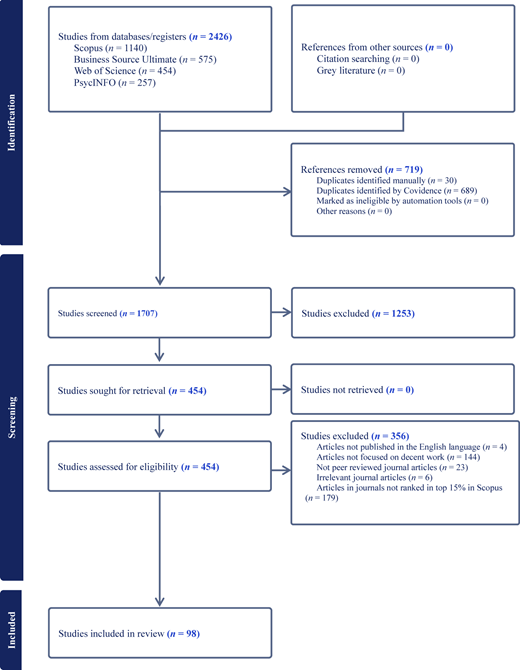
The data that were obtained at the data identification stage were exported in a research information system (RIS) file format and exported into Covidence, an online platform that aids the selection of studies for systematic literature reviews, to commence the data screening process. Two members of the research team independently screened the titles and abstracts of 1,707 studies (after 719 duplicates were removed) for relevance. After the screening, studies that received conflicting decisions (e.g., yes vote by one reviewer and no by another reviewer) were flagged in Covidence. The inter-rater reliability was moderate (Cohen's Kappa = 0.553) with a proportionate agreement of 79.5%. Discussions were held between the reviewers to decide studies to progress to the next stage (Covidence, 2024; Pluye and Hong, 2014). Eventually, 454 studies progressed to the full-text review stage where they were reviewed against the eligibility criteria. In the end, 98 studies were included in this review as depicted in Figure 1, the PRISMA flow chart.

To synthesize the data, the 98 studies were exported from Covidence in a comma-separated values (CSV) file into Microsoft Excel for initial coding. Data from each study was extracted and coded by its human participants, theory, methodology, measurement of decent work, country and findings/propositions. The author, publication year, journal and publication title were already in the exported file and subsequently coded. The data-based convergent synthesis procedure was utilized to organize the results of the studies. All the results were expressed qualitatively, analyzed thematically and presented together (Hong et al., 2017; Noyes et al., 2019; Pluye and Hong, 2014). Specific to the thematic analysis; we followed the procedures highlighted by Braun and Clarke (2006) and Naeem et al. (2023). The results were read and re-read several times for familiarization. Keywords from the results of each study were then highlighted and coded based on their function in the texts. This was critical to the analysis as some keywords appeared several times in different studies and in some instances, played different roles. Following this step, the keywords were grouped according to their functions, leading to the generation of codes (sub-themes). Finally, themes were generated through the amalgamation of the codes. This thematic analytic procedure was inductively performed. That is, the codes generated were based solely on the data and not pre-existent (Braun and Clarke, 2006; Nowell et al., 2017). The procedure was also done iteratively to achieve rigor and trustworthiness (Nowell et al., 2017; Pluye and Hong, 2014).

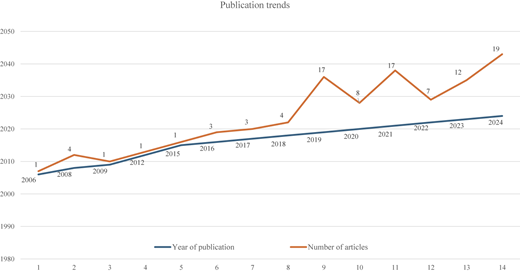
This review includes 98 articles published between 2006 and 2024. As Figure 2 presents, decent work research rose gradually from 2016 to 2018 and has seen an exponential increase since 2019. Given that the last of the four major developments around decent work, which involved the development and validation of a scale to measure the concept, occurred in 2017, it is safe to mention that awareness and interest in the phenomenon have been at an all-time high afterwards and likely to increase in the coming years.

Table 1 shows the journals, human participants and theories used in these studies. It is observed that the 98 articles included in this study were published across 40 journals, and more than half of the studies (53) were published in five journals. Majority of the papers (18) were from the Journal of Career Assessment, followed by Journal of Vocational Behavior (15), Journal of Counseling Psychology (11), Employee Relations (5) and Journal of Career Development (4). Concerning the human participants, working adults are shown to be the most studied group (19). Managers were also studied in five of the studies, whereas employed adults were studied in four studies. Both employees and employers participated in three studies each. Of the theories used, the psychology of working was used in 52 studies. Self-determination theory and stakeholder theory were each used in two studies. The rest of the theories, as shown in the table, were used once.

The methodologies used and how decent work was measured in the literature are displayed in Table 2. According to the table, majority of the studies (52) used a quantitative approach to study decent work and literature reviews were the least used methods (3). Again, it is seen that decent work was measured using 16 different measures. The decent work scale was used in 44 studies, the ILO decent work components/pillars/dimensions in four studies, and Korean version of decent work scale 3 studies. Both quality of employment and Turkish decent work scale were used in two studies.

In Table 3, the top 10 most cited papers, productive authors and studied countries are presented. A look at the table points to the Journal of Counseling Psychology as a journal containing half of the 10 most cited papers in Scopus. Journal of Career Assessment and Journal of Vocational Behavior also rank high in the journals with the most cited papers. The psychology of working theory (Duffy et al., 2016) and The development and initial validation of the decent work scale (Duffy et al., 2017) are the two most cited papers. It is important to note that these two articles make up two of the papers that have accounted for the four main developments around decent work. This is a testament to the influence of these papers on the decent work subject. Scrutinizing the most productive authors, Duffy, Autin, Allan and Blustein, all have a minimum of nine papers. They are the most influential scholars when it comes to decent work research. Not only do they have the most papers, but the articles they authored also dominate the most cited papers. Further, it is observed that with 24 studies, the USA is the country with the most decent work studies. This is unsurprising because the authors with the most contributions are based in the USA. China follows with about half (13) of the studies conducted in the USA. Sixteen countries are in the top 10 countries studied. Europe dominates the top 10 countries studied. Asia, having four countries studied (China, Turkey, South Korea and India), follows Europe. Africa (South Africa) and South America (Brazil) have one country each, North America has two countries (Mexico and the USA) and Oceania also has two countries (Australia and New Zealand).

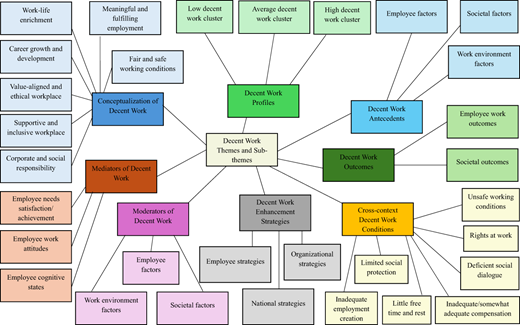
Eight core themes emerged from this review. They are conceptualization of decent work, decent work profiles, decent work antecedents, decent work outcomes, mediators of decent work, moderators of decent work, cross-context decent work conditions and decent work enhancement strategies. The themes are shown in Table 4.

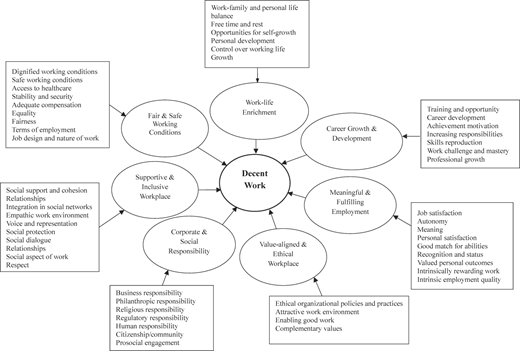
As a relatively new concept, the literature demonstrates that the theoretical conceptualization of decent work has been a preoccupation of scholars in the area, as it has been conceptualized in several national and industrial contexts. The literature reveals seven subthemes related to the conceptualization of decent work (Figure 3). These dimensions combine objective and subjective dimensions from heterogenous sources such as the ILO, employers and individual workers. The synthesis of the existing conceptualizations reveals that there is more to the decent work dimensions than what has been elucidated by the ILO (1999) and Duffy et al. (2017), which have become the widely accepted dimensions. The ILO has employment, social protection, rights of workers and social dialogue as the dimensions of decent work, while Duffy et al. (2017) espoused adequate income, access to healthcare, free time and rest, complementary values and safe working conditions as its constituents. These dimensions can be broadly categorized into two sub-themes (i.e., fair and safe working conditions and supportive and inclusive workplace).

Support for the dimensions of decent work being more than the five that Duffy and his colleagues enumerated is further corroborated when the dimensions were validated in different national contexts. For instance, in France (Vignoli et al., 2020), Portugal (Ferreira et al., 2019), South Korea (Nam and Kim, 2019), UK (Dodd et al., 2019) and Turkey (Buyukgoze-Kavas and Autin, 2019), the conceptualization of decent work was expanded. The foregoing supports the idea that decent work can have additional dimensions (Duffy et al., 2016, p. 131). The additional subthemes that emerged from the literature include work-life enrichment, career growth and development and meaningful and fulfilling employment. These and other dimensions provide a justification to the claims (Di Ruggiero et al., 2015; Dobbins et al., 2024; Wang and Cheung, 2024) that the existing conceptualization of decent work is limited in scope. Moreover, Amankwaa et al. (2025) emphasize tensions around the decent work concept. More importantly, this review synthesizes studies on the different components of decent work (Pereira et al., 2019). As a field which is relatively new and growing steadily, there is the opportunity to reconceptualize decent work to accommodate other dimensions not yet incorporated into the concept so that the totality of its meaning is captured. The continuous wholesale reliance on the already existing dimensions could steer the direction of decent work in ways that do not adequately capture the essence of the concept and could affect emerging theoretical development of decent work.

The Decent work profiles theme was obtained from studies that conducted latent profile analysis. This type of analysis identifies and clusters distinct groups (profiles) within a population based on their experiences of a phenomenon, clusters that would otherwise be hidden at the aggregate level (Spurk et al., 2020). The decent work profiles reveal different subgroups within the larger groups of workers based on their experience of decent work. The analysis suggests that workers' experiences of decent work are not the same, yet they cluster around specific profiles (decent work dimensions). This observation is an important consideration, theoretically and practically, because it highlights the dimensions of decent work (Duffy et al., 2017) that are most accessible and least accessible to workers and thus provides evidence for remedial action at work. The decent work profiles shown in the literature, therefore, reflect the nature of the working conditions experienced by individual workers. Differences in these mutually exclusive profiles are indications that decent work is not uniformly experienced by workers. As Table 4 reports, three broad profiles are identified (i.e., low decent work cluster, average decent work cluster and high decent work cluster). Generally, profiles in the low decent work cluster characteristically experience low levels of decent work. Profiles in the average decent work cluster are workers who experience low and average levels of decent work. The high decent work cluster is made up of profiles that experience high levels of decent work. There exists a significant proportion of the workforce in the low decent work and average decent work clusters. This reality is worrying because workers in these clusters are less likely to be committed to their jobs and more likely to have intentions to quit (Duffy et al., 2024b). They also tend to have low job and life satisfaction (Blustein et al., 2020; Çarkıt, 2024) and experience anxiety and depression (Blustein et al., 2023a). An interesting observation from the literature is that even the workforce belonging to the high decent work cluster do not fully experience decent work because they have low/lack of access to healthcare and adequate rest.

Generally, the foregoing discussion signals the persistence of precarious labor conditions experienced by individual workers and the accompanying gaps in the realization of decent work. A notable observation from the literature is that profile membership is predicted by factors such as the type of work, age, gender, education level, marginalization, work volition, employment status and socioeconomic status (Blustein et al., 2020; Blustein et al., 2023a; Çarkıt, 2024; Kim et al., 2021; Lee et al., 2024). However, Duffy and colleagues note that decent work is achieved when all its components are available to workers (Duffy et al., 2017). This position makes us question whether decent work as a standard work condition is “perhaps, only aspirational at best” or achievable by all workers irrespective of their circumstances. This notwithstanding, it is imperative that approaches used to promote decent work are designed with the profile of employees in mind. There needs to be targeted interventions for different worker groups (profiles) by the key actors in the industrial relations system if we are to improve the decent work experiences of workers, particularly those in the low decent work and average decent work clusters. The relevance of these findings should not be underestimated because these profiles have severe implications for workers' well-being, business profitability and survival in the long term. This can be extended to the achievement of SDG 8.

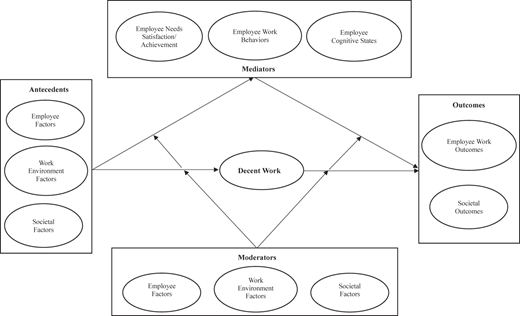
Employee, work environment and societal factors are three sub-themes shown in the literature as decent work antecedents (Figure 4). The identification of work environment factors as part of the antecedents of decent work adds to the mechanisms through which individual workers access decent work. While the psychology of working theory (Duffy et al., 2016) primarily emphasized societal (economic constraints and marginalization) and individual factors (work volition and career adaptability) as predictors of decent work, work environment factors have also been demonstrated as another medium for workers to acquire decent work. This expands the avenues through which decent work is made possible for workers. Decent work can only be experienced in the work setting since it is a workplace condition (Blustein et al., 2023b), hence it is in order that conditions in the workplace can contribute to its acquisition or otherwise (Allan et al., 2019; England et al., 2020). Blustein et al. (2023b), discuss in detail the importance of work environment factors in fostering decent work. It is therefore safe to hypothesize that decent work is not only a function of individual agency and societal influences, but a function of organizational inputs such as industrial relations systems and human resource management as well. In this regard, we urge researchers to consider work environment factors in their investigation of decent work antecedents.

According to the International Labour Organization (2013), decent work enables the achievement of equitable, inclusive and sustainable development, which makes it a means to an end. Decent work outcomes are a prominent theme discussed in the literature. It was first considered mainly as a macro-level concept and over time, has become an individual-focused concept (Duffy et al., 2016). Decent work thus affects both individual workers and society (Ralph and Arora, 2024; Randev and Jha, 2023), and the outcomes established in the literature align with decent work having employee work outcomes and societal outcomes. A notable observation is that an overwhelming majority of the studies (Table 4) have a bias for individual-level outcomes of decent work, with Pereira et al. (2019) bemoaning a lack of emphasis on the effects of decent work on the family and friends of workers and the broader society. This is quite understandable because the most influential scholar in this subject area (Ryan Duffy) advocates placing the individual worker at the center of decent work. Attention must also be given to the societal outcomes of decent work. Addressing this imbalance would provide a more complete understanding of the impact of decent work to inform policies that not only benefit individual workers but also contribute to broader societal well-being. Additionally, the literature seems to suggest that decent work affects individuals and society separately. However, we make the proposition that the individual and societal outcomes of decent work are a continuum; thus, when individuals are affected by decent work, the effects extend to society.

In the literature, employee needs satisfaction/achievement, work attitudes and cognitive states (Table 4) are shown to be the conduits that enhance decent work when it is an outcome variable (Autin et al., 2022a; Duffy et al., 2018, 2020; England et al., 2020; Su et al., 2023; Tokar and Kaut, 2018) and employee work outcomes when decent work is an antecedent variable (Allan et al., 2020; Duffy et al., 2019, 2021; Seol et al., 2024; Tokar et al., 2024; Wan and Duffy, 2023; Zhao and Liu, 2023) as decent work plays multiple roles in the work context. These indicate that decent work aligns with workers' overall well-being. A critical observation is that these mediators are predominantly employee-level variables rooted in psychological perspectives. This reflects a disciplinary bias for individual agency in transmitting decent work over structural and organizational factors. Looking beyond the individual factors would expand the mechanisms through which decent work is transmitted to facilitate the achievement of SDG 8. Notably, besides its roles as outcome variable and antecedent variable, it also acts as a mediating variable (Allan et al., 2019; Anlesinya et al., 2021; Atitsogbe et al., 2021; Heo and Lee, 2024; Masdonati et al., 2019; Wang et al., 2019). The foregoing suggests that decent work is a dynamic variable that is not only a means to an end as asserted by the International Labour Organization (2013), but an end in itself.

Another theme that emerged from the literature is the moderators of decent work. The moderators are shown to comprise employee factors, work environment factors and societal factors. Within the psychology of working theory (Duffy et al., 2016), the moderators consist of employee factors (proactive personality and critical consciousness) and societal factors (social support and economic conditions). Thus, additional moderating variables that extend beyond the initial propositions to include work environment factors have been established in the literature (Figure 4). As presented in Table 4, these include supportive organizational climate, job insecurity, workplace relational civility, labor relations climate and perceived career opportunity (Heo and Lee, 2024; Huang et al., 2022; Smith et al., 2024; Wan and Duffy, 2023; Zhao and Liu, 2023). As anticipated by Duffy et al. (2024a), this addition signals an evolution from the initial framing of the psychology of working theory and underscores the significance of organizational conditions in shaping individual workers' experiences of decent work. By this, we establish the proposition that accessibility to decent work is contingent not solely on individual agency and societal conditions, but workplace dynamics as well.

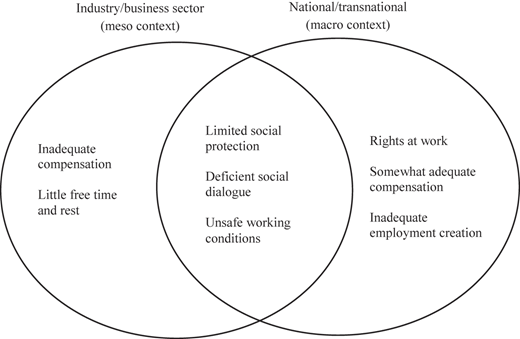
The literature is replete with revelations of decent work conditions across meso and macro contexts. That is, industry/business sector (meso) and national/transnational (macro) contexts. The conditions within both contexts are benchmarked against compensation, safe working conditions, social protection, social dialogue, employment creation and rights at work dimensions posited by the ILO. The alignment of decent work conditions with dimensions espoused by the ILO is consistent with the assertion that the international body's position on decent work reflects mainly macro-level indicators, with limited emphasis on individual worker experiences (Adhikari et al., 2012; Blustein et al., 2016; Duffy et al., 2016; Paredes Gil et al., 2008). The literature reports a general decent work deficit across both contexts (see Figure 5). While limited social protection, deficient social dialogue and unsafe working conditions emerge as common challenges in both contexts, each context has distinct decent work deficits. This suggests that there are structural and systemic barriers to achieving decent work at the meso and macro levels. Considering the decent work deficit, we are led to question the effectiveness of existing labor policies and the commitment, as well as strategies of international bodies toward the Decent Work Agenda. A coordinated action from actors in the industrial relations system, such as international labor and development organizations, national governments, industry leaders, trade unions, employers and business executives, is required to address these deficits.

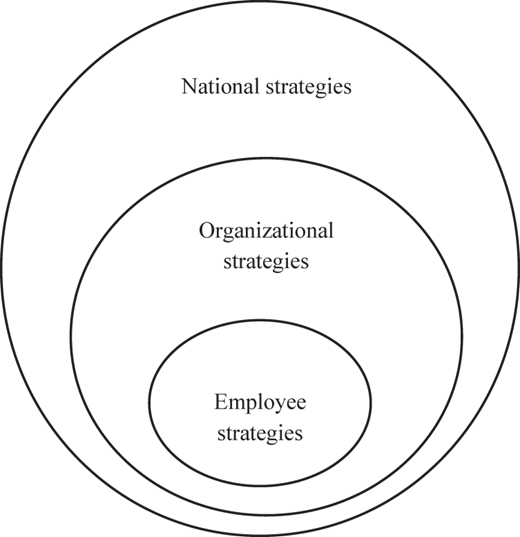
A key insight from the synthesis of the decent work literature is discussions related to strategies that can enhance decent work. The strategies operate at three levels: employee, organizational and national levels (Figure 6). Employee-level strategies are the actions taken by individual workers to improve their working conditions (Blustein et al., 2023b; Gibb et al., 2021; Khan et al., 2024). Organizational strategies involve workplace policies and practices as implemented by employers and managers (Blustein et al., 2023b; Cooke et al., 2019; Gibb et al., 2021; Randev and Jha, 2023; Reinecke and Donaghey, 2021; Thomas and Turnbull, 2018; Yao et al., 2017). At the national level, governments play a crucial role by establishing frameworks and policies that support decent work (Adhikari et al., 2012; Blustein et al., 2023b; Cooke et al., 2019). These multi-level strategies highlight shared responsibility among the three key actors in the industrial relations system in shaping decent work conditions. That no single actor can effectively enhance decent work, suggesting that effective progress toward achieving decent work for all requires coordination among the different actors. Further, this suggests that decent work cannot be achieved solely by top-down interventions or bottom-up efforts. Instead, a hybrid approach where policy enforcement, organizational commitment and worker agency interact are the necessities to overcome decent work deficits and drive sustainable improvements in decent work conditions. A thematic map of the literature is presented in Figure 7.

From the synthesized literature, we highlight several avenues for future research to further advance decent work research. These future research avenues cover, broadly, the data sources of decent work research, theoretical frameworks, methods, conceptualization and factors associated with decent work. Regarding the data sources of decent work research, the type of workforce studied, and the countries in which the studies are conducted in, need diversification. Access to decent work is most often influenced by factors such as age, gender, employment status, education level, marginalization experience and socioeconomic status (Blustein et al., 2023b; Çarkıt, 2024; Duffy et al., 2024b; Kim et al., 2021; Lee et al., 2024). While there are some studies that focus on individuals who fall within groups likely to be experiencing indecent working conditions (e.g., youth, women, minority groups, people of color, marginalized), they are hugely underrepresented. As such, their experiences are not adequately reflected in the decent work literature.

People with disabilities are other minority groups who have been ignored in the literature. Closely linked to this group of workers are neurodivergent workers, such as autistic and Attention-Deficit/Hyperactivity Disorder (ADHD) workers, whose decent work experiences are not made available in the literature. Additionally, migrants are largely ignored in the decent work literature. It must be added that while scholars such as Holzberg (2024) and Giddy (2022) had migrants included in their sample, we noted that it was not a deliberate decision to do so. It only happened that the background of the participants showed that they were migrants. Part-time workers, seasonal workers and casual workers are other worker groups likely to be of a low socio-economic status but have also not been represented in the literature. We urge scholars to pay more attention to these groups of workers to have a broader representation of worker groups in the decent work literature. Additionally, we encourage a focus on decent work studies on highly skilled workers because, according to Cooke et al. (2019), they sometimes encounter decent work deficits.

The geographic representation of decent work studies is another area that deserves more attention from scholars due to its skewed nature. Apart from Europe, which has numerous countries being studied, countries in the rest of the regions are less studied. Countries such as the USA and China dominate the studies in North America and Asia respectively. More studies ought to be conducted in North America and Asia besides the USA and China. Generally, more countries from across the globe need to be studied. There is a notable paucity of studies from the global south, particularly South America, sub-Saharan Africa and the Middle East and North Africa. Countries in these regions are mostly faced with poverty, lower income and access to education, underdeveloped infrastructure and overall, a non-buoyant economy compared to their global north counterparts. It is therefore important that decent work studies focus on such areas to bring to bear worker experiences from those areas.

The dominance of the psychology of working theory as the theoretical basis in the studies, while offering homogeneity to decent work research, has the propensity to limit its further development. The reliance on the psychology of working theory is important in laying a firm foundation for the subject by providing valuable insights into economic constraints, marginalization, work volition and career adaptability and their contributions to decent work. As a theory that is less than a decade old (Duffy et al., 2016), it is understandable because doing so establishes its relevance and ascertains how it underpins decent work, which seems to have been done. However, the challenge with this is that many of the studies anchored on this theory considered variables that were named in it. That is, economic constraints, marginalization, work volition and career adaptability as antecedent variables; and again, work volition and career adaptability as mediating variables. Similar outcome variables have also been the focus of many of the studies. The continuous reliance on the psychology of working theory especially, its core constructs, risk stagnation of the subject, as it may limit the exploration of new questions and perspectives (Duffy et al., 2024a). To ensure theoretical diversity and further developments of the subject, authors should consider theoretical alternatives to the psychology of working theory in decent work studies. Modified psycho-social theories such as self-determination and social cognitive career theories, as well as relational theory of working are good alternatives given the social and psychological aspects of decent work.

Concerning the methods used in decent work studies, while quantitative methods dominate, a variety of other methods, like qualitative, mixed methods, conceptual/theoretical and literature reviews, have been used. The use of mixed methods is especially important to advance the subject as it leverages the strengths of both qualitative and quantitative studies while limiting the weaknesses inherent in using one over the other (Creswell, 2009). More mixed methods studies will elucidate findings that just one method cannot do. However, many of the mixed methods studies adopted the concurrent mixed methods design where both quantitative and qualitative data were collected at the same time (Di Fabio and Kenny, 2019; Dodd et al., 2019; Ferreira et al., 2019; Masdonati et al., 2019; Nam and Kim, 2019; Vignoli et al., 2020). With this design, the full benefits of mixed methods studies are unlikely to be realized. Future studies are encouraged to adopt sequential mixed methods. For example, using explanatory sequential mixed methods to explain in more detail earlier quantitative findings or using exploratory sequential mixed methods so that, based on qualitative findings, measurement items suitable for the specific context of the group being studied can be developed (Creswell and Creswell, 2018).

Again, it is observed that a few of the quantitative studies are longitudinal or time-lagged. Confidence in the causalities associated with decent work, as found in the included studies, could be thought of as low since cross-sectional studies are limited in establishing clear-cut causality. This is an issue alluded to as a limitation in about 30% of the included studies. Scholars should thus conduct longitudinal or time-lagged studies to increase confidence in established causalities. Additionally, intervention studies are largely absent in the literature. Considering the benefits of intervention studies for theory and practice, the use of interventions in decent work studies could advance the subject in several ways. Such studies could unearth the boundary conditions together with the process factors that revolve around decent work while also firmly establishing causality. Decent work enhancement strategies highlighted in this study could be adopted in intervention studies. Another advantage of the intervention studies for the subject is the propensity to bridge the deficits in decent work conditions revealed in the industry/business sector and national/transnational environments, as well as decent work profiles.

The synthesized evidence regarding how the decent work concept has been theorized demands more research to firmly establish how decent work ought to be conceptualized. The claims by scholars (Di Ruggiero et al., 2015; Dobbins et al., 2024; Wang and Cheung, 2024), coupled with findings in this study, lend credence to the limited scope of the existing conceptualizations of decent work. Moreover, the revelation of additional conditions (e.g., career development, achievement motivation, autonomy, recognition and status) that workers deemed to be decent work conditions when the decent work scale developed by Duffy et al. (2017) was tested in different national contexts adds to the need for a more comprehensive conceptualization of the phenomenon. Pursuant to this, scholars are encouraged to develop a more comprehensive conceptualization of decent work. It must, however, be noted that the dimensions revealed in this study should only be a starting point in the quest to develop a more comprehensive conceptualization of the phenomenon. The dimensions evinced in this study are multi-level and heterogeneous. They combine objective and subjective dimensions from different sources, including the ILO, employers and individual workers, which, in the current state, could be quite problematic to advance without homogeneity. In the search for a comprehensive conceptualization of decent work, specific homogeneous perspectives must be targeted.

The use of latent profile analysis is a notable aspect of decent work studies. It shows individual workers and their distinct decent work profiles, which are essential for targeted interventions for worker groups. However, the decent work profiles deserve the attention of researchers. Available studies on decent work profiles are scanty, and these few studies have some peculiarities. Addressing the peculiarities in future studies will increase the volume of decent work profile studies and enhance their recognition and widespread acceptance because the profiles are not fully established yet. The distinctiveness of the decent work profiles is arguably questionable and not conclusive. Half of the studies involving the profiles were not premised on only decent work, but were combined with precarious work (Blustein et al., 2020, 2023a) and meaningful work (Duffy et al., 2024a, b). Also, these studies were conducted in Korea (Lee et al., 2024), the USA (Blustein et al., 2020; 2023a; Duffy et al., 2024b; Kim et al., 2021) and Turkey (Çarkıt, 2024). In the future, latent profile analysis could be conducted among different populations of workers and in different contexts based on only decent work. It is important to highlight that most of the studies were conducted in the USA, where access to healthcare is not universal, but largely employment-based. As a result, workers often face challenges of underemployment due to declining union influence, inadequate enforcement of labor protections, wage depression among others (Pratap et al., 2021). Given these conditions, and predictions that shifts in the employment landscape will further reduce access to employer-sponsored healthcare (Duffy et al., 2019), the low/lack of access to healthcare is understandable. More decent work profiles in countries where access to healthcare is not tied to employment will enable a holistic appreciation of the access to healthcare component of decent work profiles.

In terms of the factors associated with decent work, some of the antecedents in the societal factors need statistical testing. For instance, decent education (Duffy et al., 2022), national culture, ideology and policies and industrial relations (Cooke et al., 2019) are variables within the societal factors that have not been statistically examined. Additional work environment factors could be considered in future studies to highlight their importance in accessing decent work. Leadership and supervisor behaviors could facilitate the achievement of decent work. Therefore, these variables could be examined in future studies. Similarly, except for national well-being (Anlesinya et al., 2021), the societal outcomes of decent work (Frota, 2008; Ralph and Arora, 2024) require statistical testing. Furthermore, among the factors associated with decent work, studies have not been conducted to unearth moderating variables as much as the other factors (Duffy et al., 2024a). For example, other societal factors such as social support, types of government and labor laws (Duffy et al., 2017) and employee factors like goal orientation (Seol et al., 2024) could be considered in future studies.

The marginalization and decent work link have been found to have both a positive (Autin et al., 2021) and inverse relationship (Douglass et al., 2017, 2020; Duffy et al., 2016, 2018, 2020; Tokar and Kaut, 2018). A similar situation is observed between workplace climate and decent work. England et al. (2020) established a positive effect, whereas Allan et al. (2019) established an inverse effect. This could mean that the relations between these variables are inconclusive. It is also plausible that boundary conditions determine the type of association between the two variables. More research is therefore needed to establish which boundary conditions determine the type of relationship. Moreover, decent work has been established as a dynamic phenomenon. Its dynamism has been shown in it being an antecedent, mediator and outcome variable. It is yet to be made clear the conditions that necessitate the role it plays. Future studies could determine the specific conditions for the role it plays. Additionally, the phenomenon is yet to be considered as a moderating variable. As a dynamic variable, it will be interesting for scholars to pursue this agenda.

As shown in Figure 4, a social/relational theme is underrepresented in the decent work literature despite its importance in the discourse and experiences of decent work. Work is a social activity – it provides individuals with daily opportunities to interact directly with their colleagues, supervisors, supervisees, clients/customers and the wider community – thereby satisfying a natural social appetite (Allan et al., 2020; Blustein, 2011; Duffy et al., 2016). People spend much of their active time working (Ralph and Arora, 2024); hence, the interplay between decent work and social/relational aspects of work needs greater scholarly attention. The social/relational context of work is common to all workers and critical for career development and overall work experience (Blustein, 2011). Besides, the interpersonal discrimination and harmful workplace relationships that often affect marginalized and economically constrained workers (Binggeli et al., 2013; Duffy et al., 2016) underscore the importance of examining this interplay. From the perspective of relational theory of working, decent work can enhance the quality of the social/relational context of work (Allan et al., 2020; Blustein, 2011; Duffy et al., 2016), which may in turn spillover into relations beyond work. There is therefore a need for future research to investigate how decent work shapes and is shaped by the social/relational dynamics of work. Such a line of inquiry will complement existing factors such as employee cognitive states, work behaviors and needs satisfaction that have been linked with decent work and advance a more holistic understanding of the phenomenon.

This study drew insights from the decent work literature through a systematic mixed studies review in which evidence from quantitative, mixed methods, conceptual/theoretical and qualitative studies were synthesized. The study reveals a significant increase in research after the development and validation of the decent work scale in 2017. Despite the growing body of literature, the data sources are still not diverse enough to fully capture the experiences of marginalized groups and people facing economic constraints across different jurisdictions. Also, theoretical and methodological diversity are required in the study of the subject.

Moreover, the conceptualization of decent work needs to be broadened to encompass a wider range of dimensions. Additionally, this review highlights factors associated with decent work that are yet to undergo statistical testing, inconclusive and underrepresented. This study advances the decent work discourse by integrating fragmented evidence spanning individual, organizational and national levels. By consolidating the literature and providing a comprehensive analysis, this study advances theory and discusses avenues for future decent work research, including expanding the data sources and conceptualization of decent work, as well as conducting more statistical analyses to firmly establish factors that impact decent work and are impacted by it. In doing so, future studies can make important strides toward advancing decent work theoretically.

Practically, this study provides valuable insights for work stakeholders such as policymakers, work and vocational psychologists and human resource managers. It clarifies what constitutes decent work, how it is experienced by workers, the factors that impact it and result from it, decent work conditions across contexts and strategies that can improve decent work conditions. These insights can inform evidence-based stakeholder decisions to design targeted interventions to promote decent work and ultimately enhance worker well-being.

This study acknowledges some limitations related to the eligibility criteria. Publications such as conference proceedings, book chapters and grey literature on decent work were excluded. Similarly, journals ranked only in the top 15% were used as a cut-off point to ensure quality and rigor, but this may have resulted in the exclusion of articles from reputable journals that fall just below this threshold, which could have provided valuable insights. These criteria were applied due to concerns about variability in quality, but they may have led us to miss some key findings. Additionally, using only articles published in the English language as an eligibility criterion means that publications in other languages were excluded from the review. While English-language journals dominate global academia, excluding non-English publications may introduce a bias toward Anglo-centric perspectives and miss valuable insights from other regions. Future reviews could consider expanding the scope to include grey literature and non-English language publications to add to the comprehensiveness of the insights provided.

1.

The use of this criterion ensured that peer-reviewed articles in journals with high impact, quality and reliability were included in the review.
*
Adhikari
,
R.D.
,
Hirasawa
,
K.
,
Takakubo
,
Y.
and
Lal Pandey
,
D.
(
2012
), “
Decent work and work life quality in Nepal: an observation
”,
Employee Relations
, Vol. 
34
No. 
1
, pp. 
61
-
79
, doi: .
*
Allan
,
B.A.
,
Tebbe
,
E.A.
,
Bouchard
,
L.M.
and
Duffy
,
R.D.
(
2019
), “
Access to decent and meaningful work in a sexual minority population
”,
Journal of Career Assessment
, Vol. 
27
No. 
3
, pp. 
408
-
421
, doi: .
*
Allan
,
B.A.
,
Autin
,
K.L.
,
Duffy
,
R.D.
and
Sterling
,
H.M.
(
2020
), “
Decent and meaningful work: a longitudinal study
”,
Journal of Counseling Psychology
, Vol. 
67
No. 
6
, pp. 
669
-
679
, doi: .
Amankwaa
,
A.
,
De Pater
,
I.E.
,
Kosi
,
I.
and
Ayentimi
,
D.T.
(
2025
), “
Decent work in Ghana: towards understanding the role of positive psychological states in worker turnover intentions
”,
The International Journal of Human Resource Management
, Vol. 
36
No. 
16
, pp. 
2878
-
2903
, doi: .
*
Anlesinya
,
A.
,
Amponsah-Tawiah
,
K.
,
Adom
,
P.K.
,
Damoah
,
O.B.O.
and
Dartey-Baah
,
K.
(
2021
), “
The macro talent management, decent work and national well-being nexus: a cross-country and panel data analysis
”,
International Journal of Manpower
, Vol. 
42
No. 
5
, pp. 
777
-
793
, doi: .
*
Atitsogbe
,
K.A.
,
Kossi
,
E.Y.
,
Pari
,
P.
and
Rossier
,
J.
(
2021
), “
Decent work in Sub-Saharan Africa: an application of psychology of working theory in a sample of Togolese primary school teachers
”,
Journal of Career Assessment
, Vol. 
29
No. 
1
, pp. 
36
-
53
, doi: .
*
Autin
,
K.L.
,
Shelton
,
A.J.
,
Diaz Tapia
,
W.A.
,
Garcia
,
R.G.
and
Cadenas
,
G.A.
(
2021
), “
Testing psychology of working theory among Spanish-speaking Latinx workers in the U.S
.”,
Journal of Career Assessment
, Vol. 
29
No. 
3
, pp. 
379
-
395
, doi: .
*
Autin
,
K.L.
,
Herdt
,
M.E.
,
Allan
,
B.A.
,
Zhu
,
L.
,
Abdullah
,
M.
and
Garcia
,
R.G.
(
2022a
), “
Decent work among women workers: an intersectional approach
”,
Journal of Counseling Psychology
, Vol. 
69
No. 
6
, pp. 
775
-
785
, doi: .
*
Autin
,
K.L.
,
Williams
,
T.R.
,
Allan
,
B.A.
and
Herdt
,
M.E.
(
2022b
), “
Decent work among people of color: the moderating role of critical consciousness
”,
Journal of Career Assessment
, Vol. 
30
No. 
3
, pp. 
455
-
473
, doi: .
Baldry
,
K.
,
Koekemoer
,
E.
and
Olckers
,
C.
(
2024
), “
Empirical research on decent work and precarious work for semi-skilled and unskilled blue-collar workers: a scoping review
”,
Australian Journal of Career Development
, Vol. 
33
No. 
3
, pp. 
268
-
285
, doi: .
*
Barford
,
A.
,
Coombe
,
R.
and
Proefke
,
R.
(
2021
), “
Against the odds: young people's high aspirations and societal contributions amid a decent work shortage
”,
Geoforum
, Vol. 
121
, pp. 
162
-
172
, doi: .
Binggeli
,
S.
,
Dietz
,
J.
and
Krings
,
F.
(
2013
), “
Immigrants: a forgotten minority
”,
Industrial and Organizational Psychology
, Vol. 
6
No. 
1
, pp. 
107
-
113
, doi: .
Blustein
,
D.L.
(
2011
), “
A relational theory of working
”,
Journal of Vocational Behavior
, Vol. 
79
No. 
1
, pp. 
1
-
17
, doi: .
Blustein
,
D.L.
,
Olle
,
C.
,
Connors-Kellgren
,
A.
and
Diamonti
,
A.J.
(
2016
), “
Decent work: a psychological perspective
”,
Frontiers in Psychology
, Vol. 
7
, doi: .
*
Blustein
,
D.L.
,
Kenny
,
M.E.
,
Di Fabio
,
A.
and
Guichard
,
J.
(
2019
), “
Expanding the impact of the psychology of working: engaging psychology in the struggle for decent work and human rights
”,
Journal of Career Assessment
, Vol. 
27
No. 
1
, pp. 
3
-
28
, doi: .
*
Blustein
,
D.L.
,
Perera
,
H.N.
,
Diamonti
,
A.J.
,
Gutowski
,
E.
,
Meerkins
,
T.
,
Davila
,
A.
,
Erby
,
W.
and
Konowitz
,
L.
(
2020
), “
The uncertain state of work in the U.S.: profiles of decent work and precarious work
”,
Journal of Vocational Behavior
, Vol. 
122
, 103481, doi: .
*
Blustein
,
D.L.
,
Allan
,
B.A.
,
Davila
,
A.
,
Smith
,
C.M.
,
Gordon
,
M.
,
Wu
,
X.
,
Milo
,
L.
and
Whitson
,
N.
(
2023a
), “
Profiles of decent work and precarious work: exploring macro-level predictors and mental health outcomes
”,
Journal of Career Assessment
, Vol. 
31
No. 
3
, pp. 
423
-
441
, doi: .
*
Blustein
,
D.L.
,
Lysova
,
E.I.
and
Duffy
,
R.D.
(
2023b
), “
Understanding decent work and meaningful work
”,
Annual Review of Organizational Psychology and Organizational Behavior
, Vol. 
10
No. 
1
, pp. 
289
-
314
, doi: .
Braun
,
V.
and
Clarke
,
V.
(
2006
), “
Using thematic analysis in psychology
”,
Qualitative Research in Psychology
, Vol. 
3
No. 
2
, pp. 
77
-
101
, doi: .
*
Briseño
,
H.
,
Maisterrena
,
L.
and
Soto-Pérez
,
M.
(
2024
), “
Decent work and subjective well-being in Mexico
”,
International Journal of Sociology and Social Policy
, Vol. 
44
Nos
1/2
, pp. 
171
-
187
, doi: .
Bush
,
P.L.
,
Pluye
,
P.
,
Loignon
,
C.
,
Granikov
,
V.
,
Wright
,
M.T.
,
Pelletier
,
J.-F.
,
Bartlett-Esquilant
,
G.
,
Macaulay
,
A.C.
,
Haggerty
,
J.
,
Parry
,
S.
and
Repchinsky
,
C.
(
2017
), “
Organizational participatory research: a systematic mixed studies review exposing its extra benefits and the key factors associated with them
”,
Implementation Science
, Vol. 
12
No. 
1
, p.
119
, doi: .
*
Buyukgoze-Kavas
,
A.
and
Autin
,
K.L.
(
2019
), “
Decent work in Turkey: context, conceptualization, and assessment
”,
Journal of Vocational Behavior
, Vol. 
112
, pp. 
64
-
76
, doi: .
*
Çarkıt
,
E.
(
2024
), “
Decent work among Turkish working adults: a latent profile analysis
”,
Journal of Career Assessment
, Vol. 
33
No. 
2
, pp. 
301
-
321
, doi: .
*
Chau
,
N.H.
(
2016
), “
On sweatshop jobs and decent work
”,
Journal of Development Economics
, Vol. 
121
, pp. 
120
-
134
, doi: .
*
Conigliaro
,
P.
(
2021
), “
Between social sustainability and subjective well-being: the role of decent work
”,
Social Indicators Research
, Vol. 
157
No. 
1
, pp. 
139
-
174
, doi: .
*
Cooke
,
F.L.
,
Xu
,
J.
and
Bian
,
H.
(
2019
), “
The prospect of decent work, decent industrial relations and decent social relations in China: towards a multi-level and multi-disciplinary approach
”,
The International Journal of Human Resource Management
, Vol. 
30
No. 
1
, pp. 
122
-
155
, doi: .
Covidence
(
2024
),
A Practical Guide: Protocol Development for Systematic Reviews
,
Veritas Health Innovation
,
available at:
 https://www.covidence.org/wp-content/uploads/2024/10/A_practical_guide_Protocol_Development_for_Systematic_Reviews.pdf
Creswell
,
J.W.
(
2009
),
Research Design: Qualitative, Quantitative, and Mixed Methods Approaches
, (3rd ed.) ,
Sage
,
Thousand Oaks
.
Creswell
,
J.W.
and
Creswell
,
J.D.
(
2018
),
Research Design: Qualitative, Quantitative, and Mixed Methods Approaches
, (5th ed.) ,
Sage
,
Thousand Oaks
.
*
Dhakal
,
S.P.
and
Burgess
,
J.
(
2021
), “
Decent work for sustainable development in post- crisis Nepal: social policy challenges and a way forward
”,
Social Policy and Administration
, Vol. 
55
No. 
1
, pp. 
128
-
142
, doi: .
*
Di Fabio
,
A.
and
Kenny
,
M.E.
(
2019
), “
Decent work in Italy: context, conceptualization, and assessment
”,
Journal of Vocational Behavior
, Vol. 
110
, pp. 
131
-
143
, doi: .
*
Di Ruggiero
,
E.
,
Cohen
,
J.E.
,
Cole
,
D.C.
and
Forman
,
L.
(
2015
), “
Competing conceptualizations of decent work at the intersection of health, social and economic discourses
”,
Social Science and Medicine
, Vol. 
133
, pp. 
120
-
127
, doi: .
*
Dobbins
,
T.
,
Cao
,
X.
,
Green
,
A.
,
Johnstone
,
P.
and
Foster
,
W.
(
2024
), “
Conceptualizing decent work: an explorative study of decent work in England's Midlands region
”,
Policy Studies
, Vol. 
46
No. 
4
, pp. 
560
-
581
, doi: .
*
Dodd
,
V.
,
Hooley
,
T.
and
Burke
,
C.
(
2019
), “
Decent work in the UK: context, conceptualization, and assessment
”,
Journal of Vocational Behavior
, Vol. 
112
, pp. 
270
-
281
, doi: .
*
Douglass
,
R.P.
,
Velez
,
B.L.
,
Conlin
,
S.E.
,
Duffy
,
R.D.
and
England
,
J.W.
(
2017
), “
Examining the psychology of working theory: decent work among sexual minorities
”,
Journal of Counseling Psychology
, Vol. 
64
No. 
5
, pp. 
550
-
559
, doi: .
*
Douglass
,
R.P.
,
Autin
,
K.L.
,
Buyukgoze-Kavas
,
A.
and
Gensmer
,
N.P.
(
2020
), “
Proactive personality and decent work among racially and ethnically diverse working adults
”,
Journal of Career Assessment
, Vol. 
28
No. 
3
, pp. 
512
-
528
, doi: .
*
Duffy
,
R.D.
,
Blustein
,
D.L.
,
Diemer
,
M.A.
and
Autin
,
K.L.
(
2016
), “
The psychology of working theory
”,
Journal of Counseling Psychology
, Vol. 
63
No. 
2
, pp. 
127
-
148
, doi: .
*
Duffy
,
R.D.
,
Allan
,
B.A.
,
England
,
J.W.
,
Blustein
,
D.L.
,
Autin
,
K.L.
,
Douglass
,
R.P.
,
Ferreira
,
J.
and
Santos
,
E.J.R.
(
2017
), “
The development and initial validation of the decent work scale
”,
Journal of Counseling Psychology
, Vol. 
64
No. 
2
, pp. 
206
-
221
, doi: .
*
Duffy
,
R.D.
,
Velez
,
B.L.
,
England
,
J.W.
,
Autin
,
K.L.
,
Douglass
,
R.P.
,
Allan
,
B.A.
and
Blustein
,
D.L.
(
2018
), “
An examination of the psychology of working theory with racially and ethnically diverse employed adults
”,
Journal of Counseling Psychology
, Vol. 
65
No. 
3
, pp. 
280
-
293
, doi: .
*
Duffy
,
R.D.
,
Kim
,
H.J.
,
Gensmer
,
N.P.
,
Raque-Bogdan
,
T.L.
,
Douglass
,
R.P.
,
England
,
J.W.
and
Buyukgoze-Kavas
,
A.
(
2019
), “
Linking decent work with physical and mental health: a psychology of working perspective
”,
Journal of Vocational Behavior
, Vol. 
112
, pp. 
384
-
395
, doi: .
*
Duffy
,
R.D.
,
Kim
,
H.J.
,
Allan
,
B.A.
and
Prieto
,
C.G.
(
2020
), “
Predictors of decent work across time: testing propositions from psychology of working theory
”,
Journal of Vocational Behavior
, Vol. 
123
, 103507, doi: .
*
Duffy
,
R.D.
,
Prieto
,
C.G.
,
Kim
,
H.J.
,
Raque-Bogdan
,
T.L.
and
Duffy
,
N.O.
(
2021
), “
Decent work and physical health: a multi-wave investigation
”,
Journal of Vocational Behavior
, Vol. 
127
, 103544, doi: .
*
Duffy
,
R.D.
,
Kim
,
H.J.
,
Perez
,
G.
,
Prieto
,
C.G.
,
Torgal
,
C.
and
Kenny
,
M.E.
(
2022
), “
Decent education as a precursor to decent work: an overview and construct conceptualization
”,
Journal of Vocational Behavior
, Vol. 
138
, 103771, doi: .
Duffy
,
R.D.
,
Choi
,
Y.
,
Kim
,
H.J.
and
Park
,
J.
(
2024a
), “
Recommendations for conceptualizing and measuring constructs within psychology of working theory
”,
Journal of Career Assessment
, Vol. 
32
No. 
1
, pp. 
48
-
62
, doi: .
*
Duffy
,
R.D.
,
Gerdel
,
S.
,
Kim
,
H.J.
and
Choi
,
Y.
(
2024b
), “
Experiencing work as decent, meaningful, neither, or both: a latent profile analysis
”,
The Journal of Positive Psychology
, Vol. 
19
No. 
4
, pp. 
686
-
698
, doi: .
*
England
,
J.W.
,
Duffy
,
R.D.
,
Gensmer
,
N.P.
,
Kim
,
H.J.
,
Buyukgoze-Kavas
,
A.
and
Larson-Konar
,
D.M.
(
2020
), “
Women attaining decent work: the important role of workplace climate in psychology of working theory
”,
Journal of Counseling Psychology
, Vol. 
67
No. 
2
, pp. 
251
-
264
, doi: .
*
Fabry
,
A.
,
Schuster
,
M.
and
Maertens
,
M.
(
2024
), “
Decent and equal work in agri-food systems: evidence from Peru
”,
Applied Economic Perspectives and Policy
, Vol. 
46
No. 
2
, pp.
803
-
830
, doi: .
*
Fabry
,
A.
,
Van Den Broeck
,
G.
and
Maertens
,
M.
(
2022
), “
Decent work in global food value chains: evidence from Senegal
”,
World Development
, Vol. 
152
, 105790, doi: .
*
Fajana
,
S.
(
2008
), “
The Nigerian informal economy: instigating decent work and pay, and national development through unionisation
”,
Employee Relations
, Vol. 
30
No. 
4
, pp. 
372
-
390
, doi: .
*
Ferreira
,
J.A.
,
Haase
,
R.F.
,
Santos
,
E.R.
,
Rabaça
,
J.A.
,
Figueiredo
,
L.
,
Hemami
,
H.G.
and
Almeida
,
L.M.
(
2019
), “
Decent work in Portugal: context, conceptualization, and assessment
”,
Journal of Vocational Behavior
, Vol. 
112
, pp. 
77
-
91
, doi: .
*
Fırat
,
G.
,
Gough
,
J.
and
Moorkens
,
J.
(
2024
), “
Translators in the platform economy: a decent work perspective
”,
Perspectives
, Vol. 
32
No. 
3
, pp. 
422
-
440
, doi: .
Foláyan
,
M.O.
,
Amalia
,
R.
,
Kemoli
,
A.
,
Ayouni
,
I.
,
Nguweneza
,
A.
,
Duangthip
,
D.
,
Sun
,
I.G.
,
Virtanen
,
J.I.
,
Masumo
,
R.M.
,
Vukovic
,
A.
,
Al-Batayneh
,
O.B.
,
Gaffar
,
B.
,
Mfolo
,
T.
,
Schroth
,
R.J.
and
El Tantawi
,
M.
(
2024
), “
Scoping review on the link between economic growth, decent work, and early childhood caries
”,
BMC Oral Health
, Vol. 
24
No. 
1
, p.
77
, doi: .
*
Frota
,
L.
(
2008
), “
Securing decent work and living conditions in low-income urban settlements by linking social protection and local development: a review of case studies
”,
Habitat International
, Vol. 
32
No. 
2
, pp. 
203
-
222
, doi: .
*
García-Rodríguez
,
F.J.
,
Armas-Cruz
,
Y.
and
González-de-la-Rosa
,
M.
(
2021
), “
Decent work in hospitality: scale development and validation
”,
Journal of Sustainable Tourism
, Vol. 
29
No. 
10
, pp. 
1674
-
1693
, doi: .
*
Gibb
,
S.
and
Ishaq
,
M.
(
2020
), “
Decent work: what matters most and who can make a difference?
”,
Employee Relations: The International Journal
, Vol. 
42
No. 
4
, pp. 
845
-
861
, doi: .
*
Gibb
,
S.
,
Ishaq
,
M.
,
Elliott
,
I.
and
Hussain
,
A.M.
(
2021
), “
Fair and decent work in Scotland's local authorities: evidence and challenges
”,
Public Money and Management
, Vol. 
41
No. 
8
, pp. 
615
-
625
, doi: .
*
Giddy
,
J.K.
(
2022
), “
Uber and employment in the Global South – not-so-decent work
”,
Tourism Geographies
, Vol. 
24
Nos
6-7
, pp. 
1022
-
1039
, doi: .
*
Haddad
,
M.A.
and
Hellyer
,
J.
(
2018
), “
Decent work and social protection in Belo Horizonte, Brazil
”,
Journal of Planning Education and Research
, Vol. 
38
No. 
1
, pp. 
86
-
97
, doi: .
*
Han
,
M.
,
Zhang
,
M.
,
Hu
,
E.
and
Shan
,
H.
(
2023
), “
Decent work among rural-urban migrant workers in China: evidence and challenges
”,
Personnel Review
, Vol. 
52
No. 
4
, pp. 
916
-
932
, doi: .
*
Heeks
,
R.
,
Graham
,
M.
,
Mungai
,
P.
,
Van Belle
,
J.-P.
and
Woodcock
,
J.
(
2021
), “
Systematic evaluation of gig work against decent work standards: the development and application of the fairwork framework
”,
The Information Society
, Vol. 
37
No. 
5
, pp. 
267
-
286
, doi: .
*
Heo
,
C.
and
Lee
,
K.-H.
(
2024
), “
Interplay between childhood socioeconomic status and current job insecurity: a dual-contextual approach to decent work and well-being
”,
Journal of Counseling Psychology
, Vol. 
71
No. 
5
, pp. 
392
-
401
, doi: .
Heyvaert
,
M.
,
Hannes
,
K.
and
Onghena
,
P.
(
2017
),
Using Mixed Methods Research Synthesis for Literature Reviews
,
SAGE Publications
,
Thousand Oaks
, doi: .
*
Holzberg
,
B.
(
2024
), “
Local understandings of decent work and the legitimacy of global labour standards: insights from garment suppliers in Egypt and Jordan
”,
Journal of Business Ethics
, Vol. 
192
No. 
4
, pp. 
689
-
712
, doi: .
Hong
,
Q.N.
,
Pluye
,
P.
,
Bujold
,
M.
and
Wassef
,
M.
(
2017
), “
Convergent and sequential synthesis designs: implications for conducting and reporting systematic reviews of qualitative and quantitative evidence
”,
Systematic Reviews
, Vol. 
6
No. 
1
, p.
61
, doi: .
*
Huang
,
W.
,
Shen
,
J.
,
Yuan
,
C.
and
Li
,
M.
(
2021
), “
Roles of gender and basic need satisfaction in decent work perception and voice behavior
”,
Employee Relations: The International Journal
, Vol. 
43
No. 
1
, pp. 
263
-
278
, doi: .
*
Huang
,
W.
,
Shen
,
J.
and
Yuan
,
C.
(
2022
), “
How decent work affects affective commitment among Chinese employees: the roles of psychological safety and labor relations climate
”,
Journal of Career Assessment
, Vol. 
30
No. 
1
, pp. 
157
-
180
, doi: .
Hult
,
M.
,
Ring
,
M.
,
Siranko
,
H.
and
Kangasniemi
,
M.
(
2024
), “
Decent and precarious work among nursing and care workers: a mixed-method systematic review
”,
Journal of Advanced Nursing
, Vol. 
81
No. 
6
, pp. 
2913
-
2928
, doi: .
International Labour Organization
(
1999
), “
Report of the director-general: decent work
”,
available at:
 https://webapps.ilo.org/public/english/standards/relm/ilc/ilc87/rep-i.htm
International Labour Organization
(
2013
),
Decent Work Indicators: Guidelines for Producers and Users of Statistical and Legal Framework Indicators - ILO Manual
, (2nd Version) ,
International Labour Organization
,
available at:
 https://www.ilo.org/sites/default/files/wcmsp5/groups/public/@dgreports/@integration/documents/publication/wcms_229374.pdf
*
Işık
,
E.
,
Kozan
,
S.
and
Işık
,
A.N.
(
2019
), “
Cross-cultural validation of the Turkish version of the decent work scale
”,
Journal of Career Assessment
, Vol. 
27
No. 
3
, pp. 
471
-
489
, doi: .
*
Kashyap
,
V.
and
Arora
,
R.
(
2022
), “
Decent work and work–family enrichment: role of meaning at work and work engagement
”,
International Journal of Productivity and Performance Management
, Vol. 
71
No. 
1
, pp. 
316
-
336
, doi: .
*
Kekana
,
E.
,
Koekemoer
,
E.
and
O'Neil
,
S.
(
2023
), “
Unpacking the concept of decent work in the psychology of working theory for blue-collar workers
”,
Journal of Career Development
, Vol. 
50
No. 
2
, pp. 
273
-
294
, doi: .
*
Khan
,
A.
and
Sandhu
,
M.
(
2016
), “
Benchmarking national culture and decent work practice indicators in project-based industry: lessons from United Arab Emirates
”,
Benchmarking: An International Journal
, Vol. 
23
No. 
3
, pp. 
490
-
518
, doi: .
*
Khan
,
S.I.
,
Bartram
,
T.
,
Cavanagh
,
J.
,
Hossain
,
M.S.
and
Akter
,
S.
(
2019
), “
Decent work’ in the ready-made garment sector in Bangladesh: the role for ethical human resource management, trade unions and situated moral agency
”,
Personnel Review
, Vol. 
48
No. 
1
, pp. 
40
-
55
, doi: .
*
Khan
,
M.H.
,
Williams
,
J.
,
Williams
,
P.
and
Mayes
,
R.
(
2024
), “
Caring in the gig economy: a relational perspective of decent work
”,
Work, Employment and Society
, Vol. 
38
No. 
4
, pp. 
1107
-
1127
, doi: .
*
Kim
,
H.J.
,
Duffy
,
R.D.
and
Allan
,
B.A.
(
2021
), “
Profiles of decent work: general trends and group differences
”,
Journal of Counseling Psychology
, Vol. 
68
No. 
1
, pp. 
54
-
66
, doi: .
*
Koekemoer
,
E.
and
Masenge
,
A.
(
2024
), “
Outcomes of decent work among blue-collar workers in South Africa: the role of job satisfaction
”,
Journal of Career Assessment
, Vol. 
32
No. 
2
, pp. 
243
-
263
, doi: .
*
Kozan
,
S.
,
Işık
,
E.
and
Blustein
,
D.L.
(
2019
), “
Decent work and well-being among low- income Turkish employees: testing the psychology of working theory
”,
Journal of Counseling Psychology
, Vol. 
66
No. 
3
, pp. 
317
-
327
, doi: .
*
Lawrence
,
R.J.
,
Paredes Gil
,
M.
,
Flückiger
,
Y.
,
Lambert
,
C.
and
Werna
,
E.
(
2008
), “
Promoting decent work in the construction sector: the role of local authorities
”,
Habitat International
, Vol. 
32
No. 
2
, pp. 
160
-
171
, doi: .
*
Lee
,
S.
,
Kim
,
J.-H.
and
Lee
,
K.-H.
(
2024
), “
Decent work profiles of Korean workers: antecedents and outcomes of profile membership
”,
Journal of Career Assessment
, Vol. 
33
No. 
1
, pp. 
149
-
166
, doi: .
*
Liu
,
D.
,
Lan
,
Y.
,
Li
,
C.
,
Xu
,
Y.
and
Yang
,
J.
(
2023
), “
A bifactor exploratory structural equation modeling representation of the structure of the decent work scale: evidence from China
”,
Journal of Career Assessment
, Vol. 
31
No. 
1
, pp. 
109
-
128
, doi: .
Lizarondo
,
L.
,
Stern
,
C.
,
Apostolo
,
J.
,
Carrier
,
J.
,
De Borges
,
K.
,
Godfrey
,
C.
,
Kirkpatrick
,
P.
,
Pollock
,
D.
,
Rieger
,
K.
,
Salmond
,
S.
,
Vandyk
,
A.
and
Loveday
,
H.
(
2022
), “
Five common pitfalls in mixed methods systematic reviews: lessons learned
”,
Journal of Clinical Epidemiology
, Vol. 
148
, pp. 
178
-
183
, doi: .
López Peláez
,
A.
,
Aramendia-Muneta
,
M.E.
and
Erro-Garcés
,
A.
(
2023
), “
Poverty, social work, and social intervention: decent work as a strategy to overcome poverty after the Covid-19
”,
Journal of Social Work Practice
, Vol. 
37
No. 
2
, pp. 
213
-
229
, doi: .
*
Ma
,
Y.
,
Autin
,
K.L.
and
Ezema
,
G.N.
(
2023
), “
Validation of the Chinese decent work scale
”,
Journal of Career Development
, Vol. 
50
No. 
1
, pp. 
37
-
51
, doi: .
*
Masdonati
,
J.
,
Schreiber
,
M.
,
Marcionetti
,
J.
and
Rossier
,
J.
(
2019
), “
Decent work in Switzerland: context, conceptualization, and assessment
”,
Journal of Vocational Behavior
, Vol. 
110
, pp. 
12
-
27
, doi: .
*
McIlveen
,
P.
,
Hoare
,
P.N.
,
Perera
,
H.N.
,
Kossen
,
C.
,
Mason
,
L.
,
Munday
,
S.
,
Alchin
,
C.
,
Creed
,
A.
and
McDonald
,
N.
(
2021
), “
Decent work's association with job satisfaction, work engagement, and withdrawal intentions in Australian working adults
”,
Journal of Career Assessment
, Vol. 
29
No. 
1
, pp. 
18
-
35
, doi: .
*
Monteiro
,
A.P.
,
García-Sánchez
,
I.-M.
and
Aibar-Guzmán
,
B.
(
2022
), “
Labour practice, decent work and human rights performance and reporting: the impact of women managers
”,
Journal of Business Ethics
, Vol. 
180
No. 
2
, pp. 
523
-
542
, doi: .
Naeem
,
M.
,
Ozuem
,
W.
,
Howell
,
K.
and
Ranfagni
,
S.
(
2023
), “
A step-by-step process of thematic analysis to develop a conceptual model in qualitative research
”,
International Journal of Qualitative Methods
, Vol. 
22
, doi: .
*
Nam
,
J.S.
and
Kim
,
S.Y.
(
2019
), “
Decent work in South Korea: context, conceptualization, and assessment
”,
Journal of Vocational Behavior
, Vol. 
115
, 103309, doi: .
Nourafkan
,
N.J.
and
Tanova
,
C.
(
2023
), “
Employee perceptions of decent work: a systematic literature review of quantitative studies
”,
Current Psychology
, Vol. 
42
No. 
34
, pp. 
29772
-
29800
, doi: .
Nowell
,
L.S.
,
Norris
,
J.M.
,
White
,
D.E.
and
Moules
,
N.J.
(
2017
), “
Thematic analysis: striving to meet the trustworthiness criteria
”,
International Journal of Qualitative Methods
, Vol. 
16
No. 
1
, doi: .
Noyes
,
J.
,
Booth
,
A.
,
Moore
,
G.
,
Flemming
,
K.
,
Tunçalp
,
Ö.
and
Shakibazadeh
,
E.
(
2019
), “
Synthesising quantitative and qualitative evidence to inform guidelines on complex interventions: clarifying the purposes, designs and outlining some methods
”,
BMJ Global Health
, Vol. 
4
No. 
Suppl 1
, e000893, doi: .
Page
,
M.J.
,
McKenzie
,
J.E.
,
Bossuyt
,
P.M.
,
Boutron
,
I.
,
Hoffmann
,
T.C.
,
Mulrow
,
C.D.
,
Shamseer
,
L.
,
Tetzlaff
,
J.M.
,
Akl
,
E.A.
,
Brennan
,
S.E.
,
Chou
,
R.
,
Glanville
,
J.
,
Grimshaw
,
J.M.
,
Hróbjartsson
,
A.
,
Lalu
,
M.M.
,
Li
,
T.
,
Loder
,
E.W.
,
Mayo-Wilson
,
E.
,
McDonald
,
S.
,
McGuinness
,
L.A.
,
Stewart
,
L.A.
,
Thomas
,
J.
,
Tricco
,
A.C.
,
Welch
,
V.A.
,
Whiting
,
P.
and
Moher
,
D.
(
2021
), “
The PRISMA 2020 statement: an updated guideline for reporting systematic reviews
”,
BMJ
, Vol. 
372
, p.
n71
, doi: .
*
Paredes Gil
,
M.
,
Lawrence
,
R.J.
,
Flückiger
,
Y.
,
Lambert
,
C.
and
Werna
,
E.
(
2008
), “
Decent work in Santo André: results of a multi-method case study
”,
Habitat International
, Vol. 
32
No. 
2
, pp. 
172
-
179
, doi: .
Pereira
,
S.
,
Dos Santos
,
N.
and
Pais
,
L.
(
2019
), “
Empirical research on decent work: a literature review
”,
Scandinavian Journal of Work and Organizational Psychology
, Vol. 
4
No. 
1
, p.
4
, doi: .
Pluye
,
P.
and
Hong
,
Q.N.
(
2014
), “
Combining the power of stories and the power of numbers: mixed methods research and mixed studies reviews
”,
Annual Review of Public Health
, Vol. 
35
No. 
1
, pp. 
29
-
45
, doi: .
Pratap
,
P.
,
Dickson
,
A.
,
Love
,
M.
,
Zanoni
,
J.
,
Donato
,
C.
,
Flynn
,
M.A.
and
Schulte
,
P.A.
(
2021
), “
Public health impacts of underemployment and unemployment in the United States: exploring perceptions, gaps and opportunities
”,
International Journal of Environmental Research and Public Health
, Vol. 
18
No. 
19
, 10021, doi: .
*
Rai
,
S.M.
,
Brown
,
B.D.
and
Ruwanpura
,
K.N.
(
2019
), “
SDG 8: decent work and economic growth – a gendered analysis
”,
World Development
, Vol. 
113
, pp. 
368
-
380
, doi: .
*
Ralph
,
A.
and
Arora
,
A.
(
2024
), “
Mapping the literature on decent work: a bibliometric analysis of sustainable development goal 8
”,
Sustainable Development
, Vol. 
32
No. 
4
, pp. 
3937
-
3952
, doi: .
*
Randev
,
K.K.
and
Jha
,
J.K.
(
2023
), “
Promoting decent work in organisations: a sustainable HRD perspective
”,
Human Resource Development International
, Vol. 
26
No. 
4
, pp. 
471
-
484
, doi: .
*
Reinecke
,
J.
and
Donaghey
,
J.
(
2021
), “
Towards worker-driven supply chain governance: developing decent work through democratic worker participation
”,
Journal of Supply Chain Management
, Vol. 
57
No. 
2
, pp. 
14
-
28
, doi: .
*
Ribeiro
,
M.A.
,
Teixeira
,
M.A.P.
and
Ambiel
,
R.A.M.
(
2019
), “
Decent work in Brazil: context, conceptualization, and assessment
”,
Journal of Vocational Behavior
, Vol. 
112
, pp. 
229
-
240
, doi: .
*
Sanhokwe
,
H.
and
Takawira
,
S.
(
2023
), “
Evaluating the decent work scale measurement model in Zimbabwe
”,
Journal of Career Development
, Vol. 
50
No. 
3
, pp. 
727
-
742
, doi: .
*
Santhanam-Martin
,
M.
,
Wilkinson
,
R.
,
Cowan
,
L.
and
Nettle
,
R.
(
2024
), “
Elaborating decent work for agriculture: job experiences and workforce retention in the Australian orchard industry
”,
Journal of Rural Studies
, Vol. 
111
, 103330, doi: .
Saragih
,
S.
,
Hidajat Tjakraatmadja
,
J.
and
Putra Pratama
,
A.
(
2024
), “
Decent work in a digital age: a comprehensive review of research and theory
”,
Cogent Business and Management
, Vol. 
11
No. 
1
, 2371552, doi: .
*
Saxena
,
M.
(
2021
), “
Cultural skills as drivers of decency in decent work: an investigation of skilled workers in the informal economy
”,
European Journal of Work and Organizational Psychology
, Vol. 
30
No. 
6
, pp. 
824
-
836
, doi: .
*
Seol
,
J.H.
,
Sohn
,
Y.W.
,
Yoo
,
M.
and
Park
,
Y.
(
2024
), “
Decent work, posttraumatic stress disorder, and posttraumatic growth from the psychology of working perspective: a three-wave study of military personnel
”,
Journal of Career Assessment
, Vol. 
32
No. 
1
, pp. 
26
-
47
, doi: .
*
Seubert
,
C.
,
Hopfgartner
,
L.
and
Glaser
,
J.
(
2021
), “
Living wages, decent work, and need satisfaction: an integrated perspective
”,
European Journal of Work and Organizational Psychology
, Vol. 
30
No. 
6
, pp. 
808
-
823
, doi: .
*
Shen
,
J.
,
Zhang
,
B.
and
Huang
,
W.
(
2024
), “
Attaining decent work among Chinese rural migrants: exploring the roles of psychological ownership and proactive personality within the psychology of working theory
”,
Journal of Counseling Psychology
, Vol. 
71
No. 
2
, pp. 
126
-
137
, doi: .
*
Smith
,
C.M.
,
Allan
,
B.A.
and
Blustein
,
D.L.
(
2024
), “
Decent work and self determination needs: exploring relational workplace civility as a moderator
”,
Journal of Career Assessment
, Vol. 
32
No. 
2
, pp. 
226
-
242
, doi: .
*
Sprague
,
A.
,
Raub
,
A.
and
Heymann
,
J.
(
2020
), “
Providing a foundation for decent work and adequate income during health and economic crises: constitutional approaches in 193 countries
”,
International Journal of Sociology and Social Policy
, Vol. 
40
Nos
9/10
, pp. 
1087
-
1105
, doi: .
Spurk
,
D.
,
Hirschi
,
A.
,
Wang
,
M.
,
Valero
,
D.
and
Kauffeld
,
S.
(
2020
), “
Latent profile analysis: a review and ‘how to’ guide of its application within vocational behavior research
”,
Journal of Vocational Behavior
, Vol. 
120
, 103445, doi: .
*
Su
,
X.
,
Wong
,
V.
and
Liang
,
K.
(
2023
), “
Effects of contextual constraints, work volition, and career adaptability on decent work conditions among young adult social workers: a moderated mediation model
”,
International Journal of Adolescence and Youth
, Vol. 
28
No. 
1
, 2245451, doi: .
*
Thomas
,
H.
and
Turnbull
,
P.
(
2018
), “
From horizontal to vertical labour governance: the international labour organization (ILO) and decent work in global supply chains
”,
Human Relations
, Vol. 
71
No. 
4
, pp. 
536
-
559
, doi: .
*
Thore
,
S.
and
Tarverdyan
,
R.
(
2009
), “
Using data envelopment analysis to quantify ILO objectives and identify policies conducive to decent work in a globalizing world
”,
Socio-Economic Planning Sciences
, Vol. 
43
No. 
3
, pp. 
151
-
164
, doi: .
*
Tipple
,
G.
(
2006
), “
Employment and work conditions in home-based enterprises in four developing countries: do they constitute ‘decent work’
”,
Work, Employment and Society
, Vol. 
20
No. 
1
, pp. 
167
-
179
, doi: .
*
Tokar
,
D.M.
and
Kaut
,
K.P.
(
2018
), “
Predictors of decent work among workers with Chiari malformation: an empirical test of the psychology of working theory
”,
Journal of Vocational Behavior
, Vol. 
106
, pp. 
126
-
137
, doi: .
*
Tokar
,
D.M.
,
Duffy
,
R.D.
and
Kaut
,
K.P.
(
2024
), “
Predictors of work fulfillment and general well-being in workers with Chiari malformation: the importance of decent work
”,
Journal of Career Assessment
, Vol. 
32
No. 
2
, pp. 
283
-
304
, doi: .
United Nations
(
2015
), “
Transforming our world: the 2030 agenda for sustainable development
”,
available at:
 https://documents.un.org/doc/undoc/gen/n15/291/89/pdf/n1529189.pdf
*
Vignoli
,
E.
,
Prudhomme
,
N.
,
Terriot
,
K.
,
Cohen-Scali
,
V.
,
Arnoux-Nicolas
,
C.
,
Bernaud
,
J.-L.
and
Lallemand
,
N.
(
2020
), “
Decent work in France: context, conceptualization, and assessment
”,
Journal of Vocational Behavior
, Vol. 
116
, 103345, doi: .
*
Wadham
,
H.
and
Dashper
,
K.
(
2024
), “
The slow road to sustainable tourism: an interspecies perspective on decent work
”,
Journal of Sustainable Tourism
, Vol. 
33
No. 
9
, pp. 
1816
-
1831
, doi: .
*
Wan
,
W.
and
Duffy
,
R.D.
(
2023
), “
Decent work and turnover intentions among Chinese millennials: a longitudinal study
”,
Journal of Career Development
, Vol. 
50
No. 
4
, pp. 
933
-
946
, doi: .
*
Wang
,
D.
and
Cheung
,
C.
(
2024
), “
Decent work in tourism and hospitality – a systematic literature review, classification, and research recommendations
”,
International Journal of Contemporary Hospitality Management
, Vol. 
36
No. 
7
, pp. 
2194
-
2213
, doi: .
*
Wang
,
D.
,
Jia
,
Y.
,
Hou
,
Z.-J.
,
Xu
,
H.
,
Zhang
,
H.
and
Guo
,
X.-L.
(
2019
), “
A test of psychology of working theory among Chinese urban workers: examining predictors and outcomes of decent work
”,
Journal of Vocational Behavior
, Vol. 
115
, 103325, doi: .
*
Williams
,
T.R.
,
Autin
,
K.L.
,
Pugh
,
J.
,
Herdt
,
M.E.
,
Garcia
,
R.G.
,
Jennings
,
D.
and
Roberts
,
T.
(
2023
), “
Predicting decent work among US black workers: examining psychology of working theory
”,
Journal of Career Assessment
, Vol. 
31
No. 
4
, pp. 
756
-
772
, doi: .
*
Winchenbach
,
A.
,
Hanna
,
P.
and
Miller
,
G.
(
2019
), “
Rethinking decent work: the value of dignity in tourism employment
”,
Journal of Sustainable Tourism
, Vol. 
27
No. 
7
, pp. 
1026
-
1043
, doi: .
*
Yao
,
C.
,
Parker
,
J.
,
Arrowsmith
,
J.
and
Carr
,
S.C.
(
2017
), “
The living wage as an income range for decent work and life
”,
Employee Relations
, Vol. 
39
No. 
6
, pp. 
875
-
887
, doi: .
Yeh
,
Y.-J.
and
Wang
,
I.-Y.
(
2024
), “
Exploring the development trajectory of decent work literature: an empowerment perspective
”,
Technological Forecasting and Social Change
, Vol. 
201
, 123230, doi: .
*
Zhao
,
J.
and
Liu
,
B.
(
2023
), “
The effect of decent work on employee boundary spanning behaviour: a moderated mediation model of promotion focus and supportive organizational climate
”,
Asia Pacific Journal of Tourism Research
, Vol. 
28
No. 
10
, pp. 
1166
-
1184
, doi: .
Published by Emerald Publishing Limited. This article is published under the Creative Commons Attribution (CC BY 4.0) licence. Anyone may reproduce, distribute, translate and create derivative works of this article (for both commercial and non-commercial purposes), subject to full attribution to the original publication and authors. The full terms of this licence may be seen at Link to the terms of the CC BY 4.0 licence.

Data & Figures

Figure 1
A flow diagram shows “Identification” “Screening” and “Included” stages with study counts.The flow chart contains three vertical side stages on the left arranged as labeled text boxes from top to bottom: “Identification” “Screening” and “Included”. In the “Identification” stage, two top boxes appear. The left box reads “Studies from databases registers (n equals 2426)” followed by “Scopus (n equals 1140)”, “Business Source Ultimate (n equals 575)”, “Web of Science (n equals 454)”, and “PsycINFO (n equals 257)”. The right box reads “References from other sources (n equals 0)” followed by “Citation searching (n equals 0)” and “Grey literature (n equals 0)”. A downward arrow extends from “Studies from databases registers (n equals 2426)” to a box labeled “Studies screened (n equals 1707)” in the “Screening” stage. From the downward arrow, a horizontal connector line joins the top right box. A rightward arrow leads to a box positioned below “References from other sources (n equals 0)” and labeled “References removed (n equals 719)” followed by “Duplicates identified manually (n equals 30)”, “Duplicates identified by Covidence (n equals 689)”, “Marked as ineligible by automation tools (n equals 0)”, and “Other reasons (n equals 0)”. In the “Screening” stage, a rightward arrow from “Studies screened (n equals 1707)” leads to “Studies excluded (n equals 1253)”. A downward arrow extends from “Studies screened (n equals 1707)” and leads to a text box labeled “Studies sought for retrieval (n equals 454)”. A rightward arrow from this box leads to “Studies not retrieved (n equals 0)”. Similarly, a downward arrow extends to “Studies assessed for eligibility (n equals 454)”. A rightward arrow from this box leads to “Studies excluded (n equals 356)” followed by “Articles not published in the English language (n equals 4)”, “Articles not focused on decent work (n equals 144)”, “Not peer reviewed journal articles (n equals 23)”, “Irrelevant journal articles (n equals 6)”, and “Articles in journals not ranked in top 15 percent in Scopus (n equals 179)”. In the “Included” stage, a final downward arrow leads to the bottom box labeled “Studies included in review (n equals 98)”.

PRISMA flow chart. Source: Authors' own work

Figure 1
A flow diagram shows “Identification” “Screening” and “Included” stages with study counts.The flow chart contains three vertical side stages on the left arranged as labeled text boxes from top to bottom: “Identification” “Screening” and “Included”. In the “Identification” stage, two top boxes appear. The left box reads “Studies from databases registers (n equals 2426)” followed by “Scopus (n equals 1140)”, “Business Source Ultimate (n equals 575)”, “Web of Science (n equals 454)”, and “PsycINFO (n equals 257)”. The right box reads “References from other sources (n equals 0)” followed by “Citation searching (n equals 0)” and “Grey literature (n equals 0)”. A downward arrow extends from “Studies from databases registers (n equals 2426)” to a box labeled “Studies screened (n equals 1707)” in the “Screening” stage. From the downward arrow, a horizontal connector line joins the top right box. A rightward arrow leads to a box positioned below “References from other sources (n equals 0)” and labeled “References removed (n equals 719)” followed by “Duplicates identified manually (n equals 30)”, “Duplicates identified by Covidence (n equals 689)”, “Marked as ineligible by automation tools (n equals 0)”, and “Other reasons (n equals 0)”. In the “Screening” stage, a rightward arrow from “Studies screened (n equals 1707)” leads to “Studies excluded (n equals 1253)”. A downward arrow extends from “Studies screened (n equals 1707)” and leads to a text box labeled “Studies sought for retrieval (n equals 454)”. A rightward arrow from this box leads to “Studies not retrieved (n equals 0)”. Similarly, a downward arrow extends to “Studies assessed for eligibility (n equals 454)”. A rightward arrow from this box leads to “Studies excluded (n equals 356)” followed by “Articles not published in the English language (n equals 4)”, “Articles not focused on decent work (n equals 144)”, “Not peer reviewed journal articles (n equals 23)”, “Irrelevant journal articles (n equals 6)”, and “Articles in journals not ranked in top 15 percent in Scopus (n equals 179)”. In the “Included” stage, a final downward arrow leads to the bottom box labeled “Studies included in review (n equals 98)”.

PRISMA flow chart. Source: Authors' own work

Close modal
Figure 2
A line graph titled “Publication trends” shows the number of articles published yearly from 2006 to 2024.The line graph is titled “Publication trends”. The horizontal axis ranges from 1 to 14 in increments of 1 unit. The vertical axis ranges from 1980 to 2050 in increments of 10 units. Two lines are shown and are identified in the legend positioned below the graph: “Year of publication” and “Number of articles”. The “Number of articles” values labeled above the line are as follows: 2006: 1; 2008: 4; 2009: 1; 2012: 1; 2015: 1; 2016: 3; 2017: 3; 2018: 4; 2019: 17; 2020: 8; 2021: 17; 2022: 7; 2023: 12; 2024: 19. The number of articles increases gradually from 2006 to 2018, rises sharply in 2019, drops in 2020, increases again in 2021, dips in 2022, and reaches its highest value in 2024.

Yearly publication trend. Source: Authors' own work

Figure 2
A line graph titled “Publication trends” shows the number of articles published yearly from 2006 to 2024.The line graph is titled “Publication trends”. The horizontal axis ranges from 1 to 14 in increments of 1 unit. The vertical axis ranges from 1980 to 2050 in increments of 10 units. Two lines are shown and are identified in the legend positioned below the graph: “Year of publication” and “Number of articles”. The “Number of articles” values labeled above the line are as follows: 2006: 1; 2008: 4; 2009: 1; 2012: 1; 2015: 1; 2016: 3; 2017: 3; 2018: 4; 2019: 17; 2020: 8; 2021: 17; 2022: 7; 2023: 12; 2024: 19. The number of articles increases gradually from 2006 to 2018, rises sharply in 2019, drops in 2020, increases again in 2021, dips in 2022, and reaches its highest value in 2024.

Yearly publication trend. Source: Authors' own work

Close modal
Figure 3
A figure shows “Decent Work” linked to seven core workplace dimensions.The figure contains an oval positioned at the center labeled “Decent Work”. Seven surrounding ovals connect to the center with inward-pointing arrows. From the top and moving clockwise, the ovals are labeled: “Work-life Enrichment”, “Career Growth and Development”, “Meaningful and Fulfilling Employment”, “Value-aligned and Ethical Workplace”, “Corporate and Social Responsibility”, “Supportive and Inclusive Workplace”, and “Fair and Safe Working Conditions”. A downward arrow extends from the rectangle positioned above “Work-life Enrichment”. The rectangle lists: “Work-family and personal life balance”, “Free time and rest”, “Opportunities for self-growth”, “Personal development”, “Control over working life”, and “Growth”. A leftward arrow extends from the rectangle positioned to the right of “Career Growth and Development”. The rectangle lists: “Training and opportunity”, “Career development”, “Achievement motivation”, “Increasing responsibilities”, “Skills reproduction”, “Work challenge and mastery”, and “Professional growth”. A leftward arrow extends from the rectangle positioned to the right of “Meaningful and Fulfilling Employment”. The rectangle lists: “Job satisfaction”, “Autonomy”, “Meaning”, “Personal satisfaction”, “Good match for abilities”, “Recognition and status”, “Valued personal outcomes”, “Intrinsically rewarding work”, and “Intrinsic employment quality”. An upward arrow extends from the rectangle positioned below “Value-aligned and Ethical Workplace”. The rectangle lists: “Ethical organizational policies and practices”, “Attractive work environment”, “Enabling good work”, and “Complementary values”. An upward arrow extends from the rectangle positioned below “Corporate and Social Responsibility”. The rectangle lists: “Business responsibility”, “Philanthropic responsibility”, “Religious responsibility”, “Regulatory responsibility”, “Human responsibility”, “Citizenship or community”, and “Prosocial engagement”. A rightward arrow extends from the rectangle positioned to the left of “Supportive and Inclusive Workplace”. The rectangle lists: “Social support and cohesion”, “Relationships”, “Integration in social networks”, “Empathic work environment”, “Voice and representation”, “Social protection”, “Social dialogue”, “Relationships”, “Social aspect of work”, and “Respect”. A rightward arrow extends from the rectangle positioned to the left of “Fair and Safe Working Conditions”. The rectangle lists: “Dignified working conditions”, “Safe working conditions”, “Access to healthcare”, “Stability and security”, “Adequate compensation”, “Equality”, “Fairness”, “Terms of employment”, and “Job design and nature of work”.

Conceptualization of decent work. Source: Authors' own work

Figure 3
A figure shows “Decent Work” linked to seven core workplace dimensions.The figure contains an oval positioned at the center labeled “Decent Work”. Seven surrounding ovals connect to the center with inward-pointing arrows. From the top and moving clockwise, the ovals are labeled: “Work-life Enrichment”, “Career Growth and Development”, “Meaningful and Fulfilling Employment”, “Value-aligned and Ethical Workplace”, “Corporate and Social Responsibility”, “Supportive and Inclusive Workplace”, and “Fair and Safe Working Conditions”. A downward arrow extends from the rectangle positioned above “Work-life Enrichment”. The rectangle lists: “Work-family and personal life balance”, “Free time and rest”, “Opportunities for self-growth”, “Personal development”, “Control over working life”, and “Growth”. A leftward arrow extends from the rectangle positioned to the right of “Career Growth and Development”. The rectangle lists: “Training and opportunity”, “Career development”, “Achievement motivation”, “Increasing responsibilities”, “Skills reproduction”, “Work challenge and mastery”, and “Professional growth”. A leftward arrow extends from the rectangle positioned to the right of “Meaningful and Fulfilling Employment”. The rectangle lists: “Job satisfaction”, “Autonomy”, “Meaning”, “Personal satisfaction”, “Good match for abilities”, “Recognition and status”, “Valued personal outcomes”, “Intrinsically rewarding work”, and “Intrinsic employment quality”. An upward arrow extends from the rectangle positioned below “Value-aligned and Ethical Workplace”. The rectangle lists: “Ethical organizational policies and practices”, “Attractive work environment”, “Enabling good work”, and “Complementary values”. An upward arrow extends from the rectangle positioned below “Corporate and Social Responsibility”. The rectangle lists: “Business responsibility”, “Philanthropic responsibility”, “Religious responsibility”, “Regulatory responsibility”, “Human responsibility”, “Citizenship or community”, and “Prosocial engagement”. A rightward arrow extends from the rectangle positioned to the left of “Supportive and Inclusive Workplace”. The rectangle lists: “Social support and cohesion”, “Relationships”, “Integration in social networks”, “Empathic work environment”, “Voice and representation”, “Social protection”, “Social dialogue”, “Relationships”, “Social aspect of work”, and “Respect”. A rightward arrow extends from the rectangle positioned to the left of “Fair and Safe Working Conditions”. The rectangle lists: “Dignified working conditions”, “Safe working conditions”, “Access to healthcare”, “Stability and security”, “Adequate compensation”, “Equality”, “Fairness”, “Terms of employment”, and “Job design and nature of work”.

Conceptualization of decent work. Source: Authors' own work

Close modal
Figure 4
A figure shows “Decent Work” linking “Antecedents”, “Mediators”, “Moderators”, and “Outcomes”.The figure contains an oval positioned at the center labeled “Decent Work”. On the left, a vertical rectangle labeled “Antecedents” contains three ovals from top to bottom labeled “Employee Factors”, “Work Environment Factors”, and “Societal Factors”. At the top center, a horizontal rectangle labeled “Mediators” contains three ovals arranged from left to right labeled “Employee Needs Satisfaction or Achievement”, “Employee Work Behaviors”, and “Employee Cognitive States”. On the right, a vertical rectangle labeled “Outcomes” contains two ovals from top to bottom labeled “Employee Work Outcomes” and “Societal Outcomes”. At the bottom center, a horizontal rectangle labeled “Moderators” contains three ovals arranged from left to right labeled “Employee Factors”, “Work Environment Factors”, and “Societal Factors”. A rightward arrow extends from “Antecedents” toward “Decent Work”, and a diagonal rightward arrow extends toward “Mediators”, respectively. A horizontal rightward arrow extends from “Decent Work” to “Outcomes”. Similarly, a diagonal downward arrow extends from “Mediators” to “Outcomes”. Similarly, two diagonal upward arrows extend from “Moderators”. One leads to the horizontal rightward arrow that connects “Antecedents” and “Decent Work”, and another leads to the horizontal rightward arrow that connects “Decent Work” and “Outcomes”, respectively. Additionally, these diagonal upward arrows extend further and lead to the arrows that connect “Antecedents” to “Mediators” and “Mediators” to “Outcomes”, respectively.

Model of factors associated with decent work. Note: Decent work also acts as an antecedent/mediator/outcome. Source: Authors' own work

Figure 4
A figure shows “Decent Work” linking “Antecedents”, “Mediators”, “Moderators”, and “Outcomes”.The figure contains an oval positioned at the center labeled “Decent Work”. On the left, a vertical rectangle labeled “Antecedents” contains three ovals from top to bottom labeled “Employee Factors”, “Work Environment Factors”, and “Societal Factors”. At the top center, a horizontal rectangle labeled “Mediators” contains three ovals arranged from left to right labeled “Employee Needs Satisfaction or Achievement”, “Employee Work Behaviors”, and “Employee Cognitive States”. On the right, a vertical rectangle labeled “Outcomes” contains two ovals from top to bottom labeled “Employee Work Outcomes” and “Societal Outcomes”. At the bottom center, a horizontal rectangle labeled “Moderators” contains three ovals arranged from left to right labeled “Employee Factors”, “Work Environment Factors”, and “Societal Factors”. A rightward arrow extends from “Antecedents” toward “Decent Work”, and a diagonal rightward arrow extends toward “Mediators”, respectively. A horizontal rightward arrow extends from “Decent Work” to “Outcomes”. Similarly, a diagonal downward arrow extends from “Mediators” to “Outcomes”. Similarly, two diagonal upward arrows extend from “Moderators”. One leads to the horizontal rightward arrow that connects “Antecedents” and “Decent Work”, and another leads to the horizontal rightward arrow that connects “Decent Work” and “Outcomes”, respectively. Additionally, these diagonal upward arrows extend further and lead to the arrows that connect “Antecedents” to “Mediators” and “Mediators” to “Outcomes”, respectively.

Model of factors associated with decent work. Note: Decent work also acts as an antecedent/mediator/outcome. Source: Authors' own work

Close modal
Figure 5
A Venn diagram shows meso and macro context labor issues and overlaps.The Venn diagram shows two overlapping circles. The left circle is labeled “Industry/business sector (meso context)”. The right circle is labeled “National/transnational (macro context)”. In the left circle, the text reads “Inadequate compensation” and “Little free time and rest”. In the overlapping center area, the text reads “Limited social protection”, “Deficient social dialogue”, and “Unsafe working conditions”. In the right circle, the text reads “Rights at work”, “Somewhat adequate compensation”, and “Inadequate employment creation”.

Intersection of decent work conditions at the meso and macro contexts. Source: Authors' own work

Figure 5
A Venn diagram shows meso and macro context labor issues and overlaps.The Venn diagram shows two overlapping circles. The left circle is labeled “Industry/business sector (meso context)”. The right circle is labeled “National/transnational (macro context)”. In the left circle, the text reads “Inadequate compensation” and “Little free time and rest”. In the overlapping center area, the text reads “Limited social protection”, “Deficient social dialogue”, and “Unsafe working conditions”. In the right circle, the text reads “Rights at work”, “Somewhat adequate compensation”, and “Inadequate employment creation”.

Intersection of decent work conditions at the meso and macro contexts. Source: Authors' own work

Close modal
Figure 6
A diagram shows national, organizational, and employee strategies.The diagram shows three concentric circles. The outer largest circle is labeled “National strategies”. Inside it, a smaller middle circle is labeled “Organizational strategies”. Inside the middle circle, a smaller inner circle is labeled “Employee strategies”. The circles are centered and nested within each other.

Decent work enhancement strategies. Source: Authors' own work

Figure 6
A diagram shows national, organizational, and employee strategies.The diagram shows three concentric circles. The outer largest circle is labeled “National strategies”. Inside it, a smaller middle circle is labeled “Organizational strategies”. Inside the middle circle, a smaller inner circle is labeled “Employee strategies”. The circles are centered and nested within each other.

Decent work enhancement strategies. Source: Authors' own work

Close modal
Figure 7
A framework shows themes, conceptualization, profiles, antecedents, mediators, moderators, outcomes, conditions, and strategies of decent work.The framework shows multiple labeled boxes connected by lines around a central box titled “Decent Work Themes and Sub-themes”. To the left upper side of the central box is “Conceptualization of Decent Work”. Connected to it on the far left are seven vertically arranged boxes labeled “Work-life enrichment”, “Meaningful and fulfilling employment”, “Career growth and development”, “Fair and safe working conditions”, “Value-aligned and ethical workplace”, “Supportive and inclusive workplace”, and “Corporate and social responsibility”. Below “Conceptualization of Decent Work” is the box “Mediators of Decent Work”. Connected beneath it are three vertically arranged boxes labeled “Employee needs satisfaction or achievement”, “Employee work attitudes”, and “Employee cognitive states”. Below and slightly to the right of the mediators box is “Moderators of Decent Work”. Connected beneath it are three boxes aligned horizontally labeled “Employee factors”, “Work environment factors”, and “Societal factors”. Above the central box is “Decent Work Profiles”. Connected above it are three horizontally arranged boxes labeled “Low decent work cluster”, “Average decent work cluster”, and “High decent work cluster”. To the right upper side of the central box is “Decent Work Antecedents”. Connected above and around it are three boxes labeled “Employee factors”, “Work environment factors”, and “Societal factors”. To the right of the central box is “Decent Work Outcomes”. Connected to its right are two boxes labeled “Employee work outcomes” and “Societal outcomes”. Below the central box is “Decent Work Enhancement Strategies”. Connected below it are three horizontally arranged boxes labeled “Employee strategies”, “Organizational strategies”, and “National strategies”. To the lower right side of the diagram is “Cross-context Decent Work Conditions”. Connected around it are seven boxes labeled “Unsafe working conditions”, “Rights at work”, “Deficient social dialogue”, “Limited social protection”, “Inadequate employment creation”, “Little free time and rest”, and “Inadequate or somewhat adequate compensation”. All boxes are connected by straight lines indicating relationships within the conceptual framework.

Thematic map of decent work literature. Source: Authors' own work

Figure 7
A framework shows themes, conceptualization, profiles, antecedents, mediators, moderators, outcomes, conditions, and strategies of decent work.The framework shows multiple labeled boxes connected by lines around a central box titled “Decent Work Themes and Sub-themes”. To the left upper side of the central box is “Conceptualization of Decent Work”. Connected to it on the far left are seven vertically arranged boxes labeled “Work-life enrichment”, “Meaningful and fulfilling employment”, “Career growth and development”, “Fair and safe working conditions”, “Value-aligned and ethical workplace”, “Supportive and inclusive workplace”, and “Corporate and social responsibility”. Below “Conceptualization of Decent Work” is the box “Mediators of Decent Work”. Connected beneath it are three vertically arranged boxes labeled “Employee needs satisfaction or achievement”, “Employee work attitudes”, and “Employee cognitive states”. Below and slightly to the right of the mediators box is “Moderators of Decent Work”. Connected beneath it are three boxes aligned horizontally labeled “Employee factors”, “Work environment factors”, and “Societal factors”. Above the central box is “Decent Work Profiles”. Connected above it are three horizontally arranged boxes labeled “Low decent work cluster”, “Average decent work cluster”, and “High decent work cluster”. To the right upper side of the central box is “Decent Work Antecedents”. Connected above and around it are three boxes labeled “Employee factors”, “Work environment factors”, and “Societal factors”. To the right of the central box is “Decent Work Outcomes”. Connected to its right are two boxes labeled “Employee work outcomes” and “Societal outcomes”. Below the central box is “Decent Work Enhancement Strategies”. Connected below it are three horizontally arranged boxes labeled “Employee strategies”, “Organizational strategies”, and “National strategies”. To the lower right side of the diagram is “Cross-context Decent Work Conditions”. Connected around it are seven boxes labeled “Unsafe working conditions”, “Rights at work”, “Deficient social dialogue”, “Limited social protection”, “Inadequate employment creation”, “Little free time and rest”, and “Inadequate or somewhat adequate compensation”. All boxes are connected by straight lines indicating relationships within the conceptual framework.

Thematic map of decent work literature. Source: Authors' own work

Close modal
Table 1

Journals, human participants and theories used

JournalsHuman participantsTheories
JournalStudiesParticipantsStudiesTheoryStudies
Journal of Career Assessment18Working adults19Psychology of working theory52
Journal of Vocational Behavior15Managers5Self-determination theory2
Journal of Counseling Psychology11Employed adults4Stakeholder theory2
Employee Relations5Employers3Adoption-diffusion model1
Journal of Career Development4Employees3Capabilities theory1
Habitat International3Blue-collar workers2Cognitive decent work frames1
Journal of Sustainable Tourism3Business owners2Ethical HRM1
European Journal of Work and Organizational Psychology2Employed racially and ethnically diverse adults2Ethics of care1
International Journal of Sociology and Social Policy2Full-time employees2Hofstede's cultural dimensions theory1
Journal of Business Ethics2Supervisors2Human capital theory1
Personnel Review2Youth/Young adults2Gender identity theory1
Work, Employment and Society2Workers1Upper echelons theory1
World Development2Academics/Professors1Resource dependency theory1
Annual Review of Organizational Psychology and Organizational Behavior1Care workers1Psychological contract theory1
Applied Economic Perspectives and Policy1Disadvantaged/marginalized employees1Social information processing theory1
Asia Pacific Journal of Tourism Research1Employed adults with health conditions1Social exchange theory1
Benchmarking1Employed black adults1Slow (animal) theory1
Geoforum1Employed millennials1Enrichment theory1
Human Relations1Employed sexual minority adults1Theory of conservation of resources1
Human Resource Development International1Employed women1Theory of industrial democracy1
Information Society1Farm workers1Moral agency1
International Journal of Adolescence and Youth1Frontline employees1Proprietary cost theory1
International Journal of Contemporary Hospitality Management1Full-time workers1Precarity theory1
International Journal of Human Resource Management1Highly skilled artisans1  
International Journal of Manpower1Hired young workers1  
International Journal of Productivity and Performance Management1Horse-riding customers1  
Journal of Development Economics1Hospitality employees1  
Journal of Planning Education and Research1Human resource staff1  
Journal of Rural Studies1Industry workers1  
Journal of Supply Chain Management1International civil servants1  
Perspectives: Studies in Translation Theory and Practice1Knowledge workers1  
Policy Studies1Latinx workers1  
Public Money and Management1Local government officials1  
Social Indicators Research1Low-income employees1  
Social Policy and Administration1Migrant laborers1  
Social Science and Medicine1Military personnel1  
Socio-Economic Planning Sciences1Organizational development staff1  
Sustainable Development1Platform workers1  
The Journal of Positive Psychology1Private sector workers1  
Tourism Geographies1Public sector workers1  
  Rural migrant workers1  
  Rural-urban migrant workers1  
  Sexual minority workers1  
  Teachers1  
  Trade union representatives1  
  Translators1  
  Uber drivers1  
  Urban workers1  
  Waged workers1  
  Women workers1  
  Working adults of color1  
  Working adults struggling to obtain stable work1  
  Government officials1  
Source(s): Authors' own work
Table 2

Methodologies and measurement of decent work

Methodologies
Research approachResearch methodsStudies
QuantitativeLikert-type questionnaire, regression, structural equation modeling, process macro, multilevel modeling, percentages, t-test, latent profile analysis, econometric model, data envelopment analysis, correlation, frequencies, descriptive52
QualitativeThematic/content analysis, focus group, observation, critical discourse analysis, critical policy analysis, document analysis, interview, open-ended questionnaire, ethnography, case study, triangulation, desk review20
Mixed methodsConcurrent mixed methods, focus groups, interview, thematic analysis, opinion polls, closed and open-ended questionnaire, structural equation modeling, regression, correlation12
Conceptual/theoretical-11
Literature reviewPRISMA, cluster/bibliometric analysis, “state-of-the-art review” approach3
Measurement of decent work
MeasureDimensionsStudies
Decent work scaleAdequate income, access to healthcare, free time and rest, complementary values, safe working conditions44
ILO decent work components/pillars/dimensionsEmployment, social security/protection, rights of workers and social dialogue4
Korean version of decent work scaleAdequate income, access to healthcare, free time and rest, complementary values, safe working conditions3
Quality of employmentHourly wage, decent work index and decent work incidence2
Turkish decent work scaleAdequate income, access to healthcare, free time and rest, complementary values, safe working conditions2
Connotation structure and indicator system of decent workWork environment, social status and career development1
Decent work in hospitality firms scaleLifelong learning in employment and professional development under equal opportunity conditions; work, family and personal life balance; intrinsic employment quality; adequate income; stability and security in employment; health and safe working environment; decent and dignified working conditions; social dialogue1
Decent work componentsBalance between leisure and work, income, critical employment conditions and informality1
Fairwork principlesFair pay, fair conditions, fair contracts, fair management, fair representation1
Job quality measurementTerms of employment, pay and benefits, job design and nature of work, social support and cohesion, health, safety and psychosocial wellbeing, work-life balance, voice and representation1
Psychology contract componentsSafety and security, training and opportunity, enabling good work, benefits, autonomy, increasing responsibilities1
Wage and salaryWage and salaried workers as a percentage of total employment1
ILO decent work indicatorsAdequate earnings and productive work; working time; work, family and personal life; safe work environment; social security; social dialogue, representation and workplace democracy1
ILO decent work characteristicsSufficient work, adequate income, protection of workers' rights, productive work, social protection1
Decent work dimensionsInequality, resilience factors, vulnerabilities, work conditions, social protection1
Key indicators of decent workTotal gainful employment, social protection, gender equality1
Source(s): Authors' own work
Table 3

Top 10 cited papers, productive authors and studied countries

Top ten cited papersTop ten productive authorsTop ten studied countries
TitleJournal*CitationsAuthorsArticlesCountryStudies
The psychology of working theory (Duffy et al., 2016)Journal of Counseling Psychology615Duffy, R.16USA24
The development and initial validation of the decent work scale (Duffy et al., 2017)Journal of Counseling Psychology241Autin, K.11China13
Expanding the impact of the psychology of working: Engaging psychology in the struggle for decent work and human rights (Blustein et al., 2019)Journal of Career Assessment194Allan, B.10South Africa8
SDG 8: Decent work and economic growth – A gendered analysis (Rai et al., 2019)World Development176Blustein, D.9Turkey8
Rethinking decent work: the value of dignity in tourism employment (Winchenbach et al., 2019)Journal of Sustainable Tourism108Kim, H.7Brazil7
Examining the psychology of working theory: Decent work among sexual minorities (Douglass et al., 2017)Journal of Counseling Psychology89Douglass, R.5South Korea7
An examination of the psychology of working theory with racially and ethnically diverse employed adults (Duffy et al., 2018)Journal of Counseling Psychology86England, J.5Australia6
Understanding decent work and meaningful work (Blustein et al., 2023b)Annual Review of Organizational Psychology and Organizational Behavior75Buyukgoze-Kavas, A.4India5
Linking decent work with physical and mental health: A psychology of working perspective (Duffy et al., 2019)Journal of Vocational Behavior75Garcia, R.3France4
Decent work and well-being among low-income Turkish employees: Testing the psychology of working theory (Kozan et al., 2019)Journal of Counseling Psychology73Gensmer, N.3Italy4
Predictors of decent work among workers with Chiari malformation: An empirical test of the psychology of working theory (Tokar and Kaut, 2018)Journal of Vocational Behavior73Huang, W.3Mexico4
   Kenny, M.3New Zealand4
   Prieto, C.3Portugal4
   Shen, J.3Spain4
     Switzerland4
     UK4

Note(s): *Citations in Scopus as of 12/12/2024; Two studies focused on regional blocs (European Union, Sub-Saharan Africa, Asia and the Pacific, Middle East and North Africa, Latin America and the Caribbean, Eastern Europe and Central Asia). One other study used data from developing countries. These studies are not included in the count since they were not country-specific

Source(s): Authors' own work
Table 4

Themes form the literature

Main themesSub-themesKeywordsStudies/authors
Conceptualization of decent workWork-life enrichmentWork-family and personal life balance, free time and rest, opportunities for self-growth, personal development, control over working life, growthBuyukgoze-Kavas and Autin (2019), Di Fabio and Kenny (2019), Dobbins et al. (2024), Dodd et al. (2019), Duffy et al. (2017), Ferreira et al. (2019), García-Rodríguez et al. (2021), Gibb and Ishaq (2020), Işık et al. (2019), Liu et al. (2023), Ma et al. (2023), Masdonati et al. (2019), Nam and Kim (2019), Ribeiro et al. (2019), Vignoli et al. (2020) 
Meaningful and fulfilling employmentJob satisfaction, meaning, personal satisfaction, good match for abilities, recognition and status, valued personal outcomes, intrinsically rewarding work, intrinsic employment quality, autonomyBuyukgoze-Kavas and Autin (2019), Di Fabio and Kenny (2019), Dodd et al. (2019), García-Rodríguez et al. (2021), Gibb and Ishaq (2020), Masdonati et al. (2019), Nam and Kim (2019), Seubert et al. (2021) 
Fair and safe working conditionsDignified working conditions, safe working conditions, access to healthcare, work stability, job security, adequate compensation, equality, fairness, terms of employment, job design and nature of work, benefits, safety and securityBuyukgoze-Kavas and Autin (2019), Conigliaro (2021), Di Fabio and Kenny (2019), Di Ruggiero et al. (2015), Dobbins et al. (2024), Dodd et al. (2019), Duffy et al. (2017), Ferreira et al. (2019), García-Rodríguez et al. (2021), Gibb et al. (2021), Gibb and Ishaq (2020), Işık et al. (2019), Kekana et al. (2023), Liu et al. (2023), Ma et al. (2023), Masdonati et al. (2019), Nam and Kim (2019), Ribeiro et al. (2019), Santhanam-Martin et al. (2024), Seubert et al. (2021), Vignoli et al. (2020) 
Career growth and developmentTraining and opportunity, career development, achievement motivation, increasing responsibilities, skills reproduction, work challenge and mastery, professional growthBuyukgoze-Kavas and Autin (2019), Dodd et al. (2019), Ferreira et al. (2019), Kekana et al. (2023), Nam and Kim (2019), Santhanam-Martin et al. (2024) 
Value-aligned and ethical workplaceEthical organizational policies and practices, attractive work environment, enabling good work, complementary valuesBuyukgoze-Kavas and Autin (2019), Di Fabio and Kenny (2019), Dodd et al. (2019), Duffy et al. (2017), Ferreira et al. (2019), Işık et al. (2019), Liu et al. (2023), Ma et al. (2023), Masdonati et al. (2019), Nam and Kim (2019), Ribeiro et al. (2019), Santhanam-Martin et al. (2024), Vignoli et al. (2020) 
Supportive and inclusive workplaceSocial support and cohesion, relationships, integration in social networks, empathic work environment, voice and representation, social protection, social dialogue, relationships, social aspect of work, respectConigliaro (2021), Di Fabio and Kenny (2019), Di Ruggiero et al. (2015), Dobbins et al. (2024), Dodd et al. (2019), García-Rodríguez et al. (2021), Nam and Kim (2019), Seubert et al. (2021) 
 Corporate and social responsibilityBusiness responsibility, philanthropic responsibility, religious responsibility, regulatory responsibility, human responsibility, citizenship/community, prosocial engagementBuyukgoze-Kavas and Autin (2019), Ferreira et al. (2019), Holzberg (2024) 
Decent work profilesLow decent work clusterIndecent-precarious, only healthcare, unfulfilling, highly meaningless, highly indecent work, indecent work-low healthcare-dominant, low safety and healthcare access, vulnerability dominantBlustein et al. (2020, 2023a), Çarkıt (2024), Duffy et al. (2024b), Kim et al. (2021), Lee et al. (2024) 
High decent work clusterHighly decent, fulfilling, absent healthcare, value-dominant but low restBlustein et al. (2020, 2023a), Çarkıt (2024), Duffy et al. (2024b), Kim et al. (2021), Lee et al. (2024) 
Average decent work clusterLow health care-low rights, health care-stability, adequate safety and rest, adequate, low health care, average, low compensation-low restBlustein et al. (2020, 2023a), Çarkıt (2024), Duffy et al. (2024b), Kim et al. (2021), Lee et al. (2024) 
Decent work antecedentsEmployee factorsAge, work volition, career adaptability, psychological ownershipAllan et al. (2019), Autin et al. (2021, 2022a), Douglass et al. (2017, 2020), Duffy et al. (2016, 2018, 2020), England et al. (2020), Kozan et al. (2019), Masdonati et al. (2019), Shen et al. (2024), Su et al. (2023), Tokar and Kaut (2018), Wang et al. (2019), Williams et al. (2023) 
Work environment factorsWorkplace dignity, gender diversity, partnership at work, workplace climate†, subjective salary conditions, qualitative job insecurity*Allan et al. (2019), Atitsogbe et al. (2021), England et al. (2020), Masdonati et al. (2019), Monteiro et al. (2022), Su et al. (2023), Wadham and Dashper (2024), Winchenbach et al. (2019) 
 Societal factorsDecent education, economic constraints*, marginalization†, national culture, ideology and policies, industrial relations, macro talent management, socio-economic status, daily discrimination*, sexism experience*, racism experience*, social class/status, contextual constraints*Anlesinya et al. (2021), Autin et al. (2021, 2022a), Cooke et al. (2019), Douglass et al. (2017, 2020), Duffy et al. (2016, 2018, 2020, 2022), England et al. (2020), Han et al. (2023), Kozan et al. (2019), Masdonati et al. (2019), Shen et al. (2024), Su et al. (2023), Tokar and Kaut (2018), Wang et al. (2019) 
Decent work outcomesEmployee work outcomesMeaning (work meaning, meaningful work and meaning at work), work-family conflict*, burnout* (exhaustion* and cynicism*), physical health, commitment (organizational and affective), decreased absenteeism, empowerment, employee boundary-spanning behavior, promotion focus, social connection (social contact, community belonging, helping others), psychological safety, subjective career success, person-organization fit, organizational learning, voice behavior, work-family enrichment, productivity, physical health, workplace fatigue*, survival needs, social contribution needs, self-determination needs (relatedness, autonomy and competence), well-being (subjective, life and work), work engagement (vigor, dedication and absorption), employee retention (withdrawal intention*, turnover intention* and intention to leave*), satisfaction (need, job, life, work and basic need)Allan et al. (2019, 2020), Atitsogbe et al. (2021), Blustein et al. (2023b), Briseño et al. (2024), Buyukgoze-Kavas and Autin (2019), Di Fabio and Kenny (2019), Dodd et al. (2019), Duffy et al. (2016, 2017, 2019, 2021), Huang et al. (2021, 2022), Işık et al. (2019), Kashyap and Arora (2022), Koekemoer and Masenge (2024), Kozan et al. (2019), Liu et al. (2023), Ma et al. (2023), Masdonati et al. (2019), McIlveen et al. (2021), Nam and Kim (2019), Ralph and Arora (2024), Ribeiro et al. (2019), Sanhokwe and Takawira (2023), Santhanam-Martin et al. (2024), Seol et al. (2024), Smith et al. (2024), Tokar et al. (2024), Vignoli et al. (2020), Wan and Duffy (2023), Wang et al. (2019), Zhao and Liu (2023) 
 Societal outcomesReduced credit default payments, higher quality care, resilience to economic downturns, increase in income, sharing cost of caring, decreased child mortality, female labor market participation, reduced delinquency, reduced criminality rates, increased schooling, decreased child labor, development of local capacities, access to credit, reduced social costs, national well-being (economic and subjective)Anlesinya et al. (2021), Frota (2008), Ralph and Arora (2024) 
Mediators of decent workEmployee needs satisfaction/achievementNeed satisfaction, survival needs, social contribution needs, self-determination needs, well-being, meaning at work, basic need satisfaction, social connection (social contact, community belonging, helping others)Allan et al. (2020), Blustein et al. (2023b), Duffy et al. (2019, 2021), Huang et al. (2021), Kashyap and Arora (2022), Seol et al. (2024), Tokar et al. (2024), Wan and Duffy (2023) 
Employee work attitudesWork volition, career adaptability, helping othersAllan et al. (2019, 2020), Autin et al. (2021, 2022a), Douglass et al. (2017, 2020), Duffy et al. (2016, 2018, 2020), England et al. (2020), Han et al. (2023), Kozan et al. (2019), Masdonati et al. (2019), Shen et al. (2024), Su et al. (2023), Tokar and Kaut (2018), Williams et al. (2023) 
Employee cognitive statesWorkplace fatigue, work engagement, job satisfaction, psychological ownership, psychological safety, promotion focusDuffy et al. (2021), Huang et al. (2022), Kashyap and Arora (2022), Koekemoer and Masenge (2024), Shen et al. (2024), Zhao and Liu (2023) 
Moderators of decent workEmployee factorsCareer adaptability, proactive personality, critical consciousness (perceived inequality, sociopolitical participation), genderAutin et al. (2022b), Duffy et al. (2016), Huang et al. (2021), Su et al. (2023) 
Work environment factorsSupportive organizational climate, job insecurity, workplace relational civility, labor relations climate, perceived career opportunityHeo and Lee (2024), Huang et al. (2022), Smith et al. (2024), Wan and Duffy (2023), Zhao and Liu (2023) 
 Societal factorsRacism experience, economic conditions, social supportAutin et al. (2022a), Duffy et al. (2016) 
Decent work conditions (Industry/business sector)Inadequate compensationInsufficient earning, economic challenges, gender wage gapFabry et al. (2022), Fabry et al. (2024), Fırat et al. (2024), Giddy (2022), Khan and Sandhu (2016), Saxena (2021), Wang and Cheung (2024) 
Unsafe working conditionsPersonal safety concerns, abuse at work, longer working hoursFırat et al. (2024), Giddy (2022), Khan and Sandhu (2016), Saxena (2021), Wang and Cheung (2024) 
Limited social protectionLimited social security, precarious employmentFırat et al. (2024), Khan and Sandhu (2016), Wang and Cheung (2024) 
Deficient social dialogueDeficient workplace democracy, unionizing hindered, little union presenceFajana (2008), Fırat et al. (2024), Khan et al. (2019) 
Little free time and restDifficulty achieving work-life balance, asocial working hoursFırat et al. (2024) 
Decent work conditions (National/transnational)Inadequate employment creationUnderemployment, fewer work opportunities, unemployment, precarious employment, adequate employmentAdhikari et al. (2012), Barford et al. (2021), Blustein et al. (2019), Dhakal and Burgess (2021), Haddad and Hellyer (2018), Kozan et al. (2019), Paredes Gil et al. (2008), Thore and Tarverdyan (2009), Tipple (2006) 
Somewhat adequate compensationDevalued feminized labor, gendered income, adequate income, adequate payHaddad and Hellyer (2018), Heeks et al. (2021), Rai et al. (2019), Tipple (2006) 
Limited social protectionUnfair contract, prevalent discrimination, income securityDhakal and Burgess (2021), Heeks et al. (2021), Sprague et al. (2020), Thore and Tarverdyan (2009) 
Deficient social dialogueLow social dialogue, unfair representation, unsupported trade unionsCooke et al. (2019), Dhakal and Burgess (2021), Heeks et al. (2021), Paredes Gil et al. (2008) 
Unsafe working conditionsPoor working conditions, unfair working conditions, neglected health and safetyChau (2016), Dhakal and Burgess (2021), Heeks et al. (2021), Sprague et al. (2020), Tipple (2006) 
Rights at workProtection of equal rights, growing rights at work, ignored worker rightsCooke et al. (2019), Dhakal and Burgess (2021), Sprague et al. (2020) 
Decent work enhancement strategiesEmployee strategiesMutual interest, responsiveness, reciprocity, attentiveness, solidarity, consultation, partnerships, job crafting, resistance, activismBlustein et al. (2023b), Gibb et al. (2021), Khan et al. (2024) 
Organizational strategiesDiscursive strategies, building alliances, holistic consideration of pay range, human resource management practices, human resource development activities, coordinated multi-stakeholder approach, corporate social responsibility, democratic worker representation and influenceBlustein et al. (2023b), Cooke et al. (2019), Gibb et al. (2021), Randev and Jha (2023), Reinecke and Donaghey (2021), Thomas and Turnbull (2018), Yao et al. (2017) 
National strategiesGovernment commitment, institutional capacity building, policies, motivating institutional actors, trade union recognition, legal protection, systemic interventions, institutionalized labor rights, cross-sector collaborationAdhikari et al. (2012), Blustein et al. (2023b), Cooke et al. (2019), Lawrence et al. (2008) 

Note(s): * = inverse relationship; † = both positive and inverse relationship; keywords in parentheses are either a variation or aspect of the keyword that it precedes

Source(s): Authors' own work

Supplements

References

*
Adhikari
,
R.D.
,
Hirasawa
,
K.
,
Takakubo
,
Y.
and
Lal Pandey
,
D.
(
2012
), “
Decent work and work life quality in Nepal: an observation
”,
Employee Relations
, Vol. 
34
No. 
1
, pp. 
61
-
79
, doi: .
*
Allan
,
B.A.
,
Tebbe
,
E.A.
,
Bouchard
,
L.M.
and
Duffy
,
R.D.
(
2019
), “
Access to decent and meaningful work in a sexual minority population
”,
Journal of Career Assessment
, Vol. 
27
No. 
3
, pp. 
408
-
421
, doi: .
*
Allan
,
B.A.
,
Autin
,
K.L.
,
Duffy
,
R.D.
and
Sterling
,
H.M.
(
2020
), “
Decent and meaningful work: a longitudinal study
”,
Journal of Counseling Psychology
, Vol. 
67
No. 
6
, pp. 
669
-
679
, doi: .
Amankwaa
,
A.
,
De Pater
,
I.E.
,
Kosi
,
I.
and
Ayentimi
,
D.T.
(
2025
), “
Decent work in Ghana: towards understanding the role of positive psychological states in worker turnover intentions
”,
The International Journal of Human Resource Management
, Vol. 
36
No. 
16
, pp. 
2878
-
2903
, doi: .
*
Anlesinya
,
A.
,
Amponsah-Tawiah
,
K.
,
Adom
,
P.K.
,
Damoah
,
O.B.O.
and
Dartey-Baah
,
K.
(
2021
), “
The macro talent management, decent work and national well-being nexus: a cross-country and panel data analysis
”,
International Journal of Manpower
, Vol. 
42
No. 
5
, pp. 
777
-
793
, doi: .
*
Atitsogbe
,
K.A.
,
Kossi
,
E.Y.
,
Pari
,
P.
and
Rossier
,
J.
(
2021
), “
Decent work in Sub-Saharan Africa: an application of psychology of working theory in a sample of Togolese primary school teachers
”,
Journal of Career Assessment
, Vol. 
29
No. 
1
, pp. 
36
-
53
, doi: .
*
Autin
,
K.L.
,
Shelton
,
A.J.
,
Diaz Tapia
,
W.A.
,
Garcia
,
R.G.
and
Cadenas
,
G.A.
(
2021
), “
Testing psychology of working theory among Spanish-speaking Latinx workers in the U.S
.”,
Journal of Career Assessment
, Vol. 
29
No. 
3
, pp. 
379
-
395
, doi: .
*
Autin
,
K.L.
,
Herdt
,
M.E.
,
Allan
,
B.A.
,
Zhu
,
L.
,
Abdullah
,
M.
and
Garcia
,
R.G.
(
2022a
), “
Decent work among women workers: an intersectional approach
”,
Journal of Counseling Psychology
, Vol. 
69
No. 
6
, pp. 
775
-
785
, doi: .
*
Autin
,
K.L.
,
Williams
,
T.R.
,
Allan
,
B.A.
and
Herdt
,
M.E.
(
2022b
), “
Decent work among people of color: the moderating role of critical consciousness
”,
Journal of Career Assessment
, Vol. 
30
No. 
3
, pp. 
455
-
473
, doi: .
Baldry
,
K.
,
Koekemoer
,
E.
and
Olckers
,
C.
(
2024
), “
Empirical research on decent work and precarious work for semi-skilled and unskilled blue-collar workers: a scoping review
”,
Australian Journal of Career Development
, Vol. 
33
No. 
3
, pp. 
268
-
285
, doi: .
*
Barford
,
A.
,
Coombe
,
R.
and
Proefke
,
R.
(
2021
), “
Against the odds: young people's high aspirations and societal contributions amid a decent work shortage
”,
Geoforum
, Vol. 
121
, pp. 
162
-
172
, doi: .
Binggeli
,
S.
,
Dietz
,
J.
and
Krings
,
F.
(
2013
), “
Immigrants: a forgotten minority
”,
Industrial and Organizational Psychology
, Vol. 
6
No. 
1
, pp. 
107
-
113
, doi: .
Blustein
,
D.L.
(
2011
), “
A relational theory of working
”,
Journal of Vocational Behavior
, Vol. 
79
No. 
1
, pp. 
1
-
17
, doi: .
Blustein
,
D.L.
,
Olle
,
C.
,
Connors-Kellgren
,
A.
and
Diamonti
,
A.J.
(
2016
), “
Decent work: a psychological perspective
”,
Frontiers in Psychology
, Vol. 
7
, doi: .
*
Blustein
,
D.L.
,
Kenny
,
M.E.
,
Di Fabio
,
A.
and
Guichard
,
J.
(
2019
), “
Expanding the impact of the psychology of working: engaging psychology in the struggle for decent work and human rights
”,
Journal of Career Assessment
, Vol. 
27
No. 
1
, pp. 
3
-
28
, doi: .
*
Blustein
,
D.L.
,
Perera
,
H.N.
,
Diamonti
,
A.J.
,
Gutowski
,
E.
,
Meerkins
,
T.
,
Davila
,
A.
,
Erby
,
W.
and
Konowitz
,
L.
(
2020
), “
The uncertain state of work in the U.S.: profiles of decent work and precarious work
”,
Journal of Vocational Behavior
, Vol. 
122
, 103481, doi: .
*
Blustein
,
D.L.
,
Allan
,
B.A.
,
Davila
,
A.
,
Smith
,
C.M.
,
Gordon
,
M.
,
Wu
,
X.
,
Milo
,
L.
and
Whitson
,
N.
(
2023a
), “
Profiles of decent work and precarious work: exploring macro-level predictors and mental health outcomes
”,
Journal of Career Assessment
, Vol. 
31
No. 
3
, pp. 
423
-
441
, doi: .
*
Blustein
,
D.L.
,
Lysova
,
E.I.
and
Duffy
,
R.D.
(
2023b
), “
Understanding decent work and meaningful work
”,
Annual Review of Organizational Psychology and Organizational Behavior
, Vol. 
10
No. 
1
, pp. 
289
-
314
, doi: .
Braun
,
V.
and
Clarke
,
V.
(
2006
), “
Using thematic analysis in psychology
”,
Qualitative Research in Psychology
, Vol. 
3
No. 
2
, pp. 
77
-
101
, doi: .
*
Briseño
,
H.
,
Maisterrena
,
L.
and
Soto-Pérez
,
M.
(
2024
), “
Decent work and subjective well-being in Mexico
”,
International Journal of Sociology and Social Policy
, Vol. 
44
Nos
1/2
, pp. 
171
-
187
, doi: .
Bush
,
P.L.
,
Pluye
,
P.
,
Loignon
,
C.
,
Granikov
,
V.
,
Wright
,
M.T.
,
Pelletier
,
J.-F.
,
Bartlett-Esquilant
,
G.
,
Macaulay
,
A.C.
,
Haggerty
,
J.
,
Parry
,
S.
and
Repchinsky
,
C.
(
2017
), “
Organizational participatory research: a systematic mixed studies review exposing its extra benefits and the key factors associated with them
”,
Implementation Science
, Vol. 
12
No. 
1
, p.
119
, doi: .
*
Buyukgoze-Kavas
,
A.
and
Autin
,
K.L.
(
2019
), “
Decent work in Turkey: context, conceptualization, and assessment
”,
Journal of Vocational Behavior
, Vol. 
112
, pp. 
64
-
76
, doi: .
*
Çarkıt
,
E.
(
2024
), “
Decent work among Turkish working adults: a latent profile analysis
”,
Journal of Career Assessment
, Vol. 
33
No. 
2
, pp. 
301
-
321
, doi: .
*
Chau
,
N.H.
(
2016
), “
On sweatshop jobs and decent work
”,
Journal of Development Economics
, Vol. 
121
, pp. 
120
-
134
, doi: .
*
Conigliaro
,
P.
(
2021
), “
Between social sustainability and subjective well-being: the role of decent work
”,
Social Indicators Research
, Vol. 
157
No. 
1
, pp. 
139
-
174
, doi: .
*
Cooke
,
F.L.
,
Xu
,
J.
and
Bian
,
H.
(
2019
), “
The prospect of decent work, decent industrial relations and decent social relations in China: towards a multi-level and multi-disciplinary approach
”,
The International Journal of Human Resource Management
, Vol. 
30
No. 
1
, pp. 
122
-
155
, doi: .
Covidence
(
2024
),
A Practical Guide: Protocol Development for Systematic Reviews
,
Veritas Health Innovation
,
available at:
 https://www.covidence.org/wp-content/uploads/2024/10/A_practical_guide_Protocol_Development_for_Systematic_Reviews.pdf
Creswell
,
J.W.
(
2009
),
Research Design: Qualitative, Quantitative, and Mixed Methods Approaches
, (3rd ed.) ,
Sage
,
Thousand Oaks
.
Creswell
,
J.W.
and
Creswell
,
J.D.
(
2018
),
Research Design: Qualitative, Quantitative, and Mixed Methods Approaches
, (5th ed.) ,
Sage
,
Thousand Oaks
.
*
Dhakal
,
S.P.
and
Burgess
,
J.
(
2021
), “
Decent work for sustainable development in post- crisis Nepal: social policy challenges and a way forward
”,
Social Policy and Administration
, Vol. 
55
No. 
1
, pp. 
128
-
142
, doi: .
*
Di Fabio
,
A.
and
Kenny
,
M.E.
(
2019
), “
Decent work in Italy: context, conceptualization, and assessment
”,
Journal of Vocational Behavior
, Vol. 
110
, pp. 
131
-
143
, doi: .
*
Di Ruggiero
,
E.
,
Cohen
,
J.E.
,
Cole
,
D.C.
and
Forman
,
L.
(
2015
), “
Competing conceptualizations of decent work at the intersection of health, social and economic discourses
”,
Social Science and Medicine
, Vol. 
133
, pp. 
120
-
127
, doi: .
*
Dobbins
,
T.
,
Cao
,
X.
,
Green
,
A.
,
Johnstone
,
P.
and
Foster
,
W.
(
2024
), “
Conceptualizing decent work: an explorative study of decent work in England's Midlands region
”,
Policy Studies
, Vol. 
46
No. 
4
, pp. 
560
-
581
, doi: .
*
Dodd
,
V.
,
Hooley
,
T.
and
Burke
,
C.
(
2019
), “
Decent work in the UK: context, conceptualization, and assessment
”,
Journal of Vocational Behavior
, Vol. 
112
, pp. 
270
-
281
, doi: .
*
Douglass
,
R.P.
,
Velez
,
B.L.
,
Conlin
,
S.E.
,
Duffy
,
R.D.
and
England
,
J.W.
(
2017
), “
Examining the psychology of working theory: decent work among sexual minorities
”,
Journal of Counseling Psychology
, Vol. 
64
No. 
5
, pp. 
550
-
559
, doi: .
*
Douglass
,
R.P.
,
Autin
,
K.L.
,
Buyukgoze-Kavas
,
A.
and
Gensmer
,
N.P.
(
2020
), “
Proactive personality and decent work among racially and ethnically diverse working adults
”,
Journal of Career Assessment
, Vol. 
28
No. 
3
, pp. 
512
-
528
, doi: .
*
Duffy
,
R.D.
,
Blustein
,
D.L.
,
Diemer
,
M.A.
and
Autin
,
K.L.
(
2016
), “
The psychology of working theory
”,
Journal of Counseling Psychology
, Vol. 
63
No. 
2
, pp. 
127
-
148
, doi: .
*
Duffy
,
R.D.
,
Allan
,
B.A.
,
England
,
J.W.
,
Blustein
,
D.L.
,
Autin
,
K.L.
,
Douglass
,
R.P.
,
Ferreira
,
J.
and
Santos
,
E.J.R.
(
2017
), “
The development and initial validation of the decent work scale
”,
Journal of Counseling Psychology
, Vol. 
64
No. 
2
, pp. 
206
-
221
, doi: .
*
Duffy
,
R.D.
,
Velez
,
B.L.
,
England
,
J.W.
,
Autin
,
K.L.
,
Douglass
,
R.P.
,
Allan
,
B.A.
and
Blustein
,
D.L.
(
2018
), “
An examination of the psychology of working theory with racially and ethnically diverse employed adults
”,
Journal of Counseling Psychology
, Vol. 
65
No. 
3
, pp. 
280
-
293
, doi: .
*
Duffy
,
R.D.
,
Kim
,
H.J.
,
Gensmer
,
N.P.
,
Raque-Bogdan
,
T.L.
,
Douglass
,
R.P.
,
England
,
J.W.
and
Buyukgoze-Kavas
,
A.
(
2019
), “
Linking decent work with physical and mental health: a psychology of working perspective
”,
Journal of Vocational Behavior
, Vol. 
112
, pp. 
384
-
395
, doi: .
*
Duffy
,
R.D.
,
Kim
,
H.J.
,
Allan
,
B.A.
and
Prieto
,
C.G.
(
2020
), “
Predictors of decent work across time: testing propositions from psychology of working theory
”,
Journal of Vocational Behavior
, Vol. 
123
, 103507, doi: .
*
Duffy
,
R.D.
,
Prieto
,
C.G.
,
Kim
,
H.J.
,
Raque-Bogdan
,
T.L.
and
Duffy
,
N.O.
(
2021
), “
Decent work and physical health: a multi-wave investigation
”,
Journal of Vocational Behavior
, Vol. 
127
, 103544, doi: .
*
Duffy
,
R.D.
,
Kim
,
H.J.
,
Perez
,
G.
,
Prieto
,
C.G.
,
Torgal
,
C.
and
Kenny
,
M.E.
(
2022
), “
Decent education as a precursor to decent work: an overview and construct conceptualization
”,
Journal of Vocational Behavior
, Vol. 
138
, 103771, doi: .
Duffy
,
R.D.
,
Choi
,
Y.
,
Kim
,
H.J.
and
Park
,
J.
(
2024a
), “
Recommendations for conceptualizing and measuring constructs within psychology of working theory
”,
Journal of Career Assessment
, Vol. 
32
No. 
1
, pp. 
48
-
62
, doi: .
*
Duffy
,
R.D.
,
Gerdel
,
S.
,
Kim
,
H.J.
and
Choi
,
Y.
(
2024b
), “
Experiencing work as decent, meaningful, neither, or both: a latent profile analysis
”,
The Journal of Positive Psychology
, Vol. 
19
No. 
4
, pp. 
686
-
698
, doi: .
*
England
,
J.W.
,
Duffy
,
R.D.
,
Gensmer
,
N.P.
,
Kim
,
H.J.
,
Buyukgoze-Kavas
,
A.
and
Larson-Konar
,
D.M.
(
2020
), “
Women attaining decent work: the important role of workplace climate in psychology of working theory
”,
Journal of Counseling Psychology
, Vol. 
67
No. 
2
, pp. 
251
-
264
, doi: .
*
Fabry
,
A.
,
Schuster
,
M.
and
Maertens
,
M.
(
2024
), “
Decent and equal work in agri-food systems: evidence from Peru
”,
Applied Economic Perspectives and Policy
, Vol. 
46
No. 
2
, pp.
803
-
830
, doi: .
*
Fabry
,
A.
,
Van Den Broeck
,
G.
and
Maertens
,
M.
(
2022
), “
Decent work in global food value chains: evidence from Senegal
”,
World Development
, Vol. 
152
, 105790, doi: .
*
Fajana
,
S.
(
2008
), “
The Nigerian informal economy: instigating decent work and pay, and national development through unionisation
”,
Employee Relations
, Vol. 
30
No. 
4
, pp. 
372
-
390
, doi: .
*
Ferreira
,
J.A.
,
Haase
,
R.F.
,
Santos
,
E.R.
,
Rabaça
,
J.A.
,
Figueiredo
,
L.
,
Hemami
,
H.G.
and
Almeida
,
L.M.
(
2019
), “
Decent work in Portugal: context, conceptualization, and assessment
”,
Journal of Vocational Behavior
, Vol. 
112
, pp. 
77
-
91
, doi: .
*
Fırat
,
G.
,
Gough
,
J.
and
Moorkens
,
J.
(
2024
), “
Translators in the platform economy: a decent work perspective
”,
Perspectives
, Vol. 
32
No. 
3
, pp. 
422
-
440
, doi: .
Foláyan
,
M.O.
,
Amalia
,
R.
,
Kemoli
,
A.
,
Ayouni
,
I.
,
Nguweneza
,
A.
,
Duangthip
,
D.
,
Sun
,
I.G.
,
Virtanen
,
J.I.
,
Masumo
,
R.M.
,
Vukovic
,
A.
,
Al-Batayneh
,
O.B.
,
Gaffar
,
B.
,
Mfolo
,
T.
,
Schroth
,
R.J.
and
El Tantawi
,
M.
(
2024
), “
Scoping review on the link between economic growth, decent work, and early childhood caries
”,
BMC Oral Health
, Vol. 
24
No. 
1
, p.
77
, doi: .
*
Frota
,
L.
(
2008
), “
Securing decent work and living conditions in low-income urban settlements by linking social protection and local development: a review of case studies
”,
Habitat International
, Vol. 
32
No. 
2
, pp. 
203
-
222
, doi: .
*
García-Rodríguez
,
F.J.
,
Armas-Cruz
,
Y.
and
González-de-la-Rosa
,
M.
(
2021
), “
Decent work in hospitality: scale development and validation
”,
Journal of Sustainable Tourism
, Vol. 
29
No. 
10
, pp. 
1674
-
1693
, doi: .
*
Gibb
,
S.
and
Ishaq
,
M.
(
2020
), “
Decent work: what matters most and who can make a difference?
”,
Employee Relations: The International Journal
, Vol. 
42
No. 
4
, pp. 
845
-
861
, doi: .
*
Gibb
,
S.
,
Ishaq
,
M.
,
Elliott
,
I.
and
Hussain
,
A.M.
(
2021
), “
Fair and decent work in Scotland's local authorities: evidence and challenges
”,
Public Money and Management
, Vol. 
41
No. 
8
, pp. 
615
-
625
, doi: .
*
Giddy
,
J.K.
(
2022
), “
Uber and employment in the Global South – not-so-decent work
”,
Tourism Geographies
, Vol. 
24
Nos
6-7
, pp. 
1022
-
1039
, doi: .
*
Haddad
,
M.A.
and
Hellyer
,
J.
(
2018
), “
Decent work and social protection in Belo Horizonte, Brazil
”,
Journal of Planning Education and Research
, Vol. 
38
No. 
1
, pp. 
86
-
97
, doi: .
*
Han
,
M.
,
Zhang
,
M.
,
Hu
,
E.
and
Shan
,
H.
(
2023
), “
Decent work among rural-urban migrant workers in China: evidence and challenges
”,
Personnel Review
, Vol. 
52
No. 
4
, pp. 
916
-
932
, doi: .
*
Heeks
,
R.
,
Graham
,
M.
,
Mungai
,
P.
,
Van Belle
,
J.-P.
and
Woodcock
,
J.
(
2021
), “
Systematic evaluation of gig work against decent work standards: the development and application of the fairwork framework
”,
The Information Society
, Vol. 
37
No. 
5
, pp. 
267
-
286
, doi: .
*
Heo
,
C.
and
Lee
,
K.-H.
(
2024
), “
Interplay between childhood socioeconomic status and current job insecurity: a dual-contextual approach to decent work and well-being
”,
Journal of Counseling Psychology
, Vol. 
71
No. 
5
, pp. 
392
-
401
, doi: .
Heyvaert
,
M.
,
Hannes
,
K.
and
Onghena
,
P.
(
2017
),
Using Mixed Methods Research Synthesis for Literature Reviews
,
SAGE Publications
,
Thousand Oaks
, doi: .
*
Holzberg
,
B.
(
2024
), “
Local understandings of decent work and the legitimacy of global labour standards: insights from garment suppliers in Egypt and Jordan
”,
Journal of Business Ethics
, Vol. 
192
No. 
4
, pp. 
689
-
712
, doi: .
Hong
,
Q.N.
,
Pluye
,
P.
,
Bujold
,
M.
and
Wassef
,
M.
(
2017
), “
Convergent and sequential synthesis designs: implications for conducting and reporting systematic reviews of qualitative and quantitative evidence
”,
Systematic Reviews
, Vol. 
6
No. 
1
, p.
61
, doi: .
*
Huang
,
W.
,
Shen
,
J.
,
Yuan
,
C.
and
Li
,
M.
(
2021
), “
Roles of gender and basic need satisfaction in decent work perception and voice behavior
”,
Employee Relations: The International Journal
, Vol. 
43
No. 
1
, pp. 
263
-
278
, doi: .
*
Huang
,
W.
,
Shen
,
J.
and
Yuan
,
C.
(
2022
), “
How decent work affects affective commitment among Chinese employees: the roles of psychological safety and labor relations climate
”,
Journal of Career Assessment
, Vol. 
30
No. 
1
, pp. 
157
-
180
, doi: .
Hult
,
M.
,
Ring
,
M.
,
Siranko
,
H.
and
Kangasniemi
,
M.
(
2024
), “
Decent and precarious work among nursing and care workers: a mixed-method systematic review
”,
Journal of Advanced Nursing
, Vol. 
81
No. 
6
, pp. 
2913
-
2928
, doi: .
International Labour Organization
(
1999
), “
Report of the director-general: decent work
”,
available at:
 https://webapps.ilo.org/public/english/standards/relm/ilc/ilc87/rep-i.htm
International Labour Organization
(
2013
),
Decent Work Indicators: Guidelines for Producers and Users of Statistical and Legal Framework Indicators - ILO Manual
, (2nd Version) ,
International Labour Organization
,
available at:
 https://www.ilo.org/sites/default/files/wcmsp5/groups/public/@dgreports/@integration/documents/publication/wcms_229374.pdf
*
Işık
,
E.
,
Kozan
,
S.
and
Işık
,
A.N.
(
2019
), “
Cross-cultural validation of the Turkish version of the decent work scale
”,
Journal of Career Assessment
, Vol. 
27
No. 
3
, pp. 
471
-
489
, doi: .
*
Kashyap
,
V.
and
Arora
,
R.
(
2022
), “
Decent work and work–family enrichment: role of meaning at work and work engagement
”,
International Journal of Productivity and Performance Management
, Vol. 
71
No. 
1
, pp. 
316
-
336
, doi: .
*
Kekana
,
E.
,
Koekemoer
,
E.
and
O'Neil
,
S.
(
2023
), “
Unpacking the concept of decent work in the psychology of working theory for blue-collar workers
”,
Journal of Career Development
, Vol. 
50
No. 
2
, pp. 
273
-
294
, doi: .
*
Khan
,
A.
and
Sandhu
,
M.
(
2016
), “
Benchmarking national culture and decent work practice indicators in project-based industry: lessons from United Arab Emirates
”,
Benchmarking: An International Journal
, Vol. 
23
No. 
3
, pp. 
490
-
518
, doi: .
*
Khan
,
S.I.
,
Bartram
,
T.
,
Cavanagh
,
J.
,
Hossain
,
M.S.
and
Akter
,
S.
(
2019
), “
Decent work’ in the ready-made garment sector in Bangladesh: the role for ethical human resource management, trade unions and situated moral agency
”,
Personnel Review
, Vol. 
48
No. 
1
, pp. 
40
-
55
, doi: .
*
Khan
,
M.H.
,
Williams
,
J.
,
Williams
,
P.
and
Mayes
,
R.
(
2024
), “
Caring in the gig economy: a relational perspective of decent work
”,
Work, Employment and Society
, Vol. 
38
No. 
4
, pp. 
1107
-
1127
, doi: .
*
Kim
,
H.J.
,
Duffy
,
R.D.
and
Allan
,
B.A.
(
2021
), “
Profiles of decent work: general trends and group differences
”,
Journal of Counseling Psychology
, Vol. 
68
No. 
1
, pp. 
54
-
66
, doi: .
*
Koekemoer
,
E.
and
Masenge
,
A.
(
2024
), “
Outcomes of decent work among blue-collar workers in South Africa: the role of job satisfaction
”,
Journal of Career Assessment
, Vol. 
32
No. 
2
, pp. 
243
-
263
, doi: .
*
Kozan
,
S.
,
Işık
,
E.
and
Blustein
,
D.L.
(
2019
), “
Decent work and well-being among low- income Turkish employees: testing the psychology of working theory
”,
Journal of Counseling Psychology
, Vol. 
66
No. 
3
, pp. 
317
-
327
, doi: .
*
Lawrence
,
R.J.
,
Paredes Gil
,
M.
,
Flückiger
,
Y.
,
Lambert
,
C.
and
Werna
,
E.
(
2008
), “
Promoting decent work in the construction sector: the role of local authorities
”,
Habitat International
, Vol. 
32
No. 
2
, pp. 
160
-
171
, doi: .
*
Lee
,
S.
,
Kim
,
J.-H.
and
Lee
,
K.-H.
(
2024
), “
Decent work profiles of Korean workers: antecedents and outcomes of profile membership
”,
Journal of Career Assessment
, Vol. 
33
No. 
1
, pp. 
149
-
166
, doi: .
*
Liu
,
D.
,
Lan
,
Y.
,
Li
,
C.
,
Xu
,
Y.
and
Yang
,
J.
(
2023
), “
A bifactor exploratory structural equation modeling representation of the structure of the decent work scale: evidence from China
”,
Journal of Career Assessment
, Vol. 
31
No. 
1
, pp. 
109
-
128
, doi: .
Lizarondo
,
L.
,
Stern
,
C.
,
Apostolo
,
J.
,
Carrier
,
J.
,
De Borges
,
K.
,
Godfrey
,
C.
,
Kirkpatrick
,
P.
,
Pollock
,
D.
,
Rieger
,
K.
,
Salmond
,
S.
,
Vandyk
,
A.
and
Loveday
,
H.
(
2022
), “
Five common pitfalls in mixed methods systematic reviews: lessons learned
”,
Journal of Clinical Epidemiology
, Vol. 
148
, pp. 
178
-
183
, doi: .
López Peláez
,
A.
,
Aramendia-Muneta
,
M.E.
and
Erro-Garcés
,
A.
(
2023
), “
Poverty, social work, and social intervention: decent work as a strategy to overcome poverty after the Covid-19
”,
Journal of Social Work Practice
, Vol. 
37
No. 
2
, pp. 
213
-
229
, doi: .
*
Ma
,
Y.
,
Autin
,
K.L.
and
Ezema
,
G.N.
(
2023
), “
Validation of the Chinese decent work scale
”,
Journal of Career Development
, Vol. 
50
No. 
1
, pp. 
37
-
51
, doi: .
*
Masdonati
,
J.
,
Schreiber
,
M.
,
Marcionetti
,
J.
and
Rossier
,
J.
(
2019
), “
Decent work in Switzerland: context, conceptualization, and assessment
”,
Journal of Vocational Behavior
, Vol. 
110
, pp. 
12
-
27
, doi: .
*
McIlveen
,
P.
,
Hoare
,
P.N.
,
Perera
,
H.N.
,
Kossen
,
C.
,
Mason
,
L.
,
Munday
,
S.
,
Alchin
,
C.
,
Creed
,
A.
and
McDonald
,
N.
(
2021
), “
Decent work's association with job satisfaction, work engagement, and withdrawal intentions in Australian working adults
”,
Journal of Career Assessment
, Vol. 
29
No. 
1
, pp. 
18
-
35
, doi: .
*
Monteiro
,
A.P.
,
García-Sánchez
,
I.-M.
and
Aibar-Guzmán
,
B.
(
2022
), “
Labour practice, decent work and human rights performance and reporting: the impact of women managers
”,
Journal of Business Ethics
, Vol. 
180
No. 
2
, pp. 
523
-
542
, doi: .
Naeem
,
M.
,
Ozuem
,
W.
,
Howell
,
K.
and
Ranfagni
,
S.
(
2023
), “
A step-by-step process of thematic analysis to develop a conceptual model in qualitative research
”,
International Journal of Qualitative Methods
, Vol. 
22
, doi: .
*
Nam
,
J.S.
and
Kim
,
S.Y.
(
2019
), “
Decent work in South Korea: context, conceptualization, and assessment
”,
Journal of Vocational Behavior
, Vol. 
115
, 103309, doi: .
Nourafkan
,
N.J.
and
Tanova
,
C.
(
2023
), “
Employee perceptions of decent work: a systematic literature review of quantitative studies
”,
Current Psychology
, Vol. 
42
No. 
34
, pp. 
29772
-
29800
, doi: .
Nowell
,
L.S.
,
Norris
,
J.M.
,
White
,
D.E.
and
Moules
,
N.J.
(
2017
), “
Thematic analysis: striving to meet the trustworthiness criteria
”,
International Journal of Qualitative Methods
, Vol. 
16
No. 
1
, doi: .
Noyes
,
J.
,
Booth
,
A.
,
Moore
,
G.
,
Flemming
,
K.
,
Tunçalp
,
Ö.
and
Shakibazadeh
,
E.
(
2019
), “
Synthesising quantitative and qualitative evidence to inform guidelines on complex interventions: clarifying the purposes, designs and outlining some methods
”,
BMJ Global Health
, Vol. 
4
No. 
Suppl 1
, e000893, doi: .
Page
,
M.J.
,
McKenzie
,
J.E.
,
Bossuyt
,
P.M.
,
Boutron
,
I.
,
Hoffmann
,
T.C.
,
Mulrow
,
C.D.
,
Shamseer
,
L.
,
Tetzlaff
,
J.M.
,
Akl
,
E.A.
,
Brennan
,
S.E.
,
Chou
,
R.
,
Glanville
,
J.
,
Grimshaw
,
J.M.
,
Hróbjartsson
,
A.
,
Lalu
,
M.M.
,
Li
,
T.
,
Loder
,
E.W.
,
Mayo-Wilson
,
E.
,
McDonald
,
S.
,
McGuinness
,
L.A.
,
Stewart
,
L.A.
,
Thomas
,
J.
,
Tricco
,
A.C.
,
Welch
,
V.A.
,
Whiting
,
P.
and
Moher
,
D.
(
2021
), “
The PRISMA 2020 statement: an updated guideline for reporting systematic reviews
”,
BMJ
, Vol. 
372
, p.
n71
, doi: .
*
Paredes Gil
,
M.
,
Lawrence
,
R.J.
,
Flückiger
,
Y.
,
Lambert
,
C.
and
Werna
,
E.
(
2008
), “
Decent work in Santo André: results of a multi-method case study
”,
Habitat International
, Vol. 
32
No. 
2
, pp. 
172
-
179
, doi: .
Pereira
,
S.
,
Dos Santos
,
N.
and
Pais
,
L.
(
2019
), “
Empirical research on decent work: a literature review
”,
Scandinavian Journal of Work and Organizational Psychology
, Vol. 
4
No. 
1
, p.
4
, doi: .
Pluye
,
P.
and
Hong
,
Q.N.
(
2014
), “
Combining the power of stories and the power of numbers: mixed methods research and mixed studies reviews
”,
Annual Review of Public Health
, Vol. 
35
No. 
1
, pp. 
29
-
45
, doi: .
Pratap
,
P.
,
Dickson
,
A.
,
Love
,
M.
,
Zanoni
,
J.
,
Donato
,
C.
,
Flynn
,
M.A.
and
Schulte
,
P.A.
(
2021
), “
Public health impacts of underemployment and unemployment in the United States: exploring perceptions, gaps and opportunities
”,
International Journal of Environmental Research and Public Health
, Vol. 
18
No. 
19
, 10021, doi: .
*
Rai
,
S.M.
,
Brown
,
B.D.
and
Ruwanpura
,
K.N.
(
2019
), “
SDG 8: decent work and economic growth – a gendered analysis
”,
World Development
, Vol. 
113
, pp. 
368
-
380
, doi: .
*
Ralph
,
A.
and
Arora
,
A.
(
2024
), “
Mapping the literature on decent work: a bibliometric analysis of sustainable development goal 8
”,
Sustainable Development
, Vol. 
32
No. 
4
, pp. 
3937
-
3952
, doi: .
*
Randev
,
K.K.
and
Jha
,
J.K.
(
2023
), “
Promoting decent work in organisations: a sustainable HRD perspective
”,
Human Resource Development International
, Vol. 
26
No. 
4
, pp. 
471
-
484
, doi: .
*
Reinecke
,
J.
and
Donaghey
,
J.
(
2021
), “
Towards worker-driven supply chain governance: developing decent work through democratic worker participation
”,
Journal of Supply Chain Management
, Vol. 
57
No. 
2
, pp. 
14
-
28
, doi: .
*
Ribeiro
,
M.A.
,
Teixeira
,
M.A.P.
and
Ambiel
,
R.A.M.
(
2019
), “
Decent work in Brazil: context, conceptualization, and assessment
”,
Journal of Vocational Behavior
, Vol. 
112
, pp. 
229
-
240
, doi: .
*
Sanhokwe
,
H.
and
Takawira
,
S.
(
2023
), “
Evaluating the decent work scale measurement model in Zimbabwe
”,
Journal of Career Development
, Vol. 
50
No. 
3
, pp. 
727
-
742
, doi: .
*
Santhanam-Martin
,
M.
,
Wilkinson
,
R.
,
Cowan
,
L.
and
Nettle
,
R.
(
2024
), “
Elaborating decent work for agriculture: job experiences and workforce retention in the Australian orchard industry
”,
Journal of Rural Studies
, Vol. 
111
, 103330, doi: .
Saragih
,
S.
,
Hidajat Tjakraatmadja
,
J.
and
Putra Pratama
,
A.
(
2024
), “
Decent work in a digital age: a comprehensive review of research and theory
”,
Cogent Business and Management
, Vol. 
11
No. 
1
, 2371552, doi: .
*
Saxena
,
M.
(
2021
), “
Cultural skills as drivers of decency in decent work: an investigation of skilled workers in the informal economy
”,
European Journal of Work and Organizational Psychology
, Vol. 
30
No. 
6
, pp. 
824
-
836
, doi: .
*
Seol
,
J.H.
,
Sohn
,
Y.W.
,
Yoo
,
M.
and
Park
,
Y.
(
2024
), “
Decent work, posttraumatic stress disorder, and posttraumatic growth from the psychology of working perspective: a three-wave study of military personnel
”,
Journal of Career Assessment
, Vol. 
32
No. 
1
, pp. 
26
-
47
, doi: .
*
Seubert
,
C.
,
Hopfgartner
,
L.
and
Glaser
,
J.
(
2021
), “
Living wages, decent work, and need satisfaction: an integrated perspective
”,
European Journal of Work and Organizational Psychology
, Vol. 
30
No. 
6
, pp. 
808
-
823
, doi: .
*
Shen
,
J.
,
Zhang
,
B.
and
Huang
,
W.
(
2024
), “
Attaining decent work among Chinese rural migrants: exploring the roles of psychological ownership and proactive personality within the psychology of working theory
”,
Journal of Counseling Psychology
, Vol. 
71
No. 
2
, pp. 
126
-
137
, doi: .
*
Smith
,
C.M.
,
Allan
,
B.A.
and
Blustein
,
D.L.
(
2024
), “
Decent work and self determination needs: exploring relational workplace civility as a moderator
”,
Journal of Career Assessment
, Vol. 
32
No. 
2
, pp. 
226
-
242
, doi: .
*
Sprague
,
A.
,
Raub
,
A.
and
Heymann
,
J.
(
2020
), “
Providing a foundation for decent work and adequate income during health and economic crises: constitutional approaches in 193 countries
”,
International Journal of Sociology and Social Policy
, Vol. 
40
Nos
9/10
, pp. 
1087
-
1105
, doi: .
Spurk
,
D.
,
Hirschi
,
A.
,
Wang
,
M.
,
Valero
,
D.
and
Kauffeld
,
S.
(
2020
), “
Latent profile analysis: a review and ‘how to’ guide of its application within vocational behavior research
”,
Journal of Vocational Behavior
, Vol. 
120
, 103445, doi: .
*
Su
,
X.
,
Wong
,
V.
and
Liang
,
K.
(
2023
), “
Effects of contextual constraints, work volition, and career adaptability on decent work conditions among young adult social workers: a moderated mediation model
”,
International Journal of Adolescence and Youth
, Vol. 
28
No. 
1
, 2245451, doi: .
*
Thomas
,
H.
and
Turnbull
,
P.
(
2018
), “
From horizontal to vertical labour governance: the international labour organization (ILO) and decent work in global supply chains
”,
Human Relations
, Vol. 
71
No. 
4
, pp. 
536
-
559
, doi: .
*
Thore
,
S.
and
Tarverdyan
,
R.
(
2009
), “
Using data envelopment analysis to quantify ILO objectives and identify policies conducive to decent work in a globalizing world
”,
Socio-Economic Planning Sciences
, Vol. 
43
No. 
3
, pp. 
151
-
164
, doi: .
*
Tipple
,
G.
(
2006
), “
Employment and work conditions in home-based enterprises in four developing countries: do they constitute ‘decent work’
”,
Work, Employment and Society
, Vol. 
20
No. 
1
, pp. 
167
-
179
, doi: .
*
Tokar
,
D.M.
and
Kaut
,
K.P.
(
2018
), “
Predictors of decent work among workers with Chiari malformation: an empirical test of the psychology of working theory
”,
Journal of Vocational Behavior
, Vol. 
106
, pp. 
126
-
137
, doi: .
*
Tokar
,
D.M.
,
Duffy
,
R.D.
and
Kaut
,
K.P.
(
2024
), “
Predictors of work fulfillment and general well-being in workers with Chiari malformation: the importance of decent work
”,
Journal of Career Assessment
, Vol. 
32
No. 
2
, pp. 
283
-
304
, doi: .
United Nations
(
2015
), “
Transforming our world: the 2030 agenda for sustainable development
”,
available at:
 https://documents.un.org/doc/undoc/gen/n15/291/89/pdf/n1529189.pdf
*
Vignoli
,
E.
,
Prudhomme
,
N.
,
Terriot
,
K.
,
Cohen-Scali
,
V.
,
Arnoux-Nicolas
,
C.
,
Bernaud
,
J.-L.
and
Lallemand
,
N.
(
2020
), “
Decent work in France: context, conceptualization, and assessment
”,
Journal of Vocational Behavior
, Vol. 
116
, 103345, doi: .
*
Wadham
,
H.
and
Dashper
,
K.
(
2024
), “
The slow road to sustainable tourism: an interspecies perspective on decent work
”,
Journal of Sustainable Tourism
, Vol. 
33
No. 
9
, pp. 
1816
-
1831
, doi: .
*
Wan
,
W.
and
Duffy
,
R.D.
(
2023
), “
Decent work and turnover intentions among Chinese millennials: a longitudinal study
”,
Journal of Career Development
, Vol. 
50
No. 
4
, pp. 
933
-
946
, doi: .
*
Wang
,
D.
and
Cheung
,
C.
(
2024
), “
Decent work in tourism and hospitality – a systematic literature review, classification, and research recommendations
”,
International Journal of Contemporary Hospitality Management
, Vol. 
36
No. 
7
, pp. 
2194
-
2213
, doi: .
*
Wang
,
D.
,
Jia
,
Y.
,
Hou
,
Z.-J.
,
Xu
,
H.
,
Zhang
,
H.
and
Guo
,
X.-L.
(
2019
), “
A test of psychology of working theory among Chinese urban workers: examining predictors and outcomes of decent work
”,
Journal of Vocational Behavior
, Vol. 
115
, 103325, doi: .
*
Williams
,
T.R.
,
Autin
,
K.L.
,
Pugh
,
J.
,
Herdt
,
M.E.
,
Garcia
,
R.G.
,
Jennings
,
D.
and
Roberts
,
T.
(
2023
), “
Predicting decent work among US black workers: examining psychology of working theory
”,
Journal of Career Assessment
, Vol. 
31
No. 
4
, pp. 
756
-
772
, doi: .
*
Winchenbach
,
A.
,
Hanna
,
P.
and
Miller
,
G.
(
2019
), “
Rethinking decent work: the value of dignity in tourism employment
”,
Journal of Sustainable Tourism
, Vol. 
27
No. 
7
, pp. 
1026
-
1043
, doi: .
*
Yao
,
C.
,
Parker
,
J.
,
Arrowsmith
,
J.
and
Carr
,
S.C.
(
2017
), “
The living wage as an income range for decent work and life
”,
Employee Relations
, Vol. 
39
No. 
6
, pp. 
875
-
887
, doi: .
Yeh
,
Y.-J.
and
Wang
,
I.-Y.
(
2024
), “
Exploring the development trajectory of decent work literature: an empowerment perspective
”,
Technological Forecasting and Social Change
, Vol. 
201
, 123230, doi: .
*
Zhao
,
J.
and
Liu
,
B.
(
2023
), “
The effect of decent work on employee boundary spanning behaviour: a moderated mediation model of promotion focus and supportive organizational climate
”,
Asia Pacific Journal of Tourism Research
, Vol. 
28
No. 
10
, pp. 
1166
-
1184
, doi: .

Languages

or Create an Account

Close Modal
Close Modal