This study aims to investigate the roles of students’ outcome expectation and gender on their academic engagement and achievement of Mathematics.
Post-positivism paradigm, quantitative approach and correlation design were used, and 351 students, which were selected from randomly taken six sections, were included. Outcome expectation and engagement were measured using adapted questionnaire, whereas achievement was measured using teacher-made tests.
The descriptive statistics indicated that students have low outcome expectation and low engagement, which were accompanied by satisfactory level of achievement. The path analysis result indicated that 5.8% of variance in engagement and 33% of variance in Mathematics achievement were predicted by outcome expectation. It also revealed that standardized regression weights of outcome-expectation on engagement (β = 0.240, p < 0.05), and outcome expectation on achievement (β = 0.575, p < 0.05) were statistically significant. The result of independent sample t-test indicated that there was significant gender difference in engagement t(348) = 1.503, p < 0.05. Significant gender difference of outcome expectation was also evident t(348) = 2.539, p < 0.05. However, there was no significant gender difference in achievement.
Hence, the researchers recommended that describing the outstanding achievement of pioneer mathematicians by teachers in each lesson, and organizing annual award programs for Mathematics by Woreda education offices, are vital to enhance students’ outcome expectation and the resultant achievement.
This research is original and adds stalks of knowledge to areas of education.
Introduction
Background and justification
Mathematics is a subject being learnt at various grade levels and educational hierarchies in many countries for it helps, in all its forms, the learners transform their thinking (Elsayed, 2015), and for the fact that mathematical skills are needed in every aspect of world of jobs regardless of difference in profession (Hoyles et al., 2002). More importantly, at secondary school level, high scoring in Mathematics is needed to pursue further higher education (Pais, 2013), and this also have key role to get better paid jobs (Weinhandl et al., 2025).
Like that of any other subject, achieving better in Mathematics is an essential key for students to strive toward their long-term goals and short-term school success (Hernandez-Martinez and Vos, 2018). To achieve better by avoiding failure, students have to design their own mechanisms because failure is always associated with frustration by students themselves; disrespect, rebuke and physical or moral punishments by others (Al-Zoubi and Younes, 2015), and inappropriate labeling by peers as “incapable” (O’Shea et al., 2016).
Achieving better in Mathematics is not an easy (Akhter and Akhter, 2018) but attainable goal. Studies across grade levels pinpointed that achievement in Mathematics is associated with, but not exclusively limited to self-efficacy (Yang et al., 2024), outcome expectation (Ovella, 2023), engagement (Cevikbas and Kaiser, 2022) and gender (Amogne, 2014).
In Ethiopia, for decades, the ministry of education endorsed various measures in general education aimed at enhancing students’ achievement in Mathematics subject, among which, increasing textbook-student ratio on Mathematics and science subjects, introducing high-quality science and Mathematics curricula (Ministry of Education, 2010) were the few. Moreover, there have been changes in teacher training system to emphasize on applied sciences contents where a higher share was given to subject matter knowledge of teacher trainees of Mathematics and other hard sciences (Negasi, 2015).
Despite the measures undertaken at different times, it is consistently indicated that students’ achievement in Mathematics subject has been below the basic level of proficiency (Getahun, 2022). The national learning assessment result pinpointed that students’ mean score in Mathematics was only 34.7 for grade 10, and the same assessment in 2013 [Ministry of Education, 2013] indicated that the mean score of grade 8 was 25.53, which is among the minimum achievement as the ministry of education sets 50 mean score in national examinations as affordable pass mark [Ministry of Education (MoE), 2023]. Devastatingly, students’ Mathematics learning level declined between 2012/2013 and 2018/2019 academic years (Tiruneh et al., 2022), which indicated that the reform measures were not successful as stated by Tadesse et al. (2022). This is partly due to associating the declining Mathematics achievement with educational inputs (Tiruneh et al., 2022). It is also partly the result of associating the low result with teacher-related factors (Getahun et al., 2019). This has caused aligning of the reform actions focused mainly on teacher- and input-related activities. Hence, across the reviews, the researchers have come up with multifaceted evidences pointing out that ignoring and de-emphasizing of student-related factors such as interest, engagement, outcome expectancy, motivation and the like were evident.
Students’ outcome expectation involves the expectations of the individual to achieve certain outcomes as a result of completing a certain educational program (Springer et al., 2001). Few scarcely available studies indicated that outcome expectation plays a key role on their interest to undertake classroom activities (Bowden et al., 2019), on their engagement and on their achievement (Şimşek, 2012).
As the current investigation has root in expectancy value theory of motivation, it is essential to clarify the difference of concepts associated with outcome expectation, such as task values, valuing, achievement motivation and self-efficacy beliefs. As outcome expectation involves a belief of individuals about how likely a certain behavior will lead to outcome (Gorard et al., 2012), the self-efficacy is more closely suited to the confidence of individuals as Bandura (2010) denoted self-efficacy using the phrase “I believe I can.” Furthermore, for Rose and Sherman (2007) valuing of something precedes individuals’ achievement motivation on a person to carry out achievement-oriented tasks; hence, valuing is more certainly perceived as a prerequisite to achievement motivation. The outcome expectation also differs from task values as the task values involve individual’s belief that the tasks are worthwhile (Cennet, 2021).
We argue that outcome expectation needed to be accompanied by goal-directed efforts that can lead a person toward the expected outcome. This is because students with low outcome expectation are likely to disengage as he/she thinks that failure is inevitable. As stated by Adebusuyi et al. (2022), outcome expectation is a responsive behavior to one’s extent of social connectivity with others, which is one type of behavioral engagement. As to Maamin et al. (2021), behaviorally engaged student is confident that he/she will get the right answer if they keep on trying to solve Mathematics problems.
With regard to the effect of outcome expectation and achievement in Mathematics, studies revealed inconsistent results. The study by Gibson-Dee (2016) has shown that outcome expectation does not bring significant effect on students’ Mathematics achievement. However, Barron and Hulleman (2014) indicated that students’ results and engagement were positively affected by their respective outcome expectation.
The result of studies on the effect of students’ outcome expectation on their academic engagement also lacked consistency. The study on achievement behaviors by Plante et al. (2013) pointed out that students’ outcome expectation leads them toward achievement behaviors, signifying behavioral engagement. Likewise, Kocot et al. (2024) stated that quality and effectiveness of education is affected by students’ outcome expectation. However, the study by Edwards and Ting (2023) revealed that students’ outcome expectation predicted only behavioral engagement, not affective and cognitive engagements.
Several possible explanations for varying results of studies on the relationship of outcome expectation with achievement and engagement can be enumerated. As large number of studies confirms positive relationships between the two, the negative relationships are also evident. This may be due to failure of studies to see the social and environmental elements which were suggested by Trusty (2000). Moreover, sometimes, students highly value difficult tasks hence, wish better result on them (Wigfield and Eccles, 1992), but achieve less despite high expectancies because of difficulty of the tasks.
Gender inequalities in achievement has been the focal issue in many low-income countries and remained relatively persistent (Marcus and Page, 2016). In Ethiopian context, the finding by Eshetu (2015) indicated that male students perform better than females in all sampled subjects of grade 12 national examination. Likewise, Amogne (2014) found that males outperform females in secondary school Mathematics, and Bekele (2020) pointed that this difference is traced mainly to academic and non-academic factors such as parental education level, parents’ low trust in females’ success beyond secondary schools, fewer female role models compared to males and early marriage.
Across the studies, the results on gender difference in engagement in Mathematics classroom routines lacked consistency. In the study by Ayub et al. (2017), girls were found better engaged cognitively, affectively and behaviorally, whereas Ajai and Imoko (2015) indicated that males and females were equally capable of collaborating in Mathematics, signifying equal behavioral engagement. Similarly, the results of studies on the role of gender on students’ outcome expectation were inconsistent. The study by Gürcan (2020) indicated that the outcome expectation of boys was surpassed by that of girls, and Sintema and Jita (2022) indicated that girls exhibited higher beliefs than boys.
Findings of investigations on gender differences in Mathematics achievement also lacked consistency. The findings of Kaiser and Zhu (2022) was in favor of males, whereas that of Bakker et al. (2019) revealed no difference. The inconsistencies of results of studies on gender differences in achievement, engagement and outcome expectations can be partly associated with the sampling bias. As it is underscored by Abdulghani et al. (2014) that while high-achieving students had high expectations, the low-achieving students tended to set inappropriate self-expectations, adopt ineffective study methods and normalize failure. Hence, achievement differences among the sampled participants might lead to differences in results. It can also be argued that the sociocultural setting where the studies conducted matters. As it was stated by Watts and Bridges (2006), parents tend to transmit cultural values and norms to children this deters the children’s aspirations and propensity to education.
Among the patterns of relationships among predictor and outcome variables, the current study was aimed to assess the role of students’ outcome expectation and gender on their academic engagement and achievement in Mathematics. This study uniquely contributes to the field of Mathematics education in many ways. The four dimensions created in academic engagement in learning Mathematics as well as the three dimensions created in outcome expectation help to expand our insight of these two constructs. Moreover, there is also theoretical implication discussed in the later sections of this research report which expands our understanding of the value aspect in the expectancy value theory of motivation.
Objectives of the study
The researchers developed the following specific objectives:
to assess the status of outcome expectation and academic engagement among secondary school students;
to find out whether students’ outcome expectation significantly affect their Mathematics achievement and engagement; and
to examine whether there is gender difference in terms of Mathematics outcome expectation, academic engagement and achievement.
Theoretical root
The value-expectancy theory of motivation is the theoretical underpinning of this study. An important point in expectancy value theory is that a student behavior depends on his/her expectancy of attaining an outcome as well as how much he/she values that outcome. Outcome expectation is highly associated with both engagement and achievement (Schunk et al., 2008). Most often, as a student perceives that likelihood of success is high, then he/she is likely to engage classroom routines and the reverse is true if he/she perceived that likelihood of success is low or minimum. Hence, a student is unlikely engage in classroom tasks if he/she fails to find the worthwhileness of the goal.
Some authors also stressed that even positive outcome, for instance, in the case of the current study, to pass the exam, cannot be a reason for a student to engage in task if the outcome is not valued by the student. As stated by Schunk (2012), a student does not merely consider the immediate result, but also tends to compare the ultimate goal to be achieved with the cost he/she is going to incur while striving toward the goal. This is because it is clear that engagement, among other things, is highly affected by motivation to do academic tasks (Pintrich, 2003), and individuals’ beliefs, values and goals are key reasons of motivation (Ryan and Deci, 2019).
The conceptual framework of the study
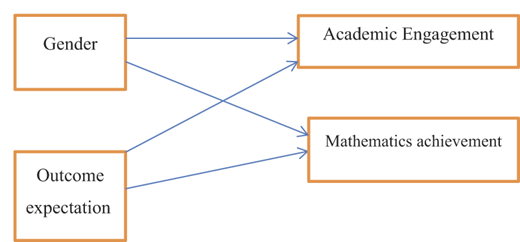
Based on the above theoretical root, the researchers have hypothesized that outcome expectation and gender influence students’ engagement in Mathematics lesson activities and their achievement on it. The hypothesized linear relationship among variables is stated in Figure 1.
As the prior emphasis in learning every subject is to bring behavioral change which is manifested in cognitive, affective and psychomotor-related changes, an important way to judge whether these aspects of changes occurred is through improvement in achievement as measured by different types of tests. Students’ meaningful engagement in lesson routines is also an important learning outcome because it is associated with motivation to learn and interest to undertake lesson routines.
Methods
This study used post-positivism research paradigm. As stated by Creswell and Poth (2018), post-positivism view of the world has the elements of being reductionistic, logical, cause-and-effect oriented and deterministic based on theories, which suits the current scenario. The study also used a quantitative type of approach. The study has also used a correlational design.
The population of this study was students of public secondary schools in Wolaita Sodo town administration, Southern Ethiopia regional state, Ethiopia. There are seven public secondary schools in the town administration. Among these, one school was randomly selected because it was the researcher’s stand that the students in the public secondary schools in the town were homogenous in terms of variables treated in this study. Next, grades 10 and 11 were purposively selected by the researcher. The rationale behind was students’ prepare themselves for national examination in grade 12 which might have changed their engagement and in grade 9, they were promoted from grade 8 and might have been struggling with new setting, where in both cases students were less likely to exhibit usual achievement related behaviors. In these selected grade levels in the school, there were a total of 2,893 grade 10 and 11 students enrolled in the academic year 2024/2025.
To determine the sample size, the researchers relied on the formula developed by Yamane (1964) as:
where n is the sample size, N is the population size, and e is the level of precision. The researchers assumed 95% confidence level and 0.05 level of error:
Hence, the sampled 351 students and additional 10% of reserve respondents were made to fill the questionnaire. Accordingly, the data was collected from 386 respondents using systematic random sampling. Among these 375 (97.1%) have returned the paper back. In the first round screening, 19 papers were identified as incomplete and three papers were rejected because they were detected as univariate and multivariate outliers. As 353 cases passed the cleaning process, two cases were rejected through random sampling and the 351 cases were finalized for main analysis.
Instruments
To measure two of the variables in this study, namely, outcome expectation and academic engagement, the adapted tools were used. To measure academic engagement, the scale developed by Maamin et al. (2021), which had three dimensions, namely, cognitive engagement, behavioral engagement and affective engagement, with a total of 21 items, was used. For the variable outcome expectation, the scale developed by Flores et al. (2008).
To measure Mathematics achievement, students’ result in teacher-made tests, which were developed and administered after due discussion of researchers with subject teachers in first semester of the academic year 2024/2025, was collected. To maintain uniformity of tests, after due discussion of researchers with the subject teachers, equal number items, equal forms of items with regard to objective-subjective dichotomy, with equal number of chapters covered in the test, were prepared and administered for both grade levels. Gender was measured by dichotomously presented item where a student was expected to designate his/her gender as male or female.
To assure instruments’ reliability, Cronbach’s alpha was run on the pilot study which was conducted on 140 students in secondary schools out of the main study area, 17 out of 18 items in outcome expectation scale and total items in students’ academic engagement were proved to have item-total correlation above 0.3, which was the cutting point used to reject items as suggested by Ho (2006).
The content validity index has been conducted by researchers, where items have been rated for “clarity” and “relevance” by eight psychology experts ranging from the level of lecturer to associate professor. Accordingly, for both clarity and relevance, the scale content validity index (scale-CVI) appeared above 0.9 for two scales. However, item-wise amendments have been undertaken after the suggestion by experts for two items in the scale of outcome expectation and three items in the scale of academic engagement.
One item (15th in list) among 21 items in engagement was identified as less clear, whereas two items (6th and 14th) were identified as less clear in the scale of outcome expectation. Furthermore, in the pilot study, 4 out of 21 items in the scale of students’ engagement, and 3 out of 18 items in the scale of outcome expectation were found to have item-total correlation below 0.3. For all these items with the above problems, the culture-oriented connotation on some terms was considered and items have been reorganized and rephrased accordingly.
Exploratory factor analysis
In the main data, prior to exploratory factor analysis (EFA), the assumption related to sample size has been tested and proved in addition to item-total correlations, which was already maintained in pilot study. Pallant (2010, p. 202) suggested that a minimum sample size for EFA is 150+ which was met in the current sample. Consequently, 21 items for academic engagement (AE) and 17 items for outcome expectation (OE) have been finalized for EFA.
The SPSS version 25, the EFA with varimax rotation, has been run. Moreover, the researchers have suppressed loadings less than |0.40| because Leech et al. (2005) have pinpointed that loadings of |0.40| or greater are taken as high.
For the scale of engagement, it has been revealed that the Kaiser–Meyer–Olkin (KMO) of 0.908 and Bartlett’s test of sphericity (Chi-square = 6050.31, df = 210; p < 0.01) indicating that further analysis was suitable.
As indicated in Table 1, the result of EFA with iterated Varimax rotation run for engagement has pinpointed the presence of four factors with Eigen value above 1 explaining 72.88% of total variance accounted for by the factors. The factors from 1 to 4 were named as affective engagement, behavioral engagement cognitive memorization and cognitive retention. The communality of variables range from 0.38 to 0.901 for items 8 and 7, respectively, which is good in that as to Tabachnick and Fidell (2013), the communality values exceeding 1 can cause convergence problems.
As the EFA result revealed four factors for the scale of engagement, researchers continued further analysis.
Similarly, for outcome expectation, EFA was run using SPSS version 25, and with varimax rotation. Suppressing loadings less than |0.40|, it has been revealed that the KMO of 0.918 and Bartlett’s test of sphericity (chi-square = 3079.33, df = 136; p < 0.01) indicating that further analysis was suitable.
As indicated in Table 2, the result of EFA run with iterated Varimax rotation for outcome revealed the presence of three factors with Eigen value above 1 by explaining 62.4% of total variance accounted for by the factors. The factors from 1 to 3 were named as job-related outcome expectation, knowledge-related outcome expectation and goal-related outcome expectation, respectively. As the EFA result revealed three factors for the scale of outcome expectation, researchers continued further analysis.
Confirmatory factor analysis
The measurement model
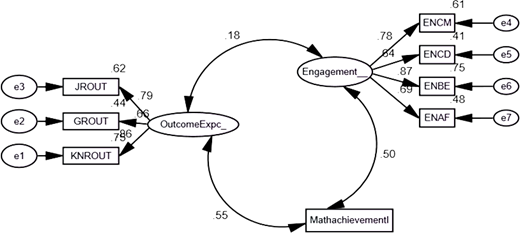
The confirmatory factor analysis (CFA) was computed by starting with measurement model using AMOS version 25. It is suggested by Ho (2006) that the eight indices, that is, GFI, AGFI, IFI, CFI, NFI, RFI and TLI need to be above 0.9, while that of RMSEA expected to be below 0.05 to prove that there CFA has met as indicated in Table 3.
The model fit indices of measurement model in Table 4 clearly indicated that the model fit to the data across all the fit indices χ2 (n = 351, df = 24) = 51.586, p < 0.05. The maximum likelihood estimates of the unstandardized and standardized regression coefficients have pointed out that all the path coefficients in the measurement model were found significant at p < 0.05.
The result in Figure 2 indicated that all paths in the measurement model were found to be statistically significant with the critical ratio test greater than ±1.96 at p < 0.05. Furthermore, the model has confirmed that the unstandardized and standardized regression weights of three dimensions of outcome expectation and four dimensions of academic engagement were significant with ±1.96 at p < 0.05.
It also revealed that standardized regression weights of all seven dimensions in the model significantly represented by their respective latent variables of outcome expectation and academic engagement. The variances of dimensions explained by their respective latent variables in academic engagement ranged from 72.2% for behavioral engagement to 42.2% for cognitive retention at p < 0.05. With regard to outcome expectation, it ranged from 72.7% for knowledge-related expectation to 43.8% for goal-related outcome expectation at p < 0.05.
Methods of data analysis
To assess the status of outcome expectation and academic engagement among secondary school students, descriptive statistics was used. To find out whether students’ outcome expectation significantly affects their Mathematics achievement and engagement, structural equation modeling (SEM) was used. To examine whether there is gender difference in terms of Mathematics outcome expectation, academic engagement and achievement, an independent sample t-test was used.
Results
Demographic characteristics of participants
As indicated in Table 3, 51.9% of participants were males, whereas 48.1% of them were females. Furthermore, 60.7% of participants were grade 10 students and 39.3% of them were grade 11 students. Hence, the majority of participants in this study were from grade 10, and also the slight majority was males.
Status of students’ mathematics outcome expectation, academic engagement and achievement
As indicated in Table 4, for males, the mean age was 17.4 years with SD of 1.27, whereas for females, the mean age was 17.2 years with SD of 2.06.
Furthermore, it has been indicated that for grade 10, the Mathematics achievement is only satisfactory, that is, for males, mean achievement was 59.01; standard deviation (SD) was 11.44, and for females, mean was 57.25; SD was 10.42.
With regard to engagement, for males, mean was 74; SD was 16.06, and for females, mean was 70; SD was 16.33. The result also indicated that for the variable outcome expectation, for males, the mean achievement was 48; SD was 13.97, and for females, the mean achievement was 52 and SD was 16.05.
From the result in Table 5, it can be inferred that males have higher outcome expectation from learning Mathematics, were better engaged and achieved slightly higher in Mathematics teacher-made test than females. However, for all the three variables, the observed mean scores are lower as the maximum possible scores for achievement, outcome expectation and engagement were 100, 85 and 105, respectively. Though cases with these or nearer figures could have been detected as outliers, it is clear that the scores found in table only can be taken as satisfactory, rather than good or above good.
Gender differences of OE, AE and achievement among students
The result in Table 6 indicates that there was significant mean difference in academic engagement between female and male students t(348) = 2.288, p < 0.05. Similarly, the result indicated that there was significant gender difference of outcome expectation t(348) = 2.539, p < 0.05. However, the result indicated that there was no significant gender difference in achievement.
From the result in Table 6, it can be inferred that males engage significantly better than females. This may be possibly because of the sociocultural barriers where females at secondary school level in the study area do more home duties with their parents than males. This might have hindered their expectation as boys still expect significantly higher than girls from learning Mathematics. The important thing here is that the gender difference in achievement is not significant enough, which indicates that despite the significant difference in predictor variables, girls are still on track to compete with boys in terms of achievement.
The effect of students’ outcome expectation on their engagement and achievement
The structural model
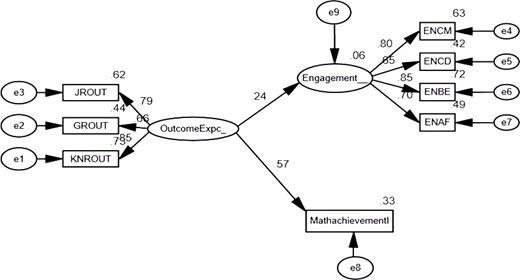
As indicated in Figure 3, two latent variables, that is, academic engagement and outcome expectation, that of error terms, and the observed variable or achievement were tested for their relationships in the structure of the path model to check how much of the dependent variables are predicted by an independent variable.
The SEM analysis made using AMOS 25 to test the entire fit of the model using the eight indices, like that of measurement model, the result revealed that the model set to fit to the data across all the fit indices χ2 (n = 351, df = 19) = 121.348, p < 0.05.
In the model, the fit indices of data revealed that the GFI, AGFI, IFI, CFI, NFI and TLI were appeared above 0.9, the RMSEA was 0.047, the CMIN/DF was 3.48, all indicated that the hypothesized structural model fits to the data, and confirming that the structural model is valid enough to make relationships among variables.
Regression weights on the effect of outcome expectation on engagement and achievement
The result indicates that unstandardized regression coefficients of outcome expectation were found to be significant with critical ratio tests greater than ±1.96 at p < 0.05. The standardized regression weights coefficients of outcome expectation on academic engagement and achievement, that is, 0.240 and 0.575, respectively, indicated that the dependent variables were significantly predicted by the independent variable with p = 0.00.
As the result in Table 7 and in the path model in Figure 3 indicated, outcome expectation has significant effect on students’ engagement in Mathematics lesson routines. The result in Table 7 indicates that the standardized regression weights of outcome expectation on engagement were statistically significant (β = 0.240, p < 0.05).
As the result in Table 7 and the path model in Figure 3 also indicated, students’ outcome expectation has significant effect on their Mathematics achievement. The result in Table 7 also indicates that the standardized regression weights of students’ outcome expectation on their Mathematics achievement were statistically significant (β = 0.575, p < 0.05).
The value of R2 revealed that 5.8% of variance in engagement and 33% variance in mathematics achievement were predicted by outcome expectation. This pinpoints that about 94.2% of variance in academic engagement and 67% of variance in academic achievement were not explained by outcome expectation.
Discussion
In the current study, students’ outcome expectation was found to be significantly affecting their achievement in Mathematics. It is stated that students’ outcome expectation can influence achievement behaviors in two ways. First, because students may cease to engage on tasks if they think that they have not competent performances to produce favorable results, which are designated as negative outcome expectation. Second, they may not engage in tasks due to low perceived likelihood of success (Schunk, 2012). In this sense, the current finding fits previous study of Yuxiao and Chao (2017). Researchers have tried to point out that outcome expectation indirectly affect achievement, that is, outcome expectation has positive significant effect on effort (Domina et al., 2011), and effort has positive and significant effect on achievement. However, it has been pointed that students’ outcome expectation directly can lead to achievement behaviors, effort and persistence, and directly to achievement (Wigfield et al., 2009).
Notwithstanding, the positive effect of outcome expectation on achievement does not always come true. Too minimum or too exaggerated expectation is not good because low expectation can impair the performance, whereas too high expectation can pressurize a student, thereby declining the performance (Boxer et al., 2011). However, most of the time, students with higher outcome expectation tend to even welcome the challenge with the recognition that more effort may be required to be academically successful and to meet their expectation (Sarah-Jane et al., 2020).
In the current study, the result also revealed that students’ outcome expectation has significant effect on their academic engagement. Bandura (1986) underscored that as a student assures that failure is inevitable, he/she tend to disengage in tasks for he/she perceives that there would not be change on the outcome, indicating that low outcome expectation results in low academic engagement. This finding also suits some empirical findings. The study on achievement behaviors by Plante et al. (2013) pointed that students’ outcome expectation has led them toward achievement behaviors, and it is convenient to state that academic engagement, unequivocally, is one of those achievement behaviors.
The current finding indicated that there was no significant mean difference in Mathematics achievement between boys and girls. This finding partly suits some previous findings but differs from many of them. Empirically, very limited findings indicated that females perform better than males (Mullis et al., 2012). However, across studies boys significantly performed better than girls (Armah et al., 2021). It seems due to the fact that some designate Mathematics as males’ subject or males’ domain (Brandell and Staberg, 2008), with boys outperforming in upper grades. Some tend to rationalize this by raising the issue of biological bases. Baron-Cohen (2003) argues that males and females have different brain types, so that women are better at empathizing while men are better at systematizing. Some others also associate it with ability differences that, in general, boys have higher abilities in spatial thinking or higher-order Mathematical strategies (Penner, 2008). Still others associate it with gender stereotypes, whereby they believe that males are better at Mathematics than females at the student school and social levels (Xie and Liu, 2023).
In the current finding, it has been revealed that there was significant difference in Mathematics outcome expectation between girls and boys. This finding was found to fit with that of Goetz et al. (2013) where girls exhibited lower outcome expectation, which is manifested by lower levels of perceived competence, than boys. The result is also concordant to the finding by Plante et al. (2013) where he indicated that boys have exhibited lower outcome expectation than girls.
In the current study, it is found that significant gender difference in academic engagement where girls were surpassed by boys was evident. This finding replicates that of Lietaert et al. (2015). In line with this, the study by Ní Fhloinn et al. (2016) indicated that females engaged better than males, where female students were nearly two and a half times more likely to engage in seeking help in Mathematics tasks. Though many findings support that girls are better task-engaged than boys, Williams et al. (2002) argued that males tend to engage better in those tasks which are novel, whereas girls tend to engage in tasks which are less novel, which they expressed as “boring tasks”.
To sum up, the current finding on the role of students’ Mathematics outcome expectation and gender on their academic engagement and Mathematics achievement has suited with many of previous findings, but failed to replicate some of previous findings.
Conclusion, implications, recommendations and future directions
Conclusions
The secondary school students in the study area have low Mathematics outcome expectation, low engagement and satisfactory level of achievement. Students’ Mathematics outcome expectation has significant effect on both their academic engagement in Mathematics lesson routines and on Mathematics achievement. Working to boost students’ outcome expectation from learning Mathematics can enhance their academic engagement, thereby enhancing their Mathematics achievement in the study area.
Implications of the study
Students’ responses to the demands of subject matter as well as to the demands of teacher are partly functions of their own analysis of costs they have to pay as well as the amount of time they have to waste versus the final outcome they would obtain in dealing with it. While learning any subject, learners striving to achieve a good result and realizing it is taken as a means to assure their short-term success, such as better ranking in classes (Elsner et al., 2021), and to ensure the long-run success like better employment (Tentama and Abdillah, 2019).
Due to this, the current study has practical implications. The mathematics teachers need to work on changing students’ expectancies by incorporating achievements of pioneer mathematicians and their contribution to the rest of the world.
Conceptually, in the four-factor solution of the construct engagement, demarcating of the cognitive memorization and cognitive retention is vital outcome. As a student increasingly becoming able to memorize (memorization), the likelihood to safely store as well as recall it later (retention) would be enhanced, but the two cognitive processes are conceptually and practically differing. A student with sufficient pre-requisite knowledge or the one who has already adequately stored information may duly rely cognitive-retention engagement, whereas the one who struggle to store information may rely on cognitive memorization.
Theoretically, the expectancy and the value, which are core elements in expectancy-value theory of motivation, are equally functioning to determine students’ engagement and the resultant achievement in the current finding. Hence, still out-of-school factors are in consideration by students in addition to immediate academic successes. This may be due to the fact that social and cultural elements are important determinants of expectancy beliefs (Eccles, 2005; Wigfield et al., 2016). Hence, in the value aspect of the theory, immediate classroom or subject-related success cannot be sufficient engine to engage students, rather they also consider out-of-school values of the outcome of engagement.
Recommendations
As it can be inferred from the results, the students’ low expectation might have contributed to low achievement because 33% of variance in achievement is explained by outcome expectation. Hence, mathematics teachers need to help students expect more by explaining achievements of successful students in previous years in their school.
The educational office at town administration level should award a Mathematics teacher who shows outstanding performance in applying Mathematics science in the community, and this should be announced to students. This can change the image of Mathematics for students where their satisfactory level of expectation can be boosted.
Any teacher-, classroom- and school-based actions aimed at enhancing students’ Mathematics achievement should give equal emphasis to both boys and girls as the result indicated that there is no significant difference in achievement between them and which is less than 60% or satisfactory. It is, hence, recommended that the classroom teachers need to help students rendering tutorial classes for both girls and boys.
Moreover, to improve the long student’s expectation of long- and short-term outcomes, school administrations should work in collaboration with Mathematics teachers in properly administering contingency management. Here, through teachers’ guidance, a student sets his/her annual goals of Mathematics subject from easy to difficult and apply self-reinforcing mechanisms in response to successive achievement of these hierarchically set goals from easy to difficult, which can improve his/her expectation.
Limitations and future directions
For the fact that secondary school students are homogenous, added to budget constraints, this study has been geographically delimited to the selected secondary school, which affects its generalizability to the whole secondary schools in the country. Due to this, interested researchers need to undertake the further study in the same issue by including additional number of schools from other regions in the country.
Further study is also recommendable for any interested researcher to undertake the further study in the same issue by including other variables, for instance, investigating the mediating role of self-efficacy in the relationship between the dependent independent variables treated in this study.
Funding
No funding was received for conducting this study.
Ethics statement
Data gathering instruments and data collection process undergone through ethical approval by Bahir Dar University’s ethical clearance office with the project Code 009 and the protocol code 001952 on July 23, 2024. The written consent was provided for the participants and only those students who were willing to participate were participated in the study.
Data availability
The authors declare that data are available whenever in need for accredited body.