With the continuous expansion of railway hubs, increasing functional complexity and growing capacity constraints, the coordinated and efficient utilization of transportation resources – such as stations, lines and maintenance facilities – has become a critical issue for improving hub operational efficiency. This study focuses on the division of functions within railway hubs that incorporate shared stations operating under mixed high-speed and conventional train services.
An optimization model for hub functional allocation is developed to achieve efficient resource utilization in hubs containing mixed-operation stations. A node–arc network representation combined with an improved multi-commodity flow model is employed, taking train dwell and operation time within the hub as the optimization objective. A case study is conducted to derive optimized solutions, followed by both qualitative and quantitative analyses.
The results indicate that optimizing train operation routes and station assignments within the hub can effectively reduce the total occupation time of train flows and significantly improve resource utilization efficiency.
The proposed model demonstrates both scientific rigor and practical effectiveness. In real-world operations, it can provide operators with preliminary and proactive functional allocation schemes, help identify key constraints limiting hub capacity utilization and offer decision support for transport plan adjustments or infrastructure and facility upgrades.
1. Introduction
Over the past decade, rapid growth in railway transportation demand has led to continuous expansion in the scale of railway hubs, accompanied by increasing functional complexity. In a speech delivered at the 2025 National Railway Transportation Work Conference, China State Railway Group pointed out that capacity constraints remain prominent in major trunk corridors and hubs, noting that the capacity utilization of key hub nodes and heavily trafficked sections along corridors such as the Beijing–Guangzhou, Beijing–Kowloon, Longhai, Ningxi, and Baolan lines has already reached saturation. This situation highlights the urgent need for more advanced approaches to railway hub operation organization and the coordinated optimization of station and infrastructure resources.
A railway hub is an integrated system composed of stations of different sizes, junctions, main and branch lines, connecting lines, depots, and associated facilities. Capacity saturation in any single component may constrain the overall performance of the entire hub. Integrated optimization of hub resources refers to the coordinated utilization of all constituent facilities to maximize overall operational efficiency. Moreover, against the backdrop of China's rapid high-speed railway development, a considerable number of stations still operate under mixed high-speed and conventional train services within shared station yards, such as Beijing Station, Shanghai Station, and Fuzhou Station. The coexistence of mixed operations further increases the complexity and challenges of hub resource allocation. Field investigations conducted by the authors indicate that traditional hub functional allocation schemes may result in inefficient resource utilization or capacity bottlenecks. Consequently, how to achieve coordinated and efficient utilization of hub resources to fully exploit hub capacity has become a critical issue in contemporary railway operation organizations.
The integrated utilization of hub capacity is primarily achieved through the rational allocation of infrastructure and operational resources, which is manifested at the macroscopic level as the functional allocation of stations within a hub. In the field of railway hub functional allocation, substantial progress has been made by previous studies. In recent study, Ji, Lin, Qiao, and Wang (2011) investigated train flow assignment and route optimization in railway networks, modeling the problem as a multicommodity flow assignment and proposing an improved node–arc formulation. Bi, He, and Yin (2018) integrated high-speed railway hub station functional allocation with track utilization, developing a coordinated optimization model that extended the analysis to the track level. Building upon earlier work, Liu, He, and Bi (2018)further refined high-speed railway hub functional allocation models by explicitly considering constraints such as station origination and termination capacity and rolling stock depot storage capacity. Mao (2021) designed a Lagrangian relaxation algorithm for the functional allocation optimization model and verified its effectiveness. Wang (2022) proposed an optimization approach for high-speed railway hub passenger station functional allocation that accounts for depot track operations, along with a solution algorithm based on the alternating direction method of multipliers. More recently, Leng, He, and Zhang (2024) developed a multi-objective optimization model for high-speed railway hub passenger station functional allocation and integrated resource coordination, incorporating passenger preference considerations under capacity constraints. Kou (2024) examined solutions to the southwest passenger capacity gap in the Puxi area of the Shanghai railway hub, evaluating alternative schemes such as integrating multiple rail lines or constructing a new Shanghai–Hangzhou intercity segment, and recommended prioritizing the Songjiang South–Jiaxing South section based on capacity adaptability, investment cost, passenger convenience, and economic benefits. Zhang, He, Zhao, Chen, and Liu (2024) investigated comprehensive utilization of station capacity in high-speed railway hubs by developing a multi-objective integer programming model and designing an augmented ε-constraint algorithm to optimize capacity use and minimize total train operation time. Yusuf, Olamide, and David (2024) proposed a smart railway framework covering infrastructure, operational control, and decision-support layers, highlighting digital twin technology for virtual simulation, risk assessment, and system-level coordination, and emphasizing data integration and cross-system optimization as key drivers of resilience and efficiency. Nold (2025) developed a system-level analytical framework for future railway technologies and operational strategies, integrating expert assessment, multi-level energy flow modeling with dynamic programming, and operational simulation to evaluate impacts on capacity utilization, energy efficiency, and travel time, demonstrating that performance improvements depend on coordinated technological and operational advancement.Existing studies and numerous practical applications have demonstrated that train flow route optimization methods based on node-arc and multi-commodity flow models are both feasible and effective (Martinelli & Teng, 1996). However, two notable limitations remain. First, since 2018, the majority of hub functional allocation studies have focused primarily on high-speed railway hubs, with conventional railway stations and mixed-operation stations largely excluded from the research scope. Given that a significant number of conventional and mixed-operation stations still exist in China, the applicability of existing methods is limited. Second, most optimization models adopt generalized train operation costs as the objective function to represent capacity occupation of lines and tracks. In practice, however, it is difficult to unify cost measures for train running and station operations, often requiring parameter conversions that may affect modeling consistency.
The main contributions of this study are threefold:
A unified functional allocation framework for railway hubs with mixed high-speed and conventional operations is proposed.
A time-based hub resource utilization metric is introduced to provide a consistent evaluation of infrastructure occupation.
2. Hub functional allocation optimization model with mixed high-speed and conventional stations
2.1 Modeling framework
This study adopts a train flow route optimization approach to assign trains to stations within a hub, with the theoretical foundation rooted in graph-based flow assignment. Specifically, a network topology is constructed according to the actual railway hub infrastructure (Borndörfer et al., 2017).Origin–destination (OD) flows of high-speed and conventional trains are represented as flows defined on the arc set, while actual train running and operation time standards are incorporated as unit flow costs. For any train flow traversing the hub, the sequence of hub nodes it passes through is uniquely determined. Accordingly, each train route within the hub can be expressed as an ordered sequence of nodes. On this basis, an integrated hub resource optimization model incorporating mixed high-speed and conventional operation stations is formulated.
The hub functional allocation problem addressed in this study involves multiple interrelated factors, including train types, operating routes, OD flow origins and destinations, station capacity, rolling stock depot (or passenger train servicing depot) storage and inspection capacity, and line capacity. In the proposed network representation, OD flow endpoints and hub stations are defined as nodes, while hub lines and mainline sections connecting adjacent nodes are modeled as arcs, thereby forming a hub network graph as . Let denote the set of passenger stations in the network and denote the set of all line arcs within the hub. Considering the significant differences in operation processes and resource occupation between originating/terminating trains and passing-through stopping trains, these two train categories are treated separately in the optimization framework. The main distinctions are as follows.
For originating and terminating trains, only the connectivity between one external node and the hub node needs to be considered, whereas passing-through stopping trains require connectivity between two external nodes and hub nodes, with directional constraints and without repeated traversal of the same line section.
A subset of originating and terminating trains is subject to rolling stock depot capacity constraints, while passing-through stopping trains are not.
Accordingly, separate optimization models are established for originating/terminating trains and passing-through stopping trains. The originating/terminating train functional allocation model is developed based on a basic node–arc formulation, and the passing-through train allocation model adopts a multi-commodity flow framework. Model determines the functional allocation and routing scheme for originating and terminating train flows, considering station handling capacity and depot service constraints. Model determines the routing and stopping scheme for through stopping train flows under shared infrastructure capacity constraints.The two models are defined on the same hub network and share common infrastructure capacity resources, including line capacity and station handling capability. The optimization results of and are integrated through capacity feasibility verification to ensure that the combined allocation scheme satisfies all hub resource constraints. This decomposition approach improves model tractability while preserving the physical consistency of hub operations. The final hub functional allocation scheme is obtained by combining the optimized train routes and station assignments derived from both models. The optimization objective is to minimize the total operation and running time of all OD train flows within the hub, subject to station facility capacity constraints and line capacity constraints. The set of optimized train flow routes obtained from the model constitutes the new hub functional allocation scheme.
2.2 Construction of the functional allocation optimization model for originating and terminating trains
2.2.1 Model assumptions
The model is developed under the following assumptions:
Except for constraints related to station originating and terminating capacity, line capacity, and rolling stock depot storage capacity, all other operational conditions are assumed to satisfy the relevant technical and operational requirements.
The number of trains for each origin–destination (OD) pair and the proportion of trains requiring inspection and maintenance are known in advance.
The inspection and servicing capacity for conventional trains is sufficient to meet operational demand.
2.2.2 Definition of variables and parameters for model M1
2.2.3 Optimization objective of the model
The hub occupation time of originating and terminating trains is defined as the sum of the train running time within the hub and the station operation time for originating/terminating activities. The objective function aims to minimize the total hub occupation time of all trains.
2.2.4 Model constraints
Capacity Constraints
For originating and terminating train flows, the capacity constraints include both the originating/terminating capacity of each station and the inspection and maintenance capacity of the depot associated with the station.
Station Originating/Terminating Capacity Constraint
This constraint ensures that the originating and terminating capacities of each station within the hub are sufficient to accommodate the required operations of both high-speed and conventional trains. The station capacity is treated as a fixed value, determined through a combination of calculation and field investigation. If the required capacity during the optimization process exceeds the station's available capacity and conflicts with other constraints, the model may become infeasible or yield a relaxed solution. The constraint can be expressed as Equation (2-1).
Line Capacity Constraint
This constraint ensures that the line capacity of each track segment within the hub is sufficient to accommodate the flow of originating and terminating trains. The line capacity is treated as a fixed value, determined based on the type of line and obtained through a combination of calculation and field investigation. If the required capacity during the optimization process exceeds the available line capacity and conflicts with other constraints, the model may become infeasible or yield a relaxed solution. The constraint is expressed in Equation (2-2).
Depot Maintenance Capacity Constraint
This constraint ensures that the maintenance and servicing capacities of the depot associated with each station—whether an EMU depot or a passenger train depot—are sufficient to meet the inspection and servicing requirements of trains entering and leaving the depot. The depot capacity is calculated based on the number and length of storage tracks available at the depot. If the required capacity during the optimization process exceeds the depot's available maintenance capacity and conflicts with other constraints, the model may become infeasible or produce a relaxed solution.
Let denote the proportion of originating and terminating trains between the hub and a directional station that require inspection and servicing per day. Accordingly, the number of trains between directional station and station requiring depot inspection and servicing for the OD flow is given by . The station depot inspection and servicing capacity constraint can be expressed as Equation (2-3).
This constraint ensures that the number of originating and terminating trains between station and directional station equals the sum of the conventional train flow and the EMU train flow between the same stations. Since the network is defined as an undirected graph, corresponding constraints apply in both directions, as expressed in Equations (2-4) and (2-5).
The decision variable “” is required to be a non-negative integer to prevent negative solutions during optimization, as expressed in Equation (2-6).
2.3 Construction of the functional allocation optimization model for through stopping trains
2.3.1 Model assumptions
To facilitate description and appropriately simplify the problem, the following assumptions are made for this model:
Except for the train dispatching/receiving capacity of each station and line capacity, all other operational conditions are assumed to satisfy the relevant technical and operational requirements.
The proportion of OD EMU trains requiring stopping operations is known in advance.
Train water supply and sewage operations are not considered.
2.3.2 Definition of model variables and parameters
2.3.3 Optimization objective of the model
The hub occupation time of through stopping trains is defined as the sum of the train running time within the hub and the station dwell operation time for boarding and alighting. The objective function aims to minimize the total hub occupation time of all trains.
2.3.4 Model constraints
Acyclic Path Constraint
This constraint ensures that each OD flow proceeds to its destination after operations at the hub stations without forming a closed loop. The constraint is expressed in Equation (2-8).
Capacity Constraints
The capacity constraints include both the line capacity constraints within the hub and the station dispatching/receiving capacity constraints for through stopping trains, ensuring that train operations within the hub remain within the allowable capacities of all hub facilities.
Line Capacity Constraints within the Hub
This constraint ensures that the line capacity of each track segment within the hub is sufficient to accommodate the flow of through stopping trains. The line capacity is treated as a fixed value based on the type of line and is determined through a combination of calculation and field investigation. If the required capacity during the optimization process exceeds the available line capacity and conflicts with other constraints, the model may become infeasible or yield a relaxed solution. The constraint is expressed as Equation (2-9).
Hub Station Dispatching/Receiving Capacity Constraint
This constraint ensures that the dispatching and receiving capacity of station is sufficient to accommodate the operational demand of all through stopping trains at the station. The station dwell operation capacity is treated as a fixed value, varying by station, and the capacity required for originating and terminating trains is subtracted. The capacity is determined through a combination of calculation and field investigation. If the required capacity during optimization exceeds the station's available capacity and conflicts with other constraints, the model may become infeasible or produce a relaxed solution. The constraint is expressed as Equation (2-10).
Dwell Operation Frequency Constraint
Based on the analysis of actual train operation plans and considerations of train operation efficiency, it is assumed that each EMU train from station to in the network only needs to perform dwell operations at one station within the hub, i.e., each train stops for operations only once within the hub. This constraint is expressed in Equation (2-11).
Logical Constraints
All decision variables in this model are binary (0–1) variables. The corresponding constraints are expressed in Equations (2-12) and (2-13).
This constraint ensures that the decision variables and maintain the corresponding logical relationship during optimization: if is selected, then must be equal to 1. The constraint is expressed in Equation (2-14).
3. Solution method
The proposed model is a mixed-integer linear programming (MILP) problem, which can be solved using either exact algorithms or heuristic approaches. ILOG CPLEX provides built-in exact solution techniques, including branch-and-bound, column generation, and Lagrangian relaxation. Owing to its high solution accuracy and computational efficiency in linear and mixed-integer optimization, CPLEX has been widely applied to various transportation planning and optimization problems (Gong, Guo, & Jiang, 2012; Zhou, He, Song, & Li, 2015; Bi, He, Li, & Li, 2016).
Moreover, the internal algorithm portfolio of CPLEX can be flexibly configured according to specific problem characteristics and solution requirements (Luo, n.d.). Therefore, this study directly employs ILOG CPLEX to solve the numerical instances of the proposed model.
4. Case study
To verify the feasibility, scientific validity, and practical effectiveness of the proposed model [11], the Nanchang railway passenger hub is selected as a real-world case study, and an optimized hub functional allocation scheme is computed.
4.1 Input of basic case data
To closely reflect actual operating conditions, this study adopts operational data from the peak summer travel period as the basis for analysis. According to the train timetable and working timetable in August 2023, 56 trains that were temporarily suspended were excluded, resulting in a total of 512 trains included in the case study. Based on the timetable, the corresponding OD flows were constructed, as shown in Table 5.
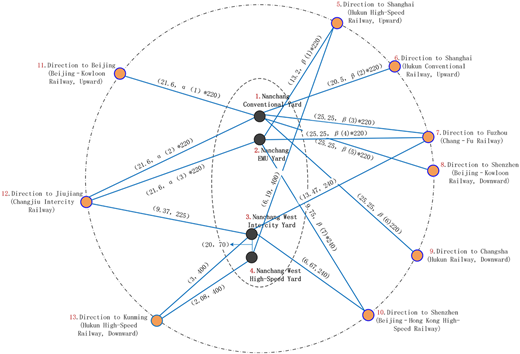
The train operation time standard is a fundamental technical specification formulated by railway authorities for specific line sections and train types, and is used in timetable preparation. It uniformly defines the running time of trains on each section and serves as the fundamental basis for calculating sectional running times as well as arrival and departure times. In this study, the train operation time standards were obtained through field investigation, and both the operation time standards and line capacity constraints are annotated in the topological graph.In actual operations, the difference between the upward and downward running time standards on hub arc segments is generally within 20 minutes, which has a negligible impact on the computational results. Therefore, identical time standards are adopted for both directions on each arc to simplify the computation. The operation time standards are listed in Table 6.
Other data required for optimization, including station operating capacity, average operation time of conventional trains and EMU trains, and train maintenance capacity, were determined through analysis of the timetable and field investigations. To avoid infeasibility caused by overly restrictive constraints, these values were appropriately enlarged. The specific values are shown in Table 7.
4.2 Construction of the case network and topology
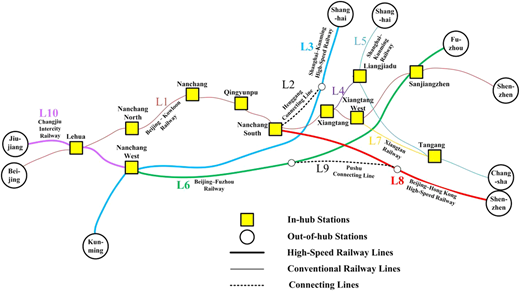
Based on the layout of the Nanchang hub railway network, a simplified diagram of the stations and lines involved in passenger operations at the Nanchang hub is first constructed (see Figure 1). The 10 arc segments shown in the figure collectively constitute the line capacity of the Nanchang hub, while the passenger stations together with the (not explicitly shown) line junctions constitute the node capacity of the hub.
According to the requirements of the calculation, all nodes and arcs within the hub are numbered with unique identifiers. Considering that the technical time standards for train operations differ among intercity, high-speed, and conventional yards, and that EMU and conventional trains share the same physical station at Nanchang Station, two virtual yards are introduced for Nanchang Station, labeled as nodes “1” and “2”, representing the conventional yard and the EMU yard, respectively. Similarly, Nanchang West Station is assigned nodes “4” and “5”, representing the intercity yard and the high-speed yard, respectively.
As the acyclic path constraint can only restrict cyclic flows between the hub and external nodes, in order to prevent the formation of closed loops within the hub that may lead to incorrect computational results and to improve computational efficiency, intermediate non-passenger stations within the hub—such as Nanchang North Station, Qingyunpu Station, and Xiangtang Station—are omitted from the topological representation, while the logical relationships among stations handling passenger services are retained. On this basis, the topological graph of the Nanchang hub is constructed, as shown in Figure 2.
4.3 Solution results and analysis
The M1 and M2 models were solved using the IBM ILOG CPLEX solver on a computer equipped with an Intel i7-8650U CPU and 16 GB of RAM, the total computation time of the software was 2 seconds and 48 milliseconds.. The corresponding results are summarized in Tables 8 and 9. Both qualitative and quantitative analyses were conducted to evaluate the optimization outcomes.
4.3.1 Qualitative analysis of optimization results
The results obtained from model M1 indicate that several trains originally operating from Nanchang Station have been reassigned to the Nanchang West intercity yard. Specifically, high-speed EMU trains on the Nanchang–Shanghai (Hukun High-Speed Railway), Nanchang–Fuzhou, and Nanchang–Shenzhen (Beijing–Hong Kong High-Speed Railway) routes, as well as a conventional train on the Nanchang–Jiujiang route, are now handled at the Nanchang West intercity yard. Additionally, a train previously originating from Fuzhou to the Nanchang West high-speed yard has been optimized to operate from the intercity yard. These results indicate three key points:
Handling the aforementioned originating and terminating trains at the Nanchang West intercity yard reduces hub occupation time while achieving the same transport performance.
Replacing the conventional Nanchang–Jiujiang train with an EMU at the intercity yard can save operation time.
Originating and terminating trains from the Fuzhou direction are also more time-efficient when handled at the intercity yard.
Analysis of the hub network structure and line connectivity confirms that these reallocations are consistent with efficient routing principles and do not exceed station or line capacity limits, thereby validating the feasibility and scientific basis of the model.
Similarly, the results from the passing-through train optimization model M2 show that EMU trains previously passing through Nanchang Station, such as Fuzhou–Jiujiang and Jiujiang–Shenzhen, have all been reassigned to pass through the Nanchang West intercity yard. This reassignment reduces hub occupation time for these passing trains. Network connectivity and line direction analysis further confirm the routing efficiency and adherence to capacity constraints, verifying the model's feasibility and scientific validity.
It should be noted that passenger travel preferences were not considered in this study. In large cities, multi-origin and multi-destination passenger boarding and alighting demand can lead to differences between the optimized allocation and the original operation plan.
4.3.2 Quantitative analysis of optimization results
To further verify the effectiveness of the optimization results, the hub occupation time under the original assignment scheme is compared with that under the optimized scheme.
The data corresponding to the original scheme are input into Ilog Cplex, and the hub occupation time of the original scheme is directly calculated using the same computational approach. The results show that the total hub occupation time of the original origin–destination (O–D) train operation scheme is 25,295.08 min, which is reduced to 24,461.71 min after optimization, representing a 3.3% decrease. For passing trains, the total hub occupation time decreases from 17,266.44 min in the original scheme to 16,359.99 min after optimization, corresponding to a 5.2% reduction.
The quantitative analysis indicates that the proposed optimization model can effectively reduce train occupation time within the hub, achieve more efficient train operation organization, and enhance the overall utilization efficiency of the railway hub.
5. Conclusions
This study develops an integrated resource optimization model for railway hubs containing mixed high-speed and conventional stations, with the Nanchang railway hub serving as a case study. The results demonstrate the feasibility, scientific validity, and practical effectiveness of the model, confirming its ability to reduce train occupation time and enhance operational efficiency.
In scenarios where future passenger flows necessitate new operational schemes, the proposed model can provide two key forms of support:
Preliminary functional allocation plans to enable more effective utilization of hub capacity.
Identification of the specific constraints responsible for infeasible or relaxed solutions, allowing operators to pinpoint the facilities that limit hub capacity and providing guidance for adjusting operational plans or upgrading infrastructure.
With the ongoing replacement of conventional trains with EMUs in the railway sector, the study innovatively considers both conventional and high-speed train flows in mixed-operation stations. The optimized allocation scheme can also provide insights for planning such upgrades.
Nonetheless, certain limitations exist. The study assumes an idealized network representation, and hub capacity constraints are derived from field investigation and calculation rather than real-time operational monitoring, which may introduce discrepancies with actual operations. As capacity constraints become more accurately defined, the optimized allocation scheme is expected to align even more closely with real-world operations.