


The expansion of lifestyle and luxury markets has necessitated new marketing techniques. Recently, brand addiction has been a new topic in luxury repurchasing. The information reported in the literature regarding the effectiveness of brand addiction is insufficient and controversial. This research aimed to assess the role of brand addiction in Islamic consumers who purchase luxury smartphone brands.
Survey responses were collected from an online sample of 384 luxury consumers in Iran. The methods were evaluated using software (smart PLS 3) to test the hypothesis.
According to the uniqueness theory, the authors completed that brand addiction and consumer relationships are different and relative in each luxury product. The results positively determine that brand addiction has a more significant impact than brand jealousy, brand love and brand experience in repurchasing luxury consumers.
This study helps expand the literature on luxury repurchases and contends that brand addiction creates a new perspective in understanding behavioral addiction.
This paper provides insights for current and future marketers and managers, especially in Iran.
This investigation is the first study on the impact of different dimensions of brand addiction on luxury smartphone repurchase intention. In this regard, the findings of the study are important in the luxury market and extend current knowledge on repurchasing luxury products such as in Iran.
1. Introduction
With the expansion of luxury products and markets have expanded over the past decade, there has been a growing interest in identifying the causes of repurchase intentions of luxury brands and developing long-term relationships with luxury consumers. Today, brands have shifted their focus from attracting new customers to building long-term relationships with existing customers (Grace et al., 2020). According to Statista, the revenue of the luxury goods market will average $0.48 trillion in 2023, which is estimated to grow by 2.22% by 2027 (CAGR 2027–2023). Meanwhile, the revenue from smartphone sales is expected to grow by 1.9% in 2024. Therefore, the luxury market is expected to reach 320–365 billion euros by 2025.
Luxury brands are no longer exclusive to developed Western markets and have expanded to Eastern economies (Ko et al., 2016). In addition, adopting a luxurious lifestyle by using distinctive products, which is often associated with authenticity, prestige, high self-confidence and self-esteem, uniqueness, superiority, originality, and high income is no longer limited to a specific social class (Kapferer et al., 2014). Therefore, Marketers and businesses are constantly looking for innovative ways to build long-term relationships. According to Davari et al. (2022), luxury brands are still purchased even in countries in economic recession due to personal, cognitive, and social factors. Fassnacht and Dahm (2018) stated that people purchase luxury goods mainly for two reasons: to be recognized by their peers and to achieve a higher social status.
Hedonism is another key driver for purchasing luxury products (Sternberg, 1986; Kostritsa et al., 2020), and it causes addiction behaviors. Nevertheless, Luxury consumers decide to purchase again based on their sense of pleasure and consider it entirely reasonable (Kim and Yoon, 2021). When consumers choose luxury as their lifestyle, they can embrace their favorite brands, become obsessed with them, and display addictive dopamine release in the brain, creating behavior. Besides, compulsive purchasing leads to addiction when it is to escape stress, anxiety, and frustration (DeSarbo and Edwards, 1996; Jalees, 2007). Therefore, the concept of addiction conforms to the theory of (TRA) and demonstrates that consumer addiction and obsession can lead to the purchase of luxury products. Moreover, Luxury brand addicts ignore the negative consequences of compulsive buying to be satisfied and differentiate themselves in society.
Recently, brand addiction is a hot topic in the new marketing literature. According to Mona Mrad et al. (2020), people who are addicted to some luxury brands become so involved in these luxury brands that they are no longer interested in maintaining their social life and because of the stress created, they only seek to purchase again. Addicted Consumers are followed to repurchase products to get some of their identity, personality, perfectionism, calmness, and a feeling of superiority (Ahmadpour and Darzian Azizi (2017), Leng and Botelho (2010). The Asia–Pacific region is the largest consumer of personal luxury goods globally and has become a significant segment of global luxury brands (2023). Luxury products are expensive products purchased by individuals who have more than average disposable income or accumulated wealth (Parekh and Paliwal, 2017). Due to luxury brands' high prices, the addicted consumer may ignore their life priorities and be severely pressured or permanently harmed (Mrad et al., 2020). Moreover, a luxury brand is composed of good quality and design, exclusivity, great products, aesthetics, heritage, and prestige (Kapferer and Valette-Florence, 2018; Seo and Buchanan-Oliver, 2019).
Brand jealousy is a form of emotional attachment to a brand caused by the inability to possess it through some constraint (Batra et al., 2012), which can significantly affect consumer behavior. Luxury has a different meaning in today's competitive world than it used to, and consumers value brand experience more than brand ownership and exclusivity. Meanwhile, Hutabarat and Surya (2023) argued that experience in using products would encourage consumers to repurchase. In contrast, according to Clara (2023), the results show that celebrity endorsements, brand love, and experience do not significantly affect purchase intention. As consumers become more sophisticated and demanding concerning brand values and new experiences increased luxury awareness and a blend of customary Eastern values with Western values have given acceptance to global luxury brands, especially in emerging markets. As the behavior of brand addicts becomes more complex, all addicts learn about brands and demand more brand values and new experiences (Mrad et al., 2020). The brand experience summarizes all products, purchases, services, and consumer experiences (Altaf et al., 2017).
According to the dopamine theory of reward and addiction, addictive behavior causes dopamine release into the brain, creating a feeling of satisfaction among consumers, which minimizes the negative effects of purchasing an expensive product (Dackis and Gold, 1985). Although most definitions of addiction discuss its harmful consequences, some scholars argue that addiction is not always detrimental (Glasser, 2012). Smartphone makers worldwide are constantly competing to gain loyal customers and increase their share of luxury markets by offering new handsets with attractive and unique capabilities. Consumers repurchase luxury products at any price and do not seek brand loyalty.
In recent years, Young people in Iran are increasingly interested in the luxury industry, especially smartphones. Conducting incomplete research into the Iranian market according to consumers' different values and lifestyles to repurchasing luxury products, as well as the various descriptions of luxury brands in Iran, which has been examined in the surveys conducted in the dimension of creating excitement. Hence, This article sought to address the gap in examining the effect of brand addiction as a compulsive, and addictive element in the marketing literature. The main purpose of this paper is to contribute to the identification and effect of brand addiction as an essential factor in encouraging consumers to repurchase luxury products. A new conceptual model was developed for luxury repurchase products. The analysis of data helps answer this question in Iran. The plan for this paper is as follows: In the first section, we review the literature on the Repurchase of luxury products, Brand Addiction, Brand Jealousy, Brand Experience, and Brand Love which were used as an antecedent of evaluation. In the second part, we present and develop a conceptual model and in the last section, we discuss the findings and implications for further research and practice.
2. Theoretical background
A review of the literature on brand addiction reveals that this topic is still largely ignored in Iran, which adds to the originality and value of the present research, which focuses on brand addiction as an emerging, interdisciplinary concept and its role in encouraging consumers to repurchase luxury products. Moreover, Marsasi and Yuanita (2023) claimed that developing specific marketing strategies for promoting luxury brands and influencing consumer purchasing intentions is essential.
In addition, by reviewing the marketing literature on brand addiction, we realized that there is little information about the key and facilitating role of brand addiction in the repurchase of luxury products, especially in Islamic countries and developing countries. A marketing literature review reveals a new discussion on brand addiction to the purchasing process. At the core is the conceptual dispute about the essence and nature of brand addiction by authors such as Mrad and Cui (2017).
The literature is reviewed in Table 1.
Summary of Literature review
| Authors (year) | Title | Findings |
|---|---|---|
| Meijani et al. (2021) | Employing the creative approach of brand addiction to develop a model of repurchasing luxury products | Brand addiction does not necessarily have negative consequences, but it creates an interesting new perspective to encourage consumers to purchase luxury products |
| Hasan (2021) | The effects of cognitive and emotional attitudes Attitudinal Components and Repurchase Intention With the Mediating Role of Personality Traits: Case of Bangladeshi Mobile Handset Users | The findings indicate that materialism does not affect the effects of cognitive and emotional attitudes on the intention to purchase |
| Tavassoli (2022) | Investigating the effects of nostalgia and brand love on the intention of Samsung mobile phone consumers | The results demonstrated nostalgia and love for the brand have a positive and significant effect on the intention of consumers to buy mobile phones |
| Alavijeh et al. (2020) | The impact of expected values from a luxury brand on outcomes Consumer behavior (s) | The result of the expected values of different dimensions can have significant effects on the perceived value of the luxury brand |
| Abrari Khotbesara et al. (2019) | The effects of the need for customer uniqueness on attitude Brand: The mediating role of self-expression and disclosure Brand (Case Study: Luxury Mobile Phone Brands) | According to the results of the two iPhone and Samsung brands, the customer's need for uniqueness positively and significantly affects brand attitude |
| Jamshidi et al. (2019) | Is self-esteem important for marketing literature? How can it be improved? Commercial perspective of Nike sportswear industry on Kish Island | The results indicated that brand addiction has the positive effects of increasing self-esteem and brand love |
| Ghaffari et al. (2018) | Study some of the factors influencing the intention to repurchase a mobile phone | It was found that expectation confirmation significantly affects brand addiction, perceived flexibility, and brand satisfaction |
| Mrad and Sui (2019b) | Consumer pleasure or guilt: luxury fashion brand addiction and social media marketing | The results indicated that marketing efforts on social networks significantly impact customer interaction with the social media content of luxury brands, which in turn has a strong impact on consumer addiction |
| Cui et al. (2018), Lone et al. (2017) Lone and Rehman (2017) | Brand Addiction: Exploring the concept and defining it through empirical research Comparative analysis of customer satisfaction toward Islamic and conventional banking: an empirical study from Saudi Arabia A comparative study of customer satisfaction in full-fledged Islamic banks and Islamic banking windows | The findings showed that the eleven salient features of brand addiction are the ability to provoke anxiety, brand bonding, brand monopoly, collection, compelling insistence, financial management versus debt tolerance, dependency, satisfaction, mental and behavioral preoccupation and word of mouth It was found that since customer satisfaction is the mandatory element of all types of business, the Islamic bank must also pay more attention to customer satisfaction The results indicated that concrete expectations, empathy and responsiveness are the most important elements of service quality, particularly in the Islamic banking sector |
Reviewed studies map up the emerging field of brand addiction as one characterized by a dependent variable under the umbrella of consumer behavior. In contrast, we considered the component of brand addiction as an independent variable that strongly affects the behavior and attitude of luxury consumers.
3. Hypothesis development and conceptual model
In contrast with the traditional definition of luxury, exclusivity is no longer the character of a luxury product. This means that the definition of luxury is constantly being updated. However, modern luxury values have gone beyond previous indicators. For this reason, marketers should look for newer motivations to engage more consumers with the brand and create a positive attitude toward it, because of planned behavior theory (Ajzen, 1985). Thus, there is no research on brand addiction to repurchases in Iran's phone industry, which can help fill the gap in marketing literature.
3.1 Repurchase of luxury products
There is a difference between Repurchase intention and purchase intention (Hutabarat and Surya, 2023). Repurchase is a key element of the customer relationship and the success of businesses (Bilali et al., 2011). Moreover, Paul (2019) developed two theoretical models for brand management as “masstige” to luxury marketing. Peluso et al. (2017) argued that consumers with higher situations are more likely to purchase high-branded luxury products than usually branded ones in emerging markets. Shukla and Purani (2012) investigated the notion that many perceptions of the value of luxury can be very influential across different cultures and countries. However, there is a paucity of studies on how brand addiction changes or involves consumers repurchasing.
3.2 Brand addiction
Brand addiction is the most intense form of consumer commitment to brands that have been largely ignored in the marketing literature (Mrad and Cui, 2017). Fournier (1998) suggests that the relationship between the consumer and the brand can increase the intensity of emotional attachment to passionate love and culminate in addictive obsession (Sternberg, 1986). Addiction in the context of consumer-brand relationships was initially by Fajer and Schouten (1995). According to Mrad (2018), brand addiction is classified by acquisition, dependence, tracking, hoarding, lack of self-control, obsession, external influence, persistence in affordability, resistance substitutions, support and anxiety. These characteristic features are derived from the life experiences of consumers who are addicted to the brand, which is separate from substance abuse (alcohol/drug). Furthermore, the theory of uniqueness by Snyder and Fromkin (1977) individuals consume luxury products to enhance their identity (Tian et al., 2001) and to differentiate themselves from others (Kauppinen-Räisänen et al., 2018). For instance, Mrad et al. (2020) have investigated that being different is more important than increasing brand participation and buying expensive luxury goods. Goodman (1990) examined the components of addiction and compulsion as inseparable features of behavioral dependency. This confirms that these needs are an important driving force for the marketing of luxury products. Thus, this study hypothesized that:
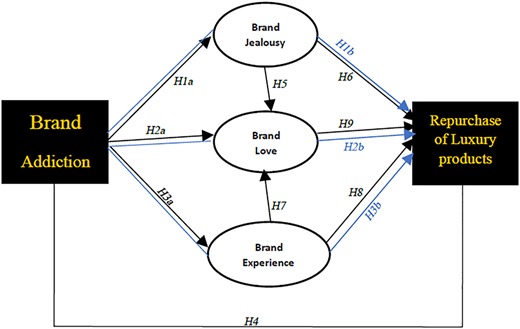
Brand addiction positively impacts brand jealousy.
Brand jealousy mediates the effects of brand addiction on the repurchase of luxury products.
Brand addiction positively impacts brand love.
Brand love mediates the effects of brand addiction on the repurchase of luxury products.
Brand addiction positively impacts brand experience.
Brand experience mediates the effects of brand addiction on the repurchase of luxury products.
Brand addiction positively impacts on repurchase of luxury products.
3.3 Brand jealousy
Brand jealousy has emerged as a new component of consumer behavior, it is defined as a complex of thoughts and feelings that follow the threat to the self-esteem of a romantic brand lover who does not currently own process a brand. Easton et al. (2008) argued that people experience jealousy because of their inability to own a brand. Furthermore, İlter et al. (2016) state that by relying on brand jealousy strategies and material values in marketing communication programs, consumers are encouraged to pay higher prices for certain brands. Thus, this study hypothesized that:
Brand jealousy positively impacts brand love.
Brand jealousy positively impacts with repurchase of luxury products.
3.4 Brand experience
Irawati et al., (2023) stated that the experience of purchasing positively influences the choice to repurchase counterfeit goods, while social factors and attitude have no effect. Thus, every customer has different expectations and experiences while making luxury purchases (Hall et al., 2017). Meanwhile, Hutabarat and Surya (2023) claimed that the experience of using a Hyundai car will give consumers a different motivation for repurchasing. Brakus et al. (2009) state that emotions, cognitions and behavioral responses are a new definition of brand experience. Besides, Hartigan and Coe, 2012 claimed that luxury products are effective in customer experience because this is what customers want. Indeed, customers are not only looking for product value but also the experience and emotions evoked during the purchase process. Furthermore, Sumbly and Siraj (2019a, b) reported that marketing managers can use the brand experience to create targeted marketing strategies and tactics for luxury consumers. The present study recommends that event marketing and brand clues positively impact brand experience. Based on these arguments, we propose the following hypotheses:
Brand experience positively impact brand love.
Brand experience positively impact on repurchase of luxury products.
3.5 Brand love
Brand love can be defined as the interplay of friendship, emotion and commitment, according to Sternberg's triangular theory of love It is a miracle for consumers (Gumparthi and Patra, 2020). In contrast, according to Batra et al. (2012), brand love is the sum of knowledge, emotions and behaviors that consumers organize in a mental prototype. Meanwhile, Amaro et al. (2020) showed that interest in brand love and passion for the brand are two factors determining brand loyalty. Besides, Le (2022) indicates that Brand love is a mediator to enhance the emotional state between a person and the brand. Hence, based on these arguments, we propose the following hypotheses:
Brand love positively impacts on repurchase of luxury products.
The proposed model demonstrates the set of hypotheses developed (Figure 1). The hypotheses provide an effective means of finding out the research objectives.
4. Methodology
The present study was a descriptive-correlational survey design as it investigates the new concept of brand addiction, which has recently been introduced as the most intense type of consumer-brand relationship. The population comprised an online sample of 384 luxury consumers in Iran. An online sample of 384 people was selected by using convenience sampling. A questionnaire with 37 items rated on a seven-point Likert scale (from 1 for "strongly disagree" to 7 for "strongly agree") was developed to collect and measure data. This instrument included five subscales: (1) Repurchase Intention with five items, adopted from Chang and Tsai and Huang (2007), (2) Brand Addiction with 14 items, adopted from Mrad and Cui (2017), (3) Brand Experience with five items, adopted from Zarantonello and Schmitt (2010), (4) Brand Jealousy with six items, adopted from Sarkar and Sreejesh (2014), and (5) Brand Love with seven items, adopted from Carroll and Ahuvia (2006) and Albert and Valette-Florence (2010) (6) Brand Experience with five items, adopted fromZarantonello and Schmitt (2010).The data were analyzed using partial least squares (SmartPLS 3).
To evaluate the validity of the instrument, a panel of experts reviewed and confirmed its face and content validity. In addition, Cronbach's alpha was used to evaluate the reliability of the instrument. Hence, It was considered that quantitative measures would usefully supplement and extend the role of brand addiction in the repurchase of luxury products. Albert and Valette-Florence (2010). The data were analyzed using partial least squares (SmartPLS 3) and the Sobel test (SPSS).
4.1 Data analysis
As shown in Table 2, the majority of the participants were male (54%) and were in the 30–40 years age group (50%) with undergraduate education (62%) and an income of 10–15 million tomans (72%). Moreover, the majority of the participants (45%) repeated their purchase after 4 years, and an average of 30–40 million tomans were spent on repurchasing mobile phones. Moreover, the iPhone brand (75%) is the most popular luxury smartphone.
Presents the descriptive statistics of the research as follows
| Descriptive statistics | Level | Abundance | Percent(%) | Descriptive statistics | Level | Abundance | (Percent%) |
|---|---|---|---|---|---|---|---|
| Age | 20–30 | 68 | 18 | education | Diploma | 38 | 10 |
| 30–40 | 191 | 50 | Associate Degree | 6 | 2 | ||
| 40–50 | 98 | 25 | Masters | 239 | 62 | ||
| Up to 50 | 27 | 7 | Bachelor and higher | one hundred and one | 26 | ||
| Gender | Male | 209 | 54 | Repurchase | Less than 2 years | 48 | 12 |
| Female | 175 | 46 | 2–3 years | 68 | 18 | ||
| Income | Less than 8 million | 14 | 3 | 3–4 years | 95 | 25 | |
| 8–10 million | 28 | 6 | More than 4 years | 174 | 45 | ||
| 10–15 million | 325 | 72 | The amount spent to repurchase the mobile phone | Less than 15 million | 8 | 2 | |
| More than 15 million | 83 | 19 | 15 to 30 million | 281 | 73 | ||
| 30 to 45 million | 90 | 24 | |||||
| 45 million and up | 5 | 1 | |||||
| Smartphone | iPhone | 365 | 71 | ||||
| Samsung | 174 | 45 | |||||
| Xiaomi | 21 | 8 | |||||
| Hoawi | 6 | 2 |
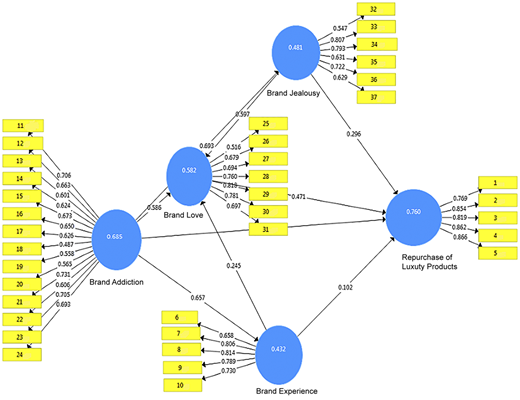
4.2 Assessing the fit of the measurement model Figure 2 illustrates the measurement model in the standard mode
Cronbach's alpha is used to assess the reliability of the investigation. The calculated values are greater than 0.7 for all the dimensions, indicating the acceptable reliability of all the subscales and items. 0078002Table 3 provides Cronbach's alpha values as well as the results of composite reliability and convergent validity assessments.
Cronbach's alpha and hybrid reliability and convergent validity
| AVE | Combined reliability | Cronbach's alpha | Model dimensions |
|---|---|---|---|
| 0/507 | 0/905 | 0/887 | Brand addiction |
| 0/58 | 0/873 | 0/818 | Brand experience |
| 0/582 | 0/846 | 0/78 | Brand jealousy |
| 0/697 | 0/92 | 0/893 | Repurchase of luxury products |
| 0/507 | 0/876 | 0/834 | Brand love |
According to Table 4, the square root of the average variance extracted (AVE) for each latent variable is greater than the correlation coefficients between that variable and other variables, which establishes the discriminant validity of the model. Moreover, In this research, considering that the calculated value of GoF for the presented model is 0.758, which is higher than 0.36 and close to one, it shows the strong overall fit of the research model.
Composite reliabilities and average variances extracted
| Brand addiction | Brand experience | Brand jealousy | Repurchase of luxury products | Brand love | |
|---|---|---|---|---|---|
| Brand addiction | 0/638 | ||||
| Brand experience | 0/657 | 0/762 | |||
| Brand jealousy | 0/692 | 0/653 | 0/694 | ||
| Repurchase of luxury products | 0/626 | 0/707 | 0/799 | 0/835 | |
| Brand love | 0/525 | 0/662 | 0/707 | 0/616 | 0/712 |
Table 5 demonstrated the results of data analysis based on direct relationships and the effects of the mediating variables that are examined by the widely used Sobel test, which confirms all hypotheses as true. The featured model of the brand addiction variable was unique for each person addicted to repurchasing luxury products. The findings also indicate that the positive impact of brand addiction on other variables acts as a catalyst for the repurchase of luxury products. Thus, brand addiction acts as an emerging structure for intense interaction with consumers and a mental involvement with the luxury brand to repurchase.
Results of hypothesis testing
| Hypothesis number | Hypothesis path | Path coefficient | Statistics t | Significance level | Result |
|---|---|---|---|---|---|
| H1a | Brand Addiction - > Brand Jealousy | 0/685 | 18/637 | 0/001 | Meaningful, positive |
| H1b | Brand addiction - > Brand jealousy - > Repurchase of luxury products | 0/203 | 5/422 | 0/001 | Meaningful, positive |
| H2a | Brand Addiction - > Brand Love | 0/586 | 3/393 | 0/001 | Meaningful, positive |
| H2b | Brand addiction - > Brand love - > Purchase of luxury products | 0/478 | 6/897 | 0/001 | Meaningful, positive |
| H3a | Brand Addiction - > Brand Experience | 0/652 | 17/271 | 0/001 | Meaningful, positive |
| H3a | Addiction - > Brand experience - > Purchase of luxury products | 0/07 | 2/535 | 0/012 | Meaningful, positive |
| H4 | Brand addiction - > repurchase of luxury products | 0/11 | 3/061 | 0/002 | Meaningful, positive |
| H5 | Brand Jealousy - > Brand Love | 0/594 | 10/323 | 0/001 | Meaningful, positive |
| H6 | Brand Jealousy - > repurchase of luxury products | 0/296 | 5/916 | 0/001 | Meaningful, positive |
| H7 | Brand Experience - > Brand Love | 0/247 | 4/853 | 0/001 | Meaningful, positive |
| H8 | Brand Experience - > repurchase of luxury products | 0/107 | 2/597 | 0/01 | Meaningful, positive |
| H9 | Brand Love- > Repurchase luxury products | 0/469 | 11/719 | 0/001 | Meaningful, positive |
5. Discussion and conclusion
In recent decades, extensive research has been done on mobile phone addiction. Previous results indicate little evidence of people's addiction to repurchasing luxury brands and the market share of luxury smartphone repurchasing. Rokna News (2018) emphasized that addiction to smartphones affects neural pathways and increases dopamine and oxytocin levels in the brain (Hooper and Zhou, 2007). Moreover, Hooper and Zhou (2007) claimed that the use of smartphones is regarded as addictive, and compulsive. Nevertheless, a behavior may be voluntary, but over time it may become compulsive and it may even start as a mandatory behavior and cause addictive behavior.
This study provides insights for marketers and luxury professionals to reveal the contribution of instrumental values and new strategies to brand addiction and its impact on brand addicts' behavioral intentions to repurchase luxury products. Therefore, While the previous studies, mostly analyzed brand addiction as a dependent variable this study goes further. Results indicate brand addiction positively affects brand jealousy, brand love and a strong emotional experience of luxury repurchasing. Thus, It creates a new behavioral process for repurchasing and supports other components as effective and embedded in a person's behavior or attitude.
According to statistics, smuggling luxury products is a common practice in Iran because of sanctions. Furthermore, Statistics indicated that Apple's brand is the most popular mobile smartphone in Iran, which is considered a luxury brand because of its high price compared to other brands. It demonstrates that strict restrictions on the import of the Apple brand into Iran have no impact on consumer attitudes or the purchase of luxury goods. Since brand addiction is an infrastructure and hot topic in new brand marketing, the implications of this research for practice and future research as well as its suggestion are provided as follows: To expand on the current results, it is proposed that other researchers study the effects of brand addiction on the consumption of other luxury products. According to the Statista statistical databases on the role of women as major consumers of luxury goods in the next decade. We recommended marketers and managers use the gender factor as a moderating variable in the brand addiction model. Moreover, the use of animal skin in the design of luxury mobile phone accessories has led environment-friendly consumers and animal rights advocates not to use accessories. Unlike that, some people have purchased these products at a high price and consider them different from others. Recently, mobile phone addiction is prevalent among Iranian youth. It is suggested that mobile phone makers focus more on younger generations, which is also highlighted in Chu et al. (2019). Just like any other research, this research has some limitations which on the other hand, represent opportunities for future research on this topic. Although the findings of this study are encouraging, several limitations need to be acknowledged. With Iran's current macroeconomic conditions, sanctions and rising income inequality, access to other luxury brands is the first limited. Moreover, the lack of research on the emerging concept of brand addiction in the country and abroad limits the ability to compare results. The lack of permission to import the iPhone is one of the other limitations. As a result, the distinct nature of the research community restricts generalizations to more distinct and larger populations, because research on brand addiction is still in childhood, and there may be numerous other motivations and consequences which are still unknown.
The data were collected for quantitative research from an online sample in Iran, future research should draw information from qualitative research or focus groups. This study was conducted in a generalized manner for “luxury smartphones”, further investigation should incorporate luxury brands from multiple sectors such as fashion, luxury services, or luxury watches. Here, we used three mediators acting on relationships, further research can examine other moderating and mediating effects. Furthermore, other researchers also incorporate factors such as price, age, and psychological characteristics (egocentrism, self-esteem, etc.) as moderating variables into the model. Besides, other researchers are invited to examine the effects of brand addition in various areas. Recently, mobile phone addiction is prevalent among Iranian youth. It is suggested that mobile phone makers focus more on younger generations, which is also highlighted in Chu et al. (2019). The findings investigated that not only the luxury brand addict may not love the luxury brand, but also the positive mental and behavioral effects encourage them to repurchase. Interestingly, we also found that the emerging concept of brand addiction can result in more intense consumer engagement with luxury products and encourage them to repurchase luxury products, which is consistent with the findings of Mrad and Cui (2019a, b). Therefore, our research can contribute to the richness of luxury repurchase marketing literature in this direction. Hence, the results illustrated that brand addiction positively influences the repurchase of luxury products. Brand addiction had a positive impact on brand jealousy. Brand addiction influenced brand love and brand experience. Moreover, the results indicated that brand jealousy, brand love, and brand experience are positive and significant mediators between brand addiction and repeated luxury purchases. Likewise, the new experiences of luxury brand consumers could create a new wave of purchases process, consistent with the findings of Rahman et al. (2023). Thus, this paper maps up the emerging field of brand addiction as an independent variable from other marketing literature variables.

