
Skip to article sections
Purpose

This paper aims to examine the relationships among attitude, subjective norm (SN), perceived behavioral control (PBC), perceived novelty (PN), consumer confidence (CC) and Generation Z’s (Gen Z’s) green apparel purchase intention (PI), and also test the moderating role of electronic word-of-mouth (eWOM).

Methodology

The quantitative study used structural equation modeling and Hayes’ PROCESS macro to analyze a survey sample of 512 Gen Z consumers.

Findings

The key findings indicate that attitude, SN, PBC, PN and CC significantly influence Gen Z consumers’ green apparel PI. Furthermore, eWOM moderated the relationship between CC and Gen Z consumers’ green apparel PI.

Originality

Although previous studies have examined the influence of attitude, SN and PBC on green product PI, the expanded framework with the proposed possible relationships is novel. This research sheds light on the effect of PN and CC on Gen Z consumers’ green apparel purchases. Furthermore, this study extends the green apparel literature by investigating the moderating impact of eWOM.

The clothing and apparel industry has seen a surge in conversations about sustainability challenges over the past decade. The fashion sector generates the second-largest amount of waste and has the second-largest carbon footprint, accounting for 4% of all global emissions (McKinsey and Company, 2022). Therefore, it is not surprising that consumers, manufacturers and researchers are now interested in eco-friendly clothing. In the apparel category, practitioners and policymakers have emphasized the need to shift toward the production and use of green apparel (McNeill and Venter, 2019), which refers to clothing or fashion items manufactured with consideration of environmental, social and economic factors. The reason for choosing the apparel sector is twofold. First, in 2021, the Indian textile and clothing market was valued at US$151.2bn and is projected to grow at a compound annual growth rate (CAGR) of 14.8% from 2022 to 2027, reaching US$344.1bn (IMARC, 2021). The apparel industry has expanded due to changing lifestyles, rising incomes and a desire to experiment with branded clothing. Second, the fashion industry has lagged behind other sectors of the economy in developing and promoting sustainable, fashionable clothing and faces significant challenges due to discrepancies between consumer attitudes and behavior (Lee et al., 2020).

Generation Z (Gen Z) is the second youngest consumer group, with millennials coming before them and Generation Alpha after them, and, compared to previous generations, they are pragmatic, who worry for the future, more interested in belonging to an inclusive, supportive community, describe themselves as environmentally conscious and expect to see sustainability commitments from companies and organizations (McKinsey Explainers, 2024). According to the generation theory (Strauss and Howe, 1997), different generations have different attitudes and consumption habits. As per Casalegno et al. (2022), age and sustainable behavior are directly related. Gen Z is uniquely positioned to modify sustainable consumption patterns (Shaheen Hosany and Serdiuk, 2025). For Gen Z, the future of the planet is as important as their social connections on social media, and they show greater environmental care and a sense of social responsibility (Salinero et al., 2022). Individuals in this generational cohort are well-educated consumers who have a solid grasp of environmental issues and eco-friendly products, which enhances their desire to use sustainable products and their self-efficacy to act in an eco-friendly manner (Chaturvedi et al., 2020). The generational theory also supports that Gen Zs and non-Gen Zs have different attitudes and behavioral outcomes toward social media marketing activities, as found by Liu et al. (2022). As per a Vogue report (Schulz, 2024), Gen Z is the first generation to grow up with full immersion in the internet and social media, and prefers recommendations from social media, influencers and celebrities. According to a 2025 Deloitte Insights report, Gen Z spends 6.9 h per day consuming media and entertainment (Widener et al., 2025). Also, PWC (2023) results show that consumer reviews are an important source of information, especially for Gen Z. Understanding young consumers offers valuable insights for green apparel marketers (Tong and Su, 2018). Gen Z is the primary focus of this study due to the rise in Gen Z consumers worldwide and the resulting shift in consumption trends.

The theory of planned behavior (TPB) (Ajzen, 1985) is considered the most powerful theory to predict consumers’ green purchasing behavior (Ghouse et al., 2024b; Sun et al., 2022). The TPB offers a theoretical framework for explaining consumer behavioral intentions and predicting consumer purchasing behavior, especially for green consumption (Jebarajakirthy et al., 2024). A review of the literature clearly shows that the TPB has been used to determine Gen Z’s intention and behavior in a number of contexts, such as fast-food consumption (Shetu, 2022); electronic wallet usage (Persada et al., 2021), but with respect to green apparel, there is a scarcity. Specifically, the role of CC and PN in green consumption has not been fully explored. This study investigates this research gap and examines what factors encourage Gen Z consumers to purchase green apparel. Specifically, this research seeks to answer the following research questions:

RQ1.

Do perceived novelty and consumer confidence, along with the three predictors of the TPB, influence Generation Z consumers’ intention to purchase green apparel?

RQ2.

Does eWOM moderate the relationship between perceived novelty, consumer confidence and Generation Z consumers’ purchase intention?

This study adds valuable knowledge to the existing body of literature. First, our study applies the TPB in the field of green apparel, specifically among Gen Z. Second, to examine Gen Z consumers’ intentions to purchase green apparel, it also examines how PN and CC affect green apparel purchase intention (PI). Third, in the literature on green marketing, the electronic word-of-mouth (eWOM) paradigm is considered relatively recent. This study considers eWOM as a moderator in the green clothing context, determining Gen Z consumers’ green apparel PI, which has yet to be tested. Therefore, we predict that our research will help researchers, marketers and decision makers clearly understand how consumers select green apparel.

The manuscript is divided into seven sections. Section 2 details the concept’s theoretical foundations and hypotheses development. Section 3 provides details on the instrument used and the data collection procedure. Data analysis is presented in Section 4. Findings are discussed in Section 5 and implications are discussed in Section 6. Finally, limitations are presented in Section 7.

Green apparel is defined as clothing designed for long-term use, produced ethically – possibly locally – with minimal environmental impact, using eco-labeled or recycled materials (Niinimäki, 2010). Song and Kim (2019, p. 2) further describe green apparel as reflecting sustainability, produced with eco-friendly materials and minimal environmental disruption and ethically sourced to help alleviate poverty and improve labor conditions. As pollution from conventional apparel production increases, the urgency to produce green apparel is clear.

Gen Z is known by its various names – iGeneration, Gen Tech, Online Generation, Post Millennials, Facebook Generation, Switchers, “always clicking,” C Generation (connected, connected to the internet, computerized, communicating, content-centric, community-oriented and changing), R Generation (responsibility generation) (Dolot, 2018). Known for their sluggishness and smartphone addiction, this generation is transforming business as we know it. A risk-averse generation that values creativity and innovation has an incredible aptitude for online research and searches (Grigoreva et al., 2021). Gen Z has unique characteristics. Gen Z has embraced hedonism, responsibility, genuineness and respect for others (Azimi et al., 2021). According to Vizcaya-Moreno and Pérez-Cañaveras (2020), Gen Z was raised in a highly technical environment and cannot operate without the internet or other modern technology. They use these resources to exchange knowledge and voice their opinions, as well as their wants and needs regarding goods and services. However, studies on the antecedents of green apparel PI among Gen Z consumers are limited, which has sparked researchers’ interest (Rūtelionė and Bhutto, 2024).

To predict consumers’ purchasing intentions or behavior for green products, the three key elements of the TPB – attitude, subjective norm (SN) and perceived behavioral control (PCB) – are commonly used. Ajzen (1991, p. 188) defines attitude as “the degree to which an individual has a favorable or unfavorable evaluation or appraisal of a given behavior.” According to Ajzen (1991, p. 188), SN refers to “the perceived social pressure to perform or not to perform the behavior.” According to Ajzen and Madden (1986, p. 457), “PBC refers to an individual’s perception regarding how easy or difficult performance of the behavior is likely to be.” The behavioral intention construct, central to the model, is a strong predictor of behavior. Therefore, we describe the consumers’ PIs rather than focusing on actual behavior in this study. Prior research has offered empirical support for the effect of the TPB antecedents – attitude, SN and PBC on PI with relation to environmentally friendly products (see Sharma et al., 2024). Specifically regarding green clothing, Tewari et al. (2022) demonstrated that customer attitudes, social influence and PBC affect young Indian customers’ decisions to purchase eco-friendly clothes. Shehawy and Ali Khan (2024), Ghouse et al. (2024a) and Tandon et al. (2023) found that attitude positively influences green consumption. Ghouse et al. (2024a) found that Gen Z’s green PIs are influenced by SN. However, a recent study by Nguyen et al. (2024) found that PBC did not influence green PI. Bong Ko and Jin (2017) found that SNs and PBC directly influence PI for green apparel products. Rūtelionė et al. (2024) found that attitude significantly predicted green apparel purchase behavior among Gen Z. After reviewing the literature, we found that we need to retest these relationships among Gen Z consumers. Therefore, we hypothesize:

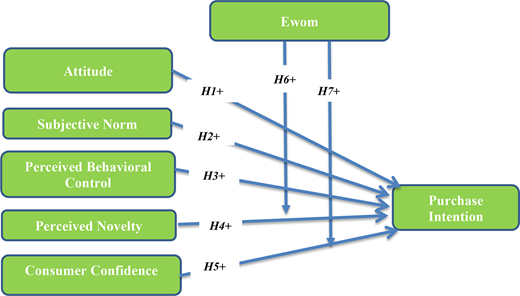
H1.

Consumers’ attitude toward green apparel positively influences Generation Z’s intention to purchase green apparel.

H2.

Subjective norm positively influences Generation Z’s intention to purchase green apparel.

H3.

Perceived behavioral control positively influences Generation Z’s intention to purchase green apparel.

According to Sethi et al. (2001, p. 74), “Novelty refers to the extent to which a concept, idea or object differs from conventional practice within the domain of interest.” Novel happenings trigger an information hunt to determine what something is, how it happened and what knowledge is required for interpretation (Hochwarter et al., 2022). Luan and Kim (2022) identified that the degree to which an evaluator recognizes that a new product differs from current items distinctively and originally after purposefully reviewing it is known as PN. Through novel products or services, consumers can understand a company’s distinctiveness, diversity and novelty (Wang et al., 2019). Consumers find novel products more appealing, thereby increasing their propensity to buy; that is, people are more likely to purchase a brand when they perceive it as new (Chen et al., 2021). When it comes to green clothing, we define PN as the extent to which customers perceive it as novel and distinctive, which encourages them to buy it more pleasurably than conventional apparel.

PN has been used in the literature in various contexts. Adapa et al. (2020) studied the association between PN and smart retail technology and found that it positively influences consumers’ perceived shopping value through innovative retail technology. Hochwarter et al. (2022) investigated the association of PN with nurses’ compassion fatigue. According to Leong et al. (2020), PN is the second-strongest predictor of m-wallet resistance among the relevant variables. Chen et al. (2021) hypothesized that PN positively influences green PI, and their results indicated that this effect was significant. The literature shows that the impact of PN has not yet been studied in the context of green clothing. Given that green clothing is a relatively recent innovation in the study’s current setting, we anticipate that perceptions of novelty will significantly influence Gen Z consumers’ intentions to buy green clothing. For this reason, we have incorporated PN into the theoretical framework. Thus, we hypothesize:

H4.

Perceived novelty positively impacts Generation Z’s green clothing purchase intention.

Siegrist et al. (2003, p. 706) defined confidence as “the belief that future events will occur as expected.” Understanding CC is crucial when anticipating consumers’ purchasing decisions (Benhabib and Spiegel, 2019). Theoretically, CC is defined as the degree to which a customer has confidence in a product, a brand or their ability to make decisions (Flanagan et al., 2005). Bearden et al. (2001, p. 122) defined consumer self-confidence as “the extent to which an individual feels capable and assured with respect to his or her marketplace decisions and behaviors.” In this study, CC is defined as the degree of buyer confidence in environmentally friendly clothing that they perceive as safe and environmentally friendly.

According to Howard and Sheth (1969), CC is a positive determinant of PI. CC has been widely used in economic studies, but its role in behavioral studies remains limited. Choshaly and Tih (2015) found that consumers’ confidence in eco-labeled products positively affects their PI. D’Souza et al. (2023) found that consumer self-confidence positively associates with PI. Han et al. (2022) examined the relationship between CC and green PI, and their results indicate a positive association. The literature shows that the impact of CC has not yet been studied in the context of green clothing. Given that green clothing is a relatively recent innovation in the study’s current setting, we anticipate that perceptions of CC will significantly influence young consumers’ intentions to buy green clothing. For this reason, we have incorporated CC into the theoretical framework. Thus, we hypothesize:

H5.

Consumer confidence positively impacts Generation Z’s green clothing purchase intention.

The development of the internet has expanded the idea of WOM communication to encompass online material, or eWOM (Uslu, 2020). WOM enables customers to share information and assessments that help and direct other customers in selecting goods or services. Online comments are produced by unidentified sources, unlike WOM, which typically concerns opinions expressed by acquaintances (such as friends, coworkers and family) (Xie et al., 2011). eWOM refers to consumer reviews, ratings and recommendations of goods, services or brands that circulate online (Hsieh et al., 2012). According to Hennig-Thurau et al. (2004, p. 39), eWOM can be defined as “any positive or negative statement made by potential, actual or former customers about a product or company, which is made available to a multitude of people and institutions via the internet.”

Chang and Hsiao (2025) noted that eWOM not only increases consumers’ confidence but also serves as a dual influencer, making it a critical factor in purchase decisions. Zamil et al. (2022) examined the moderating role of eWOM in the adoption intention for an m-wallet. Amarullah (2022) examined the moderating role of eWOM in the relationship between trust, perceived risk and the purchase decision. Regarding green PI, Pant and Kumar (2023) examined the moderating role of consumers’ eWOM. Taking a cue from the literature, this research includes eWOM as a moderator in the relationship between PN, CC and purchasing intention for green clothing. Hence, the following hypothesis is developed:

H6.

Electronic word-of-mouth intensifies (moderates) the link between PN and the intention to buy green apparel.

H7.

Electronic word-of-mouth strengthens (moderates) the association between consumer confidence and the intention to buy green apparel.

To evaluate the suggested model (Figure 1), a structured questionnaire was developed with scales to measure the constructs used in the study. Multiple-item scales were used to measure each construct. To capture the various latent variables, 29 statements were used (see Table 2), and responses were scored on a seven-point Likert scale (1 = strongly disagree, 7 = strongly agree). The measures were adapted from earlier studies in the field of green products. Researchers exercised caution in selecting items that captured the essence of the constructs, were unambiguous and concise and were relevant to the study context. The scale on attitude, having four items, was adopted from Varah et al. (2021), Wu and Chen (2014); four items of the SN from Tewari et al. (2022); Varah et al. (2021), five items from the PBC from Tewari et al. (2022). The PN scale with four items was taken from Stock and Zacharias (2013) and Adapa et al. (2020. A four-item CC scale was adopted from D’Souza et al. (2023). The scale of PI was adopted from Tewari et al. (2022). The eWOM scale with four items was adapted from Chu and Kim (2011) and Mohammad et al. (2020). Information in detail is given in Table 2.

The original draft of a structured closed-ended questionnaire was prepared using prevalidated scales with modifications to suit the context. Before starting the fieldwork, pre and pilot testing were conducted. Five experts with an understanding of green clothing looked through and analyzed the questionnaire’s original format. In response to their suggestions, we made a few minor adjustments in the wording and sequencing of the questions. A pilot study involving 50 participants was then conducted to assess the internal consistency of the measurement items. Once the defined objectives were completed, the final questionnaire was designed to gather information for evaluating the study model. To identify customers who use these products, we visited and telephoned multiple stores and boutiques in Ghaziabad and Lucknow that sold green clothing, and we requested their client information on the assurance that the data would be used only for research purposes. A number of store owners/managers declined; however, many of them were cooperative as well. After that, we tried contacting these clients online (through e-mail, WhatsApp and Telegram). The purpose of the study was explained to the respondents at the outset of the questionnaire. The participants were finally praised for taking it, but received no remuneration. They chose to participate voluntarily.

Using purposive sampling, an overall response rate of 93.28% was achieved, with 541 completed surveys from 580 respondents who received the survey link. Data from 512 respondents were used in the analysis after missing responses were removed. According to Kline (2011), the structural equation modeling (SEM) sample size should be 10:1, or at least 10 responses per item. Twenty-nine study items meant that a minimum of 290 responses were required. The details are given in Table 1.

To evaluate the measurement model, a confirmatory factor analysis (CFA) was used. First, the CFA findings demonstrate a superb fit – χ2/df = 1.729, comparative fit index (CFI) = 0.966, root mean square error of approximation (RMSEA) = 0.038, standardised root mean square residual (SRMR) = 0.037 – which is as per Hu and Bentler (1999).

Cronbach’s alpha was used to evaluate the reliability of the model variables. The model’s validity and reliability were then confirmed. Table 2 shows the composite reliability (CR) and Cronbach’s alpha values, which exceed the recommended cutoff of 0.70 (Fornell and Larcker, 1981).

To evaluate the measurement model’s validity, convergent and discriminant validity were used (Hair et al., 2010). Convergent validity was evaluated using factor loadings and the average variance extracted (AVE). The factor loadings of all items and the AVE, according to Fornell and Larcker (1981), exceeded the allowed limits of 0.6 and 0.5, respectively. The CR used to evaluate the constructs’ reliability was also above the recommended level of 0.6. (Bagozzi and Yi, 1988). The factor loadings, CR, AVE and Cronbach’s alpha are shown in Table 2.

To determine the extent to which the components and constructs were distinct, discriminant validity was assessed. Table 3 displayed the discriminant validity of each construct. The model satisfied the discriminant validity criteria because the square root of each construct’s AVE was greater than the correlations among the reflective constructs (Fornell and Larcker, 1981).

Harman’s single-factor test was conducted to examine the common technique bias. It was discovered that the single component accounted for 28.05% of the total variation, indicating that method bias was not a problem (Podsakoff et al., 2013). Skewness and kurtosis indices were used to look for any data that deviated from normality. The typical ranges for skewness and kurtosis are ±3 and ±10, respectively, according to Kline (2011). Because skewness and kurtosis were within the acceptable range, the data were deemed normal. Given that the variance inflation factor (VIF) values were below 3, it is unlikely that multicollinearity was an issue in the data.

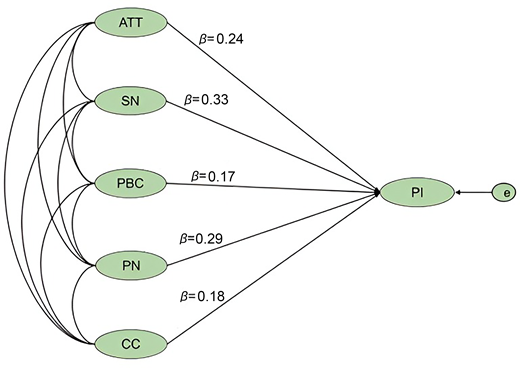
Using a structural model, the relationship between the factors was evaluated. The SEM results demonstrate a very good fit – χ2/df = 1.788, CFI = 0.970, RMSEA = 0.039, SRMR = 0.038 (Hu and Bentler, 1999). The structural model is shown in Figure 2.

Five hypotheses were proposed to examine the relationships among the model’s factors. Attitude, SN, PBC, PN, and CC positively influence PI, supporting the hypotheses H1H5 (see Table 4).

The moderation analysis was conducted using Hayes’ PROCESS macro in statistical package for social sciences (SPSS). The results show that eWOM positively moderates the relationship between CC and PI but not between PN and PI. Therefore, H7 is supported, whereas H6 is not supported. The result is shown in Table 5.

The study aimed to answer the two research questions stated earlier, which arose from a gap in the current literature. The first question was answered by the extended TPB model, which included PN and CC, explaining 62.1% of the variance in PI for green apparel. Furthermore, the impact of all the model factors was found to be significant. The second research question was answered, as eWOM was found to moderate the association between CC and PI, uncovering a complex relationship among these three variables. A detailed discussion of findings is as follows:

The study evaluated the association between attitude, SN, PBC, PN, CC and PI. By including PN and CC as predictors of PI toward green clothes, this research expanded the TPB theoretical framework. Furthermore, the moderating role of eWOM in the association between PN, CC and PI was assessed. In addition, this study focused on Gen Z, which adds to the literature. A conceptual framework is proposed and empirically tested.

This study lends credence to earlier findings that attitude, SN and PBC are significant predictors of PI. According to the hypothesized outcomes (H1, H2 and H3), attitudes toward green clothing, SNs and PBC all had a significant impact on customers’ intentions to purchase, suggesting that favorable attitudes, norms and PBC would be associated with higher intentions to buy green clothing. This outcome also aligns with earlier research (see Tewari et al., 2022).

The study confirmed that PN influences consumers’ PI. Therefore, H4 is supported. This suggests that customers will be willing to try green technology when they believe it to be new, different and up-to-date. This, in turn, will positively affect their intention to purchase green apparel. This is consistent with Chen et al.’s (2021) finding that consumers are more likely to make a purchase when they view novel products as enticing; that is, young consumers are more inclined to buy a brand when they perceive it as new. The findings corroborated the assertions made by Adapa et al. (2020) and Chen et al. (2021).

The study confirmed that CC influences consumers’ PIs. Therefore, H5 is supported. This demonstrates that customers’ desire to purchase is positively influenced if they have confidence in the new technology, product or brand, that is, feel capable and assured in their marketplace decisions and behaviors (Bearden et al., 2001). This demonstrates that consumers’ perceptions of the safety and environmental friendliness of green apparel affect their confidence in those products, which, in turn, influences Gen Z consumers’ intention to purchase green apparel. The findings corroborated the assertions made by Choshaly and Tih (2015), D’Souza et al. (2023) and Han et al. (2022).

This study adds to the body of knowledge by clarifying the influence of eWOM on Gen Z consumers’ intention to buy eco-friendly clothing. eWOM positively moderated the impact of CC on Gen Z consumers’ desire to buy green clothing, as shown by the study’s results. Therefore, H7 is accepted. The likelihood is that people with significant environmental obligations may buy eco-friendly clothing in response to persuasive information they receive through eWOM communication. This result is consistent with Jaini et al. (2020), who showed that eWOM communication influences consumers’ purchasing intentions. eWOM, however, did not moderate the relationship between PN and PI. This suggests that the influence of PN on PI does not differ significantly across levels of eWOM. A possible explanation is that PN, though a significant independent factor in green apparel purchase, does not interact with eWOM to influence Gen Z’s green apparel purchase decisions. This is an unexpected result and warrants further investigation.

This study expands our understanding of consumers’ intentions to buy eco-friendly products. The notion of planned behavior has been frequently used over the past 10 years as a paradigm for defining intent to act, particularly in relation to green apparel among Gen Z customers, which adds novelty to the literature. The two constructs – PN and CC – were successfully incorporated into the current study’s extension of the TPB model. This study also discusses the moderating function of eWOM, which offers novelty. Using this integrated model, the study’s findings offer a comprehensive, in-depth look at Gen Z customers’ intentions to purchase environmentally friendly clothing.

Also, some new connections were made, including the influence of PN and CC on Gen Z customers’ inclination to buy green clothing (Ewe and Tjiptono, 2023). The influence of PN and CC on consumers’ intention to buy green products has been studied only rarely; however, the influence of these factors on Gen Z consumers’ desire to buy green clothing has not been thoroughly researched. These new connections will provide a scholarly foundation for the future and advance the body of existing work.

Furthermore, the current study is among the first to examine the moderating effect of eWOM on the relationship between PN, CC and PI for green clothes. The body of prior literature lacks studies examining the moderating effect of eWOM on the propensity to buy green clothing. Therefore, our study sought to close this knowledge gap. According to the study’s findings, eWOM communication moderates the influence of CC on Gen Z customers’ willingness to purchase eco-friendly clothing, making a significant contribution to the green consumption literature. Summing up, the study contributes to the literature on three counts: confirming TPB as a key theoretical framework for explaining green consumption behaviors, extending TPB by including two key constructs and unearthing the complex nature of the relationships among eWOM, CC and PI. Together, these theoretical advancements will provide a foundation for sustainable marketing strategies that are both empirically grounded and generationally relevant.

Our research adds to the body of knowledge on green apparel and environmentally friendly behavior, and offers suggestions for manufacturers, marketers, decision makers and researchers. The TPB has already been used in the existing literature to predict intention to purchase green products, but in the context of green apparel, this study’s findings offer practical implications for stakeholders. The outcome may be advantageous for marketing companies, advertising agencies and green clothing researchers. Given the trend toward environmentally friendly consumer preferences, this study will be useful to marketers in understanding consumer attitudes. Furthermore, given the enormous influence of SNs, marketers should focus on motivating current customers to persuade their friends and family to try eco-friendly clothing. Given the significant impact of PBC on PI, manufacturers of eco-friendly clothing can increase the accessibility of their goods to provide customers with more opportunities and options when making their purchases.

The intention to purchase green clothing increases with CC. This study has contributed to the body of knowledge on customer confidence and green clothing buying intentions. A logical conclusion from these findings is that marketers must boost consumers’ confidence in their green garments to increase their propensity to buy green clothing. This could be accomplished by providing the customer with more product knowledge or hands-on experience to increase their perceived familiarity with it. Greater transparency from marketers could reduce greenwashing and empower informed decision-making, thereby enhancing green apparel PI. Advertisements may portray green apparel consumers as confident in their marketplace decisions.

Also, it was found that eWOM successfully moderated the relationship between CC and Gen Z consumers’ intention to purchase green apparel. This information could be valuable to marketers. Because eWOM is regarded as a reliable source of information, marketers could urge current Gen Z consumers who have had positive experiences with green clothes to recommend the product to other customers to turn them into loyal patrons. This will significantly influence consumers who are ready to purchase green apparel, and their decision becomes even stronger when they receive positive feedback from existing customers. Consumers should be encouraged to submit reviews and posts on social media platforms and share their experiences with green clothing, as Gen Z is a tech-savvy generation, and social media has become a potent tool for influencing targeted audiences. Influencer partnerships (esp. with microinfluencers) on social media may also be leveraged to reach a larger audience. Marketers can also use eWOM to increase customers’ confidence in their decision to purchase green apparel.

Though the findings are applicable only to green apparel, adopting a more lenient perspective may allow us to generalize them to other green product categories, such as organic food, green cosmetics and other recycled products. The TPB framework has already been established as a reliable model for different green/sustainable product categories. Moreover, these products are all novel, and consumers who purchase them could be perceived as confident and well-informed. These promotions could be carried out via eWOM on various media.

Table 6 summarizes the key findings with corresponding implications.

This study has a few limitations that warrant consideration. First, the research uses a cross-sectional design, which does not allow tracking behavioral changes over time. Future studies may use a longitudinal design to increase robustness. Second, purposive sampling limits the generalizability of the findings. Finally, the use of self-reported data may lead to social desirability bias. Scholars may, in the future, use measures to control this bias or use experimental or observational methods to overcome this limitation.

Furthermore, future studies may expand the current work by including a more diverse range of consumers across different generations. By including participants from various age groups, researchers can assess generational differences in attitudes and purchasing intentions toward green apparel. In addition, future studies should consider a broader analysis of demographic variables to examine how factors such as gender, income and educational level influence the intention to purchase eco-friendly clothing. Investigating these aspects could yield deeper insights into consumer behavior dynamics. Moreover, researchers could extend this study’s scope beyond green apparel to examine other sustainable product categories, thereby contributing to a more comprehensive understanding of eco-conscious consumer behavior across various markets.
Adapa
,
S.
,
Fazal-e-Hasan
,
S.M.
,
Makam
,
S.B.
,
Azeem
,
M.M.
and
Mortimer
,
G.
(
2020
), “
Examining the antecedents and consequences of perceived shopping value through smart retail technology
”,
Journal of Retailing and Consumer Services
, Vol.
52
, p.
101901
.
Ajzen
,
I.
(
1985
), “
From intentions to actions: a theory of planned behaviour
”,
Action Control
, pp.
11
-
39
.
Ajzen
,
I.
(
1991
), “
The theory of planned behavior
”,
Organizational Behavior and Human Decision Processes
, Vol.
50
No.
2
, pp.
179
-
211
.
Ajzen
,
I.
and
Madden
,
T.J.
(
1986
), “
Prediction of goal-directed behavior: attitudes, intentions, and perceived behavioral control
”,
Journal of Experimental Social Psychology
, Vol.
22
No.
5
, pp.
453
-
474
.
Amarullah
,
D.
(
2022
), “
How trust and perceived risk create consumer purchase intention in the context of e-commerce: moderation role of eWOM
”,
International Journal of Electronic Marketing and Retailing
, Vol.
1
No.
1
, p.
1
.
Azimi
,
S.
,
Andonova
,
Y.
and
Schewe
,
C.
(
2021
), “
Closer together or further apart? Values of hero generations Y and Z during crisis
”,
Young Consumers
, Vol.
23
No.
2
, pp.
179
-
196
.
Bagozzi
,
R.P.
and
Yi
,
Y.
(
1988
), “
On the evaluation of structural equation models
”,
Journal of the Academy of Marketing Science
, Vol.
16
No.
1
, pp.
74
-
94
.
Bearden
,
W.O.
,
Hardesty
,
D.M.
and
Rose
,
R.L.
(
2001
), “
Consumer self-confidence: refinements in conceptualization and measurement
”,
Journal of Consumer Research
, Vol.
28
No.
1
, pp.
121
-
134
.
Benhabib
,
J.
and
Spiegel
,
M.M.
(
2019
), “
Sentiments and economic activity: evidence from US states
”,
The Economic Journal
, Vol.
129
No.
618
, pp.
715
-
733
.
Bong Ko
,
S.
and
Jin
,
B.
(
2017
), “
Predictors of purchase intention toward green apparel products
”,
Journal of Fashion Marketing and Management: An International Journal
, Vol.
21
No.
1
, pp.
70
-
87
.
Casalegno
,
C.
,
Candelo
,
E.
and
Santoro
,
G.
(
2022
), “
Exploring the antecedents of green and sustainable purchase behaviour: a comparison among different generations
”,
Psychology and Marketing
, Vol.
39
No.
5
, pp.
1007
-
1021
.
Chang
,
I.
and
Hsiao
,
Y.
(
2025
), “
How does environmental cognition promote low-carbon travel intentions? The mediating role of green perceived value and the moderating role of electronic word-of-mouth
”,
Sustainability
, Vol.
17
No.
4
, p.
1383
.
Chaturvedi
,
P.
,
Kulshreshtha
,
K.
and
Tripathi
,
V.
(
2020
), “
Investigating the determinants of behavioral intentions of Generation Z for recycled clothing: an evidence from a developing economy
”,
Young Consumers
, Vol.
21
No.
4
, pp.
403
-
417
, doi: .
Chen
,
L.
,
Qie
,
K.
,
Memon
,
H.
and
Yesuf
,
H.M.
(
2021
), “
The empirical analysis of green innovation for fashion brands, perceived value and green purchase intention—mediating and moderating effects
”,
Sustainability
, Vol.
13
No.
8
, p.
4238
.
Choshaly
,
S.H.
and
Tih
,
S.
(
2015
), “
Consumer confidence and environmental behavioral science
”,
Advanced Science Letters
, Vol.
21
No.
6
, pp.
1923
-
1926
.
Chu
,
S.
and
Kim
,
Y.
(
2011
), “
Determinants of consumer engagement in electronic word-of-mouth (eWOM) in social networking sites
”,
International Journal of Advertising
, Vol.
30
No.
1
, pp.
47
-
75
.
D’Souza
,
C.
,
Taghian
,
M.
,
Hall
,
J.
and
Plant
,
E.
(
2023
), “
Green consumption: strategic retail considerations and consumer confidence
”,
Journal of Strategic Marketing
, Vol.
31
No.
1
, pp.
18
-
36
.
Dolot
,
A.
(
2018
), “
The characteristics of Generation Z
”,
E-mentor
, Vol.
2
No.
74
, pp.
44
-
50
.
Ewe
,
S.Y.
and
Tjiptono
,
F.
(
2023
), “
Green behavior among Gen Z consumers in an emerging market: eco-friendly versus non-eco-friendly products
”,
Young Consumers
, Vol.
24
No.
2
, pp.
234
-
252
.
Flanagan
,
P.
,
Johnston
,
R.
and
Talbot
,
D.
(
2005
), “
Customer confidence: the development of a ‘pre‐experience’ concept
”,
International Journal of Service Industry Management
, Vol.
16
No.
4
.
Fornell
,
C.
and
Larcker
,
D.F.
(
1981
), “
Structural equation models with unobservable variables and measurement error: algebra and statistics
”.
Ghouse
,
S.M.
,
Shekhar
,
R.
and
Chaudhary
,
M.
(
2024a
), “
Sustainable choices of Gen Y and Gen Z: exploring green horizons
”,
Management and Sustainability: An Arab Review
, Vol.
4
No.
3
, pp.
533
-
559
.
Ghouse
,
S.M.
,
Shekhar
,
R.
,
Ali Sulaiman
,
M.A.
and
Azam
,
A.
(
2024b
), “
Green purchase behaviour of Arab millennials towards eco-friendly products: the moderating role of eco-labelling
”,
The Bottom Line
, Vol.
38
No.
3
, pp.
286
-
308
.
Grigoreva
,
E.A.
,
Garifova
,
L.F.
and
Polovkina
,
E.A.
(
2021
), “
Consumer behavior in the information economy: Generation Z
”,
International Journal of Financial Research
, Vol.
12
No.
2
, p.
164
.
Han
,
M.S.
,
Hampson
,
D.P.
,
Wang
,
Y.
and
Wang
,
H.
(
2022
), “
Consumer confidence and green purchase intention: an application of the stimulus-organism-response model
”,
Journal of Retailing and Consumer Services
, Vol.
68
, p.
103061
.
Hair
,
J.F.
,
Black
,
W.C.
,
Babin
,
B.J.
and
Anderson
,
R.E.
(
2010
),
Multivariate data analysis
(7th ed.),
Prentice Hall
,
Englewood Cliffs
.
Hennig-Thurau
,
T.
,
Gwinner
,
K.P.
,
Walsh
,
G.
and
Gremler
,
D.D.
(
2004
), “
Electronic word-of-mouth via consumer-opinion platforms: what motivates consumers to articulate themselves on the internet?
”,
Journal of Interactive Marketing
, Vol.
18
No.
1
, pp.
38
-
52
.
Hochwarter
,
W.
,
Jordan
,
S.
,
Kiewitz
,
C.
,
Liborius
,
P.
,
Lampaki
,
A.
,
Franczak
,
J.
,
Deng
,
Y.
,
Babalola
,
M.T.
and
Khan
,
A.K.
(
2022
), “
Losing compassion for patients? The implications of COVID-19 on compassion fatigue and event-related post-traumatic stress disorder in nurses
”,
Journal of Managerial Psychology
, Vol.
37
No.
3
, pp.
206
-
223
.
Howard
,
J.A.
and
Sheth
,
J.N.
(
1969
),
The Theory of Buyer Behavior
, (Vol.
14
).
New York, NY
.
Hsieh
,
J.K.
,
Hsieh
,
Y.C.
and
Tang
,
Y.C.
(
2012
), “
Exploring the disseminating behaviors of eWOM marketing: persuasion in online video
”,
Electronic Commerce Research
, Vol.
12
No.
2
, pp.
201
-
224
.
Hu
,
L.T.
and
Bentler
,
P.M.
(
1999
), “
Cutoff criteria for fit indexes in covariance structure analysis: conventional criteria versus new alternatives
”,
Structural Equation Modeling: A Multidisciplinary Journal
, Vol.
6
No.
1
, pp.
1
-
55
.
IMARC
(
2021
), “
Indian textile and apparel market to grow at 14.8% during 2022-2027, catalyzed by abundant availability of raw materials
”,
available at:
Link to Indian textile and apparel market to grow at 14.8% during 2022-2027, catalyzed by abundant availability of raw materialsLink to the cited article.
Jaini
,
A.
,
Quoquab
,
F.
,
Mohammad
,
J.
and
Hussin
,
N.
(
2020
), “
I buy green products, do you…?
”,
International Journal of Pharmaceutical and Healthcare Marketing
, Vol.
14
No.
1
, pp.
89
-
112
, doi: .
Jebarajakirthy
,
C.
,
Sivapalan
,
A.
,
Das
,
M.
,
Maseeh
,
H.I.
,
Ashaduzzaman
,
M.
,
Strong
,
C.
and
Sangroya
,
D.
(
2024
), “
A meta-analytic integration of the theory of planned behavior and the value-belief-norm model to predict green consumption
”,
European Journal of Marketing
, Vol.
58
No.
4
, pp.
1141
-
1174
.
Kline
,
R.B.
(
2011
), “
Convergence of structural equation modeling and multilevel modeling
”.
Lee
,
E.-J.
,
Choi
,
H.
,
Han
,
J.
,
Kim
,
D.H.
,
Ko
,
E.
and
Kim
,
K.H.
(
2020
), “
How to ‘nudge’ your consumers toward sustainable fashion consumption: an fMRI investigation
”,
Journal of Business Research
, Vol.
117
.
Leong
,
L.Y.
,
Hew
,
T.S.
,
Ooi
,
K.B.
and
Wei
,
J.
(
2020
), “
Predicting mobile wallet resistance: a two-staged structural equation modeling-artificial neural network approach
”,
International Journal of Information Management
, Vol.
51
, p.
102047
.
Liu
,
J.
,
Wang
,
C.
,
Zhang
,
T.
and
Qiao
,
H.
(
2022
), “
Delineating the effects of social media marketing activities on generation Z travel behaviors
”,
Journal of Travel Research
, Vol.
62
No.
5
, pp.
1140
-
1158
.
Luan
,
Y.
and
Kim
,
Y.J.
(
2022
), “
An integrative model of new product evaluation: a systematic investigation of perceived novelty and product evaluation in the movie industry
”,
Plos One
, Vol.
17
No.
3
, p.
e0265193
.
McKinsey and Company
(
2022
), “
The state of fashion 2022
”,
available at:
Link to The state of fashion 2022Link to a pdf of the cited article.
McKinsey Explainers
(
2024
), “
What is gen Z?
”,
available at:
Link to What is gen Z?Link to the cited article.
McNeill
,
L.
and
Venter
,
B.
(
2019
), “
Identity, self‐concept, and young women’s engagement with collaborative, sustainable fashion consumption models
”,
International Journal of Consumer Studies
, Vol.
43
No.
4
, pp.
368
-
378
.
Mohammad
,
J.
,
Quoquab
,
F.
and
Mohamed Sadom
,
N.Z.
(
2020
), “
Mindful consumption of second-hand clothing: the role of eWOM, attitude, and consumer engagement
”,
Journal of Fashion Marketing and Management: An International Journal
, Vol.
25
No.
3
, pp.
482
-
510
.
Nguyen
,
T.T.T.
,
Limbu
,
Y.B.
,
Pham
,
L.
and
Zúñiga
,
M.Á.
(
2024
), “
The influence of electronic word of mouth on green cosmetics purchase intention: evidence from young Vietnamese female consumers
”,
Journal of Consumer Marketing
, Vol.
41
No.
4
.
Niinimäki
,
K.
(
2010
), “
Eco-clothing, consumer identity and ideology
”,
Sustainable Development
, Vol.
18
No.
3
, pp.
150
-
162
, doi: .
Pant
,
M.
and
Kumar
,
R.
(
2023
), “
An exploratory study on the moderating effect of e-WOM through green knowledge on green purchase intention
”,
International Journal of Green Economics
, Vol.
17
No.
3
, pp.
230
-
240
.
Persada
,
S.F.
,
Dalimunte
,
I.
,
Nadlifatin
,
R.
,
Miraja
,
B.A.
,
Redi
,
A.A.N.P.
,
Prasetyo
,
Y.T.
, …
Lin
,
S.C.
(
2021
), “
Revealing the behavior intention of tech-savvy Generation Z to use electronic wallets: a theory of planned behavior-based measurement
”,
International Journal of Business and Society
, Vol.
22
No.
1
, pp.
213
-
226
.
Podsakoff
,
N.P.
,
Podsakoff
,
P.M.
,
MacKenzie
,
S.B.
and
Klinger
,
R.L.
(
2013
), “
Are we really measuring what we say we’re measuring? Using video techniques to supplement traditional construct validation procedures
”,
Journal of Applied Psychology
, Vol.
98
No.
1
, pp.
99
-
113
.
PWC
(
2023
), “
Global consumer insights pulse survey June 2023
”,
PwC
,
available at:
Link to Global consumer insights pulse survey June 2023Link to the cited article.
Rūtelionė
,
A.
and
Bhutto
,
M.Y.
(
2024
), “
Exploring the psychological benefits of green apparel and its influence on attitude, intention and behavior among Generation Z: a serial multiple mediation study applying the stimulus–organism–response model
”,
Journal of Fashion Marketing and Management: An International Journal
, Vol.
28
No.
5
, pp.
1074
-
1092
, doi: .
Salinero
,
Y.
,
Prayag
,
G.
,
Gomez-Rico
,
M.
and
Molina-Collado
,
A.
(
2022
), “
Generation Z and pro- sustainable tourism behaviors: internal and external drivers
”,
Journal of Sustainable Tourism
, pp.
1
-
20
, doi: .
Schulz
,
M.
(
2024
), “
How Gen Z’s shopping habits will shape the future of retail
”,
Vogue
,
available at:
Link to How Gen Z’s shopping habits will shape the future of retailLink to the cited article.
Sethi
,
R.
,
Smith
,
D.C.
and
Park
,
C.W.
(
2001
), “
Cross-functional product development teams, creativity, and the innovativeness of new consumer products
”,
Journal of Marketing Research
, Vol.
38
No.
1
, pp.
73
-
85
.
Shaheen Hosany
,
A.R.
and
Serdiuk
,
K.
(
2025
), “
Understanding Gen Z consumers: a typology of (Un)sustainable purchases
”,
Psychology and Marketing
, Vol.
42
No.
11
, pp.
2820
-
2832
.
Sharma
,
H.
,
Kovid
,
R.K.
,
Tewari
,
A.
,
Singh
,
T.P.
and
Choudhury
,
T.
(
2024
), “
Would ecological and technological consciousness shape e-vehicle purchase intentions? Insights from an emerging market
”,
Socio-Ecological Practice Research
, Vol.
6
No.
1
, pp.
55
-
67
.
Shehawy
,
Y.M.
and
Ali Khan
,
S.M.
(
2024
), “
Consumer readiness for green consumption: the role of green awareness as a moderator of the relationship between green attitudes and purchase intentions
”,
Journal of Retailing and Consumer Services
, Vol.
78
, p.
103739
.
Shetu
,
S.N.
(
2022
), “
Application of theory of planned behavior (TPB) on fast-food consumption preferences among Generation Z in Dhaka city, Bangladesh: an empirical study
”,
Journal of Foodservice Business Research
, Vol.
27
No.
3
, pp.
1
-
36
.
Siegrist
,
M.
,
Earle
,
T.C.
and
Gutscher
,
H.
(
2003
), “
Test of trust and confidence model in the applied context of electromagnetic field (EMF) risks
”,
Risk Analysis
, Vol.
23
No.
4
, pp.
705
-
716
.
Song
,
S.Y.
and
Kim
,
Y.K.
(
2019
), “
Doing good better: impure altruism in green apparel advertising
”,
Sustainability
, Vol.
11
No.
20
, p.
5762
.
Stock
,
R.M.
and
Zacharias
,
N.A.
(
2013
), “
Two sides of the same coin: how do different dimensions of product program innovativeness affect customer loyalty?
”,
Journal of Product Innovation Management
, Vol.
30
No.
3
, pp.
516
-
532
.
Strauss
,
W.
and
Howe
,
N.
(
1997
),
The Fourth Turning: An American Prophecy–What the Cycles of History Tell Us About America’s Next Rendezvous with Destiny
,
Broadway Books
,
New York, NY
.
Sun
,
Y.
,
Leng
,
K.
and
Xiong
,
H.
(
2022
), “
Research on the influencing factors of consumers’ green purchase behavior in the post-pandemic era
”,
Journal of Retailing and Consumer Services
, Vol.
69
, p.
103118
.
Tandon
,
A.
,
Sithipolvanichgul
,
J.
,
Asmi
,
F.
,
Anwar
,
M.A.
and
Dhir
,
A.
(
2023
), “
Drivers of green apparel consumption: digging a little deeper into green apparel buying intentions
”,
Business Strategy and the Environment
, Vol.
32
No.
6
, pp.
3997
-
4012
.
Tewari
,
A.
,
Mathur
,
S.
,
Srivastava
,
S.
and
Gangwar
,
D.
(
2022
), “
Examining the role of receptivity to green communication, altruism, and openness to change on young consumers’ intention to purchase green apparel: a multi-analytical approach
”,
Journal of Retailing and Consumer Services
, Vol.
66
, p.
102938
.
Tong
,
X.
and
Su
,
J.
(
2018
), “
Exploring young consumers’ trust and purchase intention of organic cotton apparel
”,
Journal of Consumer Marketing
, Vol.
35
No.
5
, pp.
522
-
532
.
Uslu
,
A.
(
2020
), “
The relationship of service quality dimensions of restaurant enterprises with satisfaction, behavioral intention, eWOM, and the moderator effect of atmosphere
”,
Tourism and Management Studies
, Vol.
16
No.
3
, pp.
23
-
35
.
Varah
,
F.
,
Mahongnao
,
M.
,
Pani
,
B.
and
Khamrang
,
S.
(
2021
), “
Exploring young consumers’ intention toward green products: applying an extended theory of planned behavior
”,
Environment, Development and Sustainability
, Vol.
23
No.
6
, pp.
9181
-
9195
.
Vizcaya-Moreno
,
M.F.
and
Pérez-Cañaveras
,
R.M.
(
2020
), “
Social media used and teaching methods preferred by Generation Z students in the nursing clinical learning environment: a cross-sectional research study
”,
International Journal of Environmental Research and Public Health
, Vol.
17
No.
21
, p.
8267
.
Wang
,
B.
,
Gao
,
Y.
,
Su
,
Z.
and
Li
,
J.J.C.C.
(
2019
), “
The structural equation analysis of perceived product innovativeness upon brand loyalty based on the computation of reliability and validity analysis
”,
Cluster Computing
, Vol.
22
No.
S4
, pp.
10207
-
10217
.
Widener
,
C.
,
Arbanas
,
J.
,
Dyke
,
D.V.
,
Arkenberg
,
C.
,
Matheson
,
B.
and
Auxier
,
B.
(
2025
), “
2025 digital media trends: social platforms are becoming a dominant force in media and entertainment. Deloitte Insights
”,
available at:
Link to 2025 digital media trends: social platforms are becoming a dominant force in media and entertainment. Deloitte InsightsLink to the cited article.
Wu
,
S.I.
and
Chen
,
J.Y.
(
2014
), “
A model of green consumption behavior was constructed by the theory of planned behavior
”,
International journal of market research
, Vol.
6
No.
5
, pp.
119
-
132
.
Xie
,
H.J.
,
Miao
,
L.
,
Kuo
,
P.
and
Lee
,
B.
(
2011
), “
Consumers’ responses to ambivalent online hotel reviews: the role of perceived source credibility and pre-decisional disposition
”,
Int. J. Hosp. Manag
, Vol.
30
, p.
178
.
Zamil
,
A.M.
,
Ali
,
S.
,
Poulova
,
P.
and
Akbar
,
M.
(
2022
), “
An ounce of prevention or a pound of cure? Multi-level modelling on the antecedents of mobile-wallet adoption and the moderating role of E-wom during COVID-19
”,
Frontiers in Psychology
, Vol.
13
, doi: .
Published in Spanish Journal of Marketing – ESIC. Published by Emerald Publishing Limited. This article is published under the Creative Commons Attribution (CC BY 4.0) licence. Anyone may reproduce, distribute, translate and create derivative works of this article (for both commercial and non-commercial purposes), subject to full attribution to the original publication and authors. The full terms of this licence may be seen at Link to the terms of the CC BY 4.0 licenceLink to the terms of the CC BY 4.0 licence.

Data & Figures

Figure 1.
A conceptual framework diagram shows factors influencing purchase intention with moderating effects of E w o m.The diagram shows attitude, subjective norm, perceived behavioural control, perceived novelty, and consumer confidence connected to purchase intention through positive relationships labelled H 1 plus, H 2 plus, H 3 plus, H 4 plus, and H 5 plus. E w o m is positioned above with paths H 6 plus and H 7 plus indicating moderating effects on the relationships leading to purchase intention.

Proposed model

Figure 1.
A conceptual framework diagram shows factors influencing purchase intention with moderating effects of E w o m.The diagram shows attitude, subjective norm, perceived behavioural control, perceived novelty, and consumer confidence connected to purchase intention through positive relationships labelled H 1 plus, H 2 plus, H 3 plus, H 4 plus, and H 5 plus. E w o m is positioned above with paths H 6 plus and H 7 plus indicating moderating effects on the relationships leading to purchase intention.

Proposed model

Close modal
Figure 2.
A path diagram shows relationships between variables influencing purchase intention with beta values.The diagram shows variables A T T, S N, P B C, P N, and C C connected to P I with path coefficients where A T T to P I is 0.24, S N to P I is 0.33, P B C to P I is 0.17, P N to P I is 0.29, and C C to P I is 0.18. The variables are interrelated with curved connections, and an error term e is linked to P I indicating residual influence.

Structural model

Figure 2.
A path diagram shows relationships between variables influencing purchase intention with beta values.The diagram shows variables A T T, S N, P B C, P N, and C C connected to P I with path coefficients where A T T to P I is 0.24, S N to P I is 0.33, P B C to P I is 0.17, P N to P I is 0.29, and C C to P I is 0.18. The variables are interrelated with curved connections, and an error term e is linked to P I indicating residual influence.

Structural model

Close modal
Table 1.

Demographics of the participants (n = 512)

VariableCases (%)
Gender
Male189 (36.91)
Female323 (63.08)
Age
18–20 years100 (19.53)
21–23 years277 (54.10)
24–26 years135 (26.37)
Education level
Intermediate151 (29.49)
Graduate108 (21.09)
Postgraduate180 (35.16)
Other73 (14.26)
Table 2.

Measurement items, reliability and validity

Measurement itemsFactor loadings
Attitude (Att)Adapted from Wu and Chen (2014)Cronbach’s alpha = 0.869; CR = 0.87; AVE = 0.627
I think purchasing green apparel is righteous0.834
I think purchasing green apparel is valuable0.828
I think purchasing green apparel is delightful0.765
I think it’s wise to purchase green apparel0.735
Subjective norm (SN)Adapted from Tewari et al. (2022) and Varah et al. (2021)Cronbach’s alpha = 0.896; CR = 0.897; AVE = 0.685
My family thinks that I should buy green apparel rather than conventional apparel0.820
Most people I value would buy green apparel rather than conventional apparel0.816
My close friends, whose opinions are important to me, think that I should buy green apparel0.845
The positive perception of my friends drives me to go for green apparel0.830
Perceived behavioral control (PBC)Adapted from Tewari et al. (2022)Cronbach’s alpha = 0.837; CR = 0.841; AVE = 0.516
I believe I have the ability to purchase green apparel0.627
If it were entirely up to me, I am confident that I would be able to purchase green apparel0.749
I see myself as capable of purchasing green apparel in future0.756
I have resources, time and willingness to purchase green apparel0.638
There are likely to be plenty of opportunities for me to purchase green apparel0.803
Perceived novelty (PN)Adapted from Stock and Zacharias (2013) and Adapa et al. (2020)Cronbach’s alpha = 0.850; CR = 0.852; AVE = 0.592
The concept of green apparel is novel0.699
The concept of green apparel is inventive0.828
The concept of green apparel is exceptional0.723
The concept of green apparel is original0.819
Consumer confidence (CC)Adapted from D’Souza et al. (2023)Cronbach’s alpha = 0.868; CR = 0.868; AVE = 0.621
I know where to find the green apparel information I need0.816
I have the skills to obtain information before purchasing green apparel0.767
I am confident in my ability to research green apparel0.763
I know the right questions to ask when shopping green apparel0.806
Electronic word-of-mouth (eWOM)Adapted from Chu and Kim (2011) and Mohammad et al. (2020)Cronbach’s alpha = 0.829; CR = 0.829; AVE = 0.548
When I consider green apparel, I ask my contacts on the social networking sites for advice0.785
I like to get my contacts’ opinions on the social networking sites before I buy green apparel0.714
I feel more comfortable choosing green apparel when I have gotten my contacts’ opinions on them on the social networking sites0.768
I frequently gather information from online consumer product reviews before I buy green apparel0.689
Purchase intention (PI)Adapted from Tewari et al. (2022)Cronbach’s alpha = 0.895; CR = 0.896; AVE = 0.684
I intend to buy green apparel in the future0.879
I predict that I will buy green apparel in the future0.785
I hope to buy green clothing soon0.851
The probability I would buy environmentally friendly clothing is very high0.790
Table 3.

Correlation between the constructs

ConstructSubjective normPerceived behavioral controlAttitudePerceived noveltyConsumer confidenceElectronic word-of-mouthPurchase intention
Subjective norm0.828
Perceived behavioral control0.2100.718
Attitude0.3180.2380.792
Perceived novelty0.2930.1080.2760.769
Consumer confidence0.3530.2690.3060.2650.788
Electronic word-of-mouth0.3010.1800.2850.1760.2530.74
Purchase intention0.5890.3730.5180.5210.4940.3540.827
Note(s):

Diagonal values represent √AVE

Table 4.

Results of hypotheses testing

Pathβtp
Attitude → PI0.2375.936***
Subjective norm → PI0.3288.032***
Perceived behavioral control → PI0.1664.291***
Perceived novelty → PI0.2937.155***
Consumer confidence → PI0.1834.513***
Table 5.

Moderation results

InteractionCoeff.setpLLCIULCIModeration
Perceived novelty × eWOM0.01530.04790.32010.749−0.07880.1095No
Consumer confidence × eWOM0.10020.02394.189400.05320.1472Yes
Table 6.

Main conclusions and implications

ConclusionTheoretical and managerial implications
The three TPB factors influence green apparel purchase intentionTPB is confirmed as a key theoretical framework for explaining green consumption behaviors. Communication strategies should be developed to foster a positive mindset and create social/peer pressure toward purchase of green apparel. Availability of green apparel should be increased to make its purchase as an easy task for consumers
Perceived novelty and consumer confidence influence green apparel purchase intentionTPB is successfully extended with the inclusion of two key constructs. Green apparel should be projected as novel and different from conventional apparel. Advertisements may project green apparel consumers as those who are confident about their marketplace decisions
eWOM moderates the influence of consumer confidence on purchase intentionComplex nature of the relationship between eWOM, consumer confidence and purchase intention is highlighted. Consumers should be encouraged to spread positive word-of-mouth electronically by writing reviews, posts, etc

Supplements

References

Adapa
,
S.
,
Fazal-e-Hasan
,
S.M.
,
Makam
,
S.B.
,
Azeem
,
M.M.
and
Mortimer
,
G.
(
2020
), “
Examining the antecedents and consequences of perceived shopping value through smart retail technology
”,
Journal of Retailing and Consumer Services
, Vol.
52
, p.
101901
.
Ajzen
,
I.
(
1985
), “
From intentions to actions: a theory of planned behaviour
”,
Action Control
, pp.
11
-
39
.
Ajzen
,
I.
(
1991
), “
The theory of planned behavior
”,
Organizational Behavior and Human Decision Processes
, Vol.
50
No.
2
, pp.
179
-
211
.
Ajzen
,
I.
and
Madden
,
T.J.
(
1986
), “
Prediction of goal-directed behavior: attitudes, intentions, and perceived behavioral control
”,
Journal of Experimental Social Psychology
, Vol.
22
No.
5
, pp.
453
-
474
.
Amarullah
,
D.
(
2022
), “
How trust and perceived risk create consumer purchase intention in the context of e-commerce: moderation role of eWOM
”,
International Journal of Electronic Marketing and Retailing
, Vol.
1
No.
1
, p.
1
.
Azimi
,
S.
,
Andonova
,
Y.
and
Schewe
,
C.
(
2021
), “
Closer together or further apart? Values of hero generations Y and Z during crisis
”,
Young Consumers
, Vol.
23
No.
2
, pp.
179
-
196
.
Bagozzi
,
R.P.
and
Yi
,
Y.
(
1988
), “
On the evaluation of structural equation models
”,
Journal of the Academy of Marketing Science
, Vol.
16
No.
1
, pp.
74
-
94
.
Bearden
,
W.O.
,
Hardesty
,
D.M.
and
Rose
,
R.L.
(
2001
), “
Consumer self-confidence: refinements in conceptualization and measurement
”,
Journal of Consumer Research
, Vol.
28
No.
1
, pp.
121
-
134
.
Benhabib
,
J.
and
Spiegel
,
M.M.
(
2019
), “
Sentiments and economic activity: evidence from US states
”,
The Economic Journal
, Vol.
129
No.
618
, pp.
715
-
733
.
Bong Ko
,
S.
and
Jin
,
B.
(
2017
), “
Predictors of purchase intention toward green apparel products
”,
Journal of Fashion Marketing and Management: An International Journal
, Vol.
21
No.
1
, pp.
70
-
87
.
Casalegno
,
C.
,
Candelo
,
E.
and
Santoro
,
G.
(
2022
), “
Exploring the antecedents of green and sustainable purchase behaviour: a comparison among different generations
”,
Psychology and Marketing
, Vol.
39
No.
5
, pp.
1007
-
1021
.
Chang
,
I.
and
Hsiao
,
Y.
(
2025
), “
How does environmental cognition promote low-carbon travel intentions? The mediating role of green perceived value and the moderating role of electronic word-of-mouth
”,
Sustainability
, Vol.
17
No.
4
, p.
1383
.
Chaturvedi
,
P.
,
Kulshreshtha
,
K.
and
Tripathi
,
V.
(
2020
), “
Investigating the determinants of behavioral intentions of Generation Z for recycled clothing: an evidence from a developing economy
”,
Young Consumers
, Vol.
21
No.
4
, pp.
403
-
417
, doi: .
Chen
,
L.
,
Qie
,
K.
,
Memon
,
H.
and
Yesuf
,
H.M.
(
2021
), “
The empirical analysis of green innovation for fashion brands, perceived value and green purchase intention—mediating and moderating effects
”,
Sustainability
, Vol.
13
No.
8
, p.
4238
.
Choshaly
,
S.H.
and
Tih
,
S.
(
2015
), “
Consumer confidence and environmental behavioral science
”,
Advanced Science Letters
, Vol.
21
No.
6
, pp.
1923
-
1926
.
Chu
,
S.
and
Kim
,
Y.
(
2011
), “
Determinants of consumer engagement in electronic word-of-mouth (eWOM) in social networking sites
”,
International Journal of Advertising
, Vol.
30
No.
1
, pp.
47
-
75
.
D’Souza
,
C.
,
Taghian
,
M.
,
Hall
,
J.
and
Plant
,
E.
(
2023
), “
Green consumption: strategic retail considerations and consumer confidence
”,
Journal of Strategic Marketing
, Vol.
31
No.
1
, pp.
18
-
36
.
Dolot
,
A.
(
2018
), “
The characteristics of Generation Z
”,
E-mentor
, Vol.
2
No.
74
, pp.
44
-
50
.
Ewe
,
S.Y.
and
Tjiptono
,
F.
(
2023
), “
Green behavior among Gen Z consumers in an emerging market: eco-friendly versus non-eco-friendly products
”,
Young Consumers
, Vol.
24
No.
2
, pp.
234
-
252
.
Flanagan
,
P.
,
Johnston
,
R.
and
Talbot
,
D.
(
2005
), “
Customer confidence: the development of a ‘pre‐experience’ concept
”,
International Journal of Service Industry Management
, Vol.
16
No.
4
.
Fornell
,
C.
and
Larcker
,
D.F.
(
1981
), “
Structural equation models with unobservable variables and measurement error: algebra and statistics
”.
Ghouse
,
S.M.
,
Shekhar
,
R.
and
Chaudhary
,
M.
(
2024a
), “
Sustainable choices of Gen Y and Gen Z: exploring green horizons
”,
Management and Sustainability: An Arab Review
, Vol.
4
No.
3
, pp.
533
-
559
.
Ghouse
,
S.M.
,
Shekhar
,
R.
,
Ali Sulaiman
,
M.A.
and
Azam
,
A.
(
2024b
), “
Green purchase behaviour of Arab millennials towards eco-friendly products: the moderating role of eco-labelling
”,
The Bottom Line
, Vol.
38
No.
3
, pp.
286
-
308
.
Grigoreva
,
E.A.
,
Garifova
,
L.F.
and
Polovkina
,
E.A.
(
2021
), “
Consumer behavior in the information economy: Generation Z
”,
International Journal of Financial Research
, Vol.
12
No.
2
, p.
164
.
Han
,
M.S.
,
Hampson
,
D.P.
,
Wang
,
Y.
and
Wang
,
H.
(
2022
), “
Consumer confidence and green purchase intention: an application of the stimulus-organism-response model
”,
Journal of Retailing and Consumer Services
, Vol.
68
, p.
103061
.
Hair
,
J.F.
,
Black
,
W.C.
,
Babin
,
B.J.
and
Anderson
,
R.E.
(
2010
),
Multivariate data analysis
(7th ed.),
Prentice Hall
,
Englewood Cliffs
.
Hennig-Thurau
,
T.
,
Gwinner
,
K.P.
,
Walsh
,
G.
and
Gremler
,
D.D.
(
2004
), “
Electronic word-of-mouth via consumer-opinion platforms: what motivates consumers to articulate themselves on the internet?
”,
Journal of Interactive Marketing
, Vol.
18
No.
1
, pp.
38
-
52
.
Hochwarter
,
W.
,
Jordan
,
S.
,
Kiewitz
,
C.
,
Liborius
,
P.
,
Lampaki
,
A.
,
Franczak
,
J.
,
Deng
,
Y.
,
Babalola
,
M.T.
and
Khan
,
A.K.
(
2022
), “
Losing compassion for patients? The implications of COVID-19 on compassion fatigue and event-related post-traumatic stress disorder in nurses
”,
Journal of Managerial Psychology
, Vol.
37
No.
3
, pp.
206
-
223
.
Howard
,
J.A.
and
Sheth
,
J.N.
(
1969
),
The Theory of Buyer Behavior
, (Vol.
14
).
New York, NY
.
Hsieh
,
J.K.
,
Hsieh
,
Y.C.
and
Tang
,
Y.C.
(
2012
), “
Exploring the disseminating behaviors of eWOM marketing: persuasion in online video
”,
Electronic Commerce Research
, Vol.
12
No.
2
, pp.
201
-
224
.
Hu
,
L.T.
and
Bentler
,
P.M.
(
1999
), “
Cutoff criteria for fit indexes in covariance structure analysis: conventional criteria versus new alternatives
”,
Structural Equation Modeling: A Multidisciplinary Journal
, Vol.
6
No.
1
, pp.
1
-
55
.
IMARC
(
2021
), “
Indian textile and apparel market to grow at 14.8% during 2022-2027, catalyzed by abundant availability of raw materials
”,
available at:
Link to Indian textile and apparel market to grow at 14.8% during 2022-2027, catalyzed by abundant availability of raw materialsLink to the cited article.
Jaini
,
A.
,
Quoquab
,
F.
,
Mohammad
,
J.
and
Hussin
,
N.
(
2020
), “
I buy green products, do you…?
”,
International Journal of Pharmaceutical and Healthcare Marketing
, Vol.
14
No.
1
, pp.
89
-
112
, doi: .
Jebarajakirthy
,
C.
,
Sivapalan
,
A.
,
Das
,
M.
,
Maseeh
,
H.I.
,
Ashaduzzaman
,
M.
,
Strong
,
C.
and
Sangroya
,
D.
(
2024
), “
A meta-analytic integration of the theory of planned behavior and the value-belief-norm model to predict green consumption
”,
European Journal of Marketing
, Vol.
58
No.
4
, pp.
1141
-
1174
.
Kline
,
R.B.
(
2011
), “
Convergence of structural equation modeling and multilevel modeling
”.
Lee
,
E.-J.
,
Choi
,
H.
,
Han
,
J.
,
Kim
,
D.H.
,
Ko
,
E.
and
Kim
,
K.H.
(
2020
), “
How to ‘nudge’ your consumers toward sustainable fashion consumption: an fMRI investigation
”,
Journal of Business Research
, Vol.
117
.
Leong
,
L.Y.
,
Hew
,
T.S.
,
Ooi
,
K.B.
and
Wei
,
J.
(
2020
), “
Predicting mobile wallet resistance: a two-staged structural equation modeling-artificial neural network approach
”,
International Journal of Information Management
, Vol.
51
, p.
102047
.
Liu
,
J.
,
Wang
,
C.
,
Zhang
,
T.
and
Qiao
,
H.
(
2022
), “
Delineating the effects of social media marketing activities on generation Z travel behaviors
”,
Journal of Travel Research
, Vol.
62
No.
5
, pp.
1140
-
1158
.
Luan
,
Y.
and
Kim
,
Y.J.
(
2022
), “
An integrative model of new product evaluation: a systematic investigation of perceived novelty and product evaluation in the movie industry
”,
Plos One
, Vol.
17
No.
3
, p.
e0265193
.
McKinsey and Company
(
2022
), “
The state of fashion 2022
”,
available at:
Link to The state of fashion 2022Link to a pdf of the cited article.
McKinsey Explainers
(
2024
), “
What is gen Z?
”,
available at:
Link to What is gen Z?Link to the cited article.
McNeill
,
L.
and
Venter
,
B.
(
2019
), “
Identity, self‐concept, and young women’s engagement with collaborative, sustainable fashion consumption models
”,
International Journal of Consumer Studies
, Vol.
43
No.
4
, pp.
368
-
378
.
Mohammad
,
J.
,
Quoquab
,
F.
and
Mohamed Sadom
,
N.Z.
(
2020
), “
Mindful consumption of second-hand clothing: the role of eWOM, attitude, and consumer engagement
”,
Journal of Fashion Marketing and Management: An International Journal
, Vol.
25
No.
3
, pp.
482
-
510
.
Nguyen
,
T.T.T.
,
Limbu
,
Y.B.
,
Pham
,
L.
and
Zúñiga
,
M.Á.
(
2024
), “
The influence of electronic word of mouth on green cosmetics purchase intention: evidence from young Vietnamese female consumers
”,
Journal of Consumer Marketing
, Vol.
41
No.
4
.
Niinimäki
,
K.
(
2010
), “
Eco-clothing, consumer identity and ideology
”,
Sustainable Development
, Vol.
18
No.
3
, pp.
150
-
162
, doi: .
Pant
,
M.
and
Kumar
,
R.
(
2023
), “
An exploratory study on the moderating effect of e-WOM through green knowledge on green purchase intention
”,
International Journal of Green Economics
, Vol.
17
No.
3
, pp.
230
-
240
.
Persada
,
S.F.
,
Dalimunte
,
I.
,
Nadlifatin
,
R.
,
Miraja
,
B.A.
,
Redi
,
A.A.N.P.
,
Prasetyo
,
Y.T.
, …
Lin
,
S.C.
(
2021
), “
Revealing the behavior intention of tech-savvy Generation Z to use electronic wallets: a theory of planned behavior-based measurement
”,
International Journal of Business and Society
, Vol.
22
No.
1
, pp.
213
-
226
.
Podsakoff
,
N.P.
,
Podsakoff
,
P.M.
,
MacKenzie
,
S.B.
and
Klinger
,
R.L.
(
2013
), “
Are we really measuring what we say we’re measuring? Using video techniques to supplement traditional construct validation procedures
”,
Journal of Applied Psychology
, Vol.
98
No.
1
, pp.
99
-
113
.
PWC
(
2023
), “
Global consumer insights pulse survey June 2023
”,
PwC
,
available at:
Link to Global consumer insights pulse survey June 2023Link to the cited article.
Rūtelionė
,
A.
and
Bhutto
,
M.Y.
(
2024
), “
Exploring the psychological benefits of green apparel and its influence on attitude, intention and behavior among Generation Z: a serial multiple mediation study applying the stimulus–organism–response model
”,
Journal of Fashion Marketing and Management: An International Journal
, Vol.
28
No.
5
, pp.
1074
-
1092
, doi: .
Salinero
,
Y.
,
Prayag
,
G.
,
Gomez-Rico
,
M.
and
Molina-Collado
,
A.
(
2022
), “
Generation Z and pro- sustainable tourism behaviors: internal and external drivers
”,
Journal of Sustainable Tourism
, pp.
1
-
20
, doi: .
Schulz
,
M.
(
2024
), “
How Gen Z’s shopping habits will shape the future of retail
”,
Vogue
,
available at:
Link to How Gen Z’s shopping habits will shape the future of retailLink to the cited article.
Sethi
,
R.
,
Smith
,
D.C.
and
Park
,
C.W.
(
2001
), “
Cross-functional product development teams, creativity, and the innovativeness of new consumer products
”,
Journal of Marketing Research
, Vol.
38
No.
1
, pp.
73
-
85
.
Shaheen Hosany
,
A.R.
and
Serdiuk
,
K.
(
2025
), “
Understanding Gen Z consumers: a typology of (Un)sustainable purchases
”,
Psychology and Marketing
, Vol.
42
No.
11
, pp.
2820
-
2832
.
Sharma
,
H.
,
Kovid
,
R.K.
,
Tewari
,
A.
,
Singh
,
T.P.
and
Choudhury
,
T.
(
2024
), “
Would ecological and technological consciousness shape e-vehicle purchase intentions? Insights from an emerging market
”,
Socio-Ecological Practice Research
, Vol.
6
No.
1
, pp.
55
-
67
.
Shehawy
,
Y.M.
and
Ali Khan
,
S.M.
(
2024
), “
Consumer readiness for green consumption: the role of green awareness as a moderator of the relationship between green attitudes and purchase intentions
”,
Journal of Retailing and Consumer Services
, Vol.
78
, p.
103739
.
Shetu
,
S.N.
(
2022
), “
Application of theory of planned behavior (TPB) on fast-food consumption preferences among Generation Z in Dhaka city, Bangladesh: an empirical study
”,
Journal of Foodservice Business Research
, Vol.
27
No.
3
, pp.
1
-
36
.
Siegrist
,
M.
,
Earle
,
T.C.
and
Gutscher
,
H.
(
2003
), “
Test of trust and confidence model in the applied context of electromagnetic field (EMF) risks
”,
Risk Analysis
, Vol.
23
No.
4
, pp.
705
-
716
.
Song
,
S.Y.
and
Kim
,
Y.K.
(
2019
), “
Doing good better: impure altruism in green apparel advertising
”,
Sustainability
, Vol.
11
No.
20
, p.
5762
.
Stock
,
R.M.
and
Zacharias
,
N.A.
(
2013
), “
Two sides of the same coin: how do different dimensions of product program innovativeness affect customer loyalty?
”,
Journal of Product Innovation Management
, Vol.
30
No.
3
, pp.
516
-
532
.
Strauss
,
W.
and
Howe
,
N.
(
1997
),
The Fourth Turning: An American Prophecy–What the Cycles of History Tell Us About America’s Next Rendezvous with Destiny
,
Broadway Books
,
New York, NY
.
Sun
,
Y.
,
Leng
,
K.
and
Xiong
,
H.
(
2022
), “
Research on the influencing factors of consumers’ green purchase behavior in the post-pandemic era
”,
Journal of Retailing and Consumer Services
, Vol.
69
, p.
103118
.
Tandon
,
A.
,
Sithipolvanichgul
,
J.
,
Asmi
,
F.
,
Anwar
,
M.A.
and
Dhir
,
A.
(
2023
), “
Drivers of green apparel consumption: digging a little deeper into green apparel buying intentions
”,
Business Strategy and the Environment
, Vol.
32
No.
6
, pp.
3997
-
4012
.
Tewari
,
A.
,
Mathur
,
S.
,
Srivastava
,
S.
and
Gangwar
,
D.
(
2022
), “
Examining the role of receptivity to green communication, altruism, and openness to change on young consumers’ intention to purchase green apparel: a multi-analytical approach
”,
Journal of Retailing and Consumer Services
, Vol.
66
, p.
102938
.
Tong
,
X.
and
Su
,
J.
(
2018
), “
Exploring young consumers’ trust and purchase intention of organic cotton apparel
”,
Journal of Consumer Marketing
, Vol.
35
No.
5
, pp.
522
-
532
.
Uslu
,
A.
(
2020
), “
The relationship of service quality dimensions of restaurant enterprises with satisfaction, behavioral intention, eWOM, and the moderator effect of atmosphere
”,
Tourism and Management Studies
, Vol.
16
No.
3
, pp.
23
-
35
.
Varah
,
F.
,
Mahongnao
,
M.
,
Pani
,
B.
and
Khamrang
,
S.
(
2021
), “
Exploring young consumers’ intention toward green products: applying an extended theory of planned behavior
”,
Environment, Development and Sustainability
, Vol.
23
No.
6
, pp.
9181
-
9195
.
Vizcaya-Moreno
,
M.F.
and
Pérez-Cañaveras
,
R.M.
(
2020
), “
Social media used and teaching methods preferred by Generation Z students in the nursing clinical learning environment: a cross-sectional research study
”,
International Journal of Environmental Research and Public Health
, Vol.
17
No.
21
, p.
8267
.
Wang
,
B.
,
Gao
,
Y.
,
Su
,
Z.
and
Li
,
J.J.C.C.
(
2019
), “
The structural equation analysis of perceived product innovativeness upon brand loyalty based on the computation of reliability and validity analysis
”,
Cluster Computing
, Vol.
22
No.
S4
, pp.
10207
-
10217
.
Widener
,
C.
,
Arbanas
,
J.
,
Dyke
,
D.V.
,
Arkenberg
,
C.
,
Matheson
,
B.
and
Auxier
,
B.
(
2025
), “
2025 digital media trends: social platforms are becoming a dominant force in media and entertainment. Deloitte Insights
”,
available at:
Link to 2025 digital media trends: social platforms are becoming a dominant force in media and entertainment. Deloitte InsightsLink to the cited article.
Wu
,
S.I.
and
Chen
,
J.Y.
(
2014
), “
A model of green consumption behavior was constructed by the theory of planned behavior
”,
International journal of market research
, Vol.
6
No.
5
, pp.
119
-
132
.
Xie
,
H.J.
,
Miao
,
L.
,
Kuo
,
P.
and
Lee
,
B.
(
2011
), “
Consumers’ responses to ambivalent online hotel reviews: the role of perceived source credibility and pre-decisional disposition
”,
Int. J. Hosp. Manag
, Vol.
30
, p.
178
.
Zamil
,
A.M.
,
Ali
,
S.
,
Poulova
,
P.
and
Akbar
,
M.
(
2022
), “
An ounce of prevention or a pound of cure? Multi-level modelling on the antecedents of mobile-wallet adoption and the moderating role of E-wom during COVID-19
”,
Frontiers in Psychology
, Vol.
13
, doi: .

Languages

or Create an Account

Close Modal
Close Modal
