This study aims to examine the collective impact of physical and digital (phygital) marketing strategies on transforming customer engagement and satisfaction in the Indian tourism sector. The need to integrate physical and digital experiences has become increasingly crucial to meet the growing demands of tech-savvy travellers.
This research used a quantitative approach, analyzing data collected from 350 respondents using purposive and snowball sampling. The study examines the impact of phygital marketing strategies, including virtual reality (VR) and augmented reality (AR), on customer engagement and satisfaction using PLS-SEM.
The results highlighted a significant positive relationship between phygital marketing, customer engagement, and customer satisfaction. The result also demonstrated a significant mediating effect of engagement on satisfaction in phygital marketing. AR/VR technologies, combined with customized, data-driven marketing strategies, lead to higher satisfaction and loyalty among travelers.
To develop the tourism sector, marketing strategies play a significant role, and there is now a need to integrate personalized content, interactive tools, and immersive technologies. To meet the needs of digital natives, tourism professionals must prioritize implementing data-driven insights and leveraging social media-driven engagement.
This paper integrates service-dominant logic and experiential marketing theory to empirically explain how phygital methods can recreate value in the tourism sector.
Introduction
Phygital marketing—the integration of physical and digital marketing experiences—has begun transforming the tourism sector by offering immersive experiences and creating innovative environments (Liu and Lee, 2024). With the emergence of technobecom, its influence on consumer behavior, and the understanding of how these integrated strategies impact customer engagement and satisfaction, it has become crucial for the tourism industry’s sustained growth and competitiveness (Banik, 2021). Travelers increasingly rely on hybrid service models and digital tools for decision-making, which explains the growing importance of phygital strategies in tourism. In 2022, the tourism sector in India was valued at approximately $200 billion, accounting for 6.9% of the country’s GDP (Ministry of Tourism, 2022). Given that 85% of Indian tourists use the internet on various devices to plan and book their trips (Statista, 2022), phygital strategies are critical for meeting the expectations of digital natives. According to the Ministry of Tourism (2021), domestic travel in India has grown at an annual compound growth rate of more than 23% over the past decade, reflecting the increasing use of technological solutions common among many travelers. Notably, 78% of travelers trusted these solutions when preparing for their expedition. These changes emphasize the necessity of tailored, preference-based strategies designed for digital natives who prioritize technology-enhanced, personalized experiences. Previous studies have examined physical and digital marketing strategies in isolation (Johnson and Barlow, 2021). Studies have overlooked the integration of physical and digital experiences in influencing the emotional and cognitive dimensions of customer engagement and satisfaction (Banik, 2021).
Although international literature has examined the preferences of digital natives (Hyun et al., 2022), there is a significant lack of empirical studies focused on Indian consumers, whose patterns of digital adoption vary due to unique infrastructural, cultural, and behavioral factors (Ministry of Tourism, 2022). As a result, the research explores their interaction within the Indian tourism context, adding new depth to the understanding of consumer behavior. Building on these findings, most current studies either generalize across demographics or concentrate exclusively on technology adoption, neglecting to investigate how Indian digital natives emotionally and behaviorally interact with mixed phygital experiences. Despite its global popularity and the limited availability of data, there was a lack of empirical evidence on how culturally and behaviorally distinct Indian digital natives respond to a hybrid marketing approach for tourism. Hence, the study addresses the sociocultural gap by locating digital-native engagement within the unique sociotechnical framework of Indian tourism.
The study was further grounded in Service-Dominant Logic (SDL) (Vargo and Lusch, 2004) and Experiential Marketing Theory (Pine and Gilmore, 1998), serving as a dual-theoretical framework to examine the adoption of phygital marketing techniques and their impact on consumer engagement and satisfaction, which are reshaping the Indian tourism industry. Within phygital tour experiences for digital-native visitors, the paper examines the intersection of value co-creation (SDL) and sensory-affective engagement. Although SDL and EMT provide significant frameworks for analyzing service co-creation value, empirical research has been limited in integrating these theories to investigate the influence of phygital marketing on engagement and satisfaction, especially among digital natives in tourism (Gretzel, 2021), thereby addressing a theoretical gap. In contrast to prior studies that only examine SDL and EMT, this research integrates the value co-creation logic of SDL with the sensory-affective dimensions of EMT to investigate how Indian digital natives respond to immersive tourism experiences. The study addresses three core questions to explore these dynamics: RQ1: How do phygital marketing strategies affect customer engagement in the Indian tourism sector? RQ2: How does their integration affect how happy customers are? RQ3: What critical factors drive satisfaction within the phygital marketing paradigm? The key objectives of the study are to examine the impact of phygital marketing strategies on customer engagement and satisfaction; identify the drivers of satisfaction among digital-native travelers; and develop a theoretical framework that captures the interaction in the Indian tourism context.
There was a change in the behavior of digital-native travelers, specifically in a competitive market like India. To understand these changes, it was crucial to study the objectives. Understanding the key determinants of satisfaction can help in creating more intuitive phygital interfaces. A context-specific framework in which Value co-creation through phygital features facilitates interactive experiences and sensory and emotional engagement can help promote a user-interaction environment with phygital touchpoints in tourism. To maintain a competitive edge in the increasingly tech-enabled tourism industry by enhancing customer engagement and satisfaction, understanding how phygital features affect traveler behavior was crucial. With immense potential for Phygital innovation, India’s tourism industry was a progressive sector driven by extensive growth in both domestic and international tourism. In 2019, over 10 million international travelers visited India, underscoring the need to understand how phygital marketing strategies can meet the needs of today’s digital-native generation. As a result, by examining how the adoption and acceptance of phygital experiences facilitate engagement and satisfaction among travelers, research offers practical suggestions for capitalizing on phygital innovation and developing effective marketing strategies for India’s tourism industry. The study contributes to academia through practical evidence of the interaction between two existing theories, highlighting the interplay between technology and experiential marketing in the Indian tourism context. It also provides valuable insights to industry stakeholders by exploring the use of immersive technologies, such as augmented reality (AR)/virtual reality (VR), for enhanced interaction during travel. The findings support the design of user-centered solutions that combine digital preferences and physical connections to improve customer engagement, satisfaction, and loyalty.
In addition, the paper was structured as follows: Section 2 analyzes pertinent literature and develops theoretical frameworks and hypotheses. Section 3 outlines the methodology, including research design, data collection, and analysis. Section 4 presents the results; Section 5 discusses them; and Section 6 introduces the theoretical and managerial implications. Section 7 presents limitations and directions for future research.
2. Literature review and theoretical framework
Globalization has stimulated the integration of physical and digital experiences in marketing, with a tangible impact on consumer engagement (Pangarkar et al., 2022). Customer satisfaction strongly influences loyalty and destination choice in the tourism sector (Waslam et al., 2023). Although satisfaction alone may not explain loyalty among digital natives, who prioritize between novelty and tech-driven experiences, an assessment of how modern phygital advancements influence deep emotional and behavioral loyalty was required.
Sumaryadi et al. (2021) emphasized the quality of tourism services and highlighted the destination’s characteristics. In the same regard, researchers have not sufficiently discussed the role of phygital strategies in tourism engagement and satisfaction. At the same time, Barhorst et al. (2021) highlighted the potential of AR/VR to augment engagement but neglected the differing perceptions of immersive content among generational cohorts. Digital technologies enhance sensory engagement; however, they do not consistently lead to satisfaction, especially when users experience technological fatigue or usability issues (Smith et al., 2013). SDL primarily focuses on value co-creation through personalized, interactive digital experiences, whereas EMT explains how sensory immersion through AR/VR fosters emotional engagement and creates memorable interactions. Yet, few studies have empirically combined SDL and EMT to understand the behavioral and emotional responses of digital natives in hybrid tourism contexts, creating a clear theoretical gap that this study aims to address. Building on these technical expansions facilitates customer interactions by enabling combined and unique experiences in both physical and digital settings (Breugelmans et al., 2023). Rane et al. (2023) highlighted the role of social networks in facilitating online interactions and the importance of using appropriate data to determine optimal advertising strategies. Consequently, the study addresses prior research limitations that focused only on available physical or digital tools, while overlooking possible synergistic effects.
2.1 Phygital marketing
In this study, phygital marketing is defined as the strategic integration of physical and digital touchpoints, such as AR/VR, QR codes and real-time data personalization, which facilitates simultaneous sensory immersion (EMT) and interactive value co-creation (SDL) (Mele and Russo-Spena, 2022; Mele et al., 2023). This approach surpasses multichannel marketing by establishing a cohesive, immersive environment that enables customers to shape their experiences through hybrid interfaces.
This approach combines the best of both worlds by leveraging technology to enhance direct customer engagement and experience (Mele et al., 2023). In retail environments, Pusceddu et al. (2023) suggest that combining online and offline interactions increases users’ engagement and overall satisfaction. In the Indian tourism context, these tools integrate with social media, apps and big data to create a more engaging marketing experience. Table 1 shows the key findings of some major studies in phygital marketing.
2.2 Customer engagement
Social media networks have become crucial in facilitating communication between consumers and businesses (De Oliveira Santini et al., 2020). Tailored content fosters and develops deeper engagement with brands (Yang et al., 2023). In addition, few studies have examined how phygital elements drive emotional and behavioral engagement in sensory-driven tourism contexts. Regarding the tourism sector, a significant contribution comes from the use of AR and VR technologies, which enable users to engage with a place before they have visited it (Cheng et al., 2023). By providing accurate recommendations and maintaining direct contact with the target audience, tourism business practitioners help establish trust and enhance the engagement experience, which ultimately leads to loyalty among tourism travelers (Pardini et al., 2022).
2.3 Customer satisfaction
In the tourism industry, customer satisfaction was a critical aspect of customer loyalty and willingness to recommend services (Moutinho et al., 2012). Satisfaction drivers, such as service quality, destination characteristics or even digital interaction aspects, are also vital (Marcos and Coelho, 2022). Social media enhances satisfaction by enabling informed tour decisions (Ahmad and Guzmán, 2021). Customized digital services increase tour satisfaction. In addition, the satisfaction literature often overlooks the interplay between technological immersion and cultural expectations in India, a highly diverse market where experiential richness and service personalization can be interpreted differently (Karim et al., 2023).
2.4 Phygital marketing in Indian tourism
Indian tourism organizations are shifting their marketing approach to a Phygital one, where close interaction with the internet is key. AR apps enhance site visits with educational and real-time content (Flavián et al., 2021). Alternatively, social platforms connect locals and travelers through interactive travel content (Harrigan et al., 2017). As a result of data analytics, customer-dedicated travel services have enhanced the phygital experience by providing recommendations tailored to clients’ interests, simplifying the booking process and making the experience stress-free (Hyun et al., 2022). Most Indian tourism studies focus on metrics, neglecting constructs such as trust and immersive satisfaction dimensions that are central to loyalty but under-theorized in phygital tourism research.
A recent study has highlighted the transformative impact of new technology on travel experiences in Asia. Kumar et al. (2024) illustrated that AI-driven customization in AR/VR interfaces improves user engagement in phygital settings, whereas Çiftçi and Çizel (2024) emphasized the cultural contextualization of immersive heritage tourism in Asia. Abou-Shouk et al. (2024) empirically confirmed the mediating effect of involvement on the relationship between immersive technology and satisfaction in the hospitality sector. These studies affirm that phygital innovation in Asian markets transcends mere technology and is deeply experienced, thereby substantiating the regional significance of this subject. To synthesize the findings from the previous review, two themes emerge. The Experiential Engagement Pathway, based on Experiential Marketing Theory (EMT), prioritizes sensory immersion and emotional reaction as the core of visitor pleasure (Pine and Gilmore, 1998; Hyun et al., 2022). The Value Co-Creation Pathway, based on Service-Dominant Logic (SDL), emphasizes the active involvement of consumers as operant resources in the creation of individualized value (Vargo and Lusch, 2004; Mele et al., 2023). The integration of these pathways establishes a rational foundation for the study’s assumptions by connecting experiencing inputs with collaboratively generated outcomes in the phygital tourist environment.
2.5 Theoretical underpinning
While theoretical framing was essential to understanding consumer engagement and satisfaction in tourism, the simultaneous application of EMT and SDL, emphasizing emotional design and other value co-creation in tourism, remains uncommon. In addition, the mechanisms through which they converge to affect satisfaction outcomes in digital-native travelers are poorly understood (Harmeling et al., 2017). In addition, customer engagement underscores the significance of customer interactions and experiences in cultivating enduring connections (Brodie et al., 2013). A sense of collaborative creation and participation can be encouraged through the customized, interactive nature of phygital techniques, leading to greater overall engagement among digitally native tourists (Gretzel, 2021). This study transcends the concurrent application of SDL and EMT by introducing a synthesized perspective in which sensory-affective immersion (EMT) serves as the experiential conduit for the realization of value co-creation (SDL). As passengers engage with AR/VR interfaces to customize their tourism experiences (Flavián et al., 2021; Gretzel, 2021), sensory inputs serve as functional resources that activate the co-creation logic of Service-Dominant Logic (SDL). This integration elucidates both the sources of value (interactive technology) and the mechanisms via which value is coproduced via emotional and sensory interaction (Harmeling et al., 2017; Pine and Gilmore, 1998). Thus, the dual framework offers a unique explanatory mechanism for phygital tourism, in which emotional immersion and service co-creation are interconnected aspects of the experience.
In tourism, the realization of the dual framework of SDL and EMT occurs when consumers use digital tools to customize and influence their vacation experiences, thereby creating value. It enables collaboration between physical and digital components, allowing digital natives to actively customize their vacation experiences and enhance their happiness (Chung, 2019). Thus, incorporating these frameworks helps evaluate how co-creation (SDL) and experiential immersion (EMT) function as fundamental processes, enabling phygital marketing to amplify enjoyment and engagement.
2.5.1 Phygital marketing and customer satisfaction.
Phygital represents the integration of online and offline components to provide a seamless and engaging consumer experience by using data analytics to customize consumer experiences, which was essential in impacting satisfaction levels (Batat, 2022). Social media platforms facilitate immediate interaction in Phygital marketing within the tourism industry (Pantano et al., 2017). Harrigan et al. (2017) emphasize the significance of platforms such as Instagram and Facebook in facilitating dynamic interactions. Phygital marketing tactics facilitate these exchanges using real-time feedback, AR and VR interfaces and seamless transitions between digital and physical environments. SDL asserts that the increased perceived value, thereby improving customer happiness, leads to the hypotheses mentioned below:
“Phygital marketing strategies significantly impact customer satisfaction in the tourism sector.”
2.5.2 Phygital marketing and customer engagement.
Physical touchpoints result in a smooth and engaging consumer experience (Mele et al., 2023). In today’s environment, the tourism industry can leverage innovative ways to engage with customers, thereby creating distinct value. Social media platforms enable tourists to cocreate and share experiences, thereby deepening customer engagement (Harrigan et al., 2017). Pantano et al. (2017) emphasize the use of data analytics to gain insights into client preferences and behaviors. The multifaceted model of Customer engagement aligns with the theoretical framework proposed by Brodie et al. (2013), which describes engagement as a higher-order construct encompassing cognitive, emotional and behavioral dimensions. EMT emphasizes the significance of emotional, mental and sensory experiences in influencing customer reactions. Phygital technologies, like VR and AR, develop immersive engagement by replicating real-world experiences, which leads to the hypothesis:
“Phygital marketing strategies significantly impact customer engagement in the tourism sector.”
2.5.3 Customer engagement and customer satisfaction.
With an increasing focus on client interaction, the tourism sector has seen a significant change in its approach to customer satisfaction. Scholars emphasize customer engagement as a dynamic and emotional connection between proficient individuals who use digital technology and tour services (Hollebeek et al., 2014). In the tourism sector, consumer engagement extends beyond traditional marketing tactics and encompasses interactive experiences throughout the customer journey (So et al., 2014). Individuals who are actively involved tend to be more satisfied with their travel experiences, which, in turn, leads to increased loyalty. The emergence of digital platforms has significantly transformed the ways the tourism industry engages customers. Chen and Li (2018) established a robust correlation between customer involvement and happiness, highlighting the significance of interactive communication and tailored services. The ability to engage in real-time conversations on these platforms fosters a sense of community among travelers, which positively impacts their overall happiness (Xiang et al., 2017). Customizing services and experiences based on individual preferences can significantly enhance customer satisfaction (Wang et al., 2019). SDL views engagement as a cooperative value co-creation process, while EMT asserts that sensory-rich events enhance involvement for the betterment of all. Accordingly, client involvement established through Phygital exchanges was crucial for eliciting contentment and leading to the hypotheses mentioned below:
“Customer engagement significantly impacts Customer satisfaction.”
2.5.4 Mediating role of customer engagement.
The relevance of customer involvement as a mediator in the link between phygital marketing and customer satisfaction has become essential in current marketing research. Phygital marketing refers to the harmonious integration of digital and physical channels to provide a cohesive client experience (Mihardjo et al., 2019). Considering the mediating processes that impact customer satisfaction is as important as it is for organizations to increasingly use phygital tactics. Verhoef et al. (2015) suggest that customer interaction benefits consumer satisfaction in settings with several channels. Yet, the mechanism by which engagement translates phygital exposure into perceived value and satisfaction remains insufficiently validated through empirical mediation models. SDL’s co-creation loop facilitates engagement, in which customer involvement enhances satisfaction outcomes. EMT substantiates this by illustrating that emotionally engaging, experiential tactics enhance perceived value, rendering engagement an essential route to fulfillment and leading to the hypotheses mentioned below:
“Customer engagement was a significant mediator between Phygital marketing and customer satisfaction in the tourism sector.”
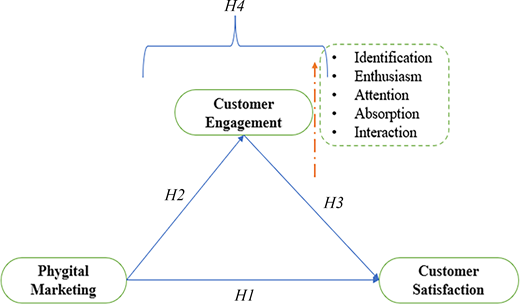
As shown in Figure 1, the relationship between Phygital Marketing, customer involvement and satisfaction was tested both directly and indirectly through various defined H1–H4, which also provide an implicit empirical assessment of SDL’s value co-creation process. The mediating function of engagement (H4) signifies the customer’s active involvement in shaping their travel experience, a process fundamental to co-creation. The robust indirect effect of phygital marketing on satisfaction through engagement empirically substantiates the SDL notion that value was co-created through interactions between customers and firms. While existing models have proposed engagement as a mediating variable (Verhoef et al., 2015), the empirical testing of the mechanism remains fragmented. This study contributes to the literature by empirically validating a mediation model linking phygital input to satisfaction via engagement, a mechanism that has been theorized but rarely operationalized. The study addresses two significant gaps identified by researchers. First, a contextual gap exists due to the limited empirical research on how phygital marketing strategies affect engagement and satisfaction in the Indian tourism sector, particularly among digital-native travelers. Second, the study bridges a theoretical integration gap by combining SDL and EMT into a unified framework and empirically testing their joint influence on customer outcomes, a convergence rarely explored in tourism studies.
3. Research methodology
To explore the identified contextual and theoretical gaps arising from a lack of empirical data and the under-theorized integration of Service-Dominant Logic (SDL) with Experiential Marketing Theory (EMT), a cross-sectional study was conducted using quantitative data collected from July 2023 to November 2023 via an adapted questionnaire. Survey questionnaires and personal visits are the primary data collection methods used in this study to gather data from 350 customers residing in the Delhi/NCR region. Delhi/NCR was home to approximately 32.9 million individuals (as of 2023). Delhi/NCR is a prominent destination for both Indian and International tourists, making it home to numerous multinational companies, travel agencies and other tech companies. Substantial evidence suggests that phygital marketing has significant potential for further research in this area. Hence, it becomes a central hub for data collection. The study used nonprobability sampling methods, including purposive and snowball sampling. To address potential sampling bias arising from snowball sampling, digital natives representing diverse socioeconomic and occupational backgrounds were purposefully selected from Delhi/NCR, based on their digital competence levels, desire to travel and willingness to explore new places. These respondents had the potential to become acquainted with the use of phygital marketing techniques in tourism, thereby aligning with the study’s objectives in terms of their relative relevance. Subsequently, the participants selected through the purposive sampling method recommended other active individuals in their social networks who travel regularly or use digital platforms for bookings. This method helped to reach target audiences that would otherwise be difficult to access, primarily people outside conventional travel networks. In addition, to ensure data saturation, 350 responses were collected, which exceeded the suggested sample size of 132, as determined using G*Power 3.1.9.7 (Faul et al., 2009).
Before data collection commenced, respondents were briefed on the study’s objectives and assured that their participation would be both voluntary and anonymous. Before questionnaire submission, electronic consent was secured and no personally identifiable information was retained. Questionnaires with completion rates below 80% or inconsistent responses were excluded, yielding 350 valid cases and an effective response rate of 87%. All procedures adhered to institutional ethical review guidelines for research involving human participants.
The study adapted questionnaires from Ballina et al. (2019) for phygital marketing, customer engagement from So et al. (2014) and Brodie et al. (2013) and customer satisfaction from Armutcu et al. (2023). All the constructs were first-order, except for customer engagement, which was a second-order reflective construct with six dimensions: Identification, Enthusiasm, Attention, Absorption, Interaction and Behavioral Intention of Loyalty.
Each construct was implemented in direct accordance with the theoretical foundation. Phygital Marketing embodies SDL’s value proposition layer by integrating hybrid services via AR/VR interfaces. Customer Engagement embodies the EMT aspect of experience immersion, characterized by excitement, attention, absorption and engagement. Customer Satisfaction is the SDL result of value-in-use derived from these encounters. This alignment ensures theoretical coherence between the measurement and the conceptual framework (Hair et al., 2019). The study tested these dimensions using a two-stage PLS-SEM methodology (Hair et al., 2019).
A pilot test involving 30 digital-native respondents was conducted before formal administration to assess clarity, item wording and contextual relevance. Input from three marketing experts led to slight modifications in wording and order. The pilot results demonstrated satisfactory reliability (all α > 0.70) and guided the development of the final instrument for extensive data collection (Hair et al., 2019).
To establish the reliability and validity of the adapted questionnaire, the process included a review of marketing experts, who gave suggestions for minor changes, followed by pilot testing (n = 30), which ensured content validity and contextual relevance. Conducting a confirmatory factor analysis helps identify and exclude items with factor loadings below 0.70. Of the 42 items, the study retained 37 items with loadings greater than 0.70 (Hair et al., 2019) as presented in Table 5.
The construct destination was maintained as the control variable due to its established impact on engagement and satisfaction outcomes, as evidenced by previous tourism research (Huwae et al., 2020). Initial assessments based on income level and travel purpose indicated no significant differences among groups, and their removal helped avoid over-parameterization of the model. The pandemic-related impacts remained consistent throughout the sampling period (July 2023–November 2023), making it unlikely they would confound the results.
The data-gathering process involved modifying a 42-question questionnaire, each item rated on a Likert scale from “Strongly Disagree” to “Strongly Agree.” Demographic information, such as age, gender and preferred destination, was collected from the digital natives. The mediation model presented in this study included reflective modeling with three components. PLS-SEM was used to validate the constructs under study.
4. Results and findings
4.1 Descriptive analysis
Table 2 represents the descriptive details of the digital natives. The data show that most respondents in this survey were male digital natives (60.0%), and 53% were in the 21- to 23-year age range. The largest segment (57%) of the data population was comprised of students, while the remaining 29% were employees, 9% were self-employed and 5% were unemployed. Travel frequency indicates that most travelers (34%) traveled more than twice a year, followed by 29% who traveled twice, 23% who traveled once and 14% who reported traveling rarely. The rubrics for travel categories suggest that leisure travel was the most common, favored by 40% of respondents, followed by business, adventure and cultural travel at 26%, 20% and 14%, respectively. The data reveal a wide range of digital proficiency among users: 43% are intermediate users, 34% are advanced users, 14% are beginners and 9% are experts. Undeniably, this demographic variable significantly enhances our understanding of the sample and its representation of the study’s significance in the context of phygital marketing strategies targeting digital natives.
The study used marker-variable analyses to determine the extent of systematic variation accounted for by this component and to assess the shared variance with a construct assumed to be unrelated to it. An unmanifested factor of linguistic proficiency, considered independent of the other factors in the model, was selected and analyzed for its associations with the different aspects, serving as an indicator variable in the PLS graph. No correlation exceeded 0.900, and the squared variable showed the highest correlation with the marker variable among the constructs. The highest observed shared variance was 0.045. The marker variable had a maximum shared variance of less than 1% (0.045), and none of the other correlations exceeded the threshold of 0.900, as indicated by the correlation matrix in Table 3. Consequently, the research does not exhibit any prevalent method bias.
Alongside the post hoc marker-variable assessment, various procedural remedies were implemented beforehand to reduce common-method bias. The questionnaire used mixed-scale anchors, randomized item order and physical separation of predictor and criterion blocks. Confidentiality was assured to respondents to mitigate evaluation apprehension. The procedural and statistical steps outlined here are consistent with the recommendations of Tehseen et al. (2017) for managing common-method variance in PLS-SEM.
4.2 Validation of second-order construct
Construct customer engagement was a second-order construct. The analyses used the PLS-SEM two-stage method to assess validity and reliability. At the first stage, the latent variable scores of the first-order dimensions (Identification, Enthusiasm, Attention, Absorption, Interaction and Behavioral Intention of Loyalty) were derived. The factor loading of all six dimensions exhibited substantial loadings on the higher-order component, above the minimal requirement of 0.70, with an average variance extracted (AVE) of 0.683, composite reliability (CR) of 0.91 and a Cronbach’s alpha of 0.89, except Ab1, Ab6, In2 and Bil3, which had reportedly low factor loadings and were removed from the second stage calculation but still establishing convergent validity. To further establish discriminant validity, the Fornell–Larcker and Heterotrait-Monotrait (HTMT) criteria were used to confirm that customer engagement is a second-order construct.
Table 4 presents the first-order loadings, Cronbach’s α, CR and AVE for the six engagement dimensions: Identification, Enthusiasm, Attention, Absorption, Interaction and Behavioral Intention of Loyalty, ensuring complete transparency. All reliability coefficients were above 0.70, and AVE values exceeded 0.50, indicating satisfactory convergent validity for each subdimension (Hair et al., 2019).
4.3 Model assessment
Internal consistency and convergent construct validity were used in this study to evaluate the framework’s external model assumptions. The study also conducted confirmatory factor analyses (CFAs) in PLS-SEM to investigate the reflective measurement models for phygital marketing, customer engagement and customer satisfaction.
The results indicated that Cronbach’s alpha, Dijkstra and Henseler’s (rhoA) and CR were below the suggested threshold of 0.71 (Hair et al., 2019).
Convergent validity was established with factor loadings exceeding 0.70, CR exceeding 0.70 and AVE exceeding 0.50 (Hair et al., 2019). The Fornell–Larcker criterion (Fornell and Larcker, 1981) was used to assess discriminant validity. Table 5 highlights the results of internal consistency and convergent validity.
Bootstrapping was conducted with 10,000 resamples using bias-corrected 95% confidence intervals, in accordance with the guidelines established by Hair et al. (2019). The HTMT analysis examined both lower and upper interval bounds and revealed that all values were below 0.85, with the confidence intervals failing to include 1.00. This confirms the presence of discriminant validity across first- and second-order constructs.
To establish discriminant validity among the constructs, Fornell and Larcker’s Criteria (FandL) (1981) were used, and the of all constructs on the slope were higher than the inter-item correlation values. A clear difference between the constructs, thereby making the proposed concept fit for further evaluation, as shown in Table 6.
HTMT ratio, another measure, was also calculated to establish discriminant validity. The suggested value of the HTMT ratio of correlations should be less than 1. In addition, correlation values of 0.87 (Voorhees et al., 2016) or 0.9 (Gold et al., 2001) were considered acceptable as valid HTMT ratios. The results indicate that all constructs fell within the suggested limits, demonstrating the uniqueness of each construct (Table 6).
4.4 Structural model assessments
The study tested the proposed conceptual model using a PLS-based Structural Equation Model and examined different hypothesized relationships. It used bootstrapping with 10,000 iterations to calculate p-values (Hair et al., 2019). The study also estimated the Variance Inflation Factor (VIF) to check for collinearity among independent variables, evaluate tolerance and test the structural inner model. The result showed no collinearity issues, as the VIF values were below 3.31 (Diamantopoulos et al., 2008).
Table 7 presents the full-collinearity VIF results for all latent constructs. The VIF scores ranged from 3.11 to 3.88. The moderate VIFs (about 3–4) suggest a mild degree of shared variance, characteristic of conceptually similar domains such as engagement and contentment, and indicate no multicollinearity among the exogenous variables (Hair et al., 2019; Kock, 2015).
The results reported an R2 value of 49.7% for the endogenous construct “customer satisfaction” and exceeded the suggested threshold of 0.20 (Rasoolimanesh et al., 2017), indicating that phygital marketing has a significant impact on consumer engagement. The analysis also included a goodness-of-fit criterion for Phygital marketing, the standardized root mean square residual (SRMR). The results indicate an SRMR of 0.058, which is below the 0.08 threshold, suggesting that the proposed model has strong explanatory power (Henseler et al., 2016).
As shown in Table 8, the results indicate a significant positive influence of phygital marketing strategies on customer satisfaction (β = 0.836, p = 0.002), suggesting that the integration of both physical and digital marketing techniques plays a role in enhancing customer experiences (Batat, 2022; Mele et al., 2023). The significant value of β demonstrates the positive impact of phygital marketing on customer satisfaction, thereby supporting the alternative H1.
The analyses indicate that phygital marketing enhances customer engagement to a reasonable extent with the younger generation of the digital age and in emerging economies (β = 0.434, p = 0.003), which means that Phygital angles, particularly while using AR/VR, offer customers delightful involvement early in the decision-making process of a purchase by making them feel and experience real events (Barhorst et al., 2021; Flavián et al., 2021). The moderate β value confirms the significant role played by these strategies in maximizing engagement, thereby substantiating H2.
A significant positive association exists between customer engagement and customer satisfaction among customers with high values (β = 0.618, p = 0.001). Customers who are emotionally attached to the brand seek interactive, unique experiences tailored to their satisfaction (Marcos and Coelho, 2022; Hollebeek et al., 2014). Customers who engage with the brand will participate more, provide feedback and write reviews, thereby deepening their connection to the brand and increasing satisfaction (So et al., 2014). The results obtained underscore the importance of engagement in satisfaction with the service, as expected, and hence support H3.
Findings indicate that customer engagement served as a vital mediator between phygital marketing strategies and customer satisfaction, with a significant coefficient (β = 0.204, p = 0.003). The mediation suggests that customers do not automatically achieve satisfaction from phygital; instead, they attain it through engagement enabled by these marketing strategies. VR previews of destinations or AR-guided tours initially serve to enthrall customers by offering them the opportunity to experience the offerings more engagingly, thereby increasing both emotional and cognitive engagement (Neuburger et al., 2018; Pardini et al., 2022). Such engagement was said to help create a sense of co-production among customers, who, more than service users, feel they are the service’s creators, making sense of the service through the SDL principles. Vargo and Lusch (2004) state that value does not reside in the goods produced but instead is co-created through the interaction between the provider and the customer, i.e. through service exchange. Concerning phygital marketing, such engagement is possible when a combination of digital (e.g. VR, AR) and physical factors, such as personalized services (e.g. destination experiences), is made available to customers, thereby increasing the value consumers derive from the service experience. A study by Gretzel (2021) supports the finding that the use of immersive technologies in tourism increases engagement, thereby enhancing customer satisfaction.
Silva (2024) and Abou-Shouk et al. (2024) noted that AR-directed tours increased client participation in providing helpful information and improved client satisfaction. Kumar et al. (2024) found evidence of a commensal effect resulting from the relationship between customer engagement and innovative marketing strategies. Customers voluntarily structure their expectations, but marketers and their companies creatively reconstruct their anticipated results. Customer engagement also played a mediating role in the advertising outcome. A desire for privacy and instant gratification primarily drives satisfaction among digital natives exploring phygital marketing. The result corresponds with the finding related to H4, which states that engagement processes contribute significantly to satisfaction and are more than just an intermediate procedure. It not only enhances the interactive role of engagement, as other studies have already established, but also assists in the application of SDL, which reconstructs client satisfaction through interactive and co-created experiences within the paradigm of phygital marketing, and the result highlights the importance of engagement as a means of achieving customer satisfaction and lends credence to H4.
The suggested model was evaluated for prognostic value and relevance using effect sizes (f2) and (Q2) (Ringle et al., 2020). The paper examines the impact of Phygital marketing (f2 = 0.38) and Customer involvement (f2 = 0.17) on Customer satisfaction. The effect of phygital marketing was moderate, while its impact on Customer involvement was relatively minor. The concept of Phygital marketing has become crucial in understanding and explaining Customer happiness. Finally, the study adapted Stone–Gewasser’s Q2 method to assess the predictive relevance of the proposed structural model. To have sufficient predictive capability and generalizability, the p-value must be greater than 0.02 (Richter et al., 2016). In the study, customer satisfaction was valued at 0.64 (Gewasser, 1975; Stone, 1975), demonstrating strong predictive validity. Phygital marketing showed a Stone-Gewaltigkeits-Quotient (Q2) of 0.69, indicating its significance for the proposed conceptual model and its potential for future research.
5. Discussion
The new generation of technology-savvy digital buyers expects high customization, and phygital marketing facilitates it by merging digital and physical interactions, making it invaluable (Batat, 2022; Mele et al., 2023). Such strategies consolidate the use of physical points, including brochures, brick-and-mortar stores, websites, various mobile apps, and social media (Hyun et al., 2022). These strategies propose content, such as virtual tours and AR experiences, that cater to individual preferences and facilitate a smooth flow in the customer’s journey (Pantano et al., 2017). Such amalgamation enhances customer satisfaction by improving communication and providing a more personalized touchpoint (Abou-Shouk et al., 2024). These experiences lead to emotional bonding with brands and destinations, hence emphasizing phygital marketing as a crucial factor in customer engagement (Pusceddu et al., 2023). AR/VR techniques are engaging, consequently attracting digital natives to use them to explore locations. (Barhorst et al., 2021; Flavián et al., 2021). Still, according to tourism experts, a dilemma exists over the use of AR/VR technology as a substitute for human guides. The extensive use of phygital can impact operational expenses, employment, and credibility (Beritelli et al., 2020). The immersive experience brings into focus a significant question: if virtual interactions are too authentic, might they diminish the uniqueness of actual travel (Neuburger et al., 2018)? In continuation, approx. Seventy percent of users felt more secure booking a VR experience, and approximately 35% were less likely to attend in person, raising an ethical issue about digital substitution (Neuhofer et al., 2015).
Stakeholders within the tourism industry must identify ways to integrate these technologies while promoting phygital experiences affordably, using easy-to-use interfaces and low-cost measures, such as collaborating with local firms or community libraries (Çiftçi and Çizel, 2024). Instagram and TikTok enable their users to share experiences worldwide and post photos, videos, and reviews of various places and activities, thereby building a travel community (Armutcu et al., 2023). Marketing user-generated content is a beneficial practice, whether through encouraging reviews or using tagged posts with rewards and discounts, as it enhances visibility and fosters trust (Harrigan et al., 2017; De Oliveira Santini et al., 2020). Tripadvisor, Inc (2024) there is a significant increase in reservations at destinations with more than 500 user-generated content postings tagged, highlighting the significant value of peer-shared content (Xiang et al., 2017). Nonetheless reconciling authenticity with brand voice remains a challenge for destination marketers. However, too much user-generated content without professional branding and marketing can lead to mixed messages (Chen and Li, 2018). As a result, to maintain a clear brand image, strategic curation of user-generated content was highly essential (Johnson and Barlow, 2021). Having such interactive digital experiences helps collect data on users’ habits and preferences for all stakeholders, allowing them to modify tours or recommend activities, such as sustainable tour packages tailored to environmentally conscious travelers (Sumaryadi et al., 2021). There has been a significant rise in consumer privacy concerns; therefore, tour operators must prioritize safety and privacy, particularly through stricter data protection procedures, when offering customized advertising or tailored packages (Karim et al., 2023). According to India’s Digital Personal Data Protection Act (2023), companies must adopt strict data protection measures before implementing individualized marketing strategies or face legal repercussions that diminish customer confidence and endanger brand loyalty. Neuhofer et al. (2014) state that immersing tourists in AR applications that help them navigate different destinations or locate accommodations using VR tools aids product development and encourages user ownership of the product. AR/VR and engagement offer rich sensory experiences and are crucial to the tourism industry. Hence, stakeholders should develop hybrid strategies that incorporate digital components, including social media, in an appealing, data-driven, yet ethical manner to enhance customers’ traditional experiences and protect customer integrity.
In addition, with the rapid technological advancements in the tourism domain, ensuring customer satisfaction and deep engagement has emerged as a key challenge (Marcos and Coelho, 2022). In addition, the study’s empirical results suggest that digital natives derive value and real-time experiences from the interactive process (Wang et al., 2019). Digital natives are transforming themselves from passive tourists into active codesigners, designing their own travel experiences through phygital marketing strategies (Pusceddu et al., 2023). In 2023, AR-based temple tours experienced a 15% increase in prebookings among tech-savvy millennials (MakeMyTrip Annual Report, 2023), indicating that phygital experiences enhance engagement. Moreover, both SDL and EMT support the results, with SDL reinforcing the notion that customer and provider can cocreate value through interaction. At the same time, EMT highlights that improved engagement stems from sensory and emotional experiences facilitated by phygital technology, which helps to understand satisfaction among digital natives (Harmeling et al., 2017). Thus, this research reinforces the foundational theories of Service-Dominant Logic and Experiential Marketing Theory in the Indian tourism context, explaining how digital natives derive value not only from outcomes but also from the interactive process and real-time experience.
6. Implications
6.1 Theoretical implications
The current study builds upon the existing literature on consumer behavior, customer satisfaction, and engagement, drawing on previously established theories applied in phygital marketing, particularly in the tourism sector among digital natives (Hollebeek et al., 2014). Testing the proposed empirical framework by integrating SDL and EMT was a novel theoretical contribution. Service industries have been using SDL for a longer time (Vargo and Lusch, 2004); however, in tourism, where tourists prefer personalized experiences and cocreate travel experiences through phygital touchpoints, its application was relatively new (Kumar et al., 2024). In addition, the inclusion of immersive tools such as VR/AR in tourism helps explain how hybrid strategies shape customer emotions and behaviors, extending EMT beyond conventional marketing when exploring digital-native behavior (Barhorst et al., 2021).
This study empirically examines customer engagement as a mediating factor between value co-creation (SDL) and sensory-affective immersion (EMT), thereby extending existing theoretical frameworks. Previous research, including Barhorst et al. (2021) and Hyun et al. (2022), has addressed these mechanisms conceptually but has not empirically validated them within a unified framework. This study empirically demonstrates the dynamic interplay of SDL and EMT within a unified structural model in the context of Indian tourism. This integration enhances theoretical understanding by converting dual-framework reasoning into quantifiable, verifiable relationships, demonstrating the translation of emotional immersion into co-created satisfaction.
Moreover, positioning customer engagement as a mediator supports EMT’s focus on sensory and emotional engagement by integrating AR/VR into tour experiences. However, co-creation and engagement may not be equal among diverse customer groups. Older travelers, those with less digital orientation, or those in remote locations may not be able to access or experience the same value from phygital innovation, thereby highlighting geographic and generational gaps in applying SDL and EMT (Chung, 2019). The SDL framework in Tourism extends the notion that value co-creation occurs throughout the entire customer journey, which includes checking peer-driven user-generated content as part of pretravel exploration, providing posttravel feedback, and is not limited to service transactions. Furthermore, the study’s results also suggest that the Technology Acceptance Model’s ease of use of phygital interfaces (intuitive mobile apps, AR previews) and perceived usefulness can significantly impact the satisfaction and engagement of digital natives through seamless, user-friendly digital experiences, aligning with TAM’s core dimensions (Davis, 1989; Pantano et al., 2017).
6.2 Practical implications
The results highlighted the need to develop and implement innovative tech-based strategies that can contribute to engagement and satisfaction among digital natives, making them particularly relevant to the tourism industry. Organizations in the tourism sector must invest in technology-aligned platforms that are user-friendly and interactive to attract and retain this digital generation. Where integrated booking tools and AR overlays can improve usability, real-time personalization leads to satisfaction and fosters loyalty. Previewing destinations and accommodations before booking using immersive technologies increases confidence and influences booking decisions. Furthermore, for co-creating value, integrating these tools with social platforms can encourage user-generated content, a cost-effective solution that aligns with SDL. Tourism providers must use data analytics in line with ethical standards to develop customized offers that are more relevant to customers. Privacy and safety are significant concerns; therefore, data-driven personalization must incorporate robust privacy safeguards to ensure trust and transparency. Without these assurances, companies cannot generate customer trust and long-term loyalty. Tourism managers can design hybrid experiences that blend tech with offline elements, such as nature-based excursions, which will prevent digital burnout among Gen Z and millennials. Hence, balancing digital exposure was crucial for long-term customer engagement (Neuburger et al., 2018). To manage evolving customer demands, phygital tools must be scalable, modular, and adaptive. When implemented, they can redefine customer journeys, ensuring user happiness and business resilience. By investing in personalized, ethical, and hybrid experiences, tourism organizations can meet customer expectations and gain a long-term competitive edge. The hybrid branding strategy aligns with young, tech-savvy digital natives (e.g., Smith et al., 2013; Jones et al., 2020) and demonstrates how engagement functions as both a process and an outcome in the tourism context. Table 9 discusses the study’s implications and conclusions.
7. Limitations and future scope
Despite several contributions, the study encounters limitations that must be acknowledged. The study focuses on digital natives from the Delhi/NCR region, and the selection of this area reflects its technological and sociocultural diversity; however, it may limit the generalizability of the results to diverse populations beyond India (Rasoolimanesh et al., 2017). Also, the sampling technique used to select respondents was nonprobability (purposive and snowball sampling), which limits the statistical generalizability of the results (Faul et al., 2009). The sample included respondents from various levels of digital exposure and diverse sociodemographic backgrounds, which is an appropriate approach for exploratory studies but requires careful consideration when drawing inferential conclusions. (Chen and Li, 2018). While 57% of respondents were students aged 18–23, this indicates the predominant group of digital-native visitors who actively use immersive technology (Statista, 2022). Future research should replicate this model across other age and career demographics to improve generalizability.
Future studies can use stratified or random sampling techniques to validate results more robustly and improve external validity (Hair et al., 2019). Moreover, some relationships have low beta values but are significant, highlighting the need for a larger, more diverse sample to minimize standard errors and maximize effect sizes (Ringle et al., 2020). The study’s key focus on phygital marketing variables and customer perceptions may have led to the exclusion of other influential constructs, such as perceived risk, trust and brand loyalty (Ahmad and Guzmán, 2021). This provides an opportunity to incorporate these variables into future studies, thereby developing a comprehensive understanding of the topic. Future studies can enhance the model in the context of technology-mediated tourism by incorporating constructs such as brand loyalty, trust, perceived usefulness and user advocacy to explain customer behavior better (Abou-Shouk et al., 2024). Future research can examine the effects of generational differences and cross-cultural variables using experimental designs or multigroup analyses to recommend customized phygital strategies for different customer segments and to understand how consumer engagement varies across millennials, Gen Z and Gen Alpha cohorts.